WP_Post Object
(
    [ID] => 3287
    [post_author] => 2
    [post_date] => 2021-10-14 14:28:27
    [post_date_gmt] => 2021-10-14 14:28:27
    [post_content] => Women shouldn’t need a 'good' reason to end a pregnancy.

Texas’s shockingly cruel new abortion law bars abortion once cardiac activity can be detected in the embryo, typically around the sixth week of pregnancy. Notably, it also allows any US citizen to sue any person who performs or otherwise “aids and abets” a prohibited abortion. The law has few defenders in the mainstream press. Jennifer Rubin, a conservative columnist for The Washington Post noted its “viciousness.” The New York Times’ Michelle Goldberg described its “sinister brilliance.” Rebecca Traister of New York Magazine decried its “ugliness.”

By deploying private citizens to subjugate the vulnerable, the law evokes the worst of the United States’ not-so-distant past. In the mid-nineteenth and early twentieth centuries, for example, doctors and police officers demanded that women dying of botched abortions name the provider. During the eighteenth and nineteenth centuries, mercenaries made their living by hunting down escaped slaves and returning them to bondage in exchange for a bounty. Some Americans have always been willing to work for or in lieu of law enforcement to catch, punish, and profit from those they or the state deem criminals based on deeply ingrained notions, rooted in systemic racism and sexism, of who is and isn’t a rational, capable human being.

Abortion was common in the United States throughout the nineteenth century. It was only in the latter half of the century, when medicine became a respected profession and the American Medical Association was established, that physicians lobbied to have abortion banned. Their concern was not about abortion’s morality, but about the financial and professional implications of being forced to compete with midwives and purveyors of home abortion remedies.

As ugly as the Texas law is on its own, many of its opponents are attempting to fight it by invoking the worst-case scenarios. A number of commentators have cited the case of a 13-year-old Texas girl who became pregnant after her grandfather raped her; the law grants no exceptions for pregnancies resulting from rape or incest. Few would argue that a 13-year-old rape victim should be forced to carry and give birth to her grandfather’s baby; that is why, even in Texas, the girl in question was able to end her pregnancy, albeit only after traveling hours from her small town to a clinic in Houston (this was a few months before the new law went into effect). People in extreme circumstances related to pregnancy—victims of rape and incest, women carrying fetuses with severe abnormalities, those who might die if they give birth—deserve support, compassion, and access to modern medicine, including abortion. But only a small minority of women seek abortion for those reasons.

The most common reasons women give for seeking abortions in the United States are the least shocking. According to data gathered from 2008 to 2010, 40 percent said they were “not financially prepared” to have a child. Thirty-six percent cited “bad timing,” “unplanned,” or “not ready.” Nearly a third (31 percent) cited reasons related to the person who caused the pregnancy—e.g., he was unsupportive, abusive, and/or didn’t want to be involved. Twenty-nine percent of abortion patients said they needed to focus on caring for the children they already had. Most gave not just one but several reasons for ending their pregnancy. By evoking only the extremes, activists risk creating a sense that some women are more or less “deserving” than others of abortion access.

Americans, including those who believe abortion should remain legal, are accustomed to weighing the relative moral acceptability of these reasons. They might sympathize with a terrified 15-year-old who gets pregnant the first time she has sex, but think a 36-year-old woman who didn’t use birth control and got pregnant from a one-night stand should have known better. Most rights are not absolute; they can be and often are restricted. But once a society recognizes that a right exists, it is not contingent on whether others approve of how it is exercised. That’s why proponents of free speech, particularly in the United States, often cite biographer Evelyn Hall’s summary of Voltaire’s philosophy: “I disapprove of what you say, but I will defend to the death your right to say it.”

Katie Watson, a lawyer and bioethicist who teaches at Northwestern University, sympathizes with advocates who focus on extraordinary cases. “Legally, you always pick the most sympathetic plaintiff for your case, and rhetorically, we often want to lead with our strongest examples,” she explained over the phone. “That’s narrative structure and that’s storytelling and that's litigation.” What concerns her is “the repetition damage…when those become the only stories that we tell, they skew our vision and our understanding of what life is really like. And starting with bad facts leads to bad policy.”

The result, said Watson, is that “the cases we discuss the most are the cases that happen the least.” She added: “When we focus exclusively on those—we unwittingly contribute to that dichotomy between good abortions and bad abortions—or deserved abortions and shameful abortions.”

Shifting attitudes toward divorce and the liberalization of divorce laws are a useful comparison. Divorce was once a very controversial issue in the United States. Until “no fault” divorce became the norm in the 1970s, the laws of most states required a woman petitioning for a legal end to her marriage to prove that her husband had committed adultery, abused her, or abandoned her. As of 2017 most Americans (73 percent), including a slim majority (51 percent) of the “very religious,” considered divorce morally acceptable. This, despite the fact that between 22 and 50 percent of people who obtain a divorce, regret having done so.  By comparison, 84 percent of women polled five years after having an abortion report feeling either positive or neutral about their decision. Few Americans, however, would advocate forcing people to stay married.

Despite the popular stereotype of those who get abortions as young, immature, and/or careless, most people who undergo terminations in the United States are not only adults, but parents. In 2014, 59 percent of abortions were obtained by women who already had at least one child. Only 12 percent were teenagers; those younger than 15 accounted for only 0.2 percent. The vast majority of people who undergo an abortion procedure are neither tricked nor pressured into ending their pregnancies. Only about 1 percent reported seeking a termination because somebody else, usually a parent or a partner, wanted them to. Most people who seek abortions know their own needs, desires, and limitations, and can imagine—or are already well aware of—the physical, psychological, and literal cost of bringing a child into being.

If a woman can choose to join the military, get married, or end a marriage—all potentially life-changing decisions—she can decide to end a pregnancy. As Watson argued in her 2018 book Scarlet A: The Ethics, Law and Politics of Ordinary Abortion, “We should be able to acknowledge the complexity of private decision making without threatening the right of private decision making.”

According to Watson, it’s no surprise, and no problem, for members of a large, diverse, and pluralistic society to have a range of views on abortion. That’s why, in defending abortion rights, she thinks it’s crucial to rely on the politics of respect rather than the politics of sympathy. “The politics of sympathy say, ‘You get to have that abortion because I feel sympathetic to you,’” she explained. “It puts the listener or the voter in the position of judge.” By contrast, “the politics of respect say, ‘I may or may not agree with her decision or like it, but she is a moral agent with a brain and a heart and she is the one who's going to live with the consequences of whatever decision she makes, whether to have a child or not…I respect her decision-making rights and her decision-making capacity and her decision-making authority, even if her moral frameworks are different than mine.’” The latter, Watson said, focuses on the pregnant person, whereas the former focuses on “the person offering the opinion or the vote.”

There are places in the world where abortion is not only safe, legal, and unremarkable, but also considered a basic human right. Five years ago, when my mother was on a group tour of Iceland, another American woman on the tour referred to then President Obama as a “baby killer.” My mother defended Obama and asked the Icelandic tour guide what she thought. “In this country,” the guide replied carefully, “Women are considered equal citizens, so abortion is not really an issue.”

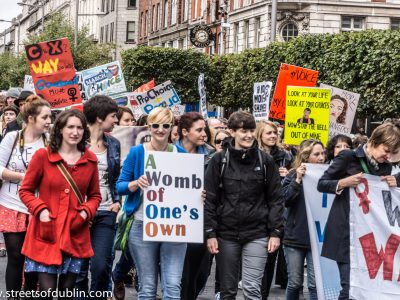
That attitude is not limited to Nordic countries. People in many industrialized nations around the world see abortion rights as inseparable from the human right to self-determination. In Ireland, which legalized abortion by a wide margin following a 2018 referendum, the government heralded the right to abortion as a welcome sign that the country had finally joined modern society. “The people have spoken,” declared then Prime Minister Leo Varadkar. “They have said we need a modern constitution for a modern country.”

Meanwhile, when the Polish government implemented draconian abortion restrictions last year, they sparked the country’s largest protests since the fall of communism. As one protester told Reuters, “I want us to have our basic rights…the right to decide what we want to do and if we want to bear children and in what circumstances to have children.”

Melissa Upreti, a human rights lawyer tasked by the United Nations Human Rights Council with fighting to end discrimination against women and girls, characterized Texas’s law as “sex and gender-based discrimination at its worst” and a clear violation of international law, adding that it has “not only taken Texas backward, but in the eyes of the international community, it has taken the entire country backward.”

Based on the means many abortion opponents have employed to limit access to the procedure—e.g., picketing clinics and shaming women as they enter, murdering and threatening abortion providers, and now passing a law that empowers ordinary citizens to be vigilantes and bounty hunters—it seems obvious that their concerns are not about the sanctity of “life” but about controlling and humiliating pregnant people.

Abortion opponents detest the slogan, “My body, my choice.” So do I—not because it invokes bodily autonomy, but because the “choice” framework is trivializing, and falsely implies that all choices are equal. The choice to bring a human being into existence is far graver and more permanently life-altering than the decision not to. Forcing a woman to endure pregnancy and labor against her will is an act of brutality with lifelong consequences for her and any children for whom she is responsible. In defending the Texas law, Ohio Republican Senate candidate J.D. Vance falsely asserted that it’s about “whether a child should be allowed to live” and “not whether a woman should be forced to bring a child to term.” But that’s precisely what it is. And that kind of torture cannot be justified by the victim’s capacity to bring into being a child who doesn’t yet exist.
    [post_title] => In defense of ordinary abortion
    [post_excerpt] => People in extreme circumstances related to pregnancy—victims of rape and incest, women carrying fetuses with severe abnormalities, those who might die if they give birth—deserve support, compassion, and access to modern medicine, including abortion. But only a small minority of women seek abortion for those reasons.
    [post_status] => publish
    [comment_status] => closed
    [ping_status] => open
    [post_password] =>
    [post_name] => in-defense-of-ordinary-abortion
    [to_ping] =>
    [pinged] =>
    [post_modified] => 2024-08-28 21:11:29
    [post_modified_gmt] => 2024-08-28 21:11:29
    [post_content_filtered] =>
    [post_parent] => 0
    [guid] => https://conversationalist.org/?p=3287
    [menu_order] => 170
    [post_type] => post
    [post_mime_type] =>
    [comment_count] => 0
    [filter] => raw
)




 Little Amal greeted by an Italian nonna, or grandmother, in Bari, Italy.[/caption]