Their stories, in their own words—and why you should be paying attention.
Rode Wanimbo’s aunties welcomed her back to her ancestral village in the usual way—with a song of lament. This, in her Lani tribe’s language, is known as leendawi, somewhere between singing and crying. And whenever she visits for a vacation, or when a family member passes away, her aunties greet her with it.
On this occasion as always, Rode followed her aunties into a traditional honai, a roundhouse built with natural materials, and sat to hear their stories, told through song. Her village has witnessed an unspeakable horror. In 1977, a year before Rode was born, the Indonesian military swept into West Papua in a hostile takeover, killing swathes of villagers. Rode’s family fled to the town of Wamena, her mother pregnant with Rode and already caring for an infant son. Others were forced to flee on foot, either seeking refuge in neighboring Papua New Guinea or becoming internally displaced people (IDPs) and clutching at survival in the forest. On her last trip home, Rode’s aunties sang tales of these atrocities. They spoke of how they were raped by the Indonesian army, of witnessing loved ones die, and how others crossed the border to live as refugees.
As Rode recounts this, her voice begins to tremble, as it does for much of the interview. The first time she heard the leendawi, she was 11 years old.
“That’s the way they express what they have been going through. I think that in our culture, that’s the only way they try to pass a message to me, through that leendawi,” she says. Women are not allowed to speak in front of men, Rode adds, making it hard for them to express their feelings. Yet across West Papua, thousands of Indigenous women are dealing with trauma after trauma after being displaced from their homes, with no outlet to speak on it.
“We thought about how to create a safe space for women, so women can talk,” Rode says.
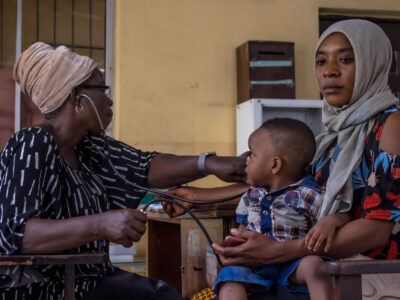
As part of her role as the coordinator of the women’s department for the Evangelical Church of Indonesia, she’s done just that. Alongside her team, Rode has created what she calls “storytelling circles,” where women can openly share their experiences and emotions with each other. Currently, Rode runs a handful of sessions a year, taking long journeys across tricky terrains to reach different communities.
At these sessions, around 20 women come together. They start with body mapping, where each woman lies on a large sheet of paper, as her body is outlined on the page by a partner. Using this silhouette as a guide, the pair asks each other which parts are sick or need attention. Sometimes the women, forced to walk for hours each day to collect food and water, share how it impacts their bodies. Other times, the women share what they’ve survived.
In another session, the participants use time periods as a way into their stories, the steady concept of dates and seasons opening a door to the traumas they’ve never spoken aloud. The women share their experiences, first with a partner and then the group, revealing how the military and police burned down their villages. They talk about their homes and gardens being destroyed, yet how they still long to go back. How they want to be in a place where they belong, the place of their ancestors.
Alongside these safe spaces, Rode—who has also sent joint submissions to the UN on the issue of IDPs in West Papua—is collecting an oral record of these women’s testimonies. She shared some of their stories with The Conversationalist, originally spoken in local languages and written down from memory. The stories here have been collected by Rode, and the names have been changed.
At this time, international journalists are not allowed into West Papua.
The women of Nduga
When Yohana and her family were forced from their home in Nduga, Yohana’s husband walked with her as far as the region’s border. He parted with sobering words.
“He said, ‘If you find a man who is able to make a garden and make sure you and our children have a meal every day at the shelter, I give you permission to marry him as if I was dead, for I will go back to join the National Liberation Army to protect our homeland,’” Yohana told the storytelling circle. She has been living in an IDP center in Wamena for around four years, and has survived by gardening on land borrowed from the local community.
Yohana was forced to flee her home after an incident that displaced hundreds of people in her community. It occurred in 2018, during a celebration of what many Indigenous Papuans consider their independence day: when their elders declared their freedom from Dutch Colonial rule on December 1, 1961, before Indonesia took over in 1969. According to Rode, as members of the West Papua National Liberation Army (a rebel civilian organization) celebrated this day in Nduga, some construction workers took a photograph. The liberation army believed the workers to be police informants, and violence broke out. Some of the workers—reportedly up to 31—were killed. According to those displaced, army and police raids followed in retaliation: They burned down houses, churches, and schools, and dropped explosives from helicopters.
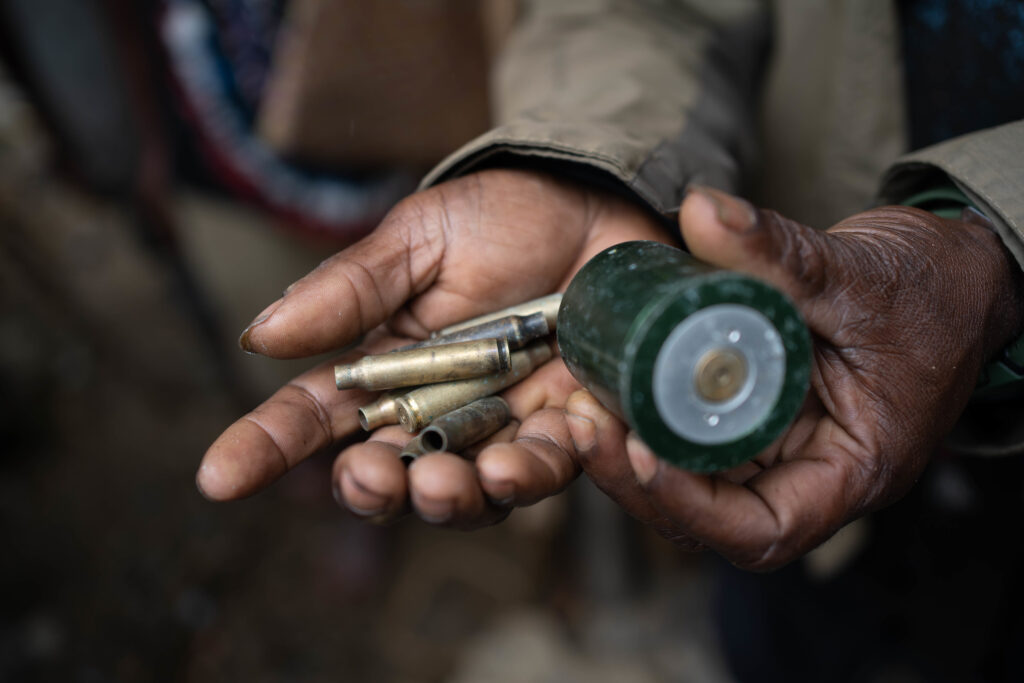
An eyewitness to an aerial attack in West Papua shares recovered ordnance. (Photographer anonymous by request.)
Life before the conflict, according to some of Rode’s friends, was peaceful and centered around community, family, and gardening. Now, this particular community in Wamena is host to around 200 women and children displaced from Nduga. There are eight other such communities in the region. Most of the men have either gone to the jungle to join armed rebel groups or have stayed behind to look after their villages, leaving them behind. There is no clean water nearby, no electricity, no hospital access, and no school. When babies are born, it is often in the IDP centers themselves.
“Some [women] spend sleepless nights because they don’t know the situation of their children,” Rode says, many of whom were separated from their mothers during the military attacks. There is no internet connection to trace them.
Displaced in Ilaga
At around 7 a.m. one morning, Irene and her husband were in front of a village office in Ilaga when she heard the fatal gunshot. She didn’t see who had fired it—only that it had come from the direction of the trees, and that it had killed her husband. She did not cry.
“My children are living with trauma as I did, but I pretend to be strong in front of them,” she told Rode. The violence has only continued: One night during her stay in Ilaga, Rode heard gunfire at the Indigenous settlement. She claims the source was the Indonesian security forces. She lay awake all night, thinking of her own two children.
The day-to-day life for these women is no easier. For many of the women in Ilaga, hours every day are spent walking to gardens and rivers, hours away, just to collect sweet potatoes and clean water. Along the way, soldiers stop them at regular army posts, where they have to report on the purpose of their travel. According to Rode, the reason for these checkpoints comes down to the army being suspicious of the IDPs—they believe they might be providing information and food to armed separatist groups. The women told Rode that they know it is dangerous to travel these distances, but that they have no choice. To stay still is to starve.
Beyond tensions around independence movements, there is another driver of conflict in the region. The island of New Guinea is home to the world’s third largest area of rainforest, and its natural resources are highly sought after. Indigenous communities, the guardians of this environment, have been further displaced from their homes as companies seek gold, minerals, or space for palm oil monocultures. Freeport’s Grasberg Mine—one of the world’s largest gold mines—has been the most famous example. But there have also been plans to build a mine in the gold-filled mountains of the Wabu Block, which have been met with huge concern from groups like Amnesty International.
In Ilaga, one mother told Rode, with anger in her eyes, “If the Indonesians want to have our gold from our mountains, they could just take it. Why did they treat us like animals? They came into our homes without permission and uprooted us from our ancestral land.”
For Indigenous communities, Rode explains, this removal feels especially painful, because of their spiritual and cultural connection with the mountains, rivers, and land. To remove the people is to destroy their identity.
“We view mountains as our mother who nurtured the plants, which become food for the animals, and we get the milk from the animals,” she says. “When our mountains are being exploited, it’s like a rape to our mother. We have to protect our mother.”
A view of the Papuan highlands near Kiwi. (Photographer anonymous by request.)
The root of West Papua’s problems
West Papua’s problems go back to 1898, when it was colonized by The Netherlands, along with the other islands that now form Indonesia. When the country became independent in 1949, however, it was without West Papua, which stayed in the control of the Dutch. Instead, West Papua prepared for its own independence throughout the 1950s, and by 1961, that moment had arrived: A congress of people declared independence and raised their new Morning Star flag for the first time in what is now called Jayapura. The Indonesian government, however, was not happy with this arrangement, and soon invaded. In a bid to end the conflict between Indonesia, the Netherlands, and Indigenous Papuans, the US government encouraged the Dutch to hand control of West Papua to Indonesia. The New York Agreement gave control of West Papua to first the United Nations, and then, by 1963, to Indonesia, which became the temporary administrator of the country, with the stipulation that West Papuans would have the right to self determination.
But a promised independence referendum in 1969, as part of the transition after the end of Dutch rule, was not a democratic event. Instead, 1,000 people were given a vote by the Indonesian army, and told to make a very specific choice under threat of being shot. Yet this vote was still approved by the UN—cementing West Papua’s place under Indonesian rule.
“The Papuans were just outside the room, while the rest of the world decided their future,” says Naomi Sosa, founder of Papua Partners, an organization that supports training and global links in the country. “The root goes down to the political contestation. They were supposed to have a vote for self determination, but it was controlled by Indonesia.”
Eventually, in 2000, West Papua was given special autonomy, with their own government looking after their affairs, but without independence. In reality, Naomi says this special autonomy wasn’t implemented properly, with all the powers being taken back to Jakarta. Today, there is a movement demanding self determination, where West Papuans could determine their own future through a referendum. But in stark contrast to this desire, the Indonesian government is focusing on the decentralization of provinces. Under Indonesian president Joko Widodo, known as Jokowi, things have become more difficult for West Papuans, with UN experts saying that since violence escalated in 2018, there are now 100,000 displaced people and humanitarian aid is being blocked. Naomi says Indigenous communities, particularly those in the highlands, are under severe threat. Any form of protest is met with brutal force. Now, the government wants to make further divisions, which Naomi says makes it harder for the 250 tribes to unite and weakens the independence movement.
More districts also means more military posts—which makes many IDPs uneasy. Rode says when displaced women in particular are encouraged to go back home, they feel they have no guarantees of their safety because of the increased military presence.
“Please tell them to leave our homeland so we can go back home,” they tell her.
Still, Rode has not given up hope, and neither have the thousands of people displaced throughout the country, whether they are part of independence movements or staying strong to keep their families alive in IDP camps. As the final call with her ends, Rode makes a plea: West Papuans need solidarity from the international community. They are experiencing settler colonialism, and it cannot be separated from global politics. Papuans do not want to be forgotten.
“We are powerless,” Rode says. “We really need help.”
[post_title] => The Forgotten Women of West Papua
[post_excerpt] => Their stories, in their own words—and why you should be paying attention.
[post_status] => publish
[comment_status] => closed
[ping_status] => closed
[post_password] =>
[post_name] => west-papua-indigenous-women-idps-crisis-indonesia
[to_ping] =>
[pinged] =>
[post_modified] => 2026-08-04 19:29:01
[post_modified_gmt] => 2026-08-04 19:29:01
[post_content_filtered] =>
[post_parent] => 0
[guid] => https://conversationalist.org/?p=5695
[menu_order] => 89
[post_type] => post
[post_mime_type] =>
[comment_count] => 0
[filter] => raw
)
How my culture's food brought me closer to myself.
“That’s the whitest pronunciation I’ve ever heard before.” My friend, Kian, stood to my left, joking or maybe humiliated, while a smiling Persian kid spooned a scoop of faloodeh and a scoop of pink rose ice cream into a cup, passing it to me over the register at Saffron & Rose.
“Fuh-LOO-duh,” Kian mimicked.
“You know I don’t speak Farsi,” I laughed, joking but actually humiliated. The kid handed a cup of Saffron Pistachio, described as a “love potion of Middle Eastern flavor,” to Kian. As we walked out, it occurred to me that while everyone in the shop had been Iranian, myself included, I had still been the other. I couldn’t even pronounce what was allegedly the first frozen dessert in the history of mankind, a delicious ancestral treat of paper-thin rice noodles and chilled rosewater sorbet. But I could learn, right? It was in my blood.
“Ok… so, how do you pronounce it?” I asked.
“FAH-loo-deh.”
FAH-loo-deh. Got it. I practiced a few times — and fucked up a few times — as I inhaled my pink rose ice cream and FAH-loo-deh. Being cultureless is so embarrassing sometimes. I promised myself the next time I ordered it, I’d be able to pronounce it, too.
~
I’m convinced I’m on this earth to eat. While adulthood has insurmountably jaded me, food is the one thing I still have child-like adulation for. I spend nearly a third of my waking life debating what to cook next, the ingredients I’ll experiment with, and which new restaurant I’ll make a sweaty, 40-minute, gridlocked-Los-Angeles-traffic drive for. I’m a proud member of probably 30 recipe subreddits. On TikTok, I’ve strategically lassoed my algorithm into serving me solely food-related content where I watch people cook with pride and eat with joy, just like I do. All Day Long I Dream About Food.
But as a half-Iranian raised by two white parents, I grew up more on hot dogs, steamed veggies, and the occasional Pennsylvania Dutch indulgence—like apple dumplings, or pork chops with sauerkraut—than anything with even a remote nod toward my Middle Eastern heritage. For a long time, I honestly didn’t even know what Middle Eastern food was.
Growing up, I never wanted to disappoint the people who raised me with excitement for something they weren’t or couldn’t understand. But naturally, I never felt my parents understood me, either. I was an insecure, unibrowed, deeply tan, and raccoon-eyed kid supremely confused about her identity. I’d stare at maps and wonder what it meant to be from “I-Ran,” as my folks and other Pennsylvanians pronounced it. Was I Asian? I wasn’t fully white. Was I Arab? Kids at school told me I was. Was any of this the reason why my hair was so thick and my eyebrows so nauseatingly connected? I liked to think I looked like Princess Jasmine with a plait down my back, but her legs weren’t nearly as hairy as mine were at eight years old. I couldn’t ask my parents questions, either, so if someone said “what are you?” and then looked at me funny when I replied “Iranian,” I’d quickly correct myself and say that actually, I was German. It was technically true, on my mom’s side. And the Pennsylvania Dutch are, after all, also German. So for me to be singularly German was easier for everybody.
While it took me much less time to admit I was also definitively Iranian, it took me nearly 30 years to explore Persian food. In a way, I was scared of what I’d find, or how much I’d enjoy it. I’d always wondered what I’d been fed during the months I’d spent in Iran as a baby. If I tried those foods again, would some small part of my soul recognize the flavor; the texture; the feeling it invoked? Would it trigger something inexplicable in me, good or bad? Would it just make sense? Would I finally become Persian?
When I first sought it out, I found Iranians are happy to share their culture of food with you, and through it, their love. They’ll also readily accept you as their brother or sister even when you know nothing about it. If you’re Persian—even half, like me—you’re unequivocally part of the tribe, fused by some ancestral chemistry and recognition I can’t quite explain. It’s like we’re all aware of the possibility we’ve known each other in previous lives and in previous, ancient lands. There within lies some familial bond.
“I don’t really know much about Iranian food,” I told my friend Nilu, who was visiting from London, over a lunch of raw onions, Persian naan, beef koobideh, and chicken kabob at Glendale’s Shamshiri Grill. It was still early in my cultural food odyssey, and we were celebrating Nowruz, the Persian New Year, which marks the beginning of spring equinox and the start of Farvardin, the first month of the ancient Solar Hijri calendar. Despite knowing nothing about it at the time, I’d already been kindly greeted with “Norooz pirooz!” and “Nowruz Mobarak!” (both roughly translate to “Happy New Year”) by several Persian friends that morning, simply for existing and being Iranian. I did not feel like I deserved it.
“Doesn’t matter. You’re Persian, and it’s Persian New Year. That’s why we’re here!” Nilu said, having admonished me just moments ago for not knowing Iranians eat plain, raw white onions the way some people might bite into an orange. “NOW TRY MY CHICKEN!” She’d ordered chicken marinated in saffron and yogurt over saffron rice with green veggies. I eyed it suspiciously.
I knew to “become Persian” I’d have to get over my immense dislike for chicken. My mom, god bless her, fed me and my family boneless, lightly seasoned, baked chicken breasts with steamed veggies several nights a week, though in my memory, it felt like every night. Pair that with a nightmare I had in college where I bit down on a chicken nugget filled with human teeth, and you’ll find chicken and I don’t have the best relationship.
I begrudgingly forked the chicken up with some rice and bit into it like a child taking a bite of asparagus. Hm, I thought, chicken’s not half bad when it’s seasoned properly. Maybe the onions would grow on me, too.
~
The next step in my journey was cooking a fully Iranian meal. Even though I cooked all the time, this was uncharted territory; and while I could do it myself, I knew who to call to help. My friend Jasmine (Yasi) had lived in Tehran until she was seven, and, unbeknownst to her, had given me the kindest gift a few years prior: She’d taken me to my first ever Iranian restaurant, Café Glacé, a Persian pizza spot in Westwood. There, I’d eaten a popular Iranian street food for the first time: pizza with thick bread, minced meat, loads of cheese, and no tomato sauce. Delicious. Chef’s kiss. Five stars. The stomach ache I had afterward was worth it.
Yasi had also recently given me a handful of Persian fruit leather and candies from Tehran that I think may have caused my entire awakening. So when it came time to actually try cooking something, I asked her if she wanted to make her favorite childhood meal with me, her mom’s Iranian macaroni, or spaghetti tahdig, an upside-down cake of thick noodles with tomato sauce and ground beef, seasoned with traditional Persian spices like turmeric, cumin, and cinnamon. I knew Yasi had the recipe because her mom had recorded a video of herself making it for her at the beginning of the pandemic.
“Duh,” she replied.
We dumped a can of Carbone pasta sauce into a Dutch oven already simmering with diced onions and minced garlic. After adding spices, we broke up a pound of ground beef into the sauce and let it simmer for 45 minutes, boiling bucatini in a pot for the last 15. We then filled the empty Carbone jar with boiling pasta water and dumped it into our sauce. I felt like a kid watching Yasi prepare our dinner. She was Mother at that moment, telling me how to break up the ground beef or stir the bucatini, and how much seasoning to add into the sauce. More turmeric, less cinnamon. Okay, even more turmeric.
I stirred both the sauce and the noodles individually, and watched the water evaporate along with many of my cultural anxieties. I am Iranian. It wasn’t my choice to grow up without any of the culture, and it’s fine that I was just now learning about it. I was done feeling embarrassed at my lack of knowledge. It’s not like the Persians in my life hadn’t been patient, kind, and generous with theirs.
After seasoning the sauce generously with cinnamon one more time and draining the pasta, it was time to form it into a traditional tahdig, which literally translates to “bottom of the pot” in Farsi. The point is to create a hard shell of pasta on the bottom that becomes a crispy crown once you turn it over and onto a plate. Yasi drizzled some olive oil on the bottom of the saucepan and started layering the bucatini as I heaped spoonfuls of our sauce over it. Once the pasta crisped up, we awkwardly placed a plate over the saucepan and used all four of our hands to topple it over. We ate it on her back porch with olives. She snapped a photo for her parents and I snapped one for myself.
~
My appreciation for this food is now indelible. Saffron has become a pantry staple and rosewater pistachio ice cream can always be found in my freezer. I intend to try a new Persian meal each month until the words, flavor combinations, and textures become second nature — this month, it was Albaloo polo: rice and sour cherries. Maybe by next year I’ll have developed an affinity for raw onions. Or maybe just a tolerance.
I live in Los Angeles, cheekily dubbed Tehrangeles, as it actually has the largest Iranian population outside of Iran. I’m in no better place to “become” Persian, because I’m in no better place to eat my way there. The beauty of food being at the center of culture is that food is a language everybody understands and, thus, can bring everybody together. When you’re breaking bread, you don’t have to speak. You all know what you’re tasting. And — outside of the idiom — I don’t need to “become” Persian. I am as Persian as my Safavid era ancestors who cut pomegranates from their trees and scooped sweet-and-sour stews up with their hands. But you can only be so close to a culture without knowing its food. Food is the dock in a harbor that guides your boat in and grounds it back to the earth. It’s a holy connector. It unifies and reunifies and is one of the only things everyone needs and enjoys. It’s home.
Now that I’ve learned them, Iranian flavors feel almost inherent to my palate. Some, in fact, taste so familiar I wonder if, as a tot, I’d ever been given a spoonful of ghormeh sabzi, Iran’s national dish of meat and kidney bean stew loaded with herbs and dried limes, or a spoonful of rosewater ice cream, which has been one of my favorites since I tried it for the first time as a teenager. Maybe I’d even had a taste of FUH-loo-deh as a baby. I know someday my children will. And I know I’ll be able to pronounce it then, too.
[post_title] => Becoming Persian
[post_excerpt] => How my culture's food brought me closer to myself.
[post_status] => publish
[comment_status] => closed
[ping_status] => closed
[post_password] =>
[post_name] => persian-iranian-food-culture-identity
[to_ping] =>
[pinged] =>
[post_modified] => 2026-08-04 19:29:54
[post_modified_gmt] => 2026-08-04 19:29:54
[post_content_filtered] =>
[post_parent] => 0
[guid] => https://conversationalist.org/?p=5693
[menu_order] => 90
[post_type] => post
[post_mime_type] =>
[comment_count] => 0
[filter] => raw
)
Last year, all eyes were on the Kurdish exile turned Swedish MP. Now that she's left parliament, here's what she plans to do with the attention.
Amineh Kakabaveh is stumbling over her words as she lists the things representatives of the regime in Iran and their families can still do, despite local authorities’ brutal crackdown on the nationwide protests for democracy that started in September. “They can still put their money in foreign banks, their children can still study abroad, they can still travel,” she says. Sure, she is glad that Iran was thrown out of the UN Committee for Women’s Rights last December. But, Kakabaveh says, it’s far from enough—and it won’t be, as long as they remain a connected member of the international community.
What adds a painful layer to her anger is the fact that she hasn’t seen her own family in Iran in years, and can’t even freely talk on the phone with them out of fear of retaliation by the regime. “Can you imagine I haven’t seen my father for 23 years?,” she says. “My mom told me on the phone she feels for the mothers. That’s all she can say without getting in trouble.”
Kakabaveh, 48, is a Kurdish-Swedish woman who was only 13 years old when she ran away from suppression and threats by Iran’s then still fairly new Islamic regime to join the armed Kurdish opposition group, the Komala Party. After six years in the mountains of Kurdistan in both Iran and Iraq, she crossed the border into Turkey at 19. From there, she was re-settled to Sweden, where she started getting a formal education for the first time in her life. She made it to university, studying both sociology and philosophy, before entering the Swedish parliament for the Green Party at the age of 35.
Through it all, her resistance against the regime has never faded. But while she has always been rather well-known in Sweden for her political work, the outside world only got to know her last year, when she was suddenly in the eye of a geopolitical storm. Sweden had applied for NATO membership to protect itself against Russian threat after the invasion of Ukraine, but met objections from NATO member Turkey, which wouldn’t give permission for Sweden’s acceptance if it kept supporting Kurdish “terrorists.” They even have one in their parliament, Turkey’s president Recep Tayyip Erdoğan fulminated, referring to Kakabaveh.
She had irritated him, to say the least. After years as an MP for the Green Party, she had become an independent MP in 2019, and as such had power to make or break any government plans: Her one vote defined whether it would get a majority or not. She used that power to force the Swedish government to express its support for the Kurds in Syria, who have been building an autonomous region in the country’s northeast since 2012. There have even been pictures of Swedish officials with what Turkey considers “terrorists” as a result of her work, not to mention the Swedish government’s decision to stop selling arms to Turkey because of the country’s invasion into Syria in 2019. (The embargo has since been lifted.) In retaliation, Erdoğan pledged that Sweden would never become a NATO member until it stopped this support.
The power play between states continues. And while the attention has shifted away from Kakabaveh, who is no longer a member of parliament since the elections in September last year, her attention hasn’t shifted away from politics. Today, she travels throughout Europe, speaking in parliaments from Belgium and Spain to Greece and France, drawing attention to the plight of the Iranian people in general, and that of the Kurds specifically.
Kakabaveh grew up in Seqiz, a town in Kurdistan in northwest Iran—the same town Jina Mahsa Amini was from, the girl who was murdered by Iran’s “morality police” for not properly wearing her hijab when she visited the country’s capital city of Tehran last September, sparking protests around the world. Kakabaveh’s family was so poor that having any kind of childhood was impossible for her. In her memoir, “No bigger than a Kalashnikov”: A Peshmerga in Parliament, she shared how she started working at age six to contribute to the family income. She spun wool, she wove and embroidered, and she did seasonal work in fields and orchards, for which she was paid in fruit and beans. Then, on the radio, a very young Kakabaveh heard about the armed communist opposition group, Komala—and decided that one day, she would join. “An uncle of mine had joined them when I was very small,” she says. “I dreamed about that. I knew that Komala had female peshmerga, too,” referring to the Kurdish fighters whose name literally means “those who face death.”
While Kurdish groups initially supported the revolution in 1979, the new government hadn’t lived up to its promises to them: Kurds didn’t get more rights, or even autonomy. A Kurdish uprising was brutally put down. Amineh was 7 years old when it happened. Soon, the regime started targeting her family after several of its members joined the resistance. Repression increased. “In some media I have been described as a child soldier,” Kakabaveh says, “because I joined the peshmerga when I was 13. But that term doesn’t do justice to reality and to our traumas. The regime abused me, they wanted to lock me up and rape me, they tortured and humiliated my father. They suppress Kurdish culture and rob us of our dignity.” Kakabaveh adds that, while formally, members must be 18 to join Komala, she felt the group “tried to create a place that was as safe as possible for their young members.”
Initially, Komala was based inside Iranian borders, but when that became too dangerous, it retreated to Kurdistan in Iraq. The group is still based there. Although the current demonstrations in Iran are not organized by Komala or other Iranian-Kurdish groups, they are still targeted by the mullahs: Since the protests started in September, their camps and villages have been shelled several times, leading to dozens of deaths, including civilians.
Kakabaveh’s life as a 13-year old peshmerga in the mountains of Kurdistan seems to be light years away from her life as an academically educated former MP in Sweden. But she says her experiences as a young girl in Iran and later as a Komala guerrilla fighter define what she fights for now as a politician and activist. “My mother was forced to marry my father, and that was the same for all the girls,” she says. “All Kurds are suppressed by the regime, but women are also suppressed by the patriarchy. Especially when the Swedish minority government needed my support to govern, I have been able to do a lot to put the Kurdish struggle and the women’s resistance on the international agenda.”
She isn’t sad, she says, that she no longer has a place in the country’s most important meeting hall. In her many years of parliamentary work, she built an enormous international network, which she uses now to draw attention to the situation in Iran from across the world.
In direct contact with her family, though, she still must be extremely careful. “I have talked to my mother only twice since the protests started, very shortly via the phone of one of her neighbors,” she says. “That she said that she is sorry for the mothers tells me a lot. The regime takes children away, takes them to prison, rapes them, tortures them, and sentences them to death.”
What angers her is that the international community doesn’t act decisively enough against the regime in Tehran. That is her most important message now: If she could stand up to it at 13, if people everywhere in Iran continue to pour into the streets in protest despite the suppression, the torture, and the death penalty—why aren’t they getting more support? Canada and Australia have issued sanctions, but that’s about it, she says. “Freeze their money, stop giving visas to them and their families, make them pariahs.”
The protests have been going on for almost six months now. Initially, international media reported on them extensively, but that has been fading away. Are the demonstrations fading away, too? “Not at all,” Kakabaveh says in a fierce voice. She mentions Kurdistan as one of the centers of the demonstrations in the northwest, but another region, Baluchistan, in the southeast, too. “Every Friday after prayers thousands of people protest in Zahedan, the biggest city in Baluchistan,” she says. “Also in Kurdistan the protests are ongoing. Kurdistan and Balochistan are the light and the eyes of Iran. But the militarization is intensifying. There are more Pasdaran [Revolutionary Guards] outside schools than students.”
Describing these two communities, the Kurds and the Baluchs, as “the light and the eyes” of Iran explains the depth of the current wave of demonstrations. According to reports by human rights organizations like Amnesty International and Human Rights Watch, it’s the minority groups who suffer the most, and in multiple ways. Both Kurds and Baluchs are not only ethnic minorities, but also predominantly Sunni Muslim, while the regime is Shia. All Iranians suffer under the dictatorship, but communities who don’t fit the default identity of Persian Shia Muslim suffer more. It was not a coincidence that the protests started with the death of a Kurdish girl, whose funeral marked the first big outpouring of grief and anger over the regime’s brutality. That’s why it’s important to name her as Jina Mahsa Amini: Jina is her Kurdish name, which only her family used, because Kurdish names are not officially accepted. It is written on her gravestone.
This dynamic was one of the topics addressed during a recent panel in the Flemish parliament, in which Kakabaveh spoke alongside two other Iranian women in exile. Kakabaveh stressed that ethnic and religious minorities would still be suppressed if the current regime was to be replaced by a secular but still nationalist one. After all, the current regime is not the first to suppress Kurds, a group that resisted the previous regime, as well. “You know, I am 48 years old and in my lifetime I have never seen democracy in Iran,” she said. “So what can we expect? For example, one of the things the women are protesting against, is the forced wearing of the hijab, but do they know the fundamental freedoms underlying this demand? That remains to be seen.”
But in her speech, Kakabaveh drew hope from her past experiences as well. She reflected on her discussions with her male comrades when she was still a peshmerga in the mountains, and how they treated her differently without realizing it. “They accepted women as peshmerga fighters, but their mentality was still male-focused and the leading positions were taken by men,” she said. “I criticized them for it. They said they supported women’s rights but had to learn. And they have learned a lot since.”
Now that what she calls a “revolution” has broken out in Iran, Kakabaveh says she is actually glad that she is no longer an MP. As an activist with a network, with a story to tell and a vision to share, she has all the freedom to travel and speak however she pleases, reaching both loyal and new audiences. In the coming months, she’ll be returning to Greece, as well as France and Germany. And while to the outside world, it may seem as if the protests don’t really have leadership, Kakabaveh believes otherwise. “The people themselves, the women who are fighting for their rights so bravely, are the leaders of this revolution,” she says. She is just hoping to help serve them.
[post_title] => What Will Amineh Kakabaveh Do Next?
[post_excerpt] => Last year, all eyes were on the Kurdish exile turned Swedish MP. Now that she's left parliament, here's what she plans to do with the attention.
[post_status] => publish
[comment_status] => closed
[ping_status] => closed
[post_password] =>
[post_name] => amineh-kakabaveh-profile-kurdistan-iran-sweden-government
[to_ping] =>
[pinged] =>
[post_modified] => 2026-08-04 19:30:57
[post_modified_gmt] => 2026-08-04 19:30:57
[post_content_filtered] =>
[post_parent] => 0
[guid] => https://conversationalist.org/?p=5633
[menu_order] => 91
[post_type] => post
[post_mime_type] =>
[comment_count] => 0
[filter] => raw
)
In praise of a Valentine who never ghosts, and what our crushes tell us about ourselves.
I have a type and always have.
It’s a broad one, but it’s terribly specific: my knees go weak for a charismatic creep. Romeos come and go, but I’ll crawl on broken glass through hell for a Mercutio. Leading men leave me cold. It’s not merely the wrong guy, it’s the one whose entire personality is built upon being the wrong guy. He’s often the life of the party, mostly a pain in the ass, and always, always, always the kind of trouble that takes my goddamn breath away. Which is why, if St. Valentine has set aside a day each year for us to pander to our sweethearts and confess our affections, I’ll do my turn: I have a crush on Death.
Can you see it? A strong cleft chin beneath gallows’ black-brown eyes, liquid eyes all the better to drown you as you lunge at the receding spark therein. His style is arresting, heart-stopping, even: the tailored hood, the cape, the leather! Gloves that send shivers down your spine. Gloves that make your throat seize. Oh, and Google tells me Ekerot’s birthday was February 8, which means Death is also an Aquarius. To be sure, he’s no Matthew McConaughey. But guess what? I’m no Kate Hudson, either.
Of course, I blame my parents. Warm-hearted snobs and Criterion Collection aficionados, Nancy and Lou made a fatal lapse in judgment when they forbade Beverly Hills 90210 in our home, but allowed me to watch Sex, Lies, & Videotape and Goodfellas when they were released. I was in the second grade. Instead of nursing a normal crush on Luke Perry or Jason Priestley, I fell hard for James Spader and Ray Liotta. I’ve been a lost cause ever since. By the time I watched The Seventh Seal in middle school, I knew I had arrived at the bad boy reductio ad absurdum: Death.
Valentine’s Day offers a rich opportunity to think about how we are conditioned to crush and to whom these feelings are assigned. What do our crushes tell us about ourselves and what we yearn for? Whom do we chase and what qualities do we crave? How do we see ourselves as incomplete? What kind of attachment style do our romantic fantasies portend? As we suffer so much discourse around the making and breaking of patterns, it is important to dissect the evolution of what we want.
While I readily accept that I first fell for Death as an insufferable pre-teen aching to have a movie crush just a bit edgier than Leonardo DiCaprio in Titanic, as I have matured, I can now see my crush on Death is actually quite healthy. I recommend it. First of all, as an American, I hail from a notoriously death-avoidant culture. Secondly, as a woman, I have been raised around ideas of Hollywood romance and romantic expectations that are arguably more dangerous than Hollywood violence. My crush shields me from these pitfalls—and he excels in the ever after.
How does he do it? What’s his trick? Well, I hope it doesn’t take Esther Perel to explain: He shows up. Let us return to the rom com’s most fertile stomping ground, the beach—here, of course, emptied by Bubonic Plague. The beach, as a liminal space, is an ideal metaphorical home for romance. Beneath the horizon, we have the waxing and waning of tides upon the shore, the ephemeral shapes in the sand. Death, the master of liminality himself, strides on in. And yes, he does play games—don’t they all?—but it’s a game, and it’s chess, which is, like, so sophisticated (and honestly fucking annoying but I’ll drop it because no one is perfect).
Still, Death is not like the others, and I’ll tell you why: He’s reliable. There are countless ways to get a hold of him. And, when all the other men have let you down—all the other ones whose faults you have compromised yourself by entertaining—he will be there, waiting for you. There are few things more humiliating in life than being attracted to straight men, but waiting for Death will never make you play the fool. Death will never ghost you. And, though typically associated with the long game, he’s full of surprises: He might pop in anytime at all. He’s always got the time for you, his girl, or his guy, or, really, his anyone. (New love is such a jealous thing, but not with my crush! Death, be not toxic.)
Death is the crush who crushes all the competition. He makes your heart skip far more than a beat. What’s more, Death doesn’t care about diet culture and he isn’t on Instagram or any of the apps. He will take you as you are. He will swipe right with that scythe—in real life. After all, when we are bullied into believing our single shot at happiness hinges (pun intended) on how we’ve lit, sequenced, and captioned half a dozen selfies, what’s wrong with lusting after the eternal? What’s wrong with wanting something real? And what’s realer than Death?
Our digital dating culture is predicated almost entirely on shallow snap judgments. The Seventh Seal, on the other hand, is about the silence of God in the moments before The Last Judgment. The movie opens with the following quote from the Book of Revelations: “And when the Lamb had opened the seventh seal, there was silence in heaven about the space of half an hour," referring to what is surely the greatest 30-minute cliffhanger in all of history—film, human, cosmic, spiritual. Ingmar Bergman portrays God as silent before human suffering, deaf to the torments of faith. The question then, regardless of belief or perhaps even in spite of it, is how do we fill that silence? The film is absolute in its suggestion: not fear, not awe, but love. Love is the only way to lend meaning to the void. And spoiler alert: The cute acrobat family are the ones who make it out alive. They elude Death because they believe in and trust one another.
This, to me, is a tall order.
Besides, some of us are not trying to escape Death. Some of us are actively combing all the beaches, certain that meet-cute moment is out there somewhere. Knowing, without a doubt, it will happen someday. Someday, I can be certain, my Dark Prince will come, with a strong jawline and a black cape and all the time in the world for me.
…Now, who says romance is dead?
[post_title] => I Have a Crush on Death
[post_excerpt] => In praise of a Valentine who never ghosts, and what our crushes tell us about ourselves.
[post_status] => publish
[comment_status] => closed
[ping_status] => closed
[post_password] =>
[post_name] => crush-death-seventh-seal-bengt-ekerot-valentines-day
[to_ping] =>
[pinged] =>
[post_modified] => 2024-08-28 21:15:11
[post_modified_gmt] => 2024-08-28 21:15:11
[post_content_filtered] =>
[post_parent] => 0
[guid] => https://conversationalist.org/?p=5593
[menu_order] => 92
[post_type] => post
[post_mime_type] =>
[comment_count] => 0
[filter] => raw
)
Over 20 years after the first "Princess Diaries," the writer is still sticking up for romance.
In the opening scene of 1999's cinematic classic 10 Things I Hate About You, guidance counselor Ms. Perky (Allison Janney) sits pert in her cardigan and pearls, tip-tapping away at her computer. "I'll be right with you," she tells a student, turning back to her PowerPC…on which she is crafting a magnum opus of a romance novel. In the film, Ms. Perky’s novel is played for laughs—a running joke, with key words like “pulsating” and “bratwurst” used to portray the luridity of her side hustle. But around that same time, in real life, an administrator at a New York University dormitory was living out a similar scene: tucked away in her office, tapping away at romance novels in between wrangling angsty students. Only this time, she was the main character.
Her name was Meg Cabot.
"It was exactly like that," Cabot told The Conversationalist shortly before Thanksgiving. Over Zoom from her longtime home in Key West, Florida, she talked a mile a minute, the charming, real-life embodiment of the chatty early-aughts heroine she's most known for: The Princess Diaries’ Mia Thermopolis. "All the kids in the dorm knew that was exactly what I was doing. I'd be on my computer when they would come in and they'd be like, 'I don't want to interrupt you, but there's a fire.'"
Cabot would put out the fires, of course. It was from that desk, though, in her tiny corner of NYU, that she'd write her first "ten or eleven" novels. At the age of 31, she’d begin publishing steamy, “pulsating” adult historical romance, before breaking into the public consciousness in 2000 with the back-to-back publication of her first young adult novels, The Princess Diaries and The Mediator: Shadowland. The rest is history. Following Disney’s smash hit movie adaptation of The Princess Diaries, Cabot's name fast became synonymous with the fun, romantic "chick lit" of the time. You an Anne Hathaway fan? You also have Meg Cabot to thank for her breakthrough role.
More than twenty years (and over 80 published novels) later, and with another Princess Diaries bookandmovie on the way, Cabot remains a powerhouse. That's not just because she's more prolific than Stephen King, who's published a comparatively paltry 65 novels in more than twice the amount of time. And it’s not just because The Princess Diariesstill makes headlines. It’s because she created something that made waves for an entire generation. For those who came of age during the early 2000s, Cabot helped redefine what books for girls and women could look like: She wrote them funny, messy—and so horny they're still getting soft-banned all over the country.
To get there, though, Cabot had to push past the judgment that's long hovered like a cloud over women's literature. At Indiana University in the 1980s, while working towards her degree in studio art, Cabot started taking creative writing classes, where professors and peers alike passed judgment on the topics she was interested in writing about. "People really looked down on romance," Cabot said. "I was writing commercial genre fiction and [my classmates] were writing literary fiction. Theirs had a lot of suicide and mine had lots of going to the mall and meeting boys." Now, she jokes that those who once mocked her choice of genre were just jealous: The kind of books she'd been working on forever turned out to be lucrative. But at the time, their response was frustrating.
The reaction, though, was nothing new. For as long as there's been literature marketed towards women, there've been people looking down on it. Because of this, Cabot kept her work to herself for years. Her first published novel, a steamy adult romance called Where Roses Grow Wild, came out in 1998 under a pen name: Patricia Cabot. She’d go on to write seven more under the same name. "I was worried about the smut factor and my grandma finding out," she remembers. From the start, Cabot proved expert in writing women and girls who were not just strong, but varied and complex; which was precisely what drew her to the genre in the first place. "Romance novels have really strong female characters, and that was hard to find [for a long time],” she said. But her entry into life as a romance author proved revelatory. Unlike those college classmates, romance readers and writers welcomed her with open arms. "It was really fun, such a supportive community," Cabot said. "That was where I belonged."
Her grandmother did eventually find out about her secret second career, too, but the smut didn't bother her. "She loved it," Cabot recalled.
For a long while, Cabot kept her day job at NYU. It was stable, and offered health insurance. She made great friends, many of whom she's still tight with to this day. Then, right as the century turned, The Princess Diaries changed everything: When Disney came knocking, Cabot knew it was her chance to jump full-time into life as an author. She took it.
"There still weren't a whole lot of funny books for girls," Cabot said about the late '90s, when she first started writing for teens. She name-checked exceptions, like Judy Blume, and Cabot's contemporary Louise Rennison, whose hilarious Angus, Thongs, and Full-Frontal Snogging came out in '99. But at the time, she says that most of the genre “was very message-y”: "There really wasn't this idea that YA could just be for entertainment and be fun." Cabot saw an opportunity to help shift that. Her characters weren't without morality: Cabot's books contained messages, in that they had characters with a point of view. At the same time, though, those characters got to be awkward, swoony, and feminist as fuck, too. Her characters felt real.
Cabot's adult work is well worth exploring—sharp, comedic, with a deep love of banter—but it’s her first works in YA where she really found her stride. It's also where she's had the most impact, acting as millions of millennial readers' introduction to romantic comedy, many of them through Mia Thermopolis. In The Princess Diaries series, Mia is a teen outcast who finds out she's heir to the throne of a small country called Genovia. The character went mainstream in 2001, when the Disney adaptation introduced the world to Anne Hathaway’s portrayal of her as a dorky and sweet girl just trying to survive high school. But while the movie version of the character is rightfully beloved, it's worth remembering how Cabot originally crafted her. In the books, Mia is a sunny bleeding heart, who only agrees to undergo "princess lessons" after the monarchal side of her family agrees to donate $36,500 a year to Greenpeace. The Mia of the books is progressive, a kid with a massive political streak, whose big desire—aside from kissing Michael Moscovitz—is how badly she wants to help push the world into a better place.
But while Mia had staunch political values, The Princess Diaries was never about them. Mia was just a girl flailing her way into adulthood. Just like her readers, she was deeply insecure. She was also chaotic, and yearny, and horny as hell—a wonderful throughline for many of Cabot's most memorable characters. There’s ballsy psychic Jessica Mastriani, who works with hot, motorcycle-riding bad boy Rob to track down missing children in 1-800-WHERE-R-U. In Cabot’s popular The Mediator series, we’re introduced to tough, leather-clad Suze Simon as she solves murders while flirting with the 19th Century ghost haunting her bedroom. There's also Katie Ellison in Pants On Fire, so-titled because its heroine 1) can't stop lying, and 2) can't stop cheating on her boyfriend to make out with new boys.
Cabot’s most sexually liberated YA novel, though, is Ready Or Not, the sequel to All-American Girl, in which a teen girl named Sam Madison saves the president from an attempted assassination. She falls for the president's son, and in the sequel, they decide to have sex. The book follows Sam on her path to readiness—including securing contraceptives and learning to masturbate with the bathtub faucet.
"Still to this day, All-American Girl and Ready Or Not are my most-banned books, because they deal with sex very frankly," Cabot said. "It's surprising to me, because my mom was a Planned Parenthood volunteer. In my house it was very open." Sexuality, after all, is part of every coming of age in one way or another. And who in this world is juggling those thoughts more than a teenager?
Of course, the now-56-year-old wasn't the first in YA to portray horny teen girls. "If you read Judy Blume, you know that's been going on for years and years," she said. But Judy Blume’s books also weren’t adapted into blockbuster movies by Disney, and part of the backlash for Cabot may have come from how ubiquitous she was for romance-loving teens of the early 2000s. The Princess Diaries adaptation became an instant classic, funneling an eager audience towards her books.
"People started buying the books expecting them to be G-rated like the movie," Cabot recalls. They were not—and some parents didn't love that the book version of The Princess Diaries' first scene involved kissing.
Still, for plenty of young girls, Cabot's work was (and continues to be) vital and illuminating. Her novels are chatty and personable, her characters flawed, and her stories casually sex-positive. Even when her young characters weren't actually having sex, the acknowledgement of desire affirmed something bigger, something deep inside. A feeling that her readers, like her characters, were still exploring. And if those readers were so inclined, Cabot's adult novels were right there, full of the "smut" she once feared would disappoint her grandmother—but also so much more.
Romance is often written off as empty-headed porn for women, a stereotype Cabot wholeheartedly rejects: What the form's critics ignore is everything that surrounds the lust. Romance is about yearning, sure. About sex. Cabot's books, though, are also about dynamic friendships. About history—she's written plenty of historical fiction—and mystery. About the way women and girls are seen by their society, and the effects that has on them. Ultimately, all of Cabot's novels are also about the inner lives of interesting young women navigating challenging times in their lives.
This is something Cabot knows intimately. Though her family home growing up was frank about sex, in other aspects, her childhood was "very dark." Her father was an alcoholic, and to escape, she buried herself in books. "There were many times I felt there was no hope," Cabot recalled. "Romance was always where I could turn to. Those books, where there was an empowered woman who got what she wanted in the end, guaranteed."
"That's what pulled me out of despair," she continued. "Knowing I can put that out there for someone else is the greatest thing." To Cabot, writing is the skill she has that she can share with people. “I'm not going to be a brain surgeon,” she joked.
But even if her books were just a horny escape, wouldn't that be OK, too? "It's just misogyny," Cabot exclaimed when asked about naysayers of her genre. "People look down on anything that women like, and anything involving women."
For her younger readers, Cabot's work was an education—not just in sex, but in how rewarding it can be for readers when an author is skilled at seamlessly blending genre. Wrapped in a shiny "chick lit" package—books more recently known as "beach reads" because, well, the former had been so dragged through the sexist mud that it needed a rebrand—Cabot’s work is multi-faceted and wide-ranging. She’s written epistolary novels, murder mysteries, sci-fi, fantasy, middle-grade, YA, adult, historical fiction, and more. Fittingly, she has no patience for those who try to one-dimensionalize her corner of women's fiction. She often hears from readers afraid to be seen reading "chick lit" in the office because coworkers make fun of them. "I tell them to tell their coworkers to go fuck themselves," Cabot said. "Those people have clearly never read it."
These days, Cabot and fellow children's and young adult author Rachel Vail challenge each other to write five pages a day. The stakes of failure keep them going: If they don't hit their page count, they're forced to donate $5 to Donald Trump. "It's very motivating," Cabot said. Like her most famous character, Cabot is disturbed by the current state of the world. She’s even contemplating leaving Key West, where she's resided with her husband and cats for almost twenty years. She loves her town, and often blogs about her life there, but has been turned off by Florida’s ongoing political turmoil.
It’s there, too, that Cabot's born witness to a new wave of challenges levied against authors and readers alike: angry right-wing parents for whom the problems don't stop at french kissing. “It's a very small percentage of the population, but they're very loud,” she said. It's a nation-wide issue: The New York Times reported in January that parents hell-bent on banning books have become "more organized, well-funded" and "effective" in recent years. The Guardian characterized the efforts as "moral militancy."
"They don't want any reference to sex, race, gender fluidity…," Cabot said of recent attempts to pull books from the library system. "It might challenge the very Christian, neofascist way they want to raise their children.”
Pushback to the kind of books that have defined her career hasn't stopped Cabot in the slightest, though. Most recently, Cabot has published the Little Bridge Island series, an adult series set in her community of Key West, and next up is a new, COVID-set Princess Diaries book, as well as a lot more children's and middle-grade fiction. (Proceeds for The Quarantine Princess Diaries will go to VOW For Girls, a charity aimed at ending child marriage.)
And thank goodness for Meg Cabot. Her naysayers—whether politically lecherous or simply snobby—have no real way to stop the flow of stories from Cabot's brain to readers' hands. Cabot doesn’t take her role lightly. A cornerstone of young adult fiction, she’s no stranger to the pressures of shaping young minds. It's impossible to calculate, in 2023, just how many authors coming up today have been influenced by her work. It’s even more impossible to calculate how many women and girls have become voracious writers and readers as a result of her work. And twenty-five years on from her debut novel, both Cabot and her books remain chatty and cheerful, effervescent and gutsy—an escape from a hellish world, just as she intended. Given all that's happened in the interim, that's certainly a crowning achievement.
[post_title] => Thank Goodness for Meg Cabot
[post_excerpt] => Over 20 years after the first "Princess Diaries," the writer is still sticking up for romance.
[post_status] => publish
[comment_status] => closed
[ping_status] => closed
[post_password] =>
[post_name] => profile-meg-cabot-princess-diaries-romance-ya-books-interview
[to_ping] =>
[pinged] =>
[post_modified] => 2024-08-28 21:15:11
[post_modified_gmt] => 2024-08-28 21:15:11
[post_content_filtered] =>
[post_parent] => 0
[guid] => https://conversationalist.org/?p=5603
[menu_order] => 93
[post_type] => post
[post_mime_type] =>
[comment_count] => 0
[filter] => raw
)
On January 4, in Enoch, Utah, 42-year-old Michael Haight shot and killed his wife, five children, and mother-in-law, before turning the gun on himself, a form of murder-suicide known as "family annihilation." Tausha Haight, his wife of twenty years, had filed for divorce a couple weeks prior. Abusers always lose it when you leave.
It's since been reported, first by the Associated Press, that Haight was investigated in 2020 for potential child abuse after someone outside the family reported it to the police. Utah's child protective services got involved. At the time, Haight’s eldest daughter Macie said the abuse had begun years earlier, in 2017. She described a time her father grabbed her by the shoulders and threw her into furniture, along with another incident in which he had strangled her. She said she’d been afraid that he would kill her. Michael blamed the then-14-year-old for his violence, saying she was "mouthy." During the same police investigation, Macie also said that her father regularly belittled her mother, and Michael admitted to surveilling his wife’s communications. No charges were filed.
Nearly three years later, Michael’s obituary in the local paper would read that he "made it a point to spend quality time with each and every one of his children," and that they were a "cherished miracle." One commenter spoke of his “Christlike love and service.” Neither the obituary nor the commenters mentioned the murders, and it was only taken down after Shannon Watts, gun reform advocate and founder of Moms Demand, tweeted it out.
Haight’s story isn’t so uncommon. In the United States alone, a man has annihilated his family every 3.5 weeks for the last two decades, a likely miniscule portion of the estimated family annihilations worldwide. Men who strangle their partners are ten times more likely to become men who kill them. And having a gun in the home increases the risk of murder in a domestic violence incident by 500%.
So why do we continue to treat what happened to the Haight family like an isolated tragedy—a “personal” matter—as opposed to exactly what it was: a domestic tyrant who felt entitled, by virtue of being a man, to enforce his will, crush dissent, and destroy his family as soon as they tried to flee?
When a head of state insists on their natural or divine right to monitor your private communications, stalk your movements, imprison you at home, and beat or kill you for wearing certain clothes, meeting friends, or maintaining a separate bank account, we rightly call them authoritarian. We are loud in our disapproval: When Iranian women took to the streets in protest over the arrest and murder of Mahsa Amini by morality police for not properly wearing hijab, the support abroad was strong, the brutality obvious. But when it's the head of a household terrorizing you, the euphemisms (and excuses) surface: family difficulties over a private matter, better dealt with behind closed doors; it’s best not to get involved, it’s none of our business. All support evaporates, because father still knows best — and if father wants to blow everything up just because he can, who's going to stop him?
Studies on familicide say in almost every case, the man claims his family as property, with the right to end their lives. Murder, after all, is the ultimate form of control. But the impulse to control or destroy isn't limited to physical violence: The easiest way to break people is to break what's precious to them. Look at Elon Musk, who had to lose 200 billion dollars before people finally stopped calling him a genius. Within months of his taking over Twitter, 80% of the company’s workforce had quit or been fired, especially anyone found criticizing him. In a recent New York Magazine piece about Musk's takeover, they describe how Twitter employees flocked to the company Slack during these mass layoffs, all anxiously waiting for the ax: "One person posted a meme of Thanos from Avengers: Infinity War, the supervillain who exterminates half the living beings in the universe with a snap.”
Advertisers fled Musk’s "extremely hardcore" site as he rolled out a disastrous verification process, threatened people who linked out to other social networks, reinstated Nazis, and ranted about eugenics, all while overseeing a radical uptick in harassment and slurs. With no clear plan to make Twitter profitable, and engineers rolling their eyes at his technical expertise, it's no wonder Twitter and Tesla's value has since plummeted. Not that he's taken any accountability for the losses or the lives he's upended. He's been too busy impregnating his employee, lashing out at mouthy critics, and, most recently, firing a Twitter engineer for informing him the reason his engagement was down wasn’t due to a bug—but because people weren’t as interested in him as they used to be.
Whether they're the head of a family, company, or state, everyone suffers so long as masculinity is wrapped up in an ability to dominate. Impunity and entitlement breed ignorance and nihilism. Patriarchy is ancient, authoritarian, incompatible with equality and democracy, and bad for everyone involved. And it’s as relevant to how Musk acquired and destroyed Twitter as it is to the protests in Iran as it is to what happened to the Haight family.
Human rights also don't disappear at your doorstep. According to the UN, 47,000 women and girls were killed by their partners or other family in 2020. On average, that means one murder every 11 minutes. But freeing women and children from violence won't happen so long as it's still taboo to speak about it. We’d rightfully consider it outrageous if someone called reports of mass rapes and murders in Ukraine by Russian soldiers "airing dirty laundry.” Yet we don’t extend the same support to women abused and murdered by partners or relatives, which happens in every community, and is far more likely than “stranger danger.” (And on the rare occasion victims do get attention, they’re usually blonde, white, and already dead.)
Meanwhile, it's the same self-destructive, patriarchal entitlement that motivates domestic violence that motivates atrocities like the Russian invasion of Ukraine – if I can't have you, nobody can – with the same results. Putin first became aggressive in 2014 after Ukraine turned down a trade agreement with Russia in favor of one with the European Union. (Again, it's most dangerous when you try to leave.) Absent consequences, including for past wars in Syria, Georgia, and Chechnya, Putin has continuously escalated the bloodshed, and will do anything short of giving up power to punish Ukrainians for daring to be free, including letting Russia crumble. In that sense, he's just like Michael Haight: Insult the sovereign, or threaten his control, and watch him burn the building down with everyone trapped inside. Whatever it takes to teach them a lesson.
Our bodies don't differentiate between state-sponsored or home-bound torture. What does your killer's institutional affiliation matter when you're dead? The lines are blurred in any case, considering the number of men who abuse in private who also abuse the public. It's not a coincidence that police abuse their families at high rates, or that two-thirds of mass shootings are either an incident of domestic violence or are perpetrated by someone with a record of it. Yet time and time again, on both a personal and policy level, we treat domestic violence as a completely separate matter – anything to avoid the reality that some homes are conflict zones, too.
Even the preeminent global treaty on women’s rights, the Convention on the Elimination of Discrimination Against Women (CEDAW), does not contain the word "violence" once. In 1980, when CEDAW was passed, gender-based violence was considered outside its scope, a private matter that this public treaty wouldn't touch with a ten-foot pole. Men's rights, especially in war, were already covered as human rights, a courtesy not extended to everyone else. It wasn't until 1992 that the CEDAW Committee issued General Recommendation 19, which interpreted the treaty to include gender violence. (Full disclosure, I'm on the board of an organization, Every Woman, calling for a new global treaty to close this atrocious gap in international law.) Like the Refugee Treaty, which advocates fought tooth and nail to have courts interpret to include gender persecution as a "particular social group," half the world's population suffering the most pervasive human rights violation was considered niche.
When feminism states that the personal is political, it speaks to the ways the private sphere continues to oppress women. There can be no equality in public so long as violence at home is ignored. To be part of the public, you first need to make it outside. Patriarchy cuts across every divide, but its effects are worsened by poverty, racism, and other forms of oppression. When 72-year-old Huu Can Tran shot and killed 11 people at the Star Ballroom Dance Studio in Monterey Park, California during a Lunar New Year celebration, people speculated whether this was yet another anti-Asian hate crime, a misogynist escalation, or possibly both. No motive has been found so far, or connection to any of the victims, but the shooting sparked a discussion online about domestic violence in the Asian American community. The Asian Pacific Institute on Gender Based Violence released a statement of mourning, and a plea to make the connection between femicide and mass shootings. They estimate that between 21-55% of API women in the US have experienced intimate physical or sexual violence.
In the United States, women of color are disproportionately affected by gender violence. The CDC reports that Black women are three times more likely than white women to be killed in a domestic dispute. More than half of Indigenous women in the US have experienced sexual or intimate partner violence. On a global scale, 1 in 3 women have experienced sexual assault or domestic violence.
Authoritarians know that subordinating women helps them stay in power, and systematically encourage and enact patriarchal violence to keep people in line. They claim that masculinity is under threat, and loosen laws that protect women and gender nonconforming people. Reactionary autocrats worldwide are attacking women's rights as a means of entrenching their control and weakening political participation in democratic mass movements. In Russia, Putin rolled back criminal consequences for domestic violence. President Recep Tayyip Erdoğan withdrew Turkey from the Istanbul Convention, the European treaty on domestic violence. Poland keeps threatening to do the same, while Hungary never signed it in the first place. (In a move to distance itself from its neighbors, Ukraine finally ratified the Istanbul Convention last year.) Before he was voted out and supporters staged a failed coup on his behalf, Jair Bolsonaro cut 90% of funding for domestic violence prevention in Brazil. The Taliban once again won’t even let women go to school.
So long as authoritarian violence is acceptable, even encouraged, on the micro level within families, it will be impossible to defeat on a macro level. There is no democracy, no value for human rights, without the participation and inclusion of women and children. And that participation depends on feeling safe at home first. All life, and livelihoods, are devalued when we devalue vulnerable people. And for what? An ancient status quo built on brute strength. Marriage and the nuclear family still provide the basic unit for our tax code. We're incentivized by the government to create a private jurisdiction where men overarchingly rule. The patriarchs are not okay, and it's doubtful they ever have been. Their benevolent dictatorship kills, and it’s time to let the toxic institution go.
[post_title] => Why Do So Many Men Destroy What They Can't Control?
[post_excerpt] => And why do so many people support them?
[post_status] => publish
[comment_status] => closed
[ping_status] => closed
[post_password] =>
[post_name] => domestic-abuse-family-annihilation-gender-violence-why-men-destroy
[to_ping] =>
[pinged] =>
[post_modified] => 2026-08-04 19:33:38
[post_modified_gmt] => 2026-08-04 19:33:38
[post_content_filtered] =>
[post_parent] => 0
[guid] => https://conversationalist.org/?p=5576
[menu_order] => 94
[post_type] => post
[post_mime_type] =>
[comment_count] => 0
[filter] => raw
)
Nothing bristles against whorephobia and class shame like a bunch of fierce strippers unionizing a strip club and then becoming a union collective.
"You live through that little piece of time that is yours, but that piece of time is not only your own life, it is the summing-up of all the other lives that are simultaneous with yours. It is, in other words, History, and what you are is an expression of History."
—Robert Penn Warren
I stripped in nude clubs before I could legally drink. It was the early nineties, in San Francisco, and my friends were unkempt, chain-smoking queer punks who wore beat-to-shit ripped slips that looked like they were stolen from some grandma’s dumpster. I wasn’t chic grunge like Courtney Love, who stripped on Hollywood Boulevard at Jumbo’s Clown room back then. I was broke. I was undone. I worked at a used clothing store on Haight Street for minimum wage, which, in 1992, was $4.25 an hour. I spent my lunch break selling T-shirts I found in trash piles on put-out night, hoping to make enough for a burrito next door. If I lucked out, I scored a burrito and bus fare. When I couldn’t afford bus fare, I walked straight to the Century, a grubby nude club where drugs were plentiful and twenty-dollar bills were rare.
Some of the strippers at the Century gave grand performances, with boas and whips and choreographed moves like in Fame. I merely darted to the dressing room before my stage set to put on something I could take off. The dressing room was down many narrow steps and through a low door, a smoker’s basement with a dirt floor that we called “the Crypt.” Luscious, Micky, Destiny, and I ashed our cigarettes on loose planks of wood. I was addicted to meth, but heroin was big then. My coworkers slid in the dark theater from lap to lap, or nodded off, or went to law school.
The Century was where I fell for stripping. Stripping is a hard, taxing job. It entails waiting, hustling, and negotiating personal physical boundaries in a place where strangers assume access to your body. As an art form, stripping is joyful, magical, and adrenaline-inducing. But it was also emotionally and politically confusing. Stripping contained that tension for me and has held me in its grip for twenty-nine years.
On the one hand, stripping was a public-facing revolt against demure femininity and heterosexual norms. Monetizing straight desire and performing as patriarchy’s plaything was fun and lucrative; lap dancing was fast money earned in the dark. At the time, feminist performance artists like Karen Finley, Laurie Anderson, Diamanda Galás, and Lydia Lunch challenged second-wave feminist ideals by performing desire and rage as a poetic disruption. They used their bodies as a site of protest against sexual shame, misogyny, and homophobia.
Stripping felt powerful back then, but not every second was an empowering feminist orgy. The job was not something I advertised to my friends or family. Deeply puritanical ideas about sex and class informed our cultural lives and affected dancers’ feminist visions of ourselves as deviants, artists, or societal failures. Among my peers, my life as a queer stripper was considered sleazy, even if it was rebellious. Dykes I dated were skeptical or downright disapproving of the sex industry, and they let me know it. Deep down, they believed the patriarchal party line that sex work was intrinsically wrong, even if they refused to admit it. One of my girlfriends threatened to break up with me if I continued full-contact lap dancing; she preferred my tenure in the live peep show behind glass at the Lusty Lady. She followed through with that promise eventually—but not before I joined a group of startlingly intelligent live nude girls who began unionizing the Lusty Lady in 1996 and eventually became the Exotic Dancers’ Alliance.
Stripping is a working-class grind.
Over the next decade, my customers became regulars, which turned me into a professional stripper who had the audacity to keep a schedule. I stripped on holidays, on weekends, and during sports events. I squirreled away cash in envelopes under my bed. My lust for financial security and love for travel led to many road trips on the search for gold mines; I stripped in Las Vegas, Hawaii, and New Orleans with only the tips and tricks of other stripper friends to guide me. This was five years before Facebook and nine years before the creation of the iPhone, which granted every sex worker the ability to screen a client in the palm of their hand.
I learned everything I know about where and how to strip by talking to seasoned strippers I befriended on the job. Strippers know where to find the money clubs and which shifts are the best ones there. They know how the fees and fines work and which managers to avoid. They know which clients to talk to and who is a time waster. I highly recommend talking to veterans in person, at work, about what they’ve learned. They are a part of my history, just as I am a part of yours.
Not only did we not text back then, but we also communicated without apps, websites, email, or the terminology strippers now use to accurately discuss the complexity of client relationships that progress outside the strip club. The fact was that I simply trusted certain clients to take me shopping or out to dinner. I indulged some of my clients in their fantasy that I was their girlfriend, their human vacation. And I charged as much as I could while maintaining a straight face.
When I moved to Los Angeles in 2004, I searched the vast whorescape that is the San Fernando Valley and Hollywood for a strip club to call my home—to no avail. Clubs in Los Angeles County were miserable, empty places with no use for a chubby, tattooed thirty-four-year-old with a women’s studies degree from Mills College. I did strip briefly at Cheetahs, Pleasures, Knockouts, and Nicholas, but the hustle baffled me; Los Angeles clients were cheap, unreliable, and awful. Unlike in San Francisco or New Orleans, where strippers are culturally relevant VIPs, Los Angeles treats non-famous strippers like the least favorite gum grabbed on the way out of the gas station. Perhaps this is due to the cultural prevalence of the porn industry that dominates the field here, rendering strippers an afterthought.
That same year, my mother was diagnosed with aggressive bile duct cancer. I was panicked and stressed, untethered by her illness. I constantly drove back and forth from LA to where my mother was hospitalized in my hometown. I switched from stripping to other types of sex work that required less of me, timewise and commitment-wise, where I could snatch as much cash as possible and still answer my phone in case my mother called.
Stripping outside the club entailed risks that were hard to anticipate, like depending on strangers to pay when they say they will and having no security whatsoever from violence. One night I stripped as “Ginger” at a Gilligan’s Island–themed fortieth birthday party. Shit-faced party guests grabbed my friend, a petite, impeccable “Maryanne,” and threw her in the pool, despite her frantic, screaming pleas that she couldn’t swim. I jumped in the pool after her, carried her out fully clothed, and scolded the organizer. I told them the least they could do was pay for her lost contact lenses and vintage clothing. A woman wrote me a check, and we left. But what if my friend had drowned? I had assumed the gig would be an easy one-off. No one knew where I was that night.
The next day, the check was canceled.
~
In 2007, at the age of sixty-two, my mother died. That same week, I attended my first class in an MFA program she had encouraged me to apply to before her illness. “Get that degree,” she said. I was heartbroken, and I was alone, but I got my MFA.
Around this time, the club in Pasadena where I stripped shut down. I was out of options and broke as fuck. My friend Kara told me about her lucrative “massage” hustle. She showed me how to put up photos and ads on sites like Backpage and Eros and—lickety-split—I was a hand job whore. At first, we mostly saw her regulars, like CJ, a chipper guy in his sixties. He’d eat her pussy while I jerked him off, and he always said the same shit: “What exemplary customer service.” Eventually, he gave Kara trichomoniasis. I had to convince her to get tested, which was not easy, because she believed she was in a constant state of orgasm—sex cult stuff she said she learned from OneTaste, an orgasmic meditation retreat up in San Raphael. It was also not easy to tell my ex, whom I was still fucking, that we had been exposed to trich. Soon after that incident, I saw CJ at Trader Joe’s piling lunch meat into a shopping cart. “Hey, CJ,” I said, before I could catch myself or think twice.
Kara had faith in her ability to stack cash safely. I did not, but I didn’t care. Blind faith, dumb luck, good timing, and magical thinking are markers of the sex trade. Similar to gamblers or stand-up comics, sometimes we lucked out. Sometimes we were on fire, sometimes we tanked. Unlike gamblers or stand-up comics, though, sometimes we got arrested. Sometimes we got STIs from our coworkers. Sometimes we got robbed or thrown in a pool. Sometimes we went missing. Sometimes we were murdered.
Class shame and whorephobia are rampant in our culture. Institutions, banks, and media platforms are denied to sex workers as punishment for trying to survive late capitalism in resourceful, clever ways. Sex workers and strippers themselves are not immune to whorephobia, in the same way that Black folks are not immune to anti-Black racism. I want to communicate the specific ethos of the deeply abusive landscape of strip clubs in order to unlearn it and to stop it.
Some commonalities in every strip club that I’ve witnessed and/or have experienced directly: the business model of theft, wage theft specifically; tip stealing; the acute lack of safety from violence inside the club; racism; anti-trans antagonism; whorephobia; anti-worker hostility; extortion; coercion; the negligence of any bookkeeping by employers; sexual assault; blame casting; misclassification; drugging of workers; unfair termination; racist hiring and firing policies; harassment. Nothing bristles against whorephobia and class shame like a bunch of fierce strippers unionizing a strip club and then becoming a union collective. The tide changed in 1996, but the labor war has dragged on since we won that battle.
I haven’t stripped inside a club since 2020; I’ve stepped away due to Covid-19 and the fact that I’m in a PhD program for literature that fills my time and pays me to show up. Clients and friends sometimes ask if I’ve retired, as if I long to quit the one job that has supported my life for nearly thirty years.
I miss stripping. Not just pole tricks and sliding from lap to lap, but being good at a thing and getting paid well to do it. Watching dancers twirl and fly on the pole like muscular ribbons. Ripping on clients and talking shit. Making money hand over fist, mid-shift. Counting dances and money under my breath while strippers pull customers from their chairs with a yank. Locking eyes with other dancers while they grind and guessing how long they will last on certain laps. I miss the grubby red theater chairs with gum residue, the zigzag carpet. I don’t miss the migraines, the wage theft, or the tired two-hour drive home.
Since April 30, 2018, I’ve been trying to organize strippers, sex workers, and allies from California to New Zealand to fight for safer and more humane working conditions. I will continue to fight for this cause because I answer to my community. My coworkers over the past twenty-nine years are a collection of intersectional, dynamic people, and my life is better for knowing them and their stories.
I was still in high school when my friend and mentor Lizzie Borden premiered Working Girls, a fictional film that shows the complex relational field sex workers navigate while also exploring class differences and queer relation ships within the industry. When I met Lizzie, in 2015, she mentioned an anthology of memoir pieces she was collecting that centered on strippers. I was delighted that she chose strippers as the group to focus on, because strippers are usually depicted as mere background, as invalids awaiting rescue, or as sociopaths. I think the best stories and films are ones where strippers/sex workers try to do right by one another, which has not happened much since Pretty Woman.
The essays and interviews Lizzie Borden has curated and collected here were written with a burning desire to share honestly about the landscape of stripping, the camaraderie and artfulness, without delighting in our demise; to celebrate our small and large triumphs, our rage, our sadness, our hope, and our love for stripping. We are living in the truth of our shared experiences together as strippers. We share that truth, and so we share our stories here. When we share our stories, we build our collective archive. When we share our collective history, we articulate our presence. And when we articulate and assert our presence, we can attempt to change our lives for the better and change the future we create. This is my history, which is part of yours. This is our history.
As if the gig economy wasn’t exploitative enough, it’s now filling a gap in another exploitative industry that values profits over human lives—both the lives of those needing the service and the lives of those providing it.
When I was in college, I worked with California’s In-Home Support Services (IHSS) as an aide in the homes of disabled people. My job was to support people in completing activities of daily living (ADLs): I swept and mopped, did dishes and laundry, dusted blinds, decluttered bedrooms, grocery shopped, picked up medication, gave rides to doctor’s appointments. I was proud of my work; I made it possible for people to stay in their homes, rather than having to enter long-term care. I liked my work. I was also paid low wages for my work.
But even at minimum wage, the people I worked for would never have been able to afford to pay me, relying instead on state assistance. Today, ten hours of “homemaker” services like those I provided would be around $1,127 a month. The average monthly disability payment—for those who manage to qualify—is $1,234. Not all disabled people qualify for Social Security disability programs or for state programs like IHSS, however, and those that do often do are often not assigned enough hours to meet their needs, if they can even find workers. People do not like the pay, the hours, the conditions; it’s hard work.
Because society does not provide disabled people with the support they need to live independently and safely, many people have been forced to fill the gaps for themselves via services that weren’t designed for them, but have become a lifeline. As a result, gig economy workers, such as rideshare drivers and shoppers, are now inadvertently assisting with ADLs and entering the care and support workforce. An Instacart driver is buying supplies someone can’t access because they’re bedbound, can’t go to the store, and don't have a support worker or a social network to help. A Taskrabbit worker is putting a mobility device together because it wasn’t delivered assembled, and the client can’t do it independently, even if she could get it up the two flights of stairs to her apartment. A Lyft driver takes someone to the doctor because there’s no public transit, and no paratransit service.
Technology has already profoundly destabilized labor. It’s changed the way we eat, access medical care, interact, and lead our daily lives. But nowhere is this destabilization more striking than in the form of an army of gig workers across the globe meeting our every conceivable need, including, inevitably, care for elders, children, and disabled people. The gig economy has been a tremendous boon for the disability community, opening pathways of connection, communication, resources, and employment to people who are more at risk of being socially, economically, and medically isolated. But while the rise of the gig economy has expanded access to society for disabled people, it has become a double-edged sword: that access has been at the expense of gig workers, some of whom are disabled themselves. As if the gig industry wasn’t exploitative enough, it’s now filling a gap in another exploitative industry that values profits over human lives—both the lives of those needing the service and the lives of those providing it.
For the time being, it is necessary to recognize that among its many functions, and in the midst of an inherently exploitative and harmful business model, the gig economy can assist some people with ADLs in a way that is not currently replicated by any other usable option. In some cases, the gig economy itself has problematically replaced those other options, such as stores relying on Instacart instead of staff to shop for customers, or Uber and Lyft pushing out the taxi industry, including legally required accessible cabs—often claiming this will result in lower costs for consumers while actually increasing pricing via surge metrics or simple rate increases once they choke out the competition. We must engage with this understanding in order to effectively criticize the gig economy and the way people use it: If a disabled person orders groceries from an app, taking advantage of a discount to make them affordable, telling them to “order directly from the store” is useless if the store no longer offers delivery, or doesn’t take SNAP for delivery orders, or has additional charges that make the groceries too expensive. The question is not “why are you ordering via app when you know it’s bad” but “what are the barriers to alternatives, and can we solve them.”
Conversation about the gig economy’s role in the disability community often ends up highly individualistic, targeting people rather than the system and implying that disabled people are uniquely exploitative or unwilling to look for alternatives. But talking about app-based end issues (e.g., Uber exploits people) rather than the problem that needs to be solved (e.g., people need to be able to get around) elides the option of discussing whether better solutions exist, and if they do not, whether it is possible to make them happen as a community, acknowledging a collective social responsibility rather than blaming individuals for forced choices.
These conversations also notoriously sour very quickly, and tend to skirt the larger implications of what it means to become part of the care economy, one designed to generate profits for a few at the expense of many, and one where disregard for disabled and elder lives makes that profit possible. The collapse of one exploitative industry into another should be decried, but the problem is not the people who need these services. Some disabled people need support to lead full lives, and that support requires workers who deserve justice and respect.
According to a 2021 Pew poll, nine percent of workers in the U.S. were current or recent gig workers, and while not all were involved in care, a not insignificant portion were, or were using their gig jobs to support unpaid care work. These workers join 3.6 million health and personal care aides as well as other care professionals, a number that is projected to grow with an aging population. Among them are many disabled people taking advantage of the “convenience” of gig work—flexible days, hours, and tasks that come, of course, with the same exploitation, including harsh ratings and penalty systems, abuse from customers, and being forced to use their own equipment for work.
Both traditional and gig care workers are underpaid, expected to work long hours, provided with minimal benefits, and not offered protections from workplace hazards such as harassment or abuse. On-the-job injuries are very common in traditional care work and a serious risk for gig workers, as well. These workers lack access to health insurance, disability insurance, paid leave, sick leave, and other benefits that might help them manage existing or work-acquired disabilities, unless they are unionized, which is rare. They are treated as disposable. The gig economy’s entry into this field is a feature, not a bug, for shareholders and executives, another source of throwaway labor they can charge a premium for.
This exploitation is also bound up in racism; Black people, Southeast Asians, and Latinx workers are more likely to be employed in these economies, where they are paid less and treated worse than their white colleagues, viewed again as a source of cheap, easy come/easy go workers. Wage theft is rampant across the care industry, even as gig apps constantly change payment policies to cheat workers. In New York State, for example, more than 100 care workers won a historic $450,000 wage theft judgment in 2021, after working 24-hour shifts that could extend over as many as five days at a time. Poor working conditions, abuse, and low pay are also driving a home health worker shortage.
This is an entire economy of capitalist abuse, enabled because society does not view disabled people as worthy of dignity, and therefore does not respect the workers who support them. This includes workers who are indirect care workers and who would not necessarily describe themselves as such if asked.
Historically, there has been a resistance within the disability community to talking about exploitation in this context. Even as workers organize and some disabled clients support them, there’s a lingering hesitancy and fear to engage with an unavoidable tension: If you agree that gig workers, home health providers, and others who assist with ADLs are being exploited, and you use these services, you are admitting that you contribute to that exploitation. That’s a sobering and uncomfortable statement to make, but it is a necessary one to engage with when considering solutions to this problem—especially since worker exploitation does not begin or end with disability services, illustrating a broader social issue that requires a response from everyone.
This issue is also largely not within the control of disabled people themselves. Unless disabled people are independently wealthy, the hours and wages of people such as in-home care providers are generally set by the state or an agency, if they are available at all—forcing disabled people to choose between accepting exploited help, or accepting no help at all, and potentially going into a long-term care facility, where workers are notably not treated well, either. All of this—lack of access to formalized care workers, poverty that constrains options, and few available resources—is pushing people toward the gig economy.
Sometimes, there is no good choice, because of decisions society has made about whose life has value and should be accommodated. This is a no-win exploitation situation, and it’s one many disabled people who need these services find profoundly unjust. Some people like to evoke “no ethical consumption under capitalism” here, misusing the phrase to suggest there’s nothing to be done and we should all throw up our hands. But perhaps people who commonly opine on how we are collectively trapped in capitalist systems that we can only escape through collaboration should acknowledge that when they are targeting disabled people for being trapped in, and relying upon, those systems. The focus specifically on disabled people who use these services rather than other clients is also…striking. Especially when the move instead should be to discuss what collective action one could embark upon to secure independence for disabled people AND justice for workers.
People who benefit from these services are not powerless to change care workers’ circumstances when they work collectively. Disability mobilizations in solidarity with home care workers and aides calling for better pay, benefits, hours, and working conditions have proven effective. Caring Across Generations, for example, has modeled a collaborative approach to fighting exploitation in caregiving settings. Similarly, disabled service users can and have mobilized to support gig workers, as when Instacart shoppers called for an app boycott in 2021. Many are eager to live in a world where their liberation is not dependent upon others’ oppression, but they can’t get there by themselves.
All workers deserve fair pay, safe working conditions, and dignity, and that should be a common goal that unites all of us. The notion that there is inherent opposition between disabled people and the workers (many likely to be disabled themselves) who provide them with the services that they need to survive is predicated on the incorrect belief that these two groups aren’t on the same side, and it is a deep distraction from the real enemies: Capitalism, disablism, and racism, and their relentless consumption of humanity for profit.
While working with IHSS, many of my clients didn’t like having to ask for help, especially those who were newly disabled; our intake conversation was often one of push and pull, what’s available, what’s imaginable, and what the two of us could improvise together regardless of what the state said was possible. The act of helping my clients was not exploitative, and their desire to get that help was not wrong. A just world for workers requires an end to capitalism, not disabled people: My state-determined wages and hours were the real enemy, and ultimately exploited us both.
Disabled people are worthy. The people who help them are not automatons. Disabled people collaborating to meet their needs will lift everyone up, but they also need to be listened to and respected when they express their needs and ask for sustainable and just help with meeting them. When those needs are unfamiliar, rather than pushing back, it’s an opportunity to learn, grow, and collaborate—with both sides equally valued. Neither care workers nor disabled people are at fault for the system they are trapped in, and they are better served by fighting that system together than they are apart.
[post_title] => When Gig Workers Inadvertently Become Care Workers
[post_excerpt] => As if the gig industry wasn’t exploitative enough, it’s now filling a gap in another exploitative industry that values profits over human lives.
[post_status] => publish
[comment_status] => closed
[ping_status] => closed
[post_password] =>
[post_name] => gig-economy-care-work
[to_ping] =>
[pinged] =>
[post_modified] => 2026-08-04 19:35:16
[post_modified_gmt] => 2026-08-04 19:35:16
[post_content_filtered] =>
[post_parent] => 0
[guid] => https://conversationalist.org/?p=5446
[menu_order] => 96
[post_type] => post
[post_mime_type] =>
[comment_count] => 0
[filter] => raw
)
How confessing my grief over my grandad's death allowed me to become a part of the human world again.
“Old Friends” is an ongoing series exploring the many ways that friendship changes shape in adulthood.
When my grandad first told me he was dying, I didn’t tell anyone.
He had first told me he was sick a week earlier. My fiancé Karl, now my husband, had come home to find me sobbing. It was as far as the news got. When my grandad called a little over a week later to confirm that there was nothing that could be done, he asked if someone was home with me. As I cried he cried with me, telling me how he had dreaded telling me most of all. We’ve always been kind of spooky, he and I, wrapped up in each other’s lives. I was born soon after my grandma died and he poured his grief into raising me, giving me space when I needed it and nurturing the things I loved to do.
Simply put, I was his favorite. I knew that. He made sure I knew that. My grandad was the first person to love me unconditionally. I had been let down by a lot of people whose job it was to care for me, but never him. He wanted me to believe that he would never leave me, and he felt as if dying was breaking a promise.
The first thing I did when he told me he was sick was walk into the sea, paddling up to my thighs in the icy May water. An hour later, when I was walking home from the beach, he called to tell me he had good news “for both of us”: He was getting treatment. He promised to live to see my wedding a few months later, a promise that felt hollow when I went to see him a week later and he could barely eat soup.
The dying was a painful, tricky limbo. Nobody could support me the way I wanted them to, by twisting the realities of time and space and death to make him well and keep him with me. I wanted to forever eat lunch with him, drink with him, yell at him over FaceTime to put his hearing aids in. He never answered his phone anyway, but now, he wasn’t ignoring me to hang out at the golf club or eat dinner at his neighbor’s house. He was in the hospital. I half-tried to live my life. Knowing he wanted me out in the world, that he waited in a hospital bed for my stories, was all that got me out of the house.
So, for weeks, I told only my fiancé. Then, in a moment of tipsy grief, I told a friend at a wedding, because I knew she would give me what I needed, a kind of maternal care, the enveloping you get from friends a few years older. I started telling other friends and colleagues when I had to: to say we might rearrange the wedding, to ask for forgiveness when I missed a deadline or canceled a trip. I retreated, keeping my circle small. I spent days swimming in the sea or out on a small boat, nights often at shows where I screamed and cried and sometimes confided in the person I was with but usually didn’t. In hindsight I think that maybe I believed that if it wasn’t spoken, it couldn’t become true.
In June I was told not to cancel a trip to Barcelona: Nothing would change and I couldn’t visit him anyway. Then, everything changed. He was admitted to the hospital for the last time. A family member texted me the words “he’s dying” for the first time, and I burst into tears, surprising a friend who had no idea anything was wrong. She confided in me that a close friend of hers had died recently and she hadn’t had a second to process it. We cried together, holding hands, walking around Barcelona scaring tourists and talking about the people we loved so much. I felt her soft hand in mine and with it the first time the closeness that grief can bring. Before then, I’d felt for a while that nobody could understand what I was feeling. I was walking around the world as a ghost, one foot in his hospital room. By confessing, everyone else’s grief poured out, too. By confessing, I became a part of the human world again, tangible and alive.
My friends would check in, asking how he was, wanting the minutiae beyond “still dying.” In an airport restaurant later that summer, my best friend asked for an update and burst into tears at the table, telling me that it had been a year that day since her own grandpa had died. She apologized for “making it about her”—but I felt only happy that we could reach each other through the thick walls grief had built.
Sitting by the water drinking mojitos, we talked about our grandads, the special men they were. The people they continued to be for us. When I checked my phone I saw updates from a group chat with my family, sharp changes in health. Sometimes I shared them. It was our first vacation in four years, and different from the ones before, but it taught me the ways our friendships change when we age, the ways death and disability and illness shape us and make us new. The way grief can either isolate us or create a cocoon in which to understand and support one another. I had shut myself off, not wanting to ask for anything, not believing that anyone would care or understand that the shock of grief can come even when someone is 92 years old. That the bargaining with death never stops. That you can be closer with a grandparent than your own parents.
He died in late July. The first thing I realized in those busy, sad first days and weeks was that it had become impossible to cut myself off from the human world and the living bodies in it as I would once have done when my grandad had first called me just two months ago.
First came the texts. Not just saying “sorry for your loss”—nothing so easy to ignore as that. No: reams, essays about my grandad, his role in making me, the man he seemed to be to friends who had never met him. I was responsible for his image in the eyes of strangers, and I had painted a noble one. My friends, their parents, too, let that be known.
Whether I responded or not, the check-ins came daily. If I replied, I lied or sent memes, wanting to try and live and avoid making eye contact with the depth of my loss. The first person to love me unconditionally lay cold, and I felt suspicious and undeserving of the love flowing so freely from my friends. But still, they came, and in those weeks, I learned uneasily to accept it.
Then came the flowers.
I couldn’t leave the city, the country, go into hiding as I once might have done. Not when boxes of bouquets were arriving at my door daily. Snapdragons, roses, lilies, hypericum berries. Not just grief flowers, but my favorites, chosen for the modicum of joy they might bring me. They filled the vases we had and then some. They came from Birmingham, from Glasgow, from Atlanta, from Los Angeles. With notes and without.
Then came the bodies.
To my flat, to my sofa bed, to my stretch of beach, the one where I’d spent most days hiding and swimming. Sometimes we talked about it, mostly we didn’t. But they didn’t flinch when we did. One friend dreamed of me, tried to meet me somewhere safe while practicing lucid dreaming. Whether it worked or not, whether they filtered through my nightmares, I don’t remember. My friend Zoe and I opened a suitcase of my grandad’s diaries for the first time since I’d lugged them all home, since he had sat up in his hospital bed to tell me where they were. We laughed at the way he wrote, the things he remembered. Zoe shivered realizing that his handwriting was the same as her own grandad’s.
When I was much younger, I had asked my childhood best friend Joe if he would walk me down the aisle. My father wasn’t, and isn’t, in my life, and I feared that my grandad might be gone by the time I actually found someone to marry me. When I got engaged, my grandad was still healthy, and asked if he could take on the job. My friend took it graciously. When my grandad died six weeks before my wedding, I asked Joe if he would consider stepping back into the role. He took it on with honor, crying on the day and giving a speech that night about what it meant to him. He raised a glass to my grandad, the man who raised me. I felt then the warmth of my friends in that room, warmth my grandad taught me I deserved.
Three days after my grandad died, Karl bought me yet another copy of Joan Didion’s grief memoir, The Year of Magical Thinking. It is my favorite of hers, and when my own book was released, Karl bought me a signed first edition. This one was cheap, flimsy, begging to be underlined and re-read in the bath. In the hotel after my grandad’s funeral, I highlighted Didion recalling the way her house filled with bodies after her husband John died suddenly. “How could I deal at this moment with company?” she asks.
I have learned that good company, the kind you need, doesn’t ask if you can or not. It just shows up without asking, arms full of flowers.
[post_title] => "Then Came the Bodies"
[post_excerpt] => How confessing my grief over my grandad's death allowed me to become a part of the human world again.
[post_status] => publish
[comment_status] => closed
[ping_status] => closed
[post_password] =>
[post_name] => old-friends-column-grief-friendship-healing-essay
[to_ping] =>
[pinged] =>
[post_modified] => 2026-08-04 19:39:56
[post_modified_gmt] => 2026-08-04 19:39:56
[post_content_filtered] =>
[post_parent] => 0
[guid] => https://conversationalist.org/?p=5345
[menu_order] => 98
[post_type] => post
[post_mime_type] =>
[comment_count] => 0
[filter] => raw
)
Nearly seven months later, a case for why some healthcare providers in Nigeria are getting nervous.
Rose sits in the waiting room of a Planned Parenthood clinic in Isolo, Lagos, waiting to receive her prescription for oral contraceptives. While her husband supports her decision, her family does not, and she is here despite their insistence on her having more children before trying them, believing that they can take away her fertility. That she’s even able to get these contraceptives would have been unthinkable just a few years ago: Rose has never heard about Roe v. Wade, but she remembers when it was impossible to consider family planning at all, let alone have access to it, and fears returning to those times.
Before organizations like Planned Parenthood Federation Nigeria (PPFN), sexual and reproductive agency were impossible for most women in the country. “Many women who visit Planned Parenthood defy their husbands to get contraceptives, secretly making choices that save their lives despite facing consequences if they are ever found out,” says Zainab Mukhtar, Communications Officer for PPFN. "We advocate method by choice and exercising free will, not only for married women but sexual and reproductive health choices for young people."
In Nigeria, many women cannot access reproductive health services without spousal permission, and if unmarried, they are shunned for considering it. Even health workers cite God's omniscience when refusing care: While trying to obtain birth control, one unmarried woman recalls her male doctor condescendingly telling her, "Ah, madam, do you want to test God? Where is your husband? Go and bring [him]." This provider bias, where health workers lead with disapproval when consulted for reproductive and sexual health care, has only made it harder for many women in Nigeria to access the care they need—a bias that becomes far more severe when it comes to abortion.
This bias is likely to only get worse: Sani Mohammed, a sociologist, activist, and the executive director of the Bridge Connect Africa Initiative, says the repeal of Roe v. Wade last summer has had ripple effects beyond the U.S., and creates justification for more limits on women's rights worldwide, often detering advocacy efforts and slowing momentum behind progressive bills. “It sends a signal to anti-abortion advocates in Nigeria that if the U.S. can do it, why not us?” Mohammed says. “It will take longer for Nigeria to make abortion services open and legal because it sets a precedent and justification, rescinding all the work done today and making it harder to make a case in favor of sexual and reproductive rights.”
Sani was careful in choosing his words, so as not to risk the little progress made, adding that it took a long time to even get this far. Bridge Connect Africa Initiative focuses on women’s rights and reproductive health rights, pushing for policies and campaigns around gender-based violence, and access to education for young girls to help inspire more informed social and reproductive health choices, especially in northern Nigeria. But it’s been an uphill battle.
Except in situations where having the child puts the mother's life at risk, Nigeria is governed by two laws that criminalize abortion: the penal code in the north and the criminal code in the south. When discussing restrictive sexual and reproductive laws in Nigeria, people often think of the north, associating it with Sharia law and terrorism, but southern Nigeria is predominantly Christian, comprising of Catholics and evangelical Christians, and their stance toward abortion and sexual reproductive rights is similar to hardliners in America. In Enugu State, in southeastern Nigeria, for example, a coalition of civil society organizations claimed that the comprehensive sexuality education (CSE) in the public school curriculum equates to pornography and demanded to stop sex education in schools.
While abortion is a crime in Nigeria, it is also a cause of shame to be pregnant out of wedlock, regardless of the circumstances of the pregnancy. In northern Nigerian culture, a girl is considered old enough to be married and have children at 11 years old, but an 11-year-old girl is not allowed to seek out family planning methods. Young girls who get pregnant from rape still have to carry it to term, and to avoid scorn and ostracism, often find unsafe means to hide their shame. Without legal recourse, these girls either neglect the children after they are born or resort to unsafe abortions, regardless of the risks. Sani recalls witnessing two cases of hysterectomies performed on 14-year-old girls. "It is already difficult to have access to safe abortion, and other reproductive health devices that help girls as young as 12 to 14 stay safe and live healthy lives."
According to a report by the Population Reference Bureau (PRB), about two million women and girls aged 15 to 45 have abortions in Nigeria every year—a staggeringly high number over three times the estimated number of abortions in the U.S. Of these women and girls, 6,000 die, and 500,000 live with complications from unsafe abortions, despite some doctors risking their licenses to provide off-record/off-book abortion care. It is also the fourth leading cause of death for lower and middle income women, according to the Academy for Health Development (AHEAD), a not-for-profit health research agency in Nigeria.
Organizations like PPFN—which is a member of the International Planned Parenthood Federation (IPPF)—are doing their best to combat this, but similar to America, misconceptions about their services abound. Like in the U.S., the majority of Planned Parenthood Nigeria’s services are preventive, especially against HIV/AIDS, cervical cancer, and malaria. They provide maternal and child care through malaria prevention and treatments, especially intermittent preventive treatment (IPT) for pregnancy malaria, which is a critical public health problem in Nigeria. Also like in the U.S., PPFN provides post-abortion care for women and girls having spontaneous abortions or miscarriages, and those who attempt incomplete abortions using crude objects to remove an unwanted pregnancy “by any means necessary.” Sometimes these objects are found still inside the women.
Would PPFN provide abortions in uncomplicated cases? Zainab, with a careful laugh, says they would, but that it’s “tricky.” They are damned if they do and damned if they don’t. If they don’t help, the patient could seek an unsafe abortion elsewhere that could lead to death; if they do, it could mean breaking the law. Nevertheless, PPFN will not turn away a patient in need, and will perform abortion services within legal exceptions—that is, when the birth of the child directly puts the life of the mother in mortal danger.
Perhaps if Nigerians were more open about abortion, it could inspire a legislative debate similar to the one in Ireland, and allow a platform to discuss the benefits of legalizing abortion, providing safer choices for women and girls through government funding and training for health care providers. But with the Nigerian health sector being one of the most underfunded in the world, it does not leave much hope.
While Zainab believes it is too early to say what the real effects of the overturning of Roe v. Wade will be on Africa, she predicts the heightening of fear and possibilities of regression. “It is difficult to work in this field in Nigeria; these things happening here have existed a long time but signaling from the U.S. can make things worse.” Shortly after the repeal of Roe v. Wade, the Lagos Government proposed new abortion guidelines on the safe termination of pregnancy. They were quickly rejected after the governor, Babajide Sanwo Olu, who is running for re-election, received backlash from Christian and Muslim religious organizations in the state.
But even before the overturning of Roe v. Wade, it’s been an especially difficult time. For more than 50 years, the United States has supported global family planning and reproductive health rights in Nigeria, but when countries like America, which have historically provided aid, start taking them away in their own countries, the idea of choice for women in oppressive societies is erased forever. Most notably, the global gag rule on abortion during the Trump years reduced reproductive health funding and setback the work being done independently on sexual health rights both locally and abroad.
There is progress, however, no matter how slow. Planned Parenthood Nigeria has a more comprehensive curriculum for sexual and reproductive health rights (SRHR) education currently being piloted in private schools, where there is less national control of the curriculum. They also train health workers on sexual and reproductive health rights and how to identify provider bias. Bridge Connect Initiative has been able to get three northern states (Kano, Jigawa, and Bauchi) to recognize the Violence Against Person Prohibition Act (VAPP) and the child protection bill. They also provide psychosocial support to child brides and survivors of gender-based violence while helping many girls complete their education.
The durability of these successes lies in the allyship of progressive nations towards women’s health abroad. This is why the rescinding of Roe v. Wade is so dangerous on a global scale. Women are dying now. Nigerian women are deprived of contraception when they want it or forced by their husbands to take it when they don’t, and even that is considered progressive. What becomes the fate of a woman living in Nigeria when the government takes a more hardline stance on her agency without a powerful ally to help? With the right support from local organizations and international health rights networks, and a renewed interest in Africa from the U.S., hopefully, we never have to find out.
[post_title] => The Overturning of Roe v. Wade Didn't Just Affect America
[post_excerpt] => Nearly seven months later, a case for why some healthcare providers in Nigeria are getting nervous.
[post_status] => publish
[comment_status] => closed
[ping_status] => closed
[post_password] =>
[post_name] => roe-v-wade-abortion-reproductive-access-planned-parenthood-nigeria
[to_ping] =>
[pinged] =>
[post_modified] => 2026-08-04 20:03:10
[post_modified_gmt] => 2026-08-04 20:03:10
[post_content_filtered] =>
[post_parent] => 0
[guid] => https://conversationalist.org/?p=5461
[menu_order] => 99
[post_type] => post
[post_mime_type] =>
[comment_count] => 0
[filter] => raw
)
Like most train enthusiasts, I’m all for high-speed rail. But there are benefits to taking the slow route.
Everyone had assured me the Nevada desert was the most boring part. Maybe because we happened to be there when the sun was setting, or maybe because my cabin was on the left side of the train, the highway out of sight, I thought it was the most spectacular.
I was heading east on the California Zephyr, an Amtrak train that joins Emeryville, California with Chicago, and all I could see out my window was desert, as vast and inhospitable as it must have looked a hundred and fifty years ago. I had always wanted to take the train through the American West, and a sale on last minute fares meant, for the first time, I could do it. For only slightly more than the cost of an airline ticket, I had purchased an 18-hour trip from the Bay Area to Salt Lake City via private room. By the time the sun was setting, I had about ten hours left in my trip—an hour more than I had been scheduled for, after a delay—but I didn’t care. I could have stayed on for days more and been happy.
Why couldn’t I go everywhere this way?
~
With climate change forcing some difficult decisions, expanding passenger rail transportation seems like one of the easiest ones we could make. Even at less than full capacity, trains emit far less carbon dioxide per passenger than any form of mechanized mass transit. But when national and regional governments talk of rail travel as a climate solution, the conversation inevitably tilts towards a certain category of rail—not trains like the California Zephyr, which are legacies of an earlier era of intracontinental transport and lurch at 80 or 90 kilometers per hour, but high-speed rail, like we see in Japan, China, and much of Europe. In the last two years, new high-speed trains that can run at speeds at or above 300 KPH have appeared in Morocco and Saudi Arabia. Another, connecting Indonesia’s two largest cities, will take its first passengers as soon as next year. The European Union has vowed to triple its high-speed capacity by 2050, and there’s even an ambitious, but struggling, plan to bring actual, Japanese bullet trains to Texas.
Like many (maybe most) rail enthusiasts, I’m all for high-speed rail. But what if we’re missing something by devoting so much attention to this ultra-advanced mode of transport? There are benefits to taking the slow route. When speed is an overriding concern for our mass transit plans, entire towns and regions get left out. We lose more than just scenery, but the people who live outside major cities, or care to visit them. Solving climate change requires building a transit system that serves everyone, and to do that, we’ll need slow trains, too.
~
If high-speed rail is like a taut rope strung between city centers, slow rail is like a chain with many links that branch out into other chains—an often intricate web that connects entire regions. It’s why, in the heyday of passenger rail, when a train was typically the fastest and often the only way to travel long distances overland, it gave rise to entire corridors of human activity. Italy’s formation as a unified nation state, Canada’s consolidation of British Columbia into its burgeoning union, Russia’s conquest of Siberia, and the United States’ settlement of the American West all depended on railroads. Like any high-speed project today, those railroads were also major infrastructure projects. But the simplicity of their components meant they could meander in places, and be extended and adjoined with shorter lines as needed, like creeks feeding into major rivers, finding people where they were.
Where slow trains are the progeny of a 19th century legacy, high-speed trains are descendents of a completely different mode of transportation. In the late 1950s and early 1960s, passenger jets were just taking off and threatened to dominate long-distance travel all over the world. Fearing the end of long-distance overland travel, Japanese planners wanted to maintain a role for passenger rail, but the only way to do so was to make trains that were just as fast as the emergent passenger network in the sky. The realization led to the development of the world’s first high-speed train network, the Shinkansen. As Bob Gwynne, a curator at the British Railway Museum, explains in a video tour of one early Japanese bullet train, the Shinkansen’s designers—many of whom engineered military aircraft during World War II—wanted their trains to look their part as passenger jet competitors by adapting the same aesthetics, like bulbous nose cones and front windows that joined at sharp angles to resemble cockpits.
Even today, high-speed rail enthusiasts still talk about their favorite trains like earthbound passenger jets. It’s a comparison that invokes not just an image of speed, but also a certain kind of passenger—namely, business people who travel frequently and value comfort, but mostly just want to get from the center of one major city to another fast and with space to work on their laptop. For these travelers, high-speed rail is very nearly the perfect mode of long-distance transportation. But reworking the rail network to suit them hasn’t exactly benefited everyone else in the same way.
The reason is cost. High-speed trains à la the Shinkansen or France’s TGV not only cost more to ride, they also cost a lot more to build. Since they can’t run on slow-speed tracks, they need dedicated infrastructure, and that necessitates some enormous capital investments—often with very little return. A 2019 report from the European Court of Auditors found that various EU governments have spent enormous amounts of money on high-speed rail lines for often marginal gains. The Madrid-Galicia route, for instance, opened in 2019 and cost almost €14 million per kilometer to build. Its trains are designed to reach 300 KPH, but its average speed is only about a third that fast. Other routes, still under construction, have come at a higher cost with more questionable benefits. An incomplete Munich-Stuttgart route costs around €40 million per kilometer to save passengers, on average, less than an hour of travel time. These figures don’t even account for the enormous amount of power required to keep high-speed trains rolling. Even the most committed environmentalist can be forgiven at this point for wondering if the costs of tripling the size of the European network, as EU member states plan to do, would not outweigh the benefits—and whether the money might be better spent on some other, slower part of the rail system.
Even as humanity becomes an increasingly urban species, with a greater proportion of people living in cities than ever before, slow rail continues to link small and mid-sized towns to metropolitan centers, distributing the benefits of economic growth across a region. Riding the train across the American West today, one can begin to appreciate the vastness of the region and rail’s essential role in making it a single place. The train crosses farmland, mountains, and desert, with stops in big cities, like Sacramento, and small towns, like Colfax, California (population: 2,000) and Winnemucca, Nevada (7,400)—towns that were founded as railroad stops, and still benefit from Amtrak’s service.
By contrast, the extraordinary cost of high-speed rail means planning any but the most direct route can make a project unviable. In California, the French national railroad operator reportedly walked away from one of the biggest high-speed rail projects in the world partly because the state insisted on running a San Francisco-Los Angeles route inland through the Central Valley, instead of a more direct route closer to the coast. The Central Valley has been neglected from California’s development plans for decades, and the idea was to use high-speed trains to join four of its metro areas with a combined population of 2.5 million people to the rest of the state. Yet what would have made perfect sense for a slow rail project has made California’s high-speed rail plans so expensive, the entire project is now in doubt. The latest figures put the final bill at around $113 billion—more than four times the budget voters had originally approved, a figure likely to rise again before the trains are finally rolling.
By contrast, in 2021, Amtrak released a proposal for a systemwide upgrade. Among other advances, the plan called for new cars and more fuel-efficient locomotives, along with new stations in 160 areas their trains currently do not serve. Upgrading the service would increase revenue and reduce greenhouse gas emissions, Amtrak said, and all for the cost of $75 billion over fifteen years. (The US Congress eventually gave Amtrak $66 billion as part of a major infrastructure bill.)
Perhaps it’s time we reconsidered our obsession with high-speed rail entirely. Instead of fixating on speed at the expense of just about everything else, we could demand a system which makes the breadth of its reach and the depth of its connection its leading ambitions. We might even retool our expectations of overland travel itself. When the time of our arrival is no longer the only thing we care about, we can turn our attention to other things—the view, the company, the book in our hands. On a trip like that, you might not think about where you’re going at all, or even care.
[post_title] => In Defense of Slow Rail
[post_excerpt] => Like most train enthusiasts, I’m all for high-speed rail. But there are benefits to taking the slow route.
[post_status] => publish
[comment_status] => closed
[ping_status] => closed
[post_password] =>
[post_name] => slow-rail-defense-trains-opinion
[to_ping] =>
[pinged] =>
[post_modified] => 2024-08-28 21:15:11
[post_modified_gmt] => 2024-08-28 21:15:11
[post_content_filtered] =>
[post_parent] => 0
[guid] => https://conversationalist.org/?p=5342
[menu_order] => 100
[post_type] => post
[post_mime_type] =>
[comment_count] => 0
[filter] => raw
)
Meet the artisans and designers who want to change where you think "luxury" comes from.
Forty years ago, in a small workshop in Sabzazar, Lahore, a young boy watched colors come to life in the form of peacocks, traditional Islamic patterns, and various depictions of his favorite Mughal stories, and fell in love with cotton printing. It was a process Aslam Mirza could watch for hours: the workers extracting natural dyes, sometimes even from vegetables; placing the stencils down for block printing; painstakingly stamping out each design; and creating rows and rows of unique patterns. He was fascinated by the way the machines and artisans came together to turn curtains, table runners, and more into usable art. It was the most beautiful thing he’d ever seen.
For Mirza, this art was also a connection to his ancestors: Under the name of Punjab Calico Printing, his family had been bringing beautiful tapestries and Mughal artwork to customers since 1868, helping to keep these delicate art forms alive. From a young age, Mirza knew that he wanted to carry on his family’s legacy, and today, he is the fourth generation in a business that has won multiple awards and accolades for their talent. But despite this rich family legacy, when he first expressed an interest in joining the family business, his father discouraged it; and by the time he was old enough to work, the once popular, 40-worker strong printing house had been left with almost nothing. “Pakistani handicrafts have long been left behind,” Mirza says. “When I attend small scale exhibitions I see that the younger generation wants nothing to do with [it] anymore.”
Despite his father’s wishes, Mirza took over Punjab Calico Printing in 1982, and with a small team of workers, he continued to create the designs that had always awed him. He also made contact with brokers and middlemen who could get his work to larger cities where he thought more people might be interested. Still, despite their best efforts to stay on top of trends and keep prices low to attract more customers, it became pretty clear to Mirza and his fellow artisans that individual efforts could only go so far. State corruption, which Mirza describes as the mismanagement and at times pocketing of funds attributed to his sector, and a lack of attention given to artisans and their needs, meant there were no areas for growth and almost no platforms for artisans to feature their work and connect with customers, or even each other. It was only when Mirza was approached by Zain Ahmad some two and a half years ago that things started to change.
Ahmed had then just started Rastah—a luxury urban wear brand fusing streetwear and traditional Pakistani crafts—and was looking to bring Mirza’s skill with Mughal art to his designs. For Ahmad, the main goal was to elevate a timeless talent to an international trend, and doing that meant challenging a lot of norms. Amidst local fashion trends having moved away from traditional crafts and a lack of access to international platforms, perhaps the biggest hurdle Rastah faced was challenging the decades old notion that anything made in Pakistan was automatically subpar. “Countries where artisanship can thrive have a very negative connotation with the tag ‘Made In Pakistan,’ which is controversial because if you look at luxury heritage brands globally, many are inspired by South Asian crafts but they won't acknowledge it,” Ahmad says. “You'll see block prints, hand woven fabrics, and more, but they're white washed to fit the narrative that sells abroad.”
Challenging these perceptions on a global scale was difficult enough on its own, but according to Ahmad, it has been just as difficult locally. Last year, the brand was embroiled in online controversy when customers accused them of exploitation due to their high prices compared to other Pakistani brands. It was only after Rastah made it into the wardrobes of high profile names like Hollywood’s Riz Ahmed and Bollywood’s Karan Johar that the criticism stopped. “We live in a Pakistan where people still live in a colonial hangover, and it shows us consumer psychology,” he says. “We need outsiders to validate things for us.”
As Ahmad explains it, the high price point is meant to be a counter to the norm of middlemen exploiting artisans by buying their products for low prices, then upselling them and pocketing the profits. It’s a practice experts and activists in the industry have long been looking to end, but hasn’t proven easy—and not just for Rastah. Sara Ejaz, the head of business developments and partnerships at Vceela, an online marketplace promoting Pakistani handicrafts, says that despite wanting to make the selling process as direct as possible, the organization has faced multiple hurdles. For one, the lack of financial inclusion for women in Pakistan has been a major barrier for women artisans who want to take their skills (and profits) further. “We’re trying to get rid of the middleman process and when we get an order on Vceela, it directly notifies the artisan who is registered as a seller,” she explains. “But we ran into an issue where many of the women artisans who were registered would put up their brother’s, father’s, or husband’s account to receive payments because they didn’t have their own.”
Still, it’s a start. Platforms and brands like Rastah, Vceela, Kaarvan Crafts Foundation, and Khudkaar are all examples of how Pakistani crafts can be amplified and made more desirable with the right structures in place, and in their own way, each of them is challenging social perceptions and inequality in order to champion the “Made in Pakistan” tag. Through these online marketplaces, artisans can access both local and international consumers directly, which otherwise wouldn’t have been possible for them.
Thus far, most of the “Made in Pakistan” movement has been about perception and innovation. But while "artisan," "heritage," and "sustainability" have all become buzzwords across Pakistan’s newly "woke" fashion landscape, a sustainable movement needs to go beyond greenwashing and putting certain words on their labels, and instead focus on investing in the people behind the products. As founder of sustainability focused organization Zuka and long time PR head at Kaarvan, Mehr Husain explains that the ultimate goal is for artisans like Mirza to be able to retain customers on their own and achieve financial independence. “Just because one engages with artisans does not mean it is sustainable,” she says. “You need to train them so they are able to earn independently and you need to go beyond just creation of fashion products. This means you raise awareness and be advocates of highlighting what is wrong with the current models of fashion and work to protect local heritage, be it fabrics, skills, or craft. Sustainable support ultimately means upward social mobility for artisans.” So far, it seems to be working: Rabia, an artisan in Layyah—a small town in South Punjab, Pakistan—who works at Khudkaar, says the organization's online marketplace and marketing has been crucial in empowering artisans to believe that they, too, can create international level products with the right training and access.
For Rastah, having their artisans have a direct stake in the products they create has played a major role in doing this, too. Building off of the hype from their initial collaboration, Ahmad decided to move past just fashion, and stock unique handmade products like Mirza’s tapestries directly onto his website. “When it comes to the products they create themselves, all the money earned on those goes to the artisan directly," Ahmad says. "We keep no part of it, we simply act as a connector between them and consumers." Before his collaboration with Rastah, Mirza’s tapestries would often sell for PKR 4000 to 5000, or $20 to $25 USD. “When I first told Aslam Saab [a term of respect used for elders] that I would stock his tapestry and price it at $300, he told me I was making a huge mistake and that no one would buy it, but it sold out.”
As the impact of these individual efforts comes together, benefiting from the accessibility that digital bridges provide, a somewhat unintentional movement is slowly starting to uplift those who have struggled in poverty for generations at the behest of their craft. Rastah—and Vceela, and many others—are proof of what artisans like Mirza have always known: that these crafts and traditions are undoubtedly unique, they just need other people to see it, too. But it can only happen working from the inside out, and it needs to be a collaborative effort. “Pakistani artisans are no less than anyone, they are just restricted because of their poverty,” Mirza says. “When people visit from abroad, they love our things but we don't like them ourselves. We need to start changing that.” Championing a “Made in Pakistan” label, and marketing it with pride, might just be step one in getting there.
[post_title] => Made in Pakistan
[post_excerpt] => Meet the artisans and designers who want to change where you think "luxury" comes from.
[post_status] => publish
[comment_status] => closed
[ping_status] => closed
[post_password] =>
[post_name] => made-in-pakistan-rastah-mughal-artisans-luxury-fashion
[to_ping] =>
[pinged] =>
[post_modified] => 2026-08-04 20:06:22
[post_modified_gmt] => 2026-08-04 20:06:22
[post_content_filtered] =>
[post_parent] => 0
[guid] => https://conversationalist.org/?p=5379
[menu_order] => 101
[post_type] => post
[post_mime_type] =>
[comment_count] => 0
[filter] => raw
)