Communities directly affected by a mass shooting don't just get to move on when there's another one.
I was a junior in high school when I first imagined dying in a mass shooting. It was 1999 and two young men had murdered 12 of their fellow students and one teacher at Columbine High School in Littleton, Colorado, 1,500 miles from my hometown of Buffalo, New York. A few weeks after the slaughter, a schoolmate burst onstage at an assembly. He was wielding a Super Soaker and wearing a trench coat, the Columbine killers’ signature clothing item. He thought it was funny. Those of us who’d spent that spring mapping out escape routes in our heads were less amused.
On the eve of my 40th birthday, I’ve been thinking about that episode a lot. Columbine stood out in 1999 because it was then the deadliest school shooting in U.S. history, the killers ending more than ten lives at once. Once a grim milestone, it now seems relatively small in scale. While roughly as common as they were in the 1990s, mass shootings have become deadlier and more prominent in the age of social media: Gunmen killed 60 people in Las Vegas in 2017; 49 at Orlando’s Pulse nightclub in 2016; 32 at Virginia Tech in 2007; and 26, including 20 first graders, at Sandy Hook Elementary School in Newtown, Connecticut in 2012. Back when I was in high school, these shootings didn’t seem so sickeningly normal.
I was sheltered enough then that I didn’t think about dying every day. Like lots of other kids, my anxiety spiked when I read about Columbine or heard about it on TV, but I didn’t really believe that something like that could happen where I lived or went to school. People frequently die of gun violence in Buffalo—a fact I was only dimly aware of as a teenager—but I invented all kinds of reasons why my classmates and I were exempt from the kind of random mass killing that had taken place at Columbine: New York has tougher gun laws than the rest of the country; my high school was small and close-knit; and, like most sheltered adolescents, I simply didn’t believe that people my age could die. As one high school friend put it, “I definitely didn’t internalize Columbine as a real risk for us. That was something crazy people in other places did.”
For a long time, it felt as if my friend was right. Our city was scarred by everyday violence, but for decades it escaped large mass shootings of the kind that happened at Columbine. Earlier this month, I was grabbing lunch at a diner in Providence, Rhode Island, when I overheard some customers chatting about a local shooting. “Not too many people get shot who haven’t put themselves in harm’s way,” one guy tut-tutted, expressing a belief many Americans still hold. It’s comforting to believe you can avoid violence by being smart and doing right, even when there’s plenty of evidence to the contrary.
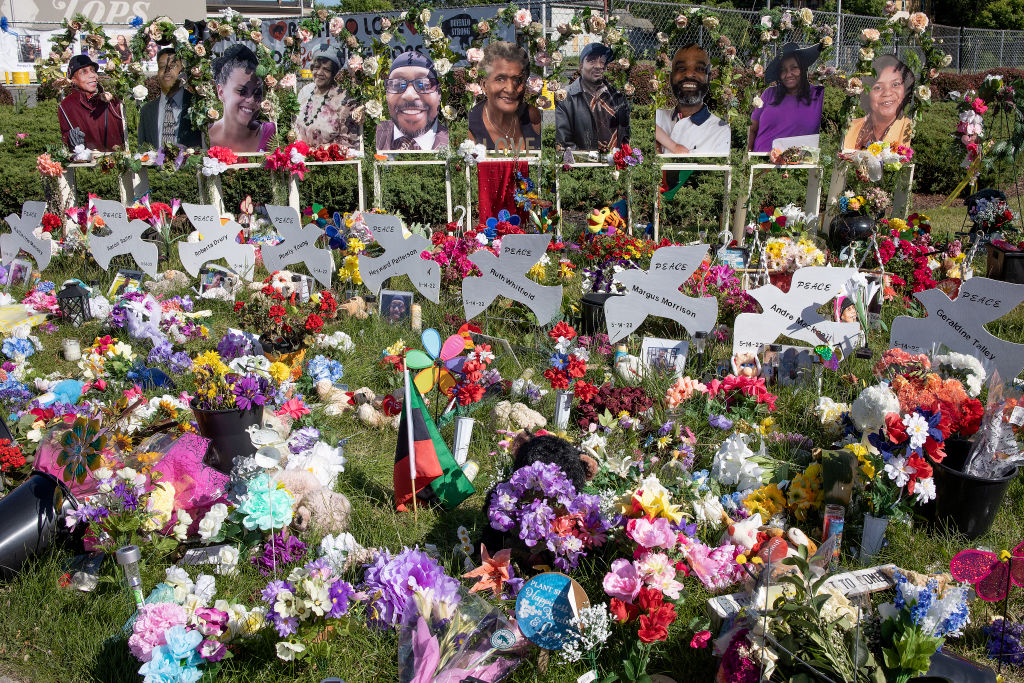
Buffalo’s luck ran out in May, when it became the latest American city to experience a deadly mass shooting, this time at a Tops grocery store in a predominantly Black neighborhood. Ten people were killed, victims of a targeted, anti-Black hate crime. No decent person would suggest that the victims had “put themselves in harm’s way” by shopping for groceries in the middle of the afternoon. But whether an act of violence feels random and haphazardly cruel or personal and targeted only really matters to those left behind. It makes no difference to the dead.
One of the cruelest aspects of the way we live now—always bracing for the next horrific headline, believing this kind of violence is inevitable because we are told over and over again that it is—is the way all of these massacres, no matter how shocking or deadly or racist or cruel, soon become old news to everyone but those most directly affected. Occasionally they reappear in headlines on anniversaries, or as benchmarks to help contextualize the latest mass shooting. Even the phrase “mass shooting” has acquired a leaden deadness; it’s become so common that it has lost the power to shock and horrify. Before those who lost children and parents and spouses and friends can even keep food down again, the rest of us have already moved on.
Andrew Lichtenstein/Corbis via Getty Images
“5/14,” the date of the Tops massacre, has become the equivalent of “9/11” for Buffalonians—a grim shorthand for a community-altering event that few outside of Buffalo would immediately comprehend. When I first heard about the shooting, I cried for two days. My sister-in-law used to shop at that Tops; it’s a mile and a half from my parents’ place. There were vigils and rallies and fundraisers. President Biden showed up to denounce the “poison” of white supremacy. Then we tried to move on. We have come to believe that those not directly affected by a particular mass shooting have to move on; it’s the only way to grasp a few moments of peace before the next one.
The respite was short-lived. Ten days after the murders in Buffalo, an 18-year-old man killed 19 children and two adults at Robb Elementary School in Uvalde, Texas. In both cases, the shooter was an 18-year-old man, the weapon of choice was a legally purchased AR-15-style rifle, and communities of color were the target. The killer in Buffalo was a young white man who targeted Black people; the killer in Uvalde was a young Latino man who targeted Latinos and was likely inspired by the massacre in Buffalo.
It’s impossible to stop thinking about something that never stops happening.
Six months on, residents of Buffalo and Uvalde are feuding over how much of the money raised by various victims' funds is going to which victims. Some Uvalde families believe that only those who lost children should be entitled to compensation. At a recent meeting in Buffalo, survivors of the Tops massacre made the opposite argument. Several argued that the people who died were at peace now, while they still had bills to pay and trauma-related symptoms that make it difficult or impossible to go back to work. Some former Tops employees shared stories of forcing themselves to return to their workplace, which now doubled as the scene of a shattering crime. Most couldn’t make it through an hour. Many of the children who watched their friends die in Uvalde have found it difficult or impossible to return to school. They suffer panic attacks, scare easily, and have trouble sleeping. Hundreds of U.S. parents have lost the power to give their children safe and normal childhoods.
In Buffalo, survivors have complained of being promised substantial financial assistance from a $2.9 million victims’ fund, then fobbed off with gift cards and meal vouchers. Worse than the inadequate disbursement policies of a particular fund is the abandonment of a community by the institutions meant to serve and protect it. In Uvalde, where the cowardice and incompetence of local police and other law enforcement officers may have cost children their lives, Governor Greg Abbott announced the opening of a center meant to provide the community with long-term mental health services. The mother of a little girl who survived the massacre toldThe Washington Post that no staffers were there when she stopped by the center to request gas vouchers. “It’s so frustrating,” she said. “Like, I know how this system works. And as an educated person, I see how they’re trying to take advantage of all these families…I knew it was gonna happen. Resources here are so limited. They were limited prior to this. And it was obvious to me this morning that there was no one that could help when we needed it.”
Adding to their trauma is the fact that survivors are now pitted against one another in a Hunger Games-style competition for artificially meager resources. A state government that cares for its people would fully fund its schools and mental health services, ensure families have a basic income, and provide free therapy to traumatized children that parents don’t have to drive for miles to access. A responsibly run charity would seek guidance from the community it is ostensibly serving and be open and transparent about its resources and who can expect what.
Instead, the thousands of people in this country who have been traumatized by a mass shooting—who were there when it happened, who were shot but survived, who lost children and parents and spouses and friends—get thoughts and prayers. They get to talk to high-profile reporters for a few days or a week. Their kids get therapy every other week, sometimes for as little as 15 minutes per session. Maybe they get a couple of gift cards or a meal voucher. After every mass shooting, we vow to support the victims, yet more often than not, what they end up getting is staggeringly inadequate. Meanwhile, the rest of the country moves on. And all these communities are left with is the pain of being associated with the worst thing that ever happened there: “Buffalo” now evokes a brutal hate crime more than football or chicken wings or snow.
On December 14, the Sandy Hook parents, with the exception of those who couldn’t bear to go on living, will have survived a decade without their babies. November 14 marked six months since the Buffalo massacre. The six-month anniversary of the Uvalde shooting falls on Thanksgiving. This year, I am thankful for my friends and family, and the fact that we survived another year in a violent, fraying, heartless country ruled by people who would rather let children smear blood on themselves and play dead than ban assault rifles.
The day this essay was commissioned, there was a mass shooting at the University of Virginia that left three young men dead. Two other students were injured, one by a bullet that went through his back and lodged in his stomach. He is expected to survive, which in this country counts as luck. Two days after I submitted a draft, a 22-year-old man shot up an LGBTQ club in Colorado, killing at least five people and injuring 25 others. The morning after I submitted a final draft, a gunman killed six people and himself at a Walmart in Chesapeake, Virginia.
What is a life worth? What about the lives of three people, or ten, or 12, or 60? We have reached a point where we can’t process the unique horror of any single massacre, let alone deal with the social fallout, before the next one comes along. And until we meaningfully restrict access to guns in the United States, there will always be a next one. That sense of inevitability has led to a pervasive hopelessness that compounds this uniquely American trauma. It is daunting to mourn each life lost, each family broken, each childhood marred, each marriage strained and severed. But that’s what we need to do, and we need to do it while fighting to dismantle the anti-democratic institutions preventing us from ending this carnage. We have to stop moving on from what those who lost loved ones, the use of limbs, or the will to live can never move on from. We have to confront the true cost of these killings: to victims, survivors, society, and every human being with a soul.
[post_title] => Buffalo and Uvalde, Six Months Later
[post_excerpt] => Communities directly affected by a mass shooting don't just get to move on when there's another one.
[post_status] => publish
[comment_status] => closed
[ping_status] => closed
[post_password] =>
[post_name] => buffalo-uvalde-shooting-six-month-anniversary
[to_ping] =>
[pinged] =>
[post_modified] => 2026-08-04 20:08:10
[post_modified_gmt] => 2026-08-04 20:08:10
[post_content_filtered] =>
[post_parent] => 0
[guid] => https://conversationalist.org/?p=5337
[menu_order] => 102
[post_type] => post
[post_mime_type] =>
[comment_count] => 0
[filter] => raw
)
Why the Duma's new restrictions against LGBTQ "propaganda" are both dangerous and unsurprising.
Nearly everyone who pursues an advanced degree in area studies without having ethnic or family ties to their chosen region has an unusual story about how they got into the field. In my case, the interest stemmed from two short-term evangelical youth mission trips to Russia in 1999 and 2000.
I had just graduated from high school at the time, and I was looking for something to help me contextualize a crisis of faith that had been troubling me for several years. I wanted to imagine a world beyond the stifling Midwestern conservative Christian enclave in which I’d grown up, and when I first stepped off the plane in Moscow, I was nervous but also thrilled to start getting a sense of what Russia was like. I was thus susceptible to certain romantic notions about the “Russian soul” and its depth of authenticity that supposedly contrasted with Western superficiality and calculation, and, after seeing the sights in Moscow and spending a couple of weeks getting to know young Russians in a rural summer camp environment, I was hooked. In that lingering post-Cold War moment of relative optimism, I developed a naive fascination with Russian language and culture that came to define my professional and intellectual life in the following years.
It’s embarrassing to me now that I ever engaged in missionary activities, but, while I quickly gave up on the desirability of converting (Orthodox) Christians to (Protestant) Christianity, the new friends and pen pals and an interest in the country itself remained. I began to study Russian in college, and from that point on, I traveled to Russia regularly until the end of 2015, by which time I had earned a PhD in modern Russian history from Stanford University and spent three years teaching at the Russian Presidential Academy of National Economy and Public Administration (RANEPA), a school with which Stanford partnered at the time. But these days, I’m forced to wonder if I’ll ever go back.
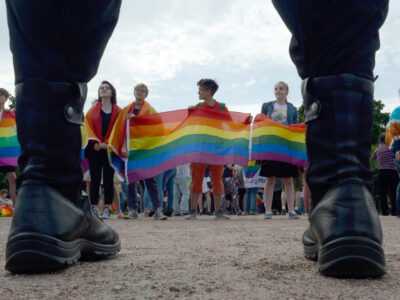
Amid the coverage of Russia’s brutal war in Ukraine, which has dragged on now for nearly eight months, the Russian State Duma has been preparing to pass further restrictions against LGBTQ “propaganda” in an initiative that Deputy Alexander Khinshtein, chair of the committee on information policy, believes may pass as early as next week, according to reporting by the Russian news service Interfax. The new legislation, for which hefty fines will be demanded from violators, is quite comprehensive, banning any public representation of queer sexualities or gender identities, and making particular mention of banning “information that might cause children to wish to change their sex.” Thus far, this new legislation has received relatively little comment in the Western press. But there is no doubt that the legislation and the Russian discourse around it will generate yet more violence against a scapegoated minority as the government drives LGBTQ existence entirely underground.
“Sodomy” was illegal in the Soviet Union, and was only legalized in Russia in 1993. At that point, many observers believed that a democratizing post-Soviet state was on a trajectory toward greater acceptance of difference and greater integration into the international community. Sadly, and in retrospect unsurprisingly, the openness did not last.
From 2003 to 2004, in between finishing college at Ball State University and starting my postgraduate studies at Stanford, I worked as an English teacher at the American Home—a private English school and center of cultural exchange—in the provincial Russian city of Vladimir, in the region I’d traveled to as a youth missionary. In my advanced English classes at the American Home, I had students read and discuss newspaper articles about current events, and that year, the state of Massachusetts had legalized same-sex marriage. When we discussed the topic in class, by and large, the students voiced negative opinions. But whether it was acceptable that we were discussing homosexuality and LGBTQ rights in the classroom was never remotely in question.
Fast-forward to the 2012-2013 academic year, when, post-PhD, I taught humanities classes to both undergraduates and master’s students at RANEPA. One of the Russian students in my postgraduate course—the only liberal among the Russians in the class—gave a sympathetic presentation about Pussy Riot’s “Punk Prayer” protest and its aftermath. She chose the topic entirely on her own, but I was admittedly enthusiastic. Her presentation gave way to a chaotic shouting match among the students, which I should have taken as a foreshadowing of things to come. Some weeks later, I got a frantic phone call from a RANEPA administrator demanding to know why I had “taught Pussy Riot lyrics” in my class. The conversation left me wondering if I was going to get fired. While I didn’t, I did learn to self-censor a bit in the classroom. Later that summer, the Russian State Duma passed its notorious anti-gay “propaganda” law banning the dissemination of any information about “non-traditional sexual relations” to minors. I was dismayed.
All of this has been on my mind in light of the Duma’s new anti-LGBTQ legislation—legislation that feels all the more potent given what is fueling it. Because while anti-queer sentiment has been brewing for years, with much encouragement from above, it is also quite clear that Moscow’s anti-queer obsession is connected with the war in Ukraine, both of which derive from an authoritarian ethos that elevates toxic masculinity, patriarchy, and “traditional values” as an ideal to be emulated, promising punishment for those who deviate. The legislation is of a piece with the war effort, which Russian Orthodox Church and state officials have cast in terms of “spiritual warfare” against the “satanic” West, specifically for its rejection of these same “traditional values.”
Russian President Vladimir Putin has taken an increasingly right-wing populist line since 2011, a period when protests against corruption and election irregularities were a regular feature of life in Moscow. Meanwhile, since the Ukrainian protests of 2013, which centered on Kyiv’s Maidan Nezalezhnosti (Independence Square) and developed into what is now referred to as the Revolution of Dignity, right-wing Russian politicians and Russian Orthodox Christian leaders have fixated on Ukrainian aspirations for democracy and self-determination, denouncing these hopes as a Western conspiracy, Nazism, Satanism—and, of course, as the corrupting influence of “Gayropa.” The authoritarian desire of the Putin regime and Russian nationalists to control the future of Kyiv has thus been framed in terms of “Western decadence” vs. “traditional Slavic values,” a framing that, until Putin actually invaded Ukraine, generated a great deal of sympathy for the Russian autocrat on the American and European Right.
Here at home, of course, LGBTQ rights are also under intense attack by the Right, and certain states’ governors—those of Florida and Texas in particular—have so severely abused their respective state bureaucracies in their efforts to persecute transgender Americans and their supporters that many families with trans children have been forced to move out of state. This isn’t the post-Cold War world many of us once young, naïve idealists imagined. When I returned from Russia to take a postdoctoral fellowship at the University of South Florida in Tampa in 2015, I still thought I was going to a place where things were getting better and better for queer folks like myself. I was wrong.
In both Putin’s authoritarian Russia and Trump’s authoritarian America, it was (and has been) painful to watch people I thought were reasonable go all-in for the nationalist narratives that leave no room for those who are different from the straight Christian norm. Ironically, it was while living in Moscow, at age 33, that I finally came to recognize my own queerness, the source of feeling “different” and uncomfortable in my own skin that had marked my evangelical childhood and youth, and which that same evangelical socialization had left me ill-equipped to see or acknowledge. Once upon a time, I had held up Russia as a mirror to America, my vague young adult discontent and inability to feel comfortable in my Christian Right milieu fueling a need to broaden my horizons about human possibilities. Now, I see in both countries a sort of imperial provincialism, a post-Cold War hangover borne of “great power” nostalgia and a yawning abyss of insecurity papered over with jingoistic bravado, conspiracy theories, and approved categories of people to hate, while (in classic abuser mode) claiming to “love” them so much that you have to beat them into conformity with what is ultimately “best for them.” In both countries, there are many good people who resist these toxic impulses, but the impulses persist, leaving destruction in their wake.
The last time I was in Russia was December 2015, when RANEPA flew me to Moscow to sign a contract that supposedly had to be signed in person before I could get paid for the last semester of editorial work I had done remotely on one of the school’s academic journals. With not much to do other than wait for the paperwork, I visited friends, strolled down memory lane, and went ice skating with a colleague and an ex-girlfriend at the massive outdoor rink in Gorky Park. Amid New Year’s preparations, almost no work gets done in Russia in late December, and on the day I had to leave Moscow, there was still no contract for me to sign. “Don’t worry,” a young administrator told me. “We’ll just forge your signature on the contract.” I finally got paid in cash at an academic conference in the United States that took place nearly a year later.
That surreal goodbye to Russia is an apt coda to the years I spent at RANEPA, when Putin’s creeping authoritarianism started to become, well, much less creeping. In the first few years after 2015, I continued to assume I would return to Russia someday. But now, many Russians themselves, including some of my friends and colleagues, have had to flee the country for their own protection as conscientious objectors to the full-scale war that, back then, none of us anticipated. Some LGBTQ Russians have also fled in recent years, a trend that will no doubt continue as state persecution of the LGBTQ community intensifies. Just as Americans sometimes debate whether it’s ethical for people whose rights and safety are threatened to leave red states instead of staying and trying to change things for the better, the topic of leaving or remaining in Russia—which inevitably raises questions of privilege and survivors’ guilt—has been a contentious matter among the Russian intelligentsia in recent years. My own thinking is that no one who can find a way to leave—especially no marginalized person—is ever ethically obligated to remain in a place that denies them their rights and is unsafe for them. Sometimes, as you struggle to keep hope alive that someday things will be better, all you can do is bear witness.
[post_title] => Russia's New Anti-LGBTQ Legislation is Just More of the Same Authoritarianism
[post_excerpt] => Why the Duma's new restrictions against LGBTQ "propaganda" are both dangerous and unsurprising.
[post_status] => publish
[comment_status] => closed
[ping_status] => closed
[post_password] =>
[post_name] => russia-duma-anti-lgbtq-propaganda-legislation-authoritarianism
[to_ping] =>
[pinged] =>
[post_modified] => 2026-08-04 20:10:42
[post_modified_gmt] => 2026-08-04 20:10:42
[post_content_filtered] =>
[post_parent] => 0
[guid] => https://conversationalist.org/?p=5317
[menu_order] => 103
[post_type] => post
[post_mime_type] =>
[comment_count] => 0
[filter] => raw
)
As a young girl, I had a spunky friend, who bossed me and dressed me, and she'd stand in her driveway, hand on her hip, taunting me, "How does it feel to want?"
It was a line in a film she saw.
At that time, I could not afford to want. But still, I wanted to have her hair, the way hairspray and crimping irons gave her that perfect Who’s The Boss, Alyssa Milano flair; her capacity to pick up dance moves, jumping off a chair like Janet Jackson in the “Pleasure Principle” video. I wanted her mom, how she sat with us at night and tickled our backs until we fell asleep, how she stocked the kitchen with healthy food, wheat germ, and honey.
Later, in foster care, I was nothing but a meat sack of want. I wanted privacy, time alone; I'd sometimes sit in the bathroom, door and eyes closed, blocking out everything outside. I wanted a home—a real home, with a dog and a family. I wanted to go back to my school where I was enrolled in accelerated classes—where I still had the freedom to dream of becoming a neurosurgeon, or a lawyer, or whatever profession would pull my mom and me out of poverty.
And the less I have, the more I want: Even now, I want ridiculous things with no purpose, the little capitalist elves getting to work on my brain. I want nail polish and lipsticks, nonsensical outfits—jumpers, one-pieces—boots, espadrilles, soaps and face creams. I want accolades, acceptance notices from fancy literary journals, and fellowships. And underneath it all, what I really want is love—to be seen, to be touched, to be held, to be kept, to be possessed wholly with all my good and all my naughty bits, a no turning away kind of love.
I want to move through the world with ease.
~
We try hard to make sense of things in a senseless time. My friend, who I'd spoken to every day before all this, but who's since been exposed to the virus, or some other cruel thing that has her sleeping and using an inhaler, says wistfully into the phone, "I miss malls."
Of malls, Frederic Jameson wrote in Postmodernism, “Overwhelmingly, our daily life, our psychic experiences, our cultural languages are processes performed in and contingent on commercial space.”
In the early days of the pandemic, I wonder what happens when we no longer have that commercial space or when that space becomes virtual. Where do we go when that pinnacle remains burning inside us, but the space to make it grow—disappears? What is America without the physical space to Want?
~
After World War II, Americans embraced the ideal of the suburbs. People moved away from big cities, and malls were a new indication of what LIVING would be like. For all those suburban households, the mall became the epicenter of activity, a place where we could brush arms with the Joneses. And all of us drove there—a luxury in itself. As Joan Didion writes in her essay "On the Mall," "as a child in the late Forties in California, I recall reading and believing that the 'freedom of movement' afforded by the automobile was 'America's fifth freedom.'"
The previous four were outlined in Franklin D. Roosevelt's 1941 State of the Union address: 1. Freedom of Speech, 2. Freedom of Worship, 3. Freedom from Want, 4. Freedom from Fear.
As for the third, what better homage is there to Want than the mall?
~
America's first malls were outdoors; they were to be community centers—our zocalo—where people could come together for social interaction. These first malls appeared in the 1920s. One of the earliest was opened in the California boom town of Lakewood. With its 154 acres and sprawling parking lot, the Lakewood Shopping Center transformed fields of lima beans into a big city suburb—a precursor for what was to come.
J.C. Nichols, generally regarded as the father of the shopping center for his role in developing Country Club Plaza in Kansas City (1924), established many of the mall’s fundamental merchandising and management concepts. Nichols’ 1945 Urban Land Institute publication, Mistakes We Have Made in Developing Shopping Centers, codified the tenets of the modern mall with a list of 150 maxims, which covered everything from strategies to ensure local political support to adequate ceiling heights.
In 1956, the first enclosed mall—Southdale, in Edina, a suburb of Minneapolis—changed everything. It also firmly cemented Austrian architect Victor Gruen as one of America's great mall pioneers. Gruen created a completely introverted building by enclosing once-open spaces and controlling the temperature, establishing the prototype for how we think of most malls today. As William Kowinski illustrates in Malling of America, once inside, the commercial potential of enormous spaces was realized in theatrical "sets" where "retail drama" could occur. Southdale was covered for practical reasons; Minnesota weather allows for only 126 outdoor shopping days a year. But the contrast between the freezing cold or blistering heat outdoors and the mall's constant 72 degrees was only accelerated by its atrium centerpiece, the Garden Court of Perpetual Spring, filled with orchids, azaleas, magnolias, and palms.
~
Kowinski identifies mal de mall (literal translation: bad of mall, which could be interpreted as mall sickness) as both stimulation and sedation, characterized by disorientation, anxiety, and apathy. Margaret Crawford writes in her essay “The World In A Shopping Mall” of The Gruen Transfer (named after Victor Gruen), which “designates the moment when a ‘destination buyer’ with a specific purchase in mind is transformed into an impulse shopper, a crucial point immediately visible in the shift from a determined stride to an erratic and meandering gait.”
These effects, in part, might help explain the expansion of the typical mall visit from twenty minutes in 1960 to nearly three hours today. Eventually, the mall became a place to cruise. For teenagers to hang out, and work, and steal, and kiss. Gallerias everywhere achieved a reputation as a safe place for singles to meet, and where "mall walkers"—senior citizens and heart patients seeking a safe place to exercise—could arrive before the shops opened to walk a measured route around the corridors.
To that end, terrazzo tiles were introduced in the '80s because developers thought the carpet would slow shoppers down. Architects also gradually increased lighting to create the illusion of longer afternoons. Finally, in 1992, the Mall of America opened, eventually featuring a whopping 5.6 million square feet of retail. The largest mall in North America, the mall sits just south of the Twin Cities, in Bloomington, Minnesota, and was built on the site of the former Metropolitan Stadium. To honor the location of home plate, the mall houses a plaque in its amusement park that commemorates a home run hit by hall-of-famer Harmon Killebrew on June 3, 1967—definitively placing this shopping center, and its absurd representation of excess, alongside America’s favorite past-time.
By the mid-90s, malls were being constructed at 140/year.
~
I was a latchkey kid when the Westside Pavilion finally arrived in Los Angeles in 1985; my young spunky friend who quoted movies about Want would raid her mother's empty Sparkletts of change, and we'd walk the two miles to the mall. We spent all day trying on clothes at Wet Seal and Contempo Casuals; we'd spend any money we had on Mrs. Fields' cookies or slices of pizza from Sbarro. We’d ride the escalator up and down.
Later the mall became a site for me to act out what feminist theorist Lauren Berlant calls "cruel optimism": “A relation of cruel optimism exists when something you desire is actually an obstacle to your flourishing.” During the holidays, I'd go to the mall and finger all the items, look on longingly at the shoes and handbags, listen to the music, and see the line for Santa, and a part of me secretly hoped that perhaps someone would see me, and take pity on me, and offer to buy me all the things. But no one ever did.
~
There is, of course, a conventional association between women and mall space. Iconic films like Valley Girl and Clueless. Roseanne Barr's television show, wherein her title character worked in the mall. And then, there's the music.
I’m shuttin’ shit down in the mall
And tellin’ every girl she’s the one for me
And I ain’t even planning to call
I want this shit forever man, ever man, ever man, ever man
—Drake, “Forever”
For rapper Drake, girls are granted equivalence to stores as sources for reaffirmation of male dominance and economic success in the hip-hop market. As early as 1998, mall space provided a similar referent for Jay Z in "Can I Get A?":
Do you need a balla? So you can shop and tear the mall up?
Brag, tell your friends what I brought ya
Jay Z directs his curiosities about mall space to female listeners, engaging end rhyme between “mall” and “balla,” a term initially used to describe wealthy athletes but which now refers to anyone or even anything admirable. While these dialogues with mall space certainly perpetuate the same anti-feminist stereotypes—positioning women as shoppers and as “shopped” by the male speakers—they reproduce the very real social relations that occur in mall space, both through the exchange of money for clothing, and sexually, through the bodies of the spatial practitioners.
For example, around 10 AM on April 12, 2019, a woman and her 5-year-old son were standing outside the Rainforest Café on the third floor of the Mall of America when 24-year-old Emmanuel Aranda approached. She asked him if they were in his way and should move. Mr. Aranda, without warning, picked her son up and threw him off the balcony. When asked why he did it, he said he was sick and tired of years of being rejected by women at the mall.
~
My generation, Generation X, could also be aptly named the Mall Generation, as we were around in the before times of malls and now in the after. The before times, for me, were riddled with trips to the local Kmart. A store that allowed for layaway, where we posed for studio-like holiday photos, drank bright blue or red slushies, and ate at the Kmart Cafe.
The first Kmart opened in San Fernando, California, in January 1962; 1500 miles north, and five months later, Sam Walton opened the first Walmart in Rogers, Alaska. Both were the blueprint for what a mall could be. In our small military town in northern California, Kmart was one of the few places to hang out. I touched and longed for all the items, imagined a need and a stealthiness with the camping gear, and extended the fictive dream of Capitalism—that somehow being near Jaclyn Smith's discount clothing line put me in closer proximity to becoming one of Charlie's Angels myself.
In the ‘80s, Ma got a job as a security officer for Kmart, and when they were robbed, she was blamed and then let go of. Years later, I worked graveyard at the Winchell's Donut, and I, too, was robbed and then fired. In reality, Jaclyn Smith's discount clothing line just put me closer to who I always was, a girl whose Ma's bounced check was on display at the Food King on Westwood Blvd. A girl who was called to the front of the class with all the other poor kids to get her lunch tickets. The tickets she tucked into the side of her Payless Shoesource ProWings, a brand of shoes all the kids talked smack about.
~
In researching genres, I recently discovered a form of ‘80s minimalist literature called “dirty realism,” also known as "Kmart realism." Author Paul McFedries, in the craft book Word Spy: The Word Lovers Guide To Modern Culture, defines the precursors of Kmart realism as “trailer park fiction, Diet-Pepsi minimalism, and hick chic.” Miriam Clark writes in Studies in Short Fiction that it "represent[s] and reproduce[s] the disintegration of public life [and] the colonization of private life by consumer capitalism."
Authors Bobbie Ann Mason and Joy Williams are most known for this genre, likely coined by author Tom Wolfe in reference to stories that mention Dairy Queens and third-rate motels. In his introduction to Patchwork: A Bobbie Ann Mason Reader, George Saunders writes, "You could say, as critics have, that Mason is writing about a particular form of late-twentieth-century American sadness, a moment during which something has fundamentally shifted in the American ethos. The way I would say it is that she is bearing witness to our descent into a new era of pure materialism."
~
If Bobbie Ann Mason is representative of Kmart realism, then I wonder who or what literature would represent Caruso realism. I'm speaking here of Rick Caruso, the Los Angeles mall developer and mayoral candidate. Caruso's The Grove and The Americana at Brand are the epitome of Los Angeles' animated spaces, spaces that are part fairy ground and part extensions of the body of Los Angeles. Caruso's intentional use of mall space and large multi-use dwelling-consumer spaces have become LA's theme park phantom limbs, filling the ghost imprint of the homes and apartment units bulldozed in the mid-20th century.
Both The Americana at Brand and The Grove are organized upon the idea of a city center—with a mix of architectural styles, building heights, materials used, and vast open spaces at their center. The Grove is reminiscent of 1930s Los Angeles; meanwhile, The Americana reflects the brick factory facades of the industrial era, with its massive elevator shaft with exposed steel beams.
Each of the two intends to appear to be a public space but is private property and is protected as such. But if mall decor and design are not explicit enough to tell young people of color or the unhoused that they are not welcome, more literal warnings can be issued. A bronze plaque placed at the Grove's southern entrance spells out the house rules: "The Grove is private property and has not at any time been dedicated to public uses," listing 18 activities from which visitors must refrain. While the two-acre park in the center of the Americana is technically public property, the private security force that patrols it prevents anyone from photographing with professional equipment without permission. "Sitting on floors, handrails, stairs, escalators, trash receptacles and other areas not specifically designed for seating” is also restricted. The Americana at Brand allows dogs on the property—except on its grassy area, and unless the dog in question is a pit bull.
Still, in a city that lacks accessible public space, The Grove and The Americana provide a peek into an alternate reality. Pedestrianized streets. Seamless sidewalks. Reliable transit. Shady trees. Alissa Walker writes in New York Magazine, “Yes, in theory, the Grove represents the dystopian future where billionaire developers have cordoned off our public spaces into oversurveilled fortresses. But in reality, elements of this future are very appealing to Angelenos. That’s why they go there. If they don’t readily admit that they do, they’re lying. Everybody loves the Grove.”
I will confess here that in recent years, I, too, have found some joy at my local outdoor mall—Americana at Brand—after one winter, as the fake snow blasted upon us, my now-wife bent down on one knee and proposed beside the iconic dancing water fountain.
~
In 1787, Grigory Potemkin, former lover of Empress Catherine II, supposedly erected phony portable settlements along the banks of the Dnieper River to impress the Russian Empress and her guests on their way to Crimea. He would then disassemble and reassemble the village along the way. Today, the term "potemkin" is used in politics and economics as any construction whose sole purpose is to provide an external façade to a country that is faring poorly, making people believe that the country is faring better.
As I write this, Caruso is running for mayor, and some Angelenos are concerned that he will try to apply these same guidelines and principles to the entire city. "You go to the Grove; it represents everybody in this great city of ours. It's every background. It's every color. It's every creed," Caruso told the Los Angeles Times editorial board earlier this year. Often compared to Walt Disney, the 63-year-old is known for a similar pseudo-urbanism, equal parts utopianism and nostalgia. He’s also known for switching his party affiliation for the race, as he was very publicly registered as a Republican three years ago. Caruso is now making it to the general election after sinking millions of his own money into ads for his campaign, featuring actors and personalities such as Gwyneth Paltrow and Snoop Dogg. The Americana, as I see it, is the modern-day Potemkin Village; and Caruso, the modern day Potemkin.
~
Being an off-brand kid—a Kmart kid, sometimes even in the time of malls—I was always consumed with desire; that achy want. The word consumption from the late 14th century to mean "wasting of the body by disease"; from Old French consumpcion, "A using up, wasting"; from consume, "the using up of material, destruction by use."
For me, it is a truly American experience to be overwhelmed with this desire to consume, to waste. I walk around my college campus and cut through USC’s University Village, a Caruso-endorsed project. In this instance, University Village is a $700 million multi-use development described by the LA Times as “a fantasia of just-add-water heritage, equal parts Disneyland and Hogwarts.” As trustee and longtime donor, Caruso has been quoted as stating, “It makes it a much more vibrant neighborhood.”
University Village is home to an Amazon pick-up center, a Target, a Trader Joe’s. But there’s most reliably a line outside of Dulce, an artisanal cafe and donut shop. I spy a plump matcha donut in the window dusted with sugar, a dollop of cream winking on the mouth-hole. I want it. Between classes, sweaty, and arm aching from my heavy book bag, I rush past a spa called Face Haus, where customers can stop in for an afternoon facial; I see the aestheticians, their face masks, an advertisement of a woman, her hair wrapped in a towel, eyes closed, relaxing beneath a cool layer of serums. I want it. Some days when I’m in need of comfort, a hug, words of encouragement, I linger a bit too long in front of Honeybird, with their southern fried chicken, banana cream pie; it smells like somebody’s home. I want it, too.
This year, I’ve received notice from two of my undergraduate students stating they had to leave the school after tuition was raised from the already-staggering $60k/year. They do not want to leave. I do not want them to leave. But they do not have what they need to stay. Money.
~
In 1943, The Saturday Evening Post published a series of oil paintings by the Americana artist Norman Rockwell that came to be known as “The Four Freedoms,” along with corresponding essays for each. “Freedom From Want” was published alongside an essay by Filipino writer and labor activist Carlos Bulosan. At the time, Bulosan was a migrant laborer working intermittent jobs when the Post tracked him down to contribute the essay. Initially, the Post lost it, and as there was no carbon copy, Bulosan had to track down the only other draft he had stashed at a bar in Tacoma.
Ultimately, Bulosan's essay proposed that while citizens had obligations to the state, the state had an obligation to provide sustenance to its citizens. Unlike Roosevelt, Bulosan presented the case that the New Deal had not already granted freedom from want as it did not guarantee Americans the essentials of life.
Lately, walking through University Village, I find myself thinking of Want. The facials, the nail salon, yes—but also, the grocery store. As an undergrad, every week, I’d buy a loaf of bread, a can of sweetened condensed milk, and a container of instant coffee. I’d pour the milk on my toast for breakfast and dinner and use it to lighten and sweeten my coffee. I remember the anguish of passing the fast food restaurants on my campus; how the credit card companies would set up tables right outside the Burger King. It worked.
In 2022, it costs up to $30 a day to park on campus, but if you can nab it, there’s free parking on Frat Row off of Hoover. Here, there are people tabling, too—but rather than signing students up for credit cards, they’re selling test strips people can put in their drinks to make sure they aren’t roofied. It works.
If you travel about twelve miles southeast from USC, you’ll hit The Compton Towne Shopping Center, a mall not designed by Caruso. You likely won’t find many USC students there. Compton, a city of 95,000 residents, acutely faces issues of racial injustice and structural inequality—issues that largely haven’t touched USC. Many of Compton’s residents are either unemployed, poorly paid, or ineligible for government assistance. Upwards of 1 in 5 Comptonians live in poverty—double the nationwide average. Compton also happens to be home to the largest city-based guaranteed income pilot project in the country, The Compton Pledge. According to the Compton Pledge website, “Local housing assistance in Compton is at capacity, presenting unaffordable hardships for a city where 46% of residents are renters. In Compton, rates of unemployment have risen to 21.9% since the beginning of COVID-19, and a growing number of residents regularly rely on food pantries.”
Ninety years after Franklin D. Roosevelt’s New Deal and local governments and private nonprofits are still trying to deliver on its promise. Ninety years after Franklin D. Roosevelt’s New Deal and we still haven’t achieved his promise of “Freedom From Want.” Because ninety years after Franklin D. Roosevelt’s New Deal, America can’t even deliver on freedom from need.
And what we need, of course, a mall can’t give us.
A small portion of this essay originally appeared in Lenny Letter.
Additional fact checking by Apoorva Tadepalli.
[post_title] => Freedom to Want
[post_excerpt] => What the mall tells us about American need.
[post_status] => publish
[comment_status] => closed
[ping_status] => closed
[post_password] =>
[post_name] => freedom-to-want-malls-america-need
[to_ping] =>
[pinged] =>
[post_modified] => 2026-08-04 20:12:17
[post_modified_gmt] => 2026-08-04 20:12:17
[post_content_filtered] =>
[post_parent] => 0
[guid] => https://conversationalist.org/?p=5265
[menu_order] => 104
[post_type] => post
[post_mime_type] =>
[comment_count] => 0
[filter] => raw
)
A review and a revisiting of Carla Lonzi’s "Self-Portrait."
On a peaked December day of a sunless Berlin winter in 2021, I attended a meeting of the personal is theoretical, a feminist reading group hosted by diffrakt center for theoretical periphery. A few weeks before, we had collectively decided to read “Let’s Spit on Hegel,” a 1970 manifesto written by Italian feminist thinker Carla Lonzi (1931–1982) and published by the feminist group she'd co-founded, Rivolta Femminile. As we read the text aloud over mugs of overly sweet mulled wine, we discussed how second wave feminism texts can feel both outdated and exciting, simultaneously limiting in terms of what the (white, Western, cis) female body can be, and inspiring in terms of what a (collective, non-hierarchical, sick of Hegel) feminist politics could demand. Towards the end of the manifesto, Lonzi declares, “An entirely new word is being put forward by an entirely new subject. It only has to be uttered to be heard,” a utopian demand for a new woman and a new feminist world to emerge through writing. Despite some reservations, I nevertheless left the meeting very curious about how Lonzi might further seize this act of self-creation in her other work.
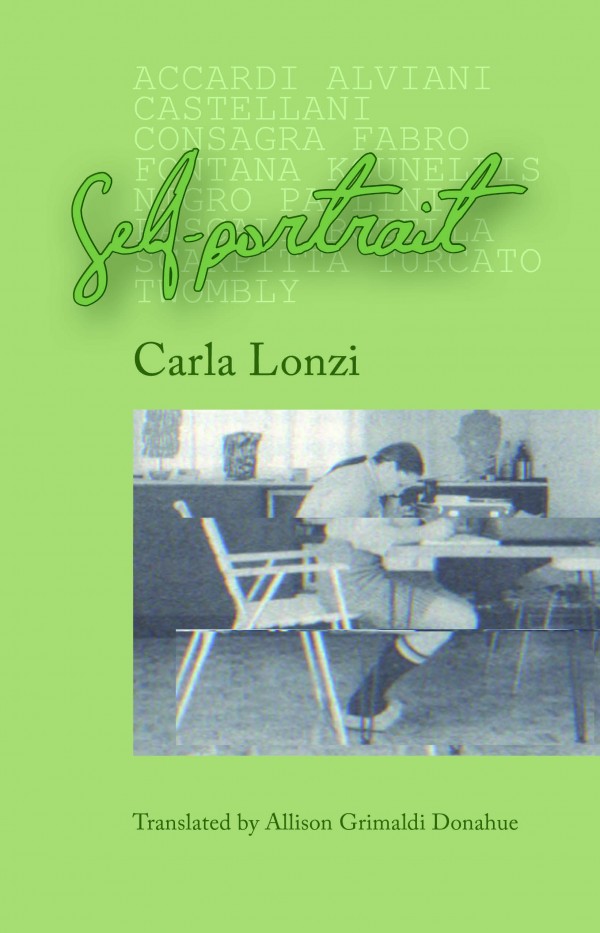
The demand for a new word/world/woman resounds between tense and vibrant frequencies in Lonzi’s 1969 Self-Portrait, recently translated into English by Alison Grimaldi Donahue for Divided Publishing. Often positioned as Lonzi’s last work before her entry into feminist activism, Self-Portrait is a collection of interviews with fourteen Italian artists mostly associated with the Arte Povera movement throughout the 1960s. More than just an attempt to destabilize the hierarchies between artist and critic, Self-Portrait significantly not only critiques the Italian art scene, but how collective configurations should grapple with power, authority, and desire. One of the more popular works in Lonzi’s broader ouvre, it is an important text in Italian feminism because it reveals tensions in the broader cultural, political, and social movements of the late sixties and seventies that led some women to turn to feminism as the main means of achieving their demands for change.
As a whole, Self-Portrait records Lonzi’s discontent with the modern critic in a strict remove from his artistic subject, the desire to let artists speak for themselves, and the limits of art. The artists shift between flattering and talking over Lonzi, each vying for her attention but often losing themselves in the void of a soliloquy. Long-winded monologues on the myth of the artist, the mechanics of sculpting an erection, and the differences between Italian and American art scenes are peppered with casual and blatant sexism. When I first read Self-Portrait, I found myself alternating between moments of boredom and mirth fueled by frustration at most of the artists, and excitement when Lonzi’s clear voice cut through their bullshit. It felt like Lonzi was sketching the void where the role of the traditional critic wavers, and a feminist voice is needed to intervene.
Upon revisiting it, I found myself thinking of Self-Portrait as less of an enjoyable reading document and more as a template for how one can play with the boundaries of the self and others through experiments with the (spoken) word. On the one hand, Self-Portrait is a mash-up of the things normally cut out of interviews, such as pauses, stutters, and ramblings that go on for too long. On the other, it is the product of a seven-year project, the first of Lonzi's works in cutting, pasting, and editing conversations as a work of art in itself. As translator Alison Grimaldi Donahue describes in an interview, what seems to be the simple transcription of interviews was a long and highly mediated process. “Maybe she’s just treating their voices as a piece of found material. She is the manipulator, she is the fabbro…they sold their voices away,” Donahue muses. In a highly performative gesture, Lonzi poses her most eloquent questions to Cy Twombly, who was never formally interviewed and whose answers are always denoted by “[silence],” seeming to ask and answer itself about how to push back against those who try to take up too much space. Just when you think Lonzi’s aim is to let artists metaphorically hang themselves with their own words, interesting bits pop in, the best being her exchanges with eventual Rivolta Femminile co-founder Carla Accardi—the only woman interviewed. “I want to kiss you!” Lonzi exclaims amidst Accardi’s reflections on collectivity. In response, perhaps smirking, Accardi continues her answer unfazed.
Carla Lonzi studied art history and worked as an art critic in Florence, but is best known for her years as a feminist activist in Rome and Milan. After declaring a decisive break from art, Lonzi co-founded the radical feminist collective Rivolta Femminile with Carla Accardi and Elvira Bannoti in 1970—just a few short months after she released Self-Portrait. Lonzi and Rivolta Femminile were major figures in second wave feminism, often seen as part of the transnational movement of women from the early 1960s to the late 1970s, united by their rejection of sexual violence and the patriarchal order. As a collective, their demands were for equality in the private and public spheres, self-determination of female bodies and reproductive rights, and equal education and work opportunities. But globally, their work has largely gone overlooked: Historian Maude Anne Bracke argues that narratives of second wave Western transnational feminism tend to give primacy to the US and UK, while positioning Italian feminism as “atypical, with its distinctive features including its non-institutional basis, the centrality of theory, and the emphasis of sexual difference.” While Rivolta Femminile did indeed emphasize female separatism, Lonzi spent her career challenging this limited depiction of Italian feminism, most notably through the incredibly multifaceted nature of her writing, between theory, manifesto, poetry, diary entries, and manipulated transcripts of conversations, as in Self-Portrait.
While the art critic and feminist Lonzi are often described as at odds with each other, these two hats are connected by a thread of experiments in collective ways of being together—experiments that call attention to and aim to break down the hierarchies of modern capitalist patriarchy. In Self-Portrait, this is explored through illuminating these structures in a toxic art world that must ultimately be left behind. In later works, these concerns take the form of explicit demands to reject patriarchy as the central form of oppression in all strata of life and to form separatist feminist groups. Lonzi played with exactly how to live out such concerns throughout her life, and was often depicted as a strong-willed figure who simultaneously sought leadership roles while trying to break them down theoretically. While one can say that such a struggle is embedded in the nature of collective politics, it is in this realm that Lonzi’s varied writings resonate as unstable experiments in blurring the boundaries between the self and others to try to reach a conception of the new woman—usually coming back to the self after all.
In thinking about Lonzi’s legacy today, I came back to the original tensions that appear in Self-Portrait and Lonzi’s broader corpus, and how these same tensions have appeared in recent discussions of the #MeToo movement. When it went viral in 2017, years after it was first used by Tarana Burke in 2006, #MeToo brought together some of the hopes of the early, seemingly long-gone internet as an equal space, textually juxtaposing a variety of women from different races, classes, and statuses through verbal repetition and collective authorship of two simple words. It also recreated a false illusion of a de-hierarchical space, namely that it was based on the accusations of the privileged as a means of creating space to hear those who had cried out unheard against such abuse for many years. In regard to Lonzi, this again underlines the tensions between self and collective at the heart of the promise of feminism to make the personal political, along with the question of whose self we are led back to. Self-Portrait came at a breaking point for Lonzi, in which she turned to a more overtly feminist agenda to address what she saw as major wrongs with living together. Her issues with self portraiture itself mirror the very demands for more inclusivity and diversity that eventually broke down many second wave feminist collectives. Even as she dismantles the critic, Lonzi struggles with the hope of writing experiments to create new spaces and the lived reality of power and hierarchy.
While the road from the self to the collective is not an impossible one, from a contemporary perspective, it is a task that demands much more reflection on and attention to its intersectional scope. Lonzi's experiments speak to both the hope for the collapse of the formal bounds of established hierarchies and the need for such a dream to be constantly recontextualized and reevaluated. Perhaps then Lonzi is best approached as an entry into writing as a malleable extension of the feminist self, one whose contours change with a feminism in flux with the demands of its time. While Self-Portrait is nominally about art, it radiates with this demand to perpetually reimagine and reinvent the self when up against the realities of breaking down such boundaries. “Mine wasn’t an interest in art…” Lonzi confesses at one point in the book, but rather the feeling that, “extraordinary things were possible between beings… a potentiality that I felt humanity possessed. I knew I had it and I felt that it belonged to everyone.”
Divided Publishing
[post_title] => Can We Write Our Way to a New Word?
[post_excerpt] => A review and a revisiting of Carla Lonzi’s "Self-Portrait."
[post_status] => publish
[comment_status] => closed
[ping_status] => closed
[post_password] =>
[post_name] => self-portrait-carla-lonzi-rivolta-femminile
[to_ping] =>
[pinged] =>
[post_modified] => 2026-08-04 20:17:50
[post_modified_gmt] => 2026-08-04 20:17:50
[post_content_filtered] =>
[post_parent] => 0
[guid] => https://conversationalist.org/?p=5269
[menu_order] => 105
[post_type] => post
[post_mime_type] =>
[comment_count] => 0
[filter] => raw
)
Why the protests in Iran are about more than just women's rights.
Zan. Zendegi. Azadi.
Woman. Life. Freedom.
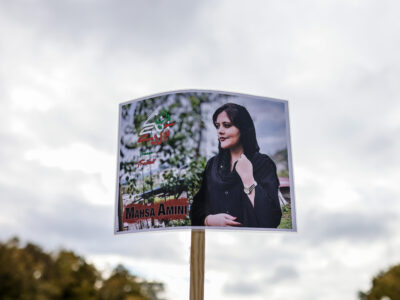
This is the rallying cry on the streets of Iran as the people clamor not just for women’s rights and justice for Mahsa Amini, but for a different world order—for the right to live under conditions of their own making.
On September 16, 2022, 22-year-old Amini died in the custody of Iran’s “morality police,” who (allegedly) beat her to death for inappropriately wearing “hijab,” or the veil. In direct response, the Iranian people have taken to the streets to protest not just gender violence, but decades-long violences of empire that survive in Iran despite the Islamic Republic’s break with the West. While galvanized by Mahsa’s murder, these protests highlight accruing grievances against the Islamic regime, as well asan empire that birthed and underwrites the state’s terror tactics.
As those of us in the West begin to make sense of Iran’s senseless state violence, we must refrain from pathologizing Islam as the source of this violence, or the veil as a sign of oppression that revokes women’s agency. We must also be careful not to reproduce the colonialist logic whereby we task ourselves, as “good liberal subjects,” with “saving” these brown women from brown men, as cultural anthropologist Lila Abu-Lughod warns.
This is not the first time that Iranian women have used the veil—in other words, gender politics—to mobilize a demand for the people. In 1979, at the height of what was then an anti-imperialist uprising, Iranian women donned the veil not because they wanted to give up their agency, but because they wanted to take it. These women had suffered for years at the hands of a puppet government that imposed Western standards of being and doing and knowing, including but not limited to mandatory unveiling—obscuring their lived experiences as a people who want to know themselves outside of the West’s phallic gaze.
As the handmaiden of empire, this gaze pretends to “know” the people it Others, making Iranians, in this case, the West’s antecedent and foil; a people in need of Western patronage and intervention in order to animate their political will. But the women of Iran are not awaiting our verb to make their demands known and felt. Neither are the Iranian children who sing about the possibility of “enghelab”—revolution—as they join their teachers to burn effigies of the Ayatollah.
Today, Iranians across gender, racial, ethnic, religious, and class lines are risking their lives in refusal of what iconic feminist scholar bell hooks describes as “imperialist white supremacist capitalist patriarchy.” Even as the state’s violence is totalizing, these women and children and those who stand with them courageously and collectively dream of an Otherwise. And it isn’t the first time: Jalal Al-e Ahmad, whose writings galvanized the 1979 revolution, called the Iranian state’s obsession with emulating the West a disease, which he termed “Gharbzadegi,” or Westoxification. He implored Iranians to seek alternative modernities outside of imperialist white supremacist capitalist patriarchy’s phallic, penetrating violence, so that they might make their own lives (and ours) matter. Indeed, the revolution that the Iranian people sought then and continue to seek today cannot be contained by a demand for gender justice alone.
I have often wondered, in the hour of bell hooks’ passing, what she might say about the uprisings in Iran. She argued that feminism is for everybody; in other words, that feminism helps us understand how society and its dis/contents function. In her final years, hooks expressed concern that feminism is dying in today’s society. As her friend and confidant, I would like to think that the protests in Iran today would give her hope, because Iranian women and their co-conspirators are strategically leveraging feminism, using a critique of patriarchy to challenge empire.
Shervin Hajipour’s song “Barayeh,” described by popular media as the “anthem” of Iran’s protests, enumerates many of these intersectional violences, and how they animate the Iranian government’s iron fist. The people are protesting, Hajipour writes, “for the child laborer and [for] his dreams”; he adds, rather poetically, that they are also protesting for a crumbling economy, for the imprisoned, for the polluted air, for the dying trees, for the extinction of Persian cheetahs, and for “the murdered and innocent forbidden street dogs.”
Interestingly, rather than get caught up in the humanist exceptionalism of Western empire, Iranians protesting on the streets today know that revolution for their people is impossible without a change in the valuation of life. Their demand is not that all lives matter, but rather, that all life—human and non-human—matters.
What’s happening in Iran today isn’t (just) the stuff of gender violence, which is a Western import, anyway. It is about survivance in the face of the imperialist white supremacist capitalist violence that remains in Iran. It is about poverty. It is about Western sanctions that make medical care impossible. It is about, as political theorist Michel Foucault wrote in a November 1978 article for the Italian daily Corriere della serra, “breaking away from…global hegemonies.” It is about a people who, “with bare hands who want to lift the fearful weight, the weight of the entire world that bears down on each of us, but more specifically on them, these oil workers and peasants at the frontiers of empire.”
In “Barayeh,” Hajipour goes on to describe the protests as a revolution for “the embarrassed fathers with empty hands,” for “the missing and murdered kids,” for “the students and their future,” for “the Afghan kids.” His list is long, because, as Foucault notes, Iranians are clamoring for all of us. While Iranian women and girls are certainly leading this charge, there has been no shortage of men who stand with them or, indeed, who follow their lead, understanding that the feminism these women employ to clamor against patriarchy will better their living conditions, too.
What we’re seeing today is a long history of Iranians demanding a freedom with empty hands, for the world that suffers, still, because—as hooks implores—imperialist white supremacist patriarchy devastates all of our living conditions.
Let us stand with Iranians now as they stand with us, as they bear this weight: the “fearful weight…of the entire world.”
This piece has been adapted from a speech given by M. Shadee Malaklou at a vigil hosted by the bell hooks center.
[post_title] => The Fight for an Otherwise
[post_excerpt] => Why the protests in Iran are about more than just women's rights.
[post_status] => publish
[comment_status] => closed
[ping_status] => closed
[post_password] =>
[post_name] => iran-protests-mahsa-amini
[to_ping] =>
[pinged] =>
[post_modified] => 2026-08-04 20:18:34
[post_modified_gmt] => 2026-08-04 20:18:34
[post_content_filtered] =>
[post_parent] => 0
[guid] => https://conversationalist.org/?p=5246
[menu_order] => 106
[post_type] => post
[post_mime_type] =>
[comment_count] => 0
[filter] => raw
)
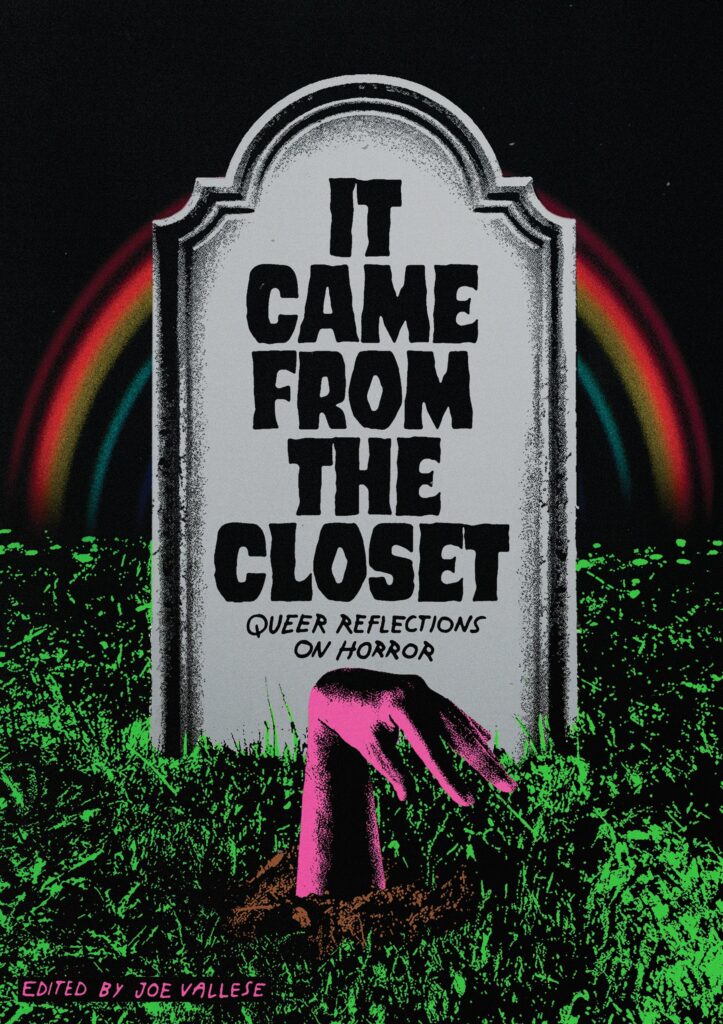
An exclusive excerpt from "It Came from the Closet: Queer Reflections on Horror."
In My Skin / Dans ma peau
IT WASN’T UNTIL I got pregnant that I finally saw how distant I was from my own body. This was late 2016, early 2017, and I was about to turn thirty-five, a late age for a first baby. I spent half my day reading pregnancy manuals and websites, baffled and embarrassed by their maniacally chipper tone, which seemed to be aimed not at parents of small children but at the actual children themselves: Baby is the size of a grape! A papaya! A spaghetti squash! It’s all right to be nervous. But more all right to be happy! Mom (the pregnant person is always addressed, in these texts, as “Mom”) is getting ready for a big change!
I was not getting ready for a big change, I was in the midst of one. My personality shifted with my hormones, giving me new tastes and interests and a terrifying ability to cry in public. I swelled and rounded, changed shirt sizes and pant sizes and shoe sizes, puffed up at the joints until I had the tree-trunk legs of a brontosaurus. In the more scientific manuals, I learned that my body had doubled its amount of blood; that the baby’s cells were mingling with mine, and would stay there after I gave birth, rendering me a biological chimera; that I was growing a new organ, the placenta, and when I gave birth, I would both expel and (the manuals strongly encouraged) eat it.
The teenage edgelord in me delighted in this information. A parasite turns you into a mutant and forces you to eat your own organs; what’s cooler than that? Yet, when I tried to talk to other people about how disgusting pregnancy was, I was met with baffled politeness, not only from the world at large but from pregnant women. This experience of being lost at sea in my own body, held captive to its processes, seemed to be mine alone. In fact, if the expressions on people’s faces were any indication, it was mildly crazy.
Yet the more I sat with the feeling, the more it seemed to me that my body had never belonged to me. There were whole areas—my hair, my breasts—that I was keeping around primarily because they got a reaction from people. There were processes that had always felt unwelcome; as a teenager, my periods were so distressing that I once passed out in the middle of a McDonalds because I felt one coming on. I could never figure out all the little things women were supposed to do, how it was that they managed to look adult and female and put-together. It seemed easy, or at least manageable; a necessary life skill, like cooking dinner. I just couldn’t do it. My body was something I needed to manipulate, a weird, soft machine I was never quite sure of operating correctly. I fed it like a pet, washed it like a car, exercised it... well, no, I didn’t exercise it, because that would require getting in there and fucking around, and I spent as much time reading or drinking or otherwise getting out of my body as I could.
It never would have occurred to me to call these feelings “dysphoria.” I pushed through them the same way I’d always pushed through the pangs of shame and panic I got when I tried to do girly things or present as convincingly feminine, telling myself it was just internalized misogyny or poor self-esteem. Yet it seems clear to me now that my pregnancy was the beginning of my coming-out process as a nonbinary transmasculine person. It called my body to my attention. It made me realize that I could successfully and intentionally undergo a big change.
Now that I’m out, my former alienation from my body seems normal. I wasn’t “put together” because I was trying to put together the wrong thing. It’s like I bought a coffee table at IKEA and spent thirty-five years trying to assemble a couch with the parts. Frustration was inevitable. Yet in the moment, before I knew any other name for my experiences, my only comparison was body horror—specifically, the body horror movie I loved most in the world, and have loved ever since I saw a crappy VHS copy of it in college: In My Skin, the 2002 independent movie by French writer-director Marina de Van. In My Skin (Dans ma peau) is one of those movies that frequently makes lists of the “most disturbing movies ever” or “toughest horror movies to watch.” The college boyfriend I rented it with noped-out by the second act, telling me he was just too uncomfortable to keep going. I’ve always enjoyed the nerdy flex of watching a horror movie that is too much for some cis guy, and yet it pains me that In My Skin is remembered primarily as a gross-out feature. The violence here is nowhere near as graphic as the average Saw or Hostel movie. In My Skin is scarier than those movies precisely because it reaches the viewer on a level that soulless splatter porn can’t; the injuries feel real and painful because they’re grounded in a frighteningly believable portrait of one woman’s self-destruction.
We open on a heroine, Esther (played by de Van, directing herself), who seems to more or less have her life together: she’s got a job at an advertising firm, with a promotion in the near future; she has a boyfriend who wants to move in together; she’s putting him off, but it seems clear where things are headed. It’s a recognizable white, upper middle-class, postfeminist, heterosexual trajectory. It’s what she’s supposed to want, even if some key elements, like the boyfriend, don’t excite her as much as she’d like.
One night, at a drunken party, Esther manages to rip her calf open on a piece of jagged metal in someone’s yard. Due to some combination of shock and nerve damage and alcohol, Esther doesn’t feel the injury, and goes through the whole night without realizing that her leg is gushing blood. She only sees what’s happened when she goes to the bathroom; she gasps, and fingers the edges of her wound, and begins crying. It’s not clear whether she’s in pain or simply horrified by what she’s seeing.
I mean to say: Esther is betrayed and traumatized to see her body shedding blood from a hole that shouldn’t be there. You can see where the transmasculine viewer might connect. It is also bizarrely relatable to see how Esther tries to deal with the injury, which is, at first, by pretending she doesn’t have one; she goes over to her friends and casually mentions that she might need to go to the hospital, but she wants to stop at a bar for one last drink first. The doctor who eventually stitches Esther up is baffled by her dissociation: “Are you sure it’s your leg?” he jokes.
Esther doesn’t laugh. She also doesn’t answer. Esther becomes obsessed with her injury, and with the numbness that seems to be spreading out over her whole body. She begins trying to re-create the thrill of getting hurt; first pinching and picking at herself, then cutting herself, then doing several things so gross that one hesitates to spoil them, except to say that this one woman somehow becomes both the perpetrator and the victim of an entire Texas Chainsaw Massacre before the credits roll.
The gross-outs are real, but never cheap. Esther’s self-harm addiction mounts slowly and realistically; the brief relief of a cutting session in the break room slowly giving way to more sessions, more extreme injuries, entire weekends spent alone in a hotel room, doing things to yourself that you have to explain later as the result of a car accident. Some scenes are uncomfortable precisely because de Van’s slack-jawed, compulsive pleasure as she works on herself feels like watching someone masturbate. It’s that kind of problem: an urge you can’t get rid of without indulging, a gross but pressing need.
Esther’s self-destruction is a symptom of alienation: from capitalism (during a business dinner, Esther has to forcibly restrain her hand from skittering around the table) or from womanhood (after one cutting session, she watches a female friend apply moisturizer, baffled by the concept of feminine self-care) or from heterosexuality (her boyfriend tries to “cure” her by fucking her while asking if she can feel him; he does not get the answer he’s hoping for). Careful viewers will have noted that de Van’s heroine shares a name with Esther Greenwood, the protagonist of Sylvia Plath’s novel The Bell Jar. Like that other Esther, she self-destructs in part because meeting the expectations placed on women already feels like a kind of self-harm.
Most importantly, though, the cutting is symptomatic of Esther’s alienation from Esther. She doesn’t hate her body, she tells us, but she also doesn’t think of it as her. Her self-injury is exploratory, almost clinical; she’s a scientist, testing the foreign object of her flesh, trying to see what it can do. In fact, there is no part of Esther’s life that is truly hers: her friends are not really her friends, the man she fucks isn’t someone she particularly wants to be fucking, her professional success is maintained at the cost of disappearing into back rooms and wine cellars and coming apart at the seams. She takes her body apart because she is trying to get back inside it. She’s not trying to kill herself. She’s trying to prove she’s alive.
~
It’s dangerous, I know, to connect transmasculinity or gender dysphoria with a movie about female self-mutilation. The idea that transmasculine people are self-harming “women” is currently one of the main talking points TERFs (trans-exclusionary radical feminists) use to try to argue us out of existence.
As I write this, the number one book result on Amazon for “trans men” is a book called Irreversible Damage. The title is splashed across the page in big, bloodred letters, with a subtitle promising to expose the “Transgender Craze That’s Seducing Our Daughters” in the same tone 1950s horror movie posters used to advertise a “Terrifying Monster of the Ages!” or some “Students Made Victims of Terror-Beast!” Beneath the titles, there’s an illustration of a little girl, or possibly a baby doll, who is still alive and conscious despite the gigantic, red-rimmed, perfectly circular hole scooped out of her stomach.
The message is clear: transmasculinity is body horror. The average trans boy, according to Irreversible Damage author Abigail Shrier, is “psychologically alienated from her [sic] own body, and headed toward medical self-harm;”she predicts that medical transition will leave such a boy “angry, regretful, maimed, and sterile.”Give or take a “sterile,” he sounds very much like Esther from In My Skin.
Other TERFs have resorted to putting transmasculine bodies on display, hoping that the supposed freakishness of top surgery scars or testosterone-squared jawlines will scare the public away from supporting us. Photographer Laura Dodsworth has published an entire series of seminude portraits of “detransitioners,” women who formerly identified as transmasculine. Dodsworth was inspired, she says, by the horror she feels when she thinks about trans men’s bodies: “For me, the idea of having my breasts, ovaries, and womb removed, and then wanting them back, creates a feeling so unnerving that I cannot occupy it for long.”
She can, however, ask other people to occupy it in front of her while she takes pictures. It’s not clear whether Dodsworth informed her subjects that she would accompany the photos of their naked bodies with commentary on how scary and disgusting they are; nor is it clear how Dodsworth’s “unnerved” feeling is different from the pleasurable disgust carnival-goers feel at freak shows.
First things first: The posttransition body is not a mutilated body. It’s a healed body. Transition is not a symptom of psychological distress but a means to cure it. That “unnerving” feeling Dodsworth imagines—the horror of looking down at a body you don’t recognize, one which can’t do what you want or need it to do—is already felt by many people who are uncomfortable in their assigned genders, and it is spectacularly cruel for someone to use her own imaginary dysphoria as an excuse to deny transpeople treatment for theirs.
Yet the rubbernecking dread transphobic “feminists” have for trans bodies—Shrier, or Dodsworth, or J. K. Rowling, for whom trans boys are merely psychologically damaged and self-hating “girls” who’ve succumbed to the “allure of escaping womanhood”—is not unfamiliar to me as a horror fan. Whether these women know it or not, they’re talking about transpeople in the same way that sexist men have historically talked about the bodies of cis women.
The body horror genre is deeply rooted in cis men’s fear of femininity, and considers cis female bodies to be inherently freakish, flawed, and deformed. In particular, body horror often focuses an obsessive disgust on cis women’s reproductive cycle, either in a sideways fashion—like the exceptionally vaginal face-hugger in Alien, or that franchise’s many chest-bursting images of “child-birth”—or directly, as in David Lynch’s Eraserhead, where a woman’s fertility dooms her man to a life of tending the foul horror she’s produced. Body horror king David Cronenberg spent much of the ’80s explaining why he was scared of vaginas. There was the pulsating external uterus of The Brood, where a (cis) woman’s capacity to reproduce without a man led to countless hammer-based murders, or the “mutant women” of Dead Ringers, with their insatiable sexual needs and triple-headed Cerberus vaginas. Both movies feature a woman chewing through an umbilical cord with her teeth, I guess because no one told Cronenberg about the placenta thing.
This is how horror is used by the dominant culture: to justify fear and violence toward the Other, the Alien, the Mutant—and in a patriarchy, that title will always belong primarily to people who aren’t white cis men. Whether it’s David Cronenberg’s umbilical phobia, Laura Dodsworth’s close-ups of top-surgery scars, or the countless ways that cis-directed comedies and slasher movies have trained us to fear the bodies of trans women, horror is always located outside, in the marginalized person, in the body that doesn’t look like the person behind the camera.
I’m not interested in this type of horror, to put it mildly. Yet I still describe my own experiences in terms of body horror, because I am my own person to describe. I still hold out hope for body horror stories told by marginalized people, stories that are not about demonizing or destroying the Other but confronting the least comfortable parts of yourself. (It’s significant that when David Cronenberg discovered male anal penetration in the ’90s—Naked Lunch, eXistenZ—his gross-outs were improved.) There is a difference between feeling uncomfortable with your own body and having others proclaim how uncomfortable they are with you, between the horror felt by a person and the horror caused by a monster. Few movies understand this as well as In My Skin.
Marina de Van spends a lot of time naked in her own movie. Esther is perpetually taking clothes off, putting them on, hanging out at home in her underwear, taking showers. The camera encourages us to study her body in detail; here are her hands, here are her legs, here’s the odd fold of skin gathered at her right hip. The nudity has a strange dissociative effect, like catching your reflection unexpectedly in a mirror—de Van is both the object of our gaze and the subject directing it, somehow behind the camera and in front of it at the same time. All this serves a very practical purpose: de Van wants us to understand the architecture of Esther’s body before she destroys it. She’s laying out the parameters of the crime scene, giving us a tour of the house before she tears it down.
These points were missed by the film’s early (and nearly all male) critics, who invariably took the sight of a woman’s body on screen as an invitation to rate her looks: “Ms. de Van, who resembles a feral, gap-toothed version of the young Leslie Caron, is at once beautiful and ugly,” runs a representative assessment from Stephen Holden’s New York Times review. Dennis Lim at the Village Voice praised her “arresting screen presence” while also calling her “pale, flared-nostriled, and gap-toothed.”There are just so many more interesting things you could say about Marina de Van’s teeth in this movie—like, for instance, the fact that she uses them to eat her own leg like a chicken wing. Even in a movie about how women’s bodies are treated like meat, these men can’t help but leave three-star Yelp reviews for hers.
Cis men seemed incapable of understanding that a woman’s body could be put on screen for reasons other than objectification. We’re not meant to want Esther—we’re meant to be her. The movie is effective precisely because de Van blurs the boundaries between inside and outside, self and other, person and object, audience and action; when viewers of In My Skin scream or flinch at some gruesome injury, it’s because we’re so connected to Esther’s body that it feels like we are being injured. In the moment, as he squirms and averts his eyes from the bloody screen, the cis male viewer of In My Skin has become the very thing he’s spent his whole life trying not to resemble: a woman.
It’s that invitation to occupy the marginalized and monstrous body, to feel what it feels, that makes In My Skin unique. The power to make our oppressors share our perspective, to make them see the world as we see it—to bring them inside our skin, as de Van puts it—is one of the most potent tools any storyteller has. In My Skin is not an overtly feminist movie, but it makes the still-radical assumption that we will be able to identify with a woman enough to take her suffering as seriously as our own.
It worked. I’m not a woman. I feel my own pain, and Esther’s, when I watch this movie. What I relate to is not the cutting, though; the TERFs are wrong on that. What I relate to is the suffering the cutting is intended to relieve. It’s the baffled sense of being locked out of your own body; unable to connect with the person that is supposed to be you. Esther’s desperate need to get back inside herself, to have even one moment of being fully present in her own life, is something I’ve felt many times. It’s something I stopped feeling only when I transitioned.
I got so used to pushing past discomfort in the first thirty-five years of my life. I maintained my disconnected body in a manner that pleased others, gritted my teeth through periods and pregnancy, suppressed the flashes of anguish and shame and self-disgust that arose at predictable moments, but for no reason I could name. It’s only now, when the discomfort has lifted somewhat, that I realize I was hurting myself every day of my life. The injury was there. I just didn’t let myself feel it. I covered it up, mopped up the blood, went out and asked if anyone wanted to grab a beer.
When we cannot put ourselves together, we tear ourselves apart. This is true no matter who we are, no matter what reason we have for not fitting into the lives we’re given. Esther never explains why she needs to destroy herself, yet the answer is always right there in front of us. Why does any animal chew its own leg off? Because it’s trapped.
On hurricanes, power, and the people the Inflation Reduction Act leaves behind.
“LUMA pa’l carajo.”
On July 28, Puerto Rican reggaeton artist Bad Bunny’s message was heard by a record-setting audience of 18,749 at San Juan’s José Miguel Agrelot Coliseum and beyond, to all those watching on Telemundo, then countless others as the clip went viral on TikTok in the days following. It was the first of three sold-out concerts—and he was telling Puerto Rico’s only electric company to go to hell.
True to his ethos of representing the archipelago first and foremost, Bad Bunny was speaking of a very specific local problem. It has been five years since the category five Hurricane Maria devastated Puerto Rico and its electricity system, yet most households still experience brief blackouts daily. In the same concert, the artist noted that it’s only in his own country that he must perform with fifteen generators to ensure the show goes on. And it wasn’t his first time speaking out on this issue: “El Apagón,” meaning “the blackout,” has been the break-out hit off the now global superstar’s latest album, Un Verano Sin Ti. The video for the song was released on September 16 and intersperses the usual music video party scenes with a documentary by independent journalist Bianca Graulau, talking of colonial displacement and gentrification. It also repeatedly calls LUMA out by name.
LUMA is a power monopoly, the only option for all residents of Puerto Rico, and was installed in June of 2020, replacing the public energy company PREPA (Puerto Rico Electric Power Authority). While LUMA was ostensibly hired to fix a faulty electric grid, Puerto Ricans have experienced rate increases over two years without broadly improved service. A nearly five-day blackout in April has seen LUMA sued by four food corporations for damages, and on July 20, there was a protest against their business that marched from the Capitol building to the governor’s mansion. “Fuera LUMA” is the call—LUMA Out. This hasn’t led to change. On August 7, Centro Médico, a main hospital, lost power for twenty hours and women were reportedly given Tylenol during cesarean procedures. When I started writing this, another complete blackout had befallen much of the San Juan metropolitan area; another large protest on August 25 saw police gassing crowds and assaulting a photojournalist; and now, Hurricane Fiona, which made landfall on September 18, has caused an archipelago-wide blackout once again.
I am a food writer, reliant on my stove and with a packed fridge. Being able to cook is survival for me in more ways than the obvious, and that means a gas stove is not a luxury but a necessity, especially during a blackout. Puerto Rico, officially a territory of the U.S. that functions more as a colony, pays more than double the average rate for energy than in the States: 33 cents per kilowatt hour versus 14 cents. Because of this, both in terms of cost and practicality, using gas isn’t just one option in Puerto Rico—for many, it’s the only option. The archipelago derives 97 percent of its energy from fossil fuels, leaving only 3 percent usage from renewable sources such as solar, wind, and water. Most believe LUMA (and, by extension, the U.S.) is largely to blame: It’s the Financial Oversight and Management Board, which the United States Congress created to oversee and approve Puerto Rico’s budget without any Puerto Rican voting representation, that has imposed austerity measures on education and public pensions while also imposing a privatized energy monopoly.
Yet this is the backdrop against which I have heard calls to “Electrify Everything,” calls that will get louder because of subsidies and tax incentives built into the new Inflation Reduction Act passed by the U.S. Congress and swiftly signed into law by President Joe Biden in August. The act provides homeowners who switch to appliances like induction stoves with $840, presenting the greening of this sector—now nationally 61 percent reliant on fossil fuels—as a problem to be solved by the market, not regulation or investment in public utilities.
Like most U.S. policies, it also leaves Puerto Ricans to fend for themselves. “City leaders, lawmakers, and climate activists pushing for all-electric policies argue that continuing to rely on fossil fuel-burning furnaces, water heaters, and cooking ranges is incompatible with plans to bring net carbon emissions to zero by mid-century or sooner,” writes Jonathan Mingle at Yale Environment 360. While these efforts already exist on city and state government scales, the greater push is toward consumer choice: Choosing an electric car, or an induction stove—choices, of course, most people in Puerto Rico do not have.
Fully placing the burden of switching to green energy sources onto those who both own their homes and have the spare $1000 or more to spend on a new stove, which might also require new cookware or even wiring, strikes me as means-testing—not to mention how it leaves renters like myself out of the equation. Scholars such as Sanya Carley and David M. Konisky in Nature Energy have written about how this “new” approach also only further reinforces old dichotomies, where it’s easy to see renters (and colonies) as the "losers": "The transition to lower-carbon sources of energy will inevitably produce and, in many cases, perpetuate pre-existing sets of winners and losers. The winners are those that will benefit from cleaner sources of energy, reduced emissions from the removal of fossil fuels, and the employment and innovation opportunities that accompany this transition. The losers are those that will bear the burdens, or lack access to the opportunities."
My personal stove in my rented Old San Juan apartment runs on tanks of propane gas that we have delivered, and as a recipe developer who also cooks at least eighteen meals per week, we go through one tank every two months. They cost $26 each time. Our last electricity bill from LUMA, without using electricity to cook, was around $284. Both of these energy sources are derived from fossil fuels, as my landlord hasn’t switched the house to solar power, and we are at their mercy on this. I do hope rebates make it more likely that this will happen, yet there is no timeline or further push to make this choice inevitable. I could purchase single induction burners for myself—would these be eligible for a tax credit?—but where would I put them in my small kitchen? They’d be useless in a blackout and only increase my already staggering electric bills.
While the archipelago is subject to U.S. laws and its economy is overseen by a Fiscal Control Board, it has no voting representation in Congress. It is thus rarely taken into consideration when it comes to legislation, and the Inflation Reduction Act is no exception. How can a colony with a higher poverty rate than any state benefit from tax credits for buying all new energy equipment for their homes? What does this act do to bring down energy costs that are double what they are in the States? How can Puerto Rico “Electrify Everything,” when it often can’t electrify anything?
Right now, solar power accounts for 2.5 percent of energy usage in Puerto Rico. Casa Pueblo, a nonprofit organization in Adjuntas, has been pushing for further reliance and has successfully brought solar to 400 homes and businesses in the city. Yet a broader, island-wide switch is elusive, as the New York Times has reported, because of cost: According to the website Solar Reviews, “As of Aug 2022, the average cost of solar panels in San Juan is $2.8 per watt making a typical 6000 watt (6 kW) solar system $12,437 after claiming the 26% federal solar tax credit now available.” Of Puerto Rico’s population of over 3.1 million, 43.4 percent live in poverty, and average per capita income is $13,318, per the 2020 Census.
The Puerto Rico Energy Public Policy Act, passed in 2019, says that the archipelago will be fossil fuel-free by 2050. In the meantime, the suggestion that we take responsibility for our appliances and install solar panels at home sounds like telling people not to use plastic straws while Taylor Swift flies in a private plane: an individualized solution that will benefit those with the money to do it, while everyone else is left to wonder if they’re not doing enough. Despite the promises of the Puerto Rico Energy Public Policy Act, all final say ultimately lies with the federal government; the Fiscal Control Board can decide on taxes for solar power, or refuse to let the local government fund initiatives. It was the U.S. Energy Department, FEMA, and HUD, after all, that allocated $12.8 billion to “revamp” the energy industry—and the U.S., after all, that gave us LUMA.
There are no guarantees around the availability or accessibility of gas to power stoves (or anything else), yet it provides security for the time being to those who have gone months without power after one storm, with another hurricane season always on the horizon, and without any real repairs to infrastructure. Puerto Rico is always an afterthought when it comes to U.S. policy, which has the effect of reinforcing its colonial status at every turn. While the Biden administration says that the new Inflation Reduction Act focuses on environmental justice for marginalized communities, Puerto Rico knows the truth: that it’s likely just another policy where we will be left behind, to cook on gas stoves, through another blackout, the words of Bad Bunny emblazoned on posters pasted all over the streets of San Juan.
[post_title] => "Electrify Everything" Doesn't Work in Puerto Rico
[post_excerpt] => On hurricanes, power, and the people the Inflation Reduction Act leaves behind.
[post_status] => publish
[comment_status] => closed
[ping_status] => closed
[post_password] =>
[post_name] => puerto-rico-blackout-luma-hurricane-fiona-maria-inflation-reduction-act
[to_ping] =>
[pinged] =>
[post_modified] => 2026-08-04 20:21:20
[post_modified_gmt] => 2026-08-04 20:21:20
[post_content_filtered] =>
[post_parent] => 0
[guid] => https://conversationalist.org/?p=5118
[menu_order] => 108
[post_type] => post
[post_mime_type] =>
[comment_count] => 0
[filter] => raw
)
Everything you need to know about the treaty protecting environmental defenders in Latin America.
In 1988, three days before Christmas,Francisco “Chico” Alves Mendes Filho went to take a shower in his yard when he was assassinated by local cattle ranchers with a .22 rifle.
Mendes had been a Brazilian leader of the rubber tapper workers’ union, who advocated for Indigenous people’s rights and defended the Amazon rainforest against exploitation. The cattle ranchers who’d killed him were rural landowners, hoping to continue deforesting it. This wasn’t the first killing of an environmental defender in Latin America and the Caribbean (LAC), and it wouldn’t be the last. In 2016, almost 30 years after Chico Mendes's murder, Berta Cáceres, a Honduran Indigenous environmental defender, was killed by sicarios for her opposition to the construction of a dam in the Gualcarque River. Two different causes, two different countries, and two different times, but one motivation: to silence those who fought and defended the environment in Latin America.
Environmental defenders have contributed to halting 11% of environmentally damaging projects across the planet. However, the role comes with a high cost to their safety: Constant threats, violence, and hundreds of assassinations make their work incredibly dangerous. These attacks are mainly related to land disputes and environmental damage, and 70%are for defending forests.
Chico Mendes and his wife, Ilsamar, in 1988. Courtesy of Miranda Smith / Wikimedia.
The UN defines environmental human rights defenders as “individuals and groups who, in their personal or professional capacity and in a peaceful manner, strive to protect and promote human rights relating to the environment, including water, air, land, flora and fauna.”They use non-violent methods to protect the environment, contributing to preserving biodiversity and Indigenous rights. In 2000, the Human Rights Commission established the Special Rapporteur on the situation of human rights defenders, which included promoting environmental defenders' protection within their mandate. In 2019, the UN General Assembly recognized the contribution of environmental defenders to ecological protection and sustainable development, urging states to develop and appropriately fund protection initiatives for human rights defenders.
But this has proven tricky in Latin America. According to a 2021 Global Witness report titled “Last Line of Defence,” 165 environmental defenders were killed in LAC in 2020,a frightening number that illustrates how vulnerable activists are in the region. In addition, these attacks made up 73% of all attacks against environmental defenders in the world, making Latin American especially hazardous area to protect the environment. The reason behind the frequency of these attacks is closely related to the region’s long history with extractive industries as a means of economic development. LAC is largely made up of developing countries, and many have opted to prioritize economic growth over environmental regulation. Vulnerable populations, such as Indigenous communities and poor local communities, have suffered the impacts of this the most, and in parallel, also act as the last line of defense when it comes to protecting the environment.
The regional response for protecting environmental defenders: The Escazú Agreement
Even though environmental regulations in Latin American countries have progressed in recent years, activists are still being murdered and attacked, and regional cooperation is required to ensure their protection. In 2012, a collective of LAC nations decided to draft an agreement implementing Principle 10 of the UN’s Rio Declaration on Environment and Development, with the goal of creating the LAC version of the Aarhus Convention. The agreement was adopted on March 4, 2018, in Escazú, Costa Rica—giving the treaty its name: the Escazú Agreement, or Acuerdo de Escazú. On April 22, 2021, nearly a decade after discussions first began, the Escazú Agreement went into effect, becoming the first environmental treaty in LAC.
The primary purpose of the treaty is to improve and guarantee the procedural human rights of access to information, public participation, and justice. Latin America is a region with severe economic inequalities that directly affect the political participation of the most vulnerable populations, excluding them from most decision-making processes. The Escazú Agreement, acknowledging this exclusionary situation and the numerous socio-environmental conflicts across the continents, sets new human rights standards, guaranteeing the most vulnerable communities are involved in environmental decision-making.
Concerning environmental defenders, the Escazú Agreement also seeks to change the dangerous circumstances they suffer across Latin America. First, the treaty states in Article 9 that “each [signing] party shall guarantee a safe and enabling environment for persons, groups and organizations thatpromote and defendhuman rights in environmental matters” In practice, this allows environmental defenders to act freely and safely, without fear of threat or harm.
The treaty also indicates that signing countries “shall take adequate and effective measures to recognize, protect and promote”the human rights of environmental defenders. This clause focuses on civil and political rights, reinforcing their right to life, freedom of opinion, freedom of movement, personal integrity, and peaceful assembly, among others. In addition, due to the historical impunity of the criminals who have perpetrated crimes against environmental defenders, the treaty reinforces due process for preventing and punishing attacks or threats made against them.
To further effectively protect environmental defenders, in April, the first Conference of the Parties (COP) to the Escazú Agreement established an ad hoc working group to create an action plan to be presented at the next COP. According to the initial COP, this working group would allow for significant public participation, “endeavouring to include persons or groups in vulnerable situations,” especially Indigenous people and local communities. This could mean that environmental defenders who have experienced attacks or threats themselves can now be a part of creating the action plan to prevent more attacks from happening in the future.
The purpose of all these rules is to protect the legitimate political work of environmental activists across Latin America. This progress is essential for making LAC more democratic and ecological; and indeed, defending those who risk their lives to protect the environment is vital for continually improving our democracies.
The problem, however, has been getting signatories to ratify it.
The vital need to adopt the treaty
Twenty-five countries have signed the Escazú Agreement so far, but only 13 have ratified it. Some have resisted signing it based on reasons of sovereignty or the vagueness of the treaty’s obligations. For instance, before Chilean president Gabriel Boric ratified the treaty, the former government of Sebastian Piñera decided to not sign it because he believed specifically protecting environmental activists would affect equality before the law.
Colombia, however, might be the most notable country to have not yet ratified the treaty, despite having the world's highest number of murdered environmental defenders (65)in 2020. Hopefully, the newly elected President, Gustavo Petro,will ratify Escazú,complying with his campaign promise to do so; because as long as countries continue not to honor it, the murders will continue to happen. Months ago in Brazil—another country that has not ratified the treaty—two environmental defenders were murderedin the Javari Valley: Dom Phillips, a British journalist, and Bruno Pereira, a Brazilian Indigenous rights defender. Since Jair Bolsonaro was elected in 2019, environmental regulations have diminished in the country, as the Brazilian president continuously opens Indigenous reserves for commercial purposes, triggering environmental conflicts and putting defenders at risk. In addition, Bolsonaro's government legitimized armed land grabbers dedicated to attacking Indigenous and local communities and deforesting the Amazon by weakening all the environmental institutions focused on protecting the environment and Indigenous rights. As a result, the biggest country of LAC has aligned itself with extractive interests over human ones.
Although the situation with environmental defenders in LAC is critical, right-wing political parties and economic groups see Escazú as an obstacle to economic development. For decades, they have rejected increasing protective measures for those who oppose extractivist expansion. Political negotiations and effective treaty implementation by state parties are crucial elements for incorporating more nations into Escazú. One way to help do this is by increasing awareness of the treaty’s existence, and the goals it hopes to accomplish.
Courtesy of Camilo Freedman / APHOTOGRAFIA / Getty Images.
The Escazú Agreement: An example of defending the defenders
Following the Escazú Agreement's example, the interest in strengthening protections for environmental defenders is expanding to other continents. For example, Asia and Africa do not have any regional treaties to protect environmental defenders, but have organized cooperative networks to defend the defenders on the ground. In Africa, Natural Justice is supporting a powerful initiative, African Environmental Defenders,which aims to protect environmental defenders though an “emergency fund” to support their work. In Europe, environmental defenders are also taking priority. In 2021, the EU Parliament called its member states to take action to protect environmental defenders' human rights, showing that the threats and attacks on these activists are not only happening in the Global South.
As we face the ever-growing climate crisis, protecting the environment and our delicate ecosystems is crucial. Globally, the role of environmental defenders has been vital to stopping the ecological degradation of the planet. However, their silent and voluntary work is not recognized, despite risking their own lives to preserve the environment for the benefit of present and future generations. Therefore, it is fair and necessary to protect them and stop the impunity of those who abuse and attack activists for exploiting the environment to make a profit. By establishing the Escazú Agreement, Latin America contributed to showing an institutionalized path for protecting environmental defenders, a priority that every government should have—not only to protect the environment, but also democracy itself.
Additional fact checking by Sophia Cleary.
You Should Give a Sh*t About is an ongoing column highlighting local stories with a global impact.
[post_title] => You Should Give a Sh*t About: The Escazú Agreement
[post_excerpt] => Everything you need to know about the treaty protecting environmental defenders in Latin America.
[post_status] => publish
[comment_status] => open
[ping_status] => open
[post_password] =>
[post_name] => escazu-agreement-explainer-latin-america-environmental-treaty
[to_ping] =>
[pinged] =>
[post_modified] => 2026-08-04 20:25:39
[post_modified_gmt] => 2026-08-04 20:25:39
[post_content_filtered] =>
[post_parent] => 0
[guid] => https://conversationalist.org/?p=4815
[menu_order] => 109
[post_type] => post
[post_mime_type] =>
[comment_count] => 0
[filter] => raw
)
Want to be a better tourist? Start by embracing local lore.
When I visited Iceland, there were a few things on my list: an active volcano, a museum of witchcraft in the Westfjords, a puffin tour, and running into Björk and becoming best friends. I kind of knew I wanted to visit Hafnarfjörður, a port town close to Reykjavík, home to an idyllic volcanic park known for elf sightings. But it was an afterthought, a kitschy stop that I expected to experience as a skeptical tourist rather than a believer.
Icelandic people’s belief in and deference to the Huldufólk (Hidden People) is well-documented. Tourists know it, and mock it, all while indulging in activities like the Elf School, which is exactly what it sounds like.On an episode of Travel Man, host Richard Ayoade and his companion attended the school and spent the segment mocking the very elves they were supposed to be learning about, leaving no more enlightened than when they went in. Global headlines read things like, “More Than Half of [This Country] Believes in Elves,” but obscure what that belief really means. It’s a punchline, something to make the people of Iceland seem naive, primitive. As if to say: There was a time when it was appropriate, but now there are cars on the road. Grow out of it, already.
The belief varies person to person, but the general consensus is that elves exist in nature, in rocks and volcanoes and forests and water. There are over 50 kinds, all with different physiques and temperaments, depending on where they live. And regardless of proof or lack thereof, one thing is for sure: When an elf’s home is moved, to make way for construction or similar human disturbances, bad things tend to happen. This alone is enough to deter most people from fucking with them. When starting construction, many people will consult with elf experts like Ragnhildur Jónsdóttir, who can liaise with the elves and find out who lives where and whether they’d consider moving on. If they won’t, construction stops. The result is a country that lives in harmony with its expansive, alien landscape. A country and a people that moves and develops slowly enough to let nature—and the Huldufólk who protect it—flourish around them.
It’s that volcanic landscape that drew me, and draws most tourists, to Iceland. Fagradalsfjall was still active, as it is again now, and the country-wide presence of volcanic rock is enough to distinguish it from anywhere else I’ve ever been. Whole fields of lava feel like a walk on the moon, sparse and removed from humanity, and yet teeming with life. Where another country might have cleared them away, Iceland builds tourism around its volcanoes, turning large expanses of hardened lava into family friendly parks and attractions. I ultimately decided to go to Hafnarfjörður, not for the elves, but for this scenery and the quiet that comes with it.
The park in Hafnarfjörður, like much of Iceland’s scenery, grows around lava and the ever-present threat of volcanic eruption. Despite the human feet stomping around, however, locals say that all that untouched nature creates the perfect environment for elves. Hafnarfjörður plays up the legend somewhat, with little human-built elf houses and a gift shop that sells elf dust. It’s kind of a tourist trap—but a very quiet one, with local families just hanging out. While I thought I just wanted to relax in the park, I was also primed to retreat into the rocks with the Huldufólk: That morning, my phone was filling up with people congratulating me on something that should have been exciting but instead felt overwhelming. I set it to airplane mode and set off into the park, trying to let myself be in tune with another world, which felt easy with an unusually warm Icelandic sun on my back.
It was there that I found the Huldufólk, or they found me. I came across a crack in the lava and crouched down, laying my hands on rock that still felt warm, alive. I peered inside and saw nothing in it, no elves teasing me, so I lay a flower at the entrance, where thick, hard, clear slime interlaced with rainbows decorated the grass. I sat, still, the peace that had been evading me finally gathering. I thanked the elves for the quiet and moved on after a while, enjoying the rest of the park.
In all of the photos surreptitiously taken of me hanging out by that crack in the rock, there is a rainbow enveloping me. It hadn’t been raining and I hadn’t seen the rainbow, except in the slime, but there it was. When my fiancée and I later told a friend of his, an Icelandic professor, about our experience, she said, “Oh yes, elf slime,” like it was the most normal thing in the world. She also gave a stern warning: Do not follow the elves, no matter what they offer.
When we later shared our experiences with other Icelandic people, it caught me off guard how difficult it was to be embarrassed. They listened, told us that we were lucky, that the elves didn’t appear to just anyone, and so rarely to tourists. It didn’t matter that I hadn’t “seen” an elf—the extent of my small interaction was enough. I felt grateful to be believed, but I also felt some gratitude in return that I hadn’t questioned their beliefs or culture. I went in, two-footed, willing to see the elves if they would show themselves to me. What I got was something special, an experience to talk about, but also a moment of peace that I desperately needed, elves or not.
For much of my early life I believed in magic, something that faded as I got older. As a child, I believed wholeheartedly in the tooth fairy, insofar as I believed she would be my friend and bring me gifts. So maybe it shouldn’t come as that much of a surprise that I found myself among elves, wanting to fall into gaps in the volcanic rock. But why shouldn’t we look for magic as adults, especially in places like Iceland that offer it up so freely? Who does it harm to respect someone else’s version of the tooth fairy I’d loved, and maybe even try to meet them, too?
When—if—we share our supernatural experiences with people who don’t come from cultures that share them readily, there’s always a moment of shared trepidation. You can sense them tip-toeing around their own experiences, hedging with “I don’t usually believe in this stuff” or “it could have been anything.” After a while, when each person realizes they are safe, they share. We might not always have proof, but what we experience and how we perceive it is real. When we experience it with others, our beliefs—and our confidence in our own experiences—gain power.
More than that, when we as tourists are lucky enough to spend time in other people’s countries and cultures, we need to honor them. That means trying their food, understanding their customs, learning to fit in. That means not immediately complaining if you don’t get enough ice or the service isn’t fast enough. It means exploring temples and monuments and other important sites with respect. It means trying your best to speak the language and not just shouting “chips, PLEASE” in a waiter’s face.
It also means taking on those customs and beliefs that are maybe even more foreign to you, like believing in elves. It means not laughing at something that means a lot to a lot of people in a country that for the most part gets by just fine without you. In Iceland, the Huldufólk maintain the rule of the land, a respect for the sparse, otherworldly landscape that blooms freely. Believing in elves or magic or ghosts or God or tree spirits isn’t inherently childish or naive, it’s a part of being a human being with a belief system and a desire for rituals and order.
More than that, by having patience and respect for the places you visit, even when it requires a suspension of disbelief, you might open yourself up to a little magic. You might make friends and take home experiences that you could never have had if you scoffed at something meaningful to someone else. You might even meet an elf. Plus, you’ll just seem like less of an asshole, one less reason for people to hate tourists. And wouldn’t that be nice?
[post_title] => I Didn't Believe in Elves Until I Did
[post_excerpt] => Want to be a better tourist? Start by embracing local lore.
[post_status] => publish
[comment_status] => closed
[ping_status] => closed
[post_password] =>
[post_name] => believe-elves-huldufolk-iceland-tourism
[to_ping] =>
[pinged] =>
[post_modified] => 2026-08-04 20:26:38
[post_modified_gmt] => 2026-08-04 20:26:38
[post_content_filtered] =>
[post_parent] => 0
[guid] => https://conversationalist.org/?p=5055
[menu_order] => 110
[post_type] => post
[post_mime_type] =>
[comment_count] => 0
[filter] => raw
)
I found my dead father's house on Airbnb. It looked nothing like it.
Recently, while looking for an Airbnb in my hometown for an upcoming visit, I found my dead father’s house.
Bewildered, I scanned the listing. Could this really be the same house where I’d scrambled eggs for him every morning and watched his favorite movies on TCM every night? The new owners had stripped the place of its shabbiness, though I wondered as I read whether they'd been able to do the same with its termites. Back when I’d lived there, an unusually ballsy mouse had ruled over the kitchen, where one side of the fridge stood on bricks because otherwise it tilted to the left from the warped tile floor. When the mouse startled me one day, calmly eating an English muffin on the countertop when I went to make coffee, my father had rolled his eyes at my scream. “That’s Mister Jingles,”he said with exasperation. “Be nice.”
The house was no “castle,” as the ad’s headline claimed. Each of its rooms was a quarter of the size that the wide-angled photos made them appear to be. Photos of the kitchen diligently cropped out the bottom left corner of the fridge, where the bricks held it up. Yet, brightened by a ring light and stuffed with the same West Elm bric-a-brac that furnishes every Airbnb, it did look like a plausible getaway. “Nobody lives here full time,” bragged the ad. “You can make yourself at home” for $145 a night.
“Nobody lives here full time”—that opposed the entire ethos of Airbnb as it once was, when it presented itself as a cheaper alternative to hotels and a win-win for everybody who used it. Founders Joe Gebbia and Brian Chesky say the idea for Airbnb came to them when they were struggling to afford the rent on their San Francisco apartment in 2007—they crammed in a few air mattresses and charged guests $80 a night to sleep on them. A year later, they turned their “Air Bed and Breakfast” into a business.
Supposedly, the idea was always for the experience to be somewhat personal, on both hosts’ and travelers’ sides. Travelers could see a new place from a lived-in home base that lent the trip some local flavor; hosts could make money off their spare rooms while offering a little hospitality. But as Airbnb’s popularity exploded, so did its problems. Tourist-heavy neighborhoods became Airbnb hubs where long term residents could no longer afford to live. Landlords converted rental units into more-profitable Airbnbs and stopped renting them to tenants. Cities’ attempts to regulate the app’s presence have proven difficult and feeble. And, of course, as more homes became full-time Airbnbs, those Airbnbs got worse.
The average Airbnb used to be friendlier than a chain hotel room. The aggressively anodyne watercolors and unopenable windows of a hotel gave way to the warmth of a real person’s home. But a real home also comes with real hassles. Guests at a hotel can leave the room as messy as they want; guests at an Airbnb have to clean up after themselves and leave the place roughly as they found it, even though hosts collect a “cleaning fee” on each reservation. The hassles were only worth it for as long as Airbnb remained the cheaper option.
And while, in 2022, data suggests that Airbnbs are still cheaper, the gap is closing quickly, and not just in terms of cost. Anecdotally, Airbnbs have been losing all personality for years. My dead father’s house—correction, my dead father’s “castle”—looks just like the “artist’s studios” and “boutique lofts” that proliferate every city on the app. Add some moose antlers to one wall and it could be a “peaceful ski lodge”; throw in a hammock and it could be a “beach house paradise.” But such hifalutin terms fail to justify Airbnb’s skyrocketing prices. When guests pay $145 a night to stay in my father’s castle, do they coo over the brass-plated vases on every surface, or do they scream at the sight of its long term resident, Mister Jingles?
Alongside the spendy soullessness of these units, the annoyances have continued to mount. Because people really did live in most early Airbnbs, they came stocked with cookware and basic amenities. Hosts who actually lived in their units were also intimately familiar with them, and could answer questions about what to do with a sticky key or whether the cat was allowed on the fire escape. The increasingly impersonal nature of Airbnbs has turned them into hotels with none of a hotel’s conveniences and even more pointed surveillance. Paranoid about their liability for everything from accidents at their guests’ family barbecues to long-term guests’ ability to claim squatters’ rights, hosts have cut corners and set unreasonable limits. For example, I am presently writing this from an Airbnb with an in-unit washer/dryer that’s padlocked to keep guests from using it.
Airbnb is still the most plausible option for guests who will be staying somewhere for a while and need a place to cook, or people looking for a place where traditional accommodations aren’t possible. Even towns that are light on tourism and don’t have many hotels usually have at least a few Airbnbs available—like the one where my father once lived. His “castle” is one of about a dozen Airbnbs in his far-flung suburb, and it’s by far the priciest one. In more remote locations like this, Airbnb sometimes retains some of its old charm. But in the case of the castle, I scroll through photo after photo of beige furniture and wonder what’s lost when homes are turned into working sites of capital.
My father died in 2018, and I liked to visit his house on Google Earth in the months after his death. I’d drag the photo of the building in circles with my cursor, trying to peer into windows. Here was where he held my head in his lap after I left my husband, patting my hair until my mucous-inflected sobs dried up; here I botched our meatloaf dinner and he laughed, said we could go to Popeye’s instead. I would imagine that we were in the Google Earth photo, nestled into that sweet dilapidated cottage with our junk food and our mouse, watching a movie, out of sight of the camera but very much at home.
Google posted photos of the place in 2012 when he lived there, a month after he died in 2018, and in 2019. As time goes on, the little pink house looks less and less loved. The vivid azaleas and carefully pruned dogwoods that lined the front walk in 2013 gave way to hostile overgrowth in 2018, all to be abandoned to a completely bare lawn by 2019, when the house’s current owner took over. The dogwoods and azaleas are long gone now, seemingly not just cut down but obliterated by the roots from the earth. The grass is perfect. The house is no longer pale pink, but a whitish color that is no color at all. It has been transformed from a home into a rentable castle.
It could be an Airbnb in Vancouver, Woodstock, or Miami. It could be anywhere, could belong to anyone. Nobody lives there full time. You can make yourself at home.
[post_title] => What's Lost When a Home Becomes a Working Site of Capital
[post_excerpt] => I found my dead father's house on Airbnb. It looked nothing like it.
[post_status] => publish
[comment_status] => closed
[ping_status] => closed
[post_password] =>
[post_name] => whats-lost-when-home-becomes-working-site-capital-airbnb-father
[to_ping] =>
[pinged] =>
[post_modified] => 2026-08-04 20:27:15
[post_modified_gmt] => 2026-08-04 20:27:15
[post_content_filtered] =>
[post_parent] => 0
[guid] => https://conversationalist.org/?p=5052
[menu_order] => 111
[post_type] => post
[post_mime_type] =>
[comment_count] => 0
[filter] => raw
)
A round table with a few members of the Abolitionist Library Association.
In the wake of George Floyd’s murder by then-police officer and now-convicted killer Derek Chauvin in 2020, a large swath of people who’d never paid attention to systemic, anti-Black racism began, for the first time, to acknowledge its existence. Something shifted. Folks who had never spoken out chose to engage; to actually do something. While the Black Lives Matter movement had existed for nearly seven years before Floyd’s death—and abolitionism for many years before that—the widespread protests of 2020 seemed to give these movements new momentum. At the height of a raging pandemic, during a time of mass isolation and fear, hundreds of thousands of people across the world took to the streets, standing up against racist police violence and the prison-industrial complex it fuels.
In the two years since, the greater outrage has waned. Those privileged enough to not have paid attention before largely went back to not paying attention; while the people who had already been doing the work continued to do the work. But that initial uprising—that newfound awareness, and solidarity, and, in some cases, radicalization—was nonetheless significant, and provided necessary support for longtime activists to realize long-held needs, giving community spaces and organizations more resources to work towards collective liberation and even, perhaps, some policy change.
One of those spaces was the library.
In the spring of 2020, the Library Freedom Project published a piece on Medium titled, “It’s not enough to say Black Lives Matter—libraries must divest from the police.” The post set the library world ablaze, and before long, a group of library workers gathered over Zoom to discuss what they could do to further their message and their agenda. From this meeting—and from decades of work before it—the Abolitionist Library Association, or AbLA, was born.
More than two years after AbLA’s inception, we sat down with four of its members*—Lawrence M. (they/them), Megan R. (she/they), Jen W. (she/they), and Les D. (they/she)—to discuss the intersection between abolitionism and library work, the importance of creating safe public spaces, and the power of the collective.
*In respect of their privacy both online and off, we’ve opted to include only their first names and last initials.
~
Gina M.
To kick things off, I feel like an obvious question, but an important one, is: What is an abolitionist library worker? What does that mean, in action?
Lawrence M.
I think it's important to foreground abolition as a specific political ideology that stems from the Black radical and Black revolutionary tradition. Dr. Joy James talks about the plurality of abolitionism, right? So I'll speak for myself: When I think about abolition, I think about this long tradition that started with the desire and the demand to end Black chattel slavery. Today what that looks like is seeing how carcerality permeates through our social structures here on occupied Turtle Island, or the United States. Abolitionists are committed and dedicated to disrupting and ending the way carcerality works, and really carcerality in general.
Megan R.
That's a really good starting point and really important background that not necessarily everybody is conscious of when they're coming to abolition. Recently, I have been doing a lot of reading around the idea of the carceral habitus, and just the structuring of society in this punitive, carceral way, and how it presents itself as a natural occurrence, or a natural way of being a society when, in fact, it's not. By human nature, we're not necessarily punitive. Our interactions don't have to be based around punishment. So I think that abolition just offers such beautiful possibilities for life outside of this carceral framework, and that's the attitude that I try to bring to my library work.
Jen W.
Yeah—this is work that Black women have been leading for a very long time, and so all the work of our association is really built on their shoulders. That's important to acknowledge. You also might not necessarily think abolitionist and librarian go together. But the library world is not immune from carcerality. I mean, the stereotypical image of a librarian is literally someone shushing people. And I think that there's a lot of ways that people are policed in library spaces, or that libraries play into the prison-industrial complex. There are very practical issues that come up in all library spaces, not just public libraries, where you'll have a security guard be the first person you see when you walk in. Some libraries have security gates that literally beep if you didn't check out a book.
Megan R.
I want to really quickly touch back on the archetypal image of the librarian as shushing or performing some sort of policing behavior. Because I really want to emphasize that that archetype, or that archetypal image, is usually a white woman. So it's really crucial to be aware of the history of libraries as institutions that continue to uphold white supremacy through this policing of behaviors, and their role in the Americanization of immigrants and inculcating the youth. Even if you're not necessarily thinking about it in terms of penal abolition, just thinking about the ways in which social reproduction happens in libraries, especially public libraries, and who is allowed to be in those spaces, and what behaviors are allowed to occur in those spaces.
Gina M.
All of you are touching on something that I was going to ask, which is, if there’s a Venn diagram, right, between library work and library spaces, and abolition work and the prison-industrial complex, what's in the in-between? Libraries, at their best, should be these incredible public spaces and resources for people—but even they have been subjected to the carceral state that we exist in. Which leads very nicely into the origins of AbLA. I would love to hear a little bit more about your origin story. And, out of curiosity, was it a conscious choice to lead with abolitionist in your name?
Lawrence M.
So, Alison, right?
Jen W.
Yeah. AbLA got started in the wake of the George Floyd uprisings. Alison Macrina and some people from the Library Freedom Project had written a piece that was published on Medium. And that was kind of the birth of this association. The reason that it's the Abolitionist Library Association—as Lawrence said, that'swhat we want to foreground. And also, a little bit of mockery of ALA [American Library Association]. There's also the fact that the Abolitionist Library Association is more inclusive to library workers who might not necessarily be a degreed librarian.
Megan R.
Yeah, we actually spent a lot of time trying to figure out what to call ourselves. Because, like Jen mentioned, not everybody who works in the library is a librarian. I tend to use the term library workers, just to be as inclusive as possible. But we also wanted it to be a space where library patrons and community members can get involved, as well. We jokingly called ourselves the "good ALA" for a while, which was not really sustainable—which is how we ended up with AbLA.
Lawrence M.
We still are the good ALA, by the way.
Megan R.
I feel like maybe [Alison] put out a call on Twitter or something along those lines. I don't remember exactly. But I remember that we all ended up on Zoom.
Jen W.
I think we called it a town hall, to discuss the Medium article, because it had gotten a lot of attention. And there was clearly a need for a space to talk about it.
Lawrence M.
Yeah, no, we can't talk about AbLA without talking about Alison. The call went out on Twitter, and we were looking at this uprising, and everyone was thinking about the field—or, everyone who gave a shit was thinking about the field—and it was like, Okay, well, what the fuck are we going to do?
And that was the first time we all got together, reviewed the statement, and went from there. But I don't know—there's a part of me, a big part of me, that wants to be like, that first meeting was not so much the origin but the culmination of a lot of things. Gina, you brought up the library being a public space, right? Well, just seeing historically how that public space wasn't available for Black people specifically, and Indigenous and racialized non-white people in general—for me, it was a start, but also the apex of what was going on during spring 2020.
Megan R.
On that note, I feel like the town hall and then the subsequent meetings that eventually morphed into AbLA, what also facilitated it, in a lot of ways, was COVID forcing everything to be online. So all of these different organizing projects that have been running parallel to each other in a lot of ways—like Cop-Free NYC and things like that—people all had a chance to connect with each other.
Gina M.
What has the work looked like so far? Or, put another way, what are the biggest goals of AbLA? I’ve read your website, of course, and the four tenets you laid out. But in your own words, what do you hope to accomplish with it?
Lawrence M.
You know, I think first and foremost, AbLA is rooted in a liberatory ideology. That's in our mission statement, if I'm not mistaken. So off the bat, reforms to liberal approaches to carcerality—I won't say we’ll outright reject, but we'll heavily scrutinize.
Megan R.
I really quickly want to backtrack to AbLA’s origins and mention that the listserv, I think, has been one thing that's really kept momentum going. Like, it's being used in ways that I didn't anticipate, including people sharing job openings and things like that. So that's been really helpful. I like listservs—it's kind of old school, but I think it's helpful.
Lawrence M.
About AbLA and the listserv, too: We have “Association” in the name, but we're not an association. Like, I think the term that could best describe us is a political formation, and I’m not even loosely using that term, [that’s] as accurate as I can be. And in terms of listservs, I'm typically not a fan of them, but AbLA is the only listserv that I know in which the conversations that are happening on this listserv—I don't see those conversations anywhere else.
Gina M.
Your listserv is open to everyone too, right?
Lawrence M.
Yeah, it's open to everyone.
Megan R.
Which you know, is a double edged sword in that everything that is happening there is essentially public.
Lawrence M.
It's open to everyone, but not cops. I will say, for sure: If I find out there's a cop on the listserv, they're gone. You can put me on the record for that!
Gina M.
It sounds like it’s this public resource in itself, the listserv.
Jen W.
The listserv is certainly very active. There are probably like 1000 people on our listserv at this time. And I think the listserv has been a great space for people who are dealing with specific in-the-moment issues with policing, to come to our group and be like, I don't know what to do. I don't know how to get my administration to realize this is bad, and to be able to find support and practical advice for how to divest from policing in our spaces.
Megan R.
I mean, this idea of community self determination and working towards liberation is really important. And what goes hand in hand with that for me is rethinking what we mean by public safety in public places. Obviously not just for patrons, but for workers.
Thinking on the recent news, I don't know if you saw that there was a retired cop that shot and killed a library—what do they call them—a special library police officer, in the DC Public Library during a training yesterday. And I was just seeing so many comments on Twitter, like, Wait, there are cops in libraries? Why are there cops with guns in libraries? And I think it's one of those things that's not even flown under the radar, it's just that, in the United States, the presence of police officers goes so unremarked upon, that trying to foreground the “Abolitionist” in the Abolitionist Library Association is really important in even just becoming aware of the ways in which the carceral has intruded into public space, or shaped public space.
Jen W.
On a practical level, just to give a general overview of some of what the work has looked like: There were a couple of divestment campaigns that really got off the ground in 2020. And as a group, we were able to support those campaigns throughout the country. And then we also have some specific working groups, [which] will have their own meetings and their own agendas. We have a special collections working group that is very active—you might have seen the Ivy+ divestment statement that came out from there. And then we also have our working group focused on information access for incarcerated people. That group was born out of a specific attempt to ban one of Mariame Kaba's books in Washington, but has since become a place for people who are doing work to make information accessible, to come together and talk about the challenges that they're facing.
I think the exciting thing about libraries is that we do have the possibility of being liberatory spaces in a way that many spaces don't. But we aren't inherently liberatory spaces. Because we are state institutions under capitalism, we replicate the same oppressive dynamics as other institutions. But having the space where we can come together, and be real about that, and find other people who have the political goal of abolition, to talk about like, Okay, we're doing this work at my library, how do I do it through this lens? I think especially with prison library work, it can be hard, because you're often doing it through the state library, partnering with the state Department of Corrections. And it's like, how do you do that work in a way that is abolitionist?
Les D.
Speaking to what Jen was saying as far as sharing notes, and that sense of community and support—it especially meant a lot to me when I was in my last position, in western Kentucky. You kind of feel alone out there, and this is a space that I could turn to to get the feedback I was looking for and build some strategies and carry through and such. From my rural organizing background, [I] definitely see the importance of decentralized social spaces on the internet. We have people involved with AbLA who are from all over, and being able to exchange notes has been really crucial. Those of us who've become friends through the work, as well, that's just as important. Because not only are we achieving and winning battles, and pushing for these wins, but we're also supporting one another.
Megan R.
You're [raising] a good point of not just [providing] mutual support for one another, but the idea of joy and play and friendship in this work, as well, because so much of it is really heavy. And a lot of it is done on our own time, as volunteer work—like those of us who do reference by mail for incarcerated people, that's usually volunteer work with PLSN [Prison Library Support Network]. Just being able to—the work itself isn't necessarily fun all the time, but that you can find joy as a result of it.
Gina M.
It’s really interesting to hear you talk about the community aspect of it, which feels so essential—being able to be in community with each other, both on the abolitionist side, and on the library work side. Especially because, all of you keep bringing up this idea of the promise of the public space versus the reality of the public space. Lawrence, I think you were saying, traditionally, libraries were not actually that inclusive at all. You could argue a lot of library spaces still aren't, to unhoused people, and to Black and brown and Indigenous people. And in spaces where the work is very heavy and very difficult, there is—to your point, Megan—value in having people who are in the boat with you, and to feeling like you aren't alone in the work. Has that been a driving force for AbLA?
Les D.
I was going to add to that. Like, some of us have pushed back in ways that did put our jobs at risk. I mean, we are fighting for abolition under capitalism, and health care is tied to employment. So we are building power in this formation to be able to push for things, while still balancing [the fact that] we work for the state. And there's a tension there, right? And it's dangerous at times. So to varying levels, there is some risk, and being able to be in relationship with one another in that strategy and building that strategy accordingly has been really powerful.
Megan R.
Yeah, I think this idea of tension is a really important one, too, because that's working on a lot of different levels. Especially these days, with the current political climate around libraries, and the very real possibility of physical danger, not just job security. Les mentioned the decentralized formation that we use for AbLA. But at the same time, because we have a name now, it validates us [and] our work in a way, in that we have been cited in some academic pieces, or at conferences and things like that. So [there’s] this tension between being a formal organization, but then at the same time, at least for me, this resistance to this formalizing and institutionalizing of the work that's being done.
Jen W.
I want to piggyback off of that. Because we have built a network, we were able to mobilize to support Amy Dodson, [for example]. She had to go before her library board for a hearing to determine whether or not she was going to lose her job, and we wrote a letter that was presented to the board. And, you know, I don't want to give AbLA too much credit here, but we did a lot to really make sure that there was public outcry and that it was very clear that she had a lot of support, and not just in her county or her state, but nationally. Having been able to have that kind of collective influence was very valuable, and we've been able to replicate that a couple of times. Recently, we had some of our members who put together a statement pushing back on the Michigan Department of Corrections' decision to censor language learning books, and not allow Spanish or Swahili language books to be sent to their prisons. And again, I can't necessarily credit AbLA for reversing it. But I think that we did help to make sure that there was a lot of public attention, and that people across the country saw what they were doing and thought it was bad. Thankfully, the Michigan DOC has also walked back the policy.
Gina M.
What’s next for AbLA? How do you want to see it grow? What’s the ideal for you of what AbLA can do and what it can become?
Lawrence M.
Ideally, our way of seeing the political structures that reinforce the library becomes the norm, right? Just in my work alone, I'm seeing more and more people who are new to the field, realizing the same shit we've known. And [I want] AbLA to continue to be a space for new library workers to feel welcomed into. But also, I'm going to do what I always do and quote Fred Moten, because once you get rid of the police, you have to take care of policy, because all the police are is just an embodiment of policy. So in terms of growth, that's what I would like: I would like for more and more people to just be like, No, AbLA is the fucking standard. You're getting into this field. You're committed to making things better for everybody except cops and capitalists and fascists.
Megan R.
I agree with what Lawrence's saying. Even thinking about policy, within the library world—Emily Drabinski winning the election for ALA president is really exciting. Because she's somebody that I know has done reference work with incarcerated people. She's really strong on labor, which, I feel like you can't really talk about safety and library work without also talking about the labor aspect of it. And I don't know, I feel like a lot of AbLA people—not necessarily in the context of AbLA—were involved in [that] campaign. It's hard to say how that's gonna turn out because ALA is such a large organization and pretty conservative, but building power is important however we can do it right now.
In terms of where I'd like to see AbLA go, it feels like a lot of people's energy has become focused on their working groups, which is really good, because when we first started having regular meetings, I think people were really fired up and ready to go, but it becomes an issue of sustainability and burnout. And it seems like it's settling more into a place where people have a better understanding of their own capacities, with the work that they can do in a way that is going to keep the work going. For myself, really just focusing more on the information access for incarcerated people working group has felt really sustainable for me, and encouraging other folks to participate in ways that feel sustainable to them is the best way that I would like to see it grow.
Les D.
Yeah, the sustainable engagement is really important, especially to longevity of the movement and actually making sustainable change. That's how it's looked for me, as well. Also doing some research on deescalation tactics in libraries, in order to avoid calling the police—that's something I've been working on. But knowing everyone's out there doing the work, and that solidarity there, is pretty powerful. Having the support and the tools to do that work is really important. More skill sharing, as we have been doing all along, is a key concept, I think.
Jen W.
My answer would probably just echo a lot of what everyone else has said. [But] I also want to say that, I think we're in a moment where, every day, fascism's stronghold is growing. And we're seeing that in libraries a lot, as well. We’ve seen a lot of push for censoring collections; we've seen fucking white supremacist militias showing up to drag queen storytime and interrupting; and people trying to destroy pride displays or make sure that those books aren't available. And ALA is nowhere to be found.
Often, more bureaucratic or conservative organizations like ALA, or library administrators, the people in power in libraries—their default response to a fascist attack is to be like, Okay, well, we need [more] security, we need police. Like, the answer is basically more fascism. So I hope that AbLA will continue to be a space where people can see that we can push back in ways that are still centering the safety of our Black and brown patrons, that are still keeping libraries a space that is open to everyone, except for cops and Proud Boys. I feel a little corny because everyone quotes Mariame Kaba all the time, but her words are so valuable, and she always reminds us that hope is a discipline. In this day and age, it can be really easy to feel hopeless and to feel like we don't have the power to push back. And having a space that helps us remember that, actually, there is hope, and we can push back, and it doesn’t have to default to carceral solutions—I think that's incredibly valuable. I hope that people will continue to see that value and continue to keep that space alive, so that we can continue to collectively push back.
Gina M.
How can people who aren’t library workers best support your work?
Les D.
I can run with this one because this is what my research work is on. As far as just anyone goes, building conflict navigation skills—deescalation skills—are really important. In [the] public library context, what I'm working on is toolkits for library staff to use to not only deescalate a situation where a patron is having a bit of a mental break, and is being loud or argumentative—being able to engage with them in a compassionate way to then bring down the situation and make sure they're taken care of in that moment, as well as deescalate surrounding patrons so they don't react in a way that makes the situation worse and thus more unsafe, all with the intention of discouraging calling police because we know how dangerous police are in mental crisis moments. All that to say, if anyone wants to engage with this work, learning how to do bystander intervention, learning how to even just breathe through a moment, calm down people around you, and approach tension with compassion [and] patience. If everybody in the space can agree, Okay, we're gonna try to get through this as smoothly as possible, that makes it a lot easier for library staff.
Jen W.
Libraries are institutions that are meant to serve our community. So I think encouraging our community to show up and tell us what they like and what they don't like; white people [especially] have to have a voice in helping us push back on having cops or security in the library. You know, if enough people say, Hey, this doesn't feel great, then maybe administrators will listen and be willing to make a change. Showing up in solidarity—a lot of people have already been doing that—[and] showing that, as a community, we can protect ourselves, we can take care of each other, we don't need the cops. I hope that we, as library workers, can make it clear that the stereotypical power dynamic of that white lady librarian shushing people—that's not how we want to be, that's not what libraries want to be, and we want to know how we can make these spaces better for everyone. We want people's voices to be heard.
Lawrence M.
Yeah, off the top of my head, what can people do? Your library has a Friends of the Library—see what they're up to. If you want to join, it'd be cool to join. I mean, shit, get on the Library Board of Directors, if your library has one.
Megan R.
Run for your local library board if you can. I know that’s not something that everybody feels comfortable doing but if that’s something in your capacity, go for it! Otherwise even just attending the meetings and letting your library board know that people in the community are invested in what happens with the library is really powerful. And give public comment, if you feel so inclined. But I think probably the most basic is learning about abolition and what that means and what it entails.
Lawrence M.
The type of person I am, I just want [people to] study. I think analysis is key in this specific historical moment, because what we know, what informs our ideology, affects how we move [and] defines our praxis. Read Angela Y. Davis's Are Prisons Obsolete? Read Mariame Kaba's We Do This Until We Free Us. Specifically looking at abolitionist texts, and committing to an abolitionist praxis, will help people figure out where they best fit in. So you know, the typical person who's reading this, we can always put out great suggestions, but at the end of the day, figure out where you stand politically and who you want to be in this moment, because you, dear reader, are ultimately going to know where you best fit.
Jen W.
Libraries have lied to you about neutrality being a thing. It's not a thing.
Lawrence M.
Yep. Essentially, pick a side. Going back to the start of our conversation, we are part of a long historical tradition here that is still ongoing. And I think study and analysis is key.
Gina M.
And get those books from the library?
Les D.
Yes, please. I was gonna elaborate as far as tactical, action steps, if you can get something submitted—like good feedback that can go on someone's record, in-house—that's a structural way to have our backs. I've been in those situations where the record comes up, and if you've got good marks [as a library worker], then you have a little bit more wiggle room to push back. So giving good feedback about your library, on paper, is a great move for just regular ol' library users, because it does matter. You do have a lot of power as the user in that situation.
Gina M.
My last question for all of you, just to end things on a joyful note—I imagine you were all drawn to library work for your own personal reasons. I'd love to hear why.
Lawrence M.
I'm just good at it. And I figured I may as well get paid to help people find information. And also, I've seen the consequences. I've seen the consequences when people, especially marginalized people, do not have access to the information that they need. I used to work with teenagers in Long Beach Unified School District, talking about, like, missed deadlines for college applications, or lost opportunities for scholarships. But also, deportations, just because somebody didn't know that ICE needed a warrant to come into somebody's place. I'm good at finding shit (information), and I'm good at communicating it and conveying it to people. So I just figured I should get paid for this. And I am and it's great.
Gina M.
Do you like the work?
Lawrence M.
Oh, yeah. I mean, what I love most is disrupting fascism. It's great. I sleep comfortably at night, knowing that ICE has a few less people to surveil online.
Gina M.
Jen? Les? Megan?
Megan R.
I started library school back in 2011, right after undergrad, mostly because I didn’t really know what to do with my Comparative Literature degree. But I dropped out after a quarter, and ended up working for a while, and then went back seven years later—and I’m really glad I waited, because it gave me a lot better of an idea of what I wanted to do with my degree. I just got really interested in precarious labor in libraries and archives. I considered myself an abolitionist prior to library school, [and] I think library work just has so much potential in terms of realizing, or working towards, a more radical, liberatory vision for our communities and collective liberation. And that just feels like the right place for me to be right now.
Jen W.
So, I don't have my MLIS. I don't even have a bachelor's degree—I'm working on that now. But I tried to get a library job out of high school, because of romanticizing the idea of working at a library. Like Lawrence said, I love information. And once I started working in a library, I realized it was such a perfect intersection of my favorite thing—information—and an opportunity to hate cops. I wanted to stay in it. I've had a lot of jobs, and I always tried to find work that felt like it fit with my values, and was often disappointed. And certainly, libraries can also be disappointing in those ways. But I've been so energized by finding community and having found AbLA because I didn't start working in libraries until 2019. And when I was able to find these like-minded people, that has really kept me wanting to do this work, because it feels like there is possibility—there's opportunity—to transform these spaces. And like Lawrence said, as well, you can really change people's lives by making sure that they have access to information.
Les D.
I got into library work because it was a part-time summer job, and I fell in love with it, took a break to do community organizing for a bit, got burnout. I did a political campaign in western Kentucky, and that was rough. Working in community organizing nonprofits was like, I'll fight like hell, but it just never ends. The burnout was not manageable. So I ended up coming back to libraries. I ended up in outreach, and I realized I could fight like hell but more subversively, especially being able to call shots on how resources are allocated. One of my favorite projects that I was able to push through with grant funding was our reentry toolkits. It was an expansion on our digital toolkits program, [where] people could check out hotspots and laptops that we reworked to meet the specific needs of people who were coming out of jail. We added a phone, added a resource booklet. And it was mostly just a way to respond to needs in our community, and build up that relationship with folks who were impacted by the carceral state. Even though it's a nightmare at times, especially how entrenched neoliberalism's veins are—it's a good lane to fight in. As Lawrence mentioned, [it’s] the very tangible daily ways that people get their needs met: We can keep them out of ICE's claws, get them fed, get them housing, all those daily things. Just little needs met by the community or for the community really keeps me in the game, and is why I fell in love with it.
This conversation has been edited and condensed for clarity.
*The Footnotes
Editor’s Note: At The Conversationalist, we understand that no story exists in a vacuum, and every story is built on the work of others before us, whether in ways big or small. We are likewise dedicated to spotlighting the voices of those who have been or continue to be oppressed, disregarded, and/or otherwise silenced, in an effort to reverse centuries of often intentional erasure. Because of this, we have opted to include “footnotes” on certain stories to give readers additional context and reading material where it feels relevant and beneficial.
Pregnancy and parenting will never "just work out” for everybody.
Nine years ago, I told my mother that the man I was seeing didn’t want children. I wasn’t yet sure what I wanted, and at the time his certainty was both comforting and concerning: I appreciated that he knew his own mind but wanted to keep my options open. “Oh, well,” my mom said. “Sometimes certain people meet, and someone gets pregnant, and—BOOM!—everybody's happy.” She was sort of joking, and sort of not. I knew she hoped that he, and I, would change our minds about becoming parents. Nine years later, for a variety of reasons, we haven’t.
Despite her Catholic education, my mother is fervently pro-choice. Having suffered a difficult miscarriage and carried three pregnancies to term, she is not cavalier about the toll pregnancy and labor take on the body and soul. She recognizes what most people—including anti-abortion activists, who get abortions when they need them—intuitively know: that forcing someone to remain pregnant and give birth is an act of brutality.
Yet, like many Americans, my mother also wants to believe that even unexpected pregnancies can sometimes turn out for the best, especially when those involved are ready, willing, and able to become parents.
It’s not wrong to wish this were always the case. It would certainly be better if it were impossible to make a baby unless you were ready and willing to parent, and always possible when you were; if every pregnancy and delivery were complication-free; and if every baby were painlessly ushered into a stable and functional family unit at birth. But that’s not the world we live in, and pregnancy is not the peaceful, glowing, rose-tinted fantasy so many want to believe it is.
Even under the best of circumstances, pregnancy can be grueling. Some people, including celebrities like the comedian Amy Schumer and Duchess of Cambridge Kate Middleton, experience hyperemesis gravidarum, or extreme, persistent nausea and vomiting. In 2019, Schumer, then in her second trimester, estimated thatshe’d vomited around 980 times since becoming pregnant. The Duchess, meanwhile, described her own experience with the condition as “utterly rotten.” And while hyperemesis gravidarum is relatively rare, around 70% of pregnant people still experience nausea and vomiting.
Pregnancy can also lead to a host of other debilitating symptoms, including depression, insomnia, and/or difficulty concentrating. “My body was heavy, tired from the insomnia that kept me awake from three until seven in the morning, exhausted from the constant vomiting, and bloated from all the eating, which fended off the unrelenting nausea,” writer Miriam Foley wrote in an essay for Parents.com. “I felt sick all day and woke up to be sick or eat during the night. I vomited in public on street corners, at roundabouts, beside parked cars, in the bin, in basins, in the toilet, in the sink…emotionally I was even worse; delicate, jumpy, tearful.”
This was Foley’s second pregnancy, one she and her husband had “very much wanted.” Imagine dealing with those symptoms when you don’t want or aren’t ready to be pregnant, give birth, or raise a child.
In the U.S., we force those who undergo childbirth to choose between solvency and recovery. Because the overwhelming majority of people who become pregnant and give birth are women, and we take women’s pain and suffering for granted, we have largely failed to ease it via public policy. Many see pain and danger as inescapable conditions of women’s lives, particularly Black and brown women, as demonstrated by our maternal mortality rates. In 2015, I wrote a column about the shocking number of U.S. women who return to work just two weeks after giving birth, a decades-long problem we lack the political will to solve. I’ll never forget the stories I heard. Two weeks after giving birth, one mom told me, she still looked six months pregnant and felt like her vagina was “inside out.” A then 34-year-old mother of two said her first baby tore her perineum, anus, and sphincter muscles “badly"; it was 10 days before she could even walk. Her legs and feet were so swollen she thought her skin was going to split open, and she developed mastitis in her left breast, which felt like the “jaws of life” were ripping her chest apart. Pregnancy and childbirth may always involve some degree of discomfort. But they could certainly be easier to endure and recover from than they are in the U.S.
The everyday agonies people who choose to be pregnant are expected to tolerate become a form of torture when those who had no choice are forced to endure them, too. A surprising number of well-meaning but clueless Americans join the right-wing religious fanatics in proffering adoption as a seamless alternative to abortion, despite the fact that the former is far riskier, costlier, and more physically and psychologically painful than the latter. As was true before Roe, and will keep happening in the wake of its repeal, many birth parents in states where abortion is illegal are forced to carry pregnancies to term and undergo childbirth against their will—a trauma with potentially life-long consequences for birth parents, babies, and adoptive families.
Even those who want and consciously decide to become parents know how hard it is to raise kids in an atomized, every-family-for-itself country with no universal health or child care, no paid family leave, and no guaranteed income. They suffer near-constant levels of stress, anxiety, and fear, both about big-picture existential threats and everyday survival. There are only four countries in the world where couples with young children who earn the average wage spend more than 30 percent of their salary on child care, and the United States is one of them—along with New Zealand, the U.K., and Australia. (By contrast, the average couple in Austria, Greece, Hungary, and Korea spends less than four percent.)
The same Republican officials who worked so tirelessly to overturn Roe have also fought tooth and nail against providing basic public goods and services to ease the considerable burdens the U.S. imposes on women and families. The states most hostile to abortion rights have no paid family leave and some of the worst maternal mortality rates in the nation. All except Louisiana are run by anti-abortion Republicans; meanwhile, Louisiana’s legislature is Republican-dominated, and its governor, a nominal Democrat, is staunchly anti-abortion, in defiance of his party’s platform. Earlier this year, the state’s lawmakers tried to classify abortion as homicide under state law and allow prosecutors to criminally charge patients. If anti-abortion legislators wanted to make it safer, easier, and more inviting to raise a family, they would have done so. Instead, they’re busy trying to figure out how to jail pregnant people.
When even the willing feel ensnared by the increasingly unmanageable demands of pregnancy and parenting, no one is free. Not every accident is a happy one, nor can it always be made so through sheer force of will. If individuals and families were not buried, alone, under the crushing burdens of pregnancy, childbirth, and childrearing, more Americans might choose to start families. And others still wouldn’t. As New York Magazine reporter Sarah Jones recently wrote, “I am childless because that’s what I’ve chosen for myself...Congress could pass Medicare for All tomorrow, and paid family leave, and all the other policies I support, and if I became pregnant right now I would still have an abortion.”
And that is her right, whether or not a stranger or a state legislator or a Democratic governor approves it.