WP_Post Object
(
    [ID] => 1510
    [post_author] => 2
    [post_date] => 2019-12-10 12:08:44
    [post_date_gmt] => 2019-12-10 12:08:44
    [post_content] => Weary British voters are not even sure what the issues are anymore.

On December 12 Britain will see its third general election in four years. The campaign, which began just over a month ago, did not see any high points. It has, however, had several low points.

For Jeremy Corbyn, the leader of the Labour party, one low point was when BBC interviewer Andrew Neil asked him whether he agreed that “Rothschild’s Zionists run Israel and world government,” a statement that a member of his own party had made was an antisemitic statement. Neil had to ask the question three times before Corbyn finally agreed, grudgingly, that the statement was antisemitic; in his first to attempts at answering Neil’s question, Corbyn only said it should not be used.

For the Conservative incumbent Boris Johnson, a low point was probably reading an interview in the prestigious Times newspaper with Jennifer Arcuri, his alleged mistress, in which she merrily describes visiting his family home before he was officially divorced from his wife. Johnson was later asked about Arcuri’s allegations but avoided addressing the questions, just as he avoided related questions about the number of affairs he has had, and the number of children he has fathered out of wedlock (is it five? Six? More? We do not know.)

The BBC has also seen its fair share of low points in its election coverage. The most notorious incident involved the national broadcaster’s selective editing of a clip from a TV debate (more on those later) for its news bulletin.

In the original, an audience member asked Johnson: "How important is it for someone in your position of power to always tell the truth?" The question was followed by laughter and clapping from other members of the audience, as the Prime Minister was beginning to answer. In the bulletin segment, the laughs and claps were gone. The BBC explained in statement that they had shortened the clip for time reasons, but the damage was already done.

In fact, “the damage was already done” feels like a running theme in Britain at the moment.

The Labour party can try all it wants to convince Jewish voters that it has got the antisemitism problem among its ranks under control; yet, fewer than 10 percent of Jewish voters are currently considering voting for the party — down from about 50 percent in previous elections.

The Conservative party can go on and on and on about how it doesn’t plan to sell off the National Health Service, or stop it from being free at the point of use; yet, only 18 percent of people trust them to keep it publicly funded and publicly run.

The Liberal Democrats, centrist and pro-Europe (anti-Brexit) are also struggling with their recent past. Jo Swinson, their new, young, female leader was predicted to bring the party up in the polls, but the Lib-Dems joined a governing coalition led by the Conservatives in 2015 and this perceived betrayal is still fresh in the minds of left-leaning voters.

It did not have to be like this, for any of the parties; initially, this election was meant to be about Brexit, and Brexit only.  Boris Johnson called it, in an attempt to regain the majority the previous party leader, Theresa May, lost — back when she was trying to win a bigger majority in order to get Brexit done.

Sadly for May, the election became about everything else — Corbynmania, her party’s disastrously unpopular social welfare policy — and it marked the beginning of her long, painful downfall.

Will Johnson suffer the same fate as May? Few analysts dare make a prediction, given the notorious inaccuracy of pre-election polls, but the mop-haired incumbent prime minister is certainly going through an election that feels very similar to the one that ended May’s political career. While the Conservatives want to focus on Labour’s supposedly confusing Brexit plans, which is based on  negotiating a softer exit deal with Brussels rather than calling a second referendum — the issue itself has largely disappeared.

Like a ghost in a mansion struggling to scare off its living inhabitants, the UK’s imminent departure from the EU crops up every few days, for a few hours, then disappears again.

Though nearly half the country says it still supports Remain, only a fraction of those voters have turned to the Liberal Democrats, the one party offering not a second referendum, but a straightforward reversal of Article 50 — i.e., canceling the referendum results and remaining in the EU. Nigel Farage and his Brexit party were initially a major threat to the Conservatives and high up in the polls, but as December 12 approaches, it languishes at 3 percent.

In a way, this shouldn’t be a surprise. The United Kingdom is split on Brexit in a way that now feels ingrained; more than a preference on the future of the country, where you stand on Brexit is now a tribal identity in itself.

It is also worth mentioning that Brexit has been going on for years, and has defeated many deadlines; the UK was going to leave in March until it didn’t, and then in October — before it was delayed again. Deciding to center an election around something voters are utterly sick of hearing about — no matter where they stand on the issue — was always going to be tricky.

Instead of arguing about Europe again and again, the public seems to yearn for conversations about, well, everything else: falling living standards, the poor quality of public services, the lack of adequate public transport in the north, unaffordable house prices in cities, and so on. Sadly, it is not clear that the main parties are offering something that quite fits this national mood.

On the one hand, Johnson and his ilk have offered a rail-thin manifesto, built on Brexit, a tough stance on crime, a promise to fix potholes and not much else. On the other, Corbyn’s Labour is offering too much: the party says it wants to renationalize industries and overhaul the health and education system, among countless other major reforms in countless other areas.

Labour’s proposals would seem ambitious in any other context, but in late, grey, cold 2019, they feel slightly out of step with the general mood. The party hasn’t captured the minds of enough voters to win a majority in this election.

In fact, it looks as though once again, no one will walk into Downing Street on December 13 with a pounding majority. Pollsters continue to remind the public that their work amounts to snapshots instead of predictions, but current figures point towards another hung Parliament, or a wafer-thin majority.

Given that Brexit has so far failed to get anywhere because no deal could get through a House of Commons that does not have a proper majority for any side, or at least any one plan, this would mean going back to square one.

So what will this election be remembered for, if it does not get the country out of its Groundhog Day dystopia? Perhaps its low points will be what defines it, in the end.

After all, there have been many of them. There was Boris Johnson reneging on a promise to sit for an interview the BBC’s prominent political journalist Andrew Neil despite having agreed in principle and having let Corbyn go first. There was the Tory social media team changing its Twitter handle to @FactCheckUK and pretending to be a fact-checking outlet during the leaders’ debate, and crowning Johnson winner of the head-to-head. In fact, most of the low points so far have come from Boris Johnson or his party, but no matter how low they go, they remain the ones higher in the polls.

Perhaps this will be the disappointment election after all. The Conservatives, having backed Boris over the summer because he promised he could lead them to victory, not getting anywhere near the landslide they were hoping for. Labour, high on Corbyn’s unexpected success in 2017, emerging bitterly as the opposition party for the fourth election in a row. The Liberal Democrats, having decided to set aside all their other ideas to fight Brexit, failing to get anywhere or even beginning to turn the Europe debate around.

The defining moment of the 2017 election was Theresa May at her manifesto launch, being asked about her campaign falling apart and awkwardly repeating “nothing has changed! nothing has changed!” with her long thin arms stuck in a near-comical shrug. Everything had changed, of course, which is what made the quote so poignant.

After some weeks of triumphant Conservative campaigning and Labour officials fearing complete wipe-out because of dire polls, the tide suddenly turned on May. The Tory operation was focusing on her and she was not very good, interacting awkwardly with journalists and members of the public alike.

Her manifesto, planned to put Tory tanks firmly on Labour’s lawns, was instead received like a cup of tepid tea by the very voters she was trying to turn. Slowly, Labour started doing better and better, until it left May with no majority at all. Looking back, it does feel like it started at that press conference, where she unexpectedly floundered.

We are yet to have such a moment this time around, but as things stand: nothing has changed, but everything is worse.
    [post_title] => British voters are sick of talking about Brexit
    [post_excerpt] => Instead of arguing about Europe again and again, the public seems to yearn for conversations about, well, everything else.
    [post_status] => publish
    [comment_status] => closed
    [ping_status] => open
    [post_password] => 
    [post_name] => the-british-general-election-of-2019-will-be-remembered-for-its-many-low-points
    [to_ping] => 
    [pinged] => 
    [post_modified] => 2026-09-16 22:49:49
    [post_modified_gmt] => 2026-09-16 22:49:49
    [post_content_filtered] => 
    [post_parent] => 0
    [guid] => https://conversationalist.org/?p=1510
    [menu_order] => 289
    [post_type] => post
    [post_mime_type] => 
    [comment_count] => 0
    [filter] => raw
)
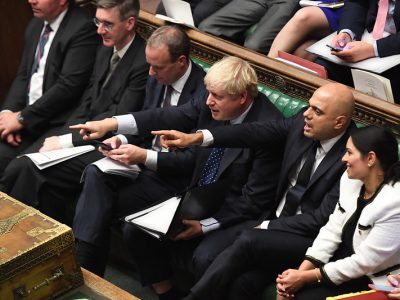
British voters are sick of talking about Brexit

WP_Post Object
(
    [ID] => 1323
    [post_author] => 2
    [post_date] => 2019-08-16 18:54:45
    [post_date_gmt] => 2019-08-16 18:54:45
    [post_content] => 

Theresa May was the only one willing and able to take on the job of trying to clean up the mess the boys made, but it was an impossible task.

Things started going downhill in the United Kingdom about 38 months ago. Well, it could be 41, if you really want to be precise. In February 2016, then-Prime Minister David Cameron announced that there would be a referendum on Britain’s membership of the European Union. The choice was between “Leave” and “Remain.”  At the time, the widely-held assumption was that the Remain campaign would win, with Cameron staying on for a few more years, and then eventually handing the reins to another Conservative politician of his choosing.

The results of the June 23, 2016 referendum shocked liberal Britons in particular and the world in general, just as much as the election of Donald Trump shocked Americans and the world four-and-a-half months later.

It is now August 2019 and Britain is getting ready to leave the bloc without a deal. Boris Johnson, the new prime minister and one of the leaders of the Leave campaign, has said a hard Brexit is his wish. Johnson replaced Theresa May on July 24, after she resigned in light of her failure to broker a deal to exit the EU that would satisfy her own party.

Remain voters feel ignored and unhappy; soft Brexit voters feel things are going too far and are unhappy; hard Brexiteers do not believe that Britain will leave the EU and are unhappy. The country is fractured and no person or party looks capable of bringing everyone together again.

David Cameron, meanwhile, is getting ready to publish his memoirs, which he reportedly wrote in a bespoke £25,000 ($30,000) shed, complete with wood-burning fireplace and sofa-bed, in the garden of his “quintessentially English” Cotswolds home. So, what went wrong?

The main answer, as it often is, comes from the hubris of men. First Cameron, with his unearned confidence, called the referendum to quell internal disagreements in his party. He was certain that he would win, and then he did not.

As the Remain campaign discovered slightly too late, a country that had just gone through six years of savage cuts to public services did not take kindly to the architects of said austerity warning them that if they voted to leave, there might be less money in the coffers. Many banks warned they would leave Brexit Britain, but such threats were not exactly convincing to those on the breadline, who had little hope of becoming more prosperous anytime soon.

The Remainers were convinced they would win easily, and were not ready for the Brexiteers’ intense, relentless and occasionally disingenuous approach to campaigning. Instead, they spent too much time trying to counter dubious claims about the EU, and not enough reminding people why the EU was a good thing for the country.

As one writer put it in the aftermath, “In confronting populist demagoguery, it isn't enough to attack its promulgators. To get people to turn out and vote in your favor, you also have to give them something positive to rally behind.”

That the debate was overwhelmingly male had something to do with this disastrous turn of events, perhaps. In May 2016, Labour grandee Harriet Harman hit out against the lack of female voices leading the referendum campaigns; she quoted a study, which found that only 16% of television appearances on EU issues had been women. She was largely ignored.

A month later Leave won, by 52% to 48%, and no-one quite knew what to do. After all, damaging over-confidence had not been a side-specific issue; when Conservative MPs Boris Johnson and Michael Gove gave their victory speeches on June 24th, they looked terrified.

It is now clear that senior figures in the Vote Leave campaign had spent little time preparing for what would happen if they were to win, instead running a campaign conveniently promising all things to all people. Do you want Britain to be a buccaneering nation, ultra-liberal and open to the world? Brexit can make that happen. Do you yearn for the Britain of the past, and wish your country could shut itself from the world, and from the people wanting to move to the islands? There’s a Brexit for that — and so on.

David Cameron, who was a Remainer, resigned from his office and retired from politics after the Leave campaign won the referendum that he had called. Within weeks Theresa May, who was also a Remainer, replaced him. She was not quite the best candidate, but she was the only one willing and able to take the job.

Boris Johnson, the face of the Vote Leave campaign, wanted to run for party leadership. But Michael Gove, the other face of Vote Leave, stabbed him in the back; Gove ran instead, and the party didn’t back him. The boys had made a mess and as is so often the case, a woman had to come in and pick up the pieces, much to the glee of the boys in question. As May won, one male Conservative MP welcomed the news with a hearty “here comes Mummy!” Dry heave is appropriate.

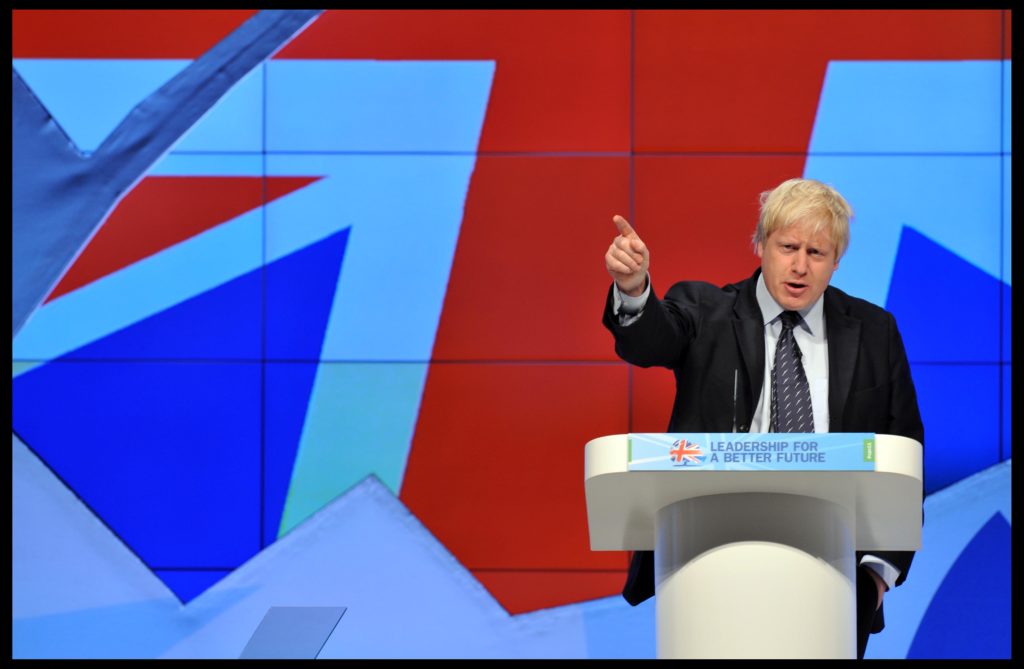
[caption id="attachment_1324" align="aligncenter" width="640"] Boris Johnson addressing the Conservative Party Conference in Manchester on October 4, 2011.[/caption]

This is where things could have picked up; the moment when the country could have come together. In a different world, May would have announced that the result of the referendum had been close, and that it called for a Brexit that kept Britain close to the European Union, in order to honour the winning side without alienating the others. Even if unenthusiastic about the compromise, Brexiteers could have rallied around her and accepted their narrow margin of victory, and Remainers could have gracefully accepted their defeat and constructively worked with those who had beaten them.

This, of course, is not what happened. Already in a tough position, May made her own life worse by pandering to the harder Brexiteers and, perhaps overcompensating for her Remainer past, all but ignoring everyone else. The Brexit fanatics used this opportunity to harden their lines every step of the way, while shellshocked Remainers floundered, and failed to do much but yap from the sidelines.

This is when things started to get steadily worse. Entire books could be written about what happened between the summer of 2016 and the summer of 2019, but in short: May called an election to get a bigger majority in Parliament and was instead left with no majority at all, the hard Brexiteers kept voting against the Brexit deal May got because they thought it wasn’t a hard enough Brexit, everyone else wasted more time arguing about whether they wanted no Brexit, a second referendum or a soft Brexit than doing anything else, and in a day of “indicative votes” (test votes), MPs showed that not a single Brexit outcome had a majority in the House of Commons.

If you want to picture it, it was a bit like one of those scenes in cartoon where the unlucky main character slips on a banana peel, stands up, steps on a rake, stands up again and then walks straight into a glass door, on repeat, for three years.

Still, the themes remained similar. There was the hubristic assumption from Remainers that as Brexit negotiations would get worse, enough people would fling back to their side (they didn’t), and the hubristic assumption from Brexiteers that all problems with the negotiations would simply fade away if people started believing in Brexit enough (they didn’t).

In a way, the natural conclusion to all this was always going to be Boris Johnson. The former London mayor is a serial cheater, has an unknown number of love children, no principles to speak of, and is interested in little but power. What he excels at is boisterous self-confidence, and an ability to speak with conviction on anything he believes would be useful for him to talk about. His gaffes are frequent and his blunders dangerous, but to his fans he represents the one true Brexit believer who can deliver on all those impossible promises. As has become received wisdom in Britain, it is sufficient to believe in things very hard in order to make them come true; he may not be fond of the comparison, but Johnson is the Tinkerbell of Brexit, Lost Boys very much in tow.

What happens now remains unclear; Johnson won on a platform of leaving the EU on the October 31st deadline “do or die.” He insists that leaving without a deal is not something he wants, but he will not bring May’s deal back to Parliament for one last go, and there is not enough time to negotiate another deal and get it through the Commons. Still, he believes something will happen therefore it must be true.

Members of Parliament, meanwhile, insist that they will stop Johnson from going for no-deal, despite the awkward fact that there is not much they can do about it. Still, they believe — well, you get the point.

As Westminster tribes keep fighting to see which will make the best Icarus, the country they govern remains entirely split along the lines drawn on June 23rd. Where you stand on Brexit is now as important (if not more) than which party you usually vote for, or any other characteristics identities are usually built upon.

It did not have to be this way, of course. The opportunities for healing were always going to be rare and complex, but they did exist and no-one took them up. After all, doing so would have involved coming to terms with reality, unpleasant and imperfect as it may be. Forty-one months on, Britain stands on the brink of destroying itself for no reason; by the time its economy tanks and it scrambles to rebuild its relationships with the EU and the rest of the world, it will be too late for anyone to be the bigger person.

Given the wider context, it might be unwise to suggest Brits now turn to culture from the continent for advice, but they could do worse than revisit the most famous scene from the cult French movie La Haine: “Heard about the guy who fell off a skyscraper? On his way down past each floor, he kept saying to reassure himself: So far so good... so far so good... so far so good. How you fall doesn't matter. It's how you land!”

https://www.youtube.com/watch?v=Uz9vgtXq_Hs

[post_title] => How less-than-great men brought Britain to its worst hour [post_excerpt] => It is now clear that senior figures in the Vote Leave campaign had spent little time preparing for what would happen if they were to win, instead running a campaign conveniently promising all things to all people. [post_status] => publish [comment_status] => closed [ping_status] => open [post_password] => [post_name] => how-less-than-great-men-brought-britain-to-its-worst-hour [to_ping] => [pinged] => [post_modified] => 2026-08-06 23:24:36 [post_modified_gmt] => 2026-08-06 23:24:36 [post_content_filtered] => [post_parent] => 0 [guid] => https://conversationalist.org/?p=1323 [menu_order] => 306 [post_type] => post [post_mime_type] => [comment_count] => 0 [filter] => raw )
How less-than-great men brought Britain to its worst hour

WP_Post Object
(
    [ID] => 1289
    [post_author] => 2
    [post_date] => 2019-08-08 20:59:43
    [post_date_gmt] => 2019-08-08 20:59:43
    [post_content] => “I did not oppose busing in America. What I opposed is busing ordered by the Department of Education. That’s what I opposed.” — Joe Biden to Kamala Harris at the June 27 Democratic primary debate

Responding to Biden's comment, investigative journalist Nikole Hannah-Jones, explains in the New York Times why busing succeeded in some parts of the country and failed in others — and also why the term "busing" is inaccurate for what was, in fact, "court-ordered school desegregation."

[The fact that] Americans of all stripes believe that the brief period in which we actually tried to desegregate our schools was a failure, speaks to one of the most successful propaganda campaigns of the last half century.

If there was a problem with busing, Hannah-Jones continues, it was that it was too successful, too good at desegregating schools in segregated cities and towns. Between 1964 and 1972, the proportion of black children attending white schools in the South rose from just two percent to nearly half. "The South," observes Hannah-Jones, "Had gone from the most segregated region of the country for black children to the most integrated, which it remains 40-some years later.” In the northern states, however, wealthy white urban parents organized against enforced busing so effectively that the policy eventually failed. Today, most school districts in cities like New York and Chicago are de facto segregated. Brown v. Education was not a court case about a child’s right to a better school on the other side of town, Hannah-Jones points out, but one about a child’s right to attend the school in her own neighborhood. The issue that Biden and others opposed was always integration, not busing. Now, three years into the Trump presidency, we are seeing the consequences of segregated neighborhoods and schools.  “De facto segregation of public schools continues to thrust aside the critical democratic experience of learning and conversing with racial Others during the formative years of human and citizen development,” MIT professor J. Phillip Thompson wrote in 2017, not long after Donald Trump took office. Segregation, he explains, means that people "are less likely to recognize commonalities in their values – concern for family, respect for hard work, willingness to help others." In the absence of mutually acknowledged humanity, it's a short step to "scapegoating and divisive politics." Segregation affects individuals and society in a variety of ways. One study by Boston University showed that black neighborhoods and white neighborhoods are policed differently, which accounts for the racial disparity in police shootings.

“A common refrain in the age of Trump is: ‘This is not who we are,’” David Smith writes in The Guardian. “A common riposte is to point to America’s long history of slavery, segregation and violence and say: ‘This is exactly who we are.’”

Most alarming about the racism exacerbated by segregation is that it has led to domestic terrorism, with mass shootings that target visible minorities. Segregated online spaces are fostering racist vitriol. “He truly believed wild conspiracy theories he read on the internet, many of which vilified Democrats and spread rumors that Trump supporters were in danger because of them,” wrote the defense lawyers for Cesar Sayoc Jr., who sent bombs to Democrats and journalists who had publicly taken on Trump. The hope and inspiration during these dark times lie with people and groups working to desegregate our society in different ways. In Houston, a city program called Build Up Houston seeks to empower and hire black business owners. Black and white ministers are working together to bridge the racial divide in churches and other faith-based spaces. Latinx activists, sometimes excluded from the black/white dichotomy, are establishing social and political movements that are founded on neither “American exceptionalism [nor] American aversion.” In 2017, Thompson identified "morally-based organizing" across races as an essential endeavor to combat white supremacism. "How to convene the public when the majority (including a majority of blacks and Latinos) is dispersed in segregated suburbs is a pressing practical issue," he wrote. If we want to save democracy, we'll have to figure out the means of traversing the physical and the racial divides.  [post_title] => Why Joe Biden's former position on school busing is anti-democratic [post_excerpt] => Between 1964 and 1972, court-enforced busing successfully desegregated public schools in the American South. But in the north, white parents in urban centers organized to oppose the policy — which eventually failed. Today, southern public schools remain integrated while northern public schools are de facto segregated. [post_status] => publish [comment_status] => closed [ping_status] => open [post_password] => [post_name] => democracy-withers-in-the-darkness-of-racism [to_ping] => [pinged] => [post_modified] => 2024-08-28 21:11:30 [post_modified_gmt] => 2024-08-28 21:11:30 [post_content_filtered] => [post_parent] => 0 [guid] => https://conversationalist.org/?p=1289 [menu_order] => 308 [post_type] => post [post_mime_type] => [comment_count] => 0 [filter] => raw )

Why Joe Biden’s former position on school busing is anti-democratic

WP_Post Object
(
    [ID] => 1259
    [post_author] => 2
    [post_date] => 2019-07-26 18:42:23
    [post_date_gmt] => 2019-07-26 18:42:23
    [post_content] => Despite the bleakness of the current political moment, the slide to authoritarian oligarchy is not inevitable.

America’s inequality crisis has emerged as the central issue of the 2020 presidential campaign. The realization that “it’s the economic inequality, stupid,” was a long time coming, given that the global economic crisis of 2008 is now more than a decade behind us. During the intervening years the global grassroots Occupy movement demonstrated for months to raise awareness, staging sit ins on Wall Street in New York and in major cities across Europe. In remarks delivered in 2013, Barack Obama called economic inequality “the defining challenge of our time.” And three years ago an anti-establishment voter revolt gave the United States its first plutocrat president in the form of Donald J. Trump. Americans have at last come to understand the effect of economic inequality on their lives. But the question of how to address inequality is fraught with controversy.

At the Democratic party debates in June, nearly all of the candidates for the presidential nomination railed against the U.S. economy for benefitting only the very rich. Senators Elizabeth Warren and Bernie Sanders, who have made inequality their signature issue, have both proposed detailed plans that would completely remake the American economy. Even frontrunner Joe Biden, for years affiliated with centrist politics, noticed that progressivism was rising in popularity; he too is now talking about inequality—with his donors.

All this is a far cry from the “America is already great” message that hampered the Clinton campaign in 2016, but is undoubtedly closer to the way Americans actually feel. Six years ago, the English edition of Thomas Piketty’s seminal book Capital in the Twenty-First Century was published, becoming a surprise bestseller and a cultural phenomenon. At the time, economists regarded as controversial Piketty’s warning that if the concentration of wealth and power remains unchecked we risk repeating the adverse conditions of the nineteenth century. In a 2016 paper, however, French economists Emmanuel Saez and Gabriel Zucman showed that American inequality is at levels unseen since the Roaring 1920s, with the top 0.1 percent controlling 22 percent of the wealth. This year, former Fed chairman Paul Volcker told the New York Times that the U.S. is “developing into a plutocracy.” Nobel laureate economist Joseph Stiglitz has written that the American economy is “rigged.” In the media, you can often see our current era referred to as the Second Gilded Age, after the period between the end of the Civil War and the beginning of the twentieth century, when inequality ran rampant and robber barons like Andrew Carnegie, John D. Rockefeller and J. P. Morgan plundered and pillaged their way into unimaginable wealth.

But Americans, who encounter extreme concentrations of wealth and power wherever they turn these days, don’t need economists to tell them what they already know: that capitalism, or at least their country’s form of it, is broken — perhaps irreparably. While the U.S. is among the world’s wealthiest countries, it is also, according to the UN, “the world champion of extreme inequality.” Forty million Americans live in poverty; in some areas of the country, life expectancy is equivalent to that of developing states. Meanwhile, “deaths of despair” — caused by drug abuse, alcoholism and suicide — have spiked. According to the UN, Americans lead “shorter and sicker lives, compared to people living in any other rich democracy.”

The American Dream — the idea that if you worked hard, you could succeed regardless of where you were born or what your parents earned — is still the national ethos, despite the fact that the U.S. currently has the lowest rate of economic mobility of any industrialized democracy. In contrast to earlier generations, very few young Americans will do better than their parents: they are buried in debt, struggling with rising rents and healthcare costs, and see more deaths from suicide and drug overdose than any other age group. The life trajectory of most contemporary Americans is inextricably linked to their parents’ education and income, and to their geographic location. A recent study by researchers at the N.Y.U. School of Medicine, for instance, found a 30-year gap in life expectancy between two neighborhoods in Chicago, one rich and one poor.

Republicans, meanwhile, passed an enormous $1.5 trillion tax cut for the wealthy and are now considering another one, while trying to cut Social Security and kick millions off Medicaid. White-collar crime prosecutions are at a record low, the president is openly corrupt, and corporate lobbyists literally run the government. Is it any wonder that polls have repeatedly shown that over two thirds of Americans believe the economic and political systems are rigged in favor of big business and the rich? This is why millions of voters paid attention when Donald Trump said during his presidential campaign that “the American dream is dead.”

While growing inequality has long been a fact of American life, income inequality has increased dramatically since the mid-1970s, to the point where the top one percent now earn 26.3 times more than the other 99 percent. And while the top one percent’s share of the nation’s earnings has doubled during that period, the top 0.1 percent fared even better: their incomes quadrupled, even as incomes for the bottom 90 percent, once adjusted for inflation, have remained stagnant.

But it is the distribution of wealth that truly highlights the vast disparities hidden by four decades of policies that have created the illusion of economic prosperity. In the U.S. today, wealth is concentrated to such an extent that three men alone — Bill Gates, Jeff Bezos, and Warren Buffett — are richer than the bottom half of the entire population. Recent data released by the Federal Reserve reveals in startling detail how the distribution of wealth in the U.S. became so unequal. Matt Bruenig of the People’s Policy Project, who analyzed the data, calculated that between 1989 and 2018, the net worth of the top one percent increased by $21 trillion, while the bottom 50 percent became poorer to the tune of $900 billion during the same period. In 2018, Bruenig finds, the top one percent owned “nearly $30 trillion of assets while the bottom half owns less than nothing, meaning they have more debts than they have assets.”

A 2018 study by researchers at the University of Bonn shows how the 2008 financial crisis exacerbated U.S. inequalities, particularly for black households, as the crisis contributed to the widening of a racial wealth gap that had already persisted for decades due to systemic discrimination. According to the authors, the median black household has only 12 percent of the wealth of a median white household and earns about half the income, leaving black households 80 percent poorer than white households. The economic crisis of 2008 erased the few gains they had made, while over the past 70 years “virtually no progress” has been made in reducing wealth inequality between blacks and whites in the United States.

The U.S. is the most extreme example, but most of the world has seen increased inequality over the past 40 years. In the U.K., deaths of despair have spiked following a decade of deliberately cruel austerity policies. In France, 2018’s gilets jaunes protests highlighted the country’s inequality crisis, partly fueled by Emmanuel Macron’s policy of cutting taxes to the top one percent while leaving those clinging to the lowest rungs of the income ladder worse off.

The causes of rising inequality vary from country to country, but in the U.S. and Europe the economic literature points to a few culprits. These include automation, the decline of organized labor, financial deregulation, regressive tax systems that allow the rich to cut their own taxes, and globalization. In the U.S. in particular, a growing body of research points to monopoly power and diminishing competition across the American economy as a major contributor. Among economists, a new movement highlights the negative impact done by decades of policies based on dubious market fundamentalist reasoning.

At the heart of all this is the ongoing failure of capitalist democracies to counter growing concentrations of wealth and power, which in turn fuel voter discontent and elevate populist authoritarians to power worldwide. In recent years many have raised the questions of why liberal democracy failed to address the rise of economic insecurity, or why the popular backlash to rising inequality has been marked by a turn toward far-right nativism —  as opposed to, say, a demand for higher taxes on the rich. Some, like Harvard economist Dani Rodrik and author Thomas Frank, argue that the answer lies in the left and center-left parties’ abdication of their historical responsibility toward low-income workers. Whereas the right has always been up front about its allegiance to business elites, the complicity of center-of-left parties in the policies that increased inequality has made them ill-equipped to address the problems that they helped create. A 2018 study by Piketty seems to confirm this view.

With democracies unable to ensure prosperity for all but the rich and well-connected, support for democracy is decreasing. In a recent speech, Angus Deaton, the Nobel Prize-winning economist, declared that rising inequality threatens democratic capitalism. But it’s not the “capitalism” part that’s under threat. Despite their populist protestations, far-right authoritarians like Brazil’s Jair Bolsonaro and Donald Trump are not opposed to rabid capitalism or even globalization—they just don’t believe democracy must be a part of it, or that it should stop them from giving handouts to their friends. Vanderbilt law professor Ganesh Sitaraman explains that the real threat to liberal democracy “isn’t authoritarianism—it’s nationalist oligarchy.” If left unchecked, the future of Western democracies could look a lot like Brazil, where pervasive inequality and lack of elite accountability gradually eroded support for democracy until the authoritarian Bolsonaro could rise to power — with the help of the country’s business elites.

Despite the bleakness of the current political moment, the slide to authoritarian oligarchy is not inevitable. One remedy, particularly in the U.S., is tougher enforcement of antitrust laws, which is necessary to constrain the power of corporate monopolies. Another, as historian-turned-folk hero Rutger Bregman told members of the global elite gathered in Davos earlier this year, is astoundingly simple: “Taxes, taxes, taxes.” Our current system, as documented by Zucman, is built upon massive tax evasion amounting trillions of dollars, by multinational corporations and the ultra-rich. Any solution to our inequality crisis necessarily involves wealthy people paying their fair share.

Any attempt at meaningful reform, however, would inevitably have to contend with the fact that all of our political and regulatory institutions have been completely captured by big business and the rich. Which brings us back to the 2020 elections.

The 2020 presidential election is not just a referendum on Trump’s authoritarian populism. It is also a test case for the ability of democratic capitalism to correct itself. The Democratic party’s candidate is thus a critical matter, whether that person is a progressive like Sanders or Warren, whose promises include a more equitable construction of the American economy, student debt forgiveness, reining in corporate power and a wealth tax; or a lifelong neoliberal centrist like Biden, who recently promised his donors that despite his newfound interest in income inequality, under his presidency “no one’s standard of living will change, nothing will fundamentally change.”

The choice goes beyond the likelihood of defeating Trump, straight to the heart of the debate over what American capitalism, and democratic capitalism in general, mean in the twenty-first century. Does democracy mean an oligarchy rooted in injustice, which is what we have had for the last few decades; or should it be a system that benefits the whole of society, rather than only a select few?
    [post_title] => In 2020, America will decide between oligarchy and egalitarianism
    [post_excerpt] => While growing inequality has long been a fact of American life, income inequality has increased dramatically since the mid-1970s, to the point where the top one percent now earn 26.3 times more than the other 99 percent. 
    [post_status] => publish
    [comment_status] => open
    [ping_status] => open
    [post_password] => 
    [post_name] => the-2020-presidential-election-will-either-make-or-break-democratic-capitalism
    [to_ping] => 
    [pinged] => 
https://democracyjournal.org/magazine/51/countering-nationalist-oligarchy/
    [post_modified] => 2026-09-15 23:00:00
    [post_modified_gmt] => 2026-09-15 23:00:00
    [post_content_filtered] => 
    [post_parent] => 0
    [guid] => https://conversationalist.org/?p=1259
    [menu_order] => 310
    [post_type] => post
    [post_mime_type] => 
    [comment_count] => 0
    [filter] => raw
)

In 2020, America will decide between oligarchy and egalitarianism

WP_Post Object
(
    [ID] => 1225
    [post_author] => 2
    [post_date] => 2019-07-19 20:06:03
    [post_date_gmt] => 2019-07-19 20:06:03
    [post_content] => Is racist the new four-letter word?

On Wednesday night at a rally in North Carolina, President Trump falsely claimed that Congresswoman Ilhan Omar, a refugee from Somalia who became a U.S. citizen when she was a child, was a supporter of Al Qaeda. Then he stood and watched as his supporters chanted “Send her back! Send her back! Send her back..!” That rally capped several days of Trump’s well-publicized incitement against the four junior congresswomen known as the Squad — Rashida Tlaib, Alexandria Ocasio-Cortez, Ayanna Presley, and Ilhan Omar — who have been vociferously critical of President Trump and his policies.

“If they don’t love [America],” said the president, “tell them to leave it.”

In their coverage of this story, legacy media outlets ranging from The New York Times to CNN finally embraced the term “racist” to describe the president’s words. Their use of this word became a story in itself, with Trump supporters denying the president’s words were racist. “It’s not racist to say love it or leave it,” said Senator Lindsey Graham. He added: “A Somali refugee embracing Trump would not have been asked to go back.”


Even if one were to agree with Graham that “send her back” was not necessarily racist, one would be hard-pressed to reconcile the core right to freedom of expression in a democracy with the idea that an immigrant who exercised that right by criticizing the president's policies should be deported.

Other Republican representatives were clearly uncomfortable with the “send her back” chant, but they didn’t want to label the president a racist, so they split the difference: The crowd was wrong, said Representative Tom Emmer (R-MN), but the president “didn’t have a racist bone in his body.” Emmer did not comment on the fact that the president stood silently for 13 seconds as the crowd he’d been working into a frenzy for the previous quarter of an hour chanted rhythmically.

Trump is, of course, notorious for his misogyny. But besides their gender, the four Democratic representatives he attacked are also all people of color. Bernie Sanders shares the same political views, but Trump did not single him out. Sanders is, of course, a white man. Meanwhile, Nancy Pelosi — who has a testy relationship with the Squad — successfully pushed through a House resolution to condemn Trump for his racist comments, overriding Republican objections and a parliamentary ruling that deemed the term an insult and thus not allowed.

The partisan argument over what constitutes racism is the driving force behind the reluctance of legacy media outlets to use the term. Editors are afraid that if they label someone a racist, the media outlet will no longer be considered an objective source of information. There is a whole separate argument over whether or not objectivity is possible or desirable in these troubled times. When, for example, The New York Times published a controversial profile of a white supremacist that made him sound like an ordinary guy who loved his family but happened to hold some extremist views, critics charged that the paper had lent credibility to a Nazi by presenting a humanizing portrait in the pages of the country’s most prestigious newspaper.

One expert argued that using the term "racist" was counter-productive because it made the person accused of racism defensive, and that the ensuing argument over whether or not the term was appropriate deflected attention from meaningful and substantive policy discussions.

But as Trump engages increasingly in overt racist incitement, the legacy media are re-examining their editorial policy. Over the past two days, The New York Times, Washington Post, CNN, MSNBC, and other prominent reporting platforms have all used the term “racist,” to describe the president’s comments. As Maria Bustillos explains in the Columbia Journalism Review: “The language of distance and delicacy is based in good faith; where good faith is absent, delicate language does little more than normalize things like racism and cruelty.” In other words, sometimes going high when others are going low can be counter-productive.
    [post_title] => Why editors are so reluctant to label Donald Trump a racist
    [post_excerpt] => The use of the term "racist" became a story in itself, with Trump supporters denying the president’s words were racist. “It’s not racist to say love it or leave it,” said Senator Lindsey Graham. He added: “A Somali refugee embracing Trump would not have been asked to go back.”
    [post_status] => publish
    [comment_status] => open
    [ping_status] => open
    [post_password] => 
    [post_name] => why-editors-are-so-reluctant-to-label-donald-trump-a-racist
    [to_ping] => 
    [pinged] => 
    [post_modified] => 2024-08-28 21:15:14
    [post_modified_gmt] => 2024-08-28 21:15:14
    [post_content_filtered] => 
    [post_parent] => 0
    [guid] => https://conversationalist.org/?p=1225
    [menu_order] => 312
    [post_type] => post
    [post_mime_type] => 
    [comment_count] => 0
    [filter] => raw
)

Why editors are so reluctant to label Donald Trump a racist

WP_Post Object
(
    [ID] => 1210
    [post_author] => 2
    [post_date] => 2019-07-12 16:16:52
    [post_date_gmt] => 2019-07-12 16:16:52
    [post_content] => The proud feminists who aspire to be the Democratic presidential nominee in 2020 haven't said much about how U.S. foreign policy affects women around the world. Maybe they should.

As a Pakistani woman, I cannot vote in the 2020 elections. But as a non-American Muslim feminist who lives in the global south I wonder what impact the election of a female American president might have on women like me. Would a woman in the Oval Office be good for citizens of Muslim-majority countries in South Asia and the Middle East?

Feminism and women’s rights are dominant issues in the current American political discourse, with four of the female candidates for the Democratic party’s nomination vowing to fight back against the Trump administration’s attempts to undermine them. Kirsten Gillibrand, reports The New York Times, is placing “women’s equality and opportunity at the center of her policy agenda.” Tulsi Gabbard has a clear position on women’s issues: she is pro-choice, supports programs to help domestic violence victims, advocates equal pay (although she has not signed the Paycheck Fairness Act), and opposes sex trafficking. Elizabeth Warren has a strategy to protect women’s reproductive rights and another one to fix America’s failing child care system. Kamala Harris backs the passing of the Equal Rights Amendment and supports pro-choice legislation; and as a black American woman, she represents the rights of women of color, who face discrimination based on both race and gender.

American government policy has profound implications for women all over the world. For example, Trump’s decision to reinstate the Reagan-era Global Gag Rule has defunded aid programs that counsel poor women on reproductive health or provide abortions. His decision to cut funding to the UN Population Fund means that women in war zones, refugee camps, and disaster-hit areas no longer have access to free contraception.

Precedents set by women who held powerful positions in Democratic administrations are not necessarily promising. Both Madeleine Albright, appointed the first female secretary of state by Bill Clinton, and Hillary Clinton, who served as Barak Obama’s secretary of state, implemented policies that had a profoundly negative impact on the lives of millions of Muslim women in Iraq, Syria, Afghanistan and Libya. The wars and conflicts that Albright and Clinton supported undermined the health and wellbeing of millions of women and their children. Both Clinton and Albright whitewashed their policies with the phrase “humanitarian war,” while one of the widely heard justifications for the U.S. military invasion of Afghanistan was to claim that it was “a fight for the rights and dignity of women.”

But war does not improve the lives of female civilians — particularly not in socially conservative societies. According to the World Health Organization (WHO), “gender-based inequity is usually exacerbated during situations of extreme violence such as armed conflict." This is certainly true in Afghanistan. The U.S. has been fighting its longest war there since 2001, with female civilians paying the highest prices in both mortality and human rights. “The legacy of war is killing our freedom,” says Jameela Naseri, a lawyer with the NGO Medica Afghanistan, in a 2018 article for Time. According to data cited by the reporter, Afghanistan is still ranked the worst country in the world to be a woman: 90% of Afghan women have experienced domestic abuse, while 87% are illiterate.

In Iraq and Syria, women and children have suffered the most from the recent and ongoing wars. The power vacuum left in Iraq following the U.S.-led military intervention was filled by ISIS, which made atrocities against women an everyday occurrence. Women who managed to escape from ISIS-held territory were often destitute and had to sell sexual favors for food; they suffered from malnutrition because men controlled food distribution in war-ravaged areas; and cultural strictures kept them from accessing health services or going to school during war.

As a U.S. senator, Hillary Clinton voted for the invasion of Iraq in 2002. Madeleine Albright infamously told journalist Leslie Stahl, during a 1996 interview for 60 Minutes, that the deaths of half a million Iraqi children as a consequence of U.S. sanctions were “worth it.” When she was Secretary of State, Hillary Clinton authorized nearly 300 drone attacks in Pakistan, which had a direct effect on the safety and security of millions of girls and women in the northwestern region, already traumatized by the reign of the Taliban.

A female president could correct these poor precedents by championing the cause of women’s rights in countries afflicted by war, political instability, or regressive societal and cultural codes that result in massive discrimination against women. This could be good news for many Muslim women, who are struggling mightily for emancipation, empowerment, and opportunities in their own countries. The coming years will probably be critical for Muslim women: they are finding their voice, and their struggle is gaining critical mass and support from Egypt to Indonesia.

If a woman were elected president in 2020, would she adopt the "feminist foreign policy" that Margot Wallstrom, Sweden's foreign minister, tried to promote in 2015? Probably not. Wallstrom lost her job in part because of the diplomatic rows her stance provoked with Saudi Arabia and her position on Israel vis-a-vis Palestine. Clinton made no such mistakes during her stint as Secretary of State; she maintained a strategic relationship with Saudi Arabia, even as she maintained that women's rights were of utmost importance to her.

Many Americans associate pacifism with weakness, and no woman who aspires to the presidency can afford to be perceived as weak. A hawkish foreign policy combined with a warm and caring outlook for America might be the winning combination for a female President.

How are these four female candidates taking this dynamic on board their campaigns?

Tulsi Gabbard opposes Trump’s hawkish policy on Iran and advocates ending the U.S. military presence in Afghanistan, but she has also met with Bashar al-Assad, who is largely responsible for the deaths of hundreds of thousands of Syrian civilians. Elizabeth Warren advocates progressive domestic policies, but she has voted in favor of hawkish foreign policy initiatives such as a 2017 bill to impose sanctions on Iran. Kamala Harris has voted against resolutions condemning Israel for destroying Palestinian villages or using lethal force in Gaza, although the ongoing occupation of Palestinian territory under Israeli rule is crushing the lives of Palestinian women and girls.

A female president who campaigned as a feminist would have to reconcile her commitment to the advancement of women's rights around the world with the well-established relationships between the United States and Middle Eastern countries that oppress women. I see nothing yet in any of the female candidate’s foreign policy record or platform that indicates an interest in improving conditions for women in Middle Eastern countries that suffer from poverty, war, and repressive dictatorships.

The women who aspire to be president of the United States must recognize that American foreign policy decisions made by her predecessors have created terrible hardship for millions of women. They must be aware of the disproportionately high cost of war to women and children, and consider how to reverse this trend. For example, they could make the landmark UN Resolution 1325 on  Women, Peace, and Security part of U.S. foreign policy. Or they could employ gender experts with on-the-ground experience in Afghan women's rights  to formulate effective programs that will help women regain their ground after decades of war.

A female president who aspires to undo the damage wrought by U.S. foreign policy on Muslim women globally will face significant challenges. But if she makes that effort, she could become the champion of women that the world so badly needs right now.

 
    [post_title] => Would a female president be a feminist for the world, or only for America?
    [post_excerpt] => A female president could champion the cause of women’s rights in countries afflicted by war, political instability, or regressive societal and cultural codes that result in massive discrimination against women. This could be good news for many Muslim women, who are struggling mightily for emancipation, empowerment, and opportunities in their own countries. 
    [post_status] => publish
    [comment_status] => open
    [ping_status] => open
    [post_password] => 
    [post_name] => if-a-women-were-president-would-she-be-a-feminist-for-all-or-only-for-americans
    [to_ping] => 
    [pinged] => 
    [post_modified] => 2026-09-15 22:50:43
    [post_modified_gmt] => 2026-09-15 22:50:43
    [post_content_filtered] => 
    [post_parent] => 0
    [guid] => https://conversationalist.org/?p=1210
    [menu_order] => 314
    [post_type] => post
    [post_mime_type] => 
    [comment_count] => 0
    [filter] => raw
)

Would a female president be a feminist for the world, or only for America?

WP_Post Object
(
    [ID] => 1173
    [post_author] => 2
    [post_date] => 2019-06-27 15:09:19
    [post_date_gmt] => 2019-06-27 15:09:19
    [post_content] => Two of the leading candidates for the Democratic party's nomination unveiled plans to deal with the student debt crisis — and were met with a chorus of critics.

On Monday, Senator Bernie Sanders proposed eliminating all student debt, to the tune of $1.6 trillion. Sanders also wants to make public universities, community colleges, and trade schools all tuition-free. With his proposal, Sanders has one-upped Elizabeth Warren, his main opponent for the Democratic party nomination. Warren’s proposal is for a tiered loan forgiveness plan — up to $50,000 based on household income.

But while student debt is an enormous burden for both individuals and the economy, critics have nonetheless objected to the plans put forward by both Sanders and Warren. Kevin Carey, who directs the education policy program at New America, the Washington, D.C. think tank, writes in the New York Times that the plans fail to account for the largest cause of student debt in the United States — i.e., graduate and professional school programs. Adam Looney, a Brookings fellow cited in The Wall Street Journal, says that Warren’s plan would benefit higher earners. Matt Bruenig, a policy analyst who founded the People’s Policy Project, grapples with some of the inconsistencies in the plans; but he does not see any potential benefits.

However, as author and documentary filmmaker Astra Taylor reminds us in The Guardian, the call for student debt forgiveness began with grassroots organizing. The Debt Collective, an organization she co-founded, organized student strikes that resulted in the cancellation of more than $1 billion in debt acquired by people who attended fraudulent for-profit colleges. Nor is the Brookings Institute’s analysis the last word on “fairness”: Taylor cites research by sociologist Tressie McMillan Cottom and economist Darrick Hamilton, which shows that student debt disproportionately affects women and people of color. Debt forgiveness could help close the racial wealth gap.

Meanwhile, more than 150,000 victims of deceptive practices by for-profit colleges are suing the Department of Education for failing to deliver on debt relief that is already guaranteed by existing laws.

In other news:

Is your vacation ethical? Writing in Yes Magazine, travel writer Bani Amor asks how we can decolonize vacations. Read more. Why is a 40-year veteran of the environmental movement feeling hopeful? Read the op-ed. Meet the big-name brands that want to buy back your old clothing to reuse and recycle. Read more. [post_title] => Searching for a way to rescue the American dream [post_excerpt] => Senators Warren and Sanders, both candidates for the Democratic party nomination, have unveiled concrete plans that would address the prohibitive financial burden of higher education [post_status] => publish [comment_status] => open [ping_status] => open [post_password] => [post_name] => searching-for-a-way-to-rescue-the-american-dream [to_ping] => [pinged] => [post_modified] => 2026-09-15 22:48:57 [post_modified_gmt] => 2026-09-15 22:48:57 [post_content_filtered] => [post_parent] => 0 [guid] => https://conversationalist.org/?p=1173 [menu_order] => 318 [post_type] => post [post_mime_type] => [comment_count] => 0 [filter] => raw )

Searching for a way to rescue the American dream

WP_Post Object
(
    [ID] => 1076
    [post_author] => 2
    [post_date] => 2019-05-31 16:43:38
    [post_date_gmt] => 2019-05-31 16:43:38
    [post_content] => The decline in international news coverage over the past two years has worrying implications

My friend used to chain smoke cigarettes as he reported from the front lines of Libya’s civil war and from Cairo’s Tahrir Square during the tumultuous 2011 Arab Spring. Today, he lives in Washington, D.C., where he has an exciting job covering U.S. news as well as a dog, and a new baby. My friend belongs to a wave of American journalists who were once foreign correspondents but have over the past couple of years shifted back to the United States. Now he reports from a different front line — the Trump White House. This shift of reporters from foreign beats to the domestic one reflects a worrying decline in rigorous international news coverage.

In 2018, six out of 10 of the top stories published by the Washington Post were Trump-related. This could be because readers are looking for Trump news; or it could be that most of the stories their favorite media outlets publish are about the president.

Foreign news coverage has, to be sure, been on the decline for quite some time. According to a 2014 Pew report 20 media companies eliminated their foreign bureaus over the past two decades. Furthermore, 64% of 250 newspapers surveyed said that over the past three years they decreased the space allotted to international news.

Declining interest

Rick Edmonds, a media analyst at the Poynter Institute, says that coverage of foreign news, especially among the big three American networks, has been declining “for a long time.” Those who seek international news coverage now rely on the New York Times and the BBC, or specialist publications and sites. Trump's attempts to monopolize the news cycle, Edmonds observes, has accelerated and exacerbated the decline in international news coverage. Freelancers are feeling the pinch. Rebecca Collard, who freelances for various Canadian media outlets, confirms that since Trump was elected, she has found it increasingly difficult to find a home for stories that are not about the U.S. president or about the so-called Islamic State. A couple of years ago, Collard said, “there was constant demand” for reporting across print, radio, and television. She was filing four stories per day from northern Iraq, plus television and radio reports. Today she finds it difficult to pitch stories that lack an American angle. The appetite for foreign news had dried up, she said. Elisa Lees Munoz heads the International Women’s Media Fund (IWMF), which disburses grants to female journalists for investigative and underreported international stories. She confirms that the organization’s grantees are having a hard time pitching and placing foreign stories that had nothing to do with Trump or the elections. Media outlets will publish foreign news pieces “grudgingly” if a media non-profit like the IWMF pays the reporter’s expenses, she said, but they will rarely commission international stories with money from their own budget. Shaheen Pasha, a professor of international news at Amherst College, sees the freelancers she teaches struggle to pitch their foreign stories to American editors. “These reporters make no money, risk their lives to do stories about people being brutalized around the world and an editor will say, what is the interest, where is Trump?” Pasha said. The lack of appetite for foreign news has, according to Pasha, created a generation of college students who are poorly informed about international affairs, because the media outlets they read have shifted away from foreign coverage. Pasha believes that the absence of rigorous reporting on important issues like the global refugee crisis and climate change narrows the breadth of voices we hear in journalism and contributes to “othering,” or a decrease in identification with and compassion for people who speak different languages and observe different religions.

The cost of not knowing

Another consequence of the vacuum in international news coverage is that it distorts the lens through which we view the world, depicting it in simplistic, binary terms and as a place full of violence and chaos. Elisa Lees Munoz of the IWMF gave the Democratic Republic of Congo (DRC) as an example of distorted coverage.  The few media reports one reads about the DRC, she pointed out, were about “war and rape and rape survivors.” So the average American news consumer has no idea that “there are really interesting stories about entrepreneurship and environmental issues” in the DRC. Editors don’t commission those stories, so reporters don’t pitch them. There are serious consequences to being uninformed about international events. Not understanding how ordinary Iranians experience sanctions for example, makes it harder for Americans to empathize with their situation or to understand the implications of the U.S. government’s foreign policy not only for Iranians – but for Americans, too. So they continue to vote for hawkish lawmakers who make often misleading, saber-rattling statements about Iran, instead of advocating diplomatic solutions. A lack of rigorous reporting about the effects of climate change has also had catastrophic consequences, with poorly informed voters choosing representatives who ignore environmental issues — or, worse, support policies that further contribute to the depleting of natural resources and the dangerous warming of the planet. The cost of being uninformed about the world is too high to ignore. There are remedies, but they require a commitment to journalism as a crucial pillar of democracy, rather than as a type of money-making entertainment. Journalism schools, said Pasha, must create courses like the one on media literacy and international reporting that she teaches at Amherst, which is available as an elective to students not majoring in journalism. Lee Keath, a Middle East editor at the Associated Press, said that because the media was so Trump-obsessed, Americans had the impression that the war in Syria was over. The fighting is in fact still raging, but the media’s spotlight has turned away. Afghanistan, too, has slipped off the news cycle despite ongoing flareups in fighting. Keath said that while plenty of editors are looking for a Trump angle to nearly every story, he also knows many journalists who are determined to cover stories rigorously, without reference to the person currently occupying the White House.

How to change

“For me, the question to editors is, why are you passing up on these stories,” said Lees Munoz. She wants to know what evidence or criteria are being used to publish more stories that are only about Trump and the election – if the editorial decisions are based on real data or just on perceptions. One systemic problem is that the vast majority of senior media jobs are still held by straight, white, men who make editorial decisions based on their own interests and worldview. But there is no single institution or factor that bears all the responsibility for this state of affairs.  Media outlets are obsessed with making a profit and editors are obsessed with the page views upon which their jobs depend. Publishers struggle to keep their newspapers afloat as the revenue from advertising continues to decline. Readers, meanwhile, increasingly fail to engage with anything longer than a 280-character tweet or a 30-second video. Miriam Elder, World News editor at BuzzFeed, cautions against blaming readers. The news cycle has accelerated to an unprecedented pace, she said, with so much happening all at once that readers are overwhelmed. It’s up to journalists, she says, to do their jobs by reporting and explaining the news clearly, engaging their target audience so that they want to read about what’s going on in the world. “And that,” she said, “Means making it more relatable to their lives.” Perhaps we all need to remind the editors who commission stories that making the news relatable is a crucial part of their jobs. While Trump and the U.S. elections must and should be covered rigorously, so should stories about what it means for a woman to be pregnant in El Salvador, or why infanticide is a problem in Senegal, or how Indians who oppose the authoritarianism of Narendra Modi are fighting for their democracy, or the real experiences and struggles of queer refugees in Europe and Canada. These are the stories that connect us on an emotional level. When they are told well and reported sensitively, we feel connected to the rest of the world — instead of isolated in a fear-filled fortress of our own making. [post_title] => The corrosive effect of the 'Trump Bump' [post_excerpt] => The lack of rigorous reporting on important issues like the global refugee crisis and climate change contributes to “othering,” or a decrease in identification with and compassion for people who speak different languages and observe different religions. [post_status] => publish [comment_status] => open [ping_status] => open [post_password] => [post_name] => trump-obsessed-media-is-increasingly-neglecting-foreign-news [to_ping] => [pinged] => https://conversationalist.org/2019/02/22/media-outlets-are-still-not-amplifying-female-experts-and-this-means-we-really-dont-know-whats-going-on-in-the-world/ [post_modified] => 2026-09-15 22:41:00 [post_modified_gmt] => 2026-09-15 22:41:00 [post_content_filtered] => [post_parent] => 0 [guid] => https://conversationalist.org/?p=1076 [menu_order] => 326 [post_type] => post [post_mime_type] => [comment_count] => 0 [filter] => raw )

The corrosive effect of the ‘Trump Bump’

WP_Post Object
(
    [ID] => 1006
    [post_author] => 5
    [post_date] => 2019-05-15 16:23:03
    [post_date_gmt] => 2019-05-15 16:23:03
    [post_content] => More than two years into the Trump administration, liberals and progressives are struggling to overcome internal divisions as they search for a strategy to push back and win against the Republicans. Some wise and insightful thinkers bring important lessons to the table from which we can all learn

If American progressives wants to win, they need to adopt the strategies of the right: find consensus, stay focused on goals, and be aggressive. This, parsed bluntly, is the message Caroline Fredrickson puts forward in an important article for The American Prospect. Frederickson, who is president of the American Constitution Society for Law and Policy, makes important observations like this one: “The right believes in long-term funding and general operating support while the left requires groups to perform against metrics in project grants and cuts them off after a short time to fund something new.” What can the left learn from the right, without compromising its values?  Read Fredrickson’s analysis here.

Democrats are trying to restrain the worst of the current administration’s excesses by pursuing their battle at the (blue) state level, via legislatures and the courts. In a sense, their strategy seems to be adopted from the Republican playbook, which since Ronald Reagan has made the phrase “states’ rights” synonymous with racist dog whistles. But Anna Lind-Guzik, a Harvard Law School graduate who is the founder and CEO of The Conversationalist, shows in a fascinating essay that historically both Democrats and Republicans have very pragmatically pursued their political agenda via states’ rights when they were stymied at the federal level. Stacey Abrams, who is suing the governor of Georgia for targeted suppression of minority voters, said in a recent speech, “Litigation can’t solve our problems — but it can illuminate them.” Read more.

By ignoring or sneering at Donald Trump’s tweets, Democrats are missing opportunities to investigate the president’s corruption. David Dayen, the new executive editor of The American Prospect, argues that in our strange and worrying political times, it’s necessary to look at unprecedented levers of power. Read more.

We see in the article above that Twitter can be an important source of information, but as a place for the exchange of ideas it functions primarily as an echo chamber and does not have the power to sway public opinion. As New York Times columnist Michelle Goldberg points out, Alexandria Ocasio-Cortez might be popular on Twitter, but Joe Biden is still the politician who drives the votes. Goldberg writes: “The future of the Democratic Party is still with left-wing social media dynamos like Ocasio-Cortez... Right now, though, her generation is mostly in charge only online.” So far, no-one has figured out how to translate the energy we see on Twitter from the left wing of the Democratic party, to the much wider voting public that is not online and not interested in the social media discourse. Read more.
    [post_title] => Advice to the left: If you want to win, keep your eyes on the prize
    [post_excerpt] => Twitter is an essential archive of information that should be used to pursue corruption investigations against Trump. But as a tool for swaying voters, its power is very limited
    [post_status] => publish
    [comment_status] => open
    [ping_status] => open
    [post_password] => 
    [post_name] => advice-to-the-left-if-you-want-to-win-keep-your-eyes-on-the-prize
    [to_ping] => 
    [pinged] => 
https://conversationalist.org/2019/05/10/why-democrats-are-turning-to-state-courts-in-the-battle-against-trump/
    [post_modified] => 2026-08-07 16:18:07
    [post_modified_gmt] => 2026-08-07 16:18:07
    [post_content_filtered] => 
    [post_parent] => 0
    [guid] => https://conversationalist.org/?p=1006
    [menu_order] => 331
    [post_type] => post
    [post_mime_type] => 
    [comment_count] => 0
    [filter] => raw
)

Advice to the left: If you want to win, keep your eyes on the prize

WP_Post Object
(
    [ID] => 989
    [post_author] => 2
    [post_date] => 2019-05-10 16:15:45
    [post_date_gmt] => 2019-05-10 16:15:45
    [post_content] => Americans tend to associate centralized government power with Democrats and the pursuit of states' rights with Republican ideology, but the truth is far more complex

“Litigation can’t solve our problems but it can illuminate them,” Stacey Abrams said at a fundraiser held this week in New York City for her voting rights’ organization, Fair Fight Action. Abrams became one of the country’s most famous Democratic politicians when she lost her 2018 bid for governor of Georgia, in a closely watched campaign that was marred by allegations of widespread voter suppression. She has refused to concede and is currently suing Governor Brian Kemp for targeted suppression of minority voters.

Abrams understands that the courts are only as principled as the judges that preside over  them. President Trump has, over the two years since he took office, appointed so many judges to lifetime tenure on the federal bench that one in six circuit court judges is now a Trump appointee. Given the long and substantial historical precedents, we can expect those newly appointed judges to cite states’ rights when upholding discriminatory policies enacted by red state legislatures. 

Americans have good reason to believe the phrase “states’ rights” is code for white supremacy. When he was employed by the Reagan White House, Republican strategist Lee Atwater notoriously revealed in an interview that the party deliberately employed abstractions like states’ rights and tax cuts as racist dog whistles. Just 13 years after the sheriff of Neshoba County, Mississippi, was tried — together with 17 co-conspirators — for the notorious 1964 abduction and murder of civil rights workers James Chaney, Michael Schwerner, and Andrew Goodman, Ronald Reagan chose to launch his presidential campaign there with the phrase, “I believe in states’ rights.”

A pragmatic agenda

But enthusiasm for states’ rights tends to be based on political pragmatism rather than ideology. As historian Caleb McDaniel writes in The Atlantic, southern slaveholders were perfectly content with federal overreach so long as it benefited them. The Fugitive Slave Act of 1850, which coerced residents of free states into returning escaped slaves to their masters, and the 1857 Supreme Court ruling against Dred Scott, which denied citizenship to black people, are two of the most infamous examples of conservatives approving of federal intervention to preserve slavery during the antebellum period. Like their conservative counterparts, progressive state courts and legislatures have historically pursued an active role as “laboratories for democracy.” When out of power nationally, progressives and conservatives alike invoke federalism and the Tenth Amendment, which reads, “The powers not delegated to the United States by the Constitution, nor prohibited by it to the states, are reserved to the states, respectively, or to the people.” The New York Court of Appeals cited state sovereignty when it ruled in the 1860 Lemmon Slave case that eight enslaved people brought into New York in 1852 by a Virginia couple en route to Texas (both slave states),were subject to New York state law, which had abolished slavery, and were thus free. In our current era, red and blue states are taking similar steps to enact opposing agendas when challenging the federal government. On the issues of reproductive and LGBTQ rights, some states are choosing to amend their constitutions or are passing legislation that defines terms to their liking, thus solidifying rights they view as under threat. New York recently passed the Reproductive Health Act (RHA), which codifies Roe v. Wade into state law, and the Gender Expression Non-Discrimination Act (GENDA), which adds gender identity and expression to the New York Human Rights Law. Although New York already protected these rights in practice, explicit codification leaves less room for judicial interpretation. Compare this to the 16  states seeking to impose heavy restrictions on abortion access: Georgia, for example, just passed a “heartbeat bill” that outlaws abortion after six weeks; while Alabama is this week considering legislation that would make women who choose to terminate their pregnancies guilty of committing a felony.

Selective federalism

States can also exercise power by suing the federal government. In the Obama era, Republican-led states consistently challenged the president’s legislative agenda, particularly over implementation of the Affordable Care Act.  But while the challenges were consistent, the logic was not. Conservative challengers to Obamacare made conflicting arguments in separate court cases, leading Abbe Gluck, a Yale Law School professor, to call them “fairweather federalists.” In 2012, in a partial win for Republicans, the Supreme Court upheld the individual mandate provisions of Obamacare while striking down Medicaid expansion as an undue burden on states, making it optional. In 2015 Republicans turned around and argued that the optional state insurance exchange programs were overly punitive. Abbe Gluck describes the legislative model of the insurance exchanges as similar to the Clean Air Act — a national program that gives states the right of first refusal before the federal government intervenes. But this model is predicated on the assumption that the federal government will enforce pre-existing laws, rather than deliberately undermine them by hollowing out administrative agencies — which is precisely what the Trump administration is doing. In January 2019, New York Attorney General Letitia James led a coalition of six states in filing suit to force Trump’s EPA into compliance with the Clean Air Act in order to protect the health of New Yorkers, whose state air quality regulations are among the most stringent in the country. Attorney General James’ predecessor, Barbara Underwood, led a different coalition of states in a lawsuit to prevent new off-shore drilling.

Battle of the blue states

States have also chosen to assert their power by refusing to enforce or implement policies and procedures handed down by the Trump administration, leading the federal government to sue them. The most salutary example of this struggle is over the issue of immigration. California has been leading the fight to protect undocumented residents from ICE detention and deportation in so-called sanctuary cities, which are jurisdictions where local law enforcement refuse to cooperate or assist in enforcing federal immigration laws.   Politico, in an article titled “Trump endorses states’ rights — but only when he agrees with the state,” noted that Trump’s lawsuit against California over its non-enforcement of immigration laws followed the blueprint of an Obama-era lawsuit against Arizona, which sought to block a bill requiring immigrants to carry proof of status and requiring law enforcement to determine a person’s status during a legal stop. Blue states have won some significant battles. The federal courts have repeatedly struck down Trump’s attempts to block federal funding for states with sanctuary cities, and experts say the courts will also shut down his latest threats to bus migrants into sanctuary cities. Meanwhile, New York state courts recently issued a directive that bars federal immigration authorities from arresting people in courthouses without a judicial warrant, curtailing ICE’s ability to arrest people who show up for hearings. These rules establish a precedent for other progressive state legislatures and courts to follow. The one major difference between the Obama and Trump eras is that the current president is widely known for his dubious financial dealings in New York City where, crucially, he still maintains significant family business interests. The consequence is that New York’s Attorney General has the unprecedented power to launch a criminal  investigation of a sitting president — and his children — for state crimes. Trump has no power to issue pardons for criminal convictions at the state level. Just to make sure, Attorney General James is seeking to amend the state’s double jeopardy laws, so that any associates pardoned on a federal level can be recharged for state crimes. In the meantime the state has forced the dissolution of Trump’s charitable foundation, and the AG’s office has sent subpoenas to Deutsche Bank regarding its business dealings with the president. In this respect litigation might, in fact, solve some of our problems. [post_title] => Why Democrats are battling Trump at the state level [post_excerpt] => Americans have good reason to believe the phrase “states’ rights” is code for white supremacy. When he was employed by the Reagan White House, Republican strategist Lee Atwater notoriously revealed in an interview that the party deliberately employed abstractions like states’ rights and tax cuts as racist dog whistles. [post_status] => publish [comment_status] => open [ping_status] => open [post_password] => [post_name] => why-democrats-are-turning-to-state-courts-in-the-battle-against-trump [to_ping] => [pinged] => [post_modified] => 2026-09-15 21:11:32 [post_modified_gmt] => 2026-09-15 21:11:32 [post_content_filtered] => [post_parent] => 0 [guid] => https://conversationalist.org/?p=989 [menu_order] => 332 [post_type] => post [post_mime_type] => [comment_count] => 0 [filter] => raw )

Why Democrats are battling Trump at the state level

WP_Post Object
(
    [ID] => 968
    [post_author] => 5
    [post_date] => 2019-05-02 20:19:38
    [post_date_gmt] => 2019-05-02 20:19:38
    [post_content] => Change is slow and hard, but the long, in-depth reporting collected here shows how it happens, from Switzerland to Turkey to the United States 2020 election season.

In Switzerland, Operation Libero is reversing the rise of right-wing populism in Europe. A key component of their tactics is taking back the narrative from the authoritarian populists. “Everywhere, the conversation’s about identity: who we are, where we’re from, the past,” explains the co-president. “But that’s their turf. We have to go on the offensive – clear the fog, refocus attention, reframe the debate.”

Operation Libero launched in 2014. Since then they have campaigned proactively, and not merely reactively, on behalf of causes like same-sex marriage. Their campaigns are playful, colorful, youthful — and also sincere. Rather than debating the pros and cons of harboring “criminal foreigners” as the right-wing populists describe immigrants, Libero re-centered the argument around “fundamental Swiss values.” Read more about their tactics and remarkable successes.

Recently The Conversationalist published the remarkable story of how Turkey’s first communist mayor came to be elected despite the country's deeply repressive political leadership. What Hande Oynar’s story demonstrates is that “transparency, rectitude, and hard work” demonstrated over years can earn people’s faith and trust, and overcome their fears of the unknown or the maligned. Read the full story here.

What is almost more difficult than shifting the politics of a country, is shifting the politics of a party. But an increasing number of democrats are coming around to the idea that “it’s the left’s turn to take the wheel,” as Ed Kilgore writes in New York Magazine, arguing that centrist democrats should focus on helping and not hindering their more progressive peers.

Kilgore is not alone in calling for a cessation of hostilities on the left; former Bernie Sanders critic Peter Daou took to the pages of The Nation to say: “I am calling on Democrats, progressives, and leftists to hit the pause button, to table our disagreements, no matter how intense, as we fight to preserve the rule of law and the last semblance of our democracy. We owe it to ourselves and our country.”
    [post_title] => Taking back the narrative: Tactics that work
    [post_excerpt] => Around the world, activists armed with smart tactics are proving that they can turn back the tide of authoritarian populism. 
    [post_status] => publish
    [comment_status] => open
    [ping_status] => open
    [post_password] => 
    [post_name] => taking-back-the-narrative-tactics-that-work
    [to_ping] => 
    [pinged] => 
    [post_modified] => 2026-08-07 16:24:12
    [post_modified_gmt] => 2026-08-07 16:24:12
    [post_content_filtered] => 
    [post_parent] => 0
    [guid] => https://conversationalist.org/?p=968
    [menu_order] => 335
    [post_type] => post
    [post_mime_type] => 
    [comment_count] => 0
    [filter] => raw
)

Taking back the narrative: Tactics that work

WP_Post Object
(
    [ID] => 850
    [post_author] => 12
    [post_date] => 2019-04-18 15:35:22
    [post_date_gmt] => 2019-04-18 15:35:22
    [post_content] => A surprise electoral win by the first and only communist mayor in Turkey deserves a closer look at how his socialist policies won over the hearts of his constituents and then of the whole country

By Hande Oynar

After dancing with his supporters on the street, one of the first things Turkey’s first elected Communist mayor did, within a week of taking office, was to remove the police checkpoint and demolish the wall in front of the municipality building in the city of Tunceli. Fatih Mehmet Maçoğlu told the assembled television news reporters that he intended to make the administrative building more accessible to the public, in keeping with the platform on which he had run. He also tweeted that he would not accept any celebratory flowers or gifts; instead, he suggested to those who wanted to give him a gift that they could instead donate to a fund for the rehabilitation of the city’s stray animals. The results of Turkey’s municipal elections last month inflicted several losses on President Erdoğan’s Justice and Development Party (AKP) in strongholds such as Istanbul and Ankara, but the most remarkable victory went to Maçoğlu, a 50-year old healthcare worker with a bushy moustache and ever-present smile who won the race for the province of Tunceli with 32.7% of the vote. The communist challenger beat the candidate for the left-wing, Pro-Kurdish People’s Democratic Party (HDP) and the incumbent from the CHP, historically the main opposition party. Maçoğlu called his election “a victory for the people of Dersim,” using the Kurdish name for the city to emphasize that its population is predominantly Alevi and Zaza/Kurdish. The city has seen several uprisings; most recently, it was run by a trustee appointed by Erdoğan as part of a crackdown on 24 Kurdish-run cities after the failed coup attempt in 2016. Maçoğlu earned his political support over a period of five years as a regional small town mayor, in which capacity he established a sterling reputation for transparency, rectitude, and hard work. But even so, his win in last month’s municipal elections is an anomaly for Turkish politics, where the word “communist” has long been used as a slur. Since the 1920s, successive Turkish governments have persecuted communists, starting in the 1920s with the assassination of the party’s leaders, through the Cold War and the period of military rule during the 1980s. Under Erdogan, opposition leaders, journalists and intellectuals are in jail. Given all this, Maçoğlu’s overt embrace of communism is an act of great courage.

Rise of an idealist

Maçoğlu entered politics in 2014, winning  a local election with 36.1% of the vote. He beat his closest rival from Peace and Democracy Party (BDP, the precursor to today’s HDP) to become the mayor of his hometown of Ovacık, a rural district of Tunceli with a population of approximately 7,000. Previously, he had worked as a healthcare professional in public hospitals. But besides his well known socialist views and his union activism, Maçoğlu had no political experience. As mayor of Ovacık he inherited a debt of approximately $200,000 from the previous local government; and so he immediately set about to increase the district’s revenue. In Ovacık, Maçoğlu’s first priority was to improve agricultural production and ease unemployment by allowing people to cultivate 160,000 acres of arable land that belong to the municipality. Comprised mostly of women and unionized teachers who had recently been laid off, Maçoğlu's army of amateur farmers began producing organic potatoes, garbanzo and cannellini beans — all crops that are relatively easy to grow in the province’s harsh climate, with its heavy winters that last five to six months. Subsidized by the municipality, the farmers founded an agricultural production cooperative, which eventually evolved into an e-commerce site, ovacikdogal.com (Ovacık Natural). Soon they added sustainably and organically produced honey, salt, cheese and molasses to their range of products. People in big cities who were following the communist mayor on social media began buying the communist beans of Ovacık to support the cooperative. The initiative performed beyond expectations. The amateur organic farmers of Ovacık succeeded not only in paying off the district’s debt, but also in providing local women with earned income for the first time in their lives. Part of its profits were put toward a small fund that helps college students from disadvantaged backgrounds to pay their school-related expenses. Maçoğlu also reduced the cost of water, which is prohibitively expensive in Turkey, to a symbolic 50 kr (about 10 cents) per cubic meter. His reason: access to water is a basic human right. He transferred the annual budget allotted to cover the cost of gas for his unused official vehicle to the only bus that served the whole district, making public transportation free. He built a library containing 10,000 books for a small town of 3,200 people and organized public programs to encourage reading habits among children and adolescents.

A folk hero

But perhaps the most striking reason for Maçoğlu having become a viral folk hero overnight was his radical fiscal transparency. At the end of the first fiscal year of his first term, he hung an enormous poster showing his administration’s profit and loss statement on the facade of the town’s municipality building. In the murky waters of municipal politics, where tenders miraculously go to people with close ties to administrators, this was a breath of fresh air. Across the country, both Maçoğlu’s supporters and his critics alike applauded his action. In Ovacık, Maçoğlu ran on a platform that promised transparency and accountability. He emphasized those two principles while championing and explaining his socialist values almost every time he opened his mouth, especially in front of cameras. And there were (and still are) a lot of cameras. People began to travel from across the country to meet the determined man with the cheerful smile, and to see his model of governance. In fact, he has made a point of keeping his office door open and has set up his desk in such a way so that he sits alongside his visitors, instead of across from them behind his desk. In Turkey, every public officer has a portrait of Ataturk, the founder of the republic above their seats, but Maçoğlu has a picture of the Argentine Marxist revolutionary Che Guevara up on his wall as well. As mayor of Tuncil, Maçoğlu has rejected the trappings of power. He made the official vehicle assigned to him available to newly weds who get married at City Hall, and opted to drive his own car while on the job. This is a significant statement in Turkey, where public officials enjoy driving around with security convoys of up to 50 vehicles, blocking traffic everywhere they go. These small acts may seem trivial or even gimmicky to those unfamiliar with Turkish politics, but in the corruption-ridden atmosphere propagated over decades by local and central governments, simple gestures go a long way. “Socialism has an inherent understanding of how to create a culture that provides the ability to act in a way that is united and in solidarity based on equality and social justice,” Maçoğlu noted in an interview with the leftist publication SOL International. With his work in Ovacık and now in Dersim, he hopes to set an example in municipal governance for other cities across the country. The fact that these values are so rare in Turkey’s political landscape makes Maçoğlu a harbinger of hope for a new breed of public official, whose agenda is truly to serve the people Hande Oynar is a freelance writer based in New York and Istanbul. She has been writing for various art and lifestyle publications for the past decade and is a regular contributor to Vogue Turkey. Follow her on Twitter @handeoynar. [post_title] => In Turkey, a communist mayor has become a national folk hero [post_excerpt] => Turkey's first communist mayor ran on a platform of radical transparency — and won, in a country where 'communism' is a dirty word [post_status] => publish [comment_status] => open [ping_status] => closed [post_password] => [post_name] => in-turkey-a-communist-mayor-has-become-a-national-folk-hero [to_ping] => [pinged] => [post_modified] => 2026-08-07 16:25:38 [post_modified_gmt] => 2026-08-07 16:25:38 [post_content_filtered] => [post_parent] => 0 [guid] => https://conversationalist.org/?p=850 [menu_order] => 338 [post_type] => post [post_mime_type] => [comment_count] => 0 [filter] => raw )

In Turkey, a communist mayor has become a national folk hero