WP_Post Object
(
    [ID] => 3855
    [post_author] => 2
    [post_date] => 2022-02-17 19:58:26
    [post_date_gmt] => 2022-02-17 19:58:26
    [post_content] => 

After two years of living under stringent pandemic protocols, Canadians are fed up. They might not agree with the freedom convoy's politics, but they understand their feeling of resentment.

“You’re taking the swastika out of context!”

I sat there wondering if someone had dosed my coffee with LSD. 

“Excuse me?”

I could feel her seething on the other end of the telephone as she prepared to walk me through the ins and outs of Nazi iconography etiquette. Annette is a patient woman. She runs a private daycare in the suburbs north of Montreal — the kind of place that teaches toddlers to use sign language so they can tell their parents when they’re thirsty or need a fresh diaper.

But the swastika thing is testing her limits. 

Two weeks ago, when a group calling itself the “Freedom Convoy” flooded downtown Ottawa with tractor trailers and an estimated 8,000 protesters, people were seen flying a Canadian flag with swastikas etched into it. There were a few, actually.

When I mentioned this to Annette, asking her why a protest about ending vaccine mandates and COVID-19 restrictions seemed like such an inviting place for extremists, she took a deep breath. Annette, who supports the convoy, told me the symbol of the Third Reich on Parliament Hill wasn’t meant to be taken literally.

“It’s not a Nazi swastika, well it is but it’s not a pro-Nazi swastika. Okay, that sounds bad. It’s a comment on how Canada has become a fascist state with all these COVID restrictions.”

“So it’s an ironic swastika?” I replied.

“Yes,” she said, sounding relieved.

“But what about the actual Nazi flag?”

I swear I heard Annette’s palm hit her forehead. We agreed to change subjects.

The problem with Canada’s Freedom Convoy isn’t people like Annette. Well, it is and it isn’t.

Annette is triple vaccinated. She respects all of the COVID protocols and even voted for Justin Trudeau’s Liberal government three times. But after two years of living with the ebbs and flows of a virus and restrictions that can feel improvised at the best of times, Annette is fed up. Which is understandable. 

In Quebec—which has the most stringent COVID protocols of any province—an estimated two million people have contracted the Omicron variant since it arrived last fall. That’s roughly a quarter of my home province’s population. Of course, this is just an estimate since the latest wave wiped out Quebec’s testing capacity.

Annette’s frustration is perfectly normal. Where things get more complicated is that while the Freedom Convoy is supported by a small but sizeable minority of Canadians from all walks of life, it’s being led by a coalition with ties to American extremists like the Three Percenters militia, QAnon and even one former Trump staffer who’s helping with strategy on the frontlines.

But there are distinctly Canadian elements to the convoy as well. Alberta’s ultra-conservative “WEXIT” secessionists and Quebec’s Europe-inspired far right are both flying their colours on Parliament Hill. I’d be remiss if I didn’t mention sightings of a few Proud Boys at the rally two weeks ago. Founded by Canadian Gavin McInnes, the Proud Boys were recently designated a terrorist group by Trudeau’s government because of their penchant for insurrection and political violence.

The convoy’s logistics and messaging is handled by a group called Canada Unity, which is a mishmash of classic Canadian grievances — the Liberal government has never had a strong presence in Conservative strongholds like the prairies and rural Ontario, which only fuels a sense of mutual resentment — the French populist gilets jaunes (Yellow Vest) movement  and American-style alt-right tactics. 

Far-right activist Pat King is a major figure in the WEXIT campaign, which advocates for Alberta to secede from Canada; many in the oil-producing province resent their tax dollars going to the federal government’s coffers. Western alienation has been a central theme of Canadian politics since Trudeau’s father Pierre Elliot Trudeau was prime minister in the 1970s.

What’s different from past western protest movements is that Albertans are finding common ground with Quebec conservatives. Traditionally, these two groups aren’t even on speaking terms—partly because they speak different languages, but also because each sees the other as taking up too much space in the national conversation. But they appear to be finding common ground over their shared resentment of Trudeau and his multiculturalist view of Canada.

King also organized attacks on anti-racist demonstrators last year in northern Alberta, referring to his roughneck crew as “Patriots” — which certainly rings a bell to American ears. He says Muslim immigration will lead to the “depopulation of the caucasian race” which is a common theme for both the American and European far right. James Bauder, a leader of the far-right movement Canada Unity (in which King is also active), authored a “Memorandum of Understanding” that would force Canada’s unelected head of state, Governor General Mary Simon, and its unelected senate to negotiate with protesters and ultimately force Canada’s elected government to “resign their lawful positions” if they don’t meet the convoy’s demands.

A constitutional lawyer friend who looked through the document called it “somewhere between political witchcraft and January 6 fan fiction.”

Here, too, Canadians feel the influence of their southern neighbours, where far right activists and conspiracy theorists justified their attempt to overturn the presidential election on January 6, 2021 with an archaic and inconsistent reading of the U.S. Constitution.

And then there’s the question of who’s funding this thing. Political parties in Canada don’t raise money at nearly the rate of their American counterparts. Elections are almost entirely funded by the state and overseen by a robust arms-length entity, Elections Canada. For context, the Conservative Party of Canada raised $13 million in the second half of 2020 — more than any other party in the country during that period.

In the U.S. that kind of cash barely finances a down ballot congressional race.

So how is it that Canadians, who are notoriously thrifty when it comes to politics, put together a $10 million war chest for the Freedom Convoy in under two weeks? Most of that money, raised on the American GoFundMe platform, was frozen by the company because there was no way of tracking how it would be spent.

The federal government has since called on GoFundMe executives to testify before Parliament as to the source of this cash.

Determined not be thwarted by financial oversight, the Freedom convoy turned to GiveSendGo — the Christian platform that collected millions in donations for Kyle Rittenhouse — to keep their movement alive. It didn’t take long for millions more in donations to pour into the Convoy’s cause. This isn’t typical of Canadian politics.

QAnon slogans like “Free the Children” and “WWG1WWA” are scattered throughout the Ottawa site, alongside signs calling for Trudeau to be jailed and tried for treason, which bring some real “lock her up” vibes.

Perhaps the most frightening aspect of the Freedom Convoy is the ease with which journalists are harassed, attacked and threatened by supporters. In Alberta—where satellite protests are being staged—a reporter from CTV News tweeted a picture of himself removing the station’s logo from its TV truck to avoid being targeted by mob violence.

“It’s just not safe right now,” CTV reporter Justin Thompson wrote.

In Ontario, supporters of the convoy smashed the windows of a van belonging to Radio Canada, the French-language national broadcaster. The Quebec-based TVA Nouvelles started sending security guards alongside its reporters when covering the convoy’s Ottawa encampment. Meanwhile, the Canadian Association of Journalists reports that members covering the protest have been spat on and shoved, and have received countless death threats since the outset of the movement.

Last week, during a “press conference” organized by the convoy’s leaders, CTV News was barred from the event because organizers wanted to “(teach) the fake news industry what news is.” Again, this must sound familiar to Americans.

I’ve written just one article about the Freedom Convoy and some of its more enthusiastic supporters have threatened to stab, shoot, and hang me.

Adding another degree of American weirdness to the mix, former Trump administration advisor Paul Alexander has been on the frontlines of the protest, helping with strategy and sitting in on meetings with leadership.

For the residents of Canada’s notoriously boring capital city, life has been upended. A friend of mine, who works as an interpreter on Parliament Hill, told me she doesn’t feel safe at night walking past the encampment. But she also says she’s been so angry that she flips them off on her way to work every morning and struggles to suppress the urge to instigate a fight with them.

“I’m just looking for an excuse to throw a punch,” she said.

Here’s something an American audience might not realize. Canadians are perfectly capable of committing political violence independently of any outside influence. Though we may not have the American appetite for revolution, this country’s wealth is derived from stolen Indigenous land and ongoing colonial violence. But I digress.

Which brings me back to Annette.

We grew up in the same small town, where a huge percentage of our parents worked in the machine shops building airplanes for Bombardier, an aeronautics giant based out of Quebec. That changed after 9/11, when Canada’s aeronautics industry collapsed. Thousands of workers were laid off and while unemployment approached historic lows ahead of the pandemic, the years of a steady, well-paid job and access to home ownership feel like something that’s dying with our parents’ generation.

This too mirrors the economic anxiety of our southern neighbours. The Obama presidency may have turned the tide on the 2008 housing market collapse but income inequality persists and average household wealth hasn’t returned to pre-recession numbers.

So a lot of people — like Annette’s machinist husband — are living through an endless cycle of being laid off, hired again and then tossed back to the wilderness when the economy takes a dip. Meanwhile, companies like Bombardier get giant government bailouts even though they fail to meet benchmarks, continue laying off workers and rewarding their inept executives with millions in bonuses.

Add two years of COVID-19 to that and it seems only to have accelerated the frustration in Annette’s household.


“It’s time for this to end, I don’t recognize life in this country anymore,” she said. “We’re told to put our lives on hold and then start again and then put them back on hold. We have a set of rules that are constantly changing. Some of us have been vaccinated three times. What’s the end game here? Why are we being treated like idiots?

“I’m not a violent person, I am against the violence in the Freedom Convoy but I’m also angrier than I’ve ever been.”

U.S. influence among supporters of the Freedom Convoy is obvious but much of the anger fueling these protests has elements of western-Canadian alienation, resentment for a Liberal government that’s been in power 21 of the last 30 years and anxiety over a rapidly changing Canadian economy. Some of the far right elements of the movement have an American feel to them but there’s an anti-immigrant, Islamophobic segment of the protest that mirrors European conservative movements like Brexit, Front National or Éric Zémmour’s ultra nationalist Reconquête party.

The most worrisome aspect of the protest is how rapidly it was embraced by American conservatives with deep pockets, access to weapons and a wealth of knowledge about attacking democratic institutions. 

Perhaps it’s just the LSD in my coffee making me paranoid but that seems like a dangerous combination. After all, we share the world’s longest international border.

[post_title] => The Freedom Convoy's politics are fringe, but the average Canadian's frustration is real [post_excerpt] => Here’s something an American audience might not realize. Canadians are perfectly capable of committing political violence independently of any outside influence. [post_status] => publish [comment_status] => closed [ping_status] => open [post_password] => [post_name] => the-freedom-convoys-politics-are-fringe-but-the-average-canadians-frustration-is-real [to_ping] => [pinged] => [post_modified] => 2026-08-04 20:59:21 [post_modified_gmt] => 2026-08-04 20:59:21 [post_content_filtered] => [post_parent] => 0 [guid] => https://conversationalist.org/?p=3855 [menu_order] => 138 [post_type] => post [post_mime_type] => [comment_count] => 0 [filter] => raw )

The Freedom Convoy’s politics are fringe, but the average Canadian’s frustration is real

WP_Post Object
(
    [ID] => 3819
    [post_author] => 2
    [post_date] => 2022-02-03 15:34:20
    [post_date_gmt] => 2022-02-03 15:34:20
    [post_content] => 

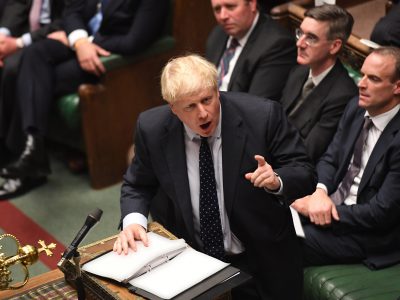
For decades Johnson glided through life on his charisma and connections, enjoying a reputation as a genial buffoon. But now his lies and hypocrisy are finally catching up with him.

Boris Johnson, the prime minister of the United Kingdom, has had a storied career. He was once a journalist who, though fired for making up quotes and even whole stories, continued to rise in the profession. He was a Member of Parliament, then Mayor of London for two terms, then went back to Parliament, where he eventually became foreign secretary, before finally getting to the prime minister’s office.

Now it seems that Johnson’s time in 10 Downing Street, the prime minister’s official residence, might well be cut short, following a still unfolding scandal about boozy illegal parties during the country’s national lockdowns.

In a video recording that was leaked in December, a spokeswoman is seen giggling at a mock press briefing as she practices lying about the parties. Since then, the media has reported a tsunami of leaks about at least 16 parties having taken place in other government departments while pandemic rules were so strict that the law even forbade more than two people walking together in the park. In a matter of days, fury spread across the country.

The details were vivid. Aides at 10 Downing Street smuggled in suitcases filled with bottles of wine. There was a drunken party on the eve of Prince Philip’s funeral, at which the Queen herself was photographed sitting masked and alone at her own husband’s funeral, as per pandemic protocol. Some of the partygoers got so inebriated one night that they broke the backyard swing set, which had been set up for Johnson’s son to play on.

Each time the media reported yet another party, people shared on social media what they had been doing on that pandemic lockdown day. At best, people sat alone in their apartments with nothing to do; at worst, they were unable to attend the funerals of loved ones because of the stringent restrictions.

The scandal has, so far, caused one member of Parliament to leave the Conservatives for the Labour party and several others to publicly call on Johnson to resign. Sue Gray, a senior and well-respected civil servant, was asked to write an official report on the illegal events.

Days before she was due to publish her report, the Metropolitan Police announced they would be conducting their own investigation into alleged breaches of lockdown rules. This means that Gray’s full report will have to wait, but a redacted version published last week hit out against "failures of leadership and judgement" in Downing Street.

Dominic Cummings, a political consultant whom Johnson hired as his senior advisor when he became prime minister in 2019, and later fired in 2020 for briefing the press against him, is widely believed to be the source of the leaks about the parties. Cummings, who was Johnson’s closest advisor during and before the election, is known for being vengeful.  This sequence of events also felt, in hindsight, a bit inevitable.

Boris Johnson has been caught lying in person and in print countless times and he has always got away with it. He has had three wives, heaven knows how many mistresses, and, allegedly, does not even know how many children he has fathered. He is untrustworthy, unserious, gaffe-prone and easily distracted; and yet, somehow, because of his charm and shamelessness, he kept falling upward.

His rise once seemed inevitable, given his class background (and the British are ever obsessed with class) and connections. The son of a politician, he spent his formative years at Eton College, Britain’s most elite private school, famously attended by both Prince William and Harry and 19 other British Prime Ministers. There, he became secretary of the debating society and editor of the school newspaper. This trajectory wasn’t surprising; as a profile from the Sunday Times once explained, “[their father] Stanley deliberately created a family atmosphere in which beating the others at running, jumping, eating the hottest mince pies, coming first at school or simply having the blondest hair entirely captured the lives of all four children.”

The Johnsons were bred to want it all. After Eton, Johnson “went up” to the University of Oxford, where he was elected president of the Oxford Union (the university’s prestigious debating club). A brief dip followed, when he was fired from an internship at the Times for making up some quotes.

Never down for long, Johnson bagged himself a job at the right-leaning Daily Telegraph instead, having met its editor while at Oxford, and took it from there. He soon became the paper’s Brussels correspondent and took to writing outlandish stories about the European Union to please its eurosceptic readers, in a bout of ham-fisted foreshadowing.

At the time, the EU was growing and important questions were being asked about what its future should be, what its members wanted and what its place should be in the world. Instead, Johnson wrote pieces on Italians wanting smaller condoms (false); about an EU spokesperson living in a castle (false); and other made up stories of that caliber.

By the end of the 1990s, Johnson started to show political ambitions. According to Jim Pickard, Chief Political Correspondent for The Financial Times, Johnson said he wanted to become a politician  because “no one puts up statues to journalists."

It was a bold move but not a surprising one; after all, many well-connected, posh British men before him managed the move from journalism to politics, no matter how ill-suited to either job they were.

Johnson, who seems to revel in his image as a genial buffoon, once called Black people "piccaninnies" with "watermelon smiles" and gay men “tank-topped bumboys.” He has said that women who wear the hijab look like “letterboxes.” And yet, his foppish charm, bumbling charisma and semi-celebrity status meant he was elected mayor of London in 2008.

During the 2012 Olympics he got stuck on a zipwire while wearing a hardhat and clutching a plastic UK flag in each hand, in an incident that many believe was a stunt because, while he looked quite silly, he did not seem the least bit flustered.

While mayor, Johnson had an affair with a woman who worked in tech and was accused of giving her access to contacts and public funds. The story only came out relatively recently, as Jennifer Arcuri, the woman in question, decided to tell her story to the media. So far, there have been no serious consequences for Johnson.

In 2016 Johnson was back in Parliament when then-Prime Minister David Cameron called a referendum on whether the country should remain in the EU. Johnson huffed and puffed and then he came out in favor of Brexit. He later admitted that he’d written two columns for that day’s Telegraph, one supporting each side, as he could not make up his mind.

He then became the most visible face for the Vote Leave campaign. Johnson rode around on a big red bus claiming that post-Brexit Britain would spend an extra 350 million pounds a year on the national health service—which never happened—and compared the EU to Adolf Hitler. Three years later, he campaigned for prime minister on a platform of “get Brexit done.”

His decision to bring in Dominic Cummings, who is such a divisive figure that David Cameron called him a “career psychopath,” as his most senior adviser could yet prove to be his undoing.

The incompatibility of their personalities led to many fights, while Cummings’s abrasive style alienated everyone around him. The real problem, however, stemmed from his repeated clashes with Carrie, Johnson’s third wife.

A former Conservative adviser herself, she wielded—and still wields—considerable power in Number 10, a fact that Cummings resented. Forced to pick between the maverick and the spouse, Johnson eventually sided with the latter, and fired Cummings in late 2020.

It was always clear that Cummings would eventually take his revenge; the only question was when and how.

Since the “partygate” revelations became the top story in the British media, Cummings has repeatedly attacked Johnson for lying about the events to Parliament. In the prime minister’s defence, lying and charming people is something he has always been good at—and, until now, has nearly always been able to get away with.

The British people seem finally to be fed up with his charismatic clown persona. Millions of law-abiding citizens were unable to see their friends and families for months on end; people died alone and people gave birth alone; and meanwhile, in the corridors of power, people danced and drank until dawn. Johnson's profuse apologies are seen as transparently mendacious and insincere.

Whether Johnson will survive this scandal is still an open question, with not even the most seasoned political analysts taking bets. If the police do find evidence of criminal behavior, and if more revelations come out in the next few weeks, he might be ousted by his own party.

As of February 3, two top aides have quit, citing Johnson having been caught lying as their reason. Meanwhile, 11 Conservative Members of Parliament have called for a vote of no confidence against Johnson. If a total of 15 percent follow suit, MPs will then have to vote on whether they have confidence in their leader. If the prime minister wins the no-confidence vote, the MPs cannot challenge him again for a year; if he loses it, a leadership contest starts immediately. As of this writing, it is impossible to predict what will happen next.

Still, there are some years to go until the next election, and illegal parties during the pandemic aren’t the only problem Britain is facing. Rising inflation and skyrocketing energy bills means the country is heading for a dire cost of living crisis, and no-one seems to know how to deal with it. The Labour Party is climbing back up in the polls, slowly but surely, but these are not their problems quite yet; instead, what the U.K. needs right now is a sharp and well-functioning government.

[post_title] => Why 'Partygate' could be the end of Boris Johnson's political career [post_excerpt] => A tsunami of revelations about drunken late-night parties at the prime minister's official residence during Covid lockdown have enraged the public, alienated members of his own party, led two top aides to quit, and might ultimately spell the end of Boris Johnson's term in office. [post_status] => publish [comment_status] => closed [ping_status] => open [post_password] => [post_name] => why-partygate-could-be-the-end-of-boris-johnsons-political-career [to_ping] => [pinged] => [post_modified] => 2026-08-05 17:59:24 [post_modified_gmt] => 2026-08-05 17:59:24 [post_content_filtered] => [post_parent] => 0 [guid] => https://conversationalist.org/?p=3819 [menu_order] => 142 [post_type] => post [post_mime_type] => [comment_count] => 0 [filter] => raw )

Why ‘Partygate’ could be the end of Boris Johnson’s political career

WP_Post Object
(
    [ID] => 3767
    [post_author] => 2
    [post_date] => 2022-02-03 01:15:03
    [post_date_gmt] => 2022-02-03 01:15:03
    [post_content] => Zemmour's racism and anti-immigrant positions are not new, but his misogyny reveals where the ideological fault line lies between the new and the old far right.

Éric Zemmour, a prominent French journalist and television personality who espouses extreme-right views, announced in November that he would be a candidate for president of the Republic. He doesn’t yet have enough signatures to run in the April election, but his potential candidacy has captured enormous media attention, revealing significant support from the far right and even from some subcultures of the moderately conservative right.

Zemmour has almost no chance of being elected president, though he might poach some votes from Marine Le Pen, the leader of the Rassemblement National (RN, or National Rally; formerly the FN, or National Front). Nevertheless, a trickle of ministers and smaller political parties continue to join his newly established Reconquête (Reconquer) party, even as he is involved in a series of high profile scandals involving several accusations of sexual assault, an extramarital relationship with a much younger woman, and three court cases on accusations of inciting racist hatred.

While he has won supporters for his extreme positions on Muslims and immigration, Zemmour polls low with women. Marine Le Pen has reorganized her campaign accordingly, and Zemmour —with seven accusations of sexual assault currently pending and more than a few misogynist tracts under his belt—was obliged, for reasons of realpolitik, to declare himself a “feminist, like the next man.”

A darling of the culture wars

Zemmour, 63, rose to prominence in the 1990s as a columnist and commentator. Back then he espoused a “union of the right”—i.e., a coalition of the moderate right Républicains and the far-right Front National (FN). He became a darling of the culture wars with his essay Le Premier Sexe (2006), a gender panic polemic on the purported “feminization” of men in France. The book—yes, its title is a riposte of Simone de Beauvoir’s feminist book The Second Sex—sold over 100,000 copies.  He followed this with a novel, Petit Frère (2008), in which he attacked “anti-racist angelism," and then a trilogy that sold even better than Le Premier Sexe—Mélancolie française (2010), in which he recounts the history of France; Le Suicide français (2014), where he argues that the French nation has become degenerate since the student-led uprisings of 1968; and Destin français (2018), a sort of autobiography in which he describes various historical events that have influenced his worldview. He ends the final essay with a polemic against the growing influence of Islam on French society. Zemmour’s most recent book, La France n’a pas dit son dernier mot (France Hasn’t Had Its Last Word), published in 2021, sold 165,000 copies within three weeks. Cherished by his followers as “an intellectual” and tolerated by others as a kind of maverick TV personality—a buffoon, perhaps, like the former journalist Boris Johnson, or like Donald Trump—Zemmour is, thanks to his many books, a frequent guest on television news and culture programs. He uses these prime-time opportunities to air his views on the decline of French society, the clash of civilizations, immigration and assimilation, national preference, and national identity. He is one of the figures responsible for bringing the “great replacement theory,” the fear that France’s “native” (white) population will be replaced by (brown) non-European people, into the mainstream discourse. Whilst lamenting the passage of France’s heroic age—Napoleon, etc.—Zemmour manages to align himself with both President Charles de Gaulle, who led the French resistance during the Nazi occupation of France, and the Nazi collaborator Marshall Philippe Pétain, Vichy France’s chief of state. This pairing is an ingenious move, presenting two historical figures who represented opposing political views as representatives of France’s lost past, when strong men took charge. Jean Marie Le Pen, the former leader of the far-right FN, made the mistake of expressing his support for Pétain while denouncing de Gaulle—at a time when de Gaulle was still an extremely popular figure in France. Zemmour expresses support for both men, which is novel.

A racist's racist

Zemmour is the son of Jewish immigrants from Algeria and is himself a practicing Jew who attends an Orthodox synagogue. That has not stopped him from aligning himself with the antisemitic far right, or from saying that Pétain was right to deport non-French Jews to concentration camps—because in doing so he saved some French-French Jews (of the 75,000 Jews deported from France, 72,500 were murdered) . Zemmour has transitioned smoothly from being an “outspoken” voice in the discourse around political correctness as it morphed into what we now call a “debate” on “cancel culture.” Today he is a comfortable anti-feminist, traditionalist, misogynist, homophobe, anti-abortionist, and a “critic” of the legacy of the social movements of the 1960s. He also deplores gender studies and writes in Le Premier Sexe that rape trials qualify as the “judiciary surveillance of desire.” In the months before he announced his candidacy, Zemmour reveled in several personal and legal scandals that further raised his public profile. In September Paris Match’s cover showed him frolicking in the sea with Sarah Knafo, his 28 year-old assistant and campaign manager, whom he has known since she was 13 years old (she is the daughter of family friends). Zemmour recently confirmed that Knafo is his “companion” and is pregnant with his baby, to the delight of the press, which speculates endlessly about Mylène Chichportich, his wife of 40 years: Is she suffering or indifferent as she stands silently at his side? While Knafo is something of a protégée to Zemmour, she is in her own right a perfectly terrifying and precocious extreme right militant. As a university student she was active in the FN and in a student association called Critique of European Reason, through which she got down with the sovereigntists and Euroskeptics, and met prominent right wing thinkers like Alain Finkielkraut. At 25 she did an internship at the French embassy in Tunis. She then authored a “handbook,” based on what she’d learned in North Africa about migration routes, on how to facilitate the deportation of undocumented migrants from France. His frequent trips in and out of court keep the press talking about Zemmour, too. His January 17 conviction for inciting racial hatred was his third. A judge fined him 10,000 euros ($11,400) for having said, on live television, that unaccompanied migrant minors “have nothing to do [in France], they’re rapists, assassins, that’s all they are, you have to send them back to where they came from.” Meanwhile, at one of his November rallies, Zemmour’s militia-style bodyguards beat up an anti-racist activist in a brawl reminiscent of Trump rally scenes.
A radical ideologue

French commentators have pointed out that the country’s media is falling into the trap of giving free publicity to Zemmour, just as the U.S. media made the mistake of broadcasting Trump’s rallies live without commentary and of reporting incessantly on his tweets, giving him massive free publicity on mainstream evening and cable news programs. Like Trump, Zemmour overwhelms the media with provocative soundbites, which are often in the form of attacks on journalists. As a result, media outlets are drowning in a sea of far-right madness—reporting and broadcasting Zemmour’s racist, sexist, and fascist comments repeatedly, without analysis or critique. The fact that Zemmour’s ideas are splayed bittily across television and internet platforms, and that only certain people read his books from beginning to end, works to obscure their character as a complete ideology. His misogyny, abhorrence for the student-led uprisings of 1968, dislike of modernity, and hatred of Muslims are connected and inform each other. A quick online search brings up a list of citations to go with each of Zemmour’s ideas, presented like an inventory of the contents of a bag belonging to the fasciste du jour. Zemmour deliberately muddies the extremism of his complete ideology by presenting his ideas in a willfully confusing, often “third positionist” manner— i.e., expressing right wing ideas in the language of left-wing ones. For example, in his books he offers a critique of the monogamous couple and, ostensibly, praise for polyamory. But this is not advocacy for free love. Rather, it is an expression of approval for a premodern society in which married men had multiple mistresses and in which women had no means of leaving an unhappy marriage. In French third positionism is roughly translated as confusionniste — which is a better term, perhaps, because the deliberate effort to create confusion is a salient and defining characteristic of contemporary fascism. Writing about Zemmour is challenging because it’s almost impossible to avoid the trap of either reproducing his ideas without comment, or presenting them with expressions of shock and outrage. In either case, the writer is amplifying Zemmour’s ideology, thus giving him yet more free publicity. Zemmour and his fellow far right television personalities have succeeded in shifting the Overton window of the French discourse. Fueled by the country’s growing and fertile climate of Islamophobia, which is partly a reaction to a series of high profile, violent terrorist attacks over the last six years, the center and center-right are now taking positions that were once considered far right. In a recent illustration of this shift, Macron’s government drafted and passed the Loi de Séparatisme, a law to “strengthen republican values.” The law targets and seeks to repress the Muslim community and its cultural expression, which conflicts with France’s aggressive secularism. As such, it is a populist attempt to exploit, or give lip service to, the idea that a cultural “great replacement” has happened, or is happening, in France. It is perhaps surprising that the extreme right—identitarian and antisemitic as it is—might choose Éric Zemmour over Marine Le Pen. Zemmour, though born in France, is the offspring of an Algerian-Berber Jewish immigrant family, while Le Pen is white and descended from France’s best-known fascist dynasty. Zemmour’s background has been a subject of conversation on fan forums for Papacito (a far-right influencer with a popular YouTube channel who supports Zemmour) and on gaming websites, where eager 20-year-old neo-Nazis agree that while his Jewishness is a bit of a problem, he’s kind of an Ubermensch.

The fault line in the far right

Physically, Zemmour cuts a slight figure, with, as Harrison Stetler put it, “massive ears folding out around [a] receding jaw.” He bears no physical resemblance to the towering Aryan figures of Donald Trump or Boris Johnson, or to the topless horse rider Vladimir Putin. His possible success amongst extreme right voters — a smattering of ultra-conservative Christians, neo-Nazi groups, far right influencers, lapsed FN or Républicains voters—seems to be derived from his capacity to embody discursively a kind of straight talking, Trumpian masculinity (and whiteness), not seen in French politics since Jean-Marie Le Pen led the FN. He espoused a more overt brand of racism than that of his daughter Marine, the heir to the party’s leadership. Marine Le Pen, meanwhile, has in recent years made a dive for the center, trying to clean up her party and kicking out embarrassing family members such as her niece (who now wants to run with Zemmour) and her father, who infamously described the Holocaust as “a detail of history” and, as a French military officer, tortured people during the Algerian war. The effect of Marine’s efforts to take the party mainstream was to alienate her most right-wing voters, who have become disillusioned with her perceived political correctness. While Le Pen herself has said she is “against gay marriage,” she has also pink-washed her party in an effort to appeal to LGBT groups and even has several gay deputies. Recently Le Pen revealed that for the last five years she has been living in secret with a woman, her “childhood friend” Ingrid. “There are no men in my house, even the cats are female,” Marine said in a widely watched TV interview broadcast in early November. The critical fault line between Zemmour and Le Pen is, clearly, misogyny. Zemmour positions himself against a “cosmopolitan” political correctness that purportedly welcomes homosexuality and feminizes extreme right politics. Those who oppose Marine Le Pen’s leadership of the FN perceive her as having emasculated her daddy’s once-great party. One might wonder what is more prominent in Zemmour’s ideology—a hatred of women, or a hatred of Muslims and immigrants? But this would be the wrong question. Zemmour’s essay Le Premier Sexe shows his misogyny and his racism to be, if not interchangeable, on a continuum with one another. It shows the strong link between “theories” of feminization and the great replacement, which usually advances the racist theory that Muslims, Jews, and other non-white people will soon replace white people. It starts out as a great replacement theory about gender, advancing the idea that French men have become feminized through a culture that elevates “feminine values.” Men, he writes, are allowing themselves to be replaced by women and become total pussies, whereas a real man is a “sexual predator, a conqueror.” It is of course a polemic: his histrionic dismay at the purported fragility of contemporary French men is motivated by his belief in a naturalized masculine power (and violence), ready and waiting to be resuscitated. His essay is a spurious patchwork of loosely connected observations on advertising, football, cinema, sport, dubious “facts” and statistics, and hardcore conspiracy theories. He advances the theory that the purported feminization of men is due to the influence of “single mothers, sixty-eighters and feminists,” plus a homosexual conspiracy that wants to denaturalize sex and create a society segregated along the lines of gender. According to Zemmour, the plot is to eradicate male body hair because it would remind men of their natural “bestiality, virility,” and to set up conspiratorial alliances in cities between immigrants, single women, and gays. The speed with which he moves from roots to rootless cosmopolitans is, frankly, startling. By the end of Le Premier Sexe all this scattered madness joins up with his other great preoccupation—Muslims and immigrants. The great replacement of gender becomes just the great replacement, tout court. Hurtling through an account of the liberalization of divorce and abortion, he claims that French men have “laid their phalluses down,” thus declaring France “an open land, waiting to be impregnated by a virility from outside.” This has happened, he writes, because Christianity is a pussy religion. Outside of the Western world, he writes, men defend their dominant position “like a treasure” and refuse to align the “status” of their women with that of the Europeans. The argument is not simply that white French men are becoming more like women, but that they will be replaced by a masculine revolution of foreign (Muslim) men who are concentrated in France’s suburbs. Despite the book’s highly misogynistic character, which shows Zemmour’s hatred for women and especially feminists, part of his argument is that Black and Arab men, with their machismo and their desire to dominate, present a danger to…Western white women and feminists. Zemmour can claim as much as he likes that he is now a feminist. His entourage of female influencers, FemmesAvecZemmour (WomenWithZemmour), are flocking to make the same racist argument about women’s safety in an effort to make a feminist of old Zemmour. But Zemmour is quite different from other leaders. He manages to present himself as a real man, a man’s man, a man who speaks his mind, while remaining, a wily, self-satisfied intellectual who espouses a hardcore and explicit ideology. Whether he becomes a candidate in the presidential election or not, it’s quite clear that his prominence is symptomatic of a rightward shift in France, and in any case such extreme right mobilizing has already made its impact on the policies of the center. [post_title] => Softbois in France: a feminist perspective on the rise of Éric Zemmour [post_excerpt] => Zemmour's racism and anti-immigrant positions are not new, but his misogyny reveals where the ideological fault line lies between the new and the old far right. [post_status] => publish [comment_status] => closed [ping_status] => open [post_password] => [post_name] => softbois-in-france-the-rise-of-eric-zemmour-from-a-feminist-perspective [to_ping] => [pinged] => [post_modified] => 2026-08-05 18:03:34 [post_modified_gmt] => 2026-08-05 18:03:34 [post_content_filtered] => [post_parent] => 0 [guid] => https://conversationalist.org/?p=3767 [menu_order] => 144 [post_type] => post [post_mime_type] => [comment_count] => 0 [filter] => raw )
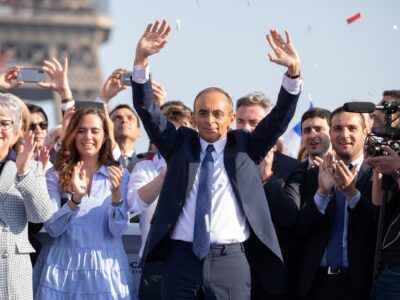
"Eric Zemmour surrounded by supporters at the end of his meeting at the Trocadero on March 27, 2022."

Softbois in France: a feminist perspective on the rise of Éric Zemmour

WP_Post Object
(
    [ID] => 3682
    [post_author] => 2
    [post_date] => 2022-01-06 12:10:09
    [post_date_gmt] => 2022-01-06 12:10:09
    [post_content] => On the sad anniversary of the January 6, 2021 coup attempt, The Conversationalist's Executive Director has assembled a list of the best analysis she's read in the U.S.'s mainstream media. 

On the one-year anniversary of the January 6 coup attempt, I've assembled some of the best reporting and analysis reflecting on how the United States got to this point, and what comes next. The articles cover a range of topics and points of view, from Osita Nwanevu's systemic analysis to Margaret Sullivan's media criticism. Rebecca Solnit and Barton Gellman offer eloquent explainers on authoritarian lies, with Solnit's essay looking backwards to Birtherism, and Gellman looking ahead to 2024. Jennifer Rubin has an interesting read on how to fight her former party's extremism, and Vice has disturbing updates on Proud Boys embedding themselves in local community organizing. 

Why Republicans Keep Falling for Trump’s Lies

Rebecca Solnit’s New York Times essay on truth, lies, and authoritarian control is brilliant; George Orwell would have been proud. She begins by tracing the series of GOP lies leading from the Tea Party to Trumpism. Delving into notions of gullibility, cynicism and true belief, Solnit paraphrases Hannah Arendt: "among those gulling the public, cynicism is a stronger force; among those being gulled, gullibility is, but the two are not so separate as they might seem." Lucky for us, Solnit is comfortable with grey areas. Where many writers might be tempted to let the deluded off the hook, especially anti-vaxers now dying from COVID, Solnit digs into their complicity, "gullibility means you believe something because someone else wants you to. You’re buying what they’re selling." 

'Trump's next coup has already begun'

Barton Gellman’s piece for The Atlantic is a strong summary of the ongoing threat to the 2024 election; he explains why and how January 6 was a practice run for future GOP violence. This is a clear and cogent breakdown of how the Big Lie incites the GOP base to violently overthrow democracy. It is an urgent call to action, but also self-conscious about not entering crisis-mode sooner. Take, for example, the source with a "judicious temperament" who "cautioned against hyperbole" last year but is now on board with U.S. democracy's death throes. The extended illness isn't examined.  “Virtually no one a year ago, certainly not I, predicted that Trump could compel the whole party’s genuflection to the Big Lie and the recasting of insurgents as martyrs," writes Gellman. But he shouldn’t take pride in being a latecomer to an obvious crisis. There are entire fields dedicated to studying authoritarianism, extremism, propaganda, and personality cults. Those scholars haven't been silent. If being wrong is reasonable, I was a hysterical alarmist, because when Trump first ran I said he would never leave office peacefully, that it was the end of elections as we know them, and that his party-cult base would back him. 

If American democracy is going to survive, the media must make this crucial shift

Margaret Sullivan, media columnist for The Washington Post, addresses the mainstream media's failure to make the threat to democracy THE story. Why aren't more outlets openly pro-democracy? Quoting Ruth Ben-Ghiat and Thomas Zimmer, both prominent scholars of authoritarianism, Sullivan argues that the piecemeal approach to covering democratic decline is failing. While the media is finally taking note (she provides plenty of links to further reading) as we approach the one-year anniversary of the insurrection, most are still failing to center the most important political story in decades. Sullivan encourages publications and editors to take a stand for democracy. "Don’t be afraid to stand for something as basic to our mission as voting rights, governmental checks and balances, and democratic standards. In other words, shout it from the rooftops. Before it’s too late."

Trump isn't the only one to blame for the Capitol Riot

In an essay for The New York Times, Osita Nwanevu argues persuasively that the American political system is to blame for the structural advantages that bred Republican entitlement to power. Yes, January 6 was an attack on our democratic institutions, but "our institutions also helped produce that violent outburst by building a sense of entitlement to power within America’s conservative minority." Citing a laundry list of undemocratic institutions and rules, including the Electoral College, stacked courts, and the Senate filibuster, Nwanevu takes issue with the outsized political power of rural voters in sparsely populated states. Structural advantages insulate Republican demagoguery from criticism, radicalizing the party faster in the name of patriotism. Meanwhile, Democrats are still reluctant to consider systemic reforms that would help address the imbalance. 

Opinion: Polling on Jan. 6 shows the vast majority of Americans aren’t crazy

Jennifer Rubin, a formerly conservative columnist for The Washington Post, wants to look on the bright side of the fact that the majority of Republicans believe the election was stolen and that Democrats are illegitimately in control. She encourages Biden and the Department of Justice to be more outspoken, and connects Christian nationalism to the insurrection, noting the Christian symbols at the insurrection, a topic The Conversationalist has covered extensively. Being Jennifer Rubin, she also wants to build out the law enforcement capacity to deal with the threat, but fails to mention rising extremism within those institutions.

The Proud Boys Changed Tactics After Jan. 6. We Tracked Their Activity.

Vice reports on how the extremist Proud Boys retreated from the national stage after January 6 to focus on local organizing. There was some speculation that the Proud Boys were going to collapse after two major events—nearly 50 of them faced federal charges, and a report showed that their "chairman" was an informant for the feds. But they did not collapse. Instead, they took a three month break and then began embedding themselves further in local communities across the country. Since then they've joined anti-vax, anti-CRT groups showing up at school board and city council meetings, and made an effort to blend in with local far-right activism. As a result, their base of support has grown.  [post_title] => Media roundup: how should we analyze the impact of last year's attempted coup? [post_excerpt] => On the sad anniversary of the January 6, 2021 coup attempt, Anna Lind-Guzik has assembled a list of the best analysis she's read in the U.S.'s mainstream media.  [post_status] => publish [comment_status] => closed [ping_status] => open [post_password] => [post_name] => media-roundup-best-analysis-of-january-6s-impact-on-the-one-year-anniversary [to_ping] => [pinged] => [post_modified] => 2024-08-28 21:11:29 [post_modified_gmt] => 2024-08-28 21:11:29 [post_content_filtered] => [post_parent] => 0 [guid] => https://conversationalist.org/?p=3682 [menu_order] => 151 [post_type] => post [post_mime_type] => [comment_count] => 0 [filter] => raw )

Media roundup: how should we analyze the impact of last year’s attempted coup?

WP_Post Object
(
    [ID] => 3675
    [post_author] => 2
    [post_date] => 2022-01-05 21:49:48
    [post_date_gmt] => 2022-01-05 21:49:48
    [post_content] => The current situation for journalists in Belarus is horrific enough, but will probably worsen. 

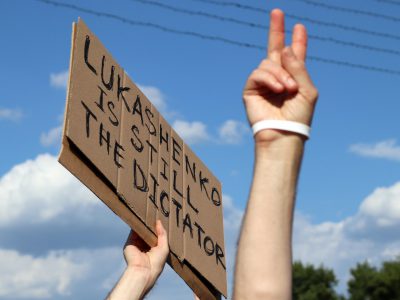
On May 23, Belarusian authorities caused a global outcry when they diverted a Lithuania-bound commercial flight to the Belarus capital of Minsk so they could arrest two passengers on the plane: self-exiled journalist Raman Pratasevich and his girlfriend Sofia Sapega. This shocking tactic was seen as emblematic of just how far President Aleksandr Lukashenko is willing to go to capture and punish his critics.

The dramatic arrest should not have surprised anyone familiar with the vindictive nature of the Lukashenko regime. The Belarusian leader, who has run the country since 1994, launched an especially brutal crackdown against the media around the August 9, 2020, presidential election, which was widely seen as rigged.

Dozens of reporters were detained for reporting on mass anti-government protests after Lukashenko claimed victory in the contested vote; Belarus now has at least 19 reporters behind bars —up from 10 in 2020 —according to CPJ’s 2021 prison census. 

CPJ has documented the beatings of journalists in detention as well as the authorities’ attempts to close media outlets, block the internet, raid newsrooms, harass journalists, and keep bringing new charges against those in jail. Many journalists have been detained multiple times.

By late 2020, CPJ noted another change in the Belarusian authorities’ tactics: they started bringing criminal charges against journalists rather than just holding them in 15-day administrative detentions. In February, two journalists of the Poland-based online broadcaster Belsat TV were sentenced to two years in jail. The two were detained in November 2020 while livestreaming from a protest in Minsk. Katsiaryna Barysevich, a correspondent for Tut.by, one of Belarus’ largest media outlets, was also detained in November 2020 and sentenced in March this year to six months in jail on absurd charges of reporting on the death of protester Raman Bandarenka.

When Barysevich, whom CPJ honored with its International Press Freedom Award this year, was released from prison on May 19, she found out that her media outlet was shuttered, more than a dozen of her colleagues, including chief editor Maryna Zolatava, journalists Elena Tolkacheva and Volha Loika were in custody on tax evasion charges. Barysevich was unable to enter the Tut.by office. “I can’t get a document that proves my past employment with Tut.by because the office is sealed off, and there’s nobody in there. I cannot prove that I am unemployed now,” she told CPJ in June. (Several other Tut.by staff remain in detention and face serious charges. They are not listed in CPJ’s prison census because they did not work as journalists.)

Days after the authorities raided the Tut.by and Belsat offices in May, the arrest of Pratasevich reinforced the full extent of the brutal nature of the Lukashenko regime.

Pratasevich, who was made to appear on state TV and at press conferences after a publicized “confession,” is now under house arrest in Minsk, banned from seeing anybody and going outside. Agents from the KGB, Belarus’ national security agency, reportedly live with him in his room. Pratasevich’s parents, Dmitry and Nataliya, say they do not know what charges their son is facing and told CPJ they are concerned about him.
By late 2021, Belarusian authorities had closed down most prominent independent media outlets and popular social media channels, branding them “extremist.” The authorities also targeted organization that help journalists. The Belarusian Association of Journalists (BAJ), an advocacy and trade group that is a partner of CPJ, was ordered to close after 26 years of operations. Its leaders continue monitoring press freedom violations from inside Belarus. The Press Club Belarus, which assisted journalists with training, education and capacity building, was shuttered; its head Yulia Slutkskaya and other employees ended up behind bars. They were released only after asking for presidential pardon and paying large fines to cover the taxes they were accused of evading. In addition, Belarusian authorities took extra measures to ensure that the information about detainees does not get to local and international media. They forced many lawyers to sign non-disclosure agreements that prevent them from speaking on cases, and stripped some lawyers of their licenses. Belarus prison conditions are harsh. Journalists usually share cells with a dozen of other inmates, some with diseases, including COVID-19, or lice. Many have health issues but are not getting the medical treatment they need. Ksenia Lutskina, detained in December 2020 and facing seven years in jail in retaliation for her work as a journalist, has a brain tumor that is growing and causing bad headaches, her father, Aleh Lutksin, told CPJ. She’s been given painkillers but is not allowed to receive tests or medication she needs. (Belarus authorities have not responded to CPJ’s requests for information about any detainees.) The current number of journalists behind bars is the highest for Belarus in the three decades since CPJ launched its prison census. Many are facing lengthy prison sentences on retaliatory and anti-state charges, such as treason. The situation for journalists in Belarusian jails is likely to worsen. Every day, there are fewer media outlets and press freedom advocates to report on the journalists’ conditions, upcoming trials, and sentences. Those who continue to do so, like reporters at BAJ, are at risk of imprisonment. Lukashenko’s track record shows he can be expected to use every available tool to continue gagging dissident voices. *This article was originally published by the Committee to Protect Journalists (CPJ).  [post_title] => In Belarus, Lukashenko’s vindictiveness reaches new heights [post_excerpt] => The current number of journalists behind bars is the highest for Belarus in three decades. [post_status] => publish [comment_status] => closed [ping_status] => open [post_password] => [post_name] => in-belarus-lukashenkos-vindictiveness-reaches-new-heights [to_ping] => [pinged] => [post_modified] => 2026-08-05 18:15:53 [post_modified_gmt] => 2026-08-05 18:15:53 [post_content_filtered] => [post_parent] => 0 [guid] => https://conversationalist.org/?p=3675 [menu_order] => 152 [post_type] => post [post_mime_type] => [comment_count] => 0 [filter] => raw )

In Belarus, Lukashenko’s vindictiveness reaches new heights

WP_Post Object
(
    [ID] => 3637
    [post_author] => 2
    [post_date] => 2021-12-20 18:10:17
    [post_date_gmt] => 2021-12-20 18:10:17
    [post_content] => The historic election marks the final stage in the transition away from Pinochet's dictatorship.

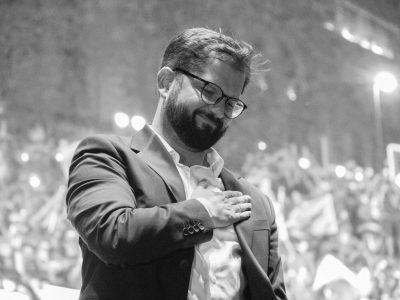
Hundreds of thousands of people flocked onto the streets of Chile’s cities on Sunday night to celebrate a history-making presidential election. The sounds of cheers and honking car horns were everywhere as, with 97 percent of the votes counted, Gabriel Boric, a 35-year-old former student leader who headed the leftist coalition Frente Amplio, became the country’s youngest president. The final polls heading into the election predicted a very close result, with the far-right Jose Antonio Kast, 55, slightly ahead of the much younger, progressive Boric. But the final tally was not even close: Boric won with 55.9 percent of the vote—12 percentage points ahead of Kast, who called Boric to concede at 7.10 p.m., after only 30 percent of the ballots had been counted.

[caption id="attachment_3644" align="aligncenter" width="740"] Jubilant Boric supporters poured onto the streets of Santiago on December 19, 2021.[/caption]

On Election Day I was in Concepcion, in south-central Chile, feeling anxious but also hopeful that the Chilean people would elect Gabriel Boric, the humane, democratic and environmentally conscious candidate. I was at a polling station as ballot counting began, watching as the numbers showed a consistent advantage for Boric. When the announcement was made that Gabriel Boric had been elected, becoming Chile's youngest president, I was euphoric.

The two candidates campaigned on polarized visions for their country.

Kast, a conservative Catholic with nine children, is a Pinochet supporter. He ran a right-wing populist campaign that promoted a continuation of neoliberal economic policies and climate change denial. He vociferously opposed gender equality and abortion rights and incited against impoverished Venezuelans and Haitians who sought a better life in Chile.

Read more: Chile faces its most consequential election since the end of the Pinochet dictatorship

Boric is a former leader of the 2011-13 student movement, which sought better and more affordable education for all; as a young politician, he was one of the architects of the 2019 Agreement for Social Peace, which led to the 2020 referendum for a new, more equitable constitution to replace the Pinochet-era one. His platform calls for an overhaul of the economy, ending the neoliberal policies that have made the country deeply unequal; Boric campaigned on making Chile a more unified society—one fully transitioned away from the legacy of the Pinochet regime.

The campaign

Sunday’s election marked the end of a long process that began with the July primaries. Boric surprised everyone by winning the leadership of the leftist coalition over the Communist candidate, Daniel Jadue. The polls had projected a win for Jadue, but he made some serious missteps with various gaffes, including antisemitic statements; Boric, meanwhile, came off as inclusive, charismatic, and knowledgeable during the debates. With his moderate yet innovative positions, like the importance of finding a balance between economic growth and a response to the climate crisis, he attracted the millennial voters who played a decisive role in his becoming the leftist coalition's candidate. A high turnout for the primaries, with more than 1.7 million voters casting a ballot, created a solid electoral base for the first round of the presidential election. Kast, on the other hand, did not participate in the right-wing party’s primary elections; nor was he a favorite in the polls at the beginning of the election campaign. His candidacy emerged from a political pact between conservative Christians and the new far-right Republican Party; he then went on to perform well during the first debates against Sebastian Sichel, his rival for leadership of the right-wing coalition. Sichel positioned himself as a center-right candidate, a move that proved to be a mistake: He pushed right-wing voters toward Kast, whom they saw as an “authentic” right-wing candidate. For the far-right, who supported the Pinochet dictatorship and opposed a new constitution, Kast represented both their natural political home, and the man who was more likely to bring a right-wing government to power. The center-right moved toward Kast because they saw him as the man most likely to be elected and they wanted a right-wing government at all costs, even if that meant tacitly supporting xenophobic proposals such as the construction of ditches in Chile’s north to prevent impoverished and desperate Venezuelan migrants from entering the country.

The race

In the weeks before Election Day on December 19, polls consistently showed Kast just slightly ahead of Boric in a very tight race. International legacy media outlets painted a picture of Chilean society polarized between two extremist candidates, although Boric’s views are hardly extreme—they would put him somewhere between Bernie Sanders and Elizabeth Warren. In Chile, the influential right-wing media outlets played an outsized role in promoting Kast’s campaign with fake news that incited against Boric. Kast, for example, claimed several times that the bearded, tattooed leader of the leftist coalition used illicit drugs, a baseless lie that the right-wing media amplified until it gained such wide credence that Boric felt compelled to respond. During the December 13 debate against Kast he released lab results that proved he had no cannabis, amphetamines, or cocaine in his bloodstream. Besides creating a divisive and polarized atmosphere during the campaign, the far right’s aggressive rhetoric and fake news also disseminated fear of Boric’s purportedly “socialist” agenda. For example, Kast claimed that the Communist Party’s support for Boric was indicative of a dangerous, far-left agenda; evoking Venezuela’s socialist bogeyman, he said that Boric, if elected, would drag Chile into chaos. In fact, Boric is very much a moderate who has attracted broad support with a political platform that advocates policies similar to those of European social democratic parties. Voter turnout in Chile hovers at 50 percent, which increased this time in the second round. Some analysts predicted that Boric would inspire a surge in the youth vote, propelled by their concerns about the climate crisis and rising authoritarianism. While there is no data yet about age groups, overall voter participation did increase by more than one million over the first round. This election saw the highest electoral turnout in Chilean history, with Gabriel Boric receiving more votes than any presidential candidate in previous elections.

A historic election

Kast’s extreme views on women’s rights, gender equality, and LGBTQ rights inspired a diverse political movement in support of Boric’s candidacy. One of his proposals, for example, was to allow police to detain suspects for five days in undefined “confinement centers.” The far-right candidate thus galvanized significant sectors of voters to find common cause in combating the threat of far-right populism. The close relationship between the far right and religious fundamentalists alarmed feminists and other progressive movements, mobilizing them to organize and get out the vote.
But Chileans remain divided about the causes and outcomes of the 2019 social movement that sparked nationwide protests, which in turn led to a political agreement for the establishment of a constitutional process. The far-right opposes any structural change to Pinochet’s system. Boric and his broad coalition represent Chile’s majority, who aspire to a stable social and political transformation. They support the constitutional process and want a more equitable economic system that will replace Pinochet’s neoliberal legacy with a welfare state and sound environmental policies. Boric’s administration will seek to introduce an ecological approach to governing, and to implement transformative policies to pensions and healthcare, two of the pillars of the unequal and segregated Chilean system. Boric represents hope for a nation that wants more dignity, a fact that puts positive pressure on the future government: it needs to be humane, fair, and efficient. I believe the newly elected President Boric is more than ready to take on this immense challenge. [post_title] => Gabriel Boric becomes Chile's youngest president on a progressive mandate [post_excerpt] => The historic election marks the final stage in the transition away from Pinochet's dictatorship. [post_status] => publish [comment_status] => closed [ping_status] => open [post_password] => [post_name] => gabriel-boric-becomes-chiles-youngest-president-on-a-progressive-mandate [to_ping] => [pinged] => https://conversationalist.org/2021/11/18/chile-faces-its-most-important-and-most-polarized-presidential-election-since-the-end-of-pinochets-rule/ [post_modified] => 2026-08-05 18:17:08 [post_modified_gmt] => 2026-08-05 18:17:08 [post_content_filtered] => [post_parent] => 0 [guid] => https://conversationalist.org/?p=3637 [menu_order] => 154 [post_type] => post [post_mime_type] => [comment_count] => 0 [filter] => raw )

Gabriel Boric becomes Chile’s youngest president on a progressive mandate

WP_Post Object
(
    [ID] => 3486
    [post_author] => 2
    [post_date] => 2021-11-24 17:46:37
    [post_date_gmt] => 2021-11-24 17:46:37
    [post_content] => There is a delicate balance when protesting inside the country: too much, and you attract police attention; too little, and you don’t make an impact.

In the summer of 2021, about 40 people sat squashed around a long table in the corner of a pizza restaurant in Minsk, the capital of Belarus. But this was not a birthday party; it was a gathering of a local opposition collective. The people seated around the table were there to reaffirm their support for the movement against the Lukashenko regime and to maintain the friendships and connections they developed during the last year of protests. 

None of the people at the pizza restaurant wore red and white, the colors of the flag of the first independent Belarusian state, as they had at the protests the year before. All expressions of solidarity with the opposition are now dangerous. But despite the regime’s brutal crackdown on dissent, grassroots opposition groups all over the country are finding novel ways to challenge the system, an undertaking that carries enormous risk. 

Belarus’s authoritarian leader Alexander Lukashenko managed to cling to power despite 10 months of massive, country-wide protests that followed the rigged national election of August 2020. But now the demonstrations—with thousands of Belarusians on the streets, workers marching out of state-owned factories, and red and white ribbon filled courtyards—are a thing of the past. Even the iconic Symbal.by, which sold products emblazoned with Belarusian traditional national symbols popular with the opposition, has been replaced with a shop selling kitchenware. The regime has crushed almost all visible dissent with mass arrests, imprisonment, and killings, instilling fear in the protest movement. 

Belarus stayed in the news cycle throughout 2021, even after the opposition was largely in jail, silenced, or in exile. Lukashenko grabbed international headlines by threatening an Olympic athlete, force-landing a Ryanair flight in order to arrest a dissident journalist, threatening to obstruct Europe’s gas supply, and manufacturing a migrant crisis in the heart of Europe. In another incident, the body of Vitaly Shishov, a Belarusian activist who headed an NGO to help fellow exiles, was found hanging from a tree in a Kyiv park after he failed to return home from a jog. Ukrainian police have opened a murder investigation. The message to exiled activists, explained Igor Mitchnik, project leader at Libereco, an NGO focused on human rights in Belarus and Ukraine, is that “nowhere is safe”—the regime can get to them anywhere.
In this superb November 19 interview, Lukashenko tells the BBC's Steven Rosenberg that he "may have helped" migrants enter the EU; he also says that Belarus would "massacre all the scum you've been financing"—referring to the 270 NGOs his regime has forcibly shut down this year.
Sviatlana Tsikhanouskaya, 39, the presumptive winner of the 2020 presidential election, who now lives in exile, has worked to keep the opposition in the news. Over the past year she has become an international figure, giving speeches, sitting for interviews with major media outlets, and meeting with world leaders like President Joe Biden, Prime Minister Boris Johnson, and Chancellor Angela Merkel. Meanwhile, the quiet work of activists inside Belarus goes mostly unnoticed. This is intentional; attention brings risk. But their persistence signals a determined strength to achieve a peaceful and sustainable transition to democracy.

The Partisans

There are many active cells of anti-regime partisans working underground inside Belarus, although the exact number of people involved is unknown. One group of partisans is a team of hackers that conducts frequent cyber attacks against the regime. Their successful hacks include: stealing the personal details of regime informants who reported on neighbors or colleagues; downloading recorded personal phone calls between members of the security apparatus; and publishing the personal information of senior KGB agents.  Tanya*, a 28 year old IT worker in Minsk, is a member of a cell that focuses primarily, in her own words, on samizdat: “We bring the truth to people, we print and distribute newspapers and leaflets.” This is in response to the regime's attempts to re-monopolize the information sphere. In restricting access to independent information, the regime has declared neighborhood social media chats “extremist,” shut down independent media outlets, and arrested numerous journalists and bloggers.  Even subscribing to an independent channel on Telegram, the encrypted messaging app, can be cause for arrest and a sentence of up to seven years in prison.  The partisan protest actions are small-scale and brief, designed to ensure images are shared widely on social media long after the activists have left the scene. There is a delicate balance when protesting inside the country: too much, and you attract police attention; too little, and you don’t make an impact. Last spring, for example, in the midst of the crackdown, activists planted small patches of white and red flowers around Minsk. Tanya shared photographs of districts that decorated their public areas with flowers and printed information on local marches and actions. The partisans also employ tactics to hurt the regime economically by, for example, encouraging consumers to boycott state-owned enterprises. In Belarus a wide range of foodstuffs and products are produced by the state, or by businesses closely connected with the regime. Products under boycott range from sausages and sugar, to cigarettes. A neighbouring cell has been raising the pressure by placing items on railway tracks to disable signals and delay trains carrying items for export, threatening the Europe-Asia transit route, a source of income for the regime.  Tanya was devastated to learn in August that the International Monetary Fund (IMF) had decided to send the regime $1 billion. The money was ostensibly earmarked to help the government fight Covid-19, but for opposition activists and outside observers, it would simply prop up Lukashenko’s illegitimate regime.  Timothy Ash, the London-based economist, asked in a rhetorical tweet if the IMF acronym SDR (Special Drawing Rights) actually stood for “support dodgy regimes.” Sviatlana Tsikhanouskaya, the exiled opposition leader, tweeted that she had sent letters to the IMF and the US government asking them to freeze the funds, which she had earlier asserted would be misused by the regime for nefarious purposes. A Washington Post editorial headline was blunt: “Biden should not let the IMF throw a lifeline to Belarus’ dictator.” Tanya said: “I felt that all my efforts, all the sleepless nights and the suffering of friends behind bars—it was all in vain.”  A few months later, as Belarus began registering record levels of Covid-19 infections, Lukashenko scrapped a short-lived mask mandate and ordered signs calling for them to be worn removed from public transport and shops, confirming the opposition’s fears that the IMF’s funds would be misappropriated.  Membership in the partisans is dangerous and many members have been arrested. But Tanya remains committed precisely because the regime treats prisoners inhumanely and humiliates their supporters. She recounted that on a recent visit to a local prison the guards refused to accept rolls of toilet paper for an inmate unless the tissue was separated along the perforated lines into individual squares. “The whole queue of family and friends were just standing there, ripping toilet paper into pieces,” she recalled. The guards eventually accepted the toilet paper, but didn’t give it to the prisoners until they were released. 

KOTOS

Alina, an economist in her 50s, is focused on organizing local self-government bodies, known in Belarus as KOTOS, across her city. The main idea behind KOTOS, which have functioned since 2014, is to build a collective of active neighbours who deal with local issues and improve the community’s quality of life. They decide what murals will be painted on local buildings, where to place a new bench in a courtyard, or how to improve playgrounds for children. For Alina, the aim is to maintain and build on the newfound momentum for civic engagement developed over the past year, laying the foundations for an eventual democratic state.  The KOTOS is supposed to be made up of locally elected representatives with a chairperson as the leader; but, as Alina and local residents discovered, to no one’s surprise, the regional administration appointed the representatives. KOTOS’s work is unpaid, and some of the appointed chairpersons in the region, explains Alina, did not want the position; but in a dictatorship, where the key currency is loyalty to the regime, they “could not refuse.” Chairpersons are reluctant to meet with the locals they represent; Alina recounts how in one neighbourhood “she [the chairman] still hides from the residents, coming up with different excuses to avoid them.” With the ongoing crackdown against any form of civic engagement, the regime is unlikely to tolerate the involvement of local citizens in KOTOS. This, however, does not discourage Alina. She is looking for different ways to work within the system, from engaging with the local chairperson, to seeking out areas where a KOTOS does not yet exist and distributing information to local residents on how to organize their own system from scratch. Her goal is to find “people who sincerely want to improve life in their neighbourhood” and build grassroots communal solidarity. This work is challenging. A year ago, there were people in the country who were happy to host discussions with locals on the rules and system of KOTOS; conduct seminars and consultations; and provide legal assistance. But, as Alina notes, who would want to  “stand out from the crowd today?”

New civil society initiatives

Volha, a businesswoman in Minsk, is developing a digital platform to educate people about democratic values. It provides a forum for experts from around the world to present information on different democratic systems to the next generation of Belarusians.  Volha describes Belarus today as “scorched earth,” noting that nearly all the people who had been developing civil society have left the country. In July 2021 Lukashenko announced a “clean-up” of civil society; since then, 270 independent NGOs have been closed down, with many activists facing trumped up criminal charges. But Volha believes some people need to remain in Belarus, despite the danger. If civil society was possible before the 2020 uprising against Lukashenko’s regime, she argues, some form “could become possible again.” She stresses that now is not the time to give up developing initiatives inside the country. And while she worries about being arrested and imprisoned, Volha says that her greatest fear is being prevented from carrying on her work, because “from prison you can’t influence anything anymore.” Activists who have remained in the country also run the risk of being labelled a GONGO— a “government-organized NGO.” For the opposition in exile, anyone who cooperates with the regime is de facto lending it legitimization. But Volha is undeterred. She knows that if she wants to develop her initiatives inside Belarus some cooperation with local authorities is unavoidable. Her approach is to integrate local authorities into her activities in order “to show them how things can work in normal countries, how it could be in Belarus.” Viewing all local authorities as representatives of Lukashenko, she says, is the wrong approach and “destroys all bridges.”  Igor Mitchnik stressed the danger of this approach. The regime, he says, “has lost any credibility as a reliable partner for civic or democratic initiatives.” But he values the work of any organization that promotes “a vision of democratic alternatives for their society.”  Volha’s approach to sustainable change in Belarus is, in her own words, “evolution, not revolution.” Yes, she acknowledges, the regime is oppressive, but “we [Belarusians] have allowed [it] to exist.” She argues that the only way to ensure Belarusians throw off the dictatorship, permanently, is through systemic change; otherwise it is only a matter of time before Belarusians will once again live under such a regime. 

Conclusion

These three activists represent very different approaches to regime change from inside Belarus, but they all believe Lukashenko is on borrowed time. While Tanya and the partisans fight the regime from the outside, Alina and Volha highlight a more nuanced grey area of opposition activism inside Belarus, one that requires some degree of cooperation with the regime. Whether their approach has merit remains to be seen; as Audre Lorde famously argued, “the master’s tools will never dismantle the master’s house.”   The future of the opposition inside Belarus is, of course, unclear. Local elections have been postponed indefinitely, and the cruelty of the ongoing crackdown means the March 22 country-wide referendum on constitutional reform is unlikely to lead to fresh protests.  One thing that is clear, however, is that the official Belarusian opposition depends on this network of activists inside the country to keep domestic pressure on the regime, and they are showing no signs of abating. As Tanya vowed: “as long as Belarus is not free, I will not stop.”   *All the names of the activists inside Belarus have been changed to protect them.  [post_title] => Risking arrest, prison & death, Belarus's underground activists fight for democracy [post_excerpt] => The vast majority of civil society activists are in exile, in prison, silenced, or dead, but a few underground cells of partisans are engaged in anti-regime and pro-democracy work that ranges from grassroots initiatives to carrying out cyber attacks against the regime. [post_status] => publish [comment_status] => closed [ping_status] => open [post_password] => [post_name] => risking-arrest-prison-death-belaruss-underground-activists-fight-for-democracy [to_ping] => [pinged] => https://conversationalist.org/2020/10/09/belaruss-uprising-against-autocracy-is-fuelled-by-an-unprecedented-civil-society-movement/ [post_modified] => 2024-08-28 21:11:29 [post_modified_gmt] => 2024-08-28 21:11:29 [post_content_filtered] => [post_parent] => 0 [guid] => https://conversationalist.org/?p=3486 [menu_order] => 160 [post_type] => post [post_mime_type] => [comment_count] => 0 [filter] => raw )

Risking arrest, prison & death, Belarus’s underground activists fight for democracy

WP_Post Object
(
    [ID] => 3461
    [post_author] => 2
    [post_date] => 2021-11-18 23:36:08
    [post_date_gmt] => 2021-11-18 23:36:08
    [post_content] => Will voters choose fear or hope?

Chile is experiencing one of its most powerful historical moments since the end of the dictatorship in 1990. The results of the November 21 presidential election will decide the fate of the social movements sparked by the 2019 “Chilean awakening' and of the constitutional process begun in 2020. Of the six candidates competing for the presidency two men who represent starkly opposing visions for Chile’s future are leading in the polls.

Gabriel Boric, 35, is a left-wing candidate who seeks to implement the social changes that Chilean people have been demanding over the last decade; his platform calls for ending the neoliberal economic-political model brutally imposed under the dictatorship of Augusto Pinochet.

On the far right is José Antonio Kast, 55, who wants to perpetuate the extreme neoliberal model that is the legacy of Pinochet’s rule. One of the many worrying aspects of Kast’s platform is a jingoistic anti-immigrant position, which includes a plan to construct ditches along Chile’s borders to prevent migrants—primarily from Haiti and Venezuela—from entering the country.

The volatile situation in which Chile finds itself—polls show Kast at 27.3 percent, ahead of Boric with 23.7 percent—makes this election an exceptional one, likely the most important since the return of democracy in 1989.

[caption id="attachment_3469" align="alignleft" width="640"] José Antonio Kast at a press conference on August 30, 2021.[/caption]

This election campaign takes place in the context of a process to rewrite the national constitution, which came out of the massive protest movement that swept across the country in 2019. The factors that led to the protests, the issues that are driving this election campaign, and the future of Chile’s democracy are the subject of this article.

1. The ‘Chilean Spring’

On October 14, 2019, high school students in Santiago responded to a government announcement of a public transportation fare hike of 30 pesos, or $0.04, by calling for widespread fare evasion; they amplified their call on social media with the hashtag #EvasionMasiva. Over the next few days, the chant "evadir, no pagar, otra forma de luchar" (“evade, don’t pay, there’s another way to fight”) was heard in almost every subway station. The student protests spread, sparking a mass movement for social change that reflected growing discontent over Chile’s enormous wealth gap, stagnant wages, and insufficient social services. The proposed subway fare hike, though small, came to symbolize the broader injustices and inequalities of Chile’s economic and political system, as enshrined in the Pinochet Constitution. Chile is the most unequal member of the OECD, with 50 percent of the population earning just $550 per month, even as the cost of living continues to rise while wages remain stagnant. The government suspended the proposed transit fare hike, but the move came too late: the spark of protest had already been already lit; people began to ask questions about years of increasingly inadequate pensions, education, and health care. During the Pinochet dictatorship (1973-90), while the military regime was prosecuting, torturing, and killing political opponents, the “Chicago Boys,” a group of right-wing Chilean economists who had studied with Milton Friedman at the University of Chicago, were busy implementing a right-wing economic model. Pinochet’s repressive dictatorship was the ideal environment for unilateral imposition of reforms in pensions, health care, and labor law—and for the privatization of state companies. In 1980, the Pinochet Constitution was enacted through a very dubious referendum, aligning the neoliberal economic reforms with the legal regime defined by the constitution. The system changed little after the dictatorship ended in 1990. Constant opposition by the country’s right wing to any mention of deeper reform, as well as a certain comfort from the center-left political elite with the existing system, provided a further obstacle to more far-reaching change. During this period, Western governments held Chile up as an example of political stability and economic growth in South America. But Chile’s perceived prosperity and stability were based on an economic and political system that was creating a huge wealth gap, with the richest one percent of the population earning 33 percent of the country’s wealth while the lower middle and working classes were barely able to make ends meet. For far too long, those in power ignored the growing resentment of Chile’s economically marginalized citizens—until it exploded. On October 18, tens of thousands of citizens poured onto the streets to protest the brutal police response to student demonstrators, which included mass arrests and the use of live ammunition. That night protesters ambushed 70 Santiago subway stations; students flooded in to vault the turnstiles, vandalize equipment, and pull the emergency brakes on trains. Police responded with beatings, tear gas, and arrests. These events were the tipping point: over the next three weeks a full-scale social movement erupted, with up to a million people pouring into the streets, clamoring for a new social and economic order that would bring dignity to the Chilean people. [caption id="attachment_3477" align="alignleft" width="640"] Protesters in Santiago on November 19, 2019.[/caption] The government responded with a repressive crackdown that included the deployment of soldiers on urban streets, the imposition of curfews in several cities, and President Sebastian Piñera’s “declaration of war” against the protesters. For untold thousands of Chileans, the sight of soldiers on their streets triggered barely repressed memories of the Pinochet dictatorship. Their fears were reflected in the horrific reports of police shooting protesters with live ammunition, often aiming at their eyes from close range. As a result, at least 300 people were injured in the eye, more than half of them partially blinded. Despite documented reports of these incidents compiled by the UN High Commissioner of Human Rights, Human Rights Watch, and Amnesty International , Piñera's government denied all the accusations of human rights violations. In this polarized context the government and the opposition reached a political agreement. On November 15, 2019, they announced a national referendum to decide whether and how a new constitution should be drafted to replace the 1980 Pinochet Constitution. The announcement helped quell the social unrest. The Chilean people had stood up for and won their right to draft a new, democratic constitution with the help of popularly elected representatives. The referendum was held October 20, 2020 and the result was a landslide: 78 percent of Chileans voted in favor of a new constitution.

2. The impact of the global rise in authoritarianism on the Chilean constitutional process

The events of 2019-20 loom heavily over the presidential election. Two issues could affect the outcome. First, there is the need for social transformation. Massive support for a new constitution drafted by elected representatives reflects the popular will for democratically implemented change to reduce inequalities. The second factor looming over this election is a fear of instability. The same people who want political and social reforms also fear the cost associated with economic and political upheaval. The euphoria of the 2019 social uprising was followed by the global pandemic, which has hurt the economy and had a chilling effect on Chilean society's social, political, and economic ambits. Unfortunately, the right and the far right-have taken advantage of this period of global instability to promote the idea that a new constitution and a left-wing president would bring about an economic and political “disaster.” The Chilean far right knows they don’t have a winning argument for maintaining the dictatorship’s constitution, so instead they are spreading fear with fake news and nationalism. In several important ways, the rising power of Chile’s far right and the threat of authoritarianism reflect the issues that dominated the last two US presidential elections. First, there is the debacle of the center right. Before Trump was elected as the Republican candidate in 2016, the moderate right in the US found itself rudderless, with no clear leaders, no discourse, and no obvious political agenda. Meanwhile, the center left failed to tackle inequality and other social ills. These two factors paved the way for Donald Trump’s takeover of the GOP, and his victory in the 2016 presidential election. Similarly, in Chile, the right-wing government of Sebastian Piñera, who is deeply unpopular, has been described as the worst in the history of Chile’s democracy. The traditional right-wing parties’ lack of credibility and the political isolation of right-wing voters contributed to the creation of a viable far right. Second, nationalism and anti-migrant sentiment are growing rapidly. Kast, the far-right candidate, is following the “Trumpist” or “Bolsonarist” blueprint of blaming migrants for the country’s social and economic problems. His dangerous rhetoric has provoked violent attacks on migrant communities, such as the September 24 police-led eviction of Venezuelan migrants, including small children, from a camp in the port city of Iquique. Third, conservative and fundamentalist religious groups, including the Political Network for Values, make up an important constituency in the Chilean far right. Their growing political clout threatens any progress on rights for women and the LGBTQ+ community. Fourth, there is a strong move toward protectionist foreign policy, alongside opposition to multilateralism. One of the main political refrains of the far right is to decry the uselessness of global forums and international agreements—particularly those that deal with human rights, the environment, and migration. Kast, for example, has declared his refusal to abide by the Escazú Agreement, a regional environmental treaty that guarantees access to information, public participation, and transparency in environmental matters. The agreement also provides special protection to environmental activists against threats and violence from polluting industries. Kast’s refusal to honor this treaty is reminiscent of Trump’s 2017 executive order to withdraw the US from the Paris Climate Agreement. The victory of the Chilean far right would almost certainly result in the country’s political isolation on the international stage. Fortunately, there is a political alternative to Kast. Gabriel Boric, a former law student, wants to move away from the country’s neoliberal past while curbing the rise of authoritarianism through a progressive and rights-based approach to policymaking. Boric’s platform builds on the social demands that a large segment of the Chilean people has pushed for over the past two decades. He rose to prominence as a leader of the 2011-13 mass student movements, which called for universal free high quality education, and launched his political career from that experience. Now his close relationship to social movements provides Boric and his allies with a real grasp of the current political reality of most Chileans. The leftist candidate's political platform calls for the total transformation of the privatized pension and inadequate health care system left over from the dictatorship, as well as an ecological agenda that recognizes the climate crisis as the catastrophic threat that it is, while offering solutions for social change and fair economic growth. The global rise of populist authoritarianism, including in the UK and the US, has not escaped the notice of Chileans. Their country’s constitutional transition should take place under the watch of a government that believes in the process and will thus facilitate it rather than impede it.

3. An essential step toward achieving social progress

Considering what’s at stake with the ratification of the new constitution, the health and progress of the Chilean political system depends in many ways on this electoral race. For instance, feminism has been an important social component in making the constitutional process more democratic. In 2019 the Chilean feminist collective Las Tesis amplified the women’s movement with their exuberant protest song, “A rapist in your path.”  It became a global feminist anthem and Chile’s feminist protests led to the inclusion of gender parity among constitutional representatives. Now Kast, the far-right candidate, wants to abolish the Ministry of Women and Gender Equality, which would mean a complete reversal of all the demands the feminist movement fought for.
The far right’s position on climate change is also very worrying. Kast’s platform casts doubt on the very existence of climate change, referring to it as a “stance” instead of a “scientific certainty.” On the other hand, several weeks ago the constitutional convention issued a declaration of climate emergency and defined an “ecological approach” as one of its guiding principles for the new constitutional text. Kast is an authoritarian threat to all the potential progress on social rights and ecological agenda that the constitutional process can bring. He led the political campaign against the new constitution and his political positions oppose any structural reform. If elected he will probably try all the mechanisms to obstruct and discredit the legitimate and legal constitutional process. Kast and Boric’s polarized positions on women’s equality and the environment reflect the opposing directions that the constitutional discussion could take, as the threat of authoritarianism from the far-right looms over Chile. The health of the country’s political and economic future hangs in the balance as Chileans await the results of both the constitutional process and the presidential election. Hopefully, the candidate who is elected president on Sunday will assist and collaborate with the constitutional assembly. For Chile, this would mean a stable and transformative constitutional transition toward a more just, democratic and sustainable country that is finally rid of Pinochet’s authoritarian politics and crippling neoliberal economic agenda. [post_title] => Chile faces its most consequential election since the end of the Pinochet dictatorship [post_excerpt] => A sharply divided electorate will choose between a young candidate for social change, and a far right middle aged candidate who embraces a radical neoliberal agenda and praises the Pinochet dictatorship. [post_status] => publish [comment_status] => closed [ping_status] => open [post_password] => [post_name] => chile-faces-its-most-important-and-most-polarized-presidential-election-since-the-end-of-pinochets-rule [to_ping] => [pinged] => [post_modified] => 2024-08-28 21:11:29 [post_modified_gmt] => 2024-08-28 21:11:29 [post_content_filtered] => [post_parent] => 0 [guid] => https://conversationalist.org/?p=3461 [menu_order] => 161 [post_type] => post [post_mime_type] => [comment_count] => 0 [filter] => raw )

Chile faces its most consequential election since the end of the Pinochet dictatorship

WP_Post Object
(
    [ID] => 2686
    [post_author] => 2
    [post_date] => 2021-06-01 17:56:08
    [post_date_gmt] => 2021-06-01 17:56:08
    [post_content] => The true bulwark against Trumpism is at the state and local level.

In the eyes of many locals, Nate McMurray’s campaign was a fool’s errand. He was running for Congress as a Democrat in New York’s 27th congressional district, where a greater percentage of residents voted for Trump in 2016 than in any other district in the state. District 27 is vast: it includes Orleans, Genesee, Wyoming, and Livingston counties, parts of Erie, Monroe, Niagara, and Ontario, suburbs of Buffalo and Rochester, and farm country; altogether, it is home to over 700,000 people. Around 42 percent of voters are registered with the Republican or Conservative parties.

McMurray is a fierce critic of former president Trump; he champions Medicare For All, gun control, and legalizing marijuana. When he first ran, he lost narrowly to Republican Chris Collins, who was then under federal indictment; Collins later resigned from Congress and pled guilty to conspiracy to commit securities fraud. Celia Spacone, a retired psychologist who was a McMurray campaign volunteer, told me in 2019, “Collins was indicted on felony charges, and people still didn’t want to hear about a Democratic candidate.”

After Collins resigned, McMurray ran against Republican nominee Chris Jacobs in a June 2020 special election to fill Collins’ seat, and again lost by a relatively narrow margin. When McMurray challenged Jacobs in the November 2020 general election, he lost by a much wider margin. (The presidential election boosted turnout across the board, leading to a surge of Republican voters.)

Recent research suggests that the Democratic Party might have benefited from McMurray’s willingness to run in a race that he was all-but-predestined to lose. The mere fact that a forceful, energetic candidate ran a high-visibility campaign in the district mobilized volunteers, energized Democrats, and might even have boosted Joe Biden’s vote share.

According to election data compiled by the Daily Kos, Trump beat Hillary Clinton by 25 points in District 27 in 2016. District voters went for Trump again in 2020, but the margin narrowed significantly, from 25 to 16 points. There are a number of possible reasons for that shift, including the pandemic and/or local voters’ preference for Biden over Clinton. But the fact that a Democrat put up a fight was good for democracy—and good for the party. (Collins faced a Democratic challenger in 2016, too, but her campaign didn’t attract as much attention as McMurray’s, in part because her platform wasn’t as bold and Collins wasn’t yet under indictment; as a result, the race wasn’t as close.)

As a candidate, McMurray worked hard and made a point of courting supporters in often-overlooked rural counties. Rural Democratic county committee chairs were especially supportive of his campaign. “Nate brought a lot of energy and passion to his races that really excited a grassroots following,” Judith Hunter, chair of the Livingston County Democratic Committee, told The Conversationalist. “That was a very impressive thing and surely helped candidates up and down the ballot.”

Hunter also chairs the Democratic Rural Conference of New York State, which represents New York’s 47 rural counties (the state has 62 counties in total). It can be tough to get people to show up to volunteer and vote for down-ballot candidates, she said, and it was easier to recruit campaign volunteers for McMurray because he was running for Congress. Still, she added, “Once people understand what a campaign needs in terms of volunteer power, it’s something a certain proportion respond to, and they’re not going to go away.”

Recently, the progressive organization Run For Something partnered with data firms Kinetic21 and BlueLabs to analyze the effect of down-ballot races on Biden’s performance in the 2020 presidential election. They found that contested state legislative races—those in which both Democrats and Republicans ran, rather than just Republicans—yielded a small but notable (0.3-1.5 percent) boost for Biden. Even when a down-ballot Democrat loses, the fact that they bothered to run can benefit a presidential candidate. This is known as the “reverse coattails” effect—the reverse happens when a down-ballot candidate rides the “coattails” of a popular presidential candidate.

Ross Morales Rocketto, co-founder and chief program and recruitment officer of Run For Something, explained during a phone interview why progressive candidates should run, even in places where they are likely to lose. One reason is that doing so could boost the candidate at the top of the ticket. Another big reason, he said, citing an old sports adage, is that “You miss 100 percent of the shots you don't take.” Given how unpredictable the results of redistricting can be, the Democratic Party doesn’t know which races may turn out to be competitive. And given that the most recent census likely undercounted Latinos, Rocketto said, Democrats should rethink their tendency to avoid running candidates in deep-red areas.

“What ends up happening is that people who live in these areas only see Democrats as the caricatures they are on Fox News or Parler or Infowars or other conservative media outlets,” he said. “But when you have a candidate there, going to their door, they get to see one of their neighbors—somebody who actually lives in their community and likely shares some of their values—talking about another way [to address local problems].” It’s especially effective, Rocketto noted, when candidates stay focused on local issues. Rocketto sees ensuring that Democrats run for local office even in districts where they have little chance of winning as part of the long-term work necessary to reverse “some of the polarization that we currently see.”

In 2016, Leah Greenberg cofounded the progressive organization Indivisible, which she now co-directs, to help counter Trump’s agenda. Greenberg, whose family is from small-town Alabama, has also spoken about how powerful it can be for residents of red and/or rural areas to encounter self-identified progressives in their communities. Democrats who live in red states sometimes compare the experience of revealing their politics to friends and neighbors to LGBTQ peoples’ experience of “coming out.” As Hannah Horick, who chairs the Ector County Democratic Party in Texas, told Politico in 2020, a number of West Texas Democratic organizers are also openly LGBTQ. According to Horick, a friend once told her it was harder to come out as a Democrat in West Texas than it was to come out as gay.

Running as a Democrat in places that have historically been hostile to Democrats is less quixotic than it used to be. This is partly because voters of color have grown as a share of the electorate in recent years, while white voters, who are likelier to support Republicans, have declined. Hispanic voters account for increasingly large shares of the electorate, particularly in battleground states like Arizona, Florida, and Nevada, and red states like Texas. And thanks to the extraordinary efforts of local organizers and pro-voter registration, anti-voter suppression groups like Fair Fight, around 130,000 more black people registered to vote in Georgia in 2020 as compared with 2016.

The GOP has sought to counteract demographic shifts and efforts to expand the electorate by making it harder to vote. Since the record turnout of the 2020 election, Republican legislators have proposed over 250 laws that would limit mail-in, early, and Election Day voting in 43 states throughout the country. In March, Georgia’s Republican governor made it a crime to distribute food or drink to voters as they wait in line to cast their ballots. A recent Washington Post analysis characterized Republican efforts to restrict voting as “potentially…the most sweeping contraction of ballot access in the United States since the end of Reconstruction.”

Steve Phillips, a senior fellow at the Center for American Progress, has long argued that the key to making Democratic gains in Republican strongholds is to register and mobilize voters, specifically black and Latino voters, most of whom vote Democratic. Millions of eligible voters, including many people of color, did not vote in 2016 or 2020. Youth turnout “surged” in 2020—53 percent of eligible young voters (ages 18 to 29) voted in 2020, versus 45 percent in 2016—but that still means nearly half stayed home. A perennial fight within the Democratic Party is whether to focus on winning over swing voters or mobilizing eligible voters who never or rarely vote, most of whom would theoretically vote Democratic.

Yet it would be short-sighted to assume that a diversifying electorate will eventually ensure that the Democrats remain in power indefinitely. In a country as large, diverse, and gerrymandered as the United States, the Party cannot rely on voters of color and/or young voters alone. Political demographer Ruy Teixeira recently reflected on a book he cowrote with John Judis in 2002, in which the two analysts posited that demographic changes in the U.S. would benefit the Democratic Party. “Democrats should take advantage of a set of interrelated social, economic and demographic changes, including the growth of minority communities and cultural shifts among college graduates,” he wrote of the book’s central argument, adding, “But we also emphasized that building this majority would require a very broad coalition, including many voters drawn from the white working class.”

That crucial nuance, Teixeira said, was lost. Instead of cultivating support among multiple groups at once, including working-class people of all races, “many Democratic pundits, operatives and elected officials have falsely come to believe that demographics are destiny.”

Ideological, ethnic, and generational differences within communities of color make it unwise to take these voters for granted. Just over a third of Asian American and Pacific Islander (AAPI) voters backed Trump in 2020, with the former president also gaining support among Latino and Black male voters. Conversely, as Nate Cohn noted in a recent analysis for The New York Times, Democrats have made gains among white voters in recent years, and Republicans can no longer take that constituency for granted.

None of these shifts happened overnight. That’s why dedicated and appealing candidates, especially those running for local office, can gradually increase Democratic viability in conservative areas. Even if they lose the first time, or the first couple of times, their campaigns can make a difference. In local races, if a candidate is known, trusted, and has a plan to improve their neighbors’ daily lives, that often matters more than their stance on national issues. Run For Something asks candidates seeking its endorsement whether or not they agree with a series of statements on racial justice, income inequality, immigration reform, LGBTQIA+ and gender equality, climate change, and gun violence. But candidates who emphasize local issues, Rocketto said, “tend to do better than folks who allow their races to become nationalized.”

Marché Johnson lost her first city council race in Montgomery, Alabama by just six votes, then ran again and won by 174 in April. At the end of the day, she told me, it’s everyday issues that matter the most. “Everyone needs their trash done on time, everyone needs their roads cleaned, everyone needs their lights up,” she said. “So I focus more on the problems and getting viable solutions.”

Raising money is one of the main challenges progressive candidates face in places where the Democratic Party is virtually nonexistent. “The issue this always comes down to is resources,” Rocketto said, “and competition for those resources.” The money, he said, is there, but it tends to go to high-profile candidates in widely watched races, rather than to local candidates whose races cost less and who are better-positioned to win with adequate support.

“If the Party had been treating state legislative elections with the same level of priority that we treated the U.S. Senate over the last 10 years, we probably wouldn't be struggling with [state-level voter suppression bills] today,” Rocketto said. It’s easy to convey the urgency of beating Trump, he added, acknowledging that doing so was equally critical to the Democratic agenda. It’s harder to explain that the true bulwark against Trumpism is at the state and local level. “People actually do care about this work,” he added. “They just don't always care about it with their money.”

Strong local candidates, he said, tend to be “super-charged organizers,” which brings its own set of benefits. He mentioned a candidate who lost a race in a small town in Missouri in 2017, and later harnessed the energy and contacts he had cultivated during that campaign to advocate for environmental issues before the city council. “It’s good for the civic health of a place to have these folks running,” Rocketto concluded, “even if you know they're going to end up losing.”
    [post_title] => How a political candidate can help their party win—by losing
    [post_excerpt] => Even when a down-ballot Democrat loses, the fact that they bothered to run can benefit a presidential candidate. 
    [post_status] => publish
    [comment_status] => closed
    [ping_status] => open
    [post_password] => 
    [post_name] => how-a-political-candidate-can-help-their-party-win-by-losing
    [to_ping] => 
    [pinged] => 
    [post_modified] => 2026-08-06 21:00:45
    [post_modified_gmt] => 2026-08-06 21:00:45
    [post_content_filtered] => 
    [post_parent] => 0
    [guid] => https://conversationalist.org/?p=2686
    [menu_order] => 200
    [post_type] => post
    [post_mime_type] => 
    [comment_count] => 0
    [filter] => raw
)

How a political candidate can help their party win—by losing

WP_Post Object
(
    [ID] => 2646
    [post_author] => 2
    [post_date] => 2021-05-20 18:22:05
    [post_date_gmt] => 2021-05-20 18:22:05
    [post_content] => Has the proliferation of electronic echo chambers hollowed out our ability to separate facts from feelings?

In Plato’s “Allegory of the Cave” a seminal sequence in his Republic, the philosopher Socrates describes a group of people who have spent their lives chained in a cave, facing a blank wall. Through an opening above their heads, fragments of the outside world are projected in the form of shadows, cast by a fire. But because they have no knowledge of the true nature of the world, the people chained in the cave experience the shadow puppets as accurate depictions of the forms themselves.

It is one of the most famous passages in Western philosophy and, while its exact meaning has been debated for millennia, one of its central concerns  is clearly the role that knowledge—i.e., information, facts, and truth – plays in the construction of social reality. And, above all, in politics. How can we ensure that truth is the foundation for political decision making?

Plato’s attempt to puzzle through these questions, though written some 2,300 years ago, weighs heavily on the present. Today, we are in a halcyon era of disinformation and propaganda—much of which is state-sponsored. But our contemporary shadow theatre is disturbing not merely for the proliferation of “fake news,” or the widespread belief in hysterical, reactionary conspiracy theories like Q-Anon.

What’s truly alarming is that human beings are being evacuated from the political process. Artificial entities—bots, deep fakes, even artificial intelligence (AI)— are beginning to sway the perceptions of voters to such an extent that they are, essentially, being mechanized.

To be clear, actually existing citizens are still, nominally, forming opinions and casting votes. But they are being influenced by complex, malign algorithms to such an extent that they—we—are at risk of turning into mere push-button appendages. The bots cannot vote, of course, but they have enormous power to shape the perceptions of human voters. This is extremely dangerous.

Rather than living in a “simulated reality,” as tech billionaire Elon Musk recently speculated, we are seeing the dawning of something more plausible and more sinister: democratic politics shaped, moved, and determined by a simulated public.

Consider the case of Serbia. In April last year, Facebook identified and deleted more than 8,500 “troll” accounts which had systematically engaged in “inauthentic coordinated activity” to boost posts by Aleksandar Vucic, the country’s president, and his ruling SNS bloc. They were also used to swarm Vucic’s critics. This army of trolls had been at work for years, creating a “parallel reality where everything in Serbia is great, and critics are simply enemies of the state.”

A stark illustration of this new, synthetic political regime came a few weeks later, when in the context of the country’s parliamentary election campaign, Vucic held a bizarre, virtual kickoff rally. Surrounded by more than a hundred square monitors, ostensibly showing supporters of his government from all over the country—who, in true proto-authoritarian fashion, struggled to contain their exuberance at seeing their leader take the stage— Vucic stood alone and spoke to the wall of disembodied faces for 20 minutes. As the president spoke, he was accompanied by a soft melody that would shift in tenor to match the contents of his speech.
The pandemic forced Vucic and the SNS to abandon traditional mass rallies, but it also gave them the opportunity to experiment with something even better: a totally controlled environment, a panopticon of adoration for the great leader—complete with a stirring soundtrack. In June came the payoff: the SNS won a crushing victory, securing 180 seats in the 250-member National Assembly. Its coalition partners won another 42 seats. The main opposition blocs boycotted the elections, but the results would probably not have been very different even if they had run. In the 2017 presidential elections, Vucic won the first round with 55 percent of the vote. His nearest opponent failed to crack 17 percent. On one level, this is the familiar trajectory of an illiberal regime veering toward outright autocracy. Vucic’s control of the print and electronic media, for instance, is something he largely learned from his mentor Slobodan Milosevic. The use of mass media to maintain control and incite violence was not, of course, invented by Milosevic. But the contemporary conflagration of bots, deep fakes, and extremism-promoting algorithms is more than the sum of its parts. And it is not unique to Serbia. All over the democratic world, large segments of the public have fallen under the sway of illiberal movements and regimes, who have in turn tightened their grip on them by unleashing massive digital influence and surveillance mechanisms. These are proving so adept at creating partisan echo chambers, that they are birthing a whole new form of political society. Already, large segments of the American public believe, falsely, that the 2020 presidential election was “stolen” from Donald J. Trump through an elaborate, international conspiracy. That view is reinforced through an expansive ecosystem of right-wing disinformation media. Their stories are promoted by untold numbers of bot accounts that originate both inside and outside the United States. In this maelstrom, the conspiracy theorists, the fantastical worlds they have collectively (if unconsciously) constructed via social media, and the politically-directed bots and algorithms that signal boost their alchemy, there is the appearance of frenetic public discourse. Except all of it is make-believe, all of it is a kind of synthetic idiocy. The result of this combination of traditional and emerging forms of propaganda is not merely a more ignorant public than in decades prior. We are witnessing the emergence of forms of social control in (erstwhile) democratic societies that were previously reserved to totalitarian regimes—or science fiction. And genuine democracy cannot survive the production of such industrialized, mechanized ignorance. Nor can civil society endure such a phenomenon. Our modern conceptions of that term originate with what Plato and other classical philosophers called the polis; meaning, literally, city, but conceptually signifying the idea of an informed, participatory society in which all citizens share the burdens of debating and resolving the issues facing the community. We have never quite achieved this level of enlightened egalitarianism, but the whole concept of modern citizenship, and accompanying theories of its rights and obligations, is rooted in this notion. What Plato did not quite anticipate is a future in which the polis and the demos (the people) disappears entirely. Not because they have been silenced by a despotic king per se, but because have been convinced by digital phantasms to willingly march themselves into underground caverns, and chain themselves to the walls. And there they will sit, periodically raising their hands to affirm being governed by shadows. This is more than the reverse of what the ancients believed the process of enlightenment would precipitate. Plato’s cave was an allegory for the process of intellectual liberation. The rise of this synthetic public discourse is dissolving the very idea of the public square and the rational, autonomous public. And it may soon leave behind a world inhabited only by automatons, ones of flesh and blood but of no agency. [post_title] => Digital disinformation is driving illiberal democracies toward authoritarianism [post_excerpt] => Human beings are being evacuated from the process of politics as artificial entities sway the perceptions of voters to such an extent that they are, essentially, being mechanized. [post_status] => publish [comment_status] => closed [ping_status] => open [post_password] => [post_name] => digital-disinformation-is-driving-illiberal-democracies-toward-authoritarianism [to_ping] => [pinged] => [post_modified] => 2026-08-06 21:02:57 [post_modified_gmt] => 2026-08-06 21:02:57 [post_content_filtered] => [post_parent] => 0 [guid] => https://conversationalist.org/?p=2646 [menu_order] => 203 [post_type] => post [post_mime_type] => [comment_count] => 0 [filter] => raw )

Digital disinformation is driving illiberal democracies toward authoritarianism

WP_Post Object
(
    [ID] => 2601
    [post_author] => 2
    [post_date] => 2021-05-12 00:11:58
    [post_date_gmt] => 2021-05-12 00:11:58
    [post_content] => Simons, who rose to fame as a glamorous television personality, leads an explicitly feminist, radical, intersectional party.

If you want to know how Sylvana Simons came to be the first Black woman in the Netherlands to head a political party elected to the House of Representatives, you’ll need to look back further than her glamorous 25-year career as a model, dancer, MTV host, television personality, and political activist. You’ll have to go back to when she dropped out of school and ran away from home at the age of 14 because there were “rules” she “didn’t agree with,” and then became a single mother at the age of 21, when she had not a penny to her name. 

It is this lived experience that informs Simons’ political views as leader of BIJ1 (“Together”), the explicitly intersectional, feminist and radical political party that she founded in 2016. Simons was elected to the House of Representatives in March, largely on the back of the urban youth vote. 

BIJ1 ran an impressively diverse list of candidates for parliament. Among the top 10 were five Black people, three of them women; a Muslim woman who is disabled; a trans woman; a sex worker; an artist and youth worker; and a woman of Indonesian background (Indonesia is a former colony of the Netherlands). The party’s manifesto breathed intersectionality. 

In April Simons made headlines with a scathing 5-minute speech in the House of Representatives on the failures of the government’s pandemic policies. “It turns out,” she said from the podium in the House of Representatives, “That allowing intensive care units to fill up with the goal of reaching herd immunity is harmful to the economy, harmful to our wellbeing, harmful to our freedom, harmful to our health, and has cost us many lives.” The government’s vaccine rollout had failed, she continued, and her party intended to pursue a parliamentary inquiry into the matter. 
The speech garnered applause and a rush of positive publicity. For Simons, the pandemic debate was an excellent opportunity to show what her party stood for, and to push parliament to hold the government to account—an obligation she accuses them of having neglected. “What kind of country do we want to be?” she asked, rhetorically. “We propose systemic change. Do you want authorities to crush citizens, or to protect and help them?”  Sylvana Simons was born in 1971 in colonial Suriname, four years before the South American country won its independence from the Netherlands—where her family has lived since she was 18 months old. She has been a well-known media figure since the mid-1990s, when she was a presenter for Dutch MTV. But in 2015 her fame morphed into notoriety when, as the host’s side-kick on the popular talk show De Wereld Draait Door (The World Moves On), she pushed back against a guest who used a derogatory term for Black people. The backlash was immediate: Simons was targeted with a tsunami of racist, sexist attacks on social media.  Overnight, the popular media personality became the most hated woman in the Netherlands. The television guest appearances and invitations to give speeches at corporate events dried up, as the establishment rushed to distance themselves from the suddenly controversial Simons. But she told The Conversationalist that she has no regrets. “It was inevitable,” she said. "I had to practice what I preached: speak out if you are in a position to do so." The feminist writer and activist Anja Meulenbelt chuckled appreciatively upon seeing Simons suddenly regaining some of her pre-2015 popularity in the wake of her speech criticizing the government’s failed pandemic policy. Meulenbelt, an icon of 1970s second wave feminism, was one of the first people to join BIJ1. “Sylvana is audacious; she is not afraid of anything,” she said.  BIJ1 had succeeded, asserted Meulenbelt, where the established leftist parties had failed: “We don’t talk about representation; we are representation. We do what other leftist parties [only] talk about.”  The praise Simons received for her pandemic policy speech was remarkable for the frequency with which it was accompanied by disclaimers—such as, “I’m not a fan of hers, but..!” or “I didn’t vote for her, but..!” or “In general I don’t like her, but..!” Simons believes those disclaimers are just temporary. She has the stage now, and no longer needs opinion leaders and journalists for exposure. “People think that because of my anti-racism, my politics are exclusive,” she said, adding that the opposite is true. “My politics aren’t exclusive, but inclusive. I act against power. Against a government and institutions that don’t care about citizens but treat them like tools to keep the economy going. That affects all of us, regardless of the color of our skin. And sometimes that means pointing out that the situation of some groups, like Black people or disabled people, requires extra attention.”  Simons said that her now-famous speech had been “brewing” for a year. But the fluidity and incisiveness of her remarks reveal that she must have been thinking deeply for at least a decade about the issues she addressed so eloquently. Her words reflected a combination of heightened political awareness and outrage over not only the handling of the coronavirus pandemic but also over social justice issues like equality, humanity—and dignity. Part of her impact is based on her understanding of performance, said Aldith Hunkar, an independent Dutch-Surinamese journalist who has known Simons for many years. “She knows like nobody else which camera is pointed at her, and at which moment to look into it,” said Hunkar, who conducted a video interview in English with Simons earlier this month. She added that Simons was completely sincere—as well as “hyper intelligent.” Sheila Sitalsing, a Dutch-Surinamese political columnist for the veteran daily newspaper de Volkskrant, described Simons to The Conversationalist as “sensational,” adding that she has “flawless political intuition” and is “factual, calm, with a sharp eye for the rule of law.”  Simons is a huge fan of Mona Eltahawy, the uncompromising and outspoken Egyptian-American journalist, commentator and activist, but considers herself to be a “diplomat.” In describing her approach, Simons said, “I can find common ground with everybody,” no matter what their background. “I am not bothered by who you are,” she said. “This has to do with my life path.” Now 50 years old, Simons became a grandmother last year. Reflecting on her life as a high school dropout and single mother who started out as a TV dancer and worked her way up, she said. “I say with pride that I have hardly any formal education. I wasn’t flattened by a system that didn’t work for me. I overcame institutional hurdles, including racism and sexism, and despite society’s consistently low expectations of me. I learned to make connections with everybody. I consider that my strength.” But how did that life experience transform into a solidly grounded intersectional worldview seemingly overnight? Where did the theory come from?  Simons mentions Gloria Wekker, a Dutch-Surinamese professor emeritus in gender studies who authored the acclaimed seminal work on Dutch racism, called White Innocence: Paradoxes of Colonialism and Race. Wekker joined BIJ1, taking it upon herself to educate the new party leader—and was struck by how quickly Simons read and understood the texts.  “I asked Gloria which books I had to read,” said Simons. “The books made scientifically tangible what I have lived and felt throughout my life.”  Feminism is, naturally, a big part of the story. But Simons cannot answer the question of which comes first for her—feminism or anti-racism. During the interview, she chooses feminism: “But one cannot exist without the other and I may choose anti-racism next week.” Simons’s feminist, anti-racist message disrupts the Netherlands, a country that sees itself as a beacon of tolerance and progressiveness. She is not the only one speaking out fiercely against Dutch racism. A decade ago, the campaign “Kick out Black Pete” started, aiming to abolish the blackface tradition that pollutes the Dutch Sinterklaas (Santa Claus) festivities. And last year the Black Lives Matter demonstrations were numerous and huge in the Netherlands. Momentum was building for BIJ1’s politics. Surprisingly enough, Simons reveals that 15 or 20 years ago she defended Black Pete from foreign criticism. “I’d tell people to butt out of our traditions, even though I’ve hated Black Pete since I was a child. But I too suffered from internalized racism. You know, we are raised in the Netherlands to say that we don’t ‘see’ color, that it’s all kumbaya, but underneath that layer of kumbaya we deny identities.” Foreigners, in other words, are not the only people surprised to discover racism in the Netherlands. The Dutch themselves are surprised, too. “Our tolerance was a facade we were collectively hiding behind and that has only now started to crumble,” said Simons. Aldith Hunkar, the Dutch-Surinamese independent journalist, agreed. “The Netherlands has built this system over 500 years and it still refuses to see the implications,” she said. “It’s learning very slowly. Simons has changed the discourse already, but it reflects the rigid, dismal Dutch mindset that she is not yet on a pedestal.” Hunkar, 58, resigned in 2007 from a position she held for 14 years as a television presenter for NOS, the state broadcaster, after accusing it of racism in its editorial decisions.  To know where Sylvana Simons is coming from, one must consider those 500 years of Dutch colonial, racist history. On March 31, the day she was inaugurated into parliament, the party gave its leader a present: a traditional Afro-Surinamese religious ceremony, held at a public square close to the parliament building. A priestess offered a libation to ask the ancestors and God to give Simons power and wisdom.  [caption id="attachment_2609" align="aligncenter" width="840"] Afro-Surinamese ceremony honoring Sylvana Simons (center) on March 31.[/caption] Simons said the ceremony made her feel honored: “I was carried by the ancestors. As a child of the colonies, as Simba, the chosen one, I was honored. It meant a lot to me but also for the people who brought me to this point. They didn’t vote for a politician but for their daughter, sister, mother, aunt, and it is completely emotional. It was about spirituality, about keeping the connection with the people who gave their lives for our freedom.” Going forward, Simons will need all her strength. The same election that brought BIJ1 to parliament also handed victories to several fascist parties, some of which have been in the legislature for several years, pulling policies and the discourse to the right side of the political spectrum. Simons hopes to pull them back to the left. “Pictures of the ceremony were shared [online] and those on the extreme-right of the spectrum saw them too. Everybody saw that my community lifted me so high—who can touch me now? It gave me wings. I flew into parliament.” The official inauguration was short. The office assigned to her turned out to be in the former Ministry of Colonies. “That is no coincidence,” said Simons. “It closes the circle.” [post_title] => 'I act against power': Sylvana Simons is proudly disrupting politics as usual in the Netherlands [post_excerpt] => A glamorous television personality for 25 years, Simons has made history as the first Black woman elected to the House of Representatives as head of a political party—and one with an explicitly radical, feminist, intersectional platform. [post_status] => publish [comment_status] => closed [ping_status] => open [post_password] => [post_name] => i-act-against-power-sylvana-simons-the-netherlands-first-elected-female-black-party-leader-is-a-proud-disruptor [to_ping] => [pinged] => [post_modified] => 2026-08-06 21:04:29 [post_modified_gmt] => 2026-08-06 21:04:29 [post_content_filtered] => [post_parent] => 0 [guid] => https://conversationalist.org/?p=2601 [menu_order] => 206 [post_type] => post [post_mime_type] => [comment_count] => 0 [filter] => raw )

A portrait of Sylvana Simons arriving "for a ceremony where Dutch King Willem-Alexander marked the opening of the parliamentary year with a speech outlining the government's budget plans for the year ahead at the Grote Kerk, or Sint-Jacobus Kerk, (Great Church or St. James' Church) in The Hague, Netherlands, Tuesday, Sept. 21, 2021."

‘I act against power’: Sylvana Simons is proudly disrupting politics as usual in the Netherlands

WP_Post Object
(
    [ID] => 2353
    [post_author] => 2
    [post_date] => 2021-03-11 18:16:11
    [post_date_gmt] => 2021-03-11 18:16:11
    [post_content] => 'God and country' has become a toxic mix in the United States. Can they be uncoupled?

I  was a graduate student in California when I realized that some white American evangelicals decouple their authoritarian views from the type of jingoistic American Christianity that rose to prominence during the early Cold War. I no longer considered myself evangelical by then, but I didn’t tell most of my family, and I still attended church occasionally, particularly when I visited my parents in Indiana. During a conversation about the “God and country” fusion I grew up with (it is now widely called Christian nationalism), my dad said, “You know, you might be surprised, but Pastor Matt* is very critical of all that God and country stuff. For him, God should absolutely come first, and it’s idolatrous to put the nation on the same level.”

I’ve been thinking about what my dad said that day in light of the response from “respectable” evangelicals to the prominent role Christian nationalists played in the January 6 insurrection, in which evangelicals carrying “Jesus 2020” banners and Christian flags participated alongside overt white supremacists displaying Confederate and Nazi symbols. Instead of asking why the vast majority of white evangelicals have so readily made common cause with white nationalists throughout the Trump years, up to and including the events of January 6, respectable evangelical commentators have now chosen to focus on Christian nationalism, full stop, as the problem that needs addressing in evangelical communities. Conveniently, this allows them to avoid looking deeper at the authoritarian theology that upholds the systemic racism, sexism, and anti-LGBTQ animus underlying evangelicalism.

Not too long before that conversation with my dad, I walked out of one of Pastor Matt’s sermons when he sneeringly equated Islam with terrorism. I was thus surprised to hear that the pastor wasn’t all-in for God and country jingoism. This was, after all, post-9/11 America, when the Bush administration encouraged evangelicals “to deepen their faith’s embrace of nationalism and American exceptionalism,” according to Anthea Butler, who is an associate professor of religious studies and Africana studies at the University of Pennsylvania. She describes the period between 9/11 and the election of Barack Obama in her new book, White Evangelical Racism: The Politics of Morality in America, as a time in which “the seeds of that racialization [of Islam] were planted.”

From my personal perspective, it certainly was odd to see a display of brazen Islamophobia, which was simultaneously a clear expression of xenophobia, from a pastor who reportedly scoffed at patriotic sentiment. Today, it seems to me that some evangelicals are focusing on the Christian nationalism of their coreligionists precisely as a means of obscuring the bigotry that underscores it, which has deep roots in evangelical subculture and history. In fact, popular author and speaker Beth Moore set the tone here in response to the “Jericho March” that took place in Washington on December 12, 2020, tweeting, “I have never seen anything in these United States of America I found more astonishingly seductive & dangerous to the saints of God than Trumpism. This Christian nationalism is not of God. Move back from it.” In a subsequent tweet, she called Christian Trump support “idolatry.” Moore recently announced she is leaving the Southern Baptist Convention, although she apparently remains a conservative evangelical.

While we will have to wait and see how far Moore’s convictions may ultimately carry her, attempts to address the harm done by conservative Christianity are bound to fail if they only address expressions of nationalism. One can see the weakness of this approach in Bonnie Kristian’s February 25 column for Christianity Today titled, “Are Christian Schools Training Christians or Americans?”

The column responds to an article of mine for Religion Dispatches, in which I point that out that many of the Capitol invaders, including the notorious Proud Boys, were animated by ideology that was recognizably evangelical. My argument is that Christian schools, Christian homeschooling, and evangelical churches can and often do foster extremism and radicalization. Kristian admits there is some truth to the claim and argues that Christian schools should address the issue by eliminating the widespread practice of reciting three pledges every morning—to the American flag, the Christian flag, and the Bible. Because public schools also instill nationalism with daily recitations of the pledge of allegiance to the American flag, however, she sees them as no better on this front than Christian schools.

In my view, eliminating the practice of pledging in schools—public or private, sectarian or secular—would be a good thing. I don’t think that children should become pawns in their parents’ disagreements about the meaning of patriotism, or that children who feel uncomfortable reciting pledges should be made to choose between participating in the ritual or feeling alienated from their peers. But the issues with evangelical and fundamentalist schools, which are usually called Christian schools or Christian academies, run so much deeper. For starters, the isolation of children in an ideologically homogeneous conservative Christian environment is harmful.

In Christian schools, students are taught that the schools’ prescribed understanding of Christianity is the absolute truth and that it is their duty to help their community gain the political power to “make the nation obedient to God” in accordance with “the biblical worldview.” In other words, they are taught to reject pluralism and to pursue social domination, imposing their sectarian standards of morality on others, primarily by banning abortion and depriving members of the LGBTQ community of rights. Likewise, Christian schools frequently make headlines for racist incidents, which do not arise in a vacuum. Strikingly, Kristian’s article does not once mention the terms “white,” “race,” or “racism.”

Public schools have their flaws, but they are better suited than their Christian counterparts in preparing children to embrace pluralism and diversity. A healthy democratic society is one composed of people who respect the dignity and human rights of those who are different from them. Exposure to diverse ideas and views helps children develop their own personalities and strengths and values. In Christian schools, children are forced to accept “alternative facts” about science and history, and to conform to ideologies that may negate their identities, which can result in trauma and long-term psychological damage (see also: queer people in evangelical environments). On this point I would direct readers to the work of journalist Rebecca Klein, who describes the Abeka and Bob Jones textbooks commonly used in Christian schools as having “overtones of nativism, militarism and racism.” Klein notes, for example, that the textbooks represent Nelson Mandela as a “Marxist agitator” and denounce the “radical affirmative action” of post-apartheid South Africa, in addition to downplaying the harm and long-term consequences of slavery in America.

Cindy Wang Brandt, an author, parenting expert, and ex-evangelical, was educated at a Christian missionary school in Taiwan. She sees a direct connection between conservative, mostly white evangelicalism and the colonialism and systemic racism that she experienced as a Taiwanese child in a Christian school. Brandt contends that it is impossible to separate the way Christianity is taught from the culture and unconscious biases of those who are teaching it. In practice, Christian teachings and interpretations of the Bible “are delivered by human beings enveloped and shaped by their cultural influences,” she says. Brandt believes it is possible for parents to teach children their religion without indoctrinating or coercing them; in fact, she considers indoctrination to be spiritual abuse. But Christian schools are sites of indoctrination, whereas formal education, according to Brandt, should “give a child tools to investigate the world and to find their place in it with their own agency.”

Reflecting on her experience in the missionary school, Brandt writes that she was taught “to become fearful of [her] own culture.”

I was taught to reject our dearly held values of respecting our elders, with Scriptures quoting Jesus saying we should reject our mother and our father. I was evangelized with the gospel of Jesus Christ by white Americans. When they taught us things of the Christian faith, it was always this is what it means to be Christian, without any acknowledgement that perhaps some of their values have been influenced by white American culture. The result is that I grew to understand that to be white is to be godly, and vice versa. My own culture was colonized out of me as a child taught to follow Jesus Christ.

If “respectable” evangelicals want to engage in good faith with people like me, who have left the fold and who write critically about the Christian education we received, they must grapple honestly with the deeper issues of supremacism, racism, misogyny and anti-LGBTQ animus that underlie the Christian nationalism we all saw at the January 6 insurrection. Even if a large number of evangelical pastors and educators were willing to confront superficial expressions of nationalism in their communities, the deeper biases and supremacist theology that animates these communities would remain. Addressing those issues is going to take more than hand-wringing about white Christian Trump support or giving up the practice of pledging allegiance to the American flag. * Name changed. [post_title] => Christian symbols at the Capitol insurrection ignited a debate among American evangelicals [post_excerpt] => Instead of asking why the vast majority of white evangelicals have so readily made common cause with white nationalists throughout the Trump years, up to and including the events of January 6, respectable evangelical commentators have now chosen to focus on Christian nationalism, full stop, as the problem that needs addressing in evangelical communities. [post_status] => publish [comment_status] => closed [ping_status] => open [post_password] => [post_name] => christian-symbols-at-the-capitol-insurrection-ignited-a-debate-among-american-evangelicals [to_ping] => [pinged] => [post_modified] => 2024-08-28 21:15:13 [post_modified_gmt] => 2024-08-28 21:15:13 [post_content_filtered] => [post_parent] => 0 [guid] => https://conversationalist.org/?p=2353 [menu_order] => 223 [post_type] => post [post_mime_type] => [comment_count] => 0 [filter] => raw )

Christian symbols at the Capitol insurrection ignited a debate among American evangelicals