WP_Post Object
(
    [ID] => 739
    [post_author] => 5
    [post_date] => 2019-03-21 15:12:23
    [post_date_gmt] => 2019-03-21 15:12:23
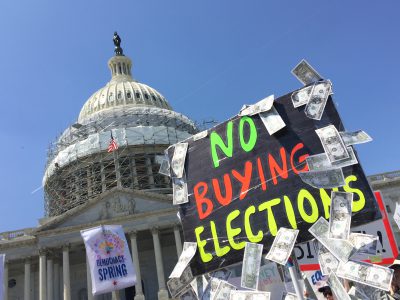
    [post_content] => Our collected stories this week look at how ordinary citizens can strengthen the essential pillars of  democracy. One way is to streamline direct communication between constituents and their political leaders, to help guide policy and governance. A strong Fourth Estate keeps politicians accountable. And now we know that we need to rethink the purpose and functioning of technology, so that it works for the people rather than as a means by which the government controls the people.

Civic hackers are remaking Taiwan’s democracy from within. Audrey Tang, Taiwan’s Digital Minister, describes in The Economist the rise of the g0v-zero movement, which encourages the public to participate in writing and rewriting new laws and policies, and to suggest new ideas for consideration. If an e-petition reaches a certain threshold of signatures, the relevant ministry is required to respond. Tang’s message is that technology can enable the promise of democracy in ways that were previously impossible. Read more.

How can we make the media more diverse? Broadcast and print media in the western democracies remain stubbornly dominated by white men, despite rising levels of awareness and some conscious efforts to change hiring practices. Sarah Jones, a staff writer at The New Republic, examines the structural problems that prevent aspiring journalists of non-white and/or working class backgrounds from breaking into journalism. One of the main issues, she writes, is that an entry level job in journalism usually begins with unpaid internships — or at the very least, years of low pay and job insecurity. Read more.

Making social media more civil is the goal of entrepreneur Brian Whitman. The New York-based technologist created an algorithm that is essentially a more ethical recommendation system, so that users won’t be duped by clickbait into spreading the worst racist, sexist, and conspiratorial content. Read more.

Will anti-trust activism be the driving issue for the Democrats in 2020? Barry Lynn, a prolific writer and former New America fellow, has joined presidential hopeful Elizabeth Warren in pushing for a breakup of the big tech monopolies for a more democratic capitalist system. This is the story of a few tough activists pushing hard against a system that has failed to check unrestrained consolidation of money, power, and market dominance. Read more.
    [post_title] => What you can do to strengthen democracy
    [post_excerpt] => 				The theme of this week's curated stories is tangible steps that ordinary citizens can take to strengthen the essential pillars of  democracy.		
    [post_status] => publish
    [comment_status] => open
    [ping_status] => open
    [post_password] => 
    [post_name] => what-can-you-do-for-democracy
    [to_ping] => 
    [pinged] => 
    [post_modified] => 2026-09-15 21:06:43
    [post_modified_gmt] => 2026-09-15 21:06:43
    [post_content_filtered] => 
    [post_parent] => 0
    [guid] => https://conversationalist.org/?p=739
    [menu_order] => 347
    [post_type] => post
    [post_mime_type] => 
    [comment_count] => 0
    [filter] => raw
)
What you can do to strengthen democracy

WP_Post Object
(
    [ID] => 702
    [post_author] => 9
    [post_date] => 2019-03-08 15:33:45
    [post_date_gmt] => 2019-03-08 15:33:45
    [post_content] => In the decade Benjamin Netanyahu has been prime minister of Israel, his right wing narrative has come to dominate the country's political discourse while the progressive minority shrinks, flails, and finds its voice drowned out. But there is a way forward, and the prescription has powerful lessons for American progressives searching for a way to win back the White House

Israel has, over the past decade, appeared to be part of the global wave of right-wing populism. Parties considered far-right just over a decade ago are now seen as moderate, while extreme-right fringe parties are increasingly legitimized. The Svengali-like Benjamin Netanyahu has won every election since 2009. The right wing bloc of parties will probably win again in Israel’s national election on April 9 , with Netanyahu once again forming and heading the governing coalition. 

Israel’s lurch to the right is not, however, the work of a single political figure. Benjamin Netanyahu, the master political puppeteer, rode the right wing wave to buoy his personal fortunes, but his political success is rooted in events and ideas that developed over decades.

A populist narrative

The modern start of Israel’s shift to the right began with the collapse of the July 2000 Camp David Summit between Ehud Barak, then Israel’s prime minister, and Yasser Arafat, the late Palestinian leader. The failure of those negotiations led right-wing leader Ariel Sharon to make a provocative visit in September 2000 to the Jerusalem holy site that the Muslims call Haram al-Sharif; the Jews call it the Temple Mount. That event precipitated the Palestinian uprising that is now called the Second Intifada. During the violent years that followed, Jewish Israeli voters who had, until then, identified as left wing, defected en masse to the center and center right. Their change in political ideology was a response to the narrative proffered by Ehud Barak — i.e., that he had offered Arafat everything at Camp David, and not only had the Palestinian leader refused, but he had then set off the Second Intifada. This is a widely accepted narrative among Israeli Jews today. By 2005, the center had eclipsed the left wing. By 2008, a poll I conducted showed that nearly half of Israelis identified as right wing, up nearly 10 points from before the Intifada. Since then the percentage of voters who self-define as right wing has climbed to the low 50s; meanwhile, the Jewish left has been stable at around 15 percent, ever since the mid-2000s (20 percent of Israeli citizens are non-Jewish Arab Palestinians). Another narrative that has taken root amongst Israeli Jews is that Ariel Sharon made a peace offering in 2005 by unilaterally withdrawing IDF bases and Jewish settlements from Gaza; but that Palestinians responded with rocket fire on southern Israeli towns and a Hamas takeover of Gaza in 2007, which forced Israel into three wars. There are other interpretations of these events, but they have little traction in Israel. Israelis rarely consider the accusation that Ehud Barak is at least partly responsible for the failure of the Camp David talks in 2000 because he tried to dictate the terms with little leeway for negotiations. Or that Israel responded to the Second Intifada with collective punishment, temporary re-occupation of cities, suffocation of Palestinian economic livelihood and, as always, settlement expansion. Israelis definitely don’t recall that Ariel Sharon’s own advisor once said that the withdrawal from Gaza was politically calculated to stymie the peace process, by dividing Palestinians and weakening their leadership. Those arguments never registered in Israeli discourse, which largely explains why there is almost no domestic opposition to Israel’s 12 year-old, ongoing military siege of Gaza. Netanyahu won the 2009 election because he skillfully leveraged the popular Israeli version of recent events, the one about the Palestinians responding with violence to all of Israel’s peaceful overtures. But he combined that narrative with a deeper and older story — one that began more than four decades earlier.

The roots of resentment

In 1977 the Likud beat the Labor party for the first time. It did so by channeling the resentment and anger of Mizrahi Jews, those from Middle Eastern backgrounds, against the Ashkenazi (European) Jews. At the time, Ashkenazi Jews were Israel’s elite, dominating every aspect of the country’s economy, polity, and culture; Mizrahi Jews were the marginalized underclass. This class/ethnic dynamic still exists, although the manner in which it manifests has changed. Prior to 1977, Labor — Ben Gurion’s party — had dominated Israeli politics without interruption since the state’s founding in 1948. The Likud won in 1977 largely based on party leader Menachem Begin’s direct appeal to Mizrahi voters, whom he identified as a constituency that had been neglected by Labor. Since then, generations of Likud voters have remained unstintingly loyal to the party, which they consider the authentic, anti-elitist voice of the people. Netanyahu perpetuated the idea that the “people” vote for the right wing parties, and that a small cadre of the leftist (read: Ashkenazi) elite has for decades been fighting a relentless, bare-fisted battle to maintain their control over Israel’s major institutions — such as the media, for example. The deep-seated populist resentment that helped fuel Donald Trump’s success has plenty in common with the the worldview espoused by Netanyahu’s base. Since the investigation into corruption allegations against Netanyahu began to close in on the prime minister, his narrative has expanded. Now he accuses the Israeli justice system, the Attorney General, the police, and civil society of coming under the influence of the elite that he insists is trying to oust him, a democratically elected leader, from power. He repeatedly accuses them all of succumbing to subversive leftist political pressure to bring him down at all costs. Sound familiar? Many Israelis agree that Netanyahu is the victim of a vast, left-wing conspiracy. The day after the attorney general announced he was likely to indict Netanyahu on criminal charges, 42 percent agreed that the AG had succumbed to pressure from the media and the left. With substantial parts of the public on Netanyahu’s side, and a new level of extremist right-wing parties moving into the political mainstream, the upcoming elections are unlikely to bring a significant change.

How the left can win (again)

But this does not mean that liberals are permanently defeated. There is a way forward. Those who support a progressive agenda must commit to playing a long game, with better strategy. To achieve their goal, progressives can take a number of important steps. First, Israel is in urgent need of a coherent ideological alternative. The left has for years been apologizing for its beliefs and obfuscating its goals, out of fear that the right wing narrative is so all-powerful that anyone who tries to express an alternative view will fail at the voting booth. The result is the perception that the left is hiding something, with the subtext that it is hiding something nefarious. If they want to win, the progressive parties must be clear about their agenda. They should say that they want to end Israel’s occupation of the occupied Palestinian territories; that they want complete separation of religion and state; that they want to strengthen democratic norms; and that they want to strengthen civil society, to integrate minorities and marginalized populations. It wouldn’t hurt to adopt other progressive causes that are generally ignored in Israel, such as climate change. To be sure, Meretz, the party that represents those who are furthest left while still on the Zionist spectrum, openly promotes these basic goals. Meretz also faces the perennial danger of falling below the electoral threshold and seeing its political presence evaporate. Meretz’s problem is partly rooted in the current left-wing camp’s insistence on continuing to promote stale solutions that long ago lost their political credibility. The second major step, therefore, is for the Israeli left to propose new approaches to its core problems. For example: while nearly half of Israelis and a majority of Palestinians believe that a two-state solution is no longer feasible, the left-wing parties cling to this ever-more remote idea. A new generation of activists examining alternative solutions, such as a two-state confederation, can breathe new life into the debate because they recognize the failure of old approaches. Given that just 20 percent of Israeli society (Jews and Arabs) self-identify as left wing, there is no way for the left to win an election solely on votes from its base. Progressive parties need a compelling message that can win over voters from the center and even from the moderate right. In order to achieve this, they will have to swallow a bitter pill: they will have to humanize the right. And that is the third important strategy. Like anyone else, the Israeli left can be guilty of disparaging and dismissing those who disagree with them. But while Israel’s right-wing can afford to alienate their adversaries, the reverse is not true. Progressive forces, if they want to win, will have to forge partnerships. That means reaching out and being inclusive.

Finding common ground

“Reaching out,” however, cannot mean imitating right-wing themes. This fourth point is essential: progressives pretending to be hardline will never win votes. This lesson proves itself time and again; at present, the Israeli Labor party is barely crossing the electoral threshold in surveys, largely for this reason. Appealing to the right without imitating them means searching for specific areas of common cause, and forging partnerships where possible. For example, a majority of Israelis support positions that are generally viewed as liberal and progressive in the United States. Israelis across the political spectrum enthusiastically embrace LGBT rights, including support for surrogacy, adoption and marriage for same sex couples. Israel saw a vigorous wave of #MeToo exposés already in 2016, the year before it began in the U.S., and surveys regularly show high overall support for further gender equality and representation. Israel has a broadly liberal de facto approach to abortion; it has growing support for marijuana legalization, a strong universal health care system and widespread expectations of a strong social safety net.   Instead of assuming that everyone who is fearful of the Palestinians in the midst of a violent conflict is a fascist, progressives should help release Israel’s inner liberal spirit. This final prescription might not end the occupation overnight. But in the long game, perhaps Israeli Jews will recognize that their policies in the occupied territories are antithetical to the kind of society the majority wishes to build at home. There are lessons for American progressives in this prescription for Israeli politics. Pandering to the right will never be a winning case for voting left. Clarity about values, acknowledging what didn’t work in the past, and creative policymaking for the future are much more attractive. That’s the kind of approach that might cause a 2012 Obama voter who defected in 2016, to consider coming home.   Dr. Dahlia Scheindlin is a public opinion expert and a political consultant. Her articles have been published in Foreign Policy, the Forward, Haaretz, the Guardian, and the Huff Po and she is a frequent commentator for the BBC, Aljazeera, and France 24. She co-hosts The Tel Aviv Review podcast and writes regularly for +972 Magazine. Dr. Scheindlin lives in Tel Aviv. [post_title] => Lessons for American progressives from Netanyahu's Israel [post_excerpt] => A strategy for progressives in Netanyahu's Israel has a lot to teach American progressives in the age of Trump. [post_status] => publish [comment_status] => open [ping_status] => open [post_password] => [post_name] => what-american-progressives-can-learn-from-netanyahus-israel [to_ping] => [pinged] => [post_modified] => 2026-09-15 21:05:33 [post_modified_gmt] => 2026-09-15 21:05:33 [post_content_filtered] => [post_parent] => 0 [guid] => https://conversationalist.org/?p=702 [menu_order] => 350 [post_type] => post [post_mime_type] => [comment_count] => 0 [filter] => raw )

Lessons for American progressives from Netanyahu’s Israel

WP_Post Object
(
    [ID] => 419
    [post_author] => 2
    [post_date] => 2019-01-22 14:55:09
    [post_date_gmt] => 2019-01-22 14:55:09
    [post_content] => 

How did we overlook billionaire Commerce Secretary Wilbur Ross’s overt financial ties with the Russian oligarchy?

Though Wilbur Ross's 2014 buyout of the Bank of Cyprus, a tax haven for Russian billionaires, has been documented in the press, it only made headlines in 2017. Spy games may capture our cultural imagination, but dirty money is what greases the machinery.

On February 16, six Democratic senators sent a letter to Wilbur Ross with questions about his Russia ties but the White House sat on his response. Cory Booker was the only senator to keep pushing into last week with follow-up questions. Ross sailed through his confirmation yesterday without answering them. We didn’t follow the money and now it’s in the White House.

In a way, the Bank of Cyprus, where Ross is the primary stakeholder and vice-chairman, symbolizes the failure of Western efforts to diminish Russian financial influence.

Cyprus was a notorious tax haven for Russian businessmen until the European debt crisis in 2013 led the bank to collapse. Russian businessmen lost billions fast. Putin refused to help and Germany was reluctant to bail out the Russian deposits. It wanted to force Russians out of the European bank and so during restructuring, deposits were converted into shares. Ironically, this gave majority ownership of the bank over to Russian plutocrats. As the Cypriot president, Nicos Anastasiades, said in June 2013, “They wanted to throw out the Russians but in the end, they delivered our main bank to the Russians.”

This is where Wilbur Ross comes in. Having already made money during the European debt crisis through a takeover of the Bank of Ireland, Ross led a 1 billion euro takeover of the Cypriot bank during the summer of 2014, including a buyout of most, but not all of the Russian plutocrats. Viktor Vekselberg, one of Russia’s richest men, became the second-largest shareholder in the bank through his Bahama-based conglomerate, Renova Group.

Ross recruited Josef Ackermann, former CEO of Deutsche Bank, Putin associate and a director at Renova Group, to join Bank of Cyprus’s board. Deutsche Bank is Trump’s largest creditor and was recently found guilty of enabling a $10 billion Russian money laundering scheme, funnelling money from Moscow to offshore accounts in Cyprus (!), among other places.

Besides Ackermann, Bank of Cyprus’s board includes Ross as vice-chairman, a position he shared until 2015 with former KGB agent and businessman Vladimir Strzhalkovsky. After Strzhalkovsky’s resignation, Renova Group executive Maksim Goldman stepped up as vice-chairman. These relationships are more than a little bit incestuous.

In his rage against Obama and Clinton over the Panama Papers and Crimean sanctions, Putin could never have planned a revenge fantasy which played out as well as it has for him — it’s too perfect. But Putin did set himself up for success.

Oil men, offshore accounts and corrupt businessmen are Putin’s bread and butter, and now he has Trump, Tillerson and Ross in the White House.

It’s unfortunate considering that the sanctions seemingly limited Russia’s financial bad behavior. In March 2016, just a week before the Panama Paper leaks revealed Putin’s off-shore investments in the Caribbean, Reuters reported on Moscow’s tighter regulation of off-shore business, citing Vekselberg’s choice to bring assets home to Russia as evidence of the Kremlin’s new muscle.

Imagine the field day these thieves will have when sanctions are lifted and secrecy is protected. Of all of the Trump team’s connections to Russia, Ross’s are explicit and well-documented and yet nothing has been done about them.

Trump’s campaign knew about Vekselberg even before he won. As Trump’s own ties to Russia were being questioned in the weeks before the election, his campaign issued a press release accusing the Clinton Foundation of being on Vekselberg’s dole. Trump regularly accuses Clinton of crimes that he has in fact committed.

Additionally, though it predates Ross’s involvement in the Bank of Cyprus, Senator Booker’s follow up letter asks Ross if he has any knowledge about the 2008 purchase of Trump’s Palm Beach home by Dmitry Rybolovlev, another Russian billionaire and investor in the Bank of Cyprus. Good luck getting an official answer now.

America’s obsession with Flynn’s phone calls should not come at the expense of investigation into Ross’s relationship with notorious money launderers. Ross has yet to resign from the Bank of Cyprus. He has said he intends to divest, but talk is especially cheap with the Trump administration. Such overt corruption in the highest echelons of our government is corrosive, and, unlike the rest of the GOPs policies, is sure to trickle down.


[post_title] => Wilbur Ross, Trump and Russia: Dirty money in the White House [post_excerpt] => Oil men, offshore accounts and corrupt businessmen are Putin’s bread and butter, and now he has Trump, Tillerson and Ross in the White House. [post_status] => publish [comment_status] => open [ping_status] => open [post_password] => [post_name] => wilbur-ross-trump-and-russia-dirty-money-in-the-white-house-2 [to_ping] => [pinged] => [post_modified] => 2026-08-07 16:51:24 [post_modified_gmt] => 2026-08-07 16:51:24 [post_content_filtered] => [post_parent] => 0 [guid] => https://conversationalist.org/?p=419 [menu_order] => 361 [post_type] => post [post_mime_type] => [comment_count] => 0 [filter] => raw )

Wilbur Ross, Trump and Russia: Dirty money in the White House

WP_Post Object
(
    [ID] => 368
    [post_author] => 2
    [post_date] => 2019-01-22 14:19:09
    [post_date_gmt] => 2019-01-22 14:19:09
    [post_content] => 

This remarkably prescient and insightful analysis was originally published on January 10, 2017. 

Early on in Ridley Scott’s movie Gladiator (2000), an overwhelming Roman force is poised to slaughter assorted Teutonic tribes, with the aging emperor, Marcus Aurelius wearily looking on from a gloomy, snow-covered hilltop. As the tribesmen raise their defiant clamor in anticipation of battle, a young Roman commander wryly opines: “A people should know when they’re conquered.” Within minutes, that point is brought home with bone-crushing vividness as the tribesmen are utterly decimated and consigned to a blood-soaked earth and to historical oblivion. Only then, however is the movie’s underlying conceit revealed.

For no sooner have the “civilized” Romans vanquished their barbarian foes than the Romans’ own, inner barbarian is released. Thus the old, philosophically inclined Marcus Aurelius is dispatched, no less violently, by his upstart son Commodus, a type who at this precise moment in our nation’s time will seem distressingly familiar: suffused with petty resentments, vacillating between bouts of insecurity and sudden imperiousness, and a narcissist who consistently blurs the lines separating crude gladiatorial spectacle from the craft of politics.

The scene comes to mind as our country awaits the transfer of political power, from a cool, articulate, and circumspect rationalist to a man of Commodus-like temper who by force of his personality and a lifetime record of fraudulent dealings has at last seized the presidency.

In this, the president-elect ended up being supported by party leaders who, temporarily caught up in a struggle between fading “principles,” stung pride, and native opportunism, predictably resolved that conflict in favor of the latter.

Having concluded its long journey from initial disbelief at an improbable candidate to groveling support of the president elect, the GOP is now poised to seize control of all three branches of government and to enjoy the spoils of a post-democratic order whose contours Trump so vividly drew throughout his seemingly endless and intensely divisive campaign.

Ideological purity and personal integrity have been sacrificed to the prospect of unchecked political power and economic interest. Meanwhile, the president-elect traverses his realm on a “thank you tour,” declares himself immune to conflicts of interest, declines intelligence briefings, stokes the passions of his fanatical supporters with irrelevant tweets at 3 a.m., and generally refuses to distinguish between fact and fantasy, promise and fulfillment.

Predictably, there has been vehement opposition, not just to Trump’s often lurid pronouncements during the campaign (a “beautiful wall” to be built; an opponent to be jailed) but also to his policy proposals: to undo his predecessor’s executive orders aimed at protecting the environment; to strip employee rights and protections; to dismantle the Affordable Care Act; to unweave the delicate fabric of legal restrictions governing business and finance and aiming to establish some semblance of parity between the haves and the have-nots of our society.

Both prior to and since November 8th, 2016, opposition to the looming deregulation of this country’s established social contract has mainly originated from what has been so dismissively and (as we now see) effectively been labeled the “liberal media.”

Facebook and Twitter accounts remain awash with conversation groups and anxious posts recalling or uncovering pertinent statistics and “facts” (a quaint word, it now seems); and social media are deluged with well-meaning advice about how to “fight back” or, more realistically, how to “survive” the coming Trump administration. And, underneath it all, the basso continuo is always the same: “How could it all have gone so wrong so suddenly?”

Which brings me back to my initial quote: “A people should know when they’re conquered.”

For so consumed have Americans been with the startling sea-change in national politics here, that they are only now, and arguably too late, beginning to realize that the shift to an autocratic form of politics in this country is part of a global pattern that has been unfolding ever since Vladimir Putin rapidly transitioned from Prime Minister (1999) to President (2000) of a crumbling and shrinking, post-Soviet empire.

Putin’s ascent was nothing if not Commodus-like as his charismatic machismo obscured unpleasant economic and geopolitical realities. As has often been observed, facts have had little or no standing during the Putin era (nor, indeed, during the eight decades or so preceding it); and anyone attempting to rouse an increasingly apathetic public with details about Russia’s pervasive corruption, the brazen manipulation of the judiciary by a small elite of oligarchs, or the staggering costs of state-sponsored violence in Chechnya and elsewhere, was silenced quickly and decisively. Anna Politkovskaya and Boris Nemtsov could tell us all about that if they were still alive.

In the context of U. S. politics, raising the tragic fate of Russian journalists and politicians who paid the ultimate price for exposing their leaders’ countless depredations may seem groundlessly alarmist. Unburdened by first-hand experience or detailed knowledge of twentieth-century totalitarianism, most Americans may yet prefer to dismiss, even ridicule, any suggestion that similar state-sponsored killings and repression could ever play out on the streets of Washington or Dallas. Time will tell. Still, evidence is mounting that a similar campaign of intimidation has already begun in this country.

Consider hundreds of documented instances of hate-speech and violent attacks that followed the 2016 election or such the president-elect’s decision to invite CEO’s of the major news organizations for a widely-reported dressing-down at Trump Tower in NYC less than two weeks after the election. The proposition so unsubtly extended on the occasion was plain enough: give up your claim to independent and critical reporting, or lose all access to information.

Meanwhile, having steadily expanded his game plan, Putin for the past several years has systematically, and lately in increasingly brazen fashion, sponsored Western Europe’s far-right parties as they plot to overturn democratic institutions and processes across Europe. He has acted as an ideological and financial sponsor of Marine Le Pen’s far-right National Front in France and, just this week, has signed a cooperative agreement with Austria’s far-right Freedom Party.

Putin’s autocratic style has served as the template for ultra-nationalist leaders in Poland and Hungary, and it shapes the aspirations of other far-right politicians diligently working to destabilize and, in time, overthrow a seemingly threadbare and irresolute liberal-democratic framework in Italy, Holland, and Germany.

Yet the consummation of Putin’s carefully orchestrated destabilizing of his Western competitors must surely be this country’s election on November 8th. Already, the president elect and his foreign policy advisors have removed Russia from the list of this country’s major threats; and all indications are that Putin’s strategy will pay off handsomely as the reputed bastion of liberal democracy (and Russia’s greatest geo-political competitor) is poised, starting January 20th, to join the post-democratic order that he has patiently been forging across Eastern and Central Europe.

Still, it would be a mistake to credit Putin with unilaterally bringing about this fateful denouement in American politics. More accurate would be to say that he has patiently and systematically exposed and exploited the deterioration of democratic process and the self-sabotage of this country’s major institutions, a pattern that has been unfolding since September 11, 2001.

If you want to blame Putin for everything — you’re taking the easy way out

The way stations of our democracy’s by now palpable demise are many: a frivolous and ruinous war waged against a far-away country starting in 2003; accelerating gerrymandering across many of the fifty states driving a wedge between popular vote counts and effective representation; a Citizens United Supreme court decision equating money and speech, and thus drowning out the voices of those without significant financial means; the rise of disinformation networks (right-wing talk radio and social media), all of which have cumulatively erased the one capacity that Plato had regarded as indispensable to a just state: being able to distinguish between truth and opinion.

So, if “a people should know when they’re conquered,” they should also acknowledge their own responsibility for that outcome and, most importantly, should understand the full magnitude of their defeat. Those intent on thwarting Mr. Trump, our nation’s Commodus, need to begin by letting go of all the old verities: traditional demographics of the electorate have proven deeply flawed; the dignified and stubborn appeal to “facts” has clearly proven an ineffectual strategy; judicial redress against the expected depredations and potentially unconstitutional actions of an autocratic president and his administration seems a long shot; and expecting congress to do anything other than what it has always done, namely, take care of its own, would be downright foolhardy.

Here, too, the rise of Putin offers an instructive analogue. For it was his predecessor’s violent 1993 siege of parliament and dismantling of an independent judiciary that had laid the foundation for Putin’s autocratic style.

To be sure, not every coup d’état is sudden and marked by conspicuous loss of life. It can also take the form of protracted legislative and judicial inertia or outright obstructionism, such as we have seen in this country for the past decade: a Congressional majority deciding not to make law but, instead, to thwart all legislative proposals for eight years; a Federal judiciary crippled by countless vacancies (currently numbering 107) that have gone unfilled for years; and a protracted degrading in word and deed of the very idea of institutions (Congress, the judiciary, the media) as agents needed to sustain a viable and balanced social order. Such, after all, has been the daily bread of Americans over the past decade or so, with talk radio, Fox News, and alt-Right websites spewing disinformation and paranoid fantasies on a daily basis. Unsurprisingly, then, distrust in congress, the judiciary, and indeed the presidency is now at an all-time high.

Hence, with this country’s key institutions having long betrayed and discredited their intrinsic purpose, recourse to traditional politics and constitutional remedies will no longer prove effective when it comes to checking a small and rapacious financial and political elite single-mindedly pursuing its interests.

In less than a month, Americans will learn the hard way that their notion of democracy, long thought to be an eternal covenant, has become an empty shell whose institutional pillars have long been crumbling. Four years from now, the oligarchs and kleptocrats about to enter through the gates of our nation’s capital will likely have reduced the Jeffersonian ideal to a fading memory. To be sure, one may hope that America and the democratic ideals it has long taken itself to embody will rise again from the ashes of 2016, hopefully as a covenant of genuinely communitarian spirit and capable of geo-political restraint.

Yet whether post-democratic America turns out a Phoenix or just the latest in a long history of empires fading into the twilight, this much seems clear now: the institutional foundations of our democracy no longer furnish viable grounds for effectively opposing those who have just conquered the Republic.


[post_title] => The Republic Conquered: On America entering the post-democratic era [post_excerpt] => So consumed have Americans been with the startling sea-change in national politics here, that they are only now, and arguably too late, beginning to realize that the shift to an autocratic form of politics in this country is part of a global pattern that has been unfolding ever since Vladimir Putin rapidly transitioned from Prime Minister (1999) to President (2000) of a crumbling and shrinking, post-Soviet empire. [post_status] => publish [comment_status] => open [ping_status] => open [post_password] => [post_name] => the-republic-conquered-on-america-entering-the-post-democratic-era-2 [to_ping] => [pinged] => [post_modified] => 2026-09-10 20:00:29 [post_modified_gmt] => 2026-09-10 20:00:29 [post_content_filtered] => [post_parent] => 0 [guid] => https://conversationalist.org/?p=368 [menu_order] => 372 [post_type] => post [post_mime_type] => [comment_count] => 0 [filter] => raw )

The Republic Conquered: On America entering the post-democratic era