WP_Post Object
(
    [ID] => 2168
    [post_author] => 2
    [post_date] => 2020-11-06 04:17:13
    [post_date_gmt] => 2020-11-06 04:17:13
    [post_content] => Gender equality in Belarus looks good on paper, but comes with many caveats. 

Less than five minutes into a recent television appearance, the interviewer asked Sviatlana Tsikhanouskaya about her last time in a kitchen. Tsikhanouskaya is generally believed to have won the August presidential election in Belarus, beating the long-term authoritarian ruler, Alyaksandr Lukashenka. During the election campaign, Tsikhanouskaya referenced her role as a housewife in what turned out to be a politically savvy move. Diverse groups within Belarus — reformists, conservatives, feminists — could all see a reflection of their ideals in Tsikhanouskaya. Conservatives could see a loving housewife and mother; reformists, an opportunity for change; and feminists saw a viable female candidate for the presidency. But the housewife trope was also used to undermine her. President Alyaksandr Lukashenka claimed that while he was sure Tsikhanouskaya could cook a good cutlet, how could he debate with her? The President sought to diminish his female opponent by comparing her knowledge of the kitchen to her lack of political experience.

During the election campaign and the now three month-old protest movement against Lukashenka’s blatant attempt to rig the results, the media spotlight has deservedly focused on Belarusian women for the outsized role they have played leading the struggle for fair elections, an end to egregious police violence, and peaceful regime change. Maria Kalesnikava, a political activist who was abducted by security forces on September 7 and then jailed, and Nina Bahinskaya, the 73 year old woman who is an iconic protest figure, have become household names for their roles in the protest movement.

However, the long-term impact on women’s role and position in society is more difficult to gauge. While a reporter for The New York Times wrote that the movement has “already shattered deeply entrenched gender stereotypes built up over generations,” and Belarusian media TUT.BY labelled it a “feminist revolution,” this view is not shared by everyone. Women have certainly played a pivotal role, but there is a great deal of work to do in mobilizing this newfound empowerment to dismantle Belarus’s deeply entrenched patriarchal system.

Barriers facing Belarusian women

On paper, Belarus is a leader in gender equality. In The Global Gender Gap Index 2020, it is ranked 29th out of 153 countries for women’s economic participation, educational attainment, health, and political empowerment. It has signed and ratified international legal frameworks on gender equality. At 69 percent, the share of women in the Belarusian judiciary is high. The Women’s Power Index shows that women have 35 percent representation in parliament, exceeding many European countries and giving Belarus a world ranking of 39th. On closer inspection, however, gender equality in Belarus comes with caveats. In the Cabinet, where more decision-making power lies, women’s representation falls to 3 percent. In 2004, Lukashenka declared that the presence of women in Parliament, makes it “stable and calm,” and that it will ensure that “the male Members of Parliament work properly,” thus reducing a woman's role to one of a caretaker or matron. True, there were a handful of high profile women in Belarusian politics before the August election—such as Lukashenka's press secretary Natalya Eismont, Senate Speaker Natalya Kochanova, and the Head of Central Election Committee, Lidziya Yarmoshyna—but their prominence does not reflect the reality for most Belarusian women. The 2019 UN Gender Equality Brief highlighted entrenched systematic gender norms and stereotypes as the biggest challenge to gender equality in Belarus, where a woman’s role is defined primarily as wife and mother. The majority of men and women in Belarus believe that being a housewife is as fulfilling as working for pay, with more women agreeing with this statement than men. Maternity leave is up to three years. This might sound ideal to women in the United States, where there is no legally mandated maternity leave, but because employers in Belarus are legally required to hold a woman’s job open for her while she is on leave, women of child-bearing age can see their careers suffer. A General Director of a medium-sized factory in Minsk once told me that it is common practice to weed out newly-married women when hiring to avoid taking on an employee who is likely to seek maternity leave. This is contributing to the wage gap that is currently around 25 percent and growing. A 2019 UN report found that almost every second woman in Belarus has faced partner violence; yet in October 2018, Lukashenka dismissed a new law on the prevention of domestic violence, decrying it as “nonsense” borrowed “from the West.”

The three graces

After the government prevented the three most popular male candidates from running as opponents of Lukashenka in the August election, women stepped up to form the main opposition. Tsikhanouskaya ran in place of her imprisoned husband, Siarhei Tsikhanouski; she was joined by Veranika Tsapkala representing her husband Valery Tsapkala, who had been forced to flee; and Maria Kalesnikava, who was the campaign manager for imprisoned opposition candidate Viktar Babaryka. It took just 15 minutes for the three women to agree to unite campaigns, something previous opposition had never managed to achieve. Over the course of the campaign, they emerged as a powerful triumvirate; it is because of their work, many believe, that Tsikhanouskaya won the election. Hundreds of thousands attended Tsikhanouskaya’s campaign rallies across Belarus, amassing huge support. But for Galina Dzesiatava, project manager at the NGO Gender Perspectives, there was also disappointment. Dzesiatava attended the rally in Homel, in southeastern Belarus, where Tsikhanouskaya expressed her desire to be “back in the kitchen frying cutlets.” Another moment that stung for Dzesiatava was when Tsikhanouskaya said “I do not have a program for changing Belarus,” adding “the men…have it.” deferring to the excluded male candidates. Dzesiatava said she “was devastated” upon hearing this.  Irina Solomatina, the founder of the project Gender Route and the Head of the Council of the Belarusian Organisation of Working Women, noted the lack of a feminist agenda in the campaign. Solomatina said they “mentioned social problems exclusively in terms of care” (for husbands, children..). In their rhetoric, “there was no place for either feminist or gender agendas.” Women rights’ issues, such as domestic violence and labour discrimination, were not mentioned during the campaign.

The women’s protests

Katya* created the initial Telegram group ‘Girl Power’ on the evening of  August 11, following two nights of protests against the fraudulent election results, which police broke up with brutal violence. She could never have foreseen the impact of a group chat she said she originally made “for close friends and friends of their friends.” The initial plan was for a flashmob of women to meet at Komarovka market in Minsk the next day wearing white and holding flowers. Katya said “the goal [of the flashmob] was to transform the violent energy of protest into something safe and inspiring.” The chat, which began inviting people that evening, had more than 8,600 members by morning, “I couldn’t believe my eyes,” Katya said. By the afternoon, thousands of women were joining hands and lining the streets all over the country. Katya and her friends had to learn fast, “it was our first chat on Telegram. Me and my friends at first had no clue how to handle it, how to pin messages, change settings etc. We had to learn on the go.” Still in awe of the power behind the protests, Katya reveals that it began as “kind of a bet” saying “I promised my friend and sister that I [would] think of a safer way for us to protest.” Katya also noted that at the time she encountered a backlash from some women who saw this form of protest — of wearing white and carrying flowers —as “revealing our weakness.” She received comments like “flowers? Don’t forget about candies for the torturers too.” Solomatina echoed this perspective, arguing that these female protests perpetuated patriarchal values and stereotypes, appealing to beauty and softness. But Solomatina also highlighted the argument that it would have been a sin “not to take advantage of the patriarchal way of life.” The idea to play on gender stereotypes and roles was central to the performance of a Belarusian lullaby as part of the protests, where women stood barefoot dressed in white holding flowers. They altered the lyrics of the lullaby, calling upon those near them to open their eyes—instead of closing them. Dzesiatava said that in these protests, the women were successfully “playing the patriarchal system against the patriarchal system.” Leandra Bias, a Gender and Peacebuilding Advisor at Swisspeace, said that foreign feminists observing from the outside sometimes “think they know which female tropes and roles are the most emancipating” but that actually “we know nothing about the lived reality of Belarusian women.” Bias added that “when it comes to women protesting, they are the ones who know best how to navigate their daily lives, they know what is going to be effective.” 

The Fem Group

One aspect of the movement with a clear feminist agenda is the Fem Group, a working group of the Coordination Council for the Transfer of Power, founded by Tsikhanouskaya. The Fem Group was created to ensure that women are involved in all the transformation processes that would follow regime change. Their work includes increasing the visibility of women’s political participation, documenting state violence against women and raising awareness of state violence against men. The group are currently conducting an anonymous study on the needs of Belarusian women and the tools required to support them. While Lukashenka labelled Tsikhanouskaya a “poor thing” during the election campaign, he now appears to have woken up to the political force women possess. The women’s marches, initially left alone by the regime, were soon subject to a cruel crackdown. Russia put out an arrest warrant for Tsikhanouskaya, who is now in exile in neighboring Lithuania, while Kalesnikava is in prison after tearing up her passport at the border to prevent police from expelling her from the country. Prominent Belarusian feminists Olga Shparaga, Yulia Mitskevich and Svetlana Gatalskaya have all recently spent time in prison. While under arrest Shparaga conducted tutorials on feminism for fellow prisoners from her prison cell.

Belarusian feminism

“Feminism” is still largely a taboo word in Belarus. Few women openly identify as a feminist, and there are many women currently marching each weekend who would balk at the label. A survey carried out back in 2012 which analysed attitudes towards feminism found that just four percent of women considered themselves feminists and more than half of the men surveyed said that they would treat such women with disgust. In 2016, fewer than one percent of Belarusian NGOs advanced women’s rights, and fewer still identified themselves as feminist.  Yuliya* is an activist from Minsk who has been organizing peaceful evening gatherings; when asked how she perceives feminism she replied: “I can’t say I’m fully aware of what ‘feminism’ really means.” Katya*, the founder of Girl Power, said she identifies as a “humanist more than a feminist.” This may change. One of the potential impacts of the current women-led protest movement is an acceptance of the term ‘feminist’ in Belarus. Kalesnikava, who openly identifies as a feminist, says that Lukashenka “accidentally did more for the development of feminism in Belarus than anyone else,” adding that “feminism will stop being a dirty word.”  Nonetheless, feminism is advancing in Belarus. In 2019 there were more than 470 educational activities associated with women’s rights—workshops, lectures, and roundtables—and more than 2,500 consultations in legal, psychological and business support. Events in the gender sphere attracted over 5,000 participants. Some of the female-led initiatives in Belarus include: March on Baby, which aims to introduce a domestic violence law; Wen-do, which conducts self-defense training for women; and Her Rights, which strengthens women’s awareness of their rights. Gender Digest stresses however, that this work that promotes gender equality is often invisible to a wider audience.

Long-term impact

Renewed awareness of domestic violence is another source of hope. The widely publicized violence of OMON, the paramilitary security forces, repulsed many, but Dzesiatava explained that “OMON are actually the fabric of Belarusian society — this level of violence has always been visible for feminists and it is now visible to everyone.” The overt violence seen today was being committed before, but behind closed doors. Now that the violence is out in the open it will be harder to ignore; the hope is that this will inspire a national conversation about domestic violence. Dzesiatava draws parallels between an abusive domestic relationship and that of the regime and the Belarusian people. Bias noted the same thing, adding that “the most dangerous moment for someone in an abusive relationship is when they decide to leave”—just as Belarusians want to leave Lukashenka.  The August election and subsequent protests have seen both classic femininity and feminism being used and inverted. Sviatlana Tsikhanouskaya has become a feminist icon around the world, but she never intended for that to be. Belarusian feminism still faces many barriers, including the use of patriarchal tropes by both women and men. Yet Belarusian women are defining a feminism of their own, one that fits their lived reality, and it may well be that regime change will enable a redefining of the women’s agenda, offering up space for new opportunities. The recent women-led uprising may not necessarily be called ‘feminist’ but, as Galina Dzesiatava makes clear, they have been dubbed the ‘Revolution of Dignity,’ and dignity is a basic tenet of feminism. [post_title] => The Belarusian protests: Feminized, but feminist? [post_excerpt] => One of the potential impacts of the current women-led protest movement is an acceptance of the term ‘feminist’ in Belarus. [post_status] => publish [comment_status] => closed [ping_status] => open [post_password] => [post_name] => the-belarusian-protests-feminized-but-feminist [to_ping] => [pinged] => https://rada.vision/en/news-from-the-coordination-council-working-groups [post_modified] => 2026-08-06 22:58:54 [post_modified_gmt] => 2026-08-06 22:58:54 [post_content_filtered] => [post_parent] => 0 [guid] => http://conversationalist.org/?p=2168 [menu_order] => 238 [post_type] => post [post_mime_type] => [comment_count] => 0 [filter] => raw )
The Belarusian protests: Feminized, but feminist?

WP_Post Object
(
    [ID] => 2160
    [post_author] => 2
    [post_date] => 2020-10-29 15:49:54
    [post_date_gmt] => 2020-10-29 15:49:54
    [post_content] => Legacy media outlets do their readers a vast disservice in presenting the minority of anti-Trump evangelicals as evidence of a broader change in attitudes.

The Trump era in American politics, which I sincerely hope comes to an end in 2021, will be forever marked by widespread public consternation over the often enthusiastic support of the Christian Right, and white evangelicals above all, for a corrupt, “pussy-grabbing,” tenth-rate would-be dictator. Over the past four years I have been trying to explain why evangelical Trump support is not only unsurprising, but also the logical culmination of the evangelical culture wars I was born into and mobilized for.

Unfortunately, legacy media outlets in the United States continue to resist this hard truth. With less than one week left before the November 3 election, they are amplifying the small minority of white evangelicals that support former Vice President Joe Biden, instead of explaining why the vast majority of white evangelicals will never dump Trump. They are also irresponsibly pushing the tired old trope that young evangelicals are changing evangelicalism for the better, in ways that will materialize any day now. Apparently we just have to keep waiting, much like Christians have been waiting for the Second Coming for the last 2,000 years.

Why do legacy media outlets continue to amplify the small liberal minority among white evangelical Christians?  Daniel Schultz, a United Church of Christ pastor and veteran civic activist, observed that they “make a good story: you’ve got white evangelicals going against the grain, so it’s unusual, and you have people standing up for their morals (or at least pretending to do so), so it’s inspirational.” However, he said, journalists need to ask whether the atypical evangelical individuals and initiatives they’re highlighting represent “meaningful change.”

Of course, the outliers do deserve some media coverage. One example is Not Our Faith Political Action Committee, a bipartisan PAC devoted to helping defeat Trump. But reporters glosses over the salient point that this organization’s  advisory council, though composed of Protestants and Catholics, is ethnically far more diverse than the white evangelicals and white Catholics who voted for Trump in 2016. Pro-Life Evangelicals for Biden, which is is prominently supported by Billy Graham’s granddaughter Jerushah Duford, likewise deserves coverage—but responsible reporting should include some healthy skepticism of Duford’s optimism about evangelicals’ ability to change for the better, given the documented resiliency of authoritarianism in conservative, mostly white evangelical subculture.

The handful of white evangelicals who oppose Trump are notably more visible, and seemingly more organized, on behalf of a Democratic presidential candidate, than any similar group has been in recent memory. And there is a non-zero chance that their efforts might actually shift a few votes in swing states, which could in turn make the difference in what will most likely be a tight contest in the Electoral College even if there is a popular vote landslide for Biden, which is likely. All of this, of course, assumes a free and fair election that plays out relatively smoothly, which is certainly not a given.

Eighty percent of the white evangelical vote went to Trump in 2016, a historic high. Trump’s share of that vote could fall back into the 70s, though this seems unlikely given the GOP’s hypocritical rush to fill Ruth Bader Ginsburg’s Supreme Court seat with charismatic Catholic extremist Amy Coney Barrett; her confirmation places the overturning of the Supreme Court’s Roe and Obergefell decisions within the Christian Right’s grasp if the composition of the court remains untouched. A Biden administration could expand the SCOTUS to restore fairness, and, while I believe it should do so, you can be sure Trump’s evangelical base will keep this possibility in mind as something to avoid by voting for Trump.

Jerushah Duford’s first name is derived from the Hebrew word for “inheritance,” but it is the notoriously bigoted and rabidly pro-Trump Franklin Graham, son of Billy, who far more embodies not only the legacy of “American’s pastor,” but also white evangelical subculture. America’s elite public sphere places far too little emphasis on that sobering fact.

If we are ever to have a proper reckoning with this moment, which is far from guaranteed even if Biden wins the 2020 presidential election handily, we will need to face not only the fact that white evangelical subculture is essentially authoritarian, but also the role of the media in obscuring that truth, and by extension enabling authoritarianism via the normalization of extremism. Major media outlets need much better religion reporting; unfortunately, however, the organizations willing to fund religion journalism, like the Lilly Endowment in my native Indianapolis, tend to be heavily biased in favor of conservative Christians.

The relatively small number of journalists who cover religion do their readers a great disservice by taking the word of the people they report on at face value, when they should be questioning them with some skepticism. Conservative Christians maintain they are misunderstood; in response, reporters seem to be striving to tell only positive stories about them, no matter how harmful the politics of those Christians might be to those who do not share their views.

It is wildly irresponsible to equate “good” religion journalism with highlighting moderate to liberal evangelical youth as if they are typical, as in this example from The New York Times, and/or parroting the aggrieved talking points of their authoritarian counterparts as if they represent “the gospel truth,” or at least something worthy of the public’s sympathy, as in this example from The Washington Post.

Or take this combative, aggressively defensive opinion piece in defense of white evangelicals published by Religion News Service in the final run-up to this year’s election. Titled “Demonizing White Evangelicals Won’t Solve Our Political Divisions,” it is another iteration of the “very fine people on both sides” argument. The writer, Arthur E. Farnsley II, posits that both liberal and conservative Americans are responsible for the divisions in our society, when it is well established that the country’s polarization is asymmetric and driven primarily from the right.

Farnsley writes that critics of right-wing evangelicals must build bridges, but provides no evidence that anyone has engaged in “demonizing” white evangelicals, let alone elite journalists and commentators. That is, unless his definition of “demonizing” is presenting the public with highly substantiated facts about the intimate connections between American white supremacism and predominantly white churches, and daring to suggest that the people who lead and attend the churches most complicit in white supremacism should be held accountable.

In a powerful response to Farnsley’s commentary in his Substack newsletter, ex-evangelical podcaster Blake Chastain, who is a friend of mine, pointed out that “it is white evangelicals who hold the flame and set fire to bridges, both in their churches and in the public square.”

We must not be taken in by Farnsley’s gaslighting, nor by right-wing extremism wrapped in “civil” trappings by “respectable” evangelicals who understand the damage that Trump support has done to their brand, and thus seek to distance evangelicalism from Trump.

The latest example of the latter comes from heavyweight Calvinist theologian John Piper’s blog, Desiring God. In a post that made waves on Twitter when it dropped on October 22, Piper strongly hinted that he will be abstaining from voting for president this year, characterizing the two choices as “death by abortion” (Biden) and “death by arrogance” (Trump). But there is simply no way to build a bridge between advocates of democracy and human rights,  on the one hand, and people like Piper who casually make false and conspiratorial statements like, “I think Planned Parenthood is a code name for baby-killing,” on the other.

How does America move forward from the Christian nationalist surge of the Trump years? Those committed to liberal democracy can and should look to build bridges with conservative Christians like Duford, who has shown a willingness to break ranks with evangelical authoritarianism and to operate in good faith in a pluralistic democracy. However, if we look away from what conservative, mostly white evangelical subculture definitively is— i.e., anti-pluralist, anti-democratic, and incapable of significant cultural change from the inside—we cannot move the country forward. Those characteristics represent unreconstructed America, and those who exhibit them must be pushed to the political sidelines or the United States will always be at risk of the unreconstructed minority imposing authoritarian, white supremacist patriarchal rule.

As sociologist of religion Andrew Whitehead, who studies evangelicals, recently observed, “there is so much inertia institutionally that it will take an extremely long time for white evangelicalism to change, and I have a hard time seeing that happen. It will be so interesting to see if younger evangelicals just leave or conform. My suspicion is those who truly embrace environmentalism or LGBTQ-affirmation, for example, will end up leaving.” And indeed, many are leaving.

True, 16 percent of the white evangelical vote went to Hillary Clinton in 2016. As Schultz explains, “About 15-25 percent of white evangelicals are liberals or at least moderates. So there's always someone to go against the majority, creating the necessary drama for a media piece.” Nevertheless, he stressed that “the numbers don’t lie: somewhere around 80 percent of white evangelicals support Trump, and that’s in line with white evangelical support for GOP presidential candidates going back to at least 2004. In other words, white evangelicals are the Republican base, and there's simply no reason to think that’s changing in this election.”

 
    [post_title] => Pro-Biden white evangelicals are a minority. The vast majority will support Trump
    [post_excerpt] => It is wildly irresponsible to equate “good” religion journalism with highlighting moderate to liberal evangelical youth as if they are typical.
    [post_status] => publish
    [comment_status] => closed
    [ping_status] => open
    [post_password] => 
    [post_name] => pro-biden-white-evangelicals-are-a-minority-the-vast-majority-will-support-trump
    [to_ping] => 
    [pinged] => 
    [post_modified] => 2024-08-28 21:11:30
    [post_modified_gmt] => 2024-08-28 21:11:30
    [post_content_filtered] => 
    [post_parent] => 0
    [guid] => http://conversationalist.org/?p=2160
    [menu_order] => 239
    [post_type] => post
    [post_mime_type] => 
    [comment_count] => 0
    [filter] => raw
)

Pro-Biden white evangelicals are a minority. The vast majority will support Trump

WP_Post Object
(
    [ID] => 2115
    [post_author] => 2
    [post_date] => 2020-10-09 04:32:33
    [post_date_gmt] => 2020-10-09 04:32:33
    [post_content] => Belarusians have found a unifying crucible in their resistance to state violence.

Mass demonstrations erupted in Belarus on August 9 to protest what was widely viewed as a rigged election that gave long-time strongman Alexander Lukashenko, who has ruled Belarus for 26-years, a victory over the popular incumbent. The protests have continued on a daily basis for nearly two months, despite mass arrests, beatings, and torture. The largest civil society movement in Belarus’s history is shaping the future of this former Soviet bloc country.

Mikita Mikado, 34 years old, is the CEO of PandaDoc, a California-based software company. From his office in San Francisco, he is following the news from his home country of Belarus. In the midst of the nationwide protests over the result of the presidential election and a crackdown of unprecedented force, he stepped in and urged police officers to resign. Money? “We can solve it,” he promised.

Never before, Mikado said, had he felt like standing up against Alexander Lukashenko, the authoritarian leader who has been president of Belarus since 1994. The breaking point was when he watched in horror as his fellow countrymen were dragged away and beaten up by riot police.

“I knew someone who was tortured and beaten,” he said. “I could no longer stay silent and do nothing, when stun grenades were exploding on the streets.”

Mikado’s crowdfunding initiative, Protect Belarus, was successful: over the ensuing three weeks it raised money to financially support police officers who quit their jobs. Hundreds of security forces members applied for re-training in the technology industry and for financial aid.

For years, Belarus’s rapidly expanding IT industry coexisted with Lukashenko’s government, keeping out of politics while benefiting from preferential tax rates and little regulation. For many tech professionals, the luxury of having a stable and relatively well-paid job allowed them the privilege of not following politics.

That relationship was already changing ahead of the August 9 election. Valery Tsepkalo, a former Belarusian ambassador to the United States and founder of the Hi-Tech Park— the Minsk equivalent of Silicon Valley—joined the opposition. Some startups created apps to monitor vote counts and collect data on poll violations.

Young and savvy engineers, fashion designers and successful entrepreneurs joined the protests. Passivity became just what a country could no longer afford. The middle class that long flourished within the system began separating from it. Post-election violence became the last straw.

An apolitical nation fights

Middle class disenchantment with the regime became apparent during the peak of the COVID-19 pandemic. Lukashenko played down the danger posed by the virus and dismissed it as mass “psychosis.” He said it was a minor health issue that could be cured easily with a shot of vodka, or with a day of working on the farm. A mass Victory Day military parade went off as scheduled. Public gatherings were not banned. Without guidance or policy from the government, Belarusians organised what they called “the people’s quarantine”: either individuals stayed home from work, or businesses introduced work from home policies without official guidance. Lacking support from the government, dozens of local initiatives and crowdfunding efforts emerged to buy and produce medical equipment, sew protective masks and raise financial support from local and diaspora communities. In Belarus, the pandemic utterly destroyed Lukashenko’s reputation as the controller-in-chief. Despite all his bravado, the president failed spectacularly to contain the virus. More importantly, civil society proved faster, more creative and resourceful than the state. By his very inaction, the president of Belarus unintentionally galvanized ordinary people to take action. Andrej Stryzhak, a human rights activist and volunteer worker, co-founded the #ByCovid19 initiative to help doctors deal with the pandemic. An informal group of some 1,500 volunteers delivered personal protective equipment (PPE) and medical equipment, purchased with money raised through crowdfunding, to hospitals across the country. Private businesses contributed funds and masks. Restaurants donated food. Hotels provided rooms pro bono to medical workers. In May, when we spoke about the initiative, Stryzhak told me he hoped the crisis would develop trust in the country’s third sector. “I see it as gradation from dissidents to parliamentary opposition,” he said. “Even if the dissidents are being trapped, they exist. If there’s less control, they are slowly becoming civil society. Later, alternative candidates appear, after which political parties will be initiated.” As numerous initiatives and projects exploded since then, he’s emerged from all that’s taken place in recent weeks in a distinctly optimistic mood. “Alternative structures of society are being created at the moment. These structures, which citizens are forming themselves, will eventually take over the current dysfunctional politics,” Stryzhak says now. The needle has indeed moved quickly.

Unprecedented solidarity

A vibrant popular movement has unfolded in the past months in Belarus. More than 100,000 rallied against Lukashenko in Minsk each of the past seven Sundays, despite detentions and police violence, insisting that his landslide re-election in August was falsified. Unlike in previous elections, the widespread grassroots protests —the largest in the country’s history—are sustained and organized with skillful use of social media. Telegram, a social media app that often remains available even during internet outages, has become a crucial tool in coordinating the unprecedented mass protests that have swept Belarus since the election. Several channels, such as Nexta and Belarus of the Brain, have become the most popular and main tools to facilitate the protests. The crowds are coming from all walks of life. In addition to the middle class, popular public figures are joining the protests. Among the celebrity protesters are athletes and Olympic medalists who march under the banner of the Free Union of Athletes, a newly-created movement. Nearly 600 Belarusian athletes signed an open letter demanding, among other things, new elections and an end to police violence. The wave of solidarity and self-organization is unprecedented in this country. Strike committees have been formed at state enterprises across the country, even though police are arresting and fining workers. Students gather on university campuses to protest repression and censorship. Lecturers support them. Media outlets publish blank pages when journalists are detained. Local residents feel the pride in belonging and self-identification; nearly every neighbourhood has its own newly designed flag. In the largest crowdfunding campaign, Belarusians have raised more than $6 million to help those who suffered from police violence and were fired for political reasons. It is a significant amount in a country where the average salary is roughly $500—and hasn’t increased in the past decade.

New values

The tide of anger and frustration with the Belarusian authorities is longstanding. People have united in the face of blatant injustice. But why was it this particular election that proved to be the tipping point? “Now it’s different. Belarusians made a sharp leap thanks to the generational change,” says Minsk-based sociologist Alena Artsiomenka. “People who grew up in the post-Perestroika era are more inclined to contribute to the society’s well-being. Those who were brought up in more stable and safe conditions are more interested in post-materialistic values.” Technology has been essential to the movement’s growth. Crowdfunding platforms made philanthropy easier. But this is no longer considered desirable. The work of one such platform, MolaMola, came to a halt after the government shut it down. It was launched by Lukashenko’s main rival’s son, Eduard Babariko, who has been under arrest since June. The same platform was used to collect money during the pandemic and previously for civil society projects that were not related to politics. Mikita Mikado felt a desire for revenge, too, after police raided the Minsk office of PandaDoc and arrested four of the company's managers. The government subsequently blocked the company’s accounts. In order to save his employees in Belarus, Mikado left the project Protect Belarus. But this did not halt the initiative. The state’s use of violence against protesters has proved to be not only a breakthrough in the way people think about the authorities— and the Belarusian public’s reaction against police brutality— but also in the way they see many realms of day-to-day life. Belarusians have been moving away from the paternalistic culture that was the tradeoff for economic stability during the post-Soviet period. In recent years, local communities managed to preserve a historic district that was slated for demolition. Residents also protested against the construction of a plant that would pollute their environment. Belarusians have long been associated with a strong paternalistic culture. This began changing in the recent years —people took matters into their own hands. The 2020 demonstrations are not without precedent. In 2017, ordinary citizens rocked the country with widespread protests against a tax on the unemployed, a bizarre plan that would have forced those who do not officially work to pay a penalty to the state. Injustice was the main driving force for the protests; the same is true of the current protests. In response to the 2017 protests, Lukashenko initially agreed to impose a ban on the tax—only to reintroduce it at a later date. He might not have changed in the intervening years, but the country has. Belarusian society had for years seen the trust of ordinary people in one another drain away. Now it has found a unifying crucible in its resistance to violence. Self-organizing and helping one another became fundamental. A nation’s new, yet old, encounter with its autocratic leader may not be finished yet. But there is little to no chance that Belarusians will submit any longer to Lukashenko's authoritarian regime. [post_title] => Belarus's protests are fueled by an unprecedented civil society movement [post_excerpt] => For years, Belarus’s rapidly expanding IT industry coexisted with Lukashenko’s government, keeping out of politics while benefiting from preferential tax rates and little regulation. The rigged August 9 election proved to be a tipping point. [post_status] => publish [comment_status] => closed [ping_status] => open [post_password] => [post_name] => belaruss-uprising-against-autocracy-is-fuelled-by-an-unprecedented-civil-society-movement [to_ping] => [pinged] => [post_modified] => 2026-08-06 22:59:40 [post_modified_gmt] => 2026-08-06 22:59:40 [post_content_filtered] => [post_parent] => 0 [guid] => http://conversationalist.org/?p=2115 [menu_order] => 242 [post_type] => post [post_mime_type] => [comment_count] => 0 [filter] => raw )

Belarus’s protests are fueled by an unprecedented civil society movement

WP_Post Object
(
    [ID] => 1941
    [post_author] => 2
    [post_date] => 2020-08-13 23:11:48
    [post_date_gmt] => 2020-08-13 23:11:48
    [post_content] => From Belarus to America: a lesson in how an authoritarian responds to those who threaten his power.

Six masked police officers in black uniforms and helmets were filmed beating one unarmed man, who can be heard moaning in pain. A woman runs up, screaming, and the cops turn on her, one of them explicitly threatening her, the other pushing her away. “Don’t touch him, that’s my husband!” she screams, flailing at them with her arms. The officers haul her husband up off the ground, presumably to be detained. It was just another day of violent crackdowns in Belarus, a country that has been ruled since 1994 by Alexander Lukashenko, who is often called Europe’s last dictator

We don’t know for certain where police took the man, but another video provides some clues. 


The women narrating the clip are clearly horrified at what they are seeing through the window. They fear the detained people lying face down in the walled yard of the police precinct will be murdered by police. One of the women wants to go out on the balcony to film, but then both decide it’s unsafe. The scene has a Children of Men vibe — dystopian and horrifyingly banal at the same time. Subsequent videos published on Twitter show protesters gathered outside a detention center in Minsk while chanting encouragement to the detainees who are being beaten inside, and weeping as large police vehicles arrive with yet more detained protesters inside. 

Reports of horrific torture in detention have begun to leak out. Here is just one video featuring the sounds of detainees screaming. Here is a video of a woman behind barbed wire, screaming “Don’t! Please stop! I can’t see anything!” A friend of mine who lives in Minsk has likened the situation to a war being waged by the state against its own populace. 

An independent Russian journalist, freed with the aid of his diplomats, was able to recount the scenes he saw after being essentially kidnapped by police (as they told him themselves, “You are not detained”), including minors being savagely beaten, people forced to lie face down in pools of blood for hours, police jumping on protesters’ backs until bones are broken, threats of rape, and much more. 

Four days into the anti-Lukashenko demonstrations, Belarusian state television broadcast a horrifying video report that shows young protesters at a detention center, obviously beaten and terrified, confirming to an off camera police officer that they will not engage in any more protests.

The mass arrests are part of a violent state crackdown on opposition demonstrators, who poured into the streets on August 9 to protest  an election that the president claimed he had “won” with 80% of the vote. Protests have sprung up all over the country, not just in the capital, Minsk. While exact numbers of protesters are hard to come by, official statistics say that at least 6,000 have been detained in just a few days. 


While media organizations have been careful to stress that vote rigging has been “alleged” in Belarus, I can state confidently that the election was stolen; the evidence is there for all to see.  Svetlana Tikhanovskaya, the 37 year-old woman who ran against Lukashenko after her husband, a well-known opposition blogger, was jailed in May, has been forced into exile in neighboring Lithuania. Security officials threatened to make orphans of her children, whom she sent abroad before the election; they later arrested her campaign manager, Maria Moroz.  They detained Moroz as a hostage, to be released in exchange for Tikhanovskaya’s departure from Belarus.  Before she was allowed to leave the country, Tikhanovskaya recorded what amounts to a hostage video, in which she reads from a script while sitting in what seems to be the office of a Belarusan Central Elections Commission chairperson. In a personal video, which she recorded shortly after arriving in Lithuania, Tikhanovskaya speaks emotionally; she calls herself a “weak woman” — a chilling reference to Lukashenko having mocked her as a “poor little girl” ahead of the election. “Children,” she said in that video, “are our everything”—a  clear indication that she was told her children would not be safe. She added: “God forbid you should ever have to face the choice I had to face.” Even with her children safely abroad, Tikhanovskaya had every reason to be terrified for them. Her husband, who was originally supposed to run instead of her before Lukashenko had him thrown in jail, remains behind bars, another hostage.  Svetlana Tikhanovskaya is young, passionate, and charismatic in a way that galvanizes voters. She has a wholesome image — an independent candidate who declared her love for her activist husband, Sergei, after he was locked up, and ran on a platform of freeing political prisoners, weakening ties with Russia, and democratic reforms. Her courage invested her with instant appeal. The threats against Tikhanovskaya and her family are not the actions of a confident leader who easily won the majority of the polls. They are the actions of a dictator who feels his throne wobbling underneath him. Although the election was not monitored — already a major red flag — the machinations witnessed by ordinary citizens at the polls were giving the game away, Tikhanovskaya was clearly getting too many votes for comfort. Demands for “all votes to be counted” are no longer relevant at this point; to get to the bottom of what happened, one would need to hold a whole new, transparent election, which is impossible at the moment. Look at this graph if you want to understand the generational span of Lukashenko’s rule: Add to that stagnation and growing inequality, as well as a history of repressions and crackdowns. Now add the fear, uncertainty, and crisis that 2020 brought — a spectacle that has included Lukashenko mocking the coronavirus and hosting a parade as infections surged Lukashenko’s response to the protests has included not just threats and violent crackdowns; he also cut off the internet in an attempt to stifle dissent. The people, however, appear furious and determined in their defiance. Bypassing restrictions, some have even created a Telegram channel dedicated to unmasking and doxxing Lukashenko’s security services — a situation that could escalate dramatically on top of all of the other escalations.  It is not clear if Lukashenko will be toppled. Certainly, the savagery with which the protesters are being treated shows us that he fears as much. Some regional analysts believe that the regime is nearing collapse, but the question is — at what cost? Americans should be paying close attention to events in Belarus. Lukashenko’s response to the opposition shows how a cornered rat behaves — with mass arrests, death threats, and attempts to shut down or limit access to the internet. Donald J. Trump is just a wannabe authoritarian, but like Lukashenko he can be dangerous when under duress. We have observed Trump’s increasing petulance — everything from the constant revenge-firings of officials and blasting his own intelligence community on Twitter — and see how it can easily turn into a rage.  We can see how that rage finds an outlet via unidentified paramilitary police grabbing protesters  in places like Portland. We can see it in how peaceful protesters were tear-gassed in D.C. for a bizarre photo op. One of the functions of authoritarianism is to bulldoze the safeguards that a democratic system places between the individual and the state — as craven officials continue to help Trump, more and more of the American public is exposed to both his anger and his incompetence. Americans are lucky to have a system that still provides many protections from Trump’s rage, but that system has its vulnerabilities. With the pandemic out of control in the States, voting by mail has become more important — but our Postal Service is being sabotaged, to name one obvious example. Republicans have been going after the USPS for years, but their efforts now present Trump with a potential opportunity to cast the upcoming presidential election as seriously flawed, especially if it’s a close one. When a crucial part of the societal infrastructure that is propping up our democracy is weakened, we stray further toward unpredictable scenarios.  Keith Kahn-Harris, a London based sociologist and prolific author, explains in an excellent Twitter thread that Western ideological zealots who support foreign dictators and cast them as fighters of Western imperialism (Kahn-Harris he refers to them as “Tankies” — the term originated with British people who supported Soviet tanks rolling across Europe, but has since broadened to include different groups, united by a disdain for the Western countries they call home) have succumbed to delusion by treating Lukashenko’s state propaganda as though it were meant to be believed.  Rather, explains Kahn-Harris, “In dictatorships the absurdity of the lie is precisely the point—it is an expression of dominance.” People who have grown up in authoritarian regimes know that official statements are lies. The trick is to understand the subtext of the lie. People who have grown up in democracies are not equipped with the necessary cynicism to combat a leader who lies axiomatically, which is why the U.S. media has failed to cover the Trump presidency with adequate insight.  There is a very good parallel to be drawn between Trump’s base — as they do everything from cheering on our own examples of horrific police violence to ignoring or dismissing the president’s inaction on the pandemic — and Lukashenko’s Western fanboys as they seek to discredit protesters in Belarus Both groups are operating in a state of unreality. As we have seen over the past few months,  2020 has shown all too well, unreality is both seductive and deadly. [post_title] => Why you should care about what's happening in Belarus [post_excerpt] => Americans should be facing close attention to events in Belarus. Lukashenko’s response to the opposition shows how a cornered rat behaves — with mass arrests, death threats, and attempts to shut down or limit access to the internet. Donald J. Trump is just a wannabe authoritarian, but like Lukashenko he can be dangerous when under duress. [post_status] => publish [comment_status] => closed [ping_status] => open [post_password] => [post_name] => why-you-should-care-about-whats-happening-in-belarus [to_ping] => [pinged] => [post_modified] => 2026-08-06 23:01:20 [post_modified_gmt] => 2026-08-06 23:01:20 [post_content_filtered] => [post_parent] => 0 [guid] => http://conversationalist.org/?p=1941 [menu_order] => 252 [post_type] => post [post_mime_type] => [comment_count] => 0 [filter] => raw )

Why you should care about what’s happening in Belarus

WP_Post Object
(
    [ID] => 1718
    [post_author] => 2
    [post_date] => 2020-04-30 13:59:50
    [post_date_gmt] => 2020-04-30 13:59:50
    [post_content] => How to explain the Christian Right's unshakable loyalty for Donald Trump, a twice-divorced man who has been credibly accused of sexual assault by numerous women? 

White evangelicals have consistently been Donald Trump’s most supportive demographic since his 2016 victory. Even as the president’s overall approval numbers decline after the initial “rally ‘round the flag” effect from the COVID-19 pandemic that he is egregiously (and arguably criminally) mishandling, white evangelicals remain steadfastly by his side. The pandemic has itself become a site of the culture wars that the anti-democratic U.S. Christian Right has been waging relentlessly for four decades as it attempts to hold back the progress of civil rights and equality in America. And Trump, who has demonstrated his willingness to pursue their culture wars agenda, can count on unwavering support from white evangelicals in the upcoming presidential election. Our analytical focus should be on why and how authoritarian evangelicals have managed to gain so much power and what can be done to fight back, as opposed to hand wringing over their willingness to partner with an impious strongman.

Pundits who do not understand right-wing evangelical subculture have over the last few years frequently suggested that certain tipping points might shake evangelicals’ loyalty to Trump. Early on, many naively believed that shaming evangelicals over their hypocrisy in supporting a thrice-married man credibly accused of sexual assault by numerous women would be an effective means of peeling some of them away. More recently, some commentators claimed hopefully that outgoing Christianity Today editor Mark Galli’s December 19, 2019 op-ed, “Trump Should be Removed from Office,” was evidence of significant dissent over support for the president within the evangelical camp.

Trump did initially seem concerned about Galli’s op-ed, tweeting angry responses and launching an “Evangelicals for Trump” initiative. He needn’t have been. His evangelical base remains unwavering in its support for one simple reason: Trump gives authoritarian Christians practically everything they want. He validates their worst culture warring impulses and pursues the Christian Right’s agenda more comprehensively and vigorously than any previous president, including George W. Bush. Not only has Trump been stacking the federal courts and the federal bureaucracy with young far right ideologues; he also moved the United States Embassy in Israel from Tel Aviv to Jerusalem to play to evangelicals “end times” beliefs.

Far from revealing that there is significant division among white evangelicals over Trump, the responses to Galli’s op-ed showed that Christianity Today, while certainly a conservative publication, is no longer the evangelical flagship magazine. Instead, the periodical that Billy Graham, “America’s Pastor,” founded in 1956 is now out of step with an increasingly radicalized white evangelical demographic, one in which the racial animosity that has always been a part of this kind of Christianity is now closer to the surface than many of the “genteel” readers of Christianity Today might wish.

Meanwhile, the prominent Southern Baptist leader Rev. R. Albert Mohler Jr., who was once critical of Trump and refused to vote for him in 2016, now says he regrets that decision and will vote for him in 2020. In his statement, Mohler bragged that he thinks Trump may see an even higher share of the white evangelical vote this time around than the 80 percent he got in 2016, and he may well be right. The case for any shift of evangelicals away from Trump thus further crumbles.

To be sure, a small minority of white evangelicals remains critical of Trump, but only 16 percent of the white evangelical vote went to Hillary Clinton in 2016, and the current polling data does not show  Joe Biden gaining a greater share. The realities of American polarization have become so stark that the coveted swing voter is now essentially a thing of the past, at least according to the analysis of political scientist Rachel Bitecofer, which I find convincing. National elections thus become a contest of turning out the base, and white evangelicals vote disproportionately to their numbers. Although they are down to 16 percent of the U.S. population, they still made up 25 percent of the electorate in the 2018 midterms.

And Trump continues to deliver for them. Most recently, he pulled money from the World Health Organization, the kind of international institution right-wing authoritarians despise for their “elitism” and “globalism,” and redistributed some of it to the evangelical missionary organization Samaritan’s Purse, which has somehow been allowed to set up a 68-bed field hospital in New York City’s Central Park despite legitimate concerns about its ability to provide an equal standard of care to all patients.

Samaritan’s Purse is headed by rabid homophobe and Islamophobe Franklin Graham—Billy Graham’s son; the organization requires staff to sign a statement of faith that reads in part, “we believe that marriage is exclusively the union of one genetic male and one genetic female.” In addition to Samaritan’s Purse, Graham also heads the Billy Graham Evangelistic Association, which is deliberately seeking to capitalize on people’s fears of the novel coronavirus in order to drum up conversions. Graham has, naturally, been one of Trump’s most outspoken prominent evangelical supporters since 2016.

But it’s not all bad news for those of us who support democracy and human rights. Trump’s supporters do have some reasons to worry about the president’s reelection prospects. The economy has historically played a decisive role in American presidential elections, and the staggering unemployment numbers caused by quarantine during the pandemic would normally sink any incumbent’s prospects. This may be one key motivation of the recent protests calling for an end to quarantine restrictions on economic activity. (By the way, the phrase “reopen the economy” is a partisan right-wing talking point, and journalists should avoid using it as a supposedly neutral descriptor for these actions.)

As some states such as Georgia move to ease quarantine restrictions and allow certain businesses to reopen, Trump continues to talk out of both sides of his mouth—for example, rebuking Georgia’s governor for planning to ease restrictions too early after tweeting a demand to “LIBERATE” other states where anti-quarantine protests had taken place. Meanwhile the anti-lockdown protestors direct their anger at Dr. Anthony Fauci rather than at Trump.

While it would be wrong to dismiss these protests as mere “astroturf” campaigns, they do have backing and funding from a wealthy and well-connected right-wing network that includes billionaire Robert Mercer and Secretary of Education Betsy DeVos. But if those of us who value democracy and equality choose to ignore the protests, labeling them as top-down initiatives with no deep grassroots support, we risk missing their potential political impact. A number of commentators made the same mistake with the appearance of the Tea Party, which was backed by many of the same members of the donor class. Another mistake was to view the Tea Party as distinct from the Christian Right, which it is not. We must avoid repeating that mistake.

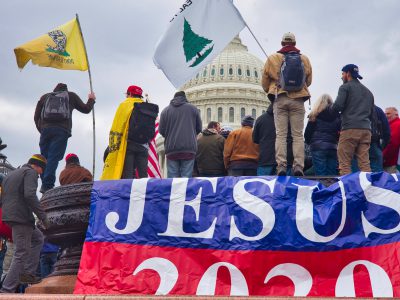
Indeed, the cab of a semi used in the protest in Harrisburg, Pennsylvania on April 20, was emblazoned with the phrase “Jesus is my vaccine,” rhetoric similar to that used by pastors who defiantly continue to hold in-person church services despite shutdown orders meant to contain the pandemic. Although there is no legal precedent for the exemption of churches from quarantine, a number of right-wing organizations have now taken up the cause under the rallying cry of “religious freedom” that they have effectively employed in recent years to impose a theocratic agenda with respect to matters such as abortion, birth control, and same-sex marriage. Meanwhile, new conspiracy theories are being spread via social media, including the apocalyptic assertion that the coronavirus vaccine will be the “Mark of the Beast” associated with the “end times,” literally damning those who receive it.

Such beliefs are harmful to both democracy and public health, and, while it remains to be seen what impact they might have on the 2020 election, it is worth remembering that in 2013 a full 20 percent of Republicans believed with certainty that Barack Obama was the Antichrist. The Electoral College, as well as America’s problems with gerrymandering and voter suppression, favor the Right, but at the same time, the spectacle of Christians behaving badly in the face of the coronavirus pandemic will most likely have a negative impact on evangelicals’ reputation, and, by extension, Trump’s.

In any case, with the Christian Right and the GOP desperate to cling to their disproportionate power, we can expect a bumpy ride to November. Democrats will need to make every effort to turn out their base in order to defeat the GOP.
    [post_title] => “Jesus is my vaccine”: Culture wars, coronavirus, and the 2020 election
    [post_excerpt] => The Trump supporters who protested the pandemic lockdown have support from billionaires like Robert Mercer and Betsy DeVos. But if we label them as top-down initiatives with no deep grassroots support, we risk missing their potential political impact.
    [post_status] => publish
    [comment_status] => closed
    [ping_status] => open
    [post_password] => 
    [post_name] => jesus-is-my-vaccine-culture-wars-coronavirus-and-the-2020-election
    [to_ping] => 
    [pinged] => 
    [post_modified] => 2026-08-06 23:04:14
    [post_modified_gmt] => 2026-08-06 23:04:14
    [post_content_filtered] => 
    [post_parent] => 0
    [guid] => http://conversationalist.org/?p=1718
    [menu_order] => 271
    [post_type] => post
    [post_mime_type] => 
    [comment_count] => 0
    [filter] => raw
)

“Jesus is my vaccine”: Culture wars, coronavirus, and the 2020 election

WP_Post Object
(
    [ID] => 1682
    [post_author] => 2
    [post_date] => 2020-04-03 03:40:38
    [post_date_gmt] => 2020-04-03 03:40:38
    [post_content] => 

Despite their liberal manifestos, the Labour Party and the Democrats continue to choose men as their leaders

It wasn’t meant to be like this. This time it would be different; Britain’s Labour party was going to elect its new leader, and this time it would be a woman. They didn’t really seem to have a choice: Labour turns 120 this year, but not once had a woman managed to poll higher than a man in a leadership contest.

On top of that, the original field of candidates looked promising. There were four women— and one solitary man. Two women dropped out early but that still left twice as many women as men in the running.

In the end, none of that mattered. The results of the Labour Party leadership election will be announced next week and, unless there is a major upset, Keir Starmer, the lone male candidate, will be elected leader by a landslide.

It wasn’t meant to be like this. The Democratic candidate was going to be Kamala Harris — or was it going to be Elizabeth Warren? No, it was going to be Bernie Sanders. One thing was certain: it was not going to be Joe Biden.

Biden was polling high but his campaign was poor and he was nowhere to be seen; he was more of the same when the consensus seemed to be that the Democrats needed anything but that. Still, he went on and slowly but surely, until everyone but Bernie dropped out. Now Biden is almost certainly going to be the candidate for president who will face off against incumbent Donald Trump in November.

It wasn’t meant to be like this. Both contests had already been going on for weeks — months! — and were starting to near fever pitch, but the pandemic hit. We know for certain that the Labour party’s leadership race will end with a whimper as everyone remains focused on the coronavirus.

The Democratic convention, meanwhile, feels like it belongs to a distant future: who even knows what our world will look like in July? But this doesn’t mean either race should go unrecorded; there are lessons that will need to be learnt, once we have the time (and mental space) to do so.

Let’s look at what happened in Britain, where the Labour party has now been headed by Jeremy Corbyn for four and a half tumultuous years. He seemed to emerge from nowhere in 2015; with politics well to the left of the party’s mainstream, the 70-year-old lawmaker had for decades been a backbencher with obscure pet issues.

With Corbyn as its leader, the Labour party was in near constant revolt. Factional infighting reached its peak in the summer of 2016, when an attempt to oust him failed.

While his fellow MPs had a famously acrimonious relationship with Corbyn, he saw his popularity with the Labour membership spike and grow exponentially in the first few years. Sadly for him, it didn’t translate into success in the polls; sadly for then-Prime Minister Theresa May, Corbyn’s apparent weakness pushed her to call an election in 2017, which turned into one of the worst campaigns in memory, and resulted in Labour making some unexpected gains.

Buoyed, the left wing of the Labour party claimed victory over its centrist counterparts — whose policies, they insisted, had lost the party the 2010 and 2015 elections — but the triumphalism was relatively short-lived.

After May came Boris, and when Johnson called an election last year, it ended with Labour’s worst electoral results since 1935. The shock came and went, and then came the gloating, this time from the moderates. After warning for four years that the hard left would bring disaster, they felt vindicated.

Corbyn’s faction, on the other hand, claimed that the election had been solely focussed on Brexit, and that the loss could be attributed to the Conservatives’ straightforward Leave message, as opposed to their own muddled position of a second referendum.

Then the leadership contest started, with Rebecca Long-Bailey, Lisa Nandy and Keir Starmer emerged as the three main candidates.

Most people believed that Long-Bailey would win; she always was a close ally of Jeremy Corbyn’s and the membership presumably still loved Corbyn, so it should have been a done deal.

[caption id="attachment_1688" align="alignnone" width="799"] Rebecca Long-Bailey at a Manchester Labour Party event on November 7. 2019.[/caption]

It wasn’t. Stuck in the former leader’s shadow, Long-Bailey struggled to make a case for herself. Yes, she was of the left, no, she wasn’t “continuity Corbyn: yes, she was asked to rate his leadership on television and gave him “10/10”; no, she couldn’t really explain what policies of hers would be a departure from the past few years.

She’s also, well, a bit middle of the road. Brought up in Manchester, she studied politics and sociology at university, and eventually became a solicitor in 2007. She joined the Labour party in 2010, was elected to a safe seat in 2015, and joined the frontbench after Corbyn’s victory, though never quite made waves.

As the party’s spokesperson for business, she pushed on establishing a Green New Deal, but the policy got a bit lost in the discourse; in fact, everything she did in those five years always failed to really land. That she was seen as the given pro-Corbyn candidate was telling.

Many observers have pointed to the similarities between Jeremy Corbyn and Bernie Sanders, both socialists roughly the same age who tend to have acrimonious relationships with their fellow legislators. But while Sanders has loyalists like 30 year-0ld Congresswoman Alexandria Ocasio-Cortez poised to pick up his torch, Corbyn has left no such legacy. Under Corbynism, no successor was allowed to grow and bloom—and here we are.

Lisa Nandy had the opposite problem. Unlike Long-Bailey, she is not stuck with the Corbynite label. Nandy is a woman of no faction.

[caption id="attachment_1689" align="alignnone" width="799"] Lisa Nandy on September 23, 2018.[/caption]

The daughter of Indian Marxist academic Dipak Nandy and granddaughter of Liberal Party MP then peer Frank Byers, she has been in Parliament since 2010 — a term longer than her two opponents. Despite her pedigree, she has always been a bit of an outsider; often hovering near the frontbench but never fully a frontline politician.

There is a drum she has been banging, often alone, and it is: English towns that used to be safe Labour strongholds are leaving us in droves because we have stopped listening to them, and the party must reconnect with its northern working class base if it wants to survive.

She is absolutely right, of course, and did gain traction when she got to claim that she had been warning that the 2019 election results would be inevitable for a long time. When the party lost seats like Bolsover — held by socialist stalwart Dennis Skinner since 1970 — and Sedgefield, which was home for decades to a certain Tony Blair, people finally started to listen.

 Still, identifying a problem and finding a solution are two different things, and she never quite convinced her peers that she had succeeded with the latter.

Then there is our last candidate, who is simultaneously the most and least exciting figure in the race. On the one hand, he used to be the Director of Public Prosecutions and head of the Crown Prosecution Service, for which he was knighted, and is rumoured to be the man Helen Fielding based dreamy Mark Darcy in her 1996 novel Bridget Jones's Diary (later made into a hit film with Colin Firth in the role of Mark Darcy).

On the other, he is boring. Keir Starmer is not an exciting politician; he is a former barrister who measures his words, speaks with the cadence of an expert, and has always managed to keep out of his party’s factional warfare. His policy platform is a bit Corbynite but not entirely so; he appealed to the moderates in Labour but without appearing like one of them either.

In fact, he is currently all things to all people; he really could not be possibly accused of leaning into populism, and he is about to become the Labour party leader. Perhaps his very own brand of establishment dullness will be needed in five years’ time, when Britain’s voters have gone through a full term of Boris Johnson. Or perhaps desperate times call for desperate measures, and he simply is not up to the gargantuan task ahead of him.

In short: Labour is playing it safe. It could have taken a gamble by electing one of two 40-year-old women occupying northern seats, but is going instead with a 57-year-old man based down the road from the current leader’s inner London constituency. Starmer and Biden may be different, but the circumstances of their rise feel eerily similar.

Header image courtesy of Chris Boland.

[post_title] => In the UK and the USA, the political left has rejected female leadership in 2020 [post_excerpt] => In their search for a leader who can beat the incumbent, both Labour in the UK and the Democrats in the USA chose white men who represent a status quo ante that already seems like ancient history. [post_status] => publish [comment_status] => closed [ping_status] => open [post_password] => [post_name] => in-the-uk-and-the-usa-the-political-left-has-rejected-female-leadership-in-2020 [to_ping] => [pinged] => [post_modified] => 2026-08-06 23:05:05 [post_modified_gmt] => 2026-08-06 23:05:05 [post_content_filtered] => [post_parent] => 0 [guid] => http://conversationalist.org/?p=1682 [menu_order] => 275 [post_type] => post [post_mime_type] => [comment_count] => 0 [filter] => raw )

In the UK and the USA, the political left has rejected female leadership in 2020

WP_Post Object
(
    [ID] => 1639
    [post_author] => 2
    [post_date] => 2020-02-27 14:38:21
    [post_date_gmt] => 2020-02-27 14:38:21
    [post_content] => In the coming election, the 21st Congressional district of northern New York State will choose between an incumbent who voted to reverse the Affordable Care Act—and a Democratic challenger who has devoted her political career to expanding healthcare access.

On a recent Thursday, Tedra Cobb rolled out of bed before 6 a.m. and did a kickboxing workout in the basement of her home in Canton, N.Y. She needed to blow off some steam–or “get my ya-yas out,” as she put it—after a frenetic few days traversing her 17,000 square mile district in upstate New York, the largest Congressional district east of the Mississippi, where she’s running against Republican incumbent Rep. Elise Stefanik. 

Those who watched the impeachment hearings will remember Stefanik, who achieved dubious fame with her unswervingly Trump-loyal line of questioning. On November 17 Trump tweeted a clip of Stefanik grilling former Ambassador Marie Yovanovitch about Hunter Biden and the Ukrainian energy company Burisma, commenting: “A new Republican Star is born.” The 35-year-old Congresswoman was rewarded for her dramatic, if intellectually dishonest, interrogations with a slot on Trump’s impeachment defense squad, alongside seven of the biggest far-right devotees in the House of Representatives. By the time Stefanik flew back from Iowa—photographed on a plane packed with surrogates wearing red “Keep America Great” hats—Trump was getting ready for his post-impeachment revenge spree, which Stefanik dutifully defended in the press. And the love fest continues: “Trump Has A Crush on Rep. Elise Stefanik,” declared a recent headline in City & State, a local news outlet. 

Trump went so far as to single out Stefanik during his post-acquittal speech in the White House East Room. “It’s most incredible what’s going on with you, Elise,” he said. “I was up campaigning for helping her and I thought, ‘She looks good, she looks like good talent.’ But I did not realize when she opens that mouth, you were killing them, Elise, you were killing them.” And, if nothing else, Trump loves a killer that looks good on television. 

Despite the impeachment hearings, Trump’s nationwide approval rating is at 49 percent—an all-time high since he took office in 2017. But in Northern New York, the 21st district—a mostly rural, economically challenged region that borders Vermont and Canada—is something of a “pivot” zone: it went twice for Obama before flipping red in 2016. So, will Elise Stefanik’s association with an increasingly erratic, impeached President help or harm her in 2020? And how will Cobb adapt for her rematch against Stefanik at a time when all local politics are being devoured by a national meta-narrative? 

I was looking forward to discussing these issues with Cobb, 52, who is a former volunteer firefighter, ESL teacher, healthcare non-profit founder and St. Lawrence County legislator, as she gears up for one of the most closely watched Congressional races in the country this November. 

There were some hurdles, however—mostly self-inflicted. That is to say, TapeACall Pro, the app I typically use to record interviews, kept malfunctioning. After the third dropped call, I apologized to Cobb, explaining that I was going to attempt to use an old-school digital voice recorder to capture our conversation instead. There was one problem: I hadn’t changed the batteries since the Obama Administration. Could she call me back in five minutes? Far from being annoyed by my technological issues, Cobb was calm and compassionate, seeing this mishap in a broader context: “That’s what we all need—many, many Plan B’s,” she said.

I had not yet internalized the lesson of the Iowa Democratic caucuses debacle: if you want to get something done, do not rely on an app. 

Once I figured out my Plan B, Cobb told me about how her career in public service led her to this moment. A resident of St. Lawrence County for the past 30 years, she was inspired to run for the first time in 2017, after Stefanik voted to repeal the Affordable Care Act. For Cobb, who had spent her career as a healthcare advocate—she worked as an educator for a local HIV/AIDS outreach program and served as Executive Director of a community health non-profit—the vote was a call to action. Just a year earlier, her daughter, now a senior at Cornell, had to have emergency back surgery, “and I didn’t blink an eye because I knew I had good insurance,” recalls Cobb, who at the time was working part-time at SUNY Potsdam, her alma mater. 

But a month after her daughter’s surgery, Cobb lost her job and her medical insurance. She realized that Stefanik’s vote to end the Affordable Care Act “would have repealed all the protections for people like my kid who have preexisting conditions,” she said. “I’ve been elected before”—to the St. Lawrence County legislature, where she beat a Republican incumbent and served for eight years—“and I just knew that feeling of, ‘I’ve gotta run.’” 

Cobb won the 2018 primary with 56 percent of the vote, but her victory was a pyrrhic one: she had blown through all her money and had to start fundraising from scratch for the general election, during which she was outspent by her opponent 3-to-1. Stefanik won the election by a 14 percentage-point margin, which seems like a lot until you compare it with her margin of victory in the previous election—35 percentage points—when she ran against a retired army colonel named Mike Derrick. Given that context, Cobb was encouraged by the results. 

“I knew going in that it might take two cycles,” she said. 

Supporters in her district are sticking with her. Rebecca Y. Rivers, owner of the Northern Light Yoga studio in Canton, New York, voted for Cobb in 2018 and plans to do so again this year. “I believe Tedra has what it takes to win because she has demonstrated greater interest in the residents of NY-21 than her opponent has,” says Rivers, 53, adding that she shares Cobb’s positions on healthcare, reproductive choice for women, environmental protection and public education. “Many in this district are seeking new representation after feeling that they haven’t been heard by Rep. Stefanik, who was making herself rather scarce and inaccessible in the district prior to seeing Tedra’s popularity increase.” (Until 2018, when she and her husband bought a home in Saratoga County, Stefanik didn’t live in her district, using a home that was owned by her mother as her address. “I like to say that we finally made her pay taxes here, like the rest of us,” said Cobb.)  

Michelle Poccia, a real estate broker who lives in Wilton, New York, says she had “high hopes” for Stefanik when she took office in 2015 at the age of 30, making her at the time the youngest woman to ever serve in Congress. “It sickens me to see someone from her generation making a play to be a career politician by latching on and following the cues of some of the most irritating, non-productive talking heads of her party,” says Poccia, 64, who changed her lifelong party affiliation as an Independent to a Democrat in 2016. “Being a puppet to the likes Jim Jordan and so obviously seeking favor with the most corrupt President in our country’s history has been painful to watch.” 

It has been painful not just for people in the 21st District. This time around, with Stefanik’s rise to the national spotlight, Cobb has seen more support emerge nationwide as a result. Before the impeachment hearings began last fall, Cobb had raised $656,000 and had about 2,000 Twitter followers. But by November 18, right after Stefanik battled with Rep. Adam Schiff when she interrupted the House Impeachment hearings, Cobb had a blowout fundraising weekend, generating $1 million from donors in all 50 states. Since then, her Twitter following has grown to more than 262,000, compared to Stefanik’s 324,000. At last count, Cobb had $2.7 million in her war chest, versus Stefanik’s $4.5 million. She recently was endorsed by End Citizens United, a non-profit devoted to getting money out of politics, which means that Cobb won’t accept money from corporate PACs; her campaign’s average contribution size is $27. 

And Stefanik seems to be feeling the heat. “My opponent is raising money from the Hollywood liberals calling me #TrashyStefanik,” she tweeted on November 17. She was referring to George Conway, the husband of White House advisor Kellyanne, whose vocal opposition to Trump is an ongoing media saga. Conway tweeted on November 16, “.@EliseStefanik is lying trash. Please give to her opponent, @TedraCobb.” In response, some online supporters launched what became the aforementioned trending Twitter hashtag, #TrashyStefanik. Cobb says she doesn’t engage in name calling and has never herself used that hashtag to describe her opponent.

Amid the rise of the #MeToo movement and a surge in the number of women who were raising their hands to run for office, the Cobb-Stefanik faceoff in 2018 also had the distinction of being the only race in New York in which two women were going head-to-head as major party candidates for a House seat. Depending on the primary results, the situation may be the same in New York this year. But according to EMILY’s List, at least 20 likely matchups for House races nationwide will feature two women running against each other. 

Initially seen as a moderate, Stefanik has been drawn further and further into the Trumpian distortion field, like so many who get close to him. “In all honesty, when Elise Stefanik was first elected in 2014 I did not think that she would be bad for the district,” says John Cain, a 45-year-old high school history teacher from Watertown, New York. “The hopefulness I once had for her ability to represent our area has been destroyed by more recent events in her career.”

In addition to voting to repeal the Affordable Care Act, she voted to support the Concealed Carry Reciprocity Act, an extreme piece of legislation that would have required all states to recognize permits issued in concealed carry states. She voted to allow coal companies to dump toxic waste into local streams without monitoring the damage that they were causing. She has also adopted Trump’s style of juvenile name-calling, referring to Cobb as #TaxinTedra and a “total trainwreck” on Twitter, and mocking elites even though she, like Trump, would by all accounts be considered a member of America’s elite socio-economic class. 

During the impeachment hearings, for example, she slammed Democrats for selecting renowned constitutional law professors, such as Harvard Law’s Noah Feldman, to respond to legal questions surrounding impeachment, arguing that “they are not in touch with the viewpoints of millions of Americans.” Stefanik is a Harvard graduate who previously worked for Mitt Romney and Paul Ryan; she failed to elaborate on who would be better qualified to weigh in on questions about constitutional law than professors who specialize in constitutional law. 

“She’s just like Trump,” says Cobb. “She calls names, she tells lies in her campaign. But quite frankly for me, always the mission is to make sure more and more people know who I am.” 

On the day Stefanik made headlines when Rep. Adam Schiff, following House rules, refused to acknowledge her questions—“the gentlewoman will suspend,” he told her repeatedly, over the objections of Rep. Devin Nunes—Cobb was focused on an issue closer to home. Her sister, who was struggling with addiction, needed a detox bed. The episode was a metaphor for her whole campaign, and her promise to provide much-needed healthcare for everyone in her district who needs it: “Elise Stefanik was performing to get attention for herself,” she says, “and I was trying really hard to be a sister and to also be meeting with people in this district.” 

All local elections are now haunted by the specter of the vindictive bully occupying the White House, but Cobb is quick to point out that she is not running against Trump. “I am running against Stefanik. I got into this race because Elise Stefanik voted to take people’s healthcare away. And she’s doing it again,” she said, referring to Stefanik’s December vote against the Elijah E. Cummings Lower Drug Costs Now Act, which would have given Medicare the power to negotiate directly with drug companies. “So she cares more about the pharmaceutical companies, because they are her donors, than the people in this district who are wondering, ‘Do I take my prescriptions or do I eat?’” 

At this stage in the campaign, it’s hard to gauge voter sentiment–polls aren’t yet publicly available—though the non-partisan Cook Political Report said in November that they considered Stefanik to be “not vulnerable.” But, as we learned in 2016, a lot can change between February and November. The lack of a Democratic primary in the 21st district this year will allow Cobb to better allocate her campaign resources, and continue to emphasize Stefanik’s record on health care and the environment, while tying her personally to Donald Trump. Because as much as Cobb says she’s not running against Trump, 2020 will be a referendum on his leadership and the example he has set.  

For example, just last weekend Cobb released an ad calling upon Stefanik to return a campaign donation from Las Vegas hotelier Steve Wynn, who resigned from his role as finance chair for the Republican National Committee amid allegations that he sexually assaulted dozens of women, including employees. So far, she’s keeping the money.  

“I think it is absolutely disgusting that any politician would hold on to the dirty money that Steve Wynn has passed around,” says Cain, the high school history teacher. “I was relieved to see most politicians give it back, and outraged that Stefanik, who has claimed to be a supporter of advancing women in politics, would refuse to do so, even after being called out on it publicly.” 

 
    [post_title] => Meet the Democratic candidate who plans to flip her district and take it back from the woman Trump called "a new Republican star"
    [post_excerpt] => 
    [post_status] => publish
    [comment_status] => closed
    [ping_status] => open
    [post_password] => 
    [post_name] => meet-the-democratic-candidate-who-plans-to-flip-her-district-and-take-it-back-from-the-woman-trump-called-a-new-republican-star
    [to_ping] => 
    [pinged] => 
    [post_modified] => 2024-08-28 21:11:30
    [post_modified_gmt] => 2024-08-28 21:11:30
    [post_content_filtered] => 
    [post_parent] => 0
    [guid] => http://conversationalist.org/?p=1639
    [menu_order] => 280
    [post_type] => post
    [post_mime_type] => 
    [comment_count] => 0
    [filter] => raw
)

Meet the Democratic candidate who plans to flip her district and take it back from the woman Trump called “a new Republican star”

WP_Post Object
(
    [ID] => 1588
    [post_author] => 2
    [post_date] => 2020-01-31 04:25:33
    [post_date_gmt] => 2020-01-31 04:25:33
    [post_content] => Grassroots organizers are proving to be a formidable challenge to the Republican Party's voter suppression tactics. 

When Stacey Abrams, the first black woman ever nominated by a major party to run for governor of any state, ran as Georgia’s Democratic candidate for governor in 2018, voters knew she might lose. Abrams’ skills, tenacity, and national profile—enhanced by a decade of service in Georgia’s state legislature and an endorsement from Barack Obama—helped secure her historic nomination. But the state’s long history of voter suppression was a formidable obstacle to victory.

Brian Kemp, the Republican gubernatorial candidate then serving as Georgia’s Secretary of State, was responsible for overseeing voter registration. One month before the election, his office was holding 53,000 voter registration applications for reviewnearly 70 percent of which were for black residents, who compose approximately 32 percent of Georgia’s population. In a leaked recording Kemp can be heard saying that the Abrams campaign’s voter turnout operation “continues to concern us, especially if everybody uses and exercises their right to vote.”

Abrams lost the election by 54,723 votes.

The United States has a long history of voter suppression. For decades following Reconstruction, black American residents of Jim Crow states who tried to exercise their right to vote were subjected to poll taxes, literacy tests, arrests, savage beatings, and murder. In the United States (and in Britain), women who agitated for the right to vote were arrested and imprisoned; when they protested by going on hunger strikes, they were violently force-fed.

Contemporary voter suppression tactics are just as prevalent, though implementation is no longer as violent. In 2011, New Hampshire House Speaker William O’Brien vowed to “tighten up the definition of a New Hampshire resident” and crack down on same-day voter registrations in college towns, which, he said, were full of “kids voting liberal, voting their feelings, with no life experience.”

Voter suppression has been a key component of Republican electoral strategy at least since 2008—particularly, but not exclusively, in the Midwest and South. The last Republican presidential candidate to win the popular vote was George W. Bush in 2004. Republican strategists saw in Obama’s 2008 and 2012 victories a rising tide of “kids voting liberal” and minority voter turnout that threatened GOP power. In response, they crafted a strategy to suppress the vote, especially among young people and black people.

It’s no secret that conservatives are deliberately targeting people of color. In a 2019 documentary called “Rigged: The Voter Suppression Playbook,” a North Carolina retiree named Michael Hyers describes his role in helping to purge thousands from his state’s voter rolls in the run-up to the 2016 presidential election. While claiming—without evidence—that he’s working to counteract rampant voter fraud, Hyers, who is white, repeatedly uses language that suggests his true motives are to keep black people from voting. “We got to clean the rolls up one way or another,” he says. “It’s about time we turned the lights on in the kitchen and started cleaning the cockroaches out of here.” In explaining that people like him have a knack for spotting anomalies in registrations, he says, “It’s kind of like seeing a lump of coal in a bale of cotton—it’ll just pop right out at you.”

Don Yelton resigned as chair of North Carolina's Buncombe County Republican Party in 2013 after “The Daily Show” aired an interview in which he acknowledged that new state voting laws were designed to “kick the Democrats in the butt” and could hurt “lazy blacks that want the government to give them everything.”

This sort of overtly racist discourse can incite violence. Shortly before a gunman opened fire in 2019 outside a Walmart in El Paso, Texas, killing 22 and wounding 26, a manifesto that he is believed to have authored appeared online. The long, detailed document includes a description of the author’s intent to “remove the threat of the Hispanic voting bloc” through violent means.

While Republicans work to keep certain demographic groups from voting, institutions like the Electoral College sap the power of our votes. In November, Stacey Abrams told Oliver Laughland, a reporter for The Guardian U.S., that the Electoral College should be abolished. It was, she said, “designed because those who were in power did not trust the peasants and the working people to actually make good decisions, and we should all be in rebellion against that idea.”

One way to join Abrams’s efforts to fight back against voter suppression is to get involved with one of the grassroots organizations that have sprung up over the last decade to combat anti-democratic measures. After Brian Kemp was declared the winner of Georgia’s gubernatorial election, Abrams founded Fair Fight to “promote fair elections in Georgia and around the country, encourage voter participation in elections, and educate voters about elections and their voting rights.” Through Fair Fight’s nonprofit she also helped organize a lawsuit that challenged Georgia’s entire election system, arguing that it violates the constitutional rights of voters of color.

While large black populations can make states like Georgia targets of voter suppression efforts, they also create bases of power from which those efforts can be fought. In a 2017 Alabama Senate election, black voters organized to propel Doug Jones, the Democratic candidate, to a narrow victory over Republican Roy Moore; his victory made Jones the first Democrat since 1997 to represent the state of Alabama in the U.S. Senate. Doug Jones is white, but 56 percent of those who voted for him were black. According to NBC News exit polls, 96 percent of black voters supported Jones, including 98 percent of black female voters and 93 percent of black male voters.New groups like Woke Vote, a “tiny” collection of students, church-going activists, and organizers, succeeded in getting out the vote for Jones by concentrating on “potential sites of latent black political power, including historically black colleges and universities and black churches,” writes Vann R. Newkirk II in The Atlantic. Newkirk describes these institutions as “force-multipliers, turning each potential new voter into an organizer.” Woke Vote “secured pledges from members not only to vote, but to bring people with them to the polls.”

Steve Phillips, the founder of Democracy in Color, writes in a 2017 New York Times op-ed that “independent, under-the-radar, grass-roots, on-the-ground voter turnout efforts by black leaders and organizers in black neighborhoods” made the difference in Alabama—and not the Democratic Party, nor Doug Jones’ campaign. Phillips names organizations like BlackPAC, which canvassed the state and organized transportation for voters.

In his notorious interview for "The Daily Show," Don Yelton said that laws restricting voting only hurt lazy people. “If it hurts a bunch of college kids that’s too lazy to get up off their bohunkus and go get a photo ID, so be it,” Yelton said.

Acquiring an ID card is, however, not an easy undertaking. Government agencies have limited hours and are often inaccessible to people who cannot afford time off work or the cost of travel. The 25 percent of Americans who do not have internet access at home face an additional obstacle: they have no easy way of looking up voter requirements in their area.

When election law is deliberately abstruse and selectively enforced, it’s rational to conclude that it might be safer to skip voting than to risk breaking the law. In 2018, a dozen people—nine of them black—in North Carolina’s Alamance County were charged with voting illegally in the 2016 presidential election. All were on probation or parole for felony convictions, and most had no idea they were committing a crime by voting while on parole. One of those charged, a man named Taranta Holman who was then 28 years old, told The New York Times that he had never voted before 2016 and never would again; it was simply “too much of a risk.” Residents of Texas, Kansas, Idaho, and other states have also been charged with voting illegally.

Grassroots efforts to counteract voter suppression have succeeded in part because many Americans see voting as a duty as well as a right. They want to vote, but they need information, encouragement, and support. Reported obstacles to voting include lack of time, lack of transportation, work and family responsibilities that preclude people from waiting in long lines, broken machines, unclear and/or onerous voter ID requirements—and, notably, anxiety. (I remember feeling slightly panicky entering a voting booth for the first time as an adult; the machines are not user-friendly!)

Accompanying a person who is nervous or uncertain because they haven’t voted in a long time, if ever, to the polls is not only an act of kindness—it’s a powerful act of solidarity. Like women seeking to exercise their right to a safe and legal abortion, marginalized people have, ever since winning the right to vote, been actively discouraged or prevented from using it.

We can’t reform institutions, repeal unjust laws, or ensure that every election official is capable and fair-minded overnight, but we can support one another, logistically and psychologically, in exercising our rights. Just as escorting one woman into an abortion clinic is an act of communal solidarity that communicates to all women the message “We are in this together,” escorting voters to the polls doesn’t just move the needle in one election: it helps build community power in the long term.
    [post_title] => Escorting voters to the polls is as crucial as escorting women to abortion clinics
    [post_excerpt] => 
    [post_status] => publish
    [comment_status] => closed
    [ping_status] => open
    [post_password] => 
    [post_name] => escorting-voters-to-the-polls-is-as-crucial-as-escorting-women-to-abortion-clinics
    [to_ping] => 
    [pinged] => 
    [post_modified] => 2026-08-06 23:09:00
    [post_modified_gmt] => 2026-08-06 23:09:00
    [post_content_filtered] => 
    [post_parent] => 0
    [guid] => http://conversationalist.org/?p=1588
    [menu_order] => 284
    [post_type] => post
    [post_mime_type] => 
    [comment_count] => 0
    [filter] => raw
)

Escorting voters to the polls is as crucial as escorting women to abortion clinics

WP_Post Object
(
    [ID] => 1510
    [post_author] => 2
    [post_date] => 2019-12-10 12:08:44
    [post_date_gmt] => 2019-12-10 12:08:44
    [post_content] => Weary British voters are not even sure what the issues are anymore.

On December 12 Britain will see its third general election in four years. The campaign, which began just over a month ago, did not see any high points. It has, however, had several low points.

For Jeremy Corbyn, the leader of the Labour party, one low point was when BBC interviewer Andrew Neil asked him whether he agreed that “Rothschild’s Zionists run Israel and world government,” a statement that a member of his own party had made, was an antisemitic statement. Neil had to ask the question three times before Corbyn finally agreed, grudgingly, that the statement was antisemitic; in his first to attempts at answering Neil’s question, Corbyn only said it should not be used.

For the Conservative incumbent Boris Johnson, a low point was probably reading an interview in the prestigious Times newspaper with Jennifer Arcuri, his alleged mistress, in which she merrily describes visiting his family home before he was officially divorced from his wife. Johnson was later asked about Arcuri’s allegations but avoided addressing the questions, just as he avoided related questions about the number of affairs he has had, and the number of children he has fathered out of wedlock (is it five? Six? More? We do not know.)

The BBC has also seen its fair share of low points in its election coverage. The most notorious incident involved the national broadcaster’s selective editing of a clip from a TV debate (more on those later) for its news bulletin.

In the original, an audience member asked Johnson: "How important is it for someone in your position of power to always tell the truth?" The question was followed by laughter and clapping from other members of the audience, as the Prime Minister was beginning to answer. In the bulletin segment, the laughs and claps were gone. The BBC explained in statement that they had shortened the clip for time reasons, but the damage was already done.

In fact, “the damage was already done” feels like a running theme in Britain at the moment.

The Labour party can try all it wants to convince Jewish voters that it has got the antisemitism problem among its ranks under control; yet, fewer than 10 percent of Jewish voters are currently considering voting for the party — down from about 50 percent in previous elections.

The Conservative party can go on and on and on about how it doesn’t plan to sell off the National Health Service, or stop it from being free at the point of use; yet, only 18 percent of people trust them to keep it publicly funded and publicly run.

The Liberal Democrats, centrist and pro-Europe (anti-Brexit) are also struggling with their recent past. Jo Swinson, their new, young, female leader was predicted to bring the party up in the polls, but the Lib-Dems joined a governing coalition led by the Conservatives in 2015 and this perceived betrayal is still fresh in the minds of left-leaning voters.

It did not have to be like this, for any of the parties; initially, this election was meant to be about Brexit, and Brexit only.  Boris Johnson called it, in an attempt to regain the majority the previous party leader, Theresa May, lost — back when she was trying to win a bigger majority in order to get Brexit done.

Sadly for May, the election became about everything else — Corbynmania, her party’s disastrously unpopular social welfare policy — and it marked the beginning of her long, painful downfall.

Will Johnson suffer the same fate as May? Few analysts dare make a prediction, given the notorious inaccuracy of pre-election polls, but the mop-haired incumbent prime minister is certainly going through an election that feels very similar to the one that ended May’s political career. While the Conservatives want to focus on Labour’s supposedly confusing Brexit plans, which is based on  negotiating a softer exit deal with Brussels rather than calling a second referendum — the issue itself has largely disappeared.

Like a ghost in a mansion struggling to scare off its living inhabitants, the UK’s imminent departure from the EU crops up every few days, for a few hours, then disappears again.

Though nearly half the country says it still supports Remain, only a fraction of those voters have turned to the Liberal Democrats, the one party offering not a second referendum, but a straightforward reversal of Article 50 — i.e., canceling the referendum results and remaining in the EU. Nigel Farage and his Brexit party were initially a major threat to the Conservatives and high up in the polls, but as December 12 approaches, it languishes at 3 percent.

In a way, this shouldn’t be a surprise. The United Kingdom is split on Brexit in a way that now feels ingrained; more than a preference on the future of the country, where you stand on Brexit is now a tribal identity in itself.

It is also worth mentioning that Brexit has been going on for years, and has defeated many deadlines; the UK was going to leave in March until it didn’t, and then in October — before it was delayed again. Deciding to center an election around something voters are utterly sick of hearing about — no matter where they stand on the issue — was always going to be tricky.

Instead of arguing about Europe again and again, the public seems to yearn for conversations about, well, everything else: falling living standards, the poor quality of public services, the lack of adequate public transport in the north, unaffordable house prices in cities, and so on. Sadly, it is not clear that the main parties are offering something that quite fits this national mood.

On the one hand, Johnson and his ilk have offered a rail-thin manifesto, built on Brexit, a tough stance on crime, a promise to fix potholes and not much else. On the other, Corbyn’s Labour is offering too much: the party says it wants to renationalize industries and overhaul the health and education system, among countless other major reforms in countless other areas.

Labour’s proposals would seem ambitious in any other context, but in late, grey, cold 2019, they feel slightly out of step with the general mood. The party hasn’t captured the minds of enough voters to win a majority in this election.

In fact, it looks as though once again, no one will walk into Downing Street on December 13 with a pounding majority. Pollsters continue to remind the public that their work amounts to snapshots instead of predictions, but current figures point towards another hung Parliament, or a wafer-thin majority.

Given that Brexit has so far failed to get anywhere because no deal could get through a House of Commons that does not have a proper majority for any side, or at least any one plan, this would mean going back to square one.

So what will this election be remembered for, if it does not get the country out of its Groundhog Day dystopia? Perhaps its low points will be what defines it, in the end.

After all, there have been many of them. There was Boris Johnson reneging on a promise to sit for an interview the BBC’s prominent political journalist Andrew Neil despite having agreed in principle and having let Corbyn go first. There was the Tory social media team changing its Twitter handle to @FactCheckUK and pretending to be a fact-checking outlet during the leaders’ debate, and crowning Johnson winner of the head-to-head. In fact, most of the low points so far have come from Boris Johnson or his party, but no matter how low they go, they remain the ones higher in the polls.

Perhaps this will be the disappointment election after all. The Conservatives, having backed Boris over the summer because he promised he could lead them to victory, not getting anywhere near the landslide they were hoping for. Labour, high on Corbyn’s unexpected success in 2017, emerging bitterly as the opposition party for the fourth election in a row. The Liberal Democrats, having decided to set aside all their other ideas to fight Brexit, failing to get anywhere or even beginning to turn the Europe debate around.

The defining moment of the 2017 election was Theresa May at her manifesto launch, being asked about her campaign falling apart and awkwardly repeating “nothing has changed! nothing has changed!” with her long thin arms stuck in a near-comical shrug. Everything had changed, of course, which is what made the quote so poignant.

After some weeks of triumphant Conservative campaigning and Labour officials fearing complete wipe-out because of dire polls, the tide suddenly turned on May. The Tory operation was focusing on her and she was not very good, interacting awkwardly with journalists and members of the public alike.

Her manifesto, planned to put Tory tanks firmly on Labour’s lawns, was instead received like a cup of tepid tea by the very voters she was trying to turn. Slowly, Labour started doing better and better, until it left May with no majority at all. Looking back, it does feel like it started at that press conference, where she unexpectedly floundered.

We are yet to have such a moment this time around, but as things stand: nothing has changed, but everything is worse.

 
    [post_title] => British voters are sick of talking about Brexit
    [post_excerpt] => Instead of arguing about Europe again and again, the public seems to yearn for conversations about, well, everything else.
    [post_status] => publish
    [comment_status] => closed
    [ping_status] => open
    [post_password] => 
    [post_name] => the-british-general-election-of-2019-will-be-remembered-for-its-many-low-points
    [to_ping] => 
    [pinged] => 
    [post_modified] => 2026-08-06 23:12:33
    [post_modified_gmt] => 2026-08-06 23:12:33
    [post_content_filtered] => 
    [post_parent] => 0
    [guid] => https://conversationalist.org/?p=1510
    [menu_order] => 289
    [post_type] => post
    [post_mime_type] => 
    [comment_count] => 0
    [filter] => raw
)

British voters are sick of talking about Brexit

WP_Post Object
(
    [ID] => 1323
    [post_author] => 2
    [post_date] => 2019-08-16 18:54:45
    [post_date_gmt] => 2019-08-16 18:54:45
    [post_content] => 

Theresa May was the only one willing and able to take on the job of trying to clean up the mess the boys made, but it was an impossible task.

Things started going downhill in the United Kingdom about 38 months ago. Well, it could be 41, if you really want to be precise. In February 2016, then-Prime Minister David Cameron announced that there would be a referendum on Britain’s membership of the European Union. The choice was between “Leave” and “Remain.”  At the time, the widely-held assumption was that the Remain campaign would win, with Cameron staying on for a few more years, and then eventually handing the reins to another Conservative politician of his choosing.

The results of the June 23, 2016 referendum shocked liberal Britons in particular and the world in general, just as much as the election of Donald Trump shocked Americans and the world four-and-a-half months later.

It is now August 2019 and Britain is getting ready to leave the bloc without a deal. Boris Johnson, the new prime minister and one of the leaders of the Leave campaign, has said a hard Brexit is his wish. Johnson replaced Theresa May on July 24, after she resigned in light of her failure to broker a deal to exit the EU that would satisfy her own party.

Remain voters feel ignored and unhappy; soft Brexit voters feel things are going too far and are unhappy; hard Brexiteers do not believe that Britain will leave the EU and are unhappy. The country is fractured and no person or party looks capable of bringing everyone together again.

David Cameron, meanwhile, is getting ready to publish his memoirs, which he reportedly wrote in a bespoke £25,000 ($30,000) shed, complete with wood-burning fireplace and sofa-bed, in the garden of his “quintessentially English” Cotswolds home. So, what went wrong?

The main answer, as it often is, comes from the hubris of men. First Cameron, with his unearned confidence, called the referendum to quell internal disagreements in his party. He was certain that he would win, and then he did not.

As the Remain campaign discovered slightly too late, a country that had just gone through six years of savage cuts to public services did not take kindly to the architects of said austerity warning them that if they voted to leave, there might be less money in the coffers. Many banks warned they would leave Brexit Britain, but such threats were not exactly convincing to those on the breadline, who had little hope of becoming more prosperous anytime soon.

The Remainers were convinced they would win easily, and were not ready for the Brexiteers’ intense, relentless and occasionally disingenuous approach to campaigning. Instead, they spent too much time trying to counter dubious claims about the EU, and not enough reminding people why the EU was a good thing for the country.

As one writer put it in the aftermath, “In confronting populist demagoguery, it isn't enough to attack its promulgators. To get people to turn out and vote in your favor, you also have to give them something positive to rally behind.”

That the debate was overwhelmingly male had something to do with this disastrous turn of events, perhaps. In May 2016, Labour grandee Harriet Harman hit out against the lack of female voices leading the referendum campaigns; she quoted a study, which found that only 16% of television appearances on EU issues had been women. She was largely ignored.

A month later Leave won, by 52% to 48%, and no-one quite knew what to do. After all, damaging over-confidence had not been a side-specific issue; when Conservative MPs Boris Johnson and Michael Gove gave their victory speeches on June 24th, they looked terrified.

It is now clear that senior figures in the Vote Leave campaign had spent little time preparing for what would happen if they were to win, instead running a campaign conveniently promising all things to all people. Do you want Britain to be a buccaneering nation, ultra-liberal and open to the world? Brexit can make that happen. Do you yearn for the Britain of the past, and wish your country could shut itself from the world, and from the people wanting to move to the islands? There’s a Brexit for that — and so on.

David Cameron, who was a Remainer, resigned from his office and retired from politics after the Leave campaign won the referendum that he had called. Within weeks Theresa May, who was also a Remainer, replaced him. She was not quite the best candidate, but she was the only one willing and able to take the job.

Boris Johnson, the face of the Vote Leave campaign, wanted to run for party leadership. But Michael Gove, the other face of Vote Leave, stabbed him in the back; Gove ran instead, and the party didn’t back him. The boys had made a mess and as is so often the case, a woman had to come in and pick up the pieces, much to the glee of the boys in question. As May won, one male Conservative MP welcomed the news with a hearty “here comes Mummy!” Dry heave is appropriate.

[caption id="attachment_1324" align="aligncenter" width="640"] Boris Johnson addressing the Conservative Party Conference in Manchester on October 4, 2011.[/caption]

This is where things could have picked up; the moment when the country could have come together. In a different world, May would have announced that the result of the referendum had been close, and that it called for a Brexit that kept Britain close to the European Union, in order to honour the winning side without alienating the others. Even if unenthusiastic about the compromise, Brexiteers could have rallied around her and accepted their narrow margin of victory, and Remainers could have gracefully accepted their defeat and constructively worked with those who had beaten them.

This, of course, is not what happened. Already in a tough position, May made her own life worse by pandering to the harder Brexiteers and, perhaps overcompensating for her Remainer past, all but ignoring everyone else. The Brexit fanatics used this opportunity to harden their lines every step of the way, while shellshocked Remainers floundered, and failed to do much but yap from the sidelines.

This is when things started to get steadily worse. Entire books could be written about what happened between the summer of 2016 and the summer of 2019, but in short: May called an election to get a bigger majority in Parliament and was instead left with no majority at all, the hard Brexiteers kept voting against the Brexit deal May got because they thought it wasn’t a hard enough Brexit, everyone else wasted more time arguing about whether they wanted no Brexit, a second referendum or a soft Brexit than doing anything else, and in a day of “indicative votes” (test votes), MPs showed that not a single Brexit outcome had a majority in the House of Commons.

If you want to picture it, it was a bit like one of those scenes in cartoon where the unlucky main character slips on a banana peel, stands up, steps on a rake, stands up again and then walks straight into a glass door, on repeat, for three years.

Still, the themes remained similar. There was the hubristic assumption from Remainers that as Brexit negotiations would get worse, enough people would fling back to their side (they didn’t), and the hubristic assumption from Brexiteers that all problems with the negotiations would simply fade away if people started believing in Brexit enough (they didn’t).

In a way, the natural conclusion to all this was always going to be Boris Johnson. The former London mayor is a serial cheater, has an unknown number of love children, no principles to speak of, and is interested in little but power. What he excels at is boisterous self-confidence, and an ability to speak with conviction on anything he believes would be useful for him to talk about. His gaffes are frequent and his blunders dangerous, but to his fans he represents the one true Brexit believer who can deliver on all those impossible promises. As has become received wisdom in Britain, it is sufficient to believe in things very hard in order to make them come true; he may not be fond of the comparison, but Johnson is the Tinkerbell of Brexit, Lost Boys very much in tow.

What happens now remains unclear; Johnson won on a platform of leaving the EU on the October 31st deadline “do or die.” He insists that leaving without a deal is not something he wants, but he will not bring May’s deal back to Parliament for one last go, and there is not enough time to negotiate another deal and get it through the Commons. Still, he believes something will happen therefore it must be true.

Members of Parliament, meanwhile, insist that they will stop Johnson from going for no-deal, despite the awkward fact that there is not much they can do about it. Still, they believe — well, you get the point.

As Westminster tribes keep fighting to see which will make the best Icarus, the country they govern remains entirely split along the lines drawn on June 23rd. Where you stand on Brexit is now as important (if not more) than which party you usually vote for, or any other characteristics identities are usually built upon.

It did not have to be this way, of course. The opportunities for healing were always going to be rare and complex, but they did exist and no-one took them up. After all, doing so would have involved coming to terms with reality, unpleasant and imperfect as it may be. Forty-one months on, Britain stands on the brink of destroying itself for no reason; by the time its economy tanks and it scrambles to rebuild its relationships with the EU and the rest of the world, it will be too late for anyone to be the bigger person.

Given the wider context, it might be unwise to suggest Brits now turn to culture from the continent for advice, but they could do worse than revisit the most famous scene from the cult French movie La Haine: “Heard about the guy who fell off a skyscraper? On his way down past each floor, he kept saying to reassure himself: So far so good... so far so good... so far so good. How you fall doesn't matter. It's how you land!”

https://www.youtube.com/watch?v=Uz9vgtXq_Hs

[post_title] => How less-than-great men brought Britain to its worst hour [post_excerpt] => It is now clear that senior figures in the Vote Leave campaign had spent little time preparing for what would happen if they were to win, instead running a campaign conveniently promising all things to all people. [post_status] => publish [comment_status] => closed [ping_status] => open [post_password] => [post_name] => how-less-than-great-men-brought-britain-to-its-worst-hour [to_ping] => [pinged] => [post_modified] => 2026-08-06 23:24:36 [post_modified_gmt] => 2026-08-06 23:24:36 [post_content_filtered] => [post_parent] => 0 [guid] => https://conversationalist.org/?p=1323 [menu_order] => 306 [post_type] => post [post_mime_type] => [comment_count] => 0 [filter] => raw )

How less-than-great men brought Britain to its worst hour

WP_Post Object
(
    [ID] => 1289
    [post_author] => 2
    [post_date] => 2019-08-08 20:59:43
    [post_date_gmt] => 2019-08-08 20:59:43
    [post_content] => “I did not oppose busing in America. What I opposed is busing ordered by the Department of Education. That’s what I opposed.” — Joe Biden to Kamala Harris at the June 27 Democratic primary debate

Responding to Biden's comment, investigative journalist Nikole Hannah-Jones, explains in the New York Times why busing succeeded in some parts of the country and failed in others — and also why the term "busing" is inaccurate for what was, in fact, "court-ordered school desegregation."

[The fact that] Americans of all stripes believe that the brief period in which we actually tried to desegregate our schools was a failure, speaks to one of the most successful propaganda campaigns of the last half century.

If there was a problem with busing, Hannah-Jones continues, it was that it was too successful, too good at desegregating schools in segregated cities and towns. Between 1964 and 1972, the proportion of black children attending white schools in the South rose from just two percent to nearly half. "The South," observes Hannah-Jones, "Had gone from the most segregated region of the country for black children to the most integrated, which it remains 40-some years later.” In the northern states, however, wealthy white urban parents organized against enforced busing so effectively that the policy eventually failed. Today, most school districts in cities like New York and Chicago are de facto segregated. Brown v. Education was not a court case about a child’s right to a better school on the other side of town, Hannah-Jones points out, but one about a child’s right to attend the school in her own neighborhood. The issue that Biden and others opposed was always integration, not busing. Now, three years into the Trump presidency, we are seeing the consequences of segregated neighborhoods and schools.  De facto segregation of public schools continues to thrust aside the critical democratic experience of learning and conversing with racial Others during the formative years of human and citizen development,” MIT professor J. Phillip Thompson wrote in 2017, not long after Donald Trump took office. Segregation, he explains, means that people "are less likely to recognize commonalities in their values – concern for family, respect for hard work, willingness to help others." In the absence of mutually acknowledged humanity, it's a short step to "scapegoating and divisive politics." Segregation affects individuals and society in a variety of ways. One study by Boston University showed that black neighborhoods and white neighborhoods are policed differently, which accounts for the racial disparity in police shootings.

“A common refrain in the age of Trump is: ‘This is not who we are,’” David Smith writes in The Guardian. “A common riposte is to point to America’s long history of slavery, segregation and violence and say: ‘This is exactly who we are.’”

Most alarming about the racism exacerbated by segregation is that it has led to domestic terrorism, with mass shootings that target visible minorities. Segregated online spaces are fostering racist vitriol. “He truly believed wild conspiracy theories he read on the internet, many of which vilified Democrats and spread rumors that Trump supporters were in danger because of them,” wrote the defense lawyers for Cesar Sayoc Jr., who sent bombs to Democrats and journalists who had publicly taken on Trump. The hope and inspiration during these dark times lie with people and groups working to desegregate our society in different ways. In Houston, a city program called Build Up Houston seeks to empower and hire black business owners. Black and white ministers are working together to bridge the racial divide in churches and other faith-based spaces. Latinx activists, sometimes excluded from the black/white dichotomy, are establishing social and political movements that are founded on neither “American exceptionalism [nor] American aversion.” In 2017, Thompson identified "morally-based organizing" across races as an essential endeavor to combat white supremacism. "How to convene the public when the majority (including a majority of blacks and Latinos) is dispersed in segregated suburbs is a pressing practical issue," he wrote. If we want to save democracy, we'll have to figure out the means of traversing the physical and the racial divides.  [post_title] => Why Joe Biden's former position on school busing is anti-democratic [post_excerpt] => Between 1964 and 1972, court-enforced busing successfully desegregated public schools in the American South. But in the north, white parents in urban centers organized to oppose the policy — which eventually failed. Today, southern public schools remain integrated while northern public schools are de facto segregated. [post_status] => publish [comment_status] => closed [ping_status] => open [post_password] => [post_name] => democracy-withers-in-the-darkness-of-racism [to_ping] => [pinged] => [post_modified] => 2024-08-28 21:11:30 [post_modified_gmt] => 2024-08-28 21:11:30 [post_content_filtered] => [post_parent] => 0 [guid] => https://conversationalist.org/?p=1289 [menu_order] => 308 [post_type] => post [post_mime_type] => [comment_count] => 0 [filter] => raw )

Why Joe Biden’s former position on school busing is anti-democratic

WP_Post Object
(
    [ID] => 1259
    [post_author] => 2
    [post_date] => 2019-07-26 18:42:23
    [post_date_gmt] => 2019-07-26 18:42:23
    [post_content] => Despite the bleakness of the current political moment, the slide to authoritarian oligarchy is not inevitable.

America’s inequality crisis has emerged as the central issue of the 2020 presidential campaign. The realization that “it’s the economic inequality, stupid,” was a long time coming, given that the global economic crisis of 2008 is now more than a decade behind us. During the intervening years the global grassroots Occupy movement demonstrated for months to raise awareness, staging sit ins on Wall Street in New York and in major cities across Europe. In remarks delivered in 2013, Barack Obama called economic inequality “the defining challenge of our time.” And three years ago an anti-establishment voter revolt gave the United States its first plutocrat president in the form of Donald J. Trump. Americans have at last come to understand the effect of economic inequality on their lives. But the question of how to address inequality is fraught with controversy.

At the Democratic party debates in June, nearly all of the candidates for the presidential nomination railed against the U.S. economy for benefitting only the very rich. Senators Elizabeth Warren and Bernie Sanders, who have made inequality their signature issue, have both proposed detailed plans that would completely remake the American economy. Even frontrunner Joe Biden, for years affiliated with centrist politics, noticed that progressivism was rising in popularity; he too is now talking about inequality—with his donors.

All this is a far cry from the “America is already great” message that hampered the Clinton campaign in 2016, but is undoubtedly closer to the way Americans actually feel. Six years ago, the English edition of Thomas Piketty’s seminal book Capital in the Twenty-First Century was published, becoming a surprise bestseller and a cultural phenomenon. At the time, economists regarded as controversial Piketty’s warning that if the concentration of wealth and power remains unchecked we risk repeating the adverse conditions of the nineteenth century. In a 2016 paper, however, French economists Emmanuel Saez and Gabriel Zucman showed that American inequality is at levels unseen since the Roaring 1920s, with the top 0.1 percent controlling 22 percent of the wealth. This year, former Fed chairman Paul Volcker told the New York Times that the U.S. is “developing into a plutocracy.” Nobel laureate economist Joseph Stiglitz has written that the American economy is “rigged.” In the media, you can often see our current era referred to as the Second Gilded Age, after the period between the end of the Civil War and the beginning of the twentieth century, when inequality ran rampant and robber barons like Andrew Carnegie, John D. Rockefeller and J. P. Morgan plundered and pillaged their way into unimaginable wealth.

But Americans, who encounter extreme concentrations of wealth and power wherever they turn these days, don’t need economists to tell them what they already know: that capitalism, or at least their country’s form of it, is broken — perhaps irreparably. While the U.S. is among the world’s wealthiest countries, it is also, according to the UN, “the world champion of extreme inequality.” Forty million Americans live in poverty; in some areas of the country, life expectancy is equivalent to that of developing states. Meanwhile, “deaths of despair” — caused by drug abuse, alcoholism and suicide — have spiked. According to the UN, Americans lead “shorter and sicker lives, compared to people living in any other rich democracy.”

The American Dream — the idea that if you worked hard, you could succeed regardless of where you were born or what your parents earned — is still the national ethos, despite the fact that the U.S. currently has the lowest rate of economic mobility of any industrialized democracy. In contrast to earlier generations, very few young Americans will do better than their parents: they are buried in debt, struggling with rising rents and healthcare costs, and see more deaths from suicide and drug overdose than any other age group. The life trajectory of most contemporary Americans is inextricably linked to their parents’ education and income, and to their geographic location. A recent study by researchers at the N.Y.U. School of Medicine, for instance, found a 30-year gap in life expectancy between two neighborhoods in Chicago, one rich and one poor.

Republicans, meanwhile, passed an enormous $1.5 trillion tax cut for the wealthy and are now considering another one, while trying to cut Social Security and kick millions off Medicaid. White-collar crime prosecutions are at a record low, the president is openly corrupt, and corporate lobbyists literally run the government. Is it any wonder that polls have repeatedly shown that over two thirds of Americans believe the economic and political systems are rigged in favor of big business and the rich? This is why millions of voters paid attention when Donald Trump said during his presidential campaign that “the American dream is dead.”

While growing inequality has long been a fact of American life, income inequality has increased dramatically since the mid-1970s, to the point where the top one percent now earn 26.3 times more than the other 99 percent. And while the top one percent’s share of the nation’s earnings has doubled during that period, the top 0.1 percent fared even better: their incomes quadrupled, even as incomes for the bottom 90 percent, once adjusted for inflation, have remained stagnant.

But it is the distribution of wealth that truly highlights the vast disparities hidden by four decades of policies that have created the illusion of economic prosperity. In the U.S. today, wealth is concentrated to such an extent that three men alone — Bill Gates, Jeff Bezos, and Warren Buffett — are richer than the bottom half of the entire population. Recent data released by the Federal Reserve reveals in startling detail how the distribution of wealth in the U.S. became so unequal. Matt Bruenig of the People’s Policy Project, who analyzed the data, calculated that between 1989 and 2018, the net worth of the top one percent increased by $21 trillion, while the bottom 50 percent became poorer to the tune of $900 billion during the same period. In 2018, Bruenig finds, the top one percent owned “nearly $30 trillion of assets while the bottom half owns less than nothing, meaning they have more debts than they have assets.”

A 2018 study by researchers at the University of Bonn shows how the 2008 financial crisis exacerbated U.S. inequalities, particularly for black households, as the crisis contributed to the widening of a racial wealth gap that had already persisted for decades due to systemic discrimination. According to the authors, the median black household has only 12 percent of the wealth of a median white household and earns about half the income, leaving black households 80 percent poorer than white households. The economic crisis of 2008 erased the few gains they had made, while over the past 70 years “virtually no progress” has been made in reducing wealth inequality between blacks and whites in the United States.

The U.S. is the most extreme example, but most of the world has seen increased inequality over the past 40 years. In the U.K., deaths of despair have spiked following a decade of deliberately cruel austerity policies. In France, 2018’s gilets jaunes protests highlighted the country’s inequality crisis, partly fueled by Emmanuel Macron’s policy of cutting taxes to the top one percent while leaving those clinging to the lowest rungs of the income ladder worse off.

The causes of rising inequality vary from country to country, but in the U.S. and Europe the economic literature points to a few culprits. These include automation, the decline of organized labor, financial deregulation, regressive tax systems that allow the rich to cut their own taxes, and globalization. In the U.S. in particular, a growing body of research points to monopoly power and diminishing competition across the American economy as a major contributor. Among economists, a new movement highlights the negative impact done by decades of policies based on dubious market fundamentalist reasoning.

At the heart of all this is the ongoing failure of capitalist democracies to counter growing concentrations of wealth and power, which in turn fuel voter discontent and elevate populist authoritarians to power worldwide. In recent years many have raised the questions of why liberal democracy failed to address the rise of economic insecurity, or why the popular backlash to rising inequality has been marked by a turn toward far-right nativism —  as opposed to, say, a demand for higher taxes on the rich. Some, like Harvard economist Dani Rodrik and author Thomas Frank, argue that the answer lies in the left and center-left parties’ abdication of their historical responsibility toward low-income workers. Whereas the right has always been up front about its allegiance to business elites, the complicity of center-of-left parties in the policies that increased inequality has made them ill-equipped to address the problems that they helped create. A 2018 study by Piketty seems to confirm this view.

With democracies unable to ensure prosperity for all but the rich and well-connected, support for democracy is decreasing. In a recent speech, Angus Deaton, the Nobel Prize-winning economist, declared that rising inequality threatens democratic capitalism. But it’s not the “capitalism” part that’s under threat. Despite their populist protestations, far-right authoritarians like Brazil’s Jair Bolsonaro and Donald Trump are not opposed to rabid capitalism or even globalization—they just don’t believe democracy must be a part of it, or that it should stop them from giving handouts to their friends. Vanderbilt law professor Ganesh Sitaraman explains that the real threat to liberal democracy “isn’t authoritarianism—it’s nationalist oligarchy.” If left unchecked, the future of Western democracies could look a lot like Brazil, where pervasive inequality and lack of elite accountability gradually eroded support for democracy until the authoritarian Bolsonaro could rise to power — with the help of the country’s business elites.

Despite the bleakness of the current political moment, the slide to authoritarian oligarchy is not inevitable. One remedy, particularly in the U.S., is tougher enforcement of antitrust laws, which is necessary to constrain the power of corporate monopolies. Another, as historian-turned-folk hero Rutger Bregman told members of the global elite gathered in Davos earlier this year, is astoundingly simple: “Taxes, taxes, taxes.” Our current system, as documented by Zucman, is built upon massive tax evasion amounting trillions of dollars, by multinational corporations and the ultra-rich. Any solution to our inequality crisis necessarily involves wealthy people paying their fair share.

Any attempt at meaningful reform, however, would inevitably have to contend with the fact that all of our political and regulatory institutions have been completely captured by big business and the rich. Which brings us back to the 2020 elections.

The 2020 presidential election is not just a referendum on Trump’s authoritarian populism. It is also a test case for the ability of democratic capitalism to correct itself. The Democratic party’s candidate is thus a critical matter, whether that person is a progressive like Sanders or Warren, whose promises include a more equitable construction of the American economy, student debt forgiveness, reining in corporate power and a wealth tax; or a lifelong neoliberal centrist like Biden, who recently promised his donors that despite his newfound interest in income inequality, under his presidency “no one’s standard of living will change, nothing will fundamentally change.”

The choice goes beyond the likelihood of defeating Trump, straight to the heart of the debate over what American capitalism, and democratic capitalism in general, mean in the twenty-first century. Does democracy mean an oligarchy rooted in injustice, which is what we have had for the last few decades; or should it be a system that benefits the whole of society, rather than only a select few?
    [post_title] => In 2020, America will decide between oligarchy and egalitarianism
    [post_excerpt] => While growing inequality has long been a fact of American life, income inequality has increased dramatically since the mid-1970s, to the point where the top one percent now earn 26.3 times more than the other 99 percent. 
    [post_status] => publish
    [comment_status] => open
    [ping_status] => open
    [post_password] => 
    [post_name] => the-2020-presidential-election-will-either-make-or-break-democratic-capitalism
    [to_ping] => 
    [pinged] => 
https://democracyjournal.org/magazine/51/countering-nationalist-oligarchy/
    [post_modified] => 2024-08-28 21:11:30
    [post_modified_gmt] => 2024-08-28 21:11:30
    [post_content_filtered] => 
    [post_parent] => 0
    [guid] => https://conversationalist.org/?p=1259
    [menu_order] => 310
    [post_type] => post
    [post_mime_type] => 
    [comment_count] => 0
    [filter] => raw
)
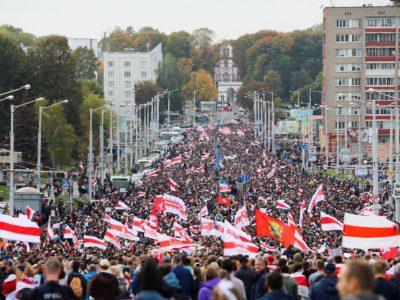
In 2020, America will decide between oligarchy and egalitarianism