WP_Post Object
(
    [ID] => 2077
    [post_author] => 2
    [post_date] => 2020-09-18 14:09:54
    [post_date_gmt] => 2020-09-18 14:09:54
    [post_content] => Women are seeing their basic rights rolled back in the era of rising authoritarianism exacerbated by the global pandemic.

For the past several decades, the world maintained a shallow consensus, propped up by international human rights law, that women and girl's rights matter, that it was important to educate them, protect them from violence, and give them the means and opportunities to make a living outside the home.

Although global mainstream discourse and rhetoric around women was nominally positive, even liberatory, women and girl's material realities still suffered. Among the 1.5 billion people living on one dollar or less a day, the majority are women and children, a phenomenon the sociologist Diana Pierce calls the feminization of poverty. Women and girls make up 70 percent of trafficking victims, according to a 2016 United Nations Office on Drugs and Crime report. As the #MeToo movement has shown, even in allegedly egalitarian countries, women and girls still commonly experience sexual assault and discrimination. Just this morning, Amy Dorris accused Donald Trump of sexually assaulting her, making her the 26th woman to level allegations against him.

Women and girls are perpetually gaslit about the glaring disconnect between the dignity they are told they possess from birth, and its continuous violation. Far too many women and girls aren't afforded basic rights to begin with. Is it any wonder that a new wave of grassroots, intersectional feminism is growing all over the world, particularly among younger generations of women who broadcast and amplify their activism on social media. The Chilean protest song, Un Violador en tu Camino, A Rapist in Your Path, became a viral feminist anthem against rape culture and personal, state, and institutional complicity.  

Now amidst the global COVID-19 pandemic, women are bearing the brunt of the impact. They are losing their jobs at a rate disproportionate to that of men; globally, domestic violence has risen to crisis levels, even as women are forced to shoulder the burden and stress of caregiving and child rearing. Now, with so many school districts having opted to go online, women have had to take on homeschooling as well. 

Many states have overtly regressed on women's rights.  This week major U.S. media outlets published shocking allegations of mass hysterectomies having been performed without informed consent on detained migrant women in a privately run ICE concentration camp in Georgia. The allegations emerged after Dawn Wooten, a nurse at the camp, filed a whistleblower complaint. As one detainee said, "I thought this was like an experimental concentration camp. It was like they’re experimenting with our bodies." Reports of women being raped in the camps are widespread and ongoing. In a federal lawsuit filed in May 2020, a Mexican woman said she was sexually assaulted and impregnated at an immigrant detention facility in Houston hours before she was deported to Mexico.

Last year, the Department of Justice's Office on Violence Against Women narrowed its definition of domestic violence to felonies or misdemeanors, in a move similar to Russia's decriminalization of most non-lethal forms of domestic violence in 2017. In recent months Turkey and Poland have been threatening to leave the Istanbul Convention, an international treaty on domestic violence. 

We're in an era of chest-thumping authoritarians, (Trump, Duterte, Modi, Xi, Putin, Erdogan, Bolsonaro, Netanyahu, MBS, Kim Jong-Un) who, despite their diverse religions, ideologies, and geopolitical backgrounds, are universally patriarchal. Women's subordination is a given, and deviations are punishable with cruelty. Fundamentalist religions, men's rights movements, and incels have fueled misogynist terror and aggrieved men's reactionary backlash against women's empowerment. Their growing political success is costing women their lives. 

Misogyny is key to understanding the male entitlement powering the global trend away from feminine-coded social democracy and toward toxic masculine authoritarianism. 

I use the definitions of feminist philosopher Kate Manne, who, in her books Down Girl: The Logic of Misogyny and Entitled, makes an important distinction between sexism and misogyny. Sexism, she writes, is the "theoretical and ideological branch of patriarchy: the beliefs, ideas, and assumptions that serve to rationalize and naturalize patriarchal norms and expectations—including a gendered division of labor, and men’s dominance over women in areas of traditionally male power and authority." 

Misogyny, she says, "should not be understood as a monolithic, deep-seated psychological hatred of girls and women. Instead, it’s best conceptualized as the “law enforcement” branch of patriarchy—a system that functions to police and enforce gendered norms and expectations, and involves girls and women facing disproportionately or distinctively hostile treatment because of their gender, among other factors."

The focus is thus flipped from perpetrator to victim. Rather than concern ourselves with men's intentions, which are easily denied and impossible to prove, misogyny is the hostile treatment women and girls experience when they step outside gender roles or are perceived to. 

Separating sexism from misogyny is necessary to understanding the current attacks on women's rights. As Manne noted in a recent  interview with Isaac Chotiner for The New Yorker, "There is this somewhat new phenomenon of men who believe women are perfectly competent and will take advantage of their talents, but who will smack them down if they try to assert their authority over a patriarchal figure." 

Misogynists who happily exploit women's talents while still maintaining patriarchal order are everywhere. Look at Trump and Ivanka, or Erdogan and his daughter, Sümeyye Erdoğan Bayraktar. Their idea of women's rights is a bouquet of flowers, a refrigerator, and a demand to have more babies, but only if you're of their preferred ethnic or religious group. 

At the same time, women, once empowered, never forget what power and respect look and feel like. Absent sexism, misogyny grates more harshly, and brutish patriarchal power plays become more transparent. Women are organizing locally and sharing their struggles online. They're speaking out like never before, whether it's the women who brought down Harvey Weinstein, or the Turkish feminists sharing black and white photos on Instagram. 

What exactly is being rolled back, and how do we fight it? 

For decades, women have been fighting for recognition and protections in international laws. 

The first major international treaty on women's rights, the Convention on the Elimination of all Forms of Discrimination Against Women (CEDAW) was adopted in 1979. In 1995, Hillary Clinton famously said, "women's rights are human rights, and human rights are women's rights" to the United Nations Fourth World Conference on Women in Beijing, China. In 2014, education activist Malala Yousafzai became the youngest person to be awarded the Nobel Peace Prize, after the Taliban shot her in the head as punishment for advocating the right to education for Pakistani girls.

In 2012, the Council of Europe passed a groundbreakingly progressive treaty on gender violence, the Council of Europe Convention on preventing and combating violence against women and domestic violence, commonly known as the Istanbul Convention. 

The Istanbul Convention was held in response to the European Court of Human Rights (ECHR) 2009 ruling in Opuz v Turkey, which found that Turkish authorities failed to protect Nahide Opuz from her ex-husband's years-long abuse, even after he stabbed her repeatedly and murdered her mother. Turkey hosted the convention, and became the first country to sign and ratify the treaty on March 12, 2012. Since then, 45 countries and the EU have signed. 

Two sections of the treaty stand out:
  • Article 12.1 of the Istanbul Convention says, "Parties shall take the necessary measures to promote changes in the social and cultural patterns of behaviour of women and men with a view to eradicating prejudices, customs, traditions and all other practices which are based on the idea of the inferiority of women or on stereotyped roles for women and men." 
    • This article commits parties to undoing patriarchy in their respective cultural traditions, social norms, and interpersonal behaviors, which the treaty identifies as the root cause of domestic violence. 
  • Article 12.5 says, "Parties shall ensure that culture, custom, religion, tradition or so-called “honour” shall not be considered as justification for any acts of violence covered by the scope of this Convention."
Another direct shot at patriarchy and organized religion. At the root of toxic male entitlement is the idea that male honor is more valuable than a woman's life. Look at Trump directing Bill Barr's Department of Justice to take over the defamation case brought by columnist E. Jean Carroll, who alleges that the President sexually assaulted her and then called her a liar.   It is these attacks on patriarchy that have triggered the misogynists. Turkish feminist Feride Eralp, who recently was interviewed for The Conversationalist about the anti-femicide protests in her country, calls this the anti-gender movement.  Erdogan’s government, said Eralp, had established a pattern of announcing extremely controversial policies regarding women's freedoms and equality in order to “gauge public reaction.” If the reaction is overwhelmingly negative, the government postpones until public memory fades, only to re-introduce it. “It's an incredibly frustrating government tactic, because it [makes it] impossible to achieve lasting gains."  In 2016, for example, the government tried to pass a law that would give amnesty to male sex offenders if they agreed to marry their underage female victims. Widespread public outrage led to the tabling of the legislation, but the government continues periodically to reintroduce it with slight changes. "It's the same with the Istanbul Convention," Eralp said.  Turkish women have been protesting rising rates of femicide for well over a decade, demanding that the government  implement the Istanbul Convention—and that it enforce the law that specifically protects women from domestic violence. Recently, Polish and Turkish women protested in solidarity with one another against their respective governments, and the ultra-conservative Catholics and Islamists who are lobbying to preserve "traditional family structures," aka free labor, at the expense of women's lives.  Eralp argues, however, that unlike grassroots women's movements, the Turkish men importing these new formulations aren't seeking solidarity with other men, but rather want to adopt effective tactics to keep women in their place. This is a cynical move by ultraconservative men who are taking advantage of Erdoğan's weakening political position to backtrack on women's rights, she argued. Turkish ultra-conservatives have adopted "pro-family" anti-LGBTQ tactics from their Catholic neighbors that Americans will be familiar with: white Evangelicals have long stoked moral panic among conservatives about feminists, single mothers, abortion, and gay and trans rights. Gains for women in America are being erased in law, too. Decades of legal advocacy efforts brought about a series of legal breakthroughs in recognizing domestic violence as a basis for protection in asylum law in the United States, only to have them dashed in 2018 by Jeff Sessions. Betsy DeVos's Department of Education's new rule undoing protections for campus assault victims under Title IX went into effect last month, to the delight of men's rights groups.  Abortion rights are perpetually under attack, as conservatives gain seats in federal courts, and acts of misogynist terror, whether its intimate partner violence or mass shootings, are increasingly common. Anti-semitic QANON supporters are obsessed with human trafficking conspiracies, while the President is trafficking thousands of children across the border in front of our eyes. The picture is bleak, and the struggle will be hard. But as we have reported—and will continue to report, here at The Conversationalist—women everywhere are strengthening their own sense of entitlement - their right to life, to bodily autonomy, to political opinions -- to being a full human being independent of men. Women and their allies are motivated, organized, and pushing back in new, creative ways at the grassroots and institutional level. [post_title] => Revenge of the patriarchs [post_excerpt] => "There is this somewhat new phenomenon of men who believe women are perfectly competent and will take advantage of their talents, but who will smack them down if they try to assert their authority over a patriarchal figure."  — Kate Manne [post_status] => publish [comment_status] => closed [ping_status] => open [post_password] => [post_name] => revenge-of-the-patriarchs [to_ping] => [pinged] => https://conversationalist.org/2020/09/11/turkish-women-are-staring-down-the-patriarchy-as-they-demand-their-rights/ [post_modified] => 2024-08-28 21:14:02 [post_modified_gmt] => 2024-08-28 21:14:02 [post_content_filtered] => [post_parent] => 0 [guid] => http://conversationalist.org/?p=2077 [menu_order] => 245 [post_type] => post [post_mime_type] => [comment_count] => 0 [filter] => raw )
Revenge of the patriarchs

WP_Post Object
(
    [ID] => 2068
    [post_author] => 2
    [post_date] => 2020-09-17 16:30:03
    [post_date_gmt] => 2020-09-17 16:30:03
    [post_content] => The curious case of the Russian grassroots movement that borrows racist and alt-right language from America to advocate for the rights of white anti-Putin protesters.

As a Black woman who is an historian of the Soviet Union and Russia, the Black Lives Matter movement has put me in an interesting position. The ongoing demonstrations taking place across the United States illuminate the depths of the physical, spiritual, and emotional violence that African Americans and ethnic minorities experience. The Trump administration’s response is callous and includes the use federal power to violate the protestors’ first amendment rights. In Russia, meanwhile, while responses to the protests have ranged from empathy to victim-blaming, one hashtag caught my attention: it is called “Russian Lives Matter.”

Despite its name, RLM does not seek solidarity with BLM. The Russian version calls out police violence committed against anti-government protestors. To be clear: police also target ethnic minorities, such as migrants from Central Asian countries like Uzbekistan, but RLM advocates specifically for ethnic (i.e., white) Russian citizens. The largely overlooked element in the Russian Lives Matter movement is its “borrowing” of American racist and alt-right language.

While a Twitter search for the hashtag Russian Lives Matter brings up a few responses in support of the demonstrations in America, many more regurgitate the Kremlin’s messaging, which mirrors the right-wing American response—i.e., that protestors are criminals and looters, and that the demonstrations are contrary to the spirit of Martin Luther King, Jr. The latter is a popular argument in both the United States and Russia, with the right using it to dismiss the validity of the contemporary struggle for civil rights—not realizing that Dr. King was murdered for his perceived radicalism.

In the United States, the right describes Black Lives Matter protests as riots, planned violence, and “poison.” This language is meant to portray the movement as anything but what it is—i.e., one that demands accountability and reform of the public institutions that maintain the racist status quo.

Many Russians deny that racism exists in their country. Alina Polyanskikh, a Russian television presenter who is Black, described her experiences with overt racism, and with those who deny its existence, in a recent blog post. When Afro-Russian blogger Maria Tunkara posted on her social media accounts about her experiences with racism, she was threatened and even investigated by the prosecutor in St. Petersburg. Popular Russian memes about the American protests compare African Americans to apes and call them thugs; the vilest make fun of George Floyd’s killing at the hands of American police.

My first reaction to these images was disgust, then sadness. They reminded me of my first experience with racism in Eastern Europe, when in spring 2011, I spent a couple of weeks in Varna, Bulgaria, volunteering at an orphanage for Roma children. On one of our first visits, the children (a range of elementary-aged kids) encircled me and called me a “n----r” and “monkey” to the tune of “Ring Around the Rosie.” I was mortified and deeply hurt; seeing my reaction, one of the kids ran off to tell the orphanage director, who made the other children apologize. I did not understand how children in Bulgaria knew the racist slurs that whites had directed against me when I was growing up in southeast Texas in the 1990s and early 2000s. Now, almost ten years after my experience at the orphanage in Bulgaria, I see the people who inhabit the corners of the Russian-language internet using the same slurs.

American ideas of racism and the racist undercurrent of conservative populism have a transnational impact that is now felt in Russia. As Natalia Antonova wrote in the early months of the Trump administration, many American racists see Russia as a “white man’s paradise” where there is no political correctness, no vocal ethnic minority demanding rights, and no legal protections for the LGBTQ community. An exploration of the connections between American and Russian white supremacist groups provides further insight into this phenomenon.

The Southern Poverty Law Center’s (SPLC) Hatewatch initiative has documented the close relationship between white supremacist groups in Russia and the United States. In 2018, members of League of the South, an Alabama-based white supremacist group, launched a Russian-language version of their organization’s website. Michael Hill, the League’s leader, said that Russians and American white supremacists have in common “real, organic factors such as shared blood, culture, and religion.” This idea of a shared culture or blood is a dog whistle for a shared white race.

The SPLC also examined the “strange alliance” between Russian Orthodox monarchists and radical white Evangelicals in the annual meeting of the World Congress of Families (WCF). The WCF is an ultra-conservative religious group; its goals include promoting anti-LGBTQ legislation. Participants in the group include far-right and nationalist groups across the United States, Europe, and Eastern Europe, all committed to white supremacism. In this case, Russia reflects American racist ideology.

Claims of a shared culture and religion notwithstanding, the image of a “white paradise” is belied by the numbers that illustrate its ethnic diversity. Russia is home to hundreds of ethnic minorities that speak over 100 languages. It has not seen the mass protests against racism that spread across Western Europe since the murder of George Floyd, but Afro-Russians, Africans, and Central Asians who live in Russia have spoken out and led discussions about their experiences of racism and prejudice.

These discussions can complicate our understandings of how racism assimilates into the relatively unique context of Eastern Europe and the post-Soviet space. Russia does not have a history of institutionalized racism against people of color (POC) like those of the United States and the former imperial states of Europe. This is not to erase the treatment of Jews, and people from the Caucasus and Central Asia who had long been targets of institutional racism and oppression in the Russian empire. In fact, the Soviet Union did not track race in its censuses. People were classified by their nationality; thus, their race was not even a possibility of official identification. This fact lends itself to current understandings of racism and prejudice in Russia.

In contemporary Russia, POC are called racial slurs, denied housing, violently beaten, and sometimes killed. Acquaintances from Russia and Ukraine have posited that these documented cases of racism are manifestations of xenophobia—i.e., that POC are not trusted or are not treated as equals because they are outsiders. But this logic illustrates the greater issue. It shows that people who have dark skin, even if they were born in Russia or are permanent residents, are still excluded from the dominant concept of who is Russian.

There is a Janus-like dichotomy when it comes to Western media portrayals of Russia. Some American conservatives see Russia as a paradise for white heterosexuals, while some American liberals see Russia as an authoritarian regime plotting to destroy U.S. democracy. From my own relatively unique position, I see in Russia a mirror of the United States.

The language and logic of racism in Russia, particularly toward Black people, is not an organic development. Throughout the Soviet period, African American and African people visited, studied, and lived in a country with relatively few incidents of race-based violence (although one African student was murdered in 1963). Even the use of racist language was different. Central Asians were called “chornyi” (black) as a slur, but Blacks were called “negr” (similar to “negro,” but without the negative connotations the word carried in the U.S..)

Since the collapse of the Soviet Union, the Russian lexicon of racism has absorbed elements from America. If Americans and Russians can take away any lessons from this development, it is that anti-racist forces in both countries need to engage with one another and build alliances. Because the forces of white supremacy certainly have.
    [post_title] => Russia as a mirror of American racism
    [post_excerpt] => Some American conservatives see Russia as a paradise for white heterosexuals, while some American liberals see Russia as an authoritarian regime plotting to destroy U.S. democracy. From her own relatively unique position as a Black American who studies Russia, the author sees in Russia a mirror of the United States.
    [post_status] => publish
    [comment_status] => closed
    [ping_status] => open
    [post_password] => 
    [post_name] => russia-as-a-mirror-of-american-racism
    [to_ping] => 
    [pinged] => 
https://conversationalist.org/2019/01/22/russia-as-a-white-mans-paradise-other-scary-reasons-why-trump-adores-putin-and-what-to-do-about-it/
    [post_modified] => 2024-08-28 21:14:02
    [post_modified_gmt] => 2024-08-28 21:14:02
    [post_content_filtered] => 
    [post_parent] => 0
    [guid] => http://conversationalist.org/?p=2068
    [menu_order] => 246
    [post_type] => post
    [post_mime_type] => 
    [comment_count] => 0
    [filter] => raw
)

Russia as a mirror of American racism

WP_Post Object
(
    [ID] => 2048
    [post_author] => 2
    [post_date] => 2020-09-11 00:18:50
    [post_date_gmt] => 2020-09-11 00:18:50
    [post_content] => Even as femicide rates rise, conservatives in the ruling party want to roll back legislation designed to protect women.

For the last five years Turkish feminist movements have faced one backlash after another and are perpetually braced for the next one. “There is always this… feeling of insecurity, uncertainty, and inability to see the future,” activist Feride Eralp told The Conversationalist. “Your most basic rights are constantly under threat.”

Eralp has been advocating for women’s rights since she was 15; her mother was active in the founding women’s movements in the 1980’s. In recent weeks, thousands of women have been demonstrating on the streets of Istanbul, Ankara, and 35 additional cities across Turkey to demand their civil rights and to protest a shocking rise in rates of femicide.

The catalyst for this latest round of protests occurred in July, when police found the mutilated corpse of Pınar Gültekin, a 27 year-old student, in a rural area of southwestern Turkey. They arrested her ex-boyfriend, Cemal Metin Avci, who confessed to having beaten and strangled Gültekin, before burning her body and stuffing it into a barrel, which he buried in the woods. The horrific incident was heavily covered by Turkish media, eliciting widespread revulsion; the murder became a rallying cry for feminist groups, which had already been protesting for months the failure of government authorities to protect women from domestic violence and femicide.

The government’s obligation to protect women is enshrined in the Istanbul Convention, a groundbreaking human rights treaty against domestic violence that is aimed at preventing violence against women. It is formally called the Council of Europe Convention on preventing and combating violence against women and domestic violence. Turkey was the first country to ratify the treaty, signed on March 12, 2012. Since then, 45 countries and the EU have signed. No country has ever withdrawn from it.

Recently, President Erdoğan's Justice and Development Party (AKP) suggested they would withdraw Turkey from the treaty.

The impetus for the Istanbul Convention was the 2009 decision of the European Court of Human Rights (ECHR) in Opuz v Turkey, which found that Turkish authorities failed to protect Nahide Opuz from her violently abusive ex-husband, even after he stabbed her repeatedly and murdered her mother.

So far this year, 285 women have been murdered in Turkey. That’s more than one woman murdered per day, the majority at the hands of their estranged spouses.

Despite these numbers, lobbying groups for political Islamists, composed mostly of conservative men, have been pressuring the government to withdraw from the Convention on the basis that it undermines ‘family structure.’ In fact, the Istanbul Convention truly aims to protect the most vulnerable members of the family from domestic violence.

Preservation of the traditional family structure has long been a foundation of values instilled by the Turkish ruling party, explained Sinem Adar, an Associate at the Center for Applied Turkey Studies in the German Institute for International and Security Affairs. “I think the current government definitely has a very particular, rigid understanding of the family,” Adar told The Conversationalist.

Erdoğan has said numerous times throughout the years that women should have at least three children. The President has also referred to women who do not wish to have children as “unnatural” and “incomplete.” The deputy chair of AKP, Numan Kurtulmus, once described single women as “hedonistic,” and asserted that they put “dynamite in the foundations of the family.”

When Erdoğan, who was then prime minister rather than president, made his 2013 statement about woman having to bear three children, he played into this capitalistic driver of women’s oppression. As Eralp said, the family becomes a unit to keep women producing labor, inside and outside the home. Turkey does not have a strong social welfare system and it is on the brink of a financial crisis; under these circumstances, women become primary caregivers for children and the elderly. “With an economic crisis of this degree, you don’t want to lose free labor,” Eralp explained. As Erdoğan said in his speech: “One or two children mean bankruptcy. Three children mean we are not improving but not receding either. So, I repeat, at least three children are necessary in each family, because our population risks aging."

Turkish society invests the family with tremendous value and importance; the average Turkish citizen is inculcated from childhood with a strong sense of responsibility for relatives. But when the issue of gender is contextualized within the family, individual rights are undermined. “It’s almost like not seeing the woman as an individual but seeing them as part of a family,” Adar said. In other words, a woman’s safety, security and freedoms cannot be seen as intrinsic, but instead debatable within traditional family structures.

The government’s rhetoric and policy can be seen as systematic pressure to suppress individual liberties when it comes to family, sex, gender relations; they leave very little space for women to seek change. “It’s like making the voice of the women who need the help the most, less and less heard, because again everyone is packaged in the context of the family,” Adar said. “If they decide to abolish [the Istanbul Convention], it would definitely have an influence on individual liberties.”

Canan Güllüm, the president of the Federation of Women's Associations in Turkey, said during a phone interview that the Islamist lobbying groups have long advocated for the “protection of the holy family.” She agreed that this contributed to a culture that threatened women’s safety and freedom. “Family, where the violence is reproduced as it is happening now in the society, is not a safe place for women,” Güllü said.

The composition of the protests belies conservative claims that Turkish feminists are primarily secular. Practicing Muslim women wearing the traditional headscarf are as visible at demonstrations as their secular sisters; they are all willing to hold picket signs reading “We don’t want to die!”; the phrase recalls the last words of Emine Bulut, whose husband stabbed her to death last year in a café—in front of her 10-year-old daughter. Women who represent a broad swathe of political and religious views have come together in these protests to advocate for their right to life. As Güllü pointed out, they “do not feel comfortable in today's patriarchal and unequal family structure where their rights are not protected.”

Whether they are religious or secular, there is only one set of laws, and one path of recourse for all people in the country. “Women are aware of these rights and they’re not willing to give them up for any ideological or political reasons,” Eralp said. “I can’t imagine a woman who would push that away under her own free will.”

The debate around the Istanbul Convention in Turkey has also divided the ruling AKP’s base. Erdoğan’s own daughter, Sümeyye Erdoğan Bayraktar has come out in support of the Convention. Bayraktar is the deputy chair of the Women and Democracy Association (KADEM), which is conservative on issues such as LGBT rights; it advocates for ‘woman’s human dignity’ and is often engaged in lobbying the government.

There is something religiously conservative in the family value model the government is trying to “preserve,” but it isn’t predicated on a secular vs religious binary. A more accurate analysis would emphasize the ongoing inequality between men and women, and how the impunity and lack of justice demonstrated in Turkey promotes it. In recent years, a more moralistic, conservative discourse has become salient in the public realm. At the same time, there has been an increasing intensity of violence by the state and break down of the justice system in order to consolidate power.  As Adar put it; “it has to do with the institutional deterioration [and] the deterioration of the primary rule of law.” To a certain extent, the increase in violence now prominent in the public eye, reflects the socio economic situation of the country.

The rate of femicide has more than doubled in Turkey since the signing of the Istanbul Convention, which means that its legal and protective measures are not being implemented. Rarely is there justice for women who are murdered or abused, particularly if the perpetrators are well connected. For Turkish women, their rights, as Eralp observed, are transactional.

Güllü added that while the framework to protect women and promote equality is already in place, it hasn’t been prioritized. The government, she believes, has not upheld the values of civil and gender equality in the last 20 years.

The rhetoric employed by Erdogan’s conservative government further conveys to the public an implicit understanding that this type of discourse and behavior is acceptable; this acts as a legitimizing power. In general, there is an acceptance and understanding of men’s motives to commit violence towards women, which ends up being passed from one generation to the next. Amnesty International went so far as to say in an August statement on the rise of femicides that “even the discussion of a possible withdrawal [from the Convention] is having a huge adverse impact on the safety of women and girls.”

At the same time, women in Turkey are clearly going through a period of consciousness raising and are becoming much more politically assertive. But unless the value of gender equality is internalized throughout all levels of government and civil society, the task of protecting individual rights in Turkey will continue to be challenging. What’s needed is a widespread understanding that no one “deserves” to be subjected to violence.

Turkey’s feminist activists are hopeful, given the increasing numbers of women coming out to protest and stand up for their rights. “The women's movement in Turkey is very strong and consolidated, and we will not give up fighting,” Güllü said, emphatically.

 
    [post_title] => "We don't want to die!" Turkish women demand government action to end femicide
    [post_excerpt] => Women who represent a broad swathe of political and religious views have come together in mass demonstrations to advocate for their right to life in a deeply patriarchal society, under a government that has failed to implement the laws that should protect them.
    [post_status] => publish
    [comment_status] => closed
    [ping_status] => open
    [post_password] => 
    [post_name] => turkish-women-are-staring-down-the-patriarchy-as-they-demand-their-rights
    [to_ping] => 
    [pinged] => 
    [post_modified] => 2024-08-28 21:15:13
    [post_modified_gmt] => 2024-08-28 21:15:13
    [post_content_filtered] => 
    [post_parent] => 0
    [guid] => http://conversationalist.org/?p=2048
    [menu_order] => 247
    [post_type] => post
    [post_mime_type] => 
    [comment_count] => 0
    [filter] => raw
)

“We don’t want to die!” Turkish women demand government action to end femicide

WP_Post Object
(
    [ID] => 2037
    [post_author] => 2
    [post_date] => 2020-09-03 19:43:41
    [post_date_gmt] => 2020-09-03 19:43:41
    [post_content] => Being able to vote is rarely the reason people choose to become citizens.

It’s an election year, the most momentous of this century, possibly for the U.S., in the last 50 or 60 years. Eager to vote, many residents are rushing to apply for and win citizenship, with 126,000 ready to take the oath that will offer them a plethora of new privileges.

Millions more are not.

The process is neither simple nor quick, as Amy Zhang recently wrote in The New York Times: “filling out a 20-page application, paying almost a thousand dollars, organizing piles of supporting documents, planning my life around five years of residency requirements and waiting another two — as well as F.B.I. background checks, InfoPass appointments and a civics test.”

Other obstacles prevent some long-time residents from making this move. If a naturalized foreigner, (even the word “naturalized” being one that some find abhorrent), repatriates or permanently leaves the U.S., they’ll still owe income tax to the U.S. government until or unless they renounce their American citizenship or even their green card.

But being able to vote is in fact rarely the reason people choose to become citizens, said Nancy Foner, Distinguished Professor of Sociology at Hunter College and the Graduate Center, City University of New York. She’s an expert on immigration and author of 19 books on the subject. “They mostly want citizenship for instrumental reasons,” Foner said. “They don’t want to get deported. If they’re citizens, they can sponsor their parents and minor children. Very few people become citizens because they want to vote.”

Having full citizenship does offer important protections, she said, like losing anxiety over “a change in laws. There’s a fear about that.”

The very high cost of acquiring U.S. citizenship – which has risen 83 percent lately — is an inhibiting factor, she adds. “The expense is very high! [rising to $1,170 as of October 2.] And some people are unsure of their English and the test they have to take.”

Thanks to current policies under Trump, “citizenship rates are not that high,” Foner said. “They’re higher in Canada which encourages citizenship and offers classes while the Trump administration is actively discouraging it.”

No matter how long they live in the U.S., often married to an American, maybe raising their American-born children, some remain determinedly faithful to their original roots and passport. Fiona Young-Brown, 47, a writer who lives in Lexington, Kentucky with her American husband, grew up in England, her accent still strong after 22 years in the U.S. A global traveler who met her husband when both were teaching English for three years in remote areas of Japan, Young-Brown first came to the U.S,  in 1993 as an exchange student at the University of Iowa. Coming to live in the U.S. has offered her professional opportunities and social freedom she knew she couldn’t have found in class-conscious England, she said.

“I grew up in a working-class town and we were always working class, living paycheck to paycheck. I’m the first college graduate in my family.” Watching American TV in the 70s and 80s “it always seemed so glamorous and exciting, just this place where you make your own future, a blank slate where you were free to re-invent yourself,” she adds. Even at 13, she wrote to the U.S. embassy in London about how to obtain a visa.

She had attended a local prep school in England as a child on full scholarship, but the inevitable class differences reminded her daily how inescapable they were. “America was going to be a place where that wasn’t an issue,” Young-Brown said. That proved to be true, but her initial optimism has faded.

Today, even after decades in the U.S., and a thriving writing career, she’s still not interested in citizenship. “America is definitely not the same as when I got here,” she said. “It’s become a much crueler country, much meaner, with more delight in kicking people who are down. It’s not a place to dream but a place you’ll struggle, and you’ll never make it anyway. To take citizenship at this point feels like an endorsement of all this shit that’s going on. To wave a little flag would feel hypocritical and completely tasteless.”

If she were single, she said, “I would have left a long time ago,” but her husband has deep roots in Kentucky, parents in poor health and, now with Brexit, she faces a much more complicated path to repatriation.

For Kevin McGilly, a 55-year-old gay married Canadian in Washington, D.C., there’s a powerful attachment to the U.S. in the form of the Black teenager he and his husband are adopting. Although he’s lived in the U.S. for many years, he still takes “existential pleasure in being Canadian. The two countries look similar, but underneath things are very very different.” Now at a point in their careers they enjoy more mobility, he and his husband have seriously discussed whether or not to return to Canada. “If Trump’s re-elected, it’s a very serious prospect,” he said.

Taking citizenship, as anyone considering it quickly learns–even if you can retain dual citizenship—means literally formally renouncing allegiance to your country of origin. “I love this country and am grateful,” he said of the U.S., but he doesn’t want to take a further step “because of what you do to become a citizen – stand in front of a magistrate and take an oath to abjure your former country. That stopped me cold. I’m not going to say I’m no longer Canadian, even if it’s pro forma.”

Other requirements were off-putting as well, he said, like having to list all the groups you’ve ever belonged to and every country you’ve visited and when. “It’s ridiculous!” And you have to swear that you’re not a Communist, a “1950s language” McGilly calls silly in today’s era.

And yet, he wishes he could vote, as he calls himself “a political animal” – instead channeling his energies into canvassing and registering voters for the candidates he believes in.

The first time Inge de Vries Harding, who lives in Chapel Hill, North Carolina, came to the U.S. she was only three-and-a-half, when her Dutch father got a job in San Diego, and she has spent most of her life living in the U.S. But at 16 she also spent three years living in the Netherlands because her brothers were then 18 and 19, and her mother said, “there was no way her boys were going to fight in Vietnam.” Living in Holland was difficult after being so accustomed to American freedoms, she said, and she was relieved to return to the U.S., where she trained as a pediatric nurse, married an American and had two sons in the U.S. In 2015 and 2016 she “very seriously considered” moving to Vancouver, Canada, thanks to its “very different mindset” but there were too many practical obstacles.

Now, still refusing to take U.S. citizenship, Harding remains rooted by family in the country. “For me it’s very simple,  I have children and grandchildren here. I’m not  going anywhere.” The few times she considered becoming a U.S. citizen she was put off by  “too much pomp and circumstance.” She has since been inhibited again by the “fairly large expense. I sometimes wish I could vote, but not enough to take that step. You actually have to denounce your country. I can’t do that! I’m proud of my Dutch heritage.”

For immigration attorney David H. Nachman, managing partner of the New Jersey firm Nachman, Phulwani, Zimovcak (NPZ) Law Group, P.C., people who cling to their cultural roots — even after decades living in the U.S. —form a large part of his practice.

“It’s related to how people feel about their cultures. None of my Japanese clients want to become citizens because it goes against their culture. Japanese are fiercely nationalistic and the French are the same way. Even getting a green card is seen as giving something up of their heritage so they don’t want to do that,” he said.

To help these clients, Nachman can offer options like an E-1 or E-2 visa, which allows permanent residence to those who can produce a solid business plan, show sufficient capital to invest in it and eventually grow their business enough to hire Americans.

“The vast majority who don’t want citizenship plan to work here temporarily and then go home,” he said.
    [post_title] => To become a citizen or not? Long-term U.S. permanent residents consider their options in the age of Trump
    [post_excerpt] => Taking citizenship, as anyone considering it quickly learns–even if you can retain dual citizenship—means literally formally renouncing allegiance to your country of origin.
    [post_status] => publish
    [comment_status] => closed
    [ping_status] => open
    [post_password] => 
    [post_name] => to-become-a-citizen-or-not-long-term-u-s-permanent-residents-consider-their-options-in-the-age-of-trump
    [to_ping] => 
    [pinged] => 
    [post_modified] => 2024-08-28 21:15:13
    [post_modified_gmt] => 2024-08-28 21:15:13
    [post_content_filtered] => 
    [post_parent] => 0
    [guid] => http://conversationalist.org/?p=2037
    [menu_order] => 248
    [post_type] => post
    [post_mime_type] => 
    [comment_count] => 0
    [filter] => raw
)

To become a citizen or not? Long-term U.S. permanent residents consider their options in the age of Trump

WP_Post Object
(
    [ID] => 56
    [post_author] => 3
    [post_date] => 2020-09-03 16:41:12
    [post_date_gmt] => 2020-09-03 16:41:12
    [post_content] => Published on December 15, 2016, this analysis of the Trump presidency is remarkably prescient.

As a writer and journalist, I’ve been lucky enough to have a long, varied and exciting (and sometimes too exciting) career. A few years ago, I worked with a genuine, bona fide narcissist. The kind of man who once bragged about his diagnosis while dismissing the “asshole shrink” who made it.

Without going into too much detail, here are a few things you can expect from a narcissist in a position of power:

He won’t take responsibility for mistakes.

At most, he will force himself to pretend to take responsibility, while scheming to shirk it in the end anyway. He will, however, hog credit for successes, whether they are his or not. This is why you absolutely have to stop being shocked when Trump says a nasty lie about the CIA and then doesn’t care about the consequences. He will never care. Consequences are for losers.

Everything is always someone else’s fault, and he’ll mess with your head to keep it that way. Here’s a classic exchange between me and my old colleague:

Him: … And let’s focus on that topic tomorrow. Me: OK. ***day goes by*** Me: …So I was writing about this topic and I think… Him: [Screaming, interrupting] WHY AREN’T YOU FOCUSED ON THIS OTHER TOPIC INSTEAD? THIS IS A NIGHTMARE. YOU’RE A NIGHTMARE. WHAT’S WRONG WITH YOU? WHAT KIND OF A JOURNALIST ARE YOU? Me: But you said… Him: [More screaming, more interrupting] I NEVER SAID THAT.

Basically, you couldn’t have a normal conversation with my colleague, because every conversation was a battle he had to win. If he found himself in a corner, he just lied.

You can’t appeal to a narcissist’s morals and ethics.

For them, morals are a weakness and you’ll lose their respect for trying. You’ll never persuade them with ethical arguments, but don’t let that corrupt your own moral compass in the process. When I was being verbally abused by my narcissist colleague, I worked hard to keep the moral high ground. When he insisted that the world was upside-down, it was necessary to keep right and wrong clear in my own head. Why should someone sick like that set the standard for my behavior, let alone explain my reality?

Don’t waste your time expecting a narcissist to change.

Before Trump won, there was all this talk about how he’ll become more “presidential” should he win, because he will realize the gravity of his responsibility. Hahaha — what a joke!

Now people are telling you that it’s OK, Trump will be “presidential” when he’s sworn in. Those people are wrong. You know, sometimes it’s necessary to admit that things are exactly as bad as they seem. I did it. You can too. This doesn’t mean you get to sink into a deep, apathetic depression about the state of things, it just means facing what is happening to our country and society head on. The emperor is naked, but you won’t go blind looking at him.

Disengagement is always the best policy, but when you can’t disengage, remember to not let the narcissist play you off other people.

Narcissists can’t form healthy bonds with others, and therefore do their best to destroy others’ healthy bonds through divide and conquer tactics.

My narcissist colleague would badmouth others around me, trying to make me feel like his special confidante. I realized he was badmouthing me to others simultaneously. I wasn’t important to him, I was just being isolated and used. Look at how Trump humiliated Mitt Romney. Trump didn’t do it because he’s some brilliant tactician, he did it because he pathologically dominates others.

Speaking of “brilliant tacticians” — don’t buy in to the image of grandiosity these people like to project.

Narcissists fake it ‘till they make it. They bluster, and people give in to the bluster. This doesn’t mean that they are smarter than you, it just means that they’re better at the game of “chicken.”

I noticed that my colleague liked to surround himself with people who were conscientious and, in many ways, vulnerable to him precisely because they were conscientious. He enjoyed making people feel guilty and insecure. This kind of abuse is so rampant because it’s everyone’s best kept secret — those of us who have been abused elsewhere are perfect targets for further abuse.

A narcissistic leader won’t inspire genuine loyalty in his inner circle, which is why he forces compliance. 

People have mercenary approaches to narcissists in power: “Oh, I just need the money,” or “Oh, let’s see what he can do for me,” that kind of stuff. Sadly, those who stick around too long get “Stockholm syndrome-ed” to the point of no return. Just look at Trump’s marriage. Melania acts like his well-coached prisoner, not his wife.

Meanwhile, does someone like Kellyanne Conway look like a true believer to you? Please. This lack of loyalty is precisely why narcissists are always working with incomplete information. It is their primary weakness and must be exploited.

These people have big plans they often can’t deliver on.

They’re too bored, enraged or hysterical, which are not particularly efficient emotions. Or it’s because hard work is rarely glamorous and seemingly unrewarding at first. Or maybe it’s because they spend all their time hiring and firing their latest favorites.

You’re going to argue, “But Trump made billions.” Says Trump. We can’t check that fact because he’s shady and avoids all accountability. He won’t even make his tax returns public.

We do know he had his father’s support, and a narcissist’s knack for abusing others’ vulnerability. It’s why he’s such an effective sexist and racist, though maybe not such a brilliant businessman. In short, Trump succeeded because money makes more money, not due to his great ideas. Don’t let the lifestyle and the babes surrounding him fool you.

I remember how my colleague would say literally anything just to maintain the appearance of power and control. People who didn’t know him took him at his word. But observing him closely, I became disillusioned. Seeing his lies for what they were helped protect my sense of self from his verbal assaults.

Narcissistic leaders need adulation and refuse to listen to things they don’t want to hear (i.e., the truth).

Besides vulnerable folks, my old colleague had to surround himself with incompetent people who made him the center of their universe (sometimes the vulnerability and the incompetence overlapped). He mistook empty praise for loyalty.

This is why members of the press should be wary about falling into Trump’s trap. He will seek to punish anyone who in any way deviates from him, because the truth is a betrayal of his worldview. And his worldview is the only one that matters.

If you’re a journalist who depends on access — you’re going to have an especially hard time. Use your access for good. Stockpile what you know. Stay organized.

Narcissists in power do everything they can to drain you of your energy.

They are relentless. They argue, cajole, whip up hysteria, insult, demand that you please them, etc. It’s important to keep quiet about what you value, because they will go nuclear just to take it from you and force you into submission.

The bottom line with a narcissist is that they demand that all attention be focused on them, at all times. If you can’t disengage, don’t try and reason with them. You must learn to conserve your energy, pick your battles, and just. remember. to. breathe.

. . .

In summation, I’d like to be completely honest : You are not going to win with powerful narcissists when you play their games. The minute you’ve started playing, you’ve already lost.

But being realistic about the person you’re dealing with will save your mental health. Don’t let them into your head to prey on your insecurities.

These people do real psychological damage. This is why The Conversationalist places so much emphasis on the roots of and consequences of authoritarianism.

[post_title] => I used to work with a narcissist. Here is my advice on dealing with Donald Trump [post_excerpt] => You’ll never persuade them with ethical arguments, but don’t let that corrupt your own moral compass in the process. [post_status] => publish [comment_status] => open [ping_status] => open [post_password] => [post_name] => i-used-to-work-with-a-narcissist-here-is-my-advice-on-dealing-with-donald-trump [to_ping] => [pinged] => [post_modified] => 2024-08-28 21:08:26 [post_modified_gmt] => 2024-08-28 21:08:26 [post_content_filtered] => [post_parent] => 0 [guid] => https://conversationalist.org/?p=56 [menu_order] => 249 [post_type] => post [post_mime_type] => [comment_count] => 0 [filter] => raw )

I used to work with a narcissist. Here is my advice on dealing with Donald Trump

WP_Post Object
(
    [ID] => 1967
    [post_author] => 2
    [post_date] => 2020-08-28 02:53:59
    [post_date_gmt] => 2020-08-28 02:53:59
    [post_content] => Elite evangelicals who oppose the current president built their careers on the culture wars that brought him to power.

For my July column at The Conversationalist, I began exploring the failures of what I call “respectable” evangelicalism—that is, the kind that is associated with a prestigious professional pedigree of some sort and an investment in civility politics. The members of this conservative Christian subculture have established a friendly-seeming presence across prominent liberal media outlets, from the major network television news broadcasts to The New York Times and the Washington Post. Because they have easy and regular access to these platforms, PR-savvy commentators from within the conservative Christian community can claim that their fellow white evangelicals are an unfairly maligned and misunderstood demographic, sincerely motivated by moral convictions about abortion and a fear of losing their “religious freedom.” Liberals, in other words, should empathize with them.

This framing, which has contributed mightily to the normalization of extremism, still dominates the American discourse. But the majority of white evangelicals are ostentatiously enthusiastic for Donald Trump; their unwavering support for the president is accompanied by a remarkable statistical about-face on the question of whether a leader’s immoral private life can coexist with an ethical public and professional life, a fact that has certainly thrown a wrench in the gears of the evangelical PR machine.

Respectable evangelicals are losing their ability to control the narrative, which is an important development that I will examine in next month’s column. This month, the subject is the failure of respectable evangelicals to accept responsibility for the harm they have done to our society and our polity. Theirs is an ethical failure; it reveals the rot at the very center of the conservative evangelical project over the last half century.

In my previous column I examined the ways in which evangelical public figures, particularly Michael Gerson and Peter Wehner, have failed to convince their coreligionists that unwavering loyalty to Donald Trump reflects poorly on evangelicalism. Wehner’s career as a GOP operative goes back to the Reagan administration, a connection of which he remains proud. Despite the hagiographic image the media has built of President Reagan, he was in many ways a proto-Trump. Reagan was catapulted to power in part thanks to the efforts of a then newly surging Christian Right, whose foot soldiers were moved by his anti-government rhetoric and projection of “cowboy” masculinity.

During the 1980 presidential campaign Reagan even used the slogan “let’s make America great again.” It was that election that set the United States on its trajectory toward Trumpism. Perhaps there is no better symbol of what Reaganite conservativism always was than the popular Soviet defector and Cold War comedian, Yakov Smirnoff, who, at the peak of the COVID-19 pandemic, opposed a mandatory mask policy in his adopted hometown of Branson, Missouri. The town is a sort of geriatric evangelical Las Vegas—at least in terms of the entertainment it offers to tourists, if not so much the libertinism. “What a country,” indeed.

Gerson acknowledged in an April 2018 article for The Atlantic that evangelical Trump supporters “have associated the Christian faith with racism and nativism,” but in the same piece he disingenuously implied that the nineteenth-century history of evangelicalism lies entirely in the abolitionist movement. In fact today’s white evangelicalism is much more a descendant of slaveholder Christianity, which claimed to have found its justification for human bondage in the Bible.

Gerson has not, as far as I know, ever expressed regret for his work in the George W. Bush administration, the politics of which—his politics—helped pave the way for the rise of Trump. The disastrous Iraq war boosted paranoia in the United States; its legacy is a climate of permanent fear, the flames of which the GOP fanned briskly after 9/11. The path from “truthiness” to post-truth is short. But please, sir, continue to wring your hands about how alienated “religious voters” are by Kamala Harris’s record on abortion while the country burns, in large part thanks to a movement you helped build.

Around the same time I was writing about Gerson and Wehner, I published related analysis in Religion Dispatches focusing on the failure of evangelical commentators David French and Ed Stetzer to dissuade rank-and-file white evangelicals from embracing conspiracy theories and spreading disinformation. The almost desperate tone of French and especially Stetzer in their commentary belies, perhaps, a sense at least of embarrassment, if not guilt, about how far into the post-truth wilderness their coreligionists have proven willing to go. What I do not see from them, or other similar commentators, is any serious attempt at self-reflection on the role they played in creating this state of affairs.

Stetzer scolds his fellow evangelicals for their “gullibility,” but not for their paranoid “mistrust of media and government.” According to Stetzer, all evangelicals need is a little more “discernment,” a perfectly vague concept he does little to fill with specific applicable content. He also invokes the Ninth Commandment’s injunction against bearing false witness and worries that the evangelical “witness” is being harmed, a tack that will fail to get results for reasons I explored in last month’s column. Meanwhile, French unconvincingly proffers his own supposed solution to the issue of evangelicals embracing QAnon and Bill Gates nonsense. If evangelical churches were simply to preach a better “political theology,” he maintains, one predicated on a robust understanding of the Ninth Commandment, the issue would be resolved.Clearly, neither man is willing to dig down to the roots of the problem—namely, the conservative evangelical theology that, as scholars in religious studies and sociology have demonstrated, was developed within, and with the purpose of justifying, an unjust hierarchical social order. Although many evangelicals with pretensions to respectability would deny they are racist, conservative evangelical thinking places men above women, white people above racial minorities, and straight people above LGBTQ people; it also emphasizes absolute parental authority over children and prescribes corporal punishment.

In other words, white evangelical subculture is a perfect recipe for authoritarianism. This is reflected in the many revelations, in recent years, of a culture of sexual misconduct and coverups.

Stetzer holds a prominent position at Wheaton College, an evangelical institution that made headlines in recent years for firing a woman hired to “support” LGBTQ students, essentially because she turned out to be “too gay,” and for ousting the only tenured African-American woman in the history of the school for the manner in which she chose to express solidarity with Muslims at a time of surging Islamophobia and anti-Muslim hate crimes. Evangelical colleges such as Wheaton depend on right-wing parents and donors who make sure the schools enforce social conservative orthodoxy, even if, quietly, some professors teach “controversial” subjects, such as evolution, psychology, and even human sexuality more or less responsibly—though always at the risk of becoming too visible and thus being purged.

These colleges depend on K-12 Christian schools feeding into them, which brings us back to French, who has a record of staunchly defending them, despite the fact that they discriminate against LGBTQ students, faculty, and staff. They also teach the sort of “alternative facts” that constitute, ahem, false witness. Be that as it may, French proudly notes that he sent his own children to a Christian school, where he served as chairman of the board. As openly queer Florida State Representative Carlos Guillermo Smith (D-Orlando) noted in a recent webinar hosted by Secular Democrats of America, at least 83 Christian schools in Florida that receive taxpayer funding through vouchers have policies in writing that they will expel openly gay or trans students. Typically, such schools also teach young earth creationism and a version of history distorted by Christian nationalism. Is it any wonder that many children socialized in these schools—as I was, by the way—emerge ready to embrace conspiracy theories?

The refusal of elite evangelicals to accept any responsibility for the harm they have done by encouraging and pursuing the Christian Right’s culture wars agenda reveals the rot at the core of the entire conservative evangelical project over the last half century.

The consequences of culture warring include paving the way for the rise of President Trump, whom #NeverTrump evangelicals now seek to scapegoat due to his penchant for saying the quiet part of their ideology out loud. But they are also much broader, affecting everything from the problems of LGBTQ youth homelessness and suicide, to our country’s failures to address urgent problems in the areas of climate change and public health, to our lack of regard, as the only United Nations member state not to have ratified the UN Convention on the Rights of the Child, for children’s rights to a robust education and to freedom from abuse and neglect.

America’s respectable evangelicals, still upheld by establishment media as commentators who deserve to be taken seriously, will not have any sort of “come to Jesus” moment over the harm they have done. If, however, enough Americans demand that those of us who have suffered that harm in various ways should be treated as stakeholders in the relevant discussions, it might be possible to compel them to face uncomfortable realities. In any case, sustained public pressure over their lack of accountability will likely be necessary if the United States is to have a healthy democratic future.
    [post_title] => The failure of 'respectable' evangelicalism: part 2
    [post_excerpt] => The refusal of elite evangelicals to accept any responsibility for the harm they have done by encouraging and pursuing the Christian Right’s culture wars agenda reveals the rot at the core of the entire conservative evangelical project over the last half century.
    [post_status] => publish
    [comment_status] => closed
    [ping_status] => open
    [post_password] => 
    [post_name] => the-failure-of-respectable-evangelicalism-part-2
    [to_ping] => 
    [pinged] => https://conversationalist.org/2020/07/30/the-failure-of-respectable-evangelicalism-part-i/
https://conversationalist.org/2020/04/30/jesus-is-my-vaccine-culture-wars-coronavirus-and-the-2020-election/
    [post_modified] => 2024-08-28 21:15:13
    [post_modified_gmt] => 2024-08-28 21:15:13
    [post_content_filtered] => 
    [post_parent] => 0
    [guid] => http://conversationalist.org/?p=1967
    [menu_order] => 250
    [post_type] => post
    [post_mime_type] => 
    [comment_count] => 0
    [filter] => raw
)

The failure of ‘respectable’ evangelicalism: part 2

WP_Post Object
(
    [ID] => 1950
    [post_author] => 2
    [post_date] => 2020-08-20 18:25:40
    [post_date_gmt] => 2020-08-20 18:25:40
    [post_content] => Three illiberal leaders cooked up a backroom deal to benefit the political careers of two and the geopolitical power of the third.

When the United Arab Emirates (UAE) announced on August 13 that it would normalize relations with Israel, under a U.S.-sponsored agreement, many were taken by surprise, including Netanyahu's coalition partners. But from the perspective of the parties involved, the deal makes perfect sense. It serves the respective interests of three illiberal leaders—Benjamin Netanyahu, Donald Trump and Mohammed bin Zayed, the powerful Emirati crown prince widely known as MBZ. Israel signed a peace treaty with Jordan in 1994 in a spirit of optimism for regional peace and an end to Israel’s military rule over the Palestinians; the current deal, by contrast, is driven by a shared perception of regional threats—most notably a fear of Iran, of political Islam and of popular mobilization. Both Netanyahu and the Emirati leadership see these as inherently destabilizing agents.

The deal is a win for all three actors. For Netanyahu, the UAE’s willingness to normalize relations without demanding territorial concessions— i.e., an end to Israel’s 53-year-old occupation of the West Bank and a lifting of its closure on Gaza—is a vindication of the political right’s long-held narrative, according to which if Israel maintained its military strength and refused to compromise, the international community and the Arab world would ultimately accept Israel on its own terms. The Israeli left has been saying for more than five decades that failure to end the occupation would lead to the country’s isolation on the international stage, to economic sanctions and political violence; now, Netanyahu can say they were wrong—and that he was right.

Netanyahu did not have to make any concessions in exchange for normalization. He is a deeply risk-averse politician, which is why he almost certainly had no intention of following through on his campaign promise—a bone to the far right—to annex the West Bank. The consequences of annexation would have been a freeze in the burgeoning and mutually beneficial—though as-yet unofficial—relationship with the Gulf Arab regimes, deterioration in relations with Jordan, and possibly another uprising in the Palestinian territories. Netanyahu’s policy for years has been to pursue creeping annexation of the West Bank, without making it official, so as to preclude the establishment of a Palestinian state, while at the same time avoiding international opprobrium and a Palestinian backlash; the latter would have interrupted almost two decades of relative calm in the occupied West Bank, since the Israeli Army crushed the Second Intifada in 2002.

But annexation was off the table, it appears, even before the normalization deal with the UAE was announced. The White House had made it clear that Netanyahu would have to make concessions to the Palestinians; but this is something the prime minister was unwilling to do, lest he bolster far right parties, such as Naftali Bennett’s Yamina and Avigdor Liberman’s Yisrael Beiteinu, which are courting voters who traditionally supported Netanyahu’s Likud. With its offer of normalization, the UAE. threw Netanyahu a lifeline: instead of fulfilling his campaign promise to annex swathes of the West Bank, the embattled prime minister could wave the trophy of peace in our time. By presenting the normalization agreement as a shining diplomatic success, he could deflect attention from his poor handling of the COVID-19 pandemic, which has caused widespread outrage, a slump in the polls, and ongoing demonstrations outside his official residence. At the same time, to appease his base, Netanyahu rushed to clarify that annexation of parts of the occupied West Bank was not canceled but rather postponed.

For Trump, the deal is a rare foreign policy success, as he continues to mismanage the national response to COVID-19 and to trail the Democratic nominee, Joe Biden, by wide margins. Trump claimed the deal was particularly popular among the Christian right, who are his most unswervingly loyal supporters and a crucial segment of his base. Conservative Evangelical Christians are ultra-hawkish supporters of Israel for theological reasons.

While most Americans would struggle to find the UAE on a map, the deal does represent a major break in Israel’s official isolation in the Middle East. The negative externalities of annexation, if Israel were to face widespread condemnation or outbreaks of violence, would likely have been blamed on Trump as well, given the inclusion of annexation in his “deal of the century” peace plan. With the UAE-Israel deal, both Netanyahu and Trump can avoid the accusation that they made Israel less safe and more isolated.

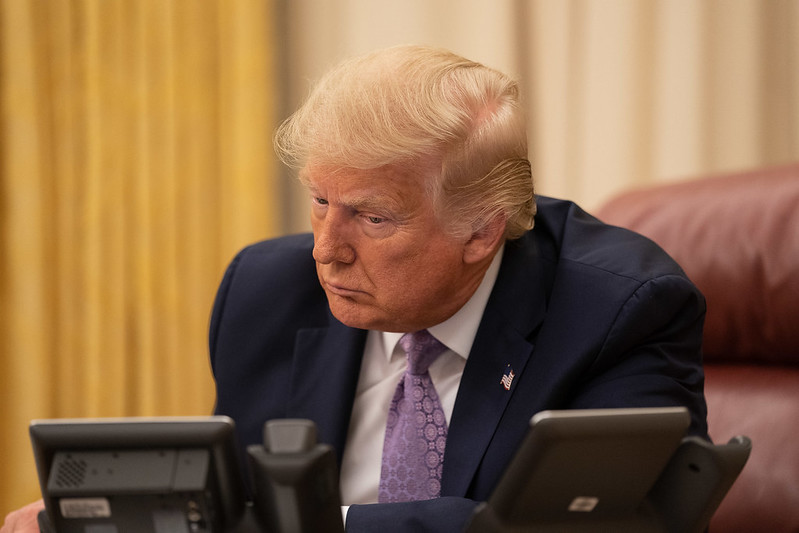
[caption id="attachment_1954" align="alignnone" width="799"] Trump on the phone with Netanyahu and Mohammed Bin Zayed to discuss the Israel-UAE deal on Thursday, Aug. 13, 2020.[/caption]

For the UAE, the deal guarantees that it will have access to advanced military technology from the United States. It will also facilitate trade in surveillance technologies, which the UAE has used to track dissidents. Israeli technology firms, which until now had to create European shell companies in order to work in Gulf countries, will be free to close deals with Emirati clients. In addition to technologies used to police their population, Abu Dhabi needs information technologies: While the wealthy U.A.E. can afford these products, Emirati university graduates still prefer to work for the stagnant, bloated but stable public sector, rather than launch technology start-ups.

The UAE also seeks to curry favor with Washington, where, in a rare show of bi-partisan agreement, the deal was supported by both Democrats and Republicans. Regardless of who wins the November elections, in Washington, the perception that one is close to Israel, and that one has Israel’s powerful lobby on one’s side, is immensely beneficial for the UAE. Israel’s allies get lobbying services for free. For example, AIPAC has for years lobbied Congress to increase financial aid to Jordan. While the UAE is hardly in need of financial aid, it could benefit from the support of one of the most powerful lobbying groups in Washington in seeking to justify its bloody interventions in Yemen and Libya, or for serving as a money-laundering hub for cronies linked to the Iranian and Syrian regimes.

Taking annexation off the table also justifies, in hindsight, the UAE’s budding relationship with Israel. This was illustrated when Yousef al Otaiba, the country’s influential ambassador to Washington, wrote an unprecedented op-ed that was published in Hebrew by Yedioth Ahronoth, one of Israel’s most widely read daily newspapers. Al Otaiba warned his Israeli readers that annexation would destabilize the region, undermine existing peace agreements with neighboring states, and lead to a freeze in normalization of ties with the Gulf states; the ambassador followed up with a video for The National, an English-language newspaper in the UAE., in which he said that he had written the op-ed for the good of the region and of the Palestinian people. If Israel had annexed part of the West Bank, particularly after this appeal, the UAE would have been unable to offer a convincing justification for its Israel strategy to the broader Arab public, which is deeply sympathetic to the Palestinian cause.

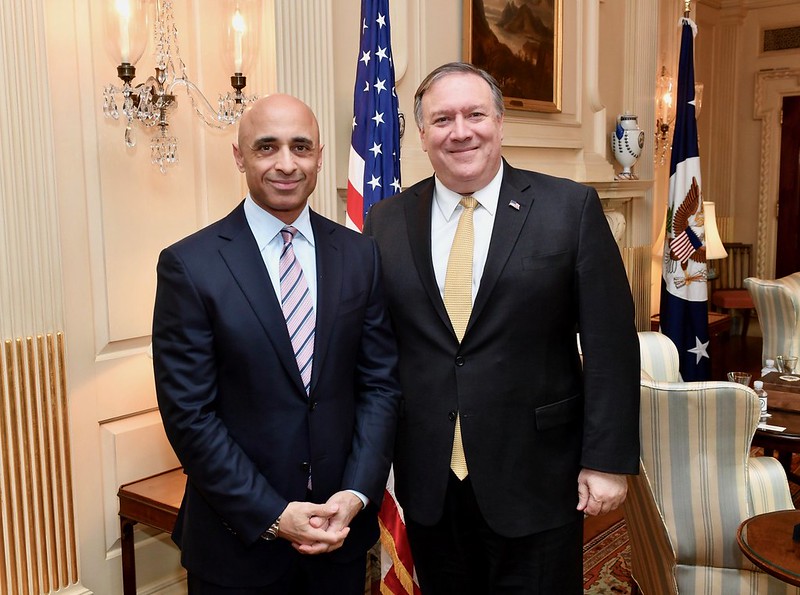
[caption id="attachment_1955" align="alignnone" width="800"] Mike Pompeo with Yousef al Otaiba at the State Department on March 29, 2019.[/caption]

The timing of the deal is linked to Netanyahu’s efforts to remain in power. Netanyahu needs any success to bolster his standing in the polls. His political survival and even his personal freedom are at stake. Israel’s longest-serving prime minister has been charged with several counts of criminal corruption, which is why he called no fewer than three elections over the past year, in increasingly desperate attempts to form a governing coalition that would pass a law to make him immune from prosecution while in office. Ahead of the second round of elections in April 2019, in an attempt to win the support of voters on the far right, he suddenly declared he would annex large parts of the West Bank, thus pushing the idea from the political fringe to the mainstream, making it seem like a real possibility. By offering Netanyahu diplomatic recognition in exchange for backing away from annexation, and possibly using the opportunity to make the long-standing unofficial ties between the two countries public, the UAE presented both the Israeli prime minister and Trump with some political capital as both leaders lose popular support due to mishandling of the COVID-19 response. Circumstances, in other words, probably precipitated the announcement of a deal that was already in the making.

The ramifications will be quite extensive. The UAE broke a long-held taboo among the Arab states by agreeing to formalize diplomatic relations with Israel without extracting any territorial concessions (as Egypt did with the Camp David Accords in 1978) or even lip-service regarding a future Palestinian state (as Jordan did in 1994). With this initiative, the UAE. is paving the way for other countries that have maintained semi-public relations with Israel—such as Bahrain, Sudan and Oman—to follow suit. The Palestinians are left to watch Israel further entrench its control over the occupied territories, while the little leverage they had dissipates.

In 2002 leaders of Arab states that had once rejected Israel’s existence met in Beirut and, following an initiative from Saudi Arabia, made Israel an unprecedented offer: full normalization in exchange for complete withdrawal from the occupied territories and a “just settlement” of the Palestinian refugee issue. At the time, the international community thought the offer was almost too good to be true; Israel, then embroiled in the Second Intifada, rejected it outright, claiming it was a ruse to destroy the Hebrew state with an influx of Palestinian refugees.  Eighteen years later, Netanyahu can claim credit for having shown that Israel can have its cake and eat it too.

The deal also crystalizes and hardens the new dividing lines of the Middle East. No longer are Middle Eastern countries categorized according to their position on the Israeli-Palestinian issue or closeness to the West, but rather according to their position on Iran and political Islam. Israel is comfortably situated within the axis that sees both Iran and political Islam as a threat, alongside the UAE., Saudi Arabia, Sudan, Bahrain, Jordan, Egypt and Morocco. Netanyahu is right at home among these authoritarian rulers, who openly express disdain for liberal principles and incite against internal enemies supposedly plotting against them. In one fell swoop, the UAE-Israel deal boosts Israel's political right, helps cement Israel's military rule over the Palestinians, and solidifies Israel's alliance with monarchical and undemocratic rulers. Illiberalism was victorious this week.
    [post_title] => The Israel-UAE deal is a triumph for authoritarianism
    [post_excerpt] => For decades, Middle Eastern countries were categorized to their positions on Israel-Palestinian issue or closeness to the West. Now, the issues are Iran and political Islam. Israel is comfortably situated within the axis that sees both Iran and political Islam as a threat, alongside the UAE., Saudi Arabia, Sudan, Bahrain, Jordan, Egypt and Morocco. Netanyahu is right at home among these authoritarian rulers
    [post_status] => publish
    [comment_status] => closed
    [ping_status] => open
    [post_password] => 
    [post_name] => the-israel-u-a-e-deal-is-a-triumph-for-authoritarianism
    [to_ping] => 
    [pinged] => 
    [post_modified] => 2024-08-28 21:11:30
    [post_modified_gmt] => 2024-08-28 21:11:30
    [post_content_filtered] => 
    [post_parent] => 0
    [guid] => http://conversationalist.org/?p=1950
    [menu_order] => 251
    [post_type] => post
    [post_mime_type] => 
    [comment_count] => 0
    [filter] => raw
)

The Israel-UAE deal is a triumph for authoritarianism

WP_Post Object
(
    [ID] => 1941
    [post_author] => 2
    [post_date] => 2020-08-13 23:11:48
    [post_date_gmt] => 2020-08-13 23:11:48
    [post_content] => From Belarus to America: a lesson in how an authoritarian responds to those who threaten his power.

Six masked police officers in black uniforms and helmets were filmed beating one unarmed man, who can be heard moaning in pain. A woman runs up, screaming, and the cops turn on her, one of them explicitly threatening her, the other pushing her away. “Don’t touch him, that’s my husband!” she screams, flailing at them with her arms. The officers haul her husband up off the ground, presumably to be detained. It was just another day of violent crackdowns in Belarus, a country that has been ruled since 1994 by Alexander Lukashenko, who is often called Europe’s last dictator

We don’t know for certain where police took the man, but another video provides some clues. 


The women narrating the clip are clearly horrified at what they are seeing through the window. They fear the detained people lying face down in the walled yard of the police precinct will be murdered by police. One of the women wants to go out on the balcony to film, but then both decide it’s unsafe. The scene has a Children of Men vibe — dystopian and horrifyingly banal at the same time. Subsequent videos published on Twitter show protesters gathered outside a detention center in Minsk while chanting encouragement to the detainees who are being beaten inside, and weeping as large police vehicles arrive with yet more detained protesters inside. 

Reports of horrific torture in detention have begun to leak out. Here is just one video featuring the sounds of detainees screaming. Here is a video of a woman behind barbed wire, screaming “Don’t! Please stop! I can’t see anything!” A friend of mine who lives in Minsk has likened the situation to a war being waged by the state against its own populace. 

An independent Russian journalist, freed with the aid of his diplomats, was able to recount the scenes he saw after being essentially kidnapped by police (as they told him themselves, “You are not detained”), including minors being savagely beaten, people forced to lie face down in pools of blood for hours, police jumping on protesters’ backs until bones are broken, threats of rape, and much more. 

Four days into the anti-Lukashenko demonstrations, Belarusian state television broadcast a horrifying video report that shows young protesters at a detention center, obviously beaten and terrified, confirming to an off camera police officer that they will not engage in any more protests.

The mass arrests are part of a violent state crackdown on opposition demonstrators, who poured into the streets on August 9 to protest  an election that the president claimed he had “won” with 80% of the vote. Protests have sprung up all over the country, not just in the capital, Minsk. While exact numbers of protesters are hard to come by, official statistics say that at least 6,000 have been detained in just a few days. 


While media organizations have been careful to stress that vote rigging has been “alleged” in Belarus, I can state confidently that the election was stolen; the evidence is there for all to see.  Svetlana Tikhanovskaya, the 37 year-old woman who ran against Lukashenko after her husband, a well-known opposition blogger, was jailed in May, has been forced into exile in neighboring Lithuania. Security officials threatened to make orphans of her children, whom she sent abroad before the election; they later arrested her campaign manager, Maria Moroz.  They detained Moroz as a hostage, to be released in exchange for Tikhanovskaya’s departure from Belarus.  Before she was allowed to leave the country, Tikhanovskaya recorded what amounts to a hostage video, in which she reads from a script while sitting in what seems to be the office of a Belarusan Central Elections Commission chairperson. In a personal video, which she recorded shortly after arriving in Lithuania, Tikhanovskaya speaks emotionally; she calls herself a “weak woman” — a chilling reference to Lukashenko having mocked her as a “poor little girl” ahead of the election. “Children,” she said in that video, “are our everything”—a  clear indication that she was told her children would not be safe. She added: “God forbid you should ever have to face the choice I had to face.” Even with her children safely abroad, Tikhanovskaya had every reason to be terrified for them. Her husband, who was originally supposed to run instead of her before Lukashenko had him thrown in jail, remains behind bars, another hostage.  Svetlana Tikhanovskaya is young, passionate, and charismatic in a way that galvanizes voters. She has a wholesome image — an independent candidate who declared her love for her activist husband, Sergei, after he was locked up, and ran on a platform of freeing political prisoners, weakening ties with Russia, and democratic reforms. Her courage invested her with instant appeal. The threats against Tikhanovskaya and her family are not the actions of a confident leader who easily won the majority of the polls. They are the actions of a dictator who feels his throne wobbling underneath him. Although the election was not monitored — already a major red flag — the machinations witnessed by ordinary citizens at the polls were giving the game away, Tikhanovskaya was clearly getting too many votes for comfort. Demands for “all votes to be counted” are no longer relevant at this point; to get to the bottom of what happened, one would need to hold a whole new, transparent election, which is impossible at the moment. Look at this graph if you want to understand the generational span of Lukashenko’s rule: Add to that stagnation and growing inequality, as well as a history of repressions and crackdowns. Now add the fear, uncertainty, and crisis that 2020 brought — a spectacle that has included Lukashenko mocking the coronavirus and hosting a parade as infections surged Lukashenko’s response to the protests has included not just threats and violent crackdowns; he also cut off the internet in an attempt to stifle dissent. The people, however, appear furious and determined in their defiance. Bypassing restrictions, some have even created a Telegram channel dedicated to unmasking and doxxing Lukashenko’s security services — a situation that could escalate dramatically on top of all of the other escalations.  It is not clear if Lukashenko will be toppled. Certainly, the savagery with which the protesters are being treated shows us that he fears as much. Some regional analysts believe that the regime is nearing collapse, but the question is — at what cost? Americans should be paying close attention to events in Belarus. Lukashenko’s response to the opposition shows how a cornered rat behaves — with mass arrests, death threats, and attempts to shut down or limit access to the internet. Donald J. Trump is just a wannabe authoritarian, but like Lukashenko he can be dangerous when under duress. We have observed Trump’s increasing petulance — everything from the constant revenge-firings of officials and blasting his own intelligence community on Twitter — and see how it can easily turn into a rage.  We can see how that rage finds an outlet via unidentified paramilitary police grabbing protesters  in places like Portland. We can see it in how peaceful protesters were tear-gassed in D.C. for a bizarre photo op. One of the functions of authoritarianism is to bulldoze the safeguards that a democratic system places between the individual and the state — as craven officials continue to help Trump, more and more of the American public is exposed to both his anger and his incompetence. Americans are lucky to have a system that still provides many protections from Trump’s rage, but that system has its vulnerabilities. With the pandemic out of control in the States, voting by mail has become more important — but our Postal Service is being sabotaged, to name one obvious example. Republicans have been going after the USPS for years, but their efforts now present Trump with a potential opportunity to cast the upcoming presidential election as seriously flawed, especially if it’s a close one. When a crucial part of the societal infrastructure that is propping up our democracy is weakened, we stray further toward unpredictable scenarios.  Keith Kahn-Harris, a London based sociologist and prolific author, explains in an excellent Twitter thread that Western ideological zealots who support foreign dictators and cast them as fighters of Western imperialism (Kahn-Harris he refers to them as “Tankies” — the term originated with British people who supported Soviet tanks rolling across Europe, but has since broadened to include different groups, united by a disdain for the Western countries they call home) have succumbed to delusion by treating Lukashenko’s state propaganda as though it were meant to be believed.  Rather, explains Kahn-Harris, “In dictatorships the absurdity of the lie is precisely the point—it is an expression of dominance.” People who have grown up in authoritarian regimes know that official statements are lies. The trick is to understand the subtext of the lie. People who have grown up in democracies are not equipped with the necessary cynicism to combat a leader who lies axiomatically, which is why the U.S. media has failed to cover the Trump presidency with adequate insight.  There is a very good parallel to be drawn between Trump’s base — as they do everything from cheering on our own examples of horrific police violence to ignoring or dismissing the president’s inaction on the pandemic — and Lukashenko’s Western fanboys as they seek to discredit protesters in Belarus Both groups are operating in a state of unreality. As we have seen over the past few months,  2020 has shown all too well, unreality is both seductive and deadly. [post_title] => Why you should care about what's happening in Belarus [post_excerpt] => Americans should be facing close attention to events in Belarus. Lukashenko’s response to the opposition shows how a cornered rat behaves — with mass arrests, death threats, and attempts to shut down or limit access to the internet. Donald J. Trump is just a wannabe authoritarian, but like Lukashenko he can be dangerous when under duress. [post_status] => publish [comment_status] => closed [ping_status] => open [post_password] => [post_name] => why-you-should-care-about-whats-happening-in-belarus [to_ping] => [pinged] => [post_modified] => 2024-08-28 21:11:30 [post_modified_gmt] => 2024-08-28 21:11:30 [post_content_filtered] => [post_parent] => 0 [guid] => http://conversationalist.org/?p=1941 [menu_order] => 252 [post_type] => post [post_mime_type] => [comment_count] => 0 [filter] => raw )
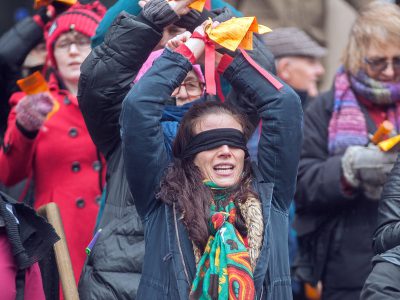
Why you should care about what’s happening in Belarus

WP_Post Object
(
    [ID] => 1932
    [post_author] => 2
    [post_date] => 2020-08-06 20:44:44
    [post_date_gmt] => 2020-08-06 20:44:44
    [post_content] => With just 89 days left before the presidential election, we need more grassroots community-led political spectacle grounded in culture and pluralism.

The morning before July 4th, a group of artists and activists working together under the banner of the project “XMAP: In Plain Sight” sent flights throughout various parts of the United States to skytype messages in defense of immigrants incarcerated in detention facilities. These multicultural, multilingual messages -- such as “Care Not Cages,” “Azadi” (“Freedom,” Urdu/Hindi)  “Lespwa Ak Libete” (“Hope and Freedom,” Haitian Creole)  “Mitakuye Oyasin” (“All Are Related,” Lakota) and “Nos Vemos Libres” (“We Will See Each Other Free,” Spanish) — conveyed hope, resistance, and solidarity. They also received significant attention from legacy media outlets like the New York Times, L.A. Times, and CNN—and on social media

That same night, at Mount Rushmore (on stolen Lakota Sioux land), the president of the United States threw a populist pageant. Each detail of the event, from his nativist and racist speech to the grandiose setting, was designed to inflame his base’s desire to pull the country deeper into white nationalism and isolationism. While Native American activists protested outside the event, he ignored people lost to the raging coronavirus pandemic and those suffering under impending economic collapse, and explicitly denigrated people fighting for racial justice. The spectacle was aimed to bolster his failing popularity by stoking fears of a culture war created and driven by his own administration.  

The two events were bipolar political spectacles. The Mount Rushmore event was fascist propaganda grounded in populism and nativism; XMAP:IPS was community-led mobilization grounded in culture and pluralism.

With just 89 days left before the presidential election, we need more of the latter. 

The world is in a fragile state, as its peoples confront multiple catastrophes simultaneously— the coronavirus pandemic, mass political uprisings, forced displacement caused by climate change and war, and massive inequality. In the United States, these interlocking crises are exacerbated by a government fast descending into fascism, sacrificing lives for cheap political points as the GDP craters and millions hover near poverty. 

Past administrations weakened the immigration system, the issue XMAP:IPS addresses. But the Trump administration, with its short-sighted and cruel policies, has caused it to degrade almost completely into brutality. As of May 2020 there are over 25,000 immigrants in detention, all denied protections against COVID-19. The current government has eroded protections for asylum seekers; it has also attempted to ban certain minority populations, roll back the protections offered to recipients of DACA (children of undocumented immigrants), and deport foreign students—all while continuing to threaten immigrant families with forced separation of children from their parents. 

And then there are persistent calls to build a wall: Trump’s “big, beautiful” wall, which serves as a billboard for the administration’s xenophobia.

And that’s the key. So much of what emanates from the White House is bluster and stunt. As election season heats up, the administration is ramping up the political theater. In the month since the July 4th weekend, he and his daughter Ivanka posed with cans of Goya beans to indicate their support for the company’s CEO, whose controversial pro-Trump remarks led to calls from Latinos to boycott the company’s products. He held what could only be called a campaign rally in the Rose Garden, despite the long-observed norm by which incumbent presidents refrained from electioneering at the White House. Later the same week, there were pickup trucks on the South Lawn held up by a crane emblazoned with “Trump Administration.” Even his use of social media is a sort of ongoing digital spectacle. Trump’s recent tweets — which range from claiming the election should be postponed to attempting to ban Tiktok — fix the attention of the media, which chases them like a kitten with a ball of yarn and amplifies them in an endless cycle. 

But just because these are stunts doesn’t mean they can be ignored. The administration is turning violations of basic rights into a series of antics to push the window of acceptability while manipulating our gaze away from the next violation. And as the tide appears to be turning, their tools against falling poll numbers will be voter suppression, attempts at election invalidation, and dialing up their culture war rhetoric. The stakes around the elections—which, despite the U.S.’s declining stature in the international arena, will be one of the most consequential global political events in recent history—couldn’t be higher. 

We need to fight it all, in the courts, on our airwaves, in the press — and also in the streets and in the public imagination. For this last one, we need to mount spectacles of our own. 

There is a long-standing tradition, domestically and internationally, of community-led cultural intervention — a social relation amongst people, mediated by images”  — crafted in the language of aesthetic political resistance and radical community. It is an essential tool of nonviolent action. ACT UP, the grassroots movement to find a cure for AIDS, is particularly well known in the United States. More recent examples can be seen in South Korea, Armenia and Argentina, where culture-based demonstrations have been instrumental in pushing movements towards their goals.

I haven’t always supported political spectacle as practiced in the United States. Too often it is generated from outside an affected community, such as last decade’s Kony 2012. When imposed on a community’s needs and demands, grand gestures can be paternalistic, whitewashed, corporate stunts, such as Paving for Pizzas, or Refugee Nation, mounted by the same advertising firm that refused to stop working with Customs and Border Patrol, the US agency responsible for menacing immigrants. These types of actions suck time and energy away from the actual work that leads to positive social change. And as with the president, authoritarians and fascists have historically relied on it as a means of delineating and manifesting ideology and to distract a populace from larger social ills. 

But when the purpose of political theater is to get people to engage with grassroots movements for change, it can be an effective tool for strengthening coalitions. When grounded in participatory democracy and cultural expression, the planning and implementation process of these events are an effective means of connecting people. This is what my team at XMAP:IPS had in mind when we created the strategy for our action in immigration. 

We built the project predicated on three commitments: First, to amplify the voices of immigrants. Second, to be intersectional in the makeup of the production team and the invited contributors. Third, to partner with a network of national and local activists and organizations working directly with affected communities, and provide a new way for them to collaborate with each other. Highlighting their calls to action helped attract attention and resources for their work. This is how we captured the public square.

Ours was one of several interventions that captured media attention this summer. Black Lives Matter protesters have peacefully claimed the streets: they turned Brooklyn’s Barclays Center and 125th Street in Harlem into outdoor dance parties; in Washington, DC they created an outdoor yoga studio. In Minnesota an Aztec dance group paid tribute to George Floyd with performance, and a group in Atlanta honored John Lewis with dance. Artists turned slogans of resistance into public art. K-Pop stans — Korean pop music fans, many of whom have turned to activism -- were joined by American TikTok teens in culture jamming the president’s June 20th Tulsa rally. In a signal they are watching and using the tools they have at their disposal to activate on current political events, they rapidly spread messages over social media channels to reserve seats in the stadium. The president’s campaign staff claimed a million people would attend. Instead, only 6,200 showed up. The president was despondent -- and the culture jam achieved its goal. 

Each of these actions is a statement. It is a reminder that none of this is okay -- but that we might be able to come together to fight it. 

In a time of fascism and propaganda, we need reason and action to be supported by grand visions of change. 

These actions are fuel to our organizing power. They can be even more effective in firing up the collective imagination if they are connected, networked, and sustainably resourced. Driven by urgency and a political philosophy of interconnectedness, artists and activists too often fight without income or safety nets. Currently, legacy media outlets are giving far more coverage to the spectacle of the Trump administration and the GOP, than they are to the spectacles mounted by grassroots movements for social justice. 

And yet, despite the lack of attention paid by the legacy media, those very movements — for Black Lives, for the climate, for the displaced and detained — are currently fighting to turn the public gaze to calls for justice. In the tradition of past cultural activations stretching from the March on Washington for Jobs and Freedom through to the establishment of Black Lives Matter Plaza in Washington DC and painting the sky with messages of solidarity, our movements are using culture and community to hold the public square. 

We are at a critical moment in history. It requires us to continue using art as a foundation of social change and community building. We need support to allow people to stand up in a different way and create the space to do so, to use public dialogue to reignite compassion and build a collective vision for the country. Our interventions leading up to November can apply a different kind of pressure and allow us to dream beyond the election. Imagine the community engagement over the coming months if we were able to mount a coordinated series of local and national cultural activations.

With 89 days left until the election, we could lead the country through song, dance, art, and flight into a just future. Let’s give it to them. In the words of the late John Lewis, let’s find a way to get in the way. Let’s go big. 

 
    [post_title] => Radical community is the way to counter the Trumpian populist spectacle
    [post_excerpt] => We are at a critical moment in history. It requires us to continue using art as a foundation of social change and community building. We need support to allow people to stand up in a different way and create the space to do so, to use public dialogue to reignite compassion and build a collective vision for the country.
    [post_status] => publish
    [comment_status] => closed
    [ping_status] => open
    [post_password] => 
    [post_name] => radical-community-is-the-way-to-counter-trumpian-populist-spectacle
    [to_ping] => 
    [pinged] => 
    [post_modified] => 2024-08-28 21:15:13
    [post_modified_gmt] => 2024-08-28 21:15:13
    [post_content_filtered] => 
    [post_parent] => 0
    [guid] => http://conversationalist.org/?p=1932
    [menu_order] => 253
    [post_type] => post
    [post_mime_type] => 
    [comment_count] => 0
    [filter] => raw
)

Radical community is the way to counter the Trumpian populist spectacle

WP_Post Object
(
    [ID] => 1921
    [post_author] => 2
    [post_date] => 2020-07-30 09:31:44
    [post_date_gmt] => 2020-07-30 09:31:44
    [post_content] => Trump did not cause the rise of authoritarian Christianity. He is its symptom.

In a recent article in The Atlantic, prominent conservative commentator Peter Wehner, who worked for the Reagan and both Bush administrations, lamented the “Faustian bargain” his fellow white evangelicals have made in aligning themselves with Donald Trump. But the coreligionists Wehner finds so problematic represent the base that made his own high-profile career possible, and they do not agree that they are dealing with the devil. That the vast majority of white evangelicals have embraced Trump has caused prominent evangelicals invested in respectability, like Wehner and Michael Gerson of The Washington Post, considerable consternation. Gerson also played an influential role in the George W. Bush administration, and his hand wringing over the alliance between the Christian Right and Trump likely represents concern for his own legacy and that of “compassionate conservatism.”

The fear is not misplaced. One key lesson the American public should take away from the Trump years is precisely that the project of “respectable evangelicalism,” to which men like Wehner and Gerson have devoted much of their careers, has emphatically failed.

Specifically, the avatars of this “genteel” conservative Christianity have failed in three interrelated ways:
  1. they have failed to convince their coreligionists that supporting Trump is hypocritical or damaging;
  2. they have failed to take responsibility for the harm they have done by encouraging the culture wars and trying to put a benevolent face on them;
  3. they have failed to maintain control of the national conversation around evangelicalism to the extent they once did, which contributed to the major U.S. media’s tendency to normalize extremism.
If the United States is to have a healthy democratic future, Americans will have to reckon with the consequences of these failures. Wehner and company still represent the conventional wisdom, but their hold on the dominant narrative is cracking. Increasingly, ex-evangelical and other critical voices are breaking through, because the would-be respectable conservative Christians have failed to provide a satisfying answer to the nagging American question, “What’s wrong with evangelicals?” I will be devoting this and my two upcoming monthly columns here to addressing each of these three failures, starting with the first: the failure of the Wehners and Gersons of the world to influence white evangelicals away from support for Trump. As I will argue in subsequent months, this failure is essentially a symptom—a reflection of respectable evangelicals’ complicity in fueling the culture wars, which they can no longer contain. The fallout from the culture wars has also finally allowed ex-evangelicals to begin to be heard in the public sphere. Wehner argues that Trump is a cause of authoritarian Christianity’s rise, rather than the symptom of a decades-old movement, which he helped build, that is centered implicitly around protecting white privilege and explicitly around paranoid sexuality politics. In his recent article, Wehner writes, “The Trump presidency… has inflicted gaping wounds on the Republican Party, conservative causes, and the evangelical movement.” He is particularly concerned with the reputation, or “witness,” of evangelicals, which is vitally important to members of a faith community grounded largely in valorizing the conversion experience and the concomitant drive to convert others. But while the reputation of the evangelical movement has deservedly suffered greatly in the Trump era, we now have the data to show that, despite warnings from men like Wehner and Gerson, most conservative evangelicals simply don’t see this. The vast majority of white evangelicals support Trump because they believe he is doing the will of God. There is some disagreement among them over whether Trump is a Christian or simply an irreligious man willing to fight for Christians, but his white evangelical base does not doubt that the president fights for them. Of course, when they maintain he fights for Christians, they mean Christians “of the right sort”—i.e., those who oppose same-sex marriage and abortion, and who dislike immigrants and refugees. If a large, powerful body of Christians insists that backing a strongman credibly accused of sexually assaulting numerous women in order to grab power is Christian behavior, then, empirically, it is Christian behavior. Religions are complex cultural systems with traditions and texts that are subject to communal mediation and interpretation, which means that well-meaning liberals who dub Christian Trump supporters “fake Christians,” fail to see that authoritarian Christianity is just as “real” a version of the faith as any sort of progressive or liberationist Christianity. Meanwhile, “respectable” commentators like Wehner who mostly agree in substance with the majority of white evangelicals’ illiberal Christianity may see Trump support as a bridge too far, but their cries to this effect fall on deaf ears among their more uncouth brethren. According to findings by Denison University political scientist Paul A. Djupe, about three quarters of white evangelicals either disagree (46.5 percent) that “Christian support for Donald Trump has hurt Christian witness” or believe that it has neither hurt nor helped Christian witness (28 percent). Probing further into the influence of whether respondents to his study perceive their friends as mostly supportive or mostly opposed to Trump, Djupe argues, “these results help us see that, at this point, it is difficult, for instance, for evangelicals to see that the Christian brand has been damaged in society by its close association with Donald Trump. In part, that is because it has probably not been damaged among their bits of society.” Men like Wehner interact with a much more ideologically diverse crowd than rank-and-file evangelicals do; they are able to see the damage that evangelical support for Trump has caused, and thus fret about their inability to rein it in. Wehner’s willingness to call out his fellow evangelicals for accepting Trump’s overt racism (for example, Trump’s pejorative use of “kung flu” to refer to COVID-19 and his pushing the birther conspiracy about President Barack Obama) accomplishes nothing except, perhaps, to assuage his own conscience. In his analysis of the Supreme Court’s decision in Bostock v. Clayton County, Georgia, Wehner argues that evangelicals, despite their “devil’s bargain” with Trump, have largely failed to get what they want. This is simply wrong. Trump has delivered in numerous ways on what he promised white evangelicals; and while they might see Bostock as a setback, subsequent “religious liberty” decisions have granted evangelicals sweeping exemptions to civil rights laws and education regulations. Since I cannot see “his heart,” to use the evangelical speak of my youth, I cannot say whether Wehner truly believes that Roe v. Wade will remain settled law when it is very much threatened. I can say, however, that he is out of touch with the evangelical movement if he sincerely fails to see that their embrace of Donald Trump is not a betrayal of their values, but rather a reflection of them. [post_title] => The failure of 'respectable' evangelicalism, part I [post_excerpt] => A minority of 'respectable' Christian conservatives who oppose Trump claim that he is responsible for the rise of authoritarian Christianity, rather than a symptom of a decades-long movement that is centered implicitly around protecting white privilege and explicitly around paranoid sexuality politics. [post_status] => publish [comment_status] => closed [ping_status] => open [post_password] => [post_name] => the-failure-of-respectable-evangelicalism-part-i [to_ping] => [pinged] => https://conversationalist.org/2020/06/25/the-christian-right-the-bostock-decision-and-the-struggle-to-define-religious-freedom/ [post_modified] => 2024-08-28 21:15:13 [post_modified_gmt] => 2024-08-28 21:15:13 [post_content_filtered] => [post_parent] => 0 [guid] => http://conversationalist.org/?p=1921 [menu_order] => 254 [post_type] => post [post_mime_type] => [comment_count] => 0 [filter] => raw )
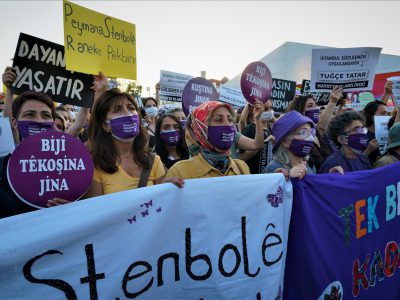
The failure of ‘respectable’ evangelicalism, part I

WP_Post Object
(
    [ID] => 1910
    [post_author] => 2
    [post_date] => 2020-07-23 17:14:58
    [post_date_gmt] => 2020-07-23 17:14:58
    [post_content] => A secret language, Láadan, allows women to express feelings and experiences for which English, with its male-centric deficiency of words, phrases and grammar, does not possess.

In May of 2017, while many were still reeling from shock at the spectacle of Donald Trump as president of the United States, the New York Review of Books published an article by Masha Gessen called “The Autocrat’s Language.” Gessen, a non-binary person who uses gender-neutral pronouns, was rapidly taking their place as a Trump explainer, drawing upon years of covering the Putin presidency in their native Russia to position themself as an expert in contemporary authoritarianism. In their piece for the NYRB, Gessen explained that because autocrats distorted the meaning of words by using them to lie, journalists were forced to use an impoverished vocabulary in order to report the truth.  Suzette Haden Elgin, a linguist and novelist, uses a variation on this scenario to inform her 1984 science fiction novel, Native Tongue; it is set in a patriarchal future United States of 2205, a place where the nineteenth amendment was repealed in 1991, stripping women of their rights. To combat male dominance, a group of female linguists invent a language of their own. Today the question posed by Native Tongue seems especially relevant to Gessen’s warning about language manipulation: is it possible to restructure language to re-alter our reality?

A particularly prescient science fiction book can offer an eerie prediction of current events years before they happen. Margaret Atwood’s 1985 novel A Handmaid’s Tale  describes a dystopia in which women’s civil rights had been rescinded; they could not vote or control their own procreation. Adapted for television in 2018, the steep erosion of rights didn’t seem so far-fetched in the Trump era. The dramatic series reflected the emerging reality that resulted from what Gessen describes as Trump’s ability to invert phrases and words dealing with power relationships into their exact opposite, thus doing “violence to language.”

This violence was strongly exemplified in Trump's July 3rd speech, given in the context of the recent protests demanding that Black lives matter as well as the Covid-19 crisis. In an attempt to discredit those calling for change, Trump spoke of a “new far-left fascism.” He argued that, “If you do not speak its language, perform its rituals, recite its mantras and follow its commandments, then you will be censored, banished, blacklisted, persecuted and punished.” In twisting these words to speak of discrimination against those in power rather than those who are oppressed, terms such as “fascism,” “censor,” “banish,” “blacklist,” “persecution” and “punishment” are stripped of their original meaning and begin to become hollow.

Native Tongue, the first of a three-book series, envisions repairing this damage to language. In Elgin imagined United States of 2205, women effectively belong to men. They are not allowed to own their own property, or to work outside the home without permission from a male relative. Because interplanetary exchange and colonization are crucial for the United States, linguists play a central role in society as interpreters for extra-terrestrial negotiations. Due to the strong demand for translation, linguistic “lines,” or dynasties, have evolved; each child of the lines is trained in at least one alien language and in multiple human languages. Native Tongue follows a group of linguist women whose secret language, Láadan, allows them to express feelings and experiences for which English, with its male-centric deficiency of words, phrases and grammar, does not possess.

Artificial, or constructed and imaginary, languages (conlang) are spoken in popular television series like Star Trek (Klingon) and Game of Thrones (Dothraki and Valyrian). They are also seen in a wide array of speculative fiction by authors like Francis Godwin and Thomas More. Artificial languages have been used in fiction to explore imaginary voyages and worlds, but in a 2007 interview Hadan Elgin described Láadan as a “thought experiment” with directives for women’s change within society. Elgin, who had a PhD in linguistics, was a writer and poet best known for a series called The Gentle Art of Verbal Defense. She also subscribed to the controversial Sapir-Whorf hypothesis, which she described in her book Language Imperative as the idea that languages “structure and constrain human perceptions of reality in significant and interesting ways”.

Accordingly, speakers of different languages see the world in very divergent ways: how one perceives the world is based both on linguistic structures in chosen words and their corresponding broader metaphors. For example, binaries such as male/female are often paired with other associations, such as strong/weak or active/passive. Elgin believed that English is dominated by male perception; that its lack of a vocabulary for women to discuss their feelings and experiences directly structures societal inequality. She argued that this configuration is upheld by societal metaphors, such as “women are objects,” reflected in cultural production ranging from fashion magazines to sitcoms. These structures, she posited, must be directly challenged by language itself. “By the technology of language– we insert new metaphors into our culture to replace the old ones, just as we have done in turning ‘war’ into ‘defense’. You don't use guns, or laws, to insert new metaphors into a culture. The only tool available for metaphor-insertion is LANGUAGE.”

Native Tongue provides a fictional blueprint for how these metaphors can change lived reality. While it takes several lifetimes and one more book in the Native Tongue trilogy, the linguist women eventually finish Láadan; they spread it secretly among themselves and then to some of the wider female population. Once enough linguist women have learned Láadan, the male linguists notice a startling change: their spouses, daughters and relatives have stopped complaining. Frustrated by the lack of nagging, which they realize had spurred them to respond, react and experience a sort of catharsis, the men eventually build separate houses for the linguist women. Left to their own devices, the women are freer to live, interact and express themselves, thus reveling in the real change produced by Láadan.

Láadan attempts to enable this freer expression through modifications to both the structure and intent of the language. Much of Native Tongue is occupied with “encodings”, new words for previously unexpressed experiences. The book includes part of a Láadan dictionary, available entirely online, which contains many words that feel very contemporary:
  • ralorolo: non-thunder, much talk and commotion from one (or more) with no real knowledge of what they’re talking about or trying to do, something like “hot air” but more so
  • rashida: non-game, a cruel “playing” that is a game only for the dominant “players” with the power to force others to participate
  • rathom: non-gestalt, a collection of parts with no relationship other than coincidence, a perverse choice of items to call a set; especially when used as “evidence”
While these definitions do fit uncannily well with the present political climate, some of the concepts of Láadan and Native Tongue feel outdated. The stark divisions between gender, for example, fit more with 1980s second-wave feminism in which gender essentialism was a big discussion. There’s also the glaring idea that all women are dominated by all men, which fails to take into account configurations of race, class, ability and non-binary gender identities. The questions posed by Native Tongue feel more relevant to our contemporary situation when  “male domination” is replaced with “patriarchy,” which is defined as an unjust social, political and economic system harmful to all who do not hold power within it. In this line of thought, “women’s language” could be replaced with “intersectional feminist language”—i.e., a language that expresses the views of those who, for a variety of factors, experience discrimination and oppression. Elgin wrote the Native Tongue trilogy with a ten-year timeline, aiming for Láadan to be adopted by 1994, but this never happened. While scholars such as Ruth Menzies point to the difficulty of learning a detailed new language, it is tempting to agree with Elgin, who argued that Láadan failed because women were reluctant to speak a language that forced them to parse their feelings so thoroughly. One additional detail about Láadan is that its structure makes the speaker state the emotion and intent behind everything they say. Necessary speech act morphemes, such as bíi (“I say to you, as a statement”), bóo (“I request”) and bée (“I say in warning”) are paired with suffixes, such as -li (“said in love”), -ya (“said in fear”) and -d (“said in anger”). Thus, in every sentence, the Láadan speaker must clarify their position with words such as:
  • bíili: “in love, I say as a statement…” (bíi + li)
  • bóoya: “in fear, I request…” (bóo + ya)
  • béed: “in anger, I say in warning…” (bée + d)
The type of emotional involvement in constantly analyzing one’s position, intention and feelings seems completely at odds with how English is spoken by those given the most attention, time and money to speak it. Imagine a society in which every politician, but also every citizen, must state their feelings of love, fear or paranoia in every sentence and choose from numerous words for comfort, community and wrongdoing. In her epigraph to chapter thirteen of Native Tongue, Elgin writes that, “For any language, there are perceptions which it cannot express because they would result in its indirect self-destruction.” Perhaps, as Gessen has warned, this implosion is in the not too distant future, in which the damage done by this era of American politics will leave us with few words that still hold meaning. Native Tongue provides a glimpse of how linguistic repair could be not just a tool to alter reality, but to mold it anew. [post_title] => In her 1984 science fiction novel 'Native Tongue,' linguist Suzette Haden Elgin created a feminist language from scratch [post_excerpt] => A particularly prescient science fiction book can offer an eerie prediction of current events years before they happen. [post_status] => publish [comment_status] => closed [ping_status] => open [post_password] => [post_name] => in-her-1984-science-fiction-novel-native-tongue-linguist-suzette-haden-elgin-created-a-feminist-language-from-scratch [to_ping] => [pinged] => [post_modified] => 2024-08-28 21:15:13 [post_modified_gmt] => 2024-08-28 21:15:13 [post_content_filtered] => [post_parent] => 0 [guid] => http://conversationalist.org/?p=1910 [menu_order] => 255 [post_type] => post [post_mime_type] => [comment_count] => 0 [filter] => raw )
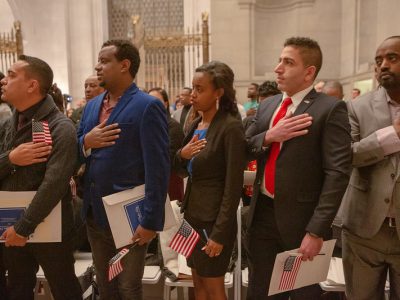
In her 1984 science fiction novel ‘Native Tongue,’ linguist Suzette Haden Elgin created a feminist language from scratch

WP_Post Object
(
    [ID] => 1900
    [post_author] => 2
    [post_date] => 2020-07-16 17:35:36
    [post_date_gmt] => 2020-07-16 17:35:36
    [post_content] => As a child, I viewed his alcoholism as a personal affront; I didn’t realize he was in a lot of silent pain

For most of my life, I thought my dad was kind of an asshole. He was a very angry guy; and by the time I was in high school, he had also started drinking a lot, which didn’t make his fits of rage any better. I thought he was abusive, and that my mother and I were victims. I changed my mind when something similar happened to me. 

I’ve always had fairly bad anxiety, but, throughout my 20s, I was good at managing it in healthy ways. When I turned 30 last year, however, something broke. I found myself downing a bottle of wine every night even though I didn’t even want it, walking to the deli at 4 a.m. to buy beer even though my mind was screaming at me to turn around. I’ve had a much more privileged life than my father, whose childhood was much more difficult than mine, and I don’t carry quite as much anger around, so the consequences were relatively mild. Most of my drinking binges ended with me just falling asleep; the next morning I went to work as usual, but felt tired and depressed. I also often found myself on the receiving end of that mixture of pity, anger, and disgust that I used to direct at him. 

“What is the matter with you?” concerned friends, asked, clearly frustrated. “Why can’t you just get it together?” I stared blankly at the wall. I did know how to explain it. I just couldn’t. 

If someone tried to take the bottle away, I felt a wave of rage unlike anything I’d ever experienced before, as though they were stealing something precious that was so clearly mine. I’d lash out, verbally, then self-isolate. My roommate said that, in those moments, I acted like a “wounded animal in a cage.”  

It had never occurred to me that my father’s drunk rages were reactive rather than intentional. Now I understand what it feels like to see revulsion in someone's eyes—how it can make you feel even lower when you thought you were already at your lowest. 

As a child, I viewed his alcoholism as a personal affront; I didn’t realize he was in a lot of silent pain. One morning when I was 15, I came downstairs to find him sobbing in the living room. Big, heaving sobs. The sight threw me off completely. I had never thought of my father as someone who cried. I sat next to him and asked him what was wrong, thinking someone must have died.

In between sobs, he finally managed to get out, "I don't understand why I don't have any friends. I thought money would make it all go away." 

My father was a Soviet Jew, one who grew up in a room in a communal apartment with peeling wallpaper and a mossy bathtub in the hallway meant to serve five families. He had no father and was raised by an alcoholic mother. When he was a little boy, he got caught under a bridge in the Neva river and almost drowned. He thought that his anxiety could be cured with a middle-class income, middle-sized car and a middle-sized house with a middle-sized garage. But it couldn't. 

I interviewed an alcoholic in recovery a few months ago who said, "No one knows how alone an alcoholic truly is." I get that now. When I'm having one of my episodes, I'm not quite sure what to do. I know I'm supposed to ask for help, but I also know I'm liable to get mean-spirited and verbally aggressive. It seems safer for everyone to self-isolate. I lie in bed and think about how I’ve turned into my father, pushing everyone away and then crying about being alone. 

Thanks to a lot of therapy and yoga and self-care last fall, I managed to start the year off strong and get by OK during quarantine. I was mostly mindful about drinking, but I had my dark days. I’m convinced, at this point, that while alcohol isn’t the solution, it also isn’t the problem. My alcoholism is different from my father’s; I go months on end drinking “normally,” and then I’ll have a self-destructive few days where I drink without eating, a condition colloquially called “drunkorexia.” The real problem for me—as far as I can tell— is wanting to hurt myself and believing that I deserve to be hurt. Drinking on an empty stomach and taking pleasure in throwing it all up is just one of the ways to make that happen. 

I've been getting together with my father's AA group a few times a week since we started reopening. They hold nightly Zoom meetings, but I find the small groups that gather at the beach to be the most helpful. I sit there and listen to them try to convince me, successfully, that you can lead a richer life without alcohol. I sit there and let them tell me, over and over again, that asking for help is not a weakness, but a strength. I don’t tell them that I’m a journalist and that I’ve written hundreds of stories on this very topic, because I know that they aren’t telling all of this to me as much as they are to themselves.

I also just really like them. I’ve never met anyone more compassionate and willing to be vulnerable than alcoholics in recovery; it's like they've already lost everything and have nothing left to lose. It's a testament to the power of a strong support system. I also think there’s nothing more inspiring than watching a bunch of burly Russian men, in their Armani jeans and leather jackets and gold chains, start sentences with phrases like, “I think that my anxiety comes from…”

It always pains me a bit to hear my father say, "One of my friends from AA used to be a surgeon." 

"He used to be a surgeon," he repeats, with gusto. When I hear him say this, I realize just how low he considers himself in society because of his drinking problem. I try to explain to him that alcoholism affects people from all walks of life, that the most intense alcoholism that I've ever encountered has been from people "at the top." Fellow journalists. My friends at Oxford. Anyone I've ever dated in finance. He doesn't really get it. To him, alcohol abuse makes you a degenerate, and that's that. 

But I'm really happy that, for once in his life, he feels like he has real friends. And I hope, for once, that I can be one of them. Because I do believe healing and forgiveness are possible, and I do think that compassion is one of the best tools we have as human beings. I think it’s not that difficult to love and accept someone, with all of their flaws, if you get where they’re coming from. All you really need to do is listen and try to understand. 
    [post_title] => My alcoholism taught me to forgive my father for his own drunken rages
    [post_excerpt] => Raised by an alcoholic father prone to drunken rages, the author thought she was nothing like him. But when she turned 30, she suddenly became a binge drinker. The experience of recognizing her alcoholism and learning compassion at her father's AA meetings helped heal their relationship. 
    [post_status] => publish
    [comment_status] => closed
    [ping_status] => open
    [post_password] => 
    [post_name] => my-alcoholism-taught-me-to-forgive-my-father-for-his-own-drunken-rages
    [to_ping] => 
    [pinged] => 
    [post_modified] => 2024-08-28 21:14:03
    [post_modified_gmt] => 2024-08-28 21:14:03
    [post_content_filtered] => 
    [post_parent] => 0
    [guid] => http://conversationalist.org/?p=1900
    [menu_order] => 256
    [post_type] => post
    [post_mime_type] => 
    [comment_count] => 0
    [filter] => raw
)

My alcoholism taught me to forgive my father for his own drunken rages