WP_Post Object
(
    [ID] => 2429
    [post_author] => 2
    [post_date] => 2021-04-08 18:57:44
    [post_date_gmt] => 2021-04-08 18:57:44
    [post_content] => In which the writer reflects with guarded optimism on a deeply traumatic year. 

April Fools’ Day has always been an idiotic quasi-holiday, offering some people an opportunity to pull pranks and others the chance to observe them–mostly by scrolling through Twitter to see which corporations embarrassed themselves the most with misguided attempts at humor (see: Duolingo’s announcement about a new line of educational toilet paper or Budweiser’s anchovy-pizza seltzer.) But for me, the context and significance of April 1 turned in on itself this year, a house of mirrors. April Fools’ Day is now serious business, a day of joy and gratitude, hope and rebirth.

On April 1, 2020, I drove with my son to the hospital 20 minutes away to retrieve my husband. Josh had been admitted to the ICU two weeks earlier and hooked up to a ventilator before making a miraculous recovery. As AJ and I pulled up into the circular driveway, the entire staff was outside clapping and cheering for Josh, who was being pushed in a wheelchair by a nurse because he could barely walk. 


We know a lot about the coronavirus now, but back then, everybody was flying blind. Josh was the first Covid patient at this particular hospital. Misinformation, often coming from the highest levels of our government, was rampant. As Josh got sicker and sicker, the President of the United States was telling the American public to “Just stay calm. It will go away.” By the end of April, he was encouraging people to inject bleach. The pulmonologist thought there was a 70 percent chance Josh wouldn’t make it. Nobody had any idea if he would experience long-term effects following his hospitalization. So far, he hasn’t. 

If someone had told me last year that by this time in 2021 Josh and I would be fully vaccinated and starting to plan our reintegration into society, I would have sent you one of those Brady Bunch “Sure, Jan” GIFs. But look at us, two Pfizer vaccine doses in each of our arms, blessed with good health, a network of supportive friends and family and access to my parents’ house outside of New York City. We go on long nature walks and appreciate silence, the beauty of simplicity: a sunset, tall trees, birds chirping, the frenetic energy of our dog when she sees a squirrel. I try to receive every day as a gift, thinking, There but for the grace of God go I and all that (even though I’m an atheist.)  

Yet, the week leading up to this moment felt precarious, as if we were being haunted by ghosts, reliving last year’s trauma. Psychologists call this “the anniversary effect,” a phenomenon I first heard about, fittingly, while watching the horror series “Stranger Things” on Netflix. As the one-year anniversary of Josh’s recovery approached, he felt ready to revisit the notes he wrote to himself on his phone when he was in the hospital–before and after he was intubated–and showed them to me for the first time. “Rachel and AJ waving goodbye. Saying they loved me. There were a bunch of other people and vehicles on the street. Escorts?” he wrote on March 20, 2020. I vividly remembered the EMTs that day in their white hazmat gear, carrying Josh out to the ambulance as he gasped for air. The following day, Josh wrote in his notes that he was “doing what needed to be done” to give himself the best chance of seeing us again. When I read that, I felt that muscle memory of the panic, the fight-or-flight mode in which my body existed for that entire two-week period he was away from us, in his own version of the Upside Down. And we’re not out of the woods yet.  

I am one of the estimated 2.3 million women who have been pushed out of the workforce as a consequence of the pandemic—possibly permanently, but who the hell knows. That’s not to say I haven’t been working. I’ve just been doing the arduous but unpaid labor of being a housewife—cooking, cleaning, homeschooling—while my husband works full time from a makeshift home office. To be sure, some elements of our new arrangement have been delightful, like having dinner together every night, discovering the joy of cooking and embracing activities like watercolor painting, which I hadn’t done in 20 years. There are sparks of joy in the small quotidian details of our home life. At the same time, I’m acutely aware that the only reason I am able to revel in these precious moments is because I am not constantly worried that one illness will hurl me into bankruptcy. 

When Josh got out of the hospital, we received a bill for $208,000, the overwhelming majority of which was covered by his employer-backed healthcare plan. (Allegedly, the federal government would have paid for these expenses if we were uninsured, but I suspect we’d still be locked in an ongoing back-and-forth with the hospital’s billing department, like the woman who was billed $52,000 for an out-of-network emergency helicopter ride.) More alarming still is thinking about the counterfactual universe—the universe where Josh didn’t survive—in which I would have become not just a widow, but an unemployed and uninsured single mother, right at the moment I needed healthcare support the most. All because I do not have a job. Due to circumstances beyond my control. This is unacceptable, denying human dignity to people who can’t work, and of course it has always been unacceptable. The coronavirus, if nothing else, has laid bare the hypocrisy of a nation founded on the principles of “life, liberty and the pursuit of happiness” without considering that healthcare is a prerequisite for any of those things. 

There has been so much suffering this past year. 530,000 deaths. 20 million job losses. 8 million Americans sinking into poverty. On the same day Josh got out of the hospital last year, one of my oldest friends said goodbye to her father, who was intubated the day after Josh was. We texted each other back and forth through the horrors of those days. Her father was the first of many people I know who didn’t make it. This anniversary has been very hard for her family. 

When people check in to see how we’re doing, I don’t know what to say. I’m fine, mostly. Because of my good fortune, I sometimes don’t feel like I’m entitled to be unhappy. But I also know—thanks to my therapist who is covered by my healthcare plan—that delegitimizing suffering because others have had it worse is not a constructive way to experience the world. I’ve been thinking a lot about the distinction between privilege, which exists in relation to others, and suffering, which feels absolute, solitary, and all-consuming. The only way through it is to feel it. 

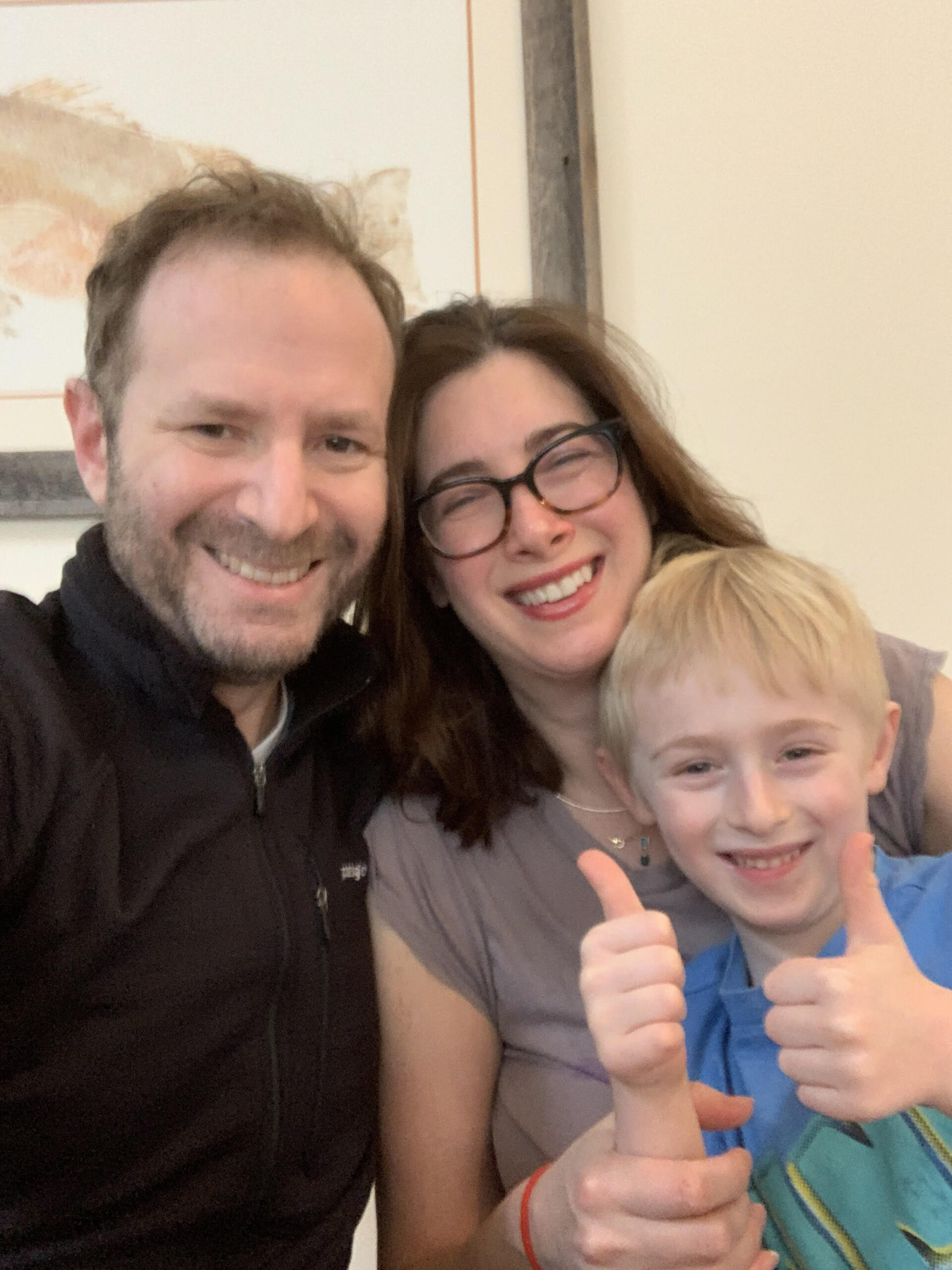
[caption id="attachment_2442" align="alignnone" width="1920"] Rachel Dodes with her husband and son.[/caption]

My seven-year-old son shook me awake early in the morning on April Fools’ Day; I was screaming in my sleep. In my dream, a swarm of live bats were flapping their wings in my face, alighting on my hands. One need not be named Sigmund Freud to decode this obvious Covid anxiety dream, reflecting a truth I’ve learned to appreciate over the course of this pandemic: how deeply interdependent we are, not just with other humans, but with the entire natural world. People, bats, pangolins–all tangled in a web of destiny. If we don’t redouble our efforts to be prepared when the next pandemic inevitably rears its head, “we are finished,” warned Jane Goodall last year, speaking at an online environmental conference. “We can’t go on very much longer like this.”

As the trees begin to bloom, and the birds fly home, I am feeling hints of optimism. We’re alive. We’re vaccinated. We should celebrate. Josh asked me if I wanted to mark our one-year milestone by dining at an actual restaurant for the first time since February 2020. Of course I did. This was a very exciting development. But the joke was on us: It was freezing cold on April 1, too cold to be outside, a symbolic reminder that things are still far from being “normal,” and in fact may never be again. 

But that’s OK. Because what we settled for before as “normal” wasn’t nearly good enough. 
    [post_title] => April Fools' Day in the year of the plague
    [post_excerpt] => On April 1, 2020, Rachel Dodes brought her husband home from the hospital. He had been in the ICU two weeks earlier with COVID-19, hooked up to a ventilator and given low odds for surviving. One year later, she takes stock and wonders if things will ever be ‘normal’ again.

    [post_status] => publish
    [comment_status] => closed
    [ping_status] => open
    [post_password] => 
    [post_name] => april-fools-day-in-the-year-of-the-plague
    [to_ping] => 
    [pinged] => 
    [post_modified] => 2024-08-28 21:15:13
    [post_modified_gmt] => 2024-08-28 21:15:13
    [post_content_filtered] => 
    [post_parent] => 0
    [guid] => https://conversationalist.org/?p=2429
    [menu_order] => 217
    [post_type] => post
    [post_mime_type] => 
    [comment_count] => 0
    [filter] => raw
)

April Fools’ Day in the year of the plague

WP_Post Object
(
    [ID] => 2401
    [post_author] => 2
    [post_date] => 2021-03-26 04:20:38
    [post_date_gmt] => 2021-03-26 04:20:38
    [post_content] => The recent proliferation of high end chai dhabas inspired a national conversation about freedom of movement for women.

It’s a truth widely accepted in Pakistan that drinking chai is what makes you a true native. And not just any chai, but the sweet, milky, caramel-colored brew that is served at dhabas (outdoor tea stands) and slurped noisily while sitting on a small plastic chair, waiting for the dhabay wala to bring you another cup because one is never enough.

But while street dhabas play a major role in Pakistani society, they are traditionally a male-dominated space.

Granaz Baloch, a teaching fellow at the University of Turbat in Balochistan, is a feminist academic and writer whose research focuses on the gender challenges rural women face in finding potable water. She said that while dhabas in Turbat provide “information, opportunities and networking” for men in the city, women are not welcome. But this is not a Turbat-specific issue. Until recently, it was very unusual to see a woman enjoying the simple pleasure of a leisurely cup of chai at a roadside stand anywhere in Pakistan. Now attitudes are beginning to change, partly on the back of social media driven influencer culture. 

[caption id="attachment_2404" align="aligncenter" width="640"] Granaz Baloch[/caption]

Chai Wala is a hip Karachi café (tagline: "reinventing the chai experience") that serves upscale versions of traditional dhaba snack foods and beverages. Established five years ago, it attracts young men and women who are drawn to its trendy decor and menu, which includes Nutella chai, "artisanal" teas, and “dips” like hummus. It also sells branded merchandise. Places like Chai Wala have taken the concept of the traditional working class outdoor tea stand and reinterpreted it to attract a bourgeois clientele. 

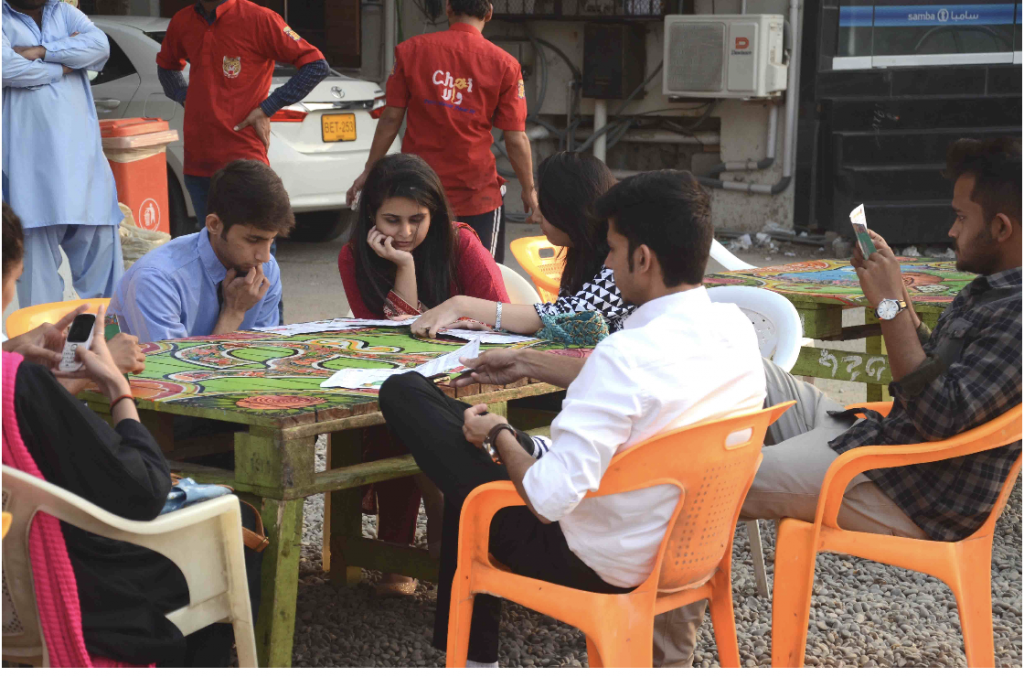
[caption id="attachment_2406" align="aligncenter" width="640"] The scene at Chai Wala.[/caption]

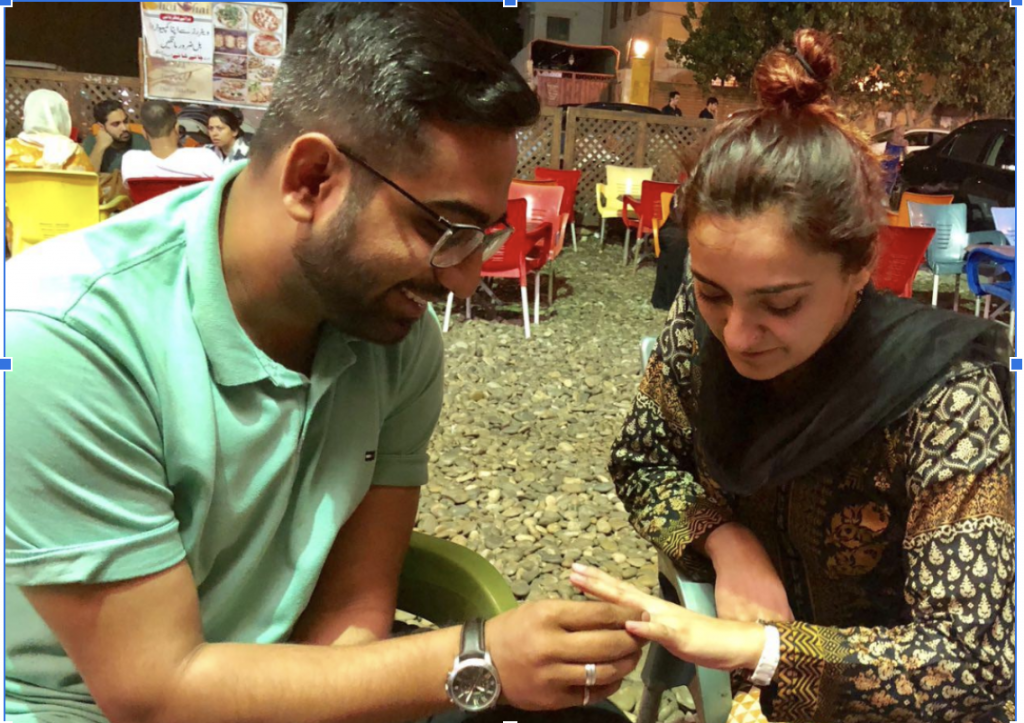
Shaheera Anwar, a 29 year old journalist who moved from Saudi Arabia to Karachi in 2017, got engaged at a traditional outdoor dhaba. “I was dating my now-husband and we often hung out at dhabas after work—and I am someone who hates grand, public gestures, so I got proposed to at a dhaba,” she said. Shaheera is aware that dhaba culture has since become trendy, and she is not sure this is a good thing. She sees places like Chai Wala as gathering places for the rich that erase the egalitarian culture of the traditional dhabas.

[caption id="attachment_2405" align="aligncenter" width="640"] Shaheera Anwar getting engaged at a traditional dhaba in Karachi.[/caption]

Among middle class Pakistanis there is a widely-held perception that high end dhabas are safer for women because they attract a “better crowd.” This raises the question of the role class plays in Pakistani society, and how it affects the way women are treated in the public domain. 

The emergence of high end dhabas occurred right around the time that a feminist collective founded an organization called Girls at Dhabas,  which addresses the absence of women in public spaces and strives to reclaim them. The media gave significant coverage to the group when it first launched, but while press attention has since dwindled the movement has only grown stronger and more vocal in addressing the structural problems that prevent Pakistani women from moving about freely in the public square.

“It took living in other countries to learn that I had been conforming to a clever scam my whole life, thinking the city belonged only to men,” said movement founder Sadia Khatri. Sadia speaks in poetic language about the joy that comes with finally breaking free of the restraints placed on women’s freedom of movement. “The city’s breath rising to meet mine with each step, the pleasure of placing one foot before another, unthinking, meditative. The trust that so long as I kept going, Karachi would keep expanding, opening up before me.”

Many Pakistani women are making similar discoveries about the joy found in moving about in public. Maliha, who re-entered the corporate world after a career break, said that working in an office brought a kind of freedom she had all but forgotten. By extension, sitting at dhabas no longer seemed as daunting. “You gain enough confidence that when someone tries to harass or catcall you, you don’t shy away from hitting back,” she said.  Maliha found herself easing into the spaces she wanted to be. “The more you become accustomed to an environment, the more you learn about an environment, the more confident you become in dealing with that environment,” she said. 

Shoaib is the owner of a successful traditional dhaba in Lahore that specializes in Amritsari hareesa, which the women in his family make according to an old family recipe. He cheerfully  acknowledges that his clientele, once predominantly male and working class, has expanded to include families and women; and he has noticed the increased presence of women on the streets. But while Shoaib expressed no objection to other women claiming public spaces as their own, he said he would not want the women of his own family to be seen on the street or eating a meal at a restaurant. For Shoaib the women he saw eating at his dhaba represented a different lived reality—one that was simply not his. 

Shoaib’s perception of the class divide seems accurate. Upper-class women at posh dhabas are granted the right to be there because they come with the entitlement associated with their socioeconomic class. They are accustomed to being addressed as “ma’am,” and the staff treat them accordingly. Working class women, however, do not see these cafés as their place.

But Sanam, a supervisor at Shahi Bawarchi Khana, a fashionable restaurant in Old Lahore,  banished her insecurities and discomfort about being out in public. “I no longer feel uncomfortable in public spaces, because I know I can handle myself,” she said of working in a restaurant, adding that “girls need to keep moving forward and face the world.” Unlike the women who founded the feminist collective Girls at Dhabas, Sanam is not from the educated upper class. But with her unapologetic confidence she is exactly the kind that needs to be normalized within this debate about public spaces. 

Aqib, the manager at a trendy chai dhaba style restaurant in Old Lahore, articulated his perception of how class drives the lived reality for women in Pakistan. “Women come here more than men now, especially young TikTokers who like creating a big fuss,” he said of the changing demographics among his customers. Like Shoaib, the proprietor of the traditional dhaba that specializes in Amritsari hareesa, Aqib thought that the increased presence of women in the public domain should occur within cultural limitations. 

But what Pakistani men think about gender roles is slowly becoming irrelevant to the women who are paving a path forward. In Karachi’s impoverished Lyari district, notorious for its gun battles between criminal gangs, Shazia Jameel, the manager at Lyari Girls’ Café provides a space in this very male dominated area where women can gather. At the café they can take English language classes, learn boxing, study hair styling and makeup techniques, and chat in a relaxed atmosphere without fear of molestation. Shazia leads a group of women from the café who go cycling on Sundays, stopping on the way back from their ride for breakfast at a male dominated dhaba. At first the women were uncomfortable there, but that feeling has since disappeared. Now they are regulars.

The truth is, it’s not the piercing gazes or the opinions that have really changed, especially not among the working class. What has begun to change is women’s responses to traditional mindsets. The posh dhabas are not remotely inclusive places, nor would anyone argue otherwise. But the noise around them has led women to question why they accepted the limitations placed on their freedom of movement in their own country. They now regard strolling the streets and sitting in cafés as their right. Shazia Jameel puts the onus for protecting women's safety on the authorities, calling upon them to instal CCTV cameras. She also advocates legislation to eradicate religious extremism, which she blames for the perpetration of restrictive attitudes toward women. 

Shazia is right. It’s well past time that the right of women to move about in public without fear of molestation be protected. Nor should they be held responsible for the way men behave toward them. Despite what the old guard may think, change is coming from every direction, one cup of chai at a time. 
    [post_title] => Pakistani women are claiming their right to be in public spaces—one cup of chai at a time
    [post_excerpt] => What Pakistani men think about gender roles is slowly becoming irrelevant to the women who are paving a path forward.
    [post_status] => publish
    [comment_status] => closed
    [ping_status] => open
    [post_password] => 
    [post_name] => pakistani-women-are-claiming-their-right-to-be-in-public-spaces-one-cup-of-chai-at-a-time
    [to_ping] => 
    [pinged] => 
    [post_modified] => 2024-08-28 21:15:13
    [post_modified_gmt] => 2024-08-28 21:15:13
    [post_content_filtered] => 
    [post_parent] => 0
    [guid] => https://conversationalist.org/?p=2401
    [menu_order] => 219
    [post_type] => post
    [post_mime_type] => 
    [comment_count] => 0
    [filter] => raw
)

Pakistani women are claiming their right to be in public spaces—one cup of chai at a time

WP_Post Object
(
    [ID] => 2323
    [post_author] => 2
    [post_date] => 2021-02-19 06:00:16
    [post_date_gmt] => 2021-02-19 06:00:16
    [post_content] => Our social discourse is tainted by mis- and disinformation that started long before Facebook and Twitter existed.

Over the past month, as new, more dangerous variants of the novel coronavirus have cropped up in various countries, some social media platforms have ramped up their fight against mis- and disinformation about the disease. Facebook, for instance, consulted with the WHO before expanding their list of false claims about COVID-19; the company announced they will delete posts that contain any of those claims. 

There’s no denying that mis- and disinformation are real problems that plague our societies. The former represents untrue information spread without the intent to deceive, while the latter is more insidious: Information that is intentionally circulated to mislead, sow chaos, or indoctrinate. Nearly all of us, at some point in our lives, have accidentally spread misinformation. Most have us have encountered it as well, whether from friends and family or authorities we were taught to trust.

As a child growing up in the United States, I encountered misinformation at public school regularly, taught as unquestionable “facts”: Columbus discovered America; the United States single handedly defeated the Nazis; America is the greatest country on earth; colonizers “civilized” the savage natives; Pluto is a planet, marijuana is a gateway drug...and so forth. In most cases, I was taught not to question these “facts.” Some were based on scientific error, but others were intentional. I was presented with a single-sided version of history that aligned with a certain narrative propagated by the country in which I was raised.

Of course, the United States is not alone in brainwashing its youth. In Morocco, where I lived during my early twenties, every schoolchild is taught the same line about Morocco’s colonization of the Western Sahara. Soviet schools taught children to revere Stalin—at least until they didn’t, following Kruschev’s de-Stalinization campaign that saw his image erased from history books. In Germany, where I live now, most friends say they were never taught about the country’s colonial past. And the vast majority of us throughout the world have spent our lives presented with a world map that distorts the size of certain countries.

Schools are not the only institutions that impart misinformation. All over the world, various faith traditions teach different and sometimes competing sets of values and histories. I was raised in a secular household and taught to respect believers, which I do—and yet, I have spent my entire life trying to reconcile the diverse and often conflicting teachings of various religions. Many others, raised in a particular faith, don’t struggle like that; instead, they believe firmly that whatever they were told as children is the ultimate truth. While diversity is part of what makes our world so complex and beautiful, these competing sets of beliefs have also caused countless wars and deaths. And yet, freedom of religious thought is generally upheld as a vital right, despite the fact that it’s simply impossible for all of these ideas to be factually accurate.

The thing is, there is absolute fact and there is the unknowable. There’s a reason why we don’t treat religion as disinformation despite the harms its adherents have caused throughout history: Because we can’t, in fact, know whether the deities in which we put so much faith exist.

What we do know, however, is that some of the information presented as fact by religious traditions has been proven to be scientifically false. And yet, we continue to allow it to propagate for fear of challenging traditions. Some disinformation, it seems, is simply not a priority.

Fact-checking as industry

During the Trump administration and particularly during the pandemic, fact-checking has been emphasized as a key measure in the war against disinformation, with numerous major publications engaging in fact-checking initiatives. The trouble is, many of the same publications that stress the importance of fact-checking and regularly deride social media companies for their failure to act against disinformation all too often engage in misinformation themselves.  The New York Times infamously threw its considerable support behind the invasion of Iraq in 2003 and played a major role in disseminating the lie about weapons of mass destruction; the paper of record also employs several columnists who frequently propagate falsehoods presented as opinions. There are also numerous publications that report on conflicts in the Middle East through the lens of nationalism, putting an emphasis on U.S. interests over the price paid by civilians on the ground.  The legacy media outlets, in other words, have played a significant role in creating a public discourse that is tainted by the pervasive belief that there is no such thing as objective truth. Nor is the World Health Organization unqualifiedly committed to the truth. As social media platforms scramble to counter new disinformation about COVID-19, some critics have raised the point that the WHO was an early perpetrator of misinformation, telling people not to wear masks for fear that they could create a higher risk of infection. The sociologist Zeynep Tufkeci—whose insights have often been a breath of fresh air throughout the past year—noted on Twitter that the WHO and the mainstream media were guilty of propagating falsehoods during the early days of the pandemic.  All of these examples demonstrate that mis- and disinformation are serious problems—and yet, the ways in which certain types of disinformation are prioritized for debunking, while others are allowed (often for nationalistic or propagandistic reasons) to flourish should serve to illustrate why our current dialogue around tackling mis- and disinformation—and particularly its emphasis on combating these ills with technology and censorship—is set to fail. As a society, we must become more comfortable with admitting that we don’t always have the answer; this is a project that must start with our youth. An article in Vice about a new app called Clubhouse illustrates my point well. The sub-head of the article is: “The increasingly popular social media app is allowing conspiracy theories about COVID-19 to spread unchecked.” The article itself is well-reported, noting how falsehoods are shared on the audio-based platform by well-known figures and spread like wildfire. The piece also gets into the difficulties of moderating speech on an app where the speech is not only audio-based, but ephemeral—Clubhouse does not allow conversations to be recorded, meaning that moderation can only be done in real-time, an impossible venture at scale.  And yet, a number of the experts quoted in the piece speak of the problem as one to be solved by technology, pointing to the moderation on other platforms done by humans or artificial intelligence as positive examples, rather than the hopeless game of whack-a-mole that they are. It’s easy to see why tech companies and media ventures would seek to root out disinformation through moderation measures. It’s also easy to understand why they would try to tackle the “worst of the worst”—that is, the most pressing issues—in this manner. And there are indeed some moderation measures (such as going after repeat offenders, particularly those with power) that are reasonable. And yet, over the past few years I’ve watched countless panel discussions about “tackling” or “fighting” misinformation through technical measures, as if social media were the key battlefield and content moderation is how the war will be won. It is eminently reasonable to fight certain disinformation using short-term means. Although I have concerns about some of the key details of, say, Facebook’s latest measure, I understand the importance of cutting off COVID-19 disinformation amidst far too many deaths and rising infection numbers. But I will not pretend that this is how we’ll solve the root causes of the problem. If lawmakers are serious about combating disinformation, then they should start looking inside classrooms and churches. They should follow the money trail and look a bit harder at why our democratic systems are failing. And most importantly, they should step away from technosolutionism and stop viewing it as anything but what it is: A stopgap measure. [post_title] => Content moderation won't stop the spread of disinformation. Here's why. [post_excerpt] => Our democratic institutions are failing due to deeply rooted problems. Online disinformation is a symptom, but not the cause. [post_status] => publish [comment_status] => closed [ping_status] => open [post_password] => [post_name] => content-moderation-wont-stop-the-spread-of-disinformation-heres-why [to_ping] => [pinged] => [post_modified] => 2024-08-28 21:15:13 [post_modified_gmt] => 2024-08-28 21:15:13 [post_content_filtered] => [post_parent] => 0 [guid] => https://conversationalist.org/?p=2323 [menu_order] => 226 [post_type] => post [post_mime_type] => [comment_count] => 0 [filter] => raw )

Content moderation won’t stop the spread of disinformation. Here’s why.

WP_Post Object
(
    [ID] => 2197
    [post_author] => 2
    [post_date] => 2020-11-20 04:47:26
    [post_date_gmt] => 2020-11-20 04:47:26
    [post_content] => There’s nothing like a contested election amid a pandemic to make you realize that we are all tied together.

Just weeks after Donald Trump defeated Hillary Clinton in the 2016 election, my extended family got together to eat our feelings. Nothing about that Thanksgiving felt normal, but we went through the motions and tried to stay positive. Twenty-five of us got together at my dad’s cousin Nancy’s place in Long Island as we always do. We gorged ourselves on turkey and pumpkin pie. We hugged and laughed and drank pinot noir. We watched football. Like many liberals, we grasped for explanations behind the political shift in the Rust Belt, a shift that the polls had failed to capture. I remember how Nancy’s dining room transformed into an impromptu book club meeting for J.D. Vance’s memoir Hillbilly Elegy, which most of us happened to be reading because we all desperately wanted to understand “the other side.” 

Vance’s book, which was published in the summer of 2016, described how an ongoing lack of economic opportunity, coupled with social isolation, has excluded huge swaths of the heartland from the American Dream. It is those “forgotten” men and women—mostly white, working-class and without a college education—who helped lead Trump to victory; at least that was the media’s dominant narrative. An escapee from a blighted town in Ohio who miraculously graduated from Yale Law School, Vance became an unlikely poster child for rural America following Trump’s shocking upset, appearing on cable news to translate his “base” for the rest of the country. Looking back, I can see that Vance’s inspiring personal history was palatable at that moment because it offered an excuse for our racist relatives. They weren’t upholding white supremacy, they were just “economically anxious.” 

Four years later, we understand everything we need to know about the other side. We’ve seen how in addition to the racial resentment, misogyny and xenophobia, Trump gave his followers permission to embrace an ethos of toxic individualism, elevating the notion of “personal choice” above community accountability. As a result, Thanksgiving 2020 is shaking up to be a referendum on exactly how divided—yet simultaneously connected—we are as a nation. While my immediate family hides in our home and rarely interacts with other people, Trump’s base, whether we’re talking about his supporters in the Senate or people attending rallies and protests, appear largely maskless and in packed crowds. A Stanford University study found that Trump rallies led to an estimated 30,000 infections and 700 deaths thus far; the recent “Million MAGA March” protest of Joe Biden’s victory in Washington, D.C. is bound to add to that tally. 

There’s nothing like a contested election amid a pandemic to make you realize that we are all tied together, red and blue, “in a single garment of destiny,” as Martin Luther King Jr. said. Those who flout C.D.C. guidelines out of “personal choice” may indirectly affect those who follow those guidelines to the letter. We need look no further than a rural town in Maine, where a 55-person wedding wound up infecting half the guests and killing seven people who weren’t even invited. 

For my family, this is personal. My husband almost died in March, after contracting a nasty case of COVID-19 on a business trip at a time that the Trump administration was telling us there was absolutely nothing to worry about. After struggling with the lack of testing facilities, I lived through the hell that is not knowing whether my husband would ever come off a ventilator. But one need not have gone through what we did to look at the charts tracking infection rates over the past week and feel a nauseating sense of déjà vu. 

Just in time for the holidays, coronavirus infection rates are soaring in a “third wave”–though, to be fair, the first never really ended–tearing through flyover country and boomeranging back to cities. New restrictions loom on the horizon: more school closures, limits on private gatherings, curfews, another round of lockdowns. Congregating indoors in a spirit of conviviality is akin to aiming “a loaded pistol at grandma’s head,” as Colorado governor Jared Polis described it. Dr. Anthony Fauci said in October that his three children will not be coming home this year for Thanksgiving “because of their concern for me and my age,” which makes sense. Yet as our soon-to-be-former president continues to reject health recommendations and deny reality—about the pandemic, about his defeat in the election, and everything in between—nearly 40 percent of Americans say they are still planning to travel home for a Thanksgiving dinner consisting of 10 or more people.

Not my family. For us, and everyone I know who takes this virus seriously, Thanksgiving this year is most definitely cancelled. My parents are isolating in Florida, and my sister is in Berlin. My mother-in-law is in Arizona, where she may host an outdoor dinner with my brother-in-law’s family, if the weather cooperates. My dad’s cousin Nancy, who together with her husband Steve has hosted our Thanksgiving for as long as I can remember, is giving herself a well-deserved break this year. 

Yet, for many people who continue to believe the COVID-19 threat is overblown, that we are “rounding the turn,” as the outgoing president repeatedly has stated, the holiday is shaping up to be a vast constellation of simultaneous superspreader events. By Christmas, we will start to see the horrifying results of these ill-conceived choices advocated by Trump allies, many of whom are based in flyover country, where the outbreaks are already straining our healthcare system. 

Just look at Ohio congressman Jim Jordan, who tweeted, “Don’t cancel Thanksgiving. Don’t cancel Christmas. Cancel lockdowns,” despite the fact that hospitals in his state are rapidly running out of beds. The Trump administration’s coronavirus adviser Scott Atlas said on Fox News this week that isolation, not the coronavirus, is the biggest threat facing the elderly. He went so far as to urge people to visit their relatives this holiday season, in direct contradiction to every infectious disease specialist’s recommendations. “For many people, this is their final Thanksgiving,” Dr. Atlas said, not realizing that his criminally negligent advice will make that a reality.  

We should bear in mind that it was a plague that wound up bringing the Pilgrims and Indians together at that first Thanksgiving in 1621. Not so much out of friendship or cultural harmony, but out of a desire on the part of the Wampoanoag tribe to avoid annihilation. An infectious disease, likely leptospirosis, is estimated to have killed between 75 and 90 percent of Massachussetts Bay Indians between 1616 and 1619, leading to the decision to make a mutual-defense pact with the nearby Pilgrims, a decision that was followed by exploitation and carnage in subsequent years. The holiday we celebrate today to commemorate a whitewashed history of that first Thanksgiving was designated by Abraham Lincoln in 1863 to bring the country together amid the horrors of the Civil War. It often feels we are as divided now as we were then. 

A schmaltzy-looking film adaptation of “Hillbilly Elegy” is set to debut on Netflix next week, but I won’t be watching it. This holiday season, instead of making excuses for the “other side,” I propose that we reject the myths of the salt-of-the-earth “economically anxious” men and women in America’s heartland just as our views about the myth of Thanksgiving have evolved. My family members are no longer wringing their hands about how to find bridges of communication with Trump supporters, how to reason with them and understand their perspective. I’ve unfriended people who voted for him. Family members who continue to support him are, much like Thanksgiving this year, cancelled. 

I understand the temptation to aim for a shred of normalcy in these tortured times. It’s getting cold. We’ve been in lockdown for nine months and we finally have many positive things to look forward to. We are witnessing the sputtering end of the disastrous Trump era and the dawn of a new administration that believes in science, accountability and racial justice. An administration that doesn’t think the press is “the enemy of the people.” A promising vaccine is on the horizon and may be distributed within a few months. 

We can celebrate all that next year. For now, let’s reject toxic individualism and the real enemy of the people: misinformation. Let’s work to honor the heroism of healthcare workers and enable the survival of our communities. Let’s just not die. 


    [post_title] => Thanksgiving elegy
    [post_excerpt] => Thanksgiving 2020 is shaking up to be a referendum on exactly how divided—yet simultaneously connected—we are as a nation.
    [post_status] => publish
    [comment_status] => closed
    [ping_status] => open
    [post_password] => 
    [post_name] => thanksgiving-elegy
    [to_ping] => 
    [pinged] => 
    [post_modified] => 2024-08-28 21:14:02
    [post_modified_gmt] => 2024-08-28 21:14:02
    [post_content_filtered] => 
    [post_parent] => 0
    [guid] => http://conversationalist.org/?p=2197
    [menu_order] => 236
    [post_type] => post
    [post_mime_type] => 
    [comment_count] => 0
    [filter] => raw
)

Thanksgiving elegy

WP_Post Object
(
    [ID] => 2186
    [post_author] => 2
    [post_date] => 2020-11-12 23:43:56
    [post_date_gmt] => 2020-11-12 23:43:56
    [post_content] => Four years of Trump will leave some bruises, but we can own them.

The most dangerous time in an abusive relationship comes when the victim tries to leave. If you recognize President Donald Trump’s relationship with American democracy as an abusive one—and the comparison to domestic abuse is certainly popular—then you can imagine how destructive the two-month transition period to a Biden presidency is going to be.

Every abuser has enablers. In Trump’s case, they are powerful Republicans using his lame duck period for their own selfish gains: these include Mike Pompeo, who is clearly eyeing a 2024 run, and is courting Trump’s base with little “jokes” about “a smooth transition to a second Trump administration” even after Joe Biden’s decisive win; or Mitch McConnell, who is supporting Trump’s refusal to concede because the president remains a useful tool for him to wield against the Democrats. This is not a coup, but it’s still destructive and dangerous. By trying to convince the public that he didn’t lose the election, Trump and his enablers are eroding the public’s already shaky trust in U.S. institutions; worse, this is happening in the midst of a pandemic and a financial crisis, which further exacerbate the country’s black mood.

Shortly after the 2016 presidential election, I wrote about my experience of working for a pathological narcissist and how it taught me to recognize and predict Donald Trump’s behavior patterns.  One way the editor I worked for manipulated and punished writers who displeased him was purposely to leave errors he could have fixed in their pieces, and then use those errors to attack them. This made no sense: by publishing texts with errors, the man in charge was ultimately damaging his own credibility. But narcissists don’t see things that way. Every situation is about the narcissist and not the organization to which they belong, or which they represent. This is why Trump will try, as his psychologist niece Mary Trump is predicting, to “burn it all down” before he is forced to leave the Oval Office on January 20. A narcissist does not feel beholden to any office, even if it’s the highest office in the most powerful nation in the world. A narcissist is only beholden to a fragile ego. 

By firing officials like Secretary of Defense Mark Esper, pushing out senior advisors like acting undersecretary of defense James Anderson, and threatening to sack any staffer who looks for a new job or shows support for outgoing officials, Trump is demonstrating narcissistic rage in full bloom. The Republicans in power are going along with Trump, partly because they obviously don’t believe the Democratic party will deliver any kind of repercussions for their craven, destructive behavior.

If you’re upset about what’s going on, that’s good! You ought to be! It’s an upsetting situation. 

At  the same time, there are useful and useless ways of being upset. You’re not helping anyone, including yourself, if you allow this situation to beat you down. Remember, one of the abuser’s most salient goals is to create chaos and to exhaust you. Don’t let Trump do this to you.

Second, we shouldn’t treat Trump as a dictator. He is not. I would argue that he has exposed just how vulnerable the United States is to the rise of a dictatorship. But treating Trump as a dictator can only create a self-fulfilling prophecy. 

Instead, Donald Trump is an aspiring dictator who wants to tear the country apart. This is why it’s important to have dialogue — but not the fluffy, “let’s understand the violent racists who gleefully voted for Trump” kind. Rather, we need to have a serious, grounded conversation about our political realities with people we can actually reach. 

It is easy to succumb to dismay and despair with the knowledge that 70 million voters cast their ballots for Trump. But despair is a luxury and dismay is counter-productive. We must internalize the understanding that our society is sharply divided over the pandemic response; that we have different psychological models for engaging leadership; that we are drowning in disinformation; and that the vast majority of white evangelical Christians support Trump not despite his racism,  misogyny and authoritarianism, but because those characteristics reflect their own worldview.  Remember, instead, that voter turnout was at historically high levels for this election, with an enormous grassroots organizing effort bearing fruit with significant early voting that flipped red states blue and won Joe Biden the presidency. Yes, there are unsavory political realities on the ground; but rather than be discouraged, we should categorize and prioritize them right now. You might not be able to change the mind of a Nazi who loves Trump, but you can certainly engage with and combat disinformation.

Now is the time to hold our elected leaders to account. Political battlegrounds are important too — which is why we should look to Georgia, where former gubernatorial candidate Stacey Abrams built a grassroots effort to register more than 800,000 voters who were primarily Black, Asian, and Latinx. Her success, and the historic voter turnout for the Biden/Harris ticket, show the power of organizing, and of positive messaging. All three candidates emphasized the power of the individual and community to effect change, and the importance of compassion. This is clearly what a tired, angry populace needed to hear.

History holds important lessons for this moment. In Rome’s Last Citizen: The Life and Legacy of Cato, Mortal Enemy of Caesar, authors Rob Goodman and Jimmy Soni paint a vivid picture of Cato the Younger, a follower of stoicism who fought against corruption brought on by wealth and empire; and against both Pompey and Caesar, as each man struggled to control Rome. This narrative should sound familiar. Yet even as Trump tries to hold onto the presidency in order to avoid being prosecuted for his debts—echoing Caesar’s own financial troubles—we should remember that Donald Trump is no Julius Caesar. On the other hand, Cato’s rigid idealism is a cautionary tale for Americans in that it shows how refusal to compromise can help bring an entire republic crashing down. For all his inspiring integrity, Cato’s life comes with its own warnings. 

The lesson is this: like Cato, we should retain our principles; but unlike Cato, we should be cognizant of realities with which we live. Yes, the United States is a messed-up country, but it’s our country. We’re not going to recover from Trump without bruises, but we can own those bruises. We shouldn’t entertain illusions about life simply going back to normal with the Biden administration, but we can draw valuable lessons from the Trump era going forward. Surviving an abuser has its own advantages, as I know personally. The experience makes one stronger and wiser. After four years of abuse at the hands of Donald Trump, you will never lose your ability to identify a malignant narcissist.
    [post_title] => How to survive Trumpism and even laugh
    [post_excerpt] => Remember, one of the abuser’s most salient goals is to create chaos and to exhaust you. Don’t let Trump do this to you.
    [post_status] => publish
    [comment_status] => closed
    [ping_status] => open
    [post_password] => 
    [post_name] => how-we-can-survive-trumpism-and-even-laugh
    [to_ping] => 
    [pinged] => 
    [post_modified] => 2024-08-28 21:14:02
    [post_modified_gmt] => 2024-08-28 21:14:02
    [post_content_filtered] => 
    [post_parent] => 0
    [guid] => http://conversationalist.org/?p=2186
    [menu_order] => 237
    [post_type] => post
    [post_mime_type] => 
    [comment_count] => 0
    [filter] => raw
)

How to survive Trumpism and even laugh

WP_Post Object
(
    [ID] => 2142
    [post_author] => 2
    [post_date] => 2020-10-22 17:38:21
    [post_date_gmt] => 2020-10-22 17:38:21
    [post_content] => Sixty years after James Baldwin fled to Europe to escape his native country's racism, Americans are once again leaving to seek a better life.

Election day in the U.S. is November 3, but some Americans have already voted with their feet, fleeing a country whose values have become anathema to them: racism, police violence, the bizarre fantasies of QAnon, exorbitant living costs and daily anxiety of life under a Trump administration.

The U.S. government does not collect data on Americans who leave the country, but estimates that 8.7 million live abroad. A website with information on how to leave says that since May 2020 it has seen its traffic surge by 1,605 percent, or sixteen fold, for Americans seeking information on which countries are open and how to move.

Even if Trump loses, it appears that none of them will be rushing back.

“We do not plan to return to the U.S., regardless of the election outcome,” said Corritta Lewis, who moved in August with her wife and their year-old son to Playa del Carmen, Mexico. Like Tiffanie Drayton, a Black American writer whose June 12 New York Times Opinion piece about “fleeing” America to Guyana went viral, Ms. Lewis sees no future in the United States.  “A new president doesn't change the systemic racism, police brutality, wealth gap, and overall experience as a black woman in America. It took hundreds of years to build a society of oppression; that won't change in four.”

They left, she said, “due to the increased racial tensions, police encounters, politics, and overall safety. My wife and I are two Black women raising a biracial son, and we didn't want him to live in a country where his parents are harassed by police for being Black.” She continued, “On more than one occasion, we have been stopped and questioned by police for no reason. His first interaction with police scared him to the point that we cried for almost five minutes. It broke our hearts… We were simply two Black women in a nice neighborhood, taking a morning walk.”

“We haven't felt this free in our lives,” she added. “Mexico will probably be our home for the next several years… As the election approaches, I watch in horror and am scared for my family still in the States. I don't have confidence that things will get better anytime soon.”

For Black Americans, the choice to flee police brutality, racism and income inequality is compelling. For others, economic pressures can feel just as overwhelming. Why spend more than you have to for a safe and healthy life?

Tim Leffel, 56, and his family, chose Guanajuato, a colonial city in Mexico, in 2018; he has written a book explaining how to move abroad to more than 20 countries. “Our daughter is 20 now, but she went to school in Mexico for three years: one of elementary, two of middle school. Private school, but all in Spanish,” he said.

“We had no reason to stay in the U.S. and keep paying inflated prices for rent, healthcare, and other expenses. We own our home outright in Mexico. Living in Trump's America was becoming more stressful and unpleasant every month, so why pay a premium to put up with that deterioration?”

“It's doubtful we'll move back,” he adds. “The U.S. is just way overpriced for what you get, especially in terms of healthcare, the worst value in the world for self-employed people like me. If a new president and congress can get us to universal healthcare, different story.

For travel blogger Ketti Wilhelm, 30, being married to an Italian means moving back to his country of origin. Wilhelm has spent much of her life living and working outside the U.S. She and her husband have no children and can work remotely. “We'll most likely move back to Milan, because my husband's family is near there, and we both have friends and connections there.”

“Our motivations are political, but it's also about much more than that,” said Wilhelm. “It's what the politics means for living in the U.S.: minimal vacation time, no family leave, no pension, health insurance stress and massive health care costs. Not to mention safety concerns – guns, white supremacy, and mass shootings. All of this is because “socialism” is a dirty word in the U.S., whereas in all the other countries I've lived, it's just part of a modern, well-run and equitable society. There are other ways of living, both culturally and politically, and in plenty of ways, I think they're doing it better elsewhere.” Her recent blog post offers 11 ways to live and work overseas.

Working as an E.R. physician in training horrifies medical student Alex Cabrera, 30, who lives in Reno, Nevada. Now in his final year of medical school and taking an online degree in public health, he sees patients every day whose care, he knows, can medically bankrupt them—even with insurance. “It’s so hard to live here! Wages aren’t going anywhere, unemployment benefits have been cut, people have no health insurance and the rent here for a one bedroom is $1,200.” He recently drove a friend his age to her new home in Victoria, British Columbia and saw another leave for France.

He’s desperate to flee. “I feel like I’m screaming into the void. On one side, you have Donald Trump who just makes it up as he goes along and Biden promising to improve and expand the A.C.A. (Affordable Care Act), which the Supreme Court plans to overthrow.” He wanted to find a medical residency abroad but is resigned to doing his training in the U.S. for the next four years. “As a physician, it’s almost hard to practice medicine in this country when everything is about profit and patient care is secondary. I’m so tired of this system.”

Because the United States remains a global hot spot for exponential transmission of the novel coronavirus, most countries are no longer allowing its citizens to enter without a pre-approved visa. Exceptions among the European countries include Croatia, Albania, Belarus, Bosnia & Herzegovina, Kosovo, Montenegro, North Macedonia, Serbia, and Ukraine. “However all European countries are accepting and approving applications for resident and work visas for U.S. citizens,” says Cepee Tabibian, founder of a website with information for women over 30 who choose to leave the U.S. “They can't [currently] travel to most European countries,  but they can still apply to move right now,” she said. And prior knowledge isn’t an issue, she adds. “You'd be surprised how many people move to a country they have never been to or have maybe visited once in their life.”

Tim Page is one. A Pulitzer-winning music critic and journalism professor at the University of Southern California, he boarded a flight from New York to Belgrade a few months ago, arriving to live in a place he’d never seen. He owns a house in Nova Scotia, but the Canadian border remains closed to Americans and he was deeply disturbed by the U.S. government’s mishandling of the COVID-19 pandemic. He wanted out.

“I'd had some students at USC who came from Belgrade and who kindly adopted me on Facebook and took me out once I had begun to acclimate myself,” he says. “My welcome was a warm one, and this may have been the most beautiful and radiant autumn I've experienced since childhood. It's a fantastic walking city and built in so many layers…I feel very much at home.”

“I'm unmated, I have no dog, my children are grown and doing well. I communicate with my friends through video conversations, phone calls, email, and I keep a nervous eye on developments in the States through on-line television. It's a much gentler life and, at 66, I appreciate the order,” Page adds. The rent for his one-bedroom apartment is $400 a month.

“I'll stay until I want to return,” he says. “Social Security has just kicked in. I have dear friends in Vienna, Berlin, Amsterdam and London whom I'd love to see when things open up a bit, but life is startlingly less expensive here and I think this will likely be "home base" for me in Europe for however long I stay. I'm much more at ease than I've been in a while.”
    [post_title] => 'Another Country,' redux: Americans are (again) moving abroad to seek a better life
    [post_excerpt] => For Black Americans, the choice to flee police brutality, racism and income inequality is compelling. For others, economic pressures can feel just as overwhelming.
    [post_status] => publish
    [comment_status] => closed
    [ping_status] => open
    [post_password] => 
    [post_name] => im-so-tired-of-this-system-a-broad-swathe-of-americans-are-moving-abroad-with-no-plans-to-return
    [to_ping] => 
    [pinged] => 
    [post_modified] => 2024-08-28 21:15:13
    [post_modified_gmt] => 2024-08-28 21:15:13
    [post_content_filtered] => 
    [post_parent] => 0
    [guid] => http://conversationalist.org/?p=2142
    [menu_order] => 240
    [post_type] => post
    [post_mime_type] => 
    [comment_count] => 0
    [filter] => raw
)

‘Another Country,’ redux: Americans are (again) moving abroad to seek a better life

WP_Post Object
(
    [ID] => 2115
    [post_author] => 2
    [post_date] => 2020-10-09 04:32:33
    [post_date_gmt] => 2020-10-09 04:32:33
    [post_content] => Belarusians have found a unifying crucible in their resistance to state violence.

Mass demonstrations erupted in Belarus on August 9 to protest what was widely viewed as a rigged election that gave long-time strongman Alexander Lukashenko, who has ruled Belarus for 26-years, a victory over the popular incumbent. The protests have continued on a daily basis for nearly two months, despite mass arrests, beatings, and torture. The largest civil society movement in Belarus’s history is shaping the future of this former Soviet bloc country.

Mikita Mikado, 34 years old, is the CEO of PandaDoc, a California-based software company. From his office in San Francisco, he is following the news from his home country of Belarus. In the midst of the nationwide protests over the result of the presidential election and a crackdown of unprecedented force, he stepped in and urged police officers to resign. Money? “We can solve it,” he promised.

Never before, Mikado said, had he felt like standing up against Alexander Lukashenko, the authoritarian leader who has been president of Belarus since 1994. The breaking point was when he watched in horror as his fellow countrymen were dragged away and beaten up by riot police.

“I knew someone who was tortured and beaten,” he said. “I could no longer stay silent and do nothing, when stun grenades were exploding on the streets.”

Mikado’s crowdfunding initiative, Protect Belarus, was successful: over the ensuing three weeks it raised money to financially support police officers who quit their jobs. Hundreds of security forces members applied for re-training in the technology industry and for financial aid.

For years, Belarus’s rapidly expanding IT industry coexisted with Lukashenko’s government, keeping out of politics while benefiting from preferential tax rates and little regulation. For many tech professionals, the luxury of having a stable and relatively well-paid job allowed them the privilege of not following politics.

That relationship was already changing ahead of the August 9 election. Valery Tsepkalo, a former Belarusian ambassador to the United States and founder of the Hi-Tech Park— the Minsk equivalent of Silicon Valley—joined the opposition. Some startups created apps to monitor vote counts and collect data on poll violations.

Young and savvy engineers, fashion designers and successful entrepreneurs joined the protests. Passivity became just what a country could no longer afford. The middle class that long flourished within the system began separating from it. Post-election violence became the last straw.

An apolitical nation fights

Middle class disenchantment with the regime became apparent during the peak of the COVID-19 pandemic. Lukashenko played down the danger posed by the virus and dismissed it as mass “psychosis.” He said it was a minor health issue that could be cured easily with a shot of vodka, or with a day of working on the farm. A mass Victory Day military parade went off as scheduled. Public gatherings were not banned. Without guidance or policy from the government, Belarusians organised what they called “the people’s quarantine”: either individuals stayed home from work, or businesses introduced work from home policies without official guidance. Lacking support from the government, dozens of local initiatives and crowdfunding efforts emerged to buy and produce medical equipment, sew protective masks and raise financial support from local and diaspora communities. In Belarus, the pandemic utterly destroyed Lukashenko’s reputation as the controller-in-chief. Despite all his bravado, the president failed spectacularly to contain the virus. More importantly, civil society proved faster, more creative and resourceful than the state. By his very inaction, the president of Belarus unintentionally galvanized ordinary people to take action. Andrej Stryzhak, a human rights activist and volunteer worker, co-founded the #ByCovid19 initiative to help doctors deal with the pandemic. An informal group of some 1,500 volunteers delivered personal protective equipment (PPE) and medical equipment, purchased with money raised through crowdfunding, to hospitals across the country. Private businesses contributed funds and masks. Restaurants donated food. Hotels provided rooms pro bono to medical workers. In May, when we spoke about the initiative, Stryzhak told me he hoped the crisis would develop trust in the country’s third sector. “I see it as gradation from dissidents to parliamentary opposition,” he said. “Even if the dissidents are being trapped, they exist. If there’s less control, they are slowly becoming civil society. Later, alternative candidates appear, after which political parties will be initiated.” As numerous initiatives and projects exploded since then, he’s emerged from all that’s taken place in recent weeks in a distinctly optimistic mood. “Alternative structures of society are being created at the moment. These structures, which citizens are forming themselves, will eventually take over the current dysfunctional politics,” Stryzhak says now. The needle has indeed moved quickly.

Unprecedented solidarity

A vibrant popular movement has unfolded in the past months in Belarus. More than 100,000 rallied against Lukashenko in Minsk each of the past seven Sundays, despite detentions and police violence, insisting that his landslide re-election in August was falsified. Unlike in previous elections, the widespread grassroots protests —the largest in the country’s history—are sustained and organized with skillful use of social media. Telegram, a social media app that often remains available even during internet outages, has become a crucial tool in coordinating the unprecedented mass protests that have swept Belarus since the election. Several channels, such as Nexta and Belarus of the Brain, have become the most popular and main tools to facilitate the protests. The crowds are coming from all walks of life. In addition to the middle class, popular public figures are joining the protests. Among the celebrity protesters are athletes and Olympic medalists who march under the banner of the Free Union of Athletes, a newly-created movement. Nearly 600 Belarusian athletes signed an open letter demanding, among other things, new elections and an end to police violence. The wave of solidarity and self-organization is unprecedented in this country. Strike committees have been formed at state enterprises across the country, even though police are arresting and fining workers. Students gather on university campuses to protest repression and censorship. Lecturers support them. Media outlets publish blank pages when journalists are detained. Local residents feel the pride in belonging and self-identification; nearly every neighbourhood has its own newly designed flag. In the largest crowdfunding campaign, Belarusians have raised more than $6 million to help those who suffered from police violence and were fired for political reasons. It is a significant amount in a country where the average salary is roughly $500—and hasn’t increased in the past decade.

New values

The tide of anger and frustration with the Belarusian authorities is longstanding. People have united in the face of blatant injustice. But why was it this particular election that proved to be the tipping point? “Now it’s different. Belarusians made a sharp leap thanks to the generational change,” says Minsk-based sociologist Alena Artsiomenka. “People who grew up in the post-Perestroika era are more inclined to contribute to the society’s well-being. Those who were brought up in more stable and safe conditions are more interested in post-materialistic values.” Technology has been essential to the movement’s growth. Crowdfunding platforms made philanthropy easier. But this is no longer considered desirable. The work of one such platform, MolaMola, came to a halt after the government shut it down. It was launched by Lukashenko’s main rival’s son, Eduard Babariko, who has been under arrest since June. The same platform was used to collect money during the pandemic and previously for civil society projects that were not related to politics. Mikita Mikado felt a desire for revenge, too, after police raided the Minsk office of PandaDoc and arrested four of the company's managers. The government subsequently blocked the company’s accounts. In order to save his employees in Belarus, Mikado left the project Protect Belarus. But this did not halt the initiative. The state’s use of violence against protesters has proved to be not only a breakthrough in the way people think about the authorities— and the Belarusian public’s reaction against police brutality— but also in the way they see many realms of day-to-day life. Belarusians have been moving away from the paternalistic culture that was the tradeoff for economic stability during the post-Soviet period. In recent years, local communities managed to preserve a historic district that was slated for demolition. Residents also protested against the construction of a plant that would pollute their environment. Belarusians have long been associated with a strong paternalistic culture. This began changing in the recent years —people took matters into their own hands. The 2020 demonstrations are not without precedent. In 2017, ordinary citizens rocked the country with widespread protests against a tax on the unemployed, a bizarre plan that would have forced those who do not officially work to pay a penalty to the state. Injustice was the main driving force for the protests; the same is true of the current protests. In response to the 2017 protests, Lukashenko initially agreed to impose a ban on the tax—only to reintroduce it at a later date. He might not have changed in the intervening years, but the country has. Belarusian society had for years seen the trust of ordinary people in one another drain away. Now it has found a unifying crucible in its resistance to violence. Self-organizing and helping one another became fundamental. A nation’s new, yet old, encounter with its autocratic leader may not be finished yet. But there is little to no chance that Belarusians will submit any longer to Lukashenko's authoritarian regime. [post_title] => Belarus's protests are fueled by an unprecedented civil society movement [post_excerpt] => For years, Belarus’s rapidly expanding IT industry coexisted with Lukashenko’s government, keeping out of politics while benefiting from preferential tax rates and little regulation. The rigged August 9 election proved to be a tipping point. [post_status] => publish [comment_status] => closed [ping_status] => open [post_password] => [post_name] => belaruss-uprising-against-autocracy-is-fuelled-by-an-unprecedented-civil-society-movement [to_ping] => [pinged] => [post_modified] => 2024-08-28 21:11:30 [post_modified_gmt] => 2024-08-28 21:11:30 [post_content_filtered] => [post_parent] => 0 [guid] => http://conversationalist.org/?p=2115 [menu_order] => 242 [post_type] => post [post_mime_type] => [comment_count] => 0 [filter] => raw )

Belarus’s protests are fueled by an unprecedented civil society movement

WP_Post Object
(
    [ID] => 2104
    [post_author] => 2
    [post_date] => 2020-10-01 20:06:59
    [post_date_gmt] => 2020-10-01 20:06:59
    [post_content] => The balance between a commitment to free speech and a means of preventing online abuse is elusive.

A few weeks ago, while scrolling Twitter, I came across a brewing controversy about the Netflix film Cuties, about a young girl from a conservative Muslim family in a Parisian banlieue who becomes involved with a dance crew. While director Maïmouna Doucouré—who is French-Senagalese just like the film’s protagonist—has said that the film is “sounding an alarm” about the all-too-early sexualization of girls (partly) through social media, its critics—many of whom seemed not to have seen the film—immediately objected, essentially accusing Doucouré of creating softcore porn and petitioning for the film to be removed.

Janice Turner, a columnist for The Times who is known for her “gender critical” stance, wrote a particularly scathing review of the film. In it, she conflated Cuties with the work of a charity that had, weeks earlier, put out a call for queer black youth in the U.K. to respond to a survey asking about their age, sexuality, location, and vulnerability of housing. The call, claimed Turner, violated safeguards intended to protect children’s privacy.

Turner’s critics, myself included, saw the piece as an attempt to paint the charity as sexualizing children. The sub-hed of her column stated so plainly: “Attempts to sexualise minors are always wrong but a vocal minority of gay campaigners twist concern into prejudice.”

I tweeted at Turner, accusing her of seeing sexualization where it didn’t exist, but she refused to engage on that point, repeatedly deflecting and implying that I didn’t care about safeguarding. I gave up shortly thereafter, but her followers did not: For hours after our brief exchange, they attacked me from just about every angle you can imagine.

There was a handful of reasonable comments that brought up the issue of safeguarding, but most were overtly transphobic: My attackers denied the existence of trans individuals, stated that children have no conception of gender, and implied those who are trans are simply insane. One person called me “batshit crazy,” while another accused me of having told trans people that “suicide is their only alternative to life-limiting drugs.”

Later, when I tweeted about the controversy around Cuties, one of Turner’s lackeys assumed I was a trans woman (presumably because I include “she/her” pronouns in my bio, which is a simple reflection of my gender identity) and began harassing me, calling me a man. Then that person’s followers began harassing me, in public and in DMs. I closed my laptop and curled up with a book.

***

This was not my first experience with online harassment. I am, after all, a woman on the internet—and a public one at that. Public critique for my political views (most often fair) has sometimes resulted in brigading by the critic's followers; I’ve at times spent entire weekends offline, avoiding Twitter and waiting for the controversy to blow over, as it almost always does. But this was different. For the first time, I experienced firsthand the kind of outrageous abuse that seems to follow transgender individuals wherever they go online. The next day, I logged back in and tweeted about my experience: “Someone on this hellsite mistook me for a trans woman last night and I got brigaded for a bit (thank you, block button), and holy shit I don't know how y'all deal with that all the time what the fuck.” That tweet received nearly 2,500 likes and retweets and dozens of comments both public and private. Trans followers confirmed that my one-off experience was their daily reality. One person called it “living in hell.” Others shared their tactics (“block early, block often”) and their solidarity. I was in the midst of finishing the final edits on a book that covers a number of issues related to free speech and social media, so the topic of harassment had been on my mind. But now I began to reflect more deeply on positions I had taken in the past, on my own experiences, and how those two things interacted. I was raised in New England to be tough and stoic. I didn’t talk much about my emotions growing up, nor did I feel the need. Then, soon after arriving at a university where I knew no one, I went through a breakup that threw me into a major depressive episode, unable to get out of bed. I tried calling my close friends, who were at other universities, but eventually they got sick of my late-night crying jags. I saw the university psychiatrist, who sent me home with pills after talking to me for just five minutes. They didn’t help, but eventually I found my way out of that depression. From there on out, I was Teflon: I didn’t let anything stick. My hard-won ability to slough off criticism gave me the confidence to work toward my goals but I still struggled, financially and otherwise. I decided that, in order to get ahead, I had to tuck my emotions away. By the time I became well-known for my work, my belief in free expression was near-absolute. The experiences that had led me to take this position were noble: the state-sanctioned murder of a blogger I’d been emailing with in Iran; the arrest of a friend in Tunisia, then another in Egypt and one in Syria; and helping people I knew through the asylum process in the United States. For a while, free expression was my religion. I studied government censorship and, later, the role of social media companies in governing our speech. I became one of the first experts on content moderation, and among the first to suggest that perhaps corporations aren’t the best arbiters of speech. For a long time, that stance felt unimpeachable. And then Gamergate happened. Gamergate, for readers who may not be aware, was a 2014 online harassment campaign. At first it targeted women in the gaming industry who had spoken up about sexism and misogyny in their field, but later it broadened to target loads of other women. Many say that it was a precursor, or an early warning, of the alt-right brigading we see online every day now. I ignored it at first. I was in Australia to give a series of talks; upon my return to San Francisco, I had two weeks to vacate my apartment and move to Berlin. It was not an easy time (there was plenty else going on beneath the surface that I’ll save for an eventual memoir). Since my colleagues were following Gamergate, I allowed myself to block out both the phenomenon and the feelings that the incident raised for me. Eventually, I was asked to comment and—still not having quite caught up on the details—I did, deflecting to talk about the importance of not allowing the Mark Zuckerbergs of the world to define acceptable speech. I argued that what we really needed were better tools that would enable users to control their own experiences. Over time, I recognized that I hadn’t given the victims of Gamergate their due. I focused harder on looking for solutions that would both preserve free expression and ensure that harassers—and the pain and silencing they cause to those they target—wouldn’t be tolerated. But I did so quietly, behind the scenes, unsure of what to say. I knew that the tech companies’ failure to take action was partly due to my prior statements on free speech. This latest incident over Cuties brought my previous missteps into clear focus. I still believe, as I write in my upcoming book, that corporations have far too much power over our speech, and that we, the people, should have the ultimate say in what is or is not acceptable expression. At the same time, I now understand that too many of us—on all sides—treat our perspectives as religion. We are dogmatic and inflexible. What I realized from the brigading I experienced a few weeks ago, and the conversations that took place in its aftermath, is that we must always remember to be compassionate. This is important not just for others but for ourselves as well. I now realize that part of the reason I once found it so difficult to express compassion for victims of harassment was that I was burying my own feelings, and thus couldn’t empathize with people who lacked my ability to grow a thick skin. I could intellectualize the harm of harassment, which I most certainly recognized as harm, but I found it nearly impossible to put myself in others’ shoes. Some of my well-known critics have themselves experienced intense harassment. And yet, they too have taken an approach that feels a lot like bullying—or at least punching down. To be sure, public figures should be criticized when they say something awful, particularly when they have the privilege of access to a massive platform like the New York Times Opinion page (I am thinking of the notoriously thin-skinned columnist Bret Stephens, but there are many like him). But we should also be careful to remember the humanity of others—especially when they’re willing to engage in discussion about or account for their mistakes. When it comes to harassment online and what to do about it, I don’t have all the answers, but here’s what I do know: We need to listen to people when they are describing their lived experience. This is particularly true of queer and trans individuals, and people of color. We need to think about holistic solutions that start with education. We need to teach people how to stick up for victims, and how to help them fight back. And we must create better tools and architecture that pre-empt those who would engage in harassment and brigading. I am fine with booting serial harassers off social media platforms, but we also need to be careful about any solutions that fail to consider free expression. In my experience, companies all too often come at harassment with a hammer, whacking not only those who are causing real harm, but also those who are engaging in counter-speech, or sharing their experiences while quoting their harassers. This is harmful too, and we should not accept it as a reasonable tradeoff. There are many partial solutions, but we must be wary of anyone who claims to have a silver bullet; and while there are many worthy ideas out there, each has significant tradeoffs. Nor can we simply ignore harassment or wish it away. Our societies are increasingly divided, a fact that leads to more vitriol, more anger, and more hate. Social media is part of the problem, but it isn’t the whole problem. What we need is to take the holistic view, to see that social media, its architecture and design, maximize controversy for profit, and that there will never be a technological solution to stop online hate and harassment, because it is rooted not in code, but in human behavior. We cannot separate “real life” from “online." And so, whatever approach we take to combat that which ails us must be rooted in compassion.   [post_title] => The struggle to combat cyber bullying begins with compassion [post_excerpt] => Corporations do have far too much power over our speech. At the same time, too many people—on all sides—present their perspective as religion. They are dogmatic and inflexible. [post_status] => publish [comment_status] => closed [ping_status] => open [post_password] => [post_name] => the-struggle-to-combat-cyber-bullying-begins-with-compassion [to_ping] => [pinged] => [post_modified] => 2024-08-28 21:15:13 [post_modified_gmt] => 2024-08-28 21:15:13 [post_content_filtered] => [post_parent] => 0 [guid] => http://conversationalist.org/?p=2104 [menu_order] => 243 [post_type] => post [post_mime_type] => [comment_count] => 0 [filter] => raw )

The struggle to combat cyber bullying begins with compassion

WP_Post Object
(
    [ID] => 2086
    [post_author] => 2
    [post_date] => 2020-09-24 15:28:22
    [post_date_gmt] => 2020-09-24 15:28:22
    [post_content] => After years of shallow coverage, legacy media in the U.S. are finally engaging critically with white evangelical ideology. Read part one of this three-part series on the trajectory of the Christian Right; and part two.

The would-be respectable evangelical elite, which includes Beltway-based media analysts and political lobbyists who rose to power under the Reagan and Bush presidencies, have positioned themselves as Never Trumpers. But they have failed to take responsibility for their role in waging the culture wars that led to Donald Trump’s election to the presidency and subsequent consolidation of power, which happened largely on the back of the Christian Right’s unswerving support. And while majorities of all white Christian demographics voted for Trump in 2018, white evangelicals led the pack and remain America’s most Trumpist demographic.

While elite evangelicals like Peter Wehner, Michael Gerson, and David French all find Donald Trump a bridge too far, they have long supported the kind of Christian schooling that serves to indoctrinate children in patriarchal and anti-LGBTQ views, toxic purity culture, Christian nationalist history, young earth creationism, and right-wing political ideology. They also share their rank-and-file coreligionists’ obsession with banning abortion, which has served since the late 1970s as a proxy for white supremacism, as white evangelicals and other right-wingers invested in respectability felt compelled to give up overt support for racial discrimination.

Concentrated in the Republican Party since the late 1960s, white Christian America has never had to face up to its crimes. These range from supporting slavery and Jim Crow, to supporting the war crimes committed abroad post-9/11 under the presidential administration of George W. Bush—along with complicity in a predictable spike in hate crimes against Muslims at home. More recently, they include complicity in anti-Black terrorism and support for the voter suppression and “law and order” politics that Trump is counting on to win a second term in office.

Thanks to white evangelicals’ unwavering Trump support, “respectable” evangelicals have failed to keep a lid on the quiet part of their ideology; as a result, they have begun to lose control over the image of the Christian Right in the media, which means they can no longer direct the national conversation about evangelical Christianity as effectively as they used to. Although progress in this regard has been uneven, and particularly limited in major legacy outlets, a significant shift is detectable. Even if Trump loses the election this November, I hope the presence of diverse voices and critical perspectives on evangelicalism will continue to increase in the media, so that the public can begin to deal seriously with the threat authoritarian Christianity poses to democracy and human rights.

The primary barrier to covering right-wing Christianity fairly is the legacy media’s unspoken taboo on careful, critical examination of views that prominent Christians say are the product of “sincerely held religious belief.” This lack of critical coverage allows conservative Christians to get away with insisting that they are above politics; and because reporters for cable news and major media outlets fail to challenge the claim, they reinforce the white Christian supremacism that has become such an important political force.

Like freedom of the press, religious freedom is an important First Amendment right. But when believers use their faith as a bludgeon to attack othered groups and to prevent equal accommodation of members of those groups in the public square, we have moved beyond the bounds of a truly democratic approach to pluralism.

Because white evangelicals are using their religious beliefs to mobilize politically, the media must hold them to account just as they would any political movement. Advocates of democracy and human rights must make the Christian supremacism that pervades American politics visible; this is the most effective means to reclaim a robustly democratic understanding of religious liberty from the Christian Right, which defines it as their right to impose their religious beliefs on a public that does not share them.

Since 81 percent of white evangelicals voted for the flagrantly impious Trump in 2016, journalists, pundits, and commentators have scrambled to explain why. The initial flood of commentary about white evangelical support for Trump was ill-informed, presenting the Christian Right through the lens of hypocrisy; while this criticism was shallow, it was important in that it indicated the extent to which respectable evangelicals were losing their control of the Christian Right’s media image.

Eventually, critical hashtags created by former evangelicals (including myself) like #ExposeChristianSchools and #ChurchToo garnered coverage in outlets like New York Times, Washington Post, and Associated Press.  Liz Kineke, a religion journalist, produced Deconstructing My Religion, a documentary about ex-evangelicals for CBS Religion (I appear in the film).

More recently, New York Times religion reporter Elizabeth Dias wrote: “Evangelicals did not support Mr. Trump in spite of who he is. They supported him because of who he is, and because of who they are.” An evangelical herself, Dias has a history of uncritical, positive coverage of white evangelicals, so it is remarkable to read her critical assessment of white evangelicals in the most prestigious newspaper in the country, even if that assessment was framed very similarly to the introduction of a recent book on right-wing Christianity and gender that Dias failed to cite.

Bradley Onishi, an ex-evangelical who is Professor of Religious Studies at Skidmore College and host of the podcast “Straight White American Jesus” (full disclosure: I have been a repeat guest), told The Conversationalist that the media still has a tendency to give disproportionate coverage to evangelicals who are critical of Trump, which he sees as “a reticence on the part of legacy outlets to be fully critical of white Christians.” He added: “We have it baked into our ether that they are good, wholesome, moral Americans who are the backbone of the country.”

Instead of exploring “the ways white evangelicals are entangled with white supremacists, white nationalists, homegrown terrorists, militias, and other anti-democratic groups,” prominent outlets take pains to represent evangelicals as largely benign, said Onishi. In his view, ex-evangelicals should be given far more media time. They know better than anyone “how and why white evangelicals became the most extreme religious group in the country when it comes to immigration, race, reproductive rights, and religious liberty.” I agree completely, because I believe in the power of stories to change minds.

The American media’s increasingly critical coverage of white evangelicals, however incomplete, has coincided with the rapid growth of the non-religious population. The latter has been driven by the Christian Right’s culture wars, which would seem to be at the root of much of the asymmetric polarization the United States has undergone in recent years. Just as Christian nationalists are concentrated in the Republican Party, a large majority of the religiously unaffiliated tend to vote for Democrats. Secular Democrats could help change the ways Americans discuss religion and pluralism; and the more the party recognizes them, the more likely we are to see such changes.

Many secular Democrats are frustrated at the heavy emphasis the Democratic National Committee places on trying to reach white Christians, the vast majority of whom will certainly vote for Trump again this year. But the Democrats have recently taken some serious steps toward embracing the nonreligious vote. These include the DNC’s 2019 Resolution 38, which recognizes the contributions of nonreligious Americans, and the appointment of Sarah Levin, formerly of Secular Coalition for America, as co-chair of the DNC’s Interfaith Council. Levin deserves much credit for pushing the DNC to include secular voters, which could create a positive feedback loop with the press that will further weaken respectable evangelicals’ control of their movement’s narrative.

Levin told The Conversationalist that the rot at the core of conservative evangelicalism “has been exposed to a new level in the eyes of everyday Americans,” who now see clearly “what it looks like when a narrow set of beliefs is privileged, when religious liberty is weaponized to undermine civil rights, when patriotic pluralism is replaced with Christian nationalism, and [how it affects] our foreign policy.”

The disastrous impact on American democracy of an empowered Christian Right could easily, as Levin points out, have been predicted. Many secularists are ex-evangelicals who know white evangelical subculture intimately have been sounding alarm bells for years; they should be part of the national conversation. The lesson of the Trump years could and should be that if the media learns, with the help of ex-evangelicals, to cover the danger of Christian nationalism accurately, it could make possible a healthier democratic future in the United States of America.
    [post_title] => The failure of 'respectable' evangelicalism, part 3
    [post_excerpt] => In the third of a three-part series about the trajectory of Christian nationalism to its current powerful position, the author looks at the media's failure to engage critically with white evangelical ideology.
    [post_status] => publish
    [comment_status] => closed
    [ping_status] => open
    [post_password] => 
    [post_name] => the-failure-of-respectable-evangelicalism-part-3
    [to_ping] => 
    [pinged] => 
    [post_modified] => 2024-08-28 21:15:13
    [post_modified_gmt] => 2024-08-28 21:15:13
    [post_content_filtered] => 
    [post_parent] => 0
    [guid] => http://conversationalist.org/?p=2086
    [menu_order] => 244
    [post_type] => post
    [post_mime_type] => 
    [comment_count] => 0
    [filter] => raw
)

The failure of ‘respectable’ evangelicalism, part 3

WP_Post Object
(
    [ID] => 2068
    [post_author] => 2
    [post_date] => 2020-09-17 16:30:03
    [post_date_gmt] => 2020-09-17 16:30:03
    [post_content] => The curious case of the Russian grassroots movement that borrows racist and alt-right language from America to advocate for the rights of white anti-Putin protesters.

As a Black woman who is an historian of the Soviet Union and Russia, the Black Lives Matter movement has put me in an interesting position. The ongoing demonstrations taking place across the United States illuminate the depths of the physical, spiritual, and emotional violence that African Americans and ethnic minorities experience. The Trump administration’s response is callous and includes the use federal power to violate the protestors’ first amendment rights. In Russia, meanwhile, while responses to the protests have ranged from empathy to victim-blaming, one hashtag caught my attention: it is called “Russian Lives Matter.”

Despite its name, RLM does not seek solidarity with BLM. The Russian version calls out police violence committed against anti-government protestors. To be clear: police also target ethnic minorities, such as migrants from Central Asian countries like Uzbekistan, but RLM advocates specifically for ethnic (i.e., white) Russian citizens. The largely overlooked element in the Russian Lives Matter movement is its “borrowing” of American racist and alt-right language.

While a Twitter search for the hashtag Russian Lives Matter brings up a few responses in support of the demonstrations in America, many more regurgitate the Kremlin’s messaging, which mirrors the right-wing American response—i.e., that protestors are criminals and looters, and that the demonstrations are contrary to the spirit of Martin Luther King, Jr. The latter is a popular argument in both the United States and Russia, with the right using it to dismiss the validity of the contemporary struggle for civil rights—not realizing that Dr. King was murdered for his perceived radicalism.

In the United States, the right describes Black Lives Matter protests as riots, planned violence, and “poison.” This language is meant to portray the movement as anything but what it is—i.e., one that demands accountability and reform of the public institutions that maintain the racist status quo.

Many Russians deny that racism exists in their country. Alina Polyanskikh, a Russian television presenter who is Black, described her experiences with overt racism, and with those who deny its existence, in a recent blog post. When Afro-Russian blogger Maria Tunkara posted on her social media accounts about her experiences with racism, she was threatened and even investigated by the prosecutor in St. Petersburg. Popular Russian memes about the American protests compare African Americans to apes and call them thugs; the vilest make fun of George Floyd’s killing at the hands of American police.

My first reaction to these images was disgust, then sadness. They reminded me of my first experience with racism in Eastern Europe, when in spring 2011, I spent a couple of weeks in Varna, Bulgaria, volunteering at an orphanage for Roma children. On one of our first visits, the children (a range of elementary-aged kids) encircled me and called me a “n----r” and “monkey” to the tune of “Ring Around the Rosie.” I was mortified and deeply hurt; seeing my reaction, one of the kids ran off to tell the orphanage director, who made the other children apologize. I did not understand how children in Bulgaria knew the racist slurs that whites had directed against me when I was growing up in southeast Texas in the 1990s and early 2000s. Now, almost ten years after my experience at the orphanage in Bulgaria, I see the people who inhabit the corners of the Russian-language internet using the same slurs.

American ideas of racism and the racist undercurrent of conservative populism have a transnational impact that is now felt in Russia. As Natalia Antonova wrote in the early months of the Trump administration, many American racists see Russia as a “white man’s paradise” where there is no political correctness, no vocal ethnic minority demanding rights, and no legal protections for the LGBTQ community. An exploration of the connections between American and Russian white supremacist groups provides further insight into this phenomenon.

The Southern Poverty Law Center’s (SPLC) Hatewatch initiative has documented the close relationship between white supremacist groups in Russia and the United States. In 2018, members of League of the South, an Alabama-based white supremacist group, launched a Russian-language version of their organization’s website. Michael Hill, the League’s leader, said that Russians and American white supremacists have in common “real, organic factors such as shared blood, culture, and religion.” This idea of a shared culture or blood is a dog whistle for a shared white race.

The SPLC also examined the “strange alliance” between Russian Orthodox monarchists and radical white Evangelicals in the annual meeting of the World Congress of Families (WCF). The WCF is an ultra-conservative religious group; its goals include promoting anti-LGBTQ legislation. Participants in the group include far-right and nationalist groups across the United States, Europe, and Eastern Europe, all committed to white supremacism. In this case, Russia reflects American racist ideology.

Claims of a shared culture and religion notwithstanding, the image of a “white paradise” is belied by the numbers that illustrate its ethnic diversity. Russia is home to hundreds of ethnic minorities that speak over 100 languages. It has not seen the mass protests against racism that spread across Western Europe since the murder of George Floyd, but Afro-Russians, Africans, and Central Asians who live in Russia have spoken out and led discussions about their experiences of racism and prejudice.

These discussions can complicate our understandings of how racism assimilates into the relatively unique context of Eastern Europe and the post-Soviet space. Russia does not have a history of institutionalized racism against people of color (POC) like those of the United States and the former imperial states of Europe. This is not to erase the treatment of Jews, and people from the Caucasus and Central Asia who had long been targets of institutional racism and oppression in the Russian empire. In fact, the Soviet Union did not track race in its censuses. People were classified by their nationality; thus, their race was not even a possibility of official identification. This fact lends itself to current understandings of racism and prejudice in Russia.

In contemporary Russia, POC are called racial slurs, denied housing, violently beaten, and sometimes killed. Acquaintances from Russia and Ukraine have posited that these documented cases of racism are manifestations of xenophobia—i.e., that POC are not trusted or are not treated as equals because they are outsiders. But this logic illustrates the greater issue. It shows that people who have dark skin, even if they were born in Russia or are permanent residents, are still excluded from the dominant concept of who is Russian.

There is a Janus-like dichotomy when it comes to Western media portrayals of Russia. Some American conservatives see Russia as a paradise for white heterosexuals, while some American liberals see Russia as an authoritarian regime plotting to destroy U.S. democracy. From my own relatively unique position, I see in Russia a mirror of the United States.

The language and logic of racism in Russia, particularly toward Black people, is not an organic development. Throughout the Soviet period, African American and African people visited, studied, and lived in a country with relatively few incidents of race-based violence (although one African student was murdered in 1963). Even the use of racist language was different. Central Asians were called “chornyi” (black) as a slur, but Blacks were called “negr” (similar to “negro,” but without the negative connotations the word carried in the U.S..)

Since the collapse of the Soviet Union, the Russian lexicon of racism has absorbed elements from America. If Americans and Russians can take away any lessons from this development, it is that anti-racist forces in both countries need to engage with one another and build alliances. Because the forces of white supremacy certainly have.
    [post_title] => Russia as a mirror of American racism
    [post_excerpt] => Some American conservatives see Russia as a paradise for white heterosexuals, while some American liberals see Russia as an authoritarian regime plotting to destroy U.S. democracy. From her own relatively unique position as a Black American who studies Russia, the author sees in Russia a mirror of the United States.
    [post_status] => publish
    [comment_status] => closed
    [ping_status] => open
    [post_password] => 
    [post_name] => russia-as-a-mirror-of-american-racism
    [to_ping] => 
    [pinged] => 
https://conversationalist.org/2019/01/22/russia-as-a-white-mans-paradise-other-scary-reasons-why-trump-adores-putin-and-what-to-do-about-it/
    [post_modified] => 2024-08-28 21:14:02
    [post_modified_gmt] => 2024-08-28 21:14:02
    [post_content_filtered] => 
    [post_parent] => 0
    [guid] => http://conversationalist.org/?p=2068
    [menu_order] => 246
    [post_type] => post
    [post_mime_type] => 
    [comment_count] => 0
    [filter] => raw
)

Russia as a mirror of American racism

WP_Post Object
(
    [ID] => 2037
    [post_author] => 2
    [post_date] => 2020-09-03 19:43:41
    [post_date_gmt] => 2020-09-03 19:43:41
    [post_content] => Being able to vote is rarely the reason people choose to become citizens.

It’s an election year, the most momentous of this century, possibly for the U.S., in the last 50 or 60 years. Eager to vote, many residents are rushing to apply for and win citizenship, with 126,000 ready to take the oath that will offer them a plethora of new privileges.

Millions more are not.

The process is neither simple nor quick, as Amy Zhang recently wrote in The New York Times: “filling out a 20-page application, paying almost a thousand dollars, organizing piles of supporting documents, planning my life around five years of residency requirements and waiting another two — as well as F.B.I. background checks, InfoPass appointments and a civics test.”

Other obstacles prevent some long-time residents from making this move. If a naturalized foreigner, (even the word “naturalized” being one that some find abhorrent), repatriates or permanently leaves the U.S., they’ll still owe income tax to the U.S. government until or unless they renounce their American citizenship or even their green card.

But being able to vote is in fact rarely the reason people choose to become citizens, said Nancy Foner, Distinguished Professor of Sociology at Hunter College and the Graduate Center, City University of New York. She’s an expert on immigration and author of 19 books on the subject. “They mostly want citizenship for instrumental reasons,” Foner said. “They don’t want to get deported. If they’re citizens, they can sponsor their parents and minor children. Very few people become citizens because they want to vote.”

Having full citizenship does offer important protections, she said, like losing anxiety over “a change in laws. There’s a fear about that.”

The very high cost of acquiring U.S. citizenship – which has risen 83 percent lately — is an inhibiting factor, she adds. “The expense is very high! [rising to $1,170 as of October 2.] And some people are unsure of their English and the test they have to take.”

Thanks to current policies under Trump, “citizenship rates are not that high,” Foner said. “They’re higher in Canada which encourages citizenship and offers classes while the Trump administration is actively discouraging it.”

No matter how long they live in the U.S., often married to an American, maybe raising their American-born children, some remain determinedly faithful to their original roots and passport. Fiona Young-Brown, 47, a writer who lives in Lexington, Kentucky with her American husband, grew up in England, her accent still strong after 22 years in the U.S. A global traveler who met her husband when both were teaching English for three years in remote areas of Japan, Young-Brown first came to the U.S,  in 1993 as an exchange student at the University of Iowa. Coming to live in the U.S. has offered her professional opportunities and social freedom she knew she couldn’t have found in class-conscious England, she said.

“I grew up in a working-class town and we were always working class, living paycheck to paycheck. I’m the first college graduate in my family.” Watching American TV in the 70s and 80s “it always seemed so glamorous and exciting, just this place where you make your own future, a blank slate where you were free to re-invent yourself,” she adds. Even at 13, she wrote to the U.S. embassy in London about how to obtain a visa.

She had attended a local prep school in England as a child on full scholarship, but the inevitable class differences reminded her daily how inescapable they were. “America was going to be a place where that wasn’t an issue,” Young-Brown said. That proved to be true, but her initial optimism has faded.

Today, even after decades in the U.S., and a thriving writing career, she’s still not interested in citizenship. “America is definitely not the same as when I got here,” she said. “It’s become a much crueler country, much meaner, with more delight in kicking people who are down. It’s not a place to dream but a place you’ll struggle, and you’ll never make it anyway. To take citizenship at this point feels like an endorsement of all this shit that’s going on. To wave a little flag would feel hypocritical and completely tasteless.”

If she were single, she said, “I would have left a long time ago,” but her husband has deep roots in Kentucky, parents in poor health and, now with Brexit, she faces a much more complicated path to repatriation.

For Kevin McGilly, a 55-year-old gay married Canadian in Washington, D.C., there’s a powerful attachment to the U.S. in the form of the Black teenager he and his husband are adopting. Although he’s lived in the U.S. for many years, he still takes “existential pleasure in being Canadian. The two countries look similar, but underneath things are very very different.” Now at a point in their careers they enjoy more mobility, he and his husband have seriously discussed whether or not to return to Canada. “If Trump’s re-elected, it’s a very serious prospect,” he said.

Taking citizenship, as anyone considering it quickly learns–even if you can retain dual citizenship—means literally formally renouncing allegiance to your country of origin. “I love this country and am grateful,” he said of the U.S., but he doesn’t want to take a further step “because of what you do to become a citizen – stand in front of a magistrate and take an oath to abjure your former country. That stopped me cold. I’m not going to say I’m no longer Canadian, even if it’s pro forma.”

Other requirements were off-putting as well, he said, like having to list all the groups you’ve ever belonged to and every country you’ve visited and when. “It’s ridiculous!” And you have to swear that you’re not a Communist, a “1950s language” McGilly calls silly in today’s era.

And yet, he wishes he could vote, as he calls himself “a political animal” – instead channeling his energies into canvassing and registering voters for the candidates he believes in.

The first time Inge de Vries Harding, who lives in Chapel Hill, North Carolina, came to the U.S. she was only three-and-a-half, when her Dutch father got a job in San Diego, and she has spent most of her life living in the U.S. But at 16 she also spent three years living in the Netherlands because her brothers were then 18 and 19, and her mother said, “there was no way her boys were going to fight in Vietnam.” Living in Holland was difficult after being so accustomed to American freedoms, she said, and she was relieved to return to the U.S., where she trained as a pediatric nurse, married an American and had two sons in the U.S. In 2015 and 2016 she “very seriously considered” moving to Vancouver, Canada, thanks to its “very different mindset” but there were too many practical obstacles.

Now, still refusing to take U.S. citizenship, Harding remains rooted by family in the country. “For me it’s very simple,  I have children and grandchildren here. I’m not  going anywhere.” The few times she considered becoming a U.S. citizen she was put off by  “too much pomp and circumstance.” She has since been inhibited again by the “fairly large expense. I sometimes wish I could vote, but not enough to take that step. You actually have to denounce your country. I can’t do that! I’m proud of my Dutch heritage.”

For immigration attorney David H. Nachman, managing partner of the New Jersey firm Nachman, Phulwani, Zimovcak (NPZ) Law Group, P.C., people who cling to their cultural roots — even after decades living in the U.S. —form a large part of his practice.

“It’s related to how people feel about their cultures. None of my Japanese clients want to become citizens because it goes against their culture. Japanese are fiercely nationalistic and the French are the same way. Even getting a green card is seen as giving something up of their heritage so they don’t want to do that,” he said.

To help these clients, Nachman can offer options like an E-1 or E-2 visa, which allows permanent residence to those who can produce a solid business plan, show sufficient capital to invest in it and eventually grow their business enough to hire Americans.

“The vast majority who don’t want citizenship plan to work here temporarily and then go home,” he said.
    [post_title] => To become a citizen or not? Long-term U.S. permanent residents consider their options in the age of Trump
    [post_excerpt] => Taking citizenship, as anyone considering it quickly learns–even if you can retain dual citizenship—means literally formally renouncing allegiance to your country of origin.
    [post_status] => publish
    [comment_status] => closed
    [ping_status] => open
    [post_password] => 
    [post_name] => to-become-a-citizen-or-not-long-term-u-s-permanent-residents-consider-their-options-in-the-age-of-trump
    [to_ping] => 
    [pinged] => 
    [post_modified] => 2024-08-28 21:15:13
    [post_modified_gmt] => 2024-08-28 21:15:13
    [post_content_filtered] => 
    [post_parent] => 0
    [guid] => http://conversationalist.org/?p=2037
    [menu_order] => 248
    [post_type] => post
    [post_mime_type] => 
    [comment_count] => 0
    [filter] => raw
)

To become a citizen or not? Long-term U.S. permanent residents consider their options in the age of Trump

WP_Post Object
(
    [ID] => 1967
    [post_author] => 2
    [post_date] => 2020-08-28 02:53:59
    [post_date_gmt] => 2020-08-28 02:53:59
    [post_content] => Elite evangelicals who oppose the current president built their careers on the culture wars that brought him to power.

For my July column at The Conversationalist, I began exploring the failures of what I call “respectable” evangelicalism—that is, the kind that is associated with a prestigious professional pedigree of some sort and an investment in civility politics. The members of this conservative Christian subculture have established a friendly-seeming presence across prominent liberal media outlets, from the major network television news broadcasts to The New York Times and the Washington Post. Because they have easy and regular access to these platforms, PR-savvy commentators from within the conservative Christian community can claim that their fellow white evangelicals are an unfairly maligned and misunderstood demographic, sincerely motivated by moral convictions about abortion and a fear of losing their “religious freedom.” Liberals, in other words, should empathize with them.

This framing, which has contributed mightily to the normalization of extremism, still dominates the American discourse. But the majority of white evangelicals are ostentatiously enthusiastic for Donald Trump; their unwavering support for the president is accompanied by a remarkable statistical about-face on the question of whether a leader’s immoral private life can coexist with an ethical public and professional life, a fact that has certainly thrown a wrench in the gears of the evangelical PR machine.

Respectable evangelicals are losing their ability to control the narrative, which is an important development that I will examine in next month’s column. This month, the subject is the failure of respectable evangelicals to accept responsibility for the harm they have done to our society and our polity. Theirs is an ethical failure; it reveals the rot at the very center of the conservative evangelical project over the last half century.

In my previous column I examined the ways in which evangelical public figures, particularly Michael Gerson and Peter Wehner, have failed to convince their coreligionists that unwavering loyalty to Donald Trump reflects poorly on evangelicalism. Wehner’s career as a GOP operative goes back to the Reagan administration, a connection of which he remains proud. Despite the hagiographic image the media has built of President Reagan, he was in many ways a proto-Trump. Reagan was catapulted to power in part thanks to the efforts of a then newly surging Christian Right, whose foot soldiers were moved by his anti-government rhetoric and projection of “cowboy” masculinity.

During the 1980 presidential campaign Reagan even used the slogan “let’s make America great again.” It was that election that set the United States on its trajectory toward Trumpism. Perhaps there is no better symbol of what Reaganite conservativism always was than the popular Soviet defector and Cold War comedian, Yakov Smirnoff, who, at the peak of the COVID-19 pandemic, opposed a mandatory mask policy in his adopted hometown of Branson, Missouri. The town is a sort of geriatric evangelical Las Vegas—at least in terms of the entertainment it offers to tourists, if not so much the libertinism. “What a country,” indeed.

Gerson acknowledged in an April 2018 article for The Atlantic that evangelical Trump supporters “have associated the Christian faith with racism and nativism,” but in the same piece he disingenuously implied that the nineteenth-century history of evangelicalism lies entirely in the abolitionist movement. In fact today’s white evangelicalism is much more a descendant of slaveholder Christianity, which claimed to have found its justification for human bondage in the Bible.

Gerson has not, as far as I know, ever expressed regret for his work in the George W. Bush administration, the politics of which—his politics—helped pave the way for the rise of Trump. The disastrous Iraq war boosted paranoia in the United States; its legacy is a climate of permanent fear, the flames of which the GOP fanned briskly after 9/11. The path from “truthiness” to post-truth is short. But please, sir, continue to wring your hands about how alienated “religious voters” are by Kamala Harris’s record on abortion while the country burns, in large part thanks to a movement you helped build.

Around the same time I was writing about Gerson and Wehner, I published related analysis in Religion Dispatches focusing on the failure of evangelical commentators David French and Ed Stetzer to dissuade rank-and-file white evangelicals from embracing conspiracy theories and spreading disinformation. The almost desperate tone of French and especially Stetzer in their commentary belies, perhaps, a sense at least of embarrassment, if not guilt, about how far into the post-truth wilderness their coreligionists have proven willing to go. What I do not see from them, or other similar commentators, is any serious attempt at self-reflection on the role they played in creating this state of affairs.

Stetzer scolds his fellow evangelicals for their “gullibility,” but not for their paranoid “mistrust of media and government.” According to Stetzer, all evangelicals need is a little more “discernment,” a perfectly vague concept he does little to fill with specific applicable content. He also invokes the Ninth Commandment’s injunction against bearing false witness and worries that the evangelical “witness” is being harmed, a tack that will fail to get results for reasons I explored in last month’s column. Meanwhile, French unconvincingly proffers his own supposed solution to the issue of evangelicals embracing QAnon and Bill Gates nonsense. If evangelical churches were simply to preach a better “political theology,” he maintains, one predicated on a robust understanding of the Ninth Commandment, the issue would be resolved.Clearly, neither man is willing to dig down to the roots of the problem—namely, the conservative evangelical theology that, as scholars in religious studies and sociology have demonstrated, was developed within, and with the purpose of justifying, an unjust hierarchical social order. Although many evangelicals with pretensions to respectability would deny they are racist, conservative evangelical thinking places men above women, white people above racial minorities, and straight people above LGBTQ people; it also emphasizes absolute parental authority over children and prescribes corporal punishment.

In other words, white evangelical subculture is a perfect recipe for authoritarianism. This is reflected in the many revelations, in recent years, of a culture of sexual misconduct and coverups.

Stetzer holds a prominent position at Wheaton College, an evangelical institution that made headlines in recent years for firing a woman hired to “support” LGBTQ students, essentially because she turned out to be “too gay,” and for ousting the only tenured African-American woman in the history of the school for the manner in which she chose to express solidarity with Muslims at a time of surging Islamophobia and anti-Muslim hate crimes. Evangelical colleges such as Wheaton depend on right-wing parents and donors who make sure the schools enforce social conservative orthodoxy, even if, quietly, some professors teach “controversial” subjects, such as evolution, psychology, and even human sexuality more or less responsibly—though always at the risk of becoming too visible and thus being purged.

These colleges depend on K-12 Christian schools feeding into them, which brings us back to French, who has a record of staunchly defending them, despite the fact that they discriminate against LGBTQ students, faculty, and staff. They also teach the sort of “alternative facts” that constitute, ahem, false witness. Be that as it may, French proudly notes that he sent his own children to a Christian school, where he served as chairman of the board. As openly queer Florida State Representative Carlos Guillermo Smith (D-Orlando) noted in a recent webinar hosted by Secular Democrats of America, at least 83 Christian schools in Florida that receive taxpayer funding through vouchers have policies in writing that they will expel openly gay or trans students. Typically, such schools also teach young earth creationism and a version of history distorted by Christian nationalism. Is it any wonder that many children socialized in these schools—as I was, by the way—emerge ready to embrace conspiracy theories?

The refusal of elite evangelicals to accept any responsibility for the harm they have done by encouraging and pursuing the Christian Right’s culture wars agenda reveals the rot at the core of the entire conservative evangelical project over the last half century.

The consequences of culture warring include paving the way for the rise of President Trump, whom #NeverTrump evangelicals now seek to scapegoat due to his penchant for saying the quiet part of their ideology out loud. But they are also much broader, affecting everything from the problems of LGBTQ youth homelessness and suicide, to our country’s failures to address urgent problems in the areas of climate change and public health, to our lack of regard, as the only United Nations member state not to have ratified the UN Convention on the Rights of the Child, for children’s rights to a robust education and to freedom from abuse and neglect.

America’s respectable evangelicals, still upheld by establishment media as commentators who deserve to be taken seriously, will not have any sort of “come to Jesus” moment over the harm they have done. If, however, enough Americans demand that those of us who have suffered that harm in various ways should be treated as stakeholders in the relevant discussions, it might be possible to compel them to face uncomfortable realities. In any case, sustained public pressure over their lack of accountability will likely be necessary if the United States is to have a healthy democratic future.
    [post_title] => The failure of 'respectable' evangelicalism: part 2
    [post_excerpt] => The refusal of elite evangelicals to accept any responsibility for the harm they have done by encouraging and pursuing the Christian Right’s culture wars agenda reveals the rot at the core of the entire conservative evangelical project over the last half century.
    [post_status] => publish
    [comment_status] => closed
    [ping_status] => open
    [post_password] => 
    [post_name] => the-failure-of-respectable-evangelicalism-part-2
    [to_ping] => 
    [pinged] => https://conversationalist.org/2020/07/30/the-failure-of-respectable-evangelicalism-part-i/
https://conversationalist.org/2020/04/30/jesus-is-my-vaccine-culture-wars-coronavirus-and-the-2020-election/
    [post_modified] => 2024-08-28 21:15:13
    [post_modified_gmt] => 2024-08-28 21:15:13
    [post_content_filtered] => 
    [post_parent] => 0
    [guid] => http://conversationalist.org/?p=1967
    [menu_order] => 250
    [post_type] => post
    [post_mime_type] => 
    [comment_count] => 0
    [filter] => raw
)

The failure of ‘respectable’ evangelicalism: part 2