WP_Post Object
(
[ID] => 2949
[post_author] => 2
[post_date] => 2021-07-23 03:19:22
[post_date_gmt] => 2021-07-23 03:19:22
[post_content] => Turkish podcasts that host frank conversations about sexuality are smashing taboos and filling information vacuums.
If her medium were television or radio, Hazal Sipahi would not be permitted to host her weekly program about sexuality in Turkey.
Thanks to podcasts, which have not yet fallen under the control of the country’s notoriously strict broadcasting rules and regulations authority, Sipahi’s audience gets to listen to “Mental Klitoris” every week.
“I wouldn’t be able to call a ‘penis’ a ‘penis’ on a traditional radio frequency,” said the 29-year-old doctoral candidate from Bursa Province, in northwestern Turkey.
Each week on her show, she discusses issues like sexual consent and positions, sex toys, health, abuse, gender, preferences, and pleasure. Her approach, Sipahi said, is “minimum shaming and maximum normalization of sexuality.”
“Sexuality has always been a favorite subject I could easily talk about,” she said. It is not, however, a subject she could discuss freely outside her social circle. In Turkey, the pervasive attitude toward open discussions about sexual intimacy and sexuality is still very conservative. Turkish schools do not provide any sex education besides the biological facts.
[caption id="attachment_2959" align="aligncenter" width="1024"] Hazal Sipahi, host of the podcast "Mental Klitoris."[/caption]
When she was a child growing up in provincial Turkey, Sipahi said, sexuality was only discussed in whispers; but as soon as she could speak English, she found an ocean of sexuality content available on the internet.
“I searched for information online and found it, only because I was curious,” she said. “I also learned many false things on the internet, and they were very hard to correct later on.”
For example, Sipahi explained, “For so long, we thought that the hymen was a literal veil like a membrane.” In Turkey there is a widespread belief that once the hymen is “deformed,” a woman’s femininity is damaged, and she somehow becomes less valuable as a future spouse.
“Mental Klitoris” is both Sipahi’s public service and her means of self-expression. She uses her podcast to correct misunderstandings and disinformation, to go beyond censorship and to translate new terminology into Turkish.
“I really wish I had been able to access this kind of information when I was around 14 or 15,” she said.
More than 45,000 people listen to Mental Klitoris, which provides them with access to crucial information in their native tongue. They learn terms like “stealthing,” “pegging,” “abortion,” “consent,” “vulva,” “menstruation,” and “slut-shaming.” Sipahi covers all these topics on her podcast; she says she’s adding important new vocabulary to the Turkish vernacular.
She’s also adding a liberal voice to the ongoing discussion about feminism, “Which became even stronger in Turkey after #MeToo.” She believes her program will lead to a wave of similar content in Turkey.
“This will go beyond podcasts,” she said. “We will have a sexual opening overall on the internet.”
Inspired by contemporary creatives like Lena Dunham (“Girls”), Michaela Coel (“I Might Detroy You”), Tuluğ Özlü, an Istanbul native, says her audience’s hunger to hear a conversation about sexuality is unmissable.
In 2020, Özlü launched a weekly talk series called “Umarım Annem Dinlemez,” (“I Hope My Mom Isn’t Listening”). With over a million listeners, it is now the third-most popular podcast on Spotify Turkey. It’s mostly about sex.
[caption id="attachment_2980" align="alignleft" width="413"]
Hazal Sipahi, host of the podcast "Mental Klitoris."[/caption]
When she was a child growing up in provincial Turkey, Sipahi said, sexuality was only discussed in whispers; but as soon as she could speak English, she found an ocean of sexuality content available on the internet.
“I searched for information online and found it, only because I was curious,” she said. “I also learned many false things on the internet, and they were very hard to correct later on.”
For example, Sipahi explained, “For so long, we thought that the hymen was a literal veil like a membrane.” In Turkey there is a widespread belief that once the hymen is “deformed,” a woman’s femininity is damaged, and she somehow becomes less valuable as a future spouse.
“Mental Klitoris” is both Sipahi’s public service and her means of self-expression. She uses her podcast to correct misunderstandings and disinformation, to go beyond censorship and to translate new terminology into Turkish.
“I really wish I had been able to access this kind of information when I was around 14 or 15,” she said.
More than 45,000 people listen to Mental Klitoris, which provides them with access to crucial information in their native tongue. They learn terms like “stealthing,” “pegging,” “abortion,” “consent,” “vulva,” “menstruation,” and “slut-shaming.” Sipahi covers all these topics on her podcast; she says she’s adding important new vocabulary to the Turkish vernacular.
She’s also adding a liberal voice to the ongoing discussion about feminism, “Which became even stronger in Turkey after #MeToo.” She believes her program will lead to a wave of similar content in Turkey.
“This will go beyond podcasts,” she said. “We will have a sexual opening overall on the internet.”
Inspired by contemporary creatives like Lena Dunham (“Girls”), Michaela Coel (“I Might Detroy You”), Tuluğ Özlü, an Istanbul native, says her audience’s hunger to hear a conversation about sexuality is unmissable.
In 2020, Özlü launched a weekly talk series called “Umarım Annem Dinlemez,” (“I Hope My Mom Isn’t Listening”). With over a million listeners, it is now the third-most popular podcast on Spotify Turkey. It’s mostly about sex.
[caption id="attachment_2980" align="alignleft" width="413"] Tuluğ Özlü[/caption]
Asked to describe how she feels when she crosses the barriers created by widely shared social taboos about human sexuality, Özlü, who lives in Istanbul’s hip Kadikoy neighborhood, answered with a single word: “Free.”
“It makes me feel I’m not obligated to keep it in, and it makes me feel free,” she says. “As I feel this, I scream."
In one episode of her podcast, she discussed group sex with Elif Domanic, a famous Turkish designer of erotic fetish lingerie. In another, the topic was one-night stands.
Özlü brings prominent actresses on air, as well as her friends. Once she invited her mother on the program. The two engaged in a frank discussion about sexuality—in what was surely an unprecedented event in Turkish broadcasting.
Rayka Kumru is a sexologist, sexual health communication and knowledge translation professional who was born and raised in Istanbul and now lives in Canada. She had the rare good fortune to be raised in a home where questions about sex were, to some extent, answered openly. She says she has made it her mission to provide information about the subject in a straightforward, compassionate and shame-free manner.
The lack of access to information about sex and sexuality in her native country, Kumru said, was “unacceptable.”
[caption id="attachment_2977" align="alignleft" width="541"]
Tuluğ Özlü[/caption]
Asked to describe how she feels when she crosses the barriers created by widely shared social taboos about human sexuality, Özlü, who lives in Istanbul’s hip Kadikoy neighborhood, answered with a single word: “Free.”
“It makes me feel I’m not obligated to keep it in, and it makes me feel free,” she says. “As I feel this, I scream."
In one episode of her podcast, she discussed group sex with Elif Domanic, a famous Turkish designer of erotic fetish lingerie. In another, the topic was one-night stands.
Özlü brings prominent actresses on air, as well as her friends. Once she invited her mother on the program. The two engaged in a frank discussion about sexuality—in what was surely an unprecedented event in Turkish broadcasting.
Rayka Kumru is a sexologist, sexual health communication and knowledge translation professional who was born and raised in Istanbul and now lives in Canada. She had the rare good fortune to be raised in a home where questions about sex were, to some extent, answered openly. She says she has made it her mission to provide information about the subject in a straightforward, compassionate and shame-free manner.
The lack of access to information about sex and sexuality in her native country, Kumru said, was “unacceptable.”
[caption id="attachment_2977" align="alignleft" width="541"] Rayka Kumru[/caption]
Kumru said one of the current barriers to freedom in Turkey was the lack of access to comprehensive sexuality education, information and skills such as sex-positivity, critical thinking around values and diversity, and communication about consent. She circumvents that barrier by informing her viewers and listeners about them directly.
“Once connections and a collaborations are established between policy, education, and [particularly sexual] health, and when access to education and to shame-free, culturally specific, scientific, and empowering skills training are allowed, we see that these barriers are removed,” Kumru explains. Otherwise, she says, the same myths and taboos continue to play out, making misinformation, disinformation, taboos, and shame ever-more toxic.
Rayka Kumru[/caption]
Kumru said one of the current barriers to freedom in Turkey was the lack of access to comprehensive sexuality education, information and skills such as sex-positivity, critical thinking around values and diversity, and communication about consent. She circumvents that barrier by informing her viewers and listeners about them directly.
“Once connections and a collaborations are established between policy, education, and [particularly sexual] health, and when access to education and to shame-free, culturally specific, scientific, and empowering skills training are allowed, we see that these barriers are removed,” Kumru explains. Otherwise, she says, the same myths and taboos continue to play out, making misinformation, disinformation, taboos, and shame ever-more toxic. Sukran Moral has first-hand knowledge of Turkey’s toxic discourse on sexuality since she first achieved public recognition in the late 1980s, first as a journalist and writer and later as an artist, sparking heated debates.
One of her most infamous pieces of work is an eight-minute video installation called “Bordello,” in which she stands on Zurafa Street, the historic location of Istanbul’s brothels, wearing a transparent negligee and a blonde wig, while men leer at her.
She said that one of Turkey’s largest newspapers at the time, Hürriyet, labeled her a “sex worker” after that performance. Moral moved to Rome to escape death threats; she stayed there for years.
[caption id="attachment_2982" align="aligncenter" width="640"]
Sukran Moral has first-hand knowledge of Turkey’s toxic discourse on sexuality since she first achieved public recognition in the late 1980s, first as a journalist and writer and later as an artist, sparking heated debates.
One of her most infamous pieces of work is an eight-minute video installation called “Bordello,” in which she stands on Zurafa Street, the historic location of Istanbul’s brothels, wearing a transparent negligee and a blonde wig, while men leer at her.
She said that one of Turkey’s largest newspapers at the time, Hürriyet, labeled her a “sex worker” after that performance. Moral moved to Rome to escape death threats; she stayed there for years.
[caption id="attachment_2982" align="aligncenter" width="640"] Şükran Moral[/caption]
When it comes to female sexuality, Moral said, Turkey’s art scene is still conservative. “There’s self-censorship among not only creators, but also viewers and buyers, so it’s a vicious cycle.”
Part being an artist, particularly one who challenges the position of women, she said, is seeing a reaction to her work. “When art isn’t displayed,” she asked, “how do you get people to talk about taboos?”
Turkish academia also suffers from a censorship of sex studies.
Dr. Asli Carkoglu, a professor of psychology at Kadir Has University, said it was not easy finding a precise translation for the English word “intimacy” in Turkish.
“There’s the word ‘mahrem,’” she said, but that term has religious connotations.
The difficulty in interpretation, she explains, illustrates the problem: In Turkey, intimacy has not been normalized.
President Recep Tayyip Erdogan and his conservative Justice and Development Party (AKP) have many times expressed support for gender-based segregation and a conservative lifestyle that protects their interpretation of Muslim values.
Erdogan, who has has been in power since 2003, has his own ways of promoting those values.
“At least three children,” has long been the slogan of Erdogan’s population campaign, as the president implores married couples to expand their families and increase Turkey’s population of 82 million.
“For the government, sex means children, population,” Dr. Carkoglu explained.
Dr. Carkoglu believes that sex education should be left to the family, but “when the government acts as though sexuality is nonexistent, the family doesn’t discuss it. It’s the chicken-and-egg dilemma,” she said.
So, how do you overcome a taboo as deep-rooted as sexuality in Turkey? Carkoglu believes that that the topic will have to be normalized through conversations between friends.
“That’s where the taboo starts to break,” she said. “Speaking with friends [about sexuality] becomes normal, speaking in public becomes normal, and then the system adapts.”
But for many Turks, speaking about sexuality is very difficult.
Berkant, 40, has made a living selling sex toys at his shop in the city of Adana, in southern Turkey, for the past two decades. But he said that he’s still too embarrassed to go up to a cashier in another store and say he wants to buy a condom.
“It doesn’t feel right,” he said, adding he doesn’t want to make the cashier uncomfortable.
He is seated comfortably at his desk as we speak; behind him, a wide selection of vibrators are arrayed on shelves.
Berkant and his older brother own one of three erotica shops in Adana. Most of their customers are lower middle class; one-third are female. “Many of them are government workers who come after hearing about us from a friend,” he said.
The shopkeeper said female customers phone in advance to check whether the shop is “available,” meaning empty.
He said he often refers women who describe certain complaints to a gynecologist.
“I see countless women who are barely aware of their own bodies,” he said.
Dr. Doğan Şahin, a psychiatrist and sexual therapist, said that the information women in Turkey hear when they are growing up has a lot to do with their avoidance of discussions about sex, even when the subject concerns their health.
[caption id="attachment_2971" align="aligncenter" width="1600"]
Şükran Moral[/caption]
When it comes to female sexuality, Moral said, Turkey’s art scene is still conservative. “There’s self-censorship among not only creators, but also viewers and buyers, so it’s a vicious cycle.”
Part being an artist, particularly one who challenges the position of women, she said, is seeing a reaction to her work. “When art isn’t displayed,” she asked, “how do you get people to talk about taboos?”
Turkish academia also suffers from a censorship of sex studies.
Dr. Asli Carkoglu, a professor of psychology at Kadir Has University, said it was not easy finding a precise translation for the English word “intimacy” in Turkish.
“There’s the word ‘mahrem,’” she said, but that term has religious connotations.
The difficulty in interpretation, she explains, illustrates the problem: In Turkey, intimacy has not been normalized.
President Recep Tayyip Erdogan and his conservative Justice and Development Party (AKP) have many times expressed support for gender-based segregation and a conservative lifestyle that protects their interpretation of Muslim values.
Erdogan, who has has been in power since 2003, has his own ways of promoting those values.
“At least three children,” has long been the slogan of Erdogan’s population campaign, as the president implores married couples to expand their families and increase Turkey’s population of 82 million.
“For the government, sex means children, population,” Dr. Carkoglu explained.
Dr. Carkoglu believes that sex education should be left to the family, but “when the government acts as though sexuality is nonexistent, the family doesn’t discuss it. It’s the chicken-and-egg dilemma,” she said.
So, how do you overcome a taboo as deep-rooted as sexuality in Turkey? Carkoglu believes that that the topic will have to be normalized through conversations between friends.
“That’s where the taboo starts to break,” she said. “Speaking with friends [about sexuality] becomes normal, speaking in public becomes normal, and then the system adapts.”
But for many Turks, speaking about sexuality is very difficult.
Berkant, 40, has made a living selling sex toys at his shop in the city of Adana, in southern Turkey, for the past two decades. But he said that he’s still too embarrassed to go up to a cashier in another store and say he wants to buy a condom.
“It doesn’t feel right,” he said, adding he doesn’t want to make the cashier uncomfortable.
He is seated comfortably at his desk as we speak; behind him, a wide selection of vibrators are arrayed on shelves.
Berkant and his older brother own one of three erotica shops in Adana. Most of their customers are lower middle class; one-third are female. “Many of them are government workers who come after hearing about us from a friend,” he said.
The shopkeeper said female customers phone in advance to check whether the shop is “available,” meaning empty.
He said he often refers women who describe certain complaints to a gynecologist.
“I see countless women who are barely aware of their own bodies,” he said.
Dr. Doğan Şahin, a psychiatrist and sexual therapist, said that the information women in Turkey hear when they are growing up has a lot to do with their avoidance of discussions about sex, even when the subject concerns their health.
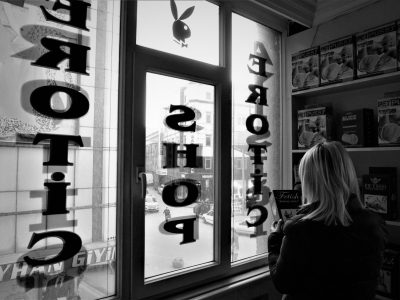
[caption id="attachment_2971" align="aligncenter" width="1600"] Advertisement for men's underwear in Izmir, Turkey.[/caption]
Men don’t really care whether the woman is aroused, willing or having an orgasm, he said. Unless the problem is due to pain, or vaginismus, couples rarely head to a therapist, he adds.
“[Women who grew up hearing false myths] tend to take sexuality as something bad happening to their bodies, and so, they unintentionally shut their vaginas, leading to vaginismus. This is actually a defense method,” he told The Conversationalist.
“They fear dying, they fear becoming a lower quality woman, or that sex is their duty.”
While most Turkish women find out about their sexual needs after getting married, the doctor says that, based on research he completed about 10 years ago, men tend to fall for myths about sexuality by watching pornography, which plants unrealistic fantasies about sex in their minds.
“Sexuality is also presented as criminal or banned in [Turkish] television shows. The shows take sexuality to be part of cheating, damaging passions or crimes instead of part of a normal, healthy, and happy life.”
He recommends that couples talk about sexuality and normalize it. Talking is crucial, and so is the language used in those conversations.
Bahar Aldanmaz, a Turkish sociologist studying for her PhD at Boston University, told The Conversationalist why talking about menstruation matters.
“A woman’s period is unfortunately seen as something to be ashamed of, something to be hidden,” she said. (According to Turkey’s language authority, the word “dirty” also means “a woman having her period.”)
“There are many children who can’t share their menstruation experience, or can’t even understand they are having their periods, or who experience this with fear and trauma.”
And this is what builds a wall of taboo around this essential issue, the professor says. It is one of the issues her non-profit organization “We Need To Talk” aims to accomplish, among other problems related to menstruation, such as period poverty and period stigma.
Female hygiene products are taxed as much as 18 percent—the same ratio as diamonds, said Ms. Aldanmaz. She adds that this is what mainly causes inequality—privileged access to basic health goods, the consequence of the roles imposed by Turkish social mores.
“Despite declining income due to the COVID-19 pandemic, there is a serious increase in the pricing of hygiene pads and tampons. This worsens period poverty,” Aldanmaz says. She offers Scotland as an example of what would like to see in Turkey: free sanitary products for all.
During Turkey’s government-imposed lockdown in May 2021, several photos showing tampons and pads in the non-essential sales part of markets stirred heated debates around the subject, but neither the Ministry of Family and Social Services nor the Health Ministry weighed in.
“We are fighting this shaming culture in Turkey,” Aldanmaz says, “by understanding and talking about it.”
[post_title] => Sexually aware and on air: Beyond Turkey's comfort zone
[post_excerpt] => Turkish podcasts that host frank conversations about sexuality are smashing taboos and filling information vacuums.
[post_status] => publish
[comment_status] => closed
[ping_status] => open
[post_password] =>
[post_name] => sexually-aware-and-on-air-beyond-turkeys-comfort-zone
[to_ping] =>
[pinged] =>
[post_modified] => 2026-08-06 19:44:25
[post_modified_gmt] => 2026-08-06 19:44:25
[post_content_filtered] =>
[post_parent] => 0
[guid] => https://conversationalist.org/?p=2949
[menu_order] => 187
[post_type] => post
[post_mime_type] =>
[comment_count] => 0
[filter] => raw
)
Advertisement for men's underwear in Izmir, Turkey.[/caption]
Men don’t really care whether the woman is aroused, willing or having an orgasm, he said. Unless the problem is due to pain, or vaginismus, couples rarely head to a therapist, he adds.
“[Women who grew up hearing false myths] tend to take sexuality as something bad happening to their bodies, and so, they unintentionally shut their vaginas, leading to vaginismus. This is actually a defense method,” he told The Conversationalist.
“They fear dying, they fear becoming a lower quality woman, or that sex is their duty.”
While most Turkish women find out about their sexual needs after getting married, the doctor says that, based on research he completed about 10 years ago, men tend to fall for myths about sexuality by watching pornography, which plants unrealistic fantasies about sex in their minds.
“Sexuality is also presented as criminal or banned in [Turkish] television shows. The shows take sexuality to be part of cheating, damaging passions or crimes instead of part of a normal, healthy, and happy life.”
He recommends that couples talk about sexuality and normalize it. Talking is crucial, and so is the language used in those conversations.
Bahar Aldanmaz, a Turkish sociologist studying for her PhD at Boston University, told The Conversationalist why talking about menstruation matters.
“A woman’s period is unfortunately seen as something to be ashamed of, something to be hidden,” she said. (According to Turkey’s language authority, the word “dirty” also means “a woman having her period.”)
“There are many children who can’t share their menstruation experience, or can’t even understand they are having their periods, or who experience this with fear and trauma.”
And this is what builds a wall of taboo around this essential issue, the professor says. It is one of the issues her non-profit organization “We Need To Talk” aims to accomplish, among other problems related to menstruation, such as period poverty and period stigma.
Female hygiene products are taxed as much as 18 percent—the same ratio as diamonds, said Ms. Aldanmaz. She adds that this is what mainly causes inequality—privileged access to basic health goods, the consequence of the roles imposed by Turkish social mores.
“Despite declining income due to the COVID-19 pandemic, there is a serious increase in the pricing of hygiene pads and tampons. This worsens period poverty,” Aldanmaz says. She offers Scotland as an example of what would like to see in Turkey: free sanitary products for all.
During Turkey’s government-imposed lockdown in May 2021, several photos showing tampons and pads in the non-essential sales part of markets stirred heated debates around the subject, but neither the Ministry of Family and Social Services nor the Health Ministry weighed in.
“We are fighting this shaming culture in Turkey,” Aldanmaz says, “by understanding and talking about it.”
[post_title] => Sexually aware and on air: Beyond Turkey's comfort zone
[post_excerpt] => Turkish podcasts that host frank conversations about sexuality are smashing taboos and filling information vacuums.
[post_status] => publish
[comment_status] => closed
[ping_status] => open
[post_password] =>
[post_name] => sexually-aware-and-on-air-beyond-turkeys-comfort-zone
[to_ping] =>
[pinged] =>
[post_modified] => 2026-08-06 19:44:25
[post_modified_gmt] => 2026-08-06 19:44:25
[post_content_filtered] =>
[post_parent] => 0
[guid] => https://conversationalist.org/?p=2949
[menu_order] => 187
[post_type] => post
[post_mime_type] =>
[comment_count] => 0
[filter] => raw
)

 Nancy Mitford[/caption]
Linda abandons her first husband: that is Diana, who left her own husband to marry Sir Oswald Mosley, the leader of Britain’s tiny smudge of fascists. She falls in love with a communist: Jessica. Then a Frenchman: Nancy. She is superficially kind: Deborah.
Linda is that mercurial thing: charming. Charm is the ability to seduce people against their better instincts. She is a feather in the wind. Such people do not take responsibility. They do not have to. The Pursuit of Love is essentially redemptive: for the Mitfords and for the aristocracy. It is the founding document of the Mitford cult—without it, there would be no cult—and it is self-serving. They only pursued love, after all—who doesn’t? In response, I can only purse my lips and say: Nazis?
The truth of their fascism—Diana was Mosley’s lover and helpmeet and Unity stalked and worshipped Hitler—is more repulsive than mere viewers of The Pursuit of Love can know. There is, for instance, no scene in the novel or TV adaptation in which Unity, living in Germany, boasts that her home is a flat belonging to Jews. Which Jews, and where are they now? (It would have made a better novel than Linda shtupping a boring Communist, but Nancy was writing absolution, and the family appreciated it. On reading it, Lord Redesdale wept with happiness.)
There are many examples. “Everyone should know I am a Jew hater,” wrote Unity to the Nazi newspaper Der Stürmer, in case mere speech was not loud enough. As late as the 1980s, Diana was blaming global Jewry for the Holocaust. If they had stepped in and saved German Jews from the consequences of their own evil—by resettling them, she suggests—it might not have happened. Consider the 1938 Evian Conference, at which the assembled representatives of 32 countries expressed their regrets at being unable to provide refuge for the Jews of Germany and Austria. Apparently she missed it.
There is a tendency to present the Mitfords as Nancy did: as eccentric and therefore unthreatening aristocrats whose attachment to murderous tyranny in life was no more significant than their clothing, their manners, or their speech. They were young and they succumbed to the jackboot: that is, the line. (Unlucky, that’s all. Poor Lady Redesdale.) It is convenient—it defends the wider aristocracy from accusations of racism, of hating democracy—and it is unjust. That Unity failed to kill herself when war broke out—she lived for nine years with a bullet in her skull—does not forgive the bullets she wished on others, if they were Jews. She was once found in the garden of a friend, practising shooting for the day she could legally kill Jews. (She was a terrible shot. When she shot herself, she missed.) In England, she is only remembered as a bit odd.
[caption id="attachment_2771" align="aligncenter" width="677"]
Nancy Mitford[/caption]
Linda abandons her first husband: that is Diana, who left her own husband to marry Sir Oswald Mosley, the leader of Britain’s tiny smudge of fascists. She falls in love with a communist: Jessica. Then a Frenchman: Nancy. She is superficially kind: Deborah.
Linda is that mercurial thing: charming. Charm is the ability to seduce people against their better instincts. She is a feather in the wind. Such people do not take responsibility. They do not have to. The Pursuit of Love is essentially redemptive: for the Mitfords and for the aristocracy. It is the founding document of the Mitford cult—without it, there would be no cult—and it is self-serving. They only pursued love, after all—who doesn’t? In response, I can only purse my lips and say: Nazis?
The truth of their fascism—Diana was Mosley’s lover and helpmeet and Unity stalked and worshipped Hitler—is more repulsive than mere viewers of The Pursuit of Love can know. There is, for instance, no scene in the novel or TV adaptation in which Unity, living in Germany, boasts that her home is a flat belonging to Jews. Which Jews, and where are they now? (It would have made a better novel than Linda shtupping a boring Communist, but Nancy was writing absolution, and the family appreciated it. On reading it, Lord Redesdale wept with happiness.)
There are many examples. “Everyone should know I am a Jew hater,” wrote Unity to the Nazi newspaper Der Stürmer, in case mere speech was not loud enough. As late as the 1980s, Diana was blaming global Jewry for the Holocaust. If they had stepped in and saved German Jews from the consequences of their own evil—by resettling them, she suggests—it might not have happened. Consider the 1938 Evian Conference, at which the assembled representatives of 32 countries expressed their regrets at being unable to provide refuge for the Jews of Germany and Austria. Apparently she missed it.
There is a tendency to present the Mitfords as Nancy did: as eccentric and therefore unthreatening aristocrats whose attachment to murderous tyranny in life was no more significant than their clothing, their manners, or their speech. They were young and they succumbed to the jackboot: that is, the line. (Unlucky, that’s all. Poor Lady Redesdale.) It is convenient—it defends the wider aristocracy from accusations of racism, of hating democracy—and it is unjust. That Unity failed to kill herself when war broke out—she lived for nine years with a bullet in her skull—does not forgive the bullets she wished on others, if they were Jews. She was once found in the garden of a friend, practising shooting for the day she could legally kill Jews. (She was a terrible shot. When she shot herself, she missed.) In England, she is only remembered as a bit odd.
[caption id="attachment_2771" align="aligncenter" width="677"] The Mitford Family in 1928.[/caption]
I think that, in retrospect, their vernacular absolved them. It makes them sound unserious; gossip columnists near tyrants, and amateurs at that. For this I blame Noël Coward and Enid Blyton. We are so used to hearing the cadence and idioms of English as it was spoken in the light comedies and children’s stories of the 1930s, that it is easy to laugh at Diana’s defence of
The Mitford Family in 1928.[/caption]
I think that, in retrospect, their vernacular absolved them. It makes them sound unserious; gossip columnists near tyrants, and amateurs at that. For this I blame Noël Coward and Enid Blyton. We are so used to hearing the cadence and idioms of English as it was spoken in the light comedies and children’s stories of the 1930s, that it is easy to laugh at Diana’s defence of  Diana Mitford, later Lady Mosley.[/caption]
Diana does not write about her physical passion for Oswald Mosley, but it is made obvious by what she gave up for it. She left a rich, loving husband—Bryan Guinness— to be Mosley’s mistress, only marrying him after his wife died (of peritonitis or heartbreak, depending on who is telling). Diana not only ruined her reputation for Oswald; she was also interned for three years as a fascist sympathizer during the Second World War. She could never admit to need (six siblings and stubbornness prohibit it) and was never short of words—she posed quite successfully as a pseudo-intellectual, mostly on the basis of possessing books—but on her passion for Mosley she only said: “He was completely sure of himself and of his ideas.” Conviction was not something her father, Lord Redesdale, who raged and squandered his fortune, ever had.
Redesdale was self-hating. His older brother Clement was killed in the First World War, and he was the remnants: a disappointing younger brother in competition with a ghost. In response he destroyed the great fortune that shamed him, which is now a few cottages, a pub, and a snack bar. (He was also likely a manic depressive. But if aristocrats had family therapy the history of Great Britain would be a different tale.) So that was that: Diana settled into Mosley’s iron fist like a pretty bird. She called him “The Leader"; by the end she was almost the only follower. Having read almost everything about Diana, I wonder if her fascism was both convenient and retrospective. Because the best and worst thing I can say about Diana Mosley is that she isn’t a convincing fascist. She was trivial and flinty; she was skin deep. She said in old age, “I don’t mind in the least what people’s politics are.”
Her family say she never changed her views: Were these, then, her views? I believe it because she was no intellectual—we are back to Hitler’s dietary imperatives and beautiful hands—and, after she was imprisoned with Mosley during the war for national security, how could she perform a retreat, admit a wrong? Diana destroyed herself for lust, and so trapped herself. It is a fair fate for someone so visual.
Unity (middle name Valkyrie), who was conceived in a small town in northern Ontario called Swastika—which still exists—is more horrifying. She went to Munich in 1932 to stalk Hitler. She hung round at Nazi party offices and lurked in his favourite restaurant—the Osteria Bavaria—with the confidence of the British aristocrat with golden hair. He considered her a lucky charm—she was related to Winston Churchill by marriage—but it consumed her. You know how stupid some people sound on Twitter? Unity wrote like that on paper. “It was all so thrilling,” she writes of one encounter with Adolf, “I can still hardly believe it. When he went, he gave me a special salute all to myself.” She would stand on street corners to “waggle a flag” at him.
It was not abnormal for women to react to him like that. One
Diana Mitford, later Lady Mosley.[/caption]
Diana does not write about her physical passion for Oswald Mosley, but it is made obvious by what she gave up for it. She left a rich, loving husband—Bryan Guinness— to be Mosley’s mistress, only marrying him after his wife died (of peritonitis or heartbreak, depending on who is telling). Diana not only ruined her reputation for Oswald; she was also interned for three years as a fascist sympathizer during the Second World War. She could never admit to need (six siblings and stubbornness prohibit it) and was never short of words—she posed quite successfully as a pseudo-intellectual, mostly on the basis of possessing books—but on her passion for Mosley she only said: “He was completely sure of himself and of his ideas.” Conviction was not something her father, Lord Redesdale, who raged and squandered his fortune, ever had.
Redesdale was self-hating. His older brother Clement was killed in the First World War, and he was the remnants: a disappointing younger brother in competition with a ghost. In response he destroyed the great fortune that shamed him, which is now a few cottages, a pub, and a snack bar. (He was also likely a manic depressive. But if aristocrats had family therapy the history of Great Britain would be a different tale.) So that was that: Diana settled into Mosley’s iron fist like a pretty bird. She called him “The Leader"; by the end she was almost the only follower. Having read almost everything about Diana, I wonder if her fascism was both convenient and retrospective. Because the best and worst thing I can say about Diana Mosley is that she isn’t a convincing fascist. She was trivial and flinty; she was skin deep. She said in old age, “I don’t mind in the least what people’s politics are.”
Her family say she never changed her views: Were these, then, her views? I believe it because she was no intellectual—we are back to Hitler’s dietary imperatives and beautiful hands—and, after she was imprisoned with Mosley during the war for national security, how could she perform a retreat, admit a wrong? Diana destroyed herself for lust, and so trapped herself. It is a fair fate for someone so visual.
Unity (middle name Valkyrie), who was conceived in a small town in northern Ontario called Swastika—which still exists—is more horrifying. She went to Munich in 1932 to stalk Hitler. She hung round at Nazi party offices and lurked in his favourite restaurant—the Osteria Bavaria—with the confidence of the British aristocrat with golden hair. He considered her a lucky charm—she was related to Winston Churchill by marriage—but it consumed her. You know how stupid some people sound on Twitter? Unity wrote like that on paper. “It was all so thrilling,” she writes of one encounter with Adolf, “I can still hardly believe it. When he went, he gave me a special salute all to myself.” She would stand on street corners to “waggle a flag” at him.
It was not abnormal for women to react to him like that. One  Unity Mitford in 1938, wearing a swastika pin.[/caption]
One
Unity Mitford in 1938, wearing a swastika pin.[/caption]
One 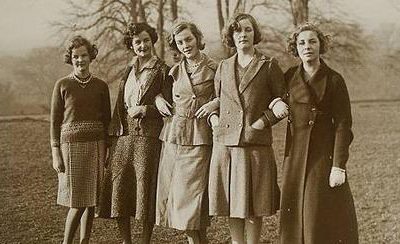

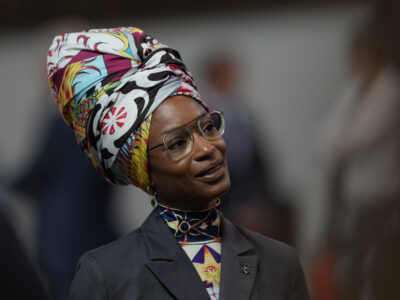
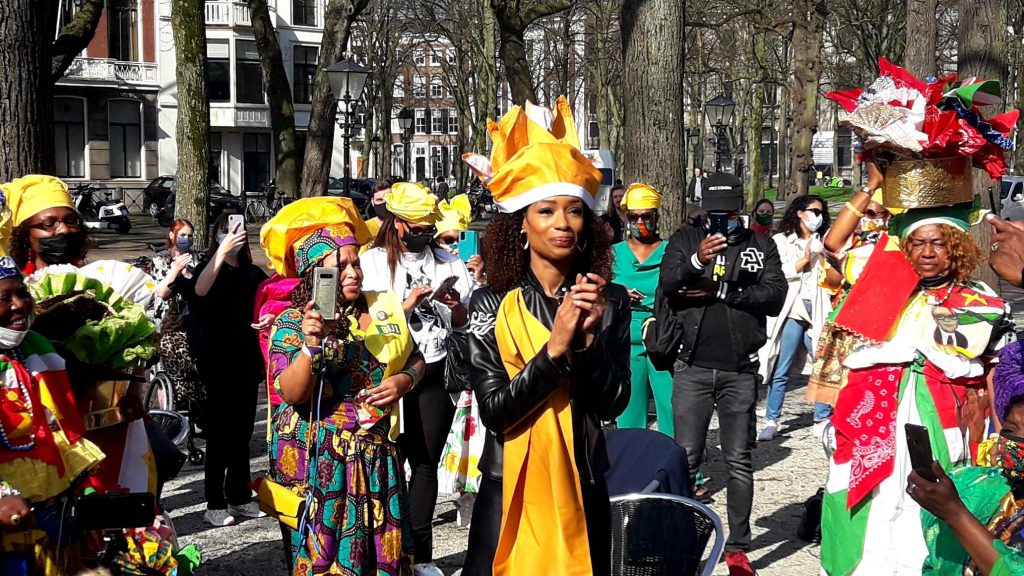 Afro-Surinamese ceremony honoring Sylvana Simons (center) on March 31.[/caption]
 A still from the film shows Bosniaks taking refuge at the UN Dutch peacekeeper base in Srebrenica.[/caption]
In 1993, at the dedication of the U.S. Holocaust Museum, Elie Wiesel made an
A still from the film shows Bosniaks taking refuge at the UN Dutch peacekeeper base in Srebrenica.[/caption]
In 1993, at the dedication of the U.S. Holocaust Museum, Elie Wiesel made an 

 During the decade prior to the 2011 uprising, Egypt saw a blogging boom, with people from diverse socio-economic backgrounds writing outspoken commentary about social and political issues, even though they ran the risk of arrest and imprisonment for criticizing the state. The internet provided space for discussions that had previously been restricted to private gatherings; it also enabled cross-national dialogue throughout the region, between bloggers who shared a common language. Public protests weren’t unheard of—in fact, as those I interviewed for the book argued, they had been building up slowly over time—but they were sporadic and lacked mass support.
While some bloggers and social media users chose to publish under their own names, others were justifiably concerned for their safety. And so, the creators of “We Are All Khaled Saeed” chose to manage the Facebook page using pseudonyms.
Facebook, however, has always had a policy that forbids the use of “fake names,” predicated on the misguided belief that people behave with more civility when using their “real” identity. Mark Zuckerberg famously claimed that having more than one identity represents a lack of integrity, thus demonstrating a profound lack of imagination and considerable ignorance. Not only had Zuckerberg never considered why a person of integrity who lived in an oppressive authoritarian state might fear revealing their identity, but he had clearly never explored the rich history of anonymous and pseudonymous publishing.
In November 2010, just before Egypt’s parliamentary elections and a planned anti-regime demonstration, Facebook, acting on a tip that its owners were using fake names, removed the “We are all Khaled Saeed” page.
At this point I had been writing and communicating for some time with Facebook staff about the problematic nature of the policy banning anonymous users. It was Thanksgiving weekend in the U.S., where I lived at the time, but a group of activists scrambled to contact Facebook to see if there was anything they could do. To their credit, the company offered a creative solution: If the Egyptian activists could find an administrator who was willing to use their real name, the page would be restored.
They did so, and the page went on to call for what became the January 25 revolution.
A few months later, I joined the Electronic Frontier Foundation and began to work full-time in advocacy, which gave my criticisms more weight and enabled me to communicate more directly with policymakers at various tech companies.
Three years later, while driving across the United States with my mother and writing a piece about social media and the Egyptian revolution, I turned on the hotel television one night and saw on the news that police in Ferguson, Missouri had shot an 18-year-old Black man, Michael Brown, sparking protests that drew a disproportionate militarized response.
The parallels between Egypt and the United States struck me even then, but only in 2016 did I become fully aware. That summer, a police officer in Minnesota pulled over 32-year-old Philando Castile—a Black man—at a traffic stop and, as he reached for his license and registration, fatally shot him five times at close range.
Castile’s partner, Diamond Reynolds, was in the passenger’s seat and had the presence of mind to whip out her phone in the immediate aftermath, streaming her exchange with the police officer on Facebook Live.
Almost immediately, Facebook removed the video. The company later restored it, citing a “technical glitch,” but the incident demonstrated the power that technology companies—accountable to no one but their shareholders and driven by profit motives—have over our expression.
The internet brought about a fundamental shift in the way we communicate and relate to one another, but its commercialization has laid bare the limits of existing systems of governance. In the years following these incidents, content moderation and the systems surrounding it became almost a singular obsession. I worked to document the experiences of social media users, collaborated with numerous individuals, and learned about the structural limitations to changing the system.
Over the years, my views on the relationship between free speech and tech have evolved. Once I believed that companies should play no role in governing our speech, but later I shifted to pragmatism, seeking ways to mitigate the harm of their decisions and enforce limits on their power.
But while the parameters of the problem and its potential solutions grew clearer, so did my thesis: Content moderation— specifically, the uneven enforcement of already-inconsistent policies—disproportionately impacts marginalized communities and exacerbates existing structural power balances. Offline repression is, as it turns out, replicated online.
The 2016 election of Donald Trump to the U.S. presidency brought the issue of content moderation to the fore; suddenly, the terms of the debate shifted. Conservatives in the United States claimed they were unjustly singled out by Big Tech and the media amplified those claims—much to my chagrin, since they were not borne out by data. At the same time, the rise of right-wing extremism, disinformation, and harassment—such as the spread of the QAnon conspiracy and wildly inaccurate information about vaccines—on social media led me to doubt some of my earlier conclusions about the role Big Tech should play in governing speech.
That’s when I knew that it was time to write about content moderation’s less-debated harms and to document them in a book.
Setting out to write about a subject I know so intimately (and have even experienced firsthand), I thought I knew what I would say. But the process turned out to be a learning experience that caused me to rethink some of my own assumptions about the right way forward.
One of the final interviews I conducted for the book was with Dave Willner, one of the early policy architects at Facebook. Sitting at a café in San Francisco just a few months before the pandemic hit, he told me: “Social media empowers previously marginal people, and some of those previously marginal people are trans teenagers and some are neo-Nazis. The empowerment sense is the same, and some of it we think is good and some of it we think is not good. The coming together of people with rare problems or views is agnostic.”
That framing guided me in the final months of writing. My instinct, based on those early experiences with social media as a democratizing force, has always been to think about the unintended consequences of any policy for the world’s most vulnerable users, and it is that lens that guides my passion for protecting free expression. But I also see now that it is imperative never to forget a crucial fact—that the very same tools which have empowered historically marginalized communities can also enable their oppressors.
[post_title] => Between Nazis and democracy activists: Social media and the free speech dilemma
[post_excerpt] => The content moderation policies employed by social media platforms disproportionately affect marginalized communities and exacerbate power imbalances. Offline repression is replicated online.
[post_status] => publish
[comment_status] => closed
[ping_status] => open
[post_password] =>
[post_name] => between-nazis-and-democracy-activists-social-media-and-the-free-speech-dilemma
[to_ping] =>
[pinged] =>
[post_modified] => 2026-08-06 22:43:16
[post_modified_gmt] => 2026-08-06 22:43:16
[post_content_filtered] =>
[post_parent] => 0
[guid] => https://conversationalist.org/?p=2452
[menu_order] => 216
[post_type] => post
[post_mime_type] =>
[comment_count] => 0
[filter] => raw
)
During the decade prior to the 2011 uprising, Egypt saw a blogging boom, with people from diverse socio-economic backgrounds writing outspoken commentary about social and political issues, even though they ran the risk of arrest and imprisonment for criticizing the state. The internet provided space for discussions that had previously been restricted to private gatherings; it also enabled cross-national dialogue throughout the region, between bloggers who shared a common language. Public protests weren’t unheard of—in fact, as those I interviewed for the book argued, they had been building up slowly over time—but they were sporadic and lacked mass support.
While some bloggers and social media users chose to publish under their own names, others were justifiably concerned for their safety. And so, the creators of “We Are All Khaled Saeed” chose to manage the Facebook page using pseudonyms.
Facebook, however, has always had a policy that forbids the use of “fake names,” predicated on the misguided belief that people behave with more civility when using their “real” identity. Mark Zuckerberg famously claimed that having more than one identity represents a lack of integrity, thus demonstrating a profound lack of imagination and considerable ignorance. Not only had Zuckerberg never considered why a person of integrity who lived in an oppressive authoritarian state might fear revealing their identity, but he had clearly never explored the rich history of anonymous and pseudonymous publishing.
In November 2010, just before Egypt’s parliamentary elections and a planned anti-regime demonstration, Facebook, acting on a tip that its owners were using fake names, removed the “We are all Khaled Saeed” page.
At this point I had been writing and communicating for some time with Facebook staff about the problematic nature of the policy banning anonymous users. It was Thanksgiving weekend in the U.S., where I lived at the time, but a group of activists scrambled to contact Facebook to see if there was anything they could do. To their credit, the company offered a creative solution: If the Egyptian activists could find an administrator who was willing to use their real name, the page would be restored.
They did so, and the page went on to call for what became the January 25 revolution.
A few months later, I joined the Electronic Frontier Foundation and began to work full-time in advocacy, which gave my criticisms more weight and enabled me to communicate more directly with policymakers at various tech companies.
Three years later, while driving across the United States with my mother and writing a piece about social media and the Egyptian revolution, I turned on the hotel television one night and saw on the news that police in Ferguson, Missouri had shot an 18-year-old Black man, Michael Brown, sparking protests that drew a disproportionate militarized response.
The parallels between Egypt and the United States struck me even then, but only in 2016 did I become fully aware. That summer, a police officer in Minnesota pulled over 32-year-old Philando Castile—a Black man—at a traffic stop and, as he reached for his license and registration, fatally shot him five times at close range.
Castile’s partner, Diamond Reynolds, was in the passenger’s seat and had the presence of mind to whip out her phone in the immediate aftermath, streaming her exchange with the police officer on Facebook Live.
Almost immediately, Facebook removed the video. The company later restored it, citing a “technical glitch,” but the incident demonstrated the power that technology companies—accountable to no one but their shareholders and driven by profit motives—have over our expression.
The internet brought about a fundamental shift in the way we communicate and relate to one another, but its commercialization has laid bare the limits of existing systems of governance. In the years following these incidents, content moderation and the systems surrounding it became almost a singular obsession. I worked to document the experiences of social media users, collaborated with numerous individuals, and learned about the structural limitations to changing the system.
Over the years, my views on the relationship between free speech and tech have evolved. Once I believed that companies should play no role in governing our speech, but later I shifted to pragmatism, seeking ways to mitigate the harm of their decisions and enforce limits on their power.
But while the parameters of the problem and its potential solutions grew clearer, so did my thesis: Content moderation— specifically, the uneven enforcement of already-inconsistent policies—disproportionately impacts marginalized communities and exacerbates existing structural power balances. Offline repression is, as it turns out, replicated online.
The 2016 election of Donald Trump to the U.S. presidency brought the issue of content moderation to the fore; suddenly, the terms of the debate shifted. Conservatives in the United States claimed they were unjustly singled out by Big Tech and the media amplified those claims—much to my chagrin, since they were not borne out by data. At the same time, the rise of right-wing extremism, disinformation, and harassment—such as the spread of the QAnon conspiracy and wildly inaccurate information about vaccines—on social media led me to doubt some of my earlier conclusions about the role Big Tech should play in governing speech.
That’s when I knew that it was time to write about content moderation’s less-debated harms and to document them in a book.
Setting out to write about a subject I know so intimately (and have even experienced firsthand), I thought I knew what I would say. But the process turned out to be a learning experience that caused me to rethink some of my own assumptions about the right way forward.
One of the final interviews I conducted for the book was with Dave Willner, one of the early policy architects at Facebook. Sitting at a café in San Francisco just a few months before the pandemic hit, he told me: “Social media empowers previously marginal people, and some of those previously marginal people are trans teenagers and some are neo-Nazis. The empowerment sense is the same, and some of it we think is good and some of it we think is not good. The coming together of people with rare problems or views is agnostic.”
That framing guided me in the final months of writing. My instinct, based on those early experiences with social media as a democratizing force, has always been to think about the unintended consequences of any policy for the world’s most vulnerable users, and it is that lens that guides my passion for protecting free expression. But I also see now that it is imperative never to forget a crucial fact—that the very same tools which have empowered historically marginalized communities can also enable their oppressors.
[post_title] => Between Nazis and democracy activists: Social media and the free speech dilemma
[post_excerpt] => The content moderation policies employed by social media platforms disproportionately affect marginalized communities and exacerbate power imbalances. Offline repression is replicated online.
[post_status] => publish
[comment_status] => closed
[ping_status] => open
[post_password] =>
[post_name] => between-nazis-and-democracy-activists-social-media-and-the-free-speech-dilemma
[to_ping] =>
[pinged] =>
[post_modified] => 2026-08-06 22:43:16
[post_modified_gmt] => 2026-08-06 22:43:16
[post_content_filtered] =>
[post_parent] => 0
[guid] => https://conversationalist.org/?p=2452
[menu_order] => 216
[post_type] => post
[post_mime_type] =>
[comment_count] => 0
[filter] => raw
)

 A fire broke out in January at one of the barracks at the Napier facility.[/caption]