A tour through Europe's past—and what lessons we might learn from its museums to fight authoritarianism today.
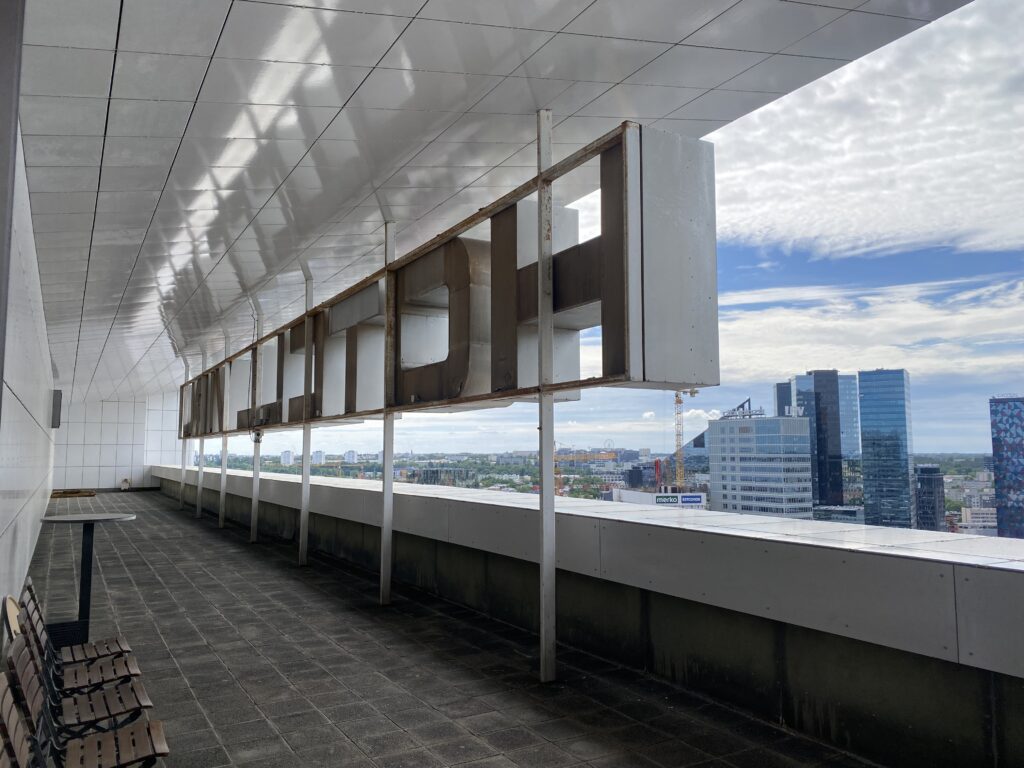
Interrupting the skyline in Tallinn, Estonia is a tall gray building, a relic of the country’s Soviet occupation. It looms over the medieval city, declaring its name in giant letters: HOTELL VIRU. Behind these letters is a secret 23rd floor, where the KGB (the Soviet Union’s security agency) would listen to the hotel’s visitors, as unsuspecting tourists sipping drinks in the restaurant just a floor below would point to the windows above them and ask, “Hey, what’s up there?”
Tourists at the hotel were spied on right up until April 1991, when the KGB left the building and shortly before the Soviet Union collapsed. While the KGB cleared away many important details, enough artifacts were left behind, including a room full of monitoring devices, that a museum was opened in 2011. It’s a constant reminder of what once happened here—a reminder of how personal freedoms can so easily be lost, and a reminder of what’s at the end of the road to authoritarianism. A road that several European countries might be on once again.
The Hotel Viru & KGB Museum is the first stop on my tour as I gather up the scattered pieces of Europe’s recent history of authoritarianism and ask whether we are paying enough attention to our present.
(Photo courtesy of Katie Dancey-Downs.)
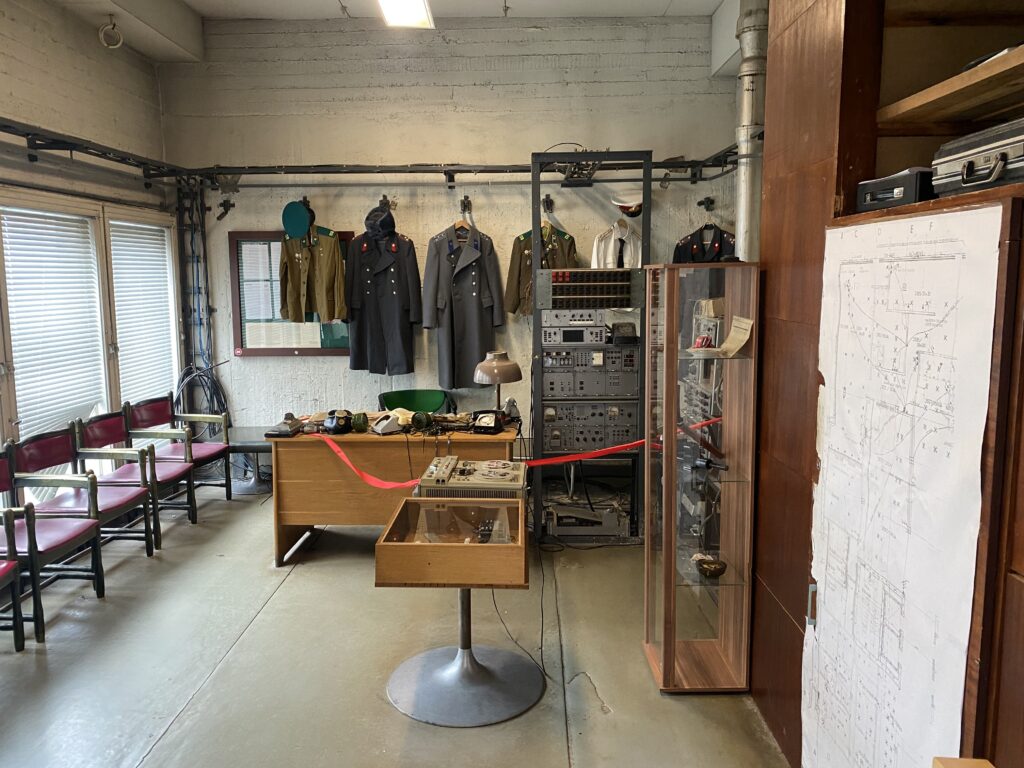
As you walk into what our tour guide calls the “listening room,” it’s the musty smell that hits you first. “Oh no, it even smells like the Soviet Union,” tourists from neighboring Finland are reported to have said, according to our guide, Margit. In one glass cabinet, there is a selection of microphones, recording devices, and transmitters. In the 1970s, when the hotel opened, around 60 guest rooms were designated as special rooms, with an empty room next door so that one of these KGB microphones could be slotted through a small hole. By the next decade, advances in technology meant more rooms could be monitored, with vases and lamps becoming favorite spots for hidden microphones. Sitting on a glass shelf in front of us, there’s even an old handheld camera, once used as a way to collect compromising photographs when poked through bedroom walls.
The guests were not completely oblivious to any of this, Margit says; KGB monitoring was something of an open secret.
“Tourists in general were very cautious in the rooms,” she explains. Visitors would leave the water running, turn up the television volume, or cover vents with towels for privacy.
The microphones weren’t limited to bedrooms, either. Margit directs us to a circular, speckled-green set of cufflinks, fitted out with a hidden microphone. In another cabinet, there’s an ashtray and a gold-rimmed plate monogrammed with a bold black V, both with hidden microphones, too. Perfect for slipping onto the table in front of people of interest.
While this hotel was a symbol of the free Western world to the people who lived in Tallinn, Soviet citizens knew not to get too close to its front doors, unless they wanted to be dragged to the basement for an interrogation. During its prime, Hotel Viru was not unique—any hotel that welcomed tourists in the Soviet Union or Eastern Bloc had a KGB presence.
It’s easy to forget that Margit lived under this occupation, that she knew exactly what it meant to keep away from Hotel Viru. I won’t go so far as to call Margit yet another artifact, but the memories and experiences held by the woman standing before us, in her Viru-branded gilet, are an important part of the picture. She remembers how Estonians used to hold their hands in front of their faces when they talked to each other in the park to fend away lip readers. She remembers how much people wanted to work at Hotel Viru, because they got access to illicit foreign goods and received gifts from the tourists. She also remembers how the hotel preferred hiring married people, assuming they wouldn’t try and couple up with a foreigner—the only accepted reason for leaving the Soviet Union. (This was an appealing option for many, although it came with complications: Divorce was allowed, but taking children to a new foreign life was not—any child born in the Soviet Union was in effect owned by the state.) This atmosphere, Margit tells us, made people easier to control.
“You are free to leave,” Margit says at the end of our tour. “Nobody takes you to the basement, nowadays.”
(Photo courtesy of Katie Dancey-Downs.)
An atmosphere of control
Unfortunately, this “special atmosphere of control” is not consigned to museum display cabinets. In Europe today, illiberal ideologies are finding strong ground, with support for populist parties soaring in many countries—my own, the UK, included.
This atmosphere Margit told us about, and the spying on people of interest, is also still going on in Russia today. Soviet (now Russian) state security has had various different names, including the Cheka, then the NKVD, then the KGB. Nowadays, the former KGB is known as the FSB.
I cannot safely travel to Russia to tell you what this atmosphere is like. I’ve criticized Putin and interviewed enough Russian dissidents that I don’t think I would be particularly welcome. But in the same way that seeing the artifacts in Hotel Viru has brought to life the history of intense surveillance and the atmosphere of terror, there is similar evidence in our current times: from school teachers forced to teach propaganda and patriotic lessons to a state-backed messaging app with extensive surveillance capabilities.
The artifacts in Hotel Viru’s listening room show us how surveillance technology developed over the decades, and that it did not stop when the Soviet Union fell in 1991. Instead, we now have even more advanced technologies to contend with.
This isn’t limited to Russia. In the UK, live facial recognition cameras are being rolled out by police across the country. According to Big Brother Watch, a human rights group that campaigns against the practice, there are 10 regional police forces regularly using the technology, but many others use it for large events. Currently, there are no specific rules governing its use.
Here's how it works: Surveillance cameras snap individuals’ faces and make biometric prints, then compare them to a police watchlist for similar matches, with the software flagging people in real time. A tech-smart way to catch criminals, yes, but here the threat to freedom begins. The technology has been deployed in numerous city centers, with hundreds of thousands of faces scanned on the streets as well as at events like Notting Hill Carnival. There have been cases of people being misidentified, and accusations from Amnesty International that the practice “amplifies racist policing,” as Black people are most often misidentified.
Big Brother Watch notes that it’s usually authoritarian regimes that embrace live facial recognition—Russia and China, for example. The UK does not currently have an authoritarian regime. But pair this with growing support for far-right politics and the UK’s rollback on protest rights—including a new provision to limit “cumulative disruption” of protests—and we might have a problem on the horizon.
Silencing critics
Across the border from Estonia, in Latvia’s capital city of Riga, is the KGB building known as the Corner House. Of all the places I see on my museums tour, the Corner House is the most chilling. The one that stinks the most of death. As I walk around the dark and dingy complex of cells, where the paint is peeling off in long strips, the thing that makes my skin crawl is the knowledge that in this very place people had their liberties stripped in the most inhumane ways. Some of them even lost their lives, simply for opposing the regime.
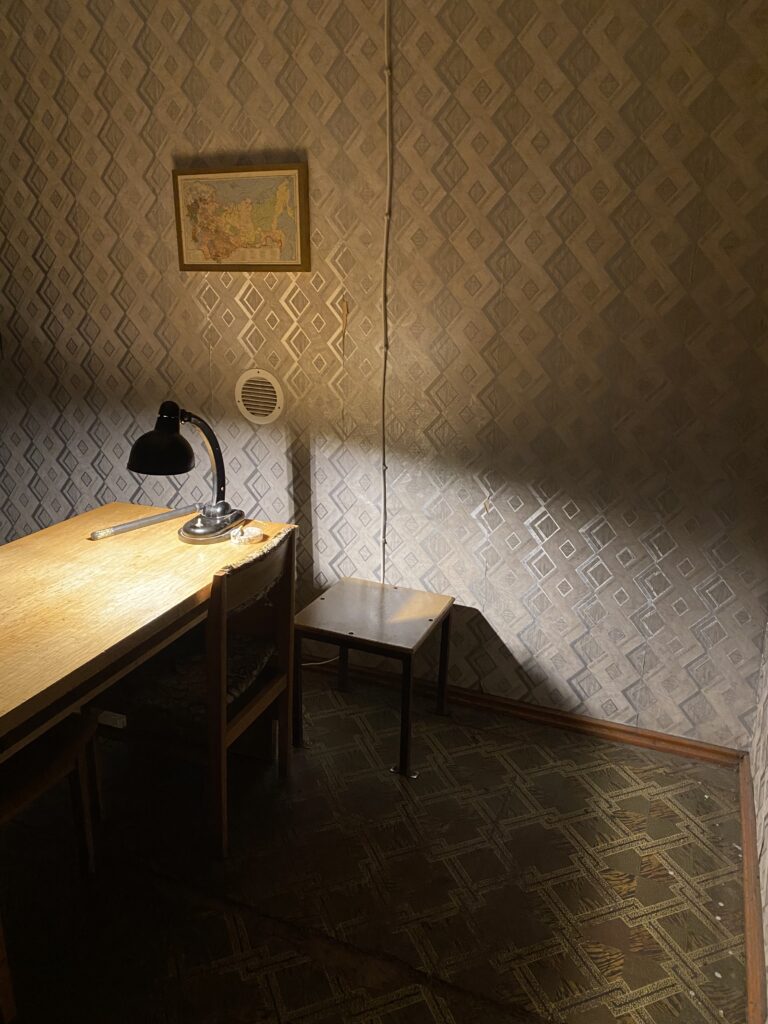
A young guide shows us around the KGB cells which were used during the first and second Soviet occupations (with a Nazi occupation in the middle). He tells us that people could be arrested for reading a banned book, for joking about the Soviets, or for believing that Latvia could be free.
At some point, when we’re standing in the old interrogation room, the guide smacks a rubber stick on the desk and we all jump, a glimmer of what someone under KGB interrogation would face. In one cell, he tells us that 30 people would be inside at once, the window covered so they couldn’t tell what time of day it was, then he flicks on the bright lights so that we’re disoriented like the prisoners would have been. He points to the heating system that would be cranked up high, and the sole bucket used as a toilet and emptied once a day.
(Photo courtesy of Katie Dancey-Downs.)
It's with all this in mind that we are taken to the courtyard. This, he tells us, would have been a reminder to the prisoners of how the free world feels (and a way to make them willing to sign anything, including confessions). Above us there are bars and netting. To stop suicides from the interrogation room, we’re told.
We’re left there for a few minutes, in a space where prisoners would have been allowed to breathe fresh air once a week, walking in circles with their heads bowed, their feet trudging along the same concrete that we stand on now. It is a reminder that not all artifacts live in glass cabinets.
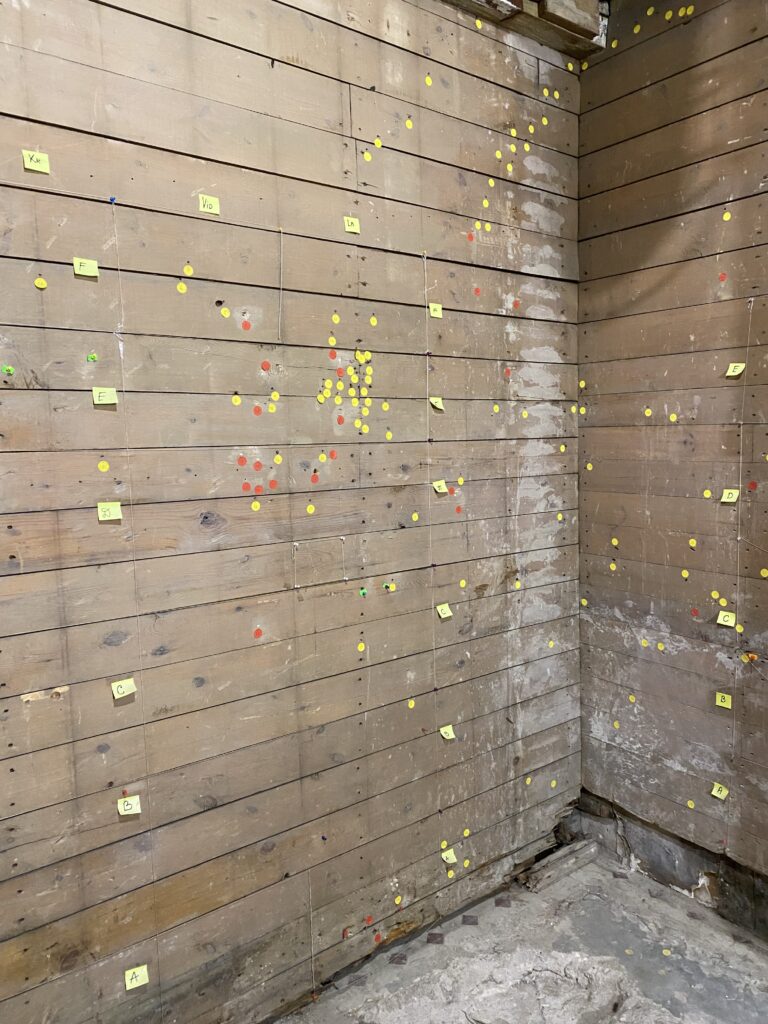
There is worse to come. In what was once an execution room, there are more than 200 bullet holes in the walls, marked with red and yellow stickers. They go back to 1940 and 1941, when prisoners were told to face the very same wall now before us, then shot in the back of the head. Researchers are still trying to find out whether executions continued here during the second Soviet occupation.
“We Latvians know the price of freedom,” the guide tells us. He also reminds us that this type of thing is still happening in Russia today.
Opposition leader Alexei Navalny is one recent, high-profile person to have lost his life while incarcerated by Russia in a penal colony north of the Arctic Circle, where he was killed with a dart frog toxin. But he is far from alone, as many other Kremlin critics or persecuted communities have been imprisoned or killed.
(Photo courtesy of Katie Dancey-Downs.)
This modern unease extends beyond Russia to Baltic states like Latvia, Estonia, and Lithuania. One person in Estonia told me that her daughter talks about how they would escape if their home was attacked. In neighboring Belarus—where state security is still called the KGB, and Russian influence is strong—more than 4,600 people have ended up as political prisoners since 2020. Many of those people are pro-democracy protesters and campaigners who stood up against dictator Alexander Lukashenko’s rule, including his rigged election win in 2020 and then 2025.
A short walk away from Riga’s Corner House, artifacts in the Museum of the Occupation of Latvia shine more light on the country’s dark history. If you’d forgotten about the KGB building already, your memory would be refreshed by this museum’s display of bullet casings and the keys for the prison cells, now housed in a glass box.
I land at a small bottle and blister pack of pills which turn out to be chlorprothixene and other antipsychotics used to “treat” dissidents imprisoned in psychiatric hospitals. This practice is not history, but still happening in Europe as I stand looking at these artifacts. I am reminded of Russia’s punitive psychiatry, where medicated treatment is forced onto political activists who have been sent to psychiatric units in response to their activism, and where they are brutalized.
And then we come to what might be one of the most terrifying tools of Soviet oppression: the concentration and forced-labor camps known as the Gulag. A quilted jacket with the number F358 sewn on the back is hanging up on display, this particular one having belonged to a woman called Leontīne Kriviņa, who in the 1950s was arrested for participation in a youth resistance group and sent to the Norilsk Gulag camp, 400km above the Arctic Circle, where temperatures could drop to -50C.
The personality cult
I’m now standing before a KGB-sponsored weekly newspaper, called Dzimtenes Balss, which translates as Voice of the Homeland. It was written specifically for Latvians in Western exile and—if we were in any doubt about its purpose—published by the “Committee for the Return to the Homeland” between 1958 and 1989. The Soviets wanted to repatriate Latvian émigrés, and propaganda like this was a vital tool in making that happen.
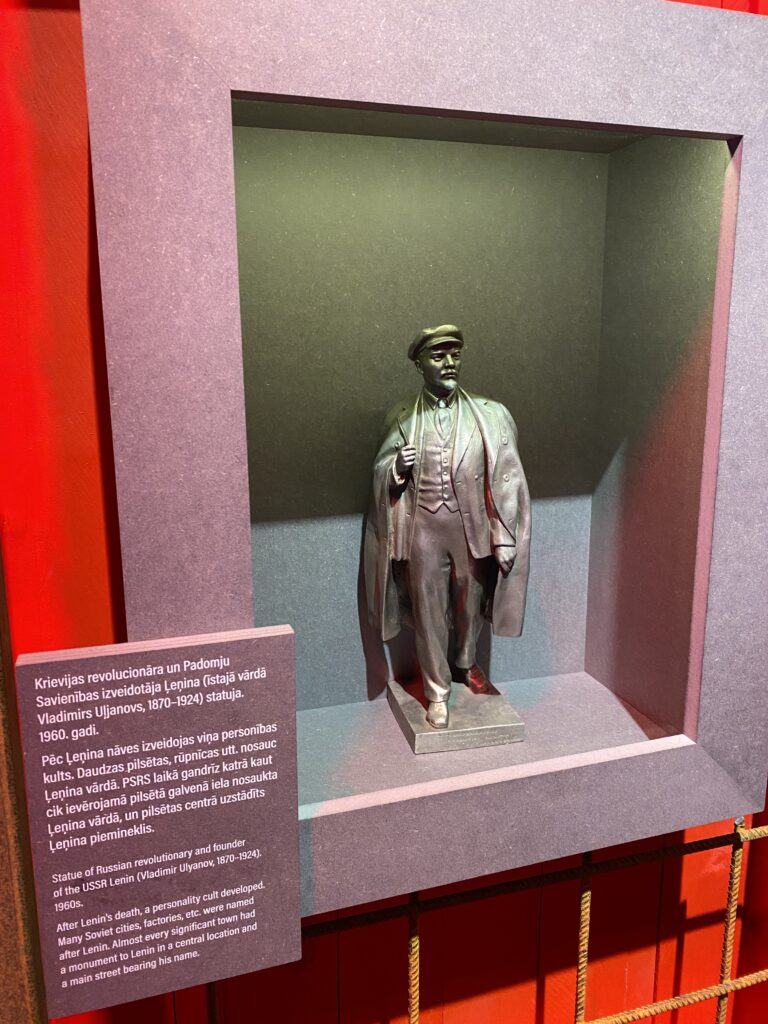
The Soviet Union had a well-oiled propaganda machine. Posters, films, lectures, theatre, newspapers, and radio were ways to shape the collective consciousness, and control society. Among these was the personality cult—which brings us to our next artifact: a small statue from the 1960s of Vladimir Lenin, the founder of the USSR, set inside a black display cabinet. The personality cult around him developed after his death, the description says, with many streets named after him and every significant town home to a monument. The “Lenin Cult” replaced the “Stalin Cult,” an information board explains, around three years after Stalin’s death, when the new leader Nikita Khrushchev denounced Stalin’s policies as a “departure from Lenin’s ideals.”
(Photo courtesy of Katie Dancey-Downs.)
There’s another artifact in this museum that speaks to this history of authoritarianism—a copy of Mein Kampf, Adolf Hitler’s memoir and manifesto. It’s chilling to see it in real life, something so feared and despised across the continent, and indeed the world. Something that represents the personality of the man who led a genocide and brought terror to Europe.
In today’s Europe, we have a personality cult problem once again. But the personalities in question don’t even need to bother writing a book: They have social media at their disposal.
The scapegoats
There’s one more thing that I want to show you in the Museum of the Occupation of Latvia. A fabric Star of David, faded with time, which would have been used by the Nazis to identify Jews. It’s one thing knowing about these yellow stars and how they were used, but it’s another to really see one, imagining who it might have been pinned on. Next to it, there are a couple of strings of numbers on what look like badges. One is brighter, and says 8533. They are identification numbers worn by Jews held in the Kaiserwald Concentration Camp or the Lenta factory in Riga. Tens of thousands of Jewish people were murdered in Latvia during the Holocaust.
While relatively short compared to their Soviet occupations, Estonia and Latvia were both subjected to Nazi occupations during World War II. Many people even welcomed the Nazis, hoping they would save them from the Soviets. What people soon learned is that no authoritarian regime is “better” than another. All are bad.
I went to Kraków, a medieval city in Poland’s south, which felt the full weight of a Nazi occupation from 1939 to 1945. Up to 20,000 Jews were forced into a purpose-made ghetto, before Heinrich Himmler ordered their deaths in 1943 and they were either shot, sent to labor camps, or sent to concentration camps where they remained as prisoners or were exterminated.
In Oskar Schindler’s Enamel Factory, the permanent exhibition Kraków Under Nazi Occupation tells this story. In one of the first displays, there is a circular wooden construction painted in yellows and blues, like something that might belong in an old-fashioned penny arcade, with pairs of binoculars set into each panel. It is a carousel of photographs, the images rendered in 3D, each one frighteningly immersive as it takes my whole field of vision. I have never seen Hitler’s face this close, as he shakes hands with another Nazi, or holds hands with a smiling girl—in the latter, they might even be dancing. Another shows a woman smiling and saluting in a Sieg Heil. Flags are draped from buildings and swastikas plastered on armbands. Not just seeing these photographs from over 80 years ago, but being inside the photographs, makes it all frighteningly real—which of course it was. The people smiling is what’s really terrifying.
As we face our own dangerous political shifts today, it scares me to think about the photographs that our generation’s great grandchildren will look at. Will they also sit in a museum like this, immersing themselves in the artifacts we’ve left behind and ask, “How did they allow this to happen?” Will they struggle to understand how so many people could welcome the far right rallies and shake hands with the populist leaders of today, the way I now struggle with the same? Or will ours be a generation that truly learns from its history, so that we do not allow the most atrocious things that have happened in the past to happen again?
(Photo courtesy of Katie Dancey-Downs.)
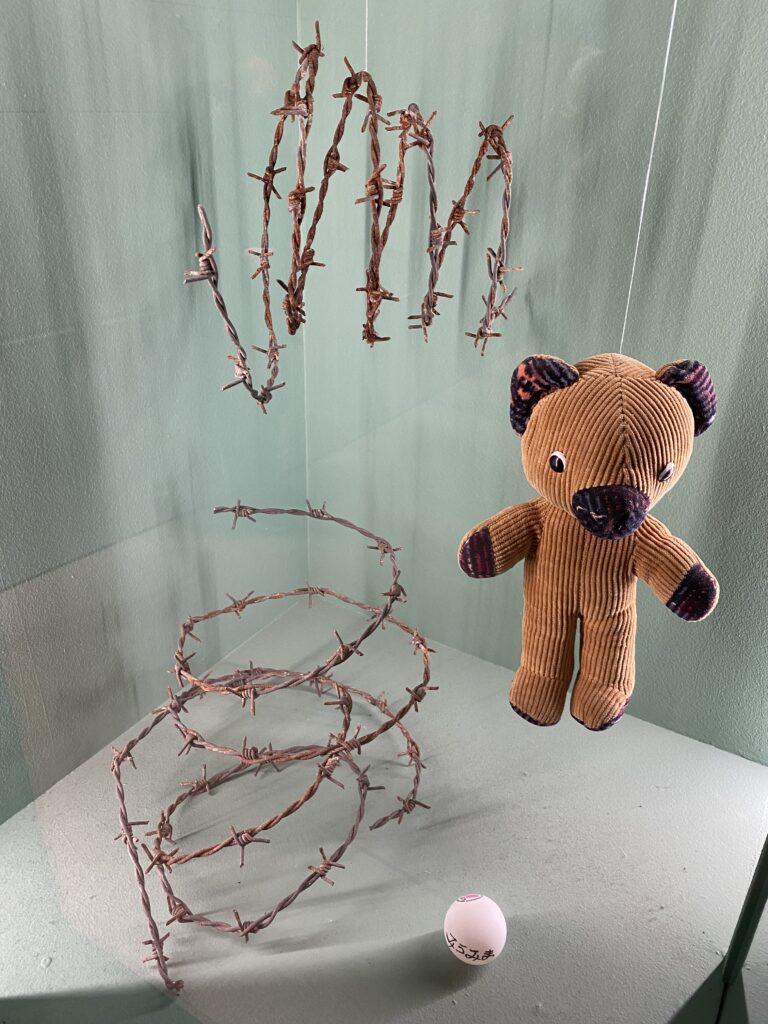
At the end of the Schindler Museum exhibit is a glass case containing two spirals of barbed wire. They are from KL Płaszów, a camp in Kraków built on Jewish cemeteries, which housed up to 25,000 prisoners at a time. It began as a forced labor camp and later became a concentration camp, a place of terror for Jews, Poles, Roma and political prisoners. Although it wasn’t an extermination camp, prisoners were indeed also executed here.
Many concentration camps have been preserved across Europe as a reminder of what happened during the Holocaust, when the Nazis murdered six million Jewish people, as well as other persecuted groups. Decades ago, I visited the Sachsenhausen concentration camp, north of Berlin, on a school history trip. I still remember, vividly, the “Arbeit Macht Frei” lettering on the gates, that awful, twisted phrase that translates as “Work Makes You Free.”
On the other side of Kraków, there is a blue and white striped uniform hanging up in the People of Kraków in Times of Terror exhibition, part of Muzeum Krakowa. A woman named Anna Pieczarka-Mikulskaw wore it while imprisoned in the German concentration camp KL Ravensbrück between 1942 and 1945. Her grandson gave it to the museum.
“Some of them came back home in the uniform,” the museum’s curator Grzegorz Jeżowski tells me.
The Holocaust is perhaps our starkest example of where scapegoating can lead. That barbed wire and that prisoner uniform in Kraków are reminders of what happened in Europe’s darkest hours. And yet today, far-right politicians are still villainizing minority groups, in particular Jews, Muslims, refugees, and LGBTQ+ people. It is not comparable with what the Nazis did, of course it isn’t. But we must never forget where this road can lead.
Today, in countries including Russia, Germany, Italy, and Georgia, there are growing political movements pushing for “traditional family values” and against LGBTQ+ rights. In Bulgaria, too, it is illegal to discuss LGBTQ+ topics in schools. There is a question mark over Hungary, which made global headlines for banning Pride marches under recently deposed strongman, Viktor Orbán. Recently in the German state of Saxony-Anhalt, the far right Alternative for Germany (AfD) won the state election, just falling short of gaining a majority, and leaving the rest of Europe shaken.
(Photo courtesy of Katie Dancey-Downs.)
Why we must visit the museum
Let me caveat what I’m about to say: I am not carrying the weight of lived or generational trauma, as others whose families have been persecuted by authoritarian regimes. But I believe it's vital we go to these museums and face the evidence head on, that we look at Mein Kampf, at the shoes of people murdered by the Soviet secret service units found in burial sites, at the microphones slipped into hotel rooms. Not just to remember what has happened in the past, but to make sure that we develop the necessary critical thinking required to understand and prevent what is already emerging in our present.
The museums I visited are just a handful of those dotted around Europe, with countless artifacts to remind us we are not immune to the possibility of ending up under authoritarianism. In Europe today, there are flickers of these tendencies—and not just in Russia and Belarus.
In Serbia and Turkey, journalists critical of the government live under serious threat, and protesters have faced violent clampdowns in Georgia since the Georgian Dream party claimed victory in the 2024 election—a result which Western pollsters said did not match exit polls. Both Turkey and Georgia’s leadership has been described as authoritarian.
And then there are countries where populist or illiberal politicians are waiting in the wings, steadily growing in popularity. Like in the UK, where there is an ever-growing personality cult around the anti-immigration Reform UK leader Nigel Farage, a man who has been accused by former schoolmates of antisemitic and racist bullying (which he denies) while more recently getting caught supporting a neo-Nazi event and using extremist slogans in personalized Cameo videos. As of May 2026, Reform UK was the most popular political party in the country, before a series of financial scandals consumed discussion around the party, dropping them to second place by August.
Similarly in France, Marine Le Pen’s far right National Rally is the country’s most popular party according to the most recent voting poll. And perhaps most shockingly, as of June 2026, the most popular political party in Germany is the far right nationalist AfD (Alternative für Deutschland), which is shaped by xenophobia, Islamophobia, antisemitism, and hostility to LGBTQ+ people.
Tyrants-gone-by echo in our current world, and illiberal politics serve as fertile ground for authoritarianism.
With all this in mind, the artefacts of terror and extremist politics in Europe’s museums are frightening, quite rightly. But in these same buildings, there are also always artefacts of hope.
In the Vabamu Museum of Occupations and Freedom in Tallinn, there is not only evidence of the oppressions Estonians faced, but also of their resistance. Hanging up on the wall, a brown leather briefcase that belonged to Enn, an Estonian dissident who was arrested by the KGB numerous times, tells the story of a petition called the Baltic Appeal, calling for the independence of the Baltic states. The briefcase was big enough to carry a secret typewriter, which could be used to make and copy prohibited materials—and there’s one of those here too, a large clunky machine with a teal-colored carriage. They were considered so dangerous by the Soviet Union, that each typewriter had to be registered, but dissidents found ways to trick the authorities. This particular typewriter belonged to Irene, who, according to the museum’s digital guide, exchanged her tent to get it and then used it to make copies of the banned The Gulag Archipelago by Aleksandr Solzhenitsyn, an autobiographical work about life in the Soviet labor camps.
(Photo courtesy of Katie Dancey-Downs.)
Sitting proudly above the typewriter and the briefcase is a piece of samizdat, which dissidents were producing in the decades after Stalin died. These were self-published copies of prohibited texts—novels, journals, cookbooks, anything people wanted to read and couldn’t—which were passed around hand-to-hand, secretively.
There is a letter on the wall, too, signed by 40 Estonian figures from the cultural and scientific communities, against Russification. They collected these signatures in secret and sent the open letter to newspapers—even though ultimately, it resulted in many of them being punished, interrogated, or forced to publicly apologize.
Lastly, in the Museum of the Occupation of Latvia, there’s one incredible artefact that I sit in front of for a long time. It’s a video of people—ordinary people—holding their linked hands up high along the side of the road. It is a singing revolution. In August 1989, 1.5 million people across the three Baltic states—Estonia, Latvia, and Lithuania—created a 410-mile chain from Tallinn to Riga to Vilnius, held hands, and sang for their independence. A few months later, the Berlin Wall fell, and by 1991, all three countries were independent and free of Soviet occupation.
So much of authoritarian control is about isolating people, making them afraid of what they say and to whom they speak. These movements of resistance, then, these items that bond people, these relics, are all precious reminders of how people have resisted before. But we must go to the museum to truly see them. We must go to the museum to find hope in what can be overwhelming times. And we must go to the museum to arm ourselves with the lessons of history in the fight against a repeat of our worst moments.
[post_title] => Warnings from the Museum
[post_excerpt] => A tour through Europe's past—and what lessons we might learn from its museums to fight authoritarianism today.
[post_status] => publish
[comment_status] => closed
[ping_status] => closed
[post_password] =>
[post_name] => warnings-from-the-museum-authoritarianism-europe-history-estonia-latvia-poland-soviet-union
[to_ping] =>
[pinged] =>
[post_modified] => 2026-09-23 00:12:35
[post_modified_gmt] => 2026-09-23 00:12:35
[post_content_filtered] =>
[post_parent] => 0
[guid] => https://conversationalist.org/?p=11041
[menu_order] => 0
[post_type] => post
[post_mime_type] =>
[comment_count] => 0
[filter] => raw
)
Györgyi Gálik on trust, agency, and the invisible work of peacebuilding.
What are the conditions that make democracy possible?
This is the question that animates the work of Györgyi Gálik, the Hungarian co-founder of Governing Together at Dark Matter Labs, a non-profit research and design lab that builds alternative models for future economies. Unlike many democracy practitioners, Gálik is less interested in designing the next civic platform or participation process than she is in understanding the invisible conditions that ensure their success: trust, agency, kindness, dignity, psychological safety, and fostering relationships that allow people to govern together.
For Gálik, peacebuilding is not something that begins after violence, but rather the work of cultivating the social, relational, and institutional conditions that make violence less likely in the first place. In that sense, peacebuilding and democracy are not separate projects to her: They are expressions of the same underlying work.
"Peace begins much earlier,” she tells me “It begins in the everyday conditions that help people feel seen, valued, connected, and capable of shaping the world around them. Peacebuilding is the slow, everyday work of creating the conditions where people can act, choose, disagree, repair, and shape the systems that govern their lives.”
“Peacebuilding is less about the absence of violence and more about the presence of agency," she continues. "That is also how I understand democracy."
Learning Democracy Through Loss
For Gálik, this understanding emerged from both political observation and personal experience.
Raised in Hungary and having lived across Europe and North America, she became fascinated by the ways political systems shape everyday life. But her deepest lessons came from watching how people lose meaning when they lose agency—something she witnessed in her own home.
Throughout her life, Gálik’s father struggled with alcoholism, and died tragically at a time when addiction was treated primarily as a moral failing or personal weakness, rather than a consequence of trauma, disconnection, and unmet needs. What he lacked, she now believes, was not willpower alone, but community, dignity, empathy, meaning, and purpose.
Over time, she began to understand what happened to her father not simply as a family story, but also a political one: The same conditions that leave individuals vulnerable also leave democracies vulnerable.
Citizens who are filled with resentment and hurt, and feel powerless, unseen, and unheard, become easier to manipulate. People stripped of purpose and dignity become susceptible to cynicism and authoritarian appeals. Far more alarming, this can happen without most even realizing it: It has always frightened Gálik how much people can normalize almost anything if the conditions are made gradually enough.
"The personal and the political were never really separate to begin with," she says.
When Democracy Exists Without Genuine Choice
Few people understand this dynamic more viscerally than Hungarians.
Gálik points to recent investigations documenting how authoritarian governments can maintain the appearance of democracy while systematically narrowing citizens' choices in reality. Elections continue. Participation technically remains available. Yet fear, dependency, poverty, and intimidation hollow out any meaningful sense of agency.
This is something Hungarians have experienced firsthand. The former government stayed in power for 16 years, not simply by putting money in people’s pockets, but by deliberately maintaining widespread vulnerability with a disturbing level of precision. Threatening parents that their children could be taken away. Telling elderly people they could lose their place in care homes. Threatening families that their heating, gas, or electricity could be switched off, or that they’d lose their jobs. Letting criminals off in return for their votes.
What makes this system so chilling is how functionally, it narrows people’s choices without ever pushing them outside a system that depends on their votes and participation in order to maintain the illusion of a functioning democracy.
"A society can have consultation, elections, surveys, town halls, and participation processes, and still not have genuine democratic choice," Gálik explains.
For her, democracy is not simply the presence of participation, but meaningful participation.
That distinction feels increasingly relevant far beyond Hungary. Across many democracies, citizens are invited to participate while struggling with economic insecurity, housing crises, burnout, and declining trust in institutions. Formal participation remains, but if people cannot afford to lose their job, speak up, move home, access care, or have the capacity to imagine a different future, then democracy becomes procedural rather than real.
Democracy's Invisible Infrastructure
One of the most striking ideas in Gálik's work is her belief that, like any seed, democratic ideals need the rich microbiome that sustains healthy, regenerative soil to grow.
In politics, we tend to focus on what is visible: elections, policies, public meetings, constitutions, and institutions. But just as a plant depends on an unseen ecosystem of microorganisms to survive, healthy democracies depend on countless invisible interactions and flows of exchange. Integrity. Curiosity. Reciprocity. The ability to repair harm. The willingness to work across differences.
Without these, both on an individual and societal level, democratic institutions may continue to function on paper while becoming increasingly brittle in practice.
As a result of New Public Management, society’s dominant doctrine since the 1980s, and our broader desire to control complexity, most governments have invested heavily in measurable outputs and performance targets. Yet many technocratic reforms designed to improve efficiency and enable growth have unintentionally weakened the relationships that allow societies to function. Gálik argues that we have become experts at producing outputs, visions, and strategies while neglecting the human infrastructure that turns those outputs into meaningful outcomes for people and communities. A city can produce an award-winning climate strategy and meet every reporting requirement, yet still struggle to deliver meaningful change when departments are siloed, staff lack the capacity to collaborate across mandates, public trust is low, and political leaders are unable to sustain collective action over time.
"We are meeting the targets," one of Gálik’s colleagues observes, "but missing the point."
The Gendered Labor of Holding Society Together
The consequences of this invisible infrastructure are not distributed equally. Much of the work required to maintain relationships, build trust, manage conflict, and hold communities together is often performed by women, yet they remain largely unseen, undervalued, and uncompensated.
Like many women working in politics, public institutions, and social change, Gálik is familiar with the invisible labor required simply to be heard.
Having lived in seven different countries, she has encountered remarkably similar patterns. Many women learn very early that they need to be significantly overprepared to be taken equally seriously. They watch as strategic contributions go unnoticed. They learn to manage their tone, language, appearance, and demeanor to navigate institutions that were rarely designed with them in mind. They learn to present as smart enough, but never too smart.
The endless examples of code-switching she’s collected from women around the world are both humorous and sobering: wearing glasses to appear more serious, wearing a ring to signal they have a husband and are therefore to be taken seriously, bringing brothers as stand-ins to unlock credibility during negotiations.
But Gálik also sees an unexpected strength in these experiences.
Women, she argues, often become experts at reading power because they have spent their lives navigating it. They know how to build trust, maintain connection during conflict, and hold complexity without collapsing into domination.
These are not secondary skills. They are precisely what modern democracies so desperately need.
Gálik has never accepted a passive role in public life. Nor has she believed that the capacity to initiate change should be reserved for those who occupy positions of formal authority. Her advice to women facing authoritarianism is practical and urgent: find each other, protect each other, document what is happening, and refuse isolation. Throughout history, women have created new forms of communication when official channels become dangerous—from underground publishing networks to other mediums of resistance (including quilts, sewing circles, and silent public gatherings). That creativity and resourcefulness remain one of democracy's most enduring resources.
Trust as Democratic Infrastructure
Throughout our conversation, Gálik repeatedly returns to one word: trust.
Not trust as a feeling, nor as a given. But trust as infrastructure, and daily practice.
Roads do not emerge spontaneously. Neither do water systems, bridges, or electrical grids. They must be built, maintained, repaired, and protected. Trust requires the same kind of investment.
When trust collapses, participation becomes performative. Citizens may still show up, but they no longer believe their contributions matter. Democracy continues as a procedure while losing its legitimacy as a shared project.
The question should not be whether citizens trust institutions. The question is whether institutions behave in trustworthy ways. Do they listen? Repair harm? Share power? Tell the truth? Follow through?
These are governance questions, Gálik argues. But they are also peacebuilding questions.
The Work Ahead
Just weeks before our conversation, Hungarian voters ended their sixteen years of increasingly authoritarian rule. Yet Gálik cautions against viewing electoral victories as endpoints. Removing an authoritarian leader is only the beginning. The deeper challenge is rebuilding trust, institutions, civic confidence, and the everyday habits of democratic life among a population long treated as invisible and disposable.
The other challenge is dealing with the rightful resentment these governments leave behind. How might we see possibility in the widespread anger that results from an oppressive regime? Anger is a healthy and necessary response to injustice. It can be one of the most powerful motivating forces for change. The problem is what happens to anger when it has nowhere to go, when it is met with indifference, with the expectation to just move on, with contempt, or with further exclusion. There, it hardens into something more destructive.
As Gálik puts it, “The answer is not to suppress anger or to fear it. The question is whether we can create places where it can be transformed into agency, participation, and collective action. Democracies do not heal by asking people to suppress or forget what happened to them. They heal when people experience that their voices matter again.”
As our conversation ends, Gálik returns to the same idea that has guided her work from the beginning. She hopes that in ten years, Governing Together will have helped to build a serious field of practice around the relational foundations of democracy—one that nurtures both individual and societal wellbeing.
Democracy is not solely defended in court or in government halls. Peacebuilding doesn’t only happen after conflict. Both depend on whether people still believe they have agency in shaping a better future together—and whether they feel their lives carry meaning and purpose within it. Democracy, then, must be something we practice every day in our workplaces, neighborhoods, families, institutions, and communities. These everyday acts are the nutrients of democratic life. They sustain the social microbiome—the living ecosystem of relationships from which trust, cooperation, collective agency, and the belief that change is possible can grow.
It is a deceptively simple idea. And perhaps one of the most radical democratic arguments of our time.
[post_title] => The Soil Beneath Democracy
[post_excerpt] => Györgyi Gálik on trust, agency, and the invisible work of peacebuilding.
[post_status] => publish
[comment_status] => closed
[ping_status] => closed
[post_password] =>
[post_name] => gyorgyi-galik-governing-together-dark-matter-labs-hungary-democracy-peacebuilding-global-peacebuilders
[to_ping] =>
[pinged] =>
[post_modified] => 2026-08-03 20:28:56
[post_modified_gmt] => 2026-08-03 20:28:56
[post_content_filtered] =>
[post_parent] => 0
[guid] => https://conversationalist.org/?p=10768
[menu_order] => 0
[post_type] => post
[post_mime_type] =>
[comment_count] => 0
[filter] => raw
)
Since the start of the war, Russian soldiers have targeted vulnerable Ukrainian women for sexual abuse.
These are just a few of their stories.
Olena Zaitseva was in the early stages of pregnancy when she was unlawfully detained by Russian forces in February 2019.
“They took me into a prison-like facility, where they handcuffed me and attached me to a pipe,” she recalls. But soon after, they moved her to another room, “where the violence—and all the horrors imaginable—took place.”
Living close to what was then the front lines of eastern Ukraine, where the ongoing war with Russia first broke out in 2014, Olena and her 18-year old son Vladyslav had been accused by Russian forces of plotting to destroy railway infrastructure. Without legal defense or recourse, the mother, then 48, would spend the next four years as a civilian captive, while her son would be sentenced to 22 years in prison.
Olena was first held captive in Makiyivka, a former prison colony, and later in Izolyatsia, a former pre-trial detention center. Both had been converted into torture chambers by the Russian army, and were widely known for the atrocities committed by Russian servicemen against Ukrainian prisoners—atrocities that continue to this day.
When she first arrived at Makiyivka, Olena tells me she was imprisoned in a one-person cell, where around six men in balaclavas beat her and raped her with rubber batons for several days. (The soldiers put a bag on her head, so she could not count the total number of perpetrators.) The rapes triggered grave gynecological difficulties, causing Olena to bleed heavily. For nearly two years, these symptoms persisted. “I was alone in a cell with only a mattress, a bottle of water, and one bucket,” she says. “I’d sit on the bucket so that the blood could flow because I had no pads, no cloth, nothing.”
Olena with a photo of her son, Vladyslav. (Photo: Sara Cincurova)
Subjected to other forms of torture, Olena did not receive medical aid in her four years in Russian captivity, except for a single hospital visit in occupied Donetsk to consult with a gynecologist. “I cannot translate that feeling into words,” she recalls. “It was like in American movies: my hands in chains, my legs in irons, I was forced to bend forward and look down, and they dragged me like a dog. I was so ashamed.”
“People were walking in the street, and I had a bag on my head, like the worst of the criminals,” she says.
The doctors did not give her a diagnosis that day. It would have been impossible, Olena says, because the same Russian servicemen and prison guards who had abused her were watching and listening. But she already knew she had lost her pregnancy as a result of the violence she’d experienced during her imprisonment. (The father of her child would die on the front lines before they could be reunited.)
After four years in captivity, Olena was freed in a prisoner exchange in 2022. I meet her outside of Kyiv, where she now lives alone in a small room in a shared apartment. She has recently applied to receive disability status as a result of permanent injuries sustained during her imprisonment, while her son Vladyslav remains in Russian captivity, now for the eighth consecutive year. Olena continues to advocate for his release every day, and says she only relives the abuse she experienced and gives interviews to the press in order to help draw attention to his case. But she admits there is little hope.
“For my son to be exchanged, a miracle would have to happen,” she tells me. “Looking at what is happening, those who had been imprisoned before 2022 have been forgotten.”
Searching Houses for Vulnerable Victims
Olena’s story is just one of nearly 30 testimonies I have collected over the past two years of conflict-related sexual violence perpetrated against Ukrainian women, and is consistent with the testimonies of other women I have interviewed who were held at Makiyivka and Izolyatsia.
All of the women’s accounts were independently verified by Ukrainian NGOs collecting evidence of Russia’s war crimes, and together, paint a grim picture of systematic abuse—one that is not just a crime of opportunity, but suggests an intentional scouting effort by Russian soldiers to find potential victims who are especially vulnerable.
Although the Geneva Conventions, as well as international humanitarian law, stipulate that all civilians in conflict who are wounded or sick “shall be respected and protected in all circumstances,” UN reporting suggests that Russian forces have not respected these protections, routinely abusing even the most defenseless of Ukrainian civilians. Children, disabled persons, and the elderly are also protected civilians under international law; as are pregnant women like Olena, as well as mothers and other caregivers. But since the war broke out in 2014, rape and other war crimes have been routinely documented against each of these protected groups, as confirmed by both a 2023 and 2024 UN Independent International Commission of Inquiry on Ukraine. Explicitly defining rape as a form of torture under international law, the investigators found that soldiers routinely "identified women in a vulnerable situation" and "committed acts of rape and sexual violence when they broke into the victims’ houses," sometimes "at gunpoint with extreme brutality and with acts of torture, such as beatings and strangling."
(Photo: Diana Deliurman)
While sexual violence has become a defining weapon in the Russian war in Ukraine, it has also been on the rise in conflicts around the world. A 2025 UN report documented thousands more cases of conflict-related sexual violence in 2024 compared with the year before—a 25 percent increase, widely considered a conservative estimate. A 2026 report of the UN Secretary-General on conflict-related sexual violence estimated that for each rape reported in connection with a global conflict, 10 to 20 cases went undocumented.
Rape and other forms of sexual violence have long been a violation of international humanitarian law, yet committed with impunity in conflicts around the world, Jessica Neuwirth, founder of the Frontline Women's Fund, tells The Conversationalist. Her organization works to combat this by offering support to women's organizations working in conflict zones, helping survivors of sexual violence. “The Geneva Conventions prohibit ‘outrages upon personal dignity’ and specifically mention ‘rape and any form of indecent assault,’" she says. “The statute of the International Criminal Court explicitly includes rape as both a war crime and a crime against humanity.”
The problem, Neuwirth says, has not been the legal prohibition of rape, but the failure to hold perpetrators accountable under the law.
There have, however, been some efforts to bring perpetrators to account. In 2025, the UN Special Rapporteur on Torture, Alice Jill Edwards, joined by several other experts, sent a dossier of sexual torture allegations to the Russian Federation, involving the cases of 10 Ukrainian civilians. “These were all highly sexualized assaults which included rapes, threats of rape, and other depraved conduct,” the dossier read. “It is becoming clearer that the Russian Federation’s deliberate and systematic policy of torture in Ukraine involves sexualized torture and other sexualized cruelty, including against the civilian population.” (While Russia did not formally address a reply to the UN, the Kremlin has publicly stated its belief that many reports by Ukrainian women of sexual violence were groundless.)
The Strongest of All
“No one is as strong as Ukrainian women,” Liudmyla, a retired teacher who will celebrate her 79th birthday this summer, tells me. In the summer of 2022, she was beaten and raped by a young Russian serviceman in her house in a small village of the Kherson region, then under Russian occupation. The soldier left her with four broken ribs, among other injuries.
I interviewed Liudmyla for the first time in February 2025. Despite temperatures in the negatives that day, we set out to meet in the ruins of a bombarded elementary school in her village, which Liudmyla wanted to show me. In the end, we had no choice but to record the interview in a car because of the unbearable cold.
Despite the risks of coming forward with her story, Liudmyla has refused to be silenced, and has inspired other survivors in the country to speak out—including elderly or deeply religious women who at times blamed themselves for their assault. For her bravery, she is now seen as a local leader.
Liudmyla. (Photo: Diana Deliurman)
A year and a half after our first interview, I meet Liudmyla again. Her mobility has worsened; she struggles to walk up and down the stairs. But her resolve remains unchanged, speaking with the same determination she had the first time we met.
The day she was raped, Liudmyla recalls, she was convinced she would die. When the soldier started violating her, she said “farewell to my children, grandchildren, and great grandchildren in my mind.” But she survived. “I speak in order to denounce the war crimes committed by Russia against Ukrainian women,” she tells me.
Liudmyla says the Russian soldier who raped her stormed into her house around 10 p.m. She was terrified: At the time, she lived alone. He shouted and interrogated her, asking questions such as “who lives in your house?” and “why are the lights turned on?” Then, he beat her up and tore her clothes apart. He raped her, she says, then immediately fell asleep beside her. Liudmyla said those hours were among the most harrowing. “I lay right next to him, petrified,” she said, “while he was asleep and snoring.”
At 4 a.m., the soldier woke up and told Liudmyla he would come back in two days. “He told me that if I told anyone, he would kill me,” she says. Liudmyla was too scared to go to the hospital—then occupied by Russian troops—and immediately decided to flee her village rather than wait for the soldier’s return. She was only able to move back to her house, which had been almost completely destroyed, after her village was liberated in late 2022.
Recalling the days of occupation, Liudmyla says she saw wounded and desperate civilians being tortured by Russian soldiers. Some were hanged; others were forced to drink motor oil, she recalls. Other survivors as well as Ukrainian soldiers from the area I have interviewed recall seeing and hearing school children being raped.
Today, Liudmyla’s village is located near the so-called “kill zone,” about 30 kilometers from the frontlines, where Russian servicemen use first-person view (FPV) drones to kill civilians with precision. The practice is called “human safari”—an act of brutality consisting of dropping bombs on people, cars, and even children at play, as if it is a video game. Making matters more dire for the village, there is almost no access to food or medications. “If it wasn’t for humanitarian organizations, I would die of hunger today,” Liudmyla tells me. She hopes the situation will not get worse.
Liudmyla’s testimony is not an isolated incident. Rape and forced abductions of elderly Ukrainian civilians by the Russian army have been widely documented in recent years. The elderly also represent a large majority of people who remain living close to the frontlines, unable or unwilling to move out of the houses where they have spent their entire lives.
Pain That Cannot Be Expressed in Words
While international humanitarian law protects all civilians living in conflict without discrimination, certain groups are singled out for additional protections. The Convention on the Rights of Persons with Disabilities, for example, contains specific protections for people with disabilities, who are at greater risk of violence, including of a sexual nature.
While reports across various countries have shown that violence against people with disabilities tends to receive relatively little media coverage, the UN has been “gravely concerned” about the fate of disabled Ukrainians since the outset of the war. “People with disabilities trapped in the Russian control zones in Ukraine are reportedly being used as ‘human shields’ by the Russian Federation armed forces,” the UN Committee on the Rights of Persons with Disabilities (CRPD) warned in September 2022. Other human rights organizations such as ZMINA have also published reports documenting the experiences of women with disabilities living in Ukraine.
Lidia Tarash, the acting head of the Department of Documenting War Crimes at the Ukrainian NGO Media Initiative for Human Rights, tells me that according to their organization’s data, at least 27 civilians with disabilities are currently held in Russian captivity. “We also have testimonies regarding at least five seriously ill civilians unlawfully detained by Russia,” she says. “These include people with spinal conditions, epilepsy, diabetes, asthma, cancer, amputations, and paralysis.” Some of these civilians are also being held “incommunicado,” in complete isolation from the outside world—their whereabouts and conditions completely unknown.
“These cases demonstrate that even particularly vulnerable groups of civilians receive no protection from Russia’s system of persecution,” she explains. “They point to the systematic nature of the unlawful detention of Ukrainian civilians and Russia’s blatant disregard for international humanitarian law."
Documenting disabled people’s stories in conflict also presents particular challenges. Many disabled people live close to the frontlines, where media access is limited and particularly dangerous. Disabled people are also a largely underrepresented group across traditional media, and anecdotally, this has made it especially difficult for journalists to find a home for their stories. On his last day in the role, Giles Duley, the United Nations Global Advocate for Persons with Disabilities in Conflict and Peacebuilding Situations, said, “When I photograph somebody in a war zone… they always say to me: share this story with the leaders. But the opportunities to do so were never fully realized.”
(Photo: Diana Deliurman)
In the spring of 2025, I spoke with the mother of a disabled woman, living with her family only about 13 kilometers from the frontlines of the Kherson region. Their village, which was occupied in 2022, has been routinely hit and targeted by FPV drones.
Her daughter Olha, she explains, sustained a severe head injury as a toddler that blocked the flow of oxygen to her brain, leaving her non-verbal and bed-bound. Although now a young woman of 33, she still looks like a child, no older than 9 or 10.
In late February 2022, as Russians stormed into their region, Olha’s parents were taken to the local police station for questioning. Her mother says they were forced to kneel for hours as they were beaten and interrogated by Russian soldiers. But all the while, she feared most for her daughter, who had been left at home alone.
Hours later, Olha’s mother was released. When she returned home, she found Olha lying on the bed, naked and motionless, with sweets placed on her pillow.
“Olha cannot undress herself alone,” her mother tells me. Devastated, she immediately knew: It must have been the Russian soldiers.
With Olha unable to speak, it was impossible to fully determine what had happened. But Olha’s body spoke for her. In the months that followed, she lost around 10 kilograms, and nearly all her teeth fell out. She became terrified of men, her mother says.
While the family will never know the details of the abuse, organizations such as Human Rights Watch have documented similar war crimes perpetrated against people with disabilities in Ukraine. In 2024, the country’s United Nations Population Fund (UNFPA) stated that the prolonged and combined nature of insecurity, displacement, and economic deterioration had reduced “the coping capacities of women and girls and other at-risk groups in Ukraine ... further exposing them to risks of gender-based violence.” The organization also warned that older women and women with disabilities represent a significant majority of vulnerable civilians in frontline areas, and that both are more likely to be left alone, which often makes them especially vulnerable. As a result, the UNFPA concluded that different forms of gender-based violence have been significantly increasing.
A Fear of Sexual Violence
Children are legally protected in armed conflicts under international humanitarian law, with a series of rules granting them special protections. Ukraine’s General Prosecutor’s Office is currently investigating 23 cases of child victims of conflict-related sexual abuse, out of a total 396 reported cases of sexual violence by Russian troops. These numbers, however, are likely just the tip of the iceberg, and do not reflect the full reality of the sexual abuse that has been committed against children.
Alla Sobchuk, a 42-year old woman from Kherson, tells me she was unlawfully detained with her then 11-year old daughter, Viktoriia, when the city was occupied in 2022. She says they were driving through a checkpoint set up by the Russian military, who tried to force her to remove her window tint.
“I said no and they threatened to shoot me,” she says. “They handcuffed me, beat me, put zip ties on my wrists, and sprayed me with tear gas.” All of this, she adds, happened in front of her daughter.
Alla next to a sign that reads, "Ukraine will win." (Photo courtesy of Alla Sobchuk.)
The pair was then taken to a former police station, occupied by what seemed to be Russian police, she says. Viktoriia watched as Russian officers hit her mother and tore her dress apart.
“We are both very afraid of sexual violence,” Alla says, “and very afraid they would assault us.” (She adds that “luckily,” the Russian forces “only” used physical violence.)
Viktoriia was taken to a separate office, where the soldiers interrogated her. One of them threatened to send her to a boarding school and Alla to prison, before threatening Alla directly, as well. “He hit me in the face because I demanded my child be returned,” Alla says. They were both held at the police station in separate offices for nearly 24 hours. The next day, they were freed.
After they were released, Alla says, Viktoriia was very frightened—but relieved to see her mother again. “I supported her by telling her she was a hero, and even adults could not endure the [abuse] by occupation forces the way she did.”
Viktoriia next to a sign that reads "Kherson is Ukraine!!!" (Photo courtesy of Alla Sobchuk.)
This kind of exposure to violence—sexual and otherwise—is prevalent in captivity, especially in cases where children and teenagers are held for longer periods of time. But as more cases emerge involving Ukrainian children, particularly those detained in Russia, humanitarian organizations—and victims’ families—are warning of another deeply disturbing reality: evidence of severe physical and sexual violence inflicted on children themselves. Mariam Lambert, the co-founder of Emile Foundation, an organization that helps bring Ukrainian children abducted to Russia back to Ukraine, shared one recent case involving a family reunited after years of separation. “One of the children, a six-year-old girl, had previously been identified on a Russian adoption database,” Lambert says. “After her return home, evidence emerged indicating that she had been exposed to violent sexual abuse while in Russian-controlled custody.”
Lambert also confirms that similar incidents point to a broader pattern of abuse, disappearance, forced separation, and exploitation of vulnerable children caught inside a system operating without transparency or accountability. “The world still does not fully understand what some of these children have endured,” she concludes.
Hundreds of Methods of Torture
The sexual abuse committed as a weapon of war by the Russian forces remains just one method of brutal torture used against imprisoned civilians and other prisoners of war. Lyubov Smachylo, the Head of the Analytical Department at Media Initiative for Human Rights Ukraine, an NGO that has carried out comprehensive investigations and in-depth interviews with detained civilians, says she and her colleagues have been able to document patterns and connections between violations of civilians’ rights in different locations and at different times, which indicates that such violations “are not isolated incidents and may qualify as war crimes, as well as crimes against humanity.” Today, the organization is aware of at least 2,495 civilians held in unlawful captivity across 240 locations.
Based on in-depth interviews conducted as part of the organization’s research, in 87% cases of torture, Russian forces subjected victims to severe beatings, using their hands, feet, sticks, clubs, belts, hammers, or other improvised equipment. Of the 54 torture victims identified, 34 were also subjected to electric shocks. The evidence also suggests that Russian forces have used sexual and gender-based violence against both male and female detainees.
On May 22, 2026, the Ukrainian Parliament Commissioner for Human Rights, Dmytro Lubinets, reported that Russia has used 695 different forms of torture, including physical and psychological abuse, as well as sexual violence, in the war so far." Prisoners of war are strangled, beaten, subjected to electric shocks, set upon by dogs and sometimes forced to stand in one place for up to 18 hours; as soon as you start to squat, you are immediately physically beaten,” he said. He said that Russia has already tortured 406 Ukrainian captives to death.
This torture and abuse is perpetrated unlawfully and indiscriminately. The stories described above are a reminder that such horrors have not spared anyone—not even the elderly, not even the children. But reporting for months on sexual abuse across Ukraine, it has become clear to me that numerous survivors do not want their accounts to remain buried in shame. Nearly all of the women I spoke to longed to have their stories told and shared with the world—showing global readers that such unbearable, widespread abuse continues, and none of its perpetrators have been brought to justice for their crimes.
[post_title] => "All the Horrors Imaginable"
[post_excerpt] => Since the start of the war, Russian soldiers have targeted vulnerable Ukrainian women for sexual abuse. These are just a few of their stories.
[post_status] => publish
[comment_status] => closed
[ping_status] => closed
[post_password] =>
[post_name] => war-crimes-rape-sexual-assault-ukraine-civilians-russia
[to_ping] =>
[pinged] =>
[post_modified] => 2026-08-03 20:47:20
[post_modified_gmt] => 2026-08-03 20:47:20
[post_content_filtered] =>
[post_parent] => 0
[guid] => https://conversationalist.org/?p=10622
[menu_order] => 0
[post_type] => post
[post_mime_type] =>
[comment_count] => 0
[filter] => raw
)
Why Ireland's Basic Income for the Arts program is just the first step in better supporting the country's artists.
In 2022, visual artist Elinor O’Donovan was working as a receptionist in Cork, Ireland, when she began to receive the Basic Income for the Arts (BIA) stipend. The Irish government had launched the program that year as a way to address the country’s unstable arts sector, which had left many artists without job security and consistent financial earnings—O’Donovan included. At the time she applied, she'd just graduated from university and was living with her parents as she tried to figure out the next steps for her career. When she found out she’d been selected from a pool of over 9,000 other applicants for the BIA, it was life-changing. As one of 2,000 artists receiving a weekly income of €325 over a three-year period, O’Donovan was able to quit her job and move to Dublin to make art full-time.
“The BIA has allowed me to be a bit more brave with the stuff that I make,” she tells The Conversationalist. “It allowed me to make whatever I want, and not feel as if I have to justify why it's important to a funding body.”
According to a cost-benefit analysis published by the Department of Culture, Communications and Sport last September, the BIA has been a resounding success for beneficiaries, and Irish society at large. The report revealed that recipients were able to dedicate an additional four hours per week to art-making, and that the program “strengthened artists’ professional autonomy, capacity for creative work, and attachment to the arts sector.” Moreover, for every €1 of public money invested in the pilot, the country received €1.39 in return—a value that accounts for an increase in earnings generated from art-making as well as an increase in public engagement with the arts. In short: Giving money to artists, with no strings attached, was demonstrably profitable.
For O’Donovan, income from the BIA not only gave her more time to make art, but provided her with newfound financial stability, something that affected every part of her life. She had more time to cook for herself, joined a gym, and for the first time, was able to afford to go to therapy. She was also finally able to plan for the future.
“I was 26 when I started receiving [the BIA], and I was able to start a pension fund,” she says. “Just having that fallback [was a relief], knowing that I would receive an income no matter what happened; if I got sick, I would still be able to pay my bills, pay my rent. It has really been transformative for my well-being.”
Importantly, the BIA has also allowed her to create opportunities for other artists: O’Donovan’s ability to explore filmmaking, something she was afforded because of the stipend, meant she could create new jobs in the field. “Having financial stability from the basic income means that I've been able to hire other people to work with me,” O’Donovan says. “So there's even been a kind of trickle down of the basic income to other artists and other creatives in Ireland.”
For artists around the world, the program has also offered one hopeful potential solution for a global arts sector severely hit with funding cuts and political uncertainties over the last few years. But while things have taken a recent downturn, the financial instability of the arts has been a major problem for decades, if not centuries, something that likely explains the growing admiration for the BIA around the world.
In a capitalist society, creative work is not valued as a productive or profitable field, which often means that artists are being underpaid for their work, if they’re paid at all. Creativity and art-making require passion and time, two resources that are generally scarce in an economic system more concerned with profit than beauty. Often, this forces workers to abandon or sideline their creative work in favor of taking a non-creative job that will provide financial stability. But a program like the BIA provides an alternative model, giving artists the financial foundation to create without the stress of figuring out how they will pay their rent or bills.
Even the program’s most ardent supporters, however, argue that the BIA is only the start of a more stable arts field. In Ireland, the arts generate €1.5 billion in income each year, but according to Praxis, the artists’ union of Ireland, artists still face “extremely challenging economic conditions.” In an open letter published in September, the group cited that 50.7% of artists in Ireland still live in Enforced Deprivation, compared to 15.7% of the general population. (The Irish Central Statistics Office defines Enforced Deprivation as when a household experiences two or more of 11 national deprivation items, such as being unable to replace worn out furniture, or being unable to afford a drink or a meal with friends once a month.) The BIA, then, should be seen as just the first step in a bigger effort to make the industry more sustainable.
“It has always been precarious,” writer, editor, and Praxis policy director Michaele Cutaya tells The Conversationalist. “I've never managed to make a living off just my art income, [and] my situation, my difficulties, are not isolated instances.” As a union representative, Cutaya helped advise the government on the BIA’s design; but despite its success, she emphasizes that the country still has a long way to go.
“Quite a large part of the economy relies on the work of artists,” she says, citing the profit the arts brings to the hospitality sector in Dublin as one example. But very little money generated by the arts sector actually goes to artists, a discrepancy that continues to grow despite the BIA. In the last three years, work opportunities have diminished throughout the sector, a trend worrying to union leadership and artists alike. “Access to public funding remains the main source of income for artists, mainly through the Arts Council,” Cutaya continues. “[But] I find that the number of chances of getting your work selected has gone down because essentially there seems to be a lot more people applying [to public funding].”
This may explain why some are concerned that the BIA will become “the shiny object” of policies, while other issues in the sector go ignored, like unregulated pay, the use of AI, and the still-growing lack of opportunities.
“There's a lot of issues and they’re not doing much about it,” says actor Christophe Lombardi, who was in the control group of the BIA pilot program, where he received one yearly payment of €650 as compensation for participating, rather than the weekly stipend of €325. (The results of Lombardi’s control group were used so researchers could better understand how the BIA helps artists over a longer period of time, in comparison with those not receiving it.)
Emphasizing other issues he would like to see addressed, Lombardi points to Gayanne Potter, a voice actor whose voice was used without permission by ScotRail to create AI-generated platform announcements in Scotland. “We are facing all the [same] problems [in Ireland]. So I don't want [the government] to use the BIA as an excuse to pretend to help the artists, but behind the scenes, not [do] anything about the rest of the issues.”
Last April, the Irish Creative Industries Forum (ICIF) wrote to the Irish government requesting measures for the protection of artists from AI, and the enforcement of copyright infringement laws against the misuse of the technology. As of yet, however, the government has yet to implement any AI regulation policies in response.
Still, there is a widespread recognition that the BIA is a net positive, and can and should be used to help address many of the existing issues in the industry. In its letter, the ICIF requested that the BIA be extended to artists affected by job loss caused by AI. Across Ireland, unionized artists are currently campaigning for the BIA’s permanent expansion. “It does make a difference, obviously,” Lombardi says. “Because it's hard to stay creative, to keep things going, while you can't keep a roof over your head. There was [an] upswing in mental health—everything's better.”
In Praxis’ open letter, the union demanded for the program’s extension for an indefinite period of time, and for the income to be indexed to inflation. Additionally, the union urged the government to expand eligibility to include previously omitted art forms, like performance artists, socially-engaged artists, craftspeople, and designers.
Arguing that the BIA pays for itself in economic returns, Praxis warns this expansion should not come at the expense of other arts agencies, which also deserve resources, attention, and support. “The arts sector needs more funding, not less,” the letter reads.
O’Donovan agrees. Given her experience, she says the BIA should be one part of a “bigger ecosystem” that helps the arts sector thrive, and allows artists to be fairly compensated for their work. “I think what people don't understand about being an artist is how much work you do that goes unpaid,” she says. “Having the basic income means that I'm still able to live and I'm still able to work.”
The pilot program was originally set to end in December 2025, but has now been extended to February 2026. From September 2026, it will be a permanent program in the country, although the government has not defined eligibility criteria or the number of recipients moving forward. In an email to The Conversationalist, a spokesperson for the Department of Culture, Communications and Sport writes that “details such as the duration, eligibility and selection method… have not yet been decided.”
Cutaya says, so far, they’ve also been left in the dark about the expanded program’s specifics, something especially concerning because, while the program was initially launched under a progressive coalition government, the current government is conservative. “We know very little at this stage,” Cutaya says, but adds that Praxis is holding out hope their input will be taken into consideration as the program evolves.
This lack of transparency has also left current BIA recipients in the dark, unsure of how they will support themselves in the gap between February and September. “Realistically I'll just have to start working again,” O’Donovan says. “It feels like a shame. I'm really grateful to have had these three years where I've been able to work full-time as an artist because very few people who aren't on the basic income can afford that.”
Reflecting on how public arts funding is the first to be cut during economic hardship, Lombardi wishes that society at large would recognize the inherent value of artists’ labor for the mental health and wellbeing of the general population. “Imagine life without art,” Lombardi says, pointing to how artists played a key role in keeping people sane during the pandemic. “Imagine for six months, there is no art. You can't watch stuff, you can't read stuff, you can't go out and see stuff. You can't sing, there's no music, there's nothing. The only thing is work and sports. That's it. The decrease in mental health would be astounding, people would go around the bend.”
Having access to the most basic resources to be able to live while working in your preferred profession shouldn’t be a privilege for the few: Everyone deserves what the BIA has provided to artists for the last three years. But as too many places proverbially edge closer to the dystopia Lombardi describes, the BIA might be seen as a place to begin to reimagine how we value and fund the arts moving forward. Whether it’s an album, a painting, a play, a movie, a live band—whatever your preferred mode of expression—the arts remind us of the wonders of life, forcing us to see the beauty in between work shifts and growth indicators. Fair pay to the workers who deliver those reminders to the general population, then, is urgent; otherwise, we risk a world without fascination. The findings of the BIA pilot reveal the systemic flaws of how society treats its artists, and beyond the stipend, point to more hopeful solutions on the path to a world where art and artists are truly valued.
[post_title] => Painting a More Hopeful Future
[post_excerpt] => Why Ireland's Basic Income for the Arts program is just the first step in better supporting the country's artists.
[post_status] => publish
[comment_status] => closed
[ping_status] => closed
[post_password] =>
[post_name] => hope-week-universal-basic-income-for-the-arts-artists-ireland
[to_ping] =>
[pinged] =>
[post_modified] => 2026-08-03 21:01:29
[post_modified_gmt] => 2026-08-03 21:01:29
[post_content_filtered] =>
[post_parent] => 0
[guid] => https://conversationalist.org/?p=9937
[menu_order] => 0
[post_type] => post
[post_mime_type] =>
[comment_count] => 0
[filter] => raw
)
How younger generations are turning knitting and crochet into a community building affair.
The first known knitted project was a pair of socks. Discovered in Egypt, the socks featured colorwork made from indigo and white cotton, and were believed to date back to the 11th century, although the craft itself has likely existed for much longer. In the many decades since, knitting, crochet, and other fiber arts have become widespread and global, evolving from the work of artisans to a beloved pastime across generations, while still staying true to the original techniques used in the very first woven fabrics. And now, the craft has evolved once more—this time, at the hands of young people seeking a comforting hobby that gets them out of the house.
This is what led Virginia Meinhausen, 28, and Lea Engler, 31, to take the leap and start Knitting Club Potsdam in Germany earlier this year. “Being part of a community in person is something [meaningful], not only just to speak to each other, it's also… Wow, so many people are doing this and we are doing this together,” says Meinhausen. “We are now meeting each other in a huge group once a month.”
Since launching the club in March, Meinhausen says it’s grown to over 100 members. But this quick success isn’t unique to just Knitting Club Potsdam. In recent years, the age-old practice has found new meaning amongst Gen Z and Millennials, who have turned to knitting as a means of bringing back the “third place” and reconnecting with their peers.
“I remember thinking, it’s crazy how many people don’t have a real hobby anymore,” says Isabelle Mann, textile business expert and owner of knitwear brand Fable and Failure. But she says this started to shift during the pandemic, as younger generations sought more analog ways to pass the time.
The trend first began online, rising to prominence through influencers like Petite Knit and platforms like Ravelry, with younger generations taking ancient techniques and adapting their garments and patterns to match modern trends. “People do appreciate knitting more again,” Mann says. She sees fiber arts as a community building affair for those between 25 and 35, and started her own club through her business in 2019 as a means of teaching and preserving the craft. She also believes that fiber arts skipped a generation, and that parents in the 90s and early 2000s simply never taught their Millennial and Gen Z children how to do it. Instead, these generations taught themselves—and eventually, as COVID lockdowns lifted, these same knitters decided it was time to take things offline.
Craving human interaction and a break from their screens, hobbyists began coming together post-pandemic as a means of bringing back the “third place”: a neutral, physical space separate from home and work (or school). The concept is set on community building in-person, without having to spend much or any money to participate—something Gen Z feels that they’ve missed out on, and Millennials frequently mourn, as social media has increasingly replaced it online.
Knitting clubs, in particular, have gained global interest in recent years, with communities expanding rapidly, even in small cities. The industry is expected to grow by $10.69 billion between 2024 and 2028, according to Technavio, a company that specializes in market research reports and industry analysis.
In addition to creating bonds through a like interest, in-person knitting clubs are also helping young fiber artists learn new techniques faster and more effectively. When they began Knitting Club Potsdam, Meinhausen was a beginner and Engler was a seasoned knitter, having learned from her mother starting at 8 years old. The club currently has 60% beginner knitters and 40% advanced, according to Engler. Meinhausen, still a beginner herself, says she can’t believe the intricate project she’s working on now, which she credits to how quickly she’s learned since starting the club. She adds that advanced members “love to help,” which gives those just starting out the confidence to continue attending—and makes everyone joyful in the process.
“I told Gini [Virginia] after the first meeting, for me, it was very calm. Everyone was smiling. Everyone [was] so, so happy,” Engler says. “I think this feeling is the best part.”
According to Meinhausen and Engler, knitting and crochet is very popular amongst young people in Germany, but the hobby has gained traction amongst 20- and 30-somethings in other places, as well. In New York, crochet designer Michelle Palacio is creating garments for her brand Venganza using crochet techniques from her Colombian grandmother. In Nepal, the Nepal KnotCraft Centre, founded in 1984, aims to help women of all ages build traditional skills in fiber arts. In Paris, Avril Bas, 26, and her co-president Alice Pierre-François, 28, launched a crochet club called Club Crochet Tricot in 2024, a club that is now officially recognized by the French government. She says membership is growing every week.
“It's really incredible to have [this] place where a common hobby links people, and it helps us find similarly minded people that want to [enjoy] the same activities,” Bas says. “It's really beautiful.”
Bas says that starting the club, combined with her passion for knitting and crochet, contributed to her pursuing fiber arts full time. She fell in love with the tight-knit nature of the community, and now, their club’s efforts have “blossomed into something massive.”
“I started this club and all of a sudden I had like quadrupled my number of friends,” she says.
Club Crochet Tricot meets on Sundays four times a month, with locations varying from scenic park picnics, local cafes, public libraries, and even the cinema. Between 40 and 100 people regularly attend their in-person crafting sessions, and there are always new and interested attendees week to week. Bas feels like younger generations long for this kind social interaction, building community around creativity—and her club is an outlet for that. She also says that she’s more than happy to be a “third place” for those who have been seeking it—and perhaps, that it’s a sign of more “third places” to come.
“Everybody around our age wants to open a bookstore, plant store, cafe,” Bas says. “I feel like it’s going to happen.”
[post_title] => Weaving a New Third Place
[post_excerpt] => How younger generations are turning knitting and crochet into a community building affair.
[post_status] => publish
[comment_status] => closed
[ping_status] => closed
[post_password] =>
[post_name] => third-place-fiber-arts-knitting-circles-clubs-crochet-weaving-community-crafts-artists-artisan
[to_ping] =>
[pinged] =>
[post_modified] => 2026-08-03 22:33:13
[post_modified_gmt] => 2026-08-03 22:33:13
[post_content_filtered] =>
[post_parent] => 0
[guid] => https://conversationalist.org/?p=9113
[menu_order] => 5
[post_type] => post
[post_mime_type] =>
[comment_count] => 0
[filter] => raw
)
Despite the threat of police violence and arrest, student-led protests against President Erdoğan and his ruling party continue across Turkey.
A wave of street demonstrations began rapidly taking over Turkey last month after a crowd of students at Istanbul University pushed back against, and ultimately overcame, a riot police barricade attempting to block their path. This feat was seen as a moment of encouragement and empowerment for a country that has long felt silenced by its current government, and has led to continued demonstrations across Turkey in the weeks since.
The students on March 19 were protesting the imprisonment of Ekrem İmamoğlu, Istanbul’s current mayor, and the biggest rival of President Recep Tayyip Erdoğan in the next presidential election. They were also protesting a court decision made the day prior that nullified İmamoğlu’s diploma, a controversial ruling that meant the mayor, a member of the main opposition Republican People’s Party, the CHP, would not be directly eligible for candidacy.
The ruling was taken as a major blow to democracy and rule of law both by his supporters and by the opposition, with the party’s chairman calling it a “black mark.” But it was only a foreshadowing. The next morning, İmamoğlu, along with some 100 people, including aides, business people, and other mayors of the metropolitan’s districts, were detained in their homes. İmamoğlu had been accused of corruption and terror for allegedly establishing an electoral alliance with the Kurds in previous mayoral elections.
The case against him was widely taken as politically-motivated—the law being utilized once again as a weapon to extend Erdoğan’s reign, and discourage and limit his critics. Many were also quick to call out the hypocrisy of the charges: President Erdoğan, founder of the ruling Justice and Development Party, the AKP, has himself been in talks with Turkey’s pro-Kurdish DEM Party to release Abdullah Öcalan, the imprisoned leader of the separatist Kurdistan Workers’ Party, the PKK, designated as a terror entity by Turkey and the U.S. alike.
In a handwritten note posted on Twitter/X while he was detained, İmamoğlu wrote, “My people will respond to those who steal the people’s will.”
Massive demonstrations immediately erupted across the country, in Istanbul, Ankara, Izmir, and tens of provinces, including Konya in central Turkey, a very conservative AKP stronghold. All were met with brutal police violence. At many of the protests, the riot police used tear gas, rubber ball rifles, and water cannons against the young protestors, many of whom had their faces covered to hide their identities, out of fear of losing their livelihoods.
For many, it was their first street demonstration. Many held various sizes of the Turkish flag, and banners—some humorous—expressing their resilience and upset.
Bülent Kılıç
On March 22, at the legal end of the mayor’s detention period, İmamoğlu and the CHP Chairman Özgür Özel both called for a demonstration at Sarachane, the metropolitan municipality’s headquarters in Istanbul’s historic Fatih district.
“The walls of fear have been overcome,” İmamoğlu said in his call, posted on Twitter/X—referencing a culture of fear that has been especially prevalent since 2015, when a war re-erupted with the PKK, and since 2016, when a U.S.-based Turkish cleric was accused of orchestrating a coup. Both paved the way for a more authoritarian environment, in which civil dissent would often be marginalized.
Hoping to deter protestors from attending the demonstration in Sarachane, the Interior Ministry imposed various travel restrictions in key provinces, including shutting down metro and bus stations to limit travel. But their efforts were unsuccessful. Hundreds of thousands surrounded the municipality in support of İmamoğlu, while many other demonstrators of various ages stood outside the courthouse in Caglayan, where the mayor’s hearing would be held throughout the night.
Ultimately, demonstrators were protesting what they believed to be an attack on Turkey’s democracy and core values. Facing a riot police barricade encircling the massive building, hundreds chanted, “Turkey is secular; it will remain secular,” and the famous Bertolt Brecht line: “All of us, or none!”
The court ruling came at early dawn: İmamoğlu and tens of aides were arrested for corruption, pending trial, which has since been postponed to July 11.
The decision drew masses more to the streets, mainly young people, many of whom viewed the ruling as an extension of Erdoğan’s corruption. For millions across the country, it was a drop too much following years of polarizing rhetoric and the criminalization of dissent in a crumbling economy.
“We are not here to support any political party,” Beyza Ozdemir, a 30-year-old screenwriter said in Sarachane, a day after the mayor was arrested. “I came because I want to defend my rights, my country; to stand against injustice. I’m here for the ruling government to resign.”
Alongside her friend, 27, Ozdemir explained that, like much of the population, they were just “surviving.” Under near-80 percent inflation, it has become nearly impossible to travel, own property, or make plans for the future in Turkey, something they blamed on Erdoğan and the AKP.
Other demonstrators said they were protesting for freedom of expression, justice, and in support of earthquake-proofing cities, following the devastating damage caused by the 2023 earthquake. Others said they were there because of the alarming femicide numbers, the destruction of nature, and the killing of strays in shelters. A majority said they came to protect the secular democracy entrusted to the Turkish youth by Mustafa Kemal Atatürk, founder of modern Turkey.
President Erdoğan, who’s been in the official power seat since 2003, called the demonstrations “a movement of violence” and “street terror.” But Beyza’s friend said that he felt like “a phoenix” standing among the crowds, chanting in solidarity, after years of being silenced following the massive 2013 Gezi Park protests against the same government, protests that were criminalized to the point of terror charges and a life sentence for a Turkish philanthropist, who is accused of undertaking an alleged organizational role.
Bülent Kılıç
Twelve years later, in Sarachane, the authorities would take similar, disproportionate measures once again. Caught on camera by photojournalists and protestors on the night of March 23, hundreds of riot police sprayed tear gas and fired heavy barrages of rubber balls directly at demonstrators, many of whom were just walking back to the metro at the end of the night.
Dozens of shoes were left behind by those who could flee. The next morning, members of the media, including internationally-acclaimed photojournalists, were detained on morning raids along with hundreds of young demonstrators, many of them university students.
All were accused of violating the law on meetings, and were imprisoned pending trial. Immediately, a public campaign to release them began, underlining that they were simply using their constitutional rights to protest. The campaign gained momentum on various social media and opposition platforms, which seems to have helped most of them to be freed, but with tens still imprisoned.
The protests continued. Following the last day of the mass gathering in Sarachane, on March 25, the CHP announced a demonstration in Maltepe, across the Bosphorus, the weekend following. They claimed 2.2 million people attended the event in solidarity.
The next day was the beginning of a government-imposed nine-day religious holiday, Eid al-Fitr, putting a temporary end to the mass demonstrations. In response, the opposition called for a day of nationwide mass boycott to curb the AKP’s economic hinge, by stopping consumption fully, a goal that was supported by many shops and restaurants, which all closed for the day.
Some actors who supported the boycott were removed from their roles in state-owned streaming platform Tabii, while Cem Yiğit Üzümoğlu, who stars as Mehmed the Conqueror in Netflix’s Rise of Empires: Ottoman, was briefly detained.
While the heat of the mass street demonstrations has since slowed down because of the break, boycotts against pro-government brands and the student-led protests have continued. This month, videos of demonstrations held by high school students from various provinces have also started circulating. In one, tens of riot police are stationed outside Vefa High School in Istanbul, where one student holds a banner reading, “Rights, Law, Justice!”
Many universities across the country have also continued to hold sit-ins and forums, calling for more demonstrations on campuses and in the streets. They continue to demand the release of the remaining imprisoned students, and to defend their right to constitutional welfare and secular democracy under new leadership.
Bülent Kılıç
On April 8, a “resistance and solidarity concert” was held in Kadikoy, attended mostly by university students, with hundreds of riot police standing by. While letters from imprisoned students were read aloud on stage, slogans against Erdoğan and his government were chanted throughout.
“Turkey has major problems of injustice and corruption. These come together and threaten our future,” Ayse, a 25-year-old student, who did not want to provide her last name, said. She’s about the same age as the AKP’s political power.
“Our fight will not end upon the students’ and İmamoğlu’s release, but when Turkey becomes a just and equal country, providing a bright future for its youth,” she said. “Though, they should be released because they were only practicing their constitutional rights.”
Despite the growing authoritarianism, Ayse said she feels more empowered than ever before, thanks to the crowds surrounding her.
[post_title] => "A Drop Too Much"
[post_excerpt] => Despite the threat of police violence and arrest, student-led protests against President Erdoğan and his ruling party continue across Turkey.
[post_status] => publish
[comment_status] => closed
[ping_status] => closed
[post_password] =>
[post_name] => turkey-protests-istanbul-university-ekrem-imamoglu-president-recep-tayyip-erdogan-politics
[to_ping] =>
[pinged] =>
[post_modified] => 2026-08-03 23:07:12
[post_modified_gmt] => 2026-08-03 23:07:12
[post_content_filtered] =>
[post_parent] => 0
[guid] => https://conversationalist.org/?p=8231
[menu_order] => 21
[post_type] => post
[post_mime_type] =>
[comment_count] => 0
[filter] => raw
)
In immigrant families, sometimes your cousins can be your earliest friends.
“Old Friends” is an ongoing series exploring the many ways that friendship changes shape in adulthood.
“You don’t seem like an only child,” people often tell me after I reveal to them that I was raised without siblings. Unsure if this comment is a compliment or a backhanded remark, I usually shrug and reply with something like, “Well, I grew up with cousins…” But what I don’t often say is my cousins didn’t quite feel like siblings, either. They felt like something else.
The truth is I don’t have an unusual amount of cousins. Five first cousins in the U.S., and one in Estonia, who I’ve never met. A growing number of second cousins once removed (the children of my first cousins). And a scattered few second cousins twice or three times removed (my parents' cousins and their offspring, respectively). It’s my first cousins, though, that I’m closest with—in large part because, as is true for many immigrant families, they were also my first friends.
As new immigrants from the former Soviet Union, my parents relied on the built-in community of care provided by our extended family: an old-world-style network of grandparents, aunts, uncles, and cousins. But while the adults in my family did play a role in my Los Angeles upbringing, it was my cousins who did the majority of the caretaking.
Only seven years older than me, two of my cousins in particular were somewhere between my babysitters, part-time siblings, and friends. Together, we would spend long sun-soaked summer days playing outside my aunt and uncle’s apartment. We’d make up elaborate games based on movies we rented from Blockbuster or 20-20 Video, where an older cousin worked. Sometimes, we were the “karate family,” influenced by none other than The Karate Kid. In silent agreement, we’d transform into a group of vigilante karate enthusiasts, climbing parked cars and saving stray cats from danger; cats that my uncle would rescue and bring home from his job as an LAX cab driver. Sometimes we would write our own Nightmare Before Christmas-style songs, practice obsessively, and perform them for the whole family. OOOo spooky, oooo spooky….I see a big fat moon…in the skyyy….a very big fat mooon. Sometimes, we’d be aspiring horror film producers. We would borrow my dad’s precious camcorder and record over family home videos with our very own renditions of the Blair Witch Project, nostrils and all. We even made our own version of the movie Hocus Pocus, which we titled, “The Heart of a Little Girl.” I was the little girl.
Then, the sun would set and my aunt would come home from her job as a cashier at the local grocery store, and my mom and dad would pick me up after a day of English and bookkeeping classes at the community college; or after a day of driving rich kids around. And I would always, without fail, break into tears, grabbing onto the leg of one of my cousins as they would obediently lead me to the door.
Only other only-children can relate to the loneliness. The pit of despair that formed each time, as a child, you were plucked from a social event and brought back to your parents’ apartment where you were forced to find creative ways to entertain yourself. Before we had the internet (and even after), I would spend long hours talking to the bathroom mirror, pretending my reflection was someone else. When I was with my cousins, the loneliness disappeared. When I left them, it would come back heavier than before.
The research is shoddy, but it is believed there is a correlation between only-childness and loneliness. In fact, studies have found that, compared to adults who grew up with siblings, only children often become adults who have significantly less interaction with their relatives. This may be true for some onlies, but not for me. I still, to this day, have remained close to my cousins. Even the older ones who had no interest in me when I was a toddler and they were teenagers. The ones who acted more like older siblings than friends by simply ignoring me, or making fun of my unibrow because it would “build character.” The ones who drew sharpie tattoos on my favorite doll’s face in between shifts at the video store, and made up for it by buying me a coveted “Diana’s Parking Only: Keep Out” sign for my bedroom door. And I’m still close with the ones who played “karate family” with me, too.
Cousin in Russian translates directly to “once removed sibling”; but often, the term is just abbreviated to brother or sister. Same goes for other Eastern languages like Chinese, Japanese, Arabic, Thai, and Korean. This must have something to do with Western Individualism vs Eastern Collectivism. The cultural values placed on the community, rather than the individual, have slowly been eroded from Western society, leading to recent phenomena like the loneliness epidemic. But many immigrant families never fully abandon the cultures they came from, including mine—and ultimately, cousins have an important role to play in keeping it that way. They are role models. They are siblings. They are caretakers. They are friends. They preserve family traditions, like avoiding the aspic and playing Monopoly on Thanksgiving. They step in and help out when a family member is in the hospital; and when you get in a fight with your mom, they are one of the only people on earth that truly understands. Because that’s what families are for.
Of course, not every American family looks like mine. We are apparently in the middle of The Great Cousin Decline, coined by Faith Hill for The Atlantic. This is due to the usual suspects: U.S. population decline, women choosing to have children later in life, and parents having fewer children in general. As of 2022, about 55% of Americans live an hour away from their extended families, while highly educated Americans live even further. Immigrant families remain the exception. My own very American husband has little interaction with his cousins, mostly due to their geographical distance. But there is much to be lost in living apart. Hill reminds us that the often overlooked reason why cousins are especially important is that “they share something rare and invaluable: They know what it’s like to be part of the same particular family.” Growing up, that’s why the loneliness never stuck around too long: I always knew that my cousins were only a phone call away.
In the Oscar-nominated film A Real Pain (2024), a pair of cousins, Benji and David Kaplan, embark on a journey to Poland funded by their shared grandmother’s inheritance. It is meant to be a cathartic trip to both honor and witness where she came from and bear the weight of the concentration camp she survived. But the cousins could not be more different. David (played by the film’s writer-director, Jesse Eisenberg) chooses to settle into modern society and accept that life is suffering, while still doing what he can to enjoy it. Benji (played by Kieran Culkin, who won Best Actor in a Supporting Role for his performance) is the more nostalgic feeler, who cannot seem to settle down and process pain in a modern sense. He is overwhelmed by his grandmother’s loss, and, as it’s revealed later in the film, even tried to overdose on sleeping pills a few months before the trip. In Poland, Benji cannot stomach the juxtaposition of privileged American Jews riding first class on a train to tour concentration camps, and lashes out at the group. Eventually, David reaches his limit:
David Kaplan: ...I love him and I hate him and I wanna kill him... and I wanna be him, you know? And I feel, like, so stupid around him, you know, because he is so fucking cool and he just does not give a shit. And then... just, like, being here with him is just so fucking baffling to me, you know? It's just baffling, 'cause it's like: How did this guy come from the survivors of this place, you know?
Diego Alburez-Gutierrez, who studies kinship dynamics at the Max Planck Institute for Demographic Research in Germany, tells Hill in an interview that, “Cousins are essentially peers who can stretch your assumptions—without as much fear of the relationship ending if debates get heated.” In A Real Pain, we watch this play out: Once inseparable as children, the two cousins have since drifted further and further apart. But the cousins are also connected by their shared ancestral trauma and their unique perspectives on how to survive in modern society despite its contradictions. No matter their differences, neither will ever abandon the other.
My own relationships with my cousins have shifted over the years. I’ve become closer to some and drifted apart from others. There are religious differences, socio-economic differences, and the fact that we are simply in different stages of life. But when times get tough, we always reconnect. Like when my second cousin was diagnosed with Leukemia at a young age and I would visit her at the children’s hospital, or when our maternal grandmother who survived WWII died a few months before the pandemic, or when the most recent wars in the region broke out.
Cousins have our backs. They are our built-in friends. And from an evolutionary perspective, they have a biological stake in our survival. Our cousins are our companions for all of life’s curveballs. And while sometimes, we don’t get along, like siblings, cousins share both our family secrets and genetics. They share our lives.
I recently got married in Las Vegas by an Elvis impersonator at the famed Little White Chapel. This wasn’t an elopement, although that was our original intent. Once we started telling our friends and family about our plan, however, some insisted on coming.
Our wedding happened this past January, in the wake of the devastating Los Angeles wildfires that almost burned down my high school and destroyed so many homes of friends and acquaintances, I’ve lost count. My cousin, who was supposed to make a speech at the wedding, was evacuated from her home the night before her flight to Las Vegas. In a last ditch effort, she ended up driving with her husband, young son, and mother-in-law with nothing but the clothes on their back to make it in time for my ceremony, like a true cousin, sister, or friend, or maybe, something even better.
[post_title] => First Friends, Once Removed
[post_excerpt] => In immigrant families, sometimes your cousins can be your earliest friends.
[post_status] => publish
[comment_status] => closed
[ping_status] => closed
[post_password] =>
[post_name] => first-old-friends-cousins-immigrant-families-los-angeles
[to_ping] =>
[pinged] =>
[post_modified] => 2026-08-03 23:15:08
[post_modified_gmt] => 2026-08-03 23:15:08
[post_content_filtered] =>
[post_parent] => 0
[guid] => https://conversationalist.org/?p=8116
[menu_order] => 24
[post_type] => post
[post_mime_type] =>
[comment_count] => 0
[filter] => raw
)
Women from one of Turkey's most affected regions share how little has changed—and how much still needs to be done.
Inside a prefabricated house atop a hill in Antakya, Turkey, Saniye Yılmaz is sitting on a beige velvet sofa, charging the beeping pill installed in her heart. She is shaking, and struggles to speak.
“Everything got worse after the earthquake,” she says, adding that the stress has made the symptoms of her Parkinson’s disease even more unbearable. “We’re the living dead.”
It’s been over a year since the Hatay region of Turkey, where she lives, faced a colossal trauma: On February 6, 2023, two catastrophic earthquakes initiated the collapse of over 160,000 buildings across 11 provinces in Turkey’s south and southeast, killing more than 50,000 people, injuring more than 107,000, and directly impacting over 13 million. The two earthquakes—with a magnitude of 7.8 and 7.5, respectively—happened only nine hours apart, with many aftershocks in between and after.
Shortly following, ahead of the centennial elections, President Recep Tayyip Erdoğan promised to “mend the scars” of this devastating tragedy while on a tour of the quake zone, telling his citizens: “Give me a year.” With the anniversary come and gone, he has so far failed to deliver on his promise—and many are outraged over it.
“We were left out in the cold and rain for five days, and I couldn’t charge my pills,” Saniye says, still stirred by the memory. “I nearly died.”
Her anger for having been abandoned by the government can be felt in her gaze, her brown eyes dark and furious. It is a feeling shared by many, especially in Antakya, where rescue workers first arrived three days after the quakes, as thousands froze or bled to death under the rubble. It has felt impossible to regain any sense of normalcy since.
“It’s very difficult, being a woman,” Saniye’s 76-year-old mother, Sakine Yılmaz, says. “But after the earthquake, everything became much harder.”
Because Saniye’s father also has Parkinson’s, Sakine is the sole caretaker of their household. The family lost their house and all their belongings to the earthquakes, and as Sakine speaks, she’s washing donated dishes by hand, as her husband eats the bulgur balls she’s prepared with yogurt. When she’s finished, she will start on the laundry. Her exhaustion from the last year is legible in the many lines on her face.
Saniye Yılmaz (left) and her mother Sakine Yılmaz (right). Photo: Can Erok
The desperate mood seen in their cramped living quarters is reflective of the almost 700,000 other people living in temporary shelters across what’s today called “the quake zone.” According to Hatay’s governor, Mustafa Masatlı, nearly 200,000 people live in “container cities” in Hatay alone. Thousands more are living in plastic tents, which you see set up on side streets and in the yards of cracked houses.
“My children can’t shake out their energies,” a distressed 31-year-old Yazgın Danışman says. “They don’t sleep at night. Their sleep and eating schedule is messed up.”
Danışman is a tired mother, housewife, and survivor, who lives in a container with her husband and three of her children. As we speak, she tries to soothe her 1-year-old to sleep in her lap. She is upset with the government for not keeping them safe against the earthquakes by promoting rapid gentrification, and for only acknowledging their hardships prior to the elections, when it could benefit them politically. “I will not vote,” she says, referring to the local elections on March 31. Her newfound friends—her neighbors—share her fury and resolve. They say they don’t want to “have to wait in these [containers]” for an unseeable future.
Still, it remains unclear just how much longer they will be trapped there. Before last year’s presidential and parliamentary selections, President Erdoğan initially vowed to totally solve the housing problem by “constructing quality and safe structures” for all affected by the earthquakes within a year. When he spoke again in August, the number was reduced to 319,000 safe new homes to be built—again, “in a year.” So far, he has only been able to deliver 46,000, according to the Environment and Urbanization Minister Mehmet Ozhaseki.
Yazgın Danışman drinks tea with Kadriye Zaran (center) and Mevlüde Aydın (right), her neighbors and now close friends. Photo: Can Erok
Critics, including the Union of Chambers of Turkish Engineers and Architects (TMMOB), have accused the government of favoring political motivations over sustainable solutions in this crisis, and have pointed out it’s making unrealistic promises to the public. Many citizens, meanwhile, blame the government not only for their lack of response to the tragedy, but for directly contributing to the extent of the damage in the first place. Although officials, including President Erdoğan, have repeatedly described the earthquakes as “the disaster of the century,” attempting to pin responsibility on divine forces, scientists suggest it was in fact the corruption and greed of local and central governments that killed the masses. Turkey had been expecting an earthquake of this magnitude for well over two decades, yet the government continuously moved forward with building projects that lacked the proper techniques, inspections, and planning to withstand the inevitable disaster. One notable example is the 2018 zoning amnesty granted by the Erdoğan government ahead of the elections, which condoned many illegal structures in a highly seismic country—a move seen as a way to gain votes over his opponents. In another case, the mayor of Hatay, a member of the main opposition party, received $200,000 worth of bribes to allow a lush apartment complex to be built three years before the earthquakes, only for it to collapse, killing more than 60 residents.
It would be one apartment complex of thousands: Lale Korkmaz, 50, lost both her husband and her 22-year-old son, Isa Baris, when their building collapsed, its foundations failing against the 4:17 AM earthquake. At the time, she had been at the hospital with her 26-year-old daughter, Buket, who was being treated for leukemia; Isa had been her marrow donor.
Buket would lose her life just one week after Korkmaz lost her husband and son. But, she says, Isa had been her daughter’s support system until the very end—not just as a donor, but as a poet, a vivid storyteller, and a bright spirit.
“He loved the Beatles; we would watch movie after movie,” Korkmaz says, her eyes tearing up. “We even had a WhatsApp chat that included only us three. One of us would message to let them know when the coffee was ready. I just really miss our conversations.”
Now, Korkmaz lives with her older daughter’s family in one of the prefabs, mounted by a private Turkish company and given to the government’s emergency and disaster management agency, AFAD. “[My granddaughter and I] blow kisses at the stars when they stand aligned,” she says, in hopes that her two late children are on the receiving end.
Korkmaz finds a small sliver of solace in her daily coffee dates with other women neighbors, each going through their own tragedies. She also holds out hope that a hospital somewhere will name one of its rooms after her daughter, and that the purple tulips she’s planted in her honor will bloom in the near future. That’s what her daughter’s name means—tulip.
Lale Korkmaz shows the flowers she grew in memory of her son and daughter. Photo: Can Erok
But besides these brief moments of peace, the future is bleak both for her and for millions across the deprived quake zone, and in Antakya’s case, it is especially horrific. Prior to the earthquakes, it had been known around the globe as a culture and gastronomy hub, and as a prime example of coexistence, with Sunnis, Alewites, and multiple different Christian communities all living in harmony. Now, the earthquake’s name is all over the wrecked city, first called Antioch in the Bible, its many unique historic heritage sites almost totally wiped out.
Today, the city is so dusty, you see tired people covering their noses and mouths as they walk amidst what seems like a doomsday plateau. You can physically see the high risk of asbestos in the layer of dust that gathers on your clothes and your car. Out of 911,000 apartment units and homes, more than 266,000 were destroyed or severely damaged in Antakya, according to Mayor Lutfu Savas. The city feels like a giant construction zone, with excavators still scooping away mountains of rubble that once stood as buildings made of feeble concrete, some of which had been approved to be mixed with sand, per court documents. Where the rubble has been cleared, large patches of empty land remain, haunting locals while silently breaking their hearts.
But while everyone suffers deeply in Antakya, for women, the toll is even heavier, according to Canan Gullu, president of the Federation of Women’s Associations of Turkey, who’s been traveling between the quake-stricken provinces over the past year to implement various projects focused on helping women.
“Turkey already ranks very low on the Gender Gap Index,” Gullu says, referring to the 2023 World Economic Forum report, which puts Turkey at 129 out of 146 countries. “So, we are seeing this divide deepen further here now.”
Part of the problem is the lack of space, leading to pressure cooker domestic situations. “Imagine a life that fits 21 square meters [or about 225 square feet],” she explains, referring to the containers. “Women lack their private spaces. In that tightness, women are expected to cook, do the laundry, look after the children, serve the rest of the family.”
She has called for immediate psychosocial rehabilitation in the region, and for more training and employment options for women. The federation has also opened 30 “Purple Sites,” containers among the temporary settlements, where women can meet with psychologists, midwives, and child education specialists. They are seeing a rise in the number of girls dropping out of school, girls and women forced into marriage due to economic reasons, and of child abuse, Gullu says. “Children must be able to go to school or kindergarten,” she urges, noting that educational costs remain sky-high. She has also called for the government and private funding to help bring small businesses back on their feet as quickly as possible to help alleviate this, but there is a long way to go.
One of the "Purple Sites." Photo: Can Erok
Turkey’s crippling inflation rate stands at around 83 percent, independent economists say. And in Hatay, many items are more expensive than ever due to lack of resources. According to the Treasury and Finance Minister, the cost of the damage from the earthquakes stands at $104 billion US dollars; but so far, only around $30 billion has been spent. And the clock is ticking for female freedoms under these destitute conditions.
“We are up against a tremendous increase in cases of violence, as well, because of poverty and unemployment,” Gullu says.
Aysel*, who asked to remain anonymous for security reasons, has experienced this firsthand.
“He beats me all the time, for any reason,” she says, referring to her abusive husband. She says she married him when she was 48, and that he has been violent throughout their marriage, choosing to spend almost all of their retirement stipend on drinking all day. But after February 6, her life only got worse.
“I want to get out,” Aysel says. “I built a little hut, and I’m going to move there, and wait for him to divorce me.” She hopes he will have to pay her alimony if that happens.
Still, Aysel is afraid that he could track her to her new home, and assault her there, and is considering trying to get a restraining order against him—but is also scared of what might happen if she does. “He’s been sleeping with a knife under his pillow for the last two months,” she says, sobbing.
What Aysel has survived is heartbreakingly common in the region, even before last year. “According to the official data on domestic violence against women, available from prior to the earthquakes, the affected regions have a relatively lower rate of reporting to authorities and higher level of acceptance in cases of violence,” a recent UN Women report says. But Aysel is determined to get out.
Now over 60, she wants to start over, if she’s able to find the opportunity to do so. She hopes to begin working soon, but is worried about the lack of opportunities in the city, and knows she will struggle finding a job. “I’m willing to do any work just to stay away from him,” she says. Her resolve is reflective of many other women in the region, in spite of all that has been taken from them.
For hundreds of thousands—if not millions—of women and girls, the obstacles of the earthquakes’ aftermath stand tall, and brighter times lay too far out in the horizon to be seen. But without the government coming to save them, each will continue doing all that they can to persevere on their own.
A woman sits on a bench in front of an expanse of prefabricated homes. Photo: Can Erok
[post_title] => One Year After the Earthquake
[post_excerpt] => Women from one of Turkey's most affected regions share how little has changed—and how much still needs to be done.
[post_status] => publish
[comment_status] => closed
[ping_status] => closed
[post_password] =>
[post_name] => turkey-antakya-hatay-earthquake-zone-year-anniversary-disaster-erdogan
[to_ping] =>
[pinged] =>
[post_modified] => 2026-08-04 17:39:28
[post_modified_gmt] => 2026-08-04 17:39:28
[post_content_filtered] =>
[post_parent] => 0
[guid] => https://conversationalist.org/?p=6756
[menu_order] => 60
[post_type] => post
[post_mime_type] =>
[comment_count] => 0
[filter] => raw
)
Why older women are dedicating their retirement to leaving a better world behind.
“I can’t get up!”
It was 5 a.m. when the dawn chorus was interrupted by a cry for help. An elderly woman had fallen while sneaking into a field with 25 other nanas, and the group rushed to her aid. “Are you alright?” one asked. They helped her stand up, brushing off her clothes and smoothing her hair. After ensuring she was fine to walk, the group pushed forward.
No nana could be left behind: These women were setting up an occupation.
It was a balmy August morning in Lancashire, a county in North West England known for its sweeping landscapes and greenery. But back in 2014, their idyllic community was facing an outside threat: Cuadrilla, an oil and gas giant and the only company in the United Kingdom with a license to frack, was about to commence shale gas exploration. If the hydraulic fracturing, or fracking, went ahead, then the site beneath the nanas’ feet would soon become an industrial wasteland—and the county’s residents would be forced to live with the consequences, unless someone was able to stop it.
(Rory Payne)
The nanas clambered over fences, quickly putting up signs and wrangling tent poles. By 6 a.m., the first tent was up. The women sat on the ground, drinking tea and watching the sun rise above the field that would be their home for the next three weeks. Technically, they weren’t all grandmothers, but before long, this group of anti-fracking activists from Lancashire would be known as the Nanas, both at home and abroad. They’d regularly stage demonstrations, roadside tea parties, and eventually, even a protest outside Buckingham Palace.
And they wouldn’t be alone: In other communities being torn apart by fracking, older people around the world have also been taking the fight into their own hands, spending their golden years in protest. But what makes someone dedicate their later life to activism? To give up the dream of pottering around the garden, pushing grandchildren on swings and enjoying long vacations and their long-awaited retirement?
As it turns out, many of them felt they didn’t have a choice.
Becoming an Activist
In the weeks leading up to their field occupation, the UK Nanas meticulously planned their invasion. What would they wear? How would they get there? Who would bring tea and cake? On the big day, at 3 a.m., they secretly gathered in a hotel basement nearby. Those in charge of wardrobe revealed what would become the Nana uniform: yellow tabards with a graphic of the red rose of Lancaster, proclaiming “Frack Free Lancashire,” alongside matching yellow headscarves. Tina Rothery, now 61, looked on with pride. She was a recent convert to activism, and her role was public relations. Just before leaving the hotel, she hit send on the press release announcing the Nanas’ 21-day field occupation to the world—having no idea that their fight against injustice was about to hit headlines and dominate her life.
As the women adapted to living in a field and spending their nights under canvas, the local milkman began making morning deliveries. Neighbors arrived at the site to indulge their curiosity, bringing ice to help the Nanas keep their food from spoiling or, in some cases, Tina says, to vent their anger.
“Why would you do this? It’s private land,” some of them would ask. But Tina was ready.
“Here’s the thing: You get us, 26 women with a bunch of tents and tent pegs—that’s bad, yeh?” she'd reply. “Or, you get at least a decade of drill rigs, and man camps, and all that goes on, and the noise, and the pollution, the threat to your water and all of that. These are your choices.”
“We’re here to let you know you do have a choice,” she’d continue. “You can stand up, and you can object.”
The UK Nanas. (Rory Payne)
Besides a few naysayers, though, Tina says the protest was relatively peaceful. She recalls the police weren’t too bothered by the presence of 26 older women, and largely left them alone. She says the police were, however, very concerned about the dozens of activists who soon descended on the field next door in support of them. These new protestors were from a group called Reclaim the Power, and they were organized. They brought solar panels, wind turbines, and compost toilets. On the final day of the Nanas’ occupation, they also led a pier-to-pier march, decked out in classic Nana-yellow with placards held high.
That same day, after three weeks of sleeping under canvas, soaking up activism knowledge from Reclaim the Power, and sharing their fears with a growing anti-fracking community, the Nanas took down their tents and searched the field to make sure they’d left nothing behind. They stuck a note on the farmer’s house, whose property they’d been occupying, and notified the police that they’d left. Despite nearly a month sleeping on the scratchy ground in makeshift beds, they felt stronger than ever.
The next day, they were sued by Cuadrilla. The legal papers said they were being fined thousands of pounds for the "eviction,” despite the fact they’d left of their own accord and had informed the landowner, press, and police. One of the Nanas would need to put their name forward and take on the cost. Though she couldn’t afford the fine, Tina stepped forward.
“You can’t get blood from a stone,” she says.
Still, they tried. Cuadrilla embroiled Tina in a legal battle for two years, first serving her the court papers at the Buckingham Palace protest. They wanted more than £55,000 (over $78,000) in legal fees and threatened her with a stint in prison if she didn’t pay up. After Tina finally provided evidence that she couldn’t pay the fees, the case was eventually dropped.
Tina Rothery. (Rory Payne)
Before getting involved with the Nanas, Tina had little experience in activism. She’d recently spent a year and a half caring for her sick mother, staying by her bedside and reminiscing about when they’d globe-trotted from London to Australia to Hong Kong together. This powerful woman, once a leading business executive, was dying, and there was nothing Tina could do. The feeling of helplessness consumed her. She couldn’t help her mother, and she couldn’t change the state of the world beyond her, which at the time, felt like it was spiraling towards further and further injustice. Both the Arab Spring and Occupy Wall Street dominated the news. She watched as uprisings against ruling parties unfolded, and looking to regain some semblance of control, Tina finally decided to join Occupy London in 2011, ending up as a de facto spokesperson.
By the time she received a leaflet on Cuadrilla’s fracking plans from a local residents' action group, Tina had zeroed in on how best to fight the whole system: You had to start closer to home. Until now she’d been trying to get to what she calls the “belly of the beast,” but this new awareness of fracking on her doorstep shifted her mindset—this single issue told the whole story of a broken system. The way she saw it, fracking was one very specific example of how the government was taking risks with people’s lives and affecting individual communities. The fight had come to her, and it was impossible to ignore. Instead of returning to London to join more protests aimed at the government and the wider system, Tina remained in Lancashire to fight Cuadrilla.
She was right about fracking’s impact on her community. In 2019, researchers Anna Szolucha from the University of Bergen, Norway and Damien Short from the University of London carried out a study published by research journal Geoforum to examine how people’s lives were affected during the fracking planning and approval process in Lancashire—and the results were harrowing. They called what they found a collective trauma: a slow-burn shock that ripped apart social lives and damaged the feeling of community.
"You can stand up, and you can object."
“Some residents experienced severe stress and anxiety. Many reported that they lost trust in the police and democracy,” Szolucha says. Residents felt a sense of loss, fear, betrayal, guilt, and anger as the fracking consultation went through its various stages. Notably, Fylde, the area of Lancashire where Cuadrilla planned to drill, has a high population of older people. Residents feared their once quiet country lives would change overnight, punctuated by trucks, drills, and an influx of workmen. The people of Lancashire objected strongly to this, and the County Council voted against moving forward with the fracking. But the Secretary of State overrode their decision, sweeping aside resident wishes, and approved the work. Residents felt betrayed and powerless.
They mounted a legal fight, but even as the case made its way through the courts, Cuadrilla continued preparing the worksite. The locals couldn’t stay silent. They did everything they could to delay the drilling, from slowing down the trucks to showing up to the site every day. Although it wasn’t a specific part of their research, Szolucha says she noticed older campaigners seemed more traumatized than their younger counterparts.
“Older campaigners, many of whom used to be Conservative voters or simply had a pretty Conservative outlook, were often enraged or in tears when they spoke to me about how disappointed they were with their political representatives and the police, who, in their eyes, allowed fracking to happen,” she says.
(Rory Payne.)
A Big Fight in a Small Town
The residents in Fylde aren't the only ones to have experienced this collective trauma, although not every town has been so unanimously against it. In Gloucester, Australia, when energy companies AGL and Halliburton began “consulting” with the locals about fracking for coal seam gas in 2009, it splintered the community—and made enemies out of neighbors.
“Don’t come near my place,” one woman in her eighties yelled at Dominique Jacobs and her foster children during a protest. “I’m going to fucking shoot ya!”
Dominique is a 59-year-old resident of Gloucester, and for nearly a decade, she’s dedicated herself to the fight against fracking—something not everyone agrees with. Sometimes, this means being on the receiving end of her neighbors’ threats during a peaceful demonstration through the town center. She brushes off these encounters with a laugh often bubbling under her voice. But in a town where so few people speak out against fracking, she feels like a pariah. It’s a small town, a farming community of around 3,000 residents. Everyone knows everyone’s business—and many don’t like hers. Even now, there are people her husband has worked with for 15 years who won’t speak to her because of her anti-fracking activism. There are shops she doesn’t go into. People were banking on the jobs fracking had been promising, and as they saw it, people like Dominique were standing in the way. But Dominique says the fracking companies don’t actually care about the community, and that part of why she became such a vocal activist against them was to prove it.
Dominique Jacobs. (Derek Henderson)
“They just leave this broken wreck of a place behind them,” she says.
Where Tina discovered activism in her later years, Dominique’s inner activist had been bubbling under the surface for most of her life. In her 20s, she was desperate to join the Franklin River blockade against a proposed dam, but couldn’t afford the travel expenses to get there. Instead, she and her husband spent the following years taking part in environmental campaigns and learning about climate change, but as soon as they became parents, their activism took a back seat. Three decades disappeared. Then, the protests appeared on her doorstep, and Dominique couldn’t sit back and watch any longer.
At first, Dominique didn’t know much about fracking. When it first arrived in Gloucester, she had been working in a preschool, and she recalls one of the parents who worked for the energy company trying to sell her on the benefits of allowing fracking in their town. There would be more job opportunities, for starters, they said. At the time, Dominique didn’t know any better, so she believed what they’d told her.
But soon, the big machinery arrived, care of Australian energy company AGL, drilling four wells in their once quiet town after initially proposing 110. In 2011, a group of local residents blockaded the corner of a dairy farm to prevent four more. Dominique started joining the protestors for a few hours at a time. The work slowed down, and as everyone awaited the results of a court challenge, the frackers eventually disappeared. By 2014, though, they’d returned.
“By then, we were really up to speed. We knew exactly what it was all about by then,” Dominique says. The local activists were no longer naive. They had a body of knowledge about what would happen to the landscape, the environment, and the people if the fracking were allowed to continue.
In October 2014, people gathered on the main road of Gloucester in a peaceful protest, populating the area with signs raising awareness about the negative impacts of fracking, like the contamination of land and water. As the small group of anti-fracking locals got into the swing of their protest, Dominique’s eye caught two yellow-clad women sitting on folding chairs, knitting needles clicking away. Fascinated, she walked over. The women were the Knitting Nannas Against Gas—a separate group from the UK Nanas, with similar motivations, tactics, and uniforms (but a slightly different spelling to their name). They were using what they called “gentle activism” to peacefully protest fracking.
If she wanted to join them, they told her, she should put on some yellow and get to knitting. So she did.
The Knitting Nannas. (Derek Henderson)
Dominique started spending three days a week manning a peaceful vigil in a little rotunda with a few other members of the community, but soon, knitting didn’t feel like enough: They wanted volunteers for arrestable actions. Dominique was fearful. She was a foster parent, and didn’t want to do anything to jeopardize that and lose her children. She chose to stick to the peaceful vigil, while others in the group went down to the gates of the fracking site and locked themselves onto it—a tried and true way to kick up a fuss. Dominique watched on as police arrested around 30 people.
Then, something happened that transformed Dominique from gentle activist to risk-taker; an experience that opened her eyes to the environmental devastation fracking could soon cause in her community. In January 2015, she and her family took a trip to Tara, Queensland, where fracking was much more developed than in Gloucester—and she was horrified.
“There was really no life anywhere,” she says of the ravaged areas she drove through. She describes two or three kilometers of road lined by huge ponds holding fracking wastewater. Forests were blocked off by metal fences. “Private property. No trespassing,” signs were plastered on the gates. Trailers, rigs, and grey infrastructure dotted the landscape. She was surprised by how industrialized it had become. Less than a decade earlier, it had been a farming community. Now, it was a wasteland.
“They just leave this broken wreck of a place behind them."
Driving through Tara, Dominique thought of the image the fracking company had sold the people of Gloucester. A little well, some cows grazing out on a green field, perhaps, and everyone enjoying a peaceful life, with no discernible difference to their community.
“When you go up there to Queensland, you go, ‘Oh my god. We've got no idea,’” Dominique says.
What she saw in Queensland was bleak, and a stark contrast to the traditional portrayal of Australia, one of sprawling landscapes teeming with biodiversity. But what happened in Queensland was far from unusual. Travel to Oklahoma, where fracking first began, and you’ll find a similar picture. Drills, industrialization, and wastewater ponds abound. Phillips 66, which used to be a subsidiary of ConocoPhillips but split in 2012, fracks the land there, and has become one of the largest energy exploration companies in the world. They produce millions of barrels of oil a day and are estimated to be worth around $50 billion—and some of its residents are furious about it.
Fracking and the Ponca Tribe
Environmental ambassador Casey Camp-Horinek has lived in Ponca City her whole life. She’s an Elder and Hereditary Drumkeeper of the Ponca Tribe of Oklahoma, and has recently turned 74.
When hundreds of people were arrested at Standing Rock in 2016, Casey was there. The Ponca people once lived further along the Missouri River, in a different region, and on that particular day, Casey was at a Tribal Historic Preservation Office meeting around 20 miles away. Mid-prayer, they got news that militarized police were heading to Standing Rock. They were going to forcefully evacuate the people at Treaty Camp who were standing up against the Dakota Access Pipeline.
Casey Camp-Horinek. (Ryan Red Corn)
Casey and the other Elders from the meeting arrived as observers, and found hundreds of people peacefully praying. Over the hill and across the road, militarized police lined up shoulder to shoulder, advancing. As they came closer, Casey stood in prayer with the other Elders. Her son was in a nearby prayer circle of around 50 people. Others were singing, drumming, or in ceremony. The peace was soon shattered. Armored trucks and tasers invaded the scene; peaceful protestors were blinded with pepper spray as they prayed. A security helicopter thundered overhead. Sound cannons erupted.
“It was a scene from a horror movie,” Casey says. She speaks slowly and deliberately, frequently pausing to think. “It was like what happened to us all throughout history, going through it again.”
The police reached the Elders. Casey was pulled down and her hands zip tied behind her back. Her son called out, asking them to at least leave the Elders alone. That day, 142 people were arrested by armed police in riot gear, numbers written on the detainees’ arms. Casey was Standing Rock 138. She had to watch as her son was beaten and dragged away, unsure of when she would see him again.
In the cells, tear gas hung on their clothes. Dozens of women were bundled into what Casey describes as dog cages.
“We sang prayer songs and victory songs, and we celebrated with each woman who was shoved into the cage with us and honored her for her bravery,” Casey says.
In many ways, it was nothing new. Casey’s stand against fracking and the extractive industries is inseparable from the disastrous consequences of colonialism that the Ponca Nation has suffered: the forced removal to Oklahoma from northeastern Nebraska, the children harmed at the boarding schools they were made to attend. There’s no short answer, she says, to explain how she got to where she is today.
“I guess one has to begin with the fact that I'm a daughter, and a granddaughter, and a great-granddaughter, and a survivor of a holocaust of when the Europeans came to these shores,” she says, speaking in her calm, grandmotherly tone. While Tina was new to environmentalism, and Dominique had spent decades as an activist in waiting, the struggle forced on Casey encompassed not only her whole life, but generations before her.
"We celebrated with each woman who was shoved into the cage with us and honored her for her bravery."
Casey uses strong words to describe what has been done to the Ponca Nation. She calls it a genocide. Nearly a third of the Ponca Tribe died due to their forced removal in the late 1800s. This history has been passed down through generations using oral traditions, which is how she continues to pass them on today. Many of the abuses she details have been well documented, ranging from colonizers gifting Indigenous people blankets laced with smallpox, to countless treaties made and broken, and the Ponca Nation’s 1.5 million acres being reduced to just a small township in Nebraska.
When the Ponca people were forcibly removed to Oklahoma, Casey’s grandparents were only around five or six years old. Their tribe was made to walk hundreds of miles, and many lives were lost along the way.
“At that time, Oklahoma was called Indian Territory. And it was to be the dumping grounds, the killing grounds, of all Native Americans,” Casey says. The Ponca people reached Oklahoma without their seeds and hunting instruments and were newly vulnerable to foreign diseases. Many of those who survived the journey did not survive the new territory.
And then, in 1911, the extractive industries arrived on Ponca land, looking for oil. The Bureau of Indian Affairs, a federal agency designed to manage relationships between the government and Indigenous communities, made decisions about their land without their consent. She says the extractive industries created “killing fields.”
Casey Camp-Horinek. (Ryan Red Corn)
As it was for Dominique’s community in Gloucester, fracking was presented to Indigenous communities with a positive spin. Today, energy giant Phillips 66 describes itself as “engaging with our communities in an environmentally just way.” A sustainability web page says that they are committed to “providing energy today with an eye on tomorrow,” and that they have the highest levels of responsibility and ethics. Their 2023 sustainability report makes bold claims of supporting biodiversity and restoring park land, and even has a section on connecting with Indigenous peoples “to build meaningful relationships, honoring them and their connection to the land in the regions where we do business.” The front cover of the report shows a sprawling refinery against a blue sky, with a solitary bird soaring overhead, assessing its industrial habitat.
But once the companies arrived, a different reality emerged.
Casey had heard many sustainable claims like these before learning the truth about how water is used in the fracking process. To start, hundreds of thousands of gallons of fresh water are injected into the earth, per well. The pressurized water, along with chemicals and sand, break open cracks below the surface and release gas. The unusable wastewater is then held in tanks, laced with fracking chemicals like hydrochloric acid, methanol, and petroleum distillates. An Environmental Protection Agency (EPA) report shows this toxic cocktail can leak into drinking supplies from unlined pits or spills, or even be injected directly into groundwater resources. Across a six year period ending in 2012, there were 151 spills in 11 states, according to the EPA’s analysis. They don’t have enough data to definitively say how much this is happening on a national level.
In the US, an average of over 3 million gallons of water were used per well between 2005 and 2015 and at least 239 billion gallons have been used across the US since 2005. This is according to a report from Environment America Research & Policy Center, an organization which researches and educates about environmental issues. At this scale, the potential harm is monumental: A report published in Nature Communications shows that fracking can increase radiation levels by as much as 40% over the background level, putting those living within about 12 miles of fracking sites at increased health risk. Casey says she has seen countless cancer cases in Ponca families, and that many children have developed breathing difficulties since fracking began in Oklahoma. Similar symptoms have been seen elsewhere, as well, with researchers at the Yale School of Public Health finding carcinogens from fracking could be contaminating air and water, increasing the risk of childhood leukemia. The Center for Environmental Health has also warned of how pollutants from fracking might impact children’s respiratory health.
“They don't tell you that it's creating radiation that they're going to dump into your yard,” Casey says.
“We are dying. We are being killed. We are suffering environmental genocide,” Casey says.
But however hopeless it might seem, Casey refuses to give up on fighting for this planet and its inhabitants. She is a part of nature, too, and that’s why she keeps pushing back.
"We are dying. We are being killed. We are suffering environmental genocide."
She’s not the only one fighting back in North America. Jesse Cardinal, Executive Director of Keepers of the Water, a group of Indigenous communities and environmental groups working together to protect nature, works with Elders responding to extractive industries across the Arctic Ocean Drainage Basin.
“The thing with the Elders is they remember a life where you can drink water without it having to be treated; they remember drinking straight from the streams; they have lived that life,” she says. They have seen the increase in sickness, mental health issues, and loss of culture, both since colonization and during this current period of extraction. Many Indigenous communities across North America are surrounded by lakes, streams, and creeks, but they are buying bottled water: We’re living in a time now, she adds, where our children don’t know that you can drink pure water.
“The Elders are amazing because having seen all this and lived through all this, they're still the voice of reason, and they're telling people what needs to be done,” Cardinal, who is from the Kikino Métis Settlement in Canada, says. She explains how they attend the rallies, go to meetings, and participate in workshops. “They know right from wrong,” she continues. “They also know that their time is going to end soon, and they don't want to leave this behind for future generations. They're so desperately trying to make change where they can before they leave this place.”
This sentiment seems to be a universal one for fracking’s elder protestors, whether in North America or elsewhere: They’ve lived the past, and many feel they have no choice but to protect the future. The only difference is in how they choose to do it.
With a key role in the UK Nanas, Tina tries to be the voice of reason and to speak up about what needs to happen to stop fracking. She leads demonstrations and raises her voice until she can’t be ignored—but does so in a way that welcomes others to join: She uses gentle protest.
The Craft of Gentle Activism
During the demonstrations in Fylde, Lancashire, the UK Nanas would meet at the community hub every Wednesday around 9:30 a.m., all dressed in white. Together, they would walk up the hill, arrive at the gates of the fracking site, and form a long line. They would then stand in silence for fifteen minutes in what they termed the “Call for Calm.” It was a moment of peace between the police and activists: The women tied ribbons to the gate, singing groups joined, and then they broke into a choreographed dance. People brought stews, quiches, vegan chocolate fudge cake. Once, actor Emma Thompson even made an appearance.
(Rory Payne)
To help bolster their efforts during this period, Tina heavily utilized social media, where she regularly live streamed the daily lives of the Nanas and their demonstrations. Across roughly 1,000 days between 2014 and 2019, Tina shared livestream after livestream on her Facebook page, where she cracked jokes, argued with police, captured people dancing and venting, and fumbled with the technicalities of filming in a beautifully human way. Most importantly to Tina, anyone could easily watch these videos and write comments in real time—wherever and whoever they were.
“I want anyone watching to think, ‘I could do that.’ So if you're eighty, and you're sat at home, I want you to feel it's accessible,” Tina says.
While the UK Nanas relied heavily on social media, in Australia, the Knitting Nannas have so far utilized a more unusual approach to their gentle activism: They play on people’s assumptions about sweet old ladies and use it to their advantage. They turn up to work sites, politicians’ offices, and anywhere else where a demonstration is needed, and they knit. While police officers might assume the Nannas are harmless, it can be a split second before they’re caught off guard and an elderly woman has chained herself to a fence.
In Oklahoma, Casey has a different approach to spearheading change: She is using legal frameworks to her advantage. Although the Ponca Nation passed a moratorium on any future fracking on their land, Casey says this was ignored, and fracking continues to this day. She grew frustrated. Then, she learned about the Rights of Nature.
At first, Casey was skeptical. She was at a meeting of Women’s Earth and Climate Action Network, where around 100 women from across the world spoke and presented solutions to various environmental issues. It was the co-founder of Movement Rights, Shannon Biggs, who introduced her to the Rights of Nature: a legal framework that recognizes that ecosystems have the right to exist, in the same way that humans do. Within this law, nature is no longer treated as property, and communities could stand up in court and fight for the rights of ecosystems.
"We're not protecting nature—we are nature, protecting itself."
Casey was reminded of the American Indian Religious Freedom Act of 1978. At the time of its introduction, her brother had scoffed and said, “If religion were truly free, why would they need to put a law around it?” She felt the same way about the Rights of Nature. But over time, as Casey talked to Shannon more, she began to see its potential. With the Ponca’s ability to create their own laws within their tribal jurisdiction, it could be a form of protection.
At the time, Casey was on the tribal council. She created a resolution, the Immutable Ponca Rights of Nature, and it became law in their court—the first time ever that an Indigenous community had recognized the Rights of Nature in tribal law. But Casey describes it as an old concept that’s just new on paper.
“This land is here forever. This water is here forever. These winds that blow are forever. You cannot eat, drink, or breathe that paper money or that plastic money. So the only way to go forward is for all of us, all human beings, to get on board and become those water protectors and land defenders. Because again, we're not protecting nature—we are nature, protecting itself,” she says.
This approach to activism is a different path from the ones Tina and Dominique have chosen. While their activism is about creating impactful moments and disrupting the system, Casey’s is about finding and implementing solutions—and loopholes. But for all of them, it’s ultimately about protection. When fracking threatens the natural world, these women have felt they have no choice but to be its protector.
The Switch
In a research paper on what they term “Nannagogy,” Larraine Larri and Hilary Whitehouse set out to discover what motivates older women to step out of their comfort zone to fight for the planet they will soon leave behind.
“What we found were women who had been marginalized due to age and gender, who were determined to be productive and creative social change agents taking action for a low-carbon future. Our data show many of these women had never done anything like this before,” they wrote.
When it comes to the specifics of that activism, Larri and Whitehouse refer to the Knitting Nannas’ activities as “Craftivism,” a term originally coined in 2003 by crafter and activist Betsy Greer, the “godmother of Craftivism.” In another paper, Larri writes, “In the case of the Nannas, Craftivism emboldens and empowers older women to challenge gender and age-related stereotypes to become vibrant and central actors in the broader social movement.”
The Knitting Nannas. (Derek Henderson)
But are gentle actions enough? Tina says the UK Nanas all had moments where they “switched,” where they decided that they were going to become more defiant. A lot of these women, she says, grew up in an era where they had to be obedient to their husbands, and during their activism, they had this moment of realization: Enough is enough.
Tina’s moment came in 2018, when she decided to take part in her first arrestable action. Up until that point, in all of their demonstrations, Tina had never technically done anything illegal. But as anti-fracking efforts started ramping up, eventually, she was asked to take part in a lock-on, where she would physically attach herself to a static object and block the gates to the fracking site in Lancashire. This would put more pressure on Cuadrilla. It would also break the law: Jail time would be imminent for anyone blocking the fracking site.
“I had always said no because I still want to set the example that you don't have to break the law to win,” she says.
Still, she thought, what if it made all the difference? If Tina was going to do a lock-on, it was now or never. With an upcoming injunction that would prevent trespassing on the exploration site, she was running out of time. So, she and her niece both said yes. The demonstration was called the Caravan of Love, and took months of planning. A group known as The Cooks invented devices for the protestors to lock onto, using hard to cut materials like cement and elevator cable. Lock-ons often end with police cutting through similar contraptions, power tools whirring close to activists’ arms. They were hoping that wouldn’t happen by creating something too dangerous for the attempt—not that this had stopped police before.
Tina remembers hiding up at the camp near the fracking site gates on the day of the demonstration, trying to keep away from the glare of security.
The fight had come to her, and it was impossible to ignore.
“We knew that at just after 2 a.m., someone was going to dump a whopping great caravan in the middle of the entranceway,” she says. The caravan concealed six men who were each locked onto a large household appliance, and once in place, would drop a huge cement foot from inside. The trailer was going nowhere. Its arrival was their cue. Two women ran up and thrust their arms into the vehicle, clipping themselves onto the men inside. Another pair locked themselves onto one side of the trailer together, and then, on the other side, Tina and her niece reached their arms through either end of a torpedo-shaped lock-on device with “love to my mum” written on it. They each clipped themselves onto a hook inside.
Tina stayed like that for 21 hours wearing incontinence pads and battling the discomfort of the outdoors. Eventually, she felt she couldn’t breathe, and the activists hatched a plan to help her escape. First, they’d distract the police, who were watching close by. Next, they’d make the switch.
“When you’re ready,” one of the other activists said.
“Quick, quick, I need some help with my pad,” Tina called out, doing her best to pretend that she really did need help, while the Nana who was attending to their personal care rushed to her “aid.”
This made the policeman standing nearby so uncomfortable, she says, that he walked off. Two other activists ducked under the tarpaulin covering Tina and her niece’s connected arms, taking their place as the two women snuck out. Tina stood up and tried to casually walk away from the scene. She was, of course, immediately arrested.
While Tina had been reluctant to do anything illegal in her anti-fracking efforts, however, after what she’d witnessed in Queensland, Dominique had been ready. Only a couple of years after becoming a Knitting Nanna, she traveled to the town of Pilliga in New South Wales, roughly 250 miles away from her home, to join their local fight against fracking—and jumped at the chance to escalate her actions.
“You kind of get to the point where you've done everything you possibly can do,” Dominique says. “What is there left to do except that? You've written so many letters, you've signed petitions, you've talked to your politicians, and they just leave you with no options. It's kind of empowering that you've finally been able to do something that has actually stopped something.”
(Derek Henderson)
Early in the morning one January day in 2016, with yellow parasols in hand to defend against the sweltering heat, Dominique and two other Nannas snuck up to the wire gates outside the fracking site, unfolded their chairs, and looped bike chains around their necks, attaching the opposite ends to the gate. Dominique settled into the lock-on and got out her knitting. Each Nanna had a buddy to support her, and eventually other Nannas arrived, throwing out tablecloths and setting up a high tea.
The police eventually ordered the buddies to leave, and tried to persuade the Nannas to do the same, Dominique recalls, telling them they’d made their point.
The Nannas didn’t budge. They knew they were likely to get arrested, but they weren’t going to give in.
The police got out the bolt cutters. They gave the Nannas one more chance to leave, and when they refused, each Nanna was arrested. They walked themselves to the police van. At the station, they weren’t put into cells but sat in the main office while their papers were processed, still wearing the straw hats that had protected them from the sun. When they finally left, it was to the sound of cheers as all the other Nannas lined the path in a guard of honor.
Dominique makes light of the situation now, but makes it clear that it was a desperate measure. They were out of options. Fracking was still happening, and gentle protest wasn’t making a big enough impact. Like Tina, she felt the same mounting pressure to force someone to listen.
"It's kind of empowering that you've finally been able to do something that has actually stopped something."
But for both women, that risk had been a choice—while for others, like Casey, even quiet protest was enough to be considered an offense. When she was arrested at Standing Rock, it wasn’t for something she'd chosen; it wasn’t for a moment of defiance. She was arrested while praying, arrested in spite of her peaceful presence, arrested in spite of the fact she was participating in the exact same vein of quiet protest that Tina and Dominique and countless other nanas around the world had participated in without punishment.
“I applaud the bravery of anyone who chooses to do nonviolent, direct actions. If that involves chaining themselves to equipment, I applaud that,” Casey says, making a particular point that she’s behind those other nanas in their actions. “I feel as if it’s time for everyone to take a stand in whatever form is necessary.”
In her younger years, Casey took part in similar actions that she describes as “pushing the envelope.” But now, as an Elder, her activism looks different. As an Indigenous woman, putting herself in the way of police would come at a higher price for Casey than it would for white activists.
“It always has,” she says. “I don’t see that as a changing trend.” Indigenous people have the second highest incarceration rate of any racial group in the United States. Casey says that if she drives her car to town with tribal tags on it, she knows she’s more likely to get stopped than if she had an Oklahoma tag.
“Yes, racism is alive. And Indigenous men and women on the front line are flagged by racist laws that are being put in place in places like Oklahoma, South Dakota, and many other places where there's large Indigenous populations,” she says. Specifically, Casey is, in part, referring to a law where anyone protesting against fossil fuels can face $100,000 fines or 10 years in prison. In stark contrast, both Tina and Dominique’s cases were eventually dropped, both still have clean criminal records, and both were treated with respect, even while getting arrested. Casey was not.
Something else happened for both Tina and Dominique and their local communities, too: Eventually, the fracking stopped. The same cannot be said for Casey and the Ponca Nation.
Gloucester. (Derek Henderson)
A Fight That’s Never Won
In summer 2019, people in Lancashire felt their homes shaken by tremors measuring 2.9 on the Richter scale. They were the UK’s largest fracking-related earthquakes to date. That November, the government halted procedures following a damning safety report that concluded there was no way to predict the probability or magnitude of future earthquakes. It finally felt like the fight was over—but Tina isn’t convinced.
“It's only a moratorium, and all we did was keep them at bay until we had enough seismic events and time to diminish their resources for it to impact them,” she says. Today, Tina stays vigilant because she still feels a responsibility to make the most of her time. “I feel like I got here really late, and so I've got a lot to do before I go,” she adds.
There are certainly still people in government who aren’t on the Nanas’ side: In the fall of 2022, during her short stint as UK Prime Minister, Liz Truss promised to lift the UK’s ban on fracking. While just a few weeks later, the new Prime Minster Rishi Sunak reversed the decision, it was definitive proof the fight is far from finished in the UK.
Meanwhile, in Australia, less than a month after Dominique’s lock-on in Pilliga, she was at home when the phone rang: The fracking in Gloucester was over. The energy company AGL was withdrawing, citing disappointing production volumes. It was so sudden and unexpected that she could barely believe it. She remembers feeling euphoric. The activists all hurried into town, gathered in the street, and popped bottles of champagne.
“No one could wipe the smiles off their faces. It was so beautiful,” she says. It was a small group of people from a small town who had fought something bigger. She says a lot of people called it the mouse that roared. But not every battle has been won.
"I feel as if it’s time for everyone to take a stand in whatever form is necessary."
In Oklahoma, fracking continues.
“We have so many societal ills caused by these colonists that it is just shameful. And that's not on us. I will not allow my people to ever feel guilt,” Casey says.
She continues to speak about solutions to environmental destruction and the Rights of Nature. She fights fracking because she has not been given any other choice. As of 2020, Oklahoma was the fourth-largest producer of natural gas in the US. There are 43,232 wells in the state, according to US Energy Information Administration data from 2019. The number of rigs is falling, but slowly; and earlier in 2021, a natural gas pipeline exploded in northwestern Oklahoma. But Casey is not giving up the fight.
None of them are. For Tina, Dominique, and Casey, their work will never truly be over, even if the battles in their hometowns have been won—or will be. For all three women and the hundreds of others fighting fracking, there will always be another energy company arriving, another community being ignored, another generation facing a threat. They persist because they feel they must, because they want to leave a better world behind. They fight because they feel you must do everything you can to stop injustice, even if you might not see the change in your own lifetime.
Which is why Tina has stayed so vigilant, even four years after the last work truck left Lancashire. It’s why Casey still leads prayer walks, taking her strong and peaceful demeanor directly to Phillips 66 refineries across Oklahoma. And it’s why every couple of weeks, you’ll find Dominique stationed outside the Federal Politician’s Office in New South Wales, Australia. Fracking in Gloucester might be over, but the drills are still in the ground in much of the country, and for as long as they are, she will be there—dressed in her yellow clothes, forcing the government to listen, and knitting.
(Rory Payne)
Photography by Rory Payne, Derek Henderson, and Ryan Red Corn. Additional editing by Mariana Heredia. Fact checking by Tadhg Stevens.
[post_title] => Meet the Anti-Fracking Nanas
[post_excerpt] => Why older women are dedicating their retirement to leaving a better world behind.
[post_status] => publish
[comment_status] => closed
[ping_status] => closed
[post_password] =>
[post_name] => anti-fracking-nanas-nannas-older-women-protesting-activism
[to_ping] =>
[pinged] =>
[post_modified] => 2026-08-04 17:53:46
[post_modified_gmt] => 2026-08-04 17:53:46
[post_content_filtered] =>
[post_parent] => 0
[guid] => https://conversationalist.org/?p=6092
[menu_order] => 71
[post_type] => post
[post_mime_type] =>
[comment_count] => 0
[filter] => raw
)
Disregard for human lives, animal lives, and nature is a feature of Moscow’s policies, not a bug.
The catastrophic collapse of the Kakhovka Dam in Ukraine earlier this month was likely the result of two possible scenarios: Russia’s occupying forces neglected the dam to the point of collapse, or those same Russian forces simply blew it up. Either way, the damage has been immense, including irreversible damage to the region’s ecosystem, as well as displacing thousands of people and threatening the global food supply for millions more.
Russia, unsurprisingly, has denied any involvement. Arguments that blame secret sabotage by Ukraine use the fact that the collapse has resulted in drowned Russian soldiers and serious water supply issues for Russian-occupied Crimea. “Why would the Russians do this to themselves?” they’ve asked. Yet as we have seen over and over again, both Soviet and Russian governments are absolutely capable of “doing this to themselves” — and have.
Disregard for human lives, animal lives, and nature is a feature of Moscow’s policies, not a bug. A salient example is the dam blown up in Ukraine by Joseph Stalin’s secret police in 1941, ostensibly to stop Nazi forces from capturing the city of Zaporizhzhya as they invaded the Soviet Union. The explosion was said to have been rushed as the NKVD feared Stalin’s wrath: Murderous dictators inspire paranoia, and paranoia leads to mental exhaustion and poor decisions. The disaster claimed tens of thousands of civilian lives, although some historians say the number could be as high as 100,000. Eventually, Zaporizhzhya was occupied by Nazi forces anyway. Thousands more were killed. As was generally the case, Stalin’s barbaric policies were both nihilistic and futile.
Given this history, the idea that Moscow would be at all concerned about the horrific damage of the Kakhovka Dam disaster is laughable. Alongside human lives, Moscow sees animals and nature as equally dispensable in its pursuit of power. Climate change is already drastically affecting Russia, which is warming at a rate 2.5 times faster than the global average. Moscow, meanwhile, has a long, dark history of persecuting environmental activists. The situation has only gotten worse with the genocidal invasion of Ukraine.
Terrorizing the victims of its invasion — and the Western countries it loathes — is Moscow’s biggest strategic goal at this point, after its plans for a three-day war against Ukraine failed spectacularly last year. In Russian-occupied territories, aid to the surviving victims of the dam disaster has predictably been made impossible by the occupiers, because the suffering is the point: Today, the war is a campaign of seething revenge, and everything and everyone living downstream from Kakhovka is as good of a target as any.
Even if Russian forces didn’t blow up the Kakhovka Dam, as is widely suspected, the dam was still in Russian hands, occupied quickly following its mass-scale invasion in February 2022. It was Moscow’s responsibility to prevent a natural disaster, and they did not.
All of this is a part of a cycle of violence, not unique to Russian society, but unique to Russia in its aftermath. Let’s go back to Stalin’s murderous reign: In countries like modern Ukraine, the violence is acknowledged for what it was — reprehensible. By contrast, Putin’s Russia has sought to rehabilitate Stalin for years. How can a society that does not, in some fashion, reckon with a dark past be expected to build a viable future?
Vladimir Putin’s revanchism took years to coalesce into a genocidal war of aggression, but his fantasy of revenge against the West, and all who stood with it, has been apparent — and disregarded — for years. Madeleine Albright called it “delusional.” Germany’s Angela Merkel said that Putin was living “in another world.” Yet everyone failed to stop him, including, most crucially, Russian citizens themselves. The Russian majority, overwhelmed with state propaganda and lingering resentment that followed the USSR’s collapse, supported Putin’s decision to steal a chunk of Ukraine.
From 2010 to 2017, I worked in Moscow and watched modern Russia’s march toward fascism from inside the country — perpetual trips abroad, which allowed me to breathe free, notwithstanding. On the day that Russia launched its mass scale invasion, I was horrified, but not surprised: I had already seen the bloodthirst up close. During my last few years in Moscow, I had watched as former friends grew distant, or even afraid of associating with me. I saw conscientious people persecuted and imperialist thugs elevated. In this light, the horror of the Kakhovka Dam disaster is astronomical, but not all that shocking. Not if you know the Kremlin.
Even as it continues to lose the war, Russia remains a ticking time bomb for the world. Accepting this grim fact is important. The nihilism of Kakhovka will be reflected in Russia’s other policies toward humanity and the environment, because disasters like this do not exist in a vacuum.
The fate of the Zaporizhhya nuclear plant, currently occupied by Russia, is one to watch in this regard. We mustn’t forget that the people in charge of Moscow are the ideological heirs of the people who mishandled and covered up the Chernobyl nuclear disaster in the 1980s. Yet there are other issues that loom on the horizon, even after Russia is beaten back, as I believe it will be. Russia’s treatment of the Arctic is especially notable in this context. There, Russia has demonstrated both contempt for nature and for its own citizens on a breathtaking scale, and the results will be disastrous.
While ecocide is the world’s collective problem, Russia happens to be an especially belligerent actor — and the collapse of the Kakhovka Dam is just one small piece of what’s to come. Strengthening support for decent environmental policies back home is one of the ways that Western nations can respond to Russian ecocide; another is critical support for nations such as Ukraine, which today bears the brunt of both Russian aggression and disregard for the environment. Still, we can always do more.
Actively planning for post-Putinism is another important step to take now, and not later. The current regime in Moscow is not committed to legal norms, and expecting it to reverse course is mostly a waste of time and energy. What comes next, however, may be a window of opportunity. If the recent armed insurrection attempt in Russia is any indication, the Putinist system is growing less stable, and the time to plan is now.
As the planet continues to deal with man-made natural disasters, long term strategizing is important. We must be proactive, not reactive — the planet depends on it.
[post_title] => The Collapse of the Kakhovka Dam Was Ecocide
[post_excerpt] => Disregard for human lives, animal lives, and nature is a feature of Moscow’s policies, not a bug.
[post_status] => publish
[comment_status] => closed
[ping_status] => closed
[post_password] =>
[post_name] => kakhovka-dam-collapse-ecocide-russia-ukraine-war-damage-environment
[to_ping] =>
[pinged] =>
[post_modified] => 2026-08-04 19:08:14
[post_modified_gmt] => 2026-08-04 19:08:14
[post_content_filtered] =>
[post_parent] => 0
[guid] => https://conversationalist.org/?p=5938
[menu_order] => 79
[post_type] => post
[post_mime_type] =>
[comment_count] => 0
[filter] => raw
)
Why the Duma's new restrictions against LGBTQ "propaganda" are both dangerous and unsurprising.
Nearly everyone who pursues an advanced degree in area studies without having ethnic or family ties to their chosen region has an unusual story about how they got into the field. In my case, the interest stemmed from two short-term evangelical youth mission trips to Russia in 1999 and 2000.
I had just graduated from high school at the time, and I was looking for something to help me contextualize a crisis of faith that had been troubling me for several years. I wanted to imagine a world beyond the stifling Midwestern conservative Christian enclave in which I’d grown up, and when I first stepped off the plane in Moscow, I was nervous but also thrilled to start getting a sense of what Russia was like. I was thus susceptible to certain romantic notions about the “Russian soul” and its depth of authenticity that supposedly contrasted with Western superficiality and calculation, and, after seeing the sights in Moscow and spending a couple of weeks getting to know young Russians in a rural summer camp environment, I was hooked. In that lingering post-Cold War moment of relative optimism, I developed a naive fascination with Russian language and culture that came to define my professional and intellectual life in the following years.
It’s embarrassing to me now that I ever engaged in missionary activities, but, while I quickly gave up on the desirability of converting (Orthodox) Christians to (Protestant) Christianity, the new friends and pen pals and an interest in the country itself remained. I began to study Russian in college, and from that point on, I traveled to Russia regularly until the end of 2015, by which time I had earned a PhD in modern Russian history from Stanford University and spent three years teaching at the Russian Presidential Academy of National Economy and Public Administration (RANEPA), a school with which Stanford partnered at the time. But these days, I’m forced to wonder if I’ll ever go back.
Amid the coverage of Russia’s brutal war in Ukraine, which has dragged on now for nearly eight months, the Russian State Duma has been preparing to pass further restrictions against LGBTQ “propaganda” in an initiative that Deputy Alexander Khinshtein, chair of the committee on information policy, believes may pass as early as next week, according to reporting by the Russian news service Interfax. The new legislation, for which hefty fines will be demanded from violators, is quite comprehensive, banning any public representation of queer sexualities or gender identities, and making particular mention of banning “information that might cause children to wish to change their sex.” Thus far, this new legislation has received relatively little comment in the Western press. But there is no doubt that the legislation and the Russian discourse around it will generate yet more violence against a scapegoated minority as the government drives LGBTQ existence entirely underground.
“Sodomy” was illegal in the Soviet Union, and was only legalized in Russia in 1993. At that point, many observers believed that a democratizing post-Soviet state was on a trajectory toward greater acceptance of difference and greater integration into the international community. Sadly, and in retrospect unsurprisingly, the openness did not last.
From 2003 to 2004, in between finishing college at Ball State University and starting my postgraduate studies at Stanford, I worked as an English teacher at the American Home—a private English school and center of cultural exchange—in the provincial Russian city of Vladimir, in the region I’d traveled to as a youth missionary. In my advanced English classes at the American Home, I had students read and discuss newspaper articles about current events, and that year, the state of Massachusetts had legalized same-sex marriage. When we discussed the topic in class, by and large, the students voiced negative opinions. But whether it was acceptable that we were discussing homosexuality and LGBTQ rights in the classroom was never remotely in question.
Fast-forward to the 2012-2013 academic year, when, post-PhD, I taught humanities classes to both undergraduates and master’s students at RANEPA. One of the Russian students in my postgraduate course—the only liberal among the Russians in the class—gave a sympathetic presentation about Pussy Riot’s “Punk Prayer” protest and its aftermath. She chose the topic entirely on her own, but I was admittedly enthusiastic. Her presentation gave way to a chaotic shouting match among the students, which I should have taken as a foreshadowing of things to come. Some weeks later, I got a frantic phone call from a RANEPA administrator demanding to know why I had “taught Pussy Riot lyrics” in my class. The conversation left me wondering if I was going to get fired. While I didn’t, I did learn to self-censor a bit in the classroom. Later that summer, the Russian State Duma passed its notorious anti-gay “propaganda” law banning the dissemination of any information about “non-traditional sexual relations” to minors. I was dismayed.
All of this has been on my mind in light of the Duma’s new anti-LGBTQ legislation—legislation that feels all the more potent given what is fueling it. Because while anti-queer sentiment has been brewing for years, with much encouragement from above, it is also quite clear that Moscow’s anti-queer obsession is connected with the war in Ukraine, both of which derive from an authoritarian ethos that elevates toxic masculinity, patriarchy, and “traditional values” as an ideal to be emulated, promising punishment for those who deviate. The legislation is of a piece with the war effort, which Russian Orthodox Church and state officials have cast in terms of “spiritual warfare” against the “satanic” West, specifically for its rejection of these same “traditional values.”
Russian President Vladimir Putin has taken an increasingly right-wing populist line since 2011, a period when protests against corruption and election irregularities were a regular feature of life in Moscow. Meanwhile, since the Ukrainian protests of 2013, which centered on Kyiv’s Maidan Nezalezhnosti (Independence Square) and developed into what is now referred to as the Revolution of Dignity, right-wing Russian politicians and Russian Orthodox Christian leaders have fixated on Ukrainian aspirations for democracy and self-determination, denouncing these hopes as a Western conspiracy, Nazism, Satanism—and, of course, as the corrupting influence of “Gayropa.” The authoritarian desire of the Putin regime and Russian nationalists to control the future of Kyiv has thus been framed in terms of “Western decadence” vs. “traditional Slavic values,” a framing that, until Putin actually invaded Ukraine, generated a great deal of sympathy for the Russian autocrat on the American and European Right.
Here at home, of course, LGBTQ rights are also under intense attack by the Right, and certain states’ governors—those of Florida and Texas in particular—have so severely abused their respective state bureaucracies in their efforts to persecute transgender Americans and their supporters that many families with trans children have been forced to move out of state. This isn’t the post-Cold War world many of us once young, naïve idealists imagined. When I returned from Russia to take a postdoctoral fellowship at the University of South Florida in Tampa in 2015, I still thought I was going to a place where things were getting better and better for queer folks like myself. I was wrong.
In both Putin’s authoritarian Russia and Trump’s authoritarian America, it was (and has been) painful to watch people I thought were reasonable go all-in for the nationalist narratives that leave no room for those who are different from the straight Christian norm. Ironically, it was while living in Moscow, at age 33, that I finally came to recognize my own queerness, the source of feeling “different” and uncomfortable in my own skin that had marked my evangelical childhood and youth, and which that same evangelical socialization had left me ill-equipped to see or acknowledge. Once upon a time, I had held up Russia as a mirror to America, my vague young adult discontent and inability to feel comfortable in my Christian Right milieu fueling a need to broaden my horizons about human possibilities. Now, I see in both countries a sort of imperial provincialism, a post-Cold War hangover borne of “great power” nostalgia and a yawning abyss of insecurity papered over with jingoistic bravado, conspiracy theories, and approved categories of people to hate, while (in classic abuser mode) claiming to “love” them so much that you have to beat them into conformity with what is ultimately “best for them.” In both countries, there are many good people who resist these toxic impulses, but the impulses persist, leaving destruction in their wake.
The last time I was in Russia was December 2015, when RANEPA flew me to Moscow to sign a contract that supposedly had to be signed in person before I could get paid for the last semester of editorial work I had done remotely on one of the school’s academic journals. With not much to do other than wait for the paperwork, I visited friends, strolled down memory lane, and went ice skating with a colleague and an ex-girlfriend at the massive outdoor rink in Gorky Park. Amid New Year’s preparations, almost no work gets done in Russia in late December, and on the day I had to leave Moscow, there was still no contract for me to sign. “Don’t worry,” a young administrator told me. “We’ll just forge your signature on the contract.” I finally got paid in cash at an academic conference in the United States that took place nearly a year later.
That surreal goodbye to Russia is an apt coda to the years I spent at RANEPA, when Putin’s creeping authoritarianism started to become, well, much less creeping. In the first few years after 2015, I continued to assume I would return to Russia someday. But now, many Russians themselves, including some of my friends and colleagues, have had to flee the country for their own protection as conscientious objectors to the full-scale war that, back then, none of us anticipated. Some LGBTQ Russians have also fled in recent years, a trend that will no doubt continue as state persecution of the LGBTQ community intensifies. Just as Americans sometimes debate whether it’s ethical for people whose rights and safety are threatened to leave red states instead of staying and trying to change things for the better, the topic of leaving or remaining in Russia—which inevitably raises questions of privilege and survivors’ guilt—has been a contentious matter among the Russian intelligentsia in recent years. My own thinking is that no one who can find a way to leave—especially no marginalized person—is ever ethically obligated to remain in a place that denies them their rights and is unsafe for them. Sometimes, as you struggle to keep hope alive that someday things will be better, all you can do is bear witness.
[post_title] => Russia's New Anti-LGBTQ Legislation is Just More of the Same Authoritarianism
[post_excerpt] => Why the Duma's new restrictions against LGBTQ "propaganda" are both dangerous and unsurprising.
[post_status] => publish
[comment_status] => closed
[ping_status] => closed
[post_password] =>
[post_name] => russia-duma-anti-lgbtq-propaganda-legislation-authoritarianism
[to_ping] =>
[pinged] =>
[post_modified] => 2026-08-04 20:10:42
[post_modified_gmt] => 2026-08-04 20:10:42
[post_content_filtered] =>
[post_parent] => 0
[guid] => https://conversationalist.org/?p=5317
[menu_order] => 103
[post_type] => post
[post_mime_type] =>
[comment_count] => 0
[filter] => raw
)
Want to be a better tourist? Start by embracing local lore.
When I visited Iceland, there were a few things on my list: an active volcano, a museum of witchcraft in the Westfjords, a puffin tour, and running into Björk and becoming best friends. I kind of knew I wanted to visit Hafnarfjörður, a port town close to Reykjavík, home to an idyllic volcanic park known for elf sightings. But it was an afterthought, a kitschy stop that I expected to experience as a skeptical tourist rather than a believer.
Icelandic people’s belief in and deference to the Huldufólk (Hidden People) is well-documented. Tourists know it, and mock it, all while indulging in activities like the Elf School, which is exactly what it sounds like.On an episode of Travel Man, host Richard Ayoade and his companion attended the school and spent the segment mocking the very elves they were supposed to be learning about, leaving no more enlightened than when they went in. Global headlines read things like, “More Than Half of [This Country] Believes in Elves,” but obscure what that belief really means. It’s a punchline, something to make the people of Iceland seem naive, primitive. As if to say: There was a time when it was appropriate, but now there are cars on the road. Grow out of it, already.
The belief varies person to person, but the general consensus is that elves exist in nature, in rocks and volcanoes and forests and water. There are over 50 kinds, all with different physiques and temperaments, depending on where they live. And regardless of proof or lack thereof, one thing is for sure: When an elf’s home is moved, to make way for construction or similar human disturbances, bad things tend to happen. This alone is enough to deter most people from fucking with them. When starting construction, many people will consult with elf experts like Ragnhildur Jónsdóttir, who can liaise with the elves and find out who lives where and whether they’d consider moving on. If they won’t, construction stops. The result is a country that lives in harmony with its expansive, alien landscape. A country and a people that moves and develops slowly enough to let nature—and the Huldufólk who protect it—flourish around them.
It’s that volcanic landscape that drew me, and draws most tourists, to Iceland. Fagradalsfjall was still active, as it is again now, and the country-wide presence of volcanic rock is enough to distinguish it from anywhere else I’ve ever been. Whole fields of lava feel like a walk on the moon, sparse and removed from humanity, and yet teeming with life. Where another country might have cleared them away, Iceland builds tourism around its volcanoes, turning large expanses of hardened lava into family friendly parks and attractions. I ultimately decided to go to Hafnarfjörður, not for the elves, but for this scenery and the quiet that comes with it.
The park in Hafnarfjörður, like much of Iceland’s scenery, grows around lava and the ever-present threat of volcanic eruption. Despite the human feet stomping around, however, locals say that all that untouched nature creates the perfect environment for elves. Hafnarfjörður plays up the legend somewhat, with little human-built elf houses and a gift shop that sells elf dust. It’s kind of a tourist trap—but a very quiet one, with local families just hanging out. While I thought I just wanted to relax in the park, I was also primed to retreat into the rocks with the Huldufólk: That morning, my phone was filling up with people congratulating me on something that should have been exciting but instead felt overwhelming. I set it to airplane mode and set off into the park, trying to let myself be in tune with another world, which felt easy with an unusually warm Icelandic sun on my back.
It was there that I found the Huldufólk, or they found me. I came across a crack in the lava and crouched down, laying my hands on rock that still felt warm, alive. I peered inside and saw nothing in it, no elves teasing me, so I lay a flower at the entrance, where thick, hard, clear slime interlaced with rainbows decorated the grass. I sat, still, the peace that had been evading me finally gathering. I thanked the elves for the quiet and moved on after a while, enjoying the rest of the park.
In all of the photos surreptitiously taken of me hanging out by that crack in the rock, there is a rainbow enveloping me. It hadn’t been raining and I hadn’t seen the rainbow, except in the slime, but there it was. When my fiancée and I later told a friend of his, an Icelandic professor, about our experience, she said, “Oh yes, elf slime,” like it was the most normal thing in the world. She also gave a stern warning: Do not follow the elves, no matter what they offer.
When we later shared our experiences with other Icelandic people, it caught me off guard how difficult it was to be embarrassed. They listened, told us that we were lucky, that the elves didn’t appear to just anyone, and so rarely to tourists. It didn’t matter that I hadn’t “seen” an elf—the extent of my small interaction was enough. I felt grateful to be believed, but I also felt some gratitude in return that I hadn’t questioned their beliefs or culture. I went in, two-footed, willing to see the elves if they would show themselves to me. What I got was something special, an experience to talk about, but also a moment of peace that I desperately needed, elves or not.
For much of my early life I believed in magic, something that faded as I got older. As a child, I believed wholeheartedly in the tooth fairy, insofar as I believed she would be my friend and bring me gifts. So maybe it shouldn’t come as that much of a surprise that I found myself among elves, wanting to fall into gaps in the volcanic rock. But why shouldn’t we look for magic as adults, especially in places like Iceland that offer it up so freely? Who does it harm to respect someone else’s version of the tooth fairy I’d loved, and maybe even try to meet them, too?
When—if—we share our supernatural experiences with people who don’t come from cultures that share them readily, there’s always a moment of shared trepidation. You can sense them tip-toeing around their own experiences, hedging with “I don’t usually believe in this stuff” or “it could have been anything.” After a while, when each person realizes they are safe, they share. We might not always have proof, but what we experience and how we perceive it is real. When we experience it with others, our beliefs—and our confidence in our own experiences—gain power.
More than that, when we as tourists are lucky enough to spend time in other people’s countries and cultures, we need to honor them. That means trying their food, understanding their customs, learning to fit in. That means not immediately complaining if you don’t get enough ice or the service isn’t fast enough. It means exploring temples and monuments and other important sites with respect. It means trying your best to speak the language and not just shouting “chips, PLEASE” in a waiter’s face.
It also means taking on those customs and beliefs that are maybe even more foreign to you, like believing in elves. It means not laughing at something that means a lot to a lot of people in a country that for the most part gets by just fine without you. In Iceland, the Huldufólk maintain the rule of the land, a respect for the sparse, otherworldly landscape that blooms freely. Believing in elves or magic or ghosts or God or tree spirits isn’t inherently childish or naive, it’s a part of being a human being with a belief system and a desire for rituals and order.
More than that, by having patience and respect for the places you visit, even when it requires a suspension of disbelief, you might open yourself up to a little magic. You might make friends and take home experiences that you could never have had if you scoffed at something meaningful to someone else. You might even meet an elf. Plus, you’ll just seem like less of an asshole, one less reason for people to hate tourists. And wouldn’t that be nice?
[post_title] => I Didn't Believe in Elves Until I Did
[post_excerpt] => Want to be a better tourist? Start by embracing local lore.
[post_status] => publish
[comment_status] => closed
[ping_status] => closed
[post_password] =>
[post_name] => believe-elves-huldufolk-iceland-tourism
[to_ping] =>
[pinged] =>
[post_modified] => 2026-08-04 20:26:38
[post_modified_gmt] => 2026-08-04 20:26:38
[post_content_filtered] =>
[post_parent] => 0
[guid] => https://conversationalist.org/?p=5055
[menu_order] => 110
[post_type] => post
[post_mime_type] =>
[comment_count] => 0
[filter] => raw
)