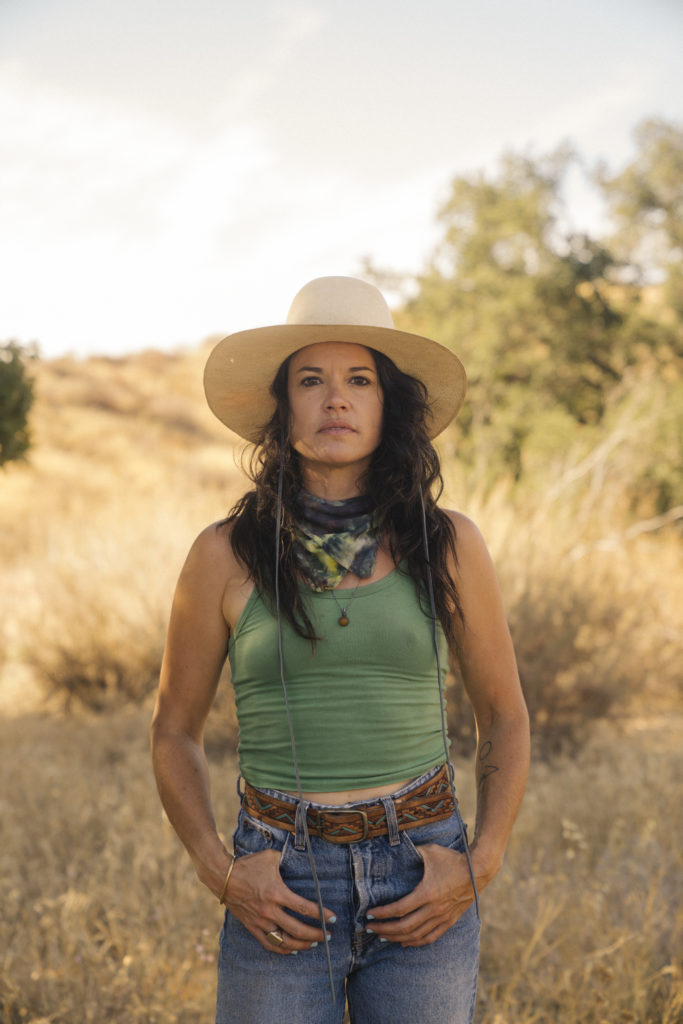
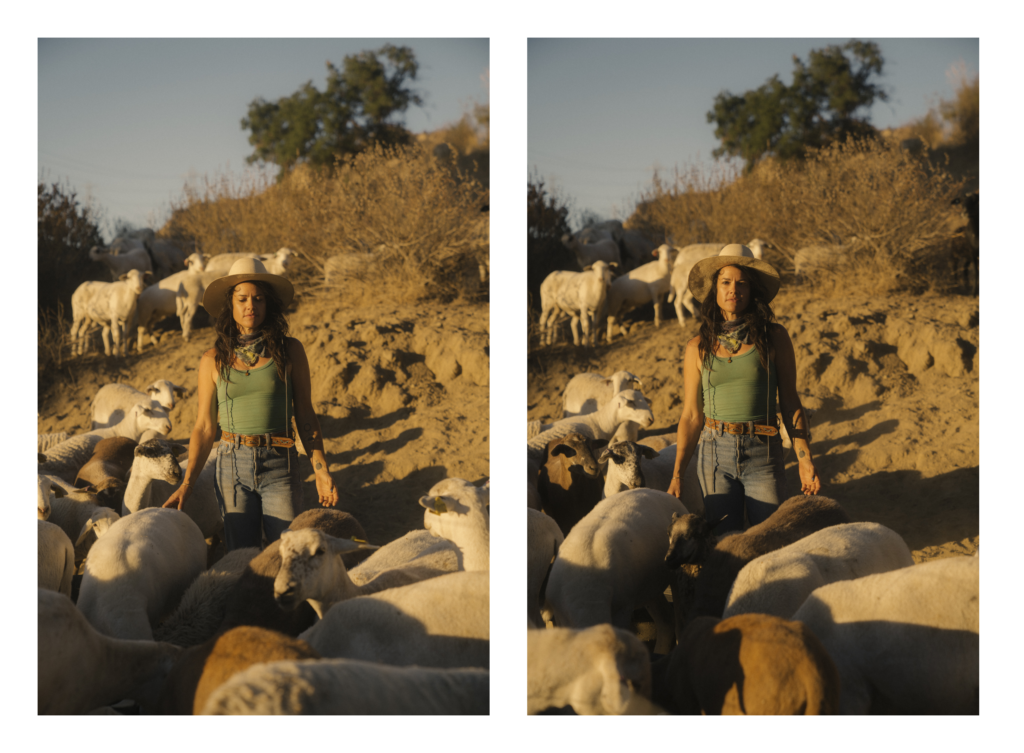
Meet Cole Bush, the shepherdess battling fire season with goats and sheep.
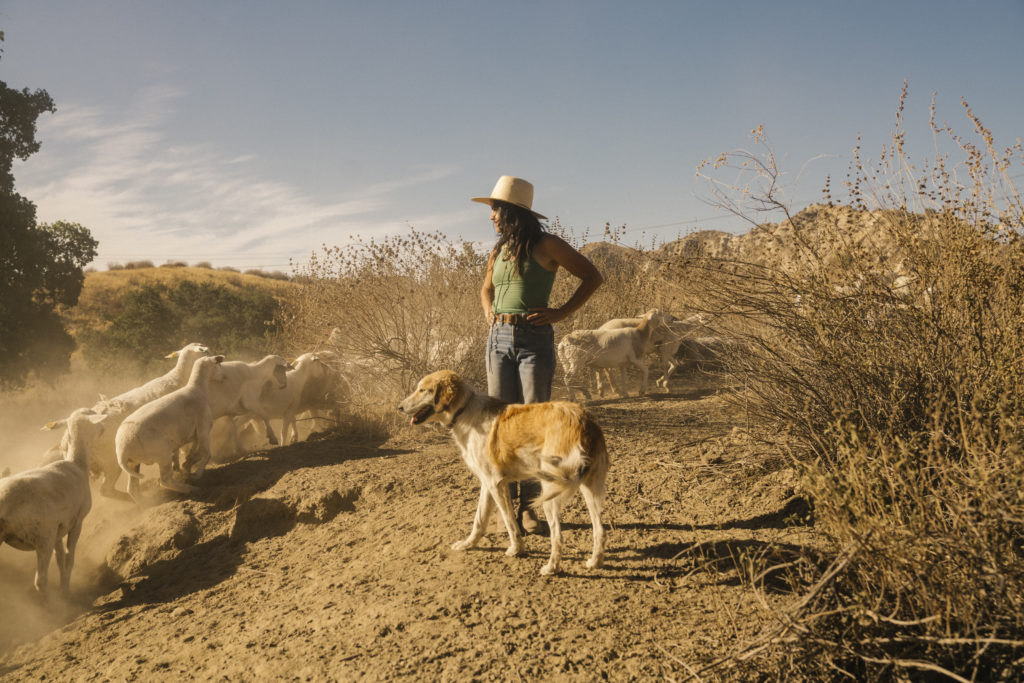
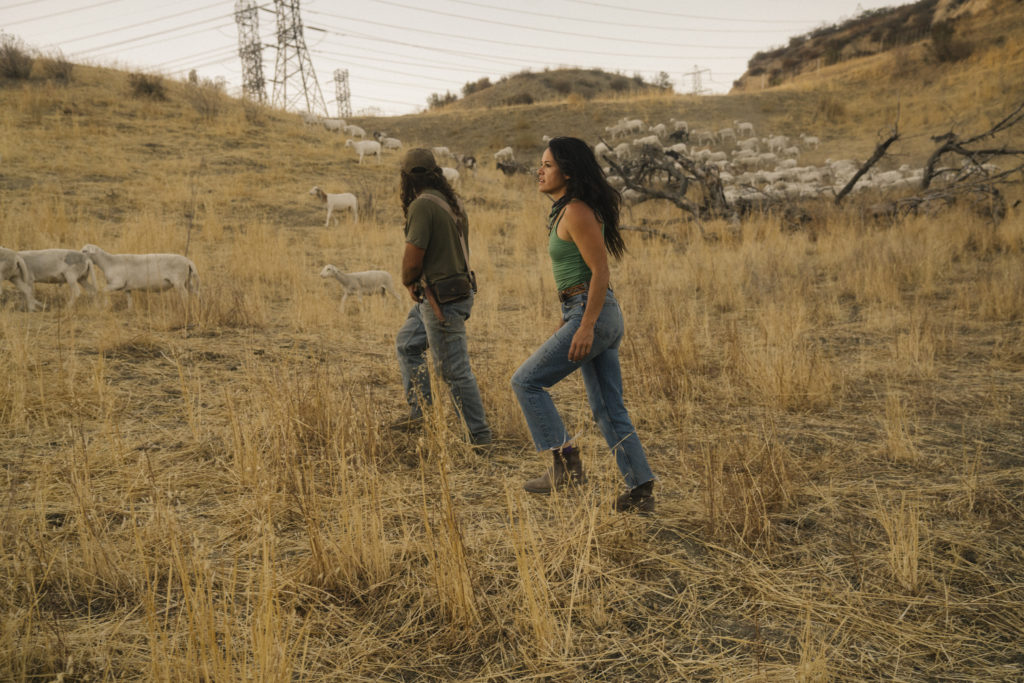
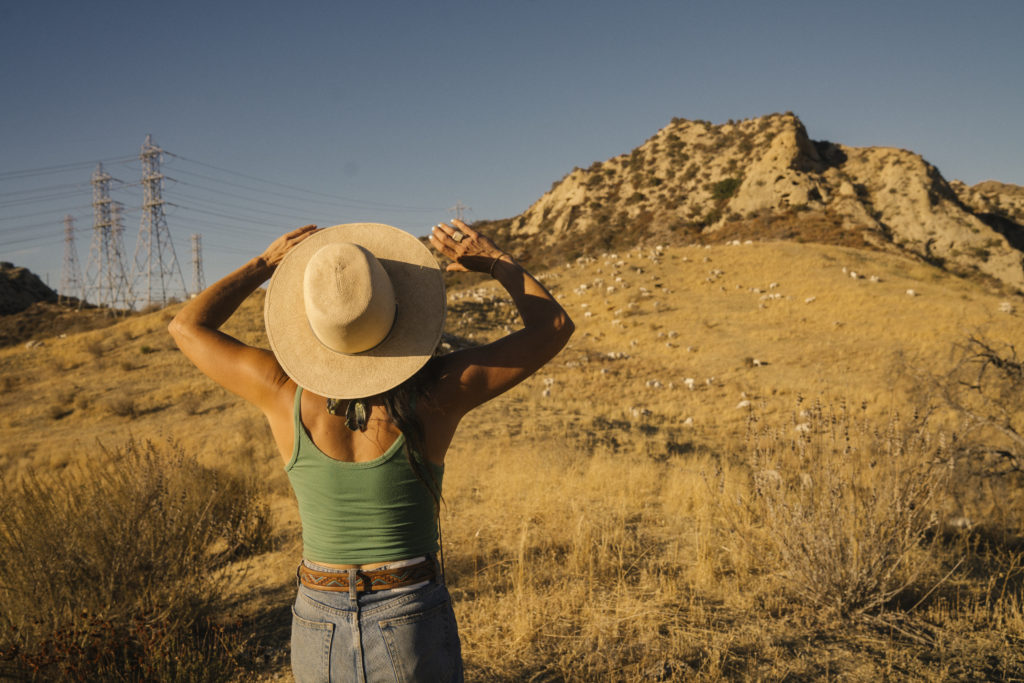
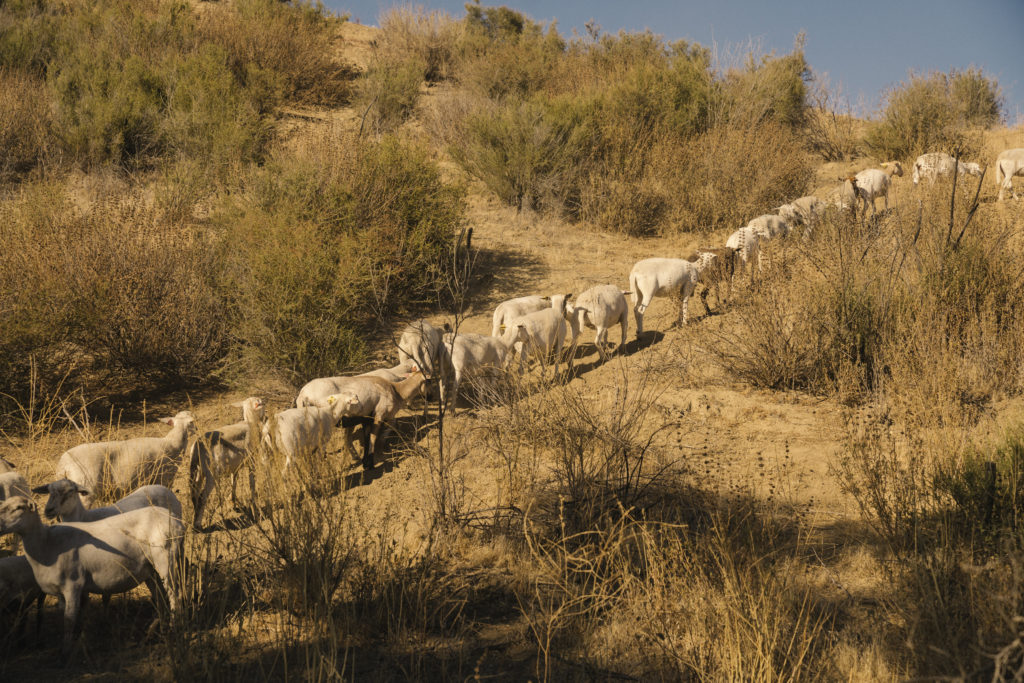
One morning last summer,Cole Bush was high up on a ridge in North Los Angeles County, shepherding her “flerd”—a mixed flock of sheep and herd of goat—from one paddock to another. Normally, this maneuver was routine; but something was wrong. When she turned around, in the distance far below, she spotted a hundred of her goats and sheep: They had slipped off into a high school parking lot and were eating the median. People were already gathering around them. Bush and her team ran down the steep hillside as quickly as they could and found a football coach surveying the scene. She began to explain what was going on: Her animals, now munching away on tufts of grass, weren’t just a prank gone awry. They were there to protect them from fire.
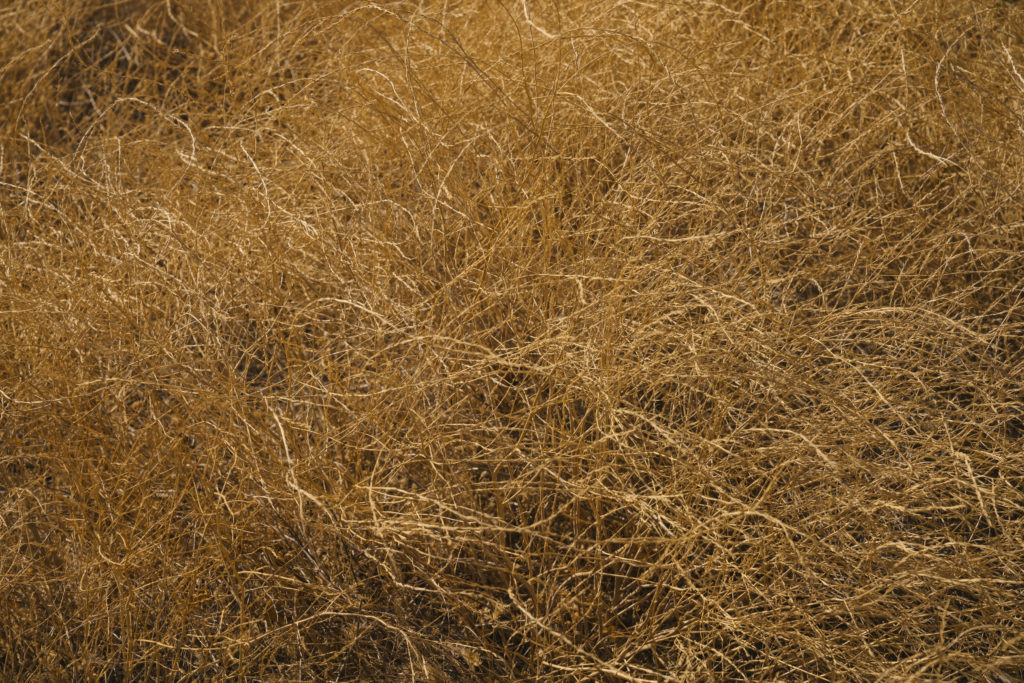
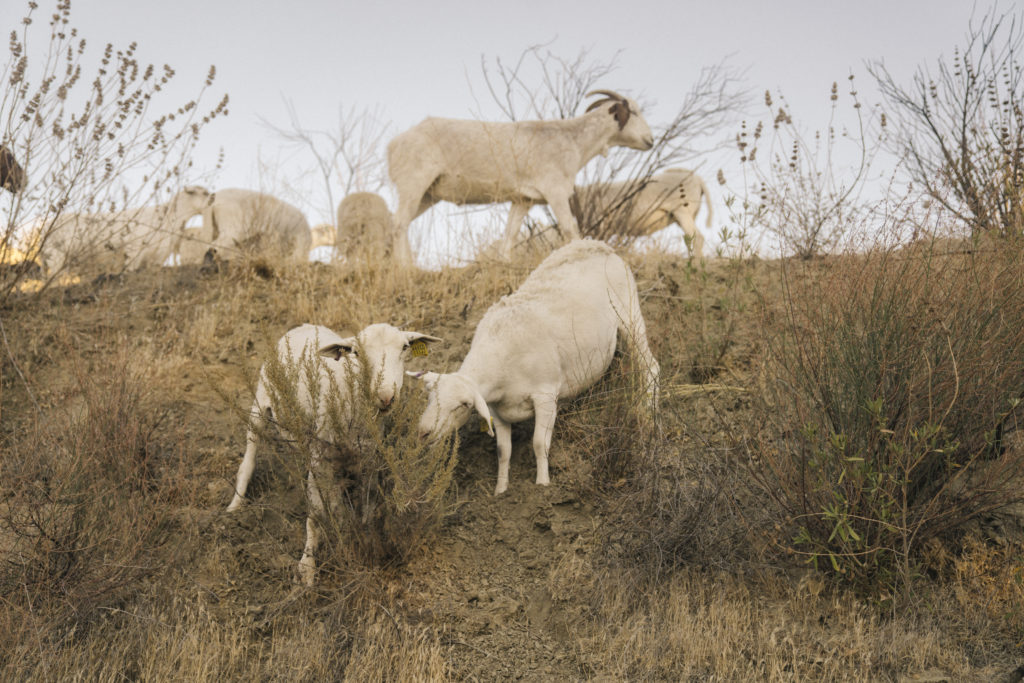
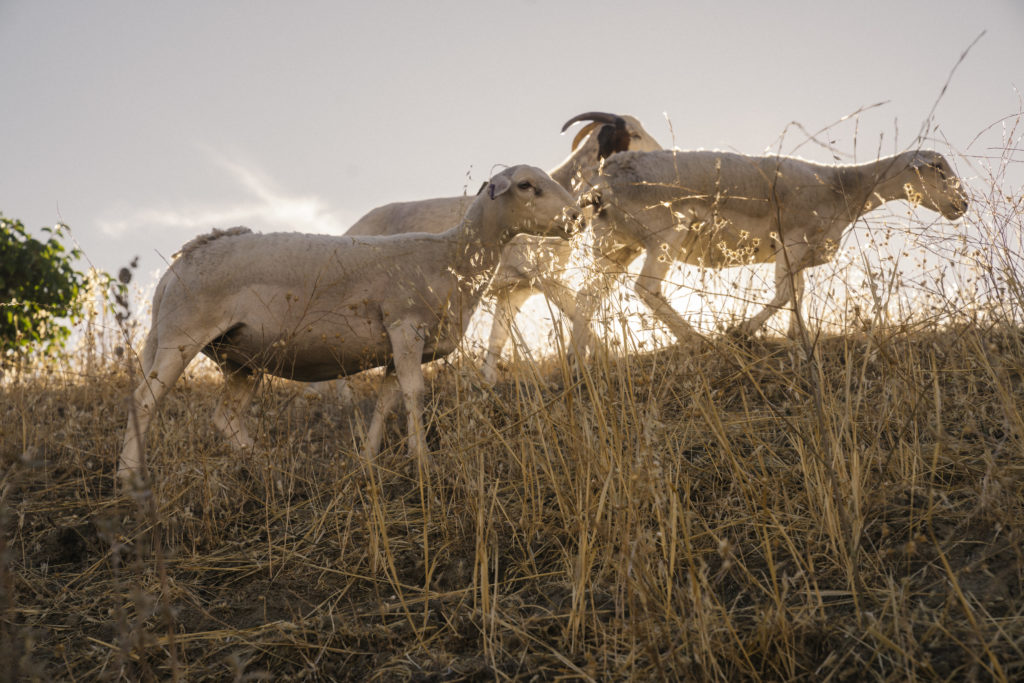
This answer likely surprised him, but Bush—who goes by BCB—explained that the animals were on the clock. Based out of Ojai Valley, in Ventura County, California, Bush’s business, Shepherdess Land and Livestock Co., is a for-hire grazing outfit that focuses on fire prevention and vegetation management. The work they do is tantamount to creating protective force fields; shepherding the flerd to eat brush, weeds, invasive plants—would-be fuel—so that fires won’t move as quickly or get as hot. The grazing is not to eradicate fires, but to ensure they’ll be smaller, more manageable, and to create defensible space.
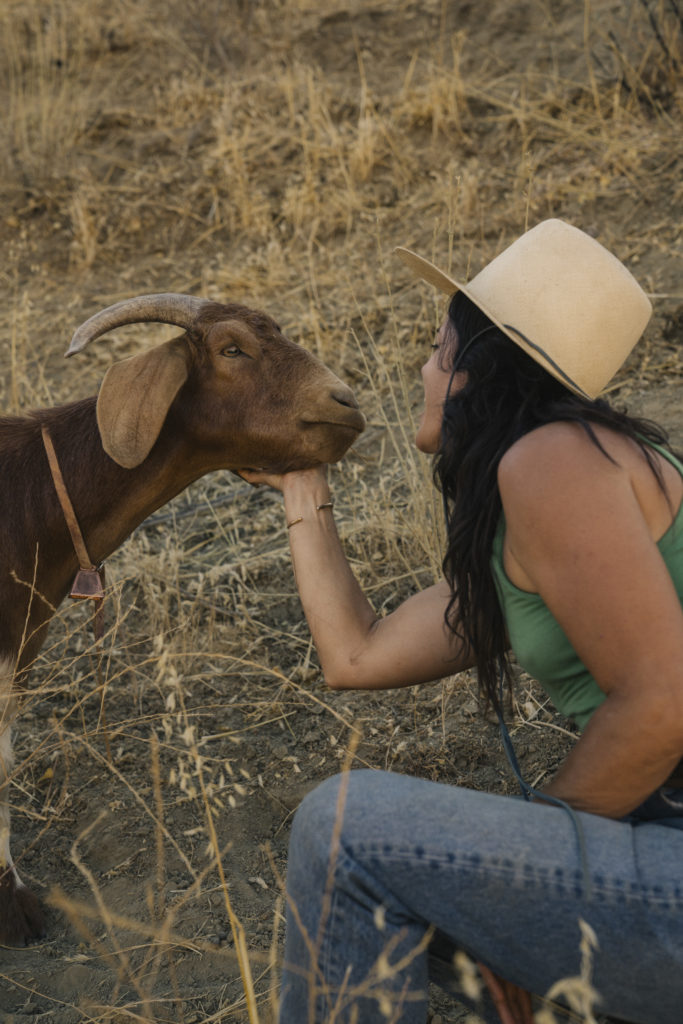
Of course, the animals have no idea they’re rushing against time to prevent the destruction of property, livelihoods, and a potential great extinction. They’re just animals doing animal things; curious, hungry, and content to roam. They have good days and bad depending on the elements; on a hot day they might move more slowly. If there are interesting landscaped yards—or football fields—nearby, they might wander over to get a taste.
Still, they’re highly effective. As they roam, their hooves aerate the soil, making it healthier. They digest plants and turn them into food for the soil when they shit. “Their bodies know so much,” says Bush. From the womb, their gut biomes are prepared as their mothers introduce them to the local weeds and brush. From birth, they begin learning what they need and how to exist with the land; and when they stray, their shepherdess guides them home.
If it seems like an underreaction to employ goats and sheep to combat an ever-expanding fire season, that’s part of the point of Bush’s project. “We have a culture of fear around fire,” she says, when we need to feel empowered against it. And to feel powerful against an element that turns us into shut-ins, that paints the sky otherworldly colors and sends residents fleeing from their homes every year, Bush says, requires us to first re-examine our relationship to the land it ravages.
“A lot of our work is this idea of bridging, of the translation piece,” she says. “We’re at war with the earth when in fact we need to see that we’re a part of it.”
~
Bush grew up in San Diego, the chaparral region of California, a fire-prone ecosystem. In middle school, her family moved to a house in Elfin Forest, just north of the city, which they could afford because the forest itself had burned down.
In the barn, a young Bush could see the smoke stains on the stucco walls. “We lived in the shadows of the aftermath of fire,” she remembers. Even then she understood on some level, despite the ash and the charred remnants of trees, that fire was not a combative element. “How [the ecosystem] has evolved with fire is so important. But the way that we have not actively stewarded or tended to our landscapes has created the devastation of mega wildfires.”
It would be a long road before Bush would realize her place was among the “flerd.” Raised in the Church of Latter-Day Saints, she knew two things by the time she was 20: that she was queer, and that she had to leave the church. Still, she remembers an idyllic childhood. Her family would cross the border to Rosarito almost every Sunday, driving workers from her dad’s LED business home. In Mexico, they’d join them for community dinners, where Bush remembers not wanting to go back to the suburbs, back to the States, where neighbors lived close, but seemed to be strangers to one another.
As Bush began breaking away from the church, she became increasingly hungry for understanding what made groups—and cultures—cohere and thrive. She thought that built environments were the answer. She’d dropped out of college, but returned to school to take classes on the history of civilizations. “All of them c[a]me down to the same demise,” she learned, “which is lack of resources or depletion of resources.” Pivoting her focus, Bush began to gravitate towards agroecology and environmental studies. It was there that she learned about what would later be called regenerative agriculture. Now it’s a buzzword—a shell for many things, often conflated with sustainability—but for Bush, regeneration was tied to the idea of “ancient futures,” of taking lessons and traditions from the past and adapting them to a future sorely in need of change.
And then she met Becky, a border collie who worked at Star Creek Ranch in Santa Cruz County, California. When Becky’s owner had to leave town, Bush adopted her and started working at the ranch alongside her, taking photos of the goats and sheep Becky herded. She began to see the animals’ personalities emerge. The goats were the “bad kids on the block,” and the sheep did, indeed, prefer to stick together. They were also surprisingly sweet with their young. Bush was hooked. The ranch opened a grazing business, called Star Creek Land Stewards, and when it landed its first big contract in 2012, Bush became the project manager. She was 27, in charge of organizing thousands of acres of prescribed grazing.
When the owner wanted to retire and sell the ranch in 2014, Bush helped track down a family that traced its lineage back to European Basque shepherds to buy and run the business. Through them, Bush was helping to reinvigorate a shepherding tradition that had waned after WWII, when demand for wool and mutton fell, followed by another decline in the '60s, as synthetic fibers continued to gain in popularity. In addition to grazing, she started selling high-end hides—repurposing waste from the lamb industry—and began calling herself “a modern-day urban shepherdess.” She had found her calling.
Soon, she took off for Spain and France, where she studied not just shepherding but also the systems that allow young people to become shepherds. She was following in the footsteps of a tradition that had existed long before her; exploring what makes a shepherd a shepherd, and what might attract more people to the work—questions posed by respected researchers like Fred Provenza and Michel Meuret in books she’d studied. She was now certain that she had “sheep and goat in her blood,” and dreamed of a grazing school in California. She created a curriculum and developed a project called The Grazing School of the West despite having no students yet. Someday, she thought, it would be a place where people could work the land with each other, with a community supporting them as they experimented with a vocation that might end up being a life calling, like it was for her. “This ancient vocation somehow persists in contemporary times and will always be a part of humanity,” explains Bush. “Domesticating animals and agriculture is what allowed us to grow as a species on Earth.”
Now, she hoped those same tools might be used to help the species survive.
~
In 2017, the Thomas Fire raged through Southern California, burning nearly two-hundred and ninety-thousand acres of land over the course of a month. The city of Ojai was surrounded by flames, and though they never fully breached its perimeter, they destroyed more than seven-hundred and fifty homes in nearby Ventura and Santa Barbara counties. At the time, it was the largest fire in California’s history—and for Bush, it served as a wake up call.
Ojai Valley was a place Bush felt close to; she’d visited often and found herself more connected to nature there. She saw, too, that Southern California was in need of a new approach to fire, one that would not perpetuate the tropes of fear and flight, losing and winning, burning and rebuilding. It needed something different, something radical but not experimental, something reliable and time-tested. It needed goats, sheep, and shepherds. So, when she opened up her own prescribed grazing outfit in 2020—Shepherdess Land and Livestock Co.—she did it in Ojai.
At the time, she knew she was choosing to “be a part of this crazy capitalist system, go out and make money and create jobs for people so that I can pay them.” It was a risky path, but the goal was always to use the grazing company not only for fire prevention but also to subsidize training for a new generation of shepherds. Bush thinks that there is a boom coming in the U.S.; a wave of people who will be eager to dedicate themselves to the land. But they won’t have the same social safety nets, like shepherds in Europe, to help them as they learn. They’ll need to get paid. Last year, The Grazing School of the West welcomed its first cohort of eight trainees. This year Bush is training six, paying them a livable wage. She hopes to continue to expand the program to include twelve shepherds each year.
When trainees see the flerd for the first time, there is a high-frequency buzz of excitement in the air. When the first goat or sheep wanders off, they panic, thinking they’ll lose the animal. And at some point, the weight of being responsible for so many lives washes over them and the true nature of the work becomes clear. In her letter preparing interested would-be shepherds for the job, Bush warns that the work “will be the HARDEST work you could possibly imagine.” It’s mostly fence-building in one-hundred-degree heat and practicing patience with people who sometimes don’t know the difference between a sheep and a goat. Since it’s rare to be grazing far from private property, Bush has to invest in liability insurance for her flerd—in case they destroy landscaping or wander into the wrong yard or, in the worst case scenario, onto a highway. Not everyone is cut out for those realities, which Bush admits don’t appear on her social media, and leads to a swath of applicants who have never done manual labor but have done a lot of Instagramming. “I made it look way too beautiful and cool,” she says. “And I'm looking at some applicants, and I'm just like, Oh, no, this is an issue.”
Still, Bush is also turning away applicants who would be good fits. “[Prescribed grazing is] a huge burgeoning industry, and the biggest bottleneck is a skilled and trained workforce,” she says. She doesn’t have the resources to expand her program, and no one else seems to either. In Bush’s experience, young folks do want to become shepherds. But she’s left wondering, “What is the barrier to getting these people trained for more businesses and more hands on the ground?” The David vs. Goliath framing, made so common by climate change, leaving smaller actors feeling impotent, weighs on her. “I would say pretty regularly I am overwhelmed with emotion because I just wish I could do more faster,” she says. Twelve new shepherds a year is not going to solve the chaos that’s already happening. And it’s frustrating when there are plenty more than twelve people who want to and could become shepherds.
Lately, with a team she can trust on the ground, Bush has been taking more time away from the day-to-day operations and focusing on education. Usually, and especially with fire, we wait for a fight to make itself plain and then send out the troops, sparing no expense. But there is another way—and Bush is trying to build bridges to decision makers who can help push structural change. In order to scale ideas, it’s all about getting funds from the state level to specific, grassroots level grazing projects, she says. One of her most radical ideas would be to bring goats into prisons, instead of sending inmates to go out and fight fires, a dangerous and grueling task. “Why don't we train inmates to learn how to manage and work with livestock?” Bush asks. “To do the same work that we're doing and also have such incredible healing components with working with animals?” These are the types of ideas she hopes to bring to the table; to prioritize prevention over fear and connection over combativeness.
The numbers don’t seem to be in Bush’s favor, nor does time, as fire season continues to expand; 2.5 million acres of land in California burned in 2021 alone. But that’s the thing about a calling: Once you answer it you have to find your way forward. If a few meetings with assembly members go well, if a few more shepherds learn quickly, then Bush might be able to shift just a few more people’s perception of fire, of animals, of the land. In turn, the path might open a bit wider for the boom of ecological doctors and modern-day shepherds that she sees coming.
With every successful connection made and bridge built, Bush stays hopeful. In the high school parking lot, as she handed the football coach her card and talked to the observers, she quickly diffused a potentially fraught situation. By the end of the day the onlookers were spreading the word that the “flerd” was in the neighborhood with a purpose, and that if anyone found animals suddenly roaming alongside them, they didn’t have to panic; they were exactly where they needed to be.
In the end, Bush considers herself a herder of humans as well as animals. And if nothing else, humans need to figure out how to give ourselves more time, so we might have more chances to adjust. As she writes in her closing line of the letter she sends to prospective shepherds, “It's a daunting world in society these days and the Earth is throwing out all kinds of loud cries for humanity to get a grip. We can do our part even if small and maybe we can herd on together for some time.”
Additional fact checking by Elizabeth Moss.
~
*The Footnotes
Editor’s Note: At The Conversationalist, we understand that no story exists in a vacuum, and every story is built on the work of others before us, whether in ways big or small. We are likewise dedicated to spotlighting the voices of those who have been or continue to be oppressed, disregarded, and/or otherwise silenced, in an effort to reverse centuries of often intentional erasure. Because of this, we have opted to include “footnotes” on certain stories to give readers additional context and reading material where it feels relevant and beneficial.
The women of color writing new narratives in perfumery.
When I travel, my souvenir of choice comes in olfactive form: a TSA-compliant bottle of perfume that embodies the spirit of the place I’m visiting, so that I can return to it later in my mind. One cherished example, from a trip to Tokyo, smells like a cup of green tea enjoyed in the cooling clarity of a shaded garden. To someone who grew up surrounded by tea rituals, it also smells like coming home. At its heart is a photorealistic green tea accord—soft yet assertive, bright and smooth at once, bitterness and sweetness in an entangled dance until the end. The scent was composed by someone who understands tea in all of its kaleidoscopic facets: Satori Osawa, a licensed Japanese tea master and one of the country’s few recognized perfumers. She was also the first East Asian perfumer I’d ever met.
Perfumers, admittedly, are hard to come by. They work in chemistry labs sheltered from the public eye and, for the most part, anonymously. But they also tend to hail from the same small pocket of the world, even though their work caters to audiences all over the globe. Looking at headshots of famous perfumers feels like playing a difficult game of Guess Who: From Jean Claude Ellena (Hermès Terre d’Hermès, Bulgari Thé Vert) to Olivier Cresp (Thierry Mugler Angel, YSL Black Opium), the creators behind some of the biggest household names in perfumery are all born in France—often into perfumer families—and trained there, too.
France is hardly the only place in the world with a rich cultural scent heritage; nevertheless, the traditional perfumer’s mold continues to be cast in the French man’s image. For those who try to challenge this convention, the barriers to entry unpack like nesting dolls: gender, race, nationality, lineage, and, at the heart of it all, access. “When I first started out and wanted to establish my brand name, it was incredibly difficult,” says Chavalia Dunlap-Mwamba, self-taught perfumer and owner of Texas-based fragrance brand Pink MahogHany. Whether it was finding other Black perfumers in the industry to reach out to, or bulk manufacturers and compounders to scale her business, helpful information proved to be scant and elusive. She found herself bootstrapping as a complete outsider.
For many, the barriers to perfumery are also profoundly financial. From minimum order quantities to the price of raw materials—250ml of jasmine absolute, for example, can retail for over a thousand dollars—every aspect of the industry comes with a price tag to choke on. “Perfumery is an expensive hobby, and historically, only the very privileged have been able to partake in it,” says Loreto Remsing, creator of artisan brand LAROMATICA. Learning the tricks of the trade is equally prohibitive, and usually involves moving to France to study at one of its prestigious fragrance institutions. For Remsing, an immigrant to the United States who faced poverty growing up and ended up putting herself through college, a formal perfume education was never an option; and even if it had been, she would have felt out of place. This exclusionary feeling is shared by Lula Curioca, an olfactory artist and perfumer based in Mexico City, and also pushed her to pursue the self-taught route. “[It was] like going against water all the time,” Curioca admits. “I was like, ‘That gate, at the moment, I can’t cross it.’”
In conversations about the industry, this image of gates comes up time and time again. “[Historically,] women of color haven’t been given the opportunity to come up in perfumery,” says Yosh Han, self-taught perfumer and creative director at Scent Trunk, a fragrance publishing house. “Many have been in marketing or sales roles only.” Disregarding the rules of convention, she launched her eponymous perfume brand in 2004, as an Asian-American female with no formal training. She recalls the industry reception being one of shock: “Everybody was like, ‘Who the fuck is this girl?’” Han, who now champions other independent and self-taught perfumers by commissioning their work for Scent Trunk, is a vocal advocate for doing things the untraditional way. She likens it to good cooking: talent can come from any kitchen, not just Le Cordon Bleu’s.
Access through the well-trodden pathways, too, comes with asterisks and caveats for those who do not fit the profile. “It’s really guarded. And still, despite what a huge industry it is,” says Anne Serrano-McClain, founder of independent perfume brand MCMC Fragrances. She’s what the industry dubs “classically” trained, through a year-long professional degree offered by the Grasse Institute of Perfumery (GIP), a rarefied and renowned perfume school located in the South of France, that only accepts 12 students a year. When she enrolled in 2009, most of her fellow students were from Europe, with familial ties to the industry; one of them was the aforementioned Olivier Cresp’s son. “You are expected in the industry to follow a very particular path,” she says. “I walked away with the technical skills, but I also walked away with this understanding that made me passionate [about] breaking that mold a little bit.”
Dana El Masri, a Lebanese-Egyptian-Canadian perfumer who launched her line Jazmin Saraï shortly after graduating from GIP, recalls clashing with her French teachers and classmates throughout her time there. Often, it came down to cultural differences as a person of color in a traditional Euro-centric environment. In one instance, while working on a group project for a perfume that she was leading—inspired by a luxury hotel in Siwa, an oasis in northern Egypt—her unusual choice of fragrance materials was called into question as being “too oriental.”
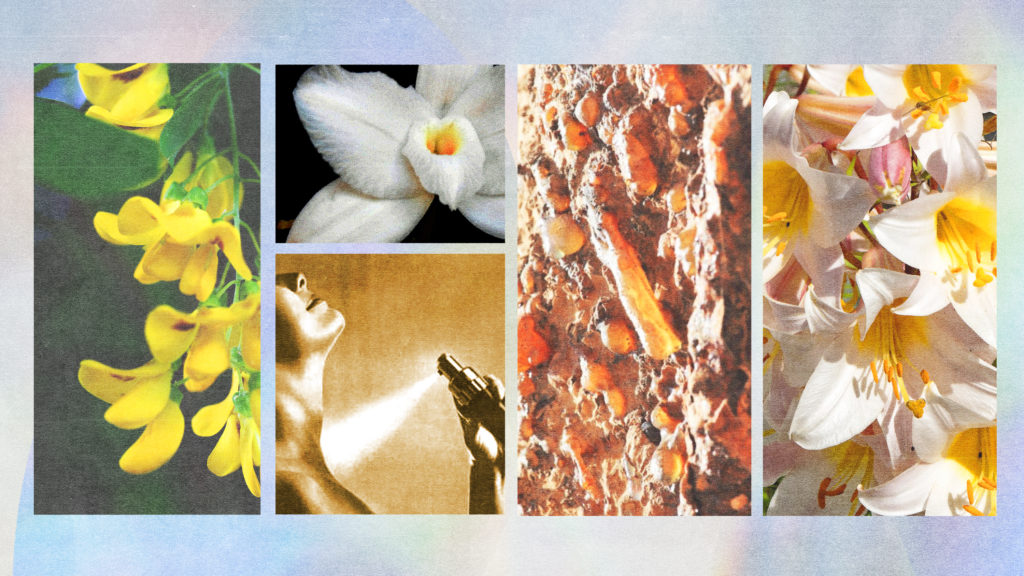
Here, “oriental” is accompanied by emphatic air quotes. Until recently, the term was a part of the perfume industry taxonomy—a fragrance family that encapsulates scents with warm, resinous, spicy facets, featuring materials such as vanilla, labdanum, and tonka bean. The classification has always played an othering role in perfumery, used to describe scents that represented fantasies of foreign places. “It means nothing from an olfactory perspective,” El Masri explains. “You can eliminate it entirely and break it down into balsamic, ambery, powdery, and gourmand.” In school, she was praised for being skilled at making “oriental” perfumes—until those compositions started to smell too foreign. “We were playing around with materials that you find in ancient Egypt. So I was using myrrh, I was playing with papyrus. Palm frond. Carob. Jasmine,” she recounts. “So yeah, it was going to be a little ‘oriental.’”
Today, due to growing pressure from industry advocates—including many of the perfumers featured here—a term that was once deemed part of perfume tradition is now understood as terribly outdated and offensive. In 2021, the perfume database Fragrances of the World updated all instances of “oriental” to “amber,” as did the perfume encyclopedia Fragrantica. Some brands and retailers followed suit. Still, many haven’t, and the industry remains riddled with disparity and ripe for change. “If a [fragrance] company cannot acknowledge a word description because they’re upholding colonial white supremacist beliefs,” asks Han, “how is a woman of color ever going to get to leadership positions?”
To amplify and uplift the presence of BIPOC creators within the industry, Han, El Masri, and their network of advocates have assembled resources like Decolonize Scent and the Diverse Talent in Fragrance & Perfumery Database. It is, after all, in perfume companies’ best interests to expand their pool of talent; diversity begets innovation and creativity. And when perfumers are hired from all over the world, not just the microclimates of the South of France, they distill their experiences and unique olfactive associations into their work. “When you bring in women of color, you are bringing in unique cultural experiences, traditions, history, heritage, and stories,” says Remsing, who attributes the inspiration for some of her creations to a childhood of living on isolated farms, surrounded by herbs, plants, and folk medicine.
Before I had the chance to visit Satori Osawa, I had smelled a dozen green tea scents—all pleasant and lovely, but none that hooked me by the heart. When I smelled her specific translation of green tea—with the sparkle of a portrait painted by a person who loves the subject—the rest of them dropped out of qualification.
Perfumes have always been prized for their transportive properties, how they allow us to return to a beloved memory, or armchair travel to new surroundings. This is why fragrance marketing copy is saturated with references to fabled worlds and exotic destinations, to odysseys and adventures. But as the olfactory terrain of fragrance becomes more and more diverse, those responsible for creating these concepts remain the same.
To the brands who capitalize on the allure of the unfamiliar yet default to working with the old guard, El Masri presents an alternative perspective: “Don't you think you're going to get more of an accurate and potentially even more soulful, passionate, connected interpretation of what you're trying to express,” she asks, “if it was made with a local [perfumer] or someone who understands the culture on a much deeper level?” This is not to say that only people who’ve lived those experiences should get to tell their stories, El Masri clarifies. “I’m just saying that we need to give those people that chance.”
For the women who’ve plodded their own paths in perfumery, a shared belief is the moral imperative to create more opportunities for the scent-curious, whomever they may be. Dunlap-Mwamba, who also works as an educator, sees it as more than a DE&I concern—it’s the missing representation that helps close gaps for the next generation. “My mission is to create more visibility for perfumers of color,” she says. “Because what happened with me is that I didn’t know this space existed until I was grown.” If fragrance became incorporated into elementary school curriculums alongside electives like art or dance, she suggests, students would be exposed to the different facets of the fragrance industry at a younger age—which broadens their avenues in the job market.
Serrano-McClain has a similar mission: to pass on her technical training from the GIP to those in less privileged positions. “We don’t treat perfume like it’s accessible art,” she says. “And we could do more of that.” She had previously taught a perfume class at a local youth engagement center, and recalls being impressed with the wealth of olfactive ideas that her teenage students brought to the table—evidence that good ideas in perfumery can come from anywhere, at any age. But what is understood for other artistic mediums—that capital and institutional training are not prerequisites to great art—still pushes the boundaries of this one.
One of the silver linings of the pandemic is how it has normalized and democratized online education—and that includes more remote perfume courses, previously rarely offered. Organizations dedicated to accessible scent education and experimentation, such as the Institute for Art and Olfaction (IAO) in Los Angeles, make it easier than ever to dabble in the art and science of smells. Curioca, who herself learned to make perfume through sessions at the IAO, offered advice for other outsiders with interest in the industry who are unsure of where to begin: “If you want to, you’ll find a way. Maybe it’s slower. Maybe it’s different. Your own path will find you—you just need to let yourself be guided.”
As they say in the industry: Just follow your nose.
[post_title] => Follow Her Nose
[post_excerpt] => The women of color rewriting the narratives of perfume.
[post_status] => publish
[comment_status] => open
[ping_status] => open
[post_password] =>
[post_name] => follow-her-nose-woc-perfumers
[to_ping] =>
[pinged] =>
[post_modified] => 2024-08-28 21:15:12
[post_modified_gmt] => 2024-08-28 21:15:12
[post_content_filtered] =>
[post_parent] => 0
[guid] => https://conversationalist.org/?p=4229
[menu_order] => 121
[post_type] => post
[post_mime_type] =>
[comment_count] => 0
[filter] => raw
)
“Old Friends” is an ongoing series exploring the many ways that friendship changes shape in adulthood.
“My friend Rachel is getting married.”
I say the words in my head, and out loud, and marvel at the way the syllables align; laugh a bit at the obvious joke about the 2008 movie; pull my mouth into a half-smile as I imagine Rachel as I knew her best, someone I sat with during tenth grade biology and who gifted me so many of the foundational touchstones of my personhood now. Rachel, goofy and unguarded and easily earnest, who spurred me to be my weirdest and wildest self. Rachel, who introduced me to Britpop; who introduced me to a lot of music, actually, including the artist Annie, whose song “Heartbeat” is a top five for sure. Rachel, who taught me to be funny in the exact way that would make her giggle, an expression and sound I can picture without any dimming over the distance of space and time.
The thing is, I haven’t seen Rachel in person in over a decade. Before this past year, the last time I’d spoken to her was back in 2017, when our friend L, who’d sat at that same bio table, passed away, and knowing that she and L had been as close as sisters, I’d reached out to Rachel over a flurry of texts. We made the kind of promises that happen over death, to be more present and ready for each other in the now. And I thought I’d meant it, but I couldn’t follow through. When everyone descended back on our hometown for the funeral, I demurred, citing life and time and work—and did I mention life?—letting the memory of who I was to them attend instead.
There were real reasons why I didn’t go back. I was in the throes of an internal gender crisis as I assessed and tried to repress my rejection of womanhood, a bridle bit that was carving a waterfall of blood from my metallic mouth. I was still reeling from a big move—out of Los Angeles, my home for seven years, and into a domicile with the man who’d become my spouse—and hadn’t quite found my footing, financially and otherwise, in this new place. But the most elemental reason I didn’t go back to New Jersey was that I didn’t know what to say to the friends I’d essentially left behind when I moved to California and decided to become the person I couldn’t be back home. Back where I knew and loved them. Back where I maybe not loved, but at least thought I knew, myself.
~
Four years later, death is what brings me back to Rachel again. She’d always been attuned to what one might call the “pop girls,” and in the early 2000s, that included Girls Aloud, the British girl group whose impact and influence never quite crossed the Atlantic like their most popular predecessors the Spice Girls' had. Rachel had made a hagiography out of their music and careers—as a group, as individuals—with the expertise of a stan, which she was. And then, last fall, one of the members of Girls Aloud passed away suddenly, at an age where your first reaction is, “That’s too young.”
I read the headline on the music blog I’ve been reading since high school and felt the impact in two waves: first, a sharp kick in the throat, and then, a dull pang tunneling through my chest cavity and into my gut, where it settled into the heavy, heady ache of guilt. I needed to tell Rachel. Did she already know? Did she still care? Would she want to talk about it with me, and could this transparent bid for reconnection actually in turn open the door for us to discuss everything I now knew about myself and everything I didn’t know about her?
~
We fell out over a boy, or at least that’s how I framed it. After my high school ex and I broke up, he’d stayed on the East Coast for college like most of the people I’d gone to school with and made plans with them and reached out to them and made them feel wanted and seen, and that included Rachel. Meanwhile, I’d crossed the country and immediately began my free bitch makeover montage, seeking nothing less than sublimation, to seem cooler, smarter, more self-possessed than I’d ever felt in the town where I’d grown up, to leave my body behind and diffuse into a sun-baptized spirit. I quite literally tried to shed my body of its mass, its baggage, its racialized cocoon, to cultivate the effortless, weightless glow of success and satisfaction that’d make people look at me, want me, and maybe even accept me. No wonder my ex broke up with me over a video call right before Halloween our freshman year; no wonder my attempts at conversations with my once-best friends became buckshot in sparse forests, doves with clipped wings released to their doom, cursory “happy birthday”s and then merciful silence. It didn’t matter that our high school friend group started to break apart on its own, that many of the friends my ex had “won” in the breakup custody battle didn’t stay friends with him or each other. I surrendered my past completely, and more than anyone else, I surrendered Rachel.
Honestly, the loss of most of those friendships was for the best. And eventually, I figured out how to become the kind of person I wanted to be without brutalizing myself for the achievement of that want. But I never got over Rachel, who was one of the only people I knew from back then who went on to work in the entertainment world, too; whose influence in my life goes down to my marrow.
I went alone to a Robyn concert and thought, “Rachel would’ve gone with me.” I went to parties and wondered what she’d think of their soundtracks, because she was the one who’d taught me how to listen to—really listen to—and contextualize music. In many ways, she was my shadow sensei and my twin, not in the biological sense but in the Hilton Als essayistic way. A mirrored soul, someone who knew how to draw the best of me out of myself.
I’d never told her any of this because nobody we grew up with talked about friendship like that. But maybe we’d always picked up a singular frequency from each other. When I heard through the grapevine that she’d come out in college, I yearned to tell her that I understood even though I hadn’t come out in my own way to myself then. When I did come out, I’d often imagine, unbidden, how I would break the news to her. How she’d process it; whether she’d recoil from or reach for me, whether she’d still recognize our similarities despite the new difference between us.
~
I stared at the headline and imagined a world where I took my regret to the grave, and texted her something that, between the lines, simply said: I miss you, I miss you, I miss you.
We talked for what felt like and actually was hours. Her girlfriend-now-fiancée had to remind her of the life outside our impassioned recollections and brutal revelations. Our mutual admirations and jealousies and drafted but scrapped overtures. She asked me what happened back then, and I told her with no shame or fear or gloss, the kind of honesty we’d never achieved as friends.
And really, we’re barely friends now. I don’t know the rhythms of her day-to-day life and she doesn’t know mine. We haven’t talked at length since that first outpouring, but we both agreed that all we could do was keep placing stones in the river that’d grown between us. I text her every time I think of her and she does the same. She’s back into British girl pop again and told me when she sang Little Mix at karaoke. I asked her for her address to send her flowers for her engagement though I’m not (and didn’t/don’t expect to be) invited to whatever ceremony she’s got planned. I won’t be in New York for a while and she won’t be in California anytime soon, but the door is open if/when one of us crosses over the same expanse that’d once divided us.
I want to shake my younger self by the shoulders and tell her/them that the only thing that ever kept me from rekindling these kinds of connections was my own damn ego, so fixated on the idea that something was broken that I couldn’t imagine reforging it into not the thing it was, but the thing it could be. I want to leap across the country and shake Rachel’s shoulders and promise, really promise, that I won’t let our friendship become a memory again. I want to watch her face morph with indescribable emotion as she sees me and I want to know she sees my face go through the same.
Maybe I’m coming on too strong. It’s true, whirlwind courtships have slimmer odds than ones that grow from deeply planted roots. So here I am, enriching the soil; soon, though, I hope to have more flowers for her.
[post_title] => How Do You Reconnect with Someone You Haven't Spoken to in a Decade?
[post_excerpt] =>
[post_status] => publish
[comment_status] => open
[ping_status] => open
[post_password] =>
[post_name] => how-to-reconnect-with-someone-you-havent-spoken-to-in-a-decade
[to_ping] =>
[pinged] =>
[post_modified] => 2024-08-28 21:15:12
[post_modified_gmt] => 2024-08-28 21:15:12
[post_content_filtered] =>
[post_parent] => 0
[guid] => https://conversationalist.org/?p=4729
[menu_order] => 122
[post_type] => post
[post_mime_type] =>
[comment_count] => 0
[filter] => raw
)
In my 20s, this question consumed me. Then, I asked a better one.
“Old Friends” is an ongoing series exploring the many ways that friendship changes shape in adulthood.
At the nadir of the Great Recession, as I prepared to hurl my about-to-graduate self into a labor pool that looked more like a quicksand pit, my many preoccupations about the future—Where would I live? How would I pay the bills? What would I do, in both a cosmic and literal sense?—were always overshadowed by a quietly devastating question: Why don’t I have any friends?
The thought was born of confusion more than self-pity. I had plenty of flaws, yes, but I wasn’t a uniquely unlikeable person, nor an especially cruel or boring or stupid one. At no point had I ever made a conscious decision to reject friendships; in fact, I craved them with a somewhat pathetic sincerity. Yet, for whatever reason, most days I woke up feeling deeply alone and went to bed feeling the same way.
Soon I’d learn this was normal, that feeling like you have no friends is one of the most universal experiences of being an adult in the 21st century. Every year there’s a new study that quantifies our collective loneliness. The specific statistics are irrelevant, the takeaways interchangeable. The numbers say little we don’t already know. Who needs an expert to explain that a society built around perpetual, exponential growth must demand ever-greater exertion and attention from an increasingly exhausted population, and that this state of affairs sucks ass?
On some level it was nice to know my misery had company. But not that nice. It certainly wasn’t enough to allay my fear that I was trying my best to make friends and failing miserably. No matter how often (or where) I put myself out there, I had nothing to show for it. Desperation is a stinky cologne, and it often felt like the more I yearned for friendship, the faster people ran away from me. After two years of playing pickup basketball at the local YMCA, I’d bonded with zero other humans. My weekly trips to the meditation center were wonderful, but even joining a “Dharma Friends” group didn’t yield any actual friends. I chatted with classmates in the halls after lectures and struck up conversations with strangers at the bus stop, often with the promise that we’d grab a drink later. We never wound up grabbing a drink later.
My inability to make friends would’ve made more sense if I’d been a “real” adult, I reasoned. If I’d had the excuse of a kid who ate up all my free time, or a career that chained me to a desk. It would’ve made more sense if I’d just moved to the area: Minnesota isnotoriously inhospitableto newcomers. None of this was true, though. The only remaining explanation? The problem was me.
In hindsight, I think this was correct, but not for the reasons I imagined.
Compared with all the time 21-year old me spent pondering why I didn’t have any friends, I spent very little wondering how I might be a good friend to others. I don’t think I was unique in this regard: Young people are typically (if not always accurately) regarded as self-centered. In any case, my own needs were so urgent and ravenous that I had no brain space to contemplate the needs of anyone else. My obsession with having friends made me poorly suited to be one myself.
Another thing I’d rarely considered was if the question of Why don’t I have any friends? waseven valid. It’s not like nobody was ever nice to me. The YMCA basketball guys, for example, may not have invited me over to play video games—but we did spend 5-10 hours a week hooping together, cracking jokes and talking good-natured smack. And some of the people I’d met at the meditation center had shown me remarkable kindness. There was the yoga teacher who’d stay after class to help me practice headstands (and, much to my surprise, commiserate about trying to quit smoking). Or the avuncular gentleman who carved me a beautiful portable altar after I told him I was moving to South Korea. I remember admiring the wood’s live edge and choking up as he hugged me goodbye. Isn’t that something friends would do, even if we’d never hit the bars together?
And then, a strange thing happened: I left the place I’d spent most of my life and promptly made a bunch of friends.
The change of scenery didn’t hurt, and finally having a small-but-steady source of income wasn’t bad either. (How invisible you can feel in a city when you have no money, and how limited your options for socializing become when a $5 drink is beyond your budget!) On Thursday nights, we’d have barbecue feasts and sing karaoke; on weekends we’d go to mud festivals or lewd sculpture parks. At last my life was full of the friendship I’d craved, the bubbly and adventurous camaraderie of beer commercials and Benetton ads. This miracle didn’t happen because I somehow got smarter or funnier or cooler, though—all the attributes I’d thought were essential for having friends. Instead, I’m pretty sure it happened because I got more curious about other peoples’ lives and less obsessed with my own.
Looking back, it feels unsatisfying to say that my reintroduction to friendship came thanks to a change in my material conditions. People can’t just pack up and move if they feel alone in their town or city, and finding a decent job has always been easier said than done. But it feels equally unsatisfying to say it happened because I shifted how I thought about things—as if the only thing standing between me and a brunch table full of chums was a pinch of positive thinking.
When it comes to making friends as an adult, the deck is indeed stacked against us. It’s not just me: This is a shitty and difficult time to be alive. Life under a hypercompetitive capitalist regime is hostile to the conditions that make friendships possible. We have little free time for long meandering chats, and we have few nice public spaces in which to have them. We’re taught from birth to view ourselves as consumers and competitors. We’re punished for having any vulnerabilities. You could say this makes friendship more urgent than ever… but when hasn’t it been urgent?
All these points are true in a big picture sense, which made it essential (in my case, at least) to ignore the big picture. Ignoring stuff tends to get a bad rap—but for me it was an act of liberation instead of neglect. When I started paying less attention to my own neuroses about friendship and the structural reasons it felt so out of reach, I had more time and energy to pay attention to other people. I started to notice little things about the ways they talked, moved, thought, ate. This was genuinely interesting to me, and it turned out that taking an interest in others was a good way to get them interested in me, too. Not all the time, but often enough that I felt less alone.
In the decade-plus since my existential friend crisis, my thoughts about friendship have changed so much they might as well belong to a different person. My urge to impress morphed into an urge to care. This shift didn’t happen because I gritted my teeth and tried extra hard to be nicer; it came when I took a break from beating myself up to notice all the fascinating humans moving around me. There’s an old Buddhist joke that goes, “Don’t just do something, sit there.” And as silly as it might sound, not trying to fix my friend problem was the first and most important step to letting it fade away.
I wish I could go back and explain all this to about-to-graduate me, but who knows if he would have listened. Maybe he had to experience it all firsthand for himself. Better late than never, though, and better now than even later. What a blessing it is to realize that we don’t have to be better to be worthy of friendship. What a relief to know that flowers bloom even if we don’t pull them up by their petals.
[post_title] => "Why Don't I Have Any Friends?"
[post_excerpt] =>
[post_status] => publish
[comment_status] => open
[ping_status] => open
[post_password] =>
[post_name] => why-dont-i-have-any-friends-culture
[to_ping] =>
[pinged] =>
[post_modified] => 2024-08-28 21:15:12
[post_modified_gmt] => 2024-08-28 21:15:12
[post_content_filtered] =>
[post_parent] => 0
[guid] => https://conversationalist.org/?p=4690
[menu_order] => 123
[post_type] => post
[post_mime_type] =>
[comment_count] => 0
[filter] => raw
)
A survey of 12-year-olds to early 20-somethings in the US.
This article is a companion piece. If you’re curious to learn how older people feel about the state of the world, click here.
We’re more than two years deep into a pandemic, and if it feels like we’re moving backwards, it’s because in many ways, we are.
In 2022 alone, there have been over 300 mass shootings in the US. Earlier this summer, in a historic decision, the Supreme Court overturned Roe v. Wade, immediately impacting the reproductive rights of millions. Meanwhile, global temperatures have reached dangerous, record-breaking highs, and if we squint into the horizon, all signs point to an imminent recession, where young people seeking employment will undoubtedly be among those hit the hardest.
Oh, and did we mention we’re still living amid a deadly virus that continues to take lives each day?
The Conversationalist asked young people from various parts of the country their thoughts on the state of the world right now. Which issues are overwhelming them the most? What kinds of discussions are they having with their friends? How do they feel about the future? Is it all doom and gloom?
Here’s what they had to say, in their own words.
~
“Turning on the news and seeing the violence in this world is not a surprise anymore. It's not even sad because I expect it. What scares me now is going to places where I can't find the nearest exit if I need to flee quickly. My home city of Chicago is now looked down upon by America as crime central. When I tell people I live in the suburbs of Chicago they gasp as if I'm in danger.
I remember flinching at school when I heard a student squeeze open their chip bag, resulting in a loud popping noise. My heart skipped a beat and my mind immediately thought of the worst. Within seconds I was asking myself, Where is the noise coming from? Is it safe to stay where I am? How did the intruder get into the school? All from a kid’s chip bag making a loud popping noise. I shouldn't be thinking that way. It shouldn't be a habit for me, a 17-year-old, to look for the nearest exit in every public place I go to.
I just want to be shocked when I turn on the news channels again.”
—Amanda, 17, suburbs of Chicago
“Not only is there more fear in the world with monkeypox currently, specifically in New York, climate change is also only giving us about eight more years before there is no turning back. This is extremely worrisome because Americans aren’t doing anything about this and we only have so much time before our ecosystems become more fragile than ever.
Overall, as someone within the generation that has to suffer most from these current issues, this is very concerning for not only our well-being but our physical health. We need to take the appropriate measures to prevent further conflict.”
—Juliette, 15, New York, NY
“I’m finishing up my senior year in the fall at Penn State University. From my vantage point, the recent Dobbs decision has stirred up an immense amount of emotion from all sides of the spectrum and both sides of the coin, so to speak. College-aged women and female students that I interact with are overwhelmingly disturbed and frightened—they are fired up and want to help right the ship to protect abortion access for themselves and, in the case of the few pro-life women, for others. I work in local political organizing and one way to communicate with pro-life women in particular is to remind them that while they may not choose to have an abortion, their friends may face situations where they need one—and bringing the hot-button issue to a hyper-personal level really helps some people understand that they should not be so anti-choice.
For men, a general sense of confusion and passive worrisome behavior is the vibe that I’m getting. My guy friends in particular tend NOT to be split among party lines with abortion—a lot of them think it’s stupid to tell women they can’t do something, while others are afraid that their female partners may not have the birth control/contraceptives they need to continue a sexual relationship.
My fear is that despite the level of concern and anger at this decision, people my age will not care enough to vote in the large numbers that we need to actually change things. [We] can’t change SCOTUS, but can sure as hell change our state legislatures and Congress. That’s why I’m getting as involved as I can to spread the word to students and folks my age that this election is undeniably the most important of our lifetimes, and that at the very least you need to vote.”
—Josh, 21, State College, PA
“With everything happening in our political climate, the one word that can't escape my mind is 'division.’ With all of the constant discord going about through the media, it's hard to ignore.
I've noticed that the in-person conversations I've shared with people of differing views from me have been much more productive than online ones, whether it be in my classes or at group hangouts. I believe a considerable problem our generation is facing is a lack of personal connection stemming from social media playing a much more significant role in our day-to-day lives. The more that I've realized the adverse side effects of social media, the more attempts I've made to stray away from it. I've deleted Twitter, TikTok, and Facebook with the goal of doing away with it entirely. It's too stressful and time-consuming, and I've also found my mental health to be better in my time away from it.
I can't help but have my worries about our society's collapse. It's very taxing on me to see so much nonstop negative news.”
—Tommy, 18, Worthington, OH
“I’m feeling a bit agitated with how we talk about mental health on the internet and social media lately. I’m not saying that mental health awareness is bad. I just think that with anything that becomes mainstream, it loses any much-needed nuance and seriousness. And that’s what has happened with mental health awareness. You can see it happening in so many forms, whether it’s brands trying to capitalize off of it, down to those stupid ‘Little Miss Whatever’ memes, or any other insert-yourself-here gimmick. All of it totally downplays how serious mental health is and buries any useful resources, turning mental health awareness into another throwaway talking point.”
—Margot, 19, Boston, MA
“I live in Jacksonville, Florida but attend school in Ohio. I’m pursuing a degree in fashion and am thankful that most opportunities in fashion do take place in more blue states like New York and California. However, that doesn’t take away my fear of what the future holds.
While New York, specifically NYC, and California are states that I believe do well in protecting the rights of their citizens, they are also some of the most expensive places to live. Fashion is not one of the best industries in terms of high salaries and affordable wages––at least compared to the cost of living in the places where the industry is best established.
But even more than that, reproductive rights are a major concern for me. The mere thought of me unintentionally getting pregnant and not even having the option to decide how I want to go about my health has me petrified and runs through my mind constantly. I’m truly at the point where I don’t think I’m even going to consider looking into jobs and companies that are located in red states. To make matters worse, we’re living in a system ruled by a Supreme Court that just took a major blow to combating the climate crisis and agreed to hear a case that heavily impacts voting rights, which would just be another major step in the seemingly decline of democracy.
I’m very worried about the future, which really sucks because I feel like this is the time that I should be looking forward to it the most.”
—Janelle, 21, Jacksonville, FL
“Over the past few years, the world has felt pretty bad and it’s not getting much better. The government is corrupt; politicians are bad. I’m just resigned to it. I don’t really know how I could change anything. All politicians suck (sorry). It feels like things have been bad forever.”
—Charlotte, 12, Los Angeles, CA
“Everything and everyone right now is so polarized. Most people are arguing for or against things that they don’t know the half about. We are being served all of our information through the media and most of it is altered and incorrect. People form opinions on misinformation and stick to them while being blind to any opposing information. We have to be more open to hearing others' ideas in order to function as a united front.”
—Kate, 18, East Lyme, CT
“It's pretty easy to feel despair about the big national issues as it really seems like there is nothing we can do to stem the flow of environmental and human rights catastrophes coming down from a federal and corporate level. That said, I feel hopeful about local politics.
I hear a lot of talk about urban issues in my peer groups, mainly how to deal with cars-as-default politics in urban planning and policy while promoting alternatives for local transport. While this also feels futile sometimes, there are always silver linings and improvements being made to help bring American cities up to snuff, which in turn seems like a way to help the battle against climate change AND improve quality of life across the board.”
—Nicholas, 21, Memphis, TN
“After the events of the last few months I have really felt a crushing fear settle under my skin, wherever I am––at a parade, my school, or the grocery store. It has become harder and harder to listen to the news, to force myself to feel the reality of the crushing headlines, both afraid of the state of the country and afraid of becoming numb to it.
Being a teen right now is a minefield of double edged swords; between finding comfort in social media and absorbing yourself in saddening discussions, and learning how to become an adult while having massive gaps in the teen experience from the pandemic. I feel young and afraid to grow up in a world where my rights are in question and where there is not a path in sight leading to true freedom. I am as helpless as our elected president, sadly tweeting about what I wish I could fix about our country.”
—Carley, 17, Romeoville, IL
“I feel like the world is moving forwards and backwards in different ways. Some things are being improved such as tech and medicine, and some things may be struggling to improve such as plastic in the ocean or people littering. [But] I believe that people should still take precautions with COVID.”
—Spencer, 13, New York, NY
“I think it’s impossible not to feel somewhat hopeless at the moment, especially if you’re an activist or politically ‘in-the-know’ circle. I work in education consultancy and research and have done so since I was 15, so I am no stranger to a challenge. Kentucky was not exactly the most conducive environment to the work I was attempting to do. So I guess today's current state of affairs does not strike me as too abnormal.
I understand this is not the prevailing view amongst my peers, especially in California. But I honed my chops in this work when Kentucky had a governor who openly wondered about drowning teachers, who loosened gun restrictions, and who attempted to gut our teacher pension system. Today's battles are not any different from yesterday’s; they are just as severe and not any more severe. But that assumes you were fighting yesterday’s battles and a lot of my peers weren’t. A lot of them gained political and social consciousness relatively recently and have nothing to compare today's climate to. I would never blame them for that, and I do not think that lessens the importance of their voices. But it does mean these activists need to take a step back from their work to frame it in historical context.
The Civil Rights Movement, the LGBTQ movement, the fight for Roe; these movements led to large scale social changes in the face of unprecedented challenges. We should be taking strategic guidance from these movements to provide us with that roadmap to social change. It’s like if we were playing chess and constantly losing to the same guy, yet when we stopped and looked at the table next to us, we see the same guy losing to someone else. By taking that step back, we are able to observe a successful strategy to counter that would not have come out of our frustration. If we just keep attempting the same strategies over and over to create social change, without drawing from successful historical examples, we are destined to lose.
This is why I have hope in the midst of such despair. Because I understand much of our despair has to do not with the particular situation we find ourselves in and more with our outlook on this situation.”
—Will, 21, Somerset, KY
[post_title] => How Do Younger People Feel About the State of the World?
[post_excerpt] =>
[post_status] => publish
[comment_status] => open
[ping_status] => open
[post_password] =>
[post_name] => how-do-younger-people-feel-about-the-state-of-the-world
[to_ping] =>
[pinged] =>
https://conversationalist.org/2022/08/31/how-do-older-people-feel-about-the-state-of-the-world/
[post_modified] => 2024-08-28 21:11:28
[post_modified_gmt] => 2024-08-28 21:11:28
[post_content_filtered] =>
[post_parent] => 0
[guid] => https://conversationalist.org/?p=4811
[menu_order] => 124
[post_type] => post
[post_mime_type] =>
[comment_count] => 0
[filter] => raw
)
A survey of late 60-somethings to 80-somethings in the US (mostly).
This article is a companion piece. If you're curious to learn how younger people feel about the state of the world, click here.
Every day is an exhausting day of dealing with unprecedented events. From multiple pandemics, out-of-control gun violence, the rollback and continued endangerment of human rights and bodily autonomy, and the aggressive creep of fascism, it is valid to feel overwhelmed and hopeless. These issues are enormous and wicked problems. And as a younger generation learns to grapple with them and find a way forward, there is also a growing understanding that these issues are not new, and are built upon the decisions and actions of the generations before us.
In consideration of this, The Conversationalist spoke to numerous people around or over the age of 70 about their hopes, concerns, and feelings regarding the current state of the world. What became apparent is that our collective experience of feeling overwhelmed by unprecedented times is not a new or unique one; and that historical texts and teachings are often a neatly organized version of events that can flatten the truth of living through them.
The conversations didn’t necessarily provide solutions— but they did offer a sense of meaningful and gritty hope. The kind of hope that suggests a hard push and insistent effort can elicit change over time. Not only of policies, but also of communities and people.
Here’s what they had to say, in their own words.
~
“Being a kid in the ‘50s, we had duck and cover. We were learning how to duck and cover [in case] a nuclear bomb goes off. [But] even as a kid, I [remember thinking], I don't think that's going to help. When [my family] was first looking for a house, a lot of homes had bomb shelters. I remember being eight or nine years old, some bomb shelter[s] had arsenic in [them], so that if all else failed, you wouldn't suffer. I mean, it's just a weird way to grow up and weird things to think about at that age. Now kids are, you know, learning what to do when there's an active shooter.
I'm hopeful. Otherwise, the alternative is too horrible. I've seen huge changes in my life, so I feel like change is possible. I just look at it like this: my mother was really homophobic. And then I came out and got a divorce, and had to go through this horrible custody battle and almost lose my kids. It took a few years, she was devastated, [it] was awful. [But] I saw her make these amazing changes. As freaked out as she was when I came out to her, and when my next brother came out, years later, and then my other brother came out, you know, she started to come around. Three out of four of us are gay and she went from being very homophobic and upset to being like a three-star general in PFLAG and she was on the speaker's bureau. I think, because of that, it helps me be more optimistic, because I really do think people can change in drastic ways that you would never imagine. I mean, I would never ever have imagined that I would have a relationship with her and I became very close to her. So that makes me optimistic.”
—Allison Akana, 71, Half Moon Bay, California
“As far as the political climate, [it] was actually much worse in the late 60s and 70s. [In] the 60s, you had [John F.] Kennedy's assassination. You had his brother, [Robert F. Kennedy’s] assassination. You had Martin Luther King's assassination. We had the Mỹ Lai massacre. Nixon was in Cambodia and Laos and wasn't supposed to be there. John Mitchell, the Attorney General of the United States, the chief law enforcement officer was in federal prison. It's really nothing new. There's more information [now]. It's available faster. [But] human behavior hasn't changed at all.
And I would think for young people, they're worse [off] now. I graduated from high school in 1971. In the Detroit area, you could go to work at Ford's Chrysler or GM after you graduated from high school and you could make as much money as your dad. Now, how many kids can do that now? No one, no one.
[I] used to work the first two weeks of the month, seven days, 10 hours a day. [For] the last two weeks of the month, I would work five days, eight hours a day. Because [I] made so much money in the first two weeks, I couldn't spend it all. My rent was $200 a month, which I split with my friend. I think our electric bill was maybe 12 bucks. My car payment was $190 per month, because I put no money down. The last time I bought gas in high school was 19 cents a gallon. So tell me, who’s got it worse?”
—Robert T., 68, Las Vegas, Nevada
“When you go [get] medicinal herbs, you pick a little piece from the east side, pick some from the south side, the west side, the north side, and you say a prayer, you say thank you. With what you've given me, I will get well—that's respect. And what I have seen in the world that we now live in, there is no respect. There is no sense of providing dignity to the things all around us. We don't care about the pollutants that we're putting into the rivers. All we're interested in is how we're going to make additional money, make more profits. I’m now seeing, like in California, all the wildfires are happening. And the water is drying up in Lake Mead and Lake Powell. That's because we did not pay attention. The larger world, the larger society has just totally knocked everything off balance. And now we're sitting with all of these fires that are raging, we have all these polluted waters. We have people that are talking about running a pipeline from Canada down to New Orleans, for this dirty oil that's going to be coming down from up there. And people go, Oh, but they'll provide jobs. They'll give them an income. You can't eat money. You know, and that pipeline is going through a very important aquifer for the Cheyenne and the Lakota people up in North and South Dakota. If that pipeline bursts it is going to pollute that aquifer. And what are they going to drink? They can't drink oil.
What we have been saying for years as Indian people, the outside world [is] finally realizing our relationship as human beings, to the worlds that we live in. We’ve been talking about polluting energy sources for a long time. [The outside world] should have listened to us 100 years ago. They could learn something from us. But we were ‘savages.’
But, you know, there is hope. That's my nature. We have all of these negative things that are happening, but there are little flashes of brilliance out there. That's why I'm working where I'm working. I am working with the elderly. I'm one myself. But I look at the elderly as a walking encyclopedia. The elderly still know our language, they know the history, the culture, traditions, customs, the ceremonies, all that keeps us in balance.
Those elderly people are precious to me. They are the hope for the next generation.”
—Larry Curley*, 73, Navajo Nation/Albuquerque, New Mexico
“You know, everything I'm seeing, it's just stuff that has happened before. I was a young adult during the Vietnam crisis and now we’ve got the Russian/Ukraine crisis. Every day, you're seeing bombings and body counts, and the news is covering it. [It’s] the same with that civil rights stuff. I mean, it's all the same kind of stuff we were dealing with then. So it'll pass, I guess, eventually. I'll do what I can. But I don't know if I have any power to do anything except vote on November 8, you know? You can go and join marches and protests and write letters and do all that. But I think voting is where people might have some power.
In a representative democracy, voting is the only thing that you can do. Because if you don't vote, you're just throwing up your hands and saying, ‘What the hell, nothing's gonna change.’ But I think it can change, and I think it will change, but you have to have an informed public and you have to have people willing to vote.”
—Barbara Walters, 77, Punta Gorda, Florida
“I remember getting the talk about pandemics and infectious diseases. It may have been kindergarten or first grade, and we all went to the school gym and we got the [polio] shot. It was during World War Two when penicillin came along and antibiotics. And it was kind of this miracle age where all these infectious diseases and dreaded pandemic diseases of childhood and beyond, were kind of behind us.
The 70s were the sexual revolution. It was a time of a lot of sexual freedom, which we hadn't had before. You know, straight people had got it wrong for so long and told us [gay people] all this crap about what we could do, and what we couldn't do, and how we were bad people, and what we did was perverted. [There was] a kind of release, which I think led to a lot of happy, free sex all the time. So when AIDS came in, it really put a damper on things, and shut a lot of people down—it shut me down a lot.
You’ve lived through Polio, AIDS, and now COVID and Monkeypox. What’s been the experience of living through those moments?
My reaction has been what [is the government] waiting for? Why is it taking so long? There have been many points when it could have been contained. They've been dragging their feet and when will they ever learn? So I find that very discouraging.
[Overall,] I'm very pessimistic. I mean, there’s always been these fascist elements. I remember the George Wallace campaign, which was quite strong, but it never felt overreaching. The Trump election was a major thing. I guess maybe I was naive. I remember when Obama ran, and I couldn't decide whether I wanted to support him or not, because I didn't think he was progressive enough. Of course, I voted for him and when he got elected I remember the whole thing on TV and crying. I remember thinking, well maybe it’s not as progressive as I like but at least we’re going to get past some of this racial shit, finally. And now I think back at how stupid and naive I was to think that, because it really had the opposite effect and there was a huge reaction to it. I mean, you know, when I was very young, I heard the stories of how it happened in Germany and how it could never happen here in this country. But it's happening.”
—David Lebe*, 74, Upstate New York
“[When I was teaching,] I worked with boys with severe emotional and behavioral problems, they taught me more than I ever could teach them. [Eventually,] I ended up getting a doctorate in technology, studying media and informational technology. And I see a real connection between all the changes, big changes in history, they're very much related to how we communicate. The Protestant Reformation—which was a great movement—started with the printing press when people started learning that they could read these scriptures rather than just look at the pictures in the cathedral. [By reading it] for themselves, [they started] making decisions for themselves. That was all traumatic for the church and the aristocracy at the time because they were in control of everything. Anyway, that's been repeated over and over with the Enlightenment and all this other stuff. Today with the internet, mainly, I think it's the biggest [form of] digital communication. [We’re] learning how to use this new way of democracy and communicating with one another. But we got a lot of learning to do. As we’ve had to do time and time again. I'm very hopeful. The more you give individuals responsibility for their life and for the life of their community, the better things happen.
—Daniel O’Donnell, 77, Chicago, Illinois
“I think the main thing that's different is that for the early part of my life a lot of us got our news from the same places. We watched ABC, CBS, and NBC. And we watched people like Walter Cronkite, or [The Huntley–Brinkley Report]. So we got kind of a similar perspective on what was going on in the United States and the world. And that's good and bad, and probably white supremacy shaped some of those messages. But on the other hand, it was easier to feel like you were part of one fabric of a nation.
Around the time that Newt Gingrich was elected and became Speaker of the House, and Karl Rove started to shape this slash and burn style of politics that has become the norm, the country bec[a]me increasingly polarized into red and blue silos. Folks just don't trust those that live in the other camp or have any other label, and often self sort themselves so that they don't spend much time with people that are different from them. I think that's the most dangerous thing going on. I'm hopeful that part of what's going on right now is the oppressive system[s] that I grew up with—white supremacy, or patriarchy, or, you know, whatever you want to call it, the status quo—that basically, enough liberation movements have happened that [it’s] kind of in its death throes. And what we're seeing could be considered kind of a death rattle.
I'd like to believe that liberty and justice and equity are going to prevail, but I don't believe that's automatic. I think we have to make that happen by our choices and by our actions [and] by living responsibly. So I'm hopeful that a more inclusive vision for how to live [and] a more compassionate set of social policies will prevail.
When I was young, I felt a lot of fear. I can remember when I was in seminary, I got anonymous mail from the Ku Klux Klan because I had volunteered with an LGBT organization, and they had a P.O. box. When I picked up the mail, there was a letter from the KKK letting me know that they were watching me and that they knew our organization existed and that they were organizing in our area. And then, when I came out during seminary, a story about me wound up on the first page of the [newspaper] in 1988. I was worried that someone might shoot me because there really was a lot of hate and hostility out there in the world.
What I've seen has made me perhaps more hopeful than when I was younger. Not only have I changed, but I've also seen things [change]. Legal discrimination [has] become illegal now. I couldn't legally marry when I was younger, I can legally marry now. Black people were having to pay poll taxes and guess how many jelly beans were in a jar [to vote] when I was a child and that's illegal now. Not that [the government] hasn't found [an] incredible number of ways to discriminate against African Americans still. But my own resilience and the things that I've seen change—we've had some wins over the years, some things have happened that are important and good and that at least move[d] the needle somewhat in the right direction.”
—J-Mo*, 68, St.Louis, Missouri
“There's going to be climate integration. For sure. The number of refugees from Ukraine right now is over 5 million. Can you believe that? That's more than 10% of the population; 15% have already left. Certainly, the wars in the Middle East created millions of refugees. These are just the tip of the iceberg. My understanding—or my belief, is that the Biden Administration is following the lead of the Trump Administration in drastically cutting back the immigration from Central and South America, and looking for technically competent immigrants from South and East Asia and Europe.
It's heartbreaking. It's a crucifixion, because I feel more and more guilty about being a poster boy [of refugees and immigrants] while people who managed to get into this country are working with leaf blowers at $5 an hour.
There are all kinds of things we could do as a country if we had the will to do [it]. And we certainly have the wherewithal to absorb a lot more people. This is still an underpopulated country by almost any standards. And we don't have quite—although Florida will be underwater the day after tomorrow—we certainly don't have the same immediate climate problem. Although we are without any doubt the worst climate criminals in the world.
It’s extremely complicated. I vote in every election, I show up for jury duty. I just returned to the United States, so I have an American passport. I believe that if I accept the citizenship I have certain obligations. But it's terribly confusing.
In terms of the context of this conversation, it’s important to mention that I survived the Holocaust. As a five- and six-year-old boy, this is profound childhood trauma. It's probably helpful for people to understand you as you're talking to somebody who has very severe Post Traumatic Stress Disorder.
[But] I now have, at the age of 84, a four-month-old grandson. He's beautiful. He's gorgeous. One-fourth of him is made of me. As long as there are people there is hope. It's not good to get cynical or bitter. It doesn't help anyone, whatsoever, ever. That's a statement from a very old man who was delighted to have his first grandchild come into the world.”
—Joseph B. Juhász*, 84, Boulder, Colorado
“I have a lot of concerns about how expensive it is to live. That's like a big, big one. That was one of the differences in the 70s, and even the 80s, we weren’t putting all our money towards rent, and all of these gadgets and all this stuff. Towards the end of my teaching—I left Portland in 2006 for Salt Spring Island, and was able to retire with some benefits—I could feel the pressures the students are under with having to work full time, or even work part-time and being so economically challenged, that they wouldn't be able to be as prepared. I don't know how a lot of people do it. And the tendency not to read. I feel like reading is not as valued. And that's a problem. I mean, reading is just, it's one of the life forces for me, and not having to teach has given me a lot of freedom to read. I have some younger friends, [who are a] range of ages and some people have kids—which I don’t have—and they have to devote a lot of time to earning money. That's pretty antithetical to being able to have a lot of time to do other kinds of organizing and community involvement. But I think that people are always going to find ways to do that.”
—Wendy Judith Cutler*, 70, Salt Spring Island British Columbia, Canada
“See, I had seen the police do terrible things. Okay. In the neighborhood [in Philly], I had seen them beat up a playmate of mine, just to beat him up. And then [they] jumped away and said, ‘We beat the wrong n-word.’ I couldn't believe that. To see this and I'm a kid. He's a kid. He had to be about a year or two older than me. We were all kids. So I didn't like the police.
The oligarchs of America do not care about people, or the welfare of common people. Do you understand? [In the 60s,] we were tearing this country apart. And I don't necessarily even mean just physically, you know.
We had Black people, just courageous Black people, who said you know what, these laws are not good for us. They're not even good for the poor working whites. They're not good for any working person in this country. So we aren't going to obey the laws, we're not going to do it, we’re gonna patrol our own communities. And so what would happen? There would be standoffs with the police, shootouts with the police, and people were willing to give their lives, go to jail, or whatever so that we can move forward as a people. And we did. So what I see now is a hesitancy. Now, there are certainly demonstrations of sorts going on now, we know that. But I don't see the kind of strategic cohesiveness that I would like to see, as an extension of what we did in the 1960s.
I know America is a criminal country. You got to understand that. I was exposed to the despotism of America for so long, that the protests, and the young Black girl filming George Floyd being killed [right] before our fucking eyes—I said, Okay. I'm sorry George was killed that way. But I also knew something like that needed to happen, because the youngsters are too complacent with the crimes of America. When I saw the protests, I watched, and I knew that it was going to be different from what it had been previously. I knew that it would spark, I'll call it a revolutionary thrust, that had not been there before. This is what I knew. And you see this country, it's very good at masquerade and camouflage. It's excellent. We want to spread democracy around [the world]. Really? With all of the homeless that are strewn across this country? But you're spreading democracy? With the inequality that regular Americans are facing?”
—Dr. Regina Jennings*, 72, Philadelphia, Pennsylvania
Interviews have been edited for length and clarity.
~
*The Footnotes
Editor’s Note: At The Conversationalist, we understand that no story exists in a vacuum, and every story is built on the work of others before us, whether in ways big or small. We are likewise dedicated to spotlighting the voices of those who have been or continue to be oppressed, disregarded, and/or otherwise silenced, in an effort to reverse centuries of often intentional erasure. Because of this, we have opted to include “footnotes” on certain stories to give readers additional context and reading material where it feels relevant and beneficial.
Larry Curley is currently the Executive Director of the National Indian Council on Aging and has worked for the Navajo Nation, of which he is a member, for most of his life.
David Lebe is a photographer known for his experimental representations of the gay experience and living with AIDS. His monograph is Long Light: Photographs by David Lebe.
J-Mo was the first openly lesbian elected official at the state level in Missouri, where ze served as Missouri House Representative.
Joseph B. Juhász is a Professor Emeritus of Architecture and Environmental Design at the University of Colorado. He is a survivor of the Holocaust and was a refugee to the United States at 13 years old.
Wendy Judith Cutler is a teacher, writer, and lesbian feminist who has been involved in feminist, leftist, social justice, and queer politics, community-building, and culture for many decades. She co-authored Writing Alone Together: Journaling in a Circle of Women for Creativity, as well as the play An UnDutiful Daughter.
A non-exhaustive list of cruel, corrupt, and extreme actions taken by Republicans of late.
With so many overlapping global crises happening at once, and Democrats in charge of the Presidency and Congress, it's especially hard to keep track of all the ways the US GOP continues to radicalize. This is partly by design. The cascade of oppressive laws and disinformation from Republican legislators and media is meant confuse and overwhelm. The following is a list of GOP and related far right news worth your attention.
Jamelle Bouie, Ezra Klein, Jane Coaston and Lulu Garcia-Navarro discuss how the GOP fringe took over American politics for the New York Times.
Gabriel Rosenberg, Duke Professor of Gender, Sexuality and Feminist Studies, wrote aTwitter threadabout how the latest "groomer" panic is categorically different and more violent than what we've seen before.
Writer Jude Doyle does a deep dive into the growing connections between anti-trans feminists and the far right. “It’s a grim irony that, by insisting on a ‘feminism’ without any trans women in it, TERFs have wound up constructing the tool by which fascists aim to destroy feminism altogether.”
Roxanna Asgarian writes in NY Mag about how Texas became the most virulently anti-trans state in America, including directing the state’s child-welfare agency to conduct abuse investigations of parents who provide their children gender-affirming care.
For the Editorial Board, Mia Brett writes about how Republicans are close to legalizing child marriage in Tennessee.
Also in the Editorial Board, John Stoehr speaks with NYU Law Professor Melissa Murray about Ginni and Clarence Thomas and how their relationship affects perceptions about the Supreme Court's legitimacy.
The editorial board of the Boston Globe wants the January 6 Committee to subpoena Ginni Thomas already.
Elie Mystal argues in The Nation that post-Roe, Republicans are coming for marriage equality next.
Gerren Keith Gaynor interviews Preston Mitchum about the harm to Black LGBTQ youth of the "Don't Say Gay" Laws.
The Oregon GOP is running three QAnon and Proud Boy candidates.
Trump admitted to speaking to key Republican figures at the time of the riot on 1/6. Greg Sargent argues that Merrick Garland should use this admission to launch a full investigation into Trump's communications that day.
Speaking of which, there are 7 hours missing from Trump's phone records that day. Historian Tim Naftali writes in The Atlantic that Trump can't just erase history like Nixon did.
On the bright side, the DOJ plans to investigate the boxes of records Trump illegally brought with him to Mar a Lago.
The Child Tax Credit expiring is pushing voters towards the GOP. Meanwhile the GOP plus Joe Manchin are why it expired in the first place.
[post_title] => What has the radicalized GOP been up to?
[post_excerpt] =>
[post_status] => publish
[comment_status] => closed
[ping_status] => open
[post_password] =>
[post_name] => media-roundup-what-has-the-radicalized-gop-been-up-to
[to_ping] =>
[pinged] =>
https://www.editorialboard.com/while-republicans-in-florida-debate-dont-say-gay-republicans-in-tennessee-are-close-to-legalizing-child-marriage/
[post_modified] => 2024-08-28 21:11:28
[post_modified_gmt] => 2024-08-28 21:11:28
[post_content_filtered] =>
[post_parent] => 0
[guid] => https://conversationalist.org/?p=4008
[menu_order] => 126
[post_type] => post
[post_mime_type] =>
[comment_count] => 0
[filter] => raw
)
Judge Ketanji Brown Jackson performed admirably before the Senate Judiciary Committee, despite attacks on her historic nomination to the Supreme Court by Republican conspiracies, racism and sexism.
Last week, the Senate Judiciary Committee held hearings on the appointment of Judge Ketanji Brown Jackson to be the first Black female justice to sit on the Supreme Court. The hearings were a circus of QAnon conspiracies and racist dog whistles, with little pushback on Republicans from Democrats. This week Executive Director Anna Lind-Guzik highlights recurring themes in the commentary on Jackson's nomination: Republican abuses and complicity, Jackson's unwavering composure and respectability politics, Democrats' abandonment of their nominee, rampant misogynoir (misogyny specifically targeting Black women), and in spite of everything, pride at Jackson's historic nomination, both as a Black woman and a former public defender.
Republican misbehavior, politicization and complicity
So far the only one Republican, Susan Collins, has said she will vote to confirm Judge Jackson. Longtime Supreme Court reporter Linda Greenhouse writes for the New York Times: "every Republican who votes against her confirmation will be complicit in the abuse that the Republican members of the Judiciary Committee heaped on her." She concludes, "the Republicans’ role in the Jackson hearing was not remotely about Ketanji Brown Jackson. It was about concocting a scary version of a Black woman to serve up to their base."
Also in the New York Times, Emily Bazelon refutes Republican attacks on Judge Jackson for her sentencing decisions in child pornography cases, even citing the National Review for calling Senator Hawley's line of questioning “meritless to the point of demagoguery.”
Related Posts
Democrats' failure to support Judge Jackson
Dahlia Lithwick wrote in Slate about how Democrats stranded Ketanji Brown Jackson at her hearings. "Jackson looked alone fending off the QAnon smear brigade for much of these hearings because she was alone, at least until Sen. Cory Booker took it upon himself in his last colloquy to offer up a powerful corrective to the hatred being leveled at her."
Here is a video of Cory Booker telling Judge Jackson that no one will "steal his joy" at her nomination. When Black women were asked how they felt watching the hearings, many expressed a range from pride and hope, to pain and disgust.
Racism, misogyny, and misogynoir
In Teen Vogue, Anna Gifty Opoku-Agyeman and Katie Camacho Orona argue that the attacks against Judge Ketanji Brown Jackson mirror those used against Justice Sonia Sotomayor. They compare the disingenuous critical race theory attacks on Judge Jackson to accusations of "reverse discrimination" made against Sotomayor.
In Oprah Daily, legal scholars Madiba Dennie and Kate Kelly speak to the misogynoir Judge Jackson faced at the hearings. "Misogynoir is a term coined by queer feminist scholar Professor Moya Bailey that encapsulates the specific hatred directed toward Black women, who face discrimination on the basis of both race and gender."
Composure and respectability in predominantly white spaces
Coming on the heels of Will Smith and Chris Rock's dust-up at the Oscars, Roxane Gay wrote an essay "In defense of thin skin"where she describes her pain watching Judge Jackson's hearing. She notes, "the Senate Judiciary Committee apparently valued decorum over Judge Jackson’s dignity."
For The Nation, Elie Mystal delves into Judge Jackson's pause after Ted Cruz rudely asked her, “Do you agree…that babies are racist?” He writes, "In that pregnant moment, everybody in the whole country who was watching got to see whiteness at work. Everybody knew that Ted Cruz got to stand up there and call Ketanji Brown Jackson whatever he wanted to, and nobody would stop him. Everybody knew that Jackson could not respond in kind if she wanted the job. And everybody knew that, in the same situation, Kavanaugh could and did sneer at his questioners, threaten the Senate with political retribution, and declare his undying love for beer, without hurting his chances at unaccountable lifetime power. Power he now holds."
Celebrating Ketanji Brown Jackson's accomplishments and experience
In the New York Times, Erica Green reports on how Ketanji Brown Jackson reacted to Confederate flag displays in her time at Harvard.
One month into Russia's full-scale invasion of Ukraine, amid rampant disinformation, the fog of war, and rapidly shifting geopolitics, The Conversationalist's Executive Director has put together an overview of the latest reporting and analysis.
Despite being at war with Ukraine in Donbas since 2014, Russia's invasion of its neighbor on February 24 took many by surprise, including experts on and from both countries. It's not that people disregarded Putin's threats, but many couldn't stomach the thought of another land war in Europe, nor what that rupture would mean for two such interconnected peoples, not to mention the world order. As both the daughter of a Ukrainian Jew from Odessa, and a historian of the Soviet Union, I've been unable to look away. For The Conversationalist, I've gathered some of the best reporting and analysis from inside Ukraine and Russia on war crimes, sanctions, repressions, Nazis, refugees and racism.
Reporting from Ukrainian cities under bombardment
The most harrowing accounts of the war have come from cities in eastern Ukraine, especially the port city Mariupol, which has been flattened in the space of a few weeks. For 20 days, AP journalists Mstyslav Chernov and Evgeniy Maloletka documented the siege of Mariupol, including mass graves and the now famous photo of a pregnant woman being carried through rubble on a stretcher after Russia targeted Mariupol's maternity hospital. They later escaped Mariupol to avoid capture by Russian forces.
Russia says it is liberating Russian-speaking Ukrainians from imagined oppression. But who is doing the actual fighting? Historian Robert Crews writes in the Washington Post about Muslims fighting on both sides of the war, and how these divisions threaten stability in the Caucasus and Central Asia. Recent reports of Syrian mercenaries being recruited by Russia triggered righteous anger in many already distressed at the disparate treatment of Syrian refugees by the international community.
What do The Conversationalist contributors have to say?
The Conversationalist is proud to have published standout scholars and journalists covering Ukraine and surrounding countries.
Natalia Antonova has been covering Russia, Ukraine, and Putin for The Conversationalist since our founding. Her December 2021 analysis in Foreign Policy on the Russian delusions motivating the invasion anticipated current events better than most. For The Conversationalist she wrote a compelling piece on sanctioning Putin's inner circle, and warning of the destabilizing effects of a Russian invasion.
David Remnick interviewed historian Stephen Kotkin for The New Yorker. The result is a mixed bag. Kotkin's sharp insights and depth of knowledge are undermined by essentialist characterizations of East and West.
We need narratives that explore our shared problems and point the way toward collective liberation, but South Asian stories in U.S. popular culture haven’t kept pace with our new political realities.
Until 9/11, I didn’t feel a strong need to see my ethnicity represented in American pop culture. Growing up in the U.S. as South Asian was an experience in cultural invisibility, but not one that was necessarily undesirable. GenXers and older Millennials came after the hippie era, which convinced mainstream American culture that Indian culture could be summarized with yoga, incense, and kirtans, and there was little in the 1980s and 1990s to dispel those lingering narratives, or to ground South Asians authentically in popular culture. What we did see, whether it was Amy Irving in brownface playing an Indian princess, or Apu in The Simpsons, was often problematic and unrepresentative.
This situation changed over the last two decades. The first film I saw in theaters after 9/11 was Mira Nair’s Monsoon Wedding, which played at New York City’s storied Paris Theater, right outside the Plaza Hotel. Steeped in joyous chaos and vitality, the film, which is set in New Delhi, portrays an exuberant, extended upper middle class family gathered at the home of the bride’s family to celebrate her arranged marriage to a suitably handsome Indian doctor. Tinged with a hint of tragedy and immersed in love for both family and the kind of colorful Desi spectacle Pico Iyer calls a “marigold tapestry,” the film was an escape, a connection, and a salve in the recovering-but-still-desolate city. I hadn’t realized how much I needed it.
The only previous occasion on which I'd had an inkling of this need was while watching Nair's 1991 film Mississippi Masala. This bittersweet and boundary-breaking love story stars Denzel Washington as Demetrius, a Black American man from a working class background, and Sarita Choudhary as Mina, an Indian woman born in Uganda. After Idi Amin expelled all the “foreigners” in 1972, Mina, who at one point in the film says she has never been to India, lives with her family in a small-town Mississippi motel owned by relatives who represent the great wave of migration from Gujarat to the U.S. during the 1980s and 1990s. The film pulsates with the same vibrancy that would be seen in Monsoon Wedding 10 years later.
But while Monsoon Wedding tells a deeply Indian story, Mississippi Masala tells a deeply American one. As Durba Mitra writes in an essay celebrating the film’s 30th anniversary, Mississippi Masala is a “love story wrapped in histories of postcolonial displacement, settler colonialism, and the shadows of Jim Crow, offer[ing] an account of the cruel circuitous routes of displacement and migration to the American South.” The film is one of the first mainstream American artworks to show both the discrimination experienced by the Indian-American diaspora, and the anti-Black racism the community directs at the Black people amongst whom they now live. Even 30 years later, it stands out as a political inquiry that interrogates what it means to seek liberation through young, urgent love across race, class, and culture.
A scene from 'Mississippi Masala,' Mira Nair's 1991 film starring Sarita Choudhury and Denzel Washington.
Mitra notes in her essay, “The Indian diaspora in the U.S. has always been imagined in the American political landscape as a people neither here nor there.” South Asians who were either born in the U.S. or came as children following the 1965 Immigration Act were so few in number—even today there are only 5.4 million—that, Mississippi Masala aside, the microculture of American-born GenX Desis made little more than a blip in popular culture. On the one hand, this environment provided a kind of freedom in which we could try to shape culture and community without a spotlight. We could try to form bonds of solidarity in the face of entrenched political, cultural, religious, national, and caste lines that separated our peers on the subcontinent and were embraced by diaspora members who clung to their xenophobic, racist, or communal ideologies. On the other hand, the community could be insular and, existing in what Shilpa Davé calls “ambiguous racialized space,” both the victim and the perpetrator of discrimination.
Events in post 9/11 America made clear the need for South Asian stories with political and cultural specificity in mainstream culture. The months immediately after that terrible day were a period of intense discrimination, surveillance, violence, and Islamophobic and anti-immigrant policies. As Representative Pramila Jayapal said, “9/11 changed what it meant to be Arab, Muslim, or South Asian in this country.” Jayapal delivered her remarks during the first ever Congressional hearing on Discrimination and Civil Liberties of Muslim, Arab, and South Asian communities, held over twenty years after 9/11. Finally.
Representation in this political context matters. Rashad Robinson, the prominent civil rights activist, rightly warns us not to mistake presence for power: Being in a room doesn't necessarily establish a direct line to decision making. None of us relates to the experience of being South Asian in the same way, and none of us should have to represent any or all of the rest of us. But one of the adverse effects of underrepresentation is to convince members of a minority community that they lack power within the dominant culture—that access and opportunity are limited, and their own stories will be unheard or filtered through stereotypes. In an essay about Lisa Ling’s food docuseries on Asian food in the U.S., Marina Fang writes: “Asian Americans often start from the default position of being “the other.” We have to explain ourselves, usually to a white audience.” In this kind of cultural environment, the need to present perfect or one dimensional characters—a pillar of the toxic “model minority” myth—takes root, and division and misunderstanding flourish.
Presence and visibility may not be the entire solution to these problems. They are nevertheless crucial levers toward power. And the years between 9/11 and the 2016 U.S. election—marked by cross-MENASA community organizing to fight discrimination and state violence —gave rise to a mini renaissance of South Asian content that explored and played with the place South Asians occupy in the U.S. cultural landscape.
Rampant xenophobia in the post-2016 world makes the need for solidarity, representation, and narrative shift even stronger. But the South Asian diaspora community has splintered over the past few years. Rising authoritarianism—from Trump to Brexit to Modi—emboldened Hindu nationalists in India and around the world, greatly exacerbating existing caste and religious discrimination. On the international stage, South Asians have been slow to rise in defense of our common humanity. It feels like a fraught time to embrace South Asian identity and a deeply precarious time around the world. We desperately need narratives that explore our shared problems and point the way toward collective liberation, but South Asian stories in U.S. popular culture haven’t kept pace with our new political realities.
I’ll admit to some satisfaction these days at seeing so much South Asian content made by people in front of and behind the camera. South Asian actors are playing a variety of dynamic, complicated, and sexy (but not exoticized) characters in content ranging from the color-blind casting of Bridgerton and The Green Knight, to the coming-of-age stories in Never Have I Ever and Spin, to superheros (that most American of genres) as seen in Eternals and Ms Marvel.
In this landscape, the character that most closely represents me, at least demographically, is Seema in …And Just Like That. Played by Sarita Choudhary (who also played Mina in Mississippi Masala), Seema is a GenX New Yorker, unapologetically sexual, self-made, fabulous, and untethered to familial or cultural expectations. She is refreshing. I understand why the show disappointed many viewers with its portrayals of aging, race, class, consumerism, gender, and sexuality, but a small part of me enjoyed watching a glamorous brown woman of a certain age chewing up the scenery.
But reality these days always creeps in. It's hard to get past what is happening politically in the South Asian community and watch even escapist content with unadulterated joy. As I watched her, I couldn’t help but wonder: Is Seema enough?
Her character comes from what appears to be an upper caste Hindu background and lives the life of a one percenter in Manhattan, with a private driver and a luxurious wardrobe of exceedingly expensive designer clothes, shoes, and handbags. She sits in privilege and has origins in what is now the oppressor class in India. As do I. Not all South Asians are privileged—far from it, especially in terms of race, class, or caste. But for a community that is small in numbers, we have a relatively high level of power and privilege. This is what Seema, as fabulous as she is in some ways, also represents.
In the current state of our world, confronting society from our perspective as South Asians should require us to interrogate where we sit along the spectrum of power. What is our collective responsibility? Where do we have social power, and where do we use it for good? We need rich, complex stories that explore these questions. We need more than a few of these stories every decade.
I want to know what Demetrius and Mina would do in our world. That’s the story I’m looking for now. We are living in monstrous, devastating times. We need lightness, escape, and joy—and a more inclusive roster of characters that will shape the way people perceive one another. Even more so, we need to tell stories of solidarity.
[post_title] => Representation matters: South Asians in American pop culture since 9/11
[post_excerpt] => During the 30 years since Mira Nair's groundbreaking film 'Mississippi Masala,' the representation of South Asians in American pop culture has evolved significantly. But is it enough?
[post_status] => publish
[comment_status] => closed
[ping_status] => open
[post_password] =>
[post_name] => representation-matters-south-asians-in-american-pop-culture-since-9-11
[to_ping] =>
[pinged] =>
[post_modified] => 2024-08-28 21:14:02
[post_modified_gmt] => 2024-08-28 21:14:02
[post_content_filtered] =>
[post_parent] => 0
[guid] => https://conversationalist.org/?p=3963
[menu_order] => 129
[post_type] => post
[post_mime_type] =>
[comment_count] => 0
[filter] => raw
)
Reproductive justice combines tenets of human rights, social justice, and reproductive rights.
What is reproductive justice?
For decades, Black feminists in the U.S. have been pushing a women’s movement too often dominated by the concerns of middle-class white women to expand its horizons. In June 1994 a caucus of Black feminists pioneered the concept of “reproductive justice,” hoping to spur their fellow advocates to broaden their definition of reproductive freedom by taking into account most women’s daily lives and experiences.
Part of what they objected to was the reduction of women’s rights to a simple, one-time choice. They knew, often firsthand, that many women who become unexpectedly pregnant do not have easy access to comprehensive health care, including abortion and other reproductive services. Because many white, middle-class feminists took stable housing, decent health care, and safe neighborhoods for granted, they did not always see that a range of other rights related to women’s bodily autonomy were also in need of defending. As Dorothy E. Roberts, author and professor of law, sociology, and civil rights at the University of Pennsylvania, explained in Dissent in 2015, “The language of choice has proved useless for claiming public resources that most women need in order to maintain control over their bodies and their lives…giving women ‘choices’ has eroded the argument for state support, because women without sufficient resources are simply held responsible for making ‘bad’ choices.”
Roberts and other champions of reproductive justice believe all women have the right to opt out of parenthood entirely, to end some pregnancies and continue others, and to have as many children as they want and raise those children in safe, healthy, and nurturing environments. Loretta Ross of SisterSong, the largest multiracial reproductive justice collective in the U.S., has described reproductive justice as “the complete physical, mental, spiritual, political, social, and economic well-being of women and girls, based on the full achievement and protection of women’s human rights.” In Ross’s view, the reproductive justice framework “analyzes how the ability of any woman to determine her own reproductive destiny is linked directly to the conditions in her community.”
Those conditions are “not just a matter of individual choice and access” but include social realities like unstable housing, poverty, racial discrimination, and lack of proximity to health care facilities that provide abortions and/or prenatal care. A 2017 study found that one in five U.S. women would need to travel at least 43 miles (69 kilometers) to reach the nearest abortion clinic. Pregnant women’s and newborns’ lack of access to health care is just as crucial to address as lack of access to abortion. Pregnant women in rural areas often receive inadequate prenatal care; some rural communities do not have even one practicing obstetrician/gynecologist. Around one in four Wyoming women receive less-than-adequate prenatal care, meaning that, on average, they begin prenatal care after the fourth month of pregnancy or attend less than 79 percent of recommended checkups.
The U.S. also has a shameful record of letting women die during or around childbirth, a particularly shocking fact in such a wealthy nation. Maternal health outcomes are even worse for women of color and low-income women. The maternal mortality ratio more than doubled in the U.S. between 1999 and 2014, and Black women are approximately three times more likely to die in childbirth than white women. Stress caused by racial discrimination plays a significant role in maternal mortality rates, as does lack of proximity to hospitals providing high-quality care. Reproductive justice means ensuring that every woman has not only the right and ability to end a pregnancy, but control of her fertility, freedom from coerced or forced sterilization, adequate health care, and the ability to give birth to and raise children in a safe and healthy environment.
For the pro-choice movement to truly represent all women, reproductive justice advocates believe it must significantly broaden its demands for privacy and respect for individual choices to include, in Ross’s words, “the social supports necessary for our individual decisions to be optimally realized.” They also believe that control of one’s reproductive destiny is a human right, and that governments are obligated to protect women’s human rights by fully funding the programs required to keep them and their children healthy and safe.
Rather than focusing solely on the legal right to an abortion, reproductive justice advocates seek to work in coalition with other social justice movements, from the Movement for Black Lives to the movements for economic justice, the rights of people with disabilities, and LGBTQ rights. Asian Communities for Reproductive Justice (ACRJ) has defined three primary frameworks for fighting reproductive oppression and furthering reproductive justice:
Reproductive Health - deals with delivery of services
Reproductive Rights - addresses legal issues
Reproductive Justice - focuses on movement building
Reproductive justice goes beyond efforts to safeguard abortion rights. It is not solely dependent on courts, political parties, or sympathetic politicians and physicians. It’s about empowering women and girls to make decisions not just about a particular pregnancy but throughout their entire reproductive lives. Reproductive justice can only be achieved when all women have not just the same rights on paper, but the power, freedom, and resources necessary to exercise them.
What are the principles of reproductive justice?
Reproductive justice is a broad concept, and as such it touches on a wide range of issues. The list below is not comprehensive—however, it does provide a useful framework for understanding just how multifaceted the fight for reproductive justice can be:
The right to remain child-free
The right to end one or multiple pregnancies
The right to free health care, including abortion
Easy access to every kind of health care, including abortion and other reproductive services
The right to raise as many children as one wants
The right to raise children in a safe and healthy environment
The right of every child to a safe and healthy home
The right to support a family
The right of all mothers, including those charged with and convicted of crimes, to see and care for their children
The right of pregnant women and mothers in prisons and jails to be treated in accordance with international human rights law
The right to nonjudgmental and medically sound health care, including abortion, prenatal care, and care for new parents and newborns
The right to create a birth plan honored by all health care providers assisting in a birth
Respect and support for essential care work performed inside and outside of the home
Freedom from food deserts, contaminated water, and state violence
Freedom from prosecution for struggling with drug addiction while pregnant
Freedom from forced or coerced sterilization
Freedom from forced or coerced abortion
Freedom from shame and stigma
Who coined the term ‘reproductive justice’?
After organizing an informal Black Women’s Caucus at a national pro-choice conference sponsored by the Illinois Pro-Choice Alliance in Chicago in 1994, a group of Black women social justice advocates came up with the term and defined the framework. They recognized that the mainstream feminist movement of the time, which was led by and represented the interests of middle- and upper-class white women, was not familiar with or equipped to meet the needs of women of color, trans people, and other marginalized women.
These women, who called themselves the “Women of African Descent for Reproductive Justice,” argued for a new and broader conception of reproductive freedom rooted in internationally recognized human rights standards developed by the United Nations. Advocates of reproductive justice seek to unite the struggle for reproductive rights with the fight for social justice. The women who coined the phrase published a full-page statement with over 800 signatures in The Washington Post and Roll Call to announce the birth of a new movement.
When did the reproductive justice movement start?
Though many of the ideas behind it have existed in some form for decades, it officially began in 1994, when a group of Black reproductive rights advocates who participated in a number of national conferences in the U.S. and the International Conference on Population & Development (ICPD) in Cairo, Egypt, gathered in Chicago to pioneer a new reproductive rights framework. They hoped that framing these rights as a question of “justice” would better address both the full spectrum of women’s reproductive rights and the particular experiences and concerns of Black and/or low-income women. They shared frustrations about the status of Black women’s reproductive health around the globe and the limits of a pro-choice movement rooted in narrow notions of privacy. And they urged the larger movement to contextualize abortion care as one crucial aspect of a broader spectrum of human rights, including bodily autonomy and the full range of reproductive decision-making.
Reproductive justice combines tenets of human rights, social justice, and reproductive rights. “In Our Own Voice: National Black Women’s Reproductive Justice Agenda,” which employs a reproductive justice framework, focuses on three key policy areas: abortion rights and access, contraceptive equity, and comprehensive sex education.
How does reproductive justice relate to intersectionality?
The concept of reproductive justice is an outgrowth of intersectionality, which is itself related to the original meaning of identity politics as defined by the Black socialist feminists of the Combahee River Collective. Members of the Collective believed their identities and the various forms of oppression they experienced as members of different but overlapping groups—Black people, women, LGBTQ people, and working-class people—uniquely suited them to fight these oppressions.
Intersectionality means that all forms of oppression are interconnected, and all people experience oppression and discrimination differently as a result of their particular identities. As the self-described “black, lesbian, mother, warrior, poet” Audre Lorde once said, “There is no such thing as a single-issue struggle because we do not live single-issue lives.” And in the words of SisterSong, “Marginalized women face multiple oppressions and we can only win freedom by addressing how they impact one another.” Reproductive justice is about recognizing, honoring, and easing the lives of all child-bearing people by fighting all forms of oppression—including racism, sexism, able-ism, anti-LGBTQ discrimination, and economic injustice—not only in isolation, but when and where they intersect.
Why does reproductive justice matter?
Reproductive justice matters because it relates to the lives and experiences of every person capable of giving birth. By significantly broadening the lens through which most people view reproductive rights, it covers a far wider range of human experiences, is relevant to and supported by many more people, and has the potential to transform millions of lives by harnessing the collective power of various social movements—for economic justice, criminal justice reform, and civil rights, among others—that are connected but too often siloed.
Reproductive justice in childbirth
Until the mid-1800s, women in the United States managed their own birth experiences with little oversight and intervention. Abortion was common throughout the nineteenth century. It was only in the latter half of the century, when medicine became a respected profession and the American Medical Association was established, that physicians lobbied to have abortion banned. Their concern was not about the morality of abortion, but the financial and professional implications of being forced to compete with midwives and purveyors of home abortion remedies.
Tensions arose around that time, and persist today, between midwives, many of whom were trained in traditional healing practices, and formally educated and/or state-licensed physicians, nurses, and other medical practitioners. The conflict was partly between an authoritarian and patriarchal medical establishment and the women giving birth and the midwives they trusted to assist them.
Women of color, poor women, and women with disabilities typically had and have fewer choices about where and how to give birth and who may attend them when they do. Reproductive justice advocates seek to eliminate these disparities and ensure that all women can give birth safely, comfortably, in the company of their chosen attendants, and in the setting and manner of their choosing.
Reproductive justice in schools
A key aspect of reproductive justice in schools is comprehensive sex education, which can help students prevent unintended pregnancies and increase their odds of graduating.
Teenagers who are given partial or no medically accurate information about how to prevent pregnancy and/or STIs and explicitly or implicitly taught to be ashamed of their bodies and sexuality are likelier to become pregnant or cause a pregnancy—a circumstance which interrupts their educations more often than not. Students who are pregnant or parenting should not have to choose between raising children and completing their educations. They deserve time to recover after giving birth, permission to make up missed work, child care, transportation, counseling, health care, personalized graduation plans, flexible schedules, and freedom from stigma. As the novelist Toni Morrison said in a 1989 Time interview in response to a leading question ("You don't feel that these girls will never know whether they could have been teachers, or whatever?”) about teen moms, “They can be teachers. They can be brain surgeons. We have to help them become brain surgeons…That's the attitude you have to have about human life. But we don't want to pay for it. I don't think anybody cares about unwed mothers unless they're black—or poor. The question is not morality, the question is money.” The U.S. will not achieve reproductive justice until it is willing to invest the necessary resources in all of its children.
Reproductive justice in workplaces
In 2014, then Rep. Tammy Duckworth (D-Illinois), a woman of color and a veteran of the Iraq war who lost both legs in a 2004 helicopter crash, was 46, pregnant, and in her third trimester. Because her doctor had advised her not to travel at that stage of her pregnancy, she appealed to her fellow Democrats to make a one-time exception to the Democratic caucus’s ban on proxy voting so she could participate in House Democratic caucus leadership and committee member elections.
Nancy Pelosi and other House Democratic leaders denied her request. Far more disturbing than what happened to Duckworth, who went on to become a U.S. senator, is what happens to women in retail and service industry jobs on a regular basis. Employers routinely deny pregnant workers basic accommodations like access to bottled water, the ability to sit down, and extra bathroom breaks. In 2014 Bene’t Holmes, a 25-year-old single mother and Walmart employee who was then four months pregnant, asked her manager for the less physically demanding job duties her doctor had recommended. Her request was denied. The next day she had a miscarriage at work.
Reproductive justice means supporting whatever choices women make about their reproductive lives, not forcing them to choose between supporting their families and following a doctor’s advice. It means fighting to ensure both that every woman who wants to end a pregnancy can do so and that every woman who wants to continue one can do so safely and with dignity. And it means that employers and governments must support workers while they are becoming and once they have become mothers. During World War II President Franklin Roosevelt used funds from a wartime infrastructure bill to establish a national network of child care centers for women who took factory jobs to support the war effort. Despite the best efforts of mothers, social welfare groups, unions, early childhood educators, and social workers to keep them open after the war, President Harry Truman shut them down as soon as Japan surrendered. It shouldn’t take a world war for governments to meet people’s needs.
Reproductive justice in prisons
Women in many countries, including the United States, have been arrested and incarcerated for ending or attempting to end unwanted pregnancies and/or endangering fetuses, which is particularly ironic given how the state often treats incarcerated mothers. It is cruel and illogical to imprison pregnant women for possibly jeopardizing a nonexistent baby by, for example, using drugs while pregnant and to separate mothers convicted of crimes from the living children who need them. The treatment of pregnant and nursing women and/or mothers in prisons and jails, including for pregnancy-related crimes, is clearly connected to poverty, xenophobia, and racism.
In 2017, a U.S. government official denied an abortion to a teenaged immigrant detainee who was pregnant as a result of rape and said she would rather harm herself than continue the pregnancy. In 2014 a Pennsylvania woman named Jennifer Whalen was charged with a felony and three misdemeanors, including endangering the welfare of a child, and sentenced to prison after helping her 16-year-old daughter end an unwanted pregnancy by ordering the abortion pill online. Whelan, a single parent who worked as a nursing home aide, said her daughter did not have health insurance and could not afford a hospital abortion.
In 1989, officials in Charleston, South Carolina, began arresting pregnant women whose prenatal tests showed they were smoking crack. In some cases, Dorothy Roberts wrote in her 1997 book, Killing the Black Body: Race, Reproduction, and the Meaning of Liberty, RACE, REPRODUCTION, AND THE MEANING OF LIBERTY a team of police officers tracked down expectant mothers in their neighborhoods. In others, officers appeared at hospital maternity wards to haul away women in handcuffs and leg irons hours after giving birth. According to Roberts, one Charleston woman spent the final weeks of her pregnancy in a dingy cell in the Charleston County Jail. When she went into labor, she was taken to the hospital in chains, where she remained shackled to the bed throughout the entire delivery. All but one of the 48 women arrested for prenatal crimes in Charleston that year were Black. And in 1978—five weeks into a 40-year sentence, with no painkillers or sterilized medical equipment of any kind—22-year-old Debbie Sims Africa gave birth to her son Mike in a Pennsylvania prison cell. She cut the baby’s umbilical cord with her teeth, hid him under a sheet, and relied on her fellow incarcerated women to hide the noise by singing or coughing when he cried. She couldn’t keep her baby with her under jail rules and knew it would be difficult to conceal his existence for long. After three days, she told the authorities, who promptly took him away.
Reproductive justice demands that all women terminating or carrying a pregnancy, giving birth, and/or raising a child be treated like human beings in life-altering circumstances. Then President Trump signed a law banning the shackling of pregnant women in 2018. Far more remains to be done to guarantee reproductive justice for incarcerated people.
Who invented intersectional feminism?
Black feminist scholar Kimberlé Crenshaw is often credited with having coined the term in 1989, when she published a paper entitled, “Demarginalizing the Intersection of Race and Sex: A Black Feminist Critique of Antidiscrimination Doctrine, Feminist Theory and Antiracist Politics.” In Keeanga-Yamahtta Taylor’s How We Get Free: Black Feminism and the Combahee River Collective, a collection of interviews with pioneering Black feminists, Demita Frazier, one of Taylor’s interviewees, questions that narrative. “I have to talk to the young woman—Kimberlé Crenshaw…who says that she coined the term intersectionality,” Frazier says. “I always laugh when I read that because I remember the day we were sitting at the women’s center in Cambridge, drafting our probably third or fourth draft of the [Combahee River Collective] statement, I said, ‘You know, we stand at the intersection where our identities are indivisible.’ There is no separation. We are as Black women truly and completely intact in our paradox, and there’s nothing paradoxical about oppression [laugh]” (How We Get Free, Haymarket Books, p. 123).
In the 1970s, Frazier and her fellow Black socialist feminists conceptualized identity politics as the idea that Black liberation, feminism, and the fight for economic justice didn’t have to and shouldn’t be disparate and conflicting movements; it was only by coming together to fight all forms of oppression that organizers could truly free all people. In 1977 the Collective issued a statement which proclaimed, among other things, that “work must be organized for the collective benefit of those who do the work…and not for the profit of the bosses,” but added, “We are not convinced, however, that a socialist revolution that is not also a feminist and anti-racist revolution will guarantee our liberation.”
Many of the core concepts of intersectionality can be traced back to nineteenth century figures like the abolitionist and women’s rights crusader Sojourner Truth, who wanted to be recognized for and freed from the specific indignities she had suffered as a Black woman in the United States. Truth is said to have challenged attendees of the 1851 Women's Rights Convention in Akron, Ohio, to include women like her in their conception of women’s rights: “That man over there says that women need to be helped into carriages, and lifted over ditches, and to have the best place everywhere. Nobody ever helps me into carriages, or over mud-puddles, or gives me any best place! And ain’t I a woman? Look at me! Look at my arm! I have ploughed and planted, and gathered into barns, and no man could head me! And ain’t I a woman? I could work as much and eat as much as a man—when I could get it—and bear the lash as well! And ain’t I a woman? I have borne thirteen children, and seen most all sold off to slavery, and when I cried out with my mother’s grief, none but Jesus heard me! And ain’t I a woman?”
Reproductive Justice Around the World
Defending the rights and dignity of all women often means confronting state power, as Irish women did when they took to the streets to demand the repeal of Ireland’s abortion ban in 2017 and Polish and Mexican women did when they protested their countries’ abortion laws en masse in 2020. Women in Chile, Colombia, El Salvador, and other Latin American countries followed suit in 2021. In the last decade and a half Marea Verde (Green Wave), a Latin American women’s movement, has waged “aggressive campaigns” and led mass popular protests “organized around legal action and legislative demands that center broadly on women’s autonomy and rights” that have helped liberalize abortions laws throughout the region, as reproductive rights litigation expert Ximena Casas recently explained in The New York Times.
Reproductive justice in the United States
Abortion is, for now, legal in the U.S. but heavily restricted. Women, many of whom are poor, immigrants, and/or women of color, have been prosecuted for ending pregnancies and having miscarriages. United Nations human rights monitors harshly criticized the state of Texas for a particularly draconian 2021 anti-abortion law which, they said, violated international law by endangering women’s lives and denying them the basic right to control their bodies. Melissa Upreti, a human rights lawyer tasked by the United Nations Human Rights Council with fighting to end discrimination against women and girls, characterized the law as “sex and gender-based discrimination at its worst,” adding that it has “not only taken Texas backward, but in the eyes of the international community, it has taken the entire country backward.”
The U.S. has the highest maternal death rate among developed nations. In 2018, there were 17 maternal deaths for every 100,000 live births in the U.S., which is more than double the ratio of most other high-income countries. It has far more OB/GYNS than midwives and an overall shortage of maternal health care providers of any kind relative to births. The U.S. is the only developed country that does not guarantee access to provider home visits or paid parental leave to women who have just given birth.
Government officials have sterilized thousands of U.S. women without their full knowledge or consent and required many more to have fewer children than they wanted in exchange for desperately needed financial support. These policies have disproportionately affected Native Americans, Black people, Latinas, low-income people, and people with intellectual disabilities. From 1950 to 1966, Black women in North Carolina were sterilized at over three times the rate of white women and over 12 times the rate of white men.
Reproductive justice in Canada
Inducing an abortion was a crime in Canada until 1988, when the country’s Supreme Court determined its abortion law was unconstitutional and struck it down. Abortion has since been legal at any stage in a woman’s pregnancy and is covered as a publicly funded medical procedure under the Canada Health Act, but provinces such as New Brunswick place limits on these funds. In New Brunswick only hospital abortions are covered by insurance; abortions at private clinics are not insured. As in the United States, access to abortion varies widely throughout the country. Inhabitants of many rural provinces and territories have access to only one or two providers. Canadian officials have a long and ugly history of sterilizing Indigenous women without their knowledge or consent.
Reproductive justice in India
India allows abortion during the first trimester with approval by a medical practitioner and under specific conditions, including when the pregnancy is the result of a rape and when a patient’s life or health is at risk. In cases involving severe fetal anomaly, a three-person medical board composed of a gynecologist, a pediatrician, and a radiologist must confirm the diagnosis in order for a pregnant person to access care, a requirement that is particularly difficult to fulfill outside of major cities.
Activists in India have been seeking to reform the country’s abortion laws for over a decade. In March 2020, a new set of amendments to the 1971 Medical Termination of Pregnancy (MTP) Act were introduced in parliament. Critics have suggested the proposed amendments were inadequate and not framed “within a rights-based context for a person seeking abortion.”
Reproductive justice in Poland
Poland has some of the most restrictive abortion laws in Europe. The government instituted a near-total ban on abortion in October 2020, triggering the country’s largest protests since the fall of communism. In September 2021 a 30-year-old woman named Izabela died of septic shock after doctors refused to perform a life-saving abortion. “The baby weighs 485 grams. For now, thanks to the abortion law, I have to lie down. And there is nothing they can do,” she wrote in a text message to her mother shortly before her death. “They'll wait until it dies or something begins, and if not, I can expect sepsis.”
Draconian abortion laws notwithstanding, Poland has one of the world’s lowest maternal mortality rates. Its National Health Fund, for which the vast majority of Polish residents are eligible, covers most of the costs associated with giving birth in a hospital. The government also covers uninsured women during pregnancy, childbirth, and the postpartum period. Low-income parents receive a government allowance for their first child, and parents of two or more children get around $130 per month per child. Every woman, regardless of insurance status, gets a home visit from a midwife within days of giving birth. The Health Ministry guarantees a woman's right to choose the place and method of birth, decide who is in the delivery room, and be with her newborn for at least two hours after giving birth.
Reproductive justice in El Salvador
Latin American women, particularly in El Salvador, have served decades-long prison sentences for having miscarriages the authorities claimed were self-induced. El Salvador is one of four countries in Latin America with no-exceptions abortion bans. In 2021, the authorities freed three Salvadoran women who were sentenced to 30 years in prison for what the authorities claimed were self-induced abortions. A fourth woman was released in 2022. In 2021, the Inter-American Court of Human Rights found El Salvador responsible for the death of a Salvadoran woman sentenced to 30 years in prison for aggravated homicide after losing a pregnancy in 2008. The woman, who had two children, died of cancer in prison two years later, partly as a result of inadequate medical care. Among other reforms, the Court ordered El Salvador to tighten regulations governing doctor-patient confidentiality and, in a ruling that applies to countries throughout Latin America and the Caribbean, ruled that health care providers can no longer report women seeking abortion care and other reproductive services to law enforcement.
Reproductive justice in Ghana
In 2022, Ghana’s national health insurance program expanded to include free long-term contraception with the goal of sparing millions of women already covered by the country’s national health insurance program from paying out-of-pocket costs for effective long-term contraception. Ghana has high maternal mortality rates—its maternal mortality ratio is 308 per 100,000 live births—high rates of sexually transmitted infections, and low levels of contraceptive use. Women in rural communities have a particularly hard time accessing birth control and other reproductive health care services. Abortion is still a criminal offense in Ghana, with exceptions in cases of rape, incest, serious fetal anomaly, and/or risk to the woman's health. Around 22–30 percent of maternal deaths in Ghana are thought to be the result of unsafe abortions.
A few last words on reproductive justice
In the last 25 years, reproductive justice advocates have worked to broaden the view of an occasionally myopic pro-choice movement overly focused on electing Democrats and pressuring sympathetic administrations to appoint liberal justices to the U.S. Supreme Court. Having a Democrat in the White House and a more liberal Supreme Court does make it likelier that American women will retain certain rights. But it would profoundly improve the lives of all U.S. women, and women and people capable of giving birth around the world, if governments treated control over one’s reproductive and family life as a fundamental human right, rather than a privilege reserved for those with the means to obtain needed services.
“Every child a wanted child” has long been a credo of the pro-choice movement. Reproductive justice seeks to take this laudable goal several steps further by challenging us to build a world in which every child is not only “wanted” by its parents at birth, but well provided for. It offers a path to creating societies that truly honor life by treating all who are capable of creating it, and every person born, as worthy of love, respect, and care—and investing our collective resources accordingly.
[post_title] => A beginner's guide to reproductive justice
[post_excerpt] => Reproductive justice combines tenets of human rights, social justice, and reproductive rights.
[post_status] => publish
[comment_status] => closed
[ping_status] => open
[post_password] =>
[post_name] => a-beginners-guide-to-reproductive-justice
[to_ping] =>
[pinged] =>
[post_modified] => 2024-08-28 21:14:02
[post_modified_gmt] => 2024-08-28 21:14:02
[post_content_filtered] =>
[post_parent] => 0
[guid] => https://conversationalist.org/?p=3955
[menu_order] => 131
[post_type] => post
[post_mime_type] =>
[comment_count] => 0
[filter] => raw
)
Language around migration can be confusing, and the way it’s used can impact meaning. When is someone an immigrant? When are they a refugee?
Immigration. It’s a topic at the heart of political arguments and family dinner table rows all around the world. It drives tabloid headlines. But it’s an issue that’s poorly understood by many people. What makes someone a refugee, and what’s an economic migrant? Why do people leave their homes? How easy is it to cross a border?
This is your immigration cheat sheet — an introduction to how humankind migrates. It’s the why, how, and where. The emotional toll many have to face, and the opportunities others enjoy. The changing policies that are impacted by the world in which we live.
What is immigration?
Language around migration can be confusing, and the way it’s used can impact meaning. When is someone an immigrant? When are they a refugee? Meanwhile, the word migrant is often used as an umbrella term for everybody moving somewhere new, regardless of the reason — it isn’t specific to refugees. Here’s a breakdown of some key terms.
Immigration vs. emigration
The difference between immigration and emigration is about whether you’re coming or going. People immigrating are moving into a new country to live, where they become immigrants. Whereas emigration relates to those leaving.
People might also talk about net migration. This is a calculation to show whether more people are moving into a country, than out of it, affecting the overall population. If there are more immigrants to a country than people emigrating, it’s known as positive net migration.
Immigration vs. migration
Moving into a new place is known as immigration. Migration, on the other hand, is the actual act of moving. It’s when people (or birds) leave one location and journey towards another. People might cross multiple borders, or they might even stay in the same country and migrate to a different area.
Immigration under duress
Not all migration is through choice. Many people are forced to move away from their countries, leaving behind homes and loved ones.
Refugees
There are 84 million people in the world who have been forcibly displaced, either within their own countries or beyond its borders. People forced to flee their home countries for fear of being persecuted are known as refugees, and they’re often at risk due to their political beliefs, religion, race, nationality, membership of a particular social group, or sexual orientation. They might be facing war or violence in their home countries. Under the Universal Declaration of Human Rights, people are guaranteed the right to seek asylum in another country. They’re also protected from refoulement, where states must not return refugees to places where their lives or freedom would be under threat.
Asylum seekers
Refugees who have made an application to stay in a new country, but have not yet received a decision, are known as asylum seekers. They can only make that application once they’re in the new country. As of 2021, there are 4.4 million people waiting on asylum applications across the world. Some travel through several nations before making an application — there is no obligation for people to seek asylum in the first country in which they arrive. Asylum procedures can be complicated, involving interviews, lengthy legal processes, and even detention-like accommodation.
Trafficked people
Human traffickers take advantage of people’s vulnerabilities. Those escaping risky situations, or deceived into believing strangers can find themselves in disastrous situations. Victims of human trafficking can be forced into sexual exploitation, slavery, marriage, or crime. It happens both across borders and within people’s home countries.
Immigration: a brief history
People have migrated throughout the whole of history, from early human movement out of Africa to periods of colonialism. It’s nothing new. But the ways migrants are treated and the factors that drive movement are ever shifting. Climate change is forcing more people to leave their homes, and technological advances mean those who want to work from anywhere often can. The Coronavirus pandemic forced countries to close their borders, and some governments used it as an excuse to turn away people.
Immigration laws
Here’s a snapshot of how immigration laws have changed in recent history, and the moments that made big impacts:
United Kingdom
During World War II, the UK took in around 70,000 Jewish refugees fleeing Nazi Germany. British children from cities and towns, known as evacuees, were sent to live in the British countryside, or even in other nations, away from the threat of bombs.
After World War II, the country needed help rebuilding cities and staffing the healthcare system, and invited people from the Commonwealth to move to the UK. Those arriving from the Caribbean were known as the Windrush generation. They were automatically British subjects. However, in 2017, it became clear that the Home Office had wrongly deported commonwealth citizens, after destroying documentation which would have proved their right to live and work in the UK.
The introduction of the Immigration Act in 1971 put an end to Commonwealth citizens enjoying more rights in the UK than those from other nations.
In 2016, the UK voted to leave the European Union. On 31 January 2020, Brexit came into force, putting an end to freedom of movement for British citizens in the EU.
The European Union and Schengen area
In 1951, six European countries joined together with the key aim of preventing further war and furthering economic growth. Through the European Economic Community, workers were eventually given the right of free movement in 1968.
In 1992, the European Union (EU) was created. Freedom of movement for all EU nationals was enshrined in law. Two years later, Iceland, Liechtenstein, Norway, and Sweden were also included in free movement measures.
The creation of the Schengen Agreement means that citizens can now travel across 26 European countries (four of which are non-EU) without facing border controls. It is a passport-free zone.
United States
The United States has long been known as a country of immigrants. In 1892, the country’s first immigration station opened — Ellis Island.
The Immigration Act of 1924 brought big changes. Fears of communism were spreading, and many Americans wanted to separate themselves from other nations after the horrors of the First World War. Racism and discrimination increased and the new law limited migration based on nationality. In the same year, the US border patrol was established to stop illegal immigrants crossing into the country.
In 1965, the nationality-based quota system finally came to an end with the Immigration and Nationality Act.
During the Trump administration, the environment for refugees became more hostile. People were forced to wait in Mexico, and anyone traveling through other countries before arriving in the US was denied the right to claim asylum. Some refugees are sent to Guatemala in a “safe third country” agreement.
Japan
Japan has a reputation for strict immigration controls. For much of history, the country has been fairly isolated, with little mix of other ethnicities.
Between 1905 and 1945, a large number of people from Japanese territories migrated to the mainland - they were Korean, Chinese, and Taiwanese. After World War II, controls tightened.
The 1952 Immigration Control and Refugee Act made it difficult for foreigners who wanted to live and work long-term in Japan.
In 2021, the government shelved a bill which would have allowed asylum seekers to be pushed back to their home countries when their applications were under appeal.
Uganda now has the largest number of refugees across the whole of Africa. It has an open-door policy, and people from neighboring East African countries arrive to seek safety. Refugees are given plots of land on arrival, access to healthcare and education, and the right to work - it’s known as a self-reliance model. This isn’t the whole story, and there are many challenges, but Uganda’s refugee policies are largely considered progressive. Nearly 1.5 million refugees now live in Uganda.
Immigration visas
Variations of passports and visas have existed throughout history, but up until World War I people could move fairly freely — although the opportunities might not have been as numerous. Following the war years and subsequent security fears, passports as we know them now came into being.
In 1920, the League of Nations set a global standard for the documents. While Western countries were keen for these identity documents, many other countries were against the idea and saw them as restrictive. With the introduction of passports, came entry visas, with the same goal of national security. Just a year after the League of Nations meeting, the US introduced an act that put a quota on the number of immigrants allowed into the country.
How different nations approach immigration visas is constantly in flux. EU citizens don’t require visas to move to other EU states, while nations like New Zealand, Australia, and Canada are pickier in who they welcome into their countries. There’s a large expat population in Singapore, and depending on which country you come from, getting a visa could be fairly straightforward.
World events impact visa restrictions. The coronavirus pandemic means some countries require anyone entering to be vaccinated. Technological advancements and a rise in working from home have created changes too. Estonia, Cape Verde, and Barbados are just some of the countries offering digital nomad passports, allowing people to enjoy residency in a new place, while their career continues from a laptop.
What immigration is like today
United Kingdom
Immigration laws are in a state of flux in the United Kingdom. Since Brexit, this island nation no longer allows people from the EU to live, study, or work in the country visa-free, as was the case before. In the rest of the EU, citizens can move freely.
Following Brexit, the UK has a points-based immigration system.
The government wants to change the asylum laws and push back people arriving via irregular routes. Many are forced to cross the English Channel on dangerous boats or stowed in lorries, for a lack of a safe alternative.
The UK granted British citizenship to 146,483 people in 2021 and gave residence documents to 10,135 people from EEA (European Economic Area) countries. The nation gave protection to 13,210 asylum seekers in the same year.
United States
People who want to call the United States home must first get an immigrant visa. When they land on US soil, they become a Lawful Permanent Resident (LPR), allowing them to apply for jobs and live in the country. After five years, they can apply for US citizenship.
There are different rules for immediate family members of US citizens, who have to meet certain eligibility criteria. Skilled workers can also get special visas on a temporary or permanent basis.
Refugees can apply to become LPRs one year after arriving or receiving asylum. They go through a complicated system.
Japan is facing a labor shortage and a shrinking population. For a country long-averse to immigration, things might be about to change. The country plans to start welcoming skilled workers to stay in the country indefinitely. Until now, their visas have only been valid for five years and didn’t extend to family members. Many of the workers come from Vietnam and China.
The country operates on a points-based system for foreign professionals. Most people need a Certificate of Eligibility, applied for by their sponsor in Japan.
People between 18 and 30 can apply for a working holiday visa, which lasts for a year.
Japan has a low rate of accepting asylum seekers, compared to other wealthy countries.
After working in the country for five years, people can apply for permanent residency. Those partnered with or related to a South African citizen can also apply, as well as some other categories.
Different European countries have different refugee policies. Sweden had a welcoming refugee policy until 2016, and offered permanent residency visas to refugees. Since then, the number of applications being granted has declined. In 2021, the new government replaced the offer of permanent visas with temporary ones. However, the country continues to accept 5,000 quota refugees a year, who are people that UNHCR (the UN’s Refugee Agency) select to be housed in safe countries.
The country does not recognize dual citizenship, so taking two passports could mean you get one confiscated. Anyone who’s visited Israel might face problems entering Saudi Arabia.
877 people applied for asylum in 2020 and while very few applications have been processed yet, they’ve all been accepted. It’s worth noting that 247 people from Saudi Arabia applied for asylum in other nations.
Why people migrate
Whether choosing to set up home in a new country or forced to make journeys across borders, there are many reasons people migrate. Economic need or opportunity is a huge driver, while war and violence displace millions every year. People move to join family, study abroad, or retire. And throughout history and today, Indigenous communities have been forced from their native lands.
Migrating for economic reasons
Money is a huge driver of migration. Many people are forced to move, because of a complete lack of opportunity to earn a living in their region. Economic migration is often viewed as a choice, but poverty, dangerous working conditions, or food insecurity can mean some people have little choice but to leave their homes. For these people, migration is a case of survival.
Others choose to migrate because they can earn higher wages in other countries, find more opportunities, or follow particular career paths. Professionals from all over the world take opportunities to make homes in new countries.
Some migrant workers face economic insecurity in their own nations. For these people, the jobs on offer when they migrate are often the ones that nationals don’t want to take on. These industries can be unregulated and migrant workers are at risk of exploitation.
Demographic changes also impact migration. Aging populations come hand-in-hand with labor shortages, leaving a need for young workers. As of 2018, Japan is facing the greatest skills shortage in the world, followed by Turkey, Greece and India.
There are 26.6 million refugees worldwide, with a further 48 million people displaced within their own countries, according to UNHCR. More than two thirds of these people have traveled from Syria, Venezuela, Afghanistan, South Sudan, and Myanmar. In these countries and others, people face war, violence, and persecution. Syrians have witnessed executions in the street and had their towns and villages bombed. Politically-driven violence and food insecurity in Venezuela forces people to leave. The recent fall of Afghanistan to the Taliban has put people in serious danger.
In Ethiopia, the Oromo people face violence and persecution, as do other specific groups of people across the world. LGBTQIA+ people are often forced to leave countries that outlaw homosexuality, or face prison, violence, or even death. In the Democratic Republic of Congo, unrest and fighting between different groups means people are forced to flee. In some nations, citizens face mandatory military service. In Eritrea, that service sometimes becomes indefinite.
In North Korea, human rights barely exist. There is no access to media from outside the country, famine is rife, and citizens are conditioned to devote themselves to the ‘Great Leader.’ Defectors have little choice but to put themselves in the hands of smugglers. If they are caught escaping, they face forced labor camps. China does not recognize North Koreans as refugees, and so those who are caught are returned.
Many people who become refugees for safety reasons are forced to choose between leaving family behind in dangerous situations, or putting their loved ones at more risk on perilous journeys. It is an impossible decision. For those making the journey alone, they may have to wait years for an asylum decision before accessing family reunification channels, where some can be reunited with their families.
Migrating for family reasons
Many people cross oceans to be closer to their families. Some refugees aim for specific countries because they already have family connections, which they hope will make integration easier. Others are the partners or children of migrant workers. Then there are people who have been apart from their families, and choose to reconnect with them: they might be caring for elderly parents, seeking comfort after changes of circumstance, or moving in with different family members. Some have new family ties — through marriage, long-term relationships, or adoption.
Depending on which country they’re applying from, some people with refugee status can go through family reunification channels to bring their loved ones into their new home country.
In 2018, around 1.9 million people moved to OECD (Organization for Economic Co-operation) countries for family reasons. Around 40 percent of family migrants live in the US.
Climate migration
The climate crisis is a growing concern. So too is climate migration. As our planet heats up, geography and weather patterns are disrupted. Island nations like Tuvalu are witnessing rising sea levels before their very eyes and people are reluctantly making migration plans. Storms, droughts, and floods are battering communities across the world, forcing people to relocate. To adapt to climate change, people are moving. Most people are displaced within their own countries, others are crossing borders.
Papua New Guinea is one nation under threat from climate change. Between 2008 and 2013, 151,000 people were displaced in the country, and two thirds of those were due to environmental hazards.
In Peru, people’s livelihoods are impacted by climate change. Glacial melting and temperature extremes mean fishers and farmers are facing new challenges — as are the people relying on these food sources. People are forced from rural areas into cities. Many face floods, landslides, cold, and drought.
Australia was hit by bush fires in both 2019 and 2020, forcing thousands of people from their homes and causing huge destruction to the environment.
Immigration isn’t easy. Once geographical and emotional barriers have been navigated, there are those conditions imposed by governments. And when people are accepted into countries, they might face new challenges — language and cultural barriers, racism, and finding work. The coronavirus pandemic has put another barrier in the way, causing backlogs and closing borders.
Government paperwork
For people who’ve been forcibly displaced, one of the first barriers to immigration can be a lack of passport. People who’ve fled their homes with nothing have difficulty proving their identity or crossing borders safely. When it comes to accessing jobs and education, it can be hard to prove education levels without physical certificates. Once people have applied for asylum, complicated processes, technicalities, or a lack of support can leave people with rejected claims or facing deportation.
Migrants who have relocated willingly are still at the hands of bureaucracy. Lengthy forms or restrictive visas can dissuade people from migrating, or they might be rejected for visas. For people on temporary visas in certain countries, accessing permanent residency can be a stressful process that takes years. I could mean staying in unpleasant jobs just to hold on to a sponsor, or paying out vast sums of money.
There are other pieces in the paperwork puzzle. Criminal record checks, medical reports, and vaccination certificates, to begin with. Couples and families might need to prove that they’re in genuine relationships.
Language
People applying for citizenship in some countries have to prove their knowledge of language and culture.
Asylum seekers can be acutely affected by language barriers. A lack of suitable translators leads to some claims being misinterpreted. People can be, and are, returned to unsafe countries due to being misunderstood or not being given enough opportunity to represent themselves. Accessing services and assimilating into wider society can also prove tough when people are learning a new language from scratch, all whilst dealing with the impact of trauma.
Financial requirements
Immigration can come with a huge price tag. Aside from the usual costs of moving home (along with flights and international haulage), there might be expensive visa fees.
Beyond this, some countries impose further financial requirements, like the salary that migrant workers need to earn. Those applying for family visas in countries like the UK and Canada might have to prove that they can financially support the people they want to bring over. In Australia, those applying for student visas need to prove that they can financially support themselves. In South Africa, anyone who wants a retired person’s visa needs to prove that they earn at least R37,000 (nearly $2,500 US) per month.
Restrictions on migrants
Migrants don’t always have the same rights as nationals. Asylum seekers in many countries are prohibited from working or studying while their applications are being assessed, which can make supporting themselves difficult, as well as impacting their wellbeing. Even though many have been through traumatic experiences, some asylum seekers are held in detention centers. They can be unsanitary and crowded.
In some countries, immigrants are required to pass a language test, undergo medical tests for things like Tuberculosis, or pay extra to access healthcare systems.
People arriving on some visas might be advised not to leave the country again — for example fiancé(e)s arriving on a family visa before the wedding takes place — or risk having to reapply.
The future of immigration
The climate crisis, a health pandemic, and political tensions are all playing into how migration is changing. People stayed put as borders closed to stop the spread of a virus, while others were forced to flee their homes regardless. Technological advances offer greater opportunities for global citizens, while far right politics threaten freedom of movement. How countries respond to refugees is in constant flux, and there are at the same time both positive and worrying trends.
According to Move by founder of FutureMap, Parag Khanna, throughout history we humans have been driven to migrate by five forces: climate change, demographics, politics, economics, and technology. Climate change, now more so than in recent centuries, is going to have a huge impact on migration. It is already happening.
As the US moves further away from the Trump administration, which was famously hostile towards migrants, the UK closes its borders to many. The effects of Brexit are coming into being. Tension in Russia casts a shadow over Europe and beyond. And people left at risk in Afghanistan are still awaiting the refuge that so many countries have promised.
Whether the world chooses to build more bridges, or more walls, is yet to be seen.
[post_title] => A beginner’s guide to immigration
[post_excerpt] => When is someone an immigrant? When are they a refugee? Meanwhile, the word migrant is often used as an umbrella term for everybody moving somewhere new, regardless of the reason — it isn’t specific to refugees.
[post_status] => publish
[comment_status] => closed
[ping_status] => open
[post_password] =>
[post_name] => a-beginners-guide-to-immigration
[to_ping] =>
[pinged] =>
http://refugeehome.uk/eritrean-students-forced-into-indefinite-military/
[post_modified] => 2024-08-28 21:11:29
[post_modified_gmt] => 2024-08-28 21:11:29
[post_content_filtered] =>
[post_parent] => 0
[guid] => https://conversationalist.org/?p=3951
[menu_order] => 132
[post_type] => post
[post_mime_type] =>
[comment_count] => 0
[filter] => raw
)