WP_Post Object
(
    [ID] => 383
    [post_author] => 2
    [post_date] => 2019-01-22 14:29:05
    [post_date_gmt] => 2019-01-22 14:29:05
    [post_content] => 


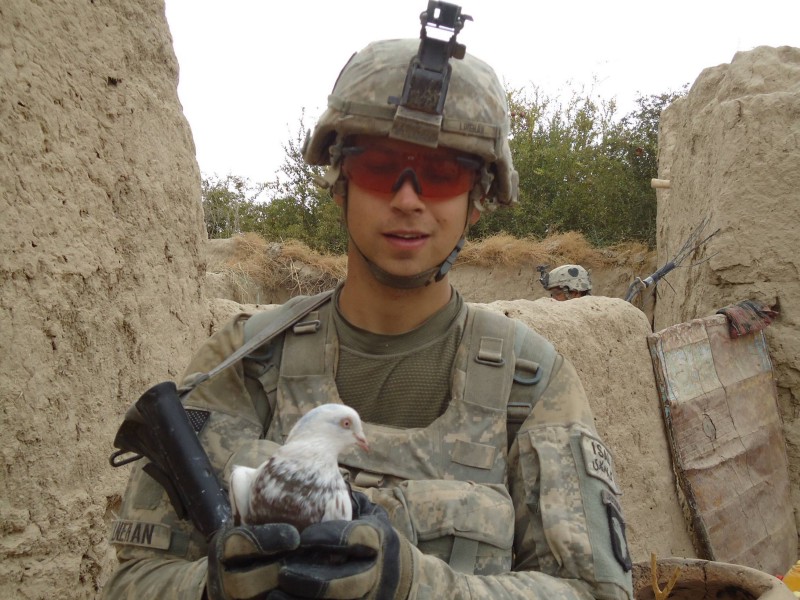
Justin 'Judd' Lienhard is a former U.S. Army Ranger officer who did multiple tours in Iraq and Afghanistan. The Conversationalist interviewed him in 2017 for its 'woke vets' series.

Natalia: I’ve read your excellent pieces on The Humanist — including your take on America refusing refugees and the gut-wrenching story of your last combat mission. It struck me that what you’re discussing, among other things, are realities of war that make the average civilian really uncomfortable — so uncomfortable that they would rather shut these stories out. Do you find that most Americans don’t want to know? Or has that not been the case?

Judd: In my experience, Americans are fine with the gory details in my stories as they’ve been desensitized pretty well. They are even OK with hearing about our soldiers’ suffering. They really like the the stories I share that humanize our soldiers in a good way.

What they don’t like to hear are my stories that humanize the enemy or even the locals that collude or sympathise with them. They change the subject quickly when I describe civilian deaths or tribulations that we were responsible for. They often try to interject and exonerate me and my compatriots from blame — and maybe themselves as well, by extension.

Judd Lienhard during his days with the Army Rangers

I think it’s important for everyone’s psyche to dehumanize the people we kill or maim.

There must be absolutely no righteousness in anyone’s cause but our own, it is simply not enough to fight for our nation’s own best interests, our enemies’ interests must be entirely deviant as well. That is nothing new however.

What has changed is that we are deep in an era of war romanticism. We almost deify our soldiers, especially our special operators, they are becoming a class to themselves, almost like a warrior elite that are beyond reproach. It’s comparable to the Janissaries or the Samurai. It’s unfair, even to them. They are very good at what they do but they are also very human.

When you begin to treat men like gods they can only disappoint.

Unless their exploits are fabricated or at the very least embellished — which is what is happening in Hollywood right now.

Natalia: I once worked with a wealthy narcissist, and a lot of what Trump is doing now has, to me, seemed predictable. I think that men like him see other human beings in terms of how they can be used. So there are beautiful women to exploit, powerful businessmen to forge beneficial relationships with, and as for the military, he sees it as an extension of his, uh, manhood. I don’t think it was an accident that he wanted to parade missile launchers on Inauguration. I am with those people who say that he has used fallen SEAL William Owens and his widow as props. So that’s my take on it. But how do you read Trump’s relationship with the military? And how do you think our military command sees Trump? I’ve seen a lot of speculation, for example, that he makes them less than comfortable, though they obviously won’t show as much in public.

Judd: Of course Trump is a narcissist, but I’m hesitant to build him up into some evil genius. He, more than anything else, wants to be liked. He’s dangerous because he’s so pliable. His mental acuity has declined greatly in the past decade, and he’s being guided by ideologues. He is probably the anti-ideologue in that he’ll back whatever side or position that will get the most people to like him.

I believe our military command sees Trump much differently than the rank and file, who are more attracted to the tough, blunt, and simplistic rhetoric of the president (this doesn’t mean they aren’t intelligent, many are extremely bright, but their areas of interest and aptitude reside more on the tactical level rather than in the intricacies of history, geopolitics and macroeconomics).

Military command sees a bumbling idiot with no grasp on the nuances of operational or strategic level planning.

Not only does Trump lack military experience, he lacks the attention span to absorb complex situational briefings.

I hate to compare Trump to Hitler, because there are many differences, but in that respect they are very similar. I believe that both lacked the respect of the military establishment and were otherwise surrounded by misfits, ideologues, and outcasts.

[The military establishment] followed Hitler nonetheless, because those generals thought they were playing the long game and wanted to be in a good position when that wave of populism passed. It wasn’t until 1942 that they realized his decisions would mean the end for Germany and not until 1944 that they organized an assassination attempt.

Our generals want to use Trump’s increases in military funding to further their own limited aims — many aren’t fully considering the damage it will do to the other two pillars of our national security triad, which are diplomacy and development.

Natalia: Everything I know about men like Trump leads me to believe that he would love to go to war. I see him thirsting for it as much as his chief strategist, Steve Bannon, is thirsting for political chaos and martial law. I think a lot of people right now are under the impression that if Trump goes to war, it will be very similar to when George W. Bush went to war — but I believe that Trump makes W look like a wise elder statesman by comparison. Am I being too apocalyptic? And how do you think a military conflict under Trump might play out?

Judd: Trump absolutely wants to go to war because wartime presidents are popular, at least at first. And Bannon wants to go to war because he has a strange obsession with military conflict. I think you are being too apocalyptic however — because you overestimate this administration’s ability to build coalitions and underestimate their utter incompetence.

Congress is protecting them right now because they want to push through their legislation.

As soon as that happens they will turn on them. Their visions of America’s role in the world diverge far too much.

Natalia: I think because we no longer have a draft, and because our military is so powerful, a lot of civilians brush off the reality of what the military deals with with a kind of, “Oh, but they signed up for it, they’re professionals, they have helicopters and cool gear, so whatever, I don’t care, what they do has nothing to do with me.” I personally agree with someone like Phil Klay when he says that — sorry, no, that’s not how it should work. But would you agree or disagree? And can anything be done to make American civilians less apathetic to the risks and dilemmas of modern military service?

Judd: I believe that because there is no draft and because the conflicts of the last generation have resulted in relatively light casualties that Americans see our military adventures as a spectator sport. It’s almost expected that we “mourn” our hero warriors, but relatively few Americans have felt the personal loss of a loved one to conflict.

They don’t relate to those Americans whose sons and daughters signed up to escape poverty rather than out of patriotic reasons.

I mean, expensive college and the GI Bill/VA Loan serve as a de-facto draft anyway. Wait until we start getting carrier groups decimated by surface skimming supersonic missiles and we start losing tens of thousands a year. The human face of war will hit us hard then.

It’s always been that way. The average Roman cared little about the legionary until Hannibal was tossing their severed heads over the gates of Rome.

Natalia: There has been a lot of dehumanization of Muslims in our public discourse. You’ve written beautifully about how awful and misleading stereotypes of Muslims are. What do you think can be done to combat such stereotypes? Besides writing, which is obviously really important, but, as a lot of psychologists point out, only reaches certain people and at certain times.

Judd: I’m a realist and I understand that our tribal nature needs mysterious foreign threats to bind itself together, especially when other social units are falling apart. There is always an enemy that poses an “existential threat” — be it Jews or Blacks, or Catholics, or Communists.

Judd Lienhard with an Iraqi interpreter. who, Lienhard has reason to believe, did not survive the continuing conflict in Iraq.

Honestly, the best cure is exposure and normalization, we fear what we know the least about and propagandists with an agenda exploit those fears for their own gains, that is nothing new.

We must avert catastrophe, let the old fear-mongers that rose up as Iran fell apart die off. Then, once there’s a mosque down the street and your Muslim neighbor feeds your dogs for you while you’re on vacation, it won’t be such a big deal anymore.


[post_title] => 'Americans see our military adventures as a spectator sport,' says former U.S. Army Ranger [post_excerpt] => "I hate to compare Trump to Hitler, because there are many differences, but in that respect they are very similar. I believe that both lacked the respect of the military establishment and were otherwise surrounded by misfits, ideologues, and outcasts." [post_status] => publish [comment_status] => open [ping_status] => open [post_password] => [post_name] => 383 [to_ping] => [pinged] => https://thehumanist.com/commentary/refusing-refugees-former-army-ranger-shares-shame [post_modified] => 2026-09-10 20:03:37 [post_modified_gmt] => 2026-09-10 20:03:37 [post_content_filtered] => [post_parent] => 0 [guid] => https://conversationalist.org/?p=383 [menu_order] => 370 [post_type] => post [post_mime_type] => [comment_count] => 0 [filter] => raw )

‘Americans see our military adventures as a spectator sport,’ says former U.S. Army Ranger

WP_Post Object
(
    [ID] => 378
    [post_author] => 2
    [post_date] => 2019-01-22 14:24:07
    [post_date_gmt] => 2019-01-22 14:24:07
    [post_content] => 

Valid criticisms of Melania Trump have been taken as a license to mock her marriage.

It’s hard to feel sympathy for Cersei Lannister, the icy queen from Game of Thrones. She’s a vindictive, murderous woman whose only redeeming quality is her love for her children (until it isn’t.) Still, I cannot rejoice when her character is paraded naked before crowds shouting “Shame! Shame!” nor when her brother rapes her or her father brutally dismisses her. Her humiliation in those instances is too familiar. It’s not fantasy. The thing about those scenes is that Cersei is not being punished for the evil she’s committed — she is being punished because she’s a woman. Gender violence is like an invisible cage, and no amount of money or status can free you from it. I won’t ever cheer for it.

This is why the recent attacks on Melania Trump, an unsympathetic character, give me chills.

It’s not because she’s immune from criticism, whether for enabling Donald Trump or for her own bigotry, far from it. It’s because those valid criticisms have been taken as license to mock her unfortunate marriage to DJT.

Trump is an abuser. He himself has made that clear. That makes him dangerous to his wife. And she likely won’t be able to redeem herself without putting herself and her child in harm’s way.

The viral video of Melania’s face falling as her husband turns his back to her during the inauguration made many people laugh. But while you’re mocking their marriage, he’s likely terrorizing her for letting her face slip on television.

How do I know that?

1)The news is already filled with White House leaks about his uncontrollable narcissistic rage.

2) An abuser’s greatest fear is that his victim might tell on him. Around the world, women and children in abusive situations are killed over revelations far smaller than what this GIF reveals:

Your denial of the stakes involved only isolates abused women and children further.

Believe me, they feel your indifference. They know that you don’t believe them. Their worst fears are realized every time people turn their heads, close their eyes and refuse to bear witness.

Victims of domestic violence, if they’re lucky, find strength in good samaritans — people who are disturbed and refuse to look away — people like Michelle and Barack Obama, who graciously waited for Melania on inauguration day and escorted her inside the White House. Even then, the relief is temporary. Eventually she’ll be alone with him again.

Don’t fear intimate violence in your daily life? Lucky you. Now shut up, because you know nothing.

The comedian Russell Peters has a famous bit about immigrant parents beating their children. “White people, please beat your kids,” he says. Why? Because immigrant kids want what white kids have — no real consequences for their behavior.

In Peters’ bit, a white kid tells little Russell, “next time your parents try and beat you, threaten Child Protective Services.” Little Russell goes home, threatens his Indian dad and gets his ass whooped like never before. Never adopt that angry white kid’s advice, Peters warns — it’ll get you killed.

Think about that the next time you judge Melania for staying with Trump. Imagine what kind of threats he uses to make her stay. It’s hard to understand them if you’ve never been subjected to them. It’s easy to be like the white kid in the Peters bit.

Remember, this country was so indifferent to Trump’s abusive ways, it elected him President. He has the lawyers, the money, and the muscle. He is free to humiliate any member of his family — whether it’s publicly agreeing that his daughter Ivanka is a “piece of ass,” or making it obvious that he cheats on his wife.

Once upon a time, Melania was literally an illegal immigrant, and while the hypocrisy of that fact in light of Trump’s racist, anti-immigrant campaign is obvious, her vulnerability should be too.

After multiple divorces, it’s no accident that Trump eventually seduced a much younger, poorer immigrant woman who could not defend herself publicly for fear of being kicked out of the country.

Though Melania consented to marry him, liberals who claim she therefore deserves whatever comes next are adopting Trump’s logic.

Meanwhile, Melania’s famous nude photos are empowering to Trump but not to her. He shows his wife off like a thoroughbred. She, on the other hand, can’t win. If she’s proud of them, she’s a whore. If she’s not, she’s a prude and a hypocrite.

Either way, Melania is stuck with a conman who raped his first wife, Ivana, because he was enraged about a bald spot, and whose idea of consent is to grab first and never apologize. Let me remind you that, according to this man’s lawyer, “you can’t rape your spouse.”

Speaking of which, where have Ivana and Marla been hidden? Ivana has been conspicuously silent about her daughter, Ivanka, essentially playing First Lady for her ex. Marla has reportedly been begging for hand-outs.

Finally, if you think Trump wouldn’t forcibly separate his youngest son Barron from his mother, you’re naïve.

Trump, like other narcissists, gets off on the impunity with which he transgresses norms. He wants you to think that Melania “deserves” whatever she gets.

Appearances can be deceptive. #BlackLivesMatter, for example, has disrupted white Americans’ benevolent view of “nice police officers who are only doing their jobs.” Melania, meanwhile, disrupts the commonly held belief that “a wealthy lifestyle means you’re safe.”

For abused women and children, the family home is not a refuge — it’s a prison. Despite what you think, prisons can come in gold.

I never felt for Melania more than when she was allowed to remain in New York with Barron. She didn’t want to see Trump every day — who would? And my stomach flipped when Trump looked over Melania’s shoulder as she voted. We turned that image into another fun meme — but ignored the darker implications:

Trump wasn’t just checking to see that Melania voted for him. He was threatening her should she hesitate.

Why? Because monsters hate being reminded that they’re monsters. Abusers beat you harder when you wince.

Forgive the frankness, but despite what you think, Melania’s job isn’t to get fucked by her husband; it’s to smile and scream that she loves it when he hurts her. He relishes her forgiveness of the unforgivable; her total submission.

Remember how he embarrassed her for laughs at the Al Smith dinner? It was played as a warm-hearted joke — but Trump never makes jokes like that about himself. And while Trump’s base may laud “Empress Melania”, her stunning good looks, and her submission to her husband, none of that makes her safe from him or his well-documented rage.

Don’t think this is just a private matter between husband and wife. Humiliating those closest to him gives Trump the energy to screw this country. Abuse makes him feel like a king. Not just Melania’s king anymore. Our king.

So don’t trash Melania just to get to Trump. He already tells her she’s trash every day.

If you don’t have the energy to go to bat for Melania, I respect that. There are many underprivileged victims of abuse in this country who need our support. I believe that we can support them without kicking a woman who, in one way or another, gets kicked every day, fancy clothes and shoes be damned.

Attack Melania’s birtherism. Criticize the fact that she hung journalist Julia Ioffe out to dry and didn’t care about the anti-Semitic attacks that followed. But please don’t talk about how she “deserves” her abusive marriage. You’re only empowering Trump when you do that.

For more information about domestic and gender violence: https://www.sanctuaryforfamilies.org/


[post_title] => Think Melania 'deserves what she gets'? Guess what, you’re helping Trump [post_excerpt] => Don’t trash Melania just to get to Trump. He already tells her she’s trash every day. [post_status] => publish [comment_status] => open [ping_status] => open [post_password] => [post_name] => think-melania-deserves-what-she-gets-guess-what-youre-helping-trump-2 [to_ping] => [pinged] => [post_modified] => 2026-09-10 20:02:15 [post_modified_gmt] => 2026-09-10 20:02:15 [post_content_filtered] => [post_parent] => 0 [guid] => https://conversationalist.org/?p=378 [menu_order] => 371 [post_type] => post [post_mime_type] => [comment_count] => 0 [filter] => raw )
Think Melania ‘deserves what she gets’? Guess what, you’re helping Trump

WP_Post Object
(
    [ID] => 368
    [post_author] => 2
    [post_date] => 2019-01-22 14:19:09
    [post_date_gmt] => 2019-01-22 14:19:09
    [post_content] => 

This remarkably prescient and insightful analysis was originally published on January 10, 2017. 

Early on in Ridley Scott’s movie Gladiator (2000), an overwhelming Roman force is poised to slaughter assorted Teutonic tribes, with the aging emperor, Marcus Aurelius wearily looking on from a gloomy, snow-covered hilltop. As the tribesmen raise their defiant clamor in anticipation of battle, a young Roman commander wryly opines: “A people should know when they’re conquered.” Within minutes, that point is brought home with bone-crushing vividness as the tribesmen are utterly decimated and consigned to a blood-soaked earth and to historical oblivion. Only then, however is the movie’s underlying conceit revealed.

For no sooner have the “civilized” Romans vanquished their barbarian foes than the Romans’ own, inner barbarian is released. Thus the old, philosophically inclined Marcus Aurelius is dispatched, no less violently, by his upstart son Commodus, a type who at this precise moment in our nation’s time will seem distressingly familiar: suffused with petty resentments, vacillating between bouts of insecurity and sudden imperiousness, and a narcissist who consistently blurs the lines separating crude gladiatorial spectacle from the craft of politics.

The scene comes to mind as our country awaits the transfer of political power, from a cool, articulate, and circumspect rationalist to a man of Commodus-like temper who by force of his personality and a lifetime record of fraudulent dealings has at last seized the presidency.

In this, the president-elect ended up being supported by party leaders who, temporarily caught up in a struggle between fading “principles,” stung pride, and native opportunism, predictably resolved that conflict in favor of the latter.

Having concluded its long journey from initial disbelief at an improbable candidate to groveling support of the president elect, the GOP is now poised to seize control of all three branches of government and to enjoy the spoils of a post-democratic order whose contours Trump so vividly drew throughout his seemingly endless and intensely divisive campaign.

Ideological purity and personal integrity have been sacrificed to the prospect of unchecked political power and economic interest. Meanwhile, the president-elect traverses his realm on a “thank you tour,” declares himself immune to conflicts of interest, declines intelligence briefings, stokes the passions of his fanatical supporters with irrelevant tweets at 3 a.m., and generally refuses to distinguish between fact and fantasy, promise and fulfillment.

Predictably, there has been vehement opposition, not just to Trump’s often lurid pronouncements during the campaign (a “beautiful wall” to be built; an opponent to be jailed) but also to his policy proposals: to undo his predecessor’s executive orders aimed at protecting the environment; to strip employee rights and protections; to dismantle the Affordable Care Act; to unweave the delicate fabric of legal restrictions governing business and finance and aiming to establish some semblance of parity between the haves and the have-nots of our society.

Both prior to and since November 8th, 2016, opposition to the looming deregulation of this country’s established social contract has mainly originated from what has been so dismissively and (as we now see) effectively been labeled the “liberal media.”

Facebook and Twitter accounts remain awash with conversation groups and anxious posts recalling or uncovering pertinent statistics and “facts” (a quaint word, it now seems); and social media are deluged with well-meaning advice about how to “fight back” or, more realistically, how to “survive” the coming Trump administration. And, underneath it all, the basso continuo is always the same: “How could it all have gone so wrong so suddenly?”

Which brings me back to my initial quote: “A people should know when they’re conquered.”

For so consumed have Americans been with the startling sea-change in national politics here, that they are only now, and arguably too late, beginning to realize that the shift to an autocratic form of politics in this country is part of a global pattern that has been unfolding ever since Vladimir Putin rapidly transitioned from Prime Minister (1999) to President (2000) of a crumbling and shrinking, post-Soviet empire.

Putin’s ascent was nothing if not Commodus-like as his charismatic machismo obscured unpleasant economic and geopolitical realities. As has often been observed, facts have had little or no standing during the Putin era (nor, indeed, during the eight decades or so preceding it); and anyone attempting to rouse an increasingly apathetic public with details about Russia’s pervasive corruption, the brazen manipulation of the judiciary by a small elite of oligarchs, or the staggering costs of state-sponsored violence in Chechnya and elsewhere, was silenced quickly and decisively. Anna Politkovskaya and Boris Nemtsov could tell us all about that if they were still alive.

In the context of U. S. politics, raising the tragic fate of Russian journalists and politicians who paid the ultimate price for exposing their leaders’ countless depredations may seem groundlessly alarmist. Unburdened by first-hand experience or detailed knowledge of twentieth-century totalitarianism, most Americans may yet prefer to dismiss, even ridicule, any suggestion that similar state-sponsored killings and repression could ever play out on the streets of Washington or Dallas. Time will tell. Still, evidence is mounting that a similar campaign of intimidation has already begun in this country.

Consider hundreds of documented instances of hate-speech and violent attacks that followed the 2016 election or such the president-elect’s decision to invite CEO’s of the major news organizations for a widely-reported dressing-down at Trump Tower in NYC less than two weeks after the election. The proposition so unsubtly extended on the occasion was plain enough: give up your claim to independent and critical reporting, or lose all access to information.

Meanwhile, having steadily expanded his game plan, Putin for the past several years has systematically, and lately in increasingly brazen fashion, sponsored Western Europe’s far-right parties as they plot to overturn democratic institutions and processes across Europe. He has acted as an ideological and financial sponsor of Marine Le Pen’s far-right National Front in France and, just this week, has signed a cooperative agreement with Austria’s far-right Freedom Party.

Putin’s autocratic style has served as the template for ultra-nationalist leaders in Poland and Hungary, and it shapes the aspirations of other far-right politicians diligently working to destabilize and, in time, overthrow a seemingly threadbare and irresolute liberal-democratic framework in Italy, Holland, and Germany.

Yet the consummation of Putin’s carefully orchestrated destabilizing of his Western competitors must surely be this country’s election on November 8th. Already, the president elect and his foreign policy advisors have removed Russia from the list of this country’s major threats; and all indications are that Putin’s strategy will pay off handsomely as the reputed bastion of liberal democracy (and Russia’s greatest geo-political competitor) is poised, starting January 20th, to join the post-democratic order that he has patiently been forging across Eastern and Central Europe.

Still, it would be a mistake to credit Putin with unilaterally bringing about this fateful denouement in American politics. More accurate would be to say that he has patiently and systematically exposed and exploited the deterioration of democratic process and the self-sabotage of this country’s major institutions, a pattern that has been unfolding since September 11, 2001.

If you want to blame Putin for everything — you’re taking the easy way out

The way stations of our democracy’s by now palpable demise are many: a frivolous and ruinous war waged against a far-away country starting in 2003; accelerating gerrymandering across many of the fifty states driving a wedge between popular vote counts and effective representation; a Citizens United Supreme court decision equating money and speech, and thus drowning out the voices of those without significant financial means; the rise of disinformation networks (right-wing talk radio and social media), all of which have cumulatively erased the one capacity that Plato had regarded as indispensable to a just state: being able to distinguish between truth and opinion.

So, if “a people should know when they’re conquered,” they should also acknowledge their own responsibility for that outcome and, most importantly, should understand the full magnitude of their defeat. Those intent on thwarting Mr. Trump, our nation’s Commodus, need to begin by letting go of all the old verities: traditional demographics of the electorate have proven deeply flawed; the dignified and stubborn appeal to “facts” has clearly proven an ineffectual strategy; judicial redress against the expected depredations and potentially unconstitutional actions of an autocratic president and his administration seems a long shot; and expecting congress to do anything other than what it has always done, namely, take care of its own, would be downright foolhardy.

Here, too, the rise of Putin offers an instructive analogue. For it was his predecessor’s violent 1993 siege of parliament and dismantling of an independent judiciary that had laid the foundation for Putin’s autocratic style.

To be sure, not every coup d’état is sudden and marked by conspicuous loss of life. It can also take the form of protracted legislative and judicial inertia or outright obstructionism, such as we have seen in this country for the past decade: a Congressional majority deciding not to make law but, instead, to thwart all legislative proposals for eight years; a Federal judiciary crippled by countless vacancies (currently numbering 107) that have gone unfilled for years; and a protracted degrading in word and deed of the very idea of institutions (Congress, the judiciary, the media) as agents needed to sustain a viable and balanced social order. Such, after all, has been the daily bread of Americans over the past decade or so, with talk radio, Fox News, and alt-Right websites spewing disinformation and paranoid fantasies on a daily basis. Unsurprisingly, then, distrust in congress, the judiciary, and indeed the presidency is now at an all-time high.

Hence, with this country’s key institutions having long betrayed and discredited their intrinsic purpose, recourse to traditional politics and constitutional remedies will no longer prove effective when it comes to checking a small and rapacious financial and political elite single-mindedly pursuing its interests.

In less than a month, Americans will learn the hard way that their notion of democracy, long thought to be an eternal covenant, has become an empty shell whose institutional pillars have long been crumbling. Four years from now, the oligarchs and kleptocrats about to enter through the gates of our nation’s capital will likely have reduced the Jeffersonian ideal to a fading memory. To be sure, one may hope that America and the democratic ideals it has long taken itself to embody will rise again from the ashes of 2016, hopefully as a covenant of genuinely communitarian spirit and capable of geo-political restraint.

Yet whether post-democratic America turns out a Phoenix or just the latest in a long history of empires fading into the twilight, this much seems clear now: the institutional foundations of our democracy no longer furnish viable grounds for effectively opposing those who have just conquered the Republic.


[post_title] => The Republic Conquered: On America entering the post-democratic era [post_excerpt] => So consumed have Americans been with the startling sea-change in national politics here, that they are only now, and arguably too late, beginning to realize that the shift to an autocratic form of politics in this country is part of a global pattern that has been unfolding ever since Vladimir Putin rapidly transitioned from Prime Minister (1999) to President (2000) of a crumbling and shrinking, post-Soviet empire. [post_status] => publish [comment_status] => open [ping_status] => open [post_password] => [post_name] => the-republic-conquered-on-america-entering-the-post-democratic-era-2 [to_ping] => [pinged] => [post_modified] => 2026-09-10 20:00:29 [post_modified_gmt] => 2026-09-10 20:00:29 [post_content_filtered] => [post_parent] => 0 [guid] => https://conversationalist.org/?p=368 [menu_order] => 372 [post_type] => post [post_mime_type] => [comment_count] => 0 [filter] => raw )
The Republic Conquered: On America entering the post-democratic era