


WP_Post Object
(
    [ID] => 11150
    [post_author] => 15
    [post_date] => 2026-10-13 12:27:12
    [post_date_gmt] => 2026-10-13 12:27:12
    [post_content] => 

A day in the life of Misk and her Hello Kitty backpack at one of Gaza's makeshift schools.

Amid the ruins of destroyed buildings and the weathered tents that have become home for more than one million displaced people in Deir al-Balah’s camps, 11-year-old Misk walks alongside her classmates, carrying her Hello Kitty school bag. Along the way, she encounters just a few of the human realities of displacement: families searching for water and food; children carrying yellow plastic jerrycans as they take on daily responsibilities far beyond what they should or can.  

But for Misk, this path represents the road to being a student again. She is feeling eager and excited. In her backpack, she carries a couple of things she had been without for some time: a notebook and a pen.

Since 2023, hundreds of thousands of children in Gaza have lost access to formal education amid the ongoing genocide and displacement of Palestinians. Israeli military operations have destroyed and continue to destroy many school buildings, while others have been converted into shelters for displaced families. Temporary learning spaces began popping up in early 2025 as teachers and volunteers transformed displacement tents into classrooms, adding desks, chairs, and blackboards so children could return to learning despite the ongoing violence. These spaces have offered more than a place to study: They have given children a chance to regain a part of their daily routines, a community of peers, and something resembling the normal life they'd lost. 

Misk was in the third grade in May 2024 when Israel Defense Forces (IDF) issued evacuation orders—paper slips that were airdropped over entire neighborhoods ordering people to vacate their homes and leave town. In southern Gaza, her city of Rafah  welcomed over a million displaced residents overnight, while Misk and her family ended up in the center of the Gaza Strip at Deir al-Balah, where they still share a single small room in her relative's house—a room where they all sleep, eat, study, and work, in circumstances that have changed nearly every part of their daily lives. Amidst all this, Misk’s new school at the Deir al-Balah displacement camp, while temporary, has become a refuge. 

On a recent September day, Misk sits with eight other children inside a small room. There is no school gate, no morning assembly, and no bell marking the beginning or end of their lesson. Yet children still arrive at 9 a.m., with whatever basic supplies they can find. Some carry old notebooks or loose papers, and the few pens they have. They sit at simple wooden desks facing the board, enthusiastically raising their hands as their teachers—sisters Jumanah, 24, and Shahd Al-Naouq, 22—guide them through lessons in Arabic, English, and mathematics. The scene resembles an ordinary classroom, where children listen, answer questions, and learn together. But instead of concrete walls and a permanent building, their class takes place in a single tent inside a displacement camp.

This one-room school did not start from big plans or with help from a fully-funded institution. It started with a question. Last year, Jumanah was an ambitious university graduate with an accounting degree preparing to begin her career. But the war had changed that path. Job opportunities were scarce and starting a career in accounting seemed increasingly out of reach as she was forced to navigate the daily challenges of an uncertain future.

Then, earlier this year, Jumanah visited a friend whose relatives were hosting a displaced family. There, she noticed a young girl drawing. She could not stay focused for long. Every so often, the girl’s mother would ask her to help wash clothes by hand or with other chores, and she would get up. After finishing, she would return to her pen and paper and continue drawing.

“When I saw Misk trying to draw despite everything happening around her, I thought we needed to do something,” Jumanah tells me. “I felt that children had not only lost their schools; they had lost a part of their daily lives.” 

She thought about the children living in the area and in the nearby displacement camps, probably tens of thousands of them, who were growing up without education or a place to return to after losing their homes. Then came her question: If children could no longer safely reach their school due to displacement, long distances, and Israeli bombardments, what if their school came to them? 

Her sister, Shahd, agreed to be a part of it.  

“We did not have a school or big resources, but we had children who wanted to learn. I said, ‘Let’s start with what we have.’ Even if the place is simple, the important thing is that they have a place to come back to,” Shahd says.

When they first opened the school, Jumanah welcomed their students inside their Deir al-Balah home, a small structure made of corrugated metal. She put a single table in a room and bought a small chalk and marker board. Shahd, an English literature student at the Islamic University of Gaza, joined her, and together the sisters spoke to their neighbors and asked for small donations to help pay for the necessary supplies. Before long, children from the neighborhood and the nearby camps came. Misk was among the first to join.

At that point, there were no more than ten students from six to 12 years old. Jumanah took on most of the responsibility for organizing the space and putting together lessons on basic Arabic, math, and other topics. Shahd, meanwhile, taught the children letters and numbers in English. 

At first, their goal was not to complete a full school year or make up for everything the children had lost during the past three years of war. “The most important thing for us was to make children connected to learning and make them feel that there was still a place waiting for them every day,” Jumanah says. 

As more families learned about the school, more children began attending. Within four months, Jumanah and Shahd were able to move to a newly designated area in their neighborhood, where not one but three rows of tents were set up as classrooms, allowing them to welcome even more children. They have since been joined by additional teachers, who also volunteer their time to teach the students.

A few simple wooden desks and learning materials were added, including notebooks, textbooks, pens, and another blackboard. Children sat in rows next to one another, with the chalkboard at one end, like a traditional classroom. It became known as the Al-Itqan (Excellence) School.

Al-Itqan has provided a refuge for children, but it is not separate from the reality of the camp—it is at its heart. Daily life continues outside its main entrance, as people push water carts between the tents, walking back and forth as they try to secure their basic needs. The children, too, also carry different stories with them—stories of the years they've lived without access to education.

For Misk, returning to the classroom has meant more than just the opportunity to sit in front of a book or complete an exercise. It has also been a chance to be with other children who have lived through the same experience. It has meant she can finally build new friendships; that once again, she can belong.

“I was happy,” Misk says about the chance to return to school again. “I felt like I was living the way I used to. I had a place to go, meet other children, and learn again.”

The school has offered something similar to other children, too, while still presenting challenges shaped by the realities of life in the camp. There is a twelve-year-old, Farah Al-Harazin, who always sits in the front, not because she chooses to, but because she needs to be close enough to see what’s written on the board. Due to limited access to medical care, she hasn't yet been able to get treatment for her weak eyesight. Still, Farah is now in a space that understands her needs and has allowed her to participate with the other children.

Other students, like nine-year-old Yousef and his seven-year-old sister Aseel, were regular students until Shahd noticed that Yousef had been absent for several days.

“I asked Aseel, ‘Where is Yousef? Why hasn’t he come for a few days?’" Shahd says. That's when Shahd learned that every morning he had to fetch water for his family living in the camp.

There is also Issa, who always comes to the classroom with an empty pot inside his backpack. The pot is his way of providing food for his family: Classes begin at 9 a.m., but every day, Issa leaves to the community kitchen (takiya) to fill the pot with whatever food is available at 10 a.m. He then brings the pot home before returning to class.

Among the children is also Ahmad Nasrallah, who lives with a kidney condition, making everyday life especially difficult. The stifling heat, poor ventilation, and lack of electricity in the classroom made the space feel exhausting and suffocating for him. During lessons, Ahmad often struggles to breathe and finds it difficult to concentrate. 

Earlier this year, Jumanah tried to move him to a better spot, where some air could reach him without him having to walk out of the classroom. “Sometimes I felt that I was not only their teacher," Jumanah tells me. "I felt like I was a mother to them. Every child has their own circumstances.” 

What the sisters-turned-teachers have witnessed in their students are not isolated cases, happening only in Al-Itqan. According to the United Nations and education organizations like Save the Children, there are around 700,000 children aged four to 17 who have missed nearly three academic years of in-person learning, while around 93% of schools in Gaza require major repairs or reconstruction.

But these numbers do not show the small ways that conflict and dispossession continue to shape the lives of children.

Three years ago, before the war, Misk’s Hello Kitty backpack was simply part of her daily journey to school. After losing her family home, she used it to carry the few clothes and personal belongings she could take with her. Today, she walks between the tents with the same backpack, carrying a notebook, a pen, and a bottle of water. The makeshift school that started with eight children has grown, too, and now welcomes nearly 100 students across its three tent classrooms.

After more than two years away from her old school, Misk now attends classes every day, with friends her own age. 

Amidst so much, it's like she is living part of her childhood again.
[post_title] => The Things Children Carry [post_excerpt] => A day in the life of Misk and her Hello Kitty backpack at one of Gaza's makeshift schools. [post_status] => publish [comment_status] => closed [ping_status] => closed [post_password] => [post_name] => gaza-palestine-makeshift-schools-deir-al-balah-camp [to_ping] => [pinged] => [post_modified] => 2026-10-13 12:30:40 [post_modified_gmt] => 2026-10-13 12:30:40 [post_content_filtered] => [post_parent] => 0 [guid] => https://conversationalist.org/?p=11150 [menu_order] => 0 [post_type] => post [post_mime_type] => [comment_count] => 0 [filter] => raw )
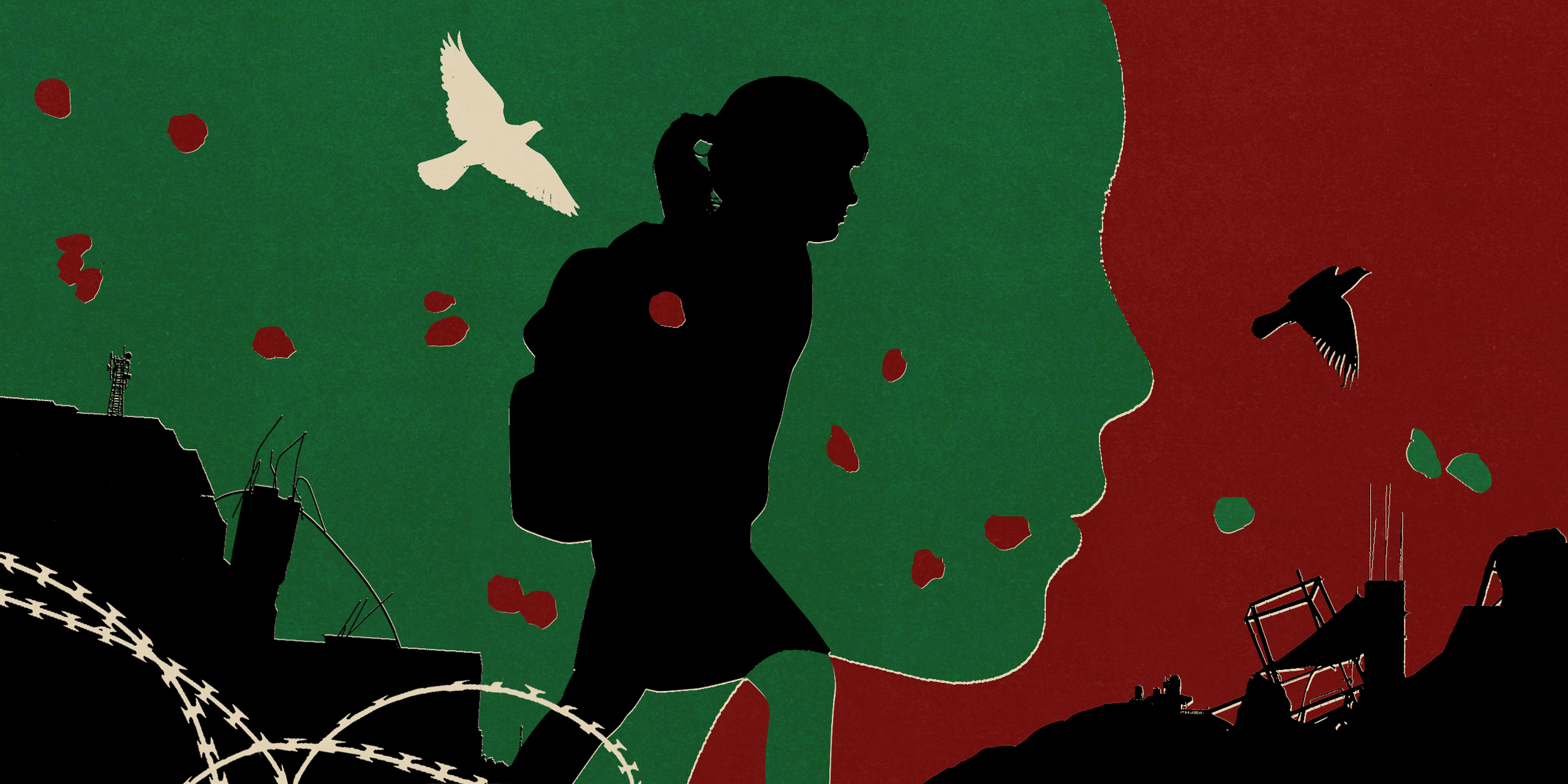
An illustration of the silhouette of a girl walking through an abstract background with her backpack.
Vartika Sharma

The Things Children Carry

A day in the life of Misk and her Hello Kitty backpack at one of Gaza’s makeshift schools.

Amid the ruins of destroyed buildings and the weathered tents that have become home for more than one million displaced people in Deir al-Balah’s camps, 11-year-old Misk walks alongside her classmates, carrying her Hello Kitty school bag. Along the way, she encounters just a few of the human realities of displacement: families searching for water and food; children carrying yellow plastic jerrycans as they take on daily responsibilities far beyond what they should or can.  

But for Misk, this path represents the road to being a student again. She is feeling eager and excited. In her backpack, she carries a couple of things she had been without for some time: a notebook and a pen.

Since 2023, hundreds of thousands of children in Gaza have lost access to formal education amid the ongoing genocide and displacement of Palestinians. Israeli military operations have destroyed and continue to destroy many school buildings, while others have been converted into shelters for displaced families. Temporary learning spaces began popping up in early 2025 as teachers and volunteers transformed displacement tents into classrooms, adding desks, chairs, and blackboards so children could return to learning despite the ongoing violence. These spaces have offered more than a place to study: They have given children a chance to regain a part of their daily routines, a community of peers, and something resembling the normal life they’d lost. 

Misk was in the third grade in May 2024 when Israel Defense Forces (IDF) issued evacuation orders—paper slips that were airdropped over entire neighborhoods ordering people to vacate their homes and leave town. In southern Gaza, her city of Rafah  welcomed over a million displaced residents overnight, while Misk and her family ended up in the center of the Gaza Strip at Deir al-Balah, where they still share a single small room in her relative’s house—a room where they all sleep, eat, study, and work, in circumstances that have changed nearly every part of their daily lives. Amidst all this, Misk’s new school at the Deir al-Balah displacement camp, while temporary, has become a refuge. 

On a recent September day, Misk sits with eight other children inside a small room. There is no school gate, no morning assembly, and no bell marking the beginning or end of their lesson. Yet children still arrive at 9 a.m., with whatever basic supplies they can find. Some carry old notebooks or loose papers, and the few pens they have. They sit at simple wooden desks facing the board, enthusiastically raising their hands as their teachers—sisters Jumanah, 24, and Shahd Al-Naouq, 22—guide them through lessons in Arabic, English, and mathematics. The scene resembles an ordinary classroom, where children listen, answer questions, and learn together. But instead of concrete walls and a permanent building, their class takes place in a single tent inside a displacement camp.

This one-room school did not start from big plans or with help from a fully-funded institution. It started with a question. Last year, Jumanah was an ambitious university graduate with an accounting degree preparing to begin her career. But the war had changed that path. Job opportunities were scarce and starting a career in accounting seemed increasingly out of reach as she was forced to navigate the daily challenges of an uncertain future.

Then, earlier this year, Jumanah visited a friend whose relatives were hosting a displaced family. There, she noticed a young girl drawing. She could not stay focused for long. Every so often, the girl’s mother would ask her to help wash clothes by hand or with other chores, and she would get up. After finishing, she would return to her pen and paper and continue drawing.

“When I saw Misk trying to draw despite everything happening around her, I thought we needed to do something,” Jumanah tells me. “I felt that children had not only lost their schools; they had lost a part of their daily lives.” 

She thought about the children living in the area and in the nearby displacement camps, probably tens of thousands of them, who were growing up without education or a place to return to after losing their homes. Then came her question: If children could no longer safely reach their school due to displacement, long distances, and Israeli bombardments, what if their school came to them? 

Her sister, Shahd, agreed to be a part of it.  

“We did not have a school or big resources, but we had children who wanted to learn. I said, ‘Let’s start with what we have.’ Even if the place is simple, the important thing is that they have a place to come back to,” Shahd says.

When they first opened the school, Jumanah welcomed their students inside their Deir al-Balah home, a small structure made of corrugated metal. She put a single table in a room and bought a small chalk and marker board. Shahd, an English literature student at the Islamic University of Gaza, joined her, and together the sisters spoke to their neighbors and asked for small donations to help pay for the necessary supplies. Before long, children from the neighborhood and the nearby camps came. Misk was among the first to join.

At that point, there were no more than ten students from six to 12 years old. Jumanah took on most of the responsibility for organizing the space and putting together lessons on basic Arabic, math, and other topics. Shahd, meanwhile, taught the children letters and numbers in English. 

At first, their goal was not to complete a full school year or make up for everything the children had lost during the past three years of war. “The most important thing for us was to make children connected to learning and make them feel that there was still a place waiting for them every day,” Jumanah says. 

As more families learned about the school, more children began attending. Within four months, Jumanah and Shahd were able to move to a newly designated area in their neighborhood, where not one but three rows of tents were set up as classrooms, allowing them to welcome even more children. They have since been joined by additional teachers, who also volunteer their time to teach the students.

A few simple wooden desks and learning materials were added, including notebooks, textbooks, pens, and another blackboard. Children sat in rows next to one another, with the chalkboard at one end, like a traditional classroom. It became known as the Al-Itqan (Excellence) School.

Al-Itqan has provided a refuge for children, but it is not separate from the reality of the camp—it is at its heart. Daily life continues outside its main entrance, as people push water carts between the tents, walking back and forth as they try to secure their basic needs. The children, too, also carry different stories with them—stories of the years they’ve lived without access to education.

For Misk, returning to the classroom has meant more than just the opportunity to sit in front of a book or complete an exercise. It has also been a chance to be with other children who have lived through the same experience. It has meant she can finally build new friendships; that once again, she can belong.

“I was happy,” Misk says about the chance to return to school again. “I felt like I was living the way I used to. I had a place to go, meet other children, and learn again.”

The school has offered something similar to other children, too, while still presenting challenges shaped by the realities of life in the camp. There is a twelve-year-old, Farah Al-Harazin, who always sits in the front, not because she chooses to, but because she needs to be close enough to see what’s written on the board. Due to limited access to medical care, she hasn’t yet been able to get treatment for her weak eyesight. Still, Farah is now in a space that understands her needs and has allowed her to participate with the other children.

Other students, like nine-year-old Yousef and his seven-year-old sister Aseel, were regular students until Shahd noticed that Yousef had been absent for several days.

“I asked Aseel, ‘Where is Yousef? Why hasn’t he come for a few days?’” Shahd says. That’s when Shahd learned that every morning he had to fetch water for his family living in the camp.

There is also Issa, who always comes to the classroom with an empty pot inside his backpack. The pot is his way of providing food for his family: Classes begin at 9 a.m., but every day, Issa leaves to the community kitchen (takiya) to fill the pot with whatever food is available at 10 a.m. He then brings the pot home before returning to class.

Among the children is also Ahmad Nasrallah, who lives with a kidney condition, making everyday life especially difficult. The stifling heat, poor ventilation, and lack of electricity in the classroom made the space feel exhausting and suffocating for him. During lessons, Ahmad often struggles to breathe and finds it difficult to concentrate. 

Earlier this year, Jumanah tried to move him to a better spot, where some air could reach him without him having to walk out of the classroom. “Sometimes I felt that I was not only their teacher,” Jumanah tells me. “I felt like I was a mother to them. Every child has their own circumstances.” 

What the sisters-turned-teachers have witnessed in their students are not isolated cases, happening only in Al-Itqan. According to the United Nations and education organizations like Save the Children, there are around 700,000 children aged four to 17 who have missed nearly three academic years of in-person learning, while around 93% of schools in Gaza require major repairs or reconstruction.

But these numbers do not show the small ways that conflict and dispossession continue to shape the lives of children.

Three years ago, before the war, Misk’s Hello Kitty backpack was simply part of her daily journey to school. After losing her family home, she used it to carry the few clothes and personal belongings she could take with her. Today, she walks between the tents with the same backpack, carrying a notebook, a pen, and a bottle of water. The makeshift school that started with eight children has grown, too, and now welcomes nearly 100 students across its three tent classrooms.

After more than two years away from her old school, Misk now attends classes every day, with friends her own age. 

Amidst so much, it’s like she is living part of her childhood again.