WP_Post Object
(
    [ID] => 11265
    [post_author] => 15
    [post_date] => 2026-10-29 23:43:13
    [post_date_gmt] => 2026-10-29 23:43:13
    [post_content] => 

A fun and feminist debut horror novel that's equal parts delectable and disgusting.

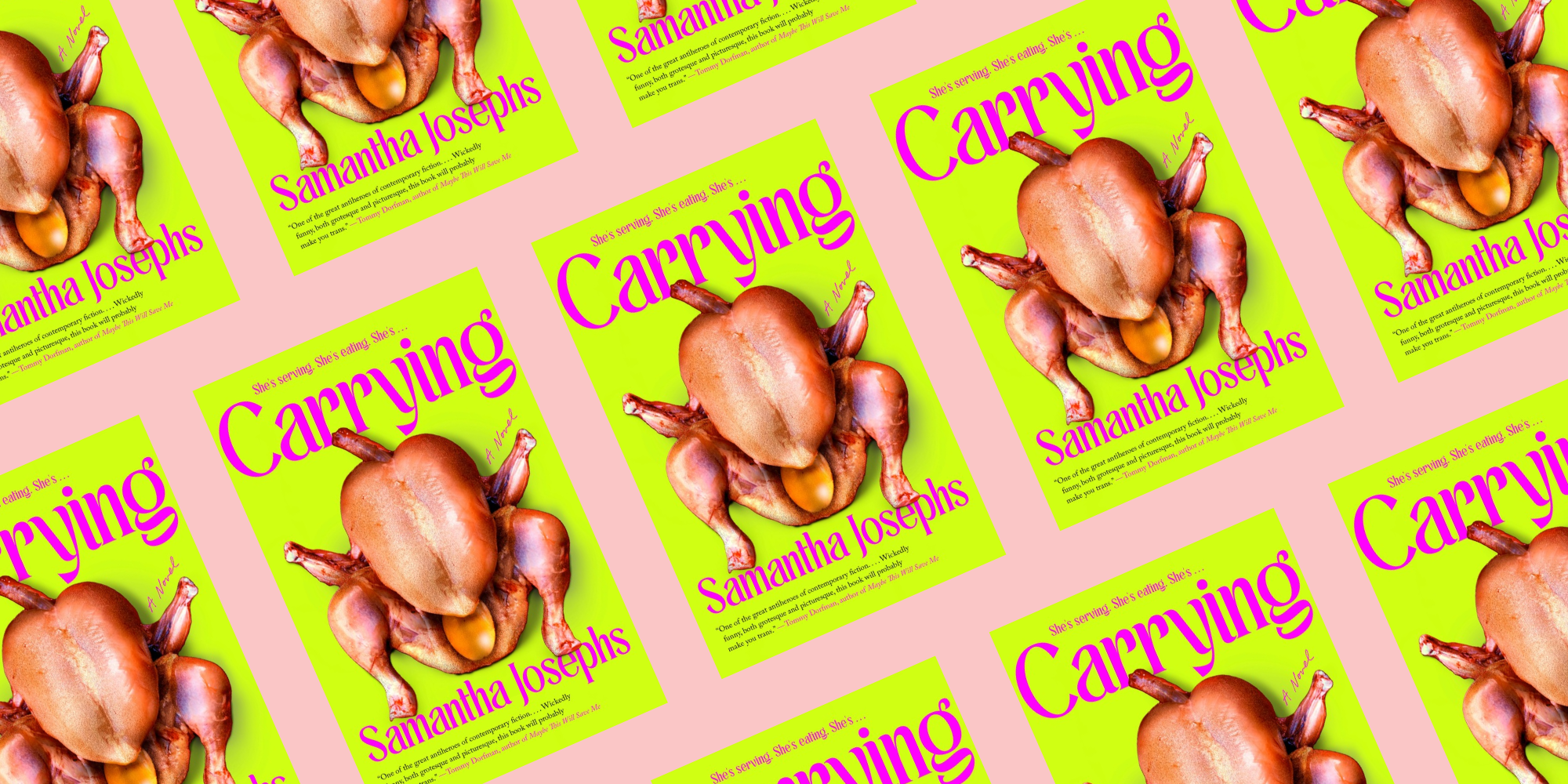
From the moment I picked up a copy of the one-of-a-kind Carrying, I had a feeling it would be equal parts gaudy, sincere, and gross: The debut novel’s neon green cover is taken up by a perfectly plump roast chicken, its legs splayed, an egg cradled between them, almost like an invitation. To what, exactly, I couldn’t yet know.

After finishing it, I wasn’t surprised to learn its author Samantha Josephs is passionate about cooking and baking. “I own a blowtorch for crème brûlée and a cast iron weight to get the perfect sear. I’m not messing around,” she declared in a recent interview. In her novel, Josephs takes that love of food and channels it into her main character, Martha, an all-American fantasy of the beautiful, doting, husband-pleasing housewife. “I wanted to turn that on its head and write about something disgusting that’s somehow completely delicious,” Josephs said.

Carrying may be delicious to the reader, but not to poor Martha. Only a few pages in, we find out her life is less than picture-perfect: Her husband and teenage step-daughter have no idea that she is trans. She is deeply insecure, obsessed with her image and with keeping up with the Joneses. Afraid that her husband Leon will leave her (or worse) if he finds out she isn’t biologically female, Martha feigns a miscarriage and pretends to get her period month after month. She also knows she can’t conceive the child Leon desperately wants, so when her husband asks her to consider a fertility clinic, she plays along and appeases him, enlisting the help of her longtime friend Roger, who also happens to be her gynecologist and the only person who knows the truth. 

Martha is precariously navigating this increasingly complex web when she starts getting sick, feeling sluggish, and acting moody, until one day—surprise!—she finds out she is pregnant. Leon is thrilled, yet Martha refuses to believe it until Roger confirms it is, indeed, a medical miracle. What’s even more surprising is when Martha discovers that the only thing that seems to keep her from feeling nauseous is a strange diet of rotting meat. By day, she continues cooking perfect meals for her family; by night, she drives around the empty streets of Los Angeles, looking for her next hit. 

The anxieties in Martha’s story start early on—long before we find out she is carrying or trans. At times, they are painfully funny: “She’d give anything to be completely content wrinkled like a walrus, bramble-bush tangled mane, flab flying wildly in the wind.” For the most part, though, Martha’s internal dialogue is just plain painful. “Martha feels zero guilt for waiters, coworkers, friends, strangers, anyone else, assuming she’s a cis woman—that’s the entire point. She does not want to live life on the margins, forever, marked by some cruel joke at birth. By passing, she undoes her own monstrosity. Nobody looks at her differently, as less than, as a perverted freak, as something to spread scary stories about,” Josephs writes.

In a sense, Martha is a symbol for all women; for anyone who has existed in a female-identifying body seeking male approval. What else can we call the pressure to be conventionally feminine, to keep up with beauty standards, if not horror? What about the financial and emotional dependence on a spouse, the feelings of jealousy for one’s imaginary competition, the awareness of being seen as little more than a vessel?

For every patriarchal monstrosity experienced by cis women, the stakes are always multiple times worse for our trans counterparts. “Passing is seen as the goal by many trans women, not just for being seen as who you are, but also that it may promise freedom from the hardships of trans life,” said Josephs, who is also trans, in an interview. A semi-retired drag queen-turned-writer of podcasts, video games, and erotica, Josephs infuses her main character’s past with much of her own. “As I’ve experienced it myself, I’ve found that passing is also completely stressful and anxiety inducing. While it was hard before when I didn’t pass to not be seen for who I am, there is a new stress in passing and fearing that people will find out.”

Likewise, the better Martha gets at passing, the more she is afraid of being found out. Her perfect body has a creature growing inside of it, as an undiagnosed chronic illness takes hold, further transforming her body in ways out of her control. Experts on transgender medicine examine her, unbeknownst to her family: “Martha gets poked, prodded, and probed. They take samples of her blood, urine, feces, sweat, mucus, throat, hair, and vaginal discharge… She feels like a two-headed calf, groped and gawked at under a microscope,” Josephs writes. She also (secretly) seeks out alternative treatments for her undiagnosable illness, which her husband believes to be morning sickness; and increasingly indulges in her bizarre and outright disgusting cravings until all of it is too much to bear. Her seemingly perfect life unravels.

Carrying may be fiction—a particular kind of surrealist horror—yet it is also the stuff of study and analysis, and deeply rooted in reality. In 2019, Spanish trans philosopher and writer, Paul B. Preciado, wrote about the experimental nature of trans bodies, for better and worse, and about the right to their reproduction in his chronicle of his own crossing, An Apartment on Uranus. “Until now, we have paid for our gender, sexual and bodily dissidence with the genetic silence of our chromosomes. We have not just been deprived of the transmission of economic patrimony: our genetic patrimony has also been confiscated. Homosexuals, transsexuals, and bodies regarded as ‘handicapped,’ we have been politically sterilized or else we have been forced to reproduce with heterosexual techniques. The present battle to extend MAP (Medically Assisted Procreation) to non-heterosexual bodies is a political and economic war to depathologize our forms of life and to maintain control of our reproductive cells.”

Martha is as complex a character as any in literature. Like Madame Bovary, she is facing the realities of what it means to be a woman. The costs of becoming a mother, too, are excruciating, yet with the help of medicine and technology, she is able to reinvent herself into a life that’s equal parts fairy tale and horror movie. She is a human beset by the pressures of late stage capitalism, living beyond its structures of gender and power in all their messy glory. Perhaps the biggest tragedy is that only the reader—and not Martha herself—get the privilege to see it.

[post_title] => Book of the Month: "Carrying" by Samantha Josephs [post_excerpt] => A fun and feminist debut horror novel that's equal parts delectable and disgusting. [post_status] => publish [comment_status] => closed [ping_status] => closed [post_password] => [post_name] => book-of-the-month-carrying-samantha-josephs-debut-novel-trans-motherhood-horror-recommendations-botm [to_ping] => [pinged] => [post_modified] => 2026-10-29 23:43:15 [post_modified_gmt] => 2026-10-29 23:43:15 [post_content_filtered] => [post_parent] => 0 [guid] => https://conversationalist.org/?p=11265 [menu_order] => 0 [post_type] => post [post_mime_type] => [comment_count] => 0 [filter] => raw )
The book cover for "Carrying" by Samantha Josephs.
G.P. Putnam’s Sons

Book of the Month: “Carrying” by Samantha Josephs

A fun and feminist debut horror novel that’s equal parts delectable and disgusting.

From the moment I picked up a copy of the one-of-a-kind Carrying, I had a feeling it would be equal parts gaudy, sincere, and gross: The debut novel’s neon green cover is taken up by a perfectly plump roast chicken, its legs splayed, an egg cradled between them, almost like an invitation. To what, exactly, I couldn’t yet know.

After finishing it, I wasn’t surprised to learn its author Samantha Josephs is passionate about cooking and baking. “I own a blowtorch for crème brûlée and a cast iron weight to get the perfect sear. I’m not messing around,” she declared in a recent interview. In her novel, Josephs takes that love of food and channels it into her main character, Martha, an all-American fantasy of the beautiful, doting, husband-pleasing housewife. “I wanted to turn that on its head and write about something disgusting that’s somehow completely delicious,” Josephs said.

Carrying may be delicious to the reader, but not to poor Martha. Only a few pages in, we find out her life is less than picture-perfect: Her husband and teenage step-daughter have no idea that she is trans. She is deeply insecure, obsessed with her image and with keeping up with the Joneses. Afraid that her husband Leon will leave her (or worse) if he finds out she isn’t biologically female, Martha feigns a miscarriage and pretends to get her period month after month. She also knows she can’t conceive the child Leon desperately wants, so when her husband asks her to consider a fertility clinic, she plays along and appeases him, enlisting the help of her longtime friend Roger, who also happens to be her gynecologist and the only person who knows the truth. 

Martha is precariously navigating this increasingly complex web when she starts getting sick, feeling sluggish, and acting moody, until one day—surprise!—she finds out she is pregnant. Leon is thrilled, yet Martha refuses to believe it until Roger confirms it is, indeed, a medical miracle. What’s even more surprising is when Martha discovers that the only thing that seems to keep her from feeling nauseous is a strange diet of rotting meat. By day, she continues cooking perfect meals for her family; by night, she drives around the empty streets of Los Angeles, looking for her next hit. 

The anxieties in Martha’s story start early on—long before we find out she is carrying or trans. At times, they are painfully funny: “She’d give anything to be completely content wrinkled like a walrus, bramble-bush tangled mane, flab flying wildly in the wind.” For the most part, though, Martha’s internal dialogue is just plain painful. “Martha feels zero guilt for waiters, coworkers, friends, strangers, anyone else, assuming she’s a cis woman—that’s the entire point. She does not want to live life on the margins, forever, marked by some cruel joke at birth. By passing, she undoes her own monstrosity. Nobody looks at her differently, as less than, as a perverted freak, as something to spread scary stories about,” Josephs writes.

In a sense, Martha is a symbol for all women; for anyone who has existed in a female-identifying body seeking male approval. What else can we call the pressure to be conventionally feminine, to keep up with beauty standards, if not horror? What about the financial and emotional dependence on a spouse, the feelings of jealousy for one’s imaginary competition, the awareness of being seen as little more than a vessel?

For every patriarchal monstrosity experienced by cis women, the stakes are always multiple times worse for our trans counterparts. “Passing is seen as the goal by many trans women, not just for being seen as who you are, but also that it may promise freedom from the hardships of trans life,” said Josephs, who is also trans, in an interview. A semi-retired drag queen-turned-writer of podcasts, video games, and erotica, Josephs infuses her main character’s past with much of her own. “As I’ve experienced it myself, I’ve found that passing is also completely stressful and anxiety inducing. While it was hard before when I didn’t pass to not be seen for who I am, there is a new stress in passing and fearing that people will find out.”

Likewise, the better Martha gets at passing, the more she is afraid of being found out. Her perfect body has a creature growing inside of it, as an undiagnosed chronic illness takes hold, further transforming her body in ways out of her control. Experts on transgender medicine examine her, unbeknownst to her family: “Martha gets poked, prodded, and probed. They take samples of her blood, urine, feces, sweat, mucus, throat, hair, and vaginal discharge… She feels like a two-headed calf, groped and gawked at under a microscope,” Josephs writes. She also (secretly) seeks out alternative treatments for her undiagnosable illness, which her husband believes to be morning sickness; and increasingly indulges in her bizarre and outright disgusting cravings until all of it is too much to bear. Her seemingly perfect life unravels.

Carrying may be fiction—a particular kind of surrealist horror—yet it is also the stuff of study and analysis, and deeply rooted in reality. In 2019, Spanish trans philosopher and writer, Paul B. Preciado, wrote about the experimental nature of trans bodies, for better and worse, and about the right to their reproduction in his chronicle of his own crossing, An Apartment on Uranus. “Until now, we have paid for our gender, sexual and bodily dissidence with the genetic silence of our chromosomes. We have not just been deprived of the transmission of economic patrimony: our genetic patrimony has also been confiscated. Homosexuals, transsexuals, and bodies regarded as ‘handicapped,’ we have been politically sterilized or else we have been forced to reproduce with heterosexual techniques. The present battle to extend MAP (Medically Assisted Procreation) to non-heterosexual bodies is a political and economic war to depathologize our forms of life and to maintain control of our reproductive cells.”

Martha is as complex a character as any in literature. Like Madame Bovary, she is facing the realities of what it means to be a woman. The costs of becoming a mother, too, are excruciating, yet with the help of medicine and technology, she is able to reinvent herself into a life that’s equal parts fairy tale and horror movie. She is a human beset by the pressures of late stage capitalism, living beyond its structures of gender and power in all their messy glory. Perhaps the biggest tragedy is that only the reader—and not Martha herself—get the privilege to see it.