Meet the mothers caring for Ukraine's most vulnerable children.
One summer day in 2022, Varvara, an autistic 6-year-old girl from Ukraine, approached her mother Oksana while she was on the phone with the police. Oksana, now 39, was inquiring about her husband Maksim, a Ukrainian soldier who had been reported dead, but whose body still hadn’t been found.
“Mom,” Varvara said, “I know that dad is already in heaven.” She pointed toward the sky.
It was at this moment that Oksana realized her daughter was not like other children. “Varvara somehow understood that her father had been killed while he was defending Kharkiv from the Russian troops,” Oksana says, tears streaming down her face. “I never told her the truth; she only knew that her daddy moved to a faraway place… But she understands everything.”
Like Oksana, thousands of mothers in Ukraine are raising their children alone as a direct result of the ongoing war between Russia and Ukraine. Although the number of war widows has not officially been confirmed by Ukrainian authorities, President Volodymyr Zelenskyy said in a statement last February that over 46,000 Ukrainian soldiers had been killed since the war began in 2022. As the fighting continues, it is mostly women who care for the country’s children. Some of these women live on the frontlines and use their own bodies to shield their toddlers from Russian attacks. Others have to safeguard children and teenagers who suffer from post-traumatic stress, developed after witnessing and experiencing atrocities during the war. Others, like Oksana, have to take care of children in increasingly difficult circumstances, managing their households and earning a living while grieving for their dead husbands, or else worrying about those alive but still fighting.
Disabled children are particularly vulnerable during war, in part because they are unable to access the same resources normally available for their ensured safety and care. On the frontline or under Russian occupation, that means that they might not have access to a hospital or needed medications, let alone specialists or therapy, as deteriorating mental health is a widespread issue in war-torn countries. Beyond that, being in the epicenter of the fighting makes children more vulnerable to PTSD and shock, as well as to physical injuries, which can further impact their mental state.
According to UN Women, of the 14.6 million people needing humanitarian assistance in Ukraine in 2024, 8 million were women—many of them single mothers, the elderly, or victims of gender-based violence. A large number of these women take care of children and loved ones with disabilities. The Centre for Sustainable Peace and Democratic Development reports that over 3 million persons with disabilities currently live in Ukraine—but this estimate almost definitely falls short of the actual numbers, and will likely continue to increase due to war-related injuries.
Of those, 1.8 million people with disabilities are already in need of humanitarian aid because of the war, a number that will also likely only increase. But where resources have fallen short, mothers across the country have singlehandedly done everything in their power to fill the gap.
Defending Ukraine Since Day One
The city of Kharkiv, where Oksana and Varvara live, was among the first to be invaded by Russian troops following the start of the war on February 24, 2022, in what Russian President Vladimir Putin called “a special military operation.” To this day, Kharkiv remains one of the most dangerous cities in Ukraine, and is regularly hit by both airstrikes and artillery.
“My husband, who has been in the Ukrainian army since 2015, told me he was going to fight immediately after Kharkiv was invaded,” Oksana says. She was left alone with their two daughters: Varvara, now nine, and Sofiia, 17. Her husband Maksim never came back; and even after he was confirmed dead, Oksana shares, it took ten months to find his body.
“It was hell,” Oksana tells me. “I am still taking antidepressants.”
Varvara, who was diagnosed on the autism spectrum at the age of three, has also become increasingly fearful as the war has unfolded. “Whenever she sees dead or injured persons, she says in her own words: ‘A bad boy has been shooting,’” Oksana says. Still, she says it has been difficult for them both. “Whenever the sirens sound, Varvara is extremely stressed—much more than a [neurotypical] child. She experiences panic several times a day.”
Oksana and her daughters, Varvara (top) and Sofiia (right). (Photo courtesy of Oksana.)
Luckily, Varvara is sociable and likes going to school, which is often her only source of joy—and a great source of comfort for her mother. In the suburbs of Kharkiv, Varvara attends classes at a specialized institution, where a local humanitarian organization recently built a bomb shelter specially tailored for children with disabilities, with heating, restrooms, and a library. Disabled children like Varvara—who are extremely afraid of air raids—can spend their entire days there peacefully.
Alyona Budagovska, a communication officer for People in Need, the NGO that constructed the bunker, tells The Conversationalist that families with disabled children in Ukraine face extraordinary challenges. For example, many parents cannot carry their children to safety during air raids, and standard public shelters are often inaccessible or too far away. In some cases, children are left behind out of fear or desperation, including children who are bed-bound or too heavy to be carried.
“In the context of war, children with disabilities are among the most vulnerable, yet often the most overlooked. Many of them attend specialized schools that lack the most basic protection against missile attacks,” Budagovska says. “Building shelters in [these] schools is about more than concrete walls—it’s about dignity and inclusion.”
Oksana feels relieved that her daughter likes school, and that her two daughters get along well. Yet, she says, it is still difficult being left without her husband, who she says knew Varvara best. “My daughters love each other very much and that makes me happy, but it doesn’t replace my husband,” she says. While her loving family is a source of resilience, both she and her daughters continue to be affected by grief.
Mothers On the Frontline
Oksana’s experience is far from singular. In frontline towns and villages across Ukraine, thousands of single mothers also raise their children without any support, despite the incredible risks. According to UNICEF, the United Nations agency for children, there are currently 1.9 million children in need inside the country. But prior to the war, Ukraine already had one of the highest rates of child institutionalization in the world, and the highest in Europe. Of these children, UNICEF reports nearly half of them were disabled. Now, the agency reports that 16 children are killed or injured in Ukraine on average every week.
Denys, a 7-year old boy from the Kherson region, is one of the survivors of such frontline attacks—together with his mother, Iuliia, 25, who also suffers from heavy injuries. Both of them were diagnosed with post-traumatic stress disorder (PTSD) and are overcoming psychological hardships, facing the challenge of healing both physically and mentally in the aftermath of their attack.
In late April, I meet them in their home village only a few miles away from Kherson, currently the most dangerous city in Ukraine. Upon entering their home, I learn that a Russian drone has shattered a local house just three hours before my arrival. These FPV (first person view) drone attacks and artillery strikes continue on a daily basis—and can be heard as I conduct interviews.
Iuliia is still in shock after the morning attack, and cries relentlessly during our conversation, while Denys is silent, hiding in another room.
“My husband died on the frontline in Kherson shortly after the war broke out,” Iuliia says. “Up until that point, we lived just like everyone else: We had jobs, we worked on a farm, we had our daily worries… Then, everything turned upside down.”
Iuliia and her son, still grieving their loss, had continued living in the destroyed village, even as artillery strikes became more and more frequent. But one night, everything changed.
She and Denys were sleeping in their house—each in a different room—when they awoke to a loud sound. Then, came the shock and the chaos: a Russian missile had hit their home, reducing it to ruins.
Iuliia and her son were lucky in their misfortune: They both survived, but suffered severe concussions, head trauma, and PTSD. Iuliia, who was closer to the explosion, also sustained skin wounds and severe damage to her inner ear.
“The ambulance immediately took us to the nearest hospital,” Iuliia recalls, shuddering at the memory. “We spent several days there. They gave us injections, syrups, medicines, and we underwent various procedures.”
Once Iuliia and Denys were released from the hospital, they also needed to find a safe place to stay. “Our house has been turned into ruins; there is no roof, and the walls are broken,” she tells me. “I literally had to go back and dig out some of our basic personal belongings from the [rubble].”
The pair decided to live, temporarily, with Iuliia’s sister. But their first night there quickly turned into a nightmare. “As we were falling asleep, a rocket hit the property right next to my sister’s house, with shrapnel hitting our walls,” Iuliia tells me, crying. Following that night, she says she suffered a breakdown.
“If I could somehow force myself to function before [the second attack], I really can’t now,” Iuliia tells me. “I have severe PTSD and need to rest and consult a psychologist. I am constantly short of breath, my hands are shaking, my vision is going black.”
But Iuliia tells me she has no savings, and nowhere to go. While Denys is sometimes cared for by their family and friends in the village, she says she has lost hope for a better future. She still suffers from earaches, tinnitus, dizziness, hypervigilance, flashbacks, and frequent blackouts. Denys, she says, is seeing several doctors and a therapist, and is in need of rehabilitation. While he is healing well from his physical injuries, there are multiple layers of trauma that he needs to talk through with a psychologist, especially due to his young age: losing his father as a toddler; losing his home in a bombardment; witnessing his mother and family members injured and suffering.
Iuliia cries whenever she talks about her son. “Denys is everything to me,” she says. “Children heal faster from some wounds; he recovered from his concussion faster than I did. At age seven, he is stronger than I am at 25.” Like many other mothers in Ukraine, she is facing the impossible challenge of remaining calm and composed in front of her child, despite facing deep physical and psychological wounds herself. But taking care of an injured child while suffering from PTSD and her own injuries, in a village hit by drones every day, is one of the most difficult things she has ever had to endure. Her only recourse, she says, has been to reach out to the very few humanitarian NGOs operating where she lives.
Giles Duley, the UN Global Advocate for Persons with Disability in Conflict and CEO of Legacy of War Foundation, which provides aid to people on the frontlines, tells me that in conflict, the most marginalized and vulnerable members of society are often forgotten or ignored. “The elderly, single parent families, and those living with disability are at far higher risk from collapsing healthcare systems, displacement, and lack of social services—in Ukraine we have seen those with disabilities unable to evacuate frontline areas; vital medical facilities targeted by Russian [forces]; and vulnerable communities left without healthcare,” he says.
“The war has also exacerbated previously existing inequalities, with disproportionate effects on older women and single mothers,” he adds.
Surviving Occupation with a Disability
Olena, 54, has felt the weight of this inequality as a single mother to a disabled child. She and her son, Misha, 12, come from Mykhailo-Laryne, a small village near Mykolaiv in the south of Ukraine that was occupied between late February and November in 2022. Her ex-husband, Misha’s father, lives in a different town, and is unable to help support their child financially, in part because of the distance, and in part because of the war.
Olena’s son Misha has an intellectual disability, and she believes he is likely also on the autism spectrum—but she has been unable to take him to a psychiatrist since the war broke out. Traveling, even to neighboring Mykolaiv, is too expensive for her, and while their village was occupied, it was “absolutely unthinkable,” she says.
Olena and her son, Misha. (Photo courtesy of Sara Cincurova.)
Olena currently works as a school assistant for a disabled girl at a local school—but with her single salary and prices skyrocketing since the outbreak of the war, she frequently struggles to buy food, she says. As a school assistant, she earns approximately $88 USD a month at most—but her salary is often cut down significantly, as it largely depends on the number of hours she works per week.
Apart from this severe financial hardship, what Olena suffers from the most is when she sees the inhabitants of her village mock and hurt her Misha, who is her only child.
“People have this narrow-minded mentality in our village… They often used to make fun of Misha, calling him [slurs],” Olena says with pain in her eyes. But Misha is a talented and sensitive boy, she adds. “He is kind, curious, and a patriot. He loves cooking, he is always cheerful.”
Olena is currently receiving humanitarian aid from a local NGO, Voices of Children. The organization works with a wide range of children—including those with disabilities and/or on the autism spectrum. Olha Yerokhina, a Communication Manager for the organization, tells me that whenever a family with a neurodivergent child asks for help, “We listen, we try to understand the need, and even if we can’t provide specialized support in-house, we do our best to refer [the family] to trusted professionals or partner organizations.”
The NGO also supports Ukrainian mothers just like Olena. “[Mothers] are often overwhelmed and left to navigate [the] complex reality alone,” Yerokhina says.
At the end of the interview, Olena recalls the one—and perhaps only—positive aspect that the war has had on her and her son. “People are now more accepting of Misha’s disability,” she says. “During the occupation, many have reconsidered their values and their priorities.”
“They now make less fun of Misha and accept he is a human being, and treat him with more love.”
[post_title] => Motherhood on the Frontlines
[post_excerpt] => Meet the mothers caring for Ukraine's most vulnerable children.
[post_status] => publish
[comment_status] => closed
[ping_status] => closed
[post_password] =>
[post_name] => single-mothers-ukraine-russia-war-conflict-frontlines-violence-motherhood-widows-vulnerable-children
[to_ping] =>
[pinged] =>
[post_modified] => 2026-08-03 22:47:03
[post_modified_gmt] => 2026-08-03 22:47:03
[post_content_filtered] =>
[post_parent] => 0
[guid] => https://conversationalist.org/?p=8696
[menu_order] => 13
[post_type] => post
[post_mime_type] =>
[comment_count] => 0
[filter] => raw
)
In hiring a babysitter of my own, have I become the mother I used to nanny for?
When the young woman appeared at my door, braless, pink-haired, and smelling faintly of cigarettes, the only thing I could think about were my shoes.
My daughter had recently gone from being a baby to a toddler, and for the first time in her short life, I’d landed a dream job that would require me to return to the office after a year off. As preparation, I’d spent hours looking for a specific pair of clog boots, the exact shoes I believed I needed to walk into my new office as a new(ish) mom, newly 40, finally in her power era. They had to be either Swedish Hasbeens or from the No. 6 Store—the ones with the shearling on the inside that came to the top of the ankle. Even though I couldn’t really justify spending $400 on a pair of shoes, I was obsessed. Something deep inside me told me these boots would complete a vision of myself that I had been fantasizing about for over a decade: practical but stylish, sophisticated but understated. I felt a primal need to have them.
Then, this manic pixie dream babysitter, complete with the prerequisite tattoos and dyed hair that changed color every week, knocked on my door, and showed me all at once where my girl boss fantasy had come from. I hadn’t put it together until that moment, but my new shoes were the exact same clogs that belonged to the mother I used to nanny for when I was my sitter’s age. Instantly I was transported back to the long oak table in their dining room, the one where I’d linger after my duties for the day were completed. For years, I’d watched this mom strut around Brooklyn in those clogs, living the life I’d desperately wanted. And somewhere in my subconscious, the boots had buried themselves as a symbol—of adulthood, of success, of stability. All the things that seemed so far away from me in my early twenties, when I first started working for her.
And in a way, they were. Fresh out of drama school in London, I had moved to New York at 23 with hopes of becoming a working actress, but instead had become what I call a “professional auditioner.” On average, I would go to something like four auditions a week, but nothing ever stuck. I was terrified of failure, terrified of everything—but more than anything else, paralyzed by what I would do if I actually got any of the parts I went in for.
Like most struggling actors, I was also broke. To make rent, I worked as a babysitter for a family in Brooklyn Heights, watching their two boys over the course of three years. Really, I was their nanny, but that word was verboten in the wealthy creative enclave that I worked under. The title would have legitimized my work, and no one—not the parents who paid me under the table, not the children I watched, and especially not me—wanted to admit that it was an actual job.
To be honest, the kids and I were never a great match; they were devoted to sports, obsessed with talking about soccer and basketball, while my athletic acumen was limited to a two hour yoga class. This didn’t seem to matter much, and the kids didn’t seem to mind, either. I would shepherd them from whatever practice they’d begged to sign up for to whatever music lesson they were being forced to take, make them dinner, give them their bath, kiss their scraped knees—and the whole time, I’d wait for her to come home.
Whenever I babysat, whether I was making broomsticks for a quidditch match in the park or listening to the same joke for the hundredth time, I was mentally elsewhere; rehearsing lines, begging my agent to get me an audition, texting some boy. But the moment Mom walked through the door, I was present; and suddenly, I never wanted to leave. At seven each night, she would swoop in from her job as a commercial producer, dressed in clothes that were always subtle but expensive, on trend but never tacky. She’d kiss the tops of her boys’ heads, take her coat off, and start telling me about her day.
Her stories about office life, about school meetings, her gossip about other parents, left me enraptured. I would study her with a mix of curiosity and fear; I wanted a version of her life, and at the time, it felt painfully unattainable.
When she was at work and the boys preoccupied, I’d spend my days gazing at the awards on her shelves, the artwork on her walls, the beautiful crown molding in her apartment. But it was more than that. As she showed me the secret corners of an adult woman’s existence, I in turn revealed my own desires, not only to her, but to myself. She listened to my ideas with respect and responded to my opinions with interest, allowing me the space to begin to think I might have some big potential I hadn’t yet realized. That maybe I, too, was in possession of the same exceptionality that I saw in all the parents at pick up at her children’s fancy alternative elementary school: the playwrights, the performance artists, the Pulitzer winners. I wanted to make something that mattered to the world—because I wanted to matter, and felt like I didn’t.
It was in those thrilling ten minutes that I spent with her each night, trying to soak up everything, that I felt like my life could finally have direction. In those brief interludes between her taking off her coat and me putting on mine, she was a confidante, a mentor, a hopeful oracle giving a glimpse of my future—and, I realize now, a mother to me, as well, in a time where I needed it.
Even so, I found myself battling a dark depression for about a year, flailing and miserable, grappling with the fact that my career wasn’t going anywhere. Eventually, it began bleeding into my work. There was a devastating moment when the nine-year-old, home sick with a stomach bug, caught me crying over yet another rejection. I thought he’d been asleep, and when he walked in on me, it seemed so taboo, I told him I was only practicing for an audition. I felt guilty, like I might have introduced something dark and scary into his perfect childhood—but truthfully, I was humiliated. I could have been so many things, and in that moment, I was a failed actress who wasn’t even allowed to call herself a nanny.
Eventually, I decided to go back to school, to change course. I gave up on acting at the same time I stopped working for the family. Leaving was fine, healthy even, for all of us. The kids, their parents—especially Mom and me—had quickly discovered that we had outgrown the need for each other.
Still, she left her mark. Eleven years later, I’d walk into my new job as a TV producer, in a secondhand version of her clog boots; in a way, a secondhand version of the woman I believed I was supposed to become. I’d amassed my own awards, my own crown molding—but it hadn’t really hit me how much I’d replicated my former boss’ life until my own babysitter showed up, a mirror image of my younger self, now reflecting back who I’d become on the other side.
I was working from home when our sitter first started with us, and watching her sleepy, wrinkle free eyes gaze upon my child was jarring. Not only because it’s always strange to watch someone else mother your baby, but also because I’d only ever played the babysitter’s part, and now, I’d been cast in the titular role, the one I’d always wanted. I suddenly found myself performing a kind of character, speaking a little too loudly when I was on a work call, hoping to impress the 22-year-old rocking my daughter to sleep in the next room.
Each night, before she left, I began to ask her about her life. How long had she been with her boyfriend: Several years, and they planned to get married. What did she want in the future: To work with kids in a small town away from the city. She told me she couldn’t wait to live without roommates and asked my opinion on her next tattoo. Once she gave me a handmade bracelet made of special crystals she had sourced herself. They’d help me through my next big pitch meeting, she said. I almost cried at the thoughtfulness. (She never gave my husband anything.) Was I becoming to this young woman what my former boss was to me, I wondered? Did I even want that?
While I mostly feel grateful towards my previous employer, I still harbor some resentment towards her, too. It was clear to me that while she’d likely had her own salaried caretaker when she was little, the mother I’d worked for had never taken on that job herself. She hadn’t needed to. As such, she’d never given a second thought to the intricacies of my well-being once I stepped foot outside of her apartment, and hadn’t ever really cared for me beyond those ten minutes she gave me each night. I made $20,000 a year working for her, and never had health insurance the entire time. She never offered it to me, and I couldn’t afford it. She trusted me with her children’s safety, with their lives—and yet there was no one I could trust with mine, no one to cover my urgent care bill when I got the flu, no one I could turn to when I needed someone to take care of me.
Of course, my relationship with my sitter is imperfect in its own ways. Like all 20-somethings, she’s subjected to her own hardships; friends let her down, great apartments pass her by, she works a second job catering while her peers all seem to get full time jobs with benefits. Sometimes she arrives at our home with a cloud of sadness that I know too well. Once settled, however, the fog disappears, replaced with a supernatural ability to be present with our baby; then, the next week, she’ll be wishy-washy, often canceling right before she’s supposed to come over.
Recently, she flaked on us again during a stressful moment when she was very much needed. My mother in law told me that there was always something a little off, something a little “unreliable about the kinds of girls drawn to these jobs.” Even though in part, I agreed with her, I was also offended—not only on her behalf, but on behalf of my younger self, too. I knew intimately how precarious this time in a young person’s life could be; how, for me, being “the babysitter” was fun and easy at first, then slowly became a twisted reflection of the life I didn’t have, the life that felt so far away, no matter how hard I tried to get to it.
So I try to extend some grace to the girl who has come to look after my child. Whenever she’s late, I remind myself that this is not what she felt put on this earth to do, that for all of us, this is temporary. While I can’t give her the opportunities she’s chasing, the life she’s running towards, I hope to give her the same ten minutes a day that, with enough accumulation, might make their own kind of guidance, draw their own kind of map, like the one that had been given to me. Sometimes I wonder if one day she might go through the same thing I’m experiencing now, and hire a babysitter of her own, continuing this cycle of nannies and mothers, mothers and nannies.
Often I find myself surprised by the largeness of these maternal feelings—how far they can extend out from my daughter towards everyone around me, how they extend to her, too. Once, I came home and found the babysitter asleep on our bed, the baby tucked against her, both of them breathing peacefully, their eyes flickering back and forth beneath their lids. I was almost dizzy looking at her, a vision from my past come to sleep in her future self’s bed. All these versions of who I was, who I am, and who I have yet to become, were suddenly in the room with me, asking me to take off my clogs before finding a way to nestle against these tender bodies. But of course, I did not do that. Instead, I covered them both with a blanket, closed the door gently behind me, and let them sleep.
[post_title] => The Babysitters Club
[post_excerpt] => In hiring a babysitter of my own, have I become the mother I used to nanny for?
[post_status] => publish
[comment_status] => closed
[ping_status] => closed
[post_password] =>
[post_name] => babysitter-nanny-mother-mom-relationship-childcare-motherhood-care-work-labor
[to_ping] =>
[pinged] =>
[post_modified] => 2026-08-04 17:10:42
[post_modified_gmt] => 2026-08-04 17:10:42
[post_content_filtered] =>
[post_parent] => 0
[guid] => https://conversationalist.org/?p=6915
[menu_order] => 58
[post_type] => post
[post_mime_type] =>
[comment_count] => 0
[filter] => raw
)
When will we as a global community say enough is enough?
Recently, an incident occurred that should not be common but is: A woman—we will call her Ada—was assaulted by her husband. The couple had not been able to conceive a child, so her husband beat her, shouting insults while he did. Then, he threw her belongings out of the house into the night and told her not to return.
One of their neighbors who had heard the shouting came over, and convinced the husband to allow Ada back into the house. She remains there still, because like so many women suffering intimate-partner violence, she does not have anywhere else to go. The issue is exacerbated by her disability: Ada uses a wheelchair as a result of polio. With no job, Ada is dependent on her husband. Finding work is challenging because of her mobility issues and because she is uneducated. In Cameroon, where she lives, they do not believe sending girls with disabilities to school is necessary or worthwhile due to social stigma.
But what happened to Ada is far from an isolated occurrence. Violence against women and girls with a disability occurs around the world at astronomical rates. The UN estimates that women with a disability are at least three times more likely to experience violence from a partner, family member, or caregiver than women without a disability. The United Nations Population Fund estimates that between 40 and 68 percent of young women with a disability experience sexual violence before the age of eighteen.
To be a woman or a girl with a disability—physical, visual, intellectual, or multiple forms—is to always be vulnerable. We know this, because we both have a physical disability, from polio and scoliosis, respectively. We’ve both experienced various forms of discrimination and violence as children and women. And we both now work with survivors of violence with disabilities and their families.
One of the most painful realities we see in our work is that the violence perpetrated against a woman or girl with a disability is often done by someone who is supposed to care for them—a partner, a spouse, a caregiver, a teacher. These perpetrators have the advantage because they know their victims, or their families, are dependent on them. Like Ada, millions of women are forced to face the question, What do you do when the person you should be able to turn to is the one perpetrating the violence?
The difficult reality is that justice for these women is elusive. Women’s stories are often discounted, but a woman with a disability faces additional barriers to even having her story heard at all. There is an added layer of discrimination against them, as well as more practical hurdles. A deaf person who is unable to share her story without an interpreter. A woman in a wheelchair who needs transportation assistance to the police station or courthouse. A woman with an intellectual disability who may not even have the language to share what happened to her.
The complexity and scope of the problem are why we sent an open letter signed by more than 400 disability rights activists and our supporters to UN General-Secretary António Guterres, calling on him and his colleagues to support the creation, adoption, and implementation of a new Optional Protocol to the Convention on the Elimination of All Forms of Discrimination against Women (CEDAW) specific to ending violence against women and girls.
As we write in our letter: “With violence against women and girls in the spotlight, the specific and unique needs of violence against women and girls with disabilities has a chance to be seen and addressed in a larger and more comprehensive way.”
Nations’ familiarity with CEDAW—one of the most ratified treaties in the world—makes a new Optional Protocol the most sensible and expedient path to a binding framework that protects women and girls around the world, including and especially the most vulnerable, like us. An Optional Protocol to CEDAW would mandate various interventions proven to lower rates of violence, including legal reform, training and accountability for law enforcement and other professionals, comprehensive services for survivors, and violence-prevention education programs. Implementation could be monitored through a metrics-based system that would hold nations accountable for meeting clear benchmarks specific to States’ duties.
In other words, an Optional Protocol would require nations to address all forms of violence against all women and girls, in all spheres and under all circumstances—including better protection for women like Ada.
The alternative is to allow the violence to continue—an unconscionable alternative where women and girls around the world will continue to suffer. How many more women and girls must be harmed before the issue is taken seriously? It horrifies us to think that the men who perpetrate this violence will continue to get away with it, and go on to harm another woman, another child. When will we as a global community say enough is enough?
We know there is a solution. The international community has been working on this issue for more than 30 years, and it is time to take the next step.
As we write in our letter, “We have it within us to change the course of human history to one where every woman and girl lives a life free of violence.” The safety of women like Ada, like us, depends on it.
[post_title] => How International Law Can Better Protect Women and Girls with Disabilities
[post_excerpt] => When will we as a global community say enough is enough?
[post_status] => publish
[comment_status] => closed
[ping_status] => closed
[post_password] =>
[post_name] => international-law-cedaw-convention-on-the-elimination-of-all-forms-of-discrimination-against-women-violence-girls-disability-abuse
[to_ping] =>
[pinged] =>
[post_modified] => 2026-08-04 17:51:17
[post_modified_gmt] => 2026-08-04 17:51:17
[post_content_filtered] =>
[post_parent] => 0
[guid] => https://conversationalist.org/?p=6461
[menu_order] => 69
[post_type] => post
[post_mime_type] =>
[comment_count] => 0
[filter] => raw
)
Finding the legal means to put children to work is another attempt to compensate for the 'great resignation,' with four million American adults declining to return to their low-paid jobs after the pandemic lockdown ended.
At the start of 2022, the United States set a global record with over one million Covid-19 cases reported each day—worse than at any time since the start of the pandemic. Just at this catastrophic moment, the government rolled back public assistance, which had become essential for millions of people struggling to deal with unemployment, the death of family members, and soaring food prices. This ongoing crisis has been particularly cruel to children, who have borne a disproportionate burden with the now-dominant Omicron variant.
Recent reports from the American Academy of Pediatrics show 11.4 million children have tested positive for the virus since the beginning of the pandemic, with 3.5 million pediatric cases reported in January alone.
Meanwhile, several Republican-controlled state legislatures want to weaken laws that limit child labor—even as Congressional Republicans oppose a continuation of Biden’s Child Tax Credit, which saw millions of children lifted from poverty virtually overnight. Those federal payments ended in December. As of January low-income parents are already in crisis and millions of children are poised to fall back into poverty.
At the federal level, the Biden administration is weakening child labor protection laws with its recently launched apprenticeship program, which lowers the minimum age for interstate long-haul trucking from 21 to 18, in an effort to ease supply chain backlogs by increasing the number of truckers. This is despite CDC research that shows motor vehicle accidents are highest among 16 to 19-year-olds. The director of the Truck Safety Coalition told theHuffington Post that putting teenagers behind the wheel of long-haul trucks was not safe, adding: “This is putting lipstick on a pig. They’re gaslighting the American people.”
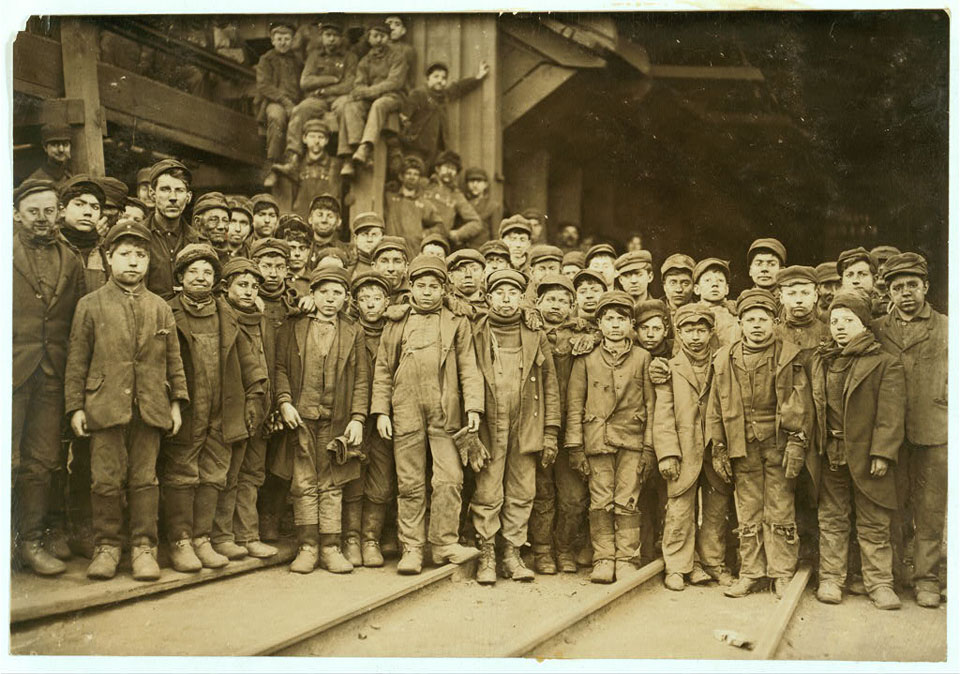
The push to weaken child labor protection laws in an effort to fill what lawmakers call “labor shortages,” and which economists say is a shortage of jobs that pay a living wage, is most pronounced in Wisconsin. State lawmakers pushed a bill through the senate that would have expanded dramatically the number of hours 14 and 15 year-olds were allowed to work, to 11 p.m. on evenings that were not followed by a school day and as late as 9:30 pm on school nights.
This 1911 photo of children working in a Pennsylvania coal mine led Congress to pass child labor protection laws. Now government is rolling those protections back, undoing a century of progress.
The Wisconsin law only applies to businesses that are not covered by the Fair Labor Standards Act, which established a federal minimum wage, overtime pay, and flagship child labor provisions. Adolescents who are 14 and 15 years old may not, for example, work more than 18 hours per week during the school year in a job covered by federal law—i.e., which take in less than $500,000 in revenue and are not engaged in interstate commerce.
Wisconsin State Senator Mary Felzkowski (R-Irma), who introduced the legislation, said in a press release that “The idea for this bill came from a small business owner in town who ran into staffing issues during summer hours due to their young employees not being able to work past 9 p.m.”
In an op-ed for the Milwaukee Journal Sentinel, Wisconsin AFL-CIO President Stephanie Bloomingdale wrote, “The proposed change is the latest attempt by Wisconsin Republicans to solve the state’s so-called labor shortage on the backs of children.” The AFL-CIO, Wisconsin Education Association Council, and Wisconsin School Social Workers Association have all issued statements condemning the new law, saying it rolls back child labor protection laws.
Governor Tony Evers apparently agreed with the AFL-CIO: on February 4 he vetoed the bill.
Finding the legal means to put children to work is another attempt to compensate for the “great resignation,” with four million Americans declining to return to their low-paid jobs when the pandemic lockdown ended. The Wisconsin law allows businesses to keep wages low and fill job vacancies with adolescent employees—who should be focusing on their studies instead of working late on school nights—rather than increasing wages to attract adult employees. Another incentive for employers is that federal law allows them to pay workers younger than 20 as little as $4.25 an hour for the first 90 consecutive days of employment, which they can describe as a training period. Wisconsin is one of 20 states that have maintained the federal minimum wage of $7.25 an hour since 2008.
Small businesses have notoriously opposed attempts to raise the minimum wage, arguing that the increased labor costs would put them out of business. But big corporations are also capitalizing on the so-called labor shortage, in an effort to hire younger workers for low wages.
“They would like to see these hours of work change nationwide,” President Bloomingdale, who recently debated the head of the Wisconsin Restaurant Association, tells The Conversationalist. “We need to renew our collective efforts to make sure that when people go to work, they have the ability to sustain a family.”
McDonald’s has come under fire in recent months for allowing a franchise owner in Medford, Oregon, to hang a banner outside that read “NOW HIRING 14 & 15 year-olds.” Job postings that advertise positions for 14, 15, and 16-year-olds at McDonald’s are still up online with a reminder that “during the summer months when school is out of session you are actually allowed to work up to 5 days a week and 38 hours a week.” Other fast-food chains have taken similar steps in a desperate attempt to alleviate staffing shortages.
Reid Maki, the Director of the National Consumer League’s Child Labor Coalition, said the government does not keep strong data on child labor. “There’s good reason to fear that the numbers could climb,” he said, adding that rising poverty caused by the pandemic could “drive kids to early work” rather than staying in school.
The Department of Labor warns that “the pandemic and subsequent economic downturns threaten to reverse decades of progress on child labor.” Labor disruptions, the death of family members, and school closures are listed as some of the key factors aggravating the situation. But this data is outward-facing and treats child labor as an international issue among developing nations.
In the U.S., one in seven children lives in poverty. They account for one-third of impoverished Americans, according to data from the Center for American Progress. The U.S. ranks third in child poverty rates among OECD nations, after Israel and Chile.
“The [American] public doesn’t really perceive that child labor is a thing of contemporary times,” Maki says.
Asked about the Wisconsin legislation, Maki said, “One issue is that kids who work a certain number of hours don’t do as well in school.” But he was also concerned about the safety issues that come with working later hours, both on the job and while driving home.
Maki is not opposed to teens working part-time jobs for some pocket money. His concern is for children who are compelled to work because the family needs their income to meet basic expenses. “We need to get to a point where all adults make a living wage and don’t need the income of their kids to help the family get by,” says Maki.
But with soaring inflation and millions newly cut off from unemployment benefits, the risk that children will have to go out and work in order to help their parents put food on the table is now very real.
Under Biden’s Covid relief package, the Child Tax Credit (CTC) provided families with $3,600 per year for each child under the age of six and $3,000 for each child 17 and under, with the funds paid out in monthly checks of up to $300 per child. These payments went furthest among families who typically don’t make enough money in a fiscal year to receive a full CTC under normal circumstances. The December expiration has now cut off a critical source of cash-in-hand for the poorest families.
For Republicans, that seems to be the point. The GOP Ways and Means Committee published ablog post in October 2021 denying that the Child Tax Credit had reduced child poverty by half and claiming that it discourages people from working. They cite a University of Chicago study that claims the CTC would cause 1.5 million workers to exit the labor force.
At the beginning of the pandemic, we believed children were largely “immune” to the virus. Now we know this isn’t the case. Children are contracting Covid, just not at numbers that register at the policy level. Our elected officials have shown that they’re willing to let children be the collateral damage of an ongoing crisis in more ways than one.
[post_title] => Republicans want to solve the labor shortage problem by putting children to work
[post_excerpt] => Weak labor laws combined with poverty and soaring inflation could result in millions of children leaving school to help put food on the family table.
[post_status] => publish
[comment_status] => closed
[ping_status] => open
[post_password] =>
[post_name] => republicans-want-to-solve-the-labor-shortage-problem-by-putting-children-to-work
[to_ping] =>
[pinged] =>
[post_modified] => 2026-08-05 17:58:45
[post_modified_gmt] => 2026-08-05 17:58:45
[post_content_filtered] =>
[post_parent] => 0
[guid] => https://conversationalist.org/?p=3778
[menu_order] => 141
[post_type] => post
[post_mime_type] =>
[comment_count] => 0
[filter] => raw
)