WP_Post Object
(
    [ID] => 9177
    [post_author] => 15
    [post_date] => 2025-09-02 20:19:11
    [post_date_gmt] => 2025-09-02 20:19:11
    [post_content] => 

How one word has birthed a globe-spanning tradition of resistance.

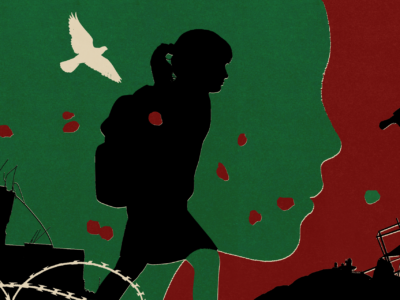
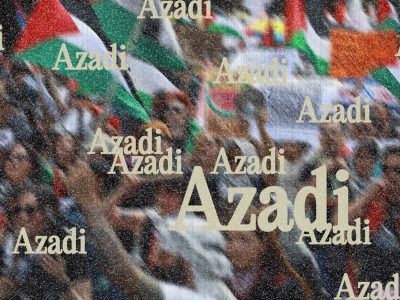
A few months ago, I was at a protest in Washington, D.C. This was not unusual. Gaza burns. The president deports with impunity. Respect for the rule of law—notably and especially by the government—now seems like the nostalgic artifact of a more innocent era, an era merely months ago. Unsurprisingly, for those of us moved by these simultaneous horror shows, expressing our anger through protest has become almost unremarkable. I’ve lost count of the number of protests I’ve attended, the catchy homemade signs I’ve crafted and seen, and the clever chants I’ve memorized. But at that particular march, something unusual happened: a chant-leader exhorted us to cry a word in my mother tongue, Urdu.

“Azadi!” she called.

“Azadi!” the crowd responded in unison.

Suddenly, the word seemed everywhere: scrawled in chalk across sidewalks and columns; emblazoned across signs. In the heart of the nation, the seat of its power, everywhere, that old watchword of uprising—Azadi.

~

Azadi, or freedom, is a small word. A scant five letters in both English and its original Farsi (آزادی), these five letters have birthed a globe-spanning tradition of resistance, having been shouted by students in Srinagar and Tehran, whispered in prison cells in Ankara, and sung by women in Kashmir and Delhi. A cry familiar to all children of the Middle Eastern and South Asian diaspora, myself included, Azadi is hymn, music, and lifeline. It’s a demand for dignity from its callers and from all those who answer the call. 

This demand is expansive in scope and depth, inclusive of the dignity of life, of identity, and of the ability to govern your own political destiny. Azadi evokes our collective memory that freedom is claimed, not given, while narrating a people’s unified struggle for systemic social change. For those who seek the protection of the most vulnerable while preserving the dignity of all, Azadi is always within reach. 

Still, for all that Azadi is, we must be clear about what it is not. It is not a slogan to be selectively invoked. It is not a justification for state violence. Azadi cannot mean the protection of innocent life only when politically convenient. Moreover, it becomes meaningless when uttered by those who do not uphold a politics grounded in human dignity. Nowhere was this distinction starker than in a recent televised address, in which Prime Minister Benjamin Netanyahu briefly switched from English to Farsi while commenting on Israel’s bombing of Iran. “Women, life, freedom. Zan, zendagi, azadi,” he said—invoking the slogan of the Iranian women’s rights movement. In that moment, the language of liberation was co-opted to justify the machinery of war. It was surreal to hear a feminist chant—professed often by Iranian women defying authoritarian rule—repurposed by the very man overseeing the brutally indiscriminate bombing of thousands of women and girls in Gaza. The slogan, stripped of its radical roots and repurposed as rhetorical cover, stood in direct contradiction to the grassroots movements that had once breathed life into it. 

Creeping autocracy in the United States has for too long been ignored and shrugged off as a dysfunction that happens only in the Middle East and elsewhere in the Global South—the lawless other. But this careless, arrogant posture can no longer be supported, nor can the dangers of autocracy be reduced to a foreign export; and so, Americans chant Azadi now, because America needs it now. The past 100+ days have exhibited what the marginalized in this country have always known: that the greatest repression within America’s borders remains homegrown. Despotism collapses the political distance between nations and times, and just as fascism is rising globally, it has risen here. The myth of American exceptionalism falsely preached that our democracy was immune to the spell of demagoguery. But we know that Americans are just as capable of voting themselves into tyranny as any other people. White supremacy, toxic masculinity, and violent inequalities in rights and liberties were always part of the country’s domestic architectures. Now, from the streets to digital silos, they are plain for all to witness. 

From Hungary to India, Israel to the U.S., authoritarian regimes the world over are in conversation, looking admirably upon each other. They swap notes in class, sharing tactics of repression, like aggrandizing executive power and politicizing independent institutions. But just as authoritarian regimes learn from each other, so too must we build solidarity across movements. The rhymes of history—from the surveillance of Black radicals in the U.S. to the targeting of Kashmiri students in India—demand collective study. And along with any new lessons that may arise, we must continue to echo the lessons of some of our most beloved visionaries. From Angela Davis to Edward Said to Arundhati Roy, we are reminded that global resistance is strongest when deeply rooted in local struggle. 

In fact, therein lies Azadi’s greatest power: It crosses borders, languages, and faiths, moving between nations without itself becoming nationalized. It is a global grammar of defiance.

~

Language lives. It breathes, grows, reproduces. Azadi has done so, too, absorbing every movement and tongue it touches: Farsi, Urdu, Kurdish, Pashto, Punjabi, English. The precise journey of the word is contested; after all, linguistic borrowing is never an isolated event. Still, it carries an expansive genealogy of struggle through its travels: against gendered violence, against settler colonialism, against religious nationalism.

While I heard cries for Azadi in D.C. for the first time this year, in Indian-occupied Kashmir—the most militarized zone on earth—Azadi has been invoked for decades, having been part of the Kashmiri liberation movement since its inception. Yet as Modi’s India forbids conversations about the region and brands it as sedition, as students and organizers are arrested for expressing their desire for freedom, as the indigenous Kashmiri struggle for self-determination persists—Azadi remains the movement’s heartbeat. 

Long serving as the anthem of the Kashmiri separatist movement, now that Azadi can no longer be expressed in the open, it hides itself in art or in niche digital spaces not yet subject to state discipline. Digital speech, however, is increasingly policed. On platforms like X (formerly Twitter), Indian authorities now block, geofence, or suspend accounts that challenge its narrative. Content from advocacy groups like Stand With Kashmir is censored using the same tools of repression that platforms in the U.S. deploy against pro-Palestinian activists—algorithms, shadowbanning, keyword suppression. Surveillance and censorship, previously characterized as exclusive to so-called illiberal regimes, are now a feature of the liberal democracies just catching up. 

As all this occurs, state actors escalate their repression of dissent in the United States. Trumpism has made it clear what can and cannot be said: speech critical of the Trump administration is met with swift retribution; and speech challenging domestic and foreign policy is quickly vilified, as seen by the vicious response to ICE protests in California earlier this summer. Meanwhile, students protesting for Palestine in the U.S. now face the same brutal state retaliation we’ve long associated with authoritarian regimes abroad—even though the U.S. has always had its own archive of violent suppression, from the surveillance and silencing of civil rights activists and abolitionists to the the crackdown on anti–Vietnam War protesters after them. Today, much to Trump’s delight, some of the most prestigious law firms have capitulated to executive pressure, agreeing to perform approximately $1 billion worth of pro-bono labor for Trump’s retributive pet projects. Activists and pro-Palestine advocates have been doxxed, fired, expelled, and/or blacklisted. All the while, institutional liberalism bends the knee: DEI offices that once promised safe harbor for marginalized voices now fall silent or side with power; liberal media outlets fire staff who speak out against atrocities in Gaza. The suppression of speech, criminalization of protest, surveillance of dissent—these are global patterns, and we are not exempt. Arguably, if American exceptionalism matters here at all, it will be in its ability to normalize this authoritarian bent worldwide.

And yet resistance continues. The same dignity Azadi rallies for abroad is now demanded here. On the steps of American universities. In its hallowed institutions. At the foot of the Capitol. 

~

For all that Azadi gives, it demands something of us—namely that we do more than simply bear witness. When we chant Azadi, we are not just echoing other movements, past and present, but entering into dialogue with them, from Kashmir to Kabul to Tehran. This is not mimicry, but lineage, as Azadi reminds us in every generation that our rights are not guaranteed and must be renewed through struggle. 

It is not enough, then, to be the appreciative, passive inheritor of a tradition of resistance; one must mobilize. This means texting rideshares, learning how to administer basic first aid for those whose names you don’t yet know, and tracking jail releases of those who you just met and marched alongside. This means disagreement without collapse, and accountability without exile. This means spending hours in rooms with bad lighting and too many opinions, trying to move toward consensus anyway. 

If Azadi is to continue to mean something lasting, we’ll need to carry it beyond the chants—into policy fights, mutual aid networks, protective kinship, and more. Because Azadi is not metaphor, it is mandate, and requires all of us to answer its call. 

~

Call and Response: 

Hum kya chahte? Azadi!
What do we want? Freedom!

Chheen ke lenge—Azadi!
We will snatch it—Freedom!

Hai haq hamara—Azadi!
It is our right—Freedom!

Zor se bolo—Azadi!
Say it louder—Freedom!

Hai jaan se pyaari—Azadi!
We love it more than life—Freedom!

Tum kuch bhi kar lo, hum leke rahenge—Azadi!
Do what you want, we will still win it—Freedom!

[post_title] => America Needs Azadi [post_excerpt] => How one word has birthed a globe-spanning tradition of resistance. [post_status] => publish [comment_status] => closed [ping_status] => closed [post_password] => [post_name] => america-united-states-azadi-freedom-protest-palestine-gaza [to_ping] => [pinged] => [post_modified] => 2025-09-03 10:27:10 [post_modified_gmt] => 2025-09-03 10:27:10 [post_content_filtered] => [post_parent] => 0 [guid] => https://conversationalist.org/?p=9177 [menu_order] => 4 [post_type] => post [post_mime_type] => [comment_count] => 0 [filter] => raw )
America Needs Azadi

WP_Post Object
(
    [ID] => 8581
    [post_author] => 15
    [post_date] => 2025-05-29 00:10:24
    [post_date_gmt] => 2025-05-29 00:10:24
    [post_content] => 

Stories from my friends still trying to survive.

It begins with a panicked message on Bluesky in October 2024. Someone is messaging me with a link to a fundraiser and stilted English that reads as though it came from a bad translation app. The picture on her GoFundMe shows a young woman with a pale face and shocking green eyes. 

It’s been seven months since the borders of Gaza were sealed. She says she is in Zeitoun, a pocket of north Gaza under siege. I respond in colloquial Arabic, to see if this person can even speak the language, to see if she is real. I ask her for a WhatsApp number. She gives me one. It starts with +972.

She is real. Her name is Hayat. She, along with her husband and children, did not flee south as the siege on north Gaza tightened. Where to go? she says. 

Hayat is pregnant. Eventually she will give birth—by c-section, without anesthesia—to a little girl with blue-green eyes as brilliant as her own. She names her Fatima. Now, I have a namesake in Gaza. 

I meet Mohamed next. A farmer and a teacher, he has lost his sheep and rabbits, but even living in al-Mawasi refugee camp, he persists in growing plants and crops in a little garden by his shelter so there may be something fresh to eat amid the siege. Al-Mawasi, a cruelly named “safe zone,” has witnessed regular attacks and bombardments since Mohamed arrived there in March 2024. 

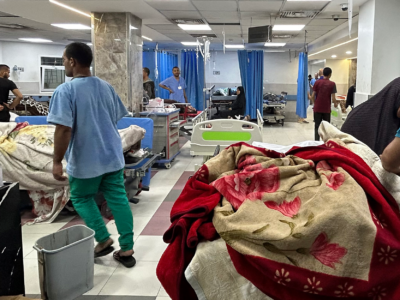
This same siege today, almost three months since all aid to Gaza has been cut off, has driven people to famine. The cost of flour, if you can find it, careens wildly, swinging from an already farcical $100 USD to an impossible $700 USD. The bread bakeries have shut down. The World Central Kitchen says its warehouses are bare. Children have been dying of malnutrition and under bombs all at once, like fish in an increasingly shrinking barrel. To quote a DC pundit, “The war in Gaza is not really that different than other wars.” A beat. “Well, except I guess they can’t run away.” 

My keeping a bunny as a pet amuses Mohamed. One day, he shares a story about missing his animals, and a farmer in Texas donates $500 to his fundraising campaign. Mohamed is saving every penny for his eventual evacuation from Gaza, now a distant hope. Meanwhile, the cost to survive continues its inhumane inflationary spiral. Funds meant for escape are now hoarded for food, any food, which is becoming harder and harder to find.

After Hayat and Mohamed, I meet Obada. Obada is a lawyer with three children. He considers his youngest, Zain, a gift from God, as his other two children required medical intervention to exist. Zain did not. On Eid, Obada shares a photo of Zain in his little white thobe, a dignified and serious garment for adults that is adorable on a baby. 

The calls for help swirl thick and fast—other families realize they can build lifelines beyond the walls of Gaza, that someone, anyone, is willing to hear out their agony. There are Naser and Amal, with their children Rolan and Omar. Naser currently lies in one of Gaza’s last functioning hospitals with a breathing obstruction, and needs surgery. I try to help them a little. Rolan sends me a thank you photo: a young girl of seven, sitting on a pile of rubble against a blue sky, holding a sign that reads, “My love for you (heart) Fatima Ayub.” 

Before Israel sealed the Rafah crossing with Egypt in March 2024, it cost $5000 USD per adult, and $2500 USD per child, to organize an evacuation from Gaza. Those figures, as extortionate as they were, are meaningless now. No one can leave, and if they do, it will be as part of the deliberate depopulation of the strip. Yet, as my friends in Gaza keep telling me, nothing is left. Virtually no school, clinic, hospital, or mosque in Gaza has been left standing. Gaza has been bombed more heavily than London, Dresden, and Hamburg in World War II, combined. Children keep arriving in the few remaining hospitals with bullets in their heads.

I meet multiple Ahmads. There is Original Ahmad, who braved the migration boat passage under Israeli gunfire to escape Gaza to Europe—but is distraught because his mother and the rest of his family are still in the north. There’s Child Ahmad, who returned to Gaza to marry his lifelong sweetheart Samar, and was trapped when the war came. There’s Other Ahmed, whose siblings are all frantically trying to survive in a tent. Then, comes Another Ahmad, who shares a photo of himself in the rain, barefoot with already too-thin legs. 

There is Suad, who is only 24, and mother to a little boy, Omar. She’s taken to calling me mom, having lost her own mother before the war. I have no maternal experience, but try to hear her story. Among the most common injuries in Gaza unrelated to war wounds are burns—made worse by so many people cooking on unsafe, open fires. She shows me a bad burn that needs medical treatment. Her little boy has broken his leg, an ordinary childhood tragedy compounded infinitely by the horror. 

I meet Malak and Maali, who are sisters. Maali is disabled and needs a new wheelchair and special care. Malak labors hard on an unwelcome internet and on an unforgiving planet to help her sister retain her life and dignity.

Then comes Majd, 17, only just a child himself. Still, he shoulders the responsibility of trying to help his sisters and mother survive. He feels he has no choice.

Moataz is a shy and kind young man whose beloved father is ailing from kidney disease. Moataz doesn’t understand online fundraising, doesn’t understand social media, doesn’t understand this bizarre dystopia where he talks to a woman on the other side of the planet to try and outmaneuver a siege of biblical proportions. 

Rumors circulate in the aftermath of hostage Edan Alexander’s release that food aid will be permitted to enter Gaza. So far, these are only rumors. The siege grinds on. The ground invasion begins in earnest. An Israeli MK tells the world, “Last night, almost 100 Gazans were killed. And the question you asked me just now had nothing to do with Gaza. Do you know why? Because it doesn’t interest anyone. Everyone has gotten used to [the fact] that [we can] kill 100 Gazans in one night during a war and nobody cares in the world.”

Does anyone care? Does caring matter? 

Hayat, too, has burned herself. She tells me a pack of diapers for baby Fatima costs $70. 

Still, no aid comes.

Obada sends me photos of his dear friend, killed just last night with his wife and baby daughter. “My heart hurts, Fatima,” he tells me. “With his baby in his arms. He was only married a year.” 

Still, no aid comes. 

A friend asks me if I can help Hanadi, a still-young woman with eight children. I give what I can. 

Still, no aid comes. 

Even good news comes tainted. Naser is out of the hospital, but now, his neighborhood in Khan Younis is under evacuation orders following the latest assault. He decides not to evacuate. “I’m tired,” he tells me. “Rolan came to me crying asking why we are staying when everyone else is fleeing. It cut my heart.”

Child Ahmad, meanwhile, is fleeing, also pushed into al-Mawasi. He says he will not be online so much. When I do not hear from him for a day, I worry. I think of the al-Hol concentration camp for some 55,000 wives and children of ISIS fighters in Syria.

The US undertakes a farcical “aid delivery attempt,” under the eye of mercenaries who take selfies against a backdrop of starving Palestinians. The effort is about as successful as the floating pier to deliver aid that sank into the sea, a perfect grotesque metaphor, almost as perfect as letting children die while hundreds of thousands of tons of food rots within sight. 

Now that the ghastly end game for Gaza has been laid bare, this is what we—the Western world—have done to the Palestinians. When will it end? my friends ask me. How much more can we be expected to take? they ask. Until when? they ask. 

It is May 28, 2025. I have no answers for anyone. 

If readers wish to help any of these or other families trying to survive in Gaza, they may contact the author on Signal at fatimaayub.01 or by email at fsayub@gmail.com.

[post_title] => To Live and Die in Gaza [post_excerpt] => Stories from my friends still trying to survive. [post_status] => publish [comment_status] => closed [ping_status] => closed [post_password] => [post_name] => gaza-palestine-israel-war-survival-siege-aid-embargo [to_ping] => [pinged] => [post_modified] => 2026-08-03 22:49:02 [post_modified_gmt] => 2026-08-03 22:49:02 [post_content_filtered] => [post_parent] => 0 [guid] => https://conversationalist.org/?p=8581 [menu_order] => 15 [post_type] => post [post_mime_type] => [comment_count] => 0 [filter] => raw )
GAZA CITY, GAZA - MAY 17: Palestinians, struggling with hunger due to Israeli embargo, wait in line to receive hot meals distributed by the charity organizations as Israeli attacks continue, in Jabalia Refugee Camp in Gaza City, Gaza on May 17, 2025.

To Live and Die in Gaza

WP_Post Object
(
    [ID] => 7547
    [post_author] => 15
    [post_date] => 2024-12-13 23:13:25
    [post_date_gmt] => 2024-12-13 23:13:25
    [post_content] => 

How the "separation barrier" changed everything.

Listen to this article on The Conversationalist Podcast. | 26:19 min

There was a time when people would ask, "Do Israelis and Palestinians hate each other?" and I would say "no."  Then, the walls came up. Now, that time is increasingly hard to imagine, even in memory.

As a Palestinian who grew up in the West Bank and would frequently return to visit, I vividly recall the first time I witnessed the walls rising in the early 2000s along a road to Ramallah, a city in the occupied West Bank near Jerusalem. I thought: Why did the Israelis do this? Why has it been erected with such disregard for the communities living behind it? I understood, even then, that this division would only tear neighbors apart, and more alarmingly, further separate "enemies" from one another.

In just a few years, the walls would stretch over 400 miles, dividing the occupied Palestinian territories from Israel. These walls and fences, which Israelis called the separation barrier, would not just be physical barriers, but the hardening and entrenchments of dueling positions in this conflict. They still stand today: In some stretches, the walls are made of concrete and 30 feet high.

What Palestinians call Al Jidar—Arabic for "the Wall," connoting "the Apartheid Wall"—was, according to Israelis, mainly erected to prevent suicide bombings and violent attacks, which were accelerating at a rate they alleged left them with very few options. In 2002, during its construction, Human Rights Watch reported that "more than 415 Israeli and other civilians have been killed, and more than two thousand injured, as a result of attacks by armed Palestinians between September 30, 2000 and August 31, 2002,” with most of the harm “caused by so-called suicide bombings.”

But while I could understand the horror and the pain and the fear these attacks had caused, I could never understand how the wall was the solution. 

A child of the occupation 

As a child, I discovered a fear that would forever shape my understanding of the military occupation.

I have seen soldiers for longer than I can remember, but through childhood eyes, they’d always seemed friendly. One night, however, that changed.

I was maybe 5 or 6 years old when I demanded that I be allowed to mop the store floor in my small town in the West Bank. It was a sign of growing up, and behaving as I saw the adults around me do—working, tidying, driving, living. While I was mopping, a group of soldiers came into the store to buy some things. I remember being unable to control the joy I felt, performing this adult chore, while trying to control the mop, which was three times my size. I wasn’t paying much attention to my surroundings, until I accidentally hit one of the soldiers with the mop’s handle.

When I looked up, I saw something I’d never seen before—the soldier's hand on the trigger of a very long weapon and, oddly, his bared teeth. I still remember these teeth without a face, and how they scared me as much as the trigger on his weapon. I knew I’d made a mistake—and that night, I learned how easily a mistake could cost me my life.

I’d finally met my "master," and understood the divide between "us" and "them."

The "solution" that created the "monsters"

After the wall, this divide grew bigger. For Palestinians, the wall separated us from life.  It turned our cities and towns into cages, where the sky above us was the only place outside that felt within reach.

Solutions to this conflict were never going to be easy, if ever achieved. Yet the wall allowed both Israel and the international community to sidestep its complexity, disregarding the future of both Palestinians and Israelis alike. It decreased all human interaction with the “other side,” regardless of which side of the wall you stood. It was not a solution at all, but the deference or maybe even the ignorance of one. It was also a boiling pot: I say this because I saw it, and I felt it, and I lived it. 

The wall disconnected me from both friends and "enemies," but in time, I was no longer interested in seeing either. It isolated all of us and confined us to our own causes and anger, not caring for how the "other" felt. After all, I could only feel my anger when standing at a checkpoint. I could only feel my hatred when looking at the wall in front of me. I could only feel my outrage that my freedom to move was restricted by a permit, which I was required to obtain whenever I wished to leave, and that it was something I needed to be deemed “acceptable” to acquire.

For some Palestinians, receiving this permit may have brought joy, because they felt like the "lucky" ones. But for me, I often felt better just going about my life, refusing to get one, because living inside the wall felt more dignified than seeking permission to leave it.

I did not always prioritize my dignity in this conflict. I looked for friendships and ways to enjoy life despite the violence and the vitriol that surrounded me. But eventually, all these constant humiliations chipped away at me. Chipped away at the hope and joys I sought—all the things available to most human beings, but not to me. It offered me no choice but to instead look at what I did not have: my freedom, my rights, even my will to love, something I cannot have when I am stripped every day of everything that is mine.

The wall did this. And I wondered as I wonder now, when people are unable to meet freely, is our only alternative more war and more killing?

Before the wall

There was a time when American-Palestinians from the West Bank could drive what we called a "yellow tag" car, which felt like the height of "privilege," because it meant you could drive freely in the West Bank and Israel. At the time, if you had one of these cars, it felt as if all you had to do was drive by the checkpoint and get waived through, most times without your ID even being checked. (Over the years—just like the ever-changing restrictions—civilian cars with a Palestinian tag couldn’t enter Israel and most parts of Jerusalem. Those rules continue to change even now, depending on the political climate.)

I drove a car like this once to go and meet with a friend for a swim in Tiberias, an Israeli town on the western shore of the Sea of Galilee. Just writing this seems absurd in the year 2024. But it did happen often once, and not just for me, but for others, as well—although for Palestinians with limited "privilege" today who have an Israeli residence or hold an Israeli passport, it can still be a daily occurrence should they wish, because those people are considered "outside" the wall.

When driving back from my trip, I had to pass another checkpoint when leaving Tiberias. While I have an American passport, I also hold a West Bank ID, which placed restrictions on what car I could drive at the time. The restrictions had recently become stricter, and technically, I was not allowed to drive the "yellow tag" car I was driving.

I was nervous, but as I passed the checkpoint, the soldiers mistook me for Israeli. They asked me a question in Hebrew that I did not fully understand, and I said "yes." I thought they were asking if I was from Jerusalem, which would have allowed me to drive that car, and hoping they’d let me pass, I lied.

Seconds later, three soldiers entered my vehicle. Afraid of being caught violating the law, I just smiled and started driving. I soon realized that the soldiers wanted to hitch a ride to Jerusalem, something that might have allowed me to get away with my transgression, except I wasn’t going to Jerusalem, but home to a village in the West Bank. Not knowing what to say or do, I kept driving.

Amidst my panic driving along the winding road that night, one of the soldiers asked, "You came from America?" I said that I had. Then, he asked, "How come your parents didn’t teach you Hebrew?"

I knew this was the moment I should tell them I am Palestinian, so I replied, "Because my parents taught me Arabic."

After, it felt as if the world stopped turning and it was just me and the soldiers in the car. We were silent for a long time. My face turned hot, so hot I can still feel it all these years later. I could feel the soldiers were tense, too.

I’d made a mistake not confessing that I was not authorized to drive that vehicle and they’d made a mistake not vetting me at that checkpoint. In any other context, this might have been a moment of silent honor amongst harmless lawbreakers, but instead, it felt like a dangerous mess for us all.

For their safety, those soldiers should not have been in my car. For my safety, I should not have let them in.

"So, what are we going to do?" I asked after another long pause. "I cannot drive you to Jerusalem because I am almost out of gas and we must go through a checkpoint, and I cannot leave you on the side of the road just anywhere." We started strategizing when and where I could drop them off that was familiar to them, but was also somewhere I could go unnoticed. Eventually, we chose a place and parted ways, and never saw each other again.

This incident would not play out the same today—or maybe, more accurately, after the walls went up, it couldn’t: I’d see them differently now, and they’d see me differently, too.

You cannot contain hate

The wall did not just create a cage for "us." Israelis were also not free; instead, they were caged in fear.  

You see, I am a person who is "occupied." I grew up understanding "they" rule me, and my rulers will kill "us" if we dare to rise and demand our freedom, the right of every human being on this earth. A right that is not to be granted or given. A right that we are born with and that belongs to us. Both of us also have a right to not live in fear. Yet it is their fear which is why we are made to stand, stripped of everything, in front of an enemy with an arsenal of weapons with which to annihilate us.

Killing, however, is not a right—not for "them" or for "us." As societies, we find different ways to justify it, support it, and, at times, speak proudly of it. Yet when we do so, we all lose, because there is no pride in killing. There is, I believe, no justification for taking a human life. And nothing can exonerate us from our complicity when we support it, even when it’s in service of pursuing our freedom. 

When I was still a young aspiring documentary filmmaker, I remember once having to ride on an Israeli bus. As a Palestinian, I had no permit, and I remember being grateful I was still able to board, but was unprepared for how I felt throughout the ride.

I felt fear! What if there was a suicide bomber on this bus? One of my people, I remember thinking. Filled with anxiety, I surveyed every person who got on the bus at every stop, worried if "this person" could be the one. And in that moment, I understood there was no human difference between the fear Israelis must experience and my own.

But I also wondered if they would ever understand that, too. When I felt "their fear," I also wished they could know mine, and how we, the Palestinians, feared "them"—their cruelty, their disproportionate response to "our" attacks. Their collective punishment without mercy against the people inside the wall.

Witnessing horror in the making 

As time passed, I grew accustomed to the wall's presence, and it became acceptable to see it everywhere without staring at or questioning it for too long. But the anger remained, an anger that is difficult to understand for those who have not lived on the "other" side of it. 

Visitors saw the wall as an "ugly" thing, a sign of injustice, at most. But they were not witnesses to what has happened to the people for whom this wall represents the circumference of their existence. We were not living—just existing. Constantly adjusting to everything, from restrictions to violations, because we had no choice.

The years have gone by, and like many, I’ve seen less hope and more hate every year, with no way to correct it. My privilege as an American-Palestinian has allowed me to see the severity of these changes with each visit: the deteriorating living conditions, the increased restrictions, the endless violence, almost always without consequence.

But I have also observed something far sadder and more terrifying: a generation growing up without seeing their "enemy" as human.

You see, I am of a different generation. A generation that grew up under occupation and was constantly reminded that I had a "ruler." But before the wall, no matter how I felt about the occupation and my oppression, I could still see the people who "ruled" me; I could still see their humanity, because I could still see their faces.

Now, the wall has made the "enemy" soulless and faceless. And I wonder, on the other side of the wall, is there also a generation that fears their enemy and thinks of us as non-human, too? As people who not only do not belong to this world, but who also wish to cause them harm—to kill them? 

I pictured a generation of people on either side, fighting an enemy they’ll never know, and I worried about what would happen when the walls come down, because walls always do. It’s because of this, when the time came, and people would ask me, "Do they hate each other?" My answer became, "Yes, they do."

The children of the wall    

October 7, 2023 happened over two decades after the walls were built. To this day, I do not want to watch the videos that were plastered on every television screen. It is the nightmare I imagined, but even worse, because it was real. In the aftermath, many people—the media, acquaintances, colleagues—called the Palestinians who did it "monsters." Then, we saw the other "monsters" emerge, the Israelis.

On October 7, more than 1,200 people were killed in Israel, including about 800 civilians, 346 Israel Defense Forces (IDF) soldiers, and 66 police officers, according to the Israeli Ministry of Foreign Affairs. Thousands were also injured in the attack and about 250 men, women, and children were abducted.

Since then, Israel’s retaliatory war on Hamas has killed more than 44,000 Palestinians, with more than half of them women and children. Gaza has become “home to the largest cohort of child amputees in modern history,” according to a UN official. Entire bloodlines have been erased. The videos that have emerged have been equally unbearable to watch as those from October 7: As ABC reported, "in many pictures and videos that have circulated since the conflict began… IDF soldiers are seen blowing up buildings in Gaza while in combat, waving women’s underwear like flags and rifling through the possessions of Gazans with gleeful expressions."    

Many families of the Israeli hostages who were not released or rescued are still waiting on their loved ones to come home, dead or alive; while thousands of unidentified Palestinian children are either buried under the rubble in Gaza or have been left orphaned and injured and starving. Mass graves are only a sign of the times for the people in Gaza: Their "open-air prison" is now a graveyard.

Many may uphold that staying in Gaza is a heroic honor—and it absolutely is. But when there is no choice but to stay, we cannot call it a choice at all. Those still alive in Gaza continue to have nowhere to go, their right to move and live freely taken from them. The children, especially, deserve to grow up and decide their position on a war they did not choose to be a part of. But we have robbed them of that. We are spectators with a cause: We count the dead but look away from the living. The Israeli soldiers and the Palestinian fighters, even Hamas—all of them chose to fight in this war. The children did not.

Are we comfortable with Gaza’s children dying for "our" cause? I am not. But there are no winners in war: What good is winning when the land is drenched in blood?  

So, who is the monster? 

Neither of us were created to suffer. It is not our destiny, or theirs. While I’m not a peace activist, I did—and still do—believe that the only way through this conflict is to be seen, to be heard, and to share without hate and fear. But we can only do that by opening ourselves to the idea of peace, to opening the doors for peace. Not by walling them up.

Like the Israelis soldiers in Gaza killing Palestinians, many of those who killed Israelis on October 7 are from "behind the wall." The same wall that taught them that neither of them is human, that the people on the other side are objects to destroy, to seek revenge from, and to win against, no matter the cost. It’s a matter of perspective.

But I do not believe it is only the people who pulled the trigger who are to blame. To me, all who were silent when the walls came up, who witnessed  human rights violations increase every year, who watched two generations living side by side while growing to hate and fear one another—they are to blame.

All of us, then, are to blame. 

Every educator, every media personality, every politician, every international leader who did not speak loudly and demanded solutions. Every person who only chose to look after it was too late. All of us are complicit in the death of every child and civilian in Gaza, and Jerusalem, and the occupied West Bank, for the death of every person and child on October 7, and for the fear every hostage and citizen feels in Gaza today. This misery was created by us all. The deadly airstrikes, the starvation, the inhumane conditions that people are living under, the unknown fate of the hostages—all of it was made and maintained by us. Whether consciously or not, through our complicity, through losing sight of our shared humanity, we have all become the monsters we most purport to fear. Because the truth is, when we choose to build walls, we are the ones making a monster out of the people on the other side—and a monster out of ourselves in the process.                

We must all ask ourselves, then, if the right conditions were set, the right circumstances—would we become a monster, too? I don’t know that I can say “no” for certain; my privilege, relative though it may be, does not allow me to give definitive answers. I was born a Palestinian by chance, just as we all are born into our circumstances by chance. But maybe in another life, I, too, could have turned into the "monster" behind the wall in this one.

[post_title] => The "Monsters" Behind the Wall [post_excerpt] => How the "separation barrier" changed everything. [post_status] => publish [comment_status] => closed [ping_status] => closed [post_password] => [post_name] => monsters-wall-israel-occupied-west-bank-palestine-separation-barrier-gaza-war-al-jidar-apartheid [to_ping] => [pinged] => [post_modified] => 2026-08-03 23:43:33 [post_modified_gmt] => 2026-08-03 23:43:33 [post_content_filtered] => [post_parent] => 0 [guid] => https://conversationalist.org/?p=7547 [menu_order] => 34 [post_type] => post [post_mime_type] => [comment_count] => 0 [filter] => raw )
RAMALLAH, WEST BANK - FEBRUARY 07: Palestinian demonstrators try to climb the separation wall during a protest against U.S. President Donald Trump's Middle East plan near a town in Ramallah, West Bank on February 07, 2020. (Photo by Issam Rimawi/Anadolu Agency via Getty Images)

The “Monsters” Behind the Wall

WP_Post Object
(
    [ID] => 7261
    [post_author] => 15
    [post_date] => 2024-10-08 21:36:40
    [post_date_gmt] => 2024-10-08 21:36:40
    [post_content] => 

Why the Abraham Accords could not bring peace to the Middle East.

In its November/December 2023 issue, the political magazine Foreign Affairs published a longform essay titled “The Sources of American Power,” which posited that the United States needs to “lay a new foundation of American strength” in the Middle East “that protects its interests and values and advances the common good.” Written shortly before the Hamas attacks of October 7, 2023 (but published after), the author argued that “although the Middle East remains beset with perennial challenges, the region is quieter than it has been for decades” thanks to the Biden administration’s responsible stewardship. This lapse of critical judgment might have been forgivable had its writer not been US National Security Advisor, Jake Sullivan.1 But he was also not the only American official who had lulled himself into false security. 

Since taking office, the Biden administration, with great fanfare, had chosen to double down on the Trump era’s diplomatic coup, the Abraham Accords, in hopes it would become the crown jewel of regional foreign policy: building a new Middle Eastern economic and security architecture between the Gulf and Israel that would successfully confront and contain their mutual regional antagonist, Iran.

The Abraham Accords’ sleight of hand was subverting the Palestinian-Israeli peacemaking paradigm in the process. Instead of normalizing relations between Israel and the rest of the Middle East in exchange for a Palestinian state, as was the guiding principle of negotiations since the 2002 Arab Peace Initiative, the 2020 Abraham Accords dropped the question of establishing a Palestinian state altogether, making instead vague allusions to peace. Its supporters didn’t seem to mind. In Abu Dhabi and other regional capitals, they believed the time was ripe to put aside “tedious” questions of protecting Palestinians or their unrealized sovereignty, and to instead focus on the much more tangible and lucrative questions of trade, defense cooperation, and intelligence-sharing, as well as upgraded strategic relationships with the United States.

In this respect, it worked. Through the Abraham Accords, the United Arab Emirates (UAE), Bahrain, Morocco, and Sudan all signed up for normalization agreements with Israel, and a flurry of diplomatic, touristic, and commercial enterprises sprung up in their wake. Israelis partied in Dubai; Bahrainis headed to Tel Aviv. Defense and intelligence sharing accelerated. All the while, the Biden administration continued to pursue Trump’s ultimate goal of bringing Saudi Arabia into the normalized fold. Pundits in the US crowed about a new era of peace.                    

Today, conditions across the region could hardly be worse. Escalations and counter-escalations in Syria, Lebanon, Iraq, Iran, and Yemen threaten to deepen the abyss of violence and suffering for civilians. A year ago, on October 7, 2023, Hamas’s attack killed over 1,300 Israelis. The attack was strategically timed, in part, to disrupt Israeli-Saudi normalization. In the months since, Israel has killed some 42,000 Palestinians. Thousands more lie dead under the rubble of what was Gaza. A hundred thousand Palestinians are wounded. Two million Gazans languish amid devastation under Israeli military occupation. The Israeli apartheid machine continues to destroy lives and cities apace in the West Bank. Palestinians confront ongoing Israeli settler violence under the full imprimatur of the Israel Defense Forces (IDF). Near 10,000 Palestinians have been imprisoned without pretense of due process. Some 2,000 civilians are already dead in Lebanon just in the last week, as Israel launched yet another invasion to fight Hezbollah. Ninety-seven Israeli hostages remain in Hamas’s custody in Gaza. The Red Sea has become a perilous commercial passage owing to Houthi attacks. And the prospect of a full-blown war between Israel and Iran grows ever more acute as Tehran executes another dramatic but fruitless missile barrage. No ceasefire is in sight on any front.

How did the Abraham Accords, heralded as a new paradigm for the Middle East, yield a total collapse of security and stability across the region? The answer lies in the deliberate effort of Israeli Prime Minister Benjamin Netanyahu and his foremost backer, the United States, to sustain Israel’s control over Palestinians in the West Bank and Gaza indefinitely. American officials—Republican or Democrat—may be loath to acknowledge this reality, but the central conceit (and consequently the failure) of the Abraham Accords lay in imagining a world where Palestinians did not exist. The status quo, which seemed quiet enough to Mr. Sullivan, was, in reality, deeply toxic. Though US policy formally sustains the fiction of a two-state solution, the Abraham Accords in effect tried to bury the question of when—or whether—Palestinians should ever be free and see an independent state come to fruition.

The desperate charm offensive led by Biden administration officials Brett McGurk and Amos Hochstein to convince Saudi Crown Prince Mohamed bin Salman to accede to the Abraham Accords, dangling offers of a defense pact among other political inducements, has failed. Even authoritarians need to keep their fingers on the pulse of public sentiment—and in Arab states, establishing diplomatic and commercial relations with Israel is deeply unpopular. Mohamed bin Salman has admitted the carnage in Gaza makes the prospect of normalization a political nonstarter in the Kingdom.

The Gulf states are now in an awkward position. On the one hand, states like Saudi Arabia and Bahrain had already been working steadily to stabilize relationships with Iran, despite overriding tensions for the past several years. At a strategic level, there’s a clear understanding that diplomatic exchanges can head off the worst types of violent confrontation. We see these ongoing efforts as Saudi Arabia and Iran attempt rapprochement: The Kingdom is unquestionably nervous about the threat on its southern border from a febrile and trigger-happy Houthi movement. On the other hand, Saudi Arabia and the UAE are equally pleased to see the destruction of groups like Hamas and Hezbollah, which they see as Islamist-Iranian proxies that pose a direct challenge to their visions of a consolidated Gulf hegemony in the Middle East. 

Reports that American officials greenlighted the Israeli escalation against Hezbollah after the two sides had agreed to a 21-day ceasefire opens the prospect of a more dangerous phase to this transnational conflict, wherein the US and Israel take this moment as an opportunity to fundamentally reshape the security architecture of the Middle East. The risk is that Israel could continue pursuing “greater strategic objectives” in responding to Iran’s missile attack on October 1, and drawing in American support for what would be a cataclysmic war of regime change in Iran.

None of this is inevitable. It’s possible that the US will be able to convince Israel to deliver a calibrated military response to Iran’s latest attack, tamping down further escalation for a brief window of time. But it feels increasingly likely that the delicate balancing act between security actors in the region that has prevailed over the last decade is about to come crashing down in the face of Israel’s unabashed impunity in both Gaza and Lebanon. This is not just because Arab states are unwilling to undo their peace agreements with Israel (Jordanian Foreign Minister Ayman Safadi underscored again last week that Arab nations stand ready to ensure Israel’s security), but because it is unlikely that Israel will ever permit the creation of a Palestinian state, and none will emerge short of an internationally-enforced partition of Israel from the Occupied Palestinian Territories.

The stark reality that Washington, Tel Aviv, Riyadh, and Abu Dhabi should grasp is that the fastest means to defanging the “Axis of Resistance” is the establishment of said Palestinian state. That state is not going to be the product of negotiations, if it ever comes. The occupation will end abruptly; there are no piecemeal negotiated solutions to apartheid. For the sake of his own political survival, Netanyahu will continue to foment chaos across the Middle East to retain power for as long as Washington allows him free rein. And in large part, the Abraham Accords are to blame. In saying the lives of Palestinians were less important than normalization, the brokers of the Abraham Accords helped embellish Israel’s fiction that it could sustain the status quo with Palestinians without friction or blowback. They were grievously wrong.

[post_title] => Biblical Failure [post_excerpt] => Why the Abraham Accords were never going to bring peace to the Middle East. [post_status] => publish [comment_status] => closed [ping_status] => closed [post_password] => [post_name] => abraham-accords-middle-east-united-states-foreign-policy-peace-israel-palestine-lebanon-uae-sudan-morocco-bahrain-saudi-arabia-war [to_ping] => [pinged] => [post_modified] => 2026-08-04 16:46:25 [post_modified_gmt] => 2026-08-04 16:46:25 [post_content_filtered] => [post_parent] => 0 [guid] => https://conversationalist.org/?p=7261 [menu_order] => 43 [post_type] => post [post_mime_type] => [comment_count] => 0 [filter] => raw )
Prime Minister of Israel Benjamin Netanyahu, U.S. President Donald Trump, Foreign Affairs Minister of Bahrain Abdullatif bin Rashid Al Zayani, and Foreign Affairs Minister of the United Arab Emirates Abdullah bin Zayed bin Sultan Al Nahyan participate in the signing ceremony of the Abraham Accords on the South Lawn of the White House September 15, 2020 in Washington, DC, USA. They stand on a balcony, waving at the photographers below. Photo by Yuri Gripas/Abaca/Sipa USA(Sipa via AP Images)

Biblical Failure

WP_Post Object
(
    [ID] => 6919
    [post_author] => 15
    [post_date] => 2024-05-23 17:24:38
    [post_date_gmt] => 2024-05-23 17:24:38
    [post_content] => 

Since October, over 100 Palestinian journalists have been killed by the IDF. They deserve our endurance—and our diligence.

War rages on in the months since Hamas’ assault against Israel and its ongoing retaliatory punishment of the blockaded Gaza Strip. It has been agonizing to witness. As of May, Israeli military actions are estimated to have killed more than 35,000 Palestinians, the majority of them women and children. Almost the entire population of Gaza has been displaced from their homes. A quarter of the population—more than half a million people—are at imminent risk of catastrophic famine, a number projected to surpass one million by July. For the average outside observer, myself fully included, it is impossible to track the dizzying onslaught of information emerging from the warzone without feeling some degree of despair, and even harder to do so with reliable accuracy. Social media is awash with falsehoods, mainstream American media demonstrably biased, and foreign press barred from entering Gaza independently. Further preventing vital access to information is the disproportionate number of Palestinian journalists who have been killed during the conflict so far, particularly compared to other instances of conflict reporting: Since October 7, at least 105 Palestinian journalists and media personnel have been killed by the Israeli Defense Forces (IDF), more than any other country at war. 

At the moment, Gaza is the most dangerous place in the world to be a reporter—and also one of the most consequential. As this war continues, it only becomes clearer to me that we must do everything in our power to protect these journalists and their work.

Since the war’s beginning, now the deadliest conflict of the 21st century, I’ve been reflecting on the word “indiscriminate,” on what it highlights and hides. It’s the word most reached for when attempting to describe the scale of civilian destruction in Gaza, a blanket term that fails to capture its intentionality in full. If you are well-versed in international human rights law, you know there are rules that distinguish between legitimate and illegitimate military actions, and these rules dictate what makes a death “indiscriminate.” These rules are governed by principles of proportionality: Warfare cannot result in the loss of civilian life excessive to the marginal military advantage it might achieve. Translated for the layperson, warfare is not open season, and a warzone is not a shooting range. Measures must be taken to mitigate civilian casualties. But even casual observers of this war have largely come to an uncomplicated understanding: It is difficult to describe what is happening in Gaza as anything but indiscriminate. Too many children are being killed. Too many civilians. Too many aid workers. Too many medical staff. Simply put, too many protected classes of noncombatants. 

In the case of journalists killed, however, the word “indiscriminate” also obscures something alarming. It’s an axiom of conflict reporting that death is an occupational hazard. But what is happening to journalists in Gaza goes beyond the normal range of risk. The watchdog group Committee to Protect Journalists (CPJ) has decried the behavior of the IDF, declaring this war “the deadliest conflict for journalists it has recorded since it started collecting data,” with more journalists “killed in the first three months of the war than have ever been killed in a single country over an entire year.” The CPJ has also brought charges against the IDF for the alleged killing of journalists’ families as retribution for critical reporting. And although Israel denies deliberately targeting members of the media—a war crime—they have been sharply criticized by the UN for failing to ensure their protection, and for failing to create real or meaningful safety measures to prevent further deaths.  

They’ve also openly attacked the media in other ways, and not just in their attempts to ban it. Journalists are noncombatants protected by international law, and their reporting serves a fundamental public interest. They must be able to report freely and without fear of retaliation, not just for the sake of a free press, but more importantly, to provide Gazans access to life-saving information. This work has been made all the more difficult by Israel’s targeted destruction of the infrastructure necessary to disseminate it. We tend to forget that the internet is rooted in the physical, and that direct attacks on journalists aren’t the only way to measure acts of aggression against the media. Cables, cell towers, internet and telecom networks; all these components are necessary for a story to reach the rest of the world. But many have been destroyed by Israeli airstrikes, causing communications systems to collapse—and what the world cannot see dies in the dark. 

With telecommunications compromised, on-the-ground journalists have collectively turned to social media as the primary vehicle for their work. It is, in many ways, their last connection to the outside world, and the outside world’s last connection with Gaza. Using donated eSIMs and shared phone chargers as lifelines, Palestinian journalists have fearlessly persisted in sharing what the Israeli government seemingly does not want us to see. But with such high stakes, I’ve found myself thinking about how we can engage most ethically with their work when our main platform for consuming it—social media—has the power to do as much, if not more, harm as it does good.  

Much has been rightly criticized about the pernicious role of social media in disseminating misinformation over the years. Social media is designed to sustain users’ attention in order to maximize advertising revenue, encouraging and rewarding us for sharing whatever posts elicit the most engagement—regardless of accuracy or potential for harm. But over the years, it has also become the internet’s town square; an accessible means of sharing information and finding first person perspectives that fill the gaps mainstream media often leaves behind. It would be reductive to cast social media as simply a peddler of falsehoods, particularly when it comes to what is occurring in Gaza. Social media now plays the role of historical record, collecting and preserving invaluable primary source material from journalists and civilians alike. 

As users of these platforms, particularly for Americans, it should be our duty to bear witness responsibly—which, at minimum, means utilizing basic media literacy and being mindful of what we choose to post and share. According to the Pew Research Center, half of U.S. adults get their news from social media at least some of the time; but four in ten of those same adults cite inaccuracy as their biggest concern when doing so. At a time of extreme and unrelenting dehumanization, social media has an outsized influence on the way this conflict has been interpreted abroad, and what we choose to share matters. For the ordinary online user, there is an almost emotional peer-pressure to rapidly engage on social media in the face of tragedy and injustice. Posting, after all, can be a necessary catharsis. We post in spite of and because of our utter helplessness in a world that seems indifferent to large-scale human suffering, railing against the seeming futility of our protests. In this case, Palestinians have also explicitly asked us to do it, to bear witness to their suffering, to not allow them to be forgotten, and to tell their stories of joy and resilience—largely via social media. Journalists, too, have made it clear: Our continual engagement with their work is what motivates them to keep reporting in the face of this incalculable tragedy. But when the abstract act of sharing online has direct consequences on real human lives, it becomes essential that we treat it with care. 

To be clear, I’m not advising you to stop posting, or even to post less. On the contrary, please post, please amplify, please share—so long as it’s done with a critical eye to impact. In moments of crisis, it can become easy to slip into what might be called pathos posting, posting that comes from the gut and not the mind. I see it in my followers and I, too, feel its lure. It’s the instant, unthinking tap to repost when confronted with images of the latest unbearable atrocity. It’s the incredibly human impulse to alchemize all our anguish, grief, and rage into action, however small it might be. Little to no caution is exercised in checking for doctored footage, manipulated video, or false contexts. In fact, the emotional weight behind these posts leads to an unwillingness to entertain the possibility of error or your own complicity in the potential spread of misinformation. Cries of caution are met with accusations of disloyalty. This unforgiving attitude siphons nuance and compassion from the public discourse, and further silences attempts at honest reporting. It also puts the people most affected by this conflict at risk of greater harm. Researchers and watchdog groups warn that in this moment of hair-trigger violence, misinformation will result in greater acts of aggression and potential escalations of violence against innocent civilians. We should be doing everything in our power not to contribute to it. 

Social media has the potential to bring out the best of our online selves, but so often instead summons our worst, most tribal, unreflective, and hardened. To honor the Palestinian journalists that are risking life and limb to report (only to not even be honored by name), I believe that we can and must push ourselves to engage with their work in ways that are principled, empathetic, and judicious. We achieve this by holding ourselves to account, and asking simple, but difficult, questions: Why are we sharing this? Is it from a reliable source? If the post contains misinformation, could someone believing it result in harm to someone else? 

Right now, caution can feel impotent and vastly unequal to the scale of the human tragedy unfolding. It feels right to post totalizing messages of condemnation and rage without a second thought. But this online posturing is myopic and counter-productive: Civilians, including journalists, are not served by misinformation that foments further aggression. I know that it can be tiring to constantly separate fact from fiction, but as the Palestinian-American activist Hala Alyan put it, we owe Gaza endurance. When language and rhetoric pose existential threats to the safety and security of Palestinians and Israelis alike, there is a moral obligation to do better. To not engage indiscriminately.
The duty of the journalist is to clarify the stakes; the duty of the reader is to respect them. But when journalists are literally putting their lives on the line to report from Gaza, we owe them more than our respect. It can be challenging to thread the needle of engaging with emotionally charged content while remaining discerning. It can be hard to treat posts with intelligence and sensitivity; and impossible to sniff out bad faith actors among the good. All these are tasks easier described than accomplished, but this doesn’t mean we should cease our efforts to achieve them. We have to try for the journalists risking their lives to report, and the over 100 journalists who have died doing the same. We owe all of them our endurance. 

[post_title] => What We Owe Gaza's Journalists [post_excerpt] => Since October, over 100 Palestinian journalists have been killed by the IDF. They deserve our endurance—and our diligence. [post_status] => publish [comment_status] => closed [ping_status] => closed [post_password] => [post_name] => gaza-palestine-israel-journalists-killed-idf-war-conflict-reporting-media-literacy [to_ping] => [pinged] => [post_modified] => 2026-08-04 17:09:57 [post_modified_gmt] => 2026-08-04 17:09:57 [post_content_filtered] => [post_parent] => 0 [guid] => https://conversationalist.org/?p=6919 [menu_order] => 57 [post_type] => post [post_mime_type] => [comment_count] => 0 [filter] => raw )
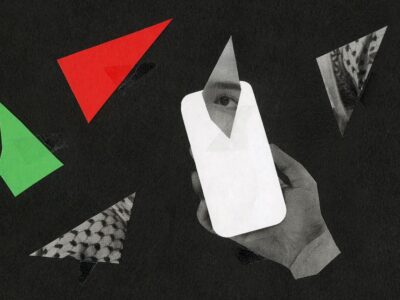
A collage on a fuzzy black background, with a disembodied hand holding a white cutout in the shape of a phone. There are fractured pieces scattered over the image, including one green triangle, one red triangle, and two triangles that show pieces of a keffiyeh. There is a fractured shard of an eye layered over the phone.

What We Owe Gaza’s Journalists

WP_Post Object
(
    [ID] => 6262
    [post_author] => 15
    [post_date] => 2023-11-03 21:11:23
    [post_date_gmt] => 2023-11-03 21:11:23
    [post_content] => 

How people respond to disillusionment shapes history. Without hope, we're doomed to repeat it.

Few things feel worse than building your hopes up about something that later turns out to be bullshit. It's the profound disillusionment of being burned by someone you trusted, by a belief you held, by a foundational narrative you built your life and identity around that's no longer possible to maintain. Whether consciously or not, most of us will do just about anything to avoid these destabilizing feelings—to shut out the pain of grief and helplessness. When confronted with ugly realities that don't match our grand narratives, we can mourn the loss and adjust, or dig our heels in deeper. Many choose the latter, because the rupture is too painful. 

I was already writing this essay on the dangers of nihilism in the face of atrocities and authoritarianism when the latest war between Israel and Hamas broke out. Russia-Ukraine, GOP Christian nationalism, and the climate crisis provided plenty of despairing material. I was feeling overwhelmed by the state of the world, and wanted to make sense of growing instability and extremism. Then came October 7.

There's a Russian saying: Just when you think you've hit rock bottom, someone knocks from below. For the past few weeks, as I've watched the war in Gaza unfurl, the atrocities pile up, and ethnic cleansing further normalized, I've tried, and failed, not to catastrophize. It doesn't seem like the world order is going to survive this, as failing democracies disgrace themselves, and warlords clap their hands. Still, I choose to remain hopeful that something better is possible, because giving up makes things infinitely worse.

By now, most people are familiar with how the latest round of violence erupted. Early in the morning of October 7, Hamas militants surprise attacked southern Israel, brutally massacring over 1400 people, killing infants, burning families alive in their homes, and shooting ravers celebrating Sukkot at a music festival in the desert near Gaza, in addition to kidnapping around 240 hostages—children and the elderly among them. The next morning, I woke up to a text from a friend who has spent years covering wars: "The world is hopeless." I was horrified. I felt grief for the dead, and the survivors, and for Gazans, who I knew would soon suffer in retaliation for Hamas' war crimes. I felt terrified for the hostages, and for Jewish people, my people, everywhere: October 7, 2023 is now understood as the deadliest day for Jews since the Holocaust. 

Israel responded to this by once again bombing the shit out of Gaza, and Gazan civilians—again, children and the elderly among them. Entire neighborhoods were flattened, as Palestinians desperately dug through the rubble to find survivors and what remained of those who’d been killed. The Israel Defense Forces (IDF) also immediately imposed a blockade, and cut off Gaza's electricity, fuel, water, and food supply—a job made easy by decades of occupation. All of it, of course, was signed off by Israel’s Prime Minister, Benjamin Netanyahu. By now, whatever reserves were left have long run out, and minimal aid has come in through Egypt. The humanitarian crisis is as dire as it gets. Many hospitals have run out of fuel for their generators, meaning anyone on a machine will likely die. People are starving, drinking sea water, being operated on without anesthesia. Defense Minister Yoav Gallant, who ordered the siege, justified collective punishment—a war crime—by saying, "We are fighting human animals and we are acting accordingly." Hearing those words, again, I was horrified. I felt sorrow for Palestinians, who've been dehumanized, ghettoized, and unable to escape collective retribution. I felt complicit in their suffering. Once again Gazans were dying en masse while the world watched. I felt despair at the lack of leadership, and helpless to stop the cycle of violence.

Even through all the noise, it is clear many people have felt the same. Moments of crisis like the one we're in now demand a lot from us emotionally, asking scared people in pain to hold the weight of many conflicting truths in our hearts at once. Zero-sum thinking is tempting, providing a false sense of certainty, a justified rejection of compassion. It’s also dangerous—all manner of atrocities follow when people believe they have no choice; that, in their circumstances, the ends justify the means. 

It's a cliche, but it's true: Hurt people hurt people. As political scientist Seva Gunitsky tweeted last month, "You know intergenerational trauma is real because the two nationalities most victimized by fascism are currently waging two proudly genocidal military campaigns." 

As both a scholar of genocide and Soviet history, and as the American daughter of a Ukrainian Jew who survived Hitler and Stalin, fled Soviet repression as a refugee for Israel, and ended up in the US, only to fall for Fox News—wow, did I feel that. My people's trauma is on full display in multiple wars, and I hate it. Despite living a remarkably secure life compared to my ancestors, disillusionment has still knocked on my door many times. It's come for all of us of late. Which makes it all the more important that we do not let it win.

As I write this, Israel's ground invasion of Gaza is underway, with all the horrors for Gazans that it brings. The day it began, the IDF blocked all communications, cutting off power and internet in Gaza so we couldn't hear or see the extent of the atrocities. Nothing in this alleged strategy to eliminate Hamas suggests the lives of the hostages or of Palestinian civilians have been given a second thought. With over 9000 Gazans dead, and Hamas leaders in Qatar and their tunnels still relatively untouched, it's hard to accept that this invasion serves a purpose beyond bloody, indiscriminate revenge—or, in the worst case, a second Nakba. I feel sick watching Bibi and Hamas drag the world into the abyss, with the US courting global catastrophe by lighting billions on fire to prolong an unwinnable armed conflict.

For Palestinians, the existential threat is immediate and ongoing, as people in Gaza cannot escape the bombs and now, the tanks. In the West Bank, there are horrifying reports of prisoners being tortured, and fundamentalist settlers armed by the state continuing to expel Palestinians from their land, and pogrom their villages; in East Jerusalem, the state continues demolishing Palestinian homes. Every day there are stories of entire families killed in Gaza while trying to flee south following the IDF's forced evacuation order, many of them with nowhere to go. Meanwhile, air strikes have only escalated. The IDF has already confirmed it has hit 11,000 targets, many of which were civilian buildings. Most recently, and horrifically, they bombed Gaza's largest refugee camp, two days in a row, killing over 100 people. There are so many dead, hospitals and morgues have run out of space, and Gazans are stuck burying bodies in mass graves. 

What do these atrocities solve? Who does this free or make safe? Certainly not Israelis, who overwhelmingly blame Netanyahu's policies for leaving them vulnerable to attack, as whatever tenuous sense of security they had was pulled out from underneath them, and all the gains they'd made regionally evaporated overnight. And certainly not Palestinians, who have suffered decades of occupation and statelessness with no end in sight, only to experience the disruption of a status quo that was already killing them: Over 200 Palestinians were killed by the IDF and militant settlers in 2023 even before the war began. The threats and conditions facing each are not the same, but at base, they share an existential fear that their people won't survive to see the aftermath of this conflict. And even if they do, how much of their humanity will remain?

It's especially disturbing watching Israeli officials declare holy wars, and talk of wiping Gazans out, flattening them, or forcibly expelling them. Jews have been on the receiving end of all the above many times over, and it's sickening knowing it's being inflicted on Palestinians in my name. They heard Hamas leaders boast about cleansing the land of Jews and are itching to outdo them: Over 2 million people, half of them minors, remain stuck without food, water, fuel, or shelter in a high-density death trap as bombs rain down, including along the very evacuation routes that were allegedly to take Palestinians to safety.

As Hamas' atrocities beget Israeli atrocities, the absolute worst people are benefitting from the suffering and chaos. Russian President Vladimir Putin and Turkish President Recep Tayyip Erdoğan are taking advantage of the chaos and using Palestinian pain for their own political ends. Iran's proxies in Yemen and Lebanon keep threatening to expand the war. In India, Prime Minister Narendra Modi's ruling BJP party is using Israel as vindication of their own Islamophobic ethnonationalism. It's easier for corrupt authoritarians to entrench power, hollow out institutions, and silence people in times of crisis. It also doesn’t help that Netanyahu knows people want his head when this war is over—naturally, he just announced the second phase of the war would be a long one. It's an open secret that Netanyahu and Hamas have fed off one another for years, neither wanting a two-state solution to succeed. We're seeing the results of their efforts now, and why it's disastrous to empower authoritarians who promise the illusion of security with a dose of repression. With the illusion gone, repression has skyrocketed.

Meanwhile, Arab leaders, most of whom had previously normalized relations with Israel, are facing populist rage and discontent at home. This seems by design: Israel was about to normalize relations with Saudi Arabia for the first time when Hamas attacked, and now weeks later, Jordan has recalled its ambassador. Diplomacy deteriorated early on when Egypt, Jordan, and Palestinian Authority President Mahmoud Abbas canceled a summit with US President Joe Biden over horrifying—but to this day, disputed—reports, first blaming Israel, then Islamic Jihad, for the October 17 bombing of Al Ahli hospital, which resulted in the deaths of hundreds of civilians. It was a pressure cooker moment in a pressure cooker conflict, an outpouring waiting for a vessel. Unverified headlines about the incident led to angry protests outside Israeli embassies; Hezbollah calling for a global day of jihad; the burning of synagogues in Berlin, Tunis, and Spain; and continued violence in the West Bank. 

Palestinian scholar Iyar el-Baghdadi tweeted about the hospital blast, and the furor it inspired, “This is no longer about a specific hospital and what happened there. The news [was] a watershed moment for a lot of pent up anger about a million things, bottled up for a long time, to explode. Confirming or debunking won't help. This is no longer about facts but about psychology.” The readiness of so many to believe the worst about each other, to blame entire peoples for the cynical actions of criminal, extremist leadership, to oversimplify a complex conflict, parrot violent propaganda and disinformation, and harass anyone calling for us to find our shared humanity is jarring. If anything, we've become disillusioned with each other.

The war has triggered a global backlash as dissent is quashed, and antisemitic and Islamaphobic hate crimes rise dramatically. Anti-war protestors have been arrested around the world, including in Israel, the US, UK, Germany, France, Egypt, and Bahrain. In Chicago, a Palestinian American boy, Wadea Al-Fayoume, was killed by his landlord. In Dagestan, a mob stormed the airport looking for Jewish passengers. Synagogues around the globe have been defaced, Jewish and Muslim university students harassed. Palestinian Israelis have been arrested for liking social media posts, and families of hostages have been harassed for demanding a ceasefire and prisoner swap. Calls ranging from pauses to peace talks and an immediate ceasefire, no matter who they’re from, have largely been ignored by the people who most need to hear them. 

Also on the chopping block: international humanitarian law. Syrian President Bashar al-Assad and Putin's impunity for war crimes in Syria was a turning point for the international system, a pure display of might makes right. Now, Russia, China, and Iran are watching as the West actively funds and arms war crimes in Gaza. Drawing tons of criticism, the US has not laid down any red lines for Israel, like conditioning funding or weapons deliveries upon them not being used against Palestinian civilians; as well as vetoing multiple UN Security Council resolutions calling for a humanitarian pause or ceasefire. What good are the Geneva and Genocide Conventions when they can be vetoed into oblivion? Who actually ends up before the International Criminal Court? When the moral authority and legitimacy of legal institutions are gone, rule of law goes with them. This emboldens bad actors to do their worst, just because they can.

As I’ve watched the last couple weeks unfold, I've sought out voices of compassion and reason, for informed people who, even as they grieve, still speak with moral clarity and a sense of our shared humanity. They do exist—they're primarily Arab and Jewish—but they're outnumbered by masses of uninformed people publicly stumbling through this, and far too many racist posts, statements, and signs justifying the ethnic cleansing of one side or the other. Even outside of reporting on Al Ahli, Western media coverage has been a mess, reminding many of 9/11: Muslim TV anchors sidelined; Palestinian commentators canceled; unverified, sensationalist reports spread; internal dissent silenced. Social media, especially Twitter—once a vital source for verifying breaking news—is rampant with antisemitism, Islamophobia, and disinformation: violent propaganda, bloody videos, memed history, unchecked rage, and nihilistic, binary thinking. In short, we are collectively struggling to cope with a spiraling situation. 

In all of this, many have gotten bogged down in ranking people's suffering. It's difficult but necessary to accept that cyclical violence, institutional collapse, and mass atrocities can happen anywhere, and have happened everywhere at some point in history, that no people are solely oppressors or oppressed, or bleed differently than any other. We're all capable of electing dictators, of succumbing to reactionary short-term thinking. We're also all capable of putting even the most egregious grievances aside, of caring more about being at peace than vengeance, and accepting that our safety and freedom depends on the safety and freedom of our neighbors.

Explanations for the current global crises are not an exercise in judgment or morality, especially when it comes to war crimes and crimes against humanity. Explanations, at their best, seek to understand the human condition, and how history and life experience affect people's subjective, emotional truth. Making sense of those myths, traumas, beliefs—often impervious to logic or reality—is critical to understanding what shapes and motivates people, and states, to behave the way they do. We're stuck with people as they are, not as we want them to be. You can't understand disillusionment without knowing the illusions that preceded it. 

October 7 and all that has followed uprooted several stubborn myths, for better and for worse. As Amjad Iraqi wrote for +972, a psychological barrier broke with Hamas' assault:

“Israel’s mass protest movement…has consciously kept the Palestinian question off its agenda. Apart from a small bloc of anti-occupation protesters, most [Israelis] still clung to the illusion that the current structures of permanent rule could deliver safety for Israelis and remain compatible with their claim to democracy. That bubble has now irreparably burst. But Israelis, who have been shifting politically rightward for years, are far from questioning or recalculating their commitment to iron rule.”

It was obvious to me, especially after a troubling visit to the military courts in the West Bank over a decade ago, that the occupation was rotting Israeli institutions from within, and that rule of law and democracy couldn't exist with parallel, unequal systems. It felt frankly delusional to think the Israeli state could repress Palestinians in the West Bank under one system, keep Gaza isolated with another, and systemically discriminate against Arab Israelis, all without the militarization and repression of Palestinian rights eventually extending to Jewish Israelis, too. But people believe what they believe.

Endless cycles of violence, democratic backsliding, and threats of institutional collapse make for scary times—and I, for one, am terrified of what’s to come. What does it look like when the bubble bursts? What fills the vacuum? The answer is rarely anything good. Idealogues are especially prone to nihilism, and the horseshoe theory, that the far-right and far-left meet at the extremes, has become a truism. The points of a horseshoe don't actually touch, though. What the extremes share is the void: "Death to Arabs" and "Kill the Jews." 

Like any supremacist ideology, both are inherently anti-democratic. But people choosing between a meaningless life of suffering, and a life of suffering, but for a cause, will always choose the latter. In Secondhand Time: The Last of the Soviets, winner of the 2015 Nobel Prize for Literature, Svetlana Alexievich documented the collapse of the USSR through oral histories of everyday people as they experienced it. There are romantics and cynics, intelligentsia and party flacks, peasants and city dwellers, many with mixed feelings about both communism and capitalism, but all having suffered under each. 

In her introduction, "Remarks from an Accomplice," Alexievich describes growing up as a believer in communism: "Disillusionment came later." She writes about how people reacted to the archives opening after perestroika, when regular people finally began learning about the vast crimes committed by the Communist Party—that their heroes were mass murderers, and their neighbors and relatives their executioners.

"People read newspapers and magazines and sat in stunned silence,” she writes. “They were overcome with unspeakable horror. How were we supposed to live with this? Many greeted the truth as an enemy. And freedom as well." Why was truth the enemy? As one interviewee put it, "Why didn't we put Stalin on trial? I'll tell you why…In order to condemn Stalin, you'd have to condemn your friends and relatives along with him." 

One woman, whose teenage son died by suicide, remembers screaming at her own mother, "What did we hear from you our whole lives? Throw yourself under a tank, go down in an airplane for your Motherland. Heroic death." I see the obvious echos here of Russia's invasion of Ukraine; but I'm also reminded of Breaking the Silence, an organization of IDF veterans devoted to exposing the violent reality of the occupation. The issue of complicity, especially in atrocity, is at the heart of so much of the hand-wringing we're seeing today in Gaza, and how people have responded to it. Who are the victims, and who are the perpetrators? As with all things, it depends who you ask and how far back you want to go. Two stateless people were pitted against each other by imperial and regional powers playing dispossession dominos, leaving enough valid grievances to last many lifetimes. The unfortunate truth is that Jewish people's right to self-determination ultimately came at Palestinians’ expense, and the establishment of a Palestinian state coexisting alongside Israel is the best shot we have at rectifying this and undermining groups like Hamas and their successors. The conflict wasn't always so lopsided, but insofar as Palestinians today are concerned, nuclear-armed, US-backed Israel has become Goliath.  

This has created an enormous rupture in the identity of Jews around the world, for whom the existential threat feels perennial, who are scared of going to synagogue while watching masses of people gather against Israel, most of whom are protesting for a ceasefire and Palestinian human rights, but a significant portion of whom blame all Jews for Israeli atrocities in Gaza, and think Netanyahu speaks for us all. No matter our politics, we’re haunted by the knowledge that as the violence wears on, more and more people out there wish the Nazis had finished the job. 

None of this excuses flattening Gaza or ethnically cleansing Palestine of Palestinians. I do still believe that Jewish people need a homeland, one country that won't expel us; I literally wouldn't exist but for Israel providing refuge to stateless Jews. But I also don't believe that right is exclusive, or that it trumps the rights of Palestinians to the same things. I deeply resent the implication that my refusal to support the genocidal policies of a foreign autocrat makes me an antisemite, a supporter of terrorism, or less Jewish. Quite the opposite: I believe and have watched the current government's vengeful, reckless, overreaching policies make Jews everywhere more of a target.

So what do we do about all this? As people process the loss of their old beliefs, they're faced with the option of hardening into something more extreme, or freeing themselves from old constraints and reimagining a better future. It's a choice between hope or revenge. But reimagining requires a shared reality, a rejection of bigotry, and people who seek complexity, not propaganda. It requires empathy, and an ability to see each other's humanity, especially when we're afraid. It requires choosing leaders who don't want to see the world burn. 

There are people all over the world already doing the work to end cycles of violence, who know that as bad as things get, they could always be worse. In Israel, Standing Together is a grassroots peace movement led by Jewish and Palestinian Israelis standing courageously against the tide of war. I recently attended a Storytelling Summit hosted by Futures Without Violence at the Courage Museum in San Francisco. The museum, which opens in 2025, is built on the belief, backed by science, that when we hear each others' stories, and see each other as people, we empathize. That as social creatures, we're built to connect and be in community. That this is how we heal ourselves.

The good news is that this healing is possible. But it can only begin from a place of safety, something too many have not been guaranteed. It's up to us to demand human rights, rule of law, and freedom and democracy for all, and to push for policies that strengthen them. Because as disillusioned as I am with the institutions meant to deliver these aspirations, I still believe in people. I understand that violence comes from a place of despair, and that hope is a precursor to peace. Even knowing what I know, I choose to be hopeful, to use my voice and what power I have to push for people everywhere to live boring lives, free from violence. It’s the only way forward for all of us.

[post_title] => We Must Not Give In To Nihilism [post_excerpt] => How people respond to disillusionment shapes history. Without hope, we're doomed to repeat it. [post_status] => publish [comment_status] => closed [ping_status] => closed [post_password] => [post_name] => nihilism-disillusionment-palestine-gaza-israel-hamas-war [to_ping] => [pinged] => [post_modified] => 2026-08-04 17:54:39 [post_modified_gmt] => 2026-08-04 17:54:39 [post_content_filtered] => [post_parent] => 0 [guid] => https://conversationalist.org/?p=6262 [menu_order] => 72 [post_type] => post [post_mime_type] => [comment_count] => 0 [filter] => raw )
A patterned image of a dove on a sage green background. There are four doves: the one on the left is in focus, and with each dove following, each dove becomes less in focus, as the background also slowly fades to a darker gray.

We Must Not Give In To Nihilism

WP_Post Object
(
    [ID] => 3458
    [post_author] => 2
    [post_date] => 2021-11-18 22:23:20
    [post_date_gmt] => 2021-11-18 22:23:20
    [post_content] => Frances Haugen's policy proposals are modest at best, amounting to little more than what Facebook has already proposed or supported. 

In the summer of 2014, the kidnapping of three Israeli teenagers in the West Bank by Hamas-afilliated Palestinians sparked a seven-week sustained Israeli military assault on Gaza, with the military wing of the Islamist organization simultaneously launching rockets into Israel. By the time a ceasefire was implemented, around 2,200 Palestinians were dead and more than 10,000 wounded, the vast majority of them civilians. On the Israeli side, 67 soldiers and six civilians were killed. The physical destruction in Gaza was immense, with entire neighbourhoods reduced to rubble. It was one of the deadliest conflicts in the region’s history.

Social media—which was by then a popular tool for activism used by both Palestinians and Israelis (as well as the Israeli state)—played a significant role in the conflict. Israelis used social media to draw attention to the kidnapping and murder of the three boys and to the fear wrought by Hamas’s rockets, while Palestinians sought to draw the world’s attention to the Israeli military’s use of immense force against civilians. Everyone used memes, hashtags, and videos to amplify their messaging.

Facebook, which was a key tool for the activists who organized the uprisings that rocked Tunisia and Egypt in 2010-12, was still a young platform. It had instituted its first community standards only three years prior. Now it was a key site for online conflict.

That summer, concerned Palestinian activists brought a Facebook page to my attention. It featured a sniper’s target, with the title, in Hebrew:  “Kidnapped: Until the boys come back, we shoot a terrorist every hour.” The page had been created by Israelis who advocated vigilante justice; they posted the photographs and names of various Palestinian political prisoners, calling for them to be shot in retribution for the killing of the three Israeli boys who had been abducted.  

There is no question that page was inciting for retributive violence; language in the ‘about’ section read: “We must use a strong hand to fight violent and life-threatening terror. The weakness shown by the Israeli Government, which released thousands of murderers has only increased their drive and led to the kidnapping of the teens. The only way to bring the teens back is to instill fear in our enemies and make them understand that they will suffer. We support executing a terrorist every hour until the teens are released.”

In Israel, killing Palestinians as revenge for an unconnected incident is known colloquially as a “price tag” killing; the US State Department has condemned the act as terrorism. The Facebook page objectively called for murder, which violated one of the precepts of the platform’s community standards: “Safety is Facebook's top priority. We remove content and may escalate to law enforcement when we perceive a genuine risk of physical harm, or a direct threat to public safety. You may not credibly threaten others, or organize acts of real-world violence.”

But the company refused to delete the page, overriding multiple reports from users. One Facebook policy staffer defended the decision by saying that the page administrators were calling for violence against terrorists, as though branding a person a terrorist justified advocating their extra-judicial murder. The page objectively violated Facebook’s own policy, but the company refused to admit it. Monika Bickert, who was then Facebook’s head of Global Policy Management, asserted in an interview that the page did not violate the company’s policy against hate speech.

This incident encapsulates Facebook’s policies in dealing with content across the Middle East and North Africa, for nearly a decade. In my book, Silicon Values: The Future of Free Speech Under Surveillance Capitalism, I describe several occasions on which Facebook either failed to act against threats, or acted in bad faith—disappearing valuable content that served as documentation of history.

In another egregious example of acting in bad faith, Facebook removed Egypt’s leading dissident page just a few months before the 2011 revolution. “We Are All Khaled Said,” named for a young man beaten to death by Alexandria police in 2010, had hundreds of thousands of followers. Ultimately, the organizers of the page put out a call for mass protests on January 25, 2011. The Tahrir Uprising, named for Cairo’s central square, lasted 18 days; it ended with the fall of the Mubarak regime. 

This is why global civil society activists were unsurprised at the revelations in the internal documents that Facebook whistleblower Frances Haugen released, particularly those that detailed the company’s abject failures in moderating content in the region. While American news outlets expressed shock at these stories, civil society organizations like 7amleh, the Palestinian civil society NGO that focuses on human rights in digital spaces, saw confirmation of what they had been reporting for years

Frances Haugen took a risk in releasing the documents, which provided important receipts for more than a decade of accusations against Facebook. But her policy proposals are modest at best, amounting to little more than what Facebook has already proposed or supported: She advocates the important intermediary liability proposals contained within Section 230, the law often dubbed “the most important law for online speech,” which protects companies from liability for what they choose to host (or remove). She has also spoken out against breaking up the increasingly monopolistic company, and told the French National Assembly that interoperability—allowing new services to “plug in” to existing, dominant ones, which is a core tenet of civil society proposals—won’t make a difference toward fixing our current conditions.  

In fact, all of these things—intermediary liability protections, competition, interoperability, as well as other fundamental concepts like transparency and accountability—are vital to a free and open internet. While companies can and should moderate content, proposals to reform Section 230 are not only likely to be unconstitutional; they also open up space for frivolous lawsuits against US companies, which are protected by the First Amendment for what content they choose to host (or not host). Interoperability would give users far more choice over how and what platforms they use, by enabling them not only to modify the services they use and communicate across services more easily, but also potentially enabling different models for content moderation. And if we want a landscape where people have more choice over where they interact, access information, and express themselves, competition is a key component of any reform. These solutions are not a panacea, nor a substitute for more holistic societal fixes, but they’re important pieces of the puzzle.

Meanwhile, media outlets outside the US and Europe are still struggling to obtain access to the Facebook company documents that Haugen leaked, so that they can report, with cultural competence and local knowledge, on the company’s shortcomings in a number of regions. In addition, Haugen’s publicity tour in the United States and Europe has prioritized talking to lawmakers rather than listening to potential allies. Many of those lawmakers ignored the demands of civil society experts, a notable number of whom are women of color; but they are willing to give their full attention to a former Facebook employee who is white and has a Harvard MBA.

Haugen isn’t entirely wrong: She understands that platforms need to be more transparent about how they create their policies and moderate content, as well as who is doing that moderation, and what sort of cultural and linguistic competencies those individuals have. Civil society actors, particularly those from the global south, have repeatedly emphasized the need for local expertise in content moderation—that is, the hiring of moderators with linguistic and cultural knowledge to tackle difficult speech issues and ensure that truly harmful content, such as incitement, doesn’t flourish while also making sure that content isn’t wrongfully removed. Here, her suggestions echo those of global civil society, although she has not given credit or consulted with those who have been making the same proposals for many years.

What Frances Haugen should have done—and still could do—is consult with the civil society experts, the activists and academics who have spent years studying and critiquing her former employer from the outside, painstakingly documenting its faults, and agitating for change. She needs to refocus her priorities to ensure that documents are made accessible to journalists around the world who have the lived experience and deep expertise to analyze them properly. Instead of assuming she has all the answers, she should be using her significant power to call for Facebook—and lawmakers—to bring them to the table. 
    [post_title] => The world's most famous Facebook whistleblower should amplify those who came before her
    [post_excerpt] => The internal documents Haugen leaked only confirmed what civil society activists and researchers have been saying for years. 
    [post_status] => publish
    [comment_status] => closed
    [ping_status] => open
    [post_password] => 
    [post_name] => the-worlds-most-famous-facebook-whistleblower-should-amplify-those-who-came-before-her
    [to_ping] => 
    [pinged] => 
    [post_modified] => 2026-08-05 19:58:12
    [post_modified_gmt] => 2026-08-05 19:58:12
    [post_content_filtered] => 
    [post_parent] => 0
    [guid] => https://conversationalist.org/?p=3458
    [menu_order] => 162
    [post_type] => post
    [post_mime_type] => 
    [comment_count] => 0
    [filter] => raw
)

The world’s most famous Facebook whistleblower should amplify those who came before her

WP_Post Object
(
    [ID] => 1409
    [post_author] => 2
    [post_date] => 2019-10-04 14:34:42
    [post_date_gmt] => 2019-10-04 14:34:42
    [post_content] => Raised in the heart of the Jewish American consensus, millennial Jews were taught to be fervently committed to Israel. Now, they are leading the push to criticize Israeli policy and question the community's Israel-centric politics. 

Talk to two Jews and you’ll get three opinions. It’s an old Jewish joke, but when the subject is Israel, a difference of opinions is often not considered amusing. Those who express unpopular opinions risk a type of excommunication, with friends and relatives severing relationships while professional networks become inaccessible.

I’ve been asked on many occasions why some otherwise-progressive Jews are so passionately supportive of Israel, even as others wonder why an increasing number of Jews in the diaspora reject Israel-centric politics. Many Jews prefer to avoid the subject. Israel is consistently ranked at or near the bottom of issues for Jewish American voters; perhaps paradoxically, there is no issue that elicits more ferocity within the Jewish community. 

The Jewish conversation on the subject of Israel/Palestine is confusing in part because things are changing rapidly. In the decades after the 1967 war, the consensus within the mainstream Jewish community was almost unwaveringly supportive of Israel — no matter what type of government the country had, or what its policies. The fabric of this broad communal agreement is now fraying, as younger Jews become increasingly aware of Palestinian life under Israeli control. They have a long way to go, but they are slowly moving the discussion about Israel-Palestine in the direction of universalism and solidarity. 

My own journey from right-wing supporter of Israel to leftist might provide some insights for an outsider trying to understand the context of Jewish Americans’ shifting communal position on Israel-Palestine.

I grew up in central North Carolina. We were almost always the only Jewish family anyone we knew had ever encountered. Our synagogue was (and is) a somewhat dilapidated brick building, too big for the tiny congregation that remains in the town, and too cash-strapped to care for its own cemetery. But it was a lovely place, and I spent hours in the small library, full of dusty history books about Israel and the Holocaust. Israel was inseparable from my Jewishness, and my Jewishness was inseparable from me.

At synagogue, Israel was the backdrop. At Jewish summer camp, it was the alpha and omega. Israel and Zionism symbolized a strength and self-assuredness that I could only imagine at home. It seemed to answer all the questions I had about the world and myself. At school, I fielded questions from evangelical peers about whether or not I had horns. At camp, I dashed around doing mock army drills and combat-crawled in wet grass. At home, friends glued a quarter onto the ground and laughed as I tried to pick it up. At camp, we learned about our heroic return to our homeland, and discussed making aliyah — a Hebrew word that means rising up, and which in this context refers to immigrating to Israel —  to fulfill our dreams. We rarely discussed the Arab Palestinians who lived there, and almost never thought of them.

For many American Jewish children, summer camp is a core component of their Jewishness. According to the Foundation for Jewish Summer Camp (tagline: Jewish Summers. Jewish Future.) about 15 percent of Jewish children, or around 90,000 kids, went to Jewish summer camp in 2017. Not all Jewish summer camps are the same; the ideology and curriculum varies from socialist to religious nationalist. The same is true for all Jewish institutions, although the majority espouse views that are more conservative than those held by the Jewish public. The message at my camp was clear. From raising the Israeli flag every morning, to singing the prayer for the State of Israel, our responsibility was to carry on the mission that the movement had pursued since its founding a century earlier.

I brought this fervent commitment with me when I traveled to Israel for my gap year between high school and college. While we traveled freely inside the Green Line, we were prohibited from traveling into the occupied Palestinian Territories — beyond the wall that Israel had constructed. A friend and I took this rule for a dare. We found a host to stay with on CouchSurfing, messaged her some vague lies about being Christian bloggers interested in Bethlehem, and woke up early to head to the Palestinian bus station outside Damascus Gate n East Jerusalem. We snickered roguishly to ourselves as we boarded the bus, which ferried mostly Palestinian passengers between Jerusalem and the West Bank. Our snickering died down as we pulled into Bethlehem and saw the graffiti-covered grey walls of what I would later know as the separation barrier. Our hilarity turned to fear when we realized that our host, a pro-Palestine activist, had set up several meetings for us with local organizers. Our little lie had blown up in our face. We had no choice: we were “bloggers” in a strange land; we had to go along, and play the part.

What I learned during those meetings changed my life. In his living room, an old man told me his story about the Nakba — Arabic for “catastrophe” — which is what Palestinians call the 1948 war that sent 800,000 Palestinians into permanent exile. I had never heard about the Nakba before that encounter. I had heard many stories about Jewish-Israeli experiences during the Second Intifada of 2000-02, but now I was hearing from Palestinians about their traumas from that time. In these and in countless subtler ways, the plain fact of Palestinian life and personhood seeped through the cracks of my nationalist worldview. I returned to my program the next day, and experienced my first ever night of insomnia.

A few months later, I reached college and, not knowing what else to do I joined the “Israeli-Palestinian Dialogue Committee.” I showed up and, at first, couldn’t help myself from repeating the talking points I’d learned as a child at synagogue and at Jewish summer camp. In retrospect I can’t believe anyone put up with me. But over time, my talking points gave way to questions, especially for the Palestinian members of our group. Not only were they real, they were my friends. And slowly, I began to organize.

At college, I could finally place my experiences into a broader pattern. Thousands of Jews, despite Israeli and American Zionist attempts at separation, have managed to escape what journalist Peter Beinart calls, “The American Jewish Cocoon,” the well-funded strategy by the mainstream community to shut our eyes to the reality of the Israeli occupation. While Palestinian organizers have, unsurprisingly, long worked hard to wake up American Jews from their comfortable slumber on this issue, the past decades have seen a groundswell in Jewish reciprocation. Entire organizations work to bring Jews out of our cocoon. Growing awareness of the dire realities for Palestinians has sparked conflict in the Jewish community over the nature of our relationship to Israel, with millennials taking a leading role in pushing for a new, more critical conversation.

This growing dissent against the pro-Israel consensus butts up against conservative Jewish communal institutions that are fighting back. They have increased pro-Israel investment in Democratic races, for example, and created McCarthy-style lists of pro-Palestinian activists on college campuses. These conservative pro-Israel activists hold political views that are far to the right of those held by the majority of Jewish Americans. But while Trump attempts to wrest Jews away from the Democratic party and progressivism in the name of supporting Israel, there is no evidence to show that Jews might abandon unbroken decades of supermajority support for it. 

What we are seeing now is a generational changing of the guard. All the efforts to hide the brutal realities of Palestinian life from plugged in and angry Millennials and Gen Z are doomed from the outset. Young Jewish Americans are, like their non-Jewish peers, increasingly progressive regarding nearly every political issue. Meanwhile, the vast majority of Jewish institutions remain in the hands of older Jewish people whose views are far more conservative. Fears of irrelevance stalk their boardrooms. The question is whether these organizations will remain in the cocoon, despite the obvious cost of alienating the younger generation, or come out with the rest of us. Either way, the majority of Jews will continue to live and vote according to their values.

 
    [post_title] => How Israel became the most divisive issue for Jewish Americans
    [post_excerpt] => Raised in the heart of the Jewish consensus, a young American journalist describes how and why a seminal trip to Israel during his gap years led to a political awakening. 
    [post_status] => publish
    [comment_status] => closed
    [ping_status] => open
    [post_password] => 
    [post_name] => how-israel-became-the-most-divisive-issue-for-jewish-americans
    [to_ping] => 
    [pinged] => 
    [post_modified] => 2026-08-06 23:22:33
    [post_modified_gmt] => 2026-08-06 23:22:33
    [post_content_filtered] => 
    [post_parent] => 0
    [guid] => https://conversationalist.org/?p=1409
    [menu_order] => 299
    [post_type] => post
    [post_mime_type] => 
    [comment_count] => 0
    [filter] => raw
)

How Israel became the most divisive issue for Jewish Americans

WP_Post Object
(
    [ID] => 1218
    [post_author] => 2
    [post_date] => 2019-07-19 18:03:53
    [post_date_gmt] => 2019-07-19 18:03:53
    [post_content] => The current political climate seems disastrous for the Palestinians. But as recent history shows, the bleakest circumstances can yield great opportunities.

Alongside the dog whistle politics, much of Donald Trump’s public image is a throwback to 1980s New York City culture, with its gaudy society parties, unapologetic misogyny, and predatory real estate practices. His presidency jerks between rhetorical excess and emptiness. From negotiations with North Korea abroad to immigration policy at home, Trump’s actions have cycled between Twitter onslaughts devoid of meaningful content and the implementation of acutely retrograde executive orders. His administration’s recent effort to address conflict in the Middle East by convening the “Peace to Prosperity” conference in Manama, Bahrain, is a further case in point.

At the core of the Trump administration’s economic plans for the Palestinians is a glossy brochure released shortly before the summit itself. Notwithstanding the slick graphics and  the presentation, which makes it look like something a business consulting firm would publish, it is an astonishing study of hollowness and deception. The $50 billion dollar pitch book promotes all sorts of investments, including a desalination plant in Gaza and a transport corridor with the West Bank, but does not even mention the word “occupation” to describe Israel’s control over the occupied Palestinian territories. Particularly galling to Israeli and Palestinian civil society activists was the discovery that the photographs used to illustrate that glossy brochure were from promotional material for the very grassroots peace building initiatives — such as The Bereaved Parents Circle Forum and Olive Oil Without Borders — that the Trump administration had abruptly defunded in recent months.

Live-tweeting from the lobby of Manama’s Four Seasons hotel, where the workshop was held, journalist Jack Moore wrote that he was “was left speechless by the Davos-esque Conflab” he had witnessed during the two-day event. In a widely-circulated Twitter thread, he described a gathering of shady private sector grandees, all male panels, and patronizing U.S. flippancy toward absent Palestinian officials. In his opening speech, Jared Kushner described his vision for an economically vibrant West Bank and Gaza without broaching the political context in which such development might take place. Other participants had spent so little time on the ground in Palestine, that they mispronounced names of well-known places. Meanwhile, the head of FIFA touted the virtues of football as a means of “contribut[ing] to change” in the region. When the numbers were crunched, it was clear that the U.S. government was looking for a way to offload the major costs of economic investment to the Gulf states and private investors, shouldering even less of the paltry amount they now provide in the form of economic assistance in the occupied territories.

This opportunistic spirit of Manama fit with a broader pattern of pushing the Palestinians into a corner. During several interviews in the run up to the Bahrain Summit, Kushner reinforced the approach of excluding the PLO while dismissing fears of American imbalance. Asked if he understood why the Palestinians did not trust him, Kushner responded curtly, “I’m not here to be trusted.” As the Palestinian historian Rashid Khalidi has argued, this “neocolonial arrogance” of the U.S. administration is a throwback to the British Mandate and the notion that Palestinians are not quite ready to govern themselves.

Israeli leaders have also promoted this paternalistic view. The former Education Minister and leader of the right-wing Jewish Home party, Naftali Bennett, for example, called for the Palestinians to govern themselves “in all aspects barring two elements: overall security responsibility and not being able to allow the return of descents of Palestinian refugees.” When asked whether his vision would provide self-determination for Palestinians, Bennett demurred. “It’s unrealistic…the Stability Plan is only partial self-determination, but in the real world you have to make compromises.”

Since Trump’s election the alignment between the U.S. and Israeli governments has yielded a series of transformative developments that in practice put an end to the two-state solution.

The most widely publicized of these developments was the relocation of the U.S. embassy from Tel Aviv to Jerusalem. With this move, the U.S. indicated that it no longer regarded as legitimate the Palestinians’ claim to East Jerusalem as the putative capital of their future state. The U.S. also closed its consulate in East Jerusalem, which had served Palestinian residents of the occupied territories; and it ordered the Palestinian mission in Washington D.C. to close, ending the official Palestinian diplomatic presence in the U.S. capital.

The U.S. withdrew its funding to UNWRA, the United Nations agency that provides essential services, like education and medical care, to over five million Palestinian refugees in Lebanon, Syria, Jordan, Gaza, and the West Bank. The State Department denied visas to prominent Palestinian figures who had been visiting the U.S. for years — including PLO executive committee member Hanan Ashrawi, who received her PhD from the University of Virginia. In addition to adopting a policy of complete indifference to Israel’s ever-expanding settlement expansion in the West Bank, the U.S. removed the word ‘occupied’ from government documents. When Netanyahu campaigned in the recent national election partly on a promise to annex the West Bank, which Israel has occupied for 52 years, the Trump administration did not even respond, even as it has chosen a permissive attitude towards the growing Israeli call for annexation of the West Bank. In all these ways, the conflict has returned to a pre-Oslo paradigm. The Palestinians are, as it were, stuck back in the 1980s.

Rather than simply lament the circus in Bahrain, the Palestinian leadership must look for a meaningful way to respond to this diplomatic farce. Some Palestinians have argued that since the Oslo Agreement has been fatally violated, the Palestinian Authority should formally be dismantled. Those who oppose this move say it would cause harm to the Palestinian population, and perhaps even lead to the outbreak of violence. Another historical parallel to consider is the PLO’s position following the 1978 Camp David Accords between Egypt and Israel. Abandoned by Egyptian President Anwar al-Sadat, sidelined in autonomy talks over their future without participation, surrounded by an expanding ring of Jewish settlements in the West Bank and Gaza, the Palestinians were forced to confront both political efforts at state prevention followed swiftly by the 1982 military intervention in Lebanon and Israeli attempts to defeat the PLO in its Beirut stronghold.

This moment of acute crisis was also an opportunity for Yasser Arafat and the Palestinian leadership to rethink the future of the national struggle. After the PLO was forced to retreat from Beirut in 1982, Palestinian political activists in Gaza and the West Bank forced a shift of power away from the exiled leaders, now based in Tunis, and a new reckoning with their demands, culminating in the outbreak of the first Intifada in December 1987. The mass grassroots protest against the then 20-year old occupation led to tangible results: the U.S. finally recognized the PLO; and by the early 1990s the Israelis began to engage with the Palestinian political movement. With that same occupation now extending over five decades, what new opportunities might be seized beyond the fulsome rejection of the Trump administration’s effort to impose what one Palestinian playwright has called a “slumlord’s peace”?

In the summer of 1986, the Palestinian political activist and intellectual Sari Nusseibeh toyed with an idea that might shake up the paradigms of political discussion. Writing in the newspaper Al-Mawqef, he posed a thought experiment about which situation was preferable: “autonomy or annexation with full equal rights [for Palestinians] in Israel?” In his view, freedom through the ballot box would give Palestinians joint control over their own lives and the lives of their Jewish neighbors. He soon appeared on a leading Israeli political talk show alongside one leader of the settler movement, who was startled by Nusseibeh’s argument. Either Palestinians would get a state of their own, or Israel would have a battle for equal rights on its hands. Suddenly, the left-wing Labor Party began invoking fears of a “demographic threat” as a means to accelerate negotiations, while the Israeli representative to the UN noted that “If Palestinians begin to think like this, then we’ve really got something to worry about."

These fears remain highly relevant today. What happens when the political conflict is framed as a conversation about equal rights, access, and citizenship? The government of Israeli Prime Minister Benjamin Netanyahu is acutely concerned about the rhetoric shifting in this direction, a fear underscored by the backlash against the movement for Boycott, Divestment, and Sanctions (BDS) as a means of pressuring Israel in economic, cultural and diplomatic realms. Recent efforts to criminalize BDS, and to label it anti-Semitic, underscore how far this battle of delegitimization can go.

In the face of these developments, advocates for an equitable solution to the Israeli-Palestinian conflict must continue to push for a values-centered approach where the language of rights and equality for Arabs and Jews remains at the center of political discourse. Trump himself was quick to dispose of the two-state paradigm in his first meeting with the Israeli Prime Minister, telling reporters he was not wedded to the idea of territorial partition. But rather than promote an equitable alterative, his administration has tipped the scales firmly in one direction. To reverse this sense of defeat, a reorientation of the parameters of debate is in order. Rather than haggle over the crumbs of economic peace, there needs to be a clear demand for meaningful sovereignty and citizenship—along with the means of leveraging that equitable future—in whatever political constellation might eventually emerge.

A return to the 1980s can evoke retrograde politics, but it is also an opportunity to interrogate the political imaginaries that took hold at the end of the Cold War, and to imagine alternative paths not taken. Could contemporary developments offer a chance to rethink the Palestinian future, moving away from territorial division and statist demands? Are there lessons to be learnt from Nusseibeh’s earlier calls for annexation alongside Netanyahu’s promise of implementing a more restrictive version? Might this crisis provide a viable way for Palestinians to firmly back out of the narrow Israeli and American corner? The current political landscape might appear calamitous, but Trump and Netanyahu will not last forever. Even as the foolhardy mandarins like Jared Kushner, Jason Greenblatt, and David Friedman demand Palestinian surrender, the threat of being vanquished can also be redirected in bracing new directions.


    [post_title] => Back to the future: How Palestine can pull itself out of the 1980s
    [post_excerpt] => Pushed into a corner by U.S. and Israeli policy and the indifference of Arab leaders, Palestinian leadership is in a moment of acute crisis. But the calamitous political landscape also presents an opportunity for creative new paradigms.
    [post_status] => publish
    [comment_status] => open
    [ping_status] => open
    [post_password] => 
    [post_name] => back-to-the-future-how-palestine-can-pull-itself-out-of-the-1980s
    [to_ping] => 
    [pinged] => 
    [post_modified] => 2026-08-07 15:59:01
    [post_modified_gmt] => 2026-08-07 15:59:01
    [post_content_filtered] => 
    [post_parent] => 0
    [guid] => https://conversationalist.org/?p=1218
    [menu_order] => 313
    [post_type] => post
    [post_mime_type] => 
    [comment_count] => 0
    [filter] => raw
)

Back to the future: How Palestine can pull itself out of the 1980s

WP_Post Object
(
    [ID] => 1019
    [post_author] => 2
    [post_date] => 2019-05-17 16:53:51
    [post_date_gmt] => 2019-05-17 16:53:51
    [post_content] => Gaza is often described as a humanitarian catastrophe, but its crisis is the result of self-serving policy implementation that could be reversed

Exactly a week after the most recent military escalation between Gaza and Israel, Haaretz, a left-leaning Israeli newspaper, placed on the front page of its Hebrew print edition a photograph depicting a crowd of Palestinians in Gaza gathered around a steaming cauldron of soup. Mostly men and boys, they are clamoring to get closer to the cauldron, clutching pots, bowls and even plastic storage containers to be filled. It is an aerial shot and you can almost hear the commotion through the image.

Over just three days during the first week of May, 25 Palestinian residents of Gaza and four Israeli citizens were killed while hundreds were injured. This was just the latest of eight military escalations since Operation Protective Edge in 2014. Israeli missiles and artillery fire damaged homes and businesses in Gaza, while barrages of rockets fired from the Strip hit dozens of homes in Israel in a tactic that seemed meant to overwhelm the Iron Dome defense system, which has until now prevented heavy damage and loss of life in Israeli cities and towns.

For most Israelis, Gaza exists only as a place of violence and misery. The images in the mainstream media depict its residents as either shooting rockets or clamoring for food. Israeli citizens can’t enter the Strip, and residents of Gaza are very rarely granted permission to enter Israel.

The misery-violence connection

While Israelis have little insight into the complex, nuanced realities of Palestinian society, many do see the link between violence and misery. In a poll conducted in early 2017, more than two-thirds of Israelis acknowledged that Israel would be serving its own interests by working to improve living conditions in Gaza. Israeli security experts — current and former military officials, analysts, and politicians — frequently warn that the misery in Gaza is a threat to Israel’s security. The terms of each ceasefire agreement have been variations on the same theme: Expanding the fishing zone, allowing more goods into Gaza, and granting exit permits to more people. But Israel regularly fails to implement the terms of the agreements, and Gaza’s desperate situation continues to deteriorate. If misery drives conflict, and everyone acknowledges this, why isn’t Israel doing more to prevent the next round of violence?

A crisis rooted in policy

Neither increased aid nor improved infrastructure can resolve the crisis in Gaza. The endless cycle of escalations, ceasefires, and unfulfilled concessions are symptomatic of a broader problem. The international community has allowed Israel to “manage the conflict” with the Palestinians, rather than take meaningful steps to end it. From Israel’s perspective, keeping Gaza in perpetual crisis is the point —not the problem. The two parties will remain stuck in this holding pattern, with escalations becoming increasingly frequent and their magnitude stronger, until external players who have an interest in ending the conflict compel Israel to shift course radically and take responsibility for the well-being of civilians in both Israel and Gaza. The crisis in Gaza today is rooted in policies implemented over the course of decades, particularly in Israel’s June 2007 decision, soon after Hamas took over, to declare Gaza a “hostile territory” and impose a closure. After 2007, Israel allowed only one crossing for the transport of humanitarian aid to remain open. The message was that Gaza could have aid but not an economy, subsistence but not prosperity. An Israeli official at the time said that the government’s policy was “no development, no prosperity, no humanitarian crisis” and in court proceedings the state articulated that its intention was to wage economic warfare against Gaza.  The justification for the closure, which Egypt joined by closing its own crossing point at Gaza’s southernmost point, was that it would squeeze Hamas into compliance — or place so much economic pressure on the general population, that it would rise up and overthrow Hamas. Over the ensuing 12 years, there have been three major military operations, more than a dozen interim escalations that felt very much like war to those experiencing them, and more than a year of protests at the perimeter fence where Israeli snipers have killed hundreds of unarmed protesters. Millions of Palestinians and Israelis have been affected by violence. Palestinians in Gaza have borne the vast brunt of the conflict, with Israel using its formidable military force on the small territory, which lacks bomb shelters and has an underfunded and overwhelmed medical system. Israelis — mostly in southern Israel but not only — have also experienced the violence of Palestinian factions, whose use of sniper, mortar and rocket fire, and incendiary devices, has caused death, injury, property damage and trauma. Prime Minister Netanyahu, realizing that Israeli policy created a situation in Gaza that was a liability as well as an image problem, has sought to manage the situation by keeping the pot simmering, believing he can prevent it from boiling over. But it keeps boiling over. Israel has reversed some of its most egregious restrictions, like the one that forbade certain foods, books and children’s toys they described as ‘luxuries’ from entering Gaza. Nonetheless, 12 years after the Hamas takeover, there are dozens of policies that have nothing to do with security and everything to do with the logic of applying pressure or sanctions — i.e., creating more misery, which keeps all parties to the conflict locked in a loop of escalations and ceasefires. For example, Israel frequently closes Erez Crossing — the only pedestrian crossing for Palestinians who have permission to leave Gaza — and Kerem Shalom, its only commercial crossing. In 2018, Israel closed both crossings on seven occasions, sometimes for weeks at a time.

Human bargaining chips

Israel only issues permits to leave Gaza for what it calls “exceptional humanitarian” reasons, with some exceptions for merchants. The list of criteria determining who is eligible to request a permit for travel reveals the arbitrary nature of Israel’s access policy and a kind of violent and dystopian bureaucracy. Even after passing a security screening, Palestinians must meet additional criteria in order to be granted an exit permit. Permission to visit a family member, for example, is only granted in the case of a first-degree relative who is dead, mortally ill, or getting married. The processing time for permit applications can run up to 70 business days, and many applications go unanswered. Israel often disputes the request, asking whether the relative is still sick enough to warrant a visit or whether their death occurred so long ago that there is no longer justification for issuing a permit to participate in the mourning rituals. Israel routinely blocks travel that could allow residents of the Strip to establish trade ties or travel for professional development — including for women, who rarely meet Israel’s bar for what is considered legitimate business needs. If Israel wanted to stave off misery in Gaza, it would take its boot off the necks of Gaza residents and stop using their lives as currency in its negotiations vis-à-vis Hamas. But Israel has no incentive to make compromises that would move the region out of conflict. It conveys the perception that it is “managing” an insoluble problem and that it is a victim of Palestinian violence, with neither responsibility for Palestinian misery nor the ability to alleviate it. But the truth is that the status quo serves Israel well. As long as a weakened Hamas has control over Gaza while Mahmoud Abbas’s Fatah heads the Palestinian Authority in the West Bank, Israel can use divide and conquer tactics to manipulate the rift between the two parties and maintain its hold on the West Bank, where more than half a million Israeli settlers live and which Netanyahu recently said he plans to annex. A deeper look at the situation in Gaza, and its connection to the bigger picture, reveals these truths. If the political leadership of Israel, Palestine and the international community were willing, collectively, to prioritize the needs and rights of civilians, in Israel and Palestine, there would be a clear path to negotiating a way out of the crisis. Israel’s control over freedom of movement provides it with ample opportunities to take meaningful steps in this direction. [post_title] => Policy, not aid: How to avert catastrophe in Gaza [post_excerpt] => Neither increased aid nor improved infrastructure can resolve the crisis in Gaza. The endless cycle of escalations, ceasefires, and unfulfilled concessions are symptomatic of a broader problem. [post_status] => publish [comment_status] => open [ping_status] => open [post_password] => [post_name] => policy-not-aid-how-to-avert-catastrophe-in-gaza [to_ping] => [pinged] => [post_modified] => 2026-08-07 16:15:46 [post_modified_gmt] => 2026-08-07 16:15:46 [post_content_filtered] => [post_parent] => 0 [guid] => https://conversationalist.org/?p=1019 [menu_order] => 330 [post_type] => post [post_mime_type] => [comment_count] => 0 [filter] => raw )

Policy, not aid: How to avert catastrophe in Gaza