WP_Post Object
(
    [ID] => 11150
    [post_author] => 15
    [post_date] => 2026-10-13 12:27:12
    [post_date_gmt] => 2026-10-13 12:27:12
    [post_content] => 

A day in the life of Misk and her Hello Kitty backpack at one of Gaza's makeshift schools.

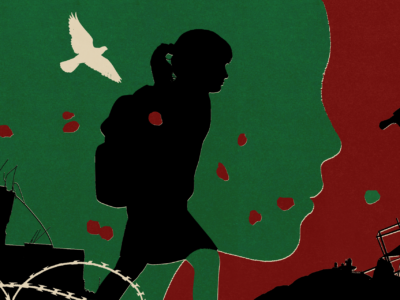
Amid the ruins of destroyed buildings and the weathered tents that have become home for more than one million displaced people in Deir al-Balah’s camps, 11-year-old Misk walks alongside her classmates, carrying her Hello Kitty school bag. Along the way, she encounters just a few of the human realities of displacement: families searching for water and food; children carrying yellow plastic jerrycans as they take on daily responsibilities far beyond what they should or can.  

But for Misk, this path represents the road to being a student again. She is feeling eager and excited. In her backpack, she carries a couple of things she had been without for some time: a notebook and a pen.

Since 2023, hundreds of thousands of children in Gaza have lost access to formal education amid the ongoing genocide and displacement of Palestinians. Israeli military operations have destroyed and continue to destroy many school buildings, while others have been converted into shelters for displaced families. Temporary learning spaces began popping up in early 2025 as teachers and volunteers transformed displacement tents into classrooms, adding desks, chairs, and blackboards so children could return to learning despite the ongoing violence. These spaces have offered more than a place to study: They have given children a chance to regain a part of their daily routines, a community of peers, and something resembling the normal life they'd lost. 

Misk was in the third grade in May 2024 when Israel Defense Forces (IDF) issued evacuation orders—paper slips that were airdropped over entire neighborhoods ordering people to vacate their homes and leave town. In southern Gaza, her city of Rafah  welcomed over a million displaced residents overnight, while Misk and her family ended up in the center of the Gaza Strip at Deir al-Balah, where they still share a single small room in her relative's house—a room where they all sleep, eat, study, and work, in circumstances that have changed nearly every part of their daily lives. Amidst all this, Misk’s new school at the Deir al-Balah displacement camp, while temporary, has become a refuge. 

On a recent September day, Misk sits with eight other children inside a small room. There is no school gate, no morning assembly, and no bell marking the beginning or end of their lesson. Yet children still arrive at 9 a.m., with whatever basic supplies they can find. Some carry old notebooks or loose papers, and the few pens they have. They sit at simple wooden desks facing the board, enthusiastically raising their hands as their teachers—sisters Jumanah, 24, and Shahd Al-Naouq, 22—guide them through lessons in Arabic, English, and mathematics. The scene resembles an ordinary classroom, where children listen, answer questions, and learn together. But instead of concrete walls and a permanent building, their class takes place in a single tent inside a displacement camp.

This one-room school did not start from big plans or with help from a fully-funded institution. It started with a question. Last year, Jumanah was an ambitious university graduate with an accounting degree preparing to begin her career. But the war had changed that path. Job opportunities were scarce and starting a career in accounting seemed increasingly out of reach as she was forced to navigate the daily challenges of an uncertain future.

Then, earlier this year, Jumanah visited a friend whose relatives were hosting a displaced family. There, she noticed a young girl drawing. She could not stay focused for long. Every so often, the girl’s mother would ask her to help wash clothes by hand or with other chores, and she would get up. After finishing, she would return to her pen and paper and continue drawing.

“When I saw Misk trying to draw despite everything happening around her, I thought we needed to do something,” Jumanah tells me. “I felt that children had not only lost their schools; they had lost a part of their daily lives.” 

She thought about the children living in the area and in the nearby displacement camps, probably tens of thousands of them, who were growing up without education or a place to return to after losing their homes. Then came her question: If children could no longer safely reach their school due to displacement, long distances, and Israeli bombardments, what if their school came to them? 

Her sister, Shahd, agreed to be a part of it.  

“We did not have a school or big resources, but we had children who wanted to learn. I said, ‘Let’s start with what we have.’ Even if the place is simple, the important thing is that they have a place to come back to,” Shahd says.

When they first opened the school, Jumanah welcomed their students inside their Deir al-Balah home, a small structure made of corrugated metal. She put a single table in a room and bought a small chalk and marker board. Shahd, an English literature student at the Islamic University of Gaza, joined her, and together the sisters spoke to their neighbors and asked for small donations to help pay for the necessary supplies. Before long, children from the neighborhood and the nearby camps came. Misk was among the first to join.

At that point, there were no more than ten students from six to 12 years old. Jumanah took on most of the responsibility for organizing the space and putting together lessons on basic Arabic, math, and other topics. Shahd, meanwhile, taught the children letters and numbers in English. 

At first, their goal was not to complete a full school year or make up for everything the children had lost during the past three years of war. “The most important thing for us was to make children connected to learning and make them feel that there was still a place waiting for them every day,” Jumanah says. 

As more families learned about the school, more children began attending. Within four months, Jumanah and Shahd were able to move to a newly designated area in their neighborhood, where not one but three rows of tents were set up as classrooms, allowing them to welcome even more children. They have since been joined by additional teachers, who also volunteer their time to teach the students.

A few simple wooden desks and learning materials were added, including notebooks, textbooks, pens, and another blackboard. Children sat in rows next to one another, with the chalkboard at one end, like a traditional classroom. It became known as the Al-Itqan (Excellence) School.

Al-Itqan has provided a refuge for children, but it is not separate from the reality of the camp—it is at its heart. Daily life continues outside its main entrance, as people push water carts between the tents, walking back and forth as they try to secure their basic needs. The children, too, also carry different stories with them—stories of the years they've lived without access to education.

For Misk, returning to the classroom has meant more than just the opportunity to sit in front of a book or complete an exercise. It has also been a chance to be with other children who have lived through the same experience. It has meant she can finally build new friendships; that once again, she can belong.

“I was happy,” Misk says about the chance to return to school again. “I felt like I was living the way I used to. I had a place to go, meet other children, and learn again.”

The school has offered something similar to other children, too, while still presenting challenges shaped by the realities of life in the camp. There is a twelve-year-old, Farah Al-Harazin, who always sits in the front, not because she chooses to, but because she needs to be close enough to see what’s written on the board. Due to limited access to medical care, she hasn't yet been able to get treatment for her weak eyesight. Still, Farah is now in a space that understands her needs and has allowed her to participate with the other children.

Other students, like nine-year-old Yousef and his seven-year-old sister Aseel, were regular students until Shahd noticed that Yousef had been absent for several days.

“I asked Aseel, ‘Where is Yousef? Why hasn’t he come for a few days?’" Shahd says. That's when Shahd learned that every morning he had to fetch water for his family living in the camp.

There is also Issa, who always comes to the classroom with an empty pot inside his backpack. The pot is his way of providing food for his family: Classes begin at 9 a.m., but every day, Issa leaves to the community kitchen (takiya) to fill the pot with whatever food is available at 10 a.m. He then brings the pot home before returning to class.

Among the children is also Ahmad Nasrallah, who lives with a kidney condition, making everyday life especially difficult. The stifling heat, poor ventilation, and lack of electricity in the classroom made the space feel exhausting and suffocating for him. During lessons, Ahmad often struggles to breathe and finds it difficult to concentrate. 

Earlier this year, Jumanah tried to move him to a better spot, where some air could reach him without him having to walk out of the classroom. “Sometimes I felt that I was not only their teacher," Jumanah tells me. "I felt like I was a mother to them. Every child has their own circumstances.” 

What the sisters-turned-teachers have witnessed in their students are not isolated cases, happening only in Al-Itqan. According to the United Nations and education organizations like Save the Children, there are around 700,000 children aged four to 17 who have missed nearly three academic years of in-person learning, while around 93% of schools in Gaza require major repairs or reconstruction.

But these numbers do not show the small ways that conflict and dispossession continue to shape the lives of children.

Three years ago, before the war, Misk’s Hello Kitty backpack was simply part of her daily journey to school. After losing her family home, she used it to carry the few clothes and personal belongings she could take with her. Today, she walks between the tents with the same backpack, carrying a notebook, a pen, and a bottle of water. The makeshift school that started with eight children has grown, too, and now welcomes nearly 100 students across its three tent classrooms.

After more than two years away from her old school, Misk now attends classes every day, with friends her own age. 

Amidst so much, it's like she is living part of her childhood again.

[post_title] => The Things Children Carry [post_excerpt] => A day in the life of Misk and her Hello Kitty backpack at one of Gaza's makeshift schools. [post_status] => publish [comment_status] => closed [ping_status] => closed [post_password] => [post_name] => gaza-palestine-makeshift-schools-deir-al-balah-camp [to_ping] => [pinged] => [post_modified] => 2026-10-13 12:30:40 [post_modified_gmt] => 2026-10-13 12:30:40 [post_content_filtered] => [post_parent] => 0 [guid] => https://conversationalist.org/?p=11150 [menu_order] => 0 [post_type] => post [post_mime_type] => [comment_count] => 0 [filter] => raw )
An illustration of the silhouette of a girl walking through an abstract background with her backpack.

The Things Children Carry

WP_Post Object
(
    [ID] => 11126
    [post_author] => 15
    [post_date] => 2026-10-08 20:19:47
    [post_date_gmt] => 2026-10-08 20:19:47
    [post_content] => 

Why you should pay attention to Alabama's Statewide Amendment 3 this election.

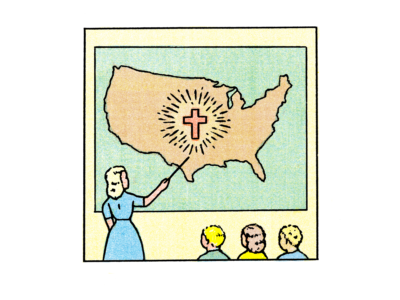
On the ballot in Alabama this November is a proposed constitutional amendment to policies on prayer and the Pledge of Allegiance in public K–12 schools.

Statewide Amendment 3 would compel local school boards to adopt rules requiring the Pledge of Allegiance at the beginning of each school day and allow student-initiated and student-led prayer. However, the amendment would not require students to participate in either the Pledge or prayer. If passed, students would have the right to opt out based on their beliefs and would be allowed to leave the classroom during either. 

On February 5, 2026, the U.S. Department of Education issued updated Guidance on Constitutionally Protected Prayer and Religious Expression in Public Elementary and Secondary Schools, replacing previous guidelines from 2023. The update states that students, teachers, and school employees retain their constitutional rights to freedom of speech and expression, which includes engaging in personal, visible prayer. Although the United States Supreme Court previously determined that public schools and their employees (including teachers, coaches, and principals) cannot lead, organize, prescribe, or endorse prayer or religious exercises during school activities, Alabama has leaned into the Department of Education’s newest recommendations, which have created a voluntary religious expression loophole.   

Back in May, the Alabama legislature approved the proposed amendment by attempting to explicitly enshrine student-led prayer into their state constitution to shield it from future legal challenges. Since April, Alabama law has required public K-12 schools to conduct the Pledge of Allegiance at the start of each school day. Additionally, students are permitted to “pray or engage in religious activities or religious expression before, during, and after the school day.” 

The bill was introduced by Republican State Representative Reed Ingram, who says the United States was founded on Christian principles. He also says that today, there are families who don’t have time to implement faith-based activities, like prayer at home, because they are too busy working. (Though he notes he doesn’t personally know a family struggling with this.)  

Both Republicans and Democrats  in the Alabama House of Representatives and Senate have expressed support for the proposal.

“This is an opportunity, not mandatory; it's a voluntary basis, student-led only,” Ingram explains. “Nothing is going over the PA, and it’s nothing that’s going to be led by a teacher or principal. The student only prays if they stand up and tell the teacher they want to pray this morning, and the class will have that option.” 

Ingham adds that student-led prayer can be led by students of all religions and faiths, not limited to just Christianity, but that’s not clearly written into the bill. 

Following the 2024 presidential election, Baptist News Global reported that the conservative thinktank, the Heritage Foundation, does not propose a mandatory federal school prayer program. However, its conservative framework aligns with efforts like this one to expand and protect individual religious expression in public schools. (The Heritage Foundation wrote the infamous Project 2025, a conservative blueprint to transform the federal government and social structures of the country at large.)

Other people of fath, including Christians, are against implementing this type of bill into state law, like Rev. Julie Conrady, Minister at Unitarian Universalist Church of Birmingham and Tuscaloosa. She says that this kind of amendment imposes or forces a religion onto individuals who may not believe in the faith being practiced during student-led prayer. 

“Alabama has plenty of churches. If folks are not getting what they need on Sunday morning, Wednesday night, and all the other opportunities they have for religious freedom and expression during the week, then they need to choose a different school for their children,” Conrady says. “Because Alabama public schools should remain available for every student to be themselves, without being coerced to subjective practices, including this bill.” 

About 25% of Alabamians do not identify with Christianity, according to a  Pew Research report from 2025. Conrady says this amendment  dismisses that figure.

“The Universalist Church is included in the fourth of [Alabamians of other faiths], which also includes Jewish, Muslim, Buddhist, Hindu, nones, and the atheist, and the humanist,”  she says. 

The minister adds she’s been talking with other religious leaders who oppose this type of bill in other red states, and they are planning to take action up to the Supreme Court if the bill passes in November. 

“There will never be a separation between church and state,” says Zareen Dodwad-Khan, 46, who lives in Leeds, Alabama. Khan is Muslim and has three kids in public schools. “If the majority of people want prayer in school, I’m not gonna fight it and say I'm totally against it, because I’m a minority. And I teach my kids about their religion and identity at home.” 

However, Khan also says she will likely vote “no” for the amendment in November. 

Christy Johnson, 43, a mother of three kids who also lives in Leeds, says the amendment is all part of the growing Christian nationalist movement and MAGA. 

“I’m a Christian, who believes in Jesus Christ. We pray every night before dinner. It’s like church, politics, and school have all been mashed together and rolled into one. Instead of the way it was intended to be, which is all separate things and separate parts of our lives,  they’re trying to make it all part of the same,” she says.  “As a parent and a Chrisitian, I think that’s very concerning, and even for people who don’t believe the same way I do.”

Alabama voters will decide if they agree on November 3, 2026.

[post_title] => "There Will Never Be a Separation of Church and State" [post_excerpt] => Why you should pay attention to Alabama's Statewide Amendment 3 this election. [post_status] => publish [comment_status] => closed [ping_status] => closed [post_password] => [post_name] => 2026-election-united-states-midterms-down-ballot-alabama-statewide-amendment-3-pledge-of-allegiance-student-led-prayer-church-religion [to_ping] => [pinged] => [post_modified] => 2026-10-09 22:25:12 [post_modified_gmt] => 2026-10-09 22:25:12 [post_content_filtered] => [post_parent] => 0 [guid] => https://conversationalist.org/?p=11126 [menu_order] => 0 [post_type] => post [post_mime_type] => [comment_count] => 0 [filter] => raw )
An illustration of a teacher pointing to a map of the United States with a cross in the middle and three children looking on.

“There Will Never Be a Separation of Church and State”

WP_Post Object
(
    [ID] => 10823
    [post_author] => 15
    [post_date] => 2026-08-03 15:56:25
    [post_date_gmt] => 2026-08-03 15:56:25
    [post_content] => 

Beyond the classroom and in real life, a teacher-student friendship can be one of the best and most enduring kinds there is.

A card arrived in the mail last week, my name written in a cursive I know well. It had been a couple of weeks since her last letter, and I eagerly sat down on my couch to read it. She told me how everyone at home, “both human and animal,” was doing well, how many cats she was currently fostering (thirteen), and yet, that she didn’t mind the label that came with it. “The Crazy Cat Lady is definitely somebody I identify with,” she wrote, and of course, that made me giggle. Her playful way with words paired with self-deprecation have always been uniquely hers. This I’ve known since long before we became friends.

My penpal and I met one morning more than three decades ago, when I walked to the end of a high school hallway full of lockers and into her classroom. I can only imagine how confused I looked to everyone on that first day of school: Shy and slightly awkward, I spoke no English and was dressed very differently from my peers. I’d only landed in that small New Jersey town a couple of weeks prior, from my home in Caracas, Venezuela. I was fourteen years old, and had attended the same school for most of my life. Suddenly, I was one of the “new kids,” and only one of three in the high school who spoke Spanish, who had the great luck of being assigned to Mrs. Boutin’s English-as-a-Second-Language (ESL) class.

I don’t remember her being a Cat Lady in those years. In fact, in one of her many letters this year, she told me she used to be a dog person until she’d helped a neighbor trap, neuter, and return a bunch of feral cats, then decided to keep doing it. She found the work humbling. It made her feel useful. I guess it wasn’t much different than teaching English to a bunch of deer-in-the-headlights scared and somewhat feral adolescents who had come from all walks of life and many corners of the world, including Vietnam, Argentina, India, and China, in my class alone. Some of us had experienced trauma, others came from families seeking work, but no matter how we ended up in that New Jersey high school, every one of us took refuge in her classroom. I’d like to think we all needed it.

We all looked up to Mrs. Boutin because she was patient, laughing off our teenage drama and championing us as we uttered our very first English words, thick accents and all. Like many of my classmates, I’d often swing by after the school bell rang just to talk. She would ask me about my old life. Did I miss it? Would I get to visit home again, and if so, what would be on the top of my list of things to do? Who did I most want to see? She listened intently to my melancholy answers like few others did. It kept me emotionally present at a time in my life when it would have been much easier to push my complex feelings under the rug and simply do whatever I could to fit in (which I did anyway).

Within a year, I was able to defend myself in English; in another three years, I graduated and left for college. I discovered journalism, moved around—within the U.S. and abroad—got married, and, almost twenty years after leaving high school, had a kid. Now that I think about it, becoming a parent must have prompted my search for her: caring for a new life made me appreciate the old ones all the more. I found her through social media. When she responded a day or two later, she insisted that I call her by her first name: Juanita.

In Sister Outsider, poet and essayist Audre Lorde says that being a teacher means learning to talk to students to get “through to them” so that “their own processes would start.” She likens it to a fire, something you could “literally incite, like a riot." By the time I found Juanita again in 2014, I’d been teaching storytelling for a few years, trying my best to incite my students like she had me. Until then, I hadn’t realized how teaching could be political, both an act of kindness and of rebellion. How, beyond the classroom and in real life, a teacher-student friendship could be one of the best and most enduring kinds there is.

After a few email exchanges, we realized snail mail was much better for us both. Juanita would often finish her letters with an invitation to visit until, four years ago, I decided to accept and travel to Mississippi, where she lives with her husband, dog, and a rotating crew of at least a dozen former street cats she’s trying to find homes for. She was the same Juanita I remembered—with her Puerto Rican Spanglish, her hair short and her skirts long—except both she and I were a few decades older. She insisted I stay at their home and sleep in a hot pink guestroom she’d dubbed the “Pepto-Bismol.” That first night, I dreamt I was back in high school; it was a good dream. 

Even though she’s long retired, Juanita still works most weekdays as a volunteer for local trap, neuter, and release efforts, which are few and far between in Mississippi. The morning after I arrived, I came along as she drove us around town to all the spots where she knew there were feral cat populations. I watched as she counted how many cats were in each, gave them food and water, and took note of any new litters or sick animals. Most of the cats scampered away as soon as they saw me. But they knew and trusted Juanita, just like the workers we ran into at the University of Mississippi campus, and the man at the gas station where she and I grabbed “the best fried chicken on a stick in all of Mississippi” after her volunteer shift. And just like me and my fellow classmates who used to seek her out after school. 

I left Mississippi feeling grateful and whole. In just three days, we’d visited three art museums, ate obscene amounts of delicious fried food, went on long sightseeing drives, discussed religion and politics and race, and visited her friends who seemed delighted to hear that I, Juanita’s former high school student, was now her friend, too.

Sometimes I think the term “friend” doesn’t quite do our relationship justice, though. Not because of our age difference or the deep respect I continue to feel for her as my former teacher. Juanita knows me like a parent; her gentle yet no-nonsense life advice has always reminded me of my late grandmother whose Spanish-language proverbs were just as funny and true. But she also continues to be a source of comfort, like she was many years ago. “Be at peace,” she texted recently, when I told her I needed to put our beloved cat to sleep. “You will know what to do as each moment arrives.” She was right. 

Can a fairy godmother be a “friend”? Absolutely. We are lucky to find (and keep) even one such friend over the course of a life, and I believe Juanita is mine. Her letters arrive in the mail with printed out poems or books I haven’t yet read that seem to address my moods in ways that sometimes spook me. Like the Mary Oliver poem, “How Would You Live Then?,”  which she’d cut down to a four-by-five piece of paper and slipped inside a card that arrived last week. “What if the mockingbird came into the house with you and became your advisor?” its third line read, which I happened to scan early one evening while I sat on my bed, listening to our resident mockingbird sing in the front yard. 

I am still drafting my latest snail mail response to her, in our now-customary English mixed in with Spanish, following our thread, asking about summers in Mississippi, her garden, and her foster cats. I am also planning another visit, already knowing which room she’ll insist I stay in when she replies, in that playful way that’s uniquely hers, and never fails to make me laugh.

[post_title] => Friendship as a Second Language [post_excerpt] => Beyond the classroom and in real life, a teacher-student friendship can be one of the best and most enduring kinds there is. [post_status] => publish [comment_status] => closed [ping_status] => closed [post_password] => [post_name] => old-friends-adult-friendship-esl-english-second-language-teacher-student [to_ping] => [pinged] => [post_modified] => 2026-08-03 15:56:27 [post_modified_gmt] => 2026-08-03 15:56:27 [post_content_filtered] => [post_parent] => 0 [guid] => https://conversationalist.org/?p=10823 [menu_order] => 0 [post_type] => post [post_mime_type] => [comment_count] => 0 [filter] => raw )

An illustration of two people sitting under a tree, surrounded by cats curled up napping.

Friendship as a Second Language

WP_Post Object
(
    [ID] => 2365
    [post_author] => 2
    [post_date] => 2021-03-12 03:41:06
    [post_date_gmt] => 2021-03-12 03:41:06
    [post_content] => The Minister of Higher Education branded academics "Islamo-leftists," claiming they bear responsibility for terror attacks.

When France’s Minister of Higher Education and Research, Frederique Vidal, announced last month that free, environmentally friendly period products would be made available on French campuses, the news generated ample national and international media coverage. This measure must be recognized as a victory for French student unions, which have long campaigned against  period poverty. Yet, a good news story about the country’s campuses is also what the center-right ruling party, La République en Marche, needs right now to distract us from the reality of what the government is doing to French universities—which is far more sinister.

In recent years, Paris has engaged in frontal attacks on academic freedom. Austerity measures have eroded universities, with students and staff struggling with deteriorating working and learning conditions. A controversial new higher education law is set to damage academic autonomy and quality by consolidating short-term employment and funding, and the role of private companies.

Most recently, the French government has decided to turn public universities into a battleground on which to wage a culture war ahead of the April 2022 presidential elections—where they will likely try and appeal to the far right. Feeding into public antagonism toward Muslims, Vidal has attacked so-called “Islamo-leftists” in universities, claiming that academics engaged in race, postcolonial, and gender studies, bear responsibility for terrorist attacks against France. Last month, Vidal called for an investigation into academic research that feeds “Islamo-leftist’’ tendencies that “corrupt society.’’ This caused a general outcry in academia and it remains unclear whether this ludicrous exercise will happen.

But in a context of socio-economic distress and social anxiety due to the pandemic, the government’s inflationary use of the term  helps build an imagined “enemy of the interior,” a treacherous intellectual elite responsible of the country’s ills. The scholars under attack are actually doing critical work in helping us understand the complex mechanisms that perpetuate sexism, racism and class and how they intersect. The official call for a purge of French academia can only raise deep concerns among those who consider academic freedom and intellectual inquiry to be core pillars of a democratic society.

At the same time, the impoverishment of French public universities has continued, carrying with it a deleterious impact on academic autonomy and students’ life. The free period products campaign will cost €15 million ($18 million) a year—a cheap price to buy a progressive reputation and social peace on campus. By comparison, the Union des Etudiants de France (UNEF), one of France’s student unions, has been calling for a €1.5 billion emergency plan to address student poverty.

Compared to the astronomical cost of higher education in the United States, French universities are inexpensive; annual tuition ranges between between €170 to €600 ( $204-$720), depending on the degree. But the principle of free education has been enshrined in the French constitution since 1946, recognized by the state as a duty to its citizens and an integral aspect of the post-WWII social contract. Anyone who completes a Baccalaureate (high school matriculation) is entitled to attend university. While the most prestigious universities remain selective and elite, low tuition fees have had the effect of narrowing socio-economic gaps. This is why French society remains strongly attached to the “free university” principle and has resisted the government’s decades-long ambition to shift to a high tuition system like the one in the United States. And yet, even with low or free tuition, student poverty is today a stark reality in France: about 20 percent of students live below the poverty line, while 46 percent are seeing their academic work suffer because they have been forced to take jobs to compensate for the severe cuts to once-adequate state financial aid.

In face of the deterioration of their learning and living conditions, student anger is brewing. Last year, a student in Lyon set himself on fire in Lyon to protest academic poverty. Over the past two decades of budget austerity, academics’ working conditions have also steadily worsened. The recruitment of permanent academic staff has been minimal while student numbers have increased very fast. Rather than ramp up university support, though, some €6 billion of public funding are annually paid to private companies to support their R&D efforts through the Research Tax Credit, with very limited impact on France’s research achievements.

Vidal’s new Higher Education and Research Law, adopted in December despite the academic community’s quasi-unanimous rejection, will deepen the inequalities between a few well-resourced institutions and the majority of cash-strapped universities.

The law increases the number of early-career academic staff who are forced to work as adjuncts rather than staff with benefits; it also reinforces the funding of public research through short-term projects and commercial companies. This will have a damaging impact on academic autonomy and quality.

All of this, meanwhile, is playing out while France grapples with a series of sexual harassment and rape cases that have damaged the reputation of prestigious higher education institutions.,

Academics and students have been calling on the government and university leadership to challenge the power structures that allow for the systemic entrenchment of sexism within French universities. So far, their demands have been met with little response.

Anti-intellectualism, scapegoating of the academic community, and chipping away at university freedom are hardly new or unique to France. These are, indeed, a cornerstone of authoritarian governments, who deploy discursive and legal tactics in order to stifle dissent and free inquiry on campus. Now, as these wars increasingly reach democratic fronts, we must oppose them.

Of course, I am in favor of free period products in universities and schools, but why did France’s universities have to wait for 2021 to receive this benefit? French public universities are an essential public service dedicated to fostering human understanding through open-ended enquiry. They are an instrument of social mobility for many working class youth. They also add to France’s influence on the world stage. As the government dismantles these crucial institutions, we should not allow opportunist politicians to use free tampons as a fig leaf for their actions.
    [post_title] => French gov't diverts attention from its war on academic freedom with free period products
    [post_excerpt] => Over the past two decades of budget austerity, academics’ working conditions have also steadily worsened. Last year, a student set himself on fire to protest academic poverty.
    [post_status] => publish
    [comment_status] => closed
    [ping_status] => open
    [post_password] => 
    [post_name] => free-menstrual-products-distract-from-the-french-govts-war-on-academia
    [to_ping] => 
    [pinged] => 
    [post_modified] => 2026-08-06 22:48:11
    [post_modified_gmt] => 2026-08-06 22:48:11
    [post_content_filtered] => 
    [post_parent] => 0
    [guid] => https://conversationalist.org/?p=2365
    [menu_order] => 222
    [post_type] => post
    [post_mime_type] => 
    [comment_count] => 0
    [filter] => raw
)

French gov’t diverts attention from its war on academic freedom with free period products

WP_Post Object
(
    [ID] => 1788
    [post_author] => 2
    [post_date] => 2020-05-28 18:50:23
    [post_date_gmt] => 2020-05-28 18:50:23
    [post_content] => The university's decision reflects a devaluation of the humanities and critical thinking among conservative white evangelicals.

Liberty University abruptly dissolved its entire philosophy department on May 11. The administration announced its decision in a letter to the department’s seven faculty members, which included Mark Foreman, who had taught there for 30 years. In a since-deleted Facebook post, Foreman wrote, “As of June 30, I am unemployed.” He added that he had been given no advance notice; his contract was simply not renewed. Liberty faculty are not eligible for tenure unless they teach in the law school, where it is offered in compliance with the American Bar Association’s accreditation requirement.

Foreman wrote in a subsequent post that he bore Liberty no ill will and had no desire to disparage the school. The university maintains that professors affected by the closing of the philosophy department will still be able to teach, online and perhaps on campus.

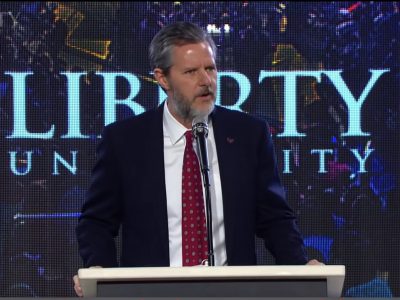
Liberty University’s president is Jerry Falwell, Jr., a powerful figure in the Christian right. Since succeeding his father as president in 2007 he has transformed the Lynchburg, Va., institution: it now has an endowment of more than $3 billion, while student enrollment (including non-residential) is over 100,000. The conservative Christian university wields considerable political influence. Donald Trump gave the 2017 commencement address at Liberty, and Falwell has become so close to Trump in recent years that even some Liberty students have expressed concern.

Falwell was the first leader in the Christian right to endorse Trump’s candidacy for the 2016 Republican nomination for president. Shortly thereafter, many prominent evangelicals shifted their support from Senator Ted Cruz, the son of an evangelical pastor, and threw it behind the thrice-married pussy grabber. According to 2016 exit polls, 80 percent of white evangelicals voted for Trump in 2016; their support remains unwavering in 2020. Trump has rewarded Falwell for his continued unstinting loyalty with regular invitations to the White House.

More recently, a series of scandals have exposed Falwell’s authoritarianism and hypocrisy. Several major media outlets have reported that former Trump lawyer Michael Cohen, who was recently furloughed from federal prison, claims that in 2015 he made some compromising photos of Falwell’s wife Becki disappear. Shortly after doing this favor for Falwell, Cohen asked him to endorse Trump’s candidacy. Separately, Politico published a lengthy investigative report that quotes senior Liberty University officials who accuse Falwell of committing grave financial improprieties.

Under Falwell’s leadership, Liberty University has become known for extreme censorship and hostility to outsiders. Last month, he announced that arrest warrants had been issued for New York Times and Pro Publica reporters who covered the university’s widely criticized decision to hold on-campus classes after spring break, despite the COVID-19 pandemic.

Given this context, Falwell’s quiet shuttering of the philosophy department in the face of declining student interest might seem insignificant. But there is a story here—one about the devaluation of the humanities and of critical thinking that speaks to why white evangelicals have consistently been, and remain, the most pro-Trump demographic in the United States.

Christianity has historically had a fraught relationship with the discipline of philosophy and its general ethos of free intellectual inquiry. Early theologians such as St. Augustine did adopt a great deal from Platonism and Stoicism, but modern philosophy developed as a discipline increasingly distinct from, and often at odds with, orthodox theology. Some authoritarian leaders view it as a threat. Tsar Nicholas I, for example, shut down the philosophy departments in Russian universities in 1850, following the 1848 revolutions that rocked Europe, lest students absorb socialist ideas that might turn them against his repressive regime.

Modern apologists, such as C.S. Lewis and the less well-known early twentieth-century Russian religious philosophers, have tried to employ the tools of philosophy in defense of essentially orthodox versions of the Christian faith. Prominent philosophers in academia generally view these attempts as failures. According to a 2013 survey of professors in leading philosophy departments in North America, Europe, and Australia, 72.8 percent of respondents identified as atheists.

Meanwhile, the fiction of the “evil godless professor” eager to corrupt the minds of Christian college students has become a staple of the American Christian right. The 2014 Pure Flix release “God’s Not Dead,” a movie nearly universally panned by critics, is perhaps the most well-known version of this trope. The villain of that modern morality tale is a philosophy professor. The trope itself is ubiquitous in conservative, mostly white evangelical subculture, whether found in a tract that blames school shootings on the teaching of evolution or in contemporary Christian novels.

One of the defining features of fundamentalist religion is the construction of what scholars call enclave communities, where the fundamentalist group’s sacrosanct “alternative facts” can go unchallenged by inconvenient modern knowledge. This is certainly true of American evangelicals. Institutions that promote their views include the controversial Museum of the Bible, in Washington, D.C., which was founded and is funded by the evangelical Green family, owners of Hobby Lobby (notorious for refusing to provide their employees with health insurance that covers contraception); and the Creation Museum in Petersburg, Kentucky, which bases its explanation of Earth’s beginnings on a literal interpretation of the Bible. There are also Christian bookstores, the contemporary Christian music and movie industries, and, of course, Christian schools, colleges, and universities—as well as homeschooling groups and curricula.

Many of these institutions promote the idea that the “Christian alternative” to the scholarly consensus on matters such as evolution, or the reliability of the Bible, is just as intellectually sound as the consensus in what Christian fundamentalists refer to as “the world”—that is, everything that exists outside their bubble and their control. But the fear that these Christian alternatives might not withstand scrutiny lurks just below the surface. Christian educational institutions, for example, are so hostile to academic and personal freedom that they require faculty, staff, and students to sign very specific, very conservative “lifestyle statements” and statements of faith.

We see this fear at play in this moment of far right-wing backlash, in the evangelical embrace of Donald Trump. Trump pursues evangelicals’ agenda of remaking the United States so that it conforms to their worldview, which is why I have occasionally remarked over the last few years that it feels as though the entire country is turning into a Christian school. In modern democracies, the existence of pluralism is simply a fact; but to authoritarian evangelicals, it is a threat. If they can eliminate the need to accommodate those who are different from them, they will.

Liberty University’s decision to eliminate its philosophy department might still seem odd, inasmuch as it undermines the school’s aspiration to intellectual seriousness. And let me be clear—some Christians are perfectly capable of intellectual seriousness. I find a great deal to criticize in Catholic theology, but today’s Catholic Church does at least teach that evolution and faith are compatible. Nor would I would deny the intellectual discipline and rigor it takes to become a Jesuit. Meanwhile, Liberty is not only dumping its philosophy programs, but also touting a new right-wing “think tank” in partnership with the notorious troll Charlie Kirk, founder of Turning Point USA.

Asked about the situation at Liberty, Professor Karl Giberson, who became an Episcopalian after he was pushed out of his community for teaching evolution at an evangelical college, ticked off the names of Stonehill, Boston College, and Georgetown—all Catholic universities, which regard philosophy as a critical conversation partner in “a school that values the Christian tradition.” A serious institution of higher education does not eliminate its philosophy department because student interest in the humanities is declining.

Jack Panyard, who graduated from Liberty University last year, was appointed editor-in-chief of the student newspaper in 2017, only to see the position eliminated entirely after he refused to submit to Falwell’s censorship. Interviewed for The Conversationalist, he said, “It's enormously irresponsible to have a university without a philosophy department, but LU has built its base enough that they know they’ll get by.” Panyard sees the recent and current changes as part of a process of prioritizing, by which Liberty is becoming “less of a Christian university” and more of a “Republican conservative evangelical” institution.

Scott Okamoto, a former English instructor at Azusa Pacific University and a keen observer of trends in evangelical higher education said, “Philosophy eats evangelical minds for breakfast. No self-respecting evangelical would ever want to study ‘worldly’ thinking that deeply—or very few.”

Evangelicals have never had a Christian intellectual tradition comparable to that of the Jesuits, but they do often pretend to intellectual seriousness. Liberty’s decision to drop the pretense is perfectly in keeping with the Trump era, when all sorts of masks are coming off.
    [post_title] => Liberty University eliminates its Philosophy Department, furthering the Christian right's anti-intellectual backlash
    [post_excerpt] => Liberty University, says one recent graduate, is becoming “less of a Christian university” and more of a “Republican conservative evangelical” institution.
    [post_status] => publish
    [comment_status] => closed
    [ping_status] => open
    [post_password] => 
    [post_name] => liberty-university-eliminates-its-philosophy-department-furthering-the-christian-rights-anti-intellectual-backlash
    [to_ping] => 
    [pinged] => 
https://conversationalist.org/2020/04/30/jesus-is-my-vaccine-culture-wars-coronavirus-and-the-2020-election/
    [post_modified] => 2026-10-01 15:56:50
    [post_modified_gmt] => 2026-10-01 15:56:50
    [post_content_filtered] => 
    [post_parent] => 0
    [guid] => http://conversationalist.org/?p=1788
    [menu_order] => 264
    [post_type] => post
    [post_mime_type] => 
    [comment_count] => 0
    [filter] => raw
)
Liberty University eliminates its Philosophy Department, furthering the Christian right’s anti-intellectual backlash

WP_Post Object
(
    [ID] => 1289
    [post_author] => 2
    [post_date] => 2019-08-08 20:59:43
    [post_date_gmt] => 2019-08-08 20:59:43
    [post_content] => “I did not oppose busing in America. What I opposed is busing ordered by the Department of Education. That’s what I opposed.” — Joe Biden to Kamala Harris at the June 27 Democratic primary debate

Responding to Biden's comment, investigative journalist Nikole Hannah-Jones, explains in the New York Times why busing succeeded in some parts of the country and failed in others — and also why the term "busing" is inaccurate for what was, in fact, "court-ordered school desegregation."

[The fact that] Americans of all stripes believe that the brief period in which we actually tried to desegregate our schools was a failure, speaks to one of the most successful propaganda campaigns of the last half century.

If there was a problem with busing, Hannah-Jones continues, it was that it was too successful, too good at desegregating schools in segregated cities and towns. Between 1964 and 1972, the proportion of black children attending white schools in the South rose from just two percent to nearly half. "The South," observes Hannah-Jones, "Had gone from the most segregated region of the country for black children to the most integrated, which it remains 40-some years later.” In the northern states, however, wealthy white urban parents organized against enforced busing so effectively that the policy eventually failed. Today, most school districts in cities like New York and Chicago are de facto segregated. Brown v. Education was not a court case about a child’s right to a better school on the other side of town, Hannah-Jones points out, but one about a child’s right to attend the school in her own neighborhood. The issue that Biden and others opposed was always integration, not busing. Now, three years into the Trump presidency, we are seeing the consequences of segregated neighborhoods and schools.  “De facto segregation of public schools continues to thrust aside the critical democratic experience of learning and conversing with racial Others during the formative years of human and citizen development,” MIT professor J. Phillip Thompson wrote in 2017, not long after Donald Trump took office. Segregation, he explains, means that people "are less likely to recognize commonalities in their values – concern for family, respect for hard work, willingness to help others." In the absence of mutually acknowledged humanity, it's a short step to "scapegoating and divisive politics." Segregation affects individuals and society in a variety of ways. One study by Boston University showed that black neighborhoods and white neighborhoods are policed differently, which accounts for the racial disparity in police shootings.

“A common refrain in the age of Trump is: ‘This is not who we are,’” David Smith writes in The Guardian. “A common riposte is to point to America’s long history of slavery, segregation and violence and say: ‘This is exactly who we are.’”

Most alarming about the racism exacerbated by segregation is that it has led to domestic terrorism, with mass shootings that target visible minorities. Segregated online spaces are fostering racist vitriol. “He truly believed wild conspiracy theories he read on the internet, many of which vilified Democrats and spread rumors that Trump supporters were in danger because of them,” wrote the defense lawyers for Cesar Sayoc Jr., who sent bombs to Democrats and journalists who had publicly taken on Trump. The hope and inspiration during these dark times lie with people and groups working to desegregate our society in different ways. In Houston, a city program called Build Up Houston seeks to empower and hire black business owners. Black and white ministers are working together to bridge the racial divide in churches and other faith-based spaces. Latinx activists, sometimes excluded from the black/white dichotomy, are establishing social and political movements that are founded on neither “American exceptionalism [nor] American aversion.” In 2017, Thompson identified "morally-based organizing" across races as an essential endeavor to combat white supremacism. "How to convene the public when the majority (including a majority of blacks and Latinos) is dispersed in segregated suburbs is a pressing practical issue," he wrote. If we want to save democracy, we'll have to figure out the means of traversing the physical and the racial divides.  [post_title] => Why Joe Biden's former position on school busing is anti-democratic [post_excerpt] => Between 1964 and 1972, court-enforced busing successfully desegregated public schools in the American South. But in the north, white parents in urban centers organized to oppose the policy — which eventually failed. Today, southern public schools remain integrated while northern public schools are de facto segregated. [post_status] => publish [comment_status] => closed [ping_status] => open [post_password] => [post_name] => democracy-withers-in-the-darkness-of-racism [to_ping] => [pinged] => [post_modified] => 2024-08-28 21:11:30 [post_modified_gmt] => 2024-08-28 21:11:30 [post_content_filtered] => [post_parent] => 0 [guid] => https://conversationalist.org/?p=1289 [menu_order] => 308 [post_type] => post [post_mime_type] => [comment_count] => 0 [filter] => raw )

Why Joe Biden’s former position on school busing is anti-democratic

WP_Post Object
(
    [ID] => 1173
    [post_author] => 2
    [post_date] => 2019-06-27 15:09:19
    [post_date_gmt] => 2019-06-27 15:09:19
    [post_content] => Two of the leading candidates for the Democratic party's nomination unveiled plans to deal with the student debt crisis — and were met with a chorus of critics.

On Monday, Senator Bernie Sanders proposed eliminating all student debt, to the tune of $1.6 trillion. Sanders also wants to make public universities, community colleges, and trade schools all tuition-free. With his proposal, Sanders has one-upped Elizabeth Warren, his main opponent for the Democratic party nomination. Warren’s proposal is for a tiered loan forgiveness plan — up to $50,000 based on household income.

But while student debt is an enormous burden for both individuals and the economy, critics have nonetheless objected to the plans put forward by both Sanders and Warren. Kevin Carey, who directs the education policy program at New America, the Washington, D.C. think tank, writes in the New York Times that the plans fail to account for the largest cause of student debt in the United States — i.e., graduate and professional school programs. Adam Looney, a Brookings fellow cited in The Wall Street Journal, says that Warren’s plan would benefit higher earners. Matt Bruenig, a policy analyst who founded the People’s Policy Project, grapples with some of the inconsistencies in the plans; but he does not see any potential benefits.

However, as author and documentary filmmaker Astra Taylor reminds us in The Guardian, the call for student debt forgiveness began with grassroots organizing. The Debt Collective, an organization she co-founded, organized student strikes that resulted in the cancellation of more than $1 billion in debt acquired by people who attended fraudulent for-profit colleges. Nor is the Brookings Institute’s analysis the last word on “fairness”: Taylor cites research by sociologist Tressie McMillan Cottom and economist Darrick Hamilton, which shows that student debt disproportionately affects women and people of color. Debt forgiveness could help close the racial wealth gap.

Meanwhile, more than 150,000 victims of deceptive practices by for-profit colleges are suing the Department of Education for failing to deliver on debt relief that is already guaranteed by existing laws.

In other news:

Is your vacation ethical? Writing in Yes Magazine, travel writer Bani Amor asks how we can decolonize vacations. Read more. Why is a 40-year veteran of the environmental movement feeling hopeful? Read the op-ed. Meet the big-name brands that want to buy back your old clothing to reuse and recycle. Read more. [post_title] => Searching for a way to rescue the American dream [post_excerpt] => Senators Warren and Sanders, both candidates for the Democratic party nomination, have unveiled concrete plans that would address the prohibitive financial burden of higher education [post_status] => publish [comment_status] => open [ping_status] => open [post_password] => [post_name] => searching-for-a-way-to-rescue-the-american-dream [to_ping] => [pinged] => [post_modified] => 2026-09-15 22:48:57 [post_modified_gmt] => 2026-09-15 22:48:57 [post_content_filtered] => [post_parent] => 0 [guid] => https://conversationalist.org/?p=1173 [menu_order] => 318 [post_type] => post [post_mime_type] => [comment_count] => 0 [filter] => raw )

Searching for a way to rescue the American dream

WP_Post Object
(
    [ID] => 1041
    [post_author] => 2
    [post_date] => 2019-05-24 16:42:49
    [post_date_gmt] => 2019-05-24 16:42:49
    [post_content] => "The past is never dead. It is not even past."
—William Faulkner

Did you ever wonder why the American education system only gets serious about foreign languages in high school, while the rest of the world seems to start sometime before kindergarten? It’s not by accident, of course. In America, the attitude toward bilingualism has historically been uneasy at best. The tremendous cultural pressure on immigrants to assimilate and to speak English, presents a problem for ethnic and national groups committed to maintaining their own languages and cultural identity beyond the first and second generations.

When a growing Yiddish after school program asked the Milwaukee public school system for use of one of its buildings, it was a local rabbi who went on the record to protest the Yiddish program. “There is altogether too much hyphenism in our present Americanism…” said Rabbi Samuel Hirschberg. He added that foreign language education was wrong because “A foreign language as a household language tends to perpetuate foreignism…” Hirschberg insisted that foreign languages were so corrosive to the American national spirit that no foreign language should be taught before high school.

That was in 1916. Rabbi Hirschberg’s curious campaign to discourage Jewish literacy points to two important facts that tend to be in tension. First, bi- and even tri-lingualism has always been tied to American Jewish identity, both as an immigrant group and a diasporic people. Second, the discourse around bilingualism in America is in large part a function of attitudes toward immigrants. Between 1881 and 1924 some 2.5 million Jews immigrated from Eastern and Central Europe. By the time Rabbi Hirschberg went on the record, the popular conversation around immigrants, especially Jews, had reached unprecedented heights of ugly xenophobia. Less than a decade later, in 1924, Congress passed legislation that would essentially cut off all immigration from Europe, including Jewish immigration.

The persistence of bilingual culture

The case of Rabbi Hirschberg shows that the question of bilingualism was a complicated one, and that the conversations happening in the mainstream were also happening within the Jewish community. But bilingual (Yiddish-English) Jewish communal life did persist in the United States, and well past its expected life span. In 1933, on the occasion of his fiftieth birthday, Hillel Rogoff, the managing editor of the most widely-read Yiddish newspaper in the United States, the Jewish Daily Forward, was asked about the future of the Yiddish press in America. Despite widely-held views that Yiddish was a dying language, Rogoff was optimistic. “There is no reason,” he said, “why the Yiddish press in America should not go on for many, many years…” Today, at 122 years of continuous publishing, the Yiddish language Forverts newspaper has already outlived the traditional Yiddish blessing, “may you live until 120.” The history of Forverts reflects a mixture of enormous communal investment, dumb luck and, in the end, the overwhelming power of monolingualism. In that sense, for newer diasporic groups hoping to maintain an identity tied to a heritage language, the Forverts provides an important case study. In the United States, maintaining an immigrant language and cultural tradition requires an act of tremendous will and coordinated community action. What’s so unique about the persistence of Forverts — which is still published to this day, albeit in a very diminished format — is not just that it defied the two-generation life span for immigrant media, but that it did so in spite of itself. The Forverts was itself a force for Americanization. Established in 1897 at the peak of mass Jewish migration from Eastern Europe, Forverts’s most famous sections were aimed at helping new immigrants assimilate. A Bintl Brif (A Bundle of Letters) was one of the first American newspaper advice columns. It provided guidance on many of the dilemmas of Americanization, including, most poignantly, the cultural gap that inevitably arose between Yiddish speaking parents and bilingual American children, many of whom were ashamed of their foreign parents. The Yiddish of Forverts was also highly ‘Americanized,’ employing many transliterated English words. Perhaps most importantly, given American political attitudes, while The Forverts was a proudly socialist publication, it was vigorously anti-Communist. The Yiddish paper of record managed to thread the needle of politically acceptable cultural autonomy. The Forverts was always more than a newspaper. It was part of a wide-ranging, interconnected network of Yiddish flavored, socialist and labor oriented institutions that included WEVD radio, Amalgamated Bank, the Amalgamated Housing Cooperative in the Bronx, a mutual aid society called the Workmen’s Circle, and a summer camp and after school education system that still exist today. At its height, the Forverts parent entity, the Forward Association, was a political machine, an organization with a constitution that spelled out expectations for members to vote along party lines, or risk disciplinary action that included expulsion. Taken together, the Forverts was a symbol of an urban, all-encompassing model of Jewish life in America. It was explicitly built by and for its members and readers, and that sense of ownership continued to reverberate through later generations, even if in a diminished, distanced way.  

Xenophobia redux

Coordinated anti-immigrant hysteria brought an end to the great era of Jewish mass migration, with the passing of the 1924 Immigration Restriction Act. Unfortunately, we are now seeing a resurgence of the ugly xenophobia that was such a salient feature of American life during the 1920s and 1930s. According to a recent Pew Foundation survey, almost one third of Americans feel uncomfortable merely hearing a language other than English in public. The irony is, for all the outrage about immigrants and their supposed resistance to assimilation, the process of Americanization is absolutely relentless and no group is immune to the inevitability of language loss.   First generation immigrants to the United States generally learn English slowly. They depend on media in their native language, which they continue to speak at home. Second generation Americans are bilingual and may or may not be attached to the immigrant language and its institutions. Third generation Americans are, almost without exception, monolingual. Many of the institutions created by the first generation of Yiddish-speaking immigrants still exist. While the WEVD radio station was sold to Disney, Amalgamated Bank and the Amalgamated Houses still stand. The Workmen’s Circle has created a new identity for itself in the twenty-first century, one that is different from its origins as a mutual aid society, but still centered on an understanding of American Jews as immigrants and descendants of immigrants. But those institutions, for all their longevity, did not create a legacy of contemporary Yiddish speakers. While the Workmen’s Circle offers superb and innovative Yiddish language classes for adults, it faces nearly insurmountable challenges in monolingual America. Providing systematic Yiddish language education for children was an exceedingly difficult proposition, given both the financial cost and the pull of assimilation. The Holocaust decimated Yiddish culture in Europe, reducing its native-speaking population by 85%. Today, outside of the Hasidic communities, Yiddish is spoken by only a small number of Jewish Americans. Many of them are people like me and my friends, residents of what we affectionately call Yiddishland.

The will to preserve a culture

So what are the twenty-first century strategies for creating fluent second and third generation heritage language speakers? According to my Yiddishland friends who are now parents, supplementary and all-day schools (which also exist for Russian, Chinese and Hungarian) have proven highly effective — if extremely expensive — for language transmission, especially where a first generation parent speaks the language at home. But it remains to be seen whether those schools alone can inspire the second generation to transmit to the third, the true challenge in monolingual America. On this question of the third generation I turned to a young friend of mine, Shifra Whiteman. As a child in the 1990s, Whiteman was part of a small Yiddish-language playgroup called Pripetshik.  The group was created by a dedicated group of second-generation parents invested in Yiddish continuity. Pripetshik met in the Workmen’s Circle building in New York and lasted for years, morphing into a Yiddish chorus and producing lifelong friendships. As adults Whiteman, and the other members of the playgroup, have gone on to become activists and leaders in the Yiddish world. The playgroup wasn’t just about teaching a language. It included cooking sessions, movies and history lessons. Pripetshik was about transmitting a very specific diasporic Jewish identity. Its location in the Workmen’s Circle building, a few floors down from the Forverts, was an important part of the lesson, showing the kids that they existed within an ongoing cultural project.   In addition to her Yiddish playgroup, Whiteman also received a conventional Jewish day school education as well as many summers at Zionist summer camp. She recently started teaching Yiddish classes in cooperation with her city’s YIVO and Workmen’s Circle branches. Her students are almost entirely young people hungry for connection to an alternative kind of Jewish identity, one that is not rooted in nationalism or political ideology. At 30, she is ready to start thinking about children of her own, and plans to speak Yiddish with them, just as her parents spoke to her. As she put it to me, among the many Jewish worlds she inhabited as a young person, “the Yiddish stuck.”   There are no easy answers to the question of how to preserve immigrant cultures and languages in the face of America’s fierce devotion to monolingualism. However, it’s clear that the success of multi-generational cultural transmission will depend on the durability of institutions, and whether the language and culture express values that the following generations find useful, and essential, to their sense of self. The Forverts was a newspaper for immigrants who wanted to become American. Today, many of its readers are the grandchildren and great-grandchildren of immigrants, people who want to expand the definition of American and once again redefine Jewish life in the diaspora. [post_title] => Make bilingualism great [post_excerpt] => What are the twenty-first century strategies for creating fluent second and third generation heritage language speakers in a pervasively unilingual and often xenophobic culture? [post_status] => publish [comment_status] => open [ping_status] => open [post_password] => [post_name] => make-bilingualism-great [to_ping] => [pinged] => [post_modified] => 2026-08-07 16:13:48 [post_modified_gmt] => 2026-08-07 16:13:48 [post_content_filtered] => [post_parent] => 0 [guid] => https://conversationalist.org/?p=1041 [menu_order] => 328 [post_type] => post [post_mime_type] => [comment_count] => 0 [filter] => raw )

Make bilingualism great

WP_Post Object
(
    [ID] => 602
    [post_author] => 5
    [post_date] => 2019-02-15 16:25:09
    [post_date_gmt] => 2019-02-15 16:25:09
    [post_content] => 


The children of California farmworkers are working with research scientists seeking a way to limit their exposure to toxic pesticides; conflict resolution experts and journalists workshop strategies for bringing more nuance to reporting from war zones and election campaigns; and a heartening story about teenage sisters in Bali who led a successful grassroots campaign to ban single use plastic bags

  • The children of migrant farmworkers in California have been invited to join a program led by scientists who want to figure out how to minimize the children's exposure to dangerous pesticides. By including the children, they are setting an example of how to democratize scientific research. Read the story published by Ensia.
  • How can journalists make their reporting on conflict and on elections more nuanced? Apparently, a very successful strategy is to bring together journalists and conflict resolution experts to workshop essential questions that "complicate the narrative." Fascinating report here.
  • There is a dearth of affordable housing in American cities, but Austin, Texas, is considering lifting building restrictions in exchange for developers building more affordable units. Next City has the story.
  • In order to stop global warming at 1.5 degrees, we need to increase radically our use of sustainable energy sources. Solutions like solar and wind energy require the use of "rare earth metals" like cadmium, neodymium and indium — which must be mined from the earth. Now the issue is: How can we do this sustainably? Here's a concrete suggestion.
  • In Bali teenage sisters led a successful grassroots campaign to ban single-use plastic in 2019. NPR has the story.
  • In Europe, teenage girls are calling for strikes to demand action on climate change, and BuzzFeed profiled their heroic efforts.


[post_title] => Bringing nuance to conflict reporting, successful campaigns to ban plastic, and children who learn scientific research for their own benefit [post_excerpt] => The children of California farmworkers are working with research scientists seeking a way to limit their exposure to toxic pesticides; conflict resolution experts and journalists workshop strategies for bringing more nuance to reporting from war zones and election campaigns; and a heartening story about teenage sisters in Bali who led a successful grassroots campaign to ban single use plastic bags [post_status] => publish [comment_status] => open [ping_status] => open [post_password] => [post_name] => bringing-nuance-to-conflict-reporting-successful-campaigns-to-ban-plastic-and-children-who-learn-scientific-research-for-their-own-benefit [to_ping] => [pinged] => [post_modified] => 2024-08-28 21:15:14 [post_modified_gmt] => 2024-08-28 21:15:14 [post_content_filtered] => [post_parent] => 0 [guid] => https://conversationalist.org/?p=602 [menu_order] => 356 [post_type] => post [post_mime_type] => [comment_count] => 0 [filter] => raw )

Bringing nuance to conflict reporting, successful campaigns to ban plastic, and children who learn scientific research for their own benefit