WP_Post Object
(
[ID] => 2601
[post_author] => 2
[post_date] => 2021-05-12 00:11:58
[post_date_gmt] => 2021-05-12 00:11:58
[post_content] => Simons, who rose to fame as a glamorous television personality, leads an explicitly feminist, radical, intersectional party.
If you want to know how Sylvana Simons came to be the first Black woman in the Netherlands to head a political party elected to the House of Representatives, you’ll need to look back further than her glamorous 25-year career as a model, dancer, MTV host, television personality, and political activist. You’ll have to go back to when she dropped out of school and ran away from home at the age of 14 because there were “rules” she “didn’t agree with,” and then became a single mother at the age of 21, when she had not a penny to her name.
It is this lived experience that informs Simons’ political views as leader of BIJ1 (“Together”), the explicitly intersectional, feminist and radical political party that she founded in 2016. Simons was elected to the House of Representatives in March, largely on the back of the urban youth vote.
BIJ1 ran an impressively diverse list of candidates for parliament. Among the top 10 were five Black people, three of them women; a Muslim woman who is disabled; a trans woman; a sex worker; an artist and youth worker; and a woman of Indonesian background (Indonesia is a former colony of the Netherlands). The party’s manifesto breathed intersectionality.
In April Simons made headlines with a scathing 5-minute speech in the House of Representatives on the failures of the government’s pandemic policies. “It turns out,” she said from the podium in the House of Representatives, “That allowing intensive care units to fill up with the goal of reaching herd immunity is harmful to the economy, harmful to our wellbeing, harmful to our freedom, harmful to our health, and has cost us many lives.” The government’s vaccine rollout had failed, she continued, and her party intended to pursue a parliamentary inquiry into the matter.
The speech garnered applause and a rush of positive publicity.
For Simons, the pandemic debate was an excellent opportunity to show what her party stood for, and to push parliament to hold the government to account—an obligation she accuses them of having neglected. “What kind of country do we want to be?” she asked, rhetorically. “We propose systemic change. Do you want authorities to crush citizens, or to protect and help them?”
Sylvana Simons was born in 1971 in colonial Suriname, four years before the South American country won its independence from the Netherlands—where her family has lived since she was 18 months old. She has been a well-known media figure since the mid-1990s, when she was a presenter for Dutch MTV. But in 2015 her fame morphed into notoriety when, as the host’s side-kick on the popular talk show De Wereld Draait Door (The World Moves On), she pushed back against a guest who used a derogatory term for Black people. The backlash was immediate: Simons was targeted with a tsunami of racist, sexist attacks on social media.
Overnight, the popular media personality became the most hated woman in the Netherlands. The television guest appearances and invitations to give speeches at corporate events dried up, as the establishment rushed to distance themselves from the suddenly controversial Simons. But she told The Conversationalist that she has no regrets. “It was inevitable,” she said. "I had to practice what I preached: speak out if you are in a position to do so."
The feminist writer and activist Anja Meulenbelt chuckled appreciatively upon seeing Simons suddenly regaining some of her pre-2015 popularity in the wake of her speech criticizing the government’s failed pandemic policy. Meulenbelt, an icon of 1970s second wave feminism, was one of the first people to join BIJ1. “Sylvana is audacious; she is not afraid of anything,” she said. BIJ1 had succeeded, asserted Meulenbelt, where the established leftist parties had failed: “We don’t talk about representation; we are representation. We do what other leftist parties [only] talk about.”
The praise Simons received for her pandemic policy speech was remarkable for the frequency with which it was accompanied by disclaimers—such as, “I’m not a fan of hers, but..!” or “I didn’t vote for her, but..!” or “In general I don’t like her, but..!”
Simons believes those disclaimers are just temporary. She has the stage now, and no longer needs opinion leaders and journalists for exposure. “People think that because of my anti-racism, my politics are exclusive,” she said, adding that the opposite is true. “My politics aren’t exclusive, but inclusive. I act against power. Against a government and institutions that don’t care about citizens but treat them like tools to keep the economy going. That affects all of us, regardless of the color of our skin. And sometimes that means pointing out that the situation of some groups, like Black people or disabled people, requires extra attention.”
Simons said that her now-famous speech had been “brewing” for a year. But the fluidity and incisiveness of her remarks reveal that she must have been thinking deeply for at least a decade about the issues she addressed so eloquently. Her words reflected a combination of heightened political awareness and outrage over not only the handling of the coronavirus pandemic but also over social justice issues like equality, humanity—and dignity.
Part of her impact is based on her understanding of performance, said Aldith Hunkar, an independent Dutch-Surinamese journalist who has known Simons for many years. “She knows like nobody else which camera is pointed at her, and at which moment to look into it,” said Hunkar, who conducted a video interview in English with Simons earlier this month. She added that Simons was completely sincere—as well as “hyper intelligent.”
Sheila Sitalsing, a Dutch-Surinamese political columnist for the veteran daily newspaper de Volkskrant, described Simons to The Conversationalist as “sensational,” adding that she has “flawless political intuition” and is “factual, calm, with a sharp eye for the rule of law.”
Simons is a huge fan of Mona Eltahawy, the uncompromising and outspoken Egyptian-American journalist, commentator and activist, but considers herself to be a “diplomat.” In describing her approach, Simons said, “I can find common ground with everybody,” no matter what their background. “I am not bothered by who you are,” she said. “This has to do with my life path.”
Now 50 years old, Simons became a grandmother last year. Reflecting on her life as a high school dropout and single mother who started out as a TV dancer and worked her way up, she said. “I say with pride that I have hardly any formal education. I wasn’t flattened by a system that didn’t work for me. I overcame institutional hurdles, including racism and sexism, and despite society’s consistently low expectations of me. I learned to make connections with everybody. I consider that my strength.”
But how did that life experience transform into a solidly grounded intersectional worldview seemingly overnight? Where did the theory come from?
Simons mentions Gloria Wekker, a Dutch-Surinamese professor emeritus in gender studies who authored the acclaimed seminal work on Dutch racism, called White Innocence: Paradoxes of Colonialism and Race. Wekker joined BIJ1, taking it upon herself to educate the new party leader—and was struck by how quickly Simons read and understood the texts.
“I asked Gloria which books I had to read,” said Simons. “The books made scientifically tangible what I have lived and felt throughout my life.”
Feminism is, naturally, a big part of the story. But Simons cannot answer the question of which comes first for her—feminism or anti-racism. During the interview, she chooses feminism: “But one cannot exist without the other and I may choose anti-racism next week.”
Simons’s feminist, anti-racist message disrupts the Netherlands, a country that sees itself as a beacon of tolerance and progressiveness. She is not the only one speaking out fiercely against Dutch racism. A decade ago, the campaign “Kick out Black Pete” started, aiming to abolish the blackface tradition that pollutes the Dutch Sinterklaas (Santa Claus) festivities. And last year the Black Lives Matter demonstrations were numerous and huge in the Netherlands. Momentum was building for BIJ1’s politics.
Surprisingly enough, Simons reveals that 15 or 20 years ago she defended Black Pete from foreign criticism. “I’d tell people to butt out of our traditions, even though I’ve hated Black Pete since I was a child. But I too suffered from internalized racism. You know, we are raised in the Netherlands to say that we don’t ‘see’ color, that it’s all kumbaya, but underneath that layer of kumbaya we deny identities.”
Foreigners, in other words, are not the only people surprised to discover racism in the Netherlands. The Dutch themselves are surprised, too. “Our tolerance was a facade we were collectively hiding behind and that has only now started to crumble,” said Simons.
Aldith Hunkar, the Dutch-Surinamese independent journalist, agreed. “The Netherlands has built this system over 500 years and it still refuses to see the implications,” she said. “It’s learning very slowly. Simons has changed the discourse already, but it reflects the rigid, dismal Dutch mindset that she is not yet on a pedestal.” Hunkar, 58, resigned in 2007 from a position she held for 14 years as a television presenter for NOS, the state broadcaster, after accusing it of racism in its editorial decisions.
To know where Sylvana Simons is coming from, one must consider those 500 years of Dutch colonial, racist history. On March 31, the day she was inaugurated into parliament, the party gave its leader a present: a traditional Afro-Surinamese religious ceremony, held at a public square close to the parliament building. A priestess offered a libation to ask the ancestors and God to give Simons power and wisdom.
[caption id="attachment_2609" align="aligncenter" width="840"]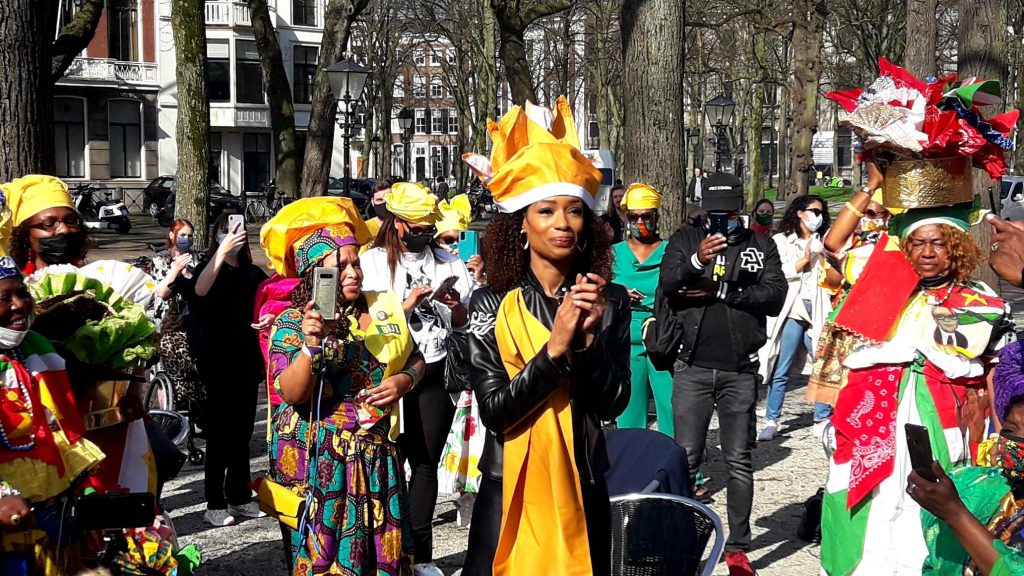 Afro-Surinamese ceremony honoring Sylvana Simons (center) on March 31.[/caption]
Simons said the ceremony made her feel honored: “I was carried by the ancestors. As a child of the colonies, as Simba, the chosen one, I was honored. It meant a lot to me but also for the people who brought me to this point. They didn’t vote for a politician but for their daughter, sister, mother, aunt, and it is completely emotional. It was about spirituality, about keeping the connection with the people who gave their lives for our freedom.”
Going forward, Simons will need all her strength. The same election that brought BIJ1 to parliament also handed victories to several fascist parties, some of which have been in the legislature for several years, pulling policies and the discourse to the right side of the political spectrum. Simons hopes to pull them back to the left. “Pictures of the ceremony were shared [online] and those on the extreme-right of the spectrum saw them too. Everybody saw that my community lifted me so high—who can touch me now? It gave me wings. I flew into parliament.”
The official inauguration was short. The office assigned to her turned out to be in the former Ministry of Colonies. “That is no coincidence,” said Simons. “It closes the circle.”
[post_title] => 'I act against power': Sylvana Simons is proudly disrupting politics as usual in the Netherlands
[post_excerpt] => A glamorous television personality for 25 years, Simons has made history as the first Black woman elected to the House of Representatives as head of a political party—and one with an explicitly radical, feminist, intersectional platform.
[post_status] => publish
[comment_status] => closed
[ping_status] => open
[post_password] =>
[post_name] => i-act-against-power-sylvana-simons-the-netherlands-first-elected-female-black-party-leader-is-a-proud-disruptor
[to_ping] =>
[pinged] =>
[post_modified] => 2026-08-06 21:04:29
[post_modified_gmt] => 2026-08-06 21:04:29
[post_content_filtered] =>
[post_parent] => 0
[guid] => https://conversationalist.org/?p=2601
[menu_order] => 206
[post_type] => post
[post_mime_type] =>
[comment_count] => 0
[filter] => raw
)
Afro-Surinamese ceremony honoring Sylvana Simons (center) on March 31.[/caption]
Simons said the ceremony made her feel honored: “I was carried by the ancestors. As a child of the colonies, as Simba, the chosen one, I was honored. It meant a lot to me but also for the people who brought me to this point. They didn’t vote for a politician but for their daughter, sister, mother, aunt, and it is completely emotional. It was about spirituality, about keeping the connection with the people who gave their lives for our freedom.”
Going forward, Simons will need all her strength. The same election that brought BIJ1 to parliament also handed victories to several fascist parties, some of which have been in the legislature for several years, pulling policies and the discourse to the right side of the political spectrum. Simons hopes to pull them back to the left. “Pictures of the ceremony were shared [online] and those on the extreme-right of the spectrum saw them too. Everybody saw that my community lifted me so high—who can touch me now? It gave me wings. I flew into parliament.”
The official inauguration was short. The office assigned to her turned out to be in the former Ministry of Colonies. “That is no coincidence,” said Simons. “It closes the circle.”
[post_title] => 'I act against power': Sylvana Simons is proudly disrupting politics as usual in the Netherlands
[post_excerpt] => A glamorous television personality for 25 years, Simons has made history as the first Black woman elected to the House of Representatives as head of a political party—and one with an explicitly radical, feminist, intersectional platform.
[post_status] => publish
[comment_status] => closed
[ping_status] => open
[post_password] =>
[post_name] => i-act-against-power-sylvana-simons-the-netherlands-first-elected-female-black-party-leader-is-a-proud-disruptor
[to_ping] =>
[pinged] =>
[post_modified] => 2026-08-06 21:04:29
[post_modified_gmt] => 2026-08-06 21:04:29
[post_content_filtered] =>
[post_parent] => 0
[guid] => https://conversationalist.org/?p=2601
[menu_order] => 206
[post_type] => post
[post_mime_type] =>
[comment_count] => 0
[filter] => raw
)

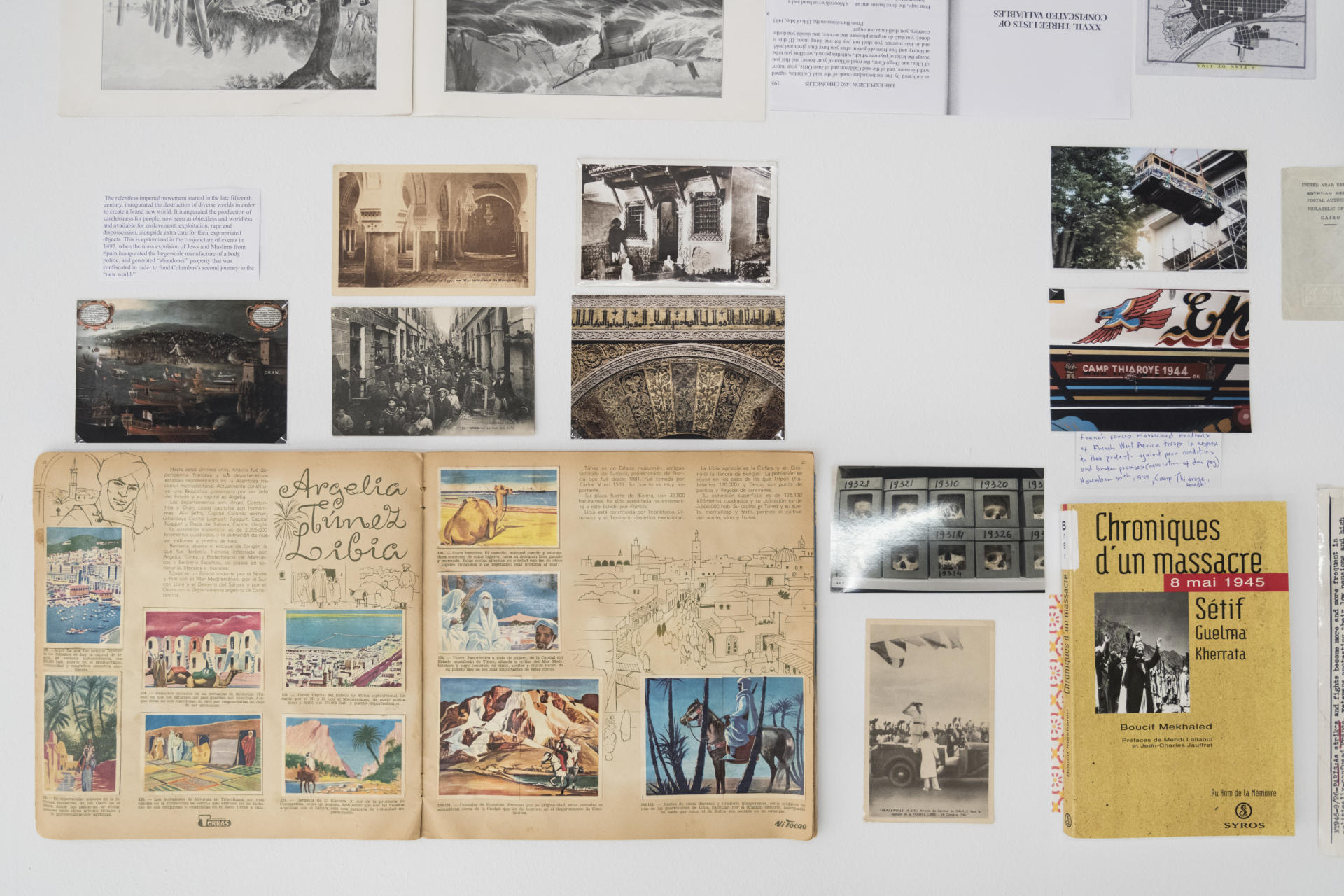 From Ariella Aïsha Azoulay's exhibition "Errata" at the Fundació Antoni Tàpies in Barcelona.[/caption]
Azoulay posits that the use of this violent photographic shutter stretches back to 1492, a moment of imperial Spanish colonization of the Americas, the start of the international global slave trade to make this possible and the obliteration of Judeo-Muslim culture through Inquisition decrees. This history also includes the devastation of the Caribbean’s indigenous Taíno people’s politics and culture in 1514; the ruination of the nonfeudal cocitizenship system of the Igabo people in West Africa; the 1872 Crémiuex decree that gave French citizenship to Jewish Algerians but withheld it from Muslims, a divide-and-conquer strategy with ramifications that are felt to this day; and the ongoing ravaging of Palestinian politics and culture since the early 1900s. In this connected schema of colonial destruction and erasure paired with institutionalization and documentation, the concept of history is premised on the ideas of discovery and progress. Each colonial regime “discovered” new artworks and exhibited them in new museums; they documented dispossessed people with the new label of “refugees” and imposed new cultural practices and political institutions premised on the undoing of previous indigenous norms and knowledge.
Potential history is positioned as a means of addressing these historical damages by imaginatively reactivating the memories and potentialities shut off by the imperialist photograph and its material positioning. Azoulay describes “rehearsal methods” for how we can question and begin to undo these structures. One strategy is the act of revising imperial photos through annotation, including notes, comments and modified captions that challenge the histories they describe. When these interventions are rejected by the archives that own the legal rights to the photos, Azoulay redraws the photographs herself.
Another rehearsal method is the idea of striking, found in short chapters that imagine museum workers, photographers and historians going on strike. The idea of striking until our world is repaired means saying no to the relentless new of history. It does not aim to substitute an alternative history or fill museums with new objects, but rather to reject their logic and promote its active unlearning. Azoulay underlines these and other rehearsals as modes of practicing new forms of co-citizenry and solidarity based on critical looking. “Unlearning imperialism,” she writes, “means aspiring to be there for and with others targeted by imperial violence, in such a way that nothing about the operation of the shutter can ever again appear neutral.”
“Being there” is a moment of radical solidarity in which one aspires to listen to those affected by such violence and question the flow of history that imperial institutions strive to promote as casual and natural. This includes recognizing the role of looted objects and their role in building imperial ideas, but also reclaiming them as means to enact other modes of being, such as thinking of them not as protected “art” but as part of people’s real material worlds.
Azoulay also listens to new melodies that arise from such sites of imperial documentation. She recounts the story of her own Algerian father moving to Israel as a child and trying to forget his native Arabic—because in Israel, the European elite actively condemned its use and promoted Hebrew. She first learned that her grandmother’s name was the Arabic Aïsha, the name of the Prophet Mohamed’s third wife, when she saw her father’s birth certificate after he died. Plucked from this imperial document, the name was a “treasure” in her Hebrew-speaking, Jewish-Israeli family; she sought to use it as a site of imagination by adopting it as her own—in addition to her Hebrew name, Ariella. Azoulay speaks of Aïsha as a haunting scream: Aïsha, Aïsha, Aïeeeeeeee-shaaaaaaaa.
Azoulay further demonstrates photographs and documents as dual sites of violence and resistance with images taken by the Civil War photographer Timothy O’Sullivan in 1862. One of his iconic images shows eight Black people standing stiffly near a large house persistently labeled as the “J.J. Smith Plantation.” These words make it clear that the people in the photograph are racialized property. She describes how this violence is repeated in historical archives, in which photographs of Black people taken before and after the Civil War are interchangeably captioned as depicting slaves; she proposes the imagining of a “dismissed exposure,” or ghostly negative of a forgotten image reinserted into the frame. The original image becomes blurred and surreal as it competes with sculptures from the MoMA floating in the background. Since there are no images on display in U.S. museums of Black Americans reunited with objects stolen from them, the dismissed exposure serves as an imaginative placeholder in the photographic archive. It waits for different worlds and meanings.
Potential history dwells in such creative exercises. It resists simplistic ideas of financial restitution for destroyed cultures or the mere substitution of one history for another. Instead, it advocates persistent unlearning of how the world is taught, represented and constructed; solidarity in resisting these demands; listening to those affected; and, above all, imagining. Azoulay’s book is a long (over 670 pages) and challenging read. It brings up the question of who has the resources to read it; while its ideas are currently being filtered through museum exhibitions such as the traveling , the question remains as to how this work can reach a wider and more diverse audience. If you do manage to find a copy, perhaps try following one of the more whimsical moments of the book: dip in as you please, conceiving of no beginning or end, but rather of moments that shine in “a bright, brief and sudden light” against the “dazzling” beam of imperialism.
After all of the “kings” had been “beheaded” at the intergalactic memorial carnival in Berlin, we passed around a hat, on which was written things we wanted to cherish and save. “It’s more about the spirit of hope than destruction,” laughed a person in a wooden demon mask.
[post_title] => 'Potential Histories: Unlearning Imperialism': A review of Ariella Azoulay's new book
[post_excerpt] => How the "shutter" of photography aided imperial conquest.
[post_status] => publish
[comment_status] => closed
[ping_status] => open
[post_password] =>
[post_name] => potential-histories-unlearning-imperialism-a-review-of-ariella-azoulays-new-book
[to_ping] =>
[pinged] =>
[post_modified] => 2026-08-06 22:58:19
[post_modified_gmt] => 2026-08-06 22:58:19
[post_content_filtered] =>
[post_parent] => 0
[guid] => http://conversationalist.org/?p=2213
[menu_order] => 234
[post_type] => post
[post_mime_type] =>
[comment_count] => 0
[filter] => raw
)
From Ariella Aïsha Azoulay's exhibition "Errata" at the Fundació Antoni Tàpies in Barcelona.[/caption]
Azoulay posits that the use of this violent photographic shutter stretches back to 1492, a moment of imperial Spanish colonization of the Americas, the start of the international global slave trade to make this possible and the obliteration of Judeo-Muslim culture through Inquisition decrees. This history also includes the devastation of the Caribbean’s indigenous Taíno people’s politics and culture in 1514; the ruination of the nonfeudal cocitizenship system of the Igabo people in West Africa; the 1872 Crémiuex decree that gave French citizenship to Jewish Algerians but withheld it from Muslims, a divide-and-conquer strategy with ramifications that are felt to this day; and the ongoing ravaging of Palestinian politics and culture since the early 1900s. In this connected schema of colonial destruction and erasure paired with institutionalization and documentation, the concept of history is premised on the ideas of discovery and progress. Each colonial regime “discovered” new artworks and exhibited them in new museums; they documented dispossessed people with the new label of “refugees” and imposed new cultural practices and political institutions premised on the undoing of previous indigenous norms and knowledge.
Potential history is positioned as a means of addressing these historical damages by imaginatively reactivating the memories and potentialities shut off by the imperialist photograph and its material positioning. Azoulay describes “rehearsal methods” for how we can question and begin to undo these structures. One strategy is the act of revising imperial photos through annotation, including notes, comments and modified captions that challenge the histories they describe. When these interventions are rejected by the archives that own the legal rights to the photos, Azoulay redraws the photographs herself.
Another rehearsal method is the idea of striking, found in short chapters that imagine museum workers, photographers and historians going on strike. The idea of striking until our world is repaired means saying no to the relentless new of history. It does not aim to substitute an alternative history or fill museums with new objects, but rather to reject their logic and promote its active unlearning. Azoulay underlines these and other rehearsals as modes of practicing new forms of co-citizenry and solidarity based on critical looking. “Unlearning imperialism,” she writes, “means aspiring to be there for and with others targeted by imperial violence, in such a way that nothing about the operation of the shutter can ever again appear neutral.”
“Being there” is a moment of radical solidarity in which one aspires to listen to those affected by such violence and question the flow of history that imperial institutions strive to promote as casual and natural. This includes recognizing the role of looted objects and their role in building imperial ideas, but also reclaiming them as means to enact other modes of being, such as thinking of them not as protected “art” but as part of people’s real material worlds.
Azoulay also listens to new melodies that arise from such sites of imperial documentation. She recounts the story of her own Algerian father moving to Israel as a child and trying to forget his native Arabic—because in Israel, the European elite actively condemned its use and promoted Hebrew. She first learned that her grandmother’s name was the Arabic Aïsha, the name of the Prophet Mohamed’s third wife, when she saw her father’s birth certificate after he died. Plucked from this imperial document, the name was a “treasure” in her Hebrew-speaking, Jewish-Israeli family; she sought to use it as a site of imagination by adopting it as her own—in addition to her Hebrew name, Ariella. Azoulay speaks of Aïsha as a haunting scream: Aïsha, Aïsha, Aïeeeeeeee-shaaaaaaaa.
Azoulay further demonstrates photographs and documents as dual sites of violence and resistance with images taken by the Civil War photographer Timothy O’Sullivan in 1862. One of his iconic images shows eight Black people standing stiffly near a large house persistently labeled as the “J.J. Smith Plantation.” These words make it clear that the people in the photograph are racialized property. She describes how this violence is repeated in historical archives, in which photographs of Black people taken before and after the Civil War are interchangeably captioned as depicting slaves; she proposes the imagining of a “dismissed exposure,” or ghostly negative of a forgotten image reinserted into the frame. The original image becomes blurred and surreal as it competes with sculptures from the MoMA floating in the background. Since there are no images on display in U.S. museums of Black Americans reunited with objects stolen from them, the dismissed exposure serves as an imaginative placeholder in the photographic archive. It waits for different worlds and meanings.
Potential history dwells in such creative exercises. It resists simplistic ideas of financial restitution for destroyed cultures or the mere substitution of one history for another. Instead, it advocates persistent unlearning of how the world is taught, represented and constructed; solidarity in resisting these demands; listening to those affected; and, above all, imagining. Azoulay’s book is a long (over 670 pages) and challenging read. It brings up the question of who has the resources to read it; while its ideas are currently being filtered through museum exhibitions such as the traveling , the question remains as to how this work can reach a wider and more diverse audience. If you do manage to find a copy, perhaps try following one of the more whimsical moments of the book: dip in as you please, conceiving of no beginning or end, but rather of moments that shine in “a bright, brief and sudden light” against the “dazzling” beam of imperialism.
After all of the “kings” had been “beheaded” at the intergalactic memorial carnival in Berlin, we passed around a hat, on which was written things we wanted to cherish and save. “It’s more about the spirit of hope than destruction,” laughed a person in a wooden demon mask.
[post_title] => 'Potential Histories: Unlearning Imperialism': A review of Ariella Azoulay's new book
[post_excerpt] => How the "shutter" of photography aided imperial conquest.
[post_status] => publish
[comment_status] => closed
[ping_status] => open
[post_password] =>
[post_name] => potential-histories-unlearning-imperialism-a-review-of-ariella-azoulays-new-book
[to_ping] =>
[pinged] =>
[post_modified] => 2026-08-06 22:58:19
[post_modified_gmt] => 2026-08-06 22:58:19
[post_content_filtered] =>
[post_parent] => 0
[guid] => http://conversationalist.org/?p=2213
[menu_order] => 234
[post_type] => post
[post_mime_type] =>
[comment_count] => 0
[filter] => raw
)