WP_Post Object
(
    [ID] => 3234
    [post_author] => 2
    [post_date] => 2021-10-05 02:14:04
    [post_date_gmt] => 2021-10-05 02:14:04
    [post_content] => We know Facebook is hurting individuals and whole societies; but now we know that Facebook knows it, too.

On Sunday, October 3, the Facebook whistle-blower, whose trove of internal research documents has made global headlines for weeks, revealed her identity on 60 Minutes, the prestigious American television news show. Frances Haugen, who quit her job at Facebook in May 2021, said “the version of Facebook that exists today is tearing our societies apart,” and that Facebook’s senior executives know this but refused to act. Haugen said she took a trove of internal documents to prove beyond doubt that Facebook’s research team and senior executives know exactly the damage the company inflicts but choose to prioritize advertising revenue. She said; “Facebook has realised if they make it safer, people spend less time on the site, click on less ads, they make less money.” She brought proof of what many outsiders have said for years: Facebook prioritizes revenue over public safety, and Instagram makes children—especially teenage girls - mentally ill.

Who is Frances Haugen? She is a 37 year-old American data scientist, a Harvard Business School graduate, who has worked for Big Tech for 15 years, including for Google, Yelp, and Pinterest. At Facebook, where she had worked for two years, Haugen led a small team working on counterespionage for civilians targeted by hostile states—for example, Taiwanese or Uyghur people being spied on by the Chinese government. Her team of just seven people was expected to provide enough protection for people around the world, and requests for more resources were refused. But Haugen says her personal trigger to blow the whistle was when she lost a friend radicalized by social media into far-right racism.

From early 2021, Haugen assiduously copied tens of thousands of pages of Facebook’s own research about the harms it creates. She has worked with the Wall Street Journal — who reported on Instagram’s harms to teenage girls in September —and will testify to the US Senate Commerce Subcommittee later this week. Just as importantly, Haugen has filed several complaints with the US Securities and Exchange Commission, a regulator for companies. She alleges that Facebook is lying to the public and to shareholders when it says it’s making progress on how it deals with disinformation and hate. One internal Facebook study said “we estimate that we may action as little as three-to- five percent of hate… and 0.6 percent of violence and incitement on Facebook.” Facebook replied a full two weeks after Wall Street Journal reports based on Haugen’s leaked documents, to claim its own research was unreliable. (To be fair, one of the Instagram studies had a tiny sample size of just 40 teenagers.) But it did not address many of the factual claims made about the real, ongoing and fully known harms Facebook is perpetrating against children—and against democracy itself.

Of course, none of the claims made by Haugen’s leaks are new. Independent researchers have pointed out for years that Facebook profits from extremism and hate. Facebook’s 2018 change to the algorithm that decides which content users see was designed to aggressively monetize even more the fact that anger drives clicks. Another whistle-blower, Sophie Zhang, said in April 2021 that Facebook systematically under-resources the teams working to counter state manipulation of the platform by autocrats around the world. If it’s the US presidential election, election integrity is a priority and, as Haugen says, rules and system changes were introduced and heavily resourced, at least temporarily. But for countries like Honduras, Albania and Azerbajan? According to Zhang, not so much. Protecting election integrity from disinformation and organized hate in lower priority countries “felt like trying to empty the ocean with an eyedropper.” And academic researchers have for years provided evidence that Instagram drives eating disorders, suicidal ideation and self-harm. We know Facebook is hurting individuals and whole societies; but now we know that Facebook knows it, too.

Whistle-blowing is vital because it provides documentary evidence not just of harms, but of the culpability of those doing the harm. That’s why Haugen’s tens of thousands of pages are important. No doubt, Senators’ research staff and SEC investigators will be pouring over them, searching for the smoking gun, for whose finger was on the trigger and when. But it is vital that, despite the attraction of focusing on the whistle-blower themselves, we concentrate on what the documents say, and about whom. Attention must go to the independent researchers who have, all along, generated credible evidence of Facebook’s harms. That includes people who have had their access revoked to data Facebook had promised to share, including researchers at NYU just weeks ago, and social scientists around the world whose access to data via APIs was blocked in 2018. Focusing attention on independent researchers is crucial, as they provide context and depth for the claims of harm. Also, every time Facebook has a scandal, it promises to "do better" and be more transparent, but once the media attention relents, it pulls the plug.

Haugen has taken a great risk with her future career, and has provided the documentation that regulators and policymakers need. For this we should be grateful. But she is not the arbiter of what should be done. So far, when asked about solutions, she’s made vague gestures toward “regulation,” but in the context of her belief that “the version of Facebook that exists today is tearing our societies apart.” To this way of thinking, there is a reachable version of Facebook that would do less harm and be OK. This incremental approach is no surprise. Haugen has already worked for 15 years for companies with names that are synonymous with surveillance capitalism. She doesn’t have a problem with the basic business model of extracting people’s data to sell ads. She just has a problem with Facebook being the most egregious of a very bad bunch.

I’ve written before about the Prodigal Tech Bro, the generic guy who got rich working for Big Tech, but then saw the light and left, to decry its failings. The Prodigal Tech Bro converts his social and actual capital into big platforms to question how technology is used. It’s not just galling; it’s dangerous. Centring people who made the problems pushes aside the people— so often women of colour— who’ve been making independent, good faith critiques for years, with little status or money. And it spotlights incremental, milquetoast “solutions” that don’t fundamentally alter the structures and incentives of Big Tech; “The prodigal tech bro doesn’t want structural change. He is reassurance, not revolution. He’s invested in the status quo, if we can only restore the founders’ purity of intent.” Haugen is far, far more courageous than the prodigal tech bro. For choosing to be a whistle-blower she will lose the rest of the career she prepared for and must have planned. She has literally put her money where her mouth is, and I applaud her. But what we need from her now is context, insider knowledge, facts and examples of how Facebook does what it does. We don’t need her to set the frame for what the solutions should be.
I have a lot of empathy for Mark, and Mark has never set out to make a hateful platform. But he has allowed choices to be made where the side-effects of those choices are that hateful polarizing content gets more distribution and more reach.
--Frances Haugen
Insider critiques are uniformly based on the feeling that “Mark” or “Sheryl” either don’t really understand the harms they do, aren’t sufficiently informed about them, or just want to do the right thing but are trapped in a system of wrong incentives. “It’s one of these unfortunate consequences,” Haugen says, “No one at Facebook is malevolent, right? But the incentives are misaligned.” But Facebook created its own incentives from nothing, hiring Sheryl Sandberg to build its data-extractive, advertising-based business model. Its focus on growth above all else is what made its platform an extreme amplifier of disinformation and hate, simply because that’s what drives clicks. And the amount of money the trillion dollar company spends on moderating content and following up on the direct incitements to violence it generates is miniscule.

Facebook does what it does because that is who it is. It doesn’t change because, as Haugen encapsulates; “Facebook has realized if they make it safer, people spend less time on the site, click on less ads, they make less money.” Haugen’s simple, pithy summary of why we are where we are is the starting point for real change. The documents she has leaked and her upcoming Senate testimony will focus attention on the fundamental problems the company created. Now we need to listen to a wide range of people and gird ourselves for a course of radical, outsider-driven change.
    [post_title] => Blowing the whistle on Facebook is just the first step
    [post_excerpt] => Whistle-blowing is vital because it provides documentary evidence not just of harms, but of the culpability of those doing the harm.
    [post_status] => publish
    [comment_status] => closed
    [ping_status] => open
    [post_password] =>
    [post_name] => blowing-the-whistle-on-facebook-is-just-the-first-step
    [to_ping] =>
    [pinged] =>
    [post_modified] => 2026-08-06 17:24:52
    [post_modified_gmt] => 2026-08-06 17:24:52
    [post_content_filtered] =>
    [post_parent] => 0
    [guid] => https://conversationalist.org/?p=3234
    [menu_order] => 173
    [post_type] => post
    [post_mime_type] =>
    [comment_count] => 0
    [filter] => raw
)

 Little Amal greeted by an Italian nonna, or grandmother, in Bari, Italy.[/caption]



 Hazal Sipahi, host of the podcast "Mental Klitoris."[/caption]
When she was a child growing up in provincial Turkey, Sipahi said, sexuality was only discussed in whispers; but as soon as she could speak English, she found an ocean of sexuality content available on the internet.
“I searched for information online and found it, only because I was curious,” she said. “I also learned many false things on the internet, and they were very hard to correct later on.”
For example, Sipahi explained, “For so long, we thought that the hymen was a literal veil like a membrane.” In Turkey there is a widespread belief that once the hymen is “deformed,” a woman’s femininity is damaged, and she somehow becomes less valuable as a future spouse.
“Mental Klitoris” is both Sipahi’s public service and her means of self-expression. She uses her podcast to correct misunderstandings and disinformation, to go beyond censorship and to translate new terminology into Turkish.
“I really wish I had been able to access this kind of information when I was around 14 or 15,” she said.
More than 45,000 people listen to Mental Klitoris, which provides them with access to crucial information in their native tongue. They learn terms like “stealthing,” “pegging,” “abortion,” “consent,” “vulva,” “menstruation,” and “slut-shaming.” Sipahi covers all these topics on her podcast; she says she’s adding important new vocabulary to the Turkish vernacular.
She’s also adding a liberal voice to the ongoing discussion about feminism, “Which became even stronger in Turkey after #MeToo.” She believes her program will lead to a wave of similar content in Turkey.
“This will go beyond podcasts,” she said. “We will have a sexual opening overall on the internet.”
Inspired by contemporary creatives like Lena Dunham (“Girls”), Michaela Coel (“I Might Detroy You”),
Hazal Sipahi, host of the podcast "Mental Klitoris."[/caption]
When she was a child growing up in provincial Turkey, Sipahi said, sexuality was only discussed in whispers; but as soon as she could speak English, she found an ocean of sexuality content available on the internet.
“I searched for information online and found it, only because I was curious,” she said. “I also learned many false things on the internet, and they were very hard to correct later on.”
For example, Sipahi explained, “For so long, we thought that the hymen was a literal veil like a membrane.” In Turkey there is a widespread belief that once the hymen is “deformed,” a woman’s femininity is damaged, and she somehow becomes less valuable as a future spouse.
“Mental Klitoris” is both Sipahi’s public service and her means of self-expression. She uses her podcast to correct misunderstandings and disinformation, to go beyond censorship and to translate new terminology into Turkish.
“I really wish I had been able to access this kind of information when I was around 14 or 15,” she said.
More than 45,000 people listen to Mental Klitoris, which provides them with access to crucial information in their native tongue. They learn terms like “stealthing,” “pegging,” “abortion,” “consent,” “vulva,” “menstruation,” and “slut-shaming.” Sipahi covers all these topics on her podcast; she says she’s adding important new vocabulary to the Turkish vernacular.
She’s also adding a liberal voice to the ongoing discussion about feminism, “Which became even stronger in Turkey after #MeToo.” She believes her program will lead to a wave of similar content in Turkey.
“This will go beyond podcasts,” she said. “We will have a sexual opening overall on the internet.”
Inspired by contemporary creatives like Lena Dunham (“Girls”), Michaela Coel (“I Might Detroy You”),  Tuluğ Özlü[/caption]
Asked to describe how she feels when she crosses the barriers created by widely shared social taboos about human sexuality, Özlü, who lives in Istanbul’s hip
Tuluğ Özlü[/caption]
Asked to describe how she feels when she crosses the barriers created by widely shared social taboos about human sexuality, Özlü, who lives in Istanbul’s hip  Rayka Kumru[/caption]
Kumru said one of the current barriers to freedom in Turkey was the lack of access to comprehensive sexuality education, information and skills such as sex-positivity, critical thinking around values and diversity, and communication about consent. She circumvents that barrier by informing her viewers and listeners about them directly.
“Once connections and a collaborations are established between policy, education, and [particularly sexual] health, and when access to education and to shame-free, culturally specific, scientific, and empowering skills training are allowed, we see that these barriers are removed,” Kumru explains. Otherwise, she says, the same myths and taboos continue to play out, making misinformation, disinformation, taboos, and shame ever-more toxic.
Rayka Kumru[/caption]
Kumru said one of the current barriers to freedom in Turkey was the lack of access to comprehensive sexuality education, information and skills such as sex-positivity, critical thinking around values and diversity, and communication about consent. She circumvents that barrier by informing her viewers and listeners about them directly.
“Once connections and a collaborations are established between policy, education, and [particularly sexual] health, and when access to education and to shame-free, culturally specific, scientific, and empowering skills training are allowed, we see that these barriers are removed,” Kumru explains. Otherwise, she says, the same myths and taboos continue to play out, making misinformation, disinformation, taboos, and shame ever-more toxic.
 Şükran Moral[/caption]
When it comes to female sexuality, Moral said, Turkey’s art scene is still conservative. “There’s self-censorship among not only creators, but also viewers and buyers, so it’s a vicious cycle.”
Part being an artist, particularly one who challenges the position of women, she said, is seeing a reaction to her work. “When art isn’t displayed,” she asked, “how do you get people to talk about taboos?”
Turkish academia also suffers from a censorship of sex studies.
Dr. Asli Carkoglu, a professor of psychology at Kadir Has University, said it was not easy finding a precise translation for the English word “intimacy” in Turkish.
“There’s the word ‘mahrem,’” she said, but that term has religious connotations.
The difficulty in interpretation, she explains, illustrates the problem: In Turkey, intimacy has not been normalized.
President Recep Tayyip Erdogan and his conservative Justice and Development Party (AKP) have many times expressed support for gender-based segregation and a conservative lifestyle that protects their interpretation of Muslim values.
Erdogan, who has has been in power since 2003, has his own ways of promoting those values.
“At least three children,” has long been the slogan of Erdogan’s population campaign, as the president implores married couples to expand their families and increase Turkey’s population of 82 million.
“For the government, sex means children, population,” Dr. Carkoglu explained.
Dr. Carkoglu believes that sex education should be left to the family, but “when the government acts as though sexuality is nonexistent, the family doesn’t discuss it. It’s the chicken-and-egg dilemma,” she said.
So, how do you overcome a taboo as deep-rooted as sexuality in Turkey? Carkoglu believes that that the topic will have to be normalized through conversations between friends.
“That’s where the taboo starts to break,” she said. “Speaking with friends [about sexuality] becomes normal, speaking in public becomes normal, and then the system adapts.”
But for many Turks, speaking about sexuality is very difficult.
Berkant, 40, has made a living selling sex toys at his shop in the city of Adana, in southern Turkey, for the past two decades. But he said that he’s still too embarrassed to go up to a cashier in another store and say he wants to buy a condom.
“It doesn’t feel right,” he said, adding he doesn’t want to make the cashier uncomfortable.
He is seated comfortably at his desk as we speak; behind him, a wide selection of vibrators are arrayed on shelves.
Berkant and his older brother own one of three erotica shops in Adana. Most of their customers are lower middle class; one-third are female. “Many of them are government workers who come after hearing about us from a friend,” he said.
The shopkeeper said female customers phone in advance to check whether the shop is “available,” meaning empty.
He said he often refers women who describe certain complaints to a gynecologist.
“I see countless women who are barely aware of their own bodies,” he said.
Dr. Doğan Şahin, a psychiatrist and sexual therapist, said that the information women in Turkey hear when they are growing up has a lot to do with their avoidance of discussions about sex, even when the subject concerns their health.
[caption id="attachment_2971" align="aligncenter" width="1600"]
Şükran Moral[/caption]
When it comes to female sexuality, Moral said, Turkey’s art scene is still conservative. “There’s self-censorship among not only creators, but also viewers and buyers, so it’s a vicious cycle.”
Part being an artist, particularly one who challenges the position of women, she said, is seeing a reaction to her work. “When art isn’t displayed,” she asked, “how do you get people to talk about taboos?”
Turkish academia also suffers from a censorship of sex studies.
Dr. Asli Carkoglu, a professor of psychology at Kadir Has University, said it was not easy finding a precise translation for the English word “intimacy” in Turkish.
“There’s the word ‘mahrem,’” she said, but that term has religious connotations.
The difficulty in interpretation, she explains, illustrates the problem: In Turkey, intimacy has not been normalized.
President Recep Tayyip Erdogan and his conservative Justice and Development Party (AKP) have many times expressed support for gender-based segregation and a conservative lifestyle that protects their interpretation of Muslim values.
Erdogan, who has has been in power since 2003, has his own ways of promoting those values.
“At least three children,” has long been the slogan of Erdogan’s population campaign, as the president implores married couples to expand their families and increase Turkey’s population of 82 million.
“For the government, sex means children, population,” Dr. Carkoglu explained.
Dr. Carkoglu believes that sex education should be left to the family, but “when the government acts as though sexuality is nonexistent, the family doesn’t discuss it. It’s the chicken-and-egg dilemma,” she said.
So, how do you overcome a taboo as deep-rooted as sexuality in Turkey? Carkoglu believes that that the topic will have to be normalized through conversations between friends.
“That’s where the taboo starts to break,” she said. “Speaking with friends [about sexuality] becomes normal, speaking in public becomes normal, and then the system adapts.”
But for many Turks, speaking about sexuality is very difficult.
Berkant, 40, has made a living selling sex toys at his shop in the city of Adana, in southern Turkey, for the past two decades. But he said that he’s still too embarrassed to go up to a cashier in another store and say he wants to buy a condom.
“It doesn’t feel right,” he said, adding he doesn’t want to make the cashier uncomfortable.
He is seated comfortably at his desk as we speak; behind him, a wide selection of vibrators are arrayed on shelves.
Berkant and his older brother own one of three erotica shops in Adana. Most of their customers are lower middle class; one-third are female. “Many of them are government workers who come after hearing about us from a friend,” he said.
The shopkeeper said female customers phone in advance to check whether the shop is “available,” meaning empty.
He said he often refers women who describe certain complaints to a gynecologist.
“I see countless women who are barely aware of their own bodies,” he said.
Dr. Doğan Şahin, a psychiatrist and sexual therapist, said that the information women in Turkey hear when they are growing up has a lot to do with their avoidance of discussions about sex, even when the subject concerns their health.
[caption id="attachment_2971" align="aligncenter" width="1600"] Advertisement for men's underwear in Izmir, Turkey.[/caption]
Men don’t really care whether the woman is aroused, willing or having an orgasm, he said. Unless the problem is due to pain, or vaginismus, couples rarely head to a therapist, he adds.
“[Women who grew up hearing false myths] tend to take sexuality as something bad happening to their bodies, and so, they unintentionally shut their vaginas, leading to vaginismus. This is actually a defense method,” he told The Conversationalist.
“They fear dying, they fear becoming a lower quality woman, or that sex is their duty.”
While most Turkish women find out about their sexual needs after getting married, the doctor says that, based on research he completed about 10 years ago, men tend to fall for myths about sexuality by watching pornography, which plants unrealistic fantasies about sex in their minds.
“Sexuality is also presented as criminal or banned in [Turkish] television shows. The shows take sexuality to be part of cheating, damaging passions or crimes instead of part of a normal, healthy, and happy life.”
He recommends that couples talk about sexuality and normalize it. Talking is crucial, and so is the language used in those conversations.
Bahar Aldanmaz, a Turkish sociologist studying for her PhD at Boston University, told The Conversationalist why talking about menstruation matters.
“A woman’s period is unfortunately seen as something to be ashamed of, something to be hidden,” she said. (According to Turkey’s language authority, the word “dirty” also means “a woman having her period.”)
“There are many children who can’t share their menstruation experience, or can’t even understand they are having their periods, or who experience this with fear and trauma.”
And this is what builds a wall of taboo around this essential issue, the professor says. It is one of the issues her non-profit organization “We Need To Talk” aims to accomplish, among other problems related to menstruation, such as period poverty and period stigma.
Female hygiene products are taxed as much as 18 percent—the same ratio as diamonds, said Ms. Aldanmaz. She adds that this is what mainly causes inequality—privileged access to basic health goods, the consequence of the roles imposed by Turkish social mores.
“Despite declining income due to the COVID-19 pandemic, there is a serious increase in the pricing of hygiene pads and tampons. This worsens period poverty,” Aldanmaz says. She offers Scotland as an example of what would like to see in Turkey: free sanitary products for all.
During Turkey’s government-imposed lockdown in May 2021, several photos showing tampons and pads in the non-essential sales part of markets stirred heated debates around the subject, but neither the Ministry of Family and Social Services nor the Health Ministry weighed in.
“We are fighting this shaming culture in Turkey,” Aldanmaz says, “by understanding and talking about it.”
[post_title] => Sexually aware and on air: Beyond Turkey's comfort zone
[post_excerpt] => Turkish podcasts that host frank conversations about sexuality are smashing taboos and filling information vacuums.
[post_status] => publish
[comment_status] => closed
[ping_status] => open
[post_password] =>
[post_name] => sexually-aware-and-on-air-beyond-turkeys-comfort-zone
[to_ping] =>
[pinged] =>
[post_modified] => 2026-08-06 19:44:25
[post_modified_gmt] => 2026-08-06 19:44:25
[post_content_filtered] =>
[post_parent] => 0
[guid] => https://conversationalist.org/?p=2949
[menu_order] => 187
[post_type] => post
[post_mime_type] =>
[comment_count] => 0
[filter] => raw
)
Advertisement for men's underwear in Izmir, Turkey.[/caption]
Men don’t really care whether the woman is aroused, willing or having an orgasm, he said. Unless the problem is due to pain, or vaginismus, couples rarely head to a therapist, he adds.
“[Women who grew up hearing false myths] tend to take sexuality as something bad happening to their bodies, and so, they unintentionally shut their vaginas, leading to vaginismus. This is actually a defense method,” he told The Conversationalist.
“They fear dying, they fear becoming a lower quality woman, or that sex is their duty.”
While most Turkish women find out about their sexual needs after getting married, the doctor says that, based on research he completed about 10 years ago, men tend to fall for myths about sexuality by watching pornography, which plants unrealistic fantasies about sex in their minds.
“Sexuality is also presented as criminal or banned in [Turkish] television shows. The shows take sexuality to be part of cheating, damaging passions or crimes instead of part of a normal, healthy, and happy life.”
He recommends that couples talk about sexuality and normalize it. Talking is crucial, and so is the language used in those conversations.
Bahar Aldanmaz, a Turkish sociologist studying for her PhD at Boston University, told The Conversationalist why talking about menstruation matters.
“A woman’s period is unfortunately seen as something to be ashamed of, something to be hidden,” she said. (According to Turkey’s language authority, the word “dirty” also means “a woman having her period.”)
“There are many children who can’t share their menstruation experience, or can’t even understand they are having their periods, or who experience this with fear and trauma.”
And this is what builds a wall of taboo around this essential issue, the professor says. It is one of the issues her non-profit organization “We Need To Talk” aims to accomplish, among other problems related to menstruation, such as period poverty and period stigma.
Female hygiene products are taxed as much as 18 percent—the same ratio as diamonds, said Ms. Aldanmaz. She adds that this is what mainly causes inequality—privileged access to basic health goods, the consequence of the roles imposed by Turkish social mores.
“Despite declining income due to the COVID-19 pandemic, there is a serious increase in the pricing of hygiene pads and tampons. This worsens period poverty,” Aldanmaz says. She offers Scotland as an example of what would like to see in Turkey: free sanitary products for all.
During Turkey’s government-imposed lockdown in May 2021, several photos showing tampons and pads in the non-essential sales part of markets stirred heated debates around the subject, but neither the Ministry of Family and Social Services nor the Health Ministry weighed in.
“We are fighting this shaming culture in Turkey,” Aldanmaz says, “by understanding and talking about it.”
[post_title] => Sexually aware and on air: Beyond Turkey's comfort zone
[post_excerpt] => Turkish podcasts that host frank conversations about sexuality are smashing taboos and filling information vacuums.
[post_status] => publish
[comment_status] => closed
[ping_status] => open
[post_password] =>
[post_name] => sexually-aware-and-on-air-beyond-turkeys-comfort-zone
[to_ping] =>
[pinged] =>
[post_modified] => 2026-08-06 19:44:25
[post_modified_gmt] => 2026-08-06 19:44:25
[post_content_filtered] =>
[post_parent] => 0
[guid] => https://conversationalist.org/?p=2949
[menu_order] => 187
[post_type] => post
[post_mime_type] =>
[comment_count] => 0
[filter] => raw
)




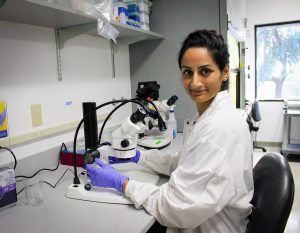 Numana Bhat in her laboratory.[/caption]
She credits her mother and a dedicated high school biology teacher for endowing her with the tools and curiosity to pursue a career in biomedical science. But other gifted young women are not as fortunate: opportunities and resources for higher education in scientific research are scarce in Kashmir, “although the people themselves, both students and mentors at the university level, are capable of doing great things,” she said.
She added that she had heard about “people in mentoring positions” who made “discouraging remarks” to female students— including explicit pressure to channel their energy into getting married and having children rather than into post-graduate studies.
Nevertheless, Dr. Bhat said, she has noticed an increasing number of young Kashmiri women pursuing graduate studies and careers in scientific research both in India and abroad. She added that younger people were going outside the sciences to choose careers in humanities, journalism and the arts, “which is also quite refreshing to see.”
Numana Bhat in her laboratory.[/caption]
She credits her mother and a dedicated high school biology teacher for endowing her with the tools and curiosity to pursue a career in biomedical science. But other gifted young women are not as fortunate: opportunities and resources for higher education in scientific research are scarce in Kashmir, “although the people themselves, both students and mentors at the university level, are capable of doing great things,” she said.
She added that she had heard about “people in mentoring positions” who made “discouraging remarks” to female students— including explicit pressure to channel their energy into getting married and having children rather than into post-graduate studies.
Nevertheless, Dr. Bhat said, she has noticed an increasing number of young Kashmiri women pursuing graduate studies and careers in scientific research both in India and abroad. She added that younger people were going outside the sciences to choose careers in humanities, journalism and the arts, “which is also quite refreshing to see.”
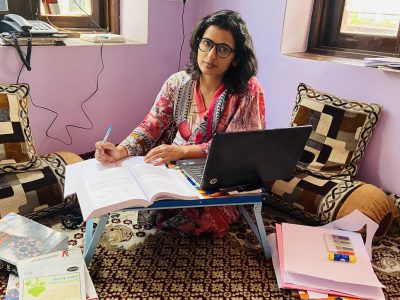
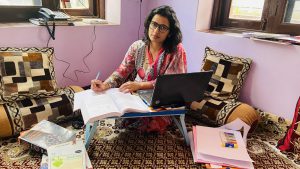 Masrat Maswal at home in Kashmir.[/caption]
Her female students are often deterred from pursuing graduate work in the sciences by social pressures to marry and settle down when they are in their twenties. “We are losing a lot of talent,” she said, “Due to the prevailing socio-cultural norms of our society.”
The lack of proper infrastructure and lab facilities in Kashmir’s colleges also undermines the enthusiasm of both students and teachers, she added.
Masrat Maswal at home in Kashmir.[/caption]
Her female students are often deterred from pursuing graduate work in the sciences by social pressures to marry and settle down when they are in their twenties. “We are losing a lot of talent,” she said, “Due to the prevailing socio-cultural norms of our society.”
The lack of proper infrastructure and lab facilities in Kashmir’s colleges also undermines the enthusiasm of both students and teachers, she added.
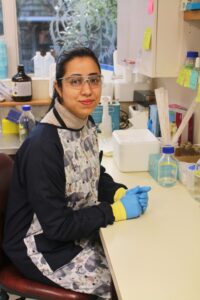 Amreen Naqash in her lab.[/caption]
“I’m in touch with some promising female undergrads from Kashmir, which makes me so glad,” she said. “It is such a wonderful feeling to guide them as they are in their prime career stage.”
Omera Matoo, 38, has a PhD in marine biology. She is an assistant professor in evolutionary genetics and physiology at the University of Nebraska in Lincoln, where her research is funded by the National Science Foundation (NSF).
Born and raised in Kashmir, Dr. Matoo earned her B.A. and Master’s degrees at Bangalore University, where she became friends with two classmates from different parts of India, both of whom came from families of scientists.
[caption id="attachment_2703" align="alignnone" width="300"]
Amreen Naqash in her lab.[/caption]
“I’m in touch with some promising female undergrads from Kashmir, which makes me so glad,” she said. “It is such a wonderful feeling to guide them as they are in their prime career stage.”
Omera Matoo, 38, has a PhD in marine biology. She is an assistant professor in evolutionary genetics and physiology at the University of Nebraska in Lincoln, where her research is funded by the National Science Foundation (NSF).
Born and raised in Kashmir, Dr. Matoo earned her B.A. and Master’s degrees at Bangalore University, where she became friends with two classmates from different parts of India, both of whom came from families of scientists.
[caption id="attachment_2703" align="alignnone" width="300"]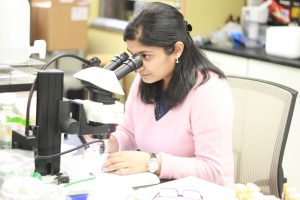 Omera Matoo in her lab.[/caption]
“Looking back, I realize that played a very big role in my career,” she said. All three of them decided to pursue doctorates in the sciences.
Omera Matoo in her lab.[/caption]
“Looking back, I realize that played a very big role in my career,” she said. All three of them decided to pursue doctorates in the sciences.

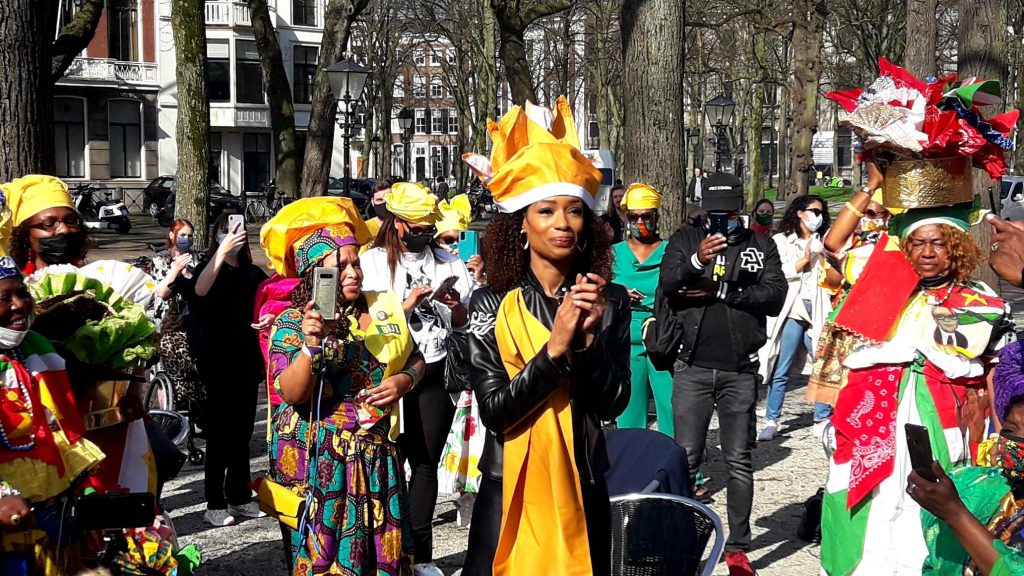 Afro-Surinamese ceremony honoring Sylvana Simons (center) on March 31.[/caption]