WP_Post Object
(
    [ID] => 3486
    [post_author] => 2
    [post_date] => 2021-11-24 17:46:37
    [post_date_gmt] => 2021-11-24 17:46:37
    [post_content] => There is a delicate balance when protesting inside the country: too much, and you attract police attention; too little, and you don’t make an impact.

In the summer of 2021, about 40 people sat squashed around a long table in the corner of a pizza restaurant in Minsk, the capital of Belarus. But this was not a birthday party; it was a gathering of a local opposition collective. The people seated around the table were there to reaffirm their support for the movement against the Lukashenko regime and to maintain the friendships and connections they developed during the last year of protests

None of the people at the pizza restaurant wore red and white, the colors of the flag of the first independent Belarusian state, as they had at the protests the year before. All expressions of solidarity with the opposition are now dangerous. But despite the regime’s brutal crackdown on dissent, grassroots opposition groups all over the country are finding novel ways to challenge the system, an undertaking that carries enormous risk. 

Belarus’s authoritarian leader Alexander Lukashenko managed to cling to power despite 10 months of massive, country-wide protests that followed the rigged national election of August 2020. But now the demonstrations—with thousands of Belarusians on the streets, workers marching out of state-owned factories, and red and white ribbon filled courtyards—are a thing of the past. Even the iconic Symbal.by, which sold products emblazoned with Belarusian traditional national symbols popular with the opposition, has been replaced with a shop selling kitchenware. The regime has crushed almost all visible dissent with mass arrests, imprisonment, and killings, instilling fear in the protest movement. 

Belarus stayed in the news cycle throughout 2021, even after the opposition was largely in jail, silenced, or in exile. Lukashenko grabbed international headlines by threatening an Olympic athlete, force-landing a Ryanair flight in order to arrest a dissident journalist, threatening to obstruct Europe’s gas supply, and manufacturing a migrant crisis in the heart of Europe. In another incident, the body of Vitaly Shishov, a Belarusian activist who headed an NGO to help fellow exiles, was found hanging from a tree in a Kyiv park after he failed to return home from a jog. Ukrainian police have opened a murder investigation. The message to exiled activists, explained Igor Mitchnik, project leader at Libereco, an NGO focused on human rights in Belarus and Ukraine, is that “nowhere is safe”—the regime can get to them anywhere.
In this superb November 19 interview, Lukashenko tells the BBC's Steven Rosenberg that he "may have helped" migrants enter the EU; he also says that Belarus would "massacre all the scum you've been financing"—referring to the 270 NGOs his regime has forcibly shut down this year.
Sviatlana Tsikhanouskaya, 39, the presumptive winner of the 2020 presidential election, who now lives in exile, has worked to keep the opposition in the news. Over the past year she has become an international figure, giving speeches, sitting for interviews with major media outlets, and meeting with world leaders like President Joe Biden, Prime Minister Boris Johnson, and Chancellor Angela Merkel. Meanwhile, the quiet work of activists inside Belarus goes mostly unnoticed. This is intentional; attention brings risk. But their persistence signals a determined strength to achieve a peaceful and sustainable transition to democracy.

The Partisans

There are many active cells of anti-regime partisans working underground inside Belarus, although the exact number of people involved is unknown. One group of partisans is a team of hackers that conducts frequent cyber attacks against the regime. Their successful hacks include: stealing the personal details of regime informants who reported on neighbors or colleagues; downloading recorded personal phone calls between members of the security apparatus; and publishing the personal information of senior KGB agents.  Tanya*, a 28 year old IT worker in Minsk, is a member of a cell that focuses primarily, in her own words, on samizdat: “We bring the truth to people, we print and distribute newspapers and leaflets.” This is in response to the regime's attempts to re-monopolize the information sphere. In restricting access to independent information, the regime has declared neighborhood social media chats “extremist,” shut down independent media outlets, and arrested numerous journalists and bloggers.  Even subscribing to an independent channel on Telegram, the encrypted messaging app, can be cause for arrest and a sentence of up to seven years in prison.  The partisan protest actions are small-scale and brief, designed to ensure images are shared widely on social media long after the activists have left the scene. There is a delicate balance when protesting inside the country: too much, and you attract police attention; too little, and you don’t make an impact. Last spring, for example, in the midst of the crackdown, activists planted small patches of white and red flowers around Minsk. Tanya shared photographs of districts that decorated their public areas with flowers and printed information on local marches and actions. The partisans also employ tactics to hurt the regime economically by, for example, encouraging consumers to boycott state-owned enterprises. In Belarus a wide range of foodstuffs and products are produced by the state, or by businesses closely connected with the regime. Products under boycott range from sausages and sugar, to cigarettes. A neighbouring cell has been raising the pressure by placing items on railway tracks to disable signals and delay trains carrying items for export, threatening the Europe-Asia transit route, a source of income for the regime.  Tanya was devastated to learn in August that the International Monetary Fund (IMF) had decided to send the regime $1 billion. The money was ostensibly earmarked to help the government fight Covid-19, but for opposition activists and outside observers, it would simply prop up Lukashenko’s illegitimate regime.  Timothy Ash, the London-based economist, asked in a rhetorical tweet if the IMF acronym SDR (Special Drawing Rights) actually stood for “support dodgy regimes.” Sviatlana Tsikhanouskaya, the exiled opposition leader, tweeted that she had sent letters to the IMF and the US government asking them to freeze the funds, which she had earlier asserted would be misused by the regime for nefarious purposes. A Washington Post editorial headline was blunt: “Biden should not let the IMF throw a lifeline to Belarus’ dictator.” Tanya said: “I felt that all my efforts, all the sleepless nights and the suffering of friends behind bars—it was all in vain.”  A few months later, as Belarus began registering record levels of Covid-19 infections, Lukashenko scrapped a short-lived mask mandate and ordered signs calling for them to be worn removed from public transport and shops, confirming the opposition’s fears that the IMF’s funds would be misappropriated.  Membership in the partisans is dangerous and many members have been arrested. But Tanya remains committed precisely because the regime treats prisoners inhumanely and humiliates their supporters. She recounted that on a recent visit to a local prison the guards refused to accept rolls of toilet paper for an inmate unless the tissue was separated along the perforated lines into individual squares. “The whole queue of family and friends were just standing there, ripping toilet paper into pieces,” she recalled. The guards eventually accepted the toilet paper, but didn’t give it to the prisoners until they were released. 

KOTOS

Alina, an economist in her 50s, is focused on organizing local self-government bodies, known in Belarus as KOTOS, across her city. The main idea behind KOTOS, which have functioned since 2014, is to build a collective of active neighbours who deal with local issues and improve the community’s quality of life. They decide what murals will be painted on local buildings, where to place a new bench in a courtyard, or how to improve playgrounds for children. For Alina, the aim is to maintain and build on the newfound momentum for civic engagement developed over the past year, laying the foundations for an eventual democratic state.  The KOTOS is supposed to be made up of locally elected representatives with a chairperson as the leader; but, as Alina and local residents discovered, to no one’s surprise, the regional administration appointed the representatives. KOTOS’s work is unpaid, and some of the appointed chairpersons in the region, explains Alina, did not want the position; but in a dictatorship, where the key currency is loyalty to the regime, they “could not refuse.” Chairpersons are reluctant to meet with the locals they represent; Alina recounts how in one neighbourhood “she [the chairman] still hides from the residents, coming up with different excuses to avoid them.” With the ongoing crackdown against any form of civic engagement, the regime is unlikely to tolerate the involvement of local citizens in KOTOS. This, however, does not discourage Alina. She is looking for different ways to work within the system, from engaging with the local chairperson, to seeking out areas where a KOTOS does not yet exist and distributing information to local residents on how to organize their own system from scratch. Her goal is to find “people who sincerely want to improve life in their neighbourhood” and build grassroots communal solidarity. This work is challenging. A year ago, there were people in the country who were happy to host discussions with locals on the rules and system of KOTOS; conduct seminars and consultations; and provide legal assistance. But, as Alina notes, who would want to  “stand out from the crowd today?”

New civil society initiatives

Volha, a businesswoman in Minsk, is developing a digital platform to educate people about democratic values. It provides a forum for experts from around the world to present information on different democratic systems to the next generation of Belarusians.  Volha describes Belarus today as “scorched earth,” noting that nearly all the people who had been developing civil society have left the country. In July 2021 Lukashenko announced a “clean-up” of civil society; since then, 270 independent NGOs have been closed down, with many activists facing trumped up criminal charges. But Volha believes some people need to remain in Belarus, despite the danger. If civil society was possible before the 2020 uprising against Lukashenko’s regime, she argues, some form “could become possible again.” She stresses that now is not the time to give up developing initiatives inside the country. And while she worries about being arrested and imprisoned, Volha says that her greatest fear is being prevented from carrying on her work, because “from prison you can’t influence anything anymore.” Activists who have remained in the country also run the risk of being labelled a GONGO— a “government-organized NGO.” For the opposition in exile, anyone who cooperates with the regime is de facto lending it legitimization. But Volha is undeterred. She knows that if she wants to develop her initiatives inside Belarus some cooperation with local authorities is unavoidable. Her approach is to integrate local authorities into her activities in order “to show them how things can work in normal countries, how it could be in Belarus.” Viewing all local authorities as representatives of Lukashenko, she says, is the wrong approach and “destroys all bridges.”  Igor Mitchnik stressed the danger of this approach. The regime, he says, “has lost any credibility as a reliable partner for civic or democratic initiatives.” But he values the work of any organization that promotes “a vision of democratic alternatives for their society.”  Volha’s approach to sustainable change in Belarus is, in her own words, “evolution, not revolution.” Yes, she acknowledges, the regime is oppressive, but “we [Belarusians] have allowed [it] to exist.” She argues that the only way to ensure Belarusians throw off the dictatorship, permanently, is through systemic change; otherwise it is only a matter of time before Belarusians will once again live under such a regime. 

Conclusion

These three activists represent very different approaches to regime change from inside Belarus, but they all believe Lukashenko is on borrowed time. While Tanya and the partisans fight the regime from the outside, Alina and Volha highlight a more nuanced grey area of opposition activism inside Belarus, one that requires some degree of cooperation with the regime. Whether their approach has merit remains to be seen; as Audre Lorde famously argued, “the master’s tools will never dismantle the master’s house.”   The future of the opposition inside Belarus is, of course, unclear. Local elections have been postponed indefinitely, and the cruelty of the ongoing crackdown means the March 22 country-wide referendum on constitutional reform is unlikely to lead to fresh protests.  One thing that is clear, however, is that the official Belarusian opposition depends on this network of activists inside the country to keep domestic pressure on the regime, and they are showing no signs of abating. As Tanya vowed: “as long as Belarus is not free, I will not stop.”   *All the names of the activists inside Belarus have been changed to protect them.  [post_title] => Risking arrest, prison & death, Belarus's underground activists fight for democracy [post_excerpt] => The vast majority of civil society activists are in exile, in prison, silenced, or dead, but a few underground cells of partisans are engaged in anti-regime and pro-democracy work that ranges from grassroots initiatives to carrying out cyber attacks against the regime. [post_status] => publish [comment_status] => closed [ping_status] => open [post_password] => [post_name] => risking-arrest-prison-death-belaruss-underground-activists-fight-for-democracy [to_ping] => [pinged] => https://conversationalist.org/2020/10/09/belaruss-uprising-against-autocracy-is-fuelled-by-an-unprecedented-civil-society-movement/ [post_modified] => 2024-08-28 21:11:29 [post_modified_gmt] => 2024-08-28 21:11:29 [post_content_filtered] => [post_parent] => 0 [guid] => https://conversationalist.org/?p=3486 [menu_order] => 160 [post_type] => post [post_mime_type] => [comment_count] => 0 [filter] => raw )
Risking arrest, prison & death, Belarus’s underground activists fight for democracy

WP_Post Object
(
    [ID] => 3461
    [post_author] => 2
    [post_date] => 2021-11-18 23:36:08
    [post_date_gmt] => 2021-11-18 23:36:08
    [post_content] => Will voters choose fear or hope?

Chile is experiencing one of its most powerful historical moments since the end of the dictatorship in 1990. The results of the November 21 presidential election will decide the fate of the social movements sparked by the 2019 “Chilean awakening' and of the constitutional process begun in 2020. Of the six candidates competing for the presidency two men who represent starkly opposing visions for Chile’s future are leading in the polls.

Gabriel Boric, 35, is a left-wing candidate who seeks to implement the social changes that Chilean people have been demanding over the last decade; his platform calls for ending the neoliberal economic-political model brutally imposed under the dictatorship of Augusto Pinochet.

On the far right is José Antonio Kast, 55, who wants to perpetuate the extreme neoliberal model that is the legacy of Pinochet’s rule. One of the many worrying aspects of Kast’s platform is a jingoistic anti-immigrant position, which includes a plan to construct ditches along Chile’s borders to prevent migrants—primarily from Haiti and Venezuela—from entering the country.

The volatile situation in which Chile finds itself—polls show Kast at 27.3 percent, ahead of Boric with 23.7 percent—makes this election an exceptional one, likely the most important since the return of democracy in 1989.

[caption id="attachment_3469" align="alignleft" width="640"] José Antonio Kast at a press conference on August 30, 2021.[/caption]

This election campaign takes place in the context of a process to rewrite the national constitution, which came out of the massive protest movement that swept across the country in 2019. The factors that led to the protests, the issues that are driving this election campaign, and the future of Chile’s democracy are the subject of this article.

1. The ‘Chilean Spring’

On October 14, 2019, high school students in Santiago responded to a government announcement of a public transportation fare hike of 30 pesos, or $0.04, by calling for widespread fare evasion; they amplified their call on social media with the hashtag #EvasionMasiva. Over the next few days, the chant "evadir, no pagar, otra forma de luchar" (“evade, don’t pay, there’s another way to fight”) was heard in almost every subway station. The student protests spread, sparking a mass movement for social change that reflected growing discontent over Chile’s enormous wealth gap, stagnant wages, and insufficient social services. The proposed subway fare hike, though small, came to symbolize the broader injustices and inequalities of Chile’s economic and political system, as enshrined in the Pinochet Constitution. Chile is the most unequal member of the OECD, with 50 percent of the population earning just $550 per month, even as the cost of living continues to rise while wages remain stagnant. The government suspended the proposed transit fare hike, but the move came too late: the spark of protest had already been already lit; people began to ask questions about years of increasingly inadequate pensions, education, and health care. During the Pinochet dictatorship (1973-90), while the military regime was prosecuting, torturing, and killing political opponents, the “Chicago Boys,” a group of right-wing Chilean economists who had studied with Milton Friedman at the University of Chicago, were busy implementing a right-wing economic model. Pinochet’s repressive dictatorship was the ideal environment for unilateral imposition of reforms in pensions, health care, and labor law—and for the privatization of state companies. In 1980, the Pinochet Constitution was enacted through a very dubious referendum, aligning the neoliberal economic reforms with the legal regime defined by the constitution. The system changed little after the dictatorship ended in 1990. Constant opposition by the country’s right wing to any mention of deeper reform, as well as a certain comfort from the center-left political elite with the existing system, provided a further obstacle to more far-reaching change. During this period, Western governments held Chile up as an example of political stability and economic growth in South America. But Chile’s perceived prosperity and stability were based on an economic and political system that was creating a huge wealth gap, with the richest one percent of the population earning 33 percent of the country’s wealth while the lower middle and working classes were barely able to make ends meet. For far too long, those in power ignored the growing resentment of Chile’s economically marginalized citizens—until it exploded. On October 18, tens of thousands of citizens poured onto the streets to protest the brutal police response to student demonstrators, which included mass arrests and the use of live ammunition. That night protesters ambushed 70 Santiago subway stations; students flooded in to vault the turnstiles, vandalize equipment, and pull the emergency brakes on trains. Police responded with beatings, tear gas, and arrests. These events were the tipping point: over the next three weeks a full-scale social movement erupted, with up to a million people pouring into the streets, clamoring for a new social and economic order that would bring dignity to the Chilean people. [caption id="attachment_3477" align="alignleft" width="640"] Protesters in Santiago on November 19, 2019.[/caption] The government responded with a repressive crackdown that included the deployment of soldiers on urban streets, the imposition of curfews in several cities, and President Sebastian Piñera’s “declaration of war” against the protesters. For untold thousands of Chileans, the sight of soldiers on their streets triggered barely repressed memories of the Pinochet dictatorship. Their fears were reflected in the horrific reports of police shooting protesters with live ammunition, often aiming at their eyes from close range. As a result, at least 300 people were injured in the eye, more than half of them partially blinded. Despite documented reports of these incidents compiled by the UN High Commissioner of Human Rights, Human Rights Watch, and Amnesty International , Piñera's government denied all the accusations of human rights violations. In this polarized context the government and the opposition reached a political agreement. On November 15, 2019, they announced a national referendum to decide whether and how a new constitution should be drafted to replace the 1980 Pinochet Constitution. The announcement helped quell the social unrest. The Chilean people had stood up for and won their right to draft a new, democratic constitution with the help of popularly elected representatives. The referendum was held October 20, 2020 and the result was a landslide: 78 percent of Chileans voted in favor of a new constitution.

2. The impact of the global rise in authoritarianism on the Chilean constitutional process

The events of 2019-20 loom heavily over the presidential election. Two issues could affect the outcome. First, there is the need for social transformation. Massive support for a new constitution drafted by elected representatives reflects the popular will for democratically implemented change to reduce inequalities. The second factor looming over this election is a fear of instability. The same people who want political and social reforms also fear the cost associated with economic and political upheaval. The euphoria of the 2019 social uprising was followed by the global pandemic, which has hurt the economy and had a chilling effect on Chilean society's social, political, and economic ambits. Unfortunately, the right and the far right-have taken advantage of this period of global instability to promote the idea that a new constitution and a left-wing president would bring about an economic and political “disaster.” The Chilean far right knows they don’t have a winning argument for maintaining the dictatorship’s constitution, so instead they are spreading fear with fake news and nationalism. In several important ways, the rising power of Chile’s far right and the threat of authoritarianism reflect the issues that dominated the last two US presidential elections. First, there is the debacle of the center right. Before Trump was elected as the Republican candidate in 2016, the moderate right in the US found itself rudderless, with no clear leaders, no discourse, and no obvious political agenda. Meanwhile, the center left failed to tackle inequality and other social ills. These two factors paved the way for Donald Trump’s takeover of the GOP, and his victory in the 2016 presidential election. Similarly, in Chile, the right-wing government of Sebastian Piñera, who is deeply unpopular, has been described as the worst in the history of Chile’s democracy. The traditional right-wing parties’ lack of credibility and the political isolation of right-wing voters contributed to the creation of a viable far right. Second, nationalism and anti-migrant sentiment are growing rapidly. Kast, the far-right candidate, is following the “Trumpist” or “Bolsonarist” blueprint of blaming migrants for the country’s social and economic problems. His dangerous rhetoric has provoked violent attacks on migrant communities, such as the September 24 police-led eviction of Venezuelan migrants, including small children, from a camp in the port city of Iquique. Third, conservative and fundamentalist religious groups, including the Political Network for Values, make up an important constituency in the Chilean far right. Their growing political clout threatens any progress on rights for women and the LGBTQ+ community. Fourth, there is a strong move toward protectionist foreign policy, alongside opposition to multilateralism. One of the main political refrains of the far right is to decry the uselessness of global forums and international agreements—particularly those that deal with human rights, the environment, and migration. Kast, for example, has declared his refusal to abide by the Escazú Agreement, a regional environmental treaty that guarantees access to information, public participation, and transparency in environmental matters. The agreement also provides special protection to environmental activists against threats and violence from polluting industries. Kast’s refusal to honor this treaty is reminiscent of Trump’s 2017 executive order to withdraw the US from the Paris Climate Agreement. The victory of the Chilean far right would almost certainly result in the country’s political isolation on the international stage. Fortunately, there is a political alternative to Kast. Gabriel Boric, a former law student, wants to move away from the country’s neoliberal past while curbing the rise of authoritarianism through a progressive and rights-based approach to policymaking. Boric’s platform builds on the social demands that a large segment of the Chilean people has pushed for over the past two decades. He rose to prominence as a leader of the 2011-13 mass student movements, which called for universal free high quality education, and launched his political career from that experience. Now his close relationship to social movements provides Boric and his allies with a real grasp of the current political reality of most Chileans. The leftist candidate's political platform calls for the total transformation of the privatized pension and inadequate health care system left over from the dictatorship, as well as an ecological agenda that recognizes the climate crisis as the catastrophic threat that it is, while offering solutions for social change and fair economic growth. The global rise of populist authoritarianism, including in the UK and the US, has not escaped the notice of Chileans. Their country’s constitutional transition should take place under the watch of a government that believes in the process and will thus facilitate it rather than impede it.

3. An essential step toward achieving social progress

Considering what’s at stake with the ratification of the new constitution, the health and progress of the Chilean political system depends in many ways on this electoral race. For instance, feminism has been an important social component in making the constitutional process more democratic. In 2019 the Chilean feminist collective Las Tesis amplified the women’s movement with their exuberant protest song, “A rapist in your path.”  It became a global feminist anthem and Chile’s feminist protests led to the inclusion of gender parity among constitutional representatives. Now Kast, the far-right candidate, wants to abolish the Ministry of Women and Gender Equality, which would mean a complete reversal of all the demands the feminist movement fought for.
The far right’s position on climate change is also very worrying. Kast’s platform casts doubt on the very existence of climate change, referring to it as a “stance” instead of a “scientific certainty.” On the other hand, several weeks ago the constitutional convention issued a declaration of climate emergency and defined an “ecological approach” as one of its guiding principles for the new constitutional text. Kast is an authoritarian threat to all the potential progress on social rights and ecological agenda that the constitutional process can bring. He led the political campaign against the new constitution and his political positions oppose any structural reform. If elected he will probably try all the mechanisms to obstruct and discredit the legitimate and legal constitutional process. Kast and Boric’s polarized positions on women’s equality and the environment reflect the opposing directions that the constitutional discussion could take, as the threat of authoritarianism from the far-right looms over Chile. The health of the country’s political and economic future hangs in the balance as Chileans await the results of both the constitutional process and the presidential election. Hopefully, the candidate who is elected president on Sunday will assist and collaborate with the constitutional assembly. For Chile, this would mean a stable and transformative constitutional transition toward a more just, democratic and sustainable country that is finally rid of Pinochet’s authoritarian politics and crippling neoliberal economic agenda. [post_title] => Chile faces its most consequential election since the end of the Pinochet dictatorship [post_excerpt] => A sharply divided electorate will choose between a young candidate for social change, and a far right middle aged candidate who embraces a radical neoliberal agenda and praises the Pinochet dictatorship. [post_status] => publish [comment_status] => closed [ping_status] => open [post_password] => [post_name] => chile-faces-its-most-important-and-most-polarized-presidential-election-since-the-end-of-pinochets-rule [to_ping] => [pinged] => [post_modified] => 2024-08-28 21:11:29 [post_modified_gmt] => 2024-08-28 21:11:29 [post_content_filtered] => [post_parent] => 0 [guid] => https://conversationalist.org/?p=3461 [menu_order] => 161 [post_type] => post [post_mime_type] => [comment_count] => 0 [filter] => raw )

Chile faces its most consequential election since the end of the Pinochet dictatorship

WP_Post Object
(
    [ID] => 3458
    [post_author] => 2
    [post_date] => 2021-11-18 22:23:20
    [post_date_gmt] => 2021-11-18 22:23:20
    [post_content] => Frances Haugen's policy proposals are modest at best, amounting to little more than what Facebook has already proposed or supported. 

In the summer of 2014, the kidnapping of three Israeli teenagers in the West Bank by Hamas-afilliated Palestinians sparked a seven-week sustained Israeli military assault on Gaza, with the military wing of the Islamist organization simultaneously launching rockets into Israel. By the time a ceasefire was implemented, around 2,200 Palestinians were dead and more than 10,000 wounded, the vast majority of them civilians. On the Israeli side, 67 soldiers and six civilians were killed. The physical destruction in Gaza was immense, with entire neighbourhoods reduced to rubble. It was one of the deadliest conflicts in the region’s history.

Social media—which was by then a popular tool for activism used by both Palestinians and Israelis (as well as the Israeli state)—played a significant role in the conflict. Israelis used social media to draw attention to the kidnapping and murder of the three boys and to the fear wrought by Hamas’s rockets, while Palestinians sought to draw the world’s attention to the Israeli military’s use of immense force against civilians. Everyone used memes, hashtags, and videos to amplify their messaging.

Facebook, which was a key tool for the activists who organized the uprisings that rocked Tunisia and Egypt in 2010-12, was still a young platform. It had instituted its first community standards only three years prior. Now it was a key site for online conflict.

That summer, concerned Palestinian activists brought a Facebook page to my attention. It featured a sniper’s target, with the title, in Hebrew:  “Kidnapped: Until the boys come back, we shoot a terrorist every hour.” The page had been created by Israelis who advocated vigilante justice; they posted the photographs and names of various Palestinian political prisoners, calling for them to be shot in retribution for the killing of the three Israeli boys who had been abducted.  

There is no question that page was inciting for retributive violence; language in the ‘about’ section read: “We must use a strong hand to fight violent and life-threatening terror. The weakness shown by the Israeli Government, which released thousands of murderers has only increased their drive and led to the kidnapping of the teens. The only way to bring the teens back is to instill fear in our enemies and make them understand that they will suffer. We support executing a terrorist every hour until the teens are released.”

In Israel, killing Palestinians as revenge for an unconnected incident is known colloquially as a “price tag” killing; the US State Department has condemned the act as terrorism. The Facebook page objectively called for murder, which violated one of the precepts of the platform’s community standards: “Safety is Facebook's top priority. We remove content and may escalate to law enforcement when we perceive a genuine risk of physical harm, or a direct threat to public safety. You may not credibly threaten others, or organize acts of real-world violence.”

But the company refused to delete the page, overriding multiple reports from users. One Facebook policy staffer defended the decision by saying that the page administrators were calling for violence against terrorists, as though branding a person a terrorist justified advocating their extra-judicial murder. The page objectively violated Facebook’s own policy, but the company refused to admit it. Monika Bickert, who was then Facebook’s head of Global Policy Management, asserted in an interview that the page did not violate the company’s policy against hate speech.

This incident encapsulates Facebook’s policies in dealing with content across the Middle East and North Africa, for nearly a decade. In my book, Silicon Values: The Future of Free Speech Under Surveillance Capitalism, I describe several occasions on which Facebook either failed to act against threats, or acted in bad faith—disappearing valuable content that served as documentation of history.

In another egregious example of acting in bad faith, Facebook removed Egypt’s leading dissident page just a few months before the 2011 revolution. “We Are All Khaled Said,” named for a young man beaten to death by Alexandria police in 2010, had hundreds of thousands of followers. Ultimately, the organizers of the page put out a call for mass protests on January 25, 2011. The Tahrir Uprising, named for Cairo’s central square, lasted 18 days; it ended with the fall of the Mubarak regime. 

This is why global civil society activists were unsurprised at the revelations in the internal documents that Facebook whistleblower Frances Haugen released, particularly those that detailed the company’s abject failures in moderating content in the region. While American news outlets expressed shock at these stories, civil society organizations like 7amleh, the Palestinian civil society NGO that focuses on human rights in digital spaces, saw confirmation of what they had been reporting for years

Frances Haugen took a risk in releasing the documents, which provided important receipts for more than a decade of accusations against Facebook. But her policy proposals are modest at best, amounting to little more than what Facebook has already proposed or supported: She advocates the important intermediary liability proposals contained within Section 230, the law often dubbed “the most important law for online speech,” which protects companies from liability for what they choose to host (or remove). She has also spoken out against breaking up the increasingly monopolistic company, and told the French National Assembly that interoperability—allowing new services to “plug in” to existing, dominant ones, which is a core tenet of civil society proposals—won’t make a difference toward fixing our current conditions.  

In fact, all of these things—intermediary liability protections, competition, interoperability, as well as other fundamental concepts like transparency and accountability—are vital to a free and open internet. While companies can and should moderate content, proposals to reform Section 230 are not only likely to be unconstitutional; they also open up space for frivolous lawsuits against US companies, which are protected by the First Amendment for what content they choose to host (or not host). Interoperability would give users far more choice over how and what platforms they use, by enabling them not only to modify the services they use and communicate across services more easily, but also potentially enabling different models for content moderation. And if we want a landscape where people have more choice over where they interact, access information, and express themselves, competition is a key component of any reform. These solutions are not a panacea, nor a substitute for more holistic societal fixes, but they’re important pieces of the puzzle.

Meanwhile, media outlets outside the US and Europe are still struggling to obtain access to the Facebook company documents that Haugen leaked, so that they can report, with cultural competence and local knowledge, on the company’s shortcomings in a number of regions. In addition, Haugen’s publicity tour in the United States and Europe has prioritized talking to lawmakers rather than listening to potential allies. Many of those lawmakers ignored the demands of civil society experts, a notable number of whom are women of color; but they are willing to give their full attention to a former Facebook employee who is white and has a Harvard MBA.

Haugen isn’t entirely wrong: She understands that platforms need to be more transparent about how they create their policies and moderate content, as well as who is doing that moderation, and what sort of cultural and linguistic competencies those individuals have. Civil society actors, particularly those from the global south, have repeatedly emphasized the need for local expertise in content moderation—that is, the hiring of moderators with linguistic and cultural knowledge to tackle difficult speech issues and ensure that truly harmful content, such as incitement, doesn’t flourish while also making sure that content isn’t wrongfully removed. Here, her suggestions echo those of global civil society, although she has not given credit or consulted with those who have been making the same proposals for many years.

What Frances Haugen should have done—and still could do—is consult with the civil society experts, the activists and academics who have spent years studying and critiquing her former employer from the outside, painstakingly documenting its faults, and agitating for change. She needs to refocus her priorities to ensure that documents are made accessible to journalists around the world who have the lived experience and deep expertise to analyze them properly. Instead of assuming she has all the answers, she should be using her significant power to call for Facebook—and lawmakers—to bring them to the table. 
    [post_title] => The world's most famous Facebook whistleblower should amplify those who came before her
    [post_excerpt] => The internal documents Haugen leaked only confirmed what civil society activists and researchers have been saying for years. 
    [post_status] => publish
    [comment_status] => closed
    [ping_status] => open
    [post_password] => 
    [post_name] => the-worlds-most-famous-facebook-whistleblower-should-amplify-those-who-came-before-her
    [to_ping] => 
    [pinged] => 
    [post_modified] => 2024-08-28 21:08:26
    [post_modified_gmt] => 2024-08-28 21:08:26
    [post_content_filtered] => 
    [post_parent] => 0
    [guid] => https://conversationalist.org/?p=3458
    [menu_order] => 162
    [post_type] => post
    [post_mime_type] => 
    [comment_count] => 0
    [filter] => raw
)

The world’s most famous Facebook whistleblower should amplify those who came before her

WP_Post Object
(
    [ID] => 3435
    [post_author] => 2
    [post_date] => 2021-11-11 12:32:06
    [post_date_gmt] => 2021-11-11 12:32:06
    [post_content] => Bond is a sex addict, but he doesn't really love women—unless they are dead.

The current James Bond, Daniel Craig, looks like a working-class man who puts in hours at the gym. If you watch his body, you think: That’s where I’ll find him, doing burpees. Sean Connery, who was the first to play 007—he and Craig are considered the best of the Bonds—was the same type. Broad and solid, he walks through the corridors of power with a sullen expression on his face. His fists itch. He is keenly addicted to these places because the people who work there let him kill things. But he does not belong there.

James Bond is not, however, packaged as a working-class man. He wears bespoke suits from Jermyn Street, the London address synonymous with timelessly elegant and very expensive men’s clothes. When you see him, you imagine a copy of Esquire or GQ just beyond his reach. His accessories are a constant reminder that Bond is a highly lucrative franchise. In “No Time to Die,” reports jamesbondlifestyle.com, “James Bond’s Tom Ford Tuxedo is presented to him in a Bennett Winch The S.C Holdall Suit Carrier”—a high end twill weekend bag that retails for about $845.

This James Bond is both a salesman and a product—a quintessentially British brand, like Devon fudge or Cheddar cheese. He sells suits, shirts, watches, shoes, ties, bags—and, especially, cars. Bond is a tenacious and destructive car salesman. A British patriot, he usually drives an Aston Martin— in “No Time to Die” there are four of them—but, as with women, he isn’t fussy. In the same film a Toyota Land Cruiser takes out two Land Rovers in a Norwegian wood.
  It feels as though every new Bond film precipitates a feminist debate. I think this is part of the marketing strategy, trying to keep a man from the past relevant, but women are not important to Bond. We think they are because they so often appear naked in front of him, but they are important the way peacocks are important, and you don’t improve a fairy tale by inviting real women in. Bond likes them pretty and even better dead.  Mrs. Bond lived a single afternoon in “On Her Majesty’s Secret Service,” and it was righteous. Fairy tale creatures can’t take responsibility. Then it was back to dull and repetitive objectification: of Beautiful Firm Breasts in floating beds or escape pods with windows and Venetian blinds. Two of his women were called, quite literally, Pussy. Others were named for sex acts: Goodhead, Onatop, O’Toole and even Chew Mee, which is outrageous. Bond is so obviously a sex addict there is little else to say. He keeps his cars longer than his women; in "Skyfall," the Aston Martin DB5 even had a garage like a marital home. He did have a female boss for a while (Judi Dench), but she died in his arms, like a broken little girl or a bad mother. Fleming called his mother M, and his women are death-stalked breasts. Ian Fleming, the man who invented Bond, was an upper middle-class journalist who worked at the foreign desk of the Sunday Times and was a sometime secret agent who lost his father in the First World War. Both Bond and Fleming are orphans, and all Fleming’s anger and longing meet in Bond, named for an ornithologist who became famous in the 1930s; because if an ornithologist can seduce and save the world, who can’t? Let us not forget that James Bond is just a civil servant—albeit one who, according to the Ian Fleming books, had an unlimited overseas expense account. According to one British newspaper, his salary would be the equivalent of $120,000, and that won’t buy many Tom Ford dinner suits. But he doesn’t live like a civil servant. He lives like an oligarch without boundaries: he lives like a villain.  When the villain says to Bond, as he often does, “we are the same person, you and I”—and Ernst Blofeld is explicitly his adoptive brother, according to “Spectre” (2015)— he means this. Want to see my new cufflinks, bro? Our beloved Bond is a Franken-Bond then: not so much a man who isn’t there as a man who cannot be. He’s not a character because he doesn’t make sense. He is a myth. No wonder Daniel Craig looks exhausted. No wonder, too, that my favorite Bond is the 2012 short film “The Queen and James Bond,” set at the London Olympics, in which 007 delivers Elizabeth II from Buckingham Palace to the opening ceremony in a helicopter. Myth to myth, they fall into the sky. “No Time to Die” makes no attempt to conceal that Bond is a creature from a fairy tale. In this latest instalment we have two imprisoned princesses, one ogre, and a poison garden. No matter; or, rather, more please. James Bond is, 10 novels and 25 films in, the third most lucrative cinema franchise in history—behind “The Avengers” and the Harry Potter series. This is suitable because he is both an Avenger without a cape and Harry Potter without magic. Sean Connery called him “an invincible superman” and “this dream we all have of survival” who “thrives on conflict” though “one can’t help liking him.” Of course, we do. He is our proxy soldier and lover; our only authentic superhero, apart from, possibly, King Arthur (and didn’t Merlin do all the real work, just as Q does?) Marvel’s Captain Britain never really took off, so we won’t include him. James Bond’s chief raison d'être is to inhabit the fantasy of British power. There are multiple drugs in Bond, but the big one is global hegemony. It’s the dream that only the villain can give voice to, the villain we are invited to despise. “World domination, same old dream,” says Roger Moore in “The Spy Who Loved Me.” Every film has shots of Imperial London—the calming scenes when Bond returns from dangerous foreign lands. But the Empire is long gone, except in the mind of this tiny man who is a bit like Hiroo Onoda, the Japanese soldier who refused to surrender in 1945; instead, he hid in the jungle of the Philippines until 1974, when the emperor formally relieved him of his command. A man from the past still alive? That is Count Dracula, and Bart Simpson, and James Bond, who fought in World War Two, which Britain won, and that finest hour was 80 years ago. It is true that Bond is sadder now, that he has gained some self-awareness, and this has ruined him. In the opening sequence of “No Time to Die” Britannia lies in sand—like Ozymandias, but next to an Aston Martin. Bond is 99 years old, entombed in Tom Ford and a dream that has now broken. You can see his misery in his face. Still, some things endure. A Black woman (Lashana Lynch) is 007 for most of “No Time to Die” but, as M retreated into useless femininity in “Skyfall,” so does Lynch as 007. She leaves the war in a dingy with the women and children, which a male 007 would never do. I won’t tell you the ending, but Bond makes breakfast for a child, and he doesn’t make sense peeling a mango. The new James Bond will collide with Brexit Britain. I cannot think what happens next.   [post_title] => The feminist debate about James Bond is a marketing strategy [post_excerpt] => James Bond is the third most lucrative cinema franchise in history—behind 'The Avengers' and the Harry Potter series. He is a British export, like Cheddar cheese or Devon fudge. He is also a man who represents nostalgia for a time, long ago, when Britain ruled over an empire. [post_status] => publish [comment_status] => closed [ping_status] => open [post_password] => [post_name] => the-feminist-debate-about-james-bond-is-just-a-marketing-strategy-for-the-brand [to_ping] => [pinged] => [post_modified] => 2024-08-28 21:15:12 [post_modified_gmt] => 2024-08-28 21:15:12 [post_content_filtered] => [post_parent] => 0 [guid] => https://conversationalist.org/?p=3435 [menu_order] => 163 [post_type] => post [post_mime_type] => [comment_count] => 0 [filter] => raw )

The feminist debate about James Bond is a marketing strategy

WP_Post Object
(
    [ID] => 3432
    [post_author] => 2
    [post_date] => 2021-11-11 12:08:43
    [post_date_gmt] => 2021-11-11 12:08:43
    [post_content] => Throughout her journey, the 9-year-old Syrian refugee girl-puppet was greeted by both loving crowds and anti-migrant protesters. 

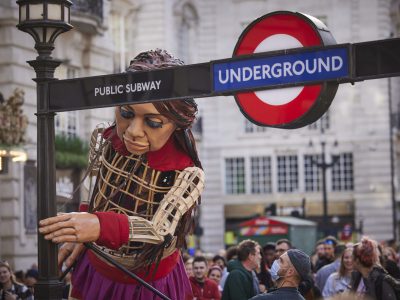
A huge crowd gathers outside the National Theatre in London’s Southbank. Children run around during the last moments of daylight. A choir stands ready. They are waiting for Amal. Heads turn and people point, as a giant puppet rounds the corner. As she walks into the courtyard, a solo voice sings out her name. The audience is silent.

Amal tentatively explores the crowd, peering into the faces in front of her. She bends down to touch a child’s hand, and an elderly woman appears to give her words of heartfelt comfort. The mood is electric. When Amal finally leaves the National Theater, the crowd follows her across Waterloo Bridge, accompanying her as she continues to her next destination. 

She might just be a puppet, but Amal represents something very real. She embodies a nine-year-old Syrian refugee, who has taken the same journey as many unaccompanied minors across Europe. Her name is Arabic for “hope.” Amal started her journey on the Turkey-Syria border, kicking off Good Chance and Handspring Puppet Company’s travelling festival, The Walk, and journeying 8,000 kilometers (5,000 miles) to find a home in Manchester, UK.

We were all invited to join Amal as she traveled across Turkey, Greece, and Italy, where she was met with both love and hostility. Amal has finally arrived in the UK, just as its government is proposing potentially hugely consequential changes to its immigration system, changes which could actually land those making dangerous journeys like Amal’s in jail. 

Thankfully for Amal, as she made her final steps across Europe, she was welcomed and given a home. Will the same be true for real migrant children?

Amal’s next steps in Europe

As Amal left Italy, to begin the final leg of her journey, she took her first steps through south-eastern France and into Switzerland. In Geneva, she played in the fountains outside the United Nations Office, and placed her hand on The Broken Chair, a 12-metre sculpture of a seat with a snapped leg, designed to raise awareness of the victims of landmines. There were many such poignant moments during The Walk. “The fact that this journey is based on a real route that many thousands of children have walked, and some have lost their life on, means that we are entrusted with a great responsibility to represent their stories in an honest and complicated way, showing the hardship but also the beauty of their journeys,” Amir Nizar Zuabi, artistic director of The Walk and Good Chance, told me.  “We take this responsibility very seriously, because we know that as big as Amal is, so is the impact of her journey.” Amal moved on from Switzerland, stepping next into Germany, home to the EU’s largest population of displaced people. When she arrived in Stuttgart, she made friends with a giant robotic puppet, part of the Dundu Family of German puppets that have brought together audiences internationally since 2006 with spectacular light and music shows. As nighttime arrived, Amal met more of the family, as they lit up the darkness. When unaccompanied minors like Amal first arrive in Germany, they’re taken into the care of the local youth welfare office, explains Jonathan Sieger, head of the Bürgerzentrum community center and executive board member of NGO Kölner Spendenkonvoi, which assists newly arrived refugees. These young people are then placed with relatives, a foster family, or a suitable facility, and they must be given a legal guardian, as is the case—although not necessarily the reality—across much of Europe. One of the main risks young refugees face, Sieger says, is developing long term trauma. “What we are lacking in Germany is general psychological treatment for refugees. Especially for unaccompanied minors, this help is crucial,” Sieger says. This same sentiment has been echoed by organizations across the continent.  Organizations like Bürgerzentrum are supporting young refugees to settle into their new homes. From its base in Cologne, Bürgerzentrum offers cooking workshops, theater classes, cultural events, and trips. Amal’s journey did not end here, but if it did, perhaps she would have found a warm welcome. As Amal bid farewell to Germany, she continued across Belgium, and then into France.

Walking through France

In the mountain region of Briançon, Amal embarked upon the treacherous path that many refugees have used to cross from Italy into France. She gazed at an exhibition of artwork made from the objects and clothes left behind by those who had traveled before her. In Paris, she saw the Eiffel Tower, and in Lyon she walked through the park with new friends. There was music wherever she went: brass bands, accordions, drumbeats. Amal was treated with dignity and celebration, but this is not always the reality for refugees in northern France. Police use violence and tear gas, which has been documented by Refugee Rights Europe and others. Safe Passage International is an organization helping child refugees reach safety and reunite with family, and it works across the UK, France, and Greece. In France, most of the people they support are sleeping on the street when they first come into contact with them. “Having fled war and persecution, there are thousands of children stuck on the streets or in refugee camps across Europe—nobody can call that safe for a child. Children are at serious risk of violence, exploitation and trafficking. These are children left in limbo and exposed to incredibly dangerous situations,” says the organization’s CEO, Beth Gardiner-Smith.  Amal then made her way to Calais flanked with cheers and flags. This is often the spot where people cross over to the UK. It was the people of the Calais Jungle, a refugee camp that the French government had destroyed in 2016, which served as the original inspiration for Amal. It was also the birthplace of an earlier Good Chance production, The Jungle, about the people who gathered at an Afghan café in the refugee camp. Despite all this, the Mayor of Calais objected to Amal passing through the area and refused to approve a permit. Like many young refugees before her, Amal crossed the English Channel to the UK. But unlike fellow young refugees, the company of Good Chance actors accompanying Amal crossed the water safely, with passports in hand and comfortable places to sleep on either side of the journey.

Arriving on UK shores

On a grey day toward the end of October, Amal finally stepped onto the shore in Folkestone, Kent, in the south-east of England. The actor Jude Law, who is an ambassador for The Walk, held her hand as she walked down the pier, where schoolchildren welcomed her and gave her a passport, blanket, and cookies. The day after Amal’s arrival, supporters flocked to Parliament Square in London to join the Refugees Welcome Rally, organized by a collective of refugee organizations. The protest took place in opposition to the government’s new “Nationality and Borders Bill,” which parliament is currently considering. The Conservative government has stated three objectives for this bill: 
  • “To make the system fairer and more effective”;
  • “To deter illegal entry into the UK”;
  • “To remove from the UK those with no right to be here.”
In her opening speech for the bill, Home Secretary Priti Patel said: “The British people have had enough of open borders and uncontrolled migration[...] Enough of dinghies arriving illegally on our shores, directed by organized crime gangs.” She went on to outline some of the proposed changes, which include a maximum prison sentence of four years for those “entering the country illegally” and additional powers for the Home Office’s Border Force.  The policies outlined in the bill contravene the UN Refugee Convention, which states that refugees should not be penalized for the manner in which they enter a country if they are coming from somewhere where their life or freedom has been threatened.  According to Safe Passage International, the UK government’s bill is aimed, foremost, at deterring migrants and refugees who wish to enter the UK, but fails to address the reasons people leave their countries. “The UK Government’s Nationality and Borders Bill will cruelly punish refugees who turn to us for compassion and safety, whilst doing nothing to break the business model of smugglers who exploit the lack of safe passage to the UK,” says the organization’s CEO, Beth Gardiner-Smith. “We urge this government to tear up these cruel plans and instead open safe routes for refugees seeking sanctuary in the UK.” There are currently no visas that would allow a person to travel legally to the UK and claim asylum.  “It’s deeply concerning that virtually the only way now for child refugees to reach the UK from France—regardless of their age, vulnerability, family links or community ties—is to risk a dangerous journey in the back of lorries or on dinghies across the Channel,” Gardiner-Smith added. If passed, the bill could see many asylum seekers deported to a third country, particularly those who have already traveled through what are considered “safe nations.” The government will introduce “reception centers,” which could resemble the controversial Napier Barracks, criticized for their “squalid” conditions. The bill also paves the way for keeping refugees offshore, where they are detained in so-called processing centers in a third country. Safe Passage International is calling on the UK government to allow entry to people seeking asylum in cases where they already have family in the UK. They also say the situation for refugees has worsened since Brexit because the EU’s Dublin Regulation, which provided the criteria for defining which country is responsible for examining a refugee’s asylum application, has not yet been replaced with a UK equivalent.  Thankfully, there is a strong network of local organizations across the UK supporting young refugees, like the Kent Refugee Action Network (KRAN). Daniel and Osama are two of KRAN’s youth ambassadors. They are also refugees; now they support people who are making the same journeys that they did.  Three years ago, KRAN started a Youth Forum, where young refugees meet to discuss different issues that affect them—like accommodation, education, and mental health. Youth ambassadors like Daniel and Osama act as a bridge between these young people and the organization. In the forum, young people often describe the contrast between their expectations and their experiences in seeking asylum in the UK. In most instances, they’ve faced challenges at every stage. These stories also highlight the essential role of organizations like KRAN and the Refugee Council, and Refugee Action. Despite the challenges he’s faced, Daniel has felt welcomed in the UK and does not believe the country’s new immigration plan represents the sentiment of the wider public. The bill is now in the report stage and awaiting its third reading, after passing its second reading by 366 votes to 265. With a Conservative majority, it seems likely the bill will pass. But there could be legal challenges to Priti Patel’s plan for a Border Force to push back boats carrying refugees.

Meeting Amal

Both Daniel and Osama met Amal in Kent. They described it as an extraordinary experience. “It really represents our stories, it represents the suffering that we have been through,” Osama says. “You have this emotional feeling when you see that people are coming just [to see] a puppet and [to give] their warm greetings.” At the beginning of this month, Amal finally found a home in Manchester. Local schools, refugee communities, and the Manchester International Festival created a spectacle for her arrival: a flock of puppet birds. As Amal moved among the crowd, a flight of swallows acted as her guide, their wings illuminated and flapping gently around Amal. These birds know migration too, making dangerous journeys every year between the UK and South Africa. “I know that the arrival into the UK specifically, though not only the UK, is not a simple one. Amal and the children she represents only start a much longer journey once they reach their final destinations,” The Walk director Zuabi says. Zuabi, nonetheless, has hopes for Amal, a puppet who represents all young refugees: “We are not born refugees, it is a circumstance, and this circumstance should be as short as possible.”  If the Nationality and Borders bill is passed, the future could look bleak for asylum seekers hoping for refuge and welcome in the UK. Already, the Border Force has been spotted practising sea push back techniques. Napier Barracks is still operating. But the open arms with which Little Amal has been welcomed and the persistent work of grassroots refugee organizations show that the British people care, and will stand up for their new neighbors. It’s there in Amal’s name—there is hope. [post_title] => Little Amal arrives in the UK as parliament considers a bill that would see her deported [post_excerpt] => Enthusiastic crowds greeted the 10 year-old unaccompanied Syrian refugee girl, even as parliament considered a bill that would make thousands of refugees ineligible to stay in the UK. [post_status] => publish [comment_status] => closed [ping_status] => open [post_password] => [post_name] => little-amal-arrives-in-the-uk-as-parliament-considers-a-bill-that-would-see-her-deported [to_ping] => [pinged] => [post_modified] => 2024-08-28 21:15:12 [post_modified_gmt] => 2024-08-28 21:15:12 [post_content_filtered] => [post_parent] => 0 [guid] => https://conversationalist.org/?p=3432 [menu_order] => 164 [post_type] => post [post_mime_type] => [comment_count] => 0 [filter] => raw )

Little Amal arrives in the UK as parliament considers a bill that would see her deported

WP_Post Object
(
    [ID] => 3409
    [post_author] => 2
    [post_date] => 2021-11-05 05:51:15
    [post_date_gmt] => 2021-11-05 05:51:15
    [post_content] => Nevertheless, she persisted.*

The first five minutes of “I Am Belmaya,” a feature documentary set in Nepal, could be a stand-alone short film. A young woman goes about her morning chores, sweeping the courtyard outside her one-room home and washing dishes at the outdoor water tap as chickens peck nearby and a rooster crows. Her face is closed; her posture speaks of drudgery and poverty. The camera then switches to street scenes in Pokhara, which lies under the stunning Annapurna Mountain. Diesel buses roar; a sidewalk barber gives a shave to a man reclining in an old-fashioned chair; and everywhere, women are engaged in backbreaking physical labor—stirring the contents of a pot at a roadside café while holding a baby with one arm, squatting on the ground to spin wool by hand, staggering as they carry impossibly heavy loads of bricks on their backs. From high above, a drone camera pans over the sprawling city and then zooms in on the tiny shack, the little courtyard, the chickens, the outdoor water faucet, and the young woman. This is Belmaya.

In a scant two minutes the young woman narrates her life story: born low caste in a poor village; orphaned by age nine; deprived of an education by brothers who thought girls were more useful working in the fields; and then, finally, some joy and hope at a boarding school for disadvantaged girls. A British woman named Sue Carpenter gave a photography workshop at the school, distributing little automatic cameras to all the girls and arranging an exhibition at the British Council in Kathmandu for the most talented ones—of whom Belmaya was one. Seven years later, Carpenter returns to Nepal and reconnects with her former protégé.

Belmaya is now 21 years old, unhappily married and the mother of a two-year-old daughter. She has not realized her ambition to become a photographer or finish high school. The school confiscated the cameras after Sue left, implementing corporal punishment that made the young girl resentful and angry. In 2006 she was full of hope for the future; but in 2014 she is mired in deep regret at not having obtained the education that would have allowed her to be independent and financially secure. Smiling sadly, she tells Carpenter that she’s never found happiness and does not expect to find peace.

The contrast between the subdued, pensive 21-year-old Belmaya of 2014 and her younger iteration, as seen in clips Carpenter filmed at the school in 2006, is stark and telling. At 14 she was a charismatic presence, laughing loudly and voicing strong opinions about the unjust position of women in her deeply patriarchal society. She loved photography, explaining that she felt free when she took pictures and that everything looked different through the camera lens. But at 21 life seems to have beaten her down.

One of the points the film makes is that Belmaya’s life could indeed have stayed stuck at the five-minute mark, in that bleak place of grinding poverty and hopelessness—but it did not. "I Am Belmaya" documents the eponymous heroine's journey to becoming a documentary filmmaker in her own right. She achieves this with remarkable resourcefulness, resilience, and hard work, despite obstacles that include a drunken husband who beats her and the 2015 earthquake that devastated Nepal.

Over the next five years, Belmaya learns filmmaking through rigorous mentoring programs that start with learning how to use a tripod. “Practice every day for at least 30 minutes,” says the director who is teaching her the craft of filmmaking. And she does, with an expression of deep focus as she repeatedly collapses and re-opens the tripod. The film shows her learning how to do closeups and storyboards; we see her smile with pleased surprise when she is told that she has a bright mind. She shows a natural talent for conducting interviews. Gradually, as she acquires skills and knowledge, a confident, ambitious woman emerges.

The film within the film is Belmaya’s making of her first documentary, a short called “Educating Our Daughters.” In one of the most poignant scenes, while interviewing two girls at their school, she asks: “Being a woman, do you believe I will be able to make a film?" Smiling warmly at her, the two girls answer: “Of course you will! What does a girl lack?” Belmaya’s expression shows wonder at their self-confidence; one can almost hear her listing all the things she lacks.

“Educate Our Daughters” was rapturously received at the Kathmandu Film Festival. It went on to win critical acclaim and awards on the international festival circuit, and Belmaya with it. The scene of her striding confidently along a street in London, where she will present her film at the UK Asian Film Festival, can only be called triumphant. But the most brilliant success of this absorbing, touching documentary is in its telling of Belmaya’s story from her own perspective, with no hint of a white savior tale. She shares director’s credit with Sue Carpenter, in an explicit assertion that she controls her own narrative.

*On December 15 The Conversationalist will screen this film live online, with a follow-up Q&A with the directors. Click here to register
    [post_title] => 'I Am Belmaya': film review
    [post_excerpt] => The film follows the life of Belmaya Nepali over a period of 14 years, as she takes up a camera to tell her story. Silenced for years by poverty and the patriarchy, the young woman transcends her circumstances and reclaims her voice through filmmaking.


    [post_status] => publish
    [comment_status] => closed
    [ping_status] => open
    [post_password] => 
    [post_name] => i-am-belmaya-film-review
    [to_ping] => 
    [pinged] => 
https://vimeo.com/595445531
    [post_modified] => 2024-08-28 21:15:12
    [post_modified_gmt] => 2024-08-28 21:15:12
    [post_content_filtered] => 
    [post_parent] => 0
    [guid] => https://conversationalist.org/?p=3409
    [menu_order] => 165
    [post_type] => post
    [post_mime_type] => 
    [comment_count] => 0
    [filter] => raw
)

‘I Am Belmaya’: film review

WP_Post Object
(
    [ID] => 3402
    [post_author] => 2
    [post_date] => 2021-11-04 11:58:57
    [post_date_gmt] => 2021-11-04 11:58:57
    [post_content] => Chappelle knew that claiming he had been 'canceled' would be the equivalent of dangling red meat in front of the Joe Rogan set.

Last week, Dave Chappelle posted a video to Instagram in which he addressed “the transgender community.” Many of its members, as well as members of several other communities, were upset by “The Closer,” Chappelle’s new Netflix special; and it’s not hard to understand why. In his one-hour monologue, Chappelle compares the genitalia of trans women to plant-derived meat. He proclaims that, like Harry Potter author J.K. Rowling, he’s “Team TERF” (trans-exclusionary radical feminist). He states that “gender is a fact.” He calls women “bitches,” drops the n-word with abandon and pitches a movie called “Space Jews” about powerful aliens who try to conquer the earth. Those are not even the most offensive parts of his act.

The show was met with a yawn from critics. In his review for The New York Times, Jason Zinoman wrote that the “fallout from ‘The Closer’ is in some ways the most interesting thing about the special.” The fallout to which he was referring included a walkout by Netflix employees, one of whom was fired for allegedly leaking internal documents to the press. It also resulted in an online feud between Chappelle and an unlikely adversary: Australian lesbian comedian Hannah Gadsby.

How this situation came about has less to do with Gadsby or Chappelle and more to do with Netflix’s increasingly untenable objective to balance its reputation for unfettered creative freedom with building an inclusive workplace. In response to the widespread criticism coming from within his company, Netflix’s chief content officer Ted Sarandos wrote a long, defensive memo to employees in which he stressed that the streaming platform is committed to airing diverse perspectives: “We are working hard to ensure marginalized communities aren’t defined by a single story. So we have Sex Education, Orange is the New Black, Control Z, Hannah Gadsby and Dave Chappelle all on Netflix.” So there was Gadsby, trotted out as a token for all Netflix employees to see.

Chappelle responded by offering trans people—all of them, everywhere—the opportunity to meet with him and air their grievances, but only under certain conditions, which he laid out in a video clip that is posted to his Instagram account. They couldn’t come unless they had watched “The Closer” in its entirety. Chappelle would determine where and when this meeting would take place. And finally, he said, all prospective attendees “must admit that Hannah Gadsby is not funny.”

You could almost hear Chappelle’s 2.4 million Instagram followers nervously laughing while asking themselves: Who? 

Hannah Gadsby, an Australian from a conservative small town in Tasmania, rose to international prominence in 2018 with “Nanette,” a Netflix special that contained atypical standup fare: In it, she described being badly beaten by a homophobic man. She spoke about suffering from mental illness and revealed that because standup comedy demanded constant self-deprecation it was killing her soul. She does an extended set on art history to take down its role in amplifying and perpetuating misogyny—or, as she puts it, “to needle the patriarchy.”

Gadsby’s audience has virtually no overlap with Chappelle’s. He is a straight, Black, American man with a storied reputation for scalding political satire that focuses primarily on race and racism. And yet, his name and Gadsby's are now linked in an angry controversy.

Once Sarandos’s email was leaked to the press, Gadsby was irate, not so much at Chappelle but at Netflix. She took the unusual step of firing back at her distribution partner, describing the company as an “amoral algorithm cult” in a public letter she posted on Instagram. “Hey Ted Sarandos!” she began, “Just a quick note to let you know that I would prefer if you didn’t drag my name into your mess. Now I have to deal with even more of the hate and anger that Dave Chappelle’s fans like to unleash on me every time Dave gets 20 million dollars to process his emotionally stunted partial world view.”

That could have been the end of Gadsby’s involvement in this narrative. But Chappelle is a guy who never will miss an opportunity to capitalize on controversy. He knew better than anyone that invoking Gadsby in his response would both signal solidarity with Sarandos—"He’s the only one who didn’t cancel me yet,” he said his Instagram video—with the added benefit of dangling more red meat in front of the alpha-male Joe Rogan set. And once again, he was right: Shortly after the video was posted, Gadsby and Chappelle appeared in dozens of headlines together, including a New York Times obituary for another, unrelated, comedian. Right-wing troll Ben Shapiro tweeted, “Admitting that Hannah Gadsby is unfunny shouldn't just be a precondition for meeting with Dave Chappelle. It should be a precondition for being considered a sentient human.” Chappelle supporters posted attacks to Gadsby’s Instagram account, flooding the comments with insults from Chappelle supporters, just as she predicted.

I decided to watch “The Closer” last week in its entirety, followed by “Nanette.” Neither special could be considered a laugh riot. Many of the jokes in “The Closer” reflect Chappelle’s frustration and bewilderment at society’s having evolved to accommodate diversity in gender and sexuality faster than it has ever risen to deal with racism. It’s an interesting point, but also problematic because the construction of Chappelle’s us-versus-them jokes rest on the fallacy that the Black and LGBTQ communities are mutually exclusive. In reality, as Netflix employee Terra Field pointed out in in a viral Twitter thread, Black trans people are the ones who bear the brunt of the real-world consequences of Chappelle’s jokes: 27 of the 43 trans people who are known to have been murdered in 2021 were Black, according to the Human Rights Campaign.

What I found most fascinating about watching these two specials back-to-back was that both Gadsby and Chappelle tell almost the exact same “joke”—I use this term loosely—about anti-trans violence, though from opposite points of view. In “Nanette,” Gadsby describes taking a beating from a straight man who thought she was hitting on his girlfriend. This story was intentionally unfunny. In “The Closer,” Chappelle brags about beating up a butch lesbian after she took a swing at him because she thought that Chappelle was hitting on her girlfriend. This story was unintentionally unfunny.

While watching “The Closer,” I got the sense that not only did Chappelle anticipate the firestorm over its content, but, lacking any relevant new material, he structured the special—ending with a tragic story of a trans comedian friend who died by suicide—precisely so he would be able to cast himself as a victim of “cancel culture” after it was released. “If this is what being canceled is like, I love it!” he said at a sold-out show at LA’s Hollywood Bowl on October 7, as he received a standing ovation.

In the special, Chappelle once again comes to the defense of people like Kevin Hart, one of the highest grossing movie stars of all time, because he lost his job hosting the Oscars four years ago due to the latter’s homophobic tweets. He defends the Grammy-nominated rapper DaBaby, who made jokes about AIDS at a music festival last summer and was subsequently dropped from Lollapalooza. Now Chappelle believes himself to be among the Canceled because, in the wake of the Netflix-Gadsby furor, he was disinvited to film festivals. Film festivals! Has there ever been a more bougie complaint? The man is a multi-millionaire, widely acknowledged even by his critics as a brilliant comedian, who fills stadiums all over the country.

Dave Chappelle has not been canceled. Awash in fame and money, he has simply lost his edge. In “The Closer,” Chappelle states that this is going to be his last comedy special for a very long time. For this, everyone—including Ted Sarandos—can be grateful.

 
    [post_title] => 'If this is what being canceled is like, I love it!': Dave Chappelle plays the culture war game
    [post_excerpt] => The comedian deliberately manufactured a controversy by gratuitously name-checking Hannah Gadsby, a comedian who has no overlap with his fan base, in order to amplify his latest Netflix special. 
    [post_status] => publish
    [comment_status] => closed
    [ping_status] => open
    [post_password] => 
    [post_name] => if-this-is-what-being-canceled-is-like-i-love-it-dave-chappelle-plays-the-culture-war-game
    [to_ping] => 
    [pinged] => 
    [post_modified] => 2024-08-28 21:15:12
    [post_modified_gmt] => 2024-08-28 21:15:12
    [post_content_filtered] => 
    [post_parent] => 0
    [guid] => https://conversationalist.org/?p=3402
    [menu_order] => 166
    [post_type] => post
    [post_mime_type] => 
    [comment_count] => 0
    [filter] => raw
)

‘If this is what being canceled is like, I love it!’: Dave Chappelle plays the culture war game

WP_Post Object
(
    [ID] => 3384
    [post_author] => 2
    [post_date] => 2021-10-28 17:01:39
    [post_date_gmt] => 2021-10-28 17:01:39
    [post_content] => For long-suffering low-and-minimum wage workers, the pandemic was the last straw.

Workers across the United States are finally saying they’ve had enough. Nineteen months into the pandemic, 24,000 of them are exercising the strongest tool they have: the power to withhold their labor. With the country already facing severe supply chain disruptions, these strikes have put added pressure on employers to improve wages and working conditions.

At the John Deere factories in Iowa, Kansas, and Illinois, 10,000 employees represented by the United Auto Workers (UAW) went on strike after rejecting a proposed contract that included wage increases below inflation levels and the elimination of pensions for new employees. Other strikes include 2,000 healthcare workers at Buffalo’s Mercy Hospital; 1,800 telecom workers at California’s Frontier Communications; and 1,400 production workers at several Kellogg’s cereal plants.

Thousands of additional workers have authorized strike votes. Earlier this month, an overwhelming majority of workers in the International Alliance of Theatrical Stage Employees (IATSE), which represents over 60,000 people in the film and TV industry, voted in favor of a strike. A few days later, 24,000 Kaiser Permanente healthcare workers in California and Oregon followed suit. Harvard’s graduate student union, with roughly 2,000 members, also authorized a strike with a 92 percent vote.

“Workers are fed up working through the pandemic under the conditions they've been working in,” says Joe Burns, a former union president and author of “Strike Back: Using the Militant Tactics of Labor’s Past to Reignite Public Sector Unionism Today.”  The strike wave “also reflects that there's a tight labor market.”

“We’ve noticed a considerable uptick in the month of October,” says Johnnie Kallas, a PhD student at Cornell’s School of Industrial and Labor Relations (ILR) and Project Director for the ILR Labor Action Tracker. The ILR has tracked 189 strikes this year. Of those, 42 are ongoing in October while 26 were initiated this month

Kallas and his team have been collecting data on strikes and labor protests since late 2020; they officially launched the Labor Action Tracker on May Day of this year. “There’s a lack of adequate strike data across the United States, says Kallas. “We thought this was a really important gap to fill.” The Bureau of Labor Statistics (BLS), he explains, only keeps track of work stoppages involving 1,000 employees or more, and which last an entire shift. “As you can imagine, this leaves out the vast majority of labor activity,” Kallas says.

Workers are demanding higher wages, adequate benefits like healthcare and pensions, improved safety and working conditions, especially concerning COVID-19, and reasonable working hours. The ILR Tracker has also been keeping tabs on “labor protests” —i.e., “collective action by a group of people as workers but without withdrawing their labor” —which aren’t recorded by BLS at all.

The federal minimum wage has been stagnant at $7.25 an hour since 2009, even as inflation has increased by 28 percent since then. Meanwhile, over the past year consumers have seen a sharp increase in the cost of everyday goods such as bacon, gasoline, eggs, and toilet paper due to the pandemic. This means workers’ wages aren’t going nearly as far as they used to.

For months, the media has been reporting on a “labor shortage” that has purportedly left employers unable to fill jobs. Fast food restaurants have posted signs that read: “We are short-staffed. Please be patient with the staff that did show up. No one wants to work anymore.” Small business owners and corporate CEOs alike have gone on cable news to complain about the hundreds of thousands of people who prefer to live on government assistance rather than find a job. But the truth, said Kallas, is that there’s no shortage of labor. Rather, employers can’t find people to work for the wages they’re offering.

Saturation coverage of the labor shortage has come at the expense of amplifying the human cost of the government’s having cut unemployment benefits for 7.5 million workers on Labor Day, while an additional three million lost their weekly $300 pandemic unemployment assistance. Time magazine called it the “largest cutoff of unemployment benefits in history.”  Just two weeks earlier, a flurry of newly published studies showed that states that chose to withdraw earlier from federal benefits did not succeed in pushing people back to work. Instead, they hurt their own economies as households cut their spending to compensate for the lost benefits.

In Wisconsin, instead of increasing benefits or raising the minimum wage, state legislators have decided to address the labor shortage by putting children to work. Last week, the state senate approved a bill that would allow 15 and 16-year-olds to work as late as 9 p.m. on school nights and 11 p.m. on days that aren’t followed by a school day. The only state legislator to speak out against the bill was Senator Bob Wirch, who said that “kids should be doing their homework, being in school, instead of working more hours.”

Despite these setbacks, the tight labor market has given workers considerable leverage. “Workers are more confident that they can strike and not be replaced,” says Burns. In places where non-union labor, or “scabs,” have been brought in to replace striking workers, there have been several incidents that underscore the importance of a union in creating a safe work environment.

Jonah Furman, a labor activist who has been covering the John Deere strike closely, reported that poorly trained replacement workers brought in to a company facility were involved in a serious tractor accident on the morning of their first day.

A higher profile and more deadly incident occurred last week when the actor Alec Baldwin fatally shot cinematographer Halyna Hutchins with a prop gun that was supposed to contain only blank rounds. According to several reports on the incident, the union camera crew quit their jobs and walked off the set earlier that day to protest abysmal safety standards—and were immediately replaced with inexperienced, non-union labor. “Corners were being cut — and they brought in nonunion people so they could continue shooting,” one crew member told the LA Times.

Kallas says the incident “clearly demonstrates the importance of workplace safety and the significance of capturing both strikes and labor protests” when collecting data. “What's becoming increasingly common are these walkouts and mass resignations,” he says. He mentioned a Burger King in Nebraska where the entire staff walked out to protest poor working conditions that included a broken air conditioner in 90° F temperatures and staff shortages. They left a note on the door that said, “We all quit. Sorry for the inconvenience.”

In another non-strike labor action, dozens of non-union school bus drivers in Charles County, Maryland called in sick to protest their low wages and lack of benefits. Over 160 bus routes were affected by the action. Meanwhile, adjacent school districts that are critically short of bus drivers find themselves unable to attract new candidates because of the perceived risk associated with driving a bus crowded with children during the pandemic. In an Opinion piece for The Guardian US, former Secretary of Labor Robert Reich suggested that the United States was in the grips of an unofficial general strike, with workers quitting their jobs “at the highest rate on record.” Why? Because they were “burned out,” fed up with “back-breaking or mind-numbing low-wage shit jobs.” The pandemic, asserted Reich, was “the last straw.” In July, an anonymous group called for a general strike on October 15, but the day came and went without much fanfare. “Traditionally, general strikes happen because workers actually want to go on strike, and not because someone declares it on Facebook or Twitter,” says Burns. Rosa Luxemburg, the German socialist and philosopher who rose to prominence at the beginning of the last century, believed general strikes were the tool to usher in social revolution after developing class consciousness through the patient building of worker organizations, such as unions. “That’s not happening today,” says Burns. The 24,000 striking workers today pale in comparison to the mass strikes of the early to mid-twentieth century, when workers shut down production by the hundreds of thousands. Some 4.6 million workers went on strike in 1946, accounting for 10 percent of the workforce. Today things aren’t as simple. In August 1981, President Ronald Reagan fired over 11,000 air traffic controllers who went on strike after negotiations between the Federal Aviation Administration broke down. These workers were prohibited from ever working for the federal government again, creating a chilling effect among unions. Reagan’s action set the tone for labor relations for the next four decades, while his administration ushered in a new era of corporate dominance, known as neoliberalism. Today, corporations such as Amazon regularly use threats, intimidation tactics, and surveillance against employees to prevent them from unionizing. “When workers engage in a true strike wave, politicians want to step in and regulate it and establish some procedures,” says Burns. The Taft-Hartley Act was passed one year after the general strikes of 1946, making wildcat strikes, secondary boycotts, and union donations to federal political campaigns illegal. The act also allowed states to pass right-to-work laws, severely limiting effective union organizing, and required union officers to sign affidavits pledging they were not communists. The Red Scare, initially sparked by the Russian Revolution of 1917, resulted in sustained attacks against organized labor, particularly the leftist Industrial Workers of the World, or “Wobblies.” By the end of the Second World War, with labor militancy intensifying and the power of the Soviet Union growing, the Red Scare had morphed into a reign of terror against an “internal enemy.” Reagan later used language from the Taft-Hartley Act that prohibited workers from striking against the government to declare the air traffic controllers’ strike illegal. [caption id="attachment_3393" align="aligncenter" width="640"] Industrial Workers of the World (IWW) demonstration in New York City, 1914.[/caption] Today, workers face serious legal barriers to organizing under a system of labor law that favors the employer. Over the years, these laws have restricted the scale with which strikes can be organized and the total number of workers who belong to unions. At the peak of organized labor in 1954, 34.8 percent of American wage and salary workers belonged to a union; by 2020, that number was down to 10.8 percent, a trend that has been closely linked to decreased wages over the last few decades. Against these grim numbers, legislation like the Protecting the Right to Organize (PRO) Act could make a huge difference to labor organizing. The PRO Act would allow workers to engage in secondary boycotts, restrict right-to-work laws, ban anti-union captive audience meetings and exact financial penalties against companies found to be in violation of the law. The bill is something President Joe Biden campaigned on during the 2020 presidential election and has pushed to include in his Build Back Better agenda. “I'm skeptical based on actual history that we're gonna see a legislative fix to this problem,” says Burns. “When workers are militant and engaged in activity, legislation will follow. Not the other way around.” The strike wave we’re witnessing today speaks to a growing militancy against several decades of sustained corporate combat. It’s an uphill battle that no one union can win in isolation. With organized labor depleted and battle weary, the only path forward is to enlist other workers to fight by organizing new unions and activating those that already exist. Only by growing its numbers will labor enact the systemic change necessary to put working people on better footing. As labor activists have long proclaimed, “there’s no such thing as an illegal strike, only an unsuccessful one.” [post_title] => Striketober: America's workers are rising up [post_excerpt] => Workers are demanding higher wages, adequate benefits like healthcare and pensions, improved safety and working conditions, especially concerning COVID-19, and reasonable working hours. [post_status] => publish [comment_status] => closed [ping_status] => open [post_password] => [post_name] => striketober-americas-workers-are-rising-up [to_ping] => [pinged] => [post_modified] => 2024-08-28 21:08:26 [post_modified_gmt] => 2024-08-28 21:08:26 [post_content_filtered] => [post_parent] => 0 [guid] => https://conversationalist.org/?p=3384 [menu_order] => 167 [post_type] => post [post_mime_type] => [comment_count] => 0 [filter] => raw )
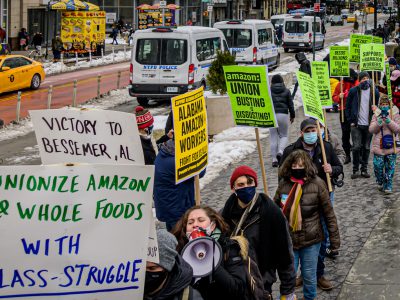
Striketober: America’s workers are rising up

WP_Post Object
(
    [ID] => 3368
    [post_author] => 2
    [post_date] => 2021-10-28 15:19:50
    [post_date_gmt] => 2021-10-28 15:19:50
    [post_content] => No one is forbidding anyone from using the term 'woman' or 'mother.'

On October 15 Rosie DiManno, a Canadian journalist, wrote a contentious column for the Toronto Star, in which she claimed that women were being “erased” because British health care providers were introducing gender-inclusive language to accommodate nonbinary people and transgender men. The practice of referring to a menstruating or pregnant person instead of a menstruating or pregnant woman was, DiManno asserted, tantamount to “blotting women out” and bore a “whiff of misogyny.” DiManno’s grievance mongering, with her anger directed at transgender people, follows a pattern we have come to expect from TERFs—the acronym stands for “trans exclusionary radical feminist”—and their enablers. Almost invariably, they invoke problems that do not exist as a means of preempting the expansion of rights and reasonable accommodations for trans people.

Whether the imaginary problem du jour is “men in dresses” invading public bathrooms or, as in DiManno’s op-ed, the supposed erasure of language that captures quintessentially female experiences, this tactic embodies reactionary politics of grievance and scapegoating. The subtext is that transgender women are “really” men, transgender men are “really” women, and nonbinary people don’t exist. DiManno’s views are widely known to Canadian newspaper readers, and rarely elicit a response, but this particular column received international attention because Margaret Atwood promoted it approvingly on Twitter. This is indeed disappointing. Even more disappointing is that Atwood refused to listen to those who alerted her to the trans-antagonistic nature of DiManno’s commentary. Instead, she doubled down.

Before exploring these developments and the key issue of inclusive language in more detail, let me get a couple of things out of the way. First, no one is forbidding anyone from using the term “woman” or “mother.” Secondly, I’m not here to “cancel” an 81-year-old literary icon, even if I had the power to do so. I taught The Handmaid’s Tale in 2018 for an arts and humanities theme course on apocalypse and dystopia in the University of South Florida’s Honors College; and, while I am not planning a return to the classroom, I would teach that book again. Atwood’s novel is an immensely important exploration of what can happen when religious extremism runs amok, with the harm disproportionately falling on women and queer people (“gender traitors” in the terminology of Gilead), and for that reason it is painfully relevant in our time.

As a trans woman, I have no trouble discussing access to abortion care as a woman’s issue, although it doesn’t fit exclusively under that rubric because it also affects trans men and some nonbinary individuals, which makes it also an LGBTQ issue. Nor is access to abortion an issue that affects all women. Cisgender women who are unable to conceive, have had hysterectomies, have gone through menopause, or who have certain intersex conditions, are not personally affected by abortion access issues, but no one would get defensive about applying the word “woman” to people in most of those categories.

I would like to pause here to point out that I unabashedly typed “woman” or “women” five times in the above paragraph, because in each case that was the most fitting term. In addition, in my recent commentary on Brittney Poolaw’s horrific manslaughter conviction in Oklahoma for suffering a miscarriage, I used the word “women” 10 times; by contrast, I used the inclusive phrase “anyone who can get pregnant” just once.

To the second point above— i.e., the issue of “cancel culture”— it should go without saying that criticizing the views of a public figure is not censorship. A highly visible public figure should expect that the expression of their opinion on political concerns will elicit a variety of responses and should be prepared for criticism. Even if one is not a public figure, the right to free speech is not the same as an exemption from consequences for expressing hateful or bigoted views.

In addition to the degree of offense, power dynamics should be taken into consideration. This should be axiomatic for feminists. And yet, when it comes to these issues and “cancel culture,” anti-trans self-described feminists are suddenly unable to understand that women (see what I did there?) like Atwood, gazillionaire Harry Potter author J.K. Rowling, and DiManno are not vulnerable people who have to worry about financial insecurity or access to healthcare. They all have white and cis privilege, and they have far more power than the average woman. Trans people, by contrast, are disproportionately poor, highly vulnerable to “cancellation” via scapegoating, likely to face barriers to healthcare access, and, especially in the case of Black trans women, disproportionately subjected to violence up to and including murder.

There is one issue DiManno raised on which I agree with her and, by extension, Atwood: the anatomy of the female reproductive system has historically been erased due to patriarchy and puritanism. Encouraging girls and, indeed, all of us to have a better understanding of the vulva, the clitoris, the cervix, the uterus, and so forth is something our society needs. Jennifer Gunter’s 2019 bestseller The Vagina Bible was a much needed intervention, and I am very glad it exists. At the same time, there is something very odd about women who identify with feminism, a movement that has sought to decouple a woman’s value from reproduction and childrearing, to suddenly wish to define women precisely in those terms so long as it means not having to accommodate “those people.”

Regarding inclusive language, I disagree with DiManno and Atwood’s claim that using it as a means of accommodating some people who can get pregnant undermines the goal of increasing literacy about female anatomy and reproduction. DiManno completely misrepresented the facts to make her case, by referring to an article in The Lancet about UK hospitals using gender-neutral language to accommodate transgender men and nonbinary people. As Stacy Lee Kong points out, rather than prescribe that language across the board, “What did happen is Brighton and Sussex University Hospitals NHS Trust announced in February that it would be adding new trans-friendly terms including ‘birthing people’ and ‘chestfeeding’ to its existing vocabulary as a way to become more inclusive. The hospital was careful to note that it would only be using gender-neutral language in its internal communications and meetings, and that staff would use patients’ correct pronouns while caring for them.”

Intentionally or not, there is a great deal of dishonesty among the handwringing “why can’t we say woman anymore” crowd. That Atwood would throw in her lot with them is more disappointing than surprising to those who have been paying attention, since, as Kong also highlighted in her commentary on the current dustup, Atwood has previously reveled in being a self-described “bad feminist.”

The evolution of language, which is often pushed along by activists and advocates for marginalized communities, is understandably something that can make people uncomfortable. And indeed, activists sometimes go to excesses, though trans rights activists have so little power that the issue is mostly a red herring. Meanwhile, discomfort is sometimes necessary in order to learn and grow. And there is simply no excuse for distorting, exaggerating, and lying about what is really happening when healthcare systems, which often discriminate against trans people, begin to move toward understanding and accommodation. That thoroughly reactionary response is antithetical to the spirit of feminism as I understand it. Atwood seems uninterested in addressing her critics in a serious way, but if she should happen to read this column, I would ask her to look at the actual facts rather than the distorted version found in DiManno’s column, to sit for a while with her discomfort, and to consider leaving the politics of fear, scapegoating, and scarcity to the reactionary Right.
    [post_title] => Margaret Atwood's opposition to gender-inclusive language is disappointing, but not surprising
    [post_excerpt] => Self described feminists who oppose the expansion of rights and reasonable accommodations for trans people are ddisregarding the facts in favor of a position predicated on fears and biases.
    [post_status] => publish
    [comment_status] => closed
    [ping_status] => open
    [post_password] => 
    [post_name] => margaret-atwoods-opposition-to-gender-inclusive-language-is-disappointing-but-not-surprising
    [to_ping] => 
    [pinged] => 
    [post_modified] => 2024-08-28 21:15:12
    [post_modified_gmt] => 2024-08-28 21:15:12
    [post_content_filtered] => 
    [post_parent] => 0
    [guid] => https://conversationalist.org/?p=3368
    [menu_order] => 168
    [post_type] => post
    [post_mime_type] => 
    [comment_count] => 0
    [filter] => raw
)

Margaret Atwood’s opposition to gender-inclusive language is disappointing, but not surprising

WP_Post Object
(
    [ID] => 3356
    [post_author] => 2
    [post_date] => 2021-10-20 13:47:51
    [post_date_gmt] => 2021-10-20 13:47:51
    [post_content] => Why white, cis feminists must not be the ‘default’ version of tech critique, or anything else.

In 2021 two former Facebook employees stepped forward as whistleblowers. One became an international media star, while the other is virtually unknown. Frances Haugen garnered global headlines after her 60 Minutes interview on October 3, during which she revealed that she was the anonymous whistleblower who supplied the internal documents for the Wall Street Journal’s investigative series, which showed that Facebook knew Instagram harms many teenage girls and that it was fully aware of the damage caused by its for-profit disinformation. Two days later, she testified at a Senate subcommittee hearing that was watched around the world.

In September 2020 Sophie Zhang blew the whistle on Facebook’s refusal to act against dictators who were creating fake accounts on a vast scale to manipulate their own citizens and steal elections. Facebook’s response was to fire her. Zhang promptly published a nearly 8,000-word memo detailing her concerns on her personal website, parts of which Buzzfeed excerpted —before Facebook pressured the company that hosted her website to delete both the site and her domain name.

When Zhang went public with her identity in mid-2021, journalist Julie Carrie Wong wrote a long feature report about her for The Guardian, while Karen Hao’s deep dive interview with the whistleblower was published by MIT Tech Review . But the Senate did not invite Zhang to a special Senate hearing; nor, until a recent outcry over the disparate treatment, did any high- profile television news shows ask to interview her. As Wong tweeted on October 12, “I’m glad people are paying attention to her now but it’s weird to retcon her into a secondary player in Haugen’s narrative.”

Why is Frances Haugen the default whistleblower to whom all others are compared—even those that came before her?

Zhang might have been shunted into a secondary role partly because she is “not charismatic”  and “not good at attracting or receiving attention,” as she told CNN reporter Donnie O’Sullivan in an interview broadcast on October 12.  “I am an introvert who wants to stay home and pet my cats,” Zhang said. Another factor that might be partly responsible for Zhang’s relative anonymity: Americans who work for the Wall Street Journal and convene Senate sub-committee hearings care more about Instagram’s possible effects on their adolescent daughters’ self-image than about stolen elections and human rights abuses in Honduras and Azerbaijan.

A year after Zhang published her memo, the claims and documentation that both she and Haugen provided are now central to a new push in the US to regulate Facebook. And yet Haugen is “the Facebook whistleblower” while, to some, Zhang is just “an ex-employee.” (The unspoken “disgruntled” in that last sentence is silent, but powerful.)

In this tale of two American whistleblowers, one was given the role of the princess, commanding attention and praise, inspiring king-makers in Washington D.C. to insist the time has finally come for regulation. And the other? I’m not going to say she played the step-sister, because I hope we’ve all come a long way from denigrating blended families, but Zhang’s reception made it clear she’s expected to be part of a different and much smaller story. If it were a house-party, she’d be the help, not the host. Meanwhile, the significant ongoing work to document, explain, and stop the systematic harms of tech companies has been carried out by women of color; and they have gone almost completely unnoticed.

The Facebook fiasco inadvertently shines a light on different strains of feminism, and the wildly disparate varieties of attention and support they receive both from the media and from policymakers.

At the top of the status game sits Sheryl Sandberg, a key inspiration for girlboss feminists, for whom victory simply means winning power, not challenging it. Corporate feminism, often the reserve of privileged white women, celebrates women who “lean in” to a man’s world, not those who insist it needs to change so that everyone has a fair chance. It’s about “diversity and inclusion”— i.e., same values, different faces. It’s about having a nanny taking care of your children in a private, dedicated playroom next to your C-suite office, rather than building an on-site daycare center for all the employees’ children—let alone mandating parental leave and ending discrimination against parents and caregivers at every socioeconomic level. It’s about the magazines covers, nonfiction bestseller lists, and keynote slots at conferences. It is about the stranglehold of soft-spoken, acceptable female power, everywhere.

When it comes to criticism of big tech, corporate feminists are OK with data-extraction and surveillance, so long as the women doing it earn almost as much as the men. Those with misgivings tend to be “reformist” critics who lament what they see as unintended consequences of the business model; and they suggest only the gentlest of nudges. As Meredith Whittaker, Faculty Director of the AI Now Institute at NYU, puts it, " ‘nuance’ is also a term heard increasingly from tech reformists, in reference to their prescriptions— usually adding oversight, transparency, accountability to the status quo. …more structural approaches like bans, breakups, redistribution, they imply, lack nuance.” In theory, not all corporate feminists are also tech apologists or, at best, reformists, but they all share a basic political stance that things are mostly OK, and just need a little tweaking at the edges. Call it “nudge criticism”; executives are just good people doing their best, and we just need a few rules changes to optimize the incentives of corporations. Nudge criticism gives establishment journalists and policymakers material for articles and legislative bills, but doesn’t change anything fundamental.

When Frances Haugen came forward as a whistleblower, she slipped smoothly into the role of the acceptable girlboss face of reformist tech criticism. This is not a criticism of Haugen, or her considerable PR resources, but of how media, policymakers and so many of us respond to her. Haugen is doing everything she can, and with all she’s got, but she’s never going to suggest lawmakers change the real rules of the game. And that, more than anything, is why she is center stage.

Sophie Zhang is a trans woman, and, echoing how trans feminists are forced to fight simply for their right to exist, she has sacrificed her physical and mental health, her relationships, her livelihood, status and peace of mind—just to be heard. None of this came easily to her, yet she has persisted far more than what is rational or reasonable, simply because she felt she must. Karen Hao’s painstakingly researched profile documents the physical and emotional abuse Zhang suffered as a teenager when she came out, and contains the quietly devastating reason why Zhang first tried so hard to change Facebook from within: “Ultimately, I decided that I was the person who stayed in imperfect situations to try and fix them.” Facebook fired Zhang for under-performance because, despite the company’s refusal to act against dictators who used the platform for political and electoral fraud, she kept on trying to fix it, in addition to doing the job she was officially paid to do, as a data scientist. Zhang knew from a previous experience of sexual harassment that she would be downplayed, discredited and disbelieved, so she documented every single claim she made.

It still wasn’t enough.

In July 2021, after almost a year doing everything she could think of to keep blowing the whistle, Zhang was disappointed by the lack of public and political response. Yet she couldn’t regret what she had done. It simply wasn’t in her character to do otherwise.

Zhang’s drive to broadcast the truth and protect people she’ll never meet, despite the high price she knew she would pay, is powerfully reminiscent of Chelsea Manning, who blew the whistle on the US military. Manning leaked videos and documentation of US abuse of detainees in Guantanamo and killing of civilians in Iraq to Wikileaks, amongst other materials, and was sentenced to 35 years in prison. (President Obama, icon of gradualists and nuance-lovers everywhere, locked up more whistleblowers in eight years than all the presidents, cumulatively, before him. He commuted Manning’s sentence just before he left office, and she was finally able to transition.)

It cannot be a coincidence that two American trans women have been at the forefront of speaking truth to intensely coercive power. Holding fast to the truth despite the gaslighting denials of those who wield authority over them is integral to who they are. And knowing the truth was insufficient, they were compelled to act on it. Not all trans women are heroic truth-tellers, sure, but a surprising number of trans women I have known in public and private life are more courageous than anyone should need to be. I don’t know why trans sisters have been moved to risk and sacrifice so much, in different fields. I do know that the changes their revelations demand are not milquetoast solutions like “better oversight” or “more transparency.” The barriers and costs to these whistleblowers of speaking out are so much greater, and their critiques are indifferent to whether you like them or not.  These sisters know what power truly looks like before it dons a pantsuit, pussy-hat, and professional smile.

Zhang’s criticisms of Facebook stick to her area of specialist knowledge, cutting narrow but deep. Unlike Haugen, she doesn’t claim “Mark” (Zuckerberg) is doing his best but is in over his head. Zhang says that Facebook systematically downgrades the priority of poorer, less prominent countries, refusing to spend the resources necessary to stop dictators from exploiting the platform’s baked-in elements to manipulate their own citizens. This is a far more devastating criticism, affecting many millions of people around the world. It goes to the heart of the business model; if Facebook can afford to be present globally, it can afford to invest in protecting the world’s most fragile democracies.

People are finally catching on. A UK parliamentary committee just invited Zhang to give evidence. I hope they look further than the incremental solutions so beloved of the management class, and instead open their minds to the possibilities that appear when you understand that progress will only happen when you tear down its quiet coercion and unequal distribution, instead of merely changing its face. To truly understand the vindictive, velvet-gloved power wielded by Facebook, we all need to understand that the harms women like Zhang and Haugen have exposed as whistleblowers are not exceptional. They’re not “abuses” of the platform, but simply what happens when third parties use it as it was designed to be used. And it won’t be fixed by asking nicely, because asking nicely never brought down a rotten system.

If we roll with the obvious narrative, that acceptable tech critique is defined around a “default whistleblower”—a white, cis, middle management American woman who was fine with it all until one day she wasn’t— we choose to avert our eyes from the worst, most systemic harms. We choose to pretend that it’s just “too hard” to find structural solutions that would stop the slow violence of for-profit hate, which is precisely Facebook’s business model. By centering white, corporate feminism in all questions that affect all kinds of women and girls, we’ll make exactly the same, systemic error Facebook does: prioritize fixing more prominent but much less serious harms.

Zhang did what she had to do because she knew that power lies. Power lies, above all, to and through those who covet it the most. To honor Zhang’s courage, we should do as she has done: see things exactly as they are, and do what truth demands.
    [post_title] => Two Facebook whistleblowers leaned in, but only one became a media star
    [post_excerpt] => Why is Frances Haugen the default whistleblower to whom all others are compared—even those that came before her?
    [post_status] => publish
    [comment_status] => closed
    [ping_status] => open
    [post_password] => 
    [post_name] => two-facebook-whistleblowers-leaned-in-but-only-one-became-a-media-star
    [to_ping] => 
    [pinged] => 
https://conversationalist.org/2021/10/05/blowing-the-whistle-on-facebook-is-just-the-first-step/
    [post_modified] => 2024-08-28 21:08:26
    [post_modified_gmt] => 2024-08-28 21:08:26
    [post_content_filtered] => 
    [post_parent] => 0
    [guid] => https://conversationalist.org/?p=3356
    [menu_order] => 169
    [post_type] => post
    [post_mime_type] => 
    [comment_count] => 0
    [filter] => raw
)

Two Facebook whistleblowers leaned in, but only one became a media star

WP_Post Object
(
    [ID] => 3287
    [post_author] => 2
    [post_date] => 2021-10-14 14:28:27
    [post_date_gmt] => 2021-10-14 14:28:27
    [post_content] => Women shouldn’t need a 'good' reason to end a pregnancy.

Texas’s shockingly cruel new abortion law bars abortion once cardiac activity can be detected in the embryo, typically around the sixth week of pregnancy. Notably, it also allows any US citizen to sue any person who performs or otherwise “aids and abets” a prohibited abortion. The law has few defenders in the mainstream press. Jennifer Rubin, a conservative columnist for The Washington Post noted its “viciousness.” The New York Times’ Michelle Goldberg described its “sinister brilliance.” Rebecca Traister of New York Magazine decried its “ugliness.”

By deploying private citizens to subjugate the vulnerable, the law evokes the worst of the United States’ not-so-distant past. In the mid-nineteenth and early twentieth centuries, for example, doctors and police officers demanded that women dying of botched abortions name the provider. During the eighteenth and nineteenth centuries, mercenaries made their living by hunting down escaped slaves and returning them to bondage in exchange for a bounty. Some Americans have always been willing to work for or in lieu of law enforcement to catch, punish, and profit from those they or the state deem criminals based on deeply ingrained notions, rooted in systemic racism and sexism, of who is and isn’t a rational, capable human being.

Abortion was common in the United States throughout the nineteenth century. It was only in the latter half of the century, when medicine became a respected profession and the American Medical Association was established, that physicians lobbied to have abortion banned. Their concern was not about abortion’s morality, but about the financial and professional implications of being forced to compete with midwives and purveyors of home abortion remedies.

As ugly as the Texas law is on its own, many of its opponents are attempting to fight it by invoking the worst-case scenarios. A number of commentators have cited the case of a 13-year-old Texas girl who became pregnant after her grandfather raped her; the law grants no exceptions for pregnancies resulting from rape or incest. Few would argue that a 13-year-old rape victim should be forced to carry and give birth to her grandfather’s baby; that is why, even in Texas, the girl in question was able to end her pregnancy, albeit only after traveling hours from her small town to a clinic in Houston (this was a few months before the new law went into effect). People in extreme circumstances related to pregnancy—victims of rape and incest, women carrying fetuses with severe abnormalities, those who might die if they give birth—deserve support, compassion, and access to modern medicine, including abortion. But only a small minority of women seek abortion for those reasons.

The most common reasons women give for seeking abortions in the United States are the least shocking. According to data gathered from 2008 to 2010, 40 percent said they were “not financially prepared” to have a child. Thirty-six percent cited “bad timing,” “unplanned,” or “not ready.” Nearly a third (31 percent) cited reasons related to the person who caused the pregnancy—e.g., he was unsupportive, abusive, and/or didn’t want to be involved. Twenty-nine percent of abortion patients said they needed to focus on caring for the children they already had. Most gave not just one but several reasons for ending their pregnancy. By evoking only the extremes, activists risk creating a sense that some women are more or less “deserving” than others of abortion access.

Americans, including those who believe abortion should remain legal, are accustomed to weighing the relative moral acceptability of these reasons. They might sympathize with a terrified 15-year-old who gets pregnant the first time she has sex, but think a 36-year-old woman who didn’t use birth control and got pregnant from a one-night stand should have known better. Most rights are not absolute; they can be and often are restricted. But once a society recognizes that a right exists, it is not contingent on whether others approve of how it is exercised. That’s why proponents of free speech, particularly in the United States, often cite biographer Evelyn Hall’s summary of Voltaire’s philosophy: “I disapprove of what you say, but I will defend to the death your right to say it.”

Katie Watson, a lawyer and bioethicist who teaches at Northwestern University, sympathizes with advocates who focus on extraordinary cases. “Legally, you always pick the most sympathetic plaintiff for your case, and rhetorically, we often want to lead with our strongest examples,” she explained over the phone. “That’s narrative structure and that’s storytelling and that's litigation.” What concerns her is “the repetition damage…when those become the only stories that we tell, they skew our vision and our understanding of what life is really like. And starting with bad facts leads to bad policy.”

The result, said Watson, is that “the cases we discuss the most are the cases that happen the least.” She added: “When we focus exclusively on those—we unwittingly contribute to that dichotomy between good abortions and bad abortions—or deserved abortions and shameful abortions.”

Shifting attitudes toward divorce and the liberalization of divorce laws are a useful comparison. Divorce was once a very controversial issue in the United States. Until “no fault” divorce became the norm in the 1970s, the laws of most states required a woman petitioning for a legal end to her marriage to prove that her husband had committed adultery, abused her, or abandoned her. As of 2017 most Americans (73 percent), including a slim majority (51 percent) of the “very religious,” considered divorce morally acceptable. This, despite the fact that between 22 and 50 percent of people who obtain a divorce, regret having done so.  By comparison, 84 percent of women polled five years after having an abortion report feeling either positive or neutral about their decision. Few Americans, however, would advocate forcing people to stay married.

Despite the popular stereotype of those who get abortions as young, immature, and/or careless, most people who undergo terminations in the United States are not only adults, but parents. In 2014, 59 percent of abortions were obtained by women who already had at least one child. Only 12 percent were teenagers; those younger than 15 accounted for only 0.2 percent. The vast majority of people who undergo an abortion procedure are neither tricked nor pressured into ending their pregnancies. Only about 1 percent reported seeking a termination because somebody else, usually a parent or a partner, wanted them to. Most people who seek abortions know their own needs, desires, and limitations, and can imagine—or are already well aware of—the physical, psychological, and literal cost of bringing a child into being.

If a woman can choose to join the military, get married, or end a marriage—all potentially life-changing decisions—she can decide to end a pregnancy. As Watson argued in her 2018 book Scarlet A: The Ethics, Law and Politics of Ordinary Abortion, “We should be able to acknowledge the complexity of private decision making without threatening the right of private decision making.”

According to Watson, it’s no surprise, and no problem, for members of a large, diverse, and pluralistic society to have a range of views on abortion. That’s why, in defending abortion rights, she thinks it’s crucial to rely on the politics of respect rather than the politics of sympathy. “The politics of sympathy say, ‘You get to have that abortion because I feel sympathetic to you,’” she explained. “It puts the listener or the voter in the position of judge.” By contrast, “the politics of respect say, ‘I may or may not agree with her decision or like it, but she is a moral agent with a brain and a heart and she is the one who's going to live with the consequences of whatever decision she makes, whether to have a child or not…I respect her decision-making rights and her decision-making capacity and her decision-making authority, even if her moral frameworks are different than mine.’” The latter, Watson said, focuses on the pregnant person, whereas the former focuses on “the person offering the opinion or the vote.”

There are places in the world where abortion is not only safe, legal, and unremarkable, but also considered a basic human right. Five years ago, when my mother was on a group tour of Iceland, another American woman on the tour referred to then President Obama as a “baby killer.” My mother defended Obama and asked the Icelandic tour guide what she thought. “In this country,” the guide replied carefully, “Women are considered equal citizens, so abortion is not really an issue.”

That attitude is not limited to Nordic countries. People in many industrialized nations around the world see abortion rights as inseparable from the human right to self-determination. In Ireland, which legalized abortion by a wide margin following a 2018 referendum, the government heralded the right to abortion as a welcome sign that the country had finally joined modern society. “The people have spoken,” declared then Prime Minister Leo Varadkar. “They have said we need a modern constitution for a modern country.”

Meanwhile, when the Polish government implemented draconian abortion restrictions last year, they sparked the country’s largest protests since the fall of communism. As one protester told Reuters, “I want us to have our basic rights…the right to decide what we want to do and if we want to bear children and in what circumstances to have children.”

Melissa Upreti, a human rights lawyer tasked by the United Nations Human Rights Council with fighting to end discrimination against women and girls, characterized Texas’s law as “sex and gender-based discrimination at its worst” and a clear violation of international law, adding that it has “not only taken Texas backward, but in the eyes of the international community, it has taken the entire country backward.”

Based on the means many abortion opponents have employed to limit access to the procedure—e.g., picketing clinics and shaming women as they enter, murdering and threatening abortion providers, and now passing a law that empowers ordinary citizens to be vigilantes and bounty hunters—it seems obvious that their concerns are not about the sanctity of “life” but about controlling and humiliating pregnant people.

Abortion opponents detest the slogan, “My body, my choice.” So do I—not because it invokes bodily autonomy, but because the “choice” framework is trivializing, and falsely implies that all choices are equal. The choice to bring a human being into existence is far graver and more permanently life-altering than the decision not to. Forcing a woman to endure pregnancy and labor against her will is an act of brutality with lifelong consequences for her and any children for whom she is responsible. In defending the Texas law, Ohio Republican Senate candidate J.D. Vance falsely asserted that it’s about “whether a child should be allowed to live” and “not whether a woman should be forced to bring a child to term.” But that’s precisely what it is. And that kind of torture cannot be justified by the victim’s capacity to bring into being a child who doesn’t yet exist.
    [post_title] => In defense of ordinary abortion
    [post_excerpt] => People in extreme circumstances related to pregnancy—victims of rape and incest, women carrying fetuses with severe abnormalities, those who might die if they give birth—deserve support, compassion, and access to modern medicine, including abortion. But only a small minority of women seek abortion for those reasons.
    [post_status] => publish
    [comment_status] => closed
    [ping_status] => open
    [post_password] => 
    [post_name] => in-defense-of-ordinary-abortion
    [to_ping] => 
    [pinged] => 
    [post_modified] => 2024-08-28 21:11:29
    [post_modified_gmt] => 2024-08-28 21:11:29
    [post_content_filtered] => 
    [post_parent] => 0
    [guid] => https://conversationalist.org/?p=3287
    [menu_order] => 170
    [post_type] => post
    [post_mime_type] => 
    [comment_count] => 0
    [filter] => raw
)

In defense of ordinary abortion

WP_Post Object
(
    [ID] => 3261
    [post_author] => 2
    [post_date] => 2021-10-14 12:18:11
    [post_date_gmt] => 2021-10-14 12:18:11
    [post_content] => The government has recognized its error and resigned, but the women's lives are still in tatters. 

Franciska Manuputty’s ordeal with the Dutch tax authorities began in 2010, when she received notification to repay €30,000 (about US $35,000) in childcare tax benefits, to which the government alleged she had not been entitled. Manuputty, 49, is a low-income single mother of two. She was soon behind on the rent, couldn’t pay her electricity bills, and turned to a food bank to feed her family. Her daughter, now 20 years old, told her recently that as a child she had lived in constant fear of returning home from school to discover they had been evicted from their apartment. 

Manuputty is one of the victims of what the Dutch media calls the child benefits scandal. Over the course of around a decade the government falsely accused thousands of eligible families of having committed fraud and ordered them to repay childcare tax benefits to which they had, in fact, been entitled. 

A parliamentary investigation published in December 2020 found that the tax authorities had set up a child benefits system with bureaucratic rules so rigid that even the smallest administrative error in filling out forms caused the system to flag beneficiaries, who were then pursued by the courts and forced to repay all the money they had received—plus fines. The total number of victims is not yet clear; but based on a parliamentary investigation and the number of people who applied for the initial compensation of €30,000 (about $35,000), at least 35,000 people have been affected. 

The fallout from the scandal led to the government’s resignation in January 2021. 

Families that were forced to repay tens of thousands of euros faced bankruptcies, job losses, forced sale of houses, homelessness, divorce—even suicide. Several families saw their children removed by child protection authorities, on the basis that they were no longer able to care for them after losing their homes and financial stability. 

The €30,000 compensation doesn’t even begin to solve Manuputty’s problems. Because the tax authorities labelled her a cheat in 2009, her name is now in the system and her credit is ruined. Over the past decade all her applications for financial aid were rejected, which forced her to keep borrowing money and leave bills unpaid. She now owes €100,000 ($115,000) to various creditors. “I hold on to life for my children,” said Manuputty.

Investigative journalists discovered, via the parliamentary freedom of information act, that the algorithms had been designed to flag “cheats” based on the amount a parent received—i.e., the more benefits they received, the more likely they were to fall under suspicion. The result: the people targeted were those whose low-paid jobs made them most eligible for childcare benefits. 

A disproportionate number of people in that group were single mothers with foreign citizenship, so the algorithm de facto flagged poor women who were either immigrants themselves or the children of immigrants, adding racism to the scandal.  The Ministry of Finance brought a discrimination suit against the tax authorities, but the  public prosecutor dismissed the case, saying the issue must be solved politically. Victims of the false accusations are appealing that decision. A parliamentary commission will be  appointed to investigate the matter later this year or next year. 

Via a WhatsApp group for victims of the scandal, Franciska Manuputty met Batya Brown, 35,  a part-time employee at a daycare center who is now pregnant with her fifth child. When the two were asked to address an anti-racism demonstration about their experiences they decided to collaborate on their speeches and provide one another with moral support. They were joined by Kristie Rongen, 45, a small truck driver, who had recently  confronted Prime Minister Rutte during a widely viewed live broadcast of a political TV show. 

While Rongen holds only Dutch citizenship, Batya Brown was born in Ethiopia. Manuputty’s parents are from the Maluku Islands, formerly a Dutch colony—now occupied by Indonesia. For the latter two women, their relationship with the Dutch state is informed by their ethnic identities, which is further compounded by the role that racism played in the tax scandal.

Brown was adopted as a child from Ethiopia, arriving in the Netherlands when she was six years old. Because of a bureaucratic error that she is fighting to correct, she is still ineligible for a Dutch passport. Meanwhile, in 2007 the tax authorities began demanding that she repay her benefits . The resulting financial problems forced her to move often and, while the tax authorities recently annulled her remaining debts, her struggle with the immigration authorities continues. In other words, she has been battling with both the tax authorities and the immigration office for her entire adult life.

Manuputty suffers from post-traumatic stress disorder and transgenerational trauma. Her grandfather is a South Mollucan, a member of an Indonesian indigenous group that fought in the Royal Netherlands East Indies Army (KNIL) alongside colonial forces in the Indonesian War of Independence (1945-9), then were brought to the Netherlands after the Dutch reneged on a promise to grant them territorial sovereignty. The Mollucan community feels humiliated to this day by their treatment at the hands of the Dutch. “As a victim of the child benefit scandal, I have been neglected and robbed of my dignity again,” said Manuputty, adding that she felt as though history were repeating itself.

Rongen acknowledged that she presents in her media appearances as a strong woman, which she is; but behind the scenes she is emotionally devastated. “I cry a lot, every day,” she said. Her ordeal with the tax authorities began in 2010, with her debt topping out at €92,000 ($123,000). After four years of debt counselling, the government annulled what was left of that amount and granted her compensation in December 2020. Her battle with psychological trauma is ongoing. She has dedicated herself to helping reunite parents with children they lost to foster care, a calling that provides her with a feeling of purpose. “When a mother messages me for help, I dry my eyes and get going again,” she said. In a matter-of-fact tone she added, “I would prefer not to live anymore. But what would happen to my children if I were no longer here?”

In addition to their media appearances and participation in anti-racism demonstrations earlier this year, the three women have initiated demonstrations of their own, to garner public support and amplify their demands. These include: cancellation of all the victims’ debts by the end of 2021; financial compensation of at least €1 million ($1.16 million) to each victim; and the immediate reunification of parents with children who were taken from them and put into foster care. They also want psychological support. And they want those responsible for the scandal to be brought to justice.

When the government resigned in January the women hoped the new administration would deal with the matter quickly, but they now understand the process will take years. One egregious reason for the slow pace: the commission tasked with defining the amount of compensation that each victim should receive is severely understaffed; at the current rate they will need 975 years to complete their work.

 “Applying for everything costs so much time and energy, which I would prefer to dedicate to my children,” said Batya Brown. Kristie Rongen added: “Instead of asking for more effort from the victims, they should just give every one of them half a million euros to settle the matter. Our lives have been destroyed.” 

Franciska Manuputty agrees. “I have been trying for years to regain my independence by setting up my own business,” she said, explaining that her applications for business loans have all been rejected because the “fraudster” label destroyed her credit rating. “I struggle for freedom, it’s in my genes, but I feel trapped in a prison without walls.”

The women have also reached out to other victims, organizing small events like picnics and activities for children, which they pay for via crowdfunding, just to relax and start healing together. Coming together has energized the women. “Our suffering has become visible,” said one. Then, with tears in her eyes and a voice choked with anger: “Years ago, when he was ten, eleven years old, I promised my oldest son that everything would be okay. He is 16 years old now! I am determined to keep my promise to him.” 
    [post_title] => 'I cry a lot, every day': victims of the Dutch child benefits scandal fight for compensation
    [post_excerpt] => Thousands of Dutch families were destroyed by financial hardship after the tax authorities falsely accused them of submitting fraudulent applications for childcare tax benefits, requiring them to pay back the allowances they had received in their entirety—plus fines.
    [post_status] => publish
    [comment_status] => closed
    [ping_status] => open
    [post_password] => 
    [post_name] => i-cry-a-lot-every-day-victims-of-the-dutch-child-benefits-scandal-fight-for-compensation
    [to_ping] => 
    [pinged] => 
    [post_modified] => 2024-08-28 21:11:29
    [post_modified_gmt] => 2024-08-28 21:11:29
    [post_content_filtered] => 
    [post_parent] => 0
    [guid] => https://conversationalist.org/?p=3261
    [menu_order] => 171
    [post_type] => post
    [post_mime_type] => 
    [comment_count] => 0
    [filter] => raw
)

‘I cry a lot, every day’: victims of the Dutch child benefits scandal fight for compensation