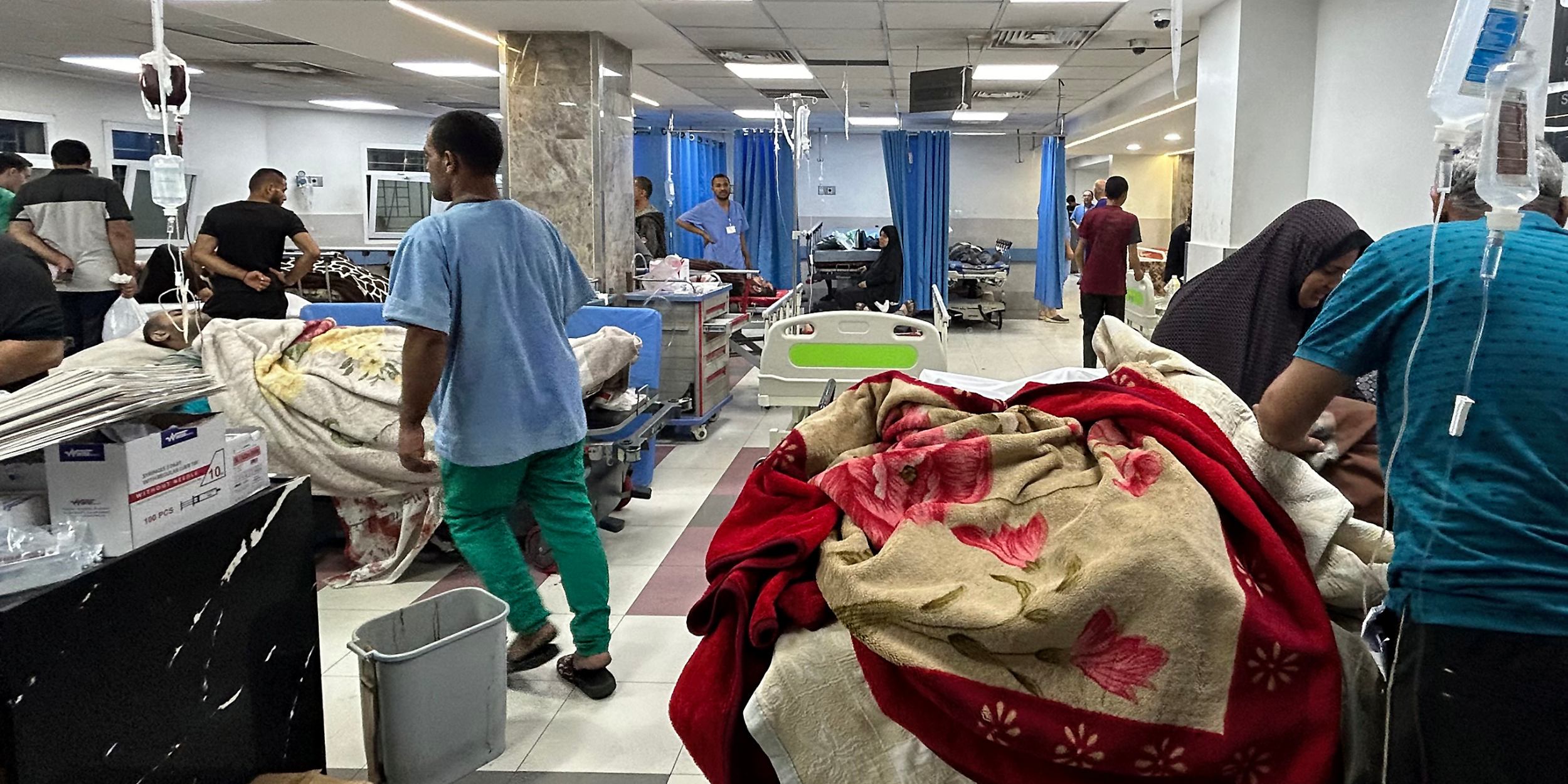





A Palestinian nurse recounts an average shift at Gaza’s largest hospital in November 2023.
I used to imagine myself as a nurse dressed in white, moving between patients’ beds, one link in the chain of their healing. I always believed that nursing was a humanitarian message before it was a job. I believed—and still believe—that nurses are angels of mercy who fight battles and wars every single day, in every shift they work. But then came October 2023.
At the beginning of the war, I decided to return to the emergency department of Al-Shifa Hospital, the largest hospital in the center of Gaza City where I’d previously done my internship. Its specialized units received patients from across the entire Gaza Strip, and its emergency department, also the largest in Gaza, was divided into three zones: green for minor, yellow for moderate, and red for critical cases.
To take the job, I had to leave my father and four of my siblings at our family home in Zeitoun, a neighborhood in eastern Gaza City. Two days later, they too were forced to leave, and another two days after that, our house was bombed. In the weeks that followed, I lost many friends and colleagues. Each day, I felt like I was losing a part of my own life.
Maybe it was the encroaching death, or separation, or longing—but “Gentle Faress,” as my mother always called me, soon became hard. At the emergency department, I carried torn limbs with my bare hands, the hospital’s supply of gloves rapidly dwindling as medical supplies weren’t allowed to reach the hospital. I put my fingers inside deep wounds to stop their bleeding. And I developed the nerve to inform a family that their son or daughter had died by telling them, “Take them to the morgue so there is room for someone else.”
~
On the third of November at 7 o’clock in the morning, I got ready to start another typical 24-hour shift. I had just woken from a two-hour nap—sleep that felt more like a half-waking—on one of the metal chairs in the staff changing room, with two of my colleagues by my side. I went out searching for any spot with a phone signal so I could call my mother and tell her I was still alive, and to make sure everyone in my family was still alive, too. I would have to lie to her as usual, telling her that I was eating well, that I was still strong, and that we were safe and under international protection because we were medical staff. But none of it was true.
Outside, a now typical scene met me: what appeared to be thousands of displaced people were spread across the ground in the stairwells and corridors of the hospital, sleeping on the bare floor without the slightest bit of privacy or comfort. Children were crying, maybe from hunger or cold, or simply in their search for any feeling of safety. I looked into people’s faces, which tell tales, and saw deep exhaustion and tears held back. Maybe they’d lost their house, their family. Maybe they’d lost everything, and only they themselves had survived.
Finally, I spotted a few people standing by the hospital gate, holding up their phones. After a few steps, I heard a loud whistling and then a violent explosion nearby. Israeli warplanes were bombing a water truck and the people queuing to fill their empty gallon bottles near the hospital’s entrance.
For a split second, in the commotion, I truly believed I had died, that I would never see my family again; that if my phone rang, no one would be able to answer it.
When sound returned to my ears, I could hear the screaming and crying of children and women around me. Wake up. Hurry. Get up, my dear. Don’t die. Like slaps across my face, these words brought my awareness back, and I ran back into the hospital as fast as I could.
~
In the emergency department, my role was to insert intravenous cannulas so a doctor could assess the patients and try to compensate for blood loss with fluids. But because the intensive care unit was already filled with severe injuries and had no space left, we began receiving ICU patients in the ER, as well. Understaffed and given the overwhelming need, this meant choosing those who we believed had the greatest chance of survival. I felt the pain of having to decide who lives and who dies as I moved from one injured person to another, my mind unable to absorb what my hands were doing. The sounds of screaming and crying, and the smell of blood and burned bodies, filled the hospital.
While I was running with an oxygen bottle in my hand, suddenly, a woman rushed toward me, seizing my hand tightly and kissing it. “Please help my son—he’s breathing, please, he’s alive, I’m sure of it, I have no one else, and if I lose him I will have lost everything in my life,” she pleaded. He was lying on the ground, blood pooling around him like a lake. I knew he was already gone, but I was caught between two fires: the fire of the mother and her grief, and the fire of the many other injured people who still needed care. My conscience insisted I do something for the woman as she looked at me with eyes full of hope and anguish. But I did not know how to tell her that her son could not be saved, so I whispered to the doctor that we needed to perform CPR. It seemed almost impossible given how little time we had, yet the doctor agreed. Afterwards, we told the mother that her son had not survived. Then we moved on to finish our work with the other patients, leaving her behind.
“He was going to be married soon, and happiness was about to visit us,” she wailed. “I was going to sing for him at his wedding. The most precious thing I had has died.” To this day, whenever I hear another story of loss in the news, I still picture that woman’s face, and her hand reaching for her son’s.
I wanted to call my own mother to tell her that I was alive. I kept seeing her image and her shadow, as if she were walking beside me, to reassure me. But after meeting that woman, after seeing her tears, I began to fear that one day, my own mother might be in her place.
~
Family members carried dozens of bodies out of the intensive care unit to the morgue, and those who’d suffered injuries were transferred to the inpatient wards for follow-up. Our department looked like an actual battlefield, with blood everywhere, and IV lines, syringes, and used equipment scattered about. Around 12 p.m., once we’d finished assisting the morning’s cases, I walked outside once again to try to call my mother. My hands trembled as I held my phone and heard her tender voice answering hello. But despite all my longing for her, I hung up. I tried another time, and when I heard her voice, I burst into tears and hung up again. I couldn’t understand why.
Maybe it was all simply too much for me to bear. The Israeli military had destroyed the infrastructure around the hospital. They had destroyed the water lines and the solar panels we used to generate electricity, which shut down the operating rooms, the ventilators, and the sterilization equipment. How could I watch thousands of people die, without any fault of their own, while we just ran from one injured person to the next without any medical resources or equipment? The military had blocked the medicine, painkillers, and sedatives sent by international organizations from reaching the hospital. There was no food. I kept a box of dates in my locker, and I ate one a day.
The hours passed and the situation grew relatively calm. We could only hear the sound of reconnaissance aircraft flying low, like the buzzing of mosquitoes in your ear, but much louder, and the gunfire from the warships at sea. They sounded increasingly close—a bad omen. Most of the bombing and the massacres took place in the middle of the night. This made it harder for ambulance and rescue crews to pull people out from under the rubble, and harder for medical staff to help the injured.
~
My colleagues and I sat in the emergency department at 1 a.m., talking about what we would wish for if we made it out alive. A radio station broadcast from the West Bank, and we tuned in hoping to hear some good news about a ceasefire, or anything at all. But all the news mentioned were the threats to storm Al-Shifa Hospital and the Israeli military plan to occupy the Strip.
We heard the sounds of bursts and fire belts striking the area near the coast that separates the north and south of Gaza City. After several minutes, some ambulances arrived after having been blocked by the advancing Israeli tanks. I assisted the dozens of injured people coming in, most of whom had burns or lacerated wounds across their entire bodies. I asked one of them where he’d come from. When he mentioned the neighborhood where my own family was, I lost my mind.
I ran among the injured and the martyrs, among the disfigured and the unidentified, searching for anyone from my family. I tried calling them but couldn’t get through, and I tried to go with the ambulances to see for myself, but the Israeli tanks had advanced so far that they’d split the Strip into separate parts. I went to the morgue to search among the bodies, thinking through the worst scenario I could imagine. I had no strength left in me, as if I had lost the last strand of hope in this world.
Heavy hours passed, but none of them arrived.
With the sunrise, I walked out to the street once again to try to call one of my brothers. After several attempts, Yasser answered, and with it, life returned to my body. His voice sounded both shaky and exhausted, as though he were forcing each word out. “We got out by a miracle,” he told me. “It truly was a miracle, but we are still alive and we are all fine.”
Then the signal dropped and our call ended.
~
Eight o’clock in the morning, the fourth of November. I made my way back to that same hard, cold metal chair where I had woken up the day before, a lifetime earlier. I closed my eyes, but sleep would not come. The day played back to me in pieces: the water truck, the young man who was already gone before I ever helped him, his mother’s hands wrapped around mine, Yasser’s voice breaking at the other end of the phone. I asked myself what our sin was, why all these children and women had to die. But instead of an answer, I only had that chair, my exhausted body, and the hope that if I kept my eyes closed long enough, I might, for once, dream of something else.