WP_Post Object
(
    [ID] => 3095
    [post_author] => 2
    [post_date] => 2021-08-12 16:05:40
    [post_date_gmt] => 2021-08-12 16:05:40
    [post_content] => 'Gold is not a human right. Housing is.'

Between 2012 and 2021, Berlin’s median rent rose by over 70 percent. The cost of housing did not skyrocket because the city suddenly became a better place to live, but because investors looking for a secure place to park their money discovered the German capital. Over the past 30 years, in major cities around the world, corporations have been buying up huge swaths of domestic properties as profitable investments. As a result, habitable and affordable housing has become exponentially more difficult for ordinary people to find and keep.

In “Push,” a 2019 documentary that investigates why and how cities have become prohibitively expensive, Leilani Farha, the former U.N. special rapporteur on adequate housing, says that “unbridled capitalism” has made cities unlivable for all but the rich, with affordable housing now a luxury rather than a necessity. “That’s what differentiates housing as a commodity from gold as a commodity,” Farha says: “Gold is not a human right. Housing is.”

In the film, Farha meets a number of people whose rent has increased so dramatically, essentially overnight, that they have little hope of remaining in their homes. A new management company bought a building in Harlem and raised some residents’ rent by $900 per month, making it impossible for an African-American man to stay in his home of many years unless he could suddenly find a $100,000/year job (around 58 percent of Harlem residents make $60,000 per year or less). Something similar happened to an apartment complex in Uppsala, Sweden, making it extremely difficult for older middle-class residents to stay in their homes without dramatically increasing their incomes—a nearly impossible feat for those unwilling to abandon their communities.
Housing is generally considered affordable when it costs no more than 30 percent of a household’s income. In the United States, nearly 11 million renters spent more than half their income on housing in 2018. That same year, the National Low Income Housing Coalition found that there are no U.S. counties in which a person working full time for the minimum wage could afford to rent a standard two-bedroom apartment. Some people spend so much of their income on housing that they have little left over for food. The fact that large companies and investors now see housing as a reliable investment vehicle, rather than an essential element of social infrastructure—a phenomenon known as the “financialization of housing”—has transformed houses across the globe into shelters for money, not people. Thousands of dwellings sit vacant in major metropolises, enhancing the portfolios of the wealthy, while tens of thousands of human beings sleep on the streets. In Berlin, housing activists are pursuing a radical solution: they want to expropriate domestic properties from Germany’s largest landlords and repurpose them as social housing. If housing is a public good, they say, then the public should control it. Among Berliners, 85 percent of whom are renters, this effort has become increasingly popular, with 56 percent saying they either support (47 percent) a proposal to expropriate the properties of large landlords or are undecided (9 percent). A common argument against expropriation is that governments should be using their limited resources to build more affordable housing. But that solution has been on offer for decades and has yet to halt, or even significantly slow, the broader crisis. Labor and building material costs are prohibitive in many places. Building and land use regulations also pose significant barriers, especially in metro areas. It remains difficult to find both suitable places to build and communities receptive to large-scale public housing projects. Simply building more units is a flawed and partial solution, especially in the absence of significant and consistent funding. But the Berlin campaign targets enormous, publicly traded companies that own more than 3,000 apartments, like Vonovia and Deutsche Wohnen, Germany’s two largest corporate residential landlords. The two companies recently negotiated an €18 billion merger that set a record for Europe’s largest real estate deal, with a combined market valuation of around €47 billion, or $56 billion. They now collectively own around 550,000 apartments throughout Germany. Article 14 of the German constitution permits expropriation only for the common good and only in exchange for fair compensation. If Berlin’s housing activists succeed, the government won’t simply seize private units; it will transfer them to the public and compensate the owners, albeit at a rate that some shareholders might not consider sufficient (companies have the right to sue if they believe the compensation is inadequate). According to a 2020 report prepared by the Rosa Luxemburg Foundation, Berlin is home to around two million apartments, about 15 percent of which are owned by financial investors and publicly traded housing companies. Globally, residential real estate accounts for $163 trillion of assets, a portion of which are held by investors and housing companies in Germany. Deutsche Wohnen reported a profit of €1.54 billion (about $1.83 billion) in fiscal year 2020. Organizers in Berlin say the company has profited handsomely from buying up properties and driving up rents, neglecting routine maintenance and dragging its feet on essential repairs until major renovations are needed, then fixing up the apartments in order to justify massive rent hikes. Berliners are not the only ones trying to take back their city from corporate profiteers. In 2020, the city of Barcelona warned 14 companies that if they failed to rent the 194 vacant apartments they collectively held within one month, the municipality would take possession and convert the units into public housing. Since 2016 Catalonia, the region that includes Barcelona, has made it legal for municipalities to seize apartments left vacant for over two years and rent them to low-income tenants for four to 10 years before returning them to the owners. Catalans also approved a 2019 measure allowing cities to buy such apartments outright at half the market rate (owners would not have the option of refusing to sell). The law allows the city of Barcelona to take possession only in cases where the owners hold multiple units, while forcible purchase is allowed only when units are left vacant for at least two years. Expropriation is unlikely to catch on any time soon in the United States, where the rights of property holders are treated as sacrosanct. During the pandemic, tenant organizers in New York, Kansas City, Los Angeles, and other U.S. cities pressured the government to cancel rent and mortgage payments for as long as the coronavirus was disrupting the economy, without forcing people to pay it back later. California, New York, and a few other states offered tenants modest relief in the form of temporary eviction moratoriums, in a compromise that fell far short of organizers’ demands. Those measures in no way matched the actions proposed or taken in Berlin or Barcelona. Nevertheless Alan Beard, managing director of Interlink Capital Strategies, a financial advisory firm, penned an op-ed for The Hill entitled, “How to protect against future U.S. government expropriation,” in which he railed against governments in the U.S. for having “effectively expropriated most of the American economy” by forcing businesses to close for safety reasons and making it harder to evict people during the pandemic. In many U.S. cities, organizers are fighting for greater control over buildings the public already owns. Last year, Philadelphia organizers obtained limited concessions from the city by setting up encampments, taking over vacant properties in North Philadelphia and on the Benjamin Franklin Parkway, and demanding that the city transfer the properties to the people living in them. The city eventually agreed to put 50 vacant homes into a community land trust and allow 50 unhoused mothers with children to stay in 15 vacant city-owned houses—a drop in the bucket, given that thousands of Philadelphians still need permanent housing. In an ideal world, said Cea Weaver, campaign coordinator for Housing Justice for All, a New York State-based coalition of housing advocates, “public housing that is democratically run and controlled by its residents” would be the norm everywhere. But in the United States, where there is little trust in government or appetite for funding public services, that can feel like a distant dream. “In order for public housing to be great, we also need to rebuild faith in government as a thing that could compassionately care for all of us,” she said, “not the thing that is killing us and making us sick by defunding our homes.” Tara Raghuveer, who directs KC Tenants, a tenants’ rights organization in Kansas City, Missouri, and the Homes Guarantee campaign at People's Action, believes one of the biggest obstacles to “a world where everyone has a home and housing is not treated as a commodity” is that “we’ve been so convinced by the profiteers” that there is no other way. “It’s this attitude of impossibility that stops us from doing things that are really quite simple and that we have models for, even in [the U.S.], going back decades,” she added. Part of expropriation’s appeal is that it allows people to stay where they already live. Thomas McGath, an American ex-pat living in Berlin and a spokesperson for the campaign to expropriate Germany’s largest landlords, said Berliners are beginning to ask themselves, “‘How do I benefit if somebody plops down a thousand apartments in a field somewhere? It doesn’t do anything for me in my neighborhood, where the rents are rising rapidly and/or exorbitantly.’” The idea, he said, is to create a city “that meets the needs of everybody who lives here, and continues to have its unique character defined by those people.” McGath said he moved to Berlin in 2013 in part to escape the growing unaffordability of U.S. cities. “If we own our own cities and we have more democratic control over the things that we own…it really makes it easier for us to make the city more sustainable, more affordable, more livable,” he said, rather than morphing into a “big playground for investors to build vanity projects that really don’t have a social purpose.” If housing is a human right, it’s fair to question whether faceless for-profit corporations should be able to determine who gets it, for how long, and on what terms. A home is more than shelter; it’s where people feel a sense of comfort and belonging. Expropriation is one tool advocates are using to help restore housing to its original purpose: sustaining and enriching human life. [post_title] => To house the people, expropriate the landlords [post_excerpt] => Housing is generally considered affordable when it costs no more than 30 percent of a household’s income. In the United States, nearly 11 million renters spent more than half their income on housing in 2018. [post_status] => publish [comment_status] => closed [ping_status] => open [post_password] => [post_name] => to-house-the-people-expropriate-the-landlords [to_ping] => [pinged] => [post_modified] => 2024-08-28 21:15:13 [post_modified_gmt] => 2024-08-28 21:15:13 [post_content_filtered] => [post_parent] => 0 [guid] => https://conversationalist.org/?p=3095 [menu_order] => 184 [post_type] => post [post_mime_type] => [comment_count] => 0 [filter] => raw )

To house the people, expropriate the landlords

WP_Post Object
(
    [ID] => 2868
    [post_author] => 2
    [post_date] => 2021-06-30 23:56:29
    [post_date_gmt] => 2021-06-30 23:56:29
    [post_content] => New York's limousine liberals seem to care more about preserving the value of their homes than the lives of the homeless.

No one wants to talk about this, but it’s true: A lot of Americans had a fantastic year in 2020. According to Forbes, we can reliably place that number around 43 million, since 14 percent of American families are directly invested in the stock market. And, wow did it perform! As the financial capital of the world, New York City has a good many denizens riding high. But for the 20 percent of New Yorkers who live below the federal poverty line, most of whom are Black and Latino, the pandemic year was a catastrophe. At the beginning of 2020, before COVID-19 hit, New York already had a jaw-dropping wealth gap that saw the top one percent of the city’s residents living on an income 113 times that of the bottom 99 percent. The pandemic hit New York particularly hard, but it was Black and Latino people who suffered the most: They were four times as likely as their white neighbors to lose their job or die from COVID-19.

As New York emerges from the pandemic and is poised to elect a new mayor, we have a prime opportunity to address the chasm between the city’s purported values and the money that floods its economy, money that isn’t reaching enough people. I know this chasm well. Throughout the pandemic, I stayed in my apartment in Chelsea, a neighborhood that is home to the world’s most expensive art galleries — and to extensive low-income housing projects. I had a front-row seat to this divide—and how my neighbors behaved around it over the turbulent past year. In March 2020, I contracted a relatively mild case of COVID-19 and recovered within 10 days. Getting sick and recovering so early on put me in a state of enormous cognitive dissonance—in which I have remained suspended ever since.

In May, a mobile morgue sprang up a few blocks from my apartment in a long, white trailer; my 52-year-old cousin died from Covid alone in a Long Island hospital; and the police broke up a crowd of would-be diners lining up for $70 veal parm take-out at Carbone, an exclusive Italian restaurant in Greenwich Village. As they used to say on Sesame Street: One of those things was not like the other! (NB: The incident at Carbone was, as far as I can recall, the first and last time the NYPD molested a crowd of wealthy white people during the pandemic.)

Next came the civic education of June, the rage and the protests. I made my protest sign, and I did my share of marching. Right-wing pundits sneered that this was a pastime for the unemployed; left-wing memes countered that capitalism is what keeps you down, too preoccupied with paying rent to raise a fuss. I would argue both had a point. After my own building was looted one night, I returned from the protests the following day to find the lobby under private armed guard.

So, I did what any tightly-wound, concerned New Yorker would do at such a juncture: I joined my block association. What happened next was the closest thing to a political awakening I’ve had in my extremely coddled existence. Not long after police wielding nightsticks broke up 2020 Pride, we had a meeting with the 10th Precinct. Naturally, idiotically, naively, I assumed my neighbors were a little concerned about police violence. Most of the block association’s members are a generation older than I am. This meant they had lived through another plague: AIDS. They had fought for their rights and watched their friends die. Surely, they would be on the side of these protestors!

Well, it turns out property ownership changes things a little. Apparently, they were terrified. Yes, the building had been looted, but even Captain Kevin J. Coleman, the commanding officer of the 10th Precinct, assured my neighbors that the culprits were from Upstate New York and had nothing to do with the protests: They were opportunists from out of town. This explanation didn’t land. The captain apologized profusely, repeatedly. This, mind you, was the same police force that had kettled me at a protest weeks earlier, a mere 12 blocks away; but on our block association’s Zoom call, they were basically my valet service.

Why, my neighbors whined over and over during this call, were there so many homeless people—“unhoused,” the captain was quick to correct—and why did they have to come here? (I would like to add that some block association members were good enough liberals to learn the first names of the people living on the sidewalks.) When someone asked about the much-publicized summer spike in gun violence, the captain assured the block association that there had only been one local shooting and no deaths in the area; that is, if you excluded the housing projects on Ninth Avenue—i.e., our other neighbors, the ones not in the block association. (Lest you think I am exaggerating; I do have a recording of this meeting in my possession.)

The members of my block association were not alone in failing to live according to their purported values. The shameful evictions at the Lucerne Hotel soon followed: Tony Upper West Siders forced homeless men out of their temporary housing at a pandemic-emptied hotel, throwing them back into the vicious cycle of uncertainty with which the unhoused must contend. I’d bet good money that most of those uptown locals who lobbied for the eviction voted for Biden in November. And, hey, I’m grateful they did! But this realization, and the nail biting, gut-wrenching stress of the presidential election, made me realize that there was a very clear division of labor between local and federal government—especially as a New Yorker.

After the events of 2020, it’s clear we will not get anywhere if we frame progressivism as a national project. The Democratic Party defeated Trump and that’s a wonderful thing. But, pretending it has anything to offer in terms of the politics of wealth, policing, and public health in New York City is absurd. On a basic level, what can a party that simply takes our state’s electoral votes for granted offer us? (The New York Times’s Farhad Manjoo wrote an insightful column that describes similar feelings about California, where he lives.)

In other words, the Democratic Party is merely a bulwark against fascism—nothing more, and nothing less. It’s utterly inept at helping anyone on the ground. I am completely cynical about the federal government, yet bone-weary of false equivalency. I’ve come to accept that the United States will continue to fight its abhorrent wars abroad, no matter who is in office, and that my federal taxes will be used to fund them. I see this as a mere tithe. But what happens in my city is of desperate and deep importance to me.

Right now, as millions of New Yorkers suffer from illness and poverty caused or exacerbated by the pandemic, the municipal government must help the poor. The rich in New York are extremely wealthy. They can literally afford to fight City Hall. If, on a national level, I’m fine shaking hands with a centrist or even a never-Trump Republican, I am basically a Marxist on a local level—especially in primary season. Right now, the subways don’t work, the school system is in chaos, and housing insecurity is endemic. Since the federal government will not step in, the local government must—even if doing so means an adversarial relationship with the wealthy. I’m confident that anyone who thrived financially during the crisis can figure out how to eke out a living during the recovery. Surely, the rich have bootstraps to spare. They shouldn’t be the concern of New York City’s mayor.

In another context, I might use this conclusion to tell you why New York is the greatest city in the world. If you disagreed or complained, I’d muster enough local color to tell you to keep it moving. Instead, I’ll say this: I believe progressivism lives or dies in the details. Those details inherently vary from place to place. We can cooperate as a nation while understanding our needs to be substantively different at the local level. Perhaps we can find more unity on the Left as a country if we are able to give one another more breathing room on a municipal level. So, allow me to take the space in this conclusion I’d reserved for my civic pride and instead ask you to write this piece about your own city or town or village. I’d love to read it! After all, as Tip O’Neill liked to say, all politics is local.
    [post_title] => Thoughts on New York's re-opened NIMBY economy
    [post_excerpt] => The city is full of wealthy Democrats who voted for Biden but are more worried about protecting their property than caring for the homeless.
    [post_status] => publish
    [comment_status] => closed
    [ping_status] => open
    [post_password] => 
    [post_name] => thoughts-on-new-yorks-re-opened-nimby-economy
    [to_ping] => 
    [pinged] => 
    [post_modified] => 2023-11-03 14:51:33
    [post_modified_gmt] => 2023-11-03 14:51:33
    [post_content_filtered] => 
    [post_parent] => 0
    [guid] => https://conversationalist.org/?p=2868
    [menu_order] => 191
    [post_type] => post
    [post_mime_type] => 
    [comment_count] => 0
    [filter] => raw
)

Thoughts on New York’s re-opened NIMBY economy

WP_Post Object
(
    [ID] => 2696
    [post_author] => 2
    [post_date] => 2021-06-04 03:39:59
    [post_date_gmt] => 2021-06-04 03:39:59
    [post_content] => Changing attitudes and mentorship programs are nurturing an emerging generation of young women. 

Numana Bhat, 34, is a postdoctoral researcher at the La Jolla Institute for Immunology in San Diego, where she focuses on understanding the biology that underlies the immune response to vaccines. Her husband, Raiees Andrabi, is Institute Investigator at the Department of Immunology and Microbiology at Scripps Research, a prestigious non-profit medical research center. Both are from Kashmir, the India-administered Muslim majority territory that has been convulsed by political violence for decades.

India and Pakistan have fought three wars over Kashmir, which is claimed by both countries. Meanwhile, the Indian military has put down popular insurgencies, which began in the late 1980s, with tactics that Amnesty International and Human Rights Watch have described as human rights abuses. Since 1989, more than 70,000 Kashmiris have been killed during these government crackdowns, while more than 8,000 have disappeared. Thousands of people have been detained without charge under the draconian Public Safety Act.

On August 5, 2019, Prime Minister Narendra Modi’s BJP government unilaterally revoked the constitutionally guaranteed autonomous status of the region, further dividing it into two federally governed union territories. The military imposed an unprecedented lockdown, blocking internet access and phone lines and intimidating journalists. As a result, seven million people were cut off from the outside world for several months.

Given the obstacles created by the political turmoil and violence in Kashmir, Dr. Bhat’s academic success is remarkable. And she is not alone; a notable number of Kashmiri women have become prominent scientists, despite periodic and unpredictable outbreaks of militarized violence, a lack of resources, and the pressure of traditional expectations.

After completing her B.A. and Master’s degrees in Kashmir, Dr. Bhat earned a PhD in biomedical sciences from Sanford Burnham Prebys Medical Discovery Institute, a non-profit medical research center in La Jolla, California. There she discovered that “a fascinating molecule called Regnase-1 acts as molecular brakes in antibody producing cells and prevents autoimmunity.”

[caption id="attachment_2698" align="alignnone" width="300"] Numana Bhat in her laboratory.[/caption]

She credits her mother and a dedicated high school biology teacher for endowing her with the tools and curiosity to pursue a career in biomedical science. But other gifted young women are not as fortunate: opportunities and resources for higher education in scientific research are scarce in Kashmir, “although the people themselves, both students and mentors at the university level, are capable of doing great things,” she said.

She added that she had heard about “people in mentoring positions” who made “discouraging remarks” to female students— including explicit pressure to channel their energy into getting married and having children rather than into post-graduate studies.

Nevertheless, Dr. Bhat said, she has noticed an increasing number of young Kashmiri women pursuing graduate studies and careers in scientific research both in India and abroad. She added that younger people were going outside the sciences to choose careers in humanities, journalism and the arts, “which is also quite refreshing to see.”

More challenges for women

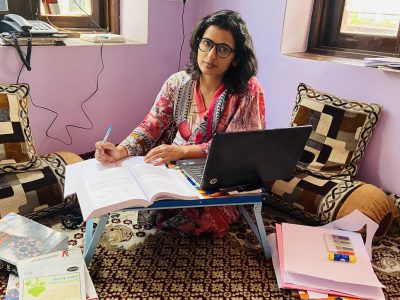
Masrat Maswal, 33, is an assistant professor in chemistry at a government college in central Kashmir’s Budgam district. She grew up middle class in an extended family where attention and money were scarce. Her parents paid more attention to her in high school, where she excelled academically and won praise from her teachers. But she said that Kashmiri society does not make it easy for young women who want to pursue post graduate work and demanding research positions in the sciences. “From the day you are born as a girl in a family in Kashmir, they start to prepare for your marriage; so choosing a career—particularly in science, which needs patience, persistence, hard work, sacrifices and an ample amount of time—is really hard,” she said. [caption id="attachment_2704" align="alignnone" width="300"] Masrat Maswal at home in Kashmir.[/caption] Her female students are often deterred from pursuing graduate work in the sciences by social pressures to marry and settle down when they are in their twenties. “We are losing a lot of talent,” she said, “Due to the prevailing socio-cultural norms of our society.” The lack of proper infrastructure and lab facilities in Kashmir’s colleges also undermines the enthusiasm of both students and teachers, she added.

Family support matters

Amreen Naqash, 31, moved to New Zealand in 2019 to study for a doctorate in pharmacology and toxicology at the University of Otago. In her spare times she mentors students in her native Kashmir who want to pursue graduate studies either in India or abroad. Women, she observed, are showing more interest in looking for fellowships and pursuing graduate work in the sciences at universities outside India. [caption id="attachment_2702" align="alignnone" width="200"] Amreen Naqash in her lab.[/caption] “I’m in touch with some promising female undergrads from Kashmir, which makes me so glad,” she said. “It is such a wonderful feeling to guide them as they are in their prime career stage.” Omera Matoo, 38, has a PhD in marine biology. She is an assistant professor in evolutionary genetics and physiology at the University of Nebraska in Lincoln, where her research is funded by the National Science Foundation (NSF). Born and raised in Kashmir, Dr. Matoo earned her B.A. and Master’s degrees at Bangalore University, where she became friends with two classmates from different parts of India, both of whom came from families of scientists. [caption id="attachment_2703" align="alignnone" width="300"] Omera Matoo in her lab.[/caption] “Looking back, I realize that played a very big role in my career,” she said. All three of them decided to pursue doctorates in the sciences.

Limited opportunities

When Dr. Matoo applied in 2007 for a doctoral program at a university in the United States, she had to travel to New Delhi and Bangalore to take her GRE and TOEFL exams; at the time, there wasn’t a single coaching or test center in Kashmir. The situation for prospective graduate students has since improved. Thanks to the internet, they can take standardized tests online. Mentoring initiatives like JKScientists have been established, with volunteers offering would-be graduate students help and advice. “And then there are other Kashmiri scientists across the world who struggled along similar paths before making a mark in their chosen fields; and now they are giving back to their society by mentoring and guiding young students and aspiring researchers.” Role models and social support structures, said Dr. Matoo, provide positive feedback for young people; this is especially true for female university students in Kashmir, who benefit from having their academic interests nurtured. Dr Seemin Rubab, a professor of physics at the National Institute of Technology in Srinagar, is regularly approached by young girls from Kashmir for career guidance and counseling. “Many times I’ve had to counsel their fathers and brothers to let them pursue their academic careers and avail themselves of opportunities outside Kashmir and India,” said Dr. Rubab. Professor Nilofer Khan, acting Vice Chancellor at the University of Kashmir who has also served as Dean of Student Welfare and founder coordinator of Women’s Studies Centre, confirmed that for years a lack of family support has been a serious obstacle for women who wished to pursue doctoral studies, particularly when they were married with children. “Very few females used to go for research studies in science subjects,” she said, adding that times were changing and female students were “proving their mettle” in the sciences. The frequent government-imposed internet shutdowns are a serious problem for students facing application deadlines, said Dr. Matoo. Delayed exams and the lack of access to resources—“all these limiting things have a scale up effect, not to mention the consequences for mental health,” she said. But somehow these obstacles have not undermined the enthusiasm and academic focus of the young women from Kashmir who regularly reach out to her for guidance on making a career in science. “I am constantly impressed and humbled by their resolve to make a bright future for themselves against all odds,” said Omera. “That gives me a lot of hope and in a way keeps me grounded.” [post_title] => Kashmiri women defy patriarchy & politics to pursue careers in the sciences [post_excerpt] => A notable number of Kashmiri women have become prominent scientists, despite periodic and unpredictable outbreaks of militarized violence, a lack of resources, and the pressure of traditional expectations. [post_status] => publish [comment_status] => closed [ping_status] => open [post_password] => [post_name] => kashmiri-women-defy-patriarchy-politics-to-pursue-careers-in-the-sciences [to_ping] => [pinged] => [post_modified] => 2024-08-28 21:08:26 [post_modified_gmt] => 2024-08-28 21:08:26 [post_content_filtered] => [post_parent] => 0 [guid] => https://conversationalist.org/?p=2696 [menu_order] => 199 [post_type] => post [post_mime_type] => [comment_count] => 0 [filter] => raw )

Kashmiri women defy patriarchy & politics to pursue careers in the sciences

WP_Post Object
(
    [ID] => 2142
    [post_author] => 2
    [post_date] => 2020-10-22 17:38:21
    [post_date_gmt] => 2020-10-22 17:38:21
    [post_content] => Sixty years after James Baldwin fled to Europe to escape his native country's racism, Americans are once again leaving to seek a better life.

Election day in the U.S. is November 3, but some Americans have already voted with their feet, fleeing a country whose values have become anathema to them: racism, police violence, the bizarre fantasies of QAnon, exorbitant living costs and daily anxiety of life under a Trump administration.

The U.S. government does not collect data on Americans who leave the country, but estimates that 8.7 million live abroad. A website with information on how to leave says that since May 2020 it has seen its traffic surge by 1,605 percent, or sixteen fold, for Americans seeking information on which countries are open and how to move.

Even if Trump loses, it appears that none of them will be rushing back.

“We do not plan to return to the U.S., regardless of the election outcome,” said Corritta Lewis, who moved in August with her wife and their year-old son to Playa del Carmen, Mexico. Like Tiffanie Drayton, a Black American writer whose June 12 New York Times Opinion piece about “fleeing” America to Guyana went viral, Ms. Lewis sees no future in the United States.  “A new president doesn't change the systemic racism, police brutality, wealth gap, and overall experience as a black woman in America. It took hundreds of years to build a society of oppression; that won't change in four.”

They left, she said, “due to the increased racial tensions, police encounters, politics, and overall safety. My wife and I are two Black women raising a biracial son, and we didn't want him to live in a country where his parents are harassed by police for being Black.” She continued, “On more than one occasion, we have been stopped and questioned by police for no reason. His first interaction with police scared him to the point that we cried for almost five minutes. It broke our hearts… We were simply two Black women in a nice neighborhood, taking a morning walk.”

“We haven't felt this free in our lives,” she added. “Mexico will probably be our home for the next several years… As the election approaches, I watch in horror and am scared for my family still in the States. I don't have confidence that things will get better anytime soon.”

For Black Americans, the choice to flee police brutality, racism and income inequality is compelling. For others, economic pressures can feel just as overwhelming. Why spend more than you have to for a safe and healthy life?

Tim Leffel, 56, and his family, chose Guanajuato, a colonial city in Mexico, in 2018; he has written a book explaining how to move abroad to more than 20 countries. “Our daughter is 20 now, but she went to school in Mexico for three years: one of elementary, two of middle school. Private school, but all in Spanish,” he said.

“We had no reason to stay in the U.S. and keep paying inflated prices for rent, healthcare, and other expenses. We own our home outright in Mexico. Living in Trump's America was becoming more stressful and unpleasant every month, so why pay a premium to put up with that deterioration?”

“It's doubtful we'll move back,” he adds. “The U.S. is just way overpriced for what you get, especially in terms of healthcare, the worst value in the world for self-employed people like me. If a new president and congress can get us to universal healthcare, different story.

For travel blogger Ketti Wilhelm, 30, being married to an Italian means moving back to his country of origin. Wilhelm has spent much of her life living and working outside the U.S. She and her husband have no children and can work remotely. “We'll most likely move back to Milan, because my husband's family is near there, and we both have friends and connections there.”

“Our motivations are political, but it's also about much more than that,” said Wilhelm. “It's what the politics means for living in the U.S.: minimal vacation time, no family leave, no pension, health insurance stress and massive health care costs. Not to mention safety concerns – guns, white supremacy, and mass shootings. All of this is because “socialism” is a dirty word in the U.S., whereas in all the other countries I've lived, it's just part of a modern, well-run and equitable society. There are other ways of living, both culturally and politically, and in plenty of ways, I think they're doing it better elsewhere.” Her recent blog post offers 11 ways to live and work overseas.

Working as an E.R. physician in training horrifies medical student Alex Cabrera, 30, who lives in Reno, Nevada. Now in his final year of medical school and taking an online degree in public health, he sees patients every day whose care, he knows, can medically bankrupt them—even with insurance. “It’s so hard to live here! Wages aren’t going anywhere, unemployment benefits have been cut, people have no health insurance and the rent here for a one bedroom is $1,200.” He recently drove a friend his age to her new home in Victoria, British Columbia and saw another leave for France.

He’s desperate to flee. “I feel like I’m screaming into the void. On one side, you have Donald Trump who just makes it up as he goes along and Biden promising to improve and expand the A.C.A. (Affordable Care Act), which the Supreme Court plans to overthrow.” He wanted to find a medical residency abroad but is resigned to doing his training in the U.S. for the next four years. “As a physician, it’s almost hard to practice medicine in this country when everything is about profit and patient care is secondary. I’m so tired of this system.”

Because the United States remains a global hot spot for exponential transmission of the novel coronavirus, most countries are no longer allowing its citizens to enter without a pre-approved visa. Exceptions among the European countries include Croatia, Albania, Belarus, Bosnia & Herzegovina, Kosovo, Montenegro, North Macedonia, Serbia, and Ukraine. “However all European countries are accepting and approving applications for resident and work visas for U.S. citizens,” says Cepee Tabibian, founder of a website with information for women over 30 who choose to leave the U.S. “They can't [currently] travel to most European countries,  but they can still apply to move right now,” she said. And prior knowledge isn’t an issue, she adds. “You'd be surprised how many people move to a country they have never been to or have maybe visited once in their life.”

Tim Page is one. A Pulitzer-winning music critic and journalism professor at the University of Southern California, he boarded a flight from New York to Belgrade a few months ago, arriving to live in a place he’d never seen. He owns a house in Nova Scotia, but the Canadian border remains closed to Americans and he was deeply disturbed by the U.S. government’s mishandling of the COVID-19 pandemic. He wanted out.

“I'd had some students at USC who came from Belgrade and who kindly adopted me on Facebook and took me out once I had begun to acclimate myself,” he says. “My welcome was a warm one, and this may have been the most beautiful and radiant autumn I've experienced since childhood. It's a fantastic walking city and built in so many layers…I feel very much at home.”

“I'm unmated, I have no dog, my children are grown and doing well. I communicate with my friends through video conversations, phone calls, email, and I keep a nervous eye on developments in the States through on-line television. It's a much gentler life and, at 66, I appreciate the order,” Page adds. The rent for his one-bedroom apartment is $400 a month.

“I'll stay until I want to return,” he says. “Social Security has just kicked in. I have dear friends in Vienna, Berlin, Amsterdam and London whom I'd love to see when things open up a bit, but life is startlingly less expensive here and I think this will likely be "home base" for me in Europe for however long I stay. I'm much more at ease than I've been in a while.”
    [post_title] => 'Another Country,' redux: Americans are (again) moving abroad to seek a better life
    [post_excerpt] => For Black Americans, the choice to flee police brutality, racism and income inequality is compelling. For others, economic pressures can feel just as overwhelming.
    [post_status] => publish
    [comment_status] => closed
    [ping_status] => open
    [post_password] => 
    [post_name] => im-so-tired-of-this-system-a-broad-swathe-of-americans-are-moving-abroad-with-no-plans-to-return
    [to_ping] => 
    [pinged] => 
    [post_modified] => 2024-08-28 21:15:13
    [post_modified_gmt] => 2024-08-28 21:15:13
    [post_content_filtered] => 
    [post_parent] => 0
    [guid] => http://conversationalist.org/?p=2142
    [menu_order] => 240
    [post_type] => post
    [post_mime_type] => 
    [comment_count] => 0
    [filter] => raw
)

‘Another Country,’ redux: Americans are (again) moving abroad to seek a better life

WP_Post Object
(
    [ID] => 2129
    [post_author] => 2
    [post_date] => 2020-10-16 04:44:02
    [post_date_gmt] => 2020-10-16 04:44:02
    [post_content] => “Show me your budget, and I will tell you what you value.”
--Joe Biden

In 2019, America spent $732 billion on its military. China, India, Russia, Saudi Arabia, France, Germany, the United Kingdom, Japan, South Korea and Brazil spent $726 billion combined. Since American defense philosophy is predicated on the belief that national defense is better carried out abroad rather than at home, it spends billions of dollars on overseas military bases—of which the U.S. has more than any other nation—and aircraft carriers.

Meanwhile, more than 210,000 Americans have died from COVID-19 and more than 7 million have contracted the virus, according to the Center for Disease Control. But the Republican-controlled Senate has refused to approve bills initiated by the Democrats, which would provide relief of $2,000 per month to people deprived of an income, even as frontline healthcare workers struggled during the height of the pandemic to secure personal protective equipment (PPE) while the federal government declined to help. 

The country with the biggest economy in the world failed to protect its citizens from unemployment, economic recession, and a pandemic. 

It’s clear we value guns and other weapons of war over the medical needs of citizens those arms are supposed to protect. 

Last summer, as financial relief to individuals under the CARES Act was about to end, Senators Bernie Sanders and Ed Markey proposed an amendment to the $740.5 billion annual defense budget that would cut 10 percent, or $74 billion, and invest the funds in education, healthcare, and housing in poor communities. 

The Senate rejected the amendment, with 37 Democrats joining their Republican colleagues to vote “no.” Senators Sanders, Warren, and Markey were among those who voted in favor of the amendment. 

In the House, Democrats split 92-139 against the amendment to cut the defense budget. This prompted Representative Ro Khanna, a progressive Democrat representing California’s 17th District, to tweet: "I don’t want to hear anyone tell me that we can’t enhance expanded unemployment benefits when we spend more on endless wars than the next ten countries combined."


Bernie Sanders argued that the cut would help create jobs by building schools, affordable housing, hospitals, sustainable energy, clean water facilities and other community centered needs that have been proven to improve health and decrease crime. It would help the federal government improve education by reducing class sizes, increasing teacher pay and supporting free public tuition for universities, colleges and trade schools.  

More poignantly, Sanders said:

 If this horrific coronavirus pandemic has shown us anything, it is that national security involves a lot more than bombs, missiles, tanks, submarines, nuclear warheads and other weapons of mass destruction. National security also means doing all we can to improve the lives of the American people, many of whom have been abandoned by our government for decades.

The United States government claims to be protecting its citizens from foreign threats, yet cannot shield them from domestic ills like homelessness, underpaid teachers, the lack of universal healthcare, and failure to implement a minimum wage that keeps full-time workers out of poverty.  The conservative position is that a superpower needs a strong military to protect itself from “emerging threats” in China, Iran, North Korea and Russia.  But what good is a strong military if it protects a nation that cannot provide food to low-income school children And what good is it to be a nuclear power if America cannot solve the problem of Black women—ironically America’s most committed voters—dying at childbirth at higher rates than any other ethnic group in America? President Dwight Eisenhower warned in 1961 of an oversized military when he spoke of an overinvestment in military spending and the excessive influence of the “military industrial complex.” We have failed to heed that warning. We need to reimagine what safety means. America’s defense policy needs to change, beginning with its position on nuclear weapons. As late as the 1980s, the United States and the former Soviet Union held close to 90 percent of the world’s nearly 75,000 nuclear weapons; through various nuclear non-proliferation treaties, that figure has dropped to around 14,000, with the U.S. and the Russian Federation continuing to hold 90 percent.  Serious, knowledgeable people have called for reducing America’s weapons stockpile. William Perry, who was Deputy Secretary of Defense during the Clinton Administration, wrote in a 2017 Washington Post op-ed that America’s proposed $1.7 trillion nuclear weapons spending was unnecessary. No surprise attack could destroy all of the navy’s submarines, he explained; but the risk of a conventionally armed cruise missile being mistaken for one with a nuclear warhead was real—as shown by the three narrowly averted Cold War catastrophes. Moreover, cutting nuclear-armed cruise missiles and cancelling plans to replace Intercontinental Ballistic Missile (ICBM) stockpiles would save $30 billion and $149 billion, respectively—i.e., more than double the $75 billion that would be saved with a 10 percent cut to the current military budget.  Similarly, Berry Blechman of the Stimson Center, a nonpartisan think tank in Washington, D.C., argued in a 2016 opinion for the New York Times that the $1 trillion nuclear weapons modernization program approved by President Obama was unnecessary because it would “impose an increasing burden on the defense budget, making it difficult to maintain our conventional military superiority—the real guarantee of U.S. security.” Like Perry, Blechman recommends cutting more than 100 ICBMs.  Defunding the Pentagon is an essential strategy for appropriating funds to social services, exactly as is defunding police departments that do not actually reduce crime. This is a message the public needs to hear. America has 6,800 nuclear weapons in its arsenal. But it only takes 100 nuclear weapons to destroy the Earth. And yet, the Trump Administration has asked for $29 billion in nuclear weapons spending for the 2021 fiscal budget—even though the president’s own Air Force Chief of Staff has argued that the Pentagon cannot afford it.  COVID-19 has killed more Americans than the five most recent wars the U.S. has been involved in combined. Our current military outlook is too focused on defending the homeland instead of actual Americans who actually reside in it. Republicans are angling to push through a SCOTUS nominee to end the Affordable Care Act, threatening to strip millions of Americans of the only healthcare safety net they have—during a pandemic.   Small businesses are struggling to secure COVID-19 relief while Donald Trump, a billionaire, notoriously paid only $750 per year in federal income tax. During the 2012 presidential debates, Mitt Romney worried that the U.S. had fewer naval ships than at any other point in the country’s history—to which Obama responded that it also had fewer horses and bayonets. In other words, having more doesn’t make us stronger; on the contrary, being smaller and nimbler makes us more efficient. Obama was wrong to dismiss the threat to U.S. security posed by the Kremlin, but Putin’s most potent weapon wasn’t the military: it was disinformation and election meddling, against which Republicans in Washington refuse to protect the nation.  The United States Postal Service is an essential service, particularly during a pandemic election year, when millions are choosing to mail their ballots rather than risk being infected by COVID-19 while standing in line to vote. And yet, the USPS is facing a budget crisis. We are a democracy that can single-handedly destroy the Earth, but can’t make it possible for every citizen to vote. The knowledge that we have an arsenal of unnecessary nuclear weapons and a military capable of occupying several nations simultaneously might make conservatives feel secure. I’m willing to bet, however, that most Americans would rather have universal healthcare, affordable housing, and improved public education. That silent majority must surely feel some bitterness at seeing their tax dollars allocated to fund endless wars when the local hospital doesn’t even have enough ventilators to save all the Covid-19 patients.    [post_title] => The case for taking from the Pentagon and giving to the people [post_excerpt] => What good is a strong military if it protects a nation that cannot provide food to low-income school children?  [post_status] => publish [comment_status] => closed [ping_status] => open [post_password] => [post_name] => guns-for-butter-the-case-for-taking-from-the-pentagon-and-giving-to-the-people [to_ping] => [pinged] => [post_modified] => 2024-08-28 21:11:30 [post_modified_gmt] => 2024-08-28 21:11:30 [post_content_filtered] => [post_parent] => 0 [guid] => http://conversationalist.org/?p=2129 [menu_order] => 241 [post_type] => post [post_mime_type] => [comment_count] => 0 [filter] => raw )

The case for taking from the Pentagon and giving to the people

WP_Post Object
(
    [ID] => 1810
    [post_author] => 2
    [post_date] => 2020-06-11 18:30:26
    [post_date_gmt] => 2020-06-11 18:30:26
    [post_content] => By failing to invest in child care, the U.S. government is placing mothers in an impossible position.

Ashley Patrick was thrilled to land a full-time position at a prestigious publishing house in July 2016. The job came with smart, bookish colleagues, opportunities for advancement, a regular salary, and health insurance. For a Brooklyn-based writer and editor, it was a rare and valuable opportunity.

At the time she had two young sons, a husband who also worked full-time, and no flexibility. By the end of 2018, Patrick and her husband had three children. The combined monthly cost of full-time daycare for the baby and after-school programs for the boys was an unaffordable minimum of $3,250. In February 2019 she made the painful decision to leave her job.

“A big part of my decision to leave was the cost of child care,” Patrick told me in a recent phone conversation. “Which was a great disappointment because I was on an upward trajectory in the company.” She had been promoted shortly before the birth of her youngest and was on track for another promotion in the next year and a half. Getting that second promotion “would have made a big difference in terms of mobility from one publishing house to another.”

The kids are now nine, seven, and 18 months old. Patrick has managed to carve out a thriving freelance business, but, with schools and daycares closed due to the pandemic, she is now trying to work and supervise her boys’ online lessons from her small apartment. Her husband, who had been earning a good salary at a major company, was laid off eight months after she quit her own job—in part, Patrick suspects, because he took the family leave he was entitled to when their third child was born. She does not know what they’ll do when schools reopen—there is still no ideal option for the baby, and the boys attend schools in different neighborhoods with different start times, making pick-up and drop-off complicated and time-consuming.

Patrick and her family are hardly alone in finding the demands of child care and full-time employment increasingly unmanageable.

According to the Organisation for Economic Co-operation and Development (OECD), there are only four countries in the world where couples with young children who earn the average wage spend more than 30 percent of their salary on child care: New Zealand, the U.K., Australia, and the United States. In Korea, Austria, Greece, and Hungary, the average couple spends less than four percent of their income on child care. Mothers in Sweden, France, and Canada report being satisfied with the overall quality, availability, and cost of child care in those countries, all of which have government-run or heavily subsidized child care systems.

Erika Gubrium, a professor at Oslo Metropolitan University who has two sons, ages eight and 11, explained in response to questions sent by email that child care in Norway is offered through a mix of public and private day cares partially subsidized by the state. The cost of a full-time spot at a daycare in Oslo is approximately 3,100 Norwegian krone per month (around $302 USD). Some families pay reduced fees if they earn less and in some areas, day care is completely free for children of certain ages. In Gubrium’s words, “There is NO opposition to government funding of child care, as there is strong sentiment across the political board that the state should support measures that enable both parents to work full-time.”

When child care is consistent, affordable, and easy to access, more women work outside of the home. Quebec’s government-subsidized child care program led to a workforce participation rate of 85 percent for women ages 26 to 44—the highest in the world, according to University of Quebec at Montreal economist Pierre Fortin. The increased tax revenue covers more than 100 percent of what the government spends on child care. “In other words, it costs zero, or the cost is negative,” Fortin told CityLab in 2018. The program also saves money by reducing the number of families on public assistance.

Hannah Selinger, a freelance writer in East Hampton, New York, has two sons, ages three and one-and-a-half. Finding convenient child care for both, she said in a phone interview, has been a “nightmare.” She quit her well-paid job to be a stay-at-home mother when she became pregnant with her first child because her partner’s salary was double what she made. Since then her freelance writing career has taken off, requiring more of her time, but the logistics of child care are making that nearly impossible. The fee for her eldest son’s preschool is $12,000 per year for three half days per week, and it’s a 30-minute drive from her home, meaning she spends six hours per week driving him (and his little brother) there and back.

Carolina Gonzalez-Villar lives in California’s Bay Area with her husband and their four-year-old son. Her father, who is retired, took care of her son until he was 18 months old. Without her father, she said, her family would have had to bear the expense of a nanny. She and her husband decided they couldn’t afford another child, given that child care where they live costs up to $2,500 per month.

A shorter workweek would reduce both child care costs and parental stress. “We have doubled productivity since the 1960s; there is no reason we shouldn’t make the same money or better and work fewer hours,” said Erin Mahoney, who lives in Queens with her 2-year-old child. Mahoney described the search for child care as one of the most stressful parts of her pregnancy. “A month before my maternity leave ended, I was still trying to figure it out.”

The burden of navigating America’s patchwork child care system falls disproportionately on mothers. Ashley Patrick recently wrote on Facebook, in response to a comment about child care centers refusing to disclose their fees until parents have scheduled a tour, “The last thing I wanted to be doing while uncomfortably pregnant and frantically prepping at work for maternity leave and scheduling and attending a zillion doctor’s appointments was making still more phone calls and sending more emails to check tuition fees.”

Liz Grefath, a mother of two young sons who lives in Brooklyn, recently wrote on Facebook that “people use words like ‘challenge’ to describe [the search for adequate child care] but that is such a neutral word.” What most U.S. parents are really engaged in, she added, is “all-out scavenging, plotting, and survivalism.”Another problem with the U.S. system is that child care providers and preschool teachers are among the worst-paid workers in America. As of 2018, 58 percent of child care workers in California were paid so little that they qualified for public assistance. Some cannot afford to have children of their own.

“One thing I find really frustrating about child care is that it’s almost prohibitively expensive for parents yet the teachers are paid close to minimum wage,” Arielle Harrison recently wrote on Facebook. Harrison, who lives in Connecticut with her husband and their two young sons, continued: “I don’t see how the economics work without some form of government subsidy.”

The U.S. provides limited subsidies to low-income families, she acknowledged, but providers are still grossly underpaid.

Historically, the U.S. government has found the money for child care when it needed women to work. President Franklin Roosevelt used funds from a wartime infrastructure bill to establish a national network of child care centers for women who took factory jobs to support the war effort (remember Rosie the Riveter?). The centers were shut down under the Truman administration, despite a battle waged by mothers, social welfare groups, unions, early childhood educators and social workers to keep them open. That was the last time the United States offered universal child care.

In May 1971, two New York congresswomen—Shirley Chisholm of Brooklyn and Bella Abzug of Manhattan—introduced a bill that would have set aside billions of dollars in federal funds for child care. A watered-down version eventually passed the House and the Senate, only to be vetoed by Nixon, on the advice of his special assistant Pat Buchanan. Nixon described the bill as “radical,” “family-weakening” and tantamount to endorsing “communal” childrearing as opposed to “the family-centered approach.”

Jen Sunderland, a child care provider and mother of a 14-year-old in New York City, pointed out in a phone conversation that the U.S.’s “family-centered approach” is the problem. Instead of acknowledging that the entire society benefits when children are well cared for, our system places “all of the burden of that work on individual families.”

For women, child care decisions are inextricably tied to stagnant wages and unequal pay. The majority of mothers who “choose” the work of childrearing over a paying job do so because they would earn less or only marginally more than they would have to spend on child care if they worked.

The situation is even more dire for single parents. Nearly a quarter of U.S. children live in single-parent households, the vast majority of which are headed by women. Single parents earning an average wage spend 52.7 percent of their income on child care, which surely contributes to the fact that 30 percent of single mothers live below the poverty line.

Child care was a campaign issue in the 2020 presidential election cycle for the first time since the 1970s. Elizabeth Warren was the first to unveil a plan; Bernie Sanders’ plan was the most comprehensive. Joe Biden has not presented one. Earlier in 2020, he told Fortune that, under a Biden administration, children will be able to attend “high-quality, universal prekindergarten at no cost” and parents “will get up to $8,000 in tax credits” to offset child care costs. In 2016 the Center for American Progress, which advised Hillary Clinton’s presidential campaign, recommended offering child care tax credits of up to $14,000 per child.

The pandemic has brought the U.S.’s deepening child care crisis into even sharper relief. Daycares are closed and many schools will not reopen until the fall. Millions of parents are now either seeking work or attempting to hold onto their jobs while caring full-time for young children. In states where businesses are reopening, many now face a choice between returning to work and leaving their kids who knows where, or staying at home with their kids and losing their jobs or part of their income.

In a 1981 op-ed headlined “Congress is Subsidizing Deterioration of Family,” Joe Biden argued against expanding a child care tax credit to include families with higher incomes and labeled day care centers and nursing homes “monuments to our growing unwillingness to accept personal responsibility for those to whom we owe the most.”A lot has changed since 1981. What hasn’t changed is the need for the government to treat child care as a social responsibility, not a personal one.

Whatever happens in November, the U.S. will almost certainly end up with either a President Trump, who has agreed to spend more on child care block grants for low-income families and doubled the federal child tax credit to $2,000, or a President Biden, who has talked about “making sure that every single solitary person needing child care gets an $8,000 tax credit.” The average American family spends nearly $15,000 a year on child care.“We dread the idea that our day care might not come back from [the pandemic],” Josef Szende, who grew up in Canada and lives in New York City with his wife and their 15-month-old son, told me via Zoom. “We don’t know what we would do…we’d move from that lucky whatever percent who somehow made it work in New York City into the majority for whom it’s not working.”

Congress voted to invest billions in child care nearly 50 years ago. It’s past time to make good on that promise.
    [post_title] => The United States cannot put its economy in order unless it invests in child care
    [post_excerpt] => The United States is one of only four countries in the world where couples earning an average wage spend more than 30 percent of their income on child care. Women are paying the highest price.
    [post_status] => publish
    [comment_status] => closed
    [ping_status] => open
    [post_password] => 
    [post_name] => the-united-states-cannot-put-its-economy-in-order-unless-it-invests-in-child-care
    [to_ping] => 
    [pinged] => 
    [post_modified] => 2024-08-28 21:15:14
    [post_modified_gmt] => 2024-08-28 21:15:14
    [post_content_filtered] => 
    [post_parent] => 0
    [guid] => http://conversationalist.org/?p=1810
    [menu_order] => 262
    [post_type] => post
    [post_mime_type] => 
    [comment_count] => 0
    [filter] => raw
)

The United States cannot put its economy in order unless it invests in child care

WP_Post Object
(
    [ID] => 1259
    [post_author] => 2
    [post_date] => 2019-07-26 18:42:23
    [post_date_gmt] => 2019-07-26 18:42:23
    [post_content] => Despite the bleakness of the current political moment, the slide to authoritarian oligarchy is not inevitable.

America’s inequality crisis has emerged as the central issue of the 2020 presidential campaign. The realization that “it’s the economic inequality, stupid,” was a long time coming, given that the global economic crisis of 2008 is now more than a decade behind us. During the intervening years the global grassroots Occupy movement demonstrated for months to raise awareness, staging sit ins on Wall Street in New York and in major cities across Europe. In remarks delivered in 2013, Barack Obama called economic inequality “the defining challenge of our time.” And three years ago an anti-establishment voter revolt gave the United States its first plutocrat president in the form of Donald J. Trump. Americans have at last come to understand the effect of economic inequality on their lives. But the question of how to address inequality is fraught with controversy.

At the Democratic party debates in June, nearly all of the candidates for the presidential nomination railed against the U.S. economy for benefitting only the very rich. Senators Elizabeth Warren and Bernie Sanders, who have made inequality their signature issue, have both proposed detailed plans that would completely remake the American economy. Even frontrunner Joe Biden, for years affiliated with centrist politics, noticed that progressivism was rising in popularity; he too is now talking about inequality—with his donors.

All this is a far cry from the “America is already great” message that hampered the Clinton campaign in 2016, but is undoubtedly closer to the way Americans actually feel. Six years ago, the English edition of Thomas Piketty’s seminal book Capital in the Twenty-First Century was published, becoming a surprise bestseller and a cultural phenomenon. At the time, economists regarded as controversial Piketty’s warning that if the concentration of wealth and power remains unchecked we risk repeating the adverse conditions of the nineteenth century. In a 2016 paper, however, French economists Emmanuel Saez and Gabriel Zucman showed that American inequality is at levels unseen since the Roaring 1920s, with the top 0.1 percent controlling 22 percent of the wealth. This year, former Fed chairman Paul Volcker told the New York Times that the U.S. is “developing into a plutocracy.” Nobel laureate economist Joseph Stiglitz has written that the American economy is “rigged.” In the media, you can often see our current era referred to as the Second Gilded Age, after the period between the end of the Civil War and the beginning of the twentieth century, when inequality ran rampant and robber barons like Andrew Carnegie, John D. Rockefeller and J. P. Morgan plundered and pillaged their way into unimaginable wealth.

But Americans, who encounter extreme concentrations of wealth and power wherever they turn these days, don’t need economists to tell them what they already know: that capitalism, or at least their country’s form of it, is broken — perhaps irreparably. While the U.S. is among the world’s wealthiest countries, it is also, according to the UN, “the world champion of extreme inequality.” Forty million Americans live in poverty; in some areas of the country, life expectancy is equivalent to that of developing states. Meanwhile, “deaths of despair” — caused by drug abuse, alcoholism and suicide — have spiked. According to the UN, Americans lead “shorter and sicker lives, compared to people living in any other rich democracy.”

The American Dream — the idea that if you worked hard, you could succeed regardless of where you were born or what your parents earned — is still the national ethos, despite the fact that the U.S. currently has the lowest rate of economic mobility of any industrialized democracy. In contrast to earlier generations, very few young Americans will do better than their parents: they are buried in debt, struggling with rising rents and healthcare costs, and see more deaths from suicide and drug overdose than any other age group. The life trajectory of most contemporary Americans is inextricably linked to their parents’ education and income, and to their geographic location. A recent study by researchers at the N.Y.U. School of Medicine, for instance, found a 30-year gap in life expectancy between two neighborhoods in Chicago, one rich and one poor.

Republicans, meanwhile, passed an enormous $1.5 trillion tax cut for the wealthy and are now considering another one, while trying to cut Social Security and kick millions off Medicaid. White-collar crime prosecutions are at a record low, the president is openly corrupt, and corporate lobbyists literally run the government. Is it any wonder that polls have repeatedly shown that over two thirds of Americans believe the economic and political systems are rigged in favor of big business and the rich? This is why millions of voters paid attention when Donald Trump said during his presidential campaign that “the American dream is dead.”

While growing inequality has long been a fact of American life, income inequality has increased dramatically since the mid-1970s, to the point where the top one percent now earn 26.3 times more than the other 99 percent. And while the top one percent’s share of the nation’s earnings has doubled during that period, the top 0.1 percent fared even better: their incomes quadrupled, even as incomes for the bottom 90 percent, once adjusted for inflation, have remained stagnant.

But it is the distribution of wealth that truly highlights the vast disparities hidden by four decades of policies that have created the illusion of economic prosperity. In the U.S. today, wealth is concentrated to such an extent that three men alone — Bill Gates, Jeff Bezos, and Warren Buffett — are richer than the bottom half of the entire population. Recent data released by the Federal Reserve reveals in startling detail how the distribution of wealth in the U.S. became so unequal. Matt Bruenig of the People’s Policy Project, who analyzed the data, calculated that between 1989 and 2018, the net worth of the top one percent increased by $21 trillion, while the bottom 50 percent became poorer to the tune of $900 billion during the same period. In 2018, Bruenig finds, the top one percent owned “nearly $30 trillion of assets while the bottom half owns less than nothing, meaning they have more debts than they have assets.”

A 2018 study by researchers at the University of Bonn shows how the 2008 financial crisis exacerbated U.S. inequalities, particularly for black households, as the crisis contributed to the widening of a racial wealth gap that had already persisted for decades due to systemic discrimination. According to the authors, the median black household has only 12 percent of the wealth of a median white household and earns about half the income, leaving black households 80 percent poorer than white households. The economic crisis of 2008 erased the few gains they had made, while over the past 70 years “virtually no progress” has been made in reducing wealth inequality between blacks and whites in the United States.

The U.S. is the most extreme example, but most of the world has seen increased inequality over the past 40 years. In the U.K., deaths of despair have spiked following a decade of deliberately cruel austerity policies. In France, 2018’s gilets jaunes protests highlighted the country’s inequality crisis, partly fueled by Emmanuel Macron’s policy of cutting taxes to the top one percent while leaving those clinging to the lowest rungs of the income ladder worse off.

The causes of rising inequality vary from country to country, but in the U.S. and Europe the economic literature points to a few culprits. These include automation, the decline of organized labor, financial deregulation, regressive tax systems that allow the rich to cut their own taxes, and globalization. In the U.S. in particular, a growing body of research points to monopoly power and diminishing competition across the American economy as a major contributor. Among economists, a new movement highlights the negative impact done by decades of policies based on dubious market fundamentalist reasoning.

At the heart of all this is the ongoing failure of capitalist democracies to counter growing concentrations of wealth and power, which in turn fuel voter discontent and elevate populist authoritarians to power worldwide. In recent years many have raised the questions of why liberal democracy failed to address the rise of economic insecurity, or why the popular backlash to rising inequality has been marked by a turn toward far-right nativism —  as opposed to, say, a demand for higher taxes on the rich. Some, like Harvard economist Dani Rodrik and author Thomas Frank, argue that the answer lies in the left and center-left parties’ abdication of their historical responsibility toward low-income workers. Whereas the right has always been up front about its allegiance to business elites, the complicity of center-of-left parties in the policies that increased inequality has made them ill-equipped to address the problems that they helped create. A 2018 study by Piketty seems to confirm this view.

With democracies unable to ensure prosperity for all but the rich and well-connected, support for democracy is decreasing. In a recent speech, Angus Deaton, the Nobel Prize-winning economist, declared that rising inequality threatens democratic capitalism. But it’s not the “capitalism” part that’s under threat. Despite their populist protestations, far-right authoritarians like Brazil’s Jair Bolsonaro and Donald Trump are not opposed to rabid capitalism or even globalization—they just don’t believe democracy must be a part of it, or that it should stop them from giving handouts to their friends. Vanderbilt law professor Ganesh Sitaraman explains that the real threat to liberal democracy “isn’t authoritarianism—it’s nationalist oligarchy.” If left unchecked, the future of Western democracies could look a lot like Brazil, where pervasive inequality and lack of elite accountability gradually eroded support for democracy until the authoritarian Bolsonaro could rise to power — with the help of the country’s business elites.

Despite the bleakness of the current political moment, the slide to authoritarian oligarchy is not inevitable. One remedy, particularly in the U.S., is tougher enforcement of antitrust laws, which is necessary to constrain the power of corporate monopolies. Another, as historian-turned-folk hero Rutger Bregman told members of the global elite gathered in Davos earlier this year, is astoundingly simple: “Taxes, taxes, taxes.” Our current system, as documented by Zucman, is built upon massive tax evasion amounting trillions of dollars, by multinational corporations and the ultra-rich. Any solution to our inequality crisis necessarily involves wealthy people paying their fair share.

Any attempt at meaningful reform, however, would inevitably have to contend with the fact that all of our political and regulatory institutions have been completely captured by big business and the rich. Which brings us back to the 2020 elections.

The 2020 presidential election is not just a referendum on Trump’s authoritarian populism. It is also a test case for the ability of democratic capitalism to correct itself. The Democratic party’s candidate is thus a critical matter, whether that person is a progressive like Sanders or Warren, whose promises include a more equitable construction of the American economy, student debt forgiveness, reining in corporate power and a wealth tax; or a lifelong neoliberal centrist like Biden, who recently promised his donors that despite his newfound interest in income inequality, under his presidency “no one’s standard of living will change, nothing will fundamentally change.”

The choice goes beyond the likelihood of defeating Trump, straight to the heart of the debate over what American capitalism, and democratic capitalism in general, mean in the twenty-first century. Does democracy mean an oligarchy rooted in injustice, which is what we have had for the last few decades; or should it be a system that benefits the whole of society, rather than only a select few?
    [post_title] => In 2020, America will decide between oligarchy and egalitarianism
    [post_excerpt] => While growing inequality has long been a fact of American life, income inequality has increased dramatically since the mid-1970s, to the point where the top one percent now earn 26.3 times more than the other 99 percent. 
    [post_status] => publish
    [comment_status] => open
    [ping_status] => open
    [post_password] => 
    [post_name] => the-2020-presidential-election-will-either-make-or-break-democratic-capitalism
    [to_ping] => 
    [pinged] => 
https://democracyjournal.org/magazine/51/countering-nationalist-oligarchy/
    [post_modified] => 2024-08-28 21:11:30
    [post_modified_gmt] => 2024-08-28 21:11:30
    [post_content_filtered] => 
    [post_parent] => 0
    [guid] => https://conversationalist.org/?p=1259
    [menu_order] => 310
    [post_type] => post
    [post_mime_type] => 
    [comment_count] => 0
    [filter] => raw
)

In 2020, America will decide between oligarchy and egalitarianism

WP_Post Object
(
    [ID] => 1199
    [post_author] => 5
    [post_date] => 2019-07-11 14:36:49
    [post_date_gmt] => 2019-07-11 14:36:49
    [post_content] => Liberal politicians are taking up a grassroots challenge to raise the minimum wage, for both humanitarian and pragmatic reasons

This week, four New Hampshire politicians have accepted the Minimum Wage Challenge (on Twitter: #MinimumWageChallenge or #LivetheWage). They will attempt to live on the $290 that a full-time employee earning minimum wage takes home at the end of the week. The four politicians, all Democrats, are promoting a bill to raise the state minimum wage to $12 an hour by 2022. The Concord Monitor reports that while Republican Governor Chris Sununu hasn’t weighed in on this bill specifically, he has raised the old claim that raising the minimum wage will hurt businesses.

In recent decades opponents of a rise in the minimum wage claimed it would “kill jobs” as companies and “American small businesses” cut staff or turned to automation to keep costs down. New research, however, tells a different story — as The Washington Post reports. Some of the benefits of higher minimum wage include: fewer suicides; reduced recidivism; higher worker productivity; more consumer spending; and falling poverty rates.

As for the assertion that increasing the minimum wage kills jobs: A study published this May in The Quarterly Journal of Economics finds that the number of low-wage jobs has remained “essentially unchanged” in the five years following a minimum wage increase. Unfortunately, the Congressional Budget Office, in analyzing the impact of raising the federal minimum wage to $15/hour, has used outdated research and arrived at overly pessimistic conclusions.

Last year, Disneyland workers set an example for the world by rallying to protest wage disparity between a CEO raking in more than $100 million a year and the rock-bottom wages of park workers, three-quarters of whom report that they don’t make enough to cover their basic expenses each month.

“What these workers are doing, standing up against the greed of one of the most powerful and profitable corporations in America, takes an enormous amount of courage,” Bernie Sanders writes in a 2018 op-ed for The Guardian. He continues:

"If they are able to win a livable wage with good benefits from Disney, it will be a shot heard around the world. It will give other low-wage workers at profitable corporations throughout the country the strength they need to demand a living wage with good benefits."

The workers won an agreement to bump wages to $15/hour in 2019. Jeff Bezos caved under similar pressure and agreed to raise wages for Amazon workers to $15/hour. but even so, critics say that the increase still fails to keep pace with the cost of living in places like Orange County, where a Disney park and resort are located. Still, every win is worth celebrating, and the wins add up: According to a study by the National Employment Law Center, the Fight for $15 movement has won a $68 billion raise for 22 million low-wage workers in cities across America.   [post_title] => Once a left wing issue, the struggle for a livable minimum wage has become mainstream [post_excerpt] => Credible research finds that the number of low-wage jobs has remained “essentially unchanged” in the five years following a minimum wage increase. [post_status] => publish [comment_status] => open [ping_status] => open [post_password] => [post_name] => once-a-left-wing-issue-the-struggle-for-a-livable-minimum-wage-has-become-mainstream [to_ping] => [pinged] => [post_modified] => 2024-08-28 21:08:26 [post_modified_gmt] => 2024-08-28 21:08:26 [post_content_filtered] => [post_parent] => 0 [guid] => https://conversationalist.org/?p=1199 [menu_order] => 315 [post_type] => post [post_mime_type] => [comment_count] => 0 [filter] => raw )

Once a left wing issue, the struggle for a livable minimum wage has become mainstream

WP_Post Object
(
    [ID] => 1191
    [post_author] => 2
    [post_date] => 2019-07-03 15:35:33
    [post_date_gmt] => 2019-07-03 15:35:33
    [post_content] => An unlikely partnership between politically opposed billionaires raises questions about the role money plays in ...  everything.

Perhaps the most surprising news this week is the unlikely partnership between two billionaires who represent opposite sides of the political spectrum. George Soros, the billionaire known for his liberalism, is partnering with the far-right Charles Koch to fund a Washington think tank that will promote a non-interventionist foreign policy. 

Stephen Kinzer, a senior fellow at the Watson Institute for International and Public Affairs at Brown University, describes his reaction to the announcement in  an op-ed for the Boston Globe:

"The depth of this heresy can only be appreciated by recognizing the meretricious power that nourishes Washington’s think-tank ecosystem… In foreign policy, all major Washington think tanks promote interventionist dogma: the United States faces threats everywhere, it must therefore be present everywhere, and “present” includes maintaining more than 800 foreign military bases and spending trillions of dollars on endless confrontations with foreign countries.” 

The Quincy Institute for Responsible Statecraft, as it will be known, will be led by a number of critics of American foreign policy, including Trita Parsi, the former president of the National Iranian American Council. Parsi said:

“It shows how important ending endless war is if they’re willing to put aside their differences and get together on this project. We are going to challenge the basis of American foreign policy in a way that has not been done in at least the last quarter-century.”

One of the loudest critics of billionaires bearing liberal gifts is Anand Giridharadas. In his book Winners Take All: the elite charade of changing the world, the former McKinsey consultant turned social critic attempts to answer the question: “What is the relationship between the extraordinary elite generosity of our time, which is real, and the extraordinary elite hoarding of our time?” Giridharadas’s conclusion: that elite generosity is a partner of elite hoarding. The billionaires’ partnership raises the issue of the role of money in, well, just about everything, explains Kelsey Piper in an article for Vox.  Institutional pushback against “endless war” feels like a relief and a welcome change in Washington, D.C., but one should temper one’s reaction with a healthy skepticism of billionaires who want to shape the world.  [post_title] => The problem with billionaires bearing liberal gifts [post_excerpt] => George Soros and Charles Koch would seem to be the most unlikely of partners, but the two billionaires have found synergy in their newly launched think tank. [post_status] => publish [comment_status] => open [ping_status] => open [post_password] => [post_name] => the-problem-with-billionaires-bearing-liberal-gifts [to_ping] => [pinged] => [post_modified] => 2024-08-28 21:15:14 [post_modified_gmt] => 2024-08-28 21:15:14 [post_content_filtered] => [post_parent] => 0 [guid] => https://conversationalist.org/?p=1191 [menu_order] => 316 [post_type] => post [post_mime_type] => [comment_count] => 0 [filter] => raw )

The problem with billionaires bearing liberal gifts

WP_Post Object
(
    [ID] => 1173
    [post_author] => 2
    [post_date] => 2019-06-27 15:09:19
    [post_date_gmt] => 2019-06-27 15:09:19
    [post_content] => Two of the leading candidates for the Democratic party's nomination unveiled plans to deal with the student debt crisis — and were met with a chorus of critics.

On Monday, Senator Bernie Sanders proposed eliminating all student debt, to the tune of $1.6 trillion. Sanders also wants to make public universities, community colleges, and trade schools all tuition-free. With his proposal, Sanders has one-upped Elizabeth Warren, his main opponent for the Democratic party nomination. Warren’s proposal is for a tiered loan forgiveness plan — up to $50,000 based on household income.

But while student debt is an enormous burden for both individuals and the economy, critics have nonetheless objected to the plans put forward by both Sanders and Warren. Kevin Carey, who directs the education policy program at New America, the Washington, D.C. think tank, writes in the New York Times that the plans fail to account for the largest cause of student debt in the United States — i.e., graduate and professional school programs. Adam Looney, a Brookings fellow cited in The Wall Street Journal, says that Warren’s plan would benefit higher earners. Matt Bruenig, a policy analyst who founded the People’s Policy Project, grapples with some of the inconsistencies in the plans; but he does not see any potential benefits.

However, as author and documentary filmmaker Astra Taylor reminds us in The Guardian, the call for student debt forgiveness began with grassroots organizing. The Debt Collective, an organization she co-founded, organized student strikes that resulted in the cancellation of more than $1 billion in debt acquired by people who attended fraudulent for-profit colleges. Nor is the Brookings Institute’s analysis the last word on “fairness”: Taylor cites research by sociologist Tressie McMillan Cottom and economist Darrick Hamilton, which shows that student debt disproportionately affects women and people of color. Debt forgiveness could help close the racial wealth gap.

Meanwhile, more than 150,000 victims of deceptive practices by for-profit colleges are suing the Department of Education for failing to deliver on debt relief that is already guaranteed by existing laws.

In other news:

Is your vacation ethical? Writing in Yes Magazine, travel writer Bani Amor asks how we can decolonize vacations. Read more. Why is a 40-year veteran of the environmental movement feeling hopeful? Read the op-ed. Meet the big-name brands that want to buy back your old clothing to reuse and recycle. Read more. [post_title] => Searching for a way to rescue the American dream [post_excerpt] => Senators Warren and Sanders, both candidates for the Democratic party nomination, have unveiled concrete plans that would address the prohibitive financial burden of higher education [post_status] => publish [comment_status] => open [ping_status] => open [post_password] => [post_name] => searching-for-a-way-to-rescue-the-american-dream [to_ping] => [pinged] => [post_modified] => 2024-08-28 21:15:14 [post_modified_gmt] => 2024-08-28 21:15:14 [post_content_filtered] => [post_parent] => 0 [guid] => https://conversationalist.org/?p=1173 [menu_order] => 318 [post_type] => post [post_mime_type] => [comment_count] => 0 [filter] => raw )

Searching for a way to rescue the American dream

WP_Post Object
(
    [ID] => 1019
    [post_author] => 2
    [post_date] => 2019-05-17 16:53:51
    [post_date_gmt] => 2019-05-17 16:53:51
    [post_content] => Gaza is often described as a humanitarian catastrophe, but its crisis is the result of self-serving policy implementation that could be reversed

Exactly a week after the most recent military escalation between Gaza and Israel, Haaretz, a left-leaning Israeli newspaper, placed on the front page of its Hebrew print edition a photograph depicting a crowd of Palestinians in Gaza gathered around a steaming cauldron of soup. Mostly men and boys, they are clamoring to get closer to the cauldron, clutching pots, bowls and even plastic storage containers to be filled. It is an aerial shot and you can almost hear the commotion through the image.

Over just three days during the first week of May, 25 Palestinian residents of Gaza and four Israeli citizens were killed while hundreds were injured. This was just the latest of eight military escalations since Operation Protective Edge in 2014. Israeli missiles and artillery fire damaged homes and businesses in Gaza, while barrages of rockets fired from the Strip hit dozens of homes in Israel in a tactic that seemed meant to overwhelm the Iron Dome defense system, which has until now prevented heavy damage and loss of life in Israeli cities and towns.

For most Israelis, Gaza exists only as a place of violence and misery. The images in the mainstream media depict its residents as either shooting rockets or clamoring for food. Israeli citizens can’t enter the Strip, and residents of Gaza are very rarely granted permission to enter Israel.

The misery-violence connection

While Israelis have little insight into the complex, nuanced realities of Palestinian society, many do see the link between violence and misery. In a poll conducted in early 2017, more than two-thirds of Israelis acknowledged that Israel would be serving its own interests by working to improve living conditions in Gaza. Israeli security experts — current and former military officials, analysts, and politicians — frequently warn that the misery in Gaza is a threat to Israel’s security. The terms of each ceasefire agreement have been variations on the same theme: Expanding the fishing zone, allowing more goods into Gaza, and granting exit permits to more people. But Israel regularly fails to implement the terms of the agreements, and Gaza’s desperate situation continues to deteriorate. If misery drives conflict, and everyone acknowledges this, why isn’t Israel doing more to prevent the next round of violence?

A crisis rooted in policy

Neither increased aid nor improved infrastructure can resolve the crisis in Gaza. The endless cycle of escalations, ceasefires, and unfulfilled concessions are symptomatic of a broader problem. The international community has allowed Israel to “manage the conflict” with the Palestinians, rather than take meaningful steps to end it. From Israel’s perspective, keeping Gaza in perpetual crisis is the point —not the problem. The two parties will remain stuck in this holding pattern, with escalations becoming increasingly frequent and their magnitude stronger, until external players who have an interest in ending the conflict compel Israel to shift course radically and take responsibility for the well-being of civilians in both Israel and Gaza. The crisis in Gaza today is rooted in policies implemented over the course of decades, particularly in Israel’s June 2007 decision, soon after Hamas took over, to declare Gaza a “hostile territory” and impose a closure. After 2007, Israel allowed only one crossing for the transport of humanitarian aid to remain open. The message was that Gaza could have aid but not an economy, subsistence but not prosperity. An Israeli official at the time said that the government’s policy was “no development, no prosperity, no humanitarian crisis” and in court proceedings the state articulated that its intention was to wage economic warfare against Gaza.  The justification for the closure, which Egypt joined by closing its own crossing point at Gaza’s southernmost point, was that it would squeeze Hamas into compliance — or place so much economic pressure on the general population, that it would rise up and overthrow Hamas. Over the ensuing 12 years, there have been three major military operations, more than a dozen interim escalations that felt very much like war to those experiencing them, and more than a year of protests at the perimeter fence where Israeli snipers have killed hundreds of unarmed protesters. Millions of Palestinians and Israelis have been affected by violence. Palestinians in Gaza have borne the vast brunt of the conflict, with Israel using its formidable military force on the small territory, which lacks bomb shelters and has an underfunded and overwhelmed medical system. Israelis — mostly in southern Israel but not only — have also experienced the violence of Palestinian factions, whose use of sniper, mortar and rocket fire, and incendiary devices, has caused death, injury, property damage and trauma. Prime Minister Netanyahu, realizing that Israeli policy created a situation in Gaza that was a liability as well as an image problem, has sought to manage the situation by keeping the pot simmering, believing he can prevent it from boiling over. But it keeps boiling over. Israel has reversed some of its most egregious restrictions, like the one that forbade certain foods, books and children’s toys they described as ‘luxuries’ from entering Gaza. Nonetheless, 12 years after the Hamas takeover, there are dozens of policies that have nothing to do with security and everything to do with the logic of applying pressure or sanctions — i.e., creating more misery, which keeps all parties to the conflict locked in a loop of escalations and ceasefires. For example, Israel frequently closes Erez Crossing — the only pedestrian crossing for Palestinians who have permission to leave Gaza — and Kerem Shalom, its only commercial crossing. In 2018, Israel closed both crossings on seven occasions, sometimes for weeks at a time.

Human bargaining chips

Israel only issues permits to leave Gaza for what it calls “exceptional humanitarian” reasons, with some exceptions for merchants. The list of criteria determining who is eligible to request a permit for travel reveals the arbitrary nature of Israel’s access policy and a kind of violent and dystopian bureaucracy. Even after passing a security screening, Palestinians must meet additional criteria in order to be granted an exit permit. Permission to visit a family member, for example, is only granted in the case of a first-degree relative who is dead, mortally ill, or getting married. The processing time for permit applications can run up to 70 business days, and many applications go unanswered. Israel often disputes the request, asking whether the relative is still sick enough to warrant a visit or whether their death occurred so long ago that there is no longer justification for issuing a permit to participate in the mourning rituals. Israel routinely blocks travel that could allow residents of the Strip to establish trade ties or travel for professional development — including for women, who rarely meet Israel’s bar for what is considered legitimate business needs. If Israel wanted to stave off misery in Gaza, it would take its boot off the necks of Gaza residents and stop using their lives as currency in its negotiations vis-à-vis Hamas. But Israel has no incentive to make compromises that would move the region out of conflict. It conveys the perception that it is “managing” an insoluble problem and that it is a victim of Palestinian violence, with neither responsibility for Palestinian misery nor the ability to alleviate it. But the truth is that the status quo serves Israel well. As long as a weakened Hamas has control over Gaza while Mahmoud Abbas’s Fatah heads the Palestinian Authority in the West Bank, Israel can use divide and conquer tactics to manipulate the rift between the two parties and maintain its hold on the West Bank, where more than half a million Israeli settlers live and which Netanyahu recently said he plans to annex. A deeper look at the situation in Gaza, and its connection to the bigger picture, reveals these truths. If the political leadership of Israel, Palestine and the international community were willing, collectively, to prioritize the needs and rights of civilians, in Israel and Palestine, there would be a clear path to negotiating a way out of the crisis. Israel’s control over freedom of movement provides it with ample opportunities to take meaningful steps in this direction. [post_title] => Policy, not aid: how to avert catastrophe in Gaza [post_excerpt] => Neither increased aid nor improved infrastructure can resolve the crisis in Gaza. The endless cycle of escalations, ceasefires, and unfulfilled concessions are symptomatic of a broader problem. [post_status] => publish [comment_status] => open [ping_status] => open [post_password] => [post_name] => policy-not-aid-how-to-avert-catastrophe-in-gaza [to_ping] => [pinged] => [post_modified] => 2024-08-28 21:11:30 [post_modified_gmt] => 2024-08-28 21:11:30 [post_content_filtered] => [post_parent] => 0 [guid] => https://conversationalist.org/?p=1019 [menu_order] => 330 [post_type] => post [post_mime_type] => [comment_count] => 0 [filter] => raw )

Policy, not aid: how to avert catastrophe in Gaza

WP_Post Object
(
    [ID] => 1006
    [post_author] => 5
    [post_date] => 2019-05-15 16:23:03
    [post_date_gmt] => 2019-05-15 16:23:03
    [post_content] => More than two years into the Trump administration, liberals and progressives are struggling to overcome internal divisions as they search for a strategy to push back and win against the Republicans. Some wise and insightful thinkers bring important lessons to the table from which we can all learn

If American progressives wants to win, they need to adopt the strategies of the right: find consensus, stay focused on goals, and be aggressive. This, parsed bluntly, is the message Caroline Fredrickson puts forward in an important article for The American Prospect. Frederickson, who is president of the American Constitution Society for Law and Policy, makes important observations like this one: “The right believes in long-term funding and general operating support while the left requires groups to perform against metrics in project grants and cuts them off after a short time to fund something new.” What can the left learn from the right, without compromising its values?  Read Fredrickson’s analysis here.

Democrats are trying to restrain the worst of the current administration’s excesses by pursuing their battle at the (blue) state level, via legislatures and the courts. In a sense, their strategy seems to be adopted from the Republican playbook, which since Ronald Reagan has made the phrase “states’ rights” synonymous with racist dog whistles. But Anna Lind-Guzik, a Harvard Law School graduate who is the founder and CEO of The Conversationalist, shows in a fascinating essay that historically both Democrats and Republicans have very pragmatically pursued their political agenda via states’ rights when they were stymied at the federal level. Stacey Abrams, who is suing the governor of Georgia for targeted suppression of minority voters, said in a recent speech, “Litigation can’t solve our problems — but it can illuminate them.” Read more.

By ignoring or sneering at Donald Trump’s tweets, Democrats are missing opportunities to investigate the president’s corruption. David Dayen, the new executive editor of The American Prospect, argues that in our strange and worrying political times, it’s necessary to look at unprecedented levers of power. Read more.

We see in the article above that Twitter can be an important source of information, but as a place for the exchange of ideas it functions primarily as an echo chamber and does not have the power to sway public opinion. As New York Times columnist Michelle Goldberg points out, Alexandria Ocasio-Cortez might be popular on Twitter, but Joe Biden is still the politician who drives the votes. Goldberg writes: “The future of the Democratic Party is still with left-wing social media dynamos like Ocasio-Cortez...Right now, though, her generation is mostly in charge only online.” So far, no-one has figured out how to translate the energy we see on Twitter from the left wing of the Democratic party, to the much wider voting public that is not online and not interested in the social media discourse. Read more.
    [post_title] => Advice to the left: If you want to win, keep your eyes on the prize
    [post_excerpt] => Twitter is an essential archive of information that should be used to pursue corruption investigations against Trump. But as a tool for swaying voters, its power is very limited
    [post_status] => publish
    [comment_status] => open
    [ping_status] => open
    [post_password] => 
    [post_name] => advice-to-the-left-if-you-want-to-win-keep-your-eyes-on-the-prize
    [to_ping] => 
    [pinged] => 
https://conversationalist.org/2019/05/10/why-democrats-are-turning-to-state-courts-in-the-battle-against-trump/
    [post_modified] => 2024-08-28 21:11:30
    [post_modified_gmt] => 2024-08-28 21:11:30
    [post_content_filtered] => 
    [post_parent] => 0
    [guid] => https://conversationalist.org/?p=1006
    [menu_order] => 331
    [post_type] => post
    [post_mime_type] => 
    [comment_count] => 0
    [filter] => raw
)

Advice to the left: If you want to win, keep your eyes on the prize