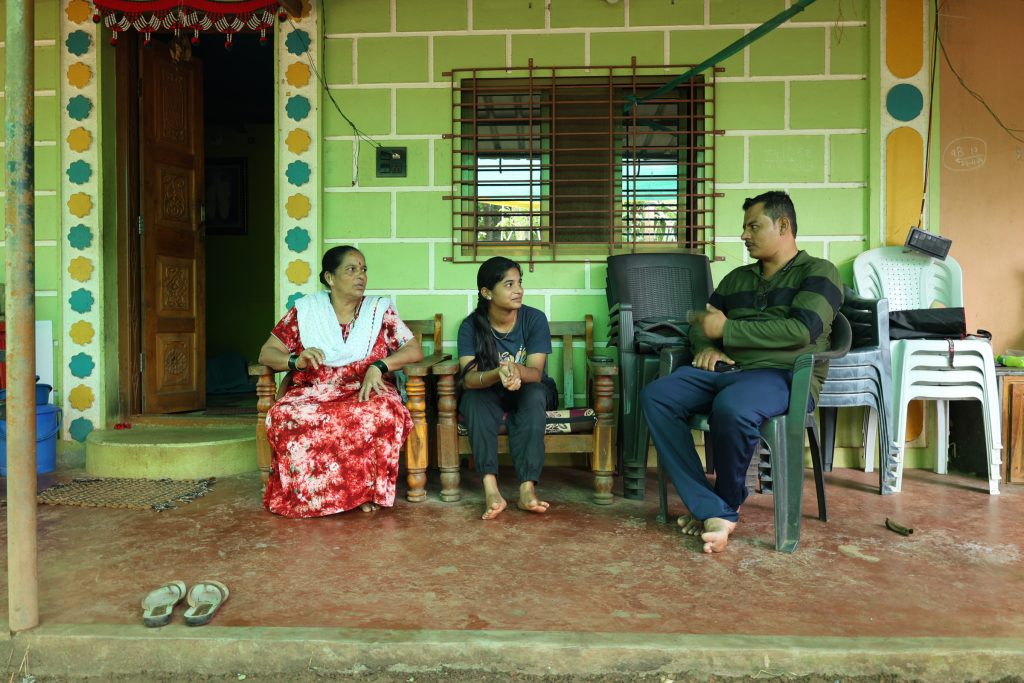
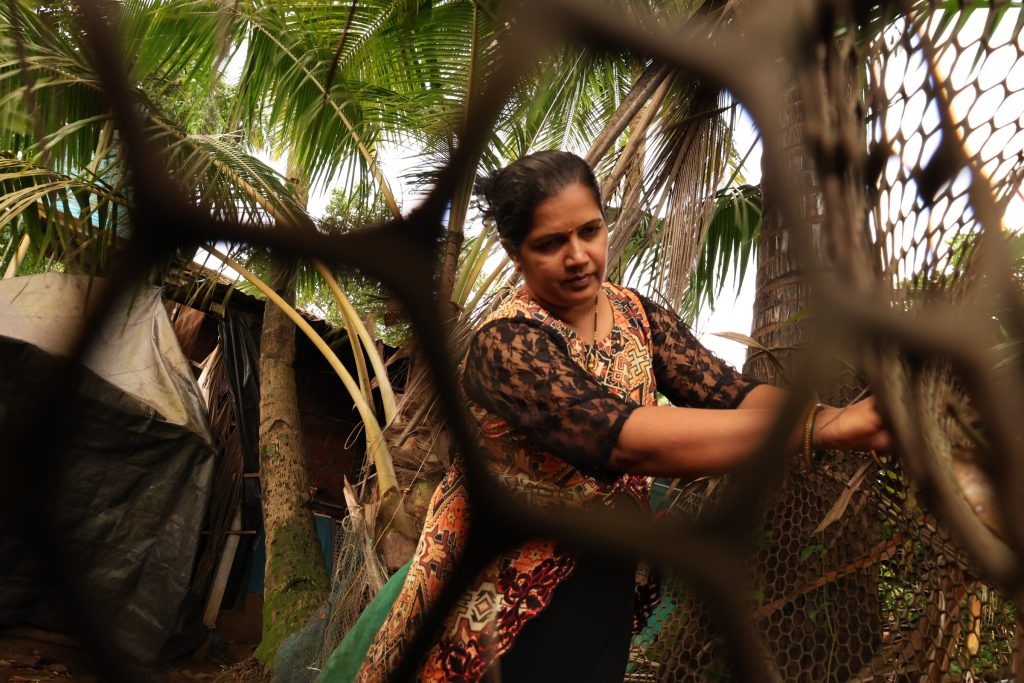
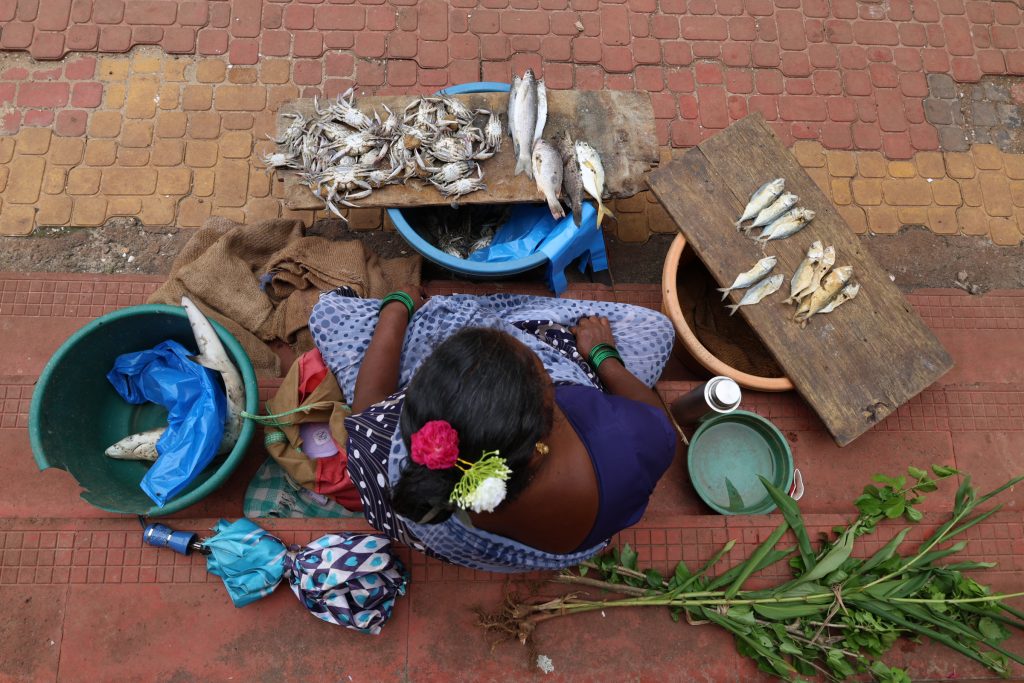
In the face of the country's plethora of problems, its artists continue on.
For as long as I’ve been alive, I’ve been aware of Nigeria’s potential.
Globally, this potential has largely been measured by the country’s natural resources, from relatively recent (and continuing) discoveries of rare earth elements, to crude oil, its greatest export commodity, and arguably also its greatest curse. Discovered some years short of independence from British colonial rule in 1960, oil has been the main cause of poverty and ecological degradation in the Delta region, often stagnating development in Nigeria’s other industries due to over-reliance on its “black gold”.
Then, there’s the potential of our country’s expansive 230 million-plus population, consisting of over 400 ethnic groups (or 500, depending on how they’re counted), with just as many languages. Equally important is our religious diversity, composed largely of Muslims and Christians, as well as practitioners of various traditional religions, the latter sometimes performed (quietly) alongside the Abrahamic faiths. Increasingly, if only marginally, there’s also a rise in irreligiosity and atheism among Nigeria’s youth, noteworthy because Nigerians are, on average, a deeply religious (pontificating and practicing) people.
There is also the potential of our diaspora. From the time of independence or even before it, the Nigerian diaspora has produced notable writers, artists, and musicians, a feat that has only grown as the country’s entertainment industries, especially in music and film, have exploded in the last decade. Notwithstanding the prevalence of a “scammer” stereotype, Nigerians in diaspora—especially in the West—stand out as among the most educated, flourishing immigrant populations across variouscountries. Last year, Nigerians abroad even remitted over $20 billion back to the country, exceeding its foreign direct investment. This statistic does more than simply demonstrate the economic success enjoyed by many Nigerians abroad; it offers insight into the intimate connections we have to the nation of our birth—or of our parents’ or grandparents' birth. It also shows that, where the government has failed to create economic conditions for the average Nigerian to meet their basic needs, Nigerians individually and collectively have offered the necessary support to fill the gap.
This, however, reveals a truth that has persisted from one generation to the next: Nigeria’s potential has not staved off its reality.
"I’ve found myself inching ever closer to a resignation that what Nigeria may mostly have in my lifetime is potential."
While the truth of any country exists beyond what data reveals, it cannot be entirely ignored. The numbers show that by most measures, Nigerians at home are collectively worse off than they were even a decade ago. Its GDP per capita, for example, has fallen to an estimated $835.49 this year; just four years ago, that figure was $2,057. Unsurprisingly, this has meant an exacerbation of extreme poverty, even as, notoriously, the combined worth of the nation’s five wealthiest people could put an end to it should they so choose.
Just as unsurprising is that Nigeria’s rate of unemployment remains high, despite the National Bureau of Statistics’ recent manipulation to arrive at the now low 4.3% figure, after surpassing 30% unemployment just a few years ago. Simultaneously, the cost of living in Nigeria has escalated to its worst in a generation, while rising security concerns, rife in different parts of the country for different reasons, have made it difficult to determine the sheer scale of crime nationally.
Put together, then, the potential of Nigeria is exponential. But the reality of Nigeria is we have a multigenerational kleptocratic political class with little interest in strengthening the nation’s institutions or improving the lives of ordinary people. Whatever improvements have been made—for decades—have been in spite of this class, and often by the sheer will of persistent individuals and grassroots community initiatives.
"Seeing the cultural and artistic production of Nigerians once again revived my belief that hope must be a practice."
You might not know any of this, of course, if you only frequent, or are attentive to, the country during its Detty December period, where the weeks-long partying never ends in the palatable parts of its Lagos metropolis. Even with hiked prices and complaints from Nigerians at home and abroad, who go less for the merriment than to visit family, the period shows no signs of easing. People anywhere, I believe, have a right to enjoyment despite whatever depths of despair we may find ourselves in. But when does this enjoyment start to become smoke and mirrors for the lack—and a desensitization to the lack—experienced by most Nigerians?
If it sounds like I am describing a country on the brink, my visits in the last two years, especially, have felt like I was witnessing it, too. This is the same country where many of our parents survived a late ’60s civil war and perennial eras of dictatorship through to the ’90s. And yet, the country today seems somehow less tolerable, because the last decade of governance has revealed even the smallest gains can be reversed; that this is not a developing country, but a regressing one.
Having frequently meditated on the state of the nation’s potential versus its reality, I’ve found myself inching ever closer to a resignation that what Nigeria may mostly have in my lifetime is potential—and a potential that will never even be minorly realized. What’s more is that the values that Nigerians ordinarily uphold—our ability to persevere, to get through, to make good of what is bad—is also ultimately what holds us back. Realizing this made me all the more hopeless, because how do a people resist over time and collectively when enough is never enough?
With all of this on my mind, last November, visiting Nigeria yet again, I was apprehensive; despite my own relative economic privilege, I’ve been enjoying my stays less, considering them more a labor of my particular family culture than a joyful homecoming. This visit, lasting less than 10 days, would be dominated by art and art makers across two cities—Lagos and Benin City. I’d also be making it to my ancestral hometown, Ughelli, in the Delta.
Yet for all my apprehensions, I found myself less fatigued by the state of the country than contemplative. While I would witness many swaths of society that spoke to the country’s regression, seeing the cultural and artistic production of Nigerians once again revived my belief that hope must be a practice.
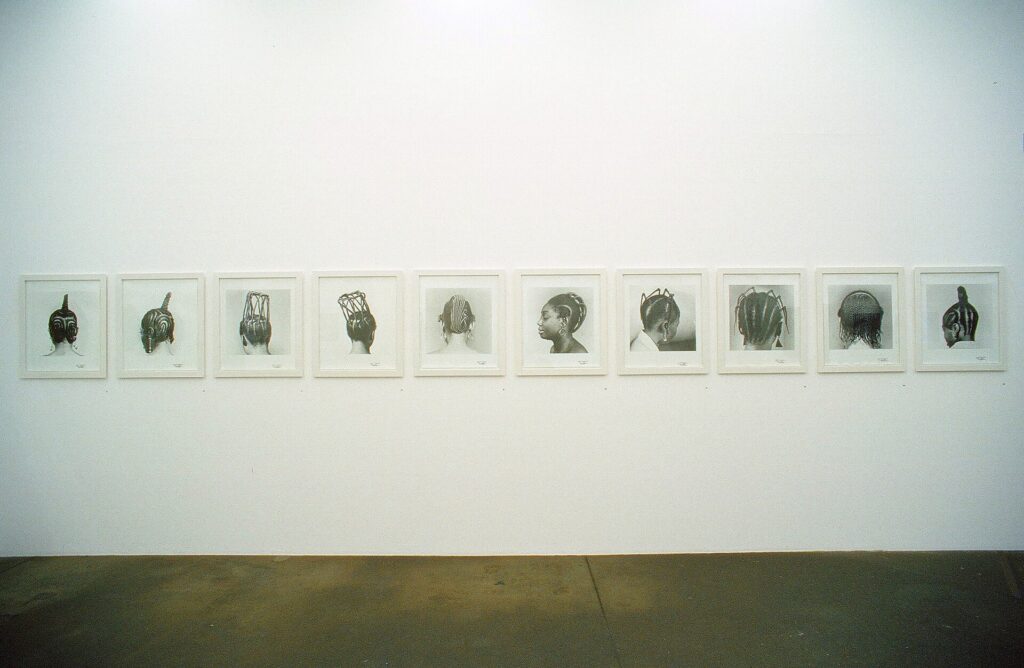
Photographs from J.D. ‘Okhai Ojeikere's Hairstyles exhibit at MAMCO in 2001. (Photo courtesy of MAMCO / Wikimedia Commons.)
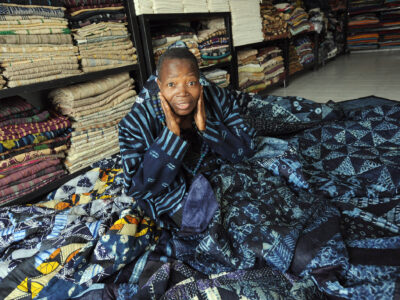
In its tenth year, ART X Lagos provided me with a swanky welcome as I encountered the who’s who of the Lagos art scene and beyond, the international fair now among Africa’s largest. Well-curated with numerous official and unofficial events, you would have to try to have a bad time. There were symposiums dedicated to the country’s different postcolonial art schools featuring the likes of Chief Nike Davies-Okundaye, founder of one of the largest art galleries in West Africa, named after herself. Then there was the live photography studio inspired by the late J.D. ‘Okhai Ojeikere, who captured Nigerians’ hairstyles as an artistic process, reminding us of the great value of art as a cultural archive.
In the midst of craftspeople, visual artists, sculptors—upcoming and established—there was also hearteningly, programming for children, inviting them to be art makers at a young age. Away from ART X Lagos, the Fela Kuti: Afrobeat Rebellion immersive exhibition, ongoing since October, was a gratifying celebration of perhaps one of Nigeria’s most notable cultural icons. Savoring it all, the only reservation I had was a familiar one—that more than just well-off Lagosians and visitors deserve access to such things, too.
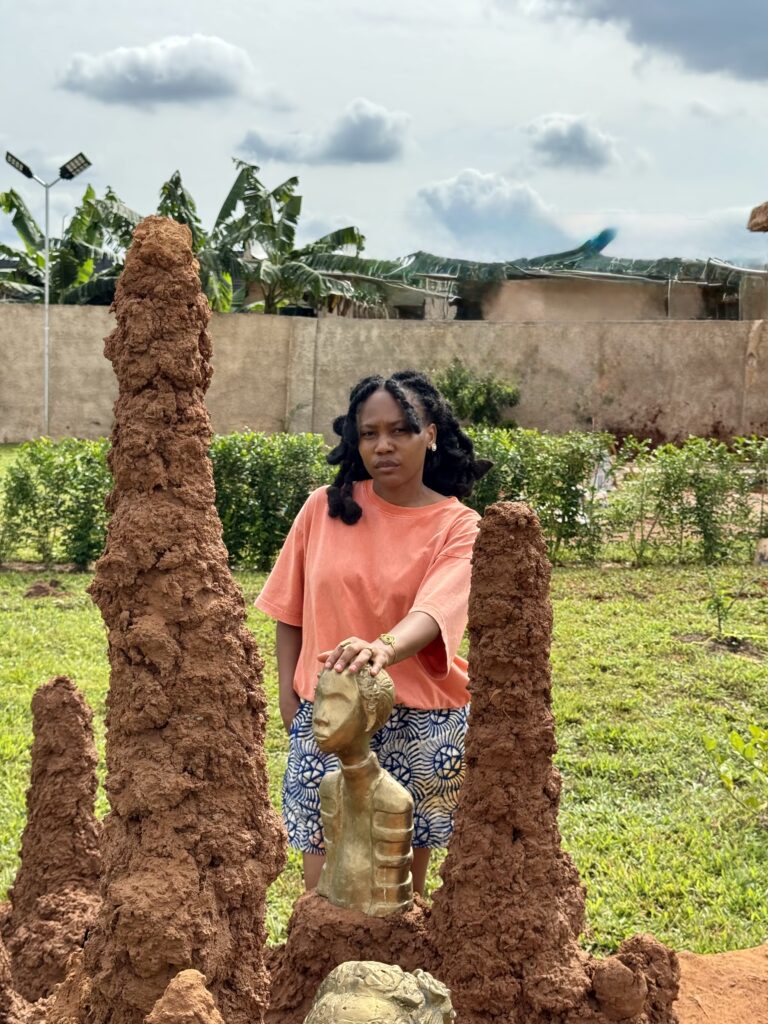
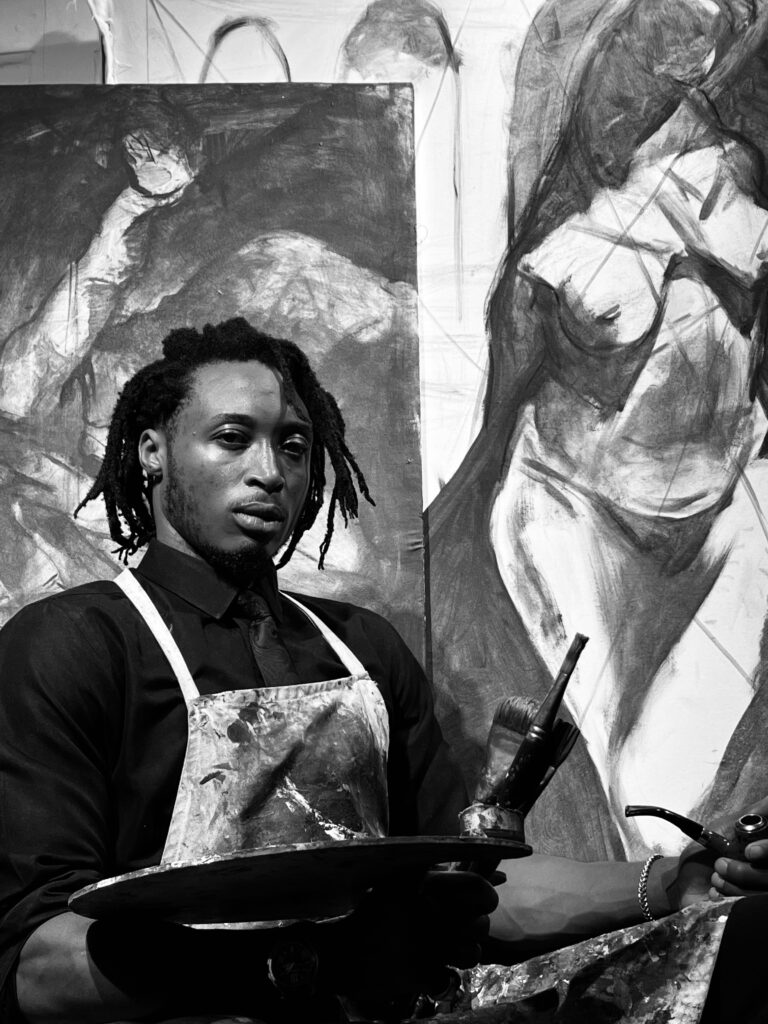
Leaving for Benin City shortly after—the old historic home of the once powerful Edo nation, famous for the Benin Bronzes—I attended the inaugural Black Music Art Festival, established by the artist Victor Ehikhamenor. The fair showcased exhibitions and a remarkable new Sculpture Park, all done in tandem with local Nigerians and featuring a plethora of young artists, including Osaru Obaseki. A multidisciplinary artist who won the surprise first prize on opening night, Obaseki stood out for many reasons, but most notably to me, for her incorporation of bronze casting, traditionally done by men. Between her work and that of her contemporaries, innovation was everywhere I looked, including in the mixed media installation Invisible Pedestrians by Seidougha Linus Eyimiegha, AKA Mr. Danfo, and a studio visit with artist Derek Jombo, who blends surrealism with classical realism in portraits of postcolonial Nigerians.
Osaru Obaseki. (Photo courtesy of the artist.)
On the way to Ughelli, four hours by road from Benin, I traveled with a colleague turned friend, Agohogo Otega, a photojournalist and artist whose work I was finally able to purchase after years of eyeing a particular piece showcasing our hometown’s sunrise. Once in Ughelli, I spent time with a cousin I don’t often see, who has turned his artistic vocations from music to visual art once again. He shared his work with me as he told me of his future plans of pursuit.
I had not wanted the best Nigeria has to offer to trick me into succumbing once again into narratives of our potential, and it didn’t. But what happened in spending time with the full range of artists—from those who have international acclaim to those who struggle to afford the most basic items for their practice—was a reminder that while I’ve never had much faith in the Nigerian political class, if I’m to maintain my ties to the country as a whole, I cannot afford to give up on its people.
"Nigerians—and that is, ordinary Nigerians—refuse to sacrifice art at the altar of the country’s plethora of problems."
This includes their many achievements despite the countless factors working against them. Aside from art, even with inadequate infrastructural support, everything from agritech businesses to renewable energy companies are still advancing, continually exhibiting to those that control the nation’s purse strings what the future could be, long before they’ve invested in it. Despite the very real partly religious conflicts and sometimes ensuing violence that has occurred in various parts of the country, for the most part, we also do more than tolerate each other: I was born in Ibadan, and if you’ve ever been there, you know that one’s neighbors are just as likely to be Christian as they are to be Muslim (or traditionalists) and celebrating each other’s festivities is part of the city’s ethos. There are many more Ibadans in Nigeria than not.
It’s why the characterization of Western (and Western-minded)politicians and pundits who don’t understand (or intentionally misunderstand) the complex dynamics of the nation—quick to weaponize “Christian genocide” rhetoric—are speaking out of turn; there are too many additional factors at play to oversimplify our national woes. It is true that Nigeria has an ethnocentrism problem that has seldom been adequately examined in the context of power and privilege, akin to racism. But for a people who still embody the memory of our once independent precolonial nations, that we have never really had many leaders keen to unite us—and in fact have leaders even today who weaponize our differences—my sense is we often belittle our everyday congeniality towards each other. A congeniality I would like to see more of in how we regard each other’s cultural expressions.
Derek Jombo. (Photo courtesy of the artist.)
Given all the tragedies of Nigeria, I remain astonished at the art and the artists the country produces. For a country that is in such dire straits, that quite frankly, has so much for its ordinary citizens to be attentive to, and where institutional support for the creative industries is dire, our artistic production feels like a small miracle. Beyond this, Nigerian families are notorious, if stereotyped, as discouraging their children from artistic undertakings, preferring they go into “practical” fields—medicine, engineering, or otherwise. Of course, there is also the wide gap of privilege: The difference between what a wealthy child is exposed to in Lagos artistically, and what a child from the working poor will be exposed to in Lagos, or Ughelli, or Benin, is great—a distance that ordinarily only exacerbates my despair. But I’d be lying if I didn't admit that it also gives me hope that Nigerians—and that is, ordinary Nigerians—refuse to sacrifice art at the altar of the country’s plethora of problems, as something only to be pursued by the elite.
It is here that Nigeria’s potential merges with its reality. Whether accompanied with other “practical work,” or disappointing their families, or restricting themselves to smaller towns and cities, Nigeria’s artists continue on. Many, without fame and certainly almost no fortune, continue on. And little else can explain why, other than because they can’t help themselves. It is something they must do, even with no fairytale ending in sight, because the art itself is the point. This, above all, is where the unexpected hope lies among a people obsessed with reaping the fruits of one’s labor: that even still, in spite of our condition, creating itself, and not its aftermath, is what matters most.
[post_title] => Where Nigeria's Potential Meets Its Reality
[post_excerpt] => In the face of the country's plethora of problems, its artists continue on.
[post_status] => publish
[comment_status] => closed
[ping_status] => closed
[post_password] =>
[post_name] => nigeria-potential-reality-art-lagos-gallery-sculpture-photography-nike-davies-okundaye-osaru-obaseki-derek-jombo-benin-ughelli
[to_ping] =>
[pinged] =>
[post_modified] => 2026-08-03 20:46:52
[post_modified_gmt] => 2026-08-03 20:46:52
[post_content_filtered] =>
[post_parent] => 0
[guid] => https://conversationalist.org/?p=10683
[menu_order] => 0
[post_type] => post
[post_mime_type] =>
[comment_count] => 0
[filter] => raw
)
A look at the cross-continental sloshing of capital beneath the art market bubble.
Cultural Currency is a bi-monthly romp through the intersections of art, capital, and politics with writer Cara Marsh Sheffler.
Lately, a series of memes, graphs, and cartoons have gone viral, all asserting variations of the same thing: “The entire U.S. economy right now is 7 companies sending a trillion fake dollars back and forth to each other.” The source diagram for this claim was published in Bloomberg last October, in a piece highlighting why all these circular deals—largely between the usual AI suspects, such as Nvidia, Microsoft, and OpenAI—indicate a likely bubble. Together, this cloud-based clusterfuck has generated a $1 trillion AI market and $192.7 billion in 2025 Venture Capital investments. As of yet, however, they’ve also yielded scant indications of any productivity gains whatsoever.
Unsurprisingly, we’re starting to see this reflected in the art itself. To my eye, the art fair circuit of today largely seems to exist to dare to dream what slop—Merriam-Webster’s 2025 word of the year—might look like in the flesh, spread out across a couple of hundred booths. Nearly 55 galleries participated for the first time at New York’s Armory fair this year, the second since Frieze purchased it in 2023. When I attended, I wondered how many of them actually belonged at Javits Convention Center. Surely, taste is subjective, but to me—and the art advisor who gifted me a VIP Pass—there wasn’t enough champagne in the joint to make the fair look anything close to well curated. I heard many whispers that the Armory show hadn’t sold all of its booths and, as a result, what they let in looked like the kind of upscale beach art you’ll see next to a store that only sells white clothing or Vilebrequin swim trunks in Amagansett. When you figure booths are about $40K, the metallic driftwood art made sense: That's nothing to the very rich, who spend about as much if not more on a Christmas vacation. A booth might placate any number of ailing family dynamics, from a bored spouse to a listless kid.
Of course, many large corporations simply fudge the numbers when the going gets tough. They pay good money for sunnier analyses. But when paired with the news of Frieze’s expansion, this dissonance should ring alarms: Something is up. Why open more fairs when the ones they already have are neither profitable nor novel and of dubious artistic merit?
The cross continental slosh has a pattern, after all. It’s a game of appearances played across the globe until resources totally, utterly run out, and crash violently. As Ernest Hemingway famously put it: “‘How did you go bankrupt?’ ‘Two ways. Gradually, then suddenly.’” And, in the meantime, it is of the utmost importance to set up shop someplace new while the goods still have some value, and the brand hasn’t yet been completely tarnished.
In the art world, this is panning out in a palpable way. It's one thing to talk about AI slop as a harbinger of economic doom, or the imminent insolvency of Social Security, but it's even wilder as a bubble indicator to see mid-tier and blue chip galleries sliding horribly in Western world capitals, while the same art fairs that are coughing and wheezing in the West open entirely new ventures in Gulf States. Rather than cultivate a new base of collectors that might sustain art markets on a local level, the industry is continuing to cater to the uber wealthy, wherever it can find them—even as this model fails miserably in the West.
Of course, the art market isn’t quite a Ponzi Scheme, if you consider that the original investors aren’t technically promised an artificially high rate of return off the bat. But neither is, say, Nvidia, which hasn’t stopped its CEO from openly insisting his company “isn’t Enron” as its stock price tumbles. Like other markets, the art market continues on by force of its ability to lure in new investors. Frankly—to bring up Michael Burry again—the notion of carrying a certain tranche of goods from market to market in search of new investors while bundling them together (in this instance, as a fair), strikes me as a sort of arty CDO (collateralized debt obligation). Magical circular thinking abounds in budget offices across the board, from art to tech to government. But, I would argue, when consulting the US Treasury’s page explaining how the national debt is structured seems helpful in understanding our current predicament…it’s not looking good.
Perhaps there is someone in Abu Dhabi who will be thrilled to learn of the art world’s KKK: Koons, Kapoor, and Kaws. But you don’t need to read that US Treasury page to know who will be left holding the bag when the cross-continental slosh finally goes splat. Even if Frieze is able to eke out an existence from selling balloon dog sculptures to billionaires, it won't protect them from the inevitable pop, although it might provide a little delusional cushion in the meantime. As critic Jerry Saltz recently cautioned in an Instagram post, quoting Yale School of Management’s Magnus Resch, “Let’s be clear: multi-million dollar trophy auctions don’t reflect the health of the market. They reflect its distortion. What the art world needs isn’t more $50 million headlines. It needs more $5,000 collectors.”
To any working artist, that Resch observation has the infuriating tenor of the proverbial “Fork Found In Kitchen” headline. We need more art for art’s sake, much as we need communities that are affordable for creators. However, today’s collector class values art that functions as investment, not the health and cultivation of anything so quaint and unremunerative as artistic communities, or even individual artists. In the same way, corporations now chiefly exist to create value for investors, rather than to provide goods and services to consumers—let alone provide any kind of reciprocal benefit to workers.
To be perfectly clear, today’s billionaire class is one mostly disinterested in public works or philanthropy. Art collection itself is not about collecting objects that carry beauty or even status, but rather ones that accrue value and allow them to hide more money from the tax man. After all, the art world KKK is not an unholy trinity of art but rather a bundle of financial tools. If 1989’s independent cinema gave us The Cook, the Thief, His Wife & Her Lover, 2026’s art market has given us The Collector, the Tax Attorney, His Wife & Her Art Advisor. Whether or not Frieze’s latest venture succeeds, the West cannot flatter itself that these new markets of Middle Eastern buyers seek Western signifiers of wealth so much as access to more of our gloriously opaque financial tools: to wit, the art itself. (That Richter will really tie the Swiss bank vault together!)
Perhaps the greatest work of art right now, then, is this art market bubble itself, that sloshes so showily as it grows. It is the work of a collective that daringly splits the newly irrelevant hair between metonymy and metaphor, spanning continents, industries, and banking systems. It performs the same wistful, elegant, melancholic drift of Albert Lamorisse’s 1956 children’s classic, The Red Balloon, aping the film’s Gallic ennui with a Chanel sweater set for the booth and Ruinart champagne in the VIP room, dragging a damning homogenizing aesthetic in its wake like a dead zone in the ocean. And all it touches turns to slop as it grows and grows, for only homogenized slop signifies fungible, quantifiable value.
This homogenizing force and its flattening aesthetics are not unique to the art world, and might be handily encapsulated in 2025’s Q4 neologism, “chubai,” meaning something “chopped but also spiritually Dubai.” (Examples were given as Soho House, Goyard, and Carbone.) All the world’s a shopping mall, to borrow from the Bard. Beige is inescapable. Travel to any continent you like and you’ll find the same shit at every fair, much as the same internationally braindead flagship fashion stores anchor every fancy downtown strip in every major city around the world.
After all, that’s what a bubble does: it floats away, to foreign lands, all year round. As long as the ultra-rich need to keep their money safe from taxes, the art market will obviously continue to spurn its own sustainability—and why shouldn’t it? What market model indicates a path that creates something other than a tiny panic room full of winners, and utter doom for every other poor schmuck who won’t make it to the slopes of Gstaad this winter? Middle and working classes are so 20th-century, and the art market bubble is just one of many that’s eventually going to pop.
We live in a global society that valorizes the iterative as novel, lionizing AI and utterly unable to tell the difference between a tool and its master. Asses and elbows are easily conflated and confused. The art market itself has more to say about the state of contemporary art—and of the economy, of what the government has promised us and won’t deliver, and to what ends the tech world will go to deem anything innovative if it might push up stock prices to enrich that selfsame collector class—than a lot of art does. The sound of shit hitting the fan is perhaps a soothing one, a sort of white noise pedaled in Instagram ads. Or perhaps that sound is the sloshing itself, crossing continents and coming home in a fantastic, tidal fashion, to crash upon our shores.
[post_title] => "The Collector, the Tax Attorney, His Wife & Her Art Advisor"
[post_excerpt] => A look at the cross-continental sloshing of capital beneath the art market bubble.
[post_status] => publish
[comment_status] => closed
[ping_status] => closed
[post_password] =>
[post_name] => the-collector-the-tax-attorney-his-wife-her-art-advisor
[to_ping] =>
[pinged] =>
[post_modified] => 2026-05-07 23:01:59
[post_modified_gmt] => 2026-05-07 23:01:59
[post_content_filtered] =>
[post_parent] => 0
[guid] => https://conversationalist.org/?p=10167
[menu_order] => 0
[post_type] => post
[post_mime_type] =>
[comment_count] => 0
[filter] => raw
)
While reporting on climate change isn’t always hopeful, the women I've met along the way are forging a path forward for intergenerational resilience.
In the dim flicker of a kerosene lantern on a fog-wreathed houseboat, I watched Nazia Qasim’s reed-scarred hands pierce threadbare fabric with her needle, weaving colored abayas as her eyes fixed on Dal Lake’s silt-choked horizon, diesel haze mingling with the sour tang of rotting lotus stems, where vibrant beds once bloomed.
I’ve heard endless tales from Nazia—and Qudisa, and Bano, and their sisters—about how the lake’s relentless shrinkage has mirrored their own lives’ contracting. Yet the women have overcome: As the lake withers, under absent snows and dying streams, the water now polluted and undrinkable, they have found new work and purpose through their weaving. For hours last January, I watched their hands move in the lantern’s glow, transforming loss into livelihood. This sisterhood, which once thrived on an endless, ancestral bounty of lotus, water chestnuts, and fish, now scraps stitched tight, the women’s quiet knots a fierce stand against the fade.
As a climate reporter based largely out of India, I am often tasked with telling stories on the frontlines of disaster. I have crouched in Pampore’s parched Karewas at dawn, watching farmers Farida Jan and Snobar Ahad recount the decline of saffron, a visceral dirge for disappearing traditions I could feel in the cracked earth underfoot. I’ve seen women shoulder jerry cans under a merciless sun, irrigating wilted bulbs past cobwebbed government drip lines, turning the world’s most prized spices into frantic wagers against the sky, where one failed season means debt for entire villages. And in countless moments, I’ve watched with growing frustration how easily the world abandons the Global South, which disproportionately bears the brunt of climate change, and how rarely the countries most responsible seem to face the same consequences.
This work necessitates exhaustive fieldwork in fragile ecosystems, sifting through scarce data amid conflict, and confronting the grief of vanishing landscapes and livelihoods. But in my writing on the realities of climate change, I’ve also made a conscious effort to find stories of resilience, rather than just stories of despair. Stories that not only show there are still people who haven’t given up on the fight, but who have made a meaningful difference in changing the tides.
These changemakers are often women.
Perhaps because of this, my work has always felt inherently hopeful: Despite climate theft splintering families—stealing not just saffron yields and Dal Lake’s bounties, but the heartbeat of a country’s soul—these women persist as resilient guardians, weaving their survival with fierce tenderness from the shattered threads.
This has also made it all the more important to me that I get their stories right. As a writer, I prioritize women’s agency and consent, letting them narrate their own stories however I can. This approach shatters poverty tropes, spotlighting their resilience and innovation over the victimhood stereotypes that dominate mainstream coverage of rural Indian women. It also imbues my work with deeper meaning, in hopes that harmful narratives might begin to shift as more of these women’s stories are allowed to take up space.
Over the years, I’ve chased India’s climate fury, from Kashmir’s vanishing glaciers to Maharashtra’s cracked fields and Tamil Nadu’s drowned coasts. And the women I’ve met along the way light a fire in me: Their grit isn’t survival, it’s rebirth for a warming world.
~
“When I got married, nobody asked my choices,” Kamla told me on her daughter’s wedding day, now nearly two years ago. “Today, I ensure hers.”
The message was loud and clear: Economic independence is agency in a patriarchal script. And for Kamla, it had allowed her to reclaim this agency on her own terms, and to give her daughter a chance at a better life.
I first met her in early 2024, while reporting my story “A Farm of One’s Own” for The Conversationalist. Kamla is a farmer from Khajraha Khurd’s sunbaked fields, in parched Bundelkhand’s Jhansi district, Uttar Pradesh. She leads local farming techniques to combat drought, something that has helped pull families in the region out of poverty, proving climate adaptation thrives on female ingenuity.
In the days we spent together, I crouched beside Kamla as she worked, enveloped in the mud’s earthy scent. Her eyes were sweat-stung, her fingers plunged into the sun-warmed soil. As she crunched freshly picked beetroot, she explained to me how she uses neem traps to ward off pests amid erratic rains. Her father-in-law burst out laughing, teasing her for explaining farming to me like she knew anything at all.
But it was clear she knew more than he understood. When the global coronavirus pandemic rapidly swept across India, some of the most vulnerable, and climate-vulnerable, migrant women were robbed of their work, Kamla included. She not only found meaningful work in the aftermath, but self-reliance, trading callused hands for hoe and seed, wresting millet, broccoli, and lentils from her own organic farm.
Kamla’s resilience was magical to witness. I spent many days with her, seeing how she started her day, plunging into compost heaps steaming with kitchen scraps and dung, spreading the fertilizer across her garden. Watching her wipe soil from her weathered palms, spinach bunch in hand, I saw her rooted at last from laborer to earth-tender, peace in every leaf, life hers again.
In the afternoon, she tiptoed through the fields and quickly kneaded the dough for lunch and put it on the tawa, slapping it thin and golden and slathering the sizzling ghee, serving it with a tin cup of frothy chai brewed strong over a chulha fire. We ate together in the rows of a multi-cropped farm, the air humming with neem leaves. This wasn't just a meal; it was a window into resilience in motion, women and girls weaving nourishment from the land. Nearby, her great-grandmother sat cross-legged on the earthen floor, her gnarled fingers deftly cleaning a mound of fresh red chillies in the sun—plucking stems, wiping dust, and muttering local songs on the front porch of her house, a visual treat to witness a silent hymn to preservation in a world of fleeting harvests.
As we ate, I thought of these women, whose callused hands not only yield the wisdom and knowledge of saplings and sickles, but carry it forward, forging an intergenerational resilience against climate chaos that exists beyond immediate harvests, or even lifetimes—ensuring the next generation endures.
~
Over the years, I’ve met countless women enacting change like Kamla, often without credit or acknowledgement. In India’s northern Haryana state, I met Sunita Dahiya, a woman pioneering eco-friendly menstrual products, and training rural women to produce organic pads that decompose rapidly, slashing microplastic pollution and the burden of billions of plastic disposables in landfills each year. In north Kashmir’s Bandipora district, I met Phula Bano, who manages large herds of wild dogs, cattle, and horses through daily treks in the Himalayas, helping to sustain a low-carbon, resilient ecosystem.
For an early story for The Conversationalist, I also met the beekeeper Towseefa Rizvi—a living embodiment of sisterhood in action. As the first female beekeeper in Ganderbal district, Kashmir, Towseefa has demonstrated, again and again, how one woman’s rise can create pathways for others to join her. Within her community, she also demonstrated that beekeeping could be a profitable path, as well as a productive response to ecological despair. Today, she still trains and supervises village women in the tender art of queen-rearing and swarm management, and sells local honey through various haats and online.
When I visited her home in Bandipora district in north Kashmir, I saw apple groves dotted with buzzing apiaries in her backyard, as she coaxed her bees into new, modern hives. She viewed her bees as family, and over the years, dedicated herself to learning about the restoration of biodiversity, pollination of resilient crops, and climate vagaries.
Her journey was also proof that true climate hope lies not in flashy summits, but more often, in one woman’s quiet and relentless work.
~
Centering hope in my reporting, of course, hasn’t saved me from the realities of writing about and from regions affected by climate change.
What started as whispers of women-led mangrove safaris while researching another story last year eventually evolved into a gruelling quest, marked by relentless weather delays and elusive sources. For months, I chased the story of Sindhudurg’s mangrove guardians—fierce women from one of Maharashtra’s pioneering women-led self-help groups (SHGs). And for months, I wondered if the story I hoped to tell would ever come to fruition.
Weather changes were unforgiving foes. Monsoons flooded coastal paths and stranded my sources with switched-off phones for weeks. Out of anxiety, I’d chase them via voicemail. Officials also proved phantoms as the network dropped along eroding coastlines.
It wasn’t easy to convince the women to entrust me with their stories; their promises fading with each storm surge and postponed boat trip. But visiting the coast and sharing chai in salt-lashed homes finally broke the ice last fall, and resulted in my final piece from the year, “Guardians of the Mangroves”, about how Maharashtra’s crab farmers are spearheading women-led coastal restoration amid local climate chaos.
Late in my visit, I stood with farmer Sonali Sunil Acharekar amid the hushed mangroves, her rough hands parting their roots in silent vigil, as cries of herons and egrets filled the skies. She paused mid-story about lost fish, her fingers sifting through the silty tides to snare a scuttling fiddler crab.
She grinned. “See? Even the birds know we’re guardians.”
I felt a spark of wonder that, despite rough weather nearly killing this story, I could still bring these women’s unbreakable strength into the light. As we enter a new year, I am ending the last with gratitude for their efforts, and the stories these women have shared. I hope, too, I continue to push myself to amplify excluded voices, to craft stories of climate hope that counter the despair-dominating headlines, and to show women as stewards of India’s Global South.
When we lose sight of hope, we risk nihilism that doesn’t allow us to see ingenuity amidst climate chaos—something women in the Global South have delivered time and time again, and something that has made me feel consistently hopeful in my work. While reporting on climate change itself isn’t always hopeful, there is always hope—and at the center of that hope are the women who bend, rise, and persist, their strength illuminating the fragile edge where water meets earth.
[post_title] => Planting the Seeds of Climate Hope
[post_excerpt] => While reporting on climate change isn’t always hopeful, the women I've met along the way are forging a path forward for intergenerational resilience.
[post_status] => publish
[comment_status] => closed
[ping_status] => closed
[post_password] =>
[post_name] => hope-week-climate-change-resilience-action-profile-economic-independence-global-south-india
[to_ping] =>
[pinged] =>
[post_modified] => 2026-08-03 21:01:04
[post_modified_gmt] => 2026-08-03 21:01:04
[post_content_filtered] =>
[post_parent] => 0
[guid] => https://conversationalist.org/?p=9889
[menu_order] => 0
[post_type] => post
[post_mime_type] =>
[comment_count] => 0
[filter] => raw
)
Why Ireland's Basic Income for the Arts program is just the first step in better supporting the country's artists.
In 2022, visual artist Elinor O’Donovan was working as a receptionist in Cork, Ireland, when she began to receive the Basic Income for the Arts (BIA) stipend. The Irish government had launched the program that year as a way to address the country’s unstable arts sector, which had left many artists without job security and consistent financial earnings—O’Donovan included. At the time she applied, she'd just graduated from university and was living with her parents as she tried to figure out the next steps for her career. When she found out she’d been selected from a pool of over 9,000 other applicants for the BIA, it was life-changing. As one of 2,000 artists receiving a weekly income of €325 over a three-year period, O’Donovan was able to quit her job and move to Dublin to make art full-time.
“The BIA has allowed me to be a bit more brave with the stuff that I make,” she tells The Conversationalist. “It allowed me to make whatever I want, and not feel as if I have to justify why it's important to a funding body.”
According to a cost-benefit analysis published by the Department of Culture, Communications and Sport last September, the BIA has been a resounding success for beneficiaries, and Irish society at large. The report revealed that recipients were able to dedicate an additional four hours per week to art-making, and that the program “strengthened artists’ professional autonomy, capacity for creative work, and attachment to the arts sector.” Moreover, for every €1 of public money invested in the pilot, the country received €1.39 in return—a value that accounts for an increase in earnings generated from art-making as well as an increase in public engagement with the arts. In short: Giving money to artists, with no strings attached, was demonstrably profitable.
For O’Donovan, income from the BIA not only gave her more time to make art, but provided her with newfound financial stability, something that affected every part of her life. She had more time to cook for herself, joined a gym, and for the first time, was able to afford to go to therapy. She was also finally able to plan for the future.
“I was 26 when I started receiving [the BIA], and I was able to start a pension fund,” she says. “Just having that fallback [was a relief], knowing that I would receive an income no matter what happened; if I got sick, I would still be able to pay my bills, pay my rent. It has really been transformative for my well-being.”
Importantly, the BIA has also allowed her to create opportunities for other artists: O’Donovan’s ability to explore filmmaking, something she was afforded because of the stipend, meant she could create new jobs in the field. “Having financial stability from the basic income means that I've been able to hire other people to work with me,” O’Donovan says. “So there's even been a kind of trickle down of the basic income to other artists and other creatives in Ireland.”
For artists around the world, the program has also offered one hopeful potential solution for a global arts sector severely hit with funding cuts and political uncertainties over the last few years. But while things have taken a recent downturn, the financial instability of the arts has been a major problem for decades, if not centuries, something that likely explains the growing admiration for the BIA around the world.
In a capitalist society, creative work is not valued as a productive or profitable field, which often means that artists are being underpaid for their work, if they’re paid at all. Creativity and art-making require passion and time, two resources that are generally scarce in an economic system more concerned with profit than beauty. Often, this forces workers to abandon or sideline their creative work in favor of taking a non-creative job that will provide financial stability. But a program like the BIA provides an alternative model, giving artists the financial foundation to create without the stress of figuring out how they will pay their rent or bills.
Even the program’s most ardent supporters, however, argue that the BIA is only the start of a more stable arts field. In Ireland, the arts generate €1.5 billion in income each year, but according to Praxis, the artists’ union of Ireland, artists still face “extremely challenging economic conditions.” In an open letter published in September, the group cited that 50.7% of artists in Ireland still live in Enforced Deprivation, compared to 15.7% of the general population. (The Irish Central Statistics Office defines Enforced Deprivation as when a household experiences two or more of 11 national deprivation items, such as being unable to replace worn out furniture, or being unable to afford a drink or a meal with friends once a month.) The BIA, then, should be seen as just the first step in a bigger effort to make the industry more sustainable.
“It has always been precarious,” writer, editor, and Praxis policy director Michaele Cutaya tells The Conversationalist. “I've never managed to make a living off just my art income, [and] my situation, my difficulties, are not isolated instances.” As a union representative, Cutaya helped advise the government on the BIA’s design; but despite its success, she emphasizes that the country still has a long way to go.
“Quite a large part of the economy relies on the work of artists,” she says, citing the profit the arts brings to the hospitality sector in Dublin as one example. But very little money generated by the arts sector actually goes to artists, a discrepancy that continues to grow despite the BIA. In the last three years, work opportunities have diminished throughout the sector, a trend worrying to union leadership and artists alike. “Access to public funding remains the main source of income for artists, mainly through the Arts Council,” Cutaya continues. “[But] I find that the number of chances of getting your work selected has gone down because essentially there seems to be a lot more people applying [to public funding].”
This may explain why some are concerned that the BIA will become “the shiny object” of policies, while other issues in the sector go ignored, like unregulated pay, the use of AI, and the still-growing lack of opportunities.
“There's a lot of issues and they’re not doing much about it,” says actor Christophe Lombardi, who was in the control group of the BIA pilot program, where he received one yearly payment of €650 as compensation for participating, rather than the weekly stipend of €325. (The results of Lombardi’s control group were used so researchers could better understand how the BIA helps artists over a longer period of time, in comparison with those not receiving it.)
Emphasizing other issues he would like to see addressed, Lombardi points to Gayanne Potter, a voice actor whose voice was used without permission by ScotRail to create AI-generated platform announcements in Scotland. “We are facing all the [same] problems [in Ireland]. So I don't want [the government] to use the BIA as an excuse to pretend to help the artists, but behind the scenes, not [do] anything about the rest of the issues.”
Last April, the Irish Creative Industries Forum (ICIF) wrote to the Irish government requesting measures for the protection of artists from AI, and the enforcement of copyright infringement laws against the misuse of the technology. As of yet, however, the government has yet to implement any AI regulation policies in response.
Still, there is a widespread recognition that the BIA is a net positive, and can and should be used to help address many of the existing issues in the industry. In its letter, the ICIF requested that the BIA be extended to artists affected by job loss caused by AI. Across Ireland, unionized artists are currently campaigning for the BIA’s permanent expansion. “It does make a difference, obviously,” Lombardi says. “Because it's hard to stay creative, to keep things going, while you can't keep a roof over your head. There was [an] upswing in mental health—everything's better.”
In Praxis’ open letter, the union demanded for the program’s extension for an indefinite period of time, and for the income to be indexed to inflation. Additionally, the union urged the government to expand eligibility to include previously omitted art forms, like performance artists, socially-engaged artists, craftspeople, and designers.
Arguing that the BIA pays for itself in economic returns, Praxis warns this expansion should not come at the expense of other arts agencies, which also deserve resources, attention, and support. “The arts sector needs more funding, not less,” the letter reads.
O’Donovan agrees. Given her experience, she says the BIA should be one part of a “bigger ecosystem” that helps the arts sector thrive, and allows artists to be fairly compensated for their work. “I think what people don't understand about being an artist is how much work you do that goes unpaid,” she says. “Having the basic income means that I'm still able to live and I'm still able to work.”
The pilot program was originally set to end in December 2025, but has now been extended to February 2026. From September 2026, it will be a permanent program in the country, although the government has not defined eligibility criteria or the number of recipients moving forward. In an email to The Conversationalist, a spokesperson for the Department of Culture, Communications and Sport writes that “details such as the duration, eligibility and selection method… have not yet been decided.”
Cutaya says, so far, they’ve also been left in the dark about the expanded program’s specifics, something especially concerning because, while the program was initially launched under a progressive coalition government, the current government is conservative. “We know very little at this stage,” Cutaya says, but adds that Praxis is holding out hope their input will be taken into consideration as the program evolves.
This lack of transparency has also left current BIA recipients in the dark, unsure of how they will support themselves in the gap between February and September. “Realistically I'll just have to start working again,” O’Donovan says. “It feels like a shame. I'm really grateful to have had these three years where I've been able to work full-time as an artist because very few people who aren't on the basic income can afford that.”
Reflecting on how public arts funding is the first to be cut during economic hardship, Lombardi wishes that society at large would recognize the inherent value of artists’ labor for the mental health and wellbeing of the general population. “Imagine life without art,” Lombardi says, pointing to how artists played a key role in keeping people sane during the pandemic. “Imagine for six months, there is no art. You can't watch stuff, you can't read stuff, you can't go out and see stuff. You can't sing, there's no music, there's nothing. The only thing is work and sports. That's it. The decrease in mental health would be astounding, people would go around the bend.”
Having access to the most basic resources to be able to live while working in your preferred profession shouldn’t be a privilege for the few: Everyone deserves what the BIA has provided to artists for the last three years. But as too many places proverbially edge closer to the dystopia Lombardi describes, the BIA might be seen as a place to begin to reimagine how we value and fund the arts moving forward. Whether it’s an album, a painting, a play, a movie, a live band—whatever your preferred mode of expression—the arts remind us of the wonders of life, forcing us to see the beauty in between work shifts and growth indicators. Fair pay to the workers who deliver those reminders to the general population, then, is urgent; otherwise, we risk a world without fascination. The findings of the BIA pilot reveal the systemic flaws of how society treats its artists, and beyond the stipend, point to more hopeful solutions on the path to a world where art and artists are truly valued.
[post_title] => Painting a More Hopeful Future
[post_excerpt] => Why Ireland's Basic Income for the Arts program is just the first step in better supporting the country's artists.
[post_status] => publish
[comment_status] => closed
[ping_status] => closed
[post_password] =>
[post_name] => hope-week-universal-basic-income-for-the-arts-artists-ireland
[to_ping] =>
[pinged] =>
[post_modified] => 2026-08-03 21:01:29
[post_modified_gmt] => 2026-08-03 21:01:29
[post_content_filtered] =>
[post_parent] => 0
[guid] => https://conversationalist.org/?p=9937
[menu_order] => 0
[post_type] => post
[post_mime_type] =>
[comment_count] => 0
[filter] => raw
)
How women crab farmers along India's coast have linked their livelihoods to environmental conservation.
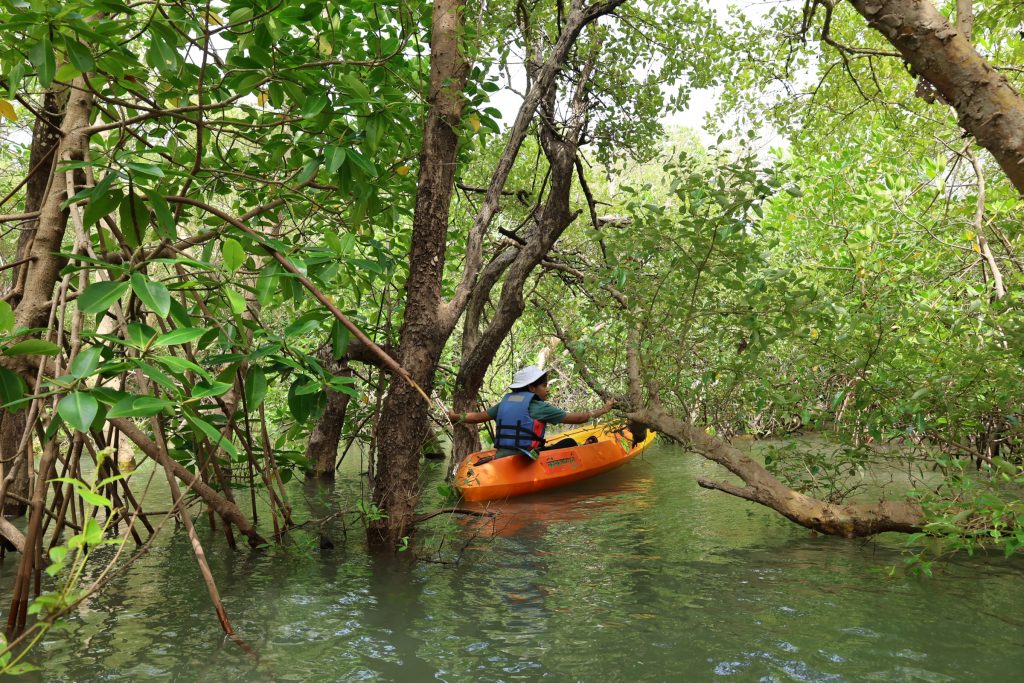
A soft current ripples near Jamdulwadi Island as 15-year-old Prachi Santosh Acharekar guides her canoe through the gnarled trunks of a mangrove forest.
The afternoon sun warms the surface of the water, revealing a familiar scene to local communities around India’s Konkan coast: clusters of mud-covered crabs, basking on branches.
As she approaches them, she slows her boat. Prachi, a 10th-standard student, doesn’t just see mud crabs: She sees her future. Her focused gaze and deft handling of the boat are part of her autodidactic training, a testament to a burgeoning passion that runs deep within the Acharekar family.
Prachi Santosh Acharekar navigating her canoe through the mangroves, a part of her crab farming training.
Champions of the Mangroves
In Achara village, where she lives, crab farming season typically runs from October to May. When Prachi is fully inducted into her family’s business in about three years, during this time, she’ll be busy with preparations, stocking seed, feeding the crabs, and folding boxes to safely transport them once they’ve been harvested.
All of it will also formalize her role in a grassroots movement, led by women from India’s coastal belt: In Sindhudurg, women fisherfolk have become champions in linking their livelihoods with environmental conservation. Through crab farming, they’ve created a strong incentive to protect local mangroves, which serve as critical nursery habitats for mangrove crabs. The benefits of this are both economical and ecological: Alongside generating sustainable income for the women, the mangroves’ preservation stabilizes shorelines and mitigates erosion, enhancing coastal resilience against the impacts of climate change.
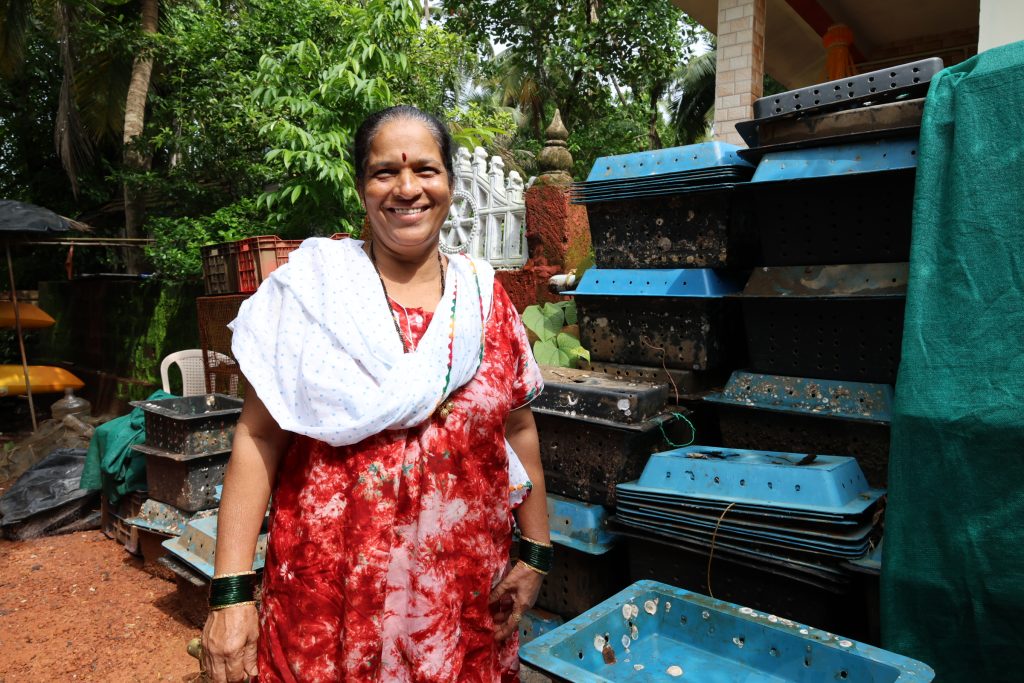
At the heart of this enterprise is Prachi’s aunt, 55-year-old Sonali Sunil Acharekar, a proud entrepreneur and leading member of Konkansparsh, one of Maharashtra’s pioneering women-led self-help groups (SHGs). Like all women of this SHG, for her, the mangrove is not just an ecosystem, but a dynamic marketplace.
“Be it dolphin safari, trekking, birdwatching, or traditional fishing, we do it all at Konkansparsh,” says Sonali, sitting in a charpoy at her home, surrounded by a vast area of mangroves. “But crab farming is our speciality. It is something we feel deeply attached to.”
Sonali and other leaders manage the entire crab farming supply chain, from feeding and harvesting the crabs to selling them. The process is meticulous but straightforward. Crab seeds are carefully placed one-by-one into fiber boxes. Each box is then deployed within the protected mangrove territories of Sindhudurg district, which boasts 6,940 hectares of mangroves perfectly suited for farming. Sonali also feeds the small raw fish stock twice daily, in the morning and evening. Then, once the crabs are ready, they’re harvested, boxed, and sold.
Sonali Sunil Acharekar in the backyard of her home in Achara village.
Overseeing the entire operation in this way has significantly enhanced the women’s access to resources, as well as to the market. The payoff is also demonstrable, including as a sustainable model: Last year, the Acharekar family, a seven-member unit that works in tandem, generated an impressive 150,000 INR ($1,706 USD) from the sale of 180 crabs. They also earned an additional 130,000 INR ($1,466 USD) from running mangrove safaris.
“It feels so good to partake in the process,” says Sonali. “This year, we intend to maintain 200 boxes fully. More boxes mean more business and more business means more prosperity.”
Their success also reinforces a crucial ecological benefit: According to research published in the Marine Biological Association of India, mud crab farming is not only a sustainable—and profitable—livelihood, but an essential strategy for mangrove conservation, supporting the region’s climate resilience through ecosystem protection. The mangroves provide a conducive natural habitat for raising mud crabs, or green crabs, commonly from the species Scylla serrata, which are indigenous to the region. By breeding and harvesting crabs, and building and tending to crabs pens in mangrove creeks, the women have both created a financial incentive for the mangroves' protection and helped to increase the local crab population.
In coastal areas, crabs are considered an economically significant species due to their huge demand. The crabs themselves can also tolerate a wide range of temperatures and salinities without destroying local ecosystems. But over the years, sand mining, saltwater intrusion, and rising water temperatures have contributed to a declining mud crab population, and are just a few of the ongoing stresses and trends that fisher communities have dealt with, and that local SHGs hope to tackle.
A wild baby crab crawls on the trunk of a mangrove tree.
In other coastal communities like Kerala, Maharashtra’s neighboring state, crab farmers who once caught wild juvenile crabs and had plentiful stock are grappling with rising costs and dwindling returns, as crabs have become scarce and stressed. Their annual incomes have dropped by 50,000 INR to 100,000 INR (around $600 USD to $1,200 USD) due to poor water quality, causing frequent disease outbreaks, pushing many farmers to downsize or cease operations altogether, largely due to reduced harvests linked to environmental degradation.
Sustainable crab models in coastal communities in Maharashtra aim to address the pressing problems of overfishing, habitat loss, and food insecurity through long-term economic stability. But without such practices, crab harvesting may yield fleeting profits, triggering ecological collapse and harm to a region’s inhabitants.
In addition to boosting the economy, this is part of why the SHG’s endeavors have been such a great boon to the area.
According to Kedar Palav, Livelihood Specialist at Sindhudurg’s Mangrove Foundation, women-led groups comprising 40 women have been active in Sindhudurg district during the 2024-25 crab farming season. “Our aim,” he notes, “is to facilitate strong livelihood opportunities for the women.”
Sonali Sunil Acharekar (left) and her niece Prachi Santosh Acharekar (center) in conversation with Mayur Pansare (right), a Project Assistant for the Mangrove Foundation.
But even those with formal careers are drawn to the potential. Sonali’s 32-year-old son, Omprakash Sunil Achrekar, an engineering graduate, has embraced crab farming full-time; and Manish Tari, 22, an undergraduate in fisheries science, launched Manish Agro & Seafood with his father during the Covid-19 pandemic, specializing in vertical crab farming.
“We deal in red and green crabs,” says Tari. “A single piece per kilo can go up to 2,400 INR. It’s very lucrative.”
Navigating the Tides
Despite the economic potential, the journey is not without profound risks and hurdles. The most immediate occupational hazard, however, is theft.
“Theft of crabs is a big problem here,” says Sonali. “Sometimes diseases can spread in the backwaters, as well…A mortality rate of 20 percent is considered normal.”
It’s a challenge that has historically forced some farmers out of business. Samiksha Gaonkar, 50, from Pirawadi village, recalls being part of Sindhudurg’s very first crab culture group, which operated between 2014 to 2019. Despite each group member earning around 5000 INR per month, they were forced to shut down.
“Our crabs got suddenly stolen,” says Samiksha. “We could not keep a check on the thefts and then we had to pull out.”
Anagarajan Joshi, 58, a former crab farmer, at her friend’s home in Pirawadi village.
Another hurdle is the scarcity of crab seed. According to Palav, there is only one hatchery in India: the Rajiv Gandhi Centre for Aquaculture (RGCA) in the southernmost state of Tamil Nadu.
Sanjeevni Santosh Mithbavker,43, a member of the Vedoleshwar SHG, says crab farming has become more difficult as a result. “We lack seed,” she says. “If the supply of seed becomes easy, we can take this business forward.”
Despite the scarcity, Sanjeevni sold crabs worth 60,000 INR last season. But while business is “great,” seed still costs 25 to 30 INR for a single piece—makings it an expensive venture for the average crab farmer.
A Wave of Resilience
To counter these challenges, government and non-governmental efforts have actively focused their support on the most vulnerable communities, placing women at the forefront.
Government initiatives such as the Mangrove Conservation and Livelihood Generation Scheme, alongside international projects like Enhancing Climate Resilience of India’s Coastal Communities (ECRICC), have been instrumental in fostering local interest in Sindhudurg’s coastal villages, including Achara and Hadi. As part of the Mangrove Foundation’s intervention, women’s groups also receive substantial training and support, including expert talks, presentations, and hands-on workshops that offer extensive practical training.
On the ground, additional support comes from 34 Sagar Mitras—fisheries graduates who act as vital resources for the women. Mayur Vinayak Pansare, Project Assistant with the Mangrove Foundation, sees themselves in a family-like role. While they occasionally help fix issues, like crabs breaking through fiber boxes, he says, “It’s heartwarming to see these women coming forward and taking steps towards self-reliance.”
Sanjeevni Santosh Mithbavker, 43, mends nets at her home in Hadi village.
The financial assistance is also significant: The Achrekar family, for instance, received a substantial 90 percent subsidy from the Department of Fisheries and the Mangrove Foundation. Between 2021 and 2025, larger initiatives like the Pradhan Mantri Machi Sampada have backed an additional 124 fisheries projects, with women as a remarkable 60 percent of beneficiaries between 2021 and 2025, says Bahar Vithala Mahakal, Sindhudurg District Program Manager at the Fisheries Department.
This focus is clear across other programs, too: The Sindu Ratna Samrudhi Scheme saw a 70 percent rise in female beneficiaries in a single year, between 2022 and 2023.
Planting the Future
Women’s presence as crab sellers in Sindhudurg’s main fish market signals a generational shift in the industry: They’re taking center stage in an otherwise male-dominated marketplace. For Dakshita (who asked we only use her first name), her presence here is about more than selling her own yield—she’s also reclaiming a little more of herself.
“What is the need for middlemen when I can run my own business?” she says, waiting for customers.
Dakshita, 50, sells green crabs at the Malvan fish market in Sindhudurg.
In Prachi’s case, the journey towards self-reliance began slowly. She initially “harbored no interest in crab farming.” But witnessing her family’s dedication and serving as a guide for tourists through the vibrant backwaters transformed her perspective, converting her initial disinterest into a passion.
In the shifting tides of the Maharashtra coast, Prachi represents the strong voice of a younger generation, seamlessly blending tradition with science to carve a new path forward. For them, crabs are the ‘green gold,’ promising economic returns.
While elder members strengthen their place in the market, Prachi is now articulating a dream that links her environment to her education, which she plans to pursue further by studying Marine Science.
“By protecting the mangroves, my crabs thrive,” she says. “The mangroves in return protect my family from storms, erosion, and the rising sea.”
A view of a mountain village in Sindhudurg.
In the nearby pond, Prachi and Sonali have also started to plant new mangrove saplings. Other efforts at sustainability have only grown. In 2017, scientists visited the area and told local crab farmers that in order to have a better catch, they needed to maintain cleaner water. To boost women’s participation in local water and pond management, women farmers are now being trained to regularly flush water through the crab ponds for freshness, monitor water quality, and prevent overcrowding. Since then, they’ve seen the return of many new birds in the area, from cattle egret to common sandpiper and Indian pond heron.
The tides speak louder than people in Sindhudurg’s coastal communities, and for these powerful women, mangroves stand like guardians along the coast. The more they nurture the mangroves, the more the mangroves give back to them, too. It’s a quiet partnership in nature, this connection between crab farmers and the mangrove forests, and a small step in healing the Earth.
[post_title] => Guardians of the Mangroves
[post_excerpt] => How women crab farmers along India's coast have linked their livelihoods to environmental conservation.
[post_status] => publish
[comment_status] => closed
[ping_status] => closed
[post_password] =>
[post_name] => crab-farmers-farming-aquaculture-india-mangroves-conservation-climate-change-ecosystem
[to_ping] =>
[pinged] =>
[post_modified] => 2026-08-03 21:03:35
[post_modified_gmt] => 2026-08-03 21:03:35
[post_content_filtered] =>
[post_parent] => 0
[guid] => https://conversationalist.org/?p=9839
[menu_order] => 0
[post_type] => post
[post_mime_type] =>
[comment_count] => 0
[filter] => raw
)
When the hero’s journey comes to its final chapter, a certain existential reckoning occurs. The life and death of ideas is very real: many far outlive their usefulness, and perhaps one that needs to die right now is the idea that art should exist on the market principally as a financial tool. Art fairs are expensive, rents are obscene, and a global economic downturn accented with the panic and chaos of trade wars and ethno-nationalism all point toward the necessity of conservative budgets and cost-cutting. Yes, the tie between money, power, and art is irrefutable, the backbone and lifeblood of art history. But as the midtier market collapses, it might be nice to finally unfuck the gap between the hand-to-mouth life of the artist and the value of art in the market, beginning with a trial separation—at least as a thought exercise—between money and art.
Now, more than ever, we need art to do the heavy lifting of defining our values. Alternative thought is essential when the capitalistic world has agreed—with zero referendum—that artificial thought is in any way preferential or superior. By subscribing to the centrism that masquerades as progressivism in the United States, the art world lost touch with the political landscape and, with that disorientation, any ability to question it. Amid the art market highs and market-oriented inclusivity, art has also lost its critical capacity.
But what is the value of art that cannot be sold? What might be the purpose of art that is simply not meant to sit aside a red dot? Historically, of course, we have performance art and Situationism, along with their descendants. But, beyond art that is merely difficult to commodify, what does an expression of cultural values look like when consciously uncoupled from the art market?
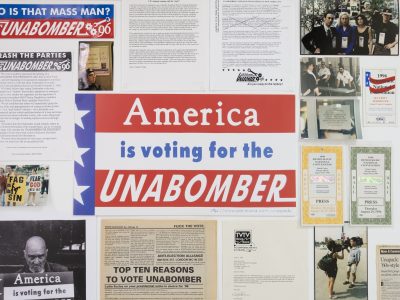
I pondered these questions as I walked around my favorite show I have seen all year, Lydia Eccles’ “Jokes About Bombs Will Not Be Taken Lightly,” which was up at Goswell Road, an artist-run space in Paris, from May 15 until June 14. In 1995, Eccles, a Boston-based artist, had one hell of an idea for an art project. Rather than taking a ho-hum trip to the supply store, she nominated the Unabomber—at the height of his anonymous reign of terror—in the 1996 US presidential election. The show was a documentation of that campaign and the ensuing pen-pal relationship Eccles formed with Ted Kaczynski after his arrest and throughout his incarceration.
Conceptual art has given us everything from Chris Burden having a friend shoot him to Agnes Denes turning a strip of downtown Manhattan to a wheatfield. Art in this vein pushes what can be a canvas for expression: the human body, landfill. But never before had I seen an artist decide their chosen medium was a presidential election. By participating in the political arena with all the familiar trappings of the era—signs, slogans, bumper stickers, and even a dedicated camera crew—Eccles showed a presidential campaign for what it is: an hysterical circus that plays to our basest fears, one where infamy and fame are interchangeable.
Eccles documents the Unabomber’s “run” alongside his more literal run from the law and the dance he did with the media, most notably and implausibly with Bob Guccione. Her prolific campaigning warranted its own inane and disturbingly underinformed coverage. At one point in the winter of 1996, WRKO radio reported, “There are more Unabomber signs than there are for Clinton, Gore, or all the Republicans, so it looks like the Unabomber is leading in this precinct.” In a time of Luigi Mangione fandom and a renewed, bi-partisan interest in Kaczynski, “Jokes About Bombs” offered a riveting, prescient, wholly prophetic anti-capitalist critique of technology’s role in a broken political system. The phrase “artistic intervention” has been worn out to the point of farce, but Eccles had staged one in a presidential election and a federal manhunt.
I had to own the catalogue.
But: how to get it home??? The cover showed an old-fashioned political sign stuck in sludgy snow amid a warren of placards for Bob Dole and Pat Buchanan:
DON’T WASTE YOUR VOTE! Write-in for President UNABOMBER ’96 If elected he will not serve ★ VOTE AGAINST REPUBLICANS ★ VOTE AGAINST DEMOCRATS ★ VOTE AGAINST CORPORATE TECHNOLOGY All you have to lose is the political illusion… ARE YOU READY FOR THE RUPTURE?
I imagined myself at customs, declaring this tome. Anthony Stephenson, the gallery’s convivial proprietor, asked me if it would be so terrible to be stuck in France forever. He had a point. Still, I demurred and, frankly, chickened out of buying a book I really wanted to own.
In my own cowardice, I recognized that Eccles’ show was lightning in a bottle, and that my own hesitation indicated that I was in the presence of something genuinely avant-garde. I’d been conditioned to the shopping malls of art fairs, swapping out the Orange Julius and TCBY of my New Jersey childhood for the (aptly named) Ruinart Champagne Lounge. Despite my arty existence, in that moment of contact, I realized that coming across art that is actually outré (if you like your French cultural theory) or verboten (if you prefer your Germans), and has purpose, simply had not been my experience of most galleries where, at best, I sigh and think “Gee, if only I had a cool $30K lying around…” Like the idea of owning its catalogue, the show itself freaked me out a bit. I felt alive in my mind and privileged to be in the room, as well as to meet Eccles herself.
In its early pages, the catalogue for “Jokes About Bombs” contains the text of a speech James Baldwin gave in 1962, “Art is here to prove, and to help one bear, the fact that all safety is an illusion. All artists are divorced from and even opposed to necessarily any system whatever.” These are, of course, the sorts of moral standards we expect whenever we read James Baldwin, who had a sixth sense for integrity the way sea turtles and migratory birds can use the earth’s magnetic fields for navigation. While I ultimately left the catalogue behind, as spring turned to summer, I let his words guide my art viewing.
I came across two moral stand-outs in London. The first was Ed Atkins at the Tate Britain, best known for his computer-generated, incredibly unsettling videos that plumb the uncanny valley. Atkins has been exploring the genre for decades, well ahead of AI moral and economic panic. Seeing his career retrospective made me think of a Democracy Now interview I saw with Karen Hao, who pointed out that, as we have no agreed-upon scientific definition of human intelligence, what, exactly, is Artificial Intelligence? Is it merely a projection of our perceived notion of intelligence, skewed entirely by capitalistic values? Are we creating “intelligent” bots with the same level of foresight and ethical depth as rare dog breeds concocted by bored, rich people that are so helpless they cannot even fuck on their own? (A sharp new ad for Merriam-Webster slyly posits their dictionary as an LLM and ends with the tagline, “There’s artificial intelligence, and then there is actual intelligence.”)
The second stand-out was “Leigh Bowery!” at the Tate Modern, a retrospective of fashion and nightclubbing as artistic expression. The text at the entrance to the exhibit read: “In his brief life Bowery was described as many things. Among them: fashion designer, club monster, human sculpture, nude model, vaudeville drunkard, anarchic auteur, pop surrealist, clown without a circus, piece of moving furniture, modern art on legs. However, he declared, ‘if you label me, you negate me,’ and always refused classification, commodification, and conformity.” The show was a riveting reminder of transgression and artistic expression in the face of AIDS, discrimination, and the rise of conservatism—and a call for the same as we face rising global authoritarianism today. In an era where fashion often feels like the reductio ad absurdum of vapid aspirational mass consumption amid our ever more precarious existences, online and in debt, Bowery’s ability to imbue costume with so much intellectual ambition and drive floored me.
These three exhibitions were recentering as reminders that art’s purpose—its true value—shouldn’t be monetary. Moreover, those figures don’t mean much just before a crash, when the numbers game is more of a hiding-the-real-numbers game. While blue chip galleries and their deep war chests can ride out the chaos for now, Hauser & Wirth’s stumble may tell us otherwise.
Right now, it is vital to uncouple cultural values from the marketplace. Commercial worth has always been baked into ideologies that align with power, whether you’re talking about royal court painters or the CIA and Abstract Expressionism. The market then reinforces that notion of value over and over again in a way that resonates into institutions and educational systems. Yes, that art market is experiencing a downturn that might spell collapse for many. It won’t be pleasant. However, chaos presents an opportunity for a reappraisal, and for finding what was lost. I would argue that—whether you love it or hate it—art that passes the Baldwin litmus test is a great place to start understanding what art with a valid critical stance looks like at this very moment in time.
Such art demands the same moral clarity from its viewers, too: I did return to Goswell Road this summer, and I bought the catalogue for “Jokes About Bombs Will Not Be Taken Lightly.” Despite my concerns, the book made it home through customs.
[post_title] => The Value of Art That Can't Be Sold
[post_excerpt] => Now, more than ever, we need art to do the heavy lifting of defining our values.
[post_status] => publish
[comment_status] => closed
[ping_status] => closed
[post_password] =>
[post_name] => cultural-currency-value-art-cant-be-sold-galleries-profits-economy-goswell-road-lydia-eccles
[to_ping] =>
[pinged] =>
[post_modified] => 2026-08-03 21:17:18
[post_modified_gmt] => 2026-08-03 21:17:18
[post_content_filtered] =>
[post_parent] => 0
[guid] => https://conversationalist.org/?p=9725
[menu_order] => 0
[post_type] => post
[post_mime_type] =>
[comment_count] => 0
[filter] => raw
)
Why you should pay attention to Massachusetts's Question 5 this election.
This article is a part of Down-Ballot, a weeklong series highlighting state measures worth watching in the 2024 United States election.
A contentious ballot question has Massachusetts wait and bar staff fearing a dramatic change in their hourly take home pay following this November. For Corri DePatra, a bartender and server since 2001, the potential industry change is maddening.
“They’re trying to pull on heartstrings,” DePatra says. “I just think it is very emotionally manipulative.”
Question 5 on the Massachusetts ballot this election year is an initiative proposed by One Fair Wage, a national nonprofit and NGO. If the measure passes in the state, it would lead to a gradual rise in the minimum wage base pay for tipped workers from its current $6.75 to $15 an hour in the next five years. Eventually, the change would also allow for a shared tip pool between the front and back of the house to be managed by restaurant owners. But many restaurant workers have come out in opposition to its passing, arguing it would likely actually decrease their take home pay.
“We were all at city hall and I went in to listen to the hearing,” DePatra says, noting that she was particularly outraged by One Fair Wage’s closing arguments, which pointed to discrimination against women as a driving factor for the initiative. As a waitress standing with others at the hearing, DePatra felt they were invalidating her experiences as a woman working as a tipped restaurant worker, and misrepresenting the amount of hard work that goes into being a part of the restaurant industry.
DePatra works at The Kenmore, a Boston pub specializing in fresh pregame eats and draft beers, where signs to “vote no” adorn the walls in hopes of informing customers of how their restaurant workers feel. To learn more, all signs point to a website for a coalition of small and large restaurants known as the Committee to Protect Tips.
The Committee is spearheaded by two of the largest groupings of restaurant leaders in the state: Massachusetts Restaurants United (MRU), a coalition of industry leaders from various sized restaurants and cafes that began after the peak of the Covid-19 pandemic, and the Massachusetts Restaurant Association (MRA), a not-for-profit lobbyist group. Their joint mission against Question 5 has so far been endorsed by eight local mayors, the Greater Boston Chamber of Commerce, and hundreds of Massachusetts restaurant workers.
“A lot of people are going to lose their jobs if this passes,” says Ryan Lotz, president of MRU and leader at Traveler Street Hospitality. “We’re going to see secondary and incurred costs go up for the restaurant operators and owners.”
Earlier this year, an MRU poll about industry crises noted that 85% of restaurant leaders said they are one surprise expense away from having to close. According to Lotz, restaurants are going to see an increase of over $18,000 per year per employee if the initiative is fully deployed, something most simply can’t afford. Restaurants will be forced to shift to models with fewer servers but quicker service, he argues, implementing functions like QR code menus or counters. And for guests, it will also mean higher menu prices and more fees on their checks when it comes to processing service.
“I think that people don't really understand the restaurant industry, and don't really understand how slim the margins are,” Lotz says.
These profit margins typically fall in the 0-15% range, with the bulk of restaurants falling around the 3-5% mark, according to national restaurant system Toast. Most of those restaurants are only able to stay open, Lotz argues, because of tips.
Currently, Massachusetts, like the majority of the United States, operates on a tip credit across the restaurant industry. This translates to every server or bartender making a base pay and tips filling in the rest of the minimum wage and more. Server Adam Dougherty has been in the industry for seven years and currently works at Fenway sports bar Cask ‘N Flagon. Even on a slow day, he says he already surpasses the $15 bar.
“People will probably tip less,” says Dougherty. “I’m going to be voting no.”
Advocates for the ballot question, meanwhile, argue that tipped wages need to become a thing of the past, and allege that the tip credit model is particularly harmful for women and people of color across the industry. This is because it can allow restaurants to get away with paying staff less than a livable wage without consequence, while putting the burden on customers to make up the difference.
One Fair Wage, which is headquartered in California, champions the initiative across the country via satellite organizing heads which advocate for tipped worker payment changes state-by-state. According to Grace McGovern, one of two Massachusetts full-time state organizers working for One Fair Wage, who has been a tipped worker herself, combating misinformation has been difficult.
“So many people are just so surprised that a subminimum wage is still in place,” says McGovern.
She adds opposition from the Committee to Protect Tips has also weaponized their research.
“Even if 90% of the 300 people that they had completed their survey answered that they want things to stay the same, there are still 124,700 tipped workers in Massachusetts—at least—without their voices heard,” McGovern says.
Massachusetts is one of six active campaign efforts targeted at raising the minimum wage this year, with other states including Rhode Island, Arizona, and Missouri. But in total, One Fair Wage has initiated 16 total targeted campaigns in states or territories, according to their website.
One place where the campaign has been successful is Washington, D.C., where according to McGovern, there has been a positive increase in the earnings of workers. Lotz, on the other hand, sees it as a tragedy.
“This passed recently, and when it did, we saw approximately 6,000 jobs lost and restaurants closing,” Lotz says.
Another hotly debated aspect of the Massachusetts ballot question is the change to the shared tip pool. Currently, Massachusetts does not have comprehensive shared tips legislation. According to McGovern, the initiative would eventually allow for tip sharing with front and back of house, but it is not immediately required. Its ultimate purpose, however, is to move us away from tipping culture as a whole, and instead make a higher minimum wage the norm.
Jay Zagorsky, professor of public policy and law at the Questrom School of Business, agrees that tips should be eliminated, but thinks Question 5 is not the answer.
“Question 5 is poorly written and poorly thought out,” he says.
According to Zagorsky, one of the biggest indicators of Question 5’s failure comes in the form of the legislative committee’s comments in the ballot guide, which states in all capital letters that it "OUGHT NOT TO BE ENACTED BY THE LEGISLATURE AT THIS TIME."
So if Question 5 is not the answer, what is? Those voting no are not quite sure.
“Eliminating the sub-minimum wage for tipped workers on a state-by-state basis is not the right way to go,” says Zagorsky, pointing out how rising labor costs will directly lead to fewer jobs and those that remain will be “worse off.”
For Lotz, fighting the current initiative remains his first priority. He can’t quite think of anything else before that’s resolved.
“I would be more than happy to start working on that if this doesn’t pass,” Lotz says. “What keeps me awake at night is that people are going into the voting booth in November with a lack of knowledge. We need to get as many people to understand the gravity of this question before November.”
[post_title] => The Tipping Point
[post_excerpt] => Why you should pay attention to Massachusetts's Question 5 this election.
[post_status] => publish
[comment_status] => closed
[ping_status] => closed
[post_password] =>
[post_name] => massachusetts-question-5-minimum-wage-tips-restaurant-workers-initiative-one-fair-wage-state-election-2024
[to_ping] =>
[pinged] =>
[post_modified] => 2026-08-04 16:44:26
[post_modified_gmt] => 2026-08-04 16:44:26
[post_content_filtered] =>
[post_parent] => 0
[guid] => https://conversationalist.org/?p=7313
[menu_order] => 41
[post_type] => post
[post_mime_type] =>
[comment_count] => 0
[filter] => raw
)
Who's taking the biggest hit in the global fast food boycott?
In the proxy war over fast food that’s now enveloping the Muslim world, it’s clear who took the first shot. But unlike the war that triggered it, who exactly is footing the bill is another matter.
In the early days of the War in Gaza, Israel’s McDonald’s franchisee, Alonyal Ltd, set off a tidal wave of controversy when it announced it would give free food to Israeli soldiers. In January, the Israeli franchisee behind Pizza Hut appeared to follow suit, when the Palestinian news source Quds News Network posted screenshots from Pizza Hut Israel’s Instagram account of smiling IDF soldiers holding stacks of pizza boxes which, according to the caption, Pizza Hut had given them for free.
Both Alonyal and Tabasco Holdings, the Israeli Pizza Hut franchisee, appear to have acted alone, without approval from the American companies that own their respective brands. But their decisions to give food to soldiers fighting perhaps the world’s most watched conflicts has led to serious global ramifications. As the news ricocheted around social media, regular McDonald’s, Pizza Hut, and KFC customers all over the world, but especially in predominantly Muslim countries, announced plans to boycott all three restaurants. (The KFC and Pizza Hut brands are both owned by the same company, Yum! Brands.)
Attempting to quell the outrage, McDonald’s Corporation, the US company that Alonyal paid to use the Golden Arches logo and menu, released statements insisting McDonald’s was politically neutral and had no ties to either side of the conflict. Soon after, McDonald’s franchisees from Turkey to Oman—all of them unrelated to Alonyal, except in their common relations to the McDonald’s brand—distanced themselves from Alonyal by issuing their own statements of support for the people of Gaza and pledging support for relief efforts in the region.
But for millions of customers, the presumed complicity of any business wearing the brand of a global fast food company was already a foregone conclusion. Either they did not grasp the fact that franchisees were independently owned, or they believed independent ownership did not absolve them from their Israeli counterpart’s choices. The fact that the United States government is the leading international sponsor of the IDF only added fuel to the flames: Regardless of ownership, customers still considered these brands to be inherently American. Franchisees in countries with large Muslim populations in the Middle East and Asia soon reported massive drops in sales. In February, the McDonald’s Corporation announced it had missed sales estimates for the first time since the early days of the Covid-19 pandemic.
Boycott promoters on social media took declining sales as a clear sign they were hitting the intended target. “Let this be a lesson to any company that wants to continue supporting the Zionist entity,” a PhD student in Canada, who goes by the handle @palfolkore, said in a TikTok with over 14 thousand likes, posted the day McDonald’s released its sales figures. “Your stocks will drop. Your earnings will be hit … There is no amount of rebranding you can do to dissuade us … We know what you are. We know what your politics are.” (@palfolkore did not respond to a request for comment.) Their post was one of countless others celebrating the apparent victory, and the boycott continues to this day.
The conceptual simplicity of a boycott, and a fast food boycott in particular, has made it especially easy for activists to get behind: Fast food companies are huge, global, and, unlike arms manufacturers, whose connection to the war is as direct as it is obvious, they depend on money from the general public to keep going. But fast food, like globalization itself, does not easily lend itself to such a straightforward line of attack. Before taking aim at fast food, it helps to understand who’s actually behind it.
~
If you know something about how the fast food industry works, you’re probably familiar with the concept of franchising. It works like this: The fast food company, called the “franchisor,” gives a company or individual, the “franchisee,” the right to use its name, menu, and likeness in a given area. In exchange, the franchisee typically pays the franchisor an annual fee and gives it a cut of its revenue. During the industry’s early rise in the United States in the 1950s and 1960s, franchising gave companies like McDonald’s and Burger King a way to expand without staking their own capital. Instead of borrowing money themselves to build new restaurants, they could rely on people with their own savings and lines of credit to underwrite new operations. It would ultimately benefit customers, too: A person could walk into a McDonald’s in Portland, Maine and another three thousand miles away in San Diego, California and expect the same food and service, despite the fact that each was independently owned.
As the industry became larger and richer, the capital advantage of franchising became less important. Many companies backed off the practice, electing the more profitable route of opening their own restaurants. But overseas, franchising still proved critical to the industry’s expansion. First, franchisees knew their own regions more intimately than a large corporation, headquartered on another continent, ever could. Secondly, local ownership allowed the industry to blur the lines around its own national identity. Depending on the mood of its customers, McDonald’s or KFC could be an American brand, a local one, or some indistinct fusion of the two.
But almost as long as global fast food companies have maintained a presence outside the US, they’ve been the subject of political protest, and even political violence, as was the case in a series of attacks and bombings in Latin American countries, such as El Salvador and Peru, from the late 1970s through the 1980s, and in majority Muslim countries, such as Pakistan, Egypt, Indonesia, and Lebanon in the 2000s and the 2010s. In many cases, it was clear the activists, rebels, or terrorists who targeted a particular fast food outlet intended to make it a proxy for something bigger. Often, the United States was the primary target. Other times, it was globalization itself. In his book-length account of his travels in India, The Age of Kali, William Dalrymplerecounts how, on the 51st anniversary of Mahatma Gandhi’s assassination in 1999, members of a farmers’ union in Bangalore trashed a KFC in the name of a “second freedom struggle” to stop “the invasion of India by multinationals.”
Drawing a line from India’s independence struggle to KFC may have been a stretch. But it made striking at a locally-owned fast food outlet easier to justify. After all, if multinational corporations were colonial powers, what were franchisees if not their collaborators?
~
A similar question hovers over the current wave of consumer action sweeping the Muslim world. If symbolism is the point, does it matter who among the multitude of people and institutions behind various international fast food brands takes the biggest hit during a boycott? Fast food corporations may be nebulous, but franchised restaurants are their real-world manifestations. They may be independently owned, but they are nothing if not closely affiliated with the corporations whose names they carry. Why not go after them?
We might see the current wave of boycotts as an attempt to apply that same logic on a massive scale. But the result has been that people are going after franchisees with no business in Israel at all. In August, Americana Group, a franchisee that owns more than 2,000 KFCs and other restaurants across the Middle East and Kazakhstan, reported a 40 percent loss in the second quarter of this year compared to the same period in 2023. QSR Group, the leading KFC and Pizza Hut franchisee in Southeast Asia, temporarily closed over one hundred KFCs in Muslim-majority areas.
“Let’s give it up for Malaysia, everybody,” another TikToker going by the handle @anti__mia said of the news. “The Malaysians really know how to boycott.”
Yet the people most affected by these boycotts may not actually be protesters’ intended target: Neither Americana nor QSR Group has any business in Israel. In fact, the largest backers of both franchisees are agencies of governments that have taken positions against Israel. Americana Group’s largest investor is the Public Investment Fund, the sovereign wealth fund of Saudi Arabia—a country which has never recognized Israel and has called Israel’s actions in Gaza a genocide. The controlling shareholder of QSR Brands is an investment company owned by the Malaysian state of Johor, and one of its largest minority shareholders is another government entity, a pension fund controlled by the Malaysian Ministry of Finance. The Malaysian government is so at odds with Israel that, last year, it adopted a boycott of its own, banning all Israeli ships from entering its ports.
Fast food ownership might be fuzzy by nature, but the effects of the current boycotts are quite vivid. Earlier this year, QSR Brands intended to put itself up on the local stock exchange, attracting more investors and likely bringing in additional money for the state-owned agencies that control it. But after closing stores and watching profits tumble, those plans are indefinitely on hold. Despite the avowedly pro-Palestinian position of the Malaysian government, to activists and Gaza-watchers on TikTok, the KFC name—and its American ties—speaks louder.
~
Back in Israel, McDonald’s has gone through an even more dramatic transition. In April, McDonald’s Corporation made the drastic choice to buy back all 225 of Alonyal’s restaurants for an undisclosed sum. Owning Israeli McDonald’s outright will expose the company to more risk, but it will also give the company more control, and the local stores more stability during a period of political upheaval. Boycott or not, the fast food industry finds a way.
Ownership also means McDonald’s Corporation gets to capture the profits for itself instead of sharing them with a local partner. Ironically, a boycott of Israeli stores now would do more harm to the US company’s bottom line than it did when the boycott began. Despite the protestations of its corporate masters, the fast food industry—like any global industry—is enmeshed in world politics, after all.
[post_title] => The Proxy Fast Food War
[post_excerpt] => Who's taking the biggest hit in the global fast food boycott?
[post_status] => publish
[comment_status] => closed
[ping_status] => closed
[post_password] =>
[post_name] => global-fast-food-boycott-gaza-palestine-israel-middle-east-mcdonalds-kfc-pizza-hut
[to_ping] =>
[pinged] =>
[post_modified] => 2026-08-04 16:47:42
[post_modified_gmt] => 2026-08-04 16:47:42
[post_content_filtered] =>
[post_parent] => 0
[guid] => https://old.conversationalist.org/?p=7248
[menu_order] => 44
[post_type] => post
[post_mime_type] =>
[comment_count] => 0
[filter] => raw
)
On gentrification's canary in the coal mine, and the cultural cost when affordable cities cease to exist.
Cultural Currency is a bi-monthly romp through the intersections of art, capital, and politics with writer Cara Marsh Sheffler.
We all know thehaircut, whether or not we know it by name. Usually the sides are shaved, the dye job is fluorescent or uneven, and the bangs are unflinchingly aggressive. The haircut is also, of course, not one haircut, but rather a whole genre of haircuts. A mullet is likely. It is something like medieval monastic cosplay by way of a Superfund Site. Glimpsed across the subway platform or at the local bodega, it is a haircut that strikes horror in the heart of the renter and joy in the heart of the owner. The haircut is gentrification’s own canary in the coal mine: It signals that your rent is about to go up.
Nowhere is the haircut more dreaded than in New York City, where no rent increase, no matter how minute the percentage point, is a casual one.The median monthly rent in Manhattan is north of $4,300. The cost of living is 128% above the national average. When Jimmy McMillan founded his political party, Rent Is Too Damn High, almost 20 years ago, it was described as a single-issue platform. Today, I would argue it’s anything but. Commercial rents have become unaffordable to the point that entire blocks have been emptied of ground-floor tenants. The ascendancy of Amazon and the price of rent have colluded to drive the commercial storefront vacancy rate in New York City north of 10%.
The irony of the haircut is that it both heralds the appearance of artists and their imminent extinction. It also isn’t limited to Manhattan: The length of time between the sighting of the first asymmetrical neon mullet to large-scale, luxury residential development is accelerating in cities across the country, and more locally, has all but collapsed into a single gesture in neighborhoods like Bushwick, Brooklyn and Ridgewood, Queens. In the process, it’s also begun flattening the art world—and culture at large—with it.
Of course, in the meme-able version of the gentrification story, the haircut is the mark of the villain. But it was not always so. In postwar New York City, when industries abandoned downtown areas and developers like Robert Moses threatened to raze entire neighborhoods to make way for cars instead of people (usually at the expense of racial minorities), creative classes stepped into wastelands like Soho and not only repurposed entire neighborhoods but spawned a class of creators as diverse as Eva Hesse, Jean-Michel Basquiat, Hannah Wilke, Gordon Matta-Clark, Ana Mendieta, Donald Judd, Nam June Paik, Fred Eversley, and too many others to name.
This cohort—living among one another in constant creative conversation and competition—produced work that helped articulate a fully formed idea of American cultural expression. Today, even adjusted for inflation, none of them would have been able to afford the rent on a closet in Soho.
When artists are priced out of any given city, the consequences resonate far beyond the neighborhood in which they can no longer afford to live. The attendant deracination makes art less tethered to real places, real communities, and real people. Art becomes less human, and derives worth from one thing only: capital. (While many question their artistic merit, NFTs are a sublime manifestation of this conflation.) In New York today, artists are barely hanging on and bled dry for studio space, while writers essentially have no value in a marketplace that has opted for AI. Musical artists are getting raw deals from streaming services and have fewer venues to play in because of soaring rent. Ditto dancers. The city faces a severe housing shortage, but no one will come forward with an honest number for overall vacancy rates, suggesting that the real estate market is falsely inflated to the detriment of all who call the city home (except landlords). Creatives who work as adjunct professors are often overworked, always underpaid, and almost never promoted to tenure-track positions. Having a family in this city on an artist’s salary is essentially fiscal suicide.
Simply put, New York’s artistic community is in danger of no longer existing, and we’ve watched it happen in real-time. Downtown New York used to be a byword for a hotbed of American culture, the same way that Chelsea is now the byword for the most prestigious (read: expensive) gallery district in the country. But while art has thrived on patronage since time immemorial, what sort of art is produced in a city artists cannot afford to live in, and where a commercialized, gentrified simulacrum of diversity signals luxury? The answer is probably an NFT.
A healthy city should contain a diversity of artists, precisely because it also contains a diversity of people. No less an urbanist than Moses-archenemy Jane Jacobs wrote in The Death and Life of Great American Cities, “Everyone is aware that tremendous numbers of people concentrate in city downtowns and that, if they did not, there would be no downtown to amount to anything—certainly not one with much downtown diversity.” In other words, downtown areas are desirable precisely because of the diversity that is priced out by their own desirability. This is also ultimately what leads to their downfall: What is the point of living in a city stuffed with billionaires but starved of human capital? And who can even afford to, anyway?
Of course, art and money have always been intertwined. Rich people have nice things. Art is often considered one of those nice things. However, the more art is commodified—and this certainly bears itself out historically with regard to art as a status symbol or reflection of power—the less of an ability it has to be critical, independent, or introspective. You know, interesting. Gradually, it also has less to say, until art is reduced to a price tag alone—like any other commodity, like currency itself. Art that is only for the mega-rich yields an entire culture that is much the same. Is it any surprise at all that a New Yorker profile of mega-dealer Larry Gagosian from earlier this year took pains to point out that his most lucrative investments were probably in real estate rather than in art?
As a small-m materialist, I am well aware these questions long ago migrated from the urban grid to Instagram’s. Our insatiable need for convenience and connectivity has destroyed our physical social networks in a variety of ways—and dictated how we continually buy into our own dystopia. It’s also sped up our isolation, both from art and from each other: The commercial tools that have warped real estate values and the basics of human interaction all flourished, of course, online. The connectivity and convenience that lured us toward our screens at all hours of the day have robbed us of storefronts, tax revenue, and chance encounters in exchange. And now, the way in which consumerism has displaced our sense of belonging in communities has manifested in urban real estate in such a way as to rob us of a creative class by destroying its habitat. As the world continues to move online, artistic communities will continue to vanish, too.
In an information economy and a literal economy that always prizes the shortest distance between two points—collateral damage be damned—artistic expression is a luxury afforded only to the idle rich. The arts will further retreat into a career path available only to those who can afford to go into them. (That is, if we aren’t basically already there, as the conversation around middle class cultural values and downward mobility seems to indicate.) All counter-culture will be co-opted, sanitized, and sold back to us by the algorithm. The resulting culture will be by the rich and for the rich only, a trend handily encapsulated by the vacuous and nauseating never-ending parade of “fashion X art” collaborations that provide little more cultural expression than a vapid launch party planned purely to be splashed across the aforementioned Instagram grid. (So long as corporations are people, I fear we are stuck with Koons’ and Kusama’s “viral Vuittons,” as their respective creators secret themselves far from any “scene” in either a mega-mansion or psychiatric hospital.)
Meanwhile, as the rich clamor for a front-row seat to this circle-jerk, rents will continue to skyrocket. The National Arts Endowment can protest that “a great nation deserves great art” until it is blue in the face, but where the fuck are the artists going to live?
Again, I return to Jacobs, who also wrote in The Death and Life of Great American Cities, “Our failures with city neighborhoods are, ultimately, failures in localized self-government.” This is absolutely true: the polis of any diverse city exists in a patchwork of political microclimates. But how can self-government take hold when no one who comes up in the new generation can afford to live in the neighborhoods that most need self-governing? Those who survived the lean years as owners cash out on once-affordable homes so their children can live better lives elsewhere. New developers buy out landlords who evict renters, and suddenly, the neighborhood is gone. The gaps left behind will be filled with coffee shops selling $7 matcha lattes and pilates studios with $45 classes, and the people who can afford to buy them.
Artists as a whole will surely still have the fire to create something, somewhere, but can already only afford to do so far from one another. The dissipation of any urban culture is its death: Downtown cannot exist as a diaspora. The point is the concentration of its energy, a sum far greater than its parts.
In The Death and Life of Great American Cities, Jacobs also chides us: “We expect too much of new buildings, and too little of ourselves.” Culture is not a commodity that can be counted. Yet, it has the power to enfranchise and empower just as much as any vote towards affordable housing or raising taxes on the rich. To preserve it, we must look to an inclusive path forward that prioritizes not just people and their work output but also the character of their communities—communities that contain multiple dimensions of diversity and creative expression that should not have to be commodified to prove their value. No developer, no bank, no corporation will do this for us. We must organize ourselves.
[post_title] => "Where the F*ck Are the Artists Going to Live?"
[post_excerpt] => On gentrification's canary in the coal mine, and the cultural cost when affordable cities cease to exist.
[post_status] => publish
[comment_status] => closed
[ping_status] => closed
[post_password] =>
[post_name] => artists-new-york-city-affordable-housing-gentrification-haircut-real-estate-culture-art-nft
[to_ping] =>
[pinged] =>
[post_modified] => 2026-08-04 16:49:00
[post_modified_gmt] => 2026-08-04 16:49:00
[post_content_filtered] =>
[post_parent] => 0
[guid] => https://conversationalist.org/?p=7195
[menu_order] => 47
[post_type] => post
[post_mime_type] =>
[comment_count] => 0
[filter] => raw
)
As if the gig economy wasn’t exploitative enough, it’s now filling a gap in another exploitative industry that values profits over human lives—both the lives of those needing the service and the lives of those providing it.
When I was in college, I worked with California’s In-Home Support Services (IHSS) as an aide in the homes of disabled people. My job was to support people in completing activities of daily living (ADLs): I swept and mopped, did dishes and laundry, dusted blinds, decluttered bedrooms, grocery shopped, picked up medication, gave rides to doctor’s appointments. I was proud of my work; I made it possible for people to stay in their homes, rather than having to enter long-term care. I liked my work. I was also paid low wages for my work.
But even at minimum wage, the people I worked for would never have been able to afford to pay me, relying instead on state assistance. Today, ten hours of “homemaker” services like those I provided would be around $1,127 a month. The average monthly disability payment—for those who manage to qualify—is $1,234. Not all disabled people qualify for Social Security disability programs or for state programs like IHSS, however, and those that do often do are often not assigned enough hours to meet their needs, if they can even find workers. People do not like the pay, the hours, the conditions; it’s hard work.
Because society does not provide disabled people with the support they need to live independently and safely, many people have been forced to fill the gaps for themselves via services that weren’t designed for them, but have become a lifeline. As a result, gig economy workers, such as rideshare drivers and shoppers, are now inadvertently assisting with ADLs and entering the care and support workforce. An Instacart driver is buying supplies someone can’t access because they’re bedbound, can’t go to the store, and don't have a support worker or a social network to help. A Taskrabbit worker is putting a mobility device together because it wasn’t delivered assembled, and the client can’t do it independently, even if she could get it up the two flights of stairs to her apartment. A Lyft driver takes someone to the doctor because there’s no public transit, and no paratransit service.
Technology has already profoundly destabilized labor. It’s changed the way we eat, access medical care, interact, and lead our daily lives. But nowhere is this destabilization more striking than in the form of an army of gig workers across the globe meeting our every conceivable need, including, inevitably, care for elders, children, and disabled people. The gig economy has been a tremendous boon for the disability community, opening pathways of connection, communication, resources, and employment to people who are more at risk of being socially, economically, and medically isolated. But while the rise of the gig economy has expanded access to society for disabled people, it has become a double-edged sword: that access has been at the expense of gig workers, some of whom are disabled themselves. As if the gig industry wasn’t exploitative enough, it’s now filling a gap in another exploitative industry that values profits over human lives—both the lives of those needing the service and the lives of those providing it.
For the time being, it is necessary to recognize that among its many functions, and in the midst of an inherently exploitative and harmful business model, the gig economy can assist some people with ADLs in a way that is not currently replicated by any other usable option. In some cases, the gig economy itself has problematically replaced those other options, such as stores relying on Instacart instead of staff to shop for customers, or Uber and Lyft pushing out the taxi industry, including legally required accessible cabs—often claiming this will result in lower costs for consumers while actually increasing pricing via surge metrics or simple rate increases once they choke out the competition. We must engage with this understanding in order to effectively criticize the gig economy and the way people use it: If a disabled person orders groceries from an app, taking advantage of a discount to make them affordable, telling them to “order directly from the store” is useless if the store no longer offers delivery, or doesn’t take SNAP for delivery orders, or has additional charges that make the groceries too expensive. The question is not “why are you ordering via app when you know it’s bad” but “what are the barriers to alternatives, and can we solve them.”
Conversation about the gig economy’s role in the disability community often ends up highly individualistic, targeting people rather than the system and implying that disabled people are uniquely exploitative or unwilling to look for alternatives. But talking about app-based end issues (e.g., Uber exploits people) rather than the problem that needs to be solved (e.g., people need to be able to get around) elides the option of discussing whether better solutions exist, and if they do not, whether it is possible to make them happen as a community, acknowledging a collective social responsibility rather than blaming individuals for forced choices.
These conversations also notoriously sour very quickly, and tend to skirt the larger implications of what it means to become part of the care economy, one designed to generate profits for a few at the expense of many, and one where disregard for disabled and elder lives makes that profit possible. The collapse of one exploitative industry into another should be decried, but the problem is not the people who need these services. Some disabled people need support to lead full lives, and that support requires workers who deserve justice and respect.
According to a 2021 Pew poll, nine percent of workers in the U.S. were current or recent gig workers, and while not all were involved in care, a not insignificant portion were, or were using their gig jobs to support unpaid care work. These workers join 3.6 million health and personal care aides as well as other care professionals, a number that is projected to grow with an aging population. Among them are many disabled people taking advantage of the “convenience” of gig work—flexible days, hours, and tasks that come, of course, with the same exploitation, including harsh ratings and penalty systems, abuse from customers, and being forced to use their own equipment for work.
Both traditional and gig care workers are underpaid, expected to work long hours, provided with minimal benefits, and not offered protections from workplace hazards such as harassment or abuse. On-the-job injuries are very common in traditional care work and a serious risk for gig workers, as well. These workers lack access to health insurance, disability insurance, paid leave, sick leave, and other benefits that might help them manage existing or work-acquired disabilities, unless they are unionized, which is rare. They are treated as disposable. The gig economy’s entry into this field is a feature, not a bug, for shareholders and executives, another source of throwaway labor they can charge a premium for.
This exploitation is also bound up in racism; Black people, Southeast Asians, and Latinx workers are more likely to be employed in these economies, where they are paid less and treated worse than their white colleagues, viewed again as a source of cheap, easy come/easy go workers. Wage theft is rampant across the care industry, even as gig apps constantly change payment policies to cheat workers. In New York State, for example, more than 100 care workers won a historic $450,000 wage theft judgment in 2021, after working 24-hour shifts that could extend over as many as five days at a time. Poor working conditions, abuse, and low pay are also driving a home health worker shortage.
This is an entire economy of capitalist abuse, enabled because society does not view disabled people as worthy of dignity, and therefore does not respect the workers who support them. This includes workers who are indirect care workers and who would not necessarily describe themselves as such if asked.
Historically, there has been a resistance within the disability community to talking about exploitation in this context. Even as workers organize and some disabled clients support them, there’s a lingering hesitancy and fear to engage with an unavoidable tension: If you agree that gig workers, home health providers, and others who assist with ADLs are being exploited, and you use these services, you are admitting that you contribute to that exploitation. That’s a sobering and uncomfortable statement to make, but it is a necessary one to engage with when considering solutions to this problem—especially since worker exploitation does not begin or end with disability services, illustrating a broader social issue that requires a response from everyone.
This issue is also largely not within the control of disabled people themselves. Unless disabled people are independently wealthy, the hours and wages of people such as in-home care providers are generally set by the state or an agency, if they are available at all—forcing disabled people to choose between accepting exploited help, or accepting no help at all, and potentially going into a long-term care facility, where workers are notably not treated well, either. All of this—lack of access to formalized care workers, poverty that constrains options, and few available resources—is pushing people toward the gig economy.
Sometimes, there is no good choice, because of decisions society has made about whose life has value and should be accommodated. This is a no-win exploitation situation, and it’s one many disabled people who need these services find profoundly unjust. Some people like to evoke “no ethical consumption under capitalism” here, misusing the phrase to suggest there’s nothing to be done and we should all throw up our hands. But perhaps people who commonly opine on how we are collectively trapped in capitalist systems that we can only escape through collaboration should acknowledge that when they are targeting disabled people for being trapped in, and relying upon, those systems. The focus specifically on disabled people who use these services rather than other clients is also…striking. Especially when the move instead should be to discuss what collective action one could embark upon to secure independence for disabled people AND justice for workers.
People who benefit from these services are not powerless to change care workers’ circumstances when they work collectively. Disability mobilizations in solidarity with home care workers and aides calling for better pay, benefits, hours, and working conditions have proven effective. Caring Across Generations, for example, has modeled a collaborative approach to fighting exploitation in caregiving settings. Similarly, disabled service users can and have mobilized to support gig workers, as when Instacart shoppers called for an app boycott in 2021. Many are eager to live in a world where their liberation is not dependent upon others’ oppression, but they can’t get there by themselves.
All workers deserve fair pay, safe working conditions, and dignity, and that should be a common goal that unites all of us. The notion that there is inherent opposition between disabled people and the workers (many likely to be disabled themselves) who provide them with the services that they need to survive is predicated on the incorrect belief that these two groups aren’t on the same side, and it is a deep distraction from the real enemies: Capitalism, disablism, and racism, and their relentless consumption of humanity for profit.
While working with IHSS, many of my clients didn’t like having to ask for help, especially those who were newly disabled; our intake conversation was often one of push and pull, what’s available, what’s imaginable, and what the two of us could improvise together regardless of what the state said was possible. The act of helping my clients was not exploitative, and their desire to get that help was not wrong. A just world for workers requires an end to capitalism, not disabled people: My state-determined wages and hours were the real enemy, and ultimately exploited us both.
Disabled people are worthy. The people who help them are not automatons. Disabled people collaborating to meet their needs will lift everyone up, but they also need to be listened to and respected when they express their needs and ask for sustainable and just help with meeting them. When those needs are unfamiliar, rather than pushing back, it’s an opportunity to learn, grow, and collaborate—with both sides equally valued. Neither care workers nor disabled people are at fault for the system they are trapped in, and they are better served by fighting that system together than they are apart.
[post_title] => When Gig Workers Inadvertently Become Care Workers
[post_excerpt] => As if the gig industry wasn’t exploitative enough, it’s now filling a gap in another exploitative industry that values profits over human lives.
[post_status] => publish
[comment_status] => closed
[ping_status] => closed
[post_password] =>
[post_name] => gig-economy-care-work
[to_ping] =>
[pinged] =>
[post_modified] => 2026-08-04 19:35:16
[post_modified_gmt] => 2026-08-04 19:35:16
[post_content_filtered] =>
[post_parent] => 0
[guid] => https://conversationalist.org/?p=5446
[menu_order] => 96
[post_type] => post
[post_mime_type] =>
[comment_count] => 0
[filter] => raw
)
As a young girl, I had a spunky friend, who bossed me and dressed me, and she'd stand in her driveway, hand on her hip, taunting me, "How does it feel to want?"
It was a line in a film she saw.
At that time, I could not afford to want. But still, I wanted to have her hair, the way hairspray and crimping irons gave her that perfect Who’s The Boss, Alyssa Milano flair; her capacity to pick up dance moves, jumping off a chair like Janet Jackson in the “Pleasure Principle” video. I wanted her mom, how she sat with us at night and tickled our backs until we fell asleep, how she stocked the kitchen with healthy food, wheat germ, and honey.
Later, in foster care, I was nothing but a meat sack of want. I wanted privacy, time alone; I'd sometimes sit in the bathroom, door and eyes closed, blocking out everything outside. I wanted a home—a real home, with a dog and a family. I wanted to go back to my school where I was enrolled in accelerated classes—where I still had the freedom to dream of becoming a neurosurgeon, or a lawyer, or whatever profession would pull my mom and me out of poverty.
And the less I have, the more I want: Even now, I want ridiculous things with no purpose, the little capitalist elves getting to work on my brain. I want nail polish and lipsticks, nonsensical outfits—jumpers, one-pieces—boots, espadrilles, soaps and face creams. I want accolades, acceptance notices from fancy literary journals, and fellowships. And underneath it all, what I really want is love—to be seen, to be touched, to be held, to be kept, to be possessed wholly with all my good and all my naughty bits, a no turning away kind of love.
I want to move through the world with ease.
~
We try hard to make sense of things in a senseless time. My friend, who I'd spoken to every day before all this, but who's since been exposed to the virus, or some other cruel thing that has her sleeping and using an inhaler, says wistfully into the phone, "I miss malls."
Of malls, Frederic Jameson wrote in Postmodernism, “Overwhelmingly, our daily life, our psychic experiences, our cultural languages are processes performed in and contingent on commercial space.”
In the early days of the pandemic, I wonder what happens when we no longer have that commercial space or when that space becomes virtual. Where do we go when that pinnacle remains burning inside us, but the space to make it grow—disappears? What is America without the physical space to Want?
~
After World War II, Americans embraced the ideal of the suburbs. People moved away from big cities, and malls were a new indication of what LIVING would be like. For all those suburban households, the mall became the epicenter of activity, a place where we could brush arms with the Joneses. And all of us drove there—a luxury in itself. As Joan Didion writes in her essay "On the Mall," "as a child in the late Forties in California, I recall reading and believing that the 'freedom of movement' afforded by the automobile was 'America's fifth freedom.'"
The previous four were outlined in Franklin D. Roosevelt's 1941 State of the Union address: 1. Freedom of Speech, 2. Freedom of Worship, 3. Freedom from Want, 4. Freedom from Fear.
As for the third, what better homage is there to Want than the mall?
~
America's first malls were outdoors; they were to be community centers—our zocalo—where people could come together for social interaction. These first malls appeared in the 1920s. One of the earliest was opened in the California boom town of Lakewood. With its 154 acres and sprawling parking lot, the Lakewood Shopping Center transformed fields of lima beans into a big city suburb—a precursor for what was to come.
J.C. Nichols, generally regarded as the father of the shopping center for his role in developing Country Club Plaza in Kansas City (1924), established many of the mall’s fundamental merchandising and management concepts. Nichols’ 1945 Urban Land Institute publication, Mistakes We Have Made in Developing Shopping Centers, codified the tenets of the modern mall with a list of 150 maxims, which covered everything from strategies to ensure local political support to adequate ceiling heights.
In 1956, the first enclosed mall—Southdale, in Edina, a suburb of Minneapolis—changed everything. It also firmly cemented Austrian architect Victor Gruen as one of America's great mall pioneers. Gruen created a completely introverted building by enclosing once-open spaces and controlling the temperature, establishing the prototype for how we think of most malls today. As William Kowinski illustrates in Malling of America, once inside, the commercial potential of enormous spaces was realized in theatrical "sets" where "retail drama" could occur. Southdale was covered for practical reasons; Minnesota weather allows for only 126 outdoor shopping days a year. But the contrast between the freezing cold or blistering heat outdoors and the mall's constant 72 degrees was only accelerated by its atrium centerpiece, the Garden Court of Perpetual Spring, filled with orchids, azaleas, magnolias, and palms.
~
Kowinski identifies mal de mall (literal translation: bad of mall, which could be interpreted as mall sickness) as both stimulation and sedation, characterized by disorientation, anxiety, and apathy. Margaret Crawford writes in her essay “The World In A Shopping Mall” of The Gruen Transfer (named after Victor Gruen), which “designates the moment when a ‘destination buyer’ with a specific purchase in mind is transformed into an impulse shopper, a crucial point immediately visible in the shift from a determined stride to an erratic and meandering gait.”
These effects, in part, might help explain the expansion of the typical mall visit from twenty minutes in 1960 to nearly three hours today. Eventually, the mall became a place to cruise. For teenagers to hang out, and work, and steal, and kiss. Gallerias everywhere achieved a reputation as a safe place for singles to meet, and where "mall walkers"—senior citizens and heart patients seeking a safe place to exercise—could arrive before the shops opened to walk a measured route around the corridors.
To that end, terrazzo tiles were introduced in the '80s because developers thought the carpet would slow shoppers down. Architects also gradually increased lighting to create the illusion of longer afternoons. Finally, in 1992, the Mall of America opened, eventually featuring a whopping 5.6 million square feet of retail. The largest mall in North America, the mall sits just south of the Twin Cities, in Bloomington, Minnesota, and was built on the site of the former Metropolitan Stadium. To honor the location of home plate, the mall houses a plaque in its amusement park that commemorates a home run hit by hall-of-famer Harmon Killebrew on June 3, 1967—definitively placing this shopping center, and its absurd representation of excess, alongside America’s favorite past-time.
By the mid-90s, malls were being constructed at 140/year.
~
I was a latchkey kid when the Westside Pavilion finally arrived in Los Angeles in 1985; my young spunky friend who quoted movies about Want would raid her mother's empty Sparkletts of change, and we'd walk the two miles to the mall. We spent all day trying on clothes at Wet Seal and Contempo Casuals; we'd spend any money we had on Mrs. Fields' cookies or slices of pizza from Sbarro. We’d ride the escalator up and down.
Later the mall became a site for me to act out what feminist theorist Lauren Berlant calls "cruel optimism": “A relation of cruel optimism exists when something you desire is actually an obstacle to your flourishing.” During the holidays, I'd go to the mall and finger all the items, look on longingly at the shoes and handbags, listen to the music, and see the line for Santa, and a part of me secretly hoped that perhaps someone would see me, and take pity on me, and offer to buy me all the things. But no one ever did.
~
There is, of course, a conventional association between women and mall space. Iconic films like Valley Girl and Clueless. Roseanne Barr's television show, wherein her title character worked in the mall. And then, there's the music.
I’m shuttin’ shit down in the mall
And tellin’ every girl she’s the one for me
And I ain’t even planning to call
I want this shit forever man, ever man, ever man, ever man
—Drake, “Forever”
For rapper Drake, girls are granted equivalence to stores as sources for reaffirmation of male dominance and economic success in the hip-hop market. As early as 1998, mall space provided a similar referent for Jay Z in "Can I Get A?":
Do you need a balla? So you can shop and tear the mall up?
Brag, tell your friends what I brought ya
Jay Z directs his curiosities about mall space to female listeners, engaging end rhyme between “mall” and “balla,” a term initially used to describe wealthy athletes but which now refers to anyone or even anything admirable. While these dialogues with mall space certainly perpetuate the same anti-feminist stereotypes—positioning women as shoppers and as “shopped” by the male speakers—they reproduce the very real social relations that occur in mall space, both through the exchange of money for clothing, and sexually, through the bodies of the spatial practitioners.
For example, around 10 AM on April 12, 2019, a woman and her 5-year-old son were standing outside the Rainforest Café on the third floor of the Mall of America when 24-year-old Emmanuel Aranda approached. She asked him if they were in his way and should move. Mr. Aranda, without warning, picked her son up and threw him off the balcony. When asked why he did it, he said he was sick and tired of years of being rejected by women at the mall.
~
My generation, Generation X, could also be aptly named the Mall Generation, as we were around in the before times of malls and now in the after. The before times, for me, were riddled with trips to the local Kmart. A store that allowed for layaway, where we posed for studio-like holiday photos, drank bright blue or red slushies, and ate at the Kmart Cafe.
The first Kmart opened in San Fernando, California, in January 1962; 1500 miles north, and five months later, Sam Walton opened the first Walmart in Rogers, Alaska. Both were the blueprint for what a mall could be. In our small military town in northern California, Kmart was one of the few places to hang out. I touched and longed for all the items, imagined a need and a stealthiness with the camping gear, and extended the fictive dream of Capitalism—that somehow being near Jaclyn Smith's discount clothing line put me in closer proximity to becoming one of Charlie's Angels myself.
In the ‘80s, Ma got a job as a security officer for Kmart, and when they were robbed, she was blamed and then let go of. Years later, I worked graveyard at the Winchell's Donut, and I, too, was robbed and then fired. In reality, Jaclyn Smith's discount clothing line just put me closer to who I always was, a girl whose Ma's bounced check was on display at the Food King on Westwood Blvd. A girl who was called to the front of the class with all the other poor kids to get her lunch tickets. The tickets she tucked into the side of her Payless Shoesource ProWings, a brand of shoes all the kids talked smack about.
~
In researching genres, I recently discovered a form of ‘80s minimalist literature called “dirty realism,” also known as "Kmart realism." Author Paul McFedries, in the craft book Word Spy: The Word Lovers Guide To Modern Culture, defines the precursors of Kmart realism as “trailer park fiction, Diet-Pepsi minimalism, and hick chic.” Miriam Clark writes in Studies in Short Fiction that it "represent[s] and reproduce[s] the disintegration of public life [and] the colonization of private life by consumer capitalism."
Authors Bobbie Ann Mason and Joy Williams are most known for this genre, likely coined by author Tom Wolfe in reference to stories that mention Dairy Queens and third-rate motels. In his introduction to Patchwork: A Bobbie Ann Mason Reader, George Saunders writes, "You could say, as critics have, that Mason is writing about a particular form of late-twentieth-century American sadness, a moment during which something has fundamentally shifted in the American ethos. The way I would say it is that she is bearing witness to our descent into a new era of pure materialism."
~
If Bobbie Ann Mason is representative of Kmart realism, then I wonder who or what literature would represent Caruso realism. I'm speaking here of Rick Caruso, the Los Angeles mall developer and mayoral candidate. Caruso's The Grove and The Americana at Brand are the epitome of Los Angeles' animated spaces, spaces that are part fairy ground and part extensions of the body of Los Angeles. Caruso's intentional use of mall space and large multi-use dwelling-consumer spaces have become LA's theme park phantom limbs, filling the ghost imprint of the homes and apartment units bulldozed in the mid-20th century.
Both The Americana at Brand and The Grove are organized upon the idea of a city center—with a mix of architectural styles, building heights, materials used, and vast open spaces at their center. The Grove is reminiscent of 1930s Los Angeles; meanwhile, The Americana reflects the brick factory facades of the industrial era, with its massive elevator shaft with exposed steel beams.
Each of the two intends to appear to be a public space but is private property and is protected as such. But if mall decor and design are not explicit enough to tell young people of color or the unhoused that they are not welcome, more literal warnings can be issued. A bronze plaque placed at the Grove's southern entrance spells out the house rules: "The Grove is private property and has not at any time been dedicated to public uses," listing 18 activities from which visitors must refrain. While the two-acre park in the center of the Americana is technically public property, the private security force that patrols it prevents anyone from photographing with professional equipment without permission. "Sitting on floors, handrails, stairs, escalators, trash receptacles and other areas not specifically designed for seating” is also restricted. The Americana at Brand allows dogs on the property—except on its grassy area, and unless the dog in question is a pit bull.
Still, in a city that lacks accessible public space, The Grove and The Americana provide a peek into an alternate reality. Pedestrianized streets. Seamless sidewalks. Reliable transit. Shady trees. Alissa Walker writes in New York Magazine, “Yes, in theory, the Grove represents the dystopian future where billionaire developers have cordoned off our public spaces into oversurveilled fortresses. But in reality, elements of this future are very appealing to Angelenos. That’s why they go there. If they don’t readily admit that they do, they’re lying. Everybody loves the Grove.”
I will confess here that in recent years, I, too, have found some joy at my local outdoor mall—Americana at Brand—after one winter, as the fake snow blasted upon us, my now-wife bent down on one knee and proposed beside the iconic dancing water fountain.
~
In 1787, Grigory Potemkin, former lover of Empress Catherine II, supposedly erected phony portable settlements along the banks of the Dnieper River to impress the Russian Empress and her guests on their way to Crimea. He would then disassemble and reassemble the village along the way. Today, the term "potemkin" is used in politics and economics as any construction whose sole purpose is to provide an external façade to a country that is faring poorly, making people believe that the country is faring better.
As I write this, Caruso is running for mayor, and some Angelenos are concerned that he will try to apply these same guidelines and principles to the entire city. "You go to the Grove; it represents everybody in this great city of ours. It's every background. It's every color. It's every creed," Caruso told the Los Angeles Times editorial board earlier this year. Often compared to Walt Disney, the 63-year-old is known for a similar pseudo-urbanism, equal parts utopianism and nostalgia. He’s also known for switching his party affiliation for the race, as he was very publicly registered as a Republican three years ago. Caruso is now making it to the general election after sinking millions of his own money into ads for his campaign, featuring actors and personalities such as Gwyneth Paltrow and Snoop Dogg. The Americana, as I see it, is the modern-day Potemkin Village; and Caruso, the modern day Potemkin.
~
Being an off-brand kid—a Kmart kid, sometimes even in the time of malls—I was always consumed with desire; that achy want. The word consumption from the late 14th century to mean "wasting of the body by disease"; from Old French consumpcion, "A using up, wasting"; from consume, "the using up of material, destruction by use."
For me, it is a truly American experience to be overwhelmed with this desire to consume, to waste. I walk around my college campus and cut through USC’s University Village, a Caruso-endorsed project. In this instance, University Village is a $700 million multi-use development described by the LA Times as “a fantasia of just-add-water heritage, equal parts Disneyland and Hogwarts.” As trustee and longtime donor, Caruso has been quoted as stating, “It makes it a much more vibrant neighborhood.”
University Village is home to an Amazon pick-up center, a Target, a Trader Joe’s. But there’s most reliably a line outside of Dulce, an artisanal cafe and donut shop. I spy a plump matcha donut in the window dusted with sugar, a dollop of cream winking on the mouth-hole. I want it. Between classes, sweaty, and arm aching from my heavy book bag, I rush past a spa called Face Haus, where customers can stop in for an afternoon facial; I see the aestheticians, their face masks, an advertisement of a woman, her hair wrapped in a towel, eyes closed, relaxing beneath a cool layer of serums. I want it. Some days when I’m in need of comfort, a hug, words of encouragement, I linger a bit too long in front of Honeybird, with their southern fried chicken, banana cream pie; it smells like somebody’s home. I want it, too.
This year, I’ve received notice from two of my undergraduate students stating they had to leave the school after tuition was raised from the already-staggering $60k/year. They do not want to leave. I do not want them to leave. But they do not have what they need to stay. Money.
~
In 1943, The Saturday Evening Post published a series of oil paintings by the Americana artist Norman Rockwell that came to be known as “The Four Freedoms,” along with corresponding essays for each. “Freedom From Want” was published alongside an essay by Filipino writer and labor activist Carlos Bulosan. At the time, Bulosan was a migrant laborer working intermittent jobs when the Post tracked him down to contribute the essay. Initially, the Post lost it, and as there was no carbon copy, Bulosan had to track down the only other draft he had stashed at a bar in Tacoma.
Ultimately, Bulosan's essay proposed that while citizens had obligations to the state, the state had an obligation to provide sustenance to its citizens. Unlike Roosevelt, Bulosan presented the case that the New Deal had not already granted freedom from want as it did not guarantee Americans the essentials of life.
Lately, walking through University Village, I find myself thinking of Want. The facials, the nail salon, yes—but also, the grocery store. As an undergrad, every week, I’d buy a loaf of bread, a can of sweetened condensed milk, and a container of instant coffee. I’d pour the milk on my toast for breakfast and dinner and use it to lighten and sweeten my coffee. I remember the anguish of passing the fast food restaurants on my campus; how the credit card companies would set up tables right outside the Burger King. It worked.
In 2022, it costs up to $30 a day to park on campus, but if you can nab it, there’s free parking on Frat Row off of Hoover. Here, there are people tabling, too—but rather than signing students up for credit cards, they’re selling test strips people can put in their drinks to make sure they aren’t roofied. It works.
If you travel about twelve miles southeast from USC, you’ll hit The Compton Towne Shopping Center, a mall not designed by Caruso. You likely won’t find many USC students there. Compton, a city of 95,000 residents, acutely faces issues of racial injustice and structural inequality—issues that largely haven’t touched USC. Many of Compton’s residents are either unemployed, poorly paid, or ineligible for government assistance. Upwards of 1 in 5 Comptonians live in poverty—double the nationwide average. Compton also happens to be home to the largest city-based guaranteed income pilot project in the country, The Compton Pledge. According to the Compton Pledge website, “Local housing assistance in Compton is at capacity, presenting unaffordable hardships for a city where 46% of residents are renters. In Compton, rates of unemployment have risen to 21.9% since the beginning of COVID-19, and a growing number of residents regularly rely on food pantries.”
Ninety years after Franklin D. Roosevelt’s New Deal and local governments and private nonprofits are still trying to deliver on its promise. Ninety years after Franklin D. Roosevelt’s New Deal and we still haven’t achieved his promise of “Freedom From Want.” Because ninety years after Franklin D. Roosevelt’s New Deal, America can’t even deliver on freedom from need.
And what we need, of course, a mall can’t give us.
A small portion of this essay originally appeared in Lenny Letter.
Additional fact checking by Apoorva Tadepalli.
[post_title] => Freedom to Want
[post_excerpt] => What the mall tells us about American need.
[post_status] => publish
[comment_status] => closed
[ping_status] => closed
[post_password] =>
[post_name] => freedom-to-want-malls-america-need
[to_ping] =>
[pinged] =>
[post_modified] => 2026-08-04 20:12:17
[post_modified_gmt] => 2026-08-04 20:12:17
[post_content_filtered] =>
[post_parent] => 0
[guid] => https://conversationalist.org/?p=5265
[menu_order] => 104
[post_type] => post
[post_mime_type] =>
[comment_count] => 0
[filter] => raw
)
I found my dead father's house on Airbnb. It looked nothing like it.
Recently, while looking for an Airbnb in my hometown for an upcoming visit, I found my dead father’s house.
Bewildered, I scanned the listing. Could this really be the same house where I’d scrambled eggs for him every morning and watched his favorite movies on TCM every night? The new owners had stripped the place of its shabbiness, though I wondered as I read whether they'd been able to do the same with its termites. Back when I’d lived there, an unusually ballsy mouse had ruled over the kitchen, where one side of the fridge stood on bricks because otherwise it tilted to the left from the warped tile floor. When the mouse startled me one day, calmly eating an English muffin on the countertop when I went to make coffee, my father had rolled his eyes at my scream. “That’s Mister Jingles,”he said with exasperation. “Be nice.”
The house was no “castle,” as the ad’s headline claimed. Each of its rooms was a quarter of the size that the wide-angled photos made them appear to be. Photos of the kitchen diligently cropped out the bottom left corner of the fridge, where the bricks held it up. Yet, brightened by a ring light and stuffed with the same West Elm bric-a-brac that furnishes every Airbnb, it did look like a plausible getaway. “Nobody lives here full time,” bragged the ad. “You can make yourself at home” for $145 a night.
“Nobody lives here full time”—that opposed the entire ethos of Airbnb as it once was, when it presented itself as a cheaper alternative to hotels and a win-win for everybody who used it. Founders Joe Gebbia and Brian Chesky say the idea for Airbnb came to them when they were struggling to afford the rent on their San Francisco apartment in 2007—they crammed in a few air mattresses and charged guests $80 a night to sleep on them. A year later, they turned their “Air Bed and Breakfast” into a business.
Supposedly, the idea was always for the experience to be somewhat personal, on both hosts’ and travelers’ sides. Travelers could see a new place from a lived-in home base that lent the trip some local flavor; hosts could make money off their spare rooms while offering a little hospitality. But as Airbnb’s popularity exploded, so did its problems. Tourist-heavy neighborhoods became Airbnb hubs where long term residents could no longer afford to live. Landlords converted rental units into more-profitable Airbnbs and stopped renting them to tenants. Cities’ attempts to regulate the app’s presence have proven difficult and feeble. And, of course, as more homes became full-time Airbnbs, those Airbnbs got worse.
The average Airbnb used to be friendlier than a chain hotel room. The aggressively anodyne watercolors and unopenable windows of a hotel gave way to the warmth of a real person’s home. But a real home also comes with real hassles. Guests at a hotel can leave the room as messy as they want; guests at an Airbnb have to clean up after themselves and leave the place roughly as they found it, even though hosts collect a “cleaning fee” on each reservation. The hassles were only worth it for as long as Airbnb remained the cheaper option.
And while, in 2022, data suggests that Airbnbs are still cheaper, the gap is closing quickly, and not just in terms of cost. Anecdotally, Airbnbs have been losing all personality for years. My dead father’s house—correction, my dead father’s “castle”—looks just like the “artist’s studios” and “boutique lofts” that proliferate every city on the app. Add some moose antlers to one wall and it could be a “peaceful ski lodge”; throw in a hammock and it could be a “beach house paradise.” But such hifalutin terms fail to justify Airbnb’s skyrocketing prices. When guests pay $145 a night to stay in my father’s castle, do they coo over the brass-plated vases on every surface, or do they scream at the sight of its long term resident, Mister Jingles?
Alongside the spendy soullessness of these units, the annoyances have continued to mount. Because people really did live in most early Airbnbs, they came stocked with cookware and basic amenities. Hosts who actually lived in their units were also intimately familiar with them, and could answer questions about what to do with a sticky key or whether the cat was allowed on the fire escape. The increasingly impersonal nature of Airbnbs has turned them into hotels with none of a hotel’s conveniences and even more pointed surveillance. Paranoid about their liability for everything from accidents at their guests’ family barbecues to long-term guests’ ability to claim squatters’ rights, hosts have cut corners and set unreasonable limits. For example, I am presently writing this from an Airbnb with an in-unit washer/dryer that’s padlocked to keep guests from using it.
Airbnb is still the most plausible option for guests who will be staying somewhere for a while and need a place to cook, or people looking for a place where traditional accommodations aren’t possible. Even towns that are light on tourism and don’t have many hotels usually have at least a few Airbnbs available—like the one where my father once lived. His “castle” is one of about a dozen Airbnbs in his far-flung suburb, and it’s by far the priciest one. In more remote locations like this, Airbnb sometimes retains some of its old charm. But in the case of the castle, I scroll through photo after photo of beige furniture and wonder what’s lost when homes are turned into working sites of capital.
My father died in 2018, and I liked to visit his house on Google Earth in the months after his death. I’d drag the photo of the building in circles with my cursor, trying to peer into windows. Here was where he held my head in his lap after I left my husband, patting my hair until my mucous-inflected sobs dried up; here I botched our meatloaf dinner and he laughed, said we could go to Popeye’s instead. I would imagine that we were in the Google Earth photo, nestled into that sweet dilapidated cottage with our junk food and our mouse, watching a movie, out of sight of the camera but very much at home.
Google posted photos of the place in 2012 when he lived there, a month after he died in 2018, and in 2019. As time goes on, the little pink house looks less and less loved. The vivid azaleas and carefully pruned dogwoods that lined the front walk in 2013 gave way to hostile overgrowth in 2018, all to be abandoned to a completely bare lawn by 2019, when the house’s current owner took over. The dogwoods and azaleas are long gone now, seemingly not just cut down but obliterated by the roots from the earth. The grass is perfect. The house is no longer pale pink, but a whitish color that is no color at all. It has been transformed from a home into a rentable castle.
It could be an Airbnb in Vancouver, Woodstock, or Miami. It could be anywhere, could belong to anyone. Nobody lives there full time. You can make yourself at home.
[post_title] => What's Lost When a Home Becomes a Working Site of Capital
[post_excerpt] => I found my dead father's house on Airbnb. It looked nothing like it.
[post_status] => publish
[comment_status] => closed
[ping_status] => closed
[post_password] =>
[post_name] => whats-lost-when-home-becomes-working-site-capital-airbnb-father
[to_ping] =>
[pinged] =>
[post_modified] => 2026-08-04 20:27:15
[post_modified_gmt] => 2026-08-04 20:27:15
[post_content_filtered] =>
[post_parent] => 0
[guid] => https://conversationalist.org/?p=5052
[menu_order] => 111
[post_type] => post
[post_mime_type] =>
[comment_count] => 0
[filter] => raw
)