WP_Post Object
(
    [ID] => 5976
    [post_author] => 15
    [post_date] => 2023-09-11 09:00:00
    [post_date_gmt] => 2023-09-11 09:00:00
    [post_content] => 

Spoiler alert: It's not that straightforward.

I have a confession to make: Over the last decade or so, it’s become increasingly difficult for me to understand why queer people raised in Christianity would want to remain practicing Christians as adults. This opinion is largely born of my own experience, and informed by the experience of countless others who have also had to overcome the self-hatred inflicted on them by anti-LGBTQ theology. I mean, why would I want to be part of a “big tent” religious affiliation in which a majority of my erstwhile coreligionists believe my very existence is sinful, including some—surely a larger proportion than most respectable Christians would like to admit—who think I deserve to be put to death simply for existing? As I see it, were I to continue to claim Christianity today, I would be submitting to the perpetual framing of my queer existence as a theological problem to be solved. And even if I were convinced that adopting “affirming” theology would solve that problem in my favor, the effort feels unnecessarily exhausting in the face of another option: simply refusing to defend my life in theological terms at all. No theology, no problem.

The mainstream punditocracy (both conservative and liberal) doesn’t see it that way, of course—and lately, I’ve been thinking a lot about how profoundly Christian privilege shapes our national discourse on the intersections of queerness, religion, and secularism. In particular, I’ve been thinking about how legacy media outlets take it for granted that religion, and especially Christianity, is a good thing, full stop, for both individuals and for society, a position that condescendingly implies that the nonreligious just don’t know what’s good for us. I’ve also wondered how this conversation might change, and how we all might benefit, if we could open it up to the many queer people directly affected by but largely excluded from taking part in it.

Despite my own stance on religion, I know many LGBTQ Christians feel empowered by reclaiming their faith from bigots, making it into something loving and inclusive and fabulous. Some of them still believe in miracles and a literal resurrection, and, to be perfectly honest, I don’t know that humans really choose whether or not we believe in the things that are at the core of our identities. As someone committed to embracing pluralism as essential to democracy, I respect queer Christians and believe we can hold space for each other. We are as we are: Each of us is individually complicated, and those of us who have left high-control Christian backgrounds are not all going to land in the same place.

The premise that religion is unequivocally good for all of us, however, is one I’ve long been skeptical of. It also, frankly, offends me—because it suggests that secular Americans, including the many queer people who have consciously disaffiliated from religion for very good reasons, are to blame for any suffering or unhappiness in our lives, when this distress is in fact largely caused by stigma, unequal treatment, and, often, rejection by our religious families when we choose to live as our authentic selves.

The doyens of the punditocracy insist that people have “metaphysical needs”; that dangerous political extremism will inevitably fill the void for those without religion (which makes American polarization at least partly the fault of us secularists); and that religion is necessary for community, social support, and good mental health—all of which, by their logic, secular people must lack. We’re expected to sit back and take it when The Atlantic and The New York Times tell us, if not exactly in so many words, that they know better than we do what we need to thrive. That the actual people who embody America’s rapid secularizing trend don’t deserve a say in how the story of American secularization is told, because we’re basically petulant children refusing to eat our vegetables.

But is any of this conventional wisdom based in truth? (Spoiler alert: It’s not.) And if we could sweep aside the dogma and the taboos in order to have a more nuanced discussion of American religion and secularism, what might both queer Christianity and queer secularism have to teach us all?

As for queer Christianity, it’s currently having a moment. A few weeks ago, Christian singer-songwriter and drag queen Flamy Grant topped the iTunes Christian music chart, staying at number one for nine days—the first time a drag queen had ever achieved the feat. Although her star was already rising, Flamy Grant’s meteoric leap to the number one spot was fueled in part by a hateful, viral tweet from charismatic evangelical Sean Feucht, best known for the massive anti-mask in-person worship concerts he held in various American cities during the COVID-19 pandemic—often without obtaining the necessary permits. His hateful rhetoric wasn’t surprising. Two years ago here in Portland, Oregon, Feucht used street brawlers, including Proud Boys, as his security detail—the kinds of gun-fetishizing Christian nationalist thugs who in recent years have taken to using intimidation and harassment in all-too-often successful attempts to shut down LGBTQ events and silence queer folks and our allies.

For anyone looking for evidence that Christianity and LGBTQ people are at odds with one another, Feucht provides a data point. But Grant’s spectacular popularity in turn offers a counterpoint: Clearly, unabashedly queer Christian art resonates profoundly with millions of Americans. The phenomenon reminds me of the time I observed a Jesus cosplayer at Orlando’s 2017 Pride festival giving out hugs to attendees, at least one of whom was moved to tears. Seeing that, you couldn’t help but feel something positive and powerful, whether you yourself believe in the ostensibly resurrected Jesus or not.

Even so, it has long been clear that American agnostics, atheists, and humanists trend disproportionately queer for what seem to me like obvious reasons—quite a few of us come from Christian backgrounds, and Christianity has typically not been kind to us. Although it did not use a nationally representative sample, American Atheists’ 2019 Secular Survey found that a striking 23% of its 33,897 respondents, drawn primarily from members of secular advocacy organizations, identified as LGBTQ. According to Gallup, less than a third as many Americans (7.2%) identify as LGBTQ overall.

But what about religious LGBTQ people? Earlier this year, the researchers Kelsy Burke, Andrew Flores, Suzanna Krivulskaya, and Tyler Lefevor attempted to answer this question, crafting a survey that asked members of the LGBTQ community (though also not a nationally representative sample) about their religious affiliation, reporting on their findings and conclusions for Religion News Service (RNS). According to the researchers, 36% of respondents reported a religious affiliation, a finding they framed—oddly, to my mind—as indicating that queer Americans are more religious than we might expect, given an ostensibly prevailing media narrative, fueled by Supreme Court decisions in favor of “religious freedom,” that queerness and faith are inherently at odds.

But this perception of American media outlets is in itself biased—and demonstrably false, as I’ve attempted to illustrate above. Our legacy media constantly sings the praises of religion, and the Flamy Grant phenomenon has only further proven that religion journalists are more than ready to celebrate queer Christianity, too. Indeed, in their rhetorical attempt to “save” queer religiosity by emphasizing how “high” 36% is, it seems to me that Burke, et al. were participating in what I consider the quintessential religion of America’s public sphere: faith in faith itself.

A hint of this pro-faith bias shows through in the way that the researchers summarized the findings of a separate study, in the same story, about religious affiliation and mental health outcomes among sexual minorities. “Although faith and participation in religion have been clearly linked to better health in heterosexual people,” they tell us, “these effects are less strong for LGBTQ+ people.” However, what the study they link to, a meta-analysis, actually says is this: “The relationship between R/S and health disappears or becomes negative when participants are sampled from sexual minority venues (e.g., bars/clubs; r = .01).” That’s social scientist speak for, “Religion and spirituality has either no impact or a negative impact on queer folks’ mental health when a study’s sample is drawn from queer community spaces.” This is clearly not the same as a “less strong” positive effect on mental health outcomes—in fact, this finding suggests that what really matters is community and social support, and that in at least some cases queer people are actually better off finding that outside of church than inside it.

With that in mind, I turned to Joshua Grubbs, an associate professor of psychology at the University of New Mexico and a fellow exvangelical whose expertise includes the relationship of religion to mental health, for an assessment of the state of the field. “Broadly speaking, religion provides two major positives for wellbeing: purpose/meaning-making and community,” Grubbs told me. But religion doesn’t provide that for all of us. If a person’s “religious affiliation is causing feelings of purposelessness, lack of meaning, or lack of community/belonging,” Grubbs explained, “it’s likely that the religious affiliation is causing harm to mental health.” He added, “In premise, if people are actively involved in community outside of religion and if they are able to find purpose/meaning in other things, they are quite likely to do just as well without religion as they would with it.” Unfortunately, as Grubbs noted in our email exchange, this is often difficult (but not impossible) to do in the United States.

To me, one way we can begin to address the media bias is obvious: Both religious and nonreligious queer folks should have and deserve representation in our national discussion of religion, secularization, and American society. They also both deserve to have their choices to be religious or secular respected. As for the RNS report, despite its shortcomings, I applaud the authors for undertaking original research on the relationship of LGBTQ Americans to religion. More of that should be done. But while data is important, so are our actual voices: Crucially, the report contains no qualitative data or quotations from members of the LGBTQ community, represented only as statistics.

Like the American religiously unaffiliated generally, the queer unaffiliated are particularly underrepresented in a public sphere being gatekept by the priests of the Great American Faith in Faith. The fact is, there is no one-size-fits-all approach to making meaning as a human. We do not all have “metaphysical needs.” We have human needs, needs to belong and be supported, to be a part of something bigger than ourselves, to find meaning in our lives—and while religion provides that for some of us, for others it is downright toxic. What might a more robust, nuanced, inclusive conversation about religion, secularism, queerness, and society look like? I think it would benefit us all to find out by bringing more secular Americans, and more queer Americans, whether secular or religious, into the elite public sphere to challenge the punditocracy’s demonstrably false idea of religion being a universal path to wellbeing and happiness.

[post_title] => Are Religious or Secular LGBTQ+ People Inherently Happier? [post_excerpt] => Spoiler alert: It's not that straightforward. [post_status] => publish [comment_status] => closed [ping_status] => closed [post_password] => [post_name] => religious-secular-lgbtq-queer-people-happiness-christianity-religion [to_ping] => [pinged] => [post_modified] => 2024-08-28 21:14:01 [post_modified_gmt] => 2024-08-28 21:14:01 [post_content_filtered] => [post_parent] => 0 [guid] => https://conversationalist.org/?p=5976 [menu_order] => 77 [post_type] => post [post_mime_type] => [comment_count] => 0 [filter] => raw )
Drag performer Flamy Grant poses prior to the Songbirds of Ramona Ranch show at Ramona Ranch Winery on August 04, 2023 in Ramona, California. She has teal hair in a high ponytail, and is wearing a mint colored long sleeved, sheer dress. She is strumming at an acoustic guitar, her eyes closed.

Are Religious or Secular LGBTQ+ People Inherently Happier?

WP_Post Object
(
    [ID] => 5941
    [post_author] => 15
    [post_date] => 2023-08-22 21:01:16
    [post_date_gmt] => 2023-08-22 21:01:16
    [post_content] => 

People who lead lives in “deviant” bodies are familiar with the state’s attempt to control them. Finding commonality is how we fight back.

At age six, “Ashley X” was subjected to a series of invasive, irreversible medical procedures. Without her consent or understanding, her breast buds were removed, along with her uterus, and she was placed on hormone therapy to limit her growth. These procedures were performed at the behest of her parents, who insisted they were for her own good.

Today, Ashley’s story conjures up the nightmare of the “trans agenda” that is being advanced in conservative circles: a vulnerable young person unable to make decisions for herself, forced into procedures that will profoundly shape the trajectory of her physical, sexual, and social development. It’s easy to imagine it as the subject of mass outrage, the center of a think piece in a conservative gossip rag running on Substack or in the Daily Mail. But it wasn’t, because of one important detail: Ashley was subjected to these procedures not because she was trans, but because she was disabled.

Ashley’s case rose to public attention in 2007, when her parents wrote a detailed explanation, justification, and treatise on their “pillow angel” in a viral blog post, claiming they wanted to keep her smaller and easier to care for. Their disregard for her humanity was perhaps most apparent in the argument that the removal of her uterus would prevent potential pregnancy, “which to our astonishment does occur to disabled women who are abused,” a very odd way to address the shockingly high rate of sexual assault in developmentally disabled women—estimated to be 80 percent. Still, many agreed with them. Doctors at Seattle Children’s Hospital received ethical approval to perform these procedures, which were written up in medical journals and widely praised. Because Ashley had “severe disabilities,” the modification of her body was deemed appropriate and necessary, with one ethicist commenting “a step too far, or not far enough?” Another ethicist, notorious for his negative commentary about the disability community, praised the Ashley treatment for The New York Times.  

As the attack on trans rights continues to escalate, I have been thinking of Ashley X, and wondering how she is faring—the last update on her parents’ blog is from 2016, and she would be in her mid-20s by now if she is still alive. Much like the war on the trans community today, her “treatment” drew upon centuries of practices that use the medicalization of marginalized bodies to control them, with the free and open permission and sometimes active approval of society at large. In the process, she joined a long list of disabled people, many of whom are not even named in records, who have endured abuses such as coerced sterilization, brain surgery, and forcible medication, all for the convenience of others around them, and to protect society from their existence. It’s a familiar playbook: This demand for bodily conformity is also (and has been) experienced by the trans community, often in lockstep—laws designed to target one inevitably harm the other—inclusive of practices like “conversion therapy” in a goal to eradicate transness, alongside denials of care or gatekeeping by authorities who control access to social, medical, and surgical transition.

Through this lens, the overlap between both communities might seem obvious. But understanding the deeper connection between the lives of people like Ashley and the trans community is an important step in building solidarity through the shared experience of medicalization as a tool for dehumanization—and is key in working towards dismantling it. Both communities experience a very specific form of somatic oppression rooted in fear and hatred of their bodies. Sometimes, this is used to pit them against each other, causing a tension between these two communities and trapping those who are a part of both in the middle. In some instances, this includes rejection of the similarities between the harm caused to both groups, or refusal to make common cause. But this is by cultural design: Keeping two communities with much in common apart makes it harder for them to team up and push back against oppression.

Harmful attitudes and policies targeting disabled people are not issues of a faint and distant past, and many in fact have laid the grounds for restricting the freedoms of trans people today: Most states have some version of a law that allows for the forcible treatment and often medication of mentally ill people, especially of note in a world where transness is treated as mental illness or a social contagion. (It wasn’t until 2019 that being trans was delisted from the World Health Organization’s ICD-11.) Deaf people are increasingly pressured to get cochlear implants, especially in the case of children, whom, some people rationalize, can learn to “speak normally” if they receive an implant early in life, an echo of the oralism of the 19th century, when educators attempted to force d/Deaf people to learn to speak and read lips rather than use sign language. (Both offer limited, if any, benefit and in fact have caused harm, fracturing Deaf culture and communities for the convenience of hearing people.) Meanwhile, other young disabled people may be encouraged—or “encouraged,” without consent—to get IUDs, again for “convenience” and avoidance of menstruation while also making it impossible to get pregnant; if Britney Spears was not exempt, how is an ordinary person supposed to fight back?

These practices aren’t new, hearkening back to policies such as 19th and 20th century “ugly laws,” which targeted “unsightly” people with fines if caught “begging,” and contemporary sit/lie laws, which effectively criminalize being unhoused on the sidewalk, again pushing unwanted bodies out of view. Rather than progress, newer policies have only widened the net: Contemporary drag bans, for example, echo historic laws designed to erase queer people to ease social discomfort. Policies that prevent trans people from accessing necessary medical care do the same, an extension of historic trends including policing that specifically targeted Black and Latinx trans people during the Stonewall Inn and Compton’s Cafeteria raids of the ‘60s.

Because of this overlap, it is important to understand the shared legacies that span both communities, because they are ultimately one fight, and collaboration makes it easier to share both strength and tenderness when needed, to be vulnerable and ferocious, to work toward a shared right to autonomy. Disabled people have been fighting for centuries against coerced treatment that targets bodies and minds deemed monstrous, wild, and unacceptable, in contexts that are often heavily racialized as well, such as Black disabled women deemed “promiscuous” and in need of sterilization. Trans people have been fighting forced detransition and denial of access to care they need to lead full, active lives for centuries, as well. As the contemporary fight extends to trans adults, with a growing number of states including Missouri and Florida moving to undermine or ban gender-affirming care for people of all ages, the stakes are even higher.

The maliciousness and cruelty of this legislation is designed to put trans people in their place, under the guise of “protecting” people from harm; precisely the same kinds of arguments used to justify the mutilation of people like Ashley, and the irreparable harm done to intersex infants and children—who are often subjected to similar forced surgeries and hormone therapies—in a “for their own good” paradigm. The goal is eliminationism. The same people who conjure up myths of trans kids being coerced into irrevocable procedures by overeager parents and doctors are very comfortable supporting those same abuses when they involve disabled people and measures to wipe out trans people altogether, betraying where their true concerns lie. Notably, legislation targeting gender-affirming care for trans youth often has specific carveouts for intersex children, a reminder that this legislation pursues normative and desirable bodies, not evidence-informed care. The purpose is not safety. It is compliance.

This tension and hypocrisy highlights the common cause between the trans and disability communities—not least because trans people are more likely to be disabled. Multiple court cases have illustrated how powerful that common cause could be, with incarcerated trans women successfully leveraging the Americans with Disabilities Act (ADA) to argue that housing them with men and denying them access to gender-affirming care is a civil rights violation, for example. Not because being trans is a disability, but because gender dysphoria may be, and as such should be entitled to legal protections, particularly in a country where many Black trans women are incarcerated in the first place because of crimes of survival.

People who lead lives in othered, “deviant” bodies are familiar with the state’s attempt to control them, and with the cultural pressures that lead people to challenge their right to exist as they are. In a culture where trans and disabled people are medical problems to be solved, thereby erasing them from society, working in solidarity with each other is extremely important, and is the best way forward in a hostile climate that uses medicalization as a tool of power and control. Issues of pressing concern to both communities can and should be common sources of organizing power. If the trans community sees applications for the ADA, for example, it also recognizes the power of legal protections against healthcare discrimination on the basis of sex and gender. The disability community is familiar with coerced care or denial of treatment, and can support the trans and intersex communities in the pursuit of their legal rights. This is a mutual struggle of survival that becomes more pressing by the day under the growing weight of the state, and its abandonment of responsibility to care for those most at risk of abuse and exploitation.

Solidarity includes thinking about the myriad ways in which medicalization is used to oppress vulnerable communities, and how to push back on these practices beyond the obvious. Mental illness is a major factor in police shootings, for example, while Black and Brown kids disproportionately experience school pushout, often on the grounds of the criminalization of behaviors that may be associated with disability, or because they are LGBTQ. Similarly, treating transness as a mental illness is used as a tool for social and institutional discrimination targeting trans people, while ignoring the mental health impacts of untreated gender dysphoria.

Many are already doing this work. Works such as Health Communism (Verso, 2022) push at the boundaries of understanding how medicalization has become such a sinister tool for suppressing marginalized groups. Similarly, abolitionists such as TL Lewis and the creators of Captive Bodies (AK Press, 2011) highlight the profound connections between disablism and larger social structures—including transphobia — while We Want It All (Nightboat, 2020) invites engagement with radical trans culture through anthologized poetry.

In a just world, humanity would not be calibrated against a medicalized status, and people’s personal health needs would not be used against them to deny full access to society. Until we live in that world, however, it’s vital to collaborate as co-conspirators in a hostile world, unpicking the threads of the tapestry someone else has knit.

[post_title] => When Medicalization Becomes a Tool for Dehumanization [post_excerpt] => People who lead lives in “deviant” bodies are familiar with the state’s attempt to control them. Finding commonality is how we fight back. [post_status] => publish [comment_status] => closed [ping_status] => closed [post_password] => [post_name] => medicalization-dehumanization-transgender-disability-rights-autonomy-solidarity [to_ping] => [pinged] => [post_modified] => 2024-08-28 21:14:01 [post_modified_gmt] => 2024-08-28 21:14:01 [post_content_filtered] => [post_parent] => 0 [guid] => https://conversationalist.org/?p=5941 [menu_order] => 78 [post_type] => post [post_mime_type] => [comment_count] => 0 [filter] => raw )
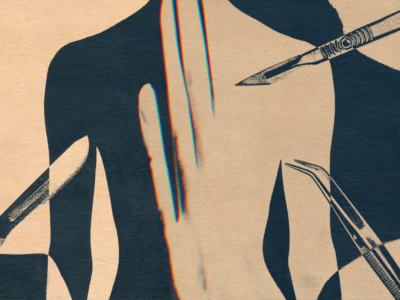
A black and off-white illustration, split in half in the center by the silhouette of a neck, torso, and arms. On one side, there's a white silhouette of the side profile of someone's face on a black background; on the other side, there's a black silhouette of the side profile of someone's face on a white background. Various surgical tools overlap on the image, appearing to stab into the body and faces.

When Medicalization Becomes a Tool for Dehumanization

WP_Post Object
(
    [ID] => 5938
    [post_author] => 15
    [post_date] => 2023-06-28 14:38:39
    [post_date_gmt] => 2023-06-28 14:38:39
    [post_content] => 

Disregard for human lives, animal lives, and nature is a feature of Moscow’s policies, not a bug.

The catastrophic collapse of the Kakhovka Dam in Ukraine earlier this month was likely the result of two possible scenarios: Russia’s occupying forces neglected the dam to the point of collapse, or those same Russian forces simply blew it up. Either way, the damage has been immense, including irreversible damage to the region’s ecosystem, as well as displacing thousands of people and threatening the global food supply for millions more.

Russia, unsurprisingly, has denied any involvement. Arguments that blame secret sabotage by Ukraine use the fact that the collapse has resulted in drowned Russian soldiers and serious water supply issues for Russian-occupied Crimea. “Why would the Russians do this to themselves?” they’ve asked. Yet as we have seen over and over again, both Soviet and Russian governments are absolutely capable of “doing this to themselves” — and have.

Disregard for human lives, animal lives, and nature is a feature of Moscow’s policies, not a bug. A salient example is the dam blown up in Ukraine by Joseph Stalin’s secret police in 1941, ostensibly to stop Nazi forces from capturing the city of Zaporizhzhya as they invaded the Soviet Union. The explosion was said to have been rushed as the NKVD feared Stalin’s wrath: Murderous dictators inspire paranoia, and paranoia leads to mental exhaustion and poor decisions. The disaster claimed tens of thousands of civilian lives, although some historians say the number could be as high as 100,000. Eventually, Zaporizhzhya was occupied by Nazi forces anyway. Thousands more were killed. As was generally the case, Stalin’s barbaric policies were both nihilistic and futile.

Given this history, the idea that Moscow would be at all concerned about the horrific damage of the Kakhovka Dam disaster is laughable. Alongside human lives, Moscow sees animals and nature as equally dispensable in its pursuit of power. Climate change is already drastically affecting Russia, which is warming at a rate 2.5 times faster than the global average. Moscow, meanwhile, has a long, dark history of persecuting environmental activists. The situation has only gotten worse with the genocidal invasion of Ukraine.

Terrorizing the victims of its invasion — and the Western countries it loathes — is Moscow’s biggest strategic goal at this point, after its plans for a three-day war against Ukraine failed spectacularly last year. In Russian-occupied territories, aid to the surviving victims of the dam disaster has predictably been made impossible by the occupiers, because the suffering is the point: Today, the war is a campaign of seething revenge, and everything and everyone living downstream from Kakhovka is as good of a target as any. 

Even if Russian forces didn’t blow up the Kakhovka Dam, as is widely suspected, the dam was still in Russian hands, occupied quickly following its mass-scale invasion in February 2022. It was Moscow’s responsibility to prevent a natural disaster, and they did not.

All of this is a part of a cycle of violence, not unique to Russian society, but unique to Russia in its aftermath. Let’s go back to Stalin’s murderous reign: In countries like modern Ukraine, the violence is acknowledged for what it was — reprehensible. By contrast, Putin’s Russia has sought to rehabilitate Stalin for years. How can a society that does not, in some fashion, reckon with a dark past be expected to build a viable future?

Vladimir Putin’s revanchism took years to coalesce into a genocidal war of aggression, but his fantasy of revenge against the West, and all who stood with it, has been apparent — and disregarded — for years. Madeleine Albright called it “delusional.” Germany’s Angela Merkel said that Putin was living “in another world.” Yet everyone failed to stop him, including, most crucially, Russian citizens themselves. The Russian majority, overwhelmed with state propaganda and lingering resentment that followed the USSR’s collapse, supported Putin’s decision to steal a chunk of Ukraine.

From 2010 to 2017, I worked in Moscow and watched modern Russia’s march toward fascism from inside the country — perpetual trips abroad, which allowed me to breathe free, notwithstanding. On the day that Russia launched its mass scale invasion, I was horrified, but not surprised: I had already seen the bloodthirst up close. During my last few years in Moscow, I had watched as former friends grew distant, or even afraid of associating with me. I saw conscientious people persecuted and imperialist thugs elevated. In this light, the horror of the Kakhovka Dam disaster is astronomical, but not all that shocking. Not if you know the Kremlin.

Even as it continues to lose the war, Russia remains a ticking time bomb for the world. Accepting this grim fact is important. The nihilism of Kakhovka will be reflected in Russia’s other policies toward humanity and the environment, because disasters like this do not exist in a vacuum.

The fate of the Zaporizhhya nuclear plant, currently occupied by Russia, is one to watch in this regard. We mustn’t forget that the people in charge of Moscow are the ideological heirs of the people who mishandled and covered up the Chernobyl nuclear disaster in the 1980s. Yet there are other issues that loom on the horizon, even after Russia is beaten back, as I believe it will be. Russia’s treatment of the Arctic is especially notable in this context. There, Russia has demonstrated both contempt for nature and for its own citizens on a breathtaking scale, and the results will be disastrous.

While ecocide is the world’s collective problem, Russia happens to be an especially belligerent actor — and the collapse of the Kakhovka Dam is just one small piece of what’s to come. Strengthening support for decent environmental policies back home is one of the ways that Western nations can respond to Russian ecocide; another is critical support for nations such as Ukraine, which today bears the brunt of both Russian aggression and disregard for the environment. Still, we can always do more.

Actively planning for post-Putinism is another important step to take now, and not later. The current regime in Moscow is not committed to legal norms, and expecting it to reverse course is mostly a waste of time and energy. What comes next, however, may be a window of opportunity. If the recent armed insurrection attempt in Russia is any indication, the Putinist system is growing less stable, and the time to plan is now.

As the planet continues to deal with man-made natural disasters, long term strategizing is important. We must be proactive, not reactive — the planet depends on it.

[post_title] => The Collapse of the Kakhovka Dam Was Ecocide [post_excerpt] => Disregard for human lives, animal lives, and nature is a feature of Moscow’s policies, not a bug. [post_status] => publish [comment_status] => closed [ping_status] => closed [post_password] => [post_name] => kakhovka-dam-collapse-ecocide-russia-ukraine-war-damage-environment [to_ping] => [pinged] => [post_modified] => 2024-08-28 21:11:28 [post_modified_gmt] => 2024-08-28 21:11:28 [post_content_filtered] => [post_parent] => 0 [guid] => https://conversationalist.org/?p=5938 [menu_order] => 79 [post_type] => post [post_mime_type] => [comment_count] => 0 [filter] => raw )
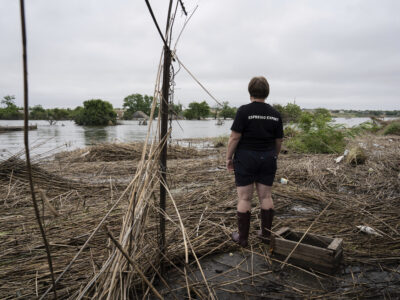
"A resident of Fedorivka is seen standing outside her flooded garden," caused by the collapse of the Kakhovka Dam. She is wearing rainboots, and wearing a black tshirt that says "Espresso Expert" across the back. We do not see her face. She is surrounded by dry debris but just a few feet in front of her we see a good amount of water still from the flooding.

The Collapse of the Kakhovka Dam Was Ecocide

WP_Post Object
(
    [ID] => 5919
    [post_author] => 15
    [post_date] => 2023-06-20 07:53:49
    [post_date_gmt] => 2023-06-20 07:53:49
    [post_content] => 

An exclusive excerpt from Anne Elizabeth Moore's "Body Horror: Capitalism, Fear, Misogyny, Jokes."

The Coronavirus. People who aren’t worried about the coronavirus. People who are too worried about the coronavirus. The possibility that I am not worried enough about the coronavirus. Case counts. The reliability of case counts. The vaccines. People who aren’t vaccinated. The reasons people aren’t vaccinated. Getting vaccinated. The mRNA vaccines. My thyroid gland, thrown into disarray by the mRNA vaccine and apparently increasing my blood pressure to dangerous levels. Convincing a pharmacist in a rural red county to give me a booster that is not an mRNA vaccine. Convincing a pharmacist in a rural red county to give me a booster at all. Convincing a pharmacist in a rural red county that the coronavirus is real. Convincing a pharmacist in a rural red county to give me a booster as an immunocompromised person. Explaining to a pharmacist in a rural red county what being immunocompromised means. Convincing my doctor that the mRNA vaccine caused my thyroid disruption, the first I’ve experienced in over a decade, occasioned exclusively and to the day by my second mRNA vaccine booster. A new coronavirus strain. The effectiveness of masks. Buying more masks. Masking at outdoor gatherings. Transmission at outdoor gatherings. Outdoor gatherings. Being around other people. Not being around other people. The large and embarrassing zit that emerged on my cheek a few days back despite the fact that I am an adult, wash frequently, and do not consume sugar. My autoimmune diseases. The medications for my autoimmune diseases. The vitamins and supplements I take to counteract the medications for my autoimmune diseases. The likelihood of accruing more autoimmune diseases. The likelihood of accruing other diseases because of my autoimmune diseases. Being immunocompromised during a pandemic. Buying clothes during a pandemic. Going outside during a pandemic. Remaining inside during a pandemic. My left forefinger, currently swollen. My blood pressure, still high. My concentration, largely shot. Oh man, a buncha stuff. So much stuff!

What comes flooding in when I have a moment to breathe. The dead tree outside my window, and the path it will take when it falls. Mowing the lawn. Trimming the lawn. The survival of the monarch butterflies. What will happen to my cat if I don’t take her to the vet soon. What will happen to my cat if she keeps eating leaves from my fig tree. What will happen to my cat if I have a heart attack. Writing a will. Finding someone to sign my will as a witness who won’t freak out about my impending death. Refinishing my furniture in a pleasing enough manner that the beneficiary named in my will won’t just throw it away. The calcium supplements I have been taking, triple the recommended dosage, which turns out to cause high blood pressure. New lab results. More lab tests. Where to drop my sharps container. Paying for lab tests. My dwindling grant funding. Inflation. Winter heating bills. Utilities costs. Author-website maintenance costs. The cost of a new computer. Word processing software subscriptions. Book prices. Food prices. Cat food prices. Finding time to run. How running will affect my achy right knee. How running will affect my left leg. Not finding time to run. Where I can go to swim. Where I can go to swim during a spike in case counts. Focusing on my personal physical health during a global health crisis. Going out to eat with my food restrictions. Going out to eat during a period in American history where setting boundaries around personal health is unwelcome. Cooking for myself, again. Another new coronavirus strain. A new vaccine. Getting the new vaccine. This sore throat. This persistent cough. This fatigue. This diminished capacity to smell. This negative coronavirus-test result. Coughing in public after a negative coronavirus-test result. Coughing in public for any reason. People casually mentioning that they just tested positive for the coronavirus but feel fine. People who would never test for the coronavirus but clearly do not feel fine. This essay. Other essays. Writing. Not writing. Publishing. Not publishing. The publishing industry. The state of this nation’s democracy, such as it is. The avowed white supremacist who lives down the road. The Civil War reenactor up the block. The guy at the edge of the village with the flag outside his house that reads, “TRUMP 2024 FUCK YOUR FEELINGS.” The guy on the internet who tells me my feelings don’t matter. The guy on the internet who tells me I am stupid. The guy on the internet who responds to every post by telling me how hot I am. The guy on the internet who tells me he knows where I live. That my house sits on a hill that is visibly eroding. The oxycodone manufacturing plant in my village. The environmental repercussions of the oxycodone manufacturing plant in my village. The social repercussions of the oxycodone manufacturing plant in my village. The sheer volume of oxycodone that passes through this village. The sheer volume of guns within a five-mile vicinity of my home. How the vast majority of gun owners in this village fundamentally disagree with me on most basic matters. Not owning a gun. Owning a gun. A civil war. The current Democratic president. Any potential future Republican president. My blood pressure, now both too high and too low. Weaning myself off blood pressure medication. Getting enough calcium in my food without consuming dangerous supplements or dairy. The vitamin D supplements I have been taking too frequently, another cause of high blood pressure. How to get more vitamin D without supplements. Finding time to google every single thing I need to know more about just to survive the week. Remembering to google everything I need to know about to survive the week. Google knowing too much about me. Amazon. Amazon’s influence over publishing. Amazon’s move into housing. Amazon’s move into healthcare. That the calcium supplements I was taking at three times the dose I ordered and which substantially contributed to my high blood pressure were due to an Amazon shipping error. My Amazon rankings. Sales numbers of my current book. Sales numbers of this book. Sales numbers of my next book. Finishing my next book. Finishing this book. Writing books. Reading books. The surprise bill I just got for something that should be entirely covered by my insurance. Calling the insurance company, who tells me to call the billing department. Calling the billing department, who demands I call my RN. My RN, who was fired for refusing to get vaccinated against the coronavirus and then rehired after a couple of months out of desperation and who never got vaccinated. Calling back the billing department, who failed to file my paperwork with the insurance company because they were “too busy” and who asks me to file it myself. That my very complicated disease- maintenance program relies entirely on a medical facility who will charge me three hundred dollars for a fully covered five-minute doctor visit because they’re “too busy” to send the same paperwork to someone else. Dobbs v. Jackson. The women I know who will be affected by Dobbs v. Jackson. The nonbinary and trans people I know who will be affected by Dobbs v. Jackson. All the people I will never meet because of how severely their lives will be affected by Dobbs v. Jackson. Whether my political organizing in response to Dobbs v. Jackson will impact my own political career. Whether or not I can have a political career in a world where people with uteruses have no bodily autonomy. Whether or not I want a political career in a world where people with uteruses have no bodily autonomy. Whether or not I want to live in a world where some people have no bodily autonomy. The kind of people who want to live in a world where some people have no bodily autonomy. Republicans. Democrats. Being told to vote in response to bad policy. Being told to vote by a political party that has more money than god. Being told to vote by the people I voted for. Being told to vote in a world where voting rights are being stripped away from increasing numbers of people. That two out of four times I have tried to vote in this village I have been told I could not. This sudden, inexplicable grief that has no identifiable origin and no end, but some days recedes while I am in the shower and stays in the background for a while, perhaps days, but at other times emerges while I am washing dishes or doing yoga or placing a forkful of salad in my mouth and causes intense chest pain and sudden tears and colors everything gray and that no amount of crying or meditating or talking to friends or sitting in the woods can alleviate in any way. Why my sunflowers have not yet opened. What is going on with my beans. The organic content of the soil in my garden. Why my herb bed isn’t filling out. Why my plum trees keep dying. What to do with all this compost. Where to get more raised beds. Wild parsnip. Buying a chain saw. Using a chain saw. Accidentally killing someone with a chain saw. And then wanting to do it again. Purposely murdering someone with a chain saw. Running for elected office. Running for elected office and then having nude pics unearthed on the internet. The kinds of people who run for office. The kinds of people who will never, ever run for office. The weird tendency my left leg has after I’ve been walking for a mile or so to sort of peter out, to stop performing at peak function, to bend less easily and not lift as high with each step, and how this appears to be a neurological, not a physical, symptom of my medications. Any neurological disease or symptom. Long COVID. Catching the coronavirus as an immunocompromised person and passing along a mutated strain. Accidentally killing someone—oh wait, that’s already listed. Mpox. Pretty much all straight white cis men. Straight white cis men who want to play devil’s advocate. Straight white cis men who just want to ask me one question about feminists. Straight white cis men who assure me they’re not racist. Straight white cis men who speak only to other straight white cis men. Introducing straight white cis men to one another in a professional capacity given the likelihood that they will develop some kind of lucrative project together, leaving me out entirely, often forgetting they ever knew me, that I introduced them, that I used to be their friend. Introducing straight white cis men to music I like. When straight white cis men express interest in my work because they are working on a similar subject. People who too aggressively want to befriend me. Obviously also people who have no interest in me. Engaging with elders in the community during a pandemic. Engaging with elders in the community in a collegial manner and immediately being treated as a sycophant. Becoming an elder in the community. Aging. Trying to behave as normal. Behaving as normal. Trying to remember what normal was. What normal was. The inexplicable knot in my stomach when I wake up every day that takes several hours to dissipate but seems really out of place because actually right now everything is fine, you know, relatively speaking. My dreams, which are often just more of the same. Sleeping, therefore. What will happen next. What will not happen next. How we will recover. Who will recover. Who will not recover.

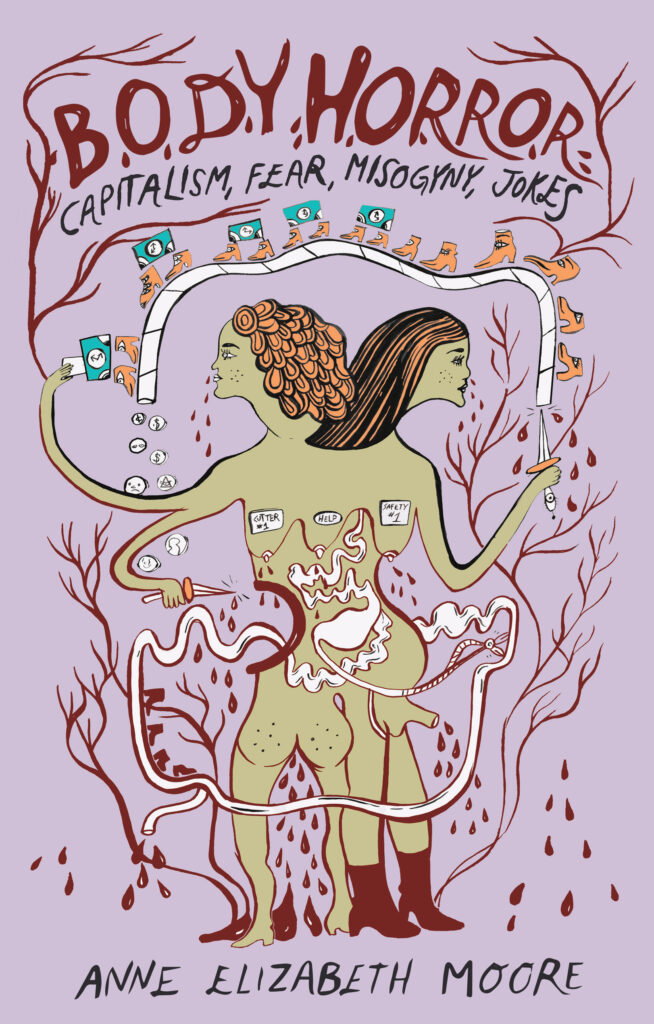
The book cover for Anne Elizabeth Moore's "Body Horror: Capitalism, Fear, Misogyny, Jokes."

From “Body Horror: Capitalism, Fear, Misogyny, Jokes” by Anne Elizabeth Moore. Excerpted with permission of Feminist Press. Copyright 2023 Anne Elizabeth Moore.

[post_title] => A Partial Recounting of My Current Anxieties [post_excerpt] => An exclusive excerpt from Anne Elizabeth Moore's "Body Horror: Capitalism, Fear, Misogyny, Jokes." [post_status] => publish [comment_status] => closed [ping_status] => closed [post_password] => [post_name] => a-partial-recounting-of-my-current-anxieties [to_ping] => [pinged] => [post_modified] => 2024-08-28 21:15:11 [post_modified_gmt] => 2024-08-28 21:15:11 [post_content_filtered] => [post_parent] => 0 [guid] => https://conversationalist.org/?p=5919 [menu_order] => 80 [post_type] => post [post_mime_type] => [comment_count] => 0 [filter] => raw )
The book cover for Anne Elizabeth Moore's "Body Horror: Capitalism, Fear, Misogyny, Jokes," on a dark red background.

A Partial Recounting of My Current Anxieties

WP_Post Object
(
    [ID] => 5901
    [post_author] => 15
    [post_date] => 2023-06-07 12:00:00
    [post_date_gmt] => 2023-06-07 12:00:00
    [post_content] => 

No one knows how to organize like a fandom.

J.K. Rowling could have died a hero, but will instead be remembered by millions of her most ardent fans as a villain.

At first, it seemed subtle enough: Rowling would “like” tweets that framed trans women as men, toeing the line of support for transphobic rhetoric. Then, in 2019, she shifted from passive implied support to active commentary. She tested the waters by voicing support for Maya Forstater, the plaintiff in a UK employment lawsuit claiming she had been discriminated against for “gender-critical” tweets. On her website, best known for its charming Harry Potter-related Easter eggs, Rowling published a nearly 3,700 word essay decrying trans activism. She has even gone so far as to compare her opponents to Death Eaters, a Nazi-esque terrorist organization in the Harry Potter universe. Today, the author’s brand is practically unrecognizable to many longtime fans; if you emerged from a coma you entered in 1997, you might look at Rowling’s Twitter and assume that policing trans lives was her day job.

As one of the leaders of Fandom Forward (formerly The Harry Potter Alliance), an international nonprofit that helps Harry Potter fans and members of other fan communities become real-life heroes through activism, I had a front row seat to Rowling’s shocking transformation. I wasn’t just angry; I was heartbroken, especially since so many of my friends and collaborators in the Harry Potter fandom are trans. Having grown up in the Catholic school system, where people simply didn’t come out until adulthood, many of the first openly trans people I ever met were people I knew through this fan community.

Whether she accepts it or not, J.K. Rowling is fighting to destroy a safe haven that she helped create. She isn’t just collecting royalty checks or rolling around in champagne: She is using the power of storytelling to enact significant political and cultural outcomes for trans people who are merely trying to live freely, without the threat of violence or death. 

Fortunately, fans who support trans rights are doing the same thing. I am one of them. As a child, pop culture was the lens through which I understood the world and myself. I didn’t just consume stories. I devoured them, and made them my own. I was born in the early ’90s, and grew up with the Hogwarts trio: The night in 2001 that my grandmother and aunt took me to see Harry Potter and the Sorcerer’s Stone, then set me up with a copy of the book, changed my life forever. I spent countless hours imagining myself at Hogwarts, fighting alongside my favorite characters. Would I be great at Quidditch like Harry and Ron? An intellectual like Hermione? Great with magical creatures like Hagrid? The ability for readers to place themselves in this magical universe and learn something about themselves in the process is part of why the story has endured for so long.

Like many children of my generation, I also understood the Harry Potter universe not as an escape from reality, but an invitation to tackle the world’s injustices. After all, Harry Potter, Ron Weasley, and Hermione Granger were never passive bystanders. Even at age 11, they stepped up to fight evil, often without the support or knowledge of the adults around them.

Today, I am part of a community of fans using the lessons we learned from Harry Potter to combat a rising tide of transphobic violence in the U.S. and U.K. The fandom’s response to Rowling's comments has been swift and impactful, creating a path forward that challenges Rowling’s ideas and fosters trans acceptance, all while offering options beyond a mere boycott. The Gayly Prophet, a Harry Potter podcast with a queer and trans lens, created a guide to firing J.K. Rowling that features countless suggestions for engaging with the franchise ethically, and even supporting trans rights through the purchase of fan-made merchandise. Fandom Forward’s Protego Toolkit provides resources and actions fans can take to lobby against anti-trans legislation, attend protests, volunteer for trans rights organizations, and make community spaces trans-friendly. A consortium of fan organizations called HP Fans Against Transphobia has collected thousands of signatures petitioning HBO against further enriching Rowling through the creation of a new Harry Potter television series. And our heroes themselves have even stepped up to be a part of this activism, too: Recently, Harry Potter star Daniel Radcliffe moderated “Sharing Space,” a Trevor Project web series featuring discussions with trans and nonbinary youth.

Whether it comes from the fandom or “Harry” himself, Rowling faces a powerful storm of collective action, rooted in love and community for trans lives. Because the truth is this: Fans have power, and as a collective, we can make a difference—sometimes even bigger than the thing that brought us together in the first place.

Media scholar Henry Jenkins defines fan activism as “forms of civic engagement and political participation that emerge from within fan culture itself, often in response to the shared interests of fans, often conducted through the infrastructure of existing fan practices and in relationships, and often framed through metaphors drawn from popular and participatory culture.” Simply put, fan activism allows fans to channel their creative energy and imagination into civic action—and it’s effective.

As an innovative practice, fan activism can take many forms, though many were popularized by what was once The Harry Potter Alliance, which I joined as a college sophomore in 2012. What started amid a rich ecosystem of transformative works on Harry Potter became a guiding force and community hub for hundreds of thousands of fans. The organization was founded in 2005 to address human rights violations in Sudan and raise money for Amnesty International at local wizard rock concerts in the Boston area. Today, we’ve turned our sights toward countless other causes, too.

In nearly 20 years, fan activists have developed innovative, powerful campaigns on a global scale. As a longtime volunteer and now as the co-chair of the board of directors at Fandom Forward, I have witnessed thousands of volunteers, often young students from various backgrounds, recognize and own their collective power through pop culture. Together, we have donated over 400,000 books and built libraries in underserved communities globally through Accio Books (now Book Defenders), connected with activist mentors at our Granger Leadership Academy (also known as Camp GLA), raised funds to bring three planes (aptly nicknamed Harry, Ron, and Hermione) full of rescue supplies to Haiti during the 2010 earthquake disaster, and even successfully lobbied Warner Bros. to use Fair Trade-certified cocoa products through our Not in Harry’s Name campaign.

The real magic and legacy of fan activism, however, is that it challenges corporate assumptions about what fandom is. The world’s greatest “superfans” are more than just passive media consumers who will buy and stream whatever you put in front of them. They are active participants who will remix and reinterpret your brand through the lens of their own experience. And they aren’t afraid to walk away from the brand itself when its creators do not align with their morals. The swift response to J.K. Rowling’s commentary on trans rights, as well as commentary on fatphobic, racist, and antisemitic tropes in the Harry Potter series, illustrates that pop culture is no longer a top-down hierarchical structure, with audiences waiting to absorb whatever studio executives have decided the masses should consume. Fans have willed ideas about their favorite stories into life. If they don’t agree with the harm a creator has caused, they can—and will—go elsewhere.

This trend is extraordinary not because it is new, but because it brings us one step closer to the heart of what storytelling looks like outside the shadow of corporate greed: not a means by which a few companies could reap profits endlessly, but a modern mythos by which our collective memory passes from generation to generation. Storytelling is one of the key elements that makes us human. For thousands of years, humans have told stories in order to survive. As our species evolved and circumstances changed, stories have shifted in purpose, meaning, and interpretation, but ultimately still exist to help us survive and build community. Fandom, and fan activism by extension, is simply a part of the storytelling evolution.

The passion, joy, and power of fandom is immeasurable. It is a magic that cannot be contained or tamped down, even as brands attempt to wrest control over the meaning and messaging behind their intellectual property. Organizing can still seem daunting, and those in it for the long haul will need plenty of ways to take care of themselves and their community. For fan activists, the hard work of organizing is often accompanied by opportunities to experience joy and self-care at community events, from wizard rock concerts to meditation retreats. In the fight against fascism and anti-democratic practices, my ability to engage in sustainable, joyful activism with other fans has given me hope beyond measure.

While Harry Potter has fostered some of the most popular forms of fan activism, the possibilities are endless, spanning countless other fan communities. The Fan Organizer Coalition, founded in 2021 and co-directed by Fandom Forward and Black Nerds Create, has sparked numerous cross-fandom collaborations. From ending voter suppression with Star Trek fans, to celebrating Indigenous geek culture, to educating Disney fans on how to fight the climate crisis, our civic imagination as fans and as storytellers knows no bounds.

[post_title] => Don't Underestimate Fan Activists [post_excerpt] => No one knows how to organize like a fandom. [post_status] => publish [comment_status] => closed [ping_status] => closed [post_password] => [post_name] => fan-activism-fandom-activists-harry-potter-jk-rowling-transphobia-protests [to_ping] => [pinged] => [post_modified] => 2024-08-28 21:15:11 [post_modified_gmt] => 2024-08-28 21:15:11 [post_content_filtered] => [post_parent] => 0 [guid] => https://conversationalist.org/?p=5901 [menu_order] => 81 [post_type] => post [post_mime_type] => [comment_count] => 0 [filter] => raw )
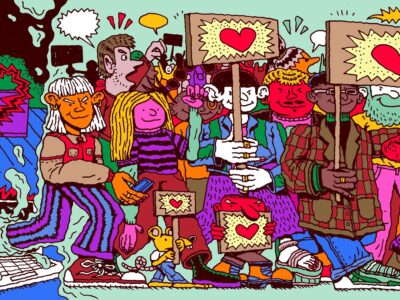
An illustration of colorful, happy cartoon people (and a couple small cartoon mice) gathering in protest. They are emerging from a laptop and into the real world. In the background, you can see the silhouette of a person going foot first into another laptop, stepping through it to join the protest on the other end. The protestors are carrying signs with red hearts, and a few have speech bubbles over themselves.

Don’t Underestimate Fan Activists

WP_Post Object
(
    [ID] => 5880
    [post_author] => 15
    [post_date] => 2023-05-18 17:06:31
    [post_date_gmt] => 2023-05-18 17:06:31
    [post_content] => 

Under international criminal law, apartheid only applies to discrimination based on race. A new open letter argues it should apply to gender discrimination, too.

In March of this year, a group of over 100 Iranian and Afghan women signatories published an open letter calling for the end of gender apartheid. The purpose of the letter was threefold: to raise awareness of what gender apartheid is, and how it's affecting women in Iran and Afghanistan; to encourage public statements and policy responses condemning these regimes; and to expand the definition of apartheid under international law. As the letter explains, currently, under international criminal law, use of the word apartheid is limited to race; but for years, activists around the world—and more specifically, in Iran and Afghanistan—have been using it to describe extreme, gender-based persecution, and the regimes that perpetrate it. The letter makes the case for why it's time we update the word's definition on the global stage.

Below, we spoke to one of the people behind the campaign, human rights lawyer Gissou Nia, on the letter's longterm goals, its challenges, and why language matters when it comes to gender persecution and apartheid.

~

How did the open letter come to be? How did you get involved?

The open letter came about with a core group of Iranian and Afghan women signatories. The genesis of this is that women's rights activists in Afghanistan and Iran have been using the term "gender apartheid" for years to describe, essentially, a system of subjugation and oppression that they are being repressed by. [But] when I spoke to some of these activists, not all of them had actually been aware that gender apartheid is not currently a crime under international law. Gender was not a part of that definition.

Apartheid, as defined under international criminal law—whether it’s a part of crimes against humanity or not—only applies to racial apartheid. So, [we] thought, why don’t we just change the definition? There have been incredible legal academics and jurors who have [already] been working on this, like Karima Bennoune, and what we wanted to achieve with the campaign is to supercharge [their] efforts. It’s an unbranded campaign—so there’s no one organization attached to it.

I’m curious what differentiates an apartheid regime from other forms of gender discrimination.

It’s a great question. One of the main things that people have asked is how is this distinct from gender persecution, let’s say. With gender persecution, which is a crime against humanity as defined under the ICC Rome Statute, that’s a more broadly defined crime. There may be some instances of something that you could charge as gender persecution that would amount to gender apartheid, but gender apartheid describes a certain type of treatment. It really focuses on the structures. The word “apartheid” comes from the word “apart” in Afrikaans, born out of the historical experience of South Africa—but it’s really about keeping one group separate from another. Here, you could say that [it’s] men subjugating and dominating women for purposes of entrenching power. I think that’s the distinguishing factor. Certainly, that would amount to a case of gender persecution, as well, and we’re not saying that it’s either/or—we think these are all complementary. In the case of race, we have both racial apartheid and racial persecution; so there’s no reason that we can’t have gender apartheid, as well.

I’d also say that gender apartheid, as opposed to gender discrimination, is much more extreme. Certainly misogyny and patriarchy exist everywhere. There are gender discriminatory laws in many different countries, including in the US. But a gender apartheid regime is something that’s quite distinct and different. It basically is saying that women are not worth a man. In the case of Iran, a woman’s value is worth half that of a man, legally. So they’re removed from public spaces. That’s why in Afghanistan, women and girls are not allowed to be educated, [why] they’ve been taken out of employment. The Taliban recently said that Afghan women cannot work for the UN in Afghanistan. So it’s essentially the removal of women from public spaces and from public life. And that’s enshrined in the law: You are formally not worth a man, and we are going to repress you, because that’s how we’re going to keep this regime in power.

When you say their value is less, how is that defined?

So, for example—I’m a lawyer, so this one for me is especially grating—if I was to give testimony in a court in Iran, my testimony would be worth half that of a man. I also wouldn’t be able to travel outside of Iran without the permission of my husband or my male guardian. I couldn’t ride a bike, I couldn’t go to sporting stadiums. I would be barred from certain types of higher education. Women do not have equal capacity, inheritance, divorce, marriage rights—anything that relates to the family, they’re unequal. And, of course, there’s the mandatory hijab laws, which we know sparked the outrage over Mahsa Amini’s murder.

For this particular campaign, why did you choose Iran and Afghanistan specifically? There are other countries where, arguably, [gender apartheid] would apply.

Because we were campaigning [and] were successful in removing the Islamic Republic from the UN Commission on the Status of Women. Obviously all of that came about because of the Woman, Life, Freedom movement in Iran after Mahsa was killed at the hands of the Islamic Republic’s morality police. There were a lot of Afghan women activists that wrote me after that and were congratulating me. [But] Afghanistan was still on the UN Commission on the Status of Women. True, the Taliban is not formally recognized before the UN, so the representative is from the former government and basically doesn’t represent anybody. Nonetheless, they’re still there.

And it really struck me, that while we’re speaking about Woman, Life, Freedom in Iran, and while there’s been such a global outpouring of attention and action and policy engagement and energy, right across the border, our Afghan sisters are dealing with a horrendous situation, of which the globe is exhibiting some form of paralysis, and a lack of direction on how to improve their circumstances.

I think a lot of Iranian women who are championing women’s rights have been thinking about our Afghan sisters, who we’re tied to through shared borders, shared culture, and in some cases shared language. These issues are interlinked and they’re not separate, and so we’ve been keen to do some joint activism. It’s something a bit new in terms of campaigning, and certainly once the law is adopted or as discussions continue, there may be other women that choose to engage with it who feel that they’re living under gender apartheid regimes. This was a campaign that Iranian and Afghan women came together to launch, but it doesn’t preclude other groups of women wanting to [sign] or get involved with this advocacy or get behind this mission. Anybody can sign, and support. But the number of gender apartheid regimes in the world is actually pretty few.

How many people have signed it so far?

I haven’t checked lately to see what the tracker is, but it was something like 5000.

Can you talk me through the three chief demands the letter makes?

So basically, the [three demands] are the way that we envision [passing the law] would happen. I’ll just walk you through the timeline. In the immediate, first of all, there’s a lot of people who are not familiar with what the term apartheid is even, [especially] under the age of 35. However, most of the decision makers that we are seeking to engage with are above the age of 35, and they’re in government, and they have direct recollection of those events in the eighties [in South Africa] until the dismantling of the apartheid system in 1990. It has a real moral and resonant power for those decision makers, so part of this campaign is aimed around introducing the term gender apartheid, so people are familiar with what that actually means. What does apartheid refer to, what does it refer to in the context of Iran and Afghanistan, and why is this still going on.

The second thing is, we want parliaments around the world to issue resolutions condemning the apartheid in Afghanistan and Iran. That’s moving forward in Canada, in the UK, in New Zealand, and now we’re doing a lot of outreach to states in South America and Africa because we think that will be very important to have a global frame. This isn’t just a Western effort, and we want to make sure that is understood.

The ultimate goal is to have some of the legal frameworks that apply to apartheid amended or introduced to include gender apartheid. One of our main goals is to have gender apartheid included in the definition at the upcoming global convention on crimes against humanity. It should be adopted at the end of 2024, with any luck, and we want to be included.

Do you think the history of the term being so associated with race helps or hinders the movement?

Well, it’s not called racial apartheid. It’s just called apartheid. The reason that apartheid doesn’t include gender is because it was created in the 20th century out of the South Africa experience. I [also] think a lot of international criminal law [has been] created by men in small rooms, and not necessarily with women’s input and that’s changing. We see that there is an increased focus on gendered crimes. There’s even a reevaluation of the crime of genocide to focus more on the gendered aspects of it. Historically, people have assumed that genocide has to be mass killing, not realizing that actually, it could also just be sterilization, and those forms of genocide are much more focused around women.

The point is a lot of crimes that we grapple with are really viewed through more of a male lens, and there’s been a concrete effort to apply a gender lens to that. I think this ties into the reason why apartheid didn’t focus on gender. It wasn’t because there weren’t gender apartheid regimes. It was just because of the kind of dialogue that was happening in the 70s and the 80s and the 90s.

Longer term, what happens if you succeed in changing international law? What happens if [gender apartheid] is criminalized?

The biggest thing is just that then it’ll be possible to be prosecuted, and there’ll be a lot of new pathways for accountability. It also ultimately will enforce prosecution of crimes like gender persecution, as well, because prosecutors will start to think more deeply about the gender aspects of crime. But while the end goal might be to have this legally enshrined, really, the goals are all along the way. Because what we want to do is raise awareness about what this crime is, but also drive policy actions.

I mean, with South Africa, the ask was really to financially isolate that regime and to get people—governments, companies—to stop doing business with them. With Iran and Afghanistan, they’re already very isolated, they’re already very sanctioned. It’s not about introducing new sanctions or dissuading companies from working with these states, because they already aren’t. It’s about reframing the discussion. Those sanctions are issued for nuclear proliferation, for WMDs, for ballistic missiles, for terrorism; they are not issued for human rights violations, and they’re definitely not issued for gender apartheid. So we want to start to reframe why it is that we’re saying that governments should not engage with these governments [so] they need to change their behavior. It makes it unacceptable.

The crime of apartheid as distinct to the crime of gender persecution, gender apartheid would introduce more of a question about third party actors. Because of the historical example of South Africa apartheid, there’s a question of liability. If governments and companies are complicit, or doing business with regimes that are perpetrating gender apartheid, are they willingly aiding and abetting this regime? It’s a bit more expansive than what’s currently on the books, in our view.

We’re not asking for increased sanctions as part of this campaign. What we’re asking for is that there clearly are demands that gender apartheid come to an end.

For more information, you can read the letter in its entirety, and join in signing it, at endgenderapartheid.today.

You Should Give a Sh*t About is an ongoing column highlighting local stories with a global impact. This interview has been edited and condensed for clarity.

[post_title] => You Should Give a Sh*t About: Gender Apartheid [post_excerpt] => Under international criminal law, apartheid only applies to discrimination based on race. A new open letter argues it should apply to gender discrimination, too. [post_status] => publish [comment_status] => closed [ping_status] => closed [post_password] => [post_name] => end-gender-apartheid-today-open-letter-interview-gissou-nia-human-rights-lawyer [to_ping] => [pinged] => [post_modified] => 2024-08-28 21:11:28 [post_modified_gmt] => 2024-08-28 21:11:28 [post_content_filtered] => [post_parent] => 0 [guid] => https://conversationalist.org/?p=5880 [menu_order] => 82 [post_type] => post [post_mime_type] => [comment_count] => 0 [filter] => raw )
An old black-and-white photo of women protesting in Iran in the 80s. Many of them are yelling, with their fists in the air. They're protesting an (at the time) newly enforced dress code for women in Iran, requiring women to dress a certain way or else lose their jobs.

You Should Give a Sh*t About: Gender Apartheid

WP_Post Object
(
    [ID] => 5856
    [post_author] => 15
    [post_date] => 2023-05-12 19:32:09
    [post_date_gmt] => 2023-05-12 19:32:09
    [post_content] => 

After my daughter was born, I struggled to produce milk. Why did I feel like I had to keep trying?

When I was sixteen, I went to see my mother in a community theater production of John Steinbeck’s The Grapes of Wrath. Though Mom performed a chilling death scene as Grandma Joad, it was the character at the center of the play, a young woman named Rose of Sharon, who ended up haunting me. In the third act, Rose has just given birth to a still born baby—a particularly cruel fate given what the Joad family had already endured on their journey West. But then, grieving and broken, the family encounters a young boy and his father, who is dying of starvation, in an abandoned barn. Rose of Sharon, with her milk having just come in, unbuttons her blouse and nurses the dying man back to health.

Even as a teenager, I sensed some great superpower, a gift that I couldn’t wait until it was my turn to receive. 

~

A few years later at a coffee shop, I watched a young mother, dressed in a blue tube top with light brown hair hanging down to her waist, wrestle with her hungry baby. I stared transfixed as she casually pulled down her top and popped out a small, perfect breast. Her baby immediately latched on. The woman was sitting in the window, warm afternoon light flooding behind her, and for a moment, she seemed to occupy a holy air: her long hair curtaining them off as the baby nursed with a practiced ease, a profound sense of calm flowing outward from them.

~

In December 2021, a few days before Christmas, I gave birth for the first time. Immediately after cutting the umbilical cord, my daughter was put to my breast; I felt a little pull and suddenly she was working away. I gasped. We stayed like that for about an hour, completely still except for her suckling. Her cheeks and my breasts were both so large at that point it was hard to know where she ended and I began. It would be the last time that breastfeeding was easy for us. 

Two days later, I was told by a nurse that my daughter's weight had dropped and that she probably wasn’t latching correctly. A lactation consultant kindly showed me a better angle to hold the baby while nursing. I adjusted. My daughter latched on. “Everyone thinks the cradle way is easiest,” she said. “But that’s because of what we see in the movies.” And in literature, and plays, and paintings, and in coffee shops, I thought. 

I believed everything was going fine until around 3 AM the following morning, when I was awoken by another lactation consultant, this one much harsher than the last. Standing over my bed, she sported a neon fanny pack and a buzz cut on one half of her head, her vibe much closer to Nurse Ratched than Mother Theresa. I honestly can’t remember most of what she said, except for one phrase that she repeated over and over: “This is an emergency.” She told me that my milk hadn’t come in yet because I’d had a c-section and my body was prioritizing healing. Strike one against mama, the c-section. Strike two, bad nipples. 

My husband and I were directed to feed the baby tiny bottles of formula while I was put on a pumping schedule of every two hours for fifteen minutes at a time. By the time I left the hospital, my nipples were cracked and bleeding, looking like a pair of skinned knees. According to Ratched, the clock began when I started the pump, not when I finished, which, after the obligatory clean up and sterilization of the pump’s various parts, meant that I was sleeping in bursts of an hour to an hour and a half. I started to lose my grip on reality from the sleep deprivation. All the while, nothing was coming out. 

Once we got home, I became obsessed with solving the riddle of my broken breasts. I saw a total of six lactation consultants. According to these experts, I had already done so much wrong: taking Dayquil when I came home from the hospital with a cold, sleeping through a couple of my pumping alarms, not being hydrated enough, not eating enough calories, being too stressed for the oxytocin to release and help the milk flow. So I ate all the lactation cookies, drank all the teas they recommended, and even went to an acupuncturist. I created Excel spreadsheets to track my progress, which I made my husband and mother fill out in detail every time they fed the baby. I continued the relentless pumping schedule that had been prescribed to me.

To make matters worse, I was spending less and less time with my baby. I was still trying to nurse her, still trying to recreate every beautiful feeding scene I’d witnessed, but the reality was that until I started to produce milk, she still needed to eat, and the bottle kept her from being interested in the breast. I’d always heard that newborns were like breathing, dreaming appendages, attached so firmly for the first few months that they don’t feel like separate beings. But whenever I looked down, instead of seeing my baby, there was only a mess of wires, and a buzzing pump always alerting me that I was more machine than mother. Over the constant noise, I’d strain to hear her cooing and crying from the other room, where my husband and my own mother held her, and changed her, and fed her. 

~

One morning, I woke up with a breast infection so painful it made me forget the intense abdominal surgery I’d just undergone to remove my daughter from my womb. 

I’d known about mastitis and blocked ducts, but this felt like broken glass inside my nipples, now shiny and hot as though they each had their own intense fever. One nurse told me she thought it could be thrush, a type of fungal infection, but another was suspicious since my baby didn’t have it in her mouth. A third said I just needed to “toughen my nipples up” and suggested dipping them in black tea. But the more I pumped and tried to nurse, the worse the pain became. I had stopped taking the powerful painkillers prescribed for my c-section recovery, but started taking them again to deal with this new agony. (Later, after I moved to formula feeding exclusively, the pain lessened but still took months to go away altogether.)  It seemed to me that my body was saying something important, something it had long been trying to tell me but that I wouldn’t let myself hear. I walked around in a cloud of such sadness that I felt like my soul had the flu. 

My pregnancy had been difficult. Almost immediately, I’d developed hyperemesis, which is like morning sickness on steroids. It had landed me in the emergency room twice with dehydration, and once at the dentist when a molar, weakened by copious amounts of stomach acid, disintegrated and fell out of my mouth. I had imagined myself as a pregnant glowing earth mama, all supple curves, completely in tune with nature and myself, but there were times the vomiting was so extreme that I just wanted to die. Then, I had a c-section, further cementing the idea that my body wasn’t meant to do this at all. That my breasts could not “correctly” produce milk was the final nail in the coffin. 

The internet, unfortunately, agreed with me. 

At the same time that I was struggling to produce milk, America experienced a terrifying formula shortage after a contaminated batch at an Abbott plant led to a widespread recall, revealing the fragility of the formula supply that so many families depend on. But for every woman who was vocal about how the shortage should be considered a national emergency, there was someone, usually a man, asking why women couldn’t “just breastfeed.” 

Suddenly total strangers from around the world were chiming in to validate my inadequacy. But in the midst of this turmoil, my breasts still vibrating with mysterious pain, rather than feel rage or frustration, I felt a perverse relief. The world seemed to agree with that little nagging voice in the back of my head. I simply wasn’t meant to be a mother.

~

How much of the breastfeeding debate is really about the health of the child, and how much is about the control of women's bodies and, moreover, about the performance of successful womanhood? 

I found myself thinking about this question a lot in my baby’s first months of life. The internet’s unsympathetic reaction to the formula shortage further demonstrated that many believe the difficulty of breastfeeding to be a modern predicament; that as women have gotten more agency, and more rights, they’ve abdicated more of their motherly duties. But breastfeeding has been complicated since the beginning of time. Women have always experienced issues like mastitis, which before the advent of penicillin was an often fatal infection. And babies have always experienced tongue ties, premature births, and trouble latching. Add to that centuries of malnutrition, as well as external traumas like giving birth in famines, war zones, or while enslaved, and the body’s ability to produce milk becomes less and less likely. We’ve always needed alternatives. 

Before formula, parents searched far and wide for methods to replace breast milk. Author Carla Cevasco notes in The Atlantic that early options ranged from cow’s milk to bone broth and nut milk—some of which provided hydration but not necessarily nutrition, and could be deadly due to contamination and poor food preservation capabilities. Historically, the surest way to keep a baby fed was a wet nurse, another woman who had also recently given birth and could breastfeed. Wet nurses were commonly poor or enslaved women who were forced, either by poverty or slaveholders, to feed other’s babies as their own starved at home. 

These women’s experiences should remind us that the history of formula feeding is not a stain against a woman’s ability to mother, but in fact quite the opposite: a testament to the incredible act of keeping one’s baby alive. 

I knew all this, so why couldn’t I let myself believe it? I thought of every poster hanging in every doctor’s office, waiting room, and maternity ward that depicted mother and child in complete harmony with the tagline “breast is best”—a mantra made popular in the 1950s by a group of Catholic women who called themselves La Leche League and believed breastfeeding was “God’s plan.” And I couldn’t stop seeing that young mother in the coffee shop from my twenties, how she had no problem nursing her infant, the two of them a recreation of every painting I’d ever seen of Madonna and child come to life.

Even before getting pregnant, I had already internalized the cultural messages surrounding breastfeeding so deeply, it had become something much bigger than a simple act. It had bloomed into a dangerous omen. 

~

During my maternity leave, my husband and I spent the late nights re-watching the entire seven seasons of Mad Men. In one episode, a pregnant Betty Draper, played by January Jones, gets asked by a nurse whether she intends to breastfeed. Betty answers with a bored “no” and the nurse nods in agreement. My husband was shocked. Here we were, struggling so intensely, and there was Betty, not even intending to try. What’s more, no one seemed to have a problem with it. 

Where my husband saw a kind of permission for formula feeding, I saw something different: an inverse reflection of the very expectations I had failed to live up to, and that are placed on so many birthing parents, regardless of gender. In the 1960s, formula feeding became the norm, with, as historian Amy Bently writes, only 20-25 percent of babies starting their lives being fed breast milk. The primary reason for this shift was the urging of pediatricians who were intent on lowering the infant mortality rate, and saw formula feeding as a more consistent and regimented way to keep babies fed and alive. More women were also working outside the home and needed to be able to leave their infant with a caregiver as they went into the office. 

Little of this was relevant to Betty, a wealthy housewife who didn’t work—and so her reasons for bottle feeding were probably similar to the reasons I wanted to breastfeed: It was a cultural marker of being a “good woman.”

~

After six excruciating weeks, the end of my breastfeeding journey was sudden, unexpected. Eventually, when calling the nurse for the umpteenth time to describe a new pain in my breast—a swelling lump that hurt to touch—I received the kindest advice I’d been given thus far.  “Honey, just give up,” she said. “You don’t need to do this.” Her tone was frank but measured; her South Boston accent rough but comforting. I didn’t know how much I’d needed her permission to stop.

I was free—almost. For a couple more weeks, I still tried to nurse, but then during a blizzard that lasted the weekend, I gave up cold turkey. I made my husband run out into the storm to collect little baggies of snow that I would then sneak into my bra sandwiched between cabbage leaves, an old wives’ remedy for weaning. Lying on the couch, icing my swollen breasts, I thought about how on New Year’s Eve, just a few days after we’d returned from the hospital, my husband and I had waited for the clock to strike midnight, my baby in my arms. While giving her a bottle, I started to cry. “Why can’t I feed my child?” I asked him. “Look at you right now,” he replied. “You are literally feeding your child.”

I glanced down at my daughter, her eyes wide, slowly blinking, and saw her taking in all of me. The Christmas tree lights glimmered behind us, lighting us both up with a starry glow. How long had she been staring at me like that? I wondered. Her tiny hand wrapped around my finger, her skin pressed against my skin. I felt like I was seeing my baby for the first time, and noticed that I was, in fact, feeding her.

[post_title] => A Personal History of Breastfeeding [post_excerpt] => After my daughter was born, I struggled to produce milk. Why did I feel like I had to keep trying? [post_status] => publish [comment_status] => closed [ping_status] => closed [post_password] => [post_name] => breastfeeding-formula-shortage-motherhood-bottle-feeding-baby [to_ping] => [pinged] => [post_modified] => 2024-08-28 21:15:11 [post_modified_gmt] => 2024-08-28 21:15:11 [post_content_filtered] => [post_parent] => 0 [guid] => https://conversationalist.org/?p=5856 [menu_order] => 83 [post_type] => post [post_mime_type] => [comment_count] => 0 [filter] => raw )
A line drawing of a woman's upper torso. Her arms are crossed in front of her, her hands covering her breasts. Underneath them, a pale blue-green aura is emanating from her chest, and pink and red flowers are blooming, further obscuring her breasts.

A Personal History of Breastfeeding

WP_Post Object
(
    [ID] => 5838
    [post_author] => 15
    [post_date] => 2023-05-03 17:29:33
    [post_date_gmt] => 2023-05-03 17:29:33
    [post_content] => 

How social media influencers are challenging stereotypes both within and outside of Muslim communities—just by being themselves.

In this very digital age, I wouldn’t describe myself as much of a social media person. Despite my active Twitter presence, which I attribute to work, and the occasional procrastination scroll on Instagram, which always ends up longer than expected, I’ve just never really found much joy in it. Even back when most people dreamed of becoming bloggers, I never saw the appeal: I couldn’t relate to their desire to share their lives so publicly, and felt a disconnect with their content as a result. 

Then, around January last year, I discovered With Love, Leena. The account follows the day to day life of Texas-based content creator Leena Snoubar, covering everything from fashion to parenting to all things lifestyle. In one video, she gives a tutorial on how she removes makeup stains from her hijabs. In another, she shares an intimate day out with her mother and sisters, where they grab brunch and go wedding dress shopping for her youngest sister. Scrolling through her account, I found myself feeling—for the first time—like I was actually getting something out of my Instagram experience: I’d never come across a Muslim influencer who was so visibly Muslim and yet didn’t feel the need to justify or be bound by their religion. 

It was only when I came across Leena that I realized my feelings of disconnect on social media had less to do with the platforms themselves, and more to do with the kind of content I was seeing. Maybe it was the algorithm or just my lack of social media engagement, but I was almost exclusively served either general fashion and beauty content—which I assumed was because of my gender—or Islamic videos, with little in between. It made me feel alienated in terms of my other interests, and like I had to separate my religious identity from the rest of me, or else somehow justify their intermingling. 

For a lot of young Muslims, being online as a visibly Muslim person creates a pressure to either always be preaching Islamic content or advocating for our religious identity. When I first started out as a journalist, I often felt a heavy responsibility to justify my identity, and to prove, somehow, that Muslim women were not limited to the stereotypes projected onto us. But constantly having to justify my identity also meant constant emotional labor, and as I quickly learned, this only ever led to burnout. It’s a pressure that content creator Maliha—who says she’s been an “internet girlie” since before influencers became popular—is very familiar with. “I started out with my YouTube channel, and then Instagram, and because a lot of my content was cosplay I became the ‘hijabi cosplayer,’” she says. “But I’m not very good with having a niche, and when I moved to TikTok, I started making content that I connected to more, mostly rants and healing—social justice-y stuff.” Despite pivoting directions with her content, though, she soon found that her audience hadn’t changed or expanded at all: Maliha says that even though her content wasn't Islamic, TikTok’s algorithm was almost exclusively showing her videos to other Muslim users. 

This sort of systemic stereotyping, that comes from both outside and within Muslim communities, is exactly what some influencers like Leena and Maliha are challenging with their diverse content. Despite living continents apart, I immediately felt a connection to Maliha—one that came from so many shared experiences, not just as Muslims, but also as young women. She’s just an average twenty-something, sharing her everyday thoughts, laced with a little humor and, often, a lot of sarcasm. I’m not the only one who has felt a connection to her work, either: Maliha says that her role as a content creator has helped her make friends across the globe. 

For 20-year-old Younis AlZubeiri, this sense of community has played a big role in his own content creating journey. “My overarching goal with my content was to also be that outlet for other Muslims on the internet that didn’t really have someone to look to online,” he says. “In the world of Andrew Tates and [other] horrible role models to young kids, especially Muslims, I tried to just be a source of good to them.” He first started creating content at 14, making videos about comics just for himself. But slowly, his focus started shifting. “When I had followers who looked like me tell me about my impact on them, there was a light that switched,” he shares. Now, he has over 100,000 followers on TikTok, where he shares videos exploring culture and entertainment and diversity within both. 

Along with creating spaces of acceptance for Muslims from all walks of life, many of these influencers are also challenging what it means to be visibly Muslim in 2023. This means fighting stereotypes offline, too: Amira Rahmat, a food and travel blogger, often embarks on solo trips and says she’s always met with surprise when people see a young Muslim woman traveling alone. “When I post content on my page, a lot of the comments I see are, ‘Oh, you’re so brave to travel alone,’” Amira shares. But likewise, she says many of her commenters are inspired by her videos: For many Muslim women, who have to fight back stereotypes that Muslim women’s pardah or religious restrictions keep them confined to their homes, seeing women like Amira and being able to share in her experiences has become a crucial part of shaping their confidence and self reflection. 

It may seem like these are just a bunch of random creators covering various topics, but that’s the point. In this age of growing Islamophobia, they’ve begun to play a very important role in humanizing all of us beyond our hijabs and beards and masjids. They’re creating their own spaces, where being Muslim doesn’t impact or influence all the other parts of themselves. This is just as pivotal within our community as it is outside of it: Muslims who find themself stuck between proving themselves to other Muslims and justifying themselves to non-Muslims seeing creators just being honest and unapologetic about whatever topic they’d like can give us a lot of strength on the days we most need it. “It’s such a fine line to be a Muslim artist in any capacity,” says Dubai based content creator Emad. Whether or not you talk about religion, he continues, you’ll be judged by Muslim and non-Muslim creators alike, and pigeonholed by both. “For someone like me, I wanted to get into Muslim content because it’s fun. [But] so many times it happens that you become a ‘Muslim creator’ and then you do a fun TikTok dance and suddenly you’re not a Muslim creator because you’ve apparently done something wrong.”  

This isn’t always easy. But when the polarized opinions and criticism become too much, Younis says that humor helps—especially when met with harmful alt-right and other extremist narratives. “I can’t just post about being a leftist and expect them to change,” he says. “You have to go about it in another light and try to convey the point you’re trying to make through humor.” These are baby steps, he adds, but making viewers laugh can challenge pre-existing notions that all Muslims are the same and that they don’t exist outside of a one-dimensional identity.

These small steps go a long way, and are already making a difference for creators (and viewers) around the world. Pakistan-based food blogger Emon Malik says the content creator economy has been growing in her country, and credits that to the growing diversity of creators. And the number of Muslim content creators is only growing.

“With more [diverse] content creation, people are more informed,” Amira says. “It comes from personal experiences, not Google, and it’s more raw and authentic.” It’s also more relatable—and for me, inspiring. When I see content creators like Leena or Maliha or Amira, it gives me the push I need to be more unapologetically myself. As these content creators have shown me, I’m more than my religious identity, but I don’t have to hide it away, either.

[post_title] => The New Faces of Being Visibly Muslim Online [post_excerpt] => How influencers are challenging stereotypes both within and outside of Muslim communities—just by being themselves. [post_status] => publish [comment_status] => closed [ping_status] => closed [post_password] => [post_name] => muslim-tiktok-social-media-islam-representation-content-creators-influencers-advocacy [to_ping] => [pinged] => [post_modified] => 2024-08-28 21:15:11 [post_modified_gmt] => 2024-08-28 21:15:11 [post_content_filtered] => [post_parent] => 0 [guid] => https://conversationalist.org/?p=5838 [menu_order] => 84 [post_type] => post [post_mime_type] => [comment_count] => 0 [filter] => raw )
A collage of screenshots, from various Muslim TikTok content creators, engaging in all sorts of different styles of content creation. In one video, the creator is dressed in a banana suit; in another, the creator is answering a question about cosplay; in another, it appears to be a cooking tutorial. The screenshots are overlapping, with various degrees of opacity, giving the feeling of rich, diverse array of content.

The New Faces of Being Visibly Muslim Online

WP_Post Object
(
    [ID] => 5810
    [post_author] => 15
    [post_date] => 2023-04-19 00:32:53
    [post_date_gmt] => 2023-04-19 00:32:53
    [post_content] => 

The first question we ask about complex chronic illnesses shouldn't be whether or not they're real.

Over the last few months, the question of whether long Covid is real has been the subject of lengthy examinations from publications across the political spectrum. These articles are often ambiguous in their conclusions, giving equal weight to the legitimacy of the condition while simultaneously attempting to debunk it.

As anyone who has it will tell you, long Covid is very real, but if you’ve been reading these articles purporting to explore LC’s reality or unreality—questioning if society has it “wrong”—you might think that it is not, or that the people who have it (and illnesses like it) do not have a physical ailment at all, but instead a mental health one. While it’s not surprising that more right-leaning publications have engaged in long Covid denialism, the trend of left-leaning legacy publications like New York Magazine and the New Republic doing something similar is, to me, cause for concern. As a disabled, nonbinary feminist who has dedicated a large chunk of their career to exploring the tangled issues of gender, chronic pain/illness, and the society-wide disbelief of these illnesses, I think the insistence on showing “bo­­th sides” of long Covid is a slippery slope.

“Skepticism” of complex chronic illnesses is nothing new. I and many other chronically ill people have seen “skepticism” of our disabilities play out in media, amongst the general public, and in the medical field plenty of times before. Diseases such as multiple sclerosis (MS), rheumatoid arthritis, and ulcers were all thought to be psychosomatic at one time. In more modern times, chronic fatigue syndrome/myalgic encephalomyelitis (CFS/ME), fibromyalgia, Postural orthostatic tachycardia syndrome (POTS), and many other chronic illnesses and pain conditions have been explained away as mysterious, and therefore Maybe Not Real, too.

Yet time and time again, it’s been shown that they are. After a CFS/ME outbreak occurred in Incline Village, Nevada in the mid-1980s, proving that the illness was seriously impacting patients, the Centers for Disease Control (CDC) pledged $12.9 million to research the condition, only to then quietly move the money they had earmarked to other departments. Meanwhile, CFS/ME remains just as pervasive today: Many long Covid patients have ended up with CFS/ME after battling acute Covid, in addition to experiencing a host of other debilitating, multi-systemic symptoms

As a person who has had lifelong health problems of varying severity, when I first heard about CFS/ME as a high school student, my immediate thought was that it sounded awful. Being tired all of the time and having to deal with muscle pain, cognitive issues, poor sleep, and post-exertional malaise (symptoms getting worse after a patient exerts themselves) sounded like a version of Hell on Earth. It’s not that I didn’t think becoming chronically ill could happen to me—because if I’ve learned one thing as a person with multiple health problems, it’s that your health is not under your complete control, no matter how much willpower you think you have. Rather, even then, I understood that extending a crumb of empathy to people whose health conditions seem weird or mysterious or exaggerated to you is not fucking rocket science.

Just a few years later, however, I would learn not everyone feels the same. When I was a 19 year-old college student, I began experiencing extreme fatigue and muscle pain in my back, neck, legs, and shoulders for no apparent reason one day. It never went away, and I spent over a year trying to figure out what was happening to me. Shortly after my 21st birthday in 2007, I was diagnosed with fibromyalgia by a rheumatologist. It would be another year before fibromyalgia had its media tipping point, but I became familiar with the stereotypes very quickly, mostly via internet comments and a few real-life unsolicited opinions. The people who get it (mostly women, as the gender ratio is very skewed), according to commentors online, tend to be middle-aged or older. They are fat and eat the wrong foods. They’re lazy. They just want prescription drugs. They are mentally ill. They aren’t utilizing positive thinking effectively enough to get better. They just need to exercise more. They are brainwashed by Big Pharma TV ads into thinking they are sick—this one courtesy of popular women’s website Jezebel.

Several of these stereotypes have been projected onto people of all genders with various disabilities, but there’s something about “mysterious” diseases with no single cause that tends to push ableism and sexism to the front—again, most likely because they disproportionately affect women. Unsurprisingly and likely because of this, fibromyalgia tends to be subjected to the “hysteria” argument, too: Per an (in)famous New York Times article titled “Drug approved. Is disease real?” about the fibromyalgia medication Lyrica, “The more these patients are around the medical establishment, the sicker they get.” I am left wondering how soon an “expert” will make a similar argument about long Covid.

Such both-sides claptrap when it comes to illnesses that medical science hasn’t “solved” yet is a thing that some media outlets like to do in the interest of “balance,” and it has been going on for a long time—longer than I have been alive, in some cases. But giving equal weight to opposing perspectives that are not, in fact, equal does not make sense. What, exactly, is the rationale for treating debilitating chronic illnesses, new and old, and those conditions’ reality for millions of people as a neat little thought experiment?

Because I’ve been writing about these issues—and living with them as a chronically ill person—for a long time, I suspect that the answer is multi-faceted. A lack of empathy is one facet; it does not escape my notice that most high-profile articles questioning the “realness” of complex, multi-system chronic illnesses are written by journalists who do not have these health conditions themselves. It also does not escape my notice that it has almost exclusively been chronically ill people, ME/CFS patients, and the journalists, writers, and medical professionals who work with ME/CFS and long Covid patients to call out NYMag, the New Republic, and other publications on bad journalism related to long Covid so far.

But another facet is the broader, ableist pattern of doubting chronically ill people in general, especially those debilitated by contested illnesses. It’s easier to not see ableism, or take it seriously as a mode of oppression, if you don’t deal with it every day. Much like it’s easier to say Well, if I had long Covid, I would just think more positively or If I had CFS/ME, I would at least TRY graded exercise therapy (GET) and cognitive behavioral therapy (CBT) to get better (even though both have been debunked) when you’re not actually going through it. Medical and everyday sexism, too, is another ingredient in this crappy metaphorical pie—doubting and dismissing women and other people who are not cis men who say that yes, they are in debilitating pain, that their fatigue crushes them 24/7, that they really are sick, has been a huge part of how chronic illness has been talked about in the U.S. for decades. Would you be surprised to learn that, like many of these illnesses, long Covid also has a gender discrepancy? Maybe I’m just cynical, but I was not.

Believing people of all genders when it comes to their experiences—of their own bodies—should be an obvious starting point when it comes to long Covid and other post-viral or “mysterious” chronic illnesses. Just because medical science hasn’t discovered the answers to long Covid, CFS/ME, fibromyalgia, and other chronic illnesses so far does not mean that there are not answers—nor does it definitively mean that these illnesses are psychosomatic. As we’ve seen, disbelieving people about their experiences of their own bodies is deeply entrenched in American culture—especially if those bodies are outside of the norm of cisgender, non-disabled, white, thin, young, and male. The long Covid coverage that’s been highly publicized in this current moment is only continuing this callous tradition of doubting, dismissing, and socially gaslighting chronically ill people as they are—yet again—shoved to the margins. It is time for the media, the government, other institutions, and the non-disabled public to do better.

[post_title] => Long Covid Skepticism is a Slippery Slope [post_excerpt] => The first question we ask about complex chronic illnesses shouldn't be whether or not they're real. [post_status] => publish [comment_status] => closed [ping_status] => closed [post_password] => [post_name] => long-covid-cfsme-fibromyalgia-skepticism-chronic-illness-media-both-sides [to_ping] => [pinged] => [post_modified] => 2024-08-28 21:14:01 [post_modified_gmt] => 2024-08-28 21:14:01 [post_content_filtered] => [post_parent] => 0 [guid] => https://conversationalist.org/?p=5810 [menu_order] => 85 [post_type] => post [post_mime_type] => [comment_count] => 0 [filter] => raw )
An illustration of a larger figure contorted and in motion, bending over and arms spread, legs buckling. The person is featureless in the face, smooth and curved. Two smaller figures are grabbing and pulling at the larger figure, one grabbing at its wrist, and the other at its calf. We can just barely perceive an orb of light rising from behind the shoulders of the larger figure. The entire illustration is bathed in dark purple.

Long Covid Skepticism is a Slippery Slope

WP_Post Object
(
    [ID] => 5764
    [post_author] => 15
    [post_date] => 2023-04-07 20:35:25
    [post_date_gmt] => 2023-04-07 20:35:25
    [post_content] => 

It’s comforting to imagine that a conscious uncoupling would heal our country’s painful divisions. But it wouldn’t.

Since its inception, the United States has been divided along a number of overlapping fault lines, most saliently race, religion, geography, and politics. Yet for decades, pundits have been acting as if this were a new and terrifying development. What’s actually a number of divides is most often portrayed as one vast gulf between two, roughly equal “sides”: two sides that can’t agree on human rights, school curricula, the role of government, or even what our Constitution means—and would rather burn the whole country down than attempt to compromise for the greater good.

Ironically, in recent years, pundits on both sides of the aisle have united around a supposed solution to this divide: a national divorce. Marjorie Taylor Greene, a Republican congresswoman from Georgia best known for suggesting that the 2018 California wildfires were ignited by a space laser controlled by a corporate cabal that included Jewish bankers, is the most recent and provocative proponent of this concept, but it’s been proposed a lot since 2016, and not just by far-right extremists. (See: The Case for Blue-State SecessionWhat Would a United Blue America Look Like?, and It’s Time for a Bluexit, to name a few.)

The appeal is obvious. Proponents across the political spectrum argue that we’d all be better off living in our particular version of a “free country”—for liberals, one where abortion is a right and kids are taught science and history; for conservatives, one where private gun ownership is not restricted and kids are not taught anything that deviates from their parents’ beliefs. It’s comforting to imagine that a conscious uncoupling would heal our country’s painful divisions. But it wouldn’t, because our real problem is not our differing beliefs—it's our broken democracy.

The largest and most profound gap in the United States today isn’t between the Right and the Left: It is between what Americans say they want—and in many cases vote for—and the laws and leaders we have. The clearest proof of this can be found in our electoral outcomes. Nearly twenty-three years ago, a conservative Supreme Court halted a recount in Florida, installing George W. Bush as president, despite his opponent Al Gore winning the popular vote by over half a million. Likewise, when Hillary Clinton became the first woman to win a majority of votes for president in 2016, the Electoral College again defied the will of the people, anointing Donald Trump instead. In the last 20 years, most Americans who vote have voted for the Democratic presidential candidate. Yet thanks to the Electoral College, since 2000, the candidate who won the most votes has twice lost the presidency. Why would someone who voted with a majority of their compatriots in multiple presidential elections, only to see the losing candidate installed in the White House, have faith in our system? Why would they bother showing up to vote the next time?

These elections have consequences that transcend the Oval Office. In 2022, a Court made rabidly right-wing by judges Trump appointed overruled a majority of Americans to strike down Roe v. Wade, extinguishing a nearly 50-year-old precedent which guaranteed limited abortion rights throughout the United States. Obergefell v. Hodges, the 2015 Supreme Court ruling that guaranteed marriage equality nationwide, is less than a decade old and could very well be next.

Behaving as if the United States is a pure democracy ruled by an enlightened majority is wishful thinking. It’s clearer every day that we are in fact ruled by a reactionary minority. And while it’s true that what the majority believes is not always right—a majority of Americans opposed interracial marriage until relatively recently, for example—consistently overruling the popular will carries its own risks, including widespread apathy and disillusionment.

Despite what he has claimed, Donald Trump has never had the support of a majority of Americans, or even half of them. He became president in 2016 thanks to the Electoral College, not the American people, nearly 3 million more of whom voted for Hillary Clinton. (Not even half of voters cast ballots for Trump, let alone half the country; neither Clinton nor Trump won more than 50 percent of votes cast in 2016—Clinton won 48 percent and Trump got 46.) Throughout his tenure, Trump attained an average approval rating of 41 percent—four points lower than that of any of his predecessors in Gallup's polling era. And voters have not hidden their disapproval: In 2020, more Americans showed up to vote than in any other presidential election in 120 years—and Trump lost by over 7 million votes.

Pundits tend to attribute this abstention to laziness, apathy, or privilege, despite the fact that non-voters are disproportionately non-white and lower-income. But it’s more often a result of hopelessness and despair: While there are many reasons Americans don’t vote, including significant structural barriers and deliberate voter suppression, not voting is also a rational response to mounting evidence that our votes don’t and can’t make a meaningful difference without major democratic reforms. Gun control, abortion rights, Medicare for All, paid family and medical leave, higher pay for child care workers, and government-subsidized child care all have clear majority support. Most Americans also believe the federal government should be doing more to reduce the impact of climate change. But the will of the people only means so much when there’s an Electoral College to overrule the popular vote, a millionaire-dominated Senate to halt popular legislation, and an unelected Supreme Court that can decide, 50 years later, to overturn Roe—itself a far-from-perfect judicial edict which ultimately failed to protect abortion rights.

Yet rather than working to abolish or reform entrenched anti-democratic institutions, pundits across the political spectrum cling to the fantasy of retreating to our separate corners. Right-wing arguments for secession mostly rest on conservatives’ antipathy to, in Rep. Greene’s memorable phrase, “sick and disgusting woke culture issues.” This might make slightly more sense if there actually were a corps of woke warriors in the United States intent on forcing kids to attend drag shows—but, spoiler alert: There’s not. Meanwhile, the liberal case for secession is slightly more reality-based, in that there really are people in power who want to charge women with murder and potentially execute them for having abortions—although such people do not represent half of the country, or even half of South Carolina.

Liberals also sometimes frame their pro-secession arguments as motivated by a desire to protect non-fascists in red states, but how exactly blue state secession would help vulnerable red staters remains a mystery. The argument rests partially on the delusion that blue states will become bastions of freedom, equality, and progressive public policy the moment they sever ties with Mississippi. That analysis conveniently ignores the persistent and ugly legacy of human rights abuses in blue states and requires faith that, as Nathan Newman wrote in “The Case for Blue-State Secession,” blue states newly freed of senators like Joe Manchin would “raise new revenue by increasing tax rates on the wealthy and corporations, and free up funds through lowered military spending”—and put all that new revenue to good and popular use.

A blue state nation might in theory be likelier to raise taxes on the rich, but anyone who has lived in ex-governor Andrew Cuomo’s New York knows blue states have powerful enemies of progress and Manchins of their own. It’s the American people who favor higher taxes on the wealthy, not political elites in any state—just like it’s the American people who want the government to tackle climate change and invest in infrastructure and subsidize child care. Many politicians are in office not to make progress but to block it. All of which is why the best solution is to strengthen our democracy, not divide our country into separate fiefdoms controlled by wealthy interests with different cultural values but a similar stake in avoiding direct democracy.

The United States is enormous, heterogeneous, and full of people with idiosyncratic and often self-contradictory views. It includes families whose members have radically different politics, some of whom live under the same roof. A 2020 report found that more LGBTQ Americans live in the South than in any other region in the country. A recent analysis of public opinion data found that Americans hold substantially more liberal attitudes on questions of gender, sexuality, race, and personal liberty than they did in the 1970s, though their views on issues like gun ownership, abortion, taxes, and law enforcement have changed little in the last 50 years. When Americans have voted directly on abortion policy via statewide ballot measures in the last year, they have—every time and in every state, red, blue, and purple—voted for fewer restrictions, not more.

Opponents of a national divorce tend to focus on the considerable structural and economic obstacles to carving up the country along partisan lines. But the biggest and most urgent reason to oppose this type of schism is the protection of human rights. Avoiding direct democracy is essential to consolidating conservative power. Mitch McConnell is serving his seventh term in the U.S. Senate for many reasons, but popularity in his home state of Kentucky is not one of them—a 2021 poll found that 53 percent of Kentuckians disapproved of McConnell’s performance, and that’s just Kentuckians who are registered to vote. According to a 2020 report, the state of Georgia likely purged nearly 200,000 Georgians from the state’s voter rolls for wrongly concluding that they had moved. Alienation, structural obstacles to voting, voter suppression, and threat of prosecution are powerful barriers to full political participation.

The fact that many of our state governments are conservative does not necessarily reflect the will of the people in those states. Millions of people live in red states and a substantial proportion of them oppose or are unaware of the ugliest policies they purportedly endorse by living there. Even Trump voters do not deserve the policies they supposedly supported; people cast ballots for all kinds of reasons, some of them rational—people whose number one issue is banning abortion will naturally vote for GOP candidates who have promised to do just that—and some of them ill-informed and contradictory. People live where they live for a variety of reasons, most notably family ties and lack of money; not everyone wants or has the resources to move to states with “better” governments. Children and teenagers, who often suffer the most from retrograde state laws, don't choose where they are born or raised. They, too, have rights in need of protection.

Venting our anger by demonizing our neighbors may feel cathartic. It’s a lot easier to rail at red states and the people who live in them than it is to build enough support to achieve the democratic reforms we so desperately need. But officially dividing the country along partisan lines would not only fail to keep vulnerable people safe; it would actively trap them in harm’s way. True democracy, like the worthiest ideals of our original, diverse, and experimental nation, is worth defending. Divorce won’t save us, but a functioning government—one everyone is encouraged and equipped to participate in, and given ample reason to trust—could.

[post_title] => America Needs a Democracy, Not a Divorce [post_excerpt] => It’s comforting to imagine that a conscious uncoupling would heal our country’s painful divisions. But it wouldn’t. [post_status] => publish [comment_status] => closed [ping_status] => closed [post_password] => [post_name] => america-national-divorce-broken-democracy [to_ping] => [pinged] => [post_modified] => 2024-08-28 21:11:28 [post_modified_gmt] => 2024-08-28 21:11:28 [post_content_filtered] => [post_parent] => 0 [guid] => https://conversationalist.org/?p=5764 [menu_order] => 86 [post_type] => post [post_mime_type] => [comment_count] => 0 [filter] => raw )
A vintage, black-and-white photo of a man walking into a building with a large "MARRIAGES AND DIVORCES" sign. He's wearing a long sleeved white button-down, high-waisted pants, and a cowboy hat. You can't see his face. On the site, there's a sandwich board sign that says "park here for information," next to an old-fashioned car.

America Needs a Democracy, Not a Divorce

WP_Post Object
(
    [ID] => 5760
    [post_author] => 15
    [post_date] => 2023-04-06 06:27:58
    [post_date_gmt] => 2023-04-06 06:27:58
    [post_content] => 

Attacks against LGBTQ rights—largely targeting trans people—have been ramping up. It isn't hard to imagine what will happen next.

Since the Supreme Court’s decision in Obergefell v. Hodges legalized same-sex marriage nationwide in 2015, we have been living through an era of fierce fascist backlash against progressive politics and “wokeness” in general—much of it targeted against the LGBTQ community. With each passing year, Republican theocrats have pushed the envelope in state legislatures, paving the way for the eventual passage of severe restrictions on LGBTQ rights. Across the board, these attacks have disproportionately affected transgender people.

In this era of defunding and banning gender-affirming healthcare—and, most recently, a ban on drag in the state of Tennessee that will likely lead to police harassment of anyone deemed gender-nonconforming, if it survives its legal challenges—the bathroom bills of yesteryear seem almost quaint. The Right’s onslaught has progressed incrementally but quickly, with the state bans on trans girls participating in school sports that began to pass in 2020 effectively serving as “gateway” bills to make today’s terrifying state-level, anti-queer crackdown possible. And now, congressional Republicans are threatening to take state persecution of the LGBTQ community nationwide once more: H.R. 734, the first national anti-trans sports bill to advance in Congress beyond committee, is currently awaiting a floor vote in the House of Representatives. This bill comes just days after the House passed a new “parental rights” bill, more accurately described as a “don’t say gay” bill: legislation that would force schools to out queer children to their parents in order to receive federal funding, among other repressive measures.

Neither of these bills will pass the narrowly Democratic-controlled Senate, of course. But should Republicans regain both houses of Congress and the presidency in 2024, national bills attacking queer schoolchildren (and the parents who support them), gender-affirming healthcare for both minors and adults, and public expressions of gender-nonconformity are very likely to become federal law. With the precedent set by the recent overturning of Roe v. Wade as a key turning point, the Roberts Court will already have established the “constitutionality” of allowing such cruel, draconian laws. And they will be passed, of course, in the name of “protecting children,” even though queer children will be severely harmed by these policies—forced to remain closeted or subjected to outing and conversion “therapy,” and, in far too many cases, driven to suicide as a result.

Using children as pawns to push a radical Christian agenda is nothing new. To make their enemies seem truly monstrous, authoritarians need innocent “victims” to “rescue.” This is where “the children” come in, so long as the children are never permitted to speak for themselves. We’ve seen this playbook before. The Christian boys supposedly subjected to ritual murder by Jews, according to the medieval European blood libel. The fertilized eggs that anti-abortion extremists insist to us are “persons” whose “murders” must be prevented and/or punished. And now, the all-American schoolchildren who might observe happy, thriving queer adults, or read about queer people in school libraries, or hear a female teacher talk about her wife, and thus “decide” to be queer against the wishes of their good Christian parents.

Of course, if proponents of anti-trans legislation actually cared about children, they would rally behind, for example, sensible regulations to make sure that homeschooling isn’t being used by parents to abuse, neglect, or indoctrinate their children. They would support initiatives like those in the state of California that provide wellness centers in public schools, where any student can get mental health help and queer children can get safe and confidential guidance without fear of being outed to parents that it may not be safe to come out to. Instead, the people concerned with “saving kids” from “transgenderism” promote the opposite—including unregulated homeschooling and Christian schooling where possible, and attempting to control public schools where it’s not.

As John Stoehr of The Editorial Board aptly put it, “The rights of children—the right to grow, develop and change—is conspicuous for its absence in the debate over anti-trans laws, book bans and other oppressive forms of government control.” In the United States, children’s rights at the federal level are almost nonexistent. We are the only United Nations member state not to have ratified the UN Convention on the Rights of the Child. And if patriarchal, anti-pluralist, authoritarian Christians who treat their children like chattel want to keep things this way—and they do—fomenting a conspiratorial politics of moral panic is an effective means of doing so.

In recent years, a number of commentators have convincingly argued that the QAnon conspiracy theory is of a piece with the Satanic Panic of the 1980s and 1990s—essentially the resurgence of an American impulse toward Christian-inflected moral panic. Then as now, conspiracy theorists have conjured up a phantasmagoric enemy, projecting their fears, anxieties, and grievances both personal and social onto a monstrous “other” in the name of protecting “children” from cabals of ritual child abusers who happen to be populated by the out-groups conservative Christians most despise: “heretics” and nonbelievers, liberals and progressives (including progressive Christians), Jewish-coded “elites,” and members of the LGBTQ community.

Again, this is nothing new. In 1977, Anita Bryant named her Miami, Florida-based organization that fought, successfully, for anti-gay discrimination “Save Our Children.” Similarly, in the original Satanic Panic, the panicking populace in question rallied around “believing the children.” The irony is that the adults involved did not, in fact, believe the children—the supposed victims of the supposed satanic ritual abuse, of which no physical evidence has ever emerged. It was only under prompting from their paranoid parents, wildly irresponsible mental health practitioners pushing “recovered memory” therapy, and police and prosecutors at the height of the “tough on crime” era that the children were “believed” at all—after they at last broke down and told the adults what they wanted to hear, by regurgitating those adults’ absurd dark fantasies back to them. In recent years, some of these children, now able to speak for themselves as adults, have explained the ways in which they were manipulated into lying. Some have even gone to court to formally recant their childhood testimony in an effort to exonerate innocent people who were falsely convicted. Not coincidentally, many of those innocent people who were unjustly locked up for years as a result of the Satanic Panic were also queer.

This historical context has been on my mind as I consider the American Christian Right’s current moral panic, in which fixations on Hollywood, the Democratic Party, and the “deep state” coincide with the rebooting of baseless 1970s and 80s era conspiracy-mongering about queer people as supposed “groomers” and “pedos.” In fact, most child molesters identify as heterosexual. But as the website of the Zero Abuse Project, a nonprofit dedicated to preventing sexual abuse, puts it, “Abuse is about power and control and is not anchored by sexual orientation.”

Never mind the fact that 93% of child sex abusers are known to their victims, and 34% of child sex abuse victims are abused by members of their own families. Statistically, attending church on a regular basis is far more dangerous for children than attending an occasional family-friendly drag show in the company of their parents. Yet only the latter are regularly targeted by raving mobs of angry, mostly white, mostly male Christian fascists, carrying the Christian flag and shouting things like, “The fist of Christ will come down on you very soon!”

Abusers and authoritarians can’t handle ego threats, so instead of self-reflection on the real threats of violence within their own communities, they scapegoat members of vulnerable groups, casting them as “demonic” and connected to powerful, “evil” forces, thus allowing them to paint themselves as victims rather than victimizers. Rather than grapple with the ways in which their patriarchal ideology directly fosters abuse against women, children, and queer folks, they push actively harmful policies that purport to “help” them. Such are the contours of majoritarian grievance-mongering—and it’s the out-groups and the children the fascists claim to be so concerned about who suffer as a result.

Like other kinds of abuse, today’s right-wing American moral panic is about power and control—the power and control of the aggrieved, privileged population who fear they are losing their “right” to put the rest of us in our place. So far, the current moral panic isn’t generating an epidemic of false convictions for “indecency” or sexual misconduct involving minors, as happened during the Satanic Panic. But if we let them get away with it, today’s American fascists will simply criminalize queer existence, and then, you can be sure, the arrests will start in force.

Tennessee’s new drag ban, which would have gone into effect on April 1 before it was temporarily blocked by a court, stipulates that a second offense is a felony, punishable by up to six years in prison. And let’s be clear: While lower courts may still block laws like Tennessee’s from going into effect as they work their way through the court system, the illegitimately stacked, far-right Supreme Court can almost be counted on to stand on the wrong side of history. If the law does go into effect within the next year or two, how it is enforced may give us a hint of what lies in store for the rest of the nation if Republicans take full control of the federal government. We need to be aware of the stakes even as we continue to fight state-level battles, and we need to start pressuring blue states to commit not to enforce unjust laws targeting marginalized people, as dictated by an angry fascist minority who hold disproportionate power in our flawed American system. Fascists should not be allowed to frame the national discourse, and they have proven time and time again that they don’t truly care about the wellbeing of actual children, as opposed to the voiceless victims they’ve created in their heads. They only care about retaining power and control—and pitting scapegoated “demons” against objectified “children” is a means to that end.

[post_title] => Tennessee's Anti-Drag Bill Doesn't Exist in a Vacuum [post_excerpt] => Attacks against LGBTQ rights—largely targeting trans people—have been ramping up. It isn't hard to imagine what will happen next. [post_status] => publish [comment_status] => closed [ping_status] => closed [post_password] => [post_name] => anti-lgbtq-drag-policies-christian-attacks-rights-tennessee [to_ping] => [pinged] => [post_modified] => 2024-08-28 21:11:28 [post_modified_gmt] => 2024-08-28 21:11:28 [post_content_filtered] => [post_parent] => 0 [guid] => https://conversationalist.org/?p=5760 [menu_order] => 88 [post_type] => post [post_mime_type] => [comment_count] => 0 [filter] => raw )
Drag queen Vanity is under a spotlight in the foreground, while most of the background is black. Her red hair is teased high in an up-do, with the front smoothed back. She's in profile, looking off to the side, and is wearing a large earring with many large gemstones. She's wearing a low cut muted green dress, with a crystal broach at the waist.

Tennessee’s Anti-Drag Bill Doesn’t Exist in a Vacuum

WP_Post Object
(
    [ID] => 5695
    [post_author] => 15
    [post_date] => 2023-03-27 17:00:00
    [post_date_gmt] => 2023-03-27 17:00:00
    [post_content] => 

Their stories, in their own words—and why you should be paying attention.

Rode Wanimbo’s aunties welcomed her back to her ancestral village in the usual way—with a song of lament. This, in her Lani tribe’s language, is known as leendawi, somewhere between singing and crying. And whenever she visits for a vacation, or when a family member passes away, her aunties greet her with it. 

On this occasion as always, Rode followed her aunties into a traditional honai, a roundhouse built with natural materials, and sat to hear their stories, told through song. Her village has witnessed an unspeakable horror. In 1977, a year before Rode was born, the Indonesian military swept into West Papua in a hostile takeover, killing swathes of villagers. Rode’s family fled to the town of Wamena, her mother pregnant with Rode and already caring for an infant son. Others were forced to flee on foot, either seeking refuge in neighboring Papua New Guinea or becoming internally displaced people (IDPs) and clutching at survival in the forest. On her last trip home, Rode’s aunties sang tales of these atrocities. They spoke of how they were raped by the Indonesian army, of witnessing loved ones die, and how others crossed the border to live as refugees. 

As Rode recounts this, her voice begins to tremble, as it does for much of the interview. The first time she heard the leendawi, she was 11 years old.

“That’s the way they express what they have been going through. I think that in our culture, that’s the only way they try to pass a message to me, through that leendawi,” she says. Women are not allowed to speak in front of men, Rode adds, making it hard for them to express their feelings. Yet across West Papua, thousands of Indigenous women are dealing with trauma after trauma after being displaced from their homes, with no outlet to speak on it.

“We thought about how to create a safe space for women, so women can talk,” Rode says.

As part of her role as the coordinator of the women’s department for the Evangelical Church of Indonesia, she’s done just that. Alongside her team, Rode has created what she calls “storytelling circles,” where women can openly share their experiences and emotions with each other. Currently, Rode runs a handful of sessions a year, taking long journeys across tricky terrains to reach different communities.

At these sessions, around 20 women come together. They start with body mapping, where each woman lies on a large sheet of paper, as her body is outlined on the page by a partner. Using this silhouette as a guide, the pair asks each other which parts are sick or need attention. Sometimes the women, forced to walk for hours each day to collect food and water, share how it impacts their bodies. Other times, the women share what they’ve survived. 

In another session, the participants use time periods as a way into their stories, the steady concept of dates and seasons opening a door to the traumas they’ve never spoken aloud. The women share their experiences, first with a partner and then the group, revealing how the military and police burned down their villages. They talk about their homes and gardens being destroyed, yet how they still long to go back. How they want to be in a place where they belong, the place of their ancestors.

Alongside these safe spaces, Rode—who has also sent joint submissions to the UN on the issue of IDPs in West Papua—is collecting an oral record of these women’s testimonies. She shared some of their stories with The Conversationalist, originally spoken in local languages and written down from memory. The stories here have been collected by Rode, and the names have been changed. 

At this time, international journalists are not allowed into West Papua.

The women of Nduga

When Yohana and her family were forced from their home in Nduga, Yohana’s husband walked with her as far as the region’s border. He parted with sobering words.

“He said, ‘If you find a man who is able to make a garden and make sure you and our children have a meal every day at the shelter, I give you permission to marry him as if I was dead, for I will go back to join the National Liberation Army to protect our homeland,’” Yohana told the storytelling circle. She has been living in an IDP center in Wamena for around four years, and has survived by gardening on land borrowed from the local community.

Yohana was forced to flee her home after an incident that displaced hundreds of people in her community. It occurred in 2018, during a celebration of what many Indigenous Papuans consider their independence day: when their elders declared their freedom from Dutch Colonial rule on December 1, 1961, before Indonesia took over in 1969. According to Rode, as members of the West Papua National Liberation Army (a rebel civilian organization) celebrated this day in Nduga, some construction workers took a photograph. The liberation army believed the workers to be police informants, and violence broke out. Some of the workers—reportedly up to 31—were killed. According to those displaced, army and police raids followed in retaliation: They burned down houses, churches, and schools, and dropped explosives from helicopters.

A close-up photograph of hands holding recovered ammunition from an aerial attack in West Papua, including what appear to be large brass-colored shells and a larger canister. The only thing in focus are the hands and the weaponry, but you can see the person holding the shells is wearing a dark gray-green jacket.
An eyewitness to an aerial attack in West Papua shares recovered ordnance. (Photographer anonymous by request.)

Life before the conflict, according to some of Rode’s friends, was peaceful and centered around community, family, and gardening. Now, this particular community in Wamena is host to around 200 women and children displaced from Nduga. There are eight other such communities in the region. Most of the men have either gone to the jungle to join armed rebel groups or have stayed behind to look after their villages, leaving them behind. There is no clean water nearby, no electricity, no hospital access, and no school. When babies are born, it is often in the IDP centers themselves.

“Some [women] spend sleepless nights because they don’t know the situation of their children,” Rode says, many of whom were separated from their mothers during the military attacks. There is no internet connection to trace them. 

Displaced in Ilaga

At around 7 a.m. one morning, Irene and her husband were in front of a village office in Ilaga when she heard the fatal gunshot. She didn’t see who had fired it—only that it had come from the direction of the trees, and that it had killed her husband. She did not cry.

“My children are living with trauma as I did, but I pretend to be strong in front of them,” she told Rode. The violence has only continued: One night during her stay in Ilaga, Rode heard gunfire at the Indigenous settlement. She claims the source was the Indonesian security forces. She lay awake all night, thinking of her own two children.

The day-to-day life for these women is no easier. For many of the women in Ilaga, hours every day are spent walking to gardens and rivers, hours away, just to collect sweet potatoes and clean water. Along the way, soldiers stop them at regular army posts, where they have to report on the purpose of their travel. According to Rode, the reason for these checkpoints comes down to the army being suspicious of the IDPs—they believe they might be providing information and food to armed separatist groups. The women told Rode that they know it is dangerous to travel these distances, but that they have no choice. To stay still is to starve.

Beyond tensions around independence movements, there is another driver of conflict in the region. The island of New Guinea is home to the world’s third largest area of rainforest, and its natural resources are highly sought after. Indigenous communities, the guardians of this environment, have been further displaced from their homes as companies seek gold, minerals, or space for palm oil monocultures. Freeport’s Grasberg Mine—one of the world’s largest gold mines—has been the most famous example. But there have also been plans to build a mine in the gold-filled mountains of the Wabu Block, which have been met with huge concern from groups like Amnesty International. 

In Ilaga, one mother told Rode, with anger in her eyes, “If the Indonesians want to have our gold from our mountains, they could just take it. Why did they treat us like animals? They came into our homes without permission and uprooted us from our ancestral land.”

For Indigenous communities, Rode explains, this removal feels especially painful, because of their spiritual and cultural connection with the mountains, rivers, and land. To remove the people is to destroy their identity.

“We view mountains as our mother who nurtured the plants, which become food for the animals, and we get the milk from the animals,” she says. “When our mountains are being exploited, it’s like a rape to our mother. We have to protect our mother.”

An aerial shot of a forest in West Papua. There are trees of different heights and varieties, and no notable gaps in the canopy; it's lush and dark green.
A view of the Papuan highlands near Kiwi. (Photographer anonymous by request.)

The root of West Papua’s problems

West Papua’s problems go back to 1898, when it was colonized by The Netherlands, along with the other islands that now form Indonesia. When the country became independent in 1949, however, it was without West Papua, which stayed in the control of the Dutch. Instead, West Papua prepared for its own independence throughout the 1950s, and by 1961, that moment had arrived: A congress of people declared independence and raised their new Morning Star flag for the first time in what is now called Jayapura. The Indonesian government, however, was not happy with this arrangement, and soon invaded. In a bid to end the conflict between Indonesia, the Netherlands, and Indigenous Papuans, the US government encouraged the Dutch to hand control of West Papua to Indonesia. The New York Agreement gave control of West Papua to first the United Nations, and then, by 1963, to Indonesia, which became the temporary administrator of the country, with the stipulation that West Papuans would have the right to self determination.

But a promised independence referendum in 1969, as part of the transition after the end of Dutch rule, was not a democratic event. Instead, 1,000 people were given a vote by the Indonesian army, and told to make a very specific choice under threat of being shot. Yet this vote was still approved by the UN—cementing West Papua’s place under Indonesian rule.

“The Papuans were just outside the room, while the rest of the world decided their future,” says Naomi Sosa, founder of Papua Partners, an organization that supports training and global links in the country. “The root goes down to the political contestation. They were supposed to have a vote for self determination, but it was controlled by Indonesia.”

Eventually, in 2000, West Papua was given special autonomy, with their own government looking after their affairs, but without independence. In reality, Naomi says this special autonomy wasn’t implemented properly, with all the powers being taken back to Jakarta. Today, there is a movement demanding self determination, where West Papuans could determine their own future through a referendum. But in stark contrast to this desire, the Indonesian government is focusing on the decentralization of provinces. Under Indonesian president Joko Widodo, known as Jokowi, things have become more difficult for West Papuans, with UN experts saying that since violence escalated in 2018, there are now 100,000 displaced people and humanitarian aid is being blocked. Naomi says Indigenous communities, particularly those in the highlands, are under severe threat. Any form of protest is met with brutal force. Now, the government wants to make further divisions, which Naomi says makes it harder for the 250 tribes to unite and weakens the independence movement. 

More districts also means more military posts—which makes many IDPs uneasy. Rode says when displaced women in particular are encouraged to go back home, they feel they have no guarantees of their safety because of the increased military presence.

“Please tell them to leave our homeland so we can go back home,” they tell her.

Still, Rode has not given up hope, and neither have the thousands of people displaced throughout the country, whether they are part of independence movements or staying strong to keep their families alive in IDP camps. As the final call with her ends, Rode makes a plea: West Papuans need solidarity from the international community. They are experiencing settler colonialism, and it cannot be separated from global politics. Papuans do not want to be forgotten.

“We are powerless,” Rode says. “We really need help.”

[post_title] => The Forgotten Women of West Papua [post_excerpt] => Their stories, in their own words—and why you should be paying attention. [post_status] => publish [comment_status] => closed [ping_status] => closed [post_password] => [post_name] => west-papua-indigenous-women-idps-crisis-indonesia [to_ping] => [pinged] => [post_modified] => 2024-08-28 21:15:11 [post_modified_gmt] => 2024-08-28 21:15:11 [post_content_filtered] => [post_parent] => 0 [guid] => https://conversationalist.org/?p=5695 [menu_order] => 89 [post_type] => post [post_mime_type] => [comment_count] => 0 [filter] => raw )
A mother sits cross-legged inside of a dark wooden structure, looking at a pot on a fire. She is holding a young child, who is grasping her necklace and putting it in their mouth. The woman is wearing a dark blue and black knit cap, a long-sleeved gray shirt, and a red skirt patterned with large leaves. The child is wearing a lighter blue knit hat and a white garment. There are chalk drawings on the wooden walls behind them.

The Forgotten Women of West Papua