WP_Post Object
(
    [ID] => 9113
    [post_author] => 15
    [post_date] => 2025-07-28 20:48:44
    [post_date_gmt] => 2025-07-28 20:48:44
    [post_content] => 

How younger generations are turning knitting and crochet into a community building affair.

The first known knitted project was a pair of socks. Discovered in Egypt, the socks featured colorwork made from indigo and white cotton, and were believed to date back to the 11th century, although the craft itself has likely existed for much longer. In the many decades since, knitting, crochet, and other fiber arts have become widespread and global, evolving from the work of artisans to a beloved pastime across generations, while still staying true to the original techniques used in the very first woven fabrics. And now, the craft has evolved once more—this time, at the hands of young people seeking a comforting hobby that gets them out of the house. 

This is what led Virginia Meinhausen, 28, and Lea Engler, 31, to take the leap and start Knitting Club Potsdam in Germany earlier this year. “Being part of a community in person is something [meaningful], not only just to speak to each other, it's also… Wow, so many people are doing this and we are doing this together,” says Meinhausen. “We are now meeting each other in a huge group once a month.” 

Since launching the club in March, Meinhausen says it’s grown to over 100 members. But this quick success isn’t unique to just Knitting Club Potsdam. In recent years, the age-old practice has found new meaning amongst Gen Z and Millennials, who have turned to knitting as a means of bringing back the “third place” and reconnecting with their peers. 

“I remember thinking, it’s crazy how many people don’t have a real hobby anymore,” says Isabelle Mann, textile business expert and owner of knitwear brand Fable and Failure. But she says this started to shift during the pandemic, as younger generations sought more analog ways to pass the time.

The trend first began online, rising to prominence through influencers like Petite Knit and platforms like Ravelry, with younger generations taking ancient techniques and adapting their garments and patterns to match modern trends. “People do appreciate knitting more again,” Mann says. She sees fiber arts as a community building affair for those between 25 and 35, and started her own club through her business in 2019 as a means of teaching and preserving the craft. She also believes that fiber arts skipped a generation, and that parents in the 90s and early 2000s simply never taught their Millennial and Gen Z children how to do it. Instead, these generations taught themselves—and eventually, as COVID lockdowns lifted, these same knitters decided it was time to take things offline. 

Craving human interaction and a break from their screens, hobbyists began coming together post-pandemic as a means of bringing back the “third place”: a neutral, physical space separate from home and work (or school). The concept is set on community building in-person, without having to spend much or any money to participate—something Gen Z feels that they’ve missed out on, and Millennials frequently mourn, as social media has increasingly replaced it online. 

Knitting clubs, in particular, have gained global interest in recent years, with communities expanding rapidly, even in small cities. The industry is expected to grow by $10.69 billion between 2024 and 2028, according to Technavio, a company that specializes in market research reports and industry analysis. 

In addition to creating bonds through a like interest, in-person knitting clubs are also helping young fiber artists learn new techniques faster and more effectively. When they began Knitting Club Potsdam, Meinhausen was a beginner and Engler was a seasoned knitter, having learned from her mother starting at 8 years old. The club currently has 60% beginner knitters and 40% advanced, according to Engler. Meinhausen, still a beginner herself, says she can’t believe the intricate project she’s working on now, which she credits to how quickly she’s learned since starting the club. She adds that advanced members “love to help,” which gives those just starting out the confidence to continue attending—and makes everyone joyful in the process. 

“I told Gini [Virginia] after the first meeting, for me, it was very calm. Everyone was smiling. Everyone [was] so, so happy,” Engler says. “I think this feeling is the best part.”

According to Meinhausen and Engler, knitting and crochet is very popular amongst young people in Germany, but the hobby has gained traction amongst 20- and 30-somethings in other places, as well. In New York, crochet designer Michelle Palacio is creating garments for her brand Venganza using crochet techniques from her Colombian grandmother. In Nepal, the Nepal KnotCraft Centre, founded in 1984, aims to help women of all ages build traditional skills in fiber arts. In Paris, Avril Bas, 26, and her co-president Alice Pierre-François, 28, launched a crochet club called Club Crochet Tricot in 2024, a club that is now officially recognized by the French government. She says membership is growing every week. 

“It's really incredible to have [this] place where a common hobby links people, and it helps us find similarly minded people that want to [enjoy] the same activities,” Bas says. “It's really beautiful.”

Bas says that starting the club, combined with her passion for knitting and crochet, contributed to her pursuing fiber arts full time. She fell in love with the tight-knit nature of the community, and now, their club’s efforts have “blossomed into something massive.”

“I started this club and all of a sudden I had like quadrupled my number of friends,” she says. 

Club Crochet Tricot meets on Sundays four times a month, with locations varying from scenic park picnics, local cafes, public libraries, and even the cinema. Between 40 and 100 people regularly attend their in-person crafting sessions, and there are always new and interested attendees week to week. Bas feels like younger generations long for this kind social interaction, building community around creativity—and her club is an outlet for that. She also says that she’s more than happy to be a “third place” for those who have been seeking it—and perhaps, that it’s a sign of more “third places” to come. 

“Everybody around our age wants to open a bookstore, plant store, cafe,” Bas says. “I feel like it’s going to happen.”

[post_title] => Weaving a New Third Place [post_excerpt] => How younger generations are turning knitting and crochet into a community building affair. [post_status] => publish [comment_status] => closed [ping_status] => closed [post_password] => [post_name] => third-place-fiber-arts-knitting-circles-clubs-crochet-weaving-community-crafts-artists-artisan [to_ping] => [pinged] => [post_modified] => 2025-12-17 02:03:35 [post_modified_gmt] => 2025-12-17 02:03:35 [post_content_filtered] => [post_parent] => 0 [guid] => https://conversationalist.org/?p=9113 [menu_order] => 5 [post_type] => post [post_mime_type] => [comment_count] => 0 [filter] => raw )
An embroidered illustration on fabric of a tree with women and sheep sitting or standing on the branches. In the background are rolling hills, and clouds in the sky.

Weaving a New Third Place

WP_Post Object
(
    [ID] => 8963
    [post_author] => 15
    [post_date] => 2025-07-14 19:52:34
    [post_date_gmt] => 2025-07-14 19:52:34
    [post_content] => 

A few unconventional beach reads from the Conversationalist team.

Trauma Plot: A Life by Jamie Hood

Part memoir, part literary criticism, part autofiction, part therapy diary, and totally all-consuming, Jamie Hood's Trauma Plot considers how rape upends subjectivity, narrative, and identity — and, in more personal terms, what it means to build a life that acknowledges the reality of sexual violence while refusing to be defined by it. Structurally, it's one of the most interesting books I've read in years; emotionally, it's one of the most gripping. It's searing and surprisingly funny, both brilliant and deeply intimate. And though its subject matter is dark, Hood's a gifted stylist who writes with a powerful spirit of hopefulness and solidarity. I found Trauma Plot utterly unforgettable.

—Marissa Lorusso

The book cover for Trauma Plot: A Life by Jamie Hood.
The book cover for Skin & Bones by Renée Watson.

Skin and Bones by Renée Watson

I started reading Skin and Bones by Renée Watson at the top of the year, a Christmas gift from a friend. The premise follows a woman, Lena, who is set to get married when her fiancé divulges a secret the day of their wedding. The book is about heartbreak and forgiveness and how relationships evolve. It's about friendships, motherhood, and multigenerational hurts, lessons, and loves. But even more, it's about the dynamics, social and political, of being a fat, black woman in the U.S.; specifically within historical and present black Portland.

I didn't know what to expect from Skin and Bones, though I'd been a bit familiar with Watson's poetry. Like her poetry, her pose is soulful, and the story keeps you wanting to know more and more and more, so much so that by the end, I still wanted to know more about the main character Lena and the world she existed in. However conscientious I may consider myself now about the politics of fatness, there's so much nuance in the book Watson offers through Lena's story, and I'm appreciative of the insight given that I didn't know; that perhaps I could not have easily known. 

All in all, the book is both informative and heartfelt, and whatever time of year you read it in, it's sure to deliver warmth to your skin—and bones.

—Kovie Biakolo

Alligator Tears: A Memoir in Essays by Edgar Gomez

From working at a bougie flip-flop store to Latin dance nights at Pulse nightclub, Edgar Gomez's Alligator Tears is an ode to Florida and queerness. As someone who also grew up in Florida, I saw so much of myself in Gomez's story. His book made me laugh, cry, and feel less alone. The writing is so raw; it's a refreshing dive into the deep end of some topics that are rarely discussed with such honesty. (Just be warned that in the deep end, you may find some alligators lurking.)

—Kiera Wright-Ruiz

The book cover for Alligator Tears: A Memoir by Edgar Gomez
Book cover of The Adventures of Amina al-Sirafi by Shannon Chakraborty.

The Adventures of Amina al-Sirafi by Shannon Chakraborty

I've been reading a lot of escapist fantasy to cope with current events, and this novel about Amina al-Sirafi, a retired pirate who gets sucked back into sailing the medieval Indian Ocean in search of a kidnapped kid and ancient, magical treasures, was the most fun I've had with a book of late. It's also especially unusual to find middle-aged mothers as fantasy protagonists, and it reminded me of another favorite, N.K. Jemisin's Broken Earth trilogy. Even better, the book is set up to become a series, which means more adventures to come.

—Anna Lind-Guzik

Things in Nature Merely Grow by Yiyun Li

Early in her memoir Things in Nature Merely Grow, Yiyun Li writes, “Facts are the harshest and the hardest part of life." Yet it is the sturdiness of facts, "unalterable," that the writer finds herself returning to in the aftermath of immeasurable loss: the deaths of both her children by suicide, six years apart.

Li writes about the abyss of grief, aware that she is still in it, and perhaps always will be. Things in Nature Merely Grow is Li’s book for her younger son James, a boy who lived life through his thoughts, and it is therefore led by logic; exploring how we think about, talk about, and rationalize death, suicide, and grief. This isn’t to say the book abandons feeling—far from it—but rather that Li’s feelings are almost always tethered to facts: Each moment she catches herself on the cliff’s edge of a hypothetical, she steps away, knowing no answer will change her reality.

A deeply generous book, this memoir flowed through me. It’s staggering to read something that so deftly addresses how impossible it is to put grief into words while doing it so masterfully. Yet here, Li’s writing is precise, capturing grief’s abyss with unwavering clarity.

Gina Mei

The book cover for Not Your Rescue Project: Migrant Sex Workers Fighting for Justice by Chanelle Gallent and Elene Lam.

Not Your Rescue Project: Migrant Sex Workers Fighting for Justice by Chanelle Gallant and Elene Lam

As a sex worker and a writer, I’m constantly on the lookout for that rare text that covers adult industry workers with nuance, accuracy, and cultural competence. Not Your Rescue Project: Migrant Sex Workers Fighting for Justice, written by sex worker advocates Chanelle Gallant and Elene Lam, is one such uncommon text. Published last year, this timely book balances workers’ personal narratives with a play-by-play breakdown of the historical and contemporary jigsaw puzzle of racist and sexist policy, stigma, and violence that plagues migrant sex workers in North America. Many people outside the sex industry don’t understand how anti-sex worker stigma affects them personally, and I’m always excited when I find a piece of media that connects the dots in a way that’s easy to understand. Not Your Rescue Project accurately situates migrant sex work as a global justice issue about gender and labor, and every page is a well-researched argument for why anyone who wants to end patriarchy would benefit from joining the fight for migrant sex workers’ rights.

Delilah Saul

Catalina by Karla Cornejo Villavicencio

The novel is written with simple language, but I read each page slowly, because every sentence contains meaning and emotion. This is the story of Catalina and her grandparents, an undocumented Ecuadorian family living in Queens, New York. From a young age, Catalina feels the fear and pressure of living in the States without a visa. When she graduates from high school, she begins studying at Harvard—her family’s great dream for her. But as the story unfolds, it becomes clear that attending such an institution won't necessarily fulfill the promise of solidifying her immigration status, nor give her family the upward mobility they'd long hoped for.

Faced with the impossibility of telling her own story, Catalina finds a way to claim space by deciding to become art—because then, she would be seen, and admired, and perhaps even able to legalize her immigration status. After all, a recognized work of art can freely come and go, without needing visas.

Unlike other common portrayals of immigrants in pop culture, Cornejo Villavicencio’s novel does not portray immigrants as victims. Rather, it asserts a claim: Immigrants want to be seen, and have the right to joy.

Ana María Betancourt Ovalle

Book cover for Catalina by Karla Cornejo Villavicencio.
Book cover for Coach Prime: Deion Sanders and the Making of Men by Jean-Jacques Taylor.

Coach Prime: Deion Sanders and the Making of Men by Jean-Jacques Taylor

This book spoke to me on so many levels. Coach Prime is more than a story about football—it’s a deep, intimate look into what it means to lead with integrity, faith, and fearlessness in a world that often misunderstands or underestimates you. Deion Sanders, known for his illustrious NFL career, emerges here not just as a coach, but as a transformational leader, mentor, and father figure who guides young men through life’s toughest moments with purpose and poise.

In an era where diversity, equity, and inclusion (DEI) efforts are often under attack or dismissed, Sanders' approach also offers a compelling and deeply needed counter-narrative: He doesn’t just preach inclusion—he lives it, modeling how authenticity and high standards can coexist. Rather than lower the bar to accommodate struggle, he lifts people up so they can reach it. 

Personally, this book has challenged me to lead with greater intentionality, to show up more consistently in my purpose, and to be a source of confidence and clarity for others. I’ve taken away this truth: Real leadership isn’t about being loud—it’s about being rooted. Others can learn from this book that greatness isn’t found in performance alone—it’s in how you treat people, how you guide them, and how you hold space for others to grow. That’s how we build lasting impact—not just on the field, but in every part of our lives.

Loleta Ross

The Book of Alchemy: A Creative Practice for an Inspired Life by Suleika Jaouad

As a lifelong journaler, I’ve been relishing each page of The Book of Alchemy by Suleika Jaouad. Even if you don’t journal (or aspire to but haven’t made it a ritual—yet!), it’s a beautiful collection of 100 essays from deep thinkers and wisdom gatherers that you can flip through and digest at your own speed. I love that each essay is short, only a few pages; which means I can manage to finish one at bedtime before falling asleep. Each essay ends with a prompt for journaling, a friendly hand reaching out to you to help make the habit a little more inviting and doable. It continues to surprise me how a journal (or just any ole notebook, really) can instantly become a safe space and listening ear for what’s swimming inside of you and wants to be released. A free form of therapy that’s available whenever you need it. Thank you Suleika for unlocking the magical world of journaling that’s awaiting all of us!

Erin Zimmer Strenio

The book cover for The Book of Alchemy: A Creative Practice for an Inspired Life by Suleika Jaouad.
[post_title] => What We're Reading This Summer [post_excerpt] => A few unconventional beach reads from the Conversationalist team. [post_status] => publish [comment_status] => closed [ping_status] => closed [post_password] => [post_name] => summer-reads-books-recommendations-2025-memoir-nonfiction-fiction-novel-trauma-plot-jamie-hood-skin-bones-renee-watson-alligator-tears-edgar-gomez-things-in-nature-merely-grow-yiyun-li [to_ping] => [pinged] => [post_modified] => 2025-09-12 16:53:42 [post_modified_gmt] => 2025-09-12 16:53:42 [post_content_filtered] => [post_parent] => 0 [guid] => https://conversationalist.org/?p=8963 [menu_order] => 7 [post_type] => post [post_mime_type] => [comment_count] => 0 [filter] => raw )
A collage of book covers on a dark red background.

What We’re Reading This Summer

WP_Post Object
(
    [ID] => 8835
    [post_author] => 15
    [post_date] => 2025-07-10 15:40:06
    [post_date_gmt] => 2025-07-10 15:40:06
    [post_content] => 

How Kenya's grocery stores might be hurting local farmers.

When the Mauritian private equity fund, Adenia Capital IV, bought Kenyan supermarket chain Quickmart and merged it with rival Tumaimi in 2019, the benefits to investors were obvious. Under the terms, all 13 Tumaimi stores in Kenya would rebrand as Quickmarts, making it the third-largest supermarket chain in Kenya by number of stores overnight. In a joint statement, the two supermarket chains said this new entity would “enhance the capacity to accelerate expansion” and bolster “operational efficiencies.” With an influx of capital, the expanded Quickmart was also poised to buy up smaller stores around the country and become an even larger retail powerhouse, extending its operations beyond dense shopping areas and into quieter residential areas on the periphery of Kenya’s major cities. 

Beyond lower prices and expanded access, Quickmart and its private equity owner also spoke of social advantages for ordinary Kenyans. At the time of the merger, 14,000 farmers across the country supplied the chain. With time, Quickmart expected them to supply about 30 percent of its fresh produce. In a country where an estimated 40 percent of people derive at least some of their income from agriculture, the promise of more opportunities for farmers looked like a benefit for everyone. 

Since exploding onto the scene in the early 2000s, there’s been a steady rise in supermarkets across Kenya. In 2002, there were four supermarket chains in the country; by 2018, there were ten. Though more “informal” operations, like market stalls, still account for the vast majority of Kenyan grocery sales, in 2020, the proportion of groceries sold through supermarkets was as high as 15 percent. By the end of the decade, such “modern retailers” could account for as much as 25 percent of sales, according to a report from Boston Consulting Group. 

It’s a similar story across the developing world, where supermarkets are rapidly displacing other retailers to become the place of choice to buy food. In doing so, supermarkets have become a major force in the Global South, not just in retailing, but in agricultural purchasing. But a closer look shows the new phenomenon has often done more harm than good for the small farmers these supermarket chains and their investors claim to help. 

~

Well into the 20th century, buying groceries in the United States was a lot like buying them in many parts of Africa today: Different vendors sold different items, like meat, produce, oil, or rice, independently, but in close proximity. 

As journalist Benjamin Lorr explains in his book, The Secret Life of Groceries: The Dark Miracle of the American Supermarket, the idea of a big store that sells everything in one place only goes back a century. Michael Cullen, the New Jersey grocer who pioneered the supermarket concept, struggled and failed to persuade colleagues about its viability for years. But when he opened his King Kullen store—the first supermarket in history—in New York in 1930, the Great Depression was raging, and the store’s wide range of heavily discounted offerings quickly proved indispensable to legions of customers. Other stores soon followed. 

“They came with names like Big Bear, Giant Tiger, Bull Market, Great Leopard, announcing their size and price-chopping ferocity with a zoological zeal that puzzles the modern ear,” Lorr writes. “Adding in-store mascots and costumes, parades and pullout advertisements, each trying to pile up merchandise into ever higher displays of abundance.” 

By the 1960s, virtually every new grocery store in America was a supermarket, and regional and national chains like Safeway and Kroger became household names throughout the country. Since big supermarkets meant big parking lots, people could also bring their cars—by then an indispensable part of modern life. And because these stores offered everything in one place, families could load up for the week in a single transaction. 

Size came with a cost advantage, both for stores and for customers. By buying so much food at once, supermarkets could insist on lower prices from farmers, then sell it to consumers for less than their smaller competitors, thus drawing more people and fueling their own expansion. 

But the supermarkets’ edge was often their suppliers’ curse. Dealing with a big supermarket chain meant farmers could sell vast amounts of their products, but it also made them beholden to them. Some farmers got by under this new regime by adapting the stores’ model for themselves, consolidating with each other, getting bigger, and selling at volume to make up for the smaller margins on each item. More often, however, farmers went out of business entirely. 

In developing countries today, farmers are facing a similar threat. As a report from the African Climate Foundation recently found, rising supermarket chains typically impose burdensome costs onto farmers in the form of “fees, terms and supply conditions” that only the very largest farmers can endure. 

In Kenya, smaller farmers are already suffering. In 2016, the Competitive Authority of Kenya (CAK), a government agency formed to regulate market competition, found that a number of supermarkets had abused their power by pressing new fees onto suppliers after signing contracts. Soon after, Kenya became only the second country in Africa, after South Africa, to prohibit such abuses in legislation.

Kenya and South Africa’s relative affluence may distinguish them from most countries in Africa, but, as supermarkets spread across the continent, they offer a warning of how supermarkets can harm farmers, even with regulations in place. In 2023, CAK hit the local operators of Carrefour, a French supermarket chain, with a record $8.5 million fine after concluding that the chain had climbed the ranks in Kenya’s supermarket industry by demanding crushing discounts from suppliers with one hand, while promoting impossibly low prices to consumers with the other. Carrefour has said it will appeal the decision, but it’s not the first time the company and its local partners have been accused of harming a supplier. A few years earlier, CAK ruled against Carrefour’s local operators after a Kenyan yogurt producer, Orchards, argued it had been forced to give Carrefour steep discounts and even free merchandise that the supermarket later turned around and sold. 

Kenya’s high court upheld the ruling last year. By then, Orchards had already gone out of business. 

~

You might think consumer demand is the sole driving force behind the rise in supermarkets in the Global South. It’s true that in Kenya and other developing countries, an emergent class of consumers has come to expect the same luxuries that people in the United States and Europe have long enjoyed. But the worldwide shift towards supermarkets isn’t just a free market trend: It’s aided by a heavy hand from taxpayers in the Global North. 

When Adenia Capital IV purchased Quickmart in 2019, more than 40 percent of the fund’s €230 million came from government-controlled development finance institutions. Development banks from Belgium, France, the United Kingdom, Switzerland, Austria, and Germany all contributed, as well, along with two multilateral banks—the International Finance Corporation (IFC), part of the World Bank Group, and the European Investment Bank, the European Union’s development bank. 

Similar taxpayer-funded institutions underwrite supermarkets all over the developing world. In the last two years alone, the European Bank for Reconstruction and Development, another development bank, has invested in supermarket chains in Uzbekistan, Romania, Turkey, Albania, and elsewhere. In 2025, the IFC promised up to $30 million to help Kazyon, an Egyptian chain, expand in Morocco. Two years before, Kazyon also received $165 million from Development Partners International, a private equity fund backed by development banks from France and the UK. 

European development banks are typically mandated to use their capital to alleviate poverty in developing countries, and often justify investments in supermarkets as a means of helping women and “modernizing” agricultural economies. Consider the Netherlands’ development bank, FMO, which provided $23 million to Azerbaijan’s Araz Supermarket in 2024 to help it build a new distribution facility. FMO said the investment would “contribute to gender equality” since Araz employed a number of women. The bank also said it would help Araz provide “modern working conditions” in a poor region of the country. 

But despite investors’ claims, history has shown that the rise and consolidation of supermarkets is usually also bad news for small farmers. Development banks may tout an altruistic mission, but the supermarkets appeal to them for the same reason they appeal to commercial banks: not because they support local agriculture or gender equality, but because they are reliable investments. What benefits they provide to rural communities is less important than whether they grow and turn a profit. 

One way to make conditions more equitable for farmers is to implement regulations that dictate what supermarkets can and cannot do to suppliers. Since 2010, the UK, Australia, and New Zealand have adopted mandatory codes that bar grocers from practices like changing the terms of a supplier contract unilaterally or delaying payments to suppliers. In Africa, two countries—Kenya and Namibia—have adopted similar codes; though, for now, adherence is voluntary. That’s an inherent weakness: As the African Climate Foundation notes—and as Kenya’s recent history of supermarket-supplier relations has demonstrated—true change requires enforcement. 

Development banks could also play a role in obliging countries to adopt these stronger regulations. By promising to invest in supermarkets only in countries that have adopted mandatory codes of conduct, a bank like the IFC could ensure its capital does more to help than harm the small farmers—not just in Africa, but in developing countries around the world—on whose labor agricultural economies depend.

[post_title] => The Troubling Rise of Supermarkets in the Global South [post_excerpt] => How Kenya's grocery stores might be hurting local farmers. [post_status] => publish [comment_status] => closed [ping_status] => closed [post_password] => [post_name] => kenya-global-south-african-supermarkets-quikmart-private-equity-fund-development-banks-food-groceries [to_ping] => [pinged] => [post_modified] => 2025-09-12 16:54:56 [post_modified_gmt] => 2025-09-12 16:54:56 [post_content_filtered] => [post_parent] => 0 [guid] => https://conversationalist.org/?p=8835 [menu_order] => 8 [post_type] => post [post_mime_type] => [comment_count] => 0 [filter] => raw )

A customer stands in front of shelves with loaves of bread at a supermarket in Nakuru City, Kenya, their back to the camera.

The Troubling Rise of Supermarkets in the Global South

WP_Post Object
(
    [ID] => 8790
    [post_author] => 15
    [post_date] => 2025-06-27 18:56:37
    [post_date_gmt] => 2025-06-27 18:56:37
    [post_content] => 

In defense of a long-neglected form of protest.

Soapbox is a series where people make the case for the sometimes surprising things they feel strongly about.

At a press conference in Baghdad in December 2008, Iraqi journalist Muntadhar al-Zaidi stood up and threw both of his shoes at then-U.S. President George W. Bush in an act of protest against the Iraq War. “This is a farewell kiss from the Iraqi people, you dog,” he yelled in Arabic, chucking the first shoe. “This is for the widows and orphans and all those killed in Iraq,” he continued, throwing the other. 

Disappointingly if impressively, Bush managed to duck both shoes. But the impact of al-Zaidi’s actions was both immediate and profound: It demonstrated that an American leader—a man responsible for the deaths of hundreds of thousands of people—was not untouchable. And by proxy, neither was the United States. 

Muntadhar al-Zaidi wasn’t the first person to throw a shoe at a politician, and he wouldn’t be the last. (In fact, he wasn’t even the first to do it that year.) Still, the Bush incident inspired copycats over the following months, many explicitly citing al-Zaidi as their inspiration. Over a decade and a half later, it feels like the practice has gone out of style. I imagine this is partly because, with the rise of global authoritarianism, the potential punishment for throwing a shoe at a world leader has drastically gotten worse—something true even with softer ammo, such as when a protester was arrested for throwing tomatoes at then-presidential candidate Donald Trump in 2016. Or last year, when another protestor was sentenced to prison for throwing coffee cups at Reform UK leader Nigel Farage. But, in my opinion, this is all the more reason for it to make a comeback: More war criminals need to have shoes thrown at them. And, more importantly, people should be allowed to throw shoes at war criminals without fear of death, jail, or other punishment. 

In the grand scheme of violence, having a shoe thrown at you is painful but temporary—often to the ego for far longer than the body. Even in the Bush incident, the only people injured were then-Press Secretary Dana Perino after a boom mic gave her a black eye, and al-Zaidi himself, when he was subsequently tackled to the ground and kicked by Iraqi guards and U.S. Secret Service agents. When compared to the countless deaths caused by the person on the receiving end of the shoe, some might even consider it a relatively minor gesture. But I believe it’s the spirit of the act that matters most, both in meaning and message. Having a shoe thrown at you is highly offensive, and as Iranian-American professor Hamid Dabashi points out, not just in Arab culture; a truth easily understood by the billions of us around the world who know to take off our shoes whenever we enter a home. As an insult, it dates at least as far back as the Old Testament—“Upon Edom I will cast My shoe” (Psalm 60:8)—and as a form of defiance towards a person in power, it requires a great deal of bravery. More than anything else, though, shoeing is an outlet for insurmountable rage and grief—a desperate expression of despair. 

Feeling helpless, al-Zaidi chose to throw his shoes at the person most responsible for his people’s suffering. In the nearly 20 years since, arguably, the world’s collective anguish has only ballooned. As I write this from my desk in Los Angeles, President Donald Trump has just sent another 2,000 members of the National Guard to tamp down protests against ICE raids across the city. The U.S. has just bombed Iran, violently escalating and inserting itself into another war in the Middle East. Over four years after their initial arrests, the majority of the Hong Kong 47 remains imprisoned, as press freedom around the world grows increasingly tenuous, further threatening the media’s ability to hold war criminals to account. On a mission to break the blockade and deliver food to Palestinians in Gaza, the Freedom Flotilla—carrying Swedish climate activist Greta Thunberg, amongst other international activists—has just been intercepted by Israel, its passengers all either deported or unlawfully arrested and detained. Unable to leave, desperate Palestinians continue to starve at "catastrophic" levels, with hundreds killed by the Israeli army "while attempting to approach the few remaining aid convoys" in the last month alone.

As our protests in their many forms continue to go unheard, and the world’s countless injustices mount, it sometimes feels as if there is little recourse to stop the people most responsible for our collective devastation. After reading Chris Stephen’s The Future of War Crimes Justice (2024), I was disappointed but not surprised to learn, in great detail, that the reason most war criminals never face trial is largely bureaucratic. There is no feasible way to have a functioning “international” criminal court, because no country notorious for its crimes against humanity would ever willingly comply with its laws, or even agree that it’s subject to such a court’s jurisdiction. Notably, the United States is still not a member of the International Criminal Court (ICC), despite signing the Rome Statute in 2000, two years after the treaty was adopted. In a statement in 2002, then-United Nations Ambassador John Bolton confirmed that the U.S. had no intention of ratifying it, and therefore, the country “has no legal obligations arising from its signature.” (Equally notable, the three other countries that signed the Rome Statute but confirmed they would not comply are Israel, Russia, and Sudan.) 

If the so-called systems of justice aren’t serving their purpose, at what point, then, is it acceptable for us to take matters—and shoes—into our own hands? I’m not saying we should all be throwing shoes at any run-of-the-mill asshole, or even any run-of-the-mill asshole politician. But I do think the world shouldn’t bend so easily to fascists and dictators and genocidal oligarchs; that literal war criminals shouldn’t get to feel so comfortable moving through the world, living morally bankrupt lives without consequence. If their victims aren’t ever going to see real justice, then at the very least, they should feel perpetually inconvenienced, and a little on edge—aware that, at any moment, a rogue shoe might thwack them in the head.

Personally, if I were a war criminal or billionaire or other generally detestable figure enacting suffering on millions, I’d rather have a shoe thrown at me than lose my head to a guillotine. (For legal reasons, this is a joke.) But beyond inconvenience, perhaps it might also accomplish something more substantial—if not a reckoning for the person being shoed, then for the millions of people who might witness it. Because sometimes, it takes seeing someone else accomplish something we hadn’t considered possible to understand what’s possible to accomplish ourselves.

Muntadhar al-Zaidi has claimed he does not believe himself to be a hero, but merely “a person with a stance.” His only apology in the incident’s aftermath was to his fellow journalists—with the caveat that, “Professionalism does not preclude nationalism.” 

“This scene stands as proof that… a simple person was capable of saying ‘no’ to that arrogant person, with all his power, tyranny, arms, media, money, and authority,” al-Zaidi said in an interview with Reuters for the shoeing’s 15-year anniversary. To me, this is precisely why it has endured in our cultural consciousness for so long: Bush’s shoeing remains an important reminder that each of us, as individuals, is more powerful than we often give ourselves credit for; and when we act collectively, that power only multiplies. 

Like all forms of “violent” protest, throwing a shoe at a prominent political figure is not without its risks. After he threw his shoes at Bush, al-Zaidi was sentenced to three years in prison, later docked down to a year. He ultimately served nine months, having been released early for good behavior, alleging he experienced violent torture at the hands of senior government officials throughout. But he has also never once expressed regret for anything other than the fact he “only had two shoes.” 

If more of us were to partake in this time-honored tradition, however, this wouldn’t be a problem: After all, if one pair of shoes can cause such a fuss, just imagine what we might accomplish with a few million more.

[post_title] => Who Throws a Shoe, Honestly? [post_excerpt] => In defense of a long-neglected form of protest. [post_status] => publish [comment_status] => closed [ping_status] => closed [post_password] => [post_name] => soapbox-shoe-throwing-shoeing-muntadhar-al-zaidi-george-w-bush-iraq-united-states-war-crimes-international-criminal-court-protest-opinion [to_ping] => [pinged] => [post_modified] => 2025-09-12 16:56:12 [post_modified_gmt] => 2025-09-12 16:56:12 [post_content_filtered] => [post_parent] => 0 [guid] => https://conversationalist.org/?p=8790 [menu_order] => 9 [post_type] => post [post_mime_type] => [comment_count] => 0 [filter] => raw )

An illustration of a brown dress shoe on a white background. The shoe is untied, and in all-caps white lettering on the side it says, "This machine kills fascists," a reference to Woody Guthrie, who would paint the same message on his guitars as protest during WWII.

Who Throws a Shoe, Honestly?

WP_Post Object
(
    [ID] => 8636
    [post_author] => 15
    [post_date] => 2025-06-25 22:18:26
    [post_date_gmt] => 2025-06-25 22:18:26
    [post_content] => 

Why I became more subscription-conscious (and you should, too).

Soapbox is a series where people make the case for the sometimes surprising things they feel strongly about.

In my junior year of college, I wound up with a free subscription to a bunch of magazines, including Real Simple. To this day, I have no idea how it happened, and if my bank account or credit card had been charged at the time, I would have remembered. But it wasn’t. So, even though I hadn’t paid for them, for much of that school year, magazines would show up in my mailbox; and apart from Real Simple, I’d mostly ignore the rest. Unable to remember any other analog subscriptions prior—even if this one was free—we’ll say this was my first. Not one that belonged to my parents, siblings, or friends, that I might have made use of, but one that was truly mine. This was 15 years ago.

Post-college, I briefly lived with my brother and benefited from all his subscriptions, many of them digital. When I eventually began graduate school and moved out, I would acquire my own first digital subscriptions, too—although these, I actually signed up and paid for. Back then and soon after, the $9.99 for Spotify and $7.99 for Netflix didn’t feel like chump change, although it didn’t exactly break the bank. Either way, both seemed like a good deal. At least, a better deal than the price iTunes charged for individual songs and albums, and the cost of renting or buying individual movies from a store, or paying for cable. 

It’s been over a decade since I completed graduate school, and since then, in addition to my first two digital subscriptions (and my unintentional first magazine subscriptions), I’ve at some point or another (and quite frankly, altogether) been subscribed to Hulu, HBO Max, Disney+, Peacock, Paramount+, Tidal, various print and digital magazines and newspapers, multiple money managing and investing apps, CitiBike, Uber One, Zoom, YouTube Premium, Amazon Prime (#judgeaway), HUM vitamins, and more. This is all without mentioning the endless products I’ve bought online then temporarily and periodically subscribed to, whenever they’ve offered a discount for doing so. 

It’s an excessive and exhaustive list, but in my defense, having studied and then covered culture, some of these subscriptions were for work, and the cost was either free for a time or could at least be counted as expenses for my taxes. Others were arguably also because of work due to having less time to myself; during certain periods in my life, hunting for home goods in a store just didn’t seem like a good use of my time when I could just search for them on a database and have them delivered to my door. 

At a certain point, however, I gradually began to realize something much more fundamental had been lost in all the “convenience” I’d been paying for. I was becoming less conscientious of how my choices were not just directly affecting  my physical locale, but the people who live and work in it. Sure, in theory, I said I valued my neighbors, residents and businesses alike, but I’d make critiques about the changing neighborhood (“there goes the neighborhood!”) without implicating myself in those changes. More thoughtful and purposeful encounters with my community had been sacrificed at my altar of convenience. 

So, I began to unsubscribe, unsubscribe, unsubscribe. 

Looking back, my subscription-ending journey—or perhaps more accurately, subscription-consciousness journey—was a product, at least in part, of post-COVID lockdown reflections on what I really need and how I’d really like to spend my time. The excess of my subscriptions had started to feel akin to hoarding, and I needed to clear space, even if most of that space was intangible. There was also the lightbulb realization that has become more and more common amongst Millennials, that, despite our monthly investments in accessing various forms of media, we don’t actually own most of the culture that we consume. What’s more, should the companies that do own that media go defunct or be sold to entities that we may prefer not to do business with, we really wouldn’t have much recourse—except to unsubscribe.

This could mean years and years of playlists and TV shows and films that we would no longer have access to because they were never really ours to begin with, ultimately leaving us with nothing. And while I’m not interested in owning many things from culture, save for books and some fashions, I do think ownership of culture in its various forms serves more than capitalistic desire. Our things can be physical memories of what we love or once did, what has been passed on and gifted to us, and sometimes, reminders of what we saved and scraped for—emblems of hard-fought earnings. We are robbed of this when we choose to rent something out of convenience or compulsion instead of mindfully acquiring things that are truly meaningful to us.

We also aren’t the only ones both literally and figuratively footing the bill for our abundance of subscriptions: The obvious, of course, is that small, local businesses pay the ultimate price for our overreliance on the monopolies cannibalizing our choices. There’s an impersonal, persistent transactional relationship that develops when you constantly have things delivered to you via third parties. It’s not your favorite delivery person from your favorite Jamaican spot; it’s just the person that first picked up the order who you’ll likely never see again. It’s not the local hardware store owner that understands which tools work best for your apartment because they know other people in your building dealing with the same problem; it’s you endlessly scrolling through the best reviewed or highest quality or cheapest options online, hoping the tools you’ve chosen will get the job done. It’s missing out on a discount from the owner of the neighborhood craft and candle store—who unbeknownst to too many others, can also act as a notary—and choosing a digital coupon over a beautiful reminder that you’re part of a community.

Moreover, overconsumption inevitably leads to resource depletion, and in this brave new world where the latest AI technology permeates everything we do (sometimes against our will), even the climate-conscious among us are contributing to it negatively. Binge-watching or binging-anything-digital also has adverse health effects, including on our mental health and sleep, and we’re yet to fully grasp all of its socio-psychological effects, not to mention its contribution to our loneliness and isolation crises

When I think about the last 15 years of subscribing—and lately, unsubscribing—I’ve had to admit that like many of us who live during this time, I sacrificed more convenience for less community, ownership of important things for access to seemingly everything, and gave my contact information to a bunch of companies whose aim is to profile my habits and patterns with little care for how my day is going. Unlike my favorite delivery person at my favorite Jamaican spot, who never fails to ask. 

Today, I don’t have as many subscriptions as I once did, and for different reasons. I downgraded or fully got rid of some streaming services because I didn’t watch them enough and I felt the value didn’t match the price—especially as prices have hiked significantly in the last few years. My short stint with CitiBike was because quite frankly, I’m more of a walker and a subway rider—and I’ve accepted once again that biking regularly for transportation is just not something I enjoy. Meanwhile, while I’ve kept some print literature, I’ve ended other subscriptions or kept them as digital-only because they were starting to need their own storage space in my home—and I couldn’t lend or donate them fast enough. And of course, with subscriptions like Amazon Prime, I decided I could no longer live with the cognitive dissonance of having it while being opposed to its labor politics and the politics of its owner. (Unfortunately, this has also meant ending a more than decade-long affair with Whole Foods, which I unashamedly enjoyed as much as the farmer’s market I still frequent.)

I don’t think I’ll ever be subscription-free. I still have Netflix, and although Tidal had replaced Spotify in my life for many years due to its higher-quality sound, I missed my old playlists and collaborations on the latter and decided it’s one excess I can live with for now. But I’ve also returned to collecting vinyl again, shopping for most things in-person, and living with things taking as long as they need to get to me if I do order them online. Putting an end to the mindless and endless subscribing has made me more mindful of the things that I do want showing up in my digital and physical mailbox once a month. Because unlike 15 years ago with that accidental analog subscription, I’m making a conscious choice for them to be there.

[post_title] => Unsubscribe, Unsubscribe, Unsubscribe [post_excerpt] => Why I became more subscription-conscious (and you should, too). [post_status] => publish [comment_status] => closed [ping_status] => closed [post_password] => [post_name] => soapbox-unsubscribe-subscriptions-community-streaming-platforms-netflix-spotify-amazon-capitalism [to_ping] => [pinged] => [post_modified] => 2025-09-12 16:58:49 [post_modified_gmt] => 2025-09-12 16:58:49 [post_content_filtered] => [post_parent] => 0 [guid] => https://conversationalist.org/?p=8636 [menu_order] => 11 [post_type] => post [post_mime_type] => [comment_count] => 0 [filter] => raw )

Unsubscribe, Unsubscribe, Unsubscribe

WP_Post Object
(
    [ID] => 8523
    [post_author] => 15
    [post_date] => 2025-06-23 21:38:31
    [post_date_gmt] => 2025-06-23 21:38:31
    [post_content] => 

And it'll make you feel alive, too.

Soapbox is a series where people make the case for the sometimes surprising things they feel strongly about.

A few months ago, I found myself openly crying in the office. I wasn’t crying about something personal, or even something particularly emotionally complex. I also wasn’t crying over the usual slate of workplace drama (bad meetings, good news, big decisions, encroaching deadlines, staffing cuts, etc.), which I’ve admittedly cried about a million times before. No, this time was different: I was crying because I was streaming the Boston Marathon at my desk, and—after 26 miles, all of them occurring hundreds of miles away from the city where I work—the lead women were approaching the finish line.

If the idea of crying over running sounds insane to you, or if the prospect of spending several hours in front of a screen watching strangers run sounds like watching paint dry: I get it. Until a few years ago, the very idea of long-distance running as a professional sport that people followed and spectated was entirely foreign to me. Having grown up in Massachusetts, I was aware that Marathon Monday was a meaningful day for the city; but for me, it mostly meant that work and school would be canceled, lots of roads would be closed, and maybe some friends would be going to cheer their friends on while I enjoyed the day off. I felt no more emotionally invested in the race and its outcome than in a 4th of July parade. Going out of my way to watch a race happening in a different city, then, would never have occurred to me; it would have felt like closely following municipal elections in a city I’d never visit.

But over the last few years, I’ve come to believe that spectating marathons is one of the most beautiful, life-affirming ways we can spend our time. Before I got into watching races, I’d never been a serious fan of any sport. I’ve long been a casual runner, who initially got into the sport out of a vague, begrudging sense of obligation to “fitness.” But then, I made friends who competed in—and sometimes even won!—local races, and who truly adored running on its own merits. Their enthusiasm got me hooked: When they sent me a pro runner’s Instagram post, I’d hit “follow”; when they wanted to watch a race, I’d stream it, too. Whenever we spectated together, they’d point out how everyone racing was quite literally on equal footing—what other sport, they’d ask, has total newbies and elite lifers competing in the same place, at the same time? Not to mention that races aren’t hard to follow. Unlike, say, baseball or football, whose fandoms seem to mandate memorizing reams of stats and plays, marathons have precious few rules to remember: Generally speaking, the first person to the finish line wins, making it incredibly accessible for both the casual and serious viewer alike. By the time the 2021 women’s Olympic marathon rolled around, I was the one texting my friends about whether they’d seen Molly Seidel’s groundbreaking bronze medal performance. 

Running asks very little of a viewer, but feels communal, and cathartic, and inspiring—feelings that are increasingly hard to come by in these particularly bleak and fractured times. It’s also just a joy to witness; and as I’ve become a more dedicated fan, I’ve come to appreciate its particular drama and intrigue. Watching as a mass of competitors thins out into a small pack of frontrunners; seeing the determination in runners’ faces as they decide when to make a break for the lead, only to sometimes get subsumed by the pack again; witnessing the absolute bliss of a first-time winner breaking the tape—all of it is, genuinely, thrilling.

I mostly follow the women’s division, in part because we’re living through an incredible moment for American women’s distance running. For decades, the sport was deemed unsafe for our supposedly fragile physiology, and women were barred from participating. The Boston Marathon has been run annually since 1897; women, though, weren’t officially allowed to compete until 1972. (This year, more than 12,000 of the approximately 30,000 runners were women.) Women’s participation in marathon running has increased steadily since the ’70s, but as the New York Times has reported, there’s been “a sea change in women’s running” in the last decade. Simply put: Way more women are running way faster than ever. Consider the U.S. Olympic Trials, which are open to any American woman who can complete a marathon within its wildly fast cut-off time (right now, that’s just under two and a half hours). In 2016, fewer than 200 women met that qualifying mark, as the Times reported; just four years later, that number jumped to over 500. (Meanwhile, the number of qualifying men during that time increased by fewer than 50.) There has never been a time where there’s more enthusiasm, community, or resources for women who want to push themselves to be the best runners they can be—and watching that magic take place at the highest levels of the sport has successfully turned me into a lifelong fan. 

Unfortunately, like all sports, it isn’t without its less uplifting aspects. The ever-higher ceiling for women runners has also attracted backlash from anti-trans campaigners, who have fought to keep trans women out of professional running, casting doubt on the biology of women they deem “too masculine” and making it near-impossible for non-binary runners to compete on their own terms. So much of what inspires me about watching women’s running—and being a runner myself—is about pushing past the assumed limits of our genders and our bodies, which makes the bigotry inherent in marginalizing trans runners feel, to me, particularly painful and incongruous. When I look to runners like Nikki Hiltz—a nonbinary middle-distance runner who represented the United States at the Olympics—and the scores of queer run clubs popping up all over the country: That’s where I, as a fan, see the true future of the sport.

Running is an individual activity, but watching (and, of course, participating in) a marathon feels like a community endeavor. Each fall, when the New York City Marathon takes over the streets of the city where I now live, I watch as the roads fill up with people across a wide range of ages, races, sizes, and abilities—all united by their participation in attempting a time-honored and miraculous feat. The sidewalks, meanwhile, are populated with ardent fans, casual viewers, young kids being hoisted on their parents’ shoulders, well-behaved dogs providing moral support; homemade signs that range from tried-and-true to weirdly topical; strangers offering racers water or Gatorade or high-fives—together, watching the sheer speed of the pros as they zoom past, making it all look elegant and easy. Even people who don’t care about running, or would never engage in the sport on their own time, quietly admit that it’s the best day of the year—and who am I to disagree? Just don’t come complaining to me when you suddenly find yourself glued to a stream of a race in a far-off city, crying over a total stranger as she crosses the finish line.

[post_title] => Watching People Run Makes Me Feel Alive [post_excerpt] => And it'll make you feel alive, too. [post_status] => publish [comment_status] => closed [ping_status] => closed [post_password] => [post_name] => women-marathon-runners-running-boston-new-york-sports-soapbox-opinion [to_ping] => [pinged] => [post_modified] => 2025-09-12 17:00:14 [post_modified_gmt] => 2025-09-12 17:00:14 [post_content_filtered] => [post_parent] => 0 [guid] => https://conversationalist.org/?p=8523 [menu_order] => 12 [post_type] => post [post_mime_type] => [comment_count] => 0 [filter] => raw )
A colorful illustration of many women marathon runners' faces as they cross the finish line, euphoric and sweaty and exhausted and happy.

Watching People Run Makes Me Feel Alive

WP_Post Object
(
    [ID] => 8696
    [post_author] => 15
    [post_date] => 2025-06-12 18:58:30
    [post_date_gmt] => 2025-06-12 18:58:30
    [post_content] => 

Meet the mothers caring for Ukraine's most vulnerable children.

One summer day in 2022, Varvara, an autistic 6-year-old girl from Ukraine, approached her mother Oksana while she was on the phone with the police. Oksana, now 39, was inquiring about her husband Maksim, a Ukrainian soldier who had been reported dead, but whose body still hadn’t been found.

“Mom,” Varvara said, “I know that dad is already in heaven.” She pointed toward the sky.

It was at this moment that Oksana realized her daughter was not like other children. “Varvara somehow understood that her father had been killed while he was defending Kharkiv from the Russian troops,” Oksana says, tears streaming down her face. “I never told her the truth; she only knew that her daddy moved to a faraway place… But she understands everything.”

Like Oksana, thousands of mothers in Ukraine are raising their children alone as a direct result of the ongoing war between Russia and Ukraine. Although the number of war widows has not officially been confirmed by Ukrainian authorities, President Volodymyr Zelenskyy said in a statement last February that over 46,000 Ukrainian soldiers had been killed since the war began in 2022. As the fighting continues, it is mostly women who care for the country’s children. Some of these women live on the frontlines and use their own bodies to shield their toddlers from Russian attacks. Others have to safeguard children and teenagers who suffer from post-traumatic stress, developed after witnessing and experiencing atrocities during the war. Others, like Oksana, have to take care of children in increasingly difficult circumstances, managing their households and earning a living while grieving for their dead husbands, or else worrying about those alive but still fighting. 

Disabled children are particularly vulnerable during war, in part because they are unable to access the same resources normally available for their ensured safety and care. On the frontline or under Russian occupation, that means that they might not have access to a hospital or needed medications, let alone specialists or therapy, as deteriorating mental health is a widespread issue in war-torn countries. Beyond that, being in the epicenter of the fighting makes children more vulnerable to PTSD and shock, as well as to physical injuries, which can further impact their mental state. 

According to UN Women, of the 14.6 million people needing humanitarian assistance in Ukraine in 2024, 8 million were women—many of them single mothers, the elderly, or victims of gender-based violence. A large number of these women take care of children and loved ones with disabilities. The Centre for Sustainable Peace and Democratic Development reports that over 3 million persons with disabilities currently live in Ukraine—but this estimate almost definitely falls short of the actual numbers, and will likely continue to increase due to war-related injuries. 

Of those, 1.8 million people with disabilities are already in need of humanitarian aid because of the war, a number that will also likely only increase. But where resources have fallen short, mothers across the country have singlehandedly done everything in their power to fill the gap.

Defending Ukraine Since Day One

The city of Kharkiv, where Oksana and Varvara live, was among the first to be invaded by Russian troops following the start of the war on February 24, 2022, in what Russian President Vladimir Putin called “a special military operation.” To this day, Kharkiv remains one of the most dangerous cities in Ukraine, and is regularly hit by both airstrikes and artillery. 

“My husband, who has been in the Ukrainian army since 2015, told me he was going to fight immediately after Kharkiv was invaded,” Oksana says. She was left alone with their two daughters: Varvara, now nine, and Sofiia, 17. Her husband Maksim never came back; and even after he was confirmed dead, Oksana shares, it took ten months to find his body.

“It was hell,” Oksana tells me. “I am still taking antidepressants.”

Varvara, who was diagnosed on the autism spectrum at the age of three, has also become increasingly fearful as the war has unfolded. “Whenever she sees dead or injured persons, she says in her own words: ‘A bad boy has been shooting,’” Oksana says. Still, she says it has been difficult for them both. “Whenever the sirens sound, Varvara is extremely stressed—much more than a [neurotypical] child. She experiences panic several times a day.”

A family photo of Varvara, Oksana, and Sofiia on a picnic blanket in a field.
Oksana and her daughters, Varvara (top) and Sofiia (right). (Photo courtesy of Oksana.)

Luckily, Varvara is sociable and likes going to school, which is often her only source of joy—and a great source of comfort for her mother. In the suburbs of Kharkiv, Varvara attends classes at a specialized institution, where a local humanitarian organization recently built a bomb shelter specially tailored for children with disabilities, with heating, restrooms, and a library. Disabled children like Varvara—who are extremely afraid of air raids—can spend their entire days there peacefully.

Alyona Budagovska, a communication officer for People in Need, the NGO that constructed the bunker, tells The Conversationalist that families with disabled children in Ukraine face extraordinary challenges. For example, many parents cannot carry their children to safety during air raids, and standard public shelters are often inaccessible or too far away. In some cases, children are left behind out of fear or desperation, including children who are bed-bound or too heavy to be carried.

“In the context of war, children with disabilities are among the most vulnerable, yet often the most overlooked. Many of them attend specialized schools that lack the most basic protection against missile attacks,” Budagovska says. “Building shelters in [these] schools is about more than concrete walls—it’s about dignity and inclusion.”

Oksana feels relieved that her daughter likes school, and that her two daughters get along well. Yet, she says, it is still difficult being left without her husband, who she says knew Varvara best. “My daughters love each other very much and that makes me happy, but it doesn’t replace my husband,” she says. While her loving family is a source of resilience, both she and her daughters continue to be affected by grief.

Mothers On the Frontline

Oksana’s experience is far from singular. In frontline towns and villages across Ukraine, thousands of single mothers also raise their children without any support, despite the incredible risks. According to UNICEF, the United Nations agency for children, there are currently 1.9 million children in need inside the country. But prior to the war, Ukraine already had one of the highest rates of child institutionalization in the world, and the highest in Europe. Of these children, UNICEF reports nearly half of them were disabled. Now, the agency reports that 16 children are killed or injured in Ukraine on average every week.

Denys, a 7-year old boy from the Kherson region, is one of the survivors of such frontline attacks—together with his mother, Iuliia, 25, who also suffers from heavy injuries. Both of them were diagnosed with post-traumatic stress disorder (PTSD) and are overcoming psychological hardships, facing the challenge of healing both physically and mentally in the aftermath of their attack.

In late April, I meet them in their home village only a few miles away from Kherson, currently the most dangerous city in Ukraine. Upon entering their home, I learn that a Russian drone has shattered a local house just three hours before my arrival. These FPV (first person view) drone attacks and artillery strikes continue on a daily basis—and can be heard as I conduct interviews.

Iuliia is still in shock after the morning attack, and cries relentlessly during our conversation, while Denys is silent, hiding in another room.

“My husband died on the frontline in Kherson shortly after the war broke out,” Iuliia says. “Up until that point, we lived just like everyone else: We had jobs, we worked on a farm, we had our daily worries… Then, everything turned upside down.”

Iuliia and her son, still grieving their loss, had continued living in the destroyed village, even as artillery strikes became more and more frequent. But one night, everything changed.

She and Denys were sleeping in their house—each in a different room—when they awoke to a loud sound. Then, came the shock and the chaos: a Russian missile had hit their home, reducing it to ruins.

Iuliia and her son were lucky in their misfortune: They both survived, but suffered severe concussions, head trauma, and PTSD. Iuliia, who was closer to the explosion, also sustained skin wounds and severe damage to her inner ear.

“The ambulance immediately took us to the nearest hospital,” Iuliia recalls, shuddering at the memory. “We spent several days there. They gave us injections, syrups, medicines, and we underwent various procedures.”

Once Iuliia and Denys were released from the hospital, they also needed to find a safe place to stay. “Our house has been turned into ruins; there is no roof, and the walls are broken,” she tells me. “I literally had to go back and dig out some of our basic personal belongings from the [rubble].”

The pair decided to live, temporarily, with Iuliia’s sister. But their first night there quickly turned into a nightmare. “As we were falling asleep, a rocket hit the property right next to my sister’s house, with shrapnel hitting our walls,” Iuliia tells me, crying. Following that night, she says she suffered a breakdown.

“If I could somehow force myself to function before [the second attack], I really can’t now,” Iuliia tells me. “I have severe PTSD and need to rest and consult a psychologist. I am constantly short of breath, my hands are shaking, my vision is going black.”

But Iuliia tells me she has no savings, and nowhere to go. While Denys is sometimes cared for by their family and friends in the village, she says she has lost hope for a better future. She still suffers from earaches, tinnitus, dizziness, hypervigilance, flashbacks, and frequent blackouts. Denys, she says, is seeing several doctors and a therapist, and is in need of rehabilitation. While he is healing well from his physical injuries, there are multiple layers of trauma that he needs to talk through with a psychologist, especially due to his young age: losing his father as a toddler; losing his home in a bombardment; witnessing his mother and family members injured and suffering. 

Iuliia cries whenever she talks about her son. “Denys is everything to me,” she says. “Children heal faster from some wounds; he recovered from his concussion faster than I did. At age seven, he is stronger than I am at 25.” Like many other mothers in Ukraine, she is facing the impossible challenge of remaining calm and composed in front of her child, despite facing deep physical and psychological wounds herself. But taking care of an injured child while suffering from PTSD and her own injuries, in a village hit by drones every day, is one of the most difficult things she has ever had to endure. Her only recourse, she says, has been to reach out to the very few humanitarian NGOs operating where she lives. 

Giles Duley, the UN Global Advocate for Persons with Disability in Conflict and CEO of Legacy of War Foundation, which provides aid to people on the frontlines, tells me that in conflict, the most marginalized and vulnerable members of society are often forgotten or ignored. “The elderly, single parent families, and those living with disability are at far higher risk from collapsing healthcare systems, displacement, and lack of social services—in Ukraine we have seen those with disabilities unable to evacuate frontline areas; vital medical facilities targeted by Russian [forces]; and vulnerable communities left without healthcare,” he says. 

“The war has also exacerbated previously existing inequalities, with disproportionate effects on older women and single mothers,” he adds.

Surviving Occupation with a Disability

Olena, 54, has felt the weight of this inequality as a single mother to a disabled child. She and her son, Misha, 12, come from Mykhailo-Laryne, a small village near Mykolaiv in the south of Ukraine that was occupied between late February and November in 2022. Her ex-husband, Misha’s father, lives in a different town, and is unable to help support their child financially, in part because of the distance, and in part because of the war.

Olena’s son Misha has an intellectual disability, and she believes he is likely also on the autism spectrum—but she has been unable to take him to a psychiatrist since the war broke out. Traveling, even to neighboring Mykolaiv, is too expensive for her, and while their village was occupied, it was “absolutely unthinkable,” she says.

Olena and Misha sitting on a couch, surrounded by drawings and art in the colors of Ukraine's flag.
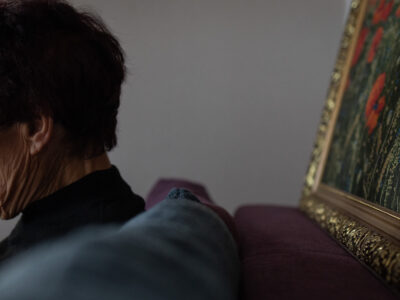
Olena and her son, Misha. (Photo courtesy of Sara Cincurova.)

Olena currently works as a school assistant for a disabled girl at a local school—but with her single salary and prices skyrocketing since the outbreak of the war, she frequently struggles to buy food, she says. As a school assistant, she earns approximately $88 USD a month at most—but her salary is often cut down significantly, as it largely depends on the number of hours she works per week.

Apart from this severe financial hardship, what Olena suffers from the most is when she sees the inhabitants of her village mock and hurt her Misha, who is her only child.

“People have this narrow-minded mentality in our village… They often used to make fun of Misha, calling him [slurs],” Olena says with pain in her eyes. But Misha is a talented and sensitive boy, she adds. “He is kind, curious, and a patriot. He loves cooking, he is always cheerful.” 

Olena is currently receiving humanitarian aid from a local NGO, Voices of Children. The organization works with a wide range of children—including those with disabilities and/or on the autism spectrum. Olha Yerokhina, a Communication Manager for the organization, tells me that whenever a family with a neurodivergent child asks for help, “We listen, we try to understand the need, and even if we can’t provide specialized support in-house, we do our best to refer [the family] to trusted professionals or partner organizations.” 

The NGO also supports Ukrainian mothers just like Olena. “[Mothers] are often overwhelmed and left to navigate [the] complex reality alone,” Yerokhina says.

At the end of the interview, Olena recalls the one—and perhaps only—positive aspect that the war has had on her and her son. “People are now more accepting of Misha’s disability,” she says. “During the occupation, many have reconsidered their values and their priorities.”

“They now make less fun of Misha and accept he is a human being, and treat him with more love.”

[post_title] => Motherhood on the Frontlines [post_excerpt] => Meet the mothers caring for Ukraine's most vulnerable children. [post_status] => publish [comment_status] => closed [ping_status] => closed [post_password] => [post_name] => single-mothers-ukraine-russia-war-conflict-frontlines-violence-motherhood-widows-vulnerable-children [to_ping] => [pinged] => [post_modified] => 2025-09-12 17:03:26 [post_modified_gmt] => 2025-09-12 17:03:26 [post_content_filtered] => [post_parent] => 0 [guid] => https://conversationalist.org/?p=8696 [menu_order] => 13 [post_type] => post [post_mime_type] => [comment_count] => 0 [filter] => raw )

Following the bombing of the Kramatorsk railway station on April 08, 2022, the wounded civilians were evacuated to the hospital in Dnipro. In the photo, 9-year-old Rinat has sustained injuries and is lying on a hospital bed at the pediatric unit, facing away from the camera. His mother Olena is sitting next to him.

Motherhood on the Frontlines

WP_Post Object
(
    [ID] => 8525
    [post_author] => 15
    [post_date] => 2025-06-05 18:35:51
    [post_date_gmt] => 2025-06-05 18:35:51
    [post_content] => 

We don't just need more women in office. We need a culture shift.

I once believed that the presence of a female leader signaled real progress—a sign that gender equality had taken root. As a girl growing up in China, I watched with admiration as women like President Tsai Ing-wen in Taiwan and President Park Geun-hye in South Korea rose to the highest offices in their respective countries. Their success seemed to promise a future in which women’s voices would be equally heard, equally respected—that perhaps women might finally be seen as equals.

But as I began to study gender and politics more deeply, particularly across East and Southeast Asia, that initial optimism gave way to unease. Representation alone, I realized, does not guarantee change. Even more alarmingly, the symbolic presence of women in power can obscure the systemic barriers that continue to shape—and often silence—most women’s participation in political life.

Globally, this problem has proven surmountable. In Scandinavia, gender quotas and institutional reforms have helped elevate women to between 40% and 50% of parliamentary seats, reflecting not only a shift in numbers but a broader cultural embrace of women as political leaders. Similar gender quotas in Mexico—which elected its first woman president, Claudia Sheinbaum Pardo, last year—have led to women making up 50% of seats in congress, after gender parity was enshrined in the country’s constitution in 2014. 

In contrast, however, East and Southeast Asian democracies continue to lag behind—not only in representation, but in the structural support needed to close the gender gap. Japan, for example, despite being one of the world’s largest economies, has seen little progress in this area. Women occupy roughly 16% of seats in the national legislature—a statistic that reveals not just electoral imbalance, but deeper societal expectations about leadership, gender roles, and public legitimacy. As of April of this year, the percentage of women who hold parliamentary seats in India (13.8%), Cambodia (13.6%), Malaysia (13.5%), Sri Lanka (9.8%), and Bhutan (4.3%) remains even lower. And in China, there have been no women in the politburo since 2022, something the United Nations has flagged as a matter of great concern.

So, are women truly gaining power in Asia, or are they simply there to make politics look more gender equal?

Analyzing data from the Asian Barometer Survey suggests the reason women’s political participation remains low in Asia is as much a numbers problem as it is a cultural one. Founded in 1971, the ABS is a cross-national survey that aims to gather “public opinion data on issues such as political values, democracy, governance, human security, and economic reforms.” In a 2020 academic paper from the University of Edinburgh’s Dr. Sarah Liu, one surprising finding from the 2010–2012 survey was how the gender of the interviewer affected women’s answers. Faced with female researchers, women opened up about their political beliefs. With male interviewers, many of them hesitated. This suggests a much deeper problem with Asia’s gender divide, rooted in women feeling both uncomfortable with and unwelcome in politics. 

Across many societies, not just in Asia, politics is still seen as a man’s domain, where women are expected to support, not lead. But in East and Southeast Asia, where traditional gender roles continue to shape public and private life, this attitude is amplified. Even in modern cities, women are constantly told that politics is not their space. For me, it wasn’t that anyone said I couldn’t be a leader when I was growing up—it was that no one ever expected me to be one. And when women are constantly told that something isn’t an option for them, it makes sense that, eventually, they might actually start to believe it.

When women do step forward to lead, they also face a very different kind of scrutiny to their male peers. Their private lives are often judged more harshly than their professional ones, and given as much attention, if not more. When Tsai Ing-wen became Taiwan’s first female president, critics focused on the fact that she was unmarried—as if being single made her unfit to lead. But when it comes to unmarried male leaders, no one ever even thinks to question it.

The media frequently contributes to this double standard. I remember watching coverage of Shoko Kawata, a 33-year-old woman who became the youngest female city mayor in Japanese history after winning her election in Yawata, Kyoto Prefecture in 2023. I was furious that the story’s focus was not on what she’d said in her speech, but on what she was wearing. Other reports also emphasized her love of tea ceremony and traditional kimono attire—while barely mentioning her actual policy goals. Her agenda had been reduced to its aesthetics: her clothes were that day’s headline news, while her policies went overlooked.

Even within political institutions, this bias persists. In Japan, a young Tokyo assemblywoman was once heckled by her male colleagues while speaking about the need for better childcare policies. This incident occurred in 2014, when Ayaka Shiomura, a member of the Tokyo Metropolitan Assembly, was addressing how the government might better support mothers in light of Japan’s drastically decreasing birth rate. During her speech, several male lawmakers interrupted her with sexist remarks such as “Go and get married!” and “Can you even have children?” One of them, Akihiro Suzuki, later admitted to the heckling and publicly apologized. But the incident sparked widespread outrage, and served as another stark reminder of the entrenched gender bias in even the most formal of political spaces. 

Fueling all this is the deeper issue that women are still expected to prioritize the family above all. This problem isn’t singular to Asia, but nonetheless, it feels especially pervasive here: Even in the public sphere, women are still trapped in private expectations. When a woman chooses public service, some see it as a betrayal of her “real” duty. The media asks, “Can she have it all?”—a question they’d never ask of a man, and one that has never been asked of a father.

These attitudes don’t just make the job harder. They make women question whether the space was ever meant for them. And in many ways, it still isn’t—something that keeps women out of politics, and keeps everyone, regardless of gender, chained to the status quo.

Yet, despite persistent challenges, women politicians in Asia have continued to make remarkable strides. President Tsai and President Park both shattered historical barriers to ascend to the highest levels of national leadership in their respective countries, proving that women are more than capable of leading. They also both drove meaningful social and economic change during their terms—even in systems not designed for them. 

As the first woman president of Taiwan, Tsai Ing-wen and her administration actively pushed for gender-equal policies, earning Taiwan the top spot in Asia—and one of the highest rankings globally—for gender equality. One particularly meaningful initiative was an amendment requiring companies with more than 100 employees to provide childcare facilities—helping to ease the burden on working mothers. Tsai also supported policies that loosened loan restrictions for women entrepreneurs and promoted female participation in the economy as a path to structural change. 

Beyond legislation, she repeatedly called for dismantling gender stereotypes and encouraged women to participate in public life—raising both the visibility and legitimacy of women in leadership. Under her eight-year tenure, Taiwan’s economy grew steadily, with an average annual GDP growth rate of 3.15%, and even reached 6.6% in 2021—a rare achievement during global economic uncertainty.

Park Geun-hye’s presidency, meanwhile, offered a different but equally important approach to leadership. While her administration made more modest progress on gender-specific reforms, it recognized the challenges faced by working mothers and proposed expanding childcare services to support female employment. More broadly, Park’s role as a woman navigating a traditionally male-dominated political landscape was also deeply symbolic. 

Under her leadership, South Korea expanded its global economic footprint by signing free trade agreements with 52 countries, including China and Vietnam—bolstering South Korea’s export markets and international competitiveness. These policy efforts, though not always framed through a gender lens, reflected a broader vision of national growth, with women as increasingly visible participants.

Tsai and Park’s contributions—each shaped by their own context—highlight the transformative power and potential of women’s leadership. For millions of women across Asia, seeing them in positions of power—on television, in parliament, in international headlines—continues to deliver an enduring message: women belong here. And their presence alone continues to inspire others to imagine what is possible when women are no longer the exception.

Change won’t come overnight. Cultural shifts take time. But every honest conversation, every woman who speaks up, every moment of resistance matters—so hopefully, one day, girls growing up in East or Southeast Asia will see women in power and think: “That could be me.” Not because it’s rare, but because it’s normal.

To achieve this, we don’t just need more women in office. We need political systems that respect their leadership, media that reports on their work—not their wardrobe—and societies that stop measuring women by outdated standards. We need women in Asia to not just be seen in politics, but truly heard.

[post_title] => When Will Women in Asia Be Seen as Leaders—Not Exceptions? [post_excerpt] => We don't just need more women in office. We need a culture shift. [post_status] => publish [comment_status] => closed [ping_status] => closed [post_password] => [post_name] => women-leaders-asia-politics-tsai-ing-wen-taiwan-park-geun-hye-south-korea-government-gender-parity-equality [to_ping] => [pinged] => [post_modified] => 2025-09-12 17:06:55 [post_modified_gmt] => 2025-09-12 17:06:55 [post_content_filtered] => [post_parent] => 0 [guid] => https://conversationalist.org/?p=8525 [menu_order] => 14 [post_type] => post [post_mime_type] => [comment_count] => 0 [filter] => raw )

A soft, blue-toned illustration of a wind chime. In the center, replacing one of the bells, is a piece of paper depicting a woman facing away.

When Will Women in Asia Be Seen as Leaders—Not Exceptions?

WP_Post Object
(
    [ID] => 8581
    [post_author] => 15
    [post_date] => 2025-05-29 00:10:24
    [post_date_gmt] => 2025-05-29 00:10:24
    [post_content] => 

Stories from my friends still trying to survive.

It begins with a panicked message on Bluesky in October 2024. Someone is messaging me with a link to a fundraiser and stilted English that reads as though it came from a bad translation app. The picture on her GoFundMe shows a young woman with a pale face and shocking green eyes. 

It’s been seven months since the borders of Gaza were sealed. She says she is in Zeitoun, a pocket of north Gaza under siege. I respond in colloquial Arabic, to see if this person can even speak the language, to see if she is real. I ask her for a WhatsApp number. She gives me one. It starts with +972.

She is real. Her name is Hayat. She, along with her husband and children, did not flee south as the siege on north Gaza tightened. Where to go? she says. 

Hayat is pregnant. Eventually she will give birth—by c-section, without anesthesia—to a little girl with blue-green eyes as brilliant as her own. She names her Fatima. Now, I have a namesake in Gaza. 

I meet Mohamed next. A farmer and a teacher, he has lost his sheep and rabbits, but even living in al-Mawasi refugee camp, he persists in growing plants and crops in a little garden by his shelter so there may be something fresh to eat amid the siege. Al-Mawasi, a cruelly named “safe zone,” has witnessed regular attacks and bombardments since Mohamed arrived there in March 2024. 

This same siege today, almost three months since all aid to Gaza has been cut off, has driven people to famine. The cost of flour, if you can find it, careens wildly, swinging from an already farcical $100 USD to an impossible $700 USD. The bread bakeries have shut down. The World Central Kitchen says its warehouses are bare. Children have been dying of malnutrition and under bombs all at once, like fish in an increasingly shrinking barrel. To quote a DC pundit, “The war in Gaza is not really that different than other wars.” A beat. “Well, except I guess they can’t run away.” 

My keeping a bunny as a pet amuses Mohamed. One day, he shares a story about missing his animals, and a farmer in Texas donates $500 to his fundraising campaign. Mohamed is saving every penny for his eventual evacuation from Gaza, now a distant hope. Meanwhile, the cost to survive continues its inhumane inflationary spiral. Funds meant for escape are now hoarded for food, any food, which is becoming harder and harder to find.

After Hayat and Mohamed, I meet Obada. Obada is a lawyer with three children. He considers his youngest, Zain, a gift from God, as his other two children required medical intervention to exist. Zain did not. On Eid, Obada shares a photo of Zain in his little white thobe, a dignified and serious garment for adults that is adorable on a baby. 

The calls for help swirl thick and fast—other families realize they can build lifelines beyond the walls of Gaza, that someone, anyone, is willing to hear out their agony. There are Naser and Amal, with their children Rolan and Omar. Naser currently lies in one of Gaza’s last functioning hospitals with a breathing obstruction, and needs surgery. I try to help them a little. Rolan sends me a thank you photo: a young girl of seven, sitting on a pile of rubble against a blue sky, holding a sign that reads, “My love for you (heart) Fatima Ayub.” 

Before Israel sealed the Rafah crossing with Egypt in March 2024, it cost $5000 USD per adult, and $2500 USD per child, to organize an evacuation from Gaza. Those figures, as extortionate as they were, are meaningless now. No one can leave, and if they do, it will be as part of the deliberate depopulation of the strip. Yet, as my friends in Gaza keep telling me, nothing is left. Virtually no school, clinic, hospital, or mosque in Gaza has been left standing. Gaza has been bombed more heavily than London, Dresden, and Hamburg in World War II, combined. Children keep arriving in the few remaining hospitals with bullets in their heads.

I meet multiple Ahmads. There is Original Ahmad, who braved the migration boat passage under Israeli gunfire to escape Gaza to Europe—but is distraught because his mother and the rest of his family are still in the north. There’s Child Ahmad, who returned to Gaza to marry his lifelong sweetheart Samar, and was trapped when the war came. There’s Other Ahmed, whose siblings are all frantically trying to survive in a tent. Then, comes Another Ahmad, who shares a photo of himself in the rain, barefoot with already too-thin legs. 

There is Suad, who is only 24, and mother to a little boy, Omar. She’s taken to calling me mom, having lost her own mother before the war. I have no maternal experience, but try to hear her story. Among the most common injuries in Gaza unrelated to war wounds are burns—made worse by so many people cooking on unsafe, open fires. She shows me a bad burn that needs medical treatment. Her little boy has broken his leg, an ordinary childhood tragedy compounded infinitely by the horror. 

I meet Malak and Maali, who are sisters. Maali is disabled and needs a new wheelchair and special care. Malak labors hard on an unwelcome internet and on an unforgiving planet to help her sister retain her life and dignity.

Then comes Majd, 17, only just a child himself. Still, he shoulders the responsibility of trying to help his sisters and mother survive. He feels he has no choice.

Moataz is a shy and kind young man whose beloved father is ailing from kidney disease. Moataz doesn’t understand online fundraising, doesn’t understand social media, doesn’t understand this bizarre dystopia where he talks to a woman on the other side of the planet to try and outmaneuver a siege of biblical proportions. 

Rumors circulate in the aftermath of hostage Edan Alexander’s release that food aid will be permitted to enter Gaza. So far, these are only rumors. The siege grinds on. The ground invasion begins in earnest. An Israeli MK tells the world, “Last night, almost 100 Gazans were killed. And the question you asked me just now had nothing to do with Gaza. Do you know why? Because it doesn’t interest anyone. Everyone has gotten used to [the fact] that [we can] kill 100 Gazans in one night during a war and nobody cares in the world.”

Does anyone care? Does caring matter? 

Hayat, too, has burned herself. She tells me a pack of diapers for baby Fatima costs $70. 

Still, no aid comes.

Obada sends me photos of his dear friend, killed just last night with his wife and baby daughter. “My heart hurts, Fatima,” he tells me. “With his baby in his arms. He was only married a year.” 

Still, no aid comes. 

A friend asks me if I can help Hanadi, a still-young woman with eight children. I give what I can. 

Still, no aid comes. 

Even good news comes tainted. Naser is out of the hospital, but now, his neighborhood in Khan Younis is under evacuation orders following the latest assault. He decides not to evacuate. “I’m tired,” he tells me. “Rolan came to me crying asking why we are staying when everyone else is fleeing. It cut my heart.”

Child Ahmad, meanwhile, is fleeing, also pushed into al-Mawasi. He says he will not be online so much. When I do not hear from him for a day, I worry. I think of the al-Hol concentration camp for some 55,000 wives and children of ISIS fighters in Syria.

The US undertakes a farcical “aid delivery attempt,” under the eye of mercenaries who take selfies against a backdrop of starving Palestinians. The effort is about as successful as the floating pier to deliver aid that sank into the sea, a perfect grotesque metaphor, almost as perfect as letting children die while hundreds of thousands of tons of food rots within sight. 

Now that the ghastly end game for Gaza has been laid bare, this is what we—the Western world—have done to the Palestinians. When will it end? my friends ask me. How much more can we be expected to take? they ask. Until when? they ask. 

It is May 28, 2025. I have no answers for anyone. 

If readers wish to help any of these or other families trying to survive in Gaza, they may contact the author on Signal at fatimaayub.01 or by email at fsayub@gmail.com.

[post_title] => To Live and Die in Gaza [post_excerpt] => Stories from my friends still trying to survive. [post_status] => publish [comment_status] => closed [ping_status] => closed [post_password] => [post_name] => gaza-palestine-israel-war-survival-siege-aid-embargo [to_ping] => [pinged] => [post_modified] => 2025-09-16 06:20:48 [post_modified_gmt] => 2025-09-16 06:20:48 [post_content_filtered] => [post_parent] => 0 [guid] => https://conversationalist.org/?p=8581 [menu_order] => 15 [post_type] => post [post_mime_type] => [comment_count] => 0 [filter] => raw )
GAZA CITY, GAZA - MAY 17: Palestinians, struggling with hunger due to Israeli embargo, wait in line to receive hot meals distributed by the charity organizations as Israeli attacks continue, in Jabalia Refugee Camp in Gaza City, Gaza on May 17, 2025.

To Live and Die in Gaza

WP_Post Object
(
    [ID] => 8570
    [post_author] => 15
    [post_date] => 2025-05-28 20:43:55
    [post_date_gmt] => 2025-05-28 20:43:55
    [post_content] => 

On modern wealth's bland aesthetics, the reopening of the Frick, and the meaning behind our Gilded Age nostalgia.

Cultural Currency is a bi-monthly romp through the intersection of art and capital with writer Cara Marsh Sheffler. 

In his recent New York Times article, “Beige is the Color of Money,” Guy Trebay explored the prevalence of muted palettes in the homes and playgrounds of the rich around the world, from St. Moritz to the Sun Valley. “In past eras,” Trebay writes, “the wealthy tended to attire themselves in the richest of colors: indigo, crimson, the purple of nobilities and kings. We are no longer in that era. These days, the hue preferred by the richest people on earth is that most bland and mousy of non-colors — beige.” Trebay argues this shift has come to the fore during a populist moment, as the “rich hunker down in khaki camouflage.” He posits that being clad in “the anodyne colors of baby food, tea cookies or screensavers: latte, oatmeal, cream, butterscotch, café au lait” signals the notion of wealth in reserve, not something to be flaunted before the frothing fury of the masses. Trebay quotes Alessandro Sartori, the artistic director of Ermenegildo Zegna, as saying, “The ultrawealthy don’t want to show off, and beige colors are good in that sense…This class of people is super discreet and doesn’t want to be seen.”

This is bullshit. Rather, I would argue, beige is a marker of how they want to be seen. And unsurprisingly, compared to its colorful predecessors, it’s a hell of a lot less interesting to look at. Aspirational wealth, now the color of barf, is especially barfy. Intriguingly, it also seems to have sparked a bit of unexpected nostalgia for when the rich spent their money on batshit, exhilarating displays of filthy lucre, rather than on a $30,000 Loro Piana cardigan that makes both the wool it is made of and the person wearing it look like a virgin

After a five-year renovation, a temple of that sort of old-school, jewel-toned ostentation has reopened on Manhattan’s Upper East Side, at the base of the Museum Mile: The Frick Collection. Ever since it reopened to the public on April 17, the museum has been so booked solid that the only way to get in on a given day is to cough up $90 for a membership. The line snaking around the block indicates this is no deterrent whatsoever. Boasting a hundred-foot-long gallery covered in the most sensual green velvet wallpaper the nation of France could produce, illuminated by a skylight that runs the entire length of the room, the Frick is the pinnacle of everything modern wealth is not. I confess I could lose an afternoon staring at its emerald walls alone, never mind the Corots, Turners, Goyas, and El Grecos that line them. 

The Frick is a civilized place: There are no cameras or children allowed. Renovation aside, it is also a museum deliberately out of pace with the modern world. True to its namesake, Henry Clay Frick was a top-tier robber baron: coal and coke magnate, business partner to Andrew Carnegie and Andrew Mellon, union-buster extraordinaire. His taste reflects it. If money could buy it in 1906, his mansion on the prime corner of 70th Street and Fifth Avenue probably has it. A gargantuan Rembrandt self-portrait? Check! An entryway made of ten tons of Breccia Aurora Blue marble leading to an indoor fountain? Check! An Aeolian pipe organ? Check! Holbein’s portrait of Sir Thomas More? Check! A Fragonard room and a Boucher room? Check, check! (Randy Baroque artists always travel best in pairs.)  

Despite occupying such a rarefied niche, both tourists and locals continue to flock to the Frick in droves, celebrating the extraordinarily beautiful shit one rich person managed to buy and keep in his freakishly expensive piece of real estate. However, in our oligarch-besotted cultural moment, it does make me wonder why this is the kind of blue-blooded wealth we red-blooded Americans seem to be so nostalgic for. 

For starters, the blood in America isn’t truly blue. For all one might say about Old New York Society—from Mrs. Astor’s ballroom to Edith Wharton—we can all agree old money isn’t so old on our side of the pond. No; the Frick, then, isn’t a temple of old wealth, but a bastion of what American rich used to be perceived as. Think of Scrooge McDuck back-stroking through his ducats; Daddy Warbucks tap-dancing; Mr. Potter scowling in his boardroom; Prince Akeem before his Randy Watson Brooklyn drag; or, most simply, Donald Trump himself, who, as Fran Lebowitz put it, “is a poor man’s idea of a rich man.” 

One need not do a deep read of The Protestant Ethic and the Spirit of Capitalism to know that ever since a raggedy pack of religious extremists dropped anchor at Plymouth Rock in 1620, this country’s inhabitants have had some fucked up ideas about wealth. Notably, New England’s Calvinist pilgrims subscribed to the doctrine of predestination: they believed God knew from the jump whether you were going to heaven or to hell—free will and the quaint American myth of bootstraps be damned. The Pilgrims also believed that God showed favor by showering wealth and good fortune upon His “elect,” and that God’s elect demonstrated their status through a lifetime of righteousness and upstanding behavior. This has quite certainly set a tone that persists well into 2025: Americans are desperate people who have deluded themselves into thinking they can become respectable. And that, to us, means rich. 

To this day, American “blue-bloods” claim descent from Mayflower stock, as did Henry Clay Frick. This tenuous—one might even say aspirational—connection is reflected in his art collection, and his proclivity for the Dutch masters, who painted the Calvinist aristocracy. The Mayflower itself was funded by Dutch Calvinists, the upper class of what was then the richest country in the world. Like the uber wealthy of today, the Calvinist elite showed their wealth in what they thought were subtle ways. They also did not not want to be seen. Rather, they wanted to be perceived as favored by God but in control of themselves—and, undoubtedly, of others (all that Bible study did little to put them off the slave trade). Like the Beige Hordes on the slopes of Courchevel today, they also preferred monotone—albeit darker hues. Simultaneously, they wore the richest fabrics, lace, and stonking pearls, all studiously catalogued in paintings eventually collected by the likes of Henry Clay Frick. Although scholarship speaks to the “restraint” in this era of fashion, I doubt a starving man in 17th-century Amsterdam would have perceived much holding back in the sumptuous, candlelit banquet tables groaning with all manner of fish, fowl, fruit, flower, crystal, and silver depicted in countless Dutch still lifes—and now hung on the Frick’s emerald green walls. Four hundred years later, I wonder if those glorious spreads were allowed to rot or wilt in the studio. 

Curiously, given the beige miasma, much ink has also been spilled about the “New Gilded Age,”  and how big, loud 80s bling is back—supply-side shoulder pads and caviar. At first blush, this may seem like a contradiction, but one must remember it's a nerd version of such bling of yore, a taste memorably summed up in Rebecca Shaw’s Guardian headline, “I Knew One Day I’d Have to Watch Powerful Men Burn the World Down, I Just Didn’t Expect Them to Be Such Losers.” Yes, Zuck got his MAGA makeover and is sporting chains and Balenciaga—so much for the de rigueur Prius and Uniqlo hoodie from HBO's Silicon Valley. But Zuck’s Maui Ewok-chic hideaway has nothing on Henry Clay Frick's Fifth Avenue digs, and offers nothing new to wealth’s aesthetics but cheap imitation. Henry Clay Frick brought Old World Wealth over to the New to demonstrate his own preeminence. Grandeur and history were entirely the point. For Zuck and his billionaire brethren, there largely isn’t one.

In an interview with comedian Dan Rosen for his Middlebrow podcast, “cyberethnographer” Ruby Thelot discussed why he believes the tech elite don't collect art: “A lot of my friends in tech in SF, besides maybe video games, are not interested in being an audience to culture that is not about them…When I am in front of the painting over there…I need to accept that I am not the center of the activity. I need to understand something else, right? I’m not optimizing myself. When you run you can beat your time. Either I like the painting or I don’t like the painting. There isn’t a clear metric around it.” Of course, Henry Clay Frick is at the center of his art, as long as his museum-mansion bears his name: he bought it and, because of his immense wealth, we get to see it all in one place. (Tellingly, his favorite painting he bought was said to be Goya’s “The Forge” which depicted the metalworking that made him a rich man.) But the Beige Bros lack the ability to see it this way, or with any nuance. Similarly, this framework also explains why the splashiest art commission Zuck has made was a seven-foot sculpture of his wife, a monstrosity brought into this world by Daniel Arsham, famed for luxury brand collaborations and toy cars

In the same interview, Thelot talks about how the culture is poorer when an audience for the arts is not cultivated from a young age and the world is run by engineers who live to work and order food to their desks on DoorDash. He implies that the striving goals of such a class of workers are simply optimization of the mind, the body, and, of course, the bank account. He sees it as a “tragedy” that they cannot tell a Monet apart from a Manet. He pins the blame on the death of liberal arts education and core curriculums. 

Whatever the cause, today’s drip simply isn’t the same. The Old Masters art market has crashed. Dead is the notion of owning old, expensive booty from empires of yore that require knowledge of craft and scholarship to appreciate. The Frick is a jaw-dropping floorshow of exactly that, and a testament to its staying power when compared to the bling of today. After all, what would a Tech Bro museum look like? Would it have its own crypto currency? Would it boast a ketamine-fueled gala on the playa at Burning Man? Or would it simply be a subtly textured, puckered ecru circle of hell underneath Satan’s frozen asshole in the Divine Comedy? (Full disclosure, that is exactly how I imagine the playa at Burning Man.)  

Anyone with a smartphone is treated to breathless news coverage of the rich: lavish events and vacations and jewels. But before rockets and megayachts (and make no mistake, Henry Clay Frick owned a steamship and the 19th-century equivalent of a rocket: a private rail car), the rich collected the booty handed down (read: stolen) from one empire to the newly ascendant one. They valued provenance, because they believed it placed them squarely in its lineage. It became their own heritage, like the family trees we Americans are so short on. To own a Roman mosaic or bust was to embody a bit of Caesar. This narrative of empire is today the backbone of most major museums, a correlation that is a pet topic of mine. It is also exactly why the Frick feels so familiar and so august: it’s like a mini museum in which one God-fearing, union-busting man lived, an experience we can microdose ourselves by walking through it. 

Of course, the art of the rich still crowds the walls of museums. Just as surely, that art reflects the power of certain dealers, just as it always has. Joseph Duveen, who famously said, "Europe had a great deal of art, and America had a great deal of money," was the famed dealer to the robber barons in the Gilded Age. He maintained four separate accounts for Henry Clay Frick alone. In New York City right now, four major museum retrospectives feature contemporary artists represented by a single blue-chip gallery, Hauser and Wirth. The rich and their servants still do a great deal to shape our notions of culture and refinement. But that 19th-century robber baron wealth is what built US museums and spread the seductive, Calvinist lie that a world where the rich were stewards of nice things was a world where the rich maybe deserved to have those nice things. Sometimes, the rich even shared them with the plebes, usually after they died out of noblesse oblige, or simply hating their kids. 

Nostalgia for the Gilded Age is nostalgia for a world order that perhaps kept us down, but at least made a little bit of sense (if you squinted hard enough at the Dutch still life). Today, we have Kaws at every art fair and Katy Perry dismayingly back from space in one piece. TikTok is rife with alleged “home improvements” that destroy historic homes in pursuit of a Kardashian aesthetic that somehow manages to be both spare and maximalist. Rebecca Shaw was right: today’s rich are cringe. Beige, however, is not a matter of seeking inconspicuousness; it is a part of the cultural poverty that plagues our ruling class, whose libraries go no further than A for Ayn Rand. Beige is the color of a desert of ideas, as well as what the earth will look like once the billionaire class has destroyed it. Ultimately, it doesn’t matter whether or not one considers the hue ostentatious. Mark Twain, who coined the term “Gilded Age,” once wrote, “The man who is ostentatious of his modesty is twin to the statue that wears a fig-leaf.” After all, it also doesn’t matter what someone is wearing when you’re under their boot. But that won’t stop me from renewing my Frick membership (or—full disclosure—borrowing my mom’s).

[post_title] => Robber Barons vs. Beige Bros [post_excerpt] => On the reopening of the Frick, modern wealth's bland aesthetics, and the meaning behind our Gilded Age nostalgia. [post_status] => publish [comment_status] => closed [ping_status] => closed [post_password] => [post_name] => frick-collection-reopening-new-york-museum-gallery-art-beige-wealth-aesthetics-calvinists [to_ping] => [pinged] => [post_modified] => 2025-09-16 06:23:08 [post_modified_gmt] => 2025-09-16 06:23:08 [post_content_filtered] => [post_parent] => 0 [guid] => https://conversationalist.org/?p=8570 [menu_order] => 16 [post_type] => post [post_mime_type] => [comment_count] => 0 [filter] => raw )

A slightly out of focus photograph from one of the rooms in the Frick Collection. There is a rich, green carpet; sumptuous green wall paper, and a rug in the center of the room with a table with sculptures on it. There is a large skylight, and on the walls are large oil paintings. Scattered throughout the room are various people in cocktail attire.

Robber Barons vs. Beige Bros

WP_Post Object
(
    [ID] => 8363
    [post_author] => 15
    [post_date] => 2025-05-20 20:08:39
    [post_date_gmt] => 2025-05-20 20:08:39
    [post_content] => 

One would hope that something that happens so frequently would be discussed. But overwhelmingly, it’s not—until, as I learned, you join the miscarriage club yourself. 

Listen to this article on The Conversationalist Podcast. | 12:57 min

For an LA storytelling show in 2009, I wrote and performed an essay called “The Cinderella Instinct,” a piece detailing that cut-and-run gut feeling nearly every woman in her 20s cultivates from continuously escaping predatory men. Easing the audience in with the softball line, “Every man is a potential rapist,” I launched into stories detailing the many times I’d quite literally run away from an uncomfortable situation with a possible predator—from hopping out of a convertible at a rolling stop in Hollywood to sprinting from a shirtless Frenchman through a deserted, deeply unsavory part of Nice. 

At the essay’s conclusion, I reflected on how, while I’d escaped potential assault throughout my life so far, 1 in 6 women do not—including some of my best friends, and my sister, whose story I shared with her permission. Perhaps my “luck” was partly because my stories had involved strangers, whereas assault has always been more likely to occur from someone you know, as it had with my loved ones. “So who that I know is the real potential rapist?” I’d written in the original essay. “Is it you?” 

Granted, they made me cut that final line in my performance, deeming it a bit too much truth telling for a comedy night. Because of this, it wasn’t until some handful of years later, with the advent of #metoo, that I thought we might finally be ready to address the question—and that things might start to shift. 

Reader, we did not cleanse the world of rape culture. But, at least, we began to talk about it, and to me, that felt like progress. 

A decade on, I’d survived the end of my twenties, and spent most of my thirties setting the stage for a deeply healthy marriage (pro-tip: couple’s therapy while dating!). Then, I fell face first into yet another hidden gem of womanhood—a very different pile of bullshit our culture has encouraged women to shovel through in silence.

I had a miscarriage. 

While there’s been a slow thaw towards openly talking about miscarriage thanks to social media, the word itself still contains an air of old-timey superstition and precious shame in most everyday contexts, something I would quickly learn in the aftermath of my own. Even now, chatting with friends or neighbors, I’ve found the word “miscarriage” invokes an involuntary wince, in both myself and others, because it’s just not something we talk about in a casual way.

Meanwhile, in a medical setting, doctors will bluntly inform you of how wildly common miscarriage is, ending 1 in 4 pregnancies, mostly in the first trimester and often before you’ve even realized you’re pregnant. One would hope that something that happens that frequently would be—I don’t know—discussed? But overwhelmingly, it’s not—until, as I learned, you join the miscarriage club yourself. 

I’m not going to get into the public political discourse on pregnancy here—that would require several books, not an article. But with the trend of states legislating a stranglehold on women’s reproductive rights, it feels more important than ever to have open, candid, and clear conversations about the reality of pregnancy—including potential miscarriage. And that means sharing our stories, no matter how uncomfortable, so that we have a realistic, informed, and nuanced view on the many things becoming pregnant can entail.  

So, here’s mine.

I’ve never felt the clicking of my biological clock, but after blissfully devoting my 30s to self-producing edgy physical theater with my co-performer-turned-husband, I realized if we wanted to procreate, we’d better get a move on. So, we survived a global pandemic, got married, and had a year’s worth of unprotected sex—until one day, just like I learned, I peed on a stick and found out I was pregnant. Like magic!

As an information-seeking, newly pregnant woman of advanced maternal age, I’d already worked hard to mentally prepare myself for possible miscarriage. I knew the 1-in-4 statistic, how spontaneous miscarriages are very normal, and that they’re often chromosomal and don’t mean anything negative about a couple’s ability to have children. Still, in the early days of my pregnancy, my mind raced, mapping out the ticking 40-week time bomb of our life. To me, my pregnancy was real the minute that pee stick said so; and I took any advice I could find, whether from doctor friends or the internet, avoiding deli meat and sushi, abstaining from alcohol and Advil, and quitting my nighttime melatonin. At the same time, I tried to hold the simultaneous truth that this pregnancy could be nothing—that I could be one of the unlucky ones—trying to temper my own anticipation until enough time had passed to make it “real.” 

To make matters worse, I’d found out I was pregnant a few weeks before my husband and I were scheduled to shoot pick-ups in Los Angeles for the film adaptation of one of our aforementioned edgy plays. I was dismayed to learn the doctor wouldn’t see me until I was 8 weeks pregnant—right when we were out of town—because of the prevalence of miscarriage in the first trimester. As she explained, it wouldn’t make sense for them to see me until the pregnancy was really viable, so they scheduled my check-up for when I would return to New York, at the top of week 11. 

Lacking a doctor’s guidance, I felt like I needed a master’s in philosophy and a zen Buddhist practice just to navigate the mindfuckery of early pregnancy. This potential baby was both alive and not at the same time. It was Schrödinger’s Cat, but in my womb. During this time, I also had several experiences where I'd cautiously divulge to a trusted friend that I was in my first trimester—always sharing that I knew I was "not supposed to tell anyone." But nearly every time I offered that caveat, people would actually shush me—as if uttering the word "miscarriage" while pregnant would invite it in. They insisted that if I believed things were okay, they would be; and as time continued to pass, I grew more confident that they were right, that I could trust my pregnancy was real. My cautious internal caveat of “I could miscarry” began to lose its footing. In my mind, Schrödinger’s baby was alive. 

Back in New York, my husband and I excitedly went to our doctor’s appointment. The vibe was immediately optimistic and pleasant: We’d just made it to week 11, and after having a discussion about all the nightmare things we’d have to monitor for the next 30-odd weeks, things felt pretty real. Then, we got around to the ultrasound. At first, the doctor couldn’t really “find” the pregnancy visually. Which... seemed bad. Then, once she did, she noted that it looked closer to 7 weeks, not 11. 

The vibe shifted. 

The doctor asked about the timing—could we have mistaken the date of conception? In response, I showed her my overachieving honor student psychopathic period tracking data, and her expression changed. Suddenly, the life-changing timeline that had taken shape over the past weeks started to crumble. The following week’s nuchal translucency, done at week 12, was changed to a "dating sonogram.” Later, in my patient notes, I saw it was actually to check viability: No heartbeat had been detected.

While I was too blindsided to think clearly, my husband luckily had the presence of mind to ask what all of this actually meant. Finally, the doctor explained how the sonogram was to confirm if this was an "abnormal pregnancy." If it was, we'd discuss next steps of how to "remove" it, and we'd be able to "try again" basically right away. 

Since this was a Friday appointment, we would have to wait an agonizing weekend before getting official answers at Monday’s sonogram. During two endless days of a new, unwelcome brand of uncertainty, I sat in my paradigm’s reversal, going from 95% sure I was pregnant to 95% sure I was not. In this purgatory, I tried to catch up to a new reality while still occupying the old truths I’d come to accept. Like a prayer or superstitious tick, I kept avoiding lox, soft cheese, and alcohol when we went out to eat, but I also cried for hours in anticipatory mourning. 

That Monday, the doctor confirmed I had, in fact, miscarried a couple of weeks prior. Turns out there's a thing called a "missed abortion," where you miscarry but it doesn't actually leave your body, and you still feel totally fine. I’d always thought miscarriages were marked by cramping and bleeding and a big event—but no, mine was just straight chilling in my body for weeks, something I found horribly disturbing, but is medically normal. (Yet another thing no one talks about, and something I only learned of after it had happened to me.)

Going through the psychological whiplash of accepting that I was no longer pregnant felt even harder given all those hushed conversations that had preceded it. I felt like this pain was something no one wanted to hear about, or talk about—that I wasn’t allowed to talk about it. But then, something surprising started happening. The minute I would get over the fear of divulging my story—and the fear of making other people feel uncomfortable, sad, or awkward by being truthful about what I’d been through—all of these other stories began emerging around me. Women I’d known for years began privately sharing their own experiences with me—how they’d miscarried both before and after carrying successful pregnancies, how they’d had to endure D&Cs during IVF, how they had held the image of their future child in their heart and had struggled to let it go. Once I learned just how many women around me had carried the same pain, the powerful loneliness around my miscarriage fell away. And while feeling grateful for the empathy and support these shared stories gave me, I also felt sorrow that I’d never heard them before—that these women only now felt like it was safe or acceptable to share them with me because I’d gone through it, too.

It was also through hearing about other women’s experiences that I learned, in at least one respect, I’d been very lucky. One small silver lining of my story was the team of spectacular women doctors who saw me through my miscarriage as quickly and empathetically as possible—something a doctor friend informed me is "very unusual for OBs." They worked to get me seen within the week of my sonogram, and upon noting my distress, the doctor doing my D&C worked to fit me in at the hospital the next day so I could go under anesthesia. When I thanked her for all her efforts—knowing how glacially slow the medical world usually works—she simply said, "1 in 4 of us have been there, we know how important it is to get past this as quickly as possible so you can heal." That same empathy was echoed by virtually every woman who saw me through my care, from both of my doctors to the receptionists booking my appointments to the nurses in the hospital. (Weill Cornell… Thank you.)

Still, it took me nearly a year to feel well enough to write about any of it. This is partly because I had to grapple with my own internalized conceptions of what a miscarriage “means,” even while knowing intellectually that it does not “mean” anything. I was raised on a German workhorse ethic, believing anything I put my mind to I can make happen, so a “failed” pregnancy did not fit into my sense of self. Plus, navigating the term “infertility”—which suddenly gets slapped on you medically after miscarriage—has been far from easy, especially in a culture that seems obsessed with women’s reproductive viability, and how many years past the age of thirty they dare to age. 

But as I’ve worked to come to grips with these many things that lie beyond my control, I hope that sharing my story can help start some necessary conversations. That maybe my sharing will help someone feel a little less alone in the same way so many women helped me feel a little less alone, too. 

I won’t sugarcoat it: Miscarriage sucks. It’s sad. And no one likes talking about sad shit. But based on my own experience, I think we need to talk about it. Because when we don’t—when we carry it alone, when we shush the possibility of its existence—we give it unnecessary weight. So many others are carrying this, have carried it—and it shouldn’t feel so heavy. But to make that possible, we need to catch up culturally to the reality of miscarriage medically: It’s normal. Often, it’s your body resetting from a pregnancy that was not ready to cook. Whatever the root reason, it’s not a failure. It’s just another one of those things that happens. 

When we stigmatize miscarriage by refusing to talk about it or treating it as a tragedy, we’re setting women up to feel isolated and broken, to feel like they’ve failed. I’ve found that, by talking about my own miscarriage openly, without hesitation, I’ve helped redefine what it means to me personally: It’s not a failure, and no one is to blame. It’s just another one of many steps along the road, a moment of sadness I’ve endured and moved beyond. It can feel tragic, but it is not a tragedy. It is normal. You’re normal. And if you need to feel sad, just know: There is a whole world of women out there sharing the weight of this with you, whether you realize it or not.

~

Author's Note: I’ve referred to people who can get pregnant in this essay as “women,” as it is a deeply personal story, written from my perspective as a woman. However, with so much rampant transphobia in culture and politics right now, I want to make clear that people beyond the traditional gender binary can get pregnant, and can also experience miscarriage—and I emphatically believe they should be included in this conversation. 

[post_title] => We Need to Talk About Our Miscarriages [post_excerpt] => One would hope something so common would be discussed. But overwhelmingly, it's not—until you join the miscarriage club yourself. [post_status] => publish [comment_status] => closed [ping_status] => closed [post_password] => [post_name] => miscarriages-pregnancy-reproductive-rights-bodies-personal-essay [to_ping] => [pinged] => [post_modified] => 2026-01-15 08:56:42 [post_modified_gmt] => 2026-01-15 08:56:42 [post_content_filtered] => [post_parent] => 0 [guid] => https://conversationalist.org/?p=8363 [menu_order] => 17 [post_type] => post [post_mime_type] => [comment_count] => 0 [filter] => raw )
An illustration of three women on a dark fading background. Each has a transparent cloud over their face, representing the weight of the miscarriage they have experienced. The woman in the foreground on the right has dark hair. To her left, there is a pregnant woman with blonde hair; in the background, there is a woman holding the hand of her child.

We Need to Talk About Our Miscarriages

WP_Post Object
(
    [ID] => 8378
    [post_author] => 15
    [post_date] => 2025-05-13 19:09:37
    [post_date_gmt] => 2025-05-13 19:09:37
    [post_content] => 

How a company in Kanpur is giving India's flower waste a second life.

It’s a sweltering April afternoon in Bhaunti village, about an hour’s drive from the heart of Kanpur, India. Inside a large hall, shaded from the harsh sun, the air is thick with the scent of marigold and rose. Groups of women, dressed in bright cotton sarees and salwar suits, work with quiet concentration. Some sit in circles, carefully sorting flower offerings collected from nearby temples; others pluck delicate petals with practiced hands. At one end, a few women lift heavy tubs of freshly washed blooms, carrying them outside to spread on large sheets, where the sun will slowly draw out their moisture, preparing them for the next stage of transformation.

Inside the factory, 38-year-old Preity Mishra moves with quiet efficiency, neatly packing incense boxes with an ease that comes from years of practice. She first joined the factory seven years ago, after unexpectedly losing her previous job, where she had worked for nine long years. At first, Preity admits, she was hesitant. Preity, along with the other women, works for Phool, a company that converts flower waste into incense sticks, cones, essential oils, and dyes. “I thought it would be dirty work,” she recalls, brushing a speck of sandalwood dust from her sleeve. But her perspective quickly changed once she learned where the flowers came from. “When I found out the waste came from temples, I began to see it differently,” she says. “These flowers are sacred and offered in prayer. It felt like I was giving them a second life, which is noble work.”

Preity Mishra inspecting a box of incense sticks.

The story of Phool traces back to 2016, when Ankit Agarwal, a computer engineer turned entrepreneur, accompanied a visiting friend on a trip to Kanpur’s ghats along the Ganga River. It was the time of Makar Sankranti, an Indian festival marked by ritual river dips. Though the water appeared visibly polluted, devotees continued to bathe as part of the tradition. “My friend began asking me questions about the purity of the water, why people still took dips despite the pollution,” Ankit recalls. “I realized I didn’t have the answers. In the meantime, a huge tractor of flower waste came and was dumped into the river.”

That moment planted the first seed of what would eventually become Phool, which means “flower” in Hindi. “I returned to my job, but I couldn’t focus. I was working, but I wasn’t content,” Ankit says, sitting in his office in Kanpur. “I eventually quit and came back to research how this flower waste could be reduced or stopped entirely from polluting our rivers.”

India, with its countless festivals and year-round celebrations, generates a significant amount of solid waste, including an estimated 800 million tons of flower waste per year. As many of these flowers are grown using pesticides and insecticides, when this floral waste is dumped into water bodies, it begins to decay, producing a foul odor and contributing to serious water pollution—much like what Ankit and his friend witnessed in the Ganga River. 

After he returned home to Kanpur, Ankit began crunching the numbers, calculating how many temples were in the region, how much flower waste was generated daily, and the scale at which it was being dumped. The results were staggering. According to government data, there are about 108,000 temples and mosques in India where flowers are offered every day, before being dumped in landfills or bodies of water, contributing significantly to the country’s water pollution and ecological damage. 

A worker scatters flower petals on a plastic sheet to help them dry.

Ankit began reaching out to temples, hoping to convince them to hand over their floral waste so that it might have a second life. “It was difficult to convince them,” he says. “Flowers offered at temples hold deep religious significance, so naturally, there was hesitation.” The temples weren’t resistant out of indifference, but an abundance of caution. “They were sincere in their concerns,” Ankit acknowledges. “They wanted to know why I wanted the flowers and what exactly I intended to do with them.”

Once Ankit succeeded in securing the flower waste, he spent the next several months immersed in research, exploring different ways the discarded blooms could be transformed into something meaningful. “I spent around eight months studying how this waste could be turned into compost or used in other sustainable ways,” he says. Then, he had a breakthrough. “Incense sticks are usually made from charcoal,” he recalls thinking. “Why not try making them from temple flower waste instead?” 

Ankit and his co-founder, Prateek Kumar, began operating out of IIT Kanpur, slowly putting their idea into action. Every day, Ankit would ride his two-wheeler to find a daily-wage laborer to help with tasks like sorting flower waste and basic processing. But the pair struggled to find reliable help—a new worker would show up each day, and rarely would anyone return, even when Ankit personally asked them to come back. It became clear that if the project was to grow, they needed a more stable workforce.

Then, by chance, a woman came to their office one morning looking for work, and Ankit offered her a day’s job. As with many others, he asked her to return the next day—and to his surprise, she did. 

A group of women rolling incense sticks by hand.

While they worked side by side, he started a conversation. Could she come regularly? Could she help bring in other women like her? She readily agreed. “It would be better to come here and work with flowers,” she told him, “than to go to seven or eight homes every morning to clean toilets. Even then, we don’t always get paid—just some leftover food or old clothes.”

Ankit was struck by her words. The next day, they visited nearby neighborhoods together, and soon, 35 women had joined the initiative. He trained them, helped them get their Aadhaar cards for the first time, assisted them in opening bank accounts, and taught them how to use mobile phones—all small but powerful steps toward economic empowerment and independence.

“It wasn’t easy at all,” Ankit says. “But we conducted a three-day workshop to teach them the basics. I didn’t want them to remain stuck in the informal sector. I wanted to bring them into the formal workforce, with dignity, stability, and skill.”

A worker monitors one of the factory's machines.

This commitment is fundamental to Phool’s success, and remains an important part of their work culture. “When we established the company, one thing was clear: There would be transparency. That’s why you’ll see there are no walls in the office—just glass partitions to divide the teams,” Ankit explains. “We also made a conscious decision to ensure that the women working with us have a clear path to grow. That’s why we move them from sorting to incense stick making, and then to packaging—so they not only feel a sense of progression but also develop leadership qualities in the process.”

Another important aspect, he shares, is supporting his employees in sending their children back to school. “We currently have 500 people working with us, and 490 of them are women,” Ankit says. “Around 60% of them have enrolled their children back in school. Our mission is to support all of them so that [over the next few years], 5,000 children return to classrooms. This is something we’re intentionally working on, even if we don’t speak about it publicly.”

As for the company itself, Ankit and his team remain dedicated to product innovation and exploring new possibilities with flower waste. Recently, the team even succeeded in creating sustainable “leather” from discarded flowers.

Workers dividing and sorting incense cones for packing.

Nachiket Kuntla, who heads the research and development division at Phool, believes this innovation could be a major breakthrough for the leather industry and the broader sustainable market. “We spent a good 7–8 years researching and experimenting with this idea,” says Nachiket. “We’ve now developed a product that is sustainable and matches leather in terms of texture, quality, and feel. We’ll be launching a pilot product in collaboration with a fashion brand by the end of this year.”

Phool’s journey is a reminder that sustainability doesn’t have to come at the cost of tradition—it can actually grow from it. What began as a simple act of questioning river pollution has now bloomed into a movement that empowers women, preserves faith, and protects the environment. As the world looks for other, cleaner ways forward, perhaps it’s time we ask ourselves: What else are we throwing away that could bloom again?

[post_title] => The Sacred Cycle [post_excerpt] => How a company in Kanpur is giving India's flower waste a second life. [post_status] => publish [comment_status] => closed [ping_status] => closed [post_password] => [post_name] => phool-kanpur-india-flower-floral-waste-temples-sustainability-water-pollution [to_ping] => [pinged] => [post_modified] => 2025-09-16 06:28:21 [post_modified_gmt] => 2025-09-16 06:28:21 [post_content_filtered] => [post_parent] => 0 [guid] => https://conversationalist.org/?p=8378 [menu_order] => 18 [post_type] => post [post_mime_type] => [comment_count] => 0 [filter] => raw )

Two women workers wearing sarees, gloves, and blue face masks sort a pile of orange and yellow flowers into a large blue bucket.

The Sacred Cycle