WP_Post Object
(
    [ID] => 1793
    [post_author] => 2
    [post_date] => 2020-05-28 18:49:18
    [post_date_gmt] => 2020-05-28 18:49:18
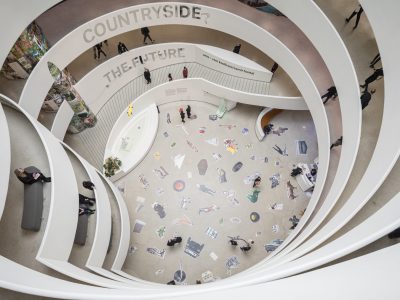
    [post_content] => An exhibition at the Guggenheim Museum challenges conventional wisdom about the role cities play in modern society.

We tend to focus on cities when we look for the sources of creativity and learning in our modern civilization. Think Paris and Milan for fashion; London and New York for literature and theatre; Los Angeles and Mumbai for films. The countryside, meanwhile, seems to represent a simpler time, when most people lived off the land. But a provocative new exhibition at New York City’s Guggenheim Museum suggests that some of the most radical changes affecting global society are, in fact, taking place in the countryside. 

In Countryside, The Future, Dutch architect and urbanist Rem Koolhaas challenges the widely held belief that the city is the future. In the catalogue for the exhibition, he rejects the idea of total mass migration to urban centers, asserting that “the countryside must be rediscovered as a place to resettle, to stay alive.” 

This message is particularly urgent with the outbreak of the coronavirus pandemic, which of course means that the Guggenheim, like all museums and most public gathering places, is closed— although part of the exhibition can be experienced online

In the age of the Covid-19 pandemic, the sheer concentration of people that once made cities so attractive is now a threat. The rapid spread of the virus between people who live in close proximity has raised awareness of the divide between the city and the countryside. This is why Countryside, The Future is both highly relevant and completely inaccessible. 

Koolhass and Samir Bantal, with whom he co-directs the think tank OMA, created an exhibition that begins with a single premise. According to the UN, more than 50 percent of the world’s population lives in cities today. This number is difficult to comprehend. The Earth is vast but, according to estimates, only around 20 percent of its surface area is habitable. Out of that area city dwellers are living in what accounts for only 2 percent of the landmass. What is happening outside of those urban territories, on the rest of the planet?

Koolhaas decided to tackle this issue when he realized that the Swiss village in which he has been vacationing since the mid-1980s had undergone a drastic change. Old houses were being renovated with a certain aesthetic to appeal to a wealthier clientele in search of quietude. There were no cows to be seen wandering around the village’s green pastures. Most of the farmers were not locals, but people from different backgrounds and ethnicities who had become disillusioned with big city life. The village was growing in physical size, but its population was dwindling, even with newcomers who had migrated from urban areas. 

To understand what is going on globally outside of cities is a complex process. Along with the Harvard School of Design, Koolhaas and his team looked at diverse case studies and anecdotes from around the world in the past, present, and future. In a style reminiscent of his seminal book, Delirious New York (1978), Koolhaas created a narrative that is highly personal and non-linear. It’s based on facts and research, but the exhibition feels like the creative documentation of a dissertation with an abundance of text, images, and graphs covering up the spiraling walls of the museum.

In some respects, the exhibition suggests, the way we live now has not changed significantly in 2,000 years. Even as far back as the 2nd century BCE, major civilizations had separated the city and the countryside by social function. The Greeks and Romans called the countryside otium, a place for contemplation and cultural endeavors, and the city negotium, the opposite of otium, a place for work and commerce. The Chinese term xiaoyao denotes “the liberation of an individual’s spirit, a state of wandering in absolute freedom, of living in tune with nature, and of blissful repose.” The difference between now and then lies in the fact that the countryside is no longer a refuge. It’s either a peripheral territory subjugated to meet the escalating demands of the city or a place of leisure that only the wealthy can afford. 

Over the centuries, there have certainly been attempts to bridge this gap by bringing certain elements of both the city and the country together. Charles Fourier, the nineteenth century French philosopher who founded utopian socialism, built factories based on the blueprint of Versailles in an attempt to improve the living conditions of the working man. These “social palaces,” as he called them, were precursors to the 1960s hippie communes. Machines did most of the work in Fourier’s factory, leaving workers plenty of time to enjoy leisure activities, and follow “liberated passions,” which included sexual relations unrestricted by marriage or monogamy.

Fourier’s utopia did not last long, but Countryside, The Future tells the stories of various twentieth century leaders who attempted to restructure rural areas and mobilize residents for national economic enterprises. Some, like the Soviet Union’s plans to turn the Russian steppes into farmland, failed. But others succeeded: the Autobahn network that the Nazi regime built to to connect urban and rural areas is still in place; and so is the Jefferson Grid in the United States.

In the twenty-first century, technological advances and social change are transforming rural regions.

In China, farmers living in urban-adjacent skyscraper farms grow fresh produce to feed tens of millions of people. Customers can connect to the farmers and see the produce they are purchasing in real time. 

In Kenya, the solar and wind-powered town of Voi just outside of Nairobi is one example of ruralization. The town, which is connected to nearby urban and rural centers via railroads; is one of several tech hubs that have become a magnet for recent university graduates. 

But what about nature, the most prominent aspect of the countryside? Twenty-first capitalism offers one solution in Patagonia, where the eponymous outdoor equipment brand has purchased vast swaths of land and made them into protected lands,  in order to stave off deforestation. 

The final part of the exhibition employs technology to ask if we can liberate ourselves from our Cartesian way of thinking. Instead of focusing solely on efficiency, can we make a shift toward healthier cultivation of the land? Can pixel-farming robots invoke ancient Mayan traditions to be easier on the soil by planting crops that are beneficial to each other? Will photosynthesis scanners be able to grow equally perfect produce by making sure each plant is receiving enough light? How will architecture adapt in designing spaces solely for robot workers? 

As I wandered through the thought-provoking exhibition, I had no idea that, in just a few weeks, the Covid-19 pandemic would force the museum to close. New York is now the epicenter of the global pandemic; at the time of writing, over 100,000 Americans have died of the virus. In Delirious New York, Koolhaas proclaims, “Manhattan is an accumulation of possible disasters that never happen.” Now as I type these words from my bed, quarantined for over two months in Brooklyn, distracted by the relentless ambulance sirens and the constant news updates, that sentence strikes a deeper chord. 

The global lockdown was caused by a catastrophe, but it also brought some hope for a better future. With the decline in travel by car and by plane, the air is cleaner and the water clearer. For many, being forced to work from home has brought the welcome corollary of having more time to spend with family, or to just slow down and think.  

I wonder, when this ends, how many of us will continue living in cities, especially in metropolises that are hit the hardest by this outbreak. How many of us will try to become more self-sufficient by learning about permaculture and growing our own food? How many of us will slow down, stop fetishizing travel, and lower our carbon footprint by taking fewer trips? Will architects keep furthering urban sprawl and putting more strain on existing infrastructure? Will we keep eating animal products and ignore the deforestation perpetrated by cattle ranchers in the Amazon? 

The message brought by the virus is that we are all connected to one another and to nature in ways we have never even been aware of. If we fail to internalize this understanding, we will not have a future as a species on this planet—whether we live in the city or in the countryside.
    [post_title] => Are cities really all that? A provocative exhibition takes a new look at the countryside
    [post_excerpt] => An exhibition at the Guggenheim Museum, now closed due to the Covid-19 pandemic, asks if the future lies in the countryside. The question now feels prescient.
    [post_status] => publish
    [comment_status] => closed
    [ping_status] => open
    [post_password] => 
    [post_name] => are-cities-really-all-that-a-provocative-exhibition-takes-a-new-look-at-the-countryside
    [to_ping] => 
    [pinged] => 
    [post_modified] => 2024-08-28 21:15:14
    [post_modified_gmt] => 2024-08-28 21:15:14
    [post_content_filtered] => 
    [post_parent] => 0
    [guid] => http://conversationalist.org/?p=1793
    [menu_order] => 265
    [post_type] => post
    [post_mime_type] => 
    [comment_count] => 0
    [filter] => raw
)
Are cities really all that? A provocative exhibition takes a new look at the countryside

WP_Post Object
(
    [ID] => 1778
    [post_author] => 2
    [post_date] => 2020-05-22 00:14:48
    [post_date_gmt] => 2020-05-22 00:14:48
    [post_content] => The search for home can sometimes clash with the need for security.

Like many Canadians, I grew up with my nose pressed to the window of American life.

This was especially true in my case, because my mother was born in New York City and her mother in Chicago; my great-grandfather was a Chicago developer who built one of the city’s first skyscrapers. My American cousins intimidated me: they included an ambassador, a Harvard archeologist, even a bullfighter. One of them was married to a woman who flew her own small aircraft.

I wanted to be like them — bold, adventurous, successful — and to understand what made them tick; I wanted to flee the quiet, polite country I was born and raised in, where ambition and strong opinions were frowned upon.

Canadian newsstands offered 80 percent American content and I knew the names of Buffalo’s suburbs, Lackawanna and Cheektowaga, because their television broadcasts reached Toronto. I caught deeper glimpses of American contradictions while attending University of Toronto, during a life-changing exchange week at the University of North Carolina, Chapel Hill. We attended a black Baptist church service where the preacher inveighed against abortion and the ladies waved paper fans. We listened to a black UNC administrator describe his life there…and begin to weep.

As someone from a multicultural city, Toronto, and a country where abortion isn’t demonized, both were shocking. Nor had I before imagined the daily toll that racism could play. It all deepened my curiosity about the U.S. even further, making me more determined to find a way to live there.

At 25, I won a fellowship to Paris, traveling Europe for eight months, then was a newspaper reporter in Toronto and Montreal, where I fell in love with a McGill medical student from New Jersey, soon to graduate and return south for residency.

I was able to follow him to the United States, although we were not married, because I was the daughter of a U.S. citizen, applying for “better work opportunities.” After I had taken an AIDS test, undergone a security check and been fingerprinted, an official at the consulate in Montreal interviewed me. I wrote, for a column in the national daily, The Globe and Mail, in 1988:

“The vice-consul asked me surprisingly little. When she approved my visa, after a brief but lively conversation, her enthusiasm and warmth were infectious. Even the guard wished me luck. I felt I’d been invited to a terrific party. I was handed a brown envelope, stamped, signed and sealed. My future was in my hands.”

And so I left behind a perfectly good country, one with excellent and heavily subsidized university education, cradle-to-grave healthcare, a wide, deep social safety net, and a Constitution that promised “peace, order and good government” rather than “life, liberty and the pursuit of happiness.” For years, Canadians had often guessed I was American, which is a veiled insult that means too bossy, too direct, too nakedly ambitious. I wanted faster decisions and a wider playing field, not the endless foot-shuffling of risk-averse fellow Canadians and a career limited to a handful of major cities. I’d thought American was more egalitarian than it is, but that turned out to be silly idealism. When I dared suggest to someone at Dartmouth that I audit classes there, since we were in the middle of nowhere for the next four years, pre-Internet, the university administration refused. How about part-time study? Also no. As I began to try to make sense of my new home, I read two seminal works of the early 1990s that explained the shadowed side of John Winthrop’s 1630 vision of America as a much-admired “city on a hill”: the first was Alex Kotlowitz’s There Are No Children Here, about two boys growing up in a decrepit Chicago housing project during the 1980s; the second was Jonathan Kozol’s Savage Inequalities, a study of two school districts, divided by wealth and class, which were allotted wildly unequal resources by the American way of funding education through housing taxes. This was a key difference between my experiences in Toronto and Montreal. In Hanover, a local social worker told me about the grinding poverty she saw on muddy backroads, the battered trailers with plastic on the windows, while Dartmouth’s most privileged students raced their shiny sports cars through town and dropped enormous sums in its few stores. There is poverty in Canada; this is particularly true for the shamefully neglected Indigenous people. But the shocking inequality of the United States, where the three wealthiest Americans collectively own more wealth than the bottom half of the population (while the middle class struggles to pay for healthcare and university tuition), is absent; Canada has its billionaires and millionaires, but they tend to be more discreet about their good fortune.

First American lesson: Prove you’re rich! Income inequality be damned.

I wanted my career back, so we moved to suburban New York, where I’ve lived ever since. After two years of marriage, my husband left and I started my American life yet again, without children. I’d insisted on a pre-nuptial agreement, which enabled me to survive financially and keep my home.

Second American lesson: Know your legal rights and be ready to fight hard for them.

Third American lesson: A tough lawyer is often your new best friend.

Single and lonely, in 1998 I answered a personals ad in a local alternative weekly — which brought a convicted con man into my life, who wreaked emotional havoc and cost me several thousand dollars.

Fourth American lesson: In a country so diverse, re-invention is easier. In a huge and mobile country, less fussy about one’s origins, he simply traveled east and started victimizing anew.

Fifth American lesson: Some Americans are wildly impressed with self-confidence and happily defer to material signs of success; before he was caught in Chicago, the conman had posed as a doctor and as a lawyer.

In the decades since, I’ve often wondered about my “ghost life.” What if I’d stayed in Canada? When I visit, I find that I miss the civil conversation, the more generous public policies and, most of all, a national culture that is not poisoned by right-wing terrorism. In 2002 and 2003, while researching my first book, I traveled to Ohio, New Orleans, Massachusetts and Texas to interview 104 men, women and teens about women and gun use, asking whether they owned a firearm or whether one had shattered their life. I spent three days learning how to fire a Smith & Wesson 9mm pistol, which gave me the street cred to speak with suspicious gun owners; their first question to me was always the same: Do you believe in the Second Amendment?

Sixth American lesson: It’s as if the Constitution’s ink were still wet, so often is it cited. And every time I ask someone about their concomitant responsibility to the common good I might as well be speaking Greek, so hollow does the phrase ring in a nation addicted to the primacy of individual rights.

I survived the financial crash of 2008, thanks to my second husband’s secure job and my work in a part-time retail position for $11/hour, an experience that was the subject of my second book. In two-and-a-half years, while selling $600 ski jackets, my hourly wage was raised by only 30 cents. The store’s wealthy customers recoiled in shock if I replied to them in French or Spanish. They automatically assumed anyone working at a low-level job couldn’t possibly be as well educated or well-traveled as they.

Seventh American lesson: A low-wage job de facto signals low status. One customer tossed a quarter at us, barking: ‘Go to college!” Every one of our 15-member staff had done so, and two were military veterans. I saw firsthand what $11/ hour could buy. Almost nothing. With college costs so high, how could anyone flee? 

Eighth American lesson: The stunning cost of American post-secondary education breaks as many as it helps. Two of our friends in their early 30s, both from blue-collar families, are crippled by their college debts of $60,000 and $100,000. My annual tuition in mid-1970s Canada was $660 a year; today, it would be $6,000.

In a country professing such deep allegiance to “liberty,” American workers have no right to paid vacation, sick leave or paid maternity leave. Union membership is low, and the federal minimum wage has been stagnant for decades. Since Donald Trump’s election, our Canadian friends have shifted from asking: “Will you come home?” to “When will you come home?” I struggle to find a response, even as I realize that most of my reasons for staying are predicated on privilege. I am an educated white woman, in good health; I have work, savings in the bank, and a gainfully employed husband who is also in good health. If I were poor and lived in a rural area, Canada’s social safety net might appear much more appealing than it does from a pretty and prosperous town within easy distance of New York City. Until we can afford to retire we need well-paid work, which, even in the worst of times, is more plentiful for us where we live now. My experience of trying to do business with Canadians has been frustrating: often they murmur encouragingly and then disappear, true to an aspect of the national character that places value on avoiding potential conflict. The U.S. feels more foreign now than it did when I first made it my home, nearly 30 years ago. It is tainted by mass incarceration, racism and daily violence. Shooters armed with automatic weapons have massacred thousands and schoolchildren practice “active shooter drills.” In a nation that never shuts up about “productivity,” retailers sell us scented candles to relax. No one seems to notice the contradiction. Soon, there will be more than 100,000 dead from COVID-19; meanwhile, the White House administration’s chaotic responses are a deadly roulette wheel. I love our historic, lovely Hudson River town and its ready access to the pleasures of Manhattan --- although they are temporarily off limits during the pandemic. The fact remains; unless we move to a rural, isolated area with poor medical access, we can’t afford comparable Canadian housing and my home city, Toronto, has become both violent and expensive, with tiny teardown houses selling for $1 million. I loathe Trump and fear four more years of this nightmare. I enjoy our life here— while knowing how deeply its systems punish so many others. It’s a moral thorn. Stay? Go? I still don’t know. [post_title] => America is home but Canada is safer: after 30 years, and despite a fulfilling personal life, is it time to leave? [post_excerpt] => In the decades since, I’ve often wondered about my “ghost life.” What if I’d stayed in Canada? When I visit, I find that I miss the civil conversation, the more generous public policies and, most of all, a national culture that is not poisoned by right-wing terrorism. [post_status] => publish [comment_status] => closed [ping_status] => open [post_password] => [post_name] => america-is-home-but-canada-is-safer-a-dual-national-wonders-whether-she-should-go-or-stay [to_ping] => [pinged] => [post_modified] => 2024-08-28 21:15:14 [post_modified_gmt] => 2024-08-28 21:15:14 [post_content_filtered] => [post_parent] => 0 [guid] => http://conversationalist.org/?p=1778 [menu_order] => 266 [post_type] => post [post_mime_type] => [comment_count] => 0 [filter] => raw )

America is home but Canada is safer: after 30 years, and despite a fulfilling personal life, is it time to leave?

WP_Post Object
(
    [ID] => 1767
    [post_author] => 2
    [post_date] => 2020-05-14 22:00:58
    [post_date_gmt] => 2020-05-14 22:00:58
    [post_content] => A scientist-turned-businessman believes he can make a profit by harvesting carbon dioxide from the atmosphere and turning it into synthetic limestone.

In 2006 Brent Constanz, a marine biologist who had studied corals for over 20 years, founded a company called Calera to produce cement with carbon dioxide. Constanz believed he could make a profit from harvesting toxic emissions to make the world’s most in-demand product with a method that was not only environmentally sound – but which actually helped reduce carbon emissions. He later thought using carbon dioxide to create concrete was the way to go and in 2012 launched Blue Planet, with the aspiration to pull 25 billion tons of carbon dioxide annually out of the air’s foul breath and turn it into synthetic limestone. Blue Planet manufactures synthetic limestone out of carbon dioxide – the toxic gas that is an industrial byproduct.  Synthetic limestone, when broken down into small pebbles and added to water and cement, becomes concrete, the second largest commodity in the world after water.

Today, carbon in the atmosphere has hit 415 parts per million—the highest level in the 800,000 years for which we have reliable data. In the pre-industrial era, it was below 300 parts per million. The excess carbon in the atmosphere traps heat on Earth, turning up the global thermostat.

Sanjeev Khagram, dean of the Thunderbird School of Global Management at Arizona State University, said that Blue Planet’s method of turning carbon into synthetic limestone was an effective means of reducing carbon dioxide emissions in the atmosphere. While presenting a paper on the subject at the Davos World Economic Forum this year, Khagram said that “carbon farming” was an opportunity for entrepreneurs to “turn a profit of $1 to $10 trillion” per year.

“Blue Planet’s is indeed a market-based approach to tackling climate change,” said Rick Parnell, CEO of the Foundation for Climate Restoration,  an organization that aspires to restore atmospheric CO2 levels to pre-industrial levels by 2050. Parnell also advocates private sector initiatives like that of Constantz’s. “You can't wait for the governments to act, we need to act now,” he said. His partner, MIT graduate Peter Fiekowsky, said that until now Bill Gates was the only person funding carbon removal. He added that recent government initiatives were “at one tenth the scale we need.”

Carbon farming on a large scale would indeed solve a major environmental issue while creating a whole new industry, said Casper Ohm, a data scientist in the field of environmental sustainability. Ohm is editor-in-chief of Water Pollution, an online resource about water and the environment. “The investment to pull 25 billion tons of C02 per year would require a huge amount of capital,” he said.  “It all depends on money.”

For other experts, carbon trading is controversial for ethical and environmental reasons.

“It is kind of like enabling other companies to release more carbon carbon dioxide [so that] another company can take it out of the atmosphere, [which allows] the first company to keep creating more carbon dioxide,” said Lisa Schaefer, a systems engineer who founded Thinq.tv, a video streaming platform developed at Arizona State University that hosts live grassroots conversations about current events.

The first company, explained Schaefer, could be investing in making its infrastructure and processes greener, but instead will now pay a contractor to clean up what they are putting out into the atmosphere.  Schaefer also believes the amount of carbon Blue Planet promises to pull out of the atmosphere might have the counter-productive effect of encouraging the production of more concrete.

“Only 10 billion tons of concrete are produced every year, not including the recycling of old concrete and other cheaper materials for making concrete,” she said. There appears to be no demand for 25 billion tons. She added: “We certainly don't want to encourage companies to manufacture more concrete even if it is a ‘green one.’”

Constantz was, until January 2020, in discussions with a wide range of industrial emitters, including cement and steel plants about initiatives to establish manufacturing plants around the world. The Covid-19 pandemic has brought those discussion to a temporary halt, but Constanz expects them to resume once the crisis has passed.

But even in these times of insecurity, global stasis, and introspection, Fiekowsky, who invested in Blue Planet years ago (Leonardo DiCaprio and  Don Kennedy, the former president of Stanford University, are also investors), says there are parallels to be drawn between how different countries are addressing climate change and Covid-19.

“Singapore and South Korea decided they wanted to control the virus. The US and the UK said, well, let's just minimize the impact of the virus,” Fiekowsky said. As of this writing, the US has reported 1,259,108 cases and 75,781 deaths and the UK 207,977 cases and 30,689 deaths, while South Korea reports 10,822 cases and 256 deaths and Singapore 21,707 cases and 20 deaths. “Obviously, it's horrible. To just minimize what you really want to get rid of,” said Fiekowsky.

Governments were giving short shrift to the urgent need for policy to deal with climate change before the pandemic, which has since drowned out the conversation about the issue.  Constanz pointed out that while the United States government has allocated $2 trillion to address the Covid-19 emergency, far more will die from climate change.

Ismail Serageldin, the former  Vice-President for Environmentally and Socially Sustainable Development at the World Bank, famously said in 1995 that "if the wars of [the twentieth century] century were fought over oil, the wars of the [twenty-first] century will be fought over water — unless we change our approach to managing this precious and vital resource."

Climate change will continue to ravage the Earth even after a vaccination for the Covid-19 virus becomes available. It is thus a crisis that we cannot afford to sideline, even during a global health crisis. To that point, climate expert Professor Robert Devoy of Ireland’s Coastal Marine Research Center issued a stark warning in a 2015 interview. “The last time the planet warmed this much,” he said, “88 percent of life disappeared.”

 
    [post_title] => Can private industry save the environment with for-profit green initiatives?
    [post_excerpt] => Harvest carbon and turning it into synthetic limestone could be an effective means of reducing carbon dioxide emissions in the atmosphere.
    [post_status] => publish
    [comment_status] => closed
    [ping_status] => open
    [post_password] => 
    [post_name] => can-private-industry-save-the-environment-with-for-profit-green-initiatives
    [to_ping] => 
    [pinged] => 
    [post_modified] => 2024-08-28 21:08:26
    [post_modified_gmt] => 2024-08-28 21:08:26
    [post_content_filtered] => 
    [post_parent] => 0
    [guid] => http://conversationalist.org/?p=1767
    [menu_order] => 267
    [post_type] => post
    [post_mime_type] => 
    [comment_count] => 0
    [filter] => raw
)

Can private industry save the environment with for-profit green initiatives?

WP_Post Object
(
    [ID] => 1759
    [post_author] => 2
    [post_date] => 2020-05-14 21:23:43
    [post_date_gmt] => 2020-05-14 21:23:43
    [post_content] => The dynamics of gentrification among the middle class are complicated, but Covid-19 has brought some painful clarity.

On January 24, the day I went into labor, only two people in the U.S. had been diagnosed with the coronavirus that still had no name. That afternoon, I stumbled out of our Brooklyn apartment building under the watchful eyes of whichever neighbors happened to be in the courtyard or peering out their windows at that moment. In recent months, as I started growing more and more rotund, neighbors who had generally offered no more than a passing nod in the elevator or by the front gate began holding doors for me, inquiring about my pregnancy, and telling me tales of their own. I started to enjoy shifting my distinguishing characteristic in the building from my whiteness, which marked me as a gentrifier in a borough of gentrification, to my belly, which marked me as a beleaguered woman in a world of beleaguered women.

The demographics inside my 120-unit apartment building on the border of two Brooklyn neighborhoods—one already thoroughly gentrified, another well on its way—reflect the demographics on the street. In the building, longtime black residents get replaced, vacancy by vacancy, with mostly white, highly educated newcomers like myself, whose rent-stabilized apartments are still a bargain at twice the price many of the older families are paying.

The dynamics of gentrification among the middle class are complicated, particularly in a city like New York, where racial differences persistently track onto income levels and health outcomes, and whole communities get displaced by predatory developers. My also-white partner is an artist and I’m a graduate student. As far as annual income is concerned, many of the longtime residents are probably in better shape than we are. But as is playing out so blatantly during this crisis, social class isn’t just about income. This lesson has never been clearer than from where I write this, perched under a skylight at a friend’s childhood home in Connecticut, where we have been hiding out for the last six weeks.

We spent the first four weeks of my son’s life in the normal self-isolation of new parenthood. The news about the spread of the virus was ominous, but felt distant. Family visited, friends brought food. The only visitors we restricted were my aunt and uncle, who had returned in mid-February from a cruise in the Far East. All others were welcome, as was the friendly up-close cooing of our neighbors. When I was finally able to move around again after a few weeks of what is euphemistically referred to as postpartum “discomfort,” I delightedly walked down the block to my favorite coffee shop and down a couple more to another, just because I could.

But soon the three of us came down with a cold and again began receding from the world. It was just as well, because days later, on March 4, a Covid-19 cluster surfaced just north of the city. As we monitored our temperatures and the baby’s cough—which is one of the saddest and scariest sounds I have ever heard—and gradually nursed ourselves back to health, the city got sicker and sicker all around us.

A neighbor posted to the building’s invite-only Facebook page, which is populated almost exclusively by the building’s gentrifiers, expressing concern for elderly residents and for the woman who cleans the hallways and takes out the trash. Ideas were circulated about how to help: sign-up sheets, phone calls, pros, cons.

At the same time, discarded latex gloves started littering the streets and sidewalks like a dystopian second autumn. At first we spotted just one or two each time we took the dog out for a walk, but soon there were scores of them clustering in slow-moving eddies.

Headlines forecasting calamities bled into each other across all our devices, the drumbeat growing louder and closer, and the warm exchanges we had been having with neighbors gradually fizzled into a mutually fearful, distanced dance when negotiating doorways in common spaces. The streets began feeling empty. Normally coveted parking spots opened up as people with means packed up and drove away. At the same time, the building’s Facebook page went curiously quiet. Had the other gentrifiers left the premises?

Since we had no country house to flee to nor the means to indefinitely rent one, we figured we would just stay put. We signed up for new internet service that week; if we were going to stay, we were going to do it with high-speed broadband.

But what might have been even more contagious than the virus so many were fleeing was the panic it induced. When close friends also with a newborn and also without a country house announced their decision to flee the city, we finally accepted that the postpartum back-to-work routine we had so meticulously planned and were started to look forward to implementing had become obsolete. So had the need for a new internet provider. The elevator, which we needed to ride up and down twice a day with our 12-year-old dog, started to feel like a death trap. High-touch zones like the front doorknobs seemed to glow, radioactive. The day Governor Cuomo finally announced the closure of public schools, I started feeling desperate. We tapped into our networks, learned that a friend’s parents had left behind an empty house in the suburbs when they decamped months earlier to the Virgin Islands, and that they would let us have it. Two days later, we made our first of several car trips to the midcentury house on a wooded road which would become our temporary home.

After hearing that we were leaving, friends in our building who had been planning to ride it out decided that they would follow suit. As they wheeled their suitcases packed with dried beans and all-season clothing through the lobby, a young black resident standing with a friend by the elevator muttered after them: “Have fun in the Poconos.”

Our friends, who are also white, weren’t going to the Poconos, and we weren’t going to the Virgin Islands. But what difference does it make? Whether their family’s empty suburban condo or our friend’s empty suburban house, we have options because the people in our communities have options. And the fact that neither we nor our friends are even paying for our temporary housing only underscores the inequality of our opportunities.

Packing up the car in front of the same neighbors who saw us off to the hospital just two months earlier is not an experience I will soon forget. As we crossed one bridge out of the city and then another, leaving the dimmed skyline behind, we found ourselves arguing about the dynamics of our departure. Ethically speaking, by most accounts, fleeing to an empty house with two weeks’ worth of groceries was the best thing to do. Three fewer people in the building means three fewer disease vectors, and three fewer hospital beds to take up if we fell ill. Our presence helped no one and was only a risk, and a potential resource drain.

And yet. Leaving behind the neighbors whose outpricing our presence only accelerated felt like a betrayal. Not that anyone seemed sorry to see us go. Maybe, just maybe, some felt a certain satisfaction at being right: that we might be friendly, we might move secondhand furniture ourselves out of our 15-year-old Honda, and we might hold doors whenever there isn’t a pandemic, but at the end of the day, we have choices, and many of them do not. The virus itself might be equal opportunity, but the crowded conditions and impossibility of remote working are not.

Maybe in the end it’s just as well the Facebook group never really integrated. If our good intentions didn’t bear fruit, at least their transience could go largely unnoticed. Except, that is, by those of us who spoke and then fell silent.
    [post_title] => Escaping pandemic Brooklyn? You're probably white, even if you have less money than your Black neighbors
    [post_excerpt] => As we crossed one bridge out of the city and then another, leaving the dimmed skyline behind, we found ourselves arguing about the dynamics of our departure.
    [post_status] => publish
    [comment_status] => closed
    [ping_status] => open
    [post_password] => 
    [post_name] => escaping-pandemic-brooklyn-youre-probably-white-even-if-you-dont-have-more-money-than-your-black-neighbors
    [to_ping] => 
    [pinged] => 
    [post_modified] => 2024-08-28 21:14:03
    [post_modified_gmt] => 2024-08-28 21:14:03
    [post_content_filtered] => 
    [post_parent] => 0
    [guid] => http://conversationalist.org/?p=1759
    [menu_order] => 268
    [post_type] => post
    [post_mime_type] => 
    [comment_count] => 0
    [filter] => raw
)

Escaping pandemic Brooklyn? You’re probably white, even if you have less money than your Black neighbors

WP_Post Object
(
    [ID] => 1744
    [post_author] => 2
    [post_date] => 2020-05-08 04:35:54
    [post_date_gmt] => 2020-05-08 04:35:54
    [post_content] => Americans are vulnerable to disinformation because they believe in their own exceptionalism.

The Trump-Russia scandal has created an entire cottage industry of disinformation experts in the United States and beyond, but not all of those purported experts are reputable. I know the pandemic is depleting much of our energy, but I am going to ask you to dig deep and find a bit more, because disinformation is a very serious problem; and if we are going to save our democracy, we need to understand how it works.

The definition of “disinformation” is false information that is deliberately introduced into the discourse in order to create doubt and chaos. This is different from misinformation, which refers to false information spread out of ignorance. But do these distinctions actually matter when the man sitting in the highest office in the land picks up and spreads false information? 

The president of the United States uses his very powerful position to disseminate information that is unverified at best—and deliberately false at worst. He recommends dangerously false “cures” for COVID-19, most notoriously when he suggested that people try injecting bleach. His goal is to calm the populace and shore up his base. His motive is to be re-elected in November. Whether he believes the lies he spins is beside the point. 

As CNN reported, Trump got the idea for injecting bleach from a Florida-based ultra-fringe church group, called the Genesis II Church of Health and Healing, which has for years advocated using potentially lethal chemical “sacraments” to cure illnesses. All Trump did was change the disinformation vector: he amplified a marginal idea advocated by a fringe group, and suddenly it was broadcast into the homes of millions of Americans. 

While we Americans think of ourselves as exceptional, the truth is that what Trump is doing to us is something that the Kremlin has been doing for years — except that Trump does it in a chaotic and uncontrolled manner. The Kremlin is much more strategic by comparison; that’s not a compliment to the Kremlin, but an expression of horror at just how badly Trump is bungling the disinformation game.

When I was working in Moscow, in 2014, I witnessed firsthand how false narratives about the shootdown of flight MH17 over Ukraine  were created and disseminated. I filed this article for the Guardian in the immediate aftermath of the shootdown, showing that there was no coherent narrative coming out of Moscow. Days later, the official propaganda machine deflecting blame from Russia was already in full swing, and as my colleagues over at the award-winning investigative platform Bellingcat note, it continues to churn to this day, even as we find more evidence linking Russian officials to the tragedy. Russian officials, of course, are not particularly happy with us.


If the tone seems familiar — it should. As should the disdainful little nickname that Russia’s second diplomat to the UN just made up for us at Bellingcat.

Trump loves making up little nicknames for his opponents— think “Sleepy Joe,” for Joe Biden, or “Crooked Hillary.”  The power of nicknames, as explained in this Columbia Journalism Review analysis, is derived from the linguistic trick in old fairy tales; they stick in your head and appeal to your inner child—and that child’s desire to see cartoonishly evil villains in the world. Trump has a predator’s instincts for wielding power, and they are working for him here. 

The idea of elite convergence, the idea that a society’s powerful people will come to resemble each other even if they hail from different political camps and or preach different ideologies, is not exclusive to American domestic politics. Trump ingratiates himself with so many foreign authoritarians, Putin included, because he sees them all as part of the same club he is in — the international club of rich, powerful, and ruthless (or, in the case of Trump, hysterically reactionary) men. 

Capitalism has made sure that these men all love the same luxury products and enjoy similar lifestyles, whether covertly or overtly. Trump’s overriding allegiance is to status, and authoritarians display their status unabashedly. You can’t shame someone like Trump into abandoning his tactics,because  they are part of a package he finds immensely attractive. 

Americans are vulnerable to disinformation because they believe in their own exceptionalism. They are no less vulnerable than Russians, who have been imbibing state-generated disinformation for more than a century. Russians swallow lies because they’re too busy surviving/navigating a treacherous political and social landscape to care, while Americans who are privileged enough to drive policy have largely been shielded and insulated from the effects of corrupt power. Think, for example, of which ethnic and racial subcultures of the U.S. population are more likely to be targeted by dirty cops — and then think about the people who actually lead us today. There is a gulf between these groups.

Trump and the pandemic are nevertheless tearing away the insulation that privileged middle class white people have taken for granted. Whether the president is babbling about fake “cures” or undermining Democratric governors with calls to reopen based on shoddy science—or, for that matter, having the feds simply snatch supplies and then staying mum about it, his lies and obfuscations, and the lies and obfuscations of all officials who enable him, have become a matter of life and death. 

The first step to fighting back is understanding that there is no such thing as “harmless” disinformation. Especially during a public health crisis. And if you think that Republican officials aren’t following Trump’s lead and spinning this disaster in whatever way is more beneficial to them — you are wrong. Trump’s shamelessness is infectious and destructive, but the bills will come due. After all, you can’t reason with a virus. Neither can you bully it into submission.
    [post_title] => If you care about saving democracy, you must learn how to deal with disinformation
    [post_excerpt] => Americans like to believe they are exceptional, but the truth is that the Kremlin has for years been doing to Russians what Trump is now doing to Americans.
    [post_status] => publish
    [comment_status] => closed
    [ping_status] => open
    [post_password] => 
    [post_name] => if-you-care-about-saving-democracy-you-must-learn-how-to-deal-with-disinformation
    [to_ping] => 
    [pinged] => 
    [post_modified] => 2024-08-28 21:11:30
    [post_modified_gmt] => 2024-08-28 21:11:30
    [post_content_filtered] => 
    [post_parent] => 0
    [guid] => http://conversationalist.org/?p=1744
    [menu_order] => 269
    [post_type] => post
    [post_mime_type] => 
    [comment_count] => 0
    [filter] => raw
)

If you care about saving democracy, you must learn how to deal with disinformation

WP_Post Object
(
    [ID] => 1730
    [post_author] => 2
    [post_date] => 2020-05-08 03:51:34
    [post_date_gmt] => 2020-05-08 03:51:34
    [post_content] => Want to stop a conversation cold? Tell someone you haven’t spoken to your mother in a decade. Then tell them you’re her only child.

The annual Mother’s Day frenzy culminates with the actual celebration this Sunday, with a sentimental blizzard of flowers and cards that included, in pre-pandemic times, restaurant tables often filled with happy mothers and daughters celebrating their love for one another.

On social media, there will be endless tributes to mothers who have died, recently or decades ago, still much missed and deeply mourned.

That won’t be me.

My mother died suddenly this year, at 85, sitting in her nursing home armchair watching television—in a city a seven-hour, cross-country international flight from me.

I hadn’t seen her in years nor tried to re-connect. I knew better, even though others repeatedly urged me to, including my father, 50 years divorced from her but lately back in touch.

“You’ll regret it!”

“What if she dies?”

“Just go!”

“You never know…”

But they didn’t know the full story.

Every year I sent her a Christmas card filled with the past year’s news, but never received a reply, not even in 2018, the year of my early-stage breast cancer, surgery and radiation. When she had had a mastectomy decades before, I’d flown from New York to Vancouver to get her back home and re-settled.

A few years ago, she told my best friend, a local who went to visit, to tell me to stay away.

How does one end up so estranged?

More easily than you’d think.

Yet no other relationship carries as much emotional freight as the mother-daughter bond.

The very word, mother, is a verb as well as a noun, implying loving attention, an open heart and arms, a ready ear. A welcoming place to run back to whenever you need comfort and solace.

But that’s just not everyone’s experience.

She left my father when I was seven. I was sent to boarding school, and every summer to camp, my battered blue trunk shuttling between them. I shared rooms for years with four to six other girls, summers in a raw wooden bunk, winters in a brown metal bed.

At school, we were shouted at routinely by ancient housemothers, women who’d been widowed or never married, old enough to be our grandparents, to whom we were nothing more than a name on a checklist and someone to discipline, but never to hug or console.

I saw my mother on weekends and holidays. She did throw great, lavish birthday parties for me, with cakes and sparklers and lots of my pals.

There were adult years when she and I got along well, and even traveled together, with adventures in Fiji, Peru, Costa Rica and Colombia as I flew in to visit her, mid-journey. She had inherited enough money to travel as long as she liked and lived frugally. Later, I visited her home in British Columbia a few times.

But her alcoholism worsened, and her bipolar illness blitzed my life repeatedly, usually without warning. That meant hospitalizations, worldwide, and I learned to dread the inevitable phone call detailing the latest mayhem – when, manic and acting out wildly in public, she landed in foreign jails and hospitals or trashed her rental apartment, sometimes many time zones distant.

At 19, living alone and attending university full-time in downtown Toronto, I had no idea what to do. You really can’t turn to someone in your Chaucer seminar and ask for that kind of help. My father, also away traveling the world with his soon-to-be second wife, showed no interest.

And talking about any of it, rough enough for me to handle privately, felt like telling tales out of school. Who could possibly understand, sympathize or help? She would just keep doing whatever she pleased anyway, consequences be damned.

The worst moment for me was when she ended up in a locked London psychiatric ward. I had just finished the happiest year of my life, on a Paris-based journalism fellowship. Her illness, a trio of frosty English doctors told me, could be inherited, while offering me no advice or comfort. I was a young, ambitious journalist with a growing career, now terrified my mind was potentially as susceptible. In a small, highly competitive industry, I couldn’t risk anyone wondering if I would be next.­­

Her weary friends gave up.

Her three American cousins, living many miles away, fed up with her late-night calls and wild-eyed visits, gave up.

No one really knew what was going on but me.

I had fled her care after a terrifying manic breakdown that occurred when I was 14, when we lived in Mexico. She drove a van carrying me and two others down a major highway with the headlights turned off, ending up crashed in a ditch at midnight in a city we’d never seen before. For two weeks it fell on me to care for a friend who’d just arrived from Canada to visit.

A few weeks later, I returned to Canada and moved in with my father and his girlfriend. I never lived with my mother again.

No one ever discussed her illness with me, or offered me tools to cope with it, even though I knew the name of her psychiatrist. Later in life, I intellectually accepted that mental illness is an illness, but at 14, I was too scared and angry at having been so endangered. Nor was this the first time I’d been subjected to a manic breakdown; she had one when I was 12 when we stayed at a friend’s house. I awoke to find a massive potted plant spread at the bottom of the stairs --- but remember nothing after that. I have some gaps in my memory, likely protective.)

Yet, for decades, like a broken robot, I did keep visiting her, hoping, naively and childishly, for the kind of mother so many others took for granted – healthy, loving, reliable, attentive. Too often, I endured another drunken rage.

So, I too, gave up.

Only in the weeks after her death, that little flickering pilot light of hope for eventual reconciliation finally extinguished, did I realize that I’d won more than I’d lost.

Without her, I’ve created and navigated a successful life, living and working in five cities and three countries. A life filled with loving friends, a strong marriage and a successful writing career.

No one taught me how to dress or apply make-up or cook or any of the skills mothers traditionally pass on to their daughters, let alone how to handle finances, work or relationships. I learned, even as a teenager, to rely on a few others, happy to help me out when needed.

The more I figured stuff out, most of the time successfully, the more self-confidence I gained. I didn’t need a lot of direction or advice.

I learned to challenge authority – or, more crucially – not genuflect to it in the first place. Would my mother disapprove of my choices? She’d never even notice. That itself offered  substantial freedom when I see so many women miserably buckling, sometimes deep into middle age, under the weight of their mothers’ disapproval --- of their bodies, their partners, their work or their parenting.

And I learned to celebrate my own triumphs.

When I graduated university, all of which she’d missed while traveling, she refused to attend my graduation, even in a huge hall with thousands of others, because I’d also invited my father. So, I asked him to stay home; when I called her back, she’d already committed to the graduation of a friend’s daughter instead.

So, friends became my  closest family.

The Christmas Eve my mother threw her gifts around my living room in a drunken rage, I fled the next day to a friend’s home in Pennsylvania, racing from my New York home down the highway to a place I knew for sure --- never having met his parents -- would be calm and kind. As usual, the homes of others were my refuge.

When I married for the second time, a friend stood in as my witness and helped me with  the last-minute primping every bride craves before heading down the aisle. For decades a friend 10 years my senior welcomed me into her home, year after year, whether I was single, divorced, re-married.

The world, I learned, is full of other mothers.

 
    [post_title] => On Mother's Day, I feel no desire to pay tribute to my mother
    [post_excerpt] => The very word, mother, is a verb as well as a noun, implying loving attention, an open heart and arms, a ready ear. A welcoming place to run back to whenever you need comfort and solace. But that’s just not everyone’s experience.
    [post_status] => publish
    [comment_status] => closed
    [ping_status] => open
    [post_password] => 
    [post_name] => a-daughter-explains-why-she-wont-celebrate-mothers-day-this-sunday
    [to_ping] => 
    [pinged] => 
    [post_modified] => 2024-08-28 21:14:03
    [post_modified_gmt] => 2024-08-28 21:14:03
    [post_content_filtered] => 
    [post_parent] => 0
    [guid] => http://conversationalist.org/?p=1730
    [menu_order] => 270
    [post_type] => post
    [post_mime_type] => 
    [comment_count] => 0
    [filter] => raw
)

On Mother’s Day, I feel no desire to pay tribute to my mother

WP_Post Object
(
    [ID] => 1718
    [post_author] => 2
    [post_date] => 2020-04-30 13:59:50
    [post_date_gmt] => 2020-04-30 13:59:50
    [post_content] => How to explain the Christian Right's unshakable loyalty for Donald Trump, a twice-divorced man who has been credibly accused of sexual assault by numerous women? 

White evangelicals have consistently been Donald Trump’s most supportive demographic since his 2016 victory. Even as the president’s overall approval numbers decline after the initial “rally ‘round the flag” effect from the COVID-19 pandemic that he is egregiously (and arguably criminally) mishandling, white evangelicals remain steadfastly by his side. The pandemic has itself become a site of the culture wars that the anti-democratic U.S. Christian Right has been waging relentlessly for four decades as it attempts to hold back the progress of civil rights and equality in America. And Trump, who has demonstrated his willingness to pursue their culture wars agenda, can count on unwavering support from white evangelicals in the upcoming presidential election. Our analytical focus should be on why and how authoritarian evangelicals have managed to gain so much power and what can be done to fight back, as opposed to hand wringing over their willingness to partner with an impious strongman.

Pundits who do not understand right-wing evangelical subculture have over the last few years frequently suggested that certain tipping points might shake evangelicals’ loyalty to Trump. Early on, many naively believed that shaming evangelicals over their hypocrisy in supporting a thrice-married man credibly accused of sexual assault by numerous women would be an effective means of peeling some of them away. More recently, some commentators claimed hopefully that outgoing Christianity Today editor Mark Galli’s December 19, 2019 op-ed, “Trump Should be Removed from Office,” was evidence of significant dissent over support for the president within the evangelical camp.

Trump did initially seem concerned about Galli’s op-ed, tweeting angry responses and launching an “Evangelicals for Trump” initiative. He needn’t have been. His evangelical base remains unwavering in its support for one simple reason: Trump gives authoritarian Christians practically everything they want. He validates their worst culture warring impulses and pursues the Christian Right’s agenda more comprehensively and vigorously than any previous president, including George W. Bush. Not only has Trump been stacking the federal courts and the federal bureaucracy with young far right ideologues; he also moved the United States Embassy in Israel from Tel Aviv to Jerusalem to play to evangelicals “end times” beliefs.

Far from revealing that there is significant division among white evangelicals over Trump, the responses to Galli’s op-ed showed that Christianity Today, while certainly a conservative publication, is no longer the evangelical flagship magazine. Instead, the periodical that Billy Graham, “America’s Pastor,” founded in 1956 is now out of step with an increasingly radicalized white evangelical demographic, one in which the racial animosity that has always been a part of this kind of Christianity is now closer to the surface than many of the “genteel” readers of Christianity Today might wish.

Meanwhile, the prominent Southern Baptist leader Rev. R. Albert Mohler Jr., who was once critical of Trump and refused to vote for him in 2016, now says he regrets that decision and will vote for him in 2020. In his statement, Mohler bragged that he thinks Trump may see an even higher share of the white evangelical vote this time around than the 80 percent he got in 2016, and he may well be right. The case for any shift of evangelicals away from Trump thus further crumbles.

To be sure, a small minority of white evangelicals remains critical of Trump, but only 16 percent of the white evangelical vote went to Hillary Clinton in 2016, and the current polling data does not show  Joe Biden gaining a greater share. The realities of American polarization have become so stark that the coveted swing voter is now essentially a thing of the past, at least according to the analysis of political scientist Rachel Bitecofer, which I find convincing. National elections thus become a contest of turning out the base, and white evangelicals vote disproportionately to their numbers. Although they are down to 16 percent of the U.S. population, they still made up 25 percent of the electorate in the 2018 midterms.

And Trump continues to deliver for them. Most recently, he pulled money from the World Health Organization, the kind of international institution right-wing authoritarians despise for their “elitism” and “globalism,” and redistributed some of it to the evangelical missionary organization Samaritan’s Purse, which has somehow been allowed to set up a 68-bed field hospital in New York City’s Central Park despite legitimate concerns about its ability to provide an equal standard of care to all patients.

Samaritan’s Purse is headed by rabid homophobe and Islamophobe Franklin Graham—Billy Graham’s son; the organization requires staff to sign a statement of faith that reads in part, “we believe that marriage is exclusively the union of one genetic male and one genetic female.” In addition to Samaritan’s Purse, Graham also heads the Billy Graham Evangelistic Association, which is deliberately seeking to capitalize on people’s fears of the novel coronavirus in order to drum up conversions. Graham has, naturally, been one of Trump’s most outspoken prominent evangelical supporters since 2016.

But it’s not all bad news for those of us who support democracy and human rights. Trump’s supporters do have some reasons to worry about the president’s reelection prospects. The economy has historically played a decisive role in American presidential elections, and the staggering unemployment numbers caused by quarantine during the pandemic would normally sink any incumbent’s prospects. This may be one key motivation of the recent protests calling for an end to quarantine restrictions on economic activity. (By the way, the phrase “reopen the economy” is a partisan right-wing talking point, and journalists should avoid using it as a supposedly neutral descriptor for these actions.)

As some states such as Georgia move to ease quarantine restrictions and allow certain businesses to reopen, Trump continues to talk out of both sides of his mouth—for example, rebuking Georgia’s governor for planning to ease restrictions too early after tweeting a demand to “LIBERATE” other states where anti-quarantine protests had taken place. Meanwhile the anti-lockdown protestors direct their anger at Dr. Anthony Fauci rather than at Trump.

While it would be wrong to dismiss these protests as mere “astroturf” campaigns, they do have backing and funding from a wealthy and well-connected right-wing network that includes billionaire Robert Mercer and Secretary of Education Betsy DeVos. But if those of us who value democracy and equality choose to ignore the protests, labeling them as top-down initiatives with no deep grassroots support, we risk missing their potential political impact. A number of commentators made the same mistake with the appearance of the Tea Party, which was backed by many of the same members of the donor class. Another mistake was to view the Tea Party as distinct from the Christian Right, which it is not. We must avoid repeating that mistake.

Indeed, the cab of a semi used in the protest in Harrisburg, Pennsylvania on April 20, was emblazoned with the phrase “Jesus is my vaccine,” rhetoric similar to that used by pastors who defiantly continue to hold in-person church services despite shutdown orders meant to contain the pandemic. Although there is no legal precedent for the exemption of churches from quarantine, a number of right-wing organizations have now taken up the cause under the rallying cry of “religious freedom” that they have effectively employed in recent years to impose a theocratic agenda with respect to matters such as abortion, birth control, and same-sex marriage. Meanwhile, new conspiracy theories are being spread via social media, including the apocalyptic assertion that the coronavirus vaccine will be the “Mark of the Beast” associated with the “end times,” literally damning those who receive it.

Such beliefs are harmful to both democracy and public health, and, while it remains to be seen what impact they might have on the 2020 election, it is worth remembering that in 2013 a full 20 percent of Republicans believed with certainty that Barack Obama was the Antichrist. The Electoral College, as well as America’s problems with gerrymandering and voter suppression, favor the Right, but at the same time, the spectacle of Christians behaving badly in the face of the coronavirus pandemic will most likely have a negative impact on evangelicals’ reputation, and, by extension, Trump’s.

In any case, with the Christian Right and the GOP desperate to cling to their disproportionate power, we can expect a bumpy ride to November. Democrats will need to make every effort to turn out their base in order to defeat the GOP.
    [post_title] => “Jesus is my vaccine”: culture wars, coronavirus, and the 2020 election
    [post_excerpt] => The Trump supporters who protested the pandemic lockdown have support from billionaires like Robert Mercer and Betsy DeVos. But if we label them as top-down initiatives with no deep grassroots support, we risk missing their potential political impact.
    [post_status] => publish
    [comment_status] => closed
    [ping_status] => open
    [post_password] => 
    [post_name] => jesus-is-my-vaccine-culture-wars-coronavirus-and-the-2020-election
    [to_ping] => 
    [pinged] => 
    [post_modified] => 2024-08-28 21:11:30
    [post_modified_gmt] => 2024-08-28 21:11:30
    [post_content_filtered] => 
    [post_parent] => 0
    [guid] => http://conversationalist.org/?p=1718
    [menu_order] => 271
    [post_type] => post
    [post_mime_type] => 
    [comment_count] => 0
    [filter] => raw
)

“Jesus is my vaccine”: culture wars, coronavirus, and the 2020 election

WP_Post Object
(
    [ID] => 1710
    [post_author] => 2
    [post_date] => 2020-04-24 02:31:36
    [post_date_gmt] => 2020-04-24 02:31:36
    [post_content] => Working from home under lockdown has highlighted some unanticipated gender and class issues.

I have a vivid memory of a 1990s television commercial for a then-state-of-the-art cordless phone. It portrayed an industrious young businesswoman working her way through the weekend from home. Her three young daughters appear and beg her to drive them to the beach. The woman is torn; she loves her kids, but she’s also a dedicated Career Woman, and, weekend or no, she has work to do.

The last shot of the ad shows the woman taking her daughters to the beach—and joining a conference call from her new cordless phone as they frolic in the waves. Technology, the ad suggested, would set a new generation of women free by allowing them to work from anywhere: with the right phone, you could spend time with your kids without sacrificing that promotion!


Fast forward to 2020 and a world reeling from a global pandemic. The ad now seems both dated and antithetical to modern concepts of gender roles and work-life balance (why can’t the children’s other parent take them to the beach? why is the person struggling to balance work and family always a woman? why should anyone have to join a conference call on a Saturday?). Now facing a grim choice between economic pain and physical risk are the huge number of people whose jobs cannot be performed from home—grocery store clerks, warehouse workers, transit workers, and health care providers, to name a few—as well as those whose employers are refusing to let them work from home, even in cases where their jobs can be done remotely.

Those who can work from home are the lucky minority. According to a survey conducted by the U.S. Bureau of Labor Statistics, 29 percent of wage and salary workers had the option of working from home in 2017-18, and 25 percent did so at least some of the time. Most of them are high-earning white collar workers. Of civilian workers, a category comprised of both private industry and state and local government workers, only 7 percent have access to “flexible” work, or telework.

The COVID-19 crisis has transformed a white-collar job perk into a necessary means of protecting the health of workers, businesses, and the overall economy. This is why, in the span of a few weeks, so many companies have gone from resisting to mandating it.

Organizations seeking to advance women in the workplace have been pushing for companies to allow flexible and/or at-home work since the 1970s. Women would benefit the most from these arrangements, the theory went, because they were expected to perform a greater share of domestic labor. Why should an ambitious, hardworking woman be held back in her career simply because she had to pick up the kids at 3pm or get dinner on the table by 7?

Today, women still do more child care and housework than men, but many fathers are playing a greater role in their children’s lives than did men of previous generations. Male and female, single and married, parents and child-free, many workers value the flexibility and freedom of working from home at least some of the time—being able to let in the plumber, sign for a package, go to the gym, walk the dog, or prepare a home-cooked meal reduces stress across the board.

Before the pandemic—and even now, in the midst of it—many organizations were and are reluctant to allow staff to work from home. Although more companies have been allowing at-home work in the last 20 years, the last decade saw a small backlash, led most notably by Marissa Mayer, who banned remote work when she took over Yahoo in 2013. Some employers worried that workers didn’t have the training or equipment necessary to work productively from home, or that being at home would be too distracting. Some managers feared a loss of control and didn’t trust employees to get work done. Mayer, Steve Jobs, and others believed that collaboration, connectedness, and innovation suffer when employees aren’t interacting with each other in person.

Now that working from home has, in some cases, gone from a reward reserved for upper management to a requirement of the job, more people are discovering its downsides. As a young entrepreneur named Adam Simmons told CBC News in 2019, "I think [working at home] is really damaging for your mental health…It definitely was for mine. I felt very, very lonely.”

When Simmons worked from home, he was alone. But due to pandemic-induced school and day care closures, many of today’s office workers are trying to meet the demands of full-time jobs while caring for children. An acquaintance recently described a meltdown her toddler son had while she was working from home. “He asked for a snack WHILE eating a snack,” she wrote in a Facebook post. “I said, ‘You’re already eating an apple,’ and he threw himself on the ground, moaning, ‘No, I need a snaaaaaaack!’” Never has the professor whose children famously interrupted a live BBC News interview in 2017 been more relatable.

Newer technologies like instant chat and video conferencing have made it easier than ever to work from home, if not necessarily more pleasant. Jeremy Bailenson, a professor of communication at Stanford and founding director of the university’s Virtual Human Interaction Lab, wrote about why so many people find Zoom meetings more exhausting than in-person ones in a recent Wall Street Journal op-ed.

Bailenson’s research suggests that employees now attending hours of Zoom meetings per week are experiencing “nonverbal overload.” The grid format of ten-person Zoom meetings, in which each participant stares at you from the screen for the entire time in an eerie echo of “The Brady Bunch,” can be “draining,” he wrote. In real-life meetings, we can “control our personal space,” whereas “for every minute we are in Zoom, we have staring faces inches from our own.”

Employers resist allowing people to work from home in part because they fear a dip in productivity. But research and workers’ experiences during the pandemic indicate that allowing (or requiring) work from home is in fact a boon to management. As Bailenson wrote in The Wall Street Journal, “people are forced to pay attention” on Zoom to a greater degree than in person. Even Kevin Roose, author of a recent New York Times op-ed entitled, “Sorry, but Working From Home is Overrated,” acknowledged that studies show remote workers are more efficient and productive and “tend to take shorter breaks and fewer sick days” than their on-site peers.

Advocates have emphasized for years that allowing employees to work from home at least some of the time can save companies money—e.g., by reducing office size or eliminating the need to rent one and slashing the cost of utilities, janitorial services, supplies, equipment, and furniture. According to a 2014 NBC News story, a typical business would save, on average, $11,000 per year by allowing employees to work from home just half of the time.

As Roose pointed out, having trouble separating work life from home life is a downside for workers, but not for bosses looking to “squeeze extra efficiency out of [their] employees.” Indeed, employees who now have to work from home because of the pandemic are encountering what one described in a recent career advice column as, “expectations that because we’re at home all the time anyway, we should be online and available at almost all times” and “being asked to do extra work during the evenings…because everyone knows we’re all here anyway.”

Without “the normal excuse of having plans,” the advice seeker wrote, “I'm finding it hard to say no.” Overwhelmed and/or abusive managers are already taking advantage of this situation; more than one person has noticed that they are working more hours now than they were before the pandemic, often because they’re replacing their daily commute with another hour or three of work.

Extra hours aside, working from home is not for everyone. Some—extroverts, parents of young children, people who value a clear separation between work and home—will be delighted to return to their offices as soon as it is safe to do so. Others, having discovered that they can work just as well (or better) from home, will not easily give up their newfound freedom.

For many companies, allowing people to work remotely at least some of the time makes sense for employers and employees alike, with or without a global pandemic. And it will be difficult for management to continue insisting it’s not feasible when workers have been doing it for months. Forcing adults to spend eight or more hours a day on-site is as outdated and ludicrous as running an ad that equates weekend work with women’s liberation.
    [post_title] => What the pandemic is teaching us about working from home
    [post_excerpt] => Now that working from home has, in some cases, gone from a privilege reserved for upper management to a requirement of the job, more people are discovering its downsides.
    [post_status] => publish
    [comment_status] => closed
    [ping_status] => open
    [post_password] => 
    [post_name] => what-the-pandemic-is-teaching-us-about-working-from-home
    [to_ping] => 
    [pinged] => 
    [post_modified] => 2024-08-28 21:08:26
    [post_modified_gmt] => 2024-08-28 21:08:26
    [post_content_filtered] => 
    [post_parent] => 0
    [guid] => http://conversationalist.org/?p=1710
    [menu_order] => 272
    [post_type] => post
    [post_mime_type] => 
    [comment_count] => 0
    [filter] => raw
)

What the pandemic is teaching us about working from home

WP_Post Object
(
    [ID] => 1703
    [post_author] => 2
    [post_date] => 2020-04-16 23:53:08
    [post_date_gmt] => 2020-04-16 23:53:08
    [post_content] => Even with ridership down by 90 percent and fare collection suspended, public transportation is considered an essential service.

In recent weeks, the coronavirus pandemic has forced transit systems worldwide to suspend fare collection to keep workers and riders safe. These changes were implemented to protect the public in a crisis, but the idea that urban areas should provide at least some free public transit is not new—roughly 200 cities around the world already do. Most of those cities are in Europe, but even in the United States, cities as disparate as Baltimore, Boston, Denver, Miami, Oakland, Olympia, and Pittsburgh have made some public transit fare-free for some or all riders.

According to An Van hamme, a spokeswoman for the Brussels Intercommunal Transport Company (STIB), public transit ridership in Brussels, Belgium, has fallen to about 15 percent of its normal level. “Price setting…is the prerogative of the Brussels government,” Van hamme responded to questions in an email. “There haven’t been any changes in the price setting since the coronavirus crisis began.” STIB has, however, taken steps to protect staff and riders, including banning payment aboard vehicles and implementing a “protection zone” around drivers, prohibiting the use of cash in STIB ticket sales, and taking extra measures to clean every tram, bus, metro, and terminal.

Verena Löw and Elke Krokowski, two spokeswomen for the transport association that serves Germany’s Berlin/Brandenburg metropolitan region (VBB), said in an email that they estimate a very sharp decline in the use of public transit since the onset of the coronavirus crisis, “between 50% and 90% depending on the line and mode of transport.” Despite this drop in ridership, they wrote, “public transit is rightly considered to be systemically relevant” and the region’s transit operators are committed to keeping it “up and running for those who need it.”

The front parts of buses in Berlin and Brandenburg are now closed to passengers to protect workers, and direct contact between riders and workers is strongly discouraged. All doors open automatically. Passengers must still buy a ticket before boarding a train, but they can no longer purchase tickets directly from transit staff (they are encouraged to use vending machines or apps instead). According to Löw and Krokowski, public transit is running “as much and often as possible in order to be able to offer lots of space for the passengers who do use it.”

Compare these measures to the situation in New York City, where ridership has declined by 87 percent on subways and more than 70 percent on buses. The Metropolitan Transportation Authority (MTA) announced that it would reduce subway service by at least 25 percent. At least 59 MTA employees have died, over 6,000 have fallen ill or self-quarantined, and nearly 1,900 of the agency’s 72,000 workers have tested positive for the coronavirus, including the agency’s chairman, Patrick J. Foye.

Foye recently told The New York Times that the MTA has provided workers with 460,000 masks, “thousands” of face shields, and 2.5 million pairs of gloves; that they disinfect train cars and buses every three days; and have eliminated cash transactions between booth clerks and riders. According to workers, the agency did not implement many aspects of its own pandemic response plan, which was adopted in 2012, until nearly a month after the virus hit New York.

Ridership has declined throughout the city, but it has dropped by significantly less in areas like the Bronx, where most residents are black and Latino. Many hold jobs in health care, social services, retail, or food service, and few have the option of working from home. As The New York Times recently reported, many “say they have no choice but to pile onto trains with strangers, potentially exposing themselves to the virus” and the MTA’s service reductions have led to crowded conditions, “making it impossible to maintain the social distancing that public health experts recommend.”

The coronavirus crisis is proving that governments can always find alternative ways of funding essential services when they must. I asked the VBB spokeswomen how the agency plans to compensate for the sharp decline in revenue and how it has been able to continue offering high-quality service at a time when so few riders are paying to use it.

“That’s indeed the challenge many sectors are facing right now,” Löw replied via email. “In general, the financing of public transit is quite complex in Germany. Local public transit is financed roughly 50:50 through passenger fares and state subsidies.” The German government, she added, “has set up funds for companies facing financial difficulties due to the current crisis,” and the VBB is working with transport operators and the federal states of Berlin and Brandenburg on various financing schemes as well.

In the U.S., Congress recently passed a $2 trillion coronavirus stimulus bill which included $25 billion in federal funding for public transportation systems. The money is intended to fund daily operations, make up for lost revenue, and sustain transit workers’ jobs. Similarly, in Canada, transit experts concerned that a steep decline in ridership could cost the country's transit authorities millions of dollars are calling on Ottawa for federal support.

Fare collection is itself a waste of time and money. It’s expensive to purchase and install state-of-the-art ticket machines. It’s expensive to pay and ensure the safety of workers tasked with collecting individual fares. Most frustrating of all to the average city dweller, it causes delays

Criminalizing fare evasion and enforcing laws against it contributes to growing inequality. In 2015, the New York City Police Department arrested more New Yorkers for fare evasion than for any other offense. Of the 29,000 people arrested for fare evasion, 94 percent were people of color. From October 2017 to June 2019, black and Hispanic people—who account for slightly more than half of New York City’s population—made up nearly 73 percent of those ticketed for fare evasion and more than 90 percent of those who were arrested, rather than issued a ticket.

Peter Harrison, who is challenging long-time incumbent Rep. Carolyn Maloney in New York’s 12th congressional district, has put forth the “Freedom of Movement in America Plan,” which would require the federal government to invest $1.7 trillion in public transportation over the next decade and provide $17 billion in federal funding to cover fare revenue and make transit fare-free throughout the country. He recently told City Limits that his plan’s name was the result of his desire to start a conversation about what “freedom” means.

“I don’t think you’re free if you can’t walk down the stairs to get on the subway to go to a doctor’s appointment,” he said. “I don’t think you’re free if you’re one flat tire or missed car payment from losing your car, triggering losing your job and losing your house, and that’s the reality for a lot of people in New York City and for a lot of people in America.”

If fare-free transit is the goal—for the safety of riders and workers alike, for a freer and fairer society, for more efficient mass transit—where do we find the funding? Harrison and other proponents of free transit believe the money is already there.

“We spent $6 trillion on 20 years of endless wars…and we have spent a trillion dollars annually on deficits for taxes,” he told Town & Village in February. “Republicans have shown that we have enough resources in the federal government to pay for the types of infrastructure investments that we want. Putting money into our sustainable transportation system will unleash an immense amount of economic growth.”

“During a pandemic,” Harrison told me in a recent phone interview, “the least we can do is make subways and buses free and reduce touchpoints to make [mass transit] safer for the people operating and using it.” But in order to achieve fare-free transit throughout the United States, he acknowledged, we need to have a “deeper conversation” about restructuring our entire society. Our freedom of movement depends on it.
    [post_title] => The global pandemic shows that cities can afford to make public transport free of charge
    [post_excerpt] => If fare-free transit is the goal—for the safety of riders and workers alike, for a freer and fairer society, for more efficient mass transit—where do we find the funding?
    [post_status] => publish
    [comment_status] => closed
    [ping_status] => open
    [post_password] => 
    [post_name] => the-global-pandemic-shows-that-cities-can-afford-to-make-public-transport-free-of-charge
    [to_ping] => 
    [pinged] => 
    [post_modified] => 2024-08-28 21:15:14
    [post_modified_gmt] => 2024-08-28 21:15:14
    [post_content_filtered] => 
    [post_parent] => 0
    [guid] => http://conversationalist.org/?p=1703
    [menu_order] => 273
    [post_type] => post
    [post_mime_type] => 
    [comment_count] => 0
    [filter] => raw
)

The global pandemic shows that cities can afford to make public transport free of charge

WP_Post Object
(
    [ID] => 1694
    [post_author] => 2
    [post_date] => 2020-04-10 17:36:04
    [post_date_gmt] => 2020-04-10 17:36:04
    [post_content] => In northern British Columbia, a female chef draws on her native heritage and introduces diners to local, pre-European cuisine.

Generations ago, Indigenous communities living in harsh environments found comfort and sustenance in a basic bread recipe. 

For many remote First Nations communities throughout North America, flour wasn’t available, so bread was made with ground-up roots, bear fat and berries to sweeten, it was then cooked in an open fire or wrapped around a stick to bake.

This bread, called bannock, changed over the years incorporating ingredients like flour, fat, and sugar that were rationed to people after the government forcibly removed them from their land. It was then fried and became an important staple at powwows. Indigenous people took the scraps of oppression and made something delicious with it.

Powwows are a meeting, a chance for Indigenous people to get together and showcase dancing, singing, artisan creations and spend time in cultural appreciation and celebration. They have also served as an act of powerful resistance against continuous attempts to destroy, legislate and remove Indigenous culture. They are a demonstration of pride.

Sharon Bond, who is from the Nooaitch Indian Band in Merritt, British Columbia, has made her “bannock and butter” from bringing this ancient food to modern diners and the public can’t get enough.

“Bannock was a survival bread that really brought communities together through celebrations and gatherings. And it was one of the roots of keeping people alive,” she says.

Bond owns Kekuli Cafe, which has become the first Indigenous-owned restaurant franchise in Canada. With two locations and a third set to open in the near future, Bond’s long-held desire to run her own restaurant has come to fruition. But it doesn’t stop there; by offering franchising opportunities, Bond is helping to empower another generation of Indigenous entrepreneurs to taste success with bannock too.

Indigenous youth can be supported from the time they are in high school. We need to bring entrepreneurs and business people into schools to teach and inspire youth, to bring out their ideas and to be creative and know that they can make their dream into a business. Mentors are needed,” she says.

She herself guides and empowers youth and aspiring business owners through an initiative called Futurpreneur and through monthly Indigenous Women Networking Sessions. She also sees mentorship as a cycle and continues to benefit from her own mentor, a successful restaurant owner, who she can talk to about any industry-specific questions she may have.

Her journey to becoming a restaurant owner was a long process, in part because she wanted the endeavor to be a success and took her time to design a winning product.

“It took a few years to do the business plan, we took our time to make sure that everything was going to be just right, the colors, the logo, the slogan. We just wanted to have a very strong business. It took time to get to that point and then when we finally opened our doors people thought we were a franchise which was pretty cool. So, I said, Well, we're not, but we will be now!”

One of the decisions she grappled with was the name for the cafe, she eventually found the word “Kekuli” in a book by James Teit, a Scottish anthropologist who wrote extensively about the people of the Interior Salish First Nations.

It’s the name for a winter dwelling, found across the Okanagan region, a house built into the ground to provide shelter and warmth. Pronounced ke-koo-lee, it seemed like the perfect moniker for the type of space she wanted to create, she registered the business name the very same day.

Even though the process of launching the business was a slow burn, Bond has been interested in cooking since she was a child, when she was making a mess in her mom’s kitchen and watching her bake cinnamon buns and bread. She remembers enjoying the smell of spices and recently found an old recipe book with a missing cover, the pages of which were decorated with her childish doodles and colorings.

One of her mom’s regular recipes was chili, which also features on Kekuli Cafe’s menu, although Bond says its quite a different recipe. A staple offered at powwows; chili is traditionally served atop a piece of bannock to catch all of the meaty juices.

Bread forms a part of almost every human culinary culture across the globe and Bond has often been told that her bannock reminds customers of other fry bread that they remember from their childhood, whether that was in China, Scotland or anywhere else across the world.

Different Indigenous communities across North America make their bannock to their own unique recipes, in fact, at Kekuli they have their own ancient and secret recipe.

Bannock fans will find that the familiar frybread taste replicated perfectly at Kekuli Cafe with regulars often praising the softness of the bannock. But you can also find a number of innovative menu items like dessert topped bannocks, BLTs and bannock-wich sandwiches.

“Time has evolved so now we've got flour and oil and cast iron pans and fryers. It’s bannock with a twist, you know a little bit more contemporary bannock,” she says.

That contemporary bannock topped with sweet treats remains very popular but the traditional bannock is favored by purists as are some of the sweet yet naturally Canadian flavors from the land like Saskatoon Berry, Maple Glaze, and Maple Walnut.

The restaurant’s slogan “Don’t Panic... We Have Bannock!” came about from one of the first customers who ran up to the counter worried that they may have sold out. Sharon reassured them by stating the now-famous line and they all broke into laughter.

Bond is an incredibly warm person who makes people feel at ease, no doubt due to her genuine care and concern for how others are feeling. One of the philosophies that Kekuli Cafe is built upon is that all her customers should feel acknowledged when they arrive.

“I wanted to open a restaurant for 20 years and I always thought ‘Oh I'm going to do this with my restaurant,’ I'm going to make sure everyone smiles and is acknowledged, you're not just someone who comes in and orders and sits down and that's it. You know, I engage with all my customers and I really felt that there wasn't enough compassion or empathy, it's important to make someone's day,” she says.

Bond is also humble and credits her success to the whole team. In fact, she was recently awarded the Indigenous Woman-Business Award of Excellence from The National Aboriginal Capital Corporation but was almost too shy to tell me. She admitted that she sometimes finds it difficult to enjoy her success without feeling like she’s bragging.

Where she excels, however, is in empowering other women to proudly and confidently promote themselves. A culture she is trying to develop in her local community through her Indigenous Women Networking Sessions. 

“I can see it becoming a very important networking group. I've been to other networking groups for women and sometimes I just feel out of place,  it doesn't seem to be me, I'm not a high heel wearing type person and everyone's all decked right out and I am more of a Doc Martens person!” she says.

Through mentorship, encouragement, and plenty of bannock, Bond is building a culture of shared success.
    [post_title] => In Canada, a female Indigenous chef popularizes local, pre-European cuisine
    [post_excerpt] => 
    [post_status] => publish
    [comment_status] => closed
    [ping_status] => open
    [post_password] => 
    [post_name] => mentoring-with-bannock-a-female-chef-popularizes-an-indigenous-dish
    [to_ping] => 
    [pinged] => 
    [post_modified] => 2024-08-28 21:15:14
    [post_modified_gmt] => 2024-08-28 21:15:14
    [post_content_filtered] => 
    [post_parent] => 0
    [guid] => http://conversationalist.org/?p=1694
    [menu_order] => 274
    [post_type] => post
    [post_mime_type] => 
    [comment_count] => 0
    [filter] => raw
)

In Canada, a female Indigenous chef popularizes local, pre-European cuisine

WP_Post Object
(
    [ID] => 1682
    [post_author] => 2
    [post_date] => 2020-04-03 03:40:38
    [post_date_gmt] => 2020-04-03 03:40:38
    [post_content] => 

Despite their liberal manifestos, the Labour Party and the Democrats continue to choose men as their leaders

It wasn’t meant to be like this. This time it would be different; Britain’s Labour party was going to elect its new leader, and this time it would be a woman. They didn’t really seem to have a choice: Labour turns 120 this year, but not once had a woman managed to poll higher than a man in a leadership contest.

On top of that, the original field of candidates looked promising. There were four women— and one solitary man. Two women dropped out early but that still left twice as many women as men in the running.

In the end, none of that mattered. The results of the Labour Party leadership election will be announced next week and, unless there is a major upset, Keir Starmer, the lone male candidate, will be elected leader by a landslide.

It wasn’t meant to be like this. The Democratic candidate was going to be Kamala Harris — or was it going to be Elizabeth Warren? No, it was going to be Bernie Sanders. One thing was certain: it was not going to be Joe Biden.

Biden was polling high but his campaign was poor and he was nowhere to be seen; he was more of the same when the consensus seemed to be that the Democrats needed anything but that. Still, he went on and slowly but surely, until everyone but Bernie dropped out. Now Biden is almost certainly going to be the candidate for president who will face off against incumbent Donald Trump in November.

It wasn’t meant to be like this. Both contests had already been going on for weeks — months! — and were starting to near fever pitch, but the pandemic hit. We know for certain that the Labour party’s leadership race will end with a whimper as everyone remains focused on the coronavirus.

The Democratic convention, meanwhile, feels like it belongs to a distant future: who even knows what our world will look like in July? But this doesn’t mean either race should go unrecorded; there are lessons that will need to be learnt, once we have the time (and mental space) to do so.

Let’s look at what happened in Britain, where the Labour party has now been headed by Jeremy Corbyn for four and a half tumultuous years. He seemed to emerge from nowhere in 2015; with politics well to the left of the party’s mainstream, the 70-year-old lawmaker had for decades been a backbencher with obscure pet issues.

With Corbyn as its leader, the Labour party was in near constant revolt. Factional infighting reached its peak in the summer of 2016, when an attempt to oust him failed.

While his fellow MPs had a famously acrimonious relationship with Corbyn, he saw his popularity with the Labour membership spike and grow exponentially in the first few years. Sadly for him, it didn’t translate into success in the polls; sadly for then-Prime Minister Theresa May, Corbyn’s apparent weakness pushed her to call an election in 2017, which turned into one of the worst campaigns in memory, and resulted in Labour making some unexpected gains.

Buoyed, the left wing of the Labour party claimed victory over its centrist counterparts — whose policies, they insisted, had lost the party the 2010 and 2015 elections — but the triumphalism was relatively short-lived.

After May came Boris, and when Johnson called an election last year, it ended with Labour’s worst electoral results since 1935. The shock came and went, and then came the gloating, this time from the moderates. After warning for four years that the hard left would bring disaster, they felt vindicated.

Corbyn’s faction, on the other hand, claimed that the election had been solely focussed on Brexit, and that the loss could be attributed to the Conservatives’ straightforward Leave message, as opposed to their own muddled position of a second referendum.

Then the leadership contest started, with Rebecca Long-Bailey, Lisa Nandy and Keir Starmer emerged as the three main candidates.

Most people believed that Long-Bailey would win; she always was a close ally of Jeremy Corbyn’s and the membership presumably still loved Corbyn, so it should have been a done deal.

[caption id="attachment_1688" align="alignnone" width="799"] Rebecca Long-Bailey at a Manchester Labour Party event on November 7. 2019.[/caption]

It wasn’t. Stuck in the former leader’s shadow, Long-Bailey struggled to make a case for herself. Yes, she was of the left, no, she wasn’t “continuity Corbyn: yes, she was asked to rate his leadership on television and gave him “10/10”; no, she couldn’t really explain what policies of hers would be a departure from the past few years.

She’s also, well, a bit middle of the road. Brought up in Manchester, she studied politics and sociology at university, and eventually became a solicitor in 2007. She joined the Labour party in 2010, was elected to a safe seat in 2015, and joined the frontbench after Corbyn’s victory, though never quite made waves.

As the party’s spokesperson for business, she pushed on establishing a Green New Deal, but the policy got a bit lost in the discourse; in fact, everything she did in those five years always failed to really land. That she was seen as the given pro-Corbyn candidate was telling.

Many observers have pointed to the similarities between Jeremy Corbyn and Bernie Sanders, both socialists roughly the same age who tend to have acrimonious relationships with their fellow legislators. But while Sanders has loyalists like 30 year-0ld Congresswoman Alexandria Ocasio-Cortez poised to pick up his torch, Corbyn has left no such legacy. Under Corbynism, no successor was allowed to grow and bloom—and here we are.

Lisa Nandy had the opposite problem. Unlike Long-Bailey, she is not stuck with the Corbynite label. Nandy is a woman of no faction.

[caption id="attachment_1689" align="alignnone" width="799"] Lisa Nandy on September 23, 2018.[/caption]

The daughter of Indian Marxist academic Dipak Nandy and granddaughter of Liberal Party MP then peer Frank Byers, she has been in Parliament since 2010 — a term longer than her two opponents. Despite her pedigree, she has always been a bit of an outsider; often hovering near the frontbench but never fully a frontline politician.

There is a drum she has been banging, often alone, and it is: English towns that used to be safe Labour strongholds are leaving us in droves because we have stopped listening to them, and the party must reconnect with its northern working class base if it wants to survive.

She is absolutely right, of course, and did gain traction when she got to claim that she had been warning that the 2019 election results would be inevitable for a long time. When the party lost seats like Bolsover — held by socialist stalwart Dennis Skinner since 1970 — and Sedgefield, which was home for decades to a certain Tony Blair, people finally started to listen.

 Still, identifying a problem and finding a solution are two different things, and she never quite convinced her peers that she had succeeded with the latter.

Then there is our last candidate, who is simultaneously the most and least exciting figure in the race. On the one hand, he used to be the Director of Public Prosecutions and head of the Crown Prosecution Service, for which he was knighted, and is rumoured to be the man Helen Fielding based dreamy Mark Darcy in her 1996 novel Bridget Jones's Diary (later made into a hit film with Colin Firth in the role of Mark Darcy).

On the other, he is boring. Keir Starmer is not an exciting politician; he is a former barrister who measures his words, speaks with the cadence of an expert, and has always managed to keep out of his party’s factional warfare. His policy platform is a bit Corbynite but not entirely so; he appealed to the moderates in Labour but without appearing like one of them either.

In fact, he is currently all things to all people; he really could not be possibly accused of leaning into populism, and he is about to become the Labour party leader. Perhaps his very own brand of establishment dullness will be needed in five years’ time, when Britain’s voters have gone through a full term of Boris Johnson. Or perhaps desperate times call for desperate measures, and he simply is not up to the gargantuan task ahead of him.

In short: Labour is playing it safe. It could have taken a gamble by electing one of two 40-year-old women occupying northern seats, but is going instead with a 57-year-old man based down the road from the current leader’s inner London constituency. Starmer and Biden may be different, but the circumstances of their rise feel eerily similar.

Header image courtesy of Chris Boland.

[post_title] => In the UK and the USA, the political left has rejected female leadership in 2020 [post_excerpt] => In their search for a leader who can beat the incumbent, both Labour in the UK and the Democrats in the USA chose white men who represent a status quo ante that already seems like ancient history. [post_status] => publish [comment_status] => closed [ping_status] => open [post_password] => [post_name] => in-the-uk-and-the-usa-the-political-left-has-rejected-female-leadership-in-2020 [to_ping] => [pinged] => [post_modified] => 2024-08-28 21:11:30 [post_modified_gmt] => 2024-08-28 21:11:30 [post_content_filtered] => [post_parent] => 0 [guid] => http://conversationalist.org/?p=1682 [menu_order] => 275 [post_type] => post [post_mime_type] => [comment_count] => 0 [filter] => raw )

In the UK and the USA, the political left has rejected female leadership in 2020

WP_Post Object
(
    [ID] => 1669
    [post_author] => 2
    [post_date] => 2020-03-27 03:07:35
    [post_date_gmt] => 2020-03-27 03:07:35
    [post_content] => What has been driving the harmful behaviors exhibited by some Christians in reaction to the coronavirus pandemic?

The World Health Organization worries, in a February 2 report about the spread of the COVID-19 virus, that an “infodemic,” i.e., “an over-abundance of information—some accurate, and some not,” is making the public feel that it’s difficult to find trustworthy sources and reliable guidance. The authors of the report seem to assume that most people want objectively reliable information. Unfortunately, far too many are looking not for objectively reliable information, but rather for “guidance” that corresponds with their political loyalties and ideological preconceptions.

In the United States, there are fundamentalist Christians who see institutions like the WHO and the Centers for Disease Control and Prevention as part of a “godless liberal” plot. Tony Spell, the Apostolic Pastor of Tabernacle Life Church in Baton Rouge, Louisiana, said: “The virus, we believe, is politically motivated.” He made this statement during a church service reportedly attended by 350 people on the evening of Tuesday, March 17, in defiance of a ban on gatherings of more than 50 people issued by Louisiana Governor John Bel Edwards.

Governor Edwards is a Democrat.

While CBS News reported that police told Spell the National Guard would break up any future gatherings at his church, a FOX News report quotes Louisiana National Guard Colonel Ed Bush denying that any such order has been issued. In any case, Life Tabernacle Church doubled down, bragging that it planned to bring 27 buses’ worth of area children to church on Sunday, March 22;  and, according to a public Facebook post by Tony Spell’s father Timothy, that they planned to host a blood drive on the same day. And the church followed through.

In a period of surging right-wing authoritarianism, defenders of democracy must not ignore the dangers posed by those who embrace “alternative facts.” Anti-intellectualism and pseudo-intellectualism are hallmarks of authoritarianism, and in the United States in particular, opposition to much modern science has come to define the mostly white, mostly Christian Republican Party. The problem, however, is global.

Independent Apostolic Christians like Spell are extremists even among extremists, but similar radical charismatic Christians are attaining ever more power and influence in a number of countries, including Uganda and Brazil, where these far-right Protestants represent strong-man President Jair Bolsonaro’s base. Meanwhile, Vladimir Putin’s Russia has emerged as the global standard bearer for international efforts to oppose women’s and LGBTQ Rights. Russia, too, is one of the countries in which authoritarian Christians have undermined efforts to stem the tide of the coronavirus pandemic.

Over the past few weeks, the coronavirus threat has dominated the news cycle, and quite a few stories about the reactions of churches—both responsible and irresponsible—have appeared. In the Orthodox Christian World, the Ecumenical Patriarchate of Constantinople—traditionally considered “first among equals” among the world’s Eastern Orthodox Churches—initially sent mixed messages; now, however, in a tacit rebuke to Russian and Greek Orthodox Christians’ insistence that “coronavirus cannot be transmitted by communion,” it has announced the cancellation of all services for laity within its jurisdiction. Here geopolitical tensions are in play, as the Putinist Russian Orthodox Church has increasingly defied the more moderate Constantinople in recent years.

Meanwhile, after calling the virus, or at least Democrats’ responses to it, a “hoax,” President Trump seemed to feel compelled to address COVID-19 in a more serious (if still dubious) manner, and, for a moment his white evangelical supporters seemed to be shifting with him, at least in some cases. Jerry Falwell, Jr., who at first declared that he would not shut down Liberty University, changed his mind. Pastor Robert Jeffress, leader of the influential megachurch First Baptist Dallas, has canceled physical church services, even going so far as to state that “every pastor and every church ought to follow the guidance to not assemble during this crisis.” But then President Trump oafishly declared that he wanted America’s economy reopened by Easter (April 12 this year for Protestants and Catholics), and Falwell called for Liberty students to return to campus after all, in sharp contrast to most universities essentially shutting down in order to slow the spread of the virus. Liberty University’s residential enrollment is around 13,500 students.

What has been driving the harmful behaviors exhibited by some Christians in reaction to the coronavirus pandemic? I turned to several experts on aspects of the crisis for their assessments of Christian defiance of public health measures.

Sarah Kendzior, an expert in authoritarianism, notes in fairness that “there’s a rational component” to the fear of government malfeasance and overreach, which underlays the paranoia of American far-right actors. She sees “a combination of defiance and obedience” in right-wing Christians’ reactions to the pandemic, and is spot-on in describing Trump’s style of demagoguery as “much more similar to a televangelist than to any previous president.” Kendzior’s observation goes some way toward illustrating why white evangelicals tend to be Trump supporters.

Obedience to authority is certainly emphasized as a virtue among authoritarians, and the Christian Right is no different in this regard. However, the authority in question must conform to their white supremacist patriarchal social hierarchy in order for them to consider it legitimate. Hence the “defiance of what they think of as evil liberal officials telling them what they can’t do,” as seen, for example, in former Alabama Supreme Court Chief Justice Roy Moore calling the inclusion of restrictions on church services in public health responses to the pandemic “tyranny.” When asked about the parallels between right-wing American Christians and the Russian Orthodox Church with respect to coronavirus, Kendzior found them unsurprising.

André Gagné, a former charismatic pastor and current Associate Professor of Theological Studies at Concordia University in Montreal, offered some insights into why charismatic believers are so vocal in defying the imposition of public health measures to contain the spread of coronavirus. He maintains that we must understand charismatic Christians’ defiance in terms of their theology of “spiritual warfare” and the “victorious eschatology” espoused by some charistmatics, i.e., “the idea that the church will be victorious before the second coming of Christ.”

According to Gagné, “Some neo-charismatics believe that ‘end-time’ Christians will be able to heal people from plagues, diseases, or any other physical conditions, and even take dominion over entire hospitals, healing every patient in them by laying hands on the building.” Such theology is, of course, not benign. “When people die, these ministers will find a way to rationalize the consequences, saying that the Church is also called to go through a time of tribulation and persecution, and that God is somehow sifting his Church for the Second Coming of Christ.”

Also in play is Christian nationalism, a phenomenon that sociologists Andrew L. Whitehead and Samuel L. Perry have found to be predictive of Trump support. Whitehead was kind enough to speak with me about the issue and about his forthcoming research with Perry and Joseph O. Baker, which shows how anti-science views in the United States are intimately intertwined with Christian nationalism. Noting that “Christian nationalism is a threat to a pluralistic democratic society,” an issue I have also written about for both The Conversationalist and Religion Dispatches, Whitehead observes that Christian nationalists “legitimate their desires for the country in the will of the Christian God. This severely inhibits any chance or even desire for compromise.”

But how is this related to the kind of science denial we find in right-wing Christian responses to the coronavirus pandemic? Whitehead summarizes some of the key findings from his forthcoming paper with Perry and Baker as follows:

We find consistent evidence that Christian nationalism—a desire to see a particularistic and exclusive version of Christian symbols, values, and policies privileged and enshrined in US civil society—is a strong predictor about Americans’ attitudes toward science. In fact, the effect of political conservatism on skepticism about the moral authority of science is mediated through Christian nationalism, meaning that political conservatives are more likely to be skeptical of science because they are more likely to be Christian nationalists.

The conclusion of the new paper puts it more simply: “Christian nationalism is many things, but above all it is an effort to (re)assert the dominant moral and cultural authority of a white, native-born, straight, masculine, and Christian social order. Likewise, disputes about ‘science and religion’ are primarily conflicts over moral and cultural order.” We can only hope that the empirical demonstration of such connections will prove useful in the struggle for a more equitable democratic future for reasonable believers and non-believers alike. Charismatic and evangelical Christians represent, after all, varieties of Christian fundamentalism, and fundamentalism is a constant source of disinformation. Indeed, fundamentalism is incompatible with democracy, yet for the most part the American press remains deferential to authoritarian Christians. That needs to change if we have any hope of stemming the influence of the radical right-wing Christians Trump has surrounded himself with. As has become clear, they threaten not only our human rights, but also our public health. [post_title] => Authoritarian Christians are deliberately undermining the public health response to coronavirus [post_excerpt] => In a period of surging right-wing authoritarianism, defenders of democracy must not ignore the dangers posed by those who embrace “alternative facts.” [post_status] => publish [comment_status] => closed [ping_status] => open [post_password] => [post_name] => authoritarian-christians-are-deliberately-undermining-the-public-health-response-to-coronavirus [to_ping] => [pinged] => [post_modified] => 2024-08-28 21:15:14 [post_modified_gmt] => 2024-08-28 21:15:14 [post_content_filtered] => [post_parent] => 0 [guid] => http://conversationalist.org/?p=1669 [menu_order] => 276 [post_type] => post [post_mime_type] => [comment_count] => 0 [filter] => raw )

Authoritarian Christians are deliberately undermining the public health response to coronavirus