




Conflict is inevitable. Parker’s latest book is a helpful guide on how to better navigate it.
There are plenty of self-care books out there, but what about group-care books? Who’s looking out for the health and wellness of friend groups, work colleagues, neighborhoods, families, and other communities that fill our cups and sustain us in our personal and professional lives?
I think about this topic a lot. As the director of our small but mighty team at The Conversationalist (itself a global network of writers and artists!), as well as a neighborhood potluck organizer, a dedicated friend to my long-distance besties, and a mom/wife/sister/daughter/cousin who doesn’t always see eye-to-eye with loved ones, I know that conflict is inevitable for any group. But I also know how hard it can be to actually address conflict when we’d rather run for the hills and pretend it’s not happening.
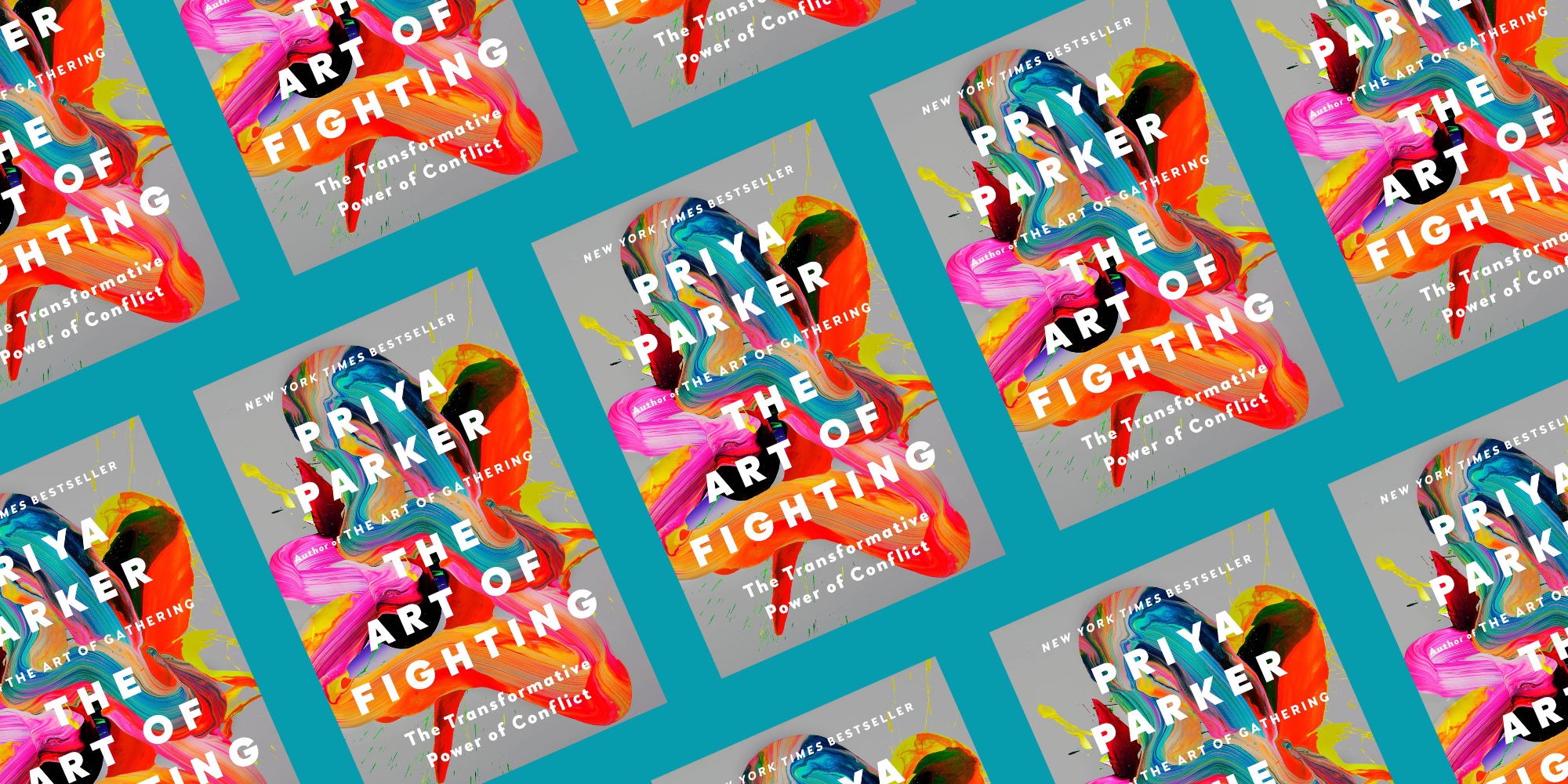
Priya Parker’s new book, The Art of Fighting: The Transformative Power of Conflict, is a manual to help us navigate those inevitable bumps, kerfuffles, and painful rifts. It’s a collection of anecdotes and prompts that remind us that conflict is not only natural but essential for healthy, long-lasting groups. Parker also provides some other useful tools—often in the form of asking open-ended questions and really listening to the answers—meant as guides rather than prescriptions. Because even if we know that conflict is inevitable, it can be hard to know what to do with that awkward energy that seemingly comes out of nowhere in a work meeting or family holiday gathering or group chat with friends.
We could just take the easy route and try to ignore it. Let it simmer and deal with it later, or hope it goes away on its own. Because who has the time and energy to navigate complex social dynamics?! I’m too tired and you probably are, too. (Everything is on fire and somehow we still have to cook dinner tonight, am I right?)
But if we really want long-lasting relationships, and to build vibrant, diverse communities like we say we do, then we have to do the work. And in order to do that work, we need to have tools in our collective pockets to move through the inevitable conflict that comes with being a part of living, breathing, and ever-evolving groups of people.
“Healthy heat” is a term and idea Parker uses in the book that really stuck with me. “Healthy heat is the willingness and ability to hold tension, with care, long enough for it to become clarifying and generative. Heat is energy. It is information. It tells us that something, or someone, matters,” Parker explains. “Hold it long enough, with care and without judgment…pause before deciding whether it is good or bad.”
For starters, we can name this heat when we notice it. When we validate what we’re seeing, it often helps other people feel validated in what they’re seeing, too. This alone can help diffuse some of the heat.
From there, Parker says we usually need to take a step back and consider what she calls the “us-ness” of the group, as a way to bring the group back to itself. What makes us us?
“It can be helpful to tap back into your group’s central motivation force,” she writes. “Set aside the particulars of the conflict at hand. Step back and do a check-in with yourself and your sense of the group: When it gets bad, is there still juice here? …Is there still relevance and energy that comes from this collection of individuals contributing their time and energy to one another?”
Parker offers questions to ask yourself to get to the heart of the underlying issues causing the group tension. (Is this conflict touching on a core value of mine? Do I care enough about this group? What are we not saying right now? How might not facing this conflict hurt the group?)
Sometimes, this can help a group reach a resolution. But sometimes, the answers might reveal it’s not worth facing the conflict at all. You might still be able to lighten some tension, but as Parker attests, there’s also validity in strategic conflict avoidance.
“Sometimes fighting happens because, if we’re honest, the group has reached the end of its natural life,” she writes. (She recommends hosting a funeral event for the group in this scenario.) Other times, individuals don’t have the emotional infrastructure to process what’s actually happening in a group conflict. A conflict might even point to deeper clashes in worldviews or inherent racism and other bigotry, which of course is not a small or quick fix.
Parker points to another book, Constructive Conflicts: From Escalation to Resolution by Louis Kiesberg and Bruce W. Dayton, to provide a framework for whether a conflict even can be addressed. “First: More than one person needs to see a problem. The second: They need to be connected to each other. Third: There needs to be an addressable party, responsible for that grievance, that can be changed. The fourth: They need to believe that they could actually bring about that change.”
If you believe you can bring about the change, and decide to face the conflict, good for you and buckle up! You’re not alone, and this book will be your friend, so keep it handy.
I already know this won’t be a one-time read for me. Parker’s first book, The Art of Gathering, is another one I keep on my shelf and flip through when I’m looking for inspiration and guidance. Confronting conflict and hosting gatherings like my weekly potluck are two muscles I try to exercise on a regular basis. They also work hand in hand — in order to create vibrant gatherings within our communities, we need to navigate the inevitably bumpy roads that come with group dynamics. This takes practice just like anything else, and often, a little sense of humor can go a long way.
Parker shares an example of a leadership summit where employees practiced “healthy heat” through some “heavy topics.” They started with one guaranteed to get people riled up.
PINEAPPLE ON PIZZA. YES OR NO?
The group of colleagues divided into smaller groups and debated, then presented their arguments to the bigger group. Parker says “to grow heat, grow warmth.” If you want to get better at fighting, start with getting better at banter. “Banter is the secret sauce of pro-social conflict,” she writes. “It gives people a way of fighting with each other that feels playful rather than fatal.”
So your homework—whether you read Parker’s book or not, and if you’re ready for some healthy heat—is to do some bantering, a.k.a. some low-stakes fighting, and keep growing your own conflict resolution muscle. The communities we love depend on it.