



WP_Post Object
(
    [ID] => 10961
    [post_author] => 15
    [post_date] => 2026-08-18 19:09:53
    [post_date_gmt] => 2026-08-18 19:09:53
    [post_content] => 

As the genre continues to diversify, it's time for K-pop to reckon with its relationship to Blackness.

BTS’s long-awaited comeback was controversial from the start. 

In March, following a year-and-a-half hiatus to fulfill their mandatory Korean military service, the seven-member boy group reunited with a short animated trailer teasing their new album Arirang. Inspired by a nationally beloved and UNESCO-recognized folk song of the same name, the album was positioned as somewhat of an homage to the group’s Korean roots. In the trailer, the group spotlights the “profound cultural significance” of the original song—believed to be over 600 years old—through a “modern reimagining” of the seven Korean students at Howard University who first recorded it in 1896. 

But many fans noticed something strange: For a few seconds, BTS can be seen portraying the students while singing, on campus, to a mostly white audience. 

“Who are [these] white folks at a historically Black college built so Black Americans could actually go to college because white people would not allow them into their schools?” one fan commented on YouTube. Others followed suit.

Upon release, the 14-track album followed the standard K-pop formula: a mix of Korean and English songs with a bit of AAVE slang thrown in, and a slew of high-profile Western producers and writers, including Mike-Will-Made-It, Tezzo Touchdown, and Diplo. In short, Arirang was less an homage to an unofficial national anthem than it was a catchy hip-hop album—a nod to the group's cultural influences, but not necessarily their Korean ones. Only the leading track (“Body to Body”) sampled parts of the historic song.

This wasn’t unusual: Over time, as the genre has diversified, K-pop groups have made music with expanding influences, ranging from house to trap. In recent years, the genre has only further loosened, often following global trends rather than strictly adhering to what’s popular in Korea. 

It’s an identity crisis that’s been plaguing the genre since the beginning of the decade. While the earliest iterations of K-pop groups (also known as first generation K-pop) occasionally produced songs in English, such tracks didn’t determine a group’s popularity, nor did they dominate the genre like they do now. As K-pop reaches a critical mass of popularity among international audiences, with groups not only sometimes singing exclusively in English, but also branding themselves as “global groups” with members from around the world, the lines have started to blur on what specifically makes K-pop, K-pop. It’s also why it’s become increasingly necessary for the genre as a whole to reckon with its relationship to Blackness, both historically and today.  

The word K-pop itself was a bit of an accident. Dr. Stephanie Choi, Assistant Professor of Ethnomusicology at the University of Colorado Boulder, says that the label was “coined by outsiders, not by the K-pop industry itself.” Popularized in the 90s by Japanese and Chinese media, the term was used to refer to the global popularity of Korean dance pop, before Western media began using it throughout the decade. “Only by the early 2000s was the term introduced to Korean media,” says Dr. Choi. 

It was around this time that Lee Soo-man, the architect of what's known as contemporary K-pop, created the idol trainee system that now defines the genre. Inspired by the assembly line approach of 60s Motown, Soo-man brought the same model to Korea, founding SM Entertainment in 1995, carefully crafting and turbocharging each trainee’s talents in dance, vocals, and visual identity through bootcamps notorious for their intensity. 

This tradition has endured, eventually evolving into idol trainee reality TV-style competitions that have since produced some of the biggest K-pop groups in the world, including TWICE and Stray Kids. Like the rest of the genre, the success of these shows has now moved beyond Korea to the international stage, which is where The Debut: Dream Academy—the hit show behind the global girl group Katseye—was born.  

In addition to commercial success, equally pivotal to defining K-pop is the loyalty of its fandoms, something that’s endured even as the genre has continued to diversify. All K-pop groups thrive on the intimate relationship fostered between idols and their fans, and through social media, this relationship has only intensified. But as the genre has globalized, this intensity has also proven to be a double-edged sword for idols of color. While there's, of course, virtue in national and ethnic representation, for idols, this has often manifested as overexposure to racism and bigotry—sometimes including from fans of color who project themselves onto what they believe an idol of their culture should look like. 

It’s a part of why in late February, when Manon Bannerman, the only Black-identifying member of the global girl group Katseye, announced a temporary hiatus from group activities for unspecified reasons, the internet was abuzz with shock, confusion, outrage, and genuine concern on her behalf. Others, meanwhile, were suspicious.

“Definitely some anti-Blackness going on behind the scenes & you can’t tell me otherwise,” one fan commented on Reddit amidst all the speculation. “It’s very textbook.” 

For an industry that has roots in Black entertainment, you’d think Black idols would be more common in K-pop. But while K-pop groups have always had members from other East Asian countries, having visibly non-Asian members is still rare. Alexandra Reid of girl group BP Rania was the first Black idol in K-pop history, debuting in 2015. After BP Rania disbanded and re-debuted as Blackswan in 2020, Senegalese-Belgian member Fatou joined her in the lineup. In 2025, Girlset (formerly known as VCHA) rebranded into a multinational four-person girl group, including a Venezuelan-Trinidadian member. But otherwise, Katseye remains the exception rather than the rule when it comes to racial diversity.

The Katseye girls hail from three continents and several different ethnicities and nationalities. Sophia, the group leader, is from the Philippines. Manon is Ghanaian and Swiss. Lara, Daniela, and Megan are all from the States, representing Indian, Cuban-Venezuelan, and Chinese-Singaporean heritages respectively. The only member born and raised in Korea is Yoonchae, who is also the youngest of the six. Their diversity has long been their strength—carefully engineered to capture the hearts of millions of fans, starting from their debut on 2023’s The Debut: Dream Academy, then in 2024, through their intimate Netflix docu-series Pop Star Academy. Following multiple successful commercials for Jollibee, Glossier, and The Gap (the latter of which went viral as a perceived response to Sydney Sweeney’s rather tactless American Eagle ad), the group became seen by fans as a paragon of what the future of K-pop could be.  

“I found it interesting that there was a member with the same name as mine who also has Venezuelan ancestry,” says Daniela Bottini, a self-identified Eyekon, as the group’s fans are known. “It was refreshing to see that when they said global, they really meant it. They took the best parts of the K-pop training system, but also recognized that the rigid rules that govern it couldn’t work in a group mainly comprised of young Gen Z women raised in more liberal countries.”

Indeed, on paper, Katseye checks off every K-pop box: rooted in the trainee system, with a deeply interpersonal fandom, challenging choreography, and catchy songs perfect for a 30-second TikTok. Unfortunately, their success has also shed light on the uncomfortable ways global groups are still perceived—and treated—in K-pop compared with their all-Korean peers.

Unlike her Korean contemporaries, Bannerman has not been offered the same grace nor protection she might otherwise have found from fans, even before she announced her hiatus. Throughout her trainee days and well into her debut, she received online hate and death threats and was often called “lazy” and “ungrateful” for someone in her position. It’s an unfortunate reality that all idols, Korean or not, have to go through; but coupled with xenophobia and racism, often rampant against non-Korean idols within fandom spaces, the insults compound. 

While anti-Blackness is a worldwide phenomenon, it feels especially glaring in an industry that has long been inspired by Black American culture. Historically, the genre has borrowed heavily from Black aesthetics and practices while divorcing them from the bitterness of Black history, thus turning them into something more “palatable” for a broader audience to enjoy. Across the genre, Black culture is simultaneously commodified while its originators go unrecognized—something increasingly harder to ignore when Black idols like Bannerman exist. Katseye and other global groups, then, present an interesting tension point within the genre, ultimately forcing K-pop’s global audience to reconcile its conflicting ideas of fetishized exotic orientalism—its own form of racism—with its disdain for Black people. It's also what makes BTS’s Arirang trailer snafu—intentional or not—so glaring.

As the genre continues to diversify and to innovate, we’ll likely see more attempts at recreating Katseye’s success, and songs that are not just in English, but in Spanish, French, and other languages, too. Maybe there will be a K-pop group that only produces house music and dance. Perhaps the next trend in K-pop will be country guitar riffs. Jeff Benjamin, a K-pop contributor at Billboard, made the prescient prediction that 2026 will be a defining year for how the genre shifts and how global audiences perceive K-pop overall.

“At this year's Grammy Awards, we saw Katseye as well as Rosé of Blackpink perform; additionally, KPop Demon Hunters won an award—but the bodies of work that these three acts were nominated for aren't traditional K-pop,” says Benjamin. 

It’s likely we’ll see a shift happen sooner rather than later. As of June 2026, the Grammys have introduced a new award: Best Asian Pop Music Performance, a category recognizing pop music performances originating from or widely known in Asian markets. It isn’t limited to just K-pop, but J-pop, C-pop, and music from other countries across the Asian diaspora, too. Shortly after the category was announced, BTS said they would not submit Arirang for consideration in the 2027 awards.

“We hope our music can be heard and loved for what it is, rather than being divided by region or language,” reads a statement from all seven members of the group, explaining their decision. “We thank Army [the group's fandom] and everyone who has always stood by us.”

As barriers between cultures and languages break down on our screens, and the world as we know it inevitably changes, it’s clear that K-pop has the potential to be a bright spot in a new world order. It’s already crossed the boundaries of race, ethnicity, and language to become an international genre. Its music resonates and inspires millions of fans across the world. But if the genre wants to reach its full cultural potential, it will also have to reckon with its relationship not only to idols of color, but xenophobia towards idols outside of Korea, once and for all. 

As of today, Katseye is a de facto four-member girl group with Bannerman’s hiatus ongoing, and Sophia's recent announcement she would be stepping back from the group until September. Prolonged hiatuses aren’t uncommon in K-pop groups, usually due to illness or injury or just the need for a mental health break. But whether Bannerman comes back to the group or not, one thing is for certain: the issue of anti-Blackness in K-pop remains, and it’s up to both the industry and its fans to dismantle it.


[post_title] => The Globalization of K-Pop [post_excerpt] => As the genre continues to diversify, it's time for K-pop to reckon with its relationship to Blackness. [post_status] => publish [comment_status] => closed [ping_status] => closed [post_password] => [post_name] => globalization-k-pop-music-genre-anti-blackness-katseye-manon-bannerman-idols [to_ping] => [pinged] => [post_modified] => 2026-08-18 20:33:39 [post_modified_gmt] => 2026-08-18 20:33:39 [post_content_filtered] => [post_parent] => 0 [guid] => https://conversationalist.org/?p=10961 [menu_order] => 0 [post_type] => post [post_mime_type] => [comment_count] => 0 [filter] => raw )
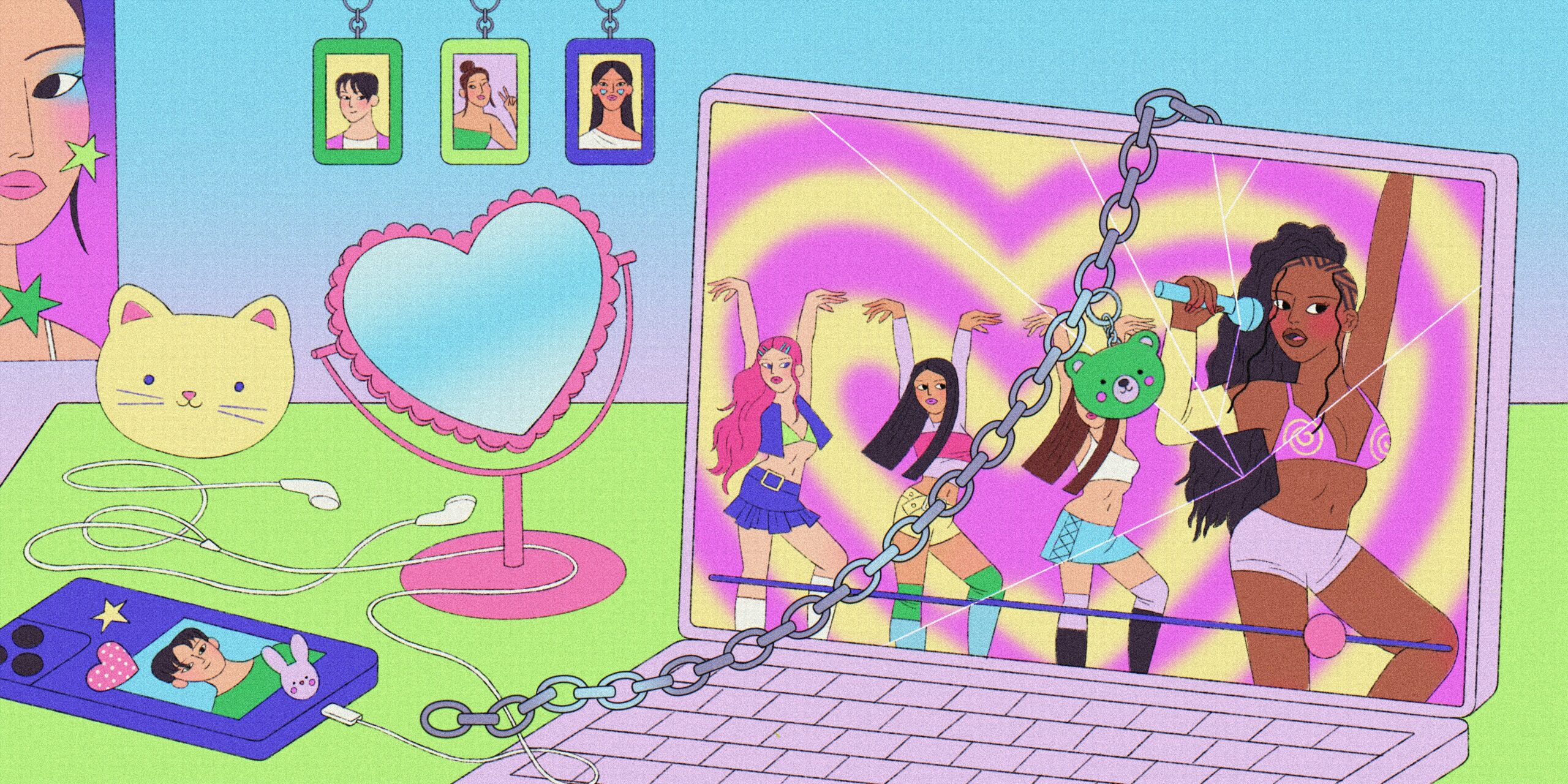
A colorful illustration of a laptop playing a YouTube video featuring a K-pop global group.
Taylor Barron

The Globalization of K-Pop

As the genre continues to diversify, it’s time for K-pop to reckon with its relationship to Blackness.

BTS’s long-awaited comeback was controversial from the start. 

In March, following a year-and-a-half hiatus to fulfill their mandatory Korean military service, the seven-member boy group reunited with a short animated trailer teasing their new album Arirang. Inspired by a nationally beloved and UNESCO-recognized folk song of the same name, the album was positioned as somewhat of an homage to the group’s Korean roots. In the trailer, the group spotlights the “profound cultural significance” of the original song—believed to be over 600 years old—through a “modern reimagining” of the seven Korean students at Howard University who first recorded it in 1896. 

But many fans noticed something strange: For a few seconds, BTS can be seen portraying the students while singing, on campus, to a mostly white audience. 

“Who are [these] white folks at a historically Black college built so Black Americans could actually go to college because white people would not allow them into their schools?” one fan commented on YouTube. Others followed suit.

Upon release, the 14-track album followed the standard K-pop formula: a mix of Korean and English songs with a bit of AAVE slang thrown in, and a slew of high-profile Western producers and writers, including Mike-Will-Made-It, Tezzo Touchdown, and Diplo. In short, Arirang was less an homage to an unofficial national anthem than it was a catchy hip-hop album—a nod to the group’s cultural influences, but not necessarily their Korean ones. Only the leading track (“Body to Body”) sampled parts of the historic song.

This wasn’t unusual: Over time, as the genre has diversified, K-pop groups have made music with expanding influences, ranging from house to trap. In recent years, the genre has only further loosened, often following global trends rather than strictly adhering to what’s popular in Korea. 

It’s an identity crisis that’s been plaguing the genre since the beginning of the decade. While the earliest iterations of K-pop groups (also known as first generation K-pop) occasionally produced songs in English, such tracks didn’t determine a group’s popularity, nor did they dominate the genre like they do now. As K-pop reaches a critical mass of popularity among international audiences, with groups not only sometimes singing exclusively in English, but also branding themselves as “global groups” with members from around the world, the lines have started to blur on what specifically makes K-pop, K-pop. It’s also why it’s become increasingly necessary for the genre as a whole to reckon with its relationship to Blackness, both historically and today.  

The word K-pop itself was a bit of an accident. Dr. Stephanie Choi, Assistant Professor of Ethnomusicology at the University of Colorado Boulder, says that the label was “coined by outsiders, not by the K-pop industry itself.” Popularized in the 90s by Japanese and Chinese media, the term was used to refer to the global popularity of Korean dance pop, before Western media began using it throughout the decade. “Only by the early 2000s was the term introduced to Korean media,” says Dr. Choi. 

It was around this time that Lee Soo-man, the architect of what’s known as contemporary K-pop, created the idol trainee system that now defines the genre. Inspired by the assembly line approach of 60s Motown, Soo-man brought the same model to Korea, founding SM Entertainment in 1995, carefully crafting and turbocharging each trainee’s talents in dance, vocals, and visual identity through bootcamps notorious for their intensity. 

This tradition has endured, eventually evolving into idol trainee reality TV-style competitions that have since produced some of the biggest K-pop groups in the world, including TWICE and Stray Kids. Like the rest of the genre, the success of these shows has now moved beyond Korea to the international stage, which is where The Debut: Dream Academy—the hit show behind the global girl group Katseye—was born.  

In addition to commercial success, equally pivotal to defining K-pop is the loyalty of its fandoms, something that’s endured even as the genre has continued to diversify. All K-pop groups thrive on the intimate relationship fostered between idols and their fans, and through social media, this relationship has only intensified. But as the genre has globalized, this intensity has also proven to be a double-edged sword for idols of color. While there’s, of course, virtue in national and ethnic representation, for idols, this has often manifested as overexposure to racism and bigotry—sometimes including from fans of color who project themselves onto what they believe an idol of their culture should look like. 

It’s a part of why in late February, when Manon Bannerman, the only Black-identifying member of the global girl group Katseye, announced a temporary hiatus from group activities for unspecified reasons, the internet was abuzz with shock, confusion, outrage, and genuine concern on her behalf. Others, meanwhile, were suspicious.

“Definitely some anti-Blackness going on behind the scenes & you can’t tell me otherwise,” one fan commented on Reddit amidst all the speculation. “It’s very textbook.” 

For an industry that has roots in Black entertainment, you’d think Black idols would be more common in K-pop. But while K-pop groups have always had members from other East Asian countries, having visibly non-Asian members is still rare. Alexandra Reid of girl group BP Rania was the first Black idol in K-pop history, debuting in 2015. After BP Rania disbanded and re-debuted as Blackswan in 2020, Senegalese-Belgian member Fatou joined her in the lineup. In 2025, Girlset (formerly known as VCHA) rebranded into a multinational four-person girl group, including a Venezuelan-Trinidadian member. But otherwise, Katseye remains the exception rather than the rule when it comes to racial diversity.

The Katseye girls hail from three continents and several different ethnicities and nationalities. Sophia, the group leader, is from the Philippines. Manon is Ghanaian and Swiss. Lara, Daniela, and Megan are all from the States, representing Indian, Cuban-Venezuelan, and Chinese-Singaporean heritages respectively. The only member born and raised in Korea is Yoonchae, who is also the youngest of the six. Their diversity has long been their strength—carefully engineered to capture the hearts of millions of fans, starting from their debut on 2023’s The Debut: Dream Academy, then in 2024, through their intimate Netflix docu-series Pop Star Academy. Following multiple successful commercials for Jollibee, Glossier, and The Gap (the latter of which went viral as a perceived response to Sydney Sweeney’s rather tactless American Eagle ad), the group became seen by fans as a paragon of what the future of K-pop could be.  

“I found it interesting that there was a member with the same name as mine who also has Venezuelan ancestry,” says Daniela Bottini, a self-identified Eyekon, as the group’s fans are known. “It was refreshing to see that when they said global, they really meant it. They took the best parts of the K-pop training system, but also recognized that the rigid rules that govern it couldn’t work in a group mainly comprised of young Gen Z women raised in more liberal countries.”

Indeed, on paper, Katseye checks off every K-pop box: rooted in the trainee system, with a deeply interpersonal fandom, challenging choreography, and catchy songs perfect for a 30-second TikTok. Unfortunately, their success has also shed light on the uncomfortable ways global groups are still perceived—and treated—in K-pop compared with their all-Korean peers.

Unlike her Korean contemporaries, Bannerman has not been offered the same grace nor protection she might otherwise have found from fans, even before she announced her hiatus. Throughout her trainee days and well into her debut, she received online hate and death threats and was often called “lazy” and “ungrateful” for someone in her position. It’s an unfortunate reality that all idols, Korean or not, have to go through; but coupled with xenophobia and racism, often rampant against non-Korean idols within fandom spaces, the insults compound. 

While anti-Blackness is a worldwide phenomenon, it feels especially glaring in an industry that has long been inspired by Black American culture. Historically, the genre has borrowed heavily from Black aesthetics and practices while divorcing them from the bitterness of Black history, thus turning them into something more “palatable” for a broader audience to enjoy. Across the genre, Black culture is simultaneously commodified while its originators go unrecognized—something increasingly harder to ignore when Black idols like Bannerman exist. Katseye and other global groups, then, present an interesting tension point within the genre, ultimately forcing K-pop’s global audience to reconcile its conflicting ideas of fetishized exotic orientalism—its own form of racism—with its disdain for Black people. It’s also what makes BTS’s Arirang trailer snafu—intentional or not—so glaring.

As the genre continues to diversify and to innovate, we’ll likely see more attempts at recreating Katseye’s success, and songs that are not just in English, but in Spanish, French, and other languages, too. Maybe there will be a K-pop group that only produces house music and dance. Perhaps the next trend in K-pop will be country guitar riffs. Jeff Benjamin, a K-pop contributor at Billboard, made the prescient prediction that 2026 will be a defining year for how the genre shifts and how global audiences perceive K-pop overall.

“At this year’s Grammy Awards, we saw Katseye as well as Rosé of Blackpink perform; additionally, KPop Demon Hunters won an award—but the bodies of work that these three acts were nominated for aren’t traditional K-pop,” says Benjamin. 

It’s likely we’ll see a shift happen sooner rather than later. As of June 2026, the Grammys have introduced a new award: Best Asian Pop Music Performance, a category recognizing pop music performances originating from or widely known in Asian markets. It isn’t limited to just K-pop, but J-pop, C-pop, and music from other countries across the Asian diaspora, too. Shortly after the category was announced, BTS said they would not submit Arirang for consideration in the 2027 awards.

“We hope our music can be heard and loved for what it is, rather than being divided by region or language,” reads a statement from all seven members of the group, explaining their decision. “We thank Army [the group’s fandom] and everyone who has always stood by us.”

As barriers between cultures and languages break down on our screens, and the world as we know it inevitably changes, it’s clear that K-pop has the potential to be a bright spot in a new world order. It’s already crossed the boundaries of race, ethnicity, and language to become an international genre. Its music resonates and inspires millions of fans across the world. But if the genre wants to reach its full cultural potential, it will also have to reckon with its relationship not only to idols of color, but xenophobia towards idols outside of Korea, once and for all. 

As of today, Katseye is a de facto four-member girl group with Bannerman’s hiatus ongoing, and Sophia’s recent announcement she would be stepping back from the group until September. Prolonged hiatuses aren’t uncommon in K-pop groups, usually due to illness or injury or just the need for a mental health break. But whether Bannerman comes back to the group or not, one thing is for certain: the issue of anti-Blackness in K-pop remains, and it’s up to both the industry and its fans to dismantle it.

Published on
Posted in Culture