WP_Post Object
(
    [ID] => 11228
    [post_author] => 15
    [post_date] => 2026-10-28 00:44:33
    [post_date_gmt] => 2026-10-28 00:44:33
    [post_content] => 

Some spooky seasonal appreciation for Ahmed Saadawi’s "Frankenstein in Baghdad."

Who alive on this Earth needs to deliberately seek out a fright? Horrors persist in great abundance throughout news outlets and social media feeds. One might think it obscene to pay over $20 and sit through a Nicole Kidman monologue to be spooked. Or to spend $30 or more on a hardcover Stephen King reissue. However, like brains to a roving pack of zombies, bad times are the foodstuff of horror. Its popularity spikes during recessions, wars, and other global crises by creating a space into which the audience can safely project its worst fears. Horror, as a genre, has the distinction of being both allegorical and metonymic, which is a pretentious way of saying that its themes and plots play out the deep-seated fears and anxieties that shoot through our societies, thus enabling the viewer or reader to be gripped by the drama of said fear—all while remaining far from any real danger. Paradoxically, this process is soothing; its psychological effect is said to be akin to the thrill of a roller coaster ride. But, I write this not long after a 42-year-old man was fatally ejected from one in Georgia, which, to me, is an apt metaphor for what consuming fictional horror feels like in 2026. 

Horror allegorizes problems; it sorts problems; it describes problems; it plays out problems. What it does not do is solve them, and this intractability is the main theme of the most gripping book of horror I have read as an adult. Ahmed Saadawi’s Frankenstein in Baghdad is a triumph of the genre, but it is also one where the monster, if allegorical, is also very real. Set in 2005 in the depths of chaos and terror of the US invasion of Iraq, Frankenstein in Baghdad gives us no scientist striving to know the nature of the human soul, toying with fate, daring to play God. Its creature—known as Whatsitsname—is likewise not a science experiment, but a metonymic tour guide through a sort of magical realist house of horrors—the sort of inane horrors that could only ensue from an American invasion in the name of “democracy.” (Here, we might pause to note that the acknowledged masterpiece of magical realism, Gabriel García Márquez’s One Hundred Years Of Solitude, was also inspired by a US-backed atrocity.) The fright is not merely a fun spook on the pages, but rather a stand-in for death, rage, tribalism, pain, gore, and the absurdities of fate. 

Published nearly 200 years prior, Mary Shelley’s original Frankenstein was subtitled “The Modern Prometheus,” after the Greek myth about the god who, punished for giving fire to humans, was tied to a mountainside, doomed to have his liver devoured by raptors each day. The Greeks knew the liver regenerates, so accordingly this punishment would be eternal: Prometheus’ liver regrew every night. (A fair bit of body horror!) Sadaawi’s book, on the other hand, begins with a shady junkyard dealer named Hadi, whose main passions are whoring and ouzo, when he can afford them. Despite—or perhaps because of—his knowledge of his own degeneracy (is there ever really a difference?), he muses that the many dismembered body parts around town—thanks to both the US invasion and the vicious sectarian violence in its wake—deserve a proper burial. 

A tinkerer, Hadi is quite handy with needle and thread, and, for those of you familiar with the source material, you can guess what happens next. Once enough body parts have been stitched together, the timely (or untimely) demise of a local security guard in an explosion renders his body a vaporous “pink mist” devoid of solid pieces, thus delivering a Shelleyan soul to the oozing, squishy, rotting patchwork of flesh. Whatsitsname is born. It’s alive! 

It’s worth noting here that those words were never spoken by a character in Mary Shelley’s 1818 novel (or the 1823 version): That line was pure Hollywood. Shelley’s language is decidedly longwinded and flowery, unlike her novel's many, many movie versions, which never seem to stop reanimating. In the last few years alone, two major Hollywood adaptations have garnered critical attention (Yorgos Lanthimos’ Poor Things and Guillermo del Toro’s Frankenstein), while this spooky season’s lead up has been dominated by Tim Curry’s immortal Dr. Frank N. Furter in The Rocky Horror Picture Show, following the actor’s passing. Screenings of the scores of various film adaptations of Shelley’s novel are legion this time of year, including my absolute favorite of the lot, which I would be severely remiss without recommending, Mel Brooks’ Young Frankenstein. Like florals for spring, the book’s plot never goes out of style—no matter how one pronounces Frankenstein (or Frahhhnkensteen).

While the original novel is subtitled for an actual god who gifted fire to mankind, the idea of human daring so sacrilege as to generate life (outside of, you know, fucking) is endlessly fascinating (like fucking). The ghost story is undoubtedly as old as camp fires, Promethean and otherwise. But gothic horror has its roots in a very particular moment in history, relevant to Shelley in a different (if also very scary) way compared with the historical context that informed Saadawi. 

Apropos of fucking, the summer Mary Shelley started writing the book featured one hell of a Regency romp. After absconding to Europe in the wake of sex scandals too numerous and incestuous to list here, Mary Shelley, her new husband, Percy, and Lord Byron, among others, found themselves in Switzerland. 

Instead of frolicking in abundant sunshine and mountain flowers, the group was trapped indoors due to a climate catastrophe: Unbeknownst to them, on April 5, 1815, Mount Tambora had erupted so violently that it blocked out the sun across the world for the better part of the following year. This meant, apart from their infamously preferred pastime, they had to find other ways to entertain themselves. They resorted to ghost stories, which is how Mary Shelley came up with a doozy (and, many have argued, a retelling of the Golem myth). Also present was John William Polidori, who would soon thereafter publish The Vampyre. 

That climate catastrophe which gifted the world the gothic genre would also decide the fate of nations. Its global ramifications lasted for years. There was no summer of 1816. Europe, already reeling from the destruction of the Napoleonic Wars, which ended in 1815, sank into crop failure and misery that crystallized lower class discontent into political radicalism and revolt in the coming decades. In New England, the following winter after the lack of summer was dubbed “Eighteen-hundred-and-froze-to-death.” The region was so cold, it partly depopulated, driving the westward migration that would soon anoint itself “Manifest Destiny.” In South Asia, cholera killed at unprecedented rates, weakening empires and making way for total British conquest and greater European colonial incursion into Asia. That legacy and the United States’ subsequent 20th-century rebranding of empire set the stage for the horrors of Frankenstein in Baghdad, even if Mary Shelley provided the plot.
A photograph of an embroidered skeleton sculpture.
Caitlin McCormack

Sadaawi first published his update of Shelley’s tale, replete with djinns, genie folklore, and American incompetence, in 2013. It won a brace of major awards before Jonathan Wright translated it in 2018, winning it many more. 

All that time—and still to this day—the book is wretchedly timely. Whatsitname initially seeks revenge upon evil, but that task in and of itself is a mire of gray areas and contradictions. Beyond the murky, moral ambiguity of seeking revenge in a sectarian conflict set loose by a brutal invasion, Whatsitsname is plagued by “serious putrefaction problems.” These, in turn, force it to be more indiscriminate in picking its victims simply to harvest body parts he needs to replace. 

The violence literally feeds on itself and the moral imperative doubles back. The wacky plot descends into the Pynchonian (e.g., a “Tracking and Pursuit Department” becomes a focal point); Whatsitsname grows media savvy and gives the following soundbite: “Because I’m made up of body parts of people from diverse backgrounds—ethnicities, tribes, races and social classes—I represent the impossible mix that never was achieved in the past. I’m the first true Iraqi citizen.”  

Though it is perhaps implied, one reason I hastened to name-check Young Frankenstein is that there is no describing Frankenstein in Baghdad without emphasizing its hilarity. The absurd premise of the book careens between horrors, but it never strays far from the sense of humor that, as the book suggests, is the next best thing to a moral compass. Sometimes, it’s all you’ve got left. 

Rare is the book that will make you tear up, throw up, and crack up in a single chapter. Like Whatsitsname, it’s stitched together of too many parts to be identifiable as any single genre other than human. Whatsitsname is a metaphor for messes left behind, vendettas at tragic cross purposes, hopes of coexistence wrecked and rotting, but it is also a metaphysical mystery to behold, a sign of faith and of ruin. The “monster”’s name is dead-on. 

In the original, Mary Shelley herself wrote an admonishment that could easily be applied to Western Imperialism: “Learn from me, if not by my precepts, at least by my example, how dangerous is the acquirement of knowledge, and how much happier that man is who believes his native town to be the world, than he who aspires to become greater than his nature will allow." Perhaps the United States itself is the closest thing to an arrogant mad scientist forcing both its beliefs and its hierarchies on the ancient city of Baghdad—daring to play God by wanting to remake a country in its own image and, in the process, unleashing every demon from the depths of hell. 

Ahmed Sadaawi rips out the soul of a Western metaphysical classic to attempt to describe the horrors that a soulless, thoughtless Western invasion unleashed. It’s alive: The elegance and grotesque totality of the metaphor are complete.

[post_title] => The Monster Mash of Imperialism [post_excerpt] => Some spooky seasonal appreciation for Ahmed Saadawi’s "Frankenstein in Baghdad." [post_status] => publish [comment_status] => closed [ping_status] => closed [post_password] => [post_name] => frankenstein-in-baghdad-ahmed-saadawi-book-review-essay-iraq-war-united-states-imperialism-novel-fiction-mary-shelley [to_ping] => [pinged] => [post_modified] => 2026-10-28 00:46:02 [post_modified_gmt] => 2026-10-28 00:46:02 [post_content_filtered] => [post_parent] => 0 [guid] => https://conversationalist.org/?p=11228 [menu_order] => 0 [post_type] => post [post_mime_type] => [comment_count] => 0 [filter] => raw )
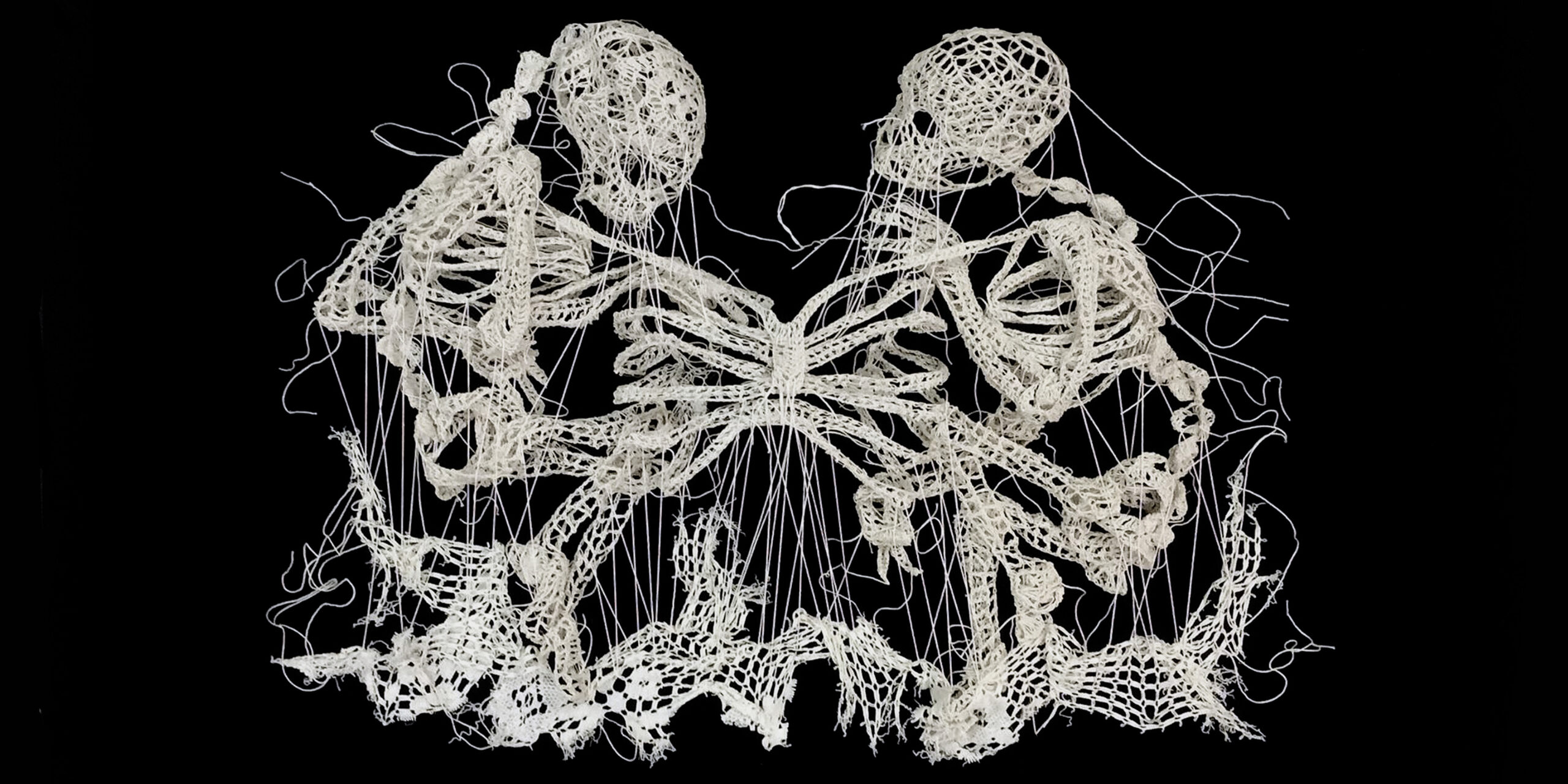
White embroidery on a black background of two skeletons connected by a shared ribcage.
Caitlin McCormack

The Monster Mash of Imperialism

Some spooky seasonal appreciation for Ahmed Saadawi’s “Frankenstein in Baghdad.”

Who alive on this Earth needs to deliberately seek out a fright? Horrors persist in great abundance throughout news outlets and social media feeds. One might think it obscene to pay over $20 and sit through a Nicole Kidman monologue to be spooked. Or to spend $30 or more on a hardcover Stephen King reissue. However, like brains to a roving pack of zombies, bad times are the foodstuff of horror. Its popularity spikes during recessions, wars, and other global crises by creating a space into which the audience can safely project its worst fears. Horror, as a genre, has the distinction of being both allegorical and metonymic, which is a pretentious way of saying that its themes and plots play out the deep-seated fears and anxieties that shoot through our societies, thus enabling the viewer or reader to be gripped by the drama of said fear—all while remaining far from any real danger. Paradoxically, this process is soothing; its psychological effect is said to be akin to the thrill of a roller coaster ride. But, I write this not long after a 42-year-old man was fatally ejected from one in Georgia, which, to me, is an apt metaphor for what consuming fictional horror feels like in 2026. 

Horror allegorizes problems; it sorts problems; it describes problems; it plays out problems. What it does not do is solve them, and this intractability is the main theme of the most gripping book of horror I have read as an adult. Ahmed Saadawi’s Frankenstein in Baghdad is a triumph of the genre, but it is also one where the monster, if allegorical, is also very real. Set in 2005 in the depths of chaos and terror of the US invasion of Iraq, Frankenstein in Baghdad gives us no scientist striving to know the nature of the human soul, toying with fate, daring to play God. Its creature—known as Whatsitsname—is likewise not a science experiment, but a metonymic tour guide through a sort of magical realist house of horrors—the sort of inane horrors that could only ensue from an American invasion in the name of “democracy.” (Here, we might pause to note that the acknowledged masterpiece of magical realism, Gabriel García Márquez’s One Hundred Years Of Solitude, was also inspired by a US-backed atrocity.) The fright is not merely a fun spook on the pages, but rather a stand-in for death, rage, tribalism, pain, gore, and the absurdities of fate. 

Published nearly 200 years prior, Mary Shelley’s original Frankenstein was subtitled “The Modern Prometheus,” after the Greek myth about the god who, punished for giving fire to humans, was tied to a mountainside, doomed to have his liver devoured by raptors each day. The Greeks knew the liver regenerates, so accordingly this punishment would be eternal: Prometheus’ liver regrew every night. (A fair bit of body horror!) Sadaawi’s book, on the other hand, begins with a shady junkyard dealer named Hadi, whose main passions are whoring and ouzo, when he can afford them. Despite—or perhaps because of—his knowledge of his own degeneracy (is there ever really a difference?), he muses that the many dismembered body parts around town—thanks to both the US invasion and the vicious sectarian violence in its wake—deserve a proper burial. 

A tinkerer, Hadi is quite handy with needle and thread, and, for those of you familiar with the source material, you can guess what happens next. Once enough body parts have been stitched together, the timely (or untimely) demise of a local security guard in an explosion renders his body a vaporous “pink mist” devoid of solid pieces, thus delivering a Shelleyan soul to the oozing, squishy, rotting patchwork of flesh. Whatsitsname is born. It’s alive! 

It’s worth noting here that those words were never spoken by a character in Mary Shelley’s 1818 novel (or the 1823 version): That line was pure Hollywood. Shelley’s language is decidedly longwinded and flowery, unlike her novel’s many, many movie versions, which never seem to stop reanimating. In the last few years alone, two major Hollywood adaptations have garnered critical attention (Yorgos Lanthimos’ Poor Things and Guillermo del Toro’s Frankenstein), while this spooky season’s lead up has been dominated by Tim Curry’s immortal Dr. Frank N. Furter in The Rocky Horror Picture Show, following the actor’s passing. Screenings of the scores of various film adaptations of Shelley’s novel are legion this time of year, including my absolute favorite of the lot, which I would be severely remiss without recommending, Mel Brooks’ Young Frankenstein. Like florals for spring, the book’s plot never goes out of style—no matter how one pronounces Frankenstein (or Frahhhnkensteen).

While the original novel is subtitled for an actual god who gifted fire to mankind, the idea of human daring so sacrilege as to generate life (outside of, you know, fucking) is endlessly fascinating (like fucking). The ghost story is undoubtedly as old as camp fires, Promethean and otherwise. But gothic horror has its roots in a very particular moment in history, relevant to Shelley in a different (if also very scary) way compared with the historical context that informed Saadawi. 

Apropos of fucking, the summer Mary Shelley started writing the book featured one hell of a Regency romp. After absconding to Europe in the wake of sex scandals too numerous and incestuous to list here, Mary Shelley, her new husband, Percy, and Lord Byron, among others, found themselves in Switzerland. 

Instead of frolicking in abundant sunshine and mountain flowers, the group was trapped indoors due to a climate catastrophe: Unbeknownst to them, on April 5, 1815, Mount Tambora had erupted so violently that it blocked out the sun across the world for the better part of the following year. This meant, apart from their infamously preferred pastime, they had to find other ways to entertain themselves. They resorted to ghost stories, which is how Mary Shelley came up with a doozy (and, many have argued, a retelling of the Golem myth). Also present was John William Polidori, who would soon thereafter publish The Vampyre. 

That climate catastrophe which gifted the world the gothic genre would also decide the fate of nations. Its global ramifications lasted for years. There was no summer of 1816. Europe, already reeling from the destruction of the Napoleonic Wars, which ended in 1815, sank into crop failure and misery that crystallized lower class discontent into political radicalism and revolt in the coming decades. In New England, the following winter after the lack of summer was dubbed “Eighteen-hundred-and-froze-to-death.” The region was so cold, it partly depopulated, driving the westward migration that would soon anoint itself “Manifest Destiny.” In South Asia, cholera killed at unprecedented rates, weakening empires and making way for total British conquest and greater European colonial incursion into Asia. That legacy and the United States’ subsequent 20th-century rebranding of empire set the stage for the horrors of Frankenstein in Baghdad, even if Mary Shelley provided the plot.

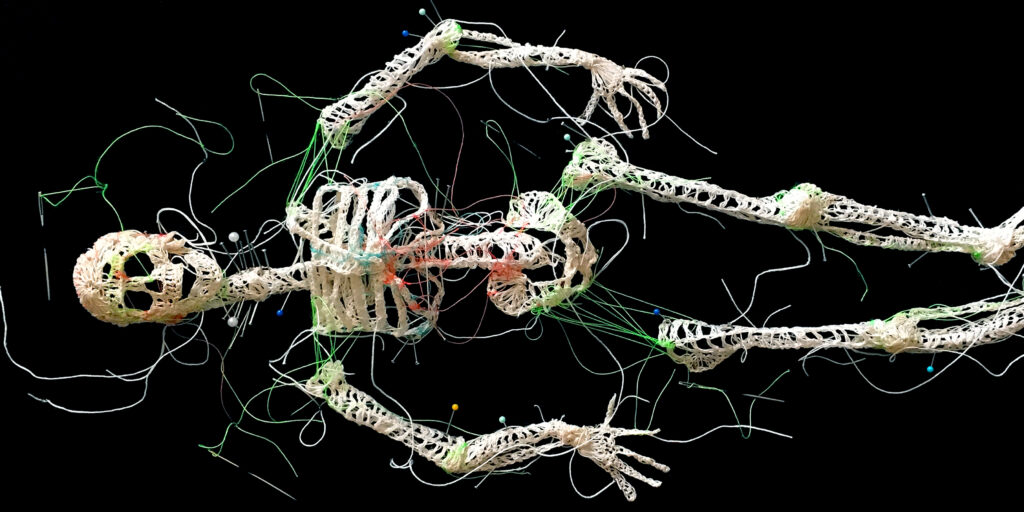
A photograph of an embroidered skeleton sculpture.
Caitlin McCormack

Sadaawi first published his update of Shelley’s tale, replete with djinns, genie folklore, and American incompetence, in 2013. It won a brace of major awards before Jonathan Wright translated it in 2018, winning it many more. 

All that time—and still to this day—the book is wretchedly timely. Whatsitname initially seeks revenge upon evil, but that task in and of itself is a mire of gray areas and contradictions. Beyond the murky, moral ambiguity of seeking revenge in a sectarian conflict set loose by a brutal invasion, Whatsitsname is plagued by “serious putrefaction problems.” These, in turn, force it to be more indiscriminate in picking its victims simply to harvest body parts he needs to replace. 

The violence literally feeds on itself and the moral imperative doubles back. The wacky plot descends into the Pynchonian (e.g., a “Tracking and Pursuit Department” becomes a focal point); Whatsitsname grows media savvy and gives the following soundbite: “Because I’m made up of body parts of people from diverse backgrounds—ethnicities, tribes, races and social classes—I represent the impossible mix that never was achieved in the past. I’m the first true Iraqi citizen.”  

Though it is perhaps implied, one reason I hastened to name-check Young Frankenstein is that there is no describing Frankenstein in Baghdad without emphasizing its hilarity. The absurd premise of the book careens between horrors, but it never strays far from the sense of humor that, as the book suggests, is the next best thing to a moral compass. Sometimes, it’s all you’ve got left. 

Rare is the book that will make you tear up, throw up, and crack up in a single chapter. Like Whatsitsname, it’s stitched together of too many parts to be identifiable as any single genre other than human. Whatsitsname is a metaphor for messes left behind, vendettas at tragic cross purposes, hopes of coexistence wrecked and rotting, but it is also a metaphysical mystery to behold, a sign of faith and of ruin. The “monster”’s name is dead-on. 

In the original, Mary Shelley herself wrote an admonishment that could easily be applied to Western Imperialism: “Learn from me, if not by my precepts, at least by my example, how dangerous is the acquirement of knowledge, and how much happier that man is who believes his native town to be the world, than he who aspires to become greater than his nature will allow.” Perhaps the United States itself is the closest thing to an arrogant mad scientist forcing both its beliefs and its hierarchies on the ancient city of Baghdad—daring to play God by wanting to remake a country in its own image and, in the process, unleashing every demon from the depths of hell. 

Ahmed Sadaawi rips out the soul of a Western metaphysical classic to attempt to describe the horrors that a soulless, thoughtless Western invasion unleashed. It’s alive: The elegance and grotesque totality of the metaphor are complete.