WP_Post Object
(
    [ID] => 1142
    [post_author] => 2
    [post_date] => 2019-06-21 17:23:28
    [post_date_gmt] => 2019-06-21 17:23:28
    [post_content] => America's foreign policy and international image would be improved if the foreign policy community were more diverse.

I am a black man in America, which means I am physically vulnerable all the time. The United States leads the world in police killings of its own black and brown citizens, and ranks first in incarcerating them. Its education system disproportionately funnels black children through the school to prison pipeline. Millions of people  — many of them black — are disenfranchised from voting because they served time in jail for felonies. In many cases they never regain their right to participate  in American democracy. Despite all these obvious and well-documented injustices, the white majority believes America has the moral pedigree to tell the rest of the world how to handle its own internal affairs. 

This attitude among white Americans speaks to an astonishing lack of self-awareness. The people who dominate and shape global conversations in the western and English-speaking world — think tank presidents, diplomats, foreign correspondents, and business executives  — are almost exclusively white men. They have no experience of the America I grew up in, and this limits their ability to understand the world. 

 As a black man who grew up in Detroit and then spent a good part of his adult life traveling and reporting in Eastern Europe, I have learned that white supremacy and imperialism are the same. The difference is that one is global while the other is domestic. Africa is least responsible for global warming but suffers most of its consequences, which are caused by the world’s leading powers. This is the type of visceral understanding gained from lived experience that the white men who dominate and shape the foreign policy conversation do not have. Their understanding of the world is thus limited, and the consequences are becoming increasingly clear: the American conversation about the world lacks nuance and insight; this undermines our ability to engage effectively — which, in turn, weakens both our own society and our place in the world.

I welcome the conversations about the need for more ethnic diversity in foreign policy conversations. I am glad that people are beginning to understand that with more diverse voices, America could develop a foreign policy that was less expansionist in its global engagement. Unfortunately, however, these conversations are predicated on inaccurate beliefs.

A flawed democracy

America is not the world’s most successful democracy; nor is it an example for the world to follow. Its own legal system has kept black people from gaining any real electoral power at the local and national levels. In Florida alone, more than a million people convicted of felonies were disenfranchised from voting before a November referendum restored their rights; the current governor is trying to slow the restoration process. This is not a system to export. It is a system that must be changed. If America’s white majority were truly interested in making sure that non-white voices were included in foreign policy discussions, they would first work to stop the disenfranchisement of people of color. Nor are teachers with unchecked racial biases qualified to shape the minds of the next generation of foreign policy thinkers. Besides its many misguided military interventions, such as the now widely-reviled Second Iraq War, the U.S. also has a long-documented history of allowing its intelligence service to carry out assassinations against world leaders whose policies deviate from the administration’s. In the twentieth century the CIA backed the assassination of elected leaders like Chile’s Salvador Allende because he was a socialist, and helped engineer the coup that deposed Iran’s Mohammad Mosaddegh because he wanted to nationalize his country’s oil reserves. The United States is accustomed to implementing its foreign policy via the barrel of a gun, which makes a twisted kind of sense for the most gun-toting country on earth with the second-highest number of gun-related murders of any industrialized nation. But if the United States wants to be an example to the world it must change its gun laws and change its ways. It must ban the sale and distribution of military grade weapons to law enforcement agencies that treat the communities they are supposed to serve like enemy combatants. There is a saying in journalism that all politics is local. I’d argue that international politics is local and it's impossible to deploy a diverse diplomatic corps if so many potential non-white recruits are disenfranchised or jailed. I write for The Root, the largest black news site in America. I have the rare opportunity of covering national politics from the perspective of a black person with a black editor. I do not have to deal with a white male editor who might try to change my voice or question my using personal experiences to inform my reporting. I love working at The Root, but my ambition is to be a foreign correspondent. I have two graduate degrees in journalism and another in Russia area studies; I speak two Eastern European languages and can point to many other achievements. But I have never been invited to an interview for any foreign reporting job. An editor at a mainstream newspaper once told me that I wasn’t qualified to write about U.S.-Russia/Ukraine relations because I was not a diplomat. This same publication has hired white people without any relevant credentials for foreign reporting positions. One of the recurring claims one hears in foreign policy circles is there aren’t enough qualified people of color to fill open positions. And yet, despite my qualifications, I cannot find a job as a foreign correspondent.

Hypocrisy won't win hearts and minds

The lack of diverse voices in international news has a profound  impact on the coverage of countries like Russia, China, Nigeria and Ukraine. The foreign press corps in Moscow and Kiev are almost exclusively white. I am quite confident that the reporting from those regions would be richer and more nuanced if half the press corps were composed of black and brown reporters who had personal experiences of immigration and of police abuse. In the United States the coverage of Russia over the past two years has been weak. Analysts have focused on Putin, at the expense of nuanced reporting about ordinary Russians. Our media has spent an inordinate amount of time trying to blame the Kremlin for the fact that millions of Americans decided to vote a white supremacist into the White House, even as they have refused to engage in a serious conversation about the white supremacy that played a far greater role in getting Donald Trump elected than Putin could have done. Incorporating more ethnically diverse people into foreign policy spaces goes well beyond cherry picking brown faces that seem non-threatening to sit at the table. If the U.S. is to pursue an honest, effective foreign policy, it needs to recruit people who are willing to break from the neo-liberalism that underlies the racism in contemporary American society. There is transparent hypocrisy in insisting that Russia remove its troops from Ukraine while threatening military intervention in Iran. America regularly condemns Russia and other nations over their abuse of LGBTQ people, even as black trans women in America are murdered at alarming rates.

Why diversity is important

Too many of our white diplomats are blind to this hypocrisy, because they are the products of an America that was built by and for them. There are too few people like me representing the United States at the table of global affairs, and this undermines the effectiveness of its foreign policy. Take Haiti, for example. Under the expansionist Monroe Doctrine, the United States deployed Marines to the island in 1915 to fend off German influence during World War I. But instead of helping to protect Haiti’s independence, the U.S. occupied the Caribbean country until 1934, exacerbating the theft of resources and political instability caused by French colonization. More recent U.S. policy towards Haiti hasn’t been much better. During the 1970s and 1980s successive administrations supported the violent  regime of Jean-Claude “Baby Doc” Duvalier, while Donald Trump stripped Haitians in the United States of their Temporary Protected Status and made them vulnerable to deportation. House Democrats have held hearings on reparations for the descendants of slaves who were brought to America from Africa. The conversation needs to go global in the case of Haiti, with a hearing to address reparations for that country — or, better yet, a Marshall Plan. What is good for Europe is good for Haiti. Americans see their country as a global cop enforcing democracy around the world, but Putin, Kim Jong-un, China’s President Xi and Iran’s Supreme Leader Ali Khamenei see a state with dubious motives and a narcissistic worldview. I am working to diversify the international affairs conversation through my fellowship at Global Strategists Association, a non-profit organization that helps people from the black diaspora to engage in foreign policy spaces. Most of our events are held in spaces that are majority people of color, and look at domestic and global issues through the lens of blackness. Founder Apprecia Faulkner created the organization after encountering obstacles that prevented her from persuading white-dominated organizations to open up for black participants. I and other fellows are benefiting from her efforts, but the fact that she had to build that space illustrates the problem: America’s foreign policy circles are not interested in being as diverse as the image of America they sell to the world. The United States needs to carry out a major makeover of its domestic politics so that it is committed to all of its citizens, and not just the white ones. Only then can America truly promote an honest foreign policy that is not predicated on exploiting the world’s most vulnerable people — which is precisely what it does to its own minority groups at home. [post_title] => America's foreign policy is undermined by the dominance of white men [post_excerpt] => There is a saying in journalism that all politics is local. I’d argue that international politics is local and it's impossible to deploy a diverse diplomatic corps if so many potential non-white recruits are disenfranchised or jailed. [post_status] => publish [comment_status] => open [ping_status] => open [post_password] => [post_name] => americas-foreign-policy-is-undermined-by-the-dominance-of-white-men [to_ping] => [pinged] => [post_modified] => 2024-08-28 21:11:30 [post_modified_gmt] => 2024-08-28 21:11:30 [post_content_filtered] => [post_parent] => 0 [guid] => https://conversationalist.org/?p=1142 [menu_order] => 320 [post_type] => post [post_mime_type] => [comment_count] => 0 [filter] => raw )

America’s foreign policy is undermined by the dominance of white men

WP_Post Object
(
    [ID] => 1019
    [post_author] => 2
    [post_date] => 2019-05-17 16:53:51
    [post_date_gmt] => 2019-05-17 16:53:51
    [post_content] => Gaza is often described as a humanitarian catastrophe, but its crisis is the result of self-serving policy implementation that could be reversed

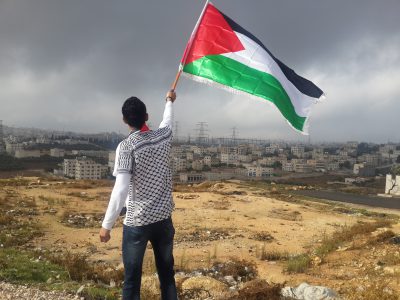
Exactly a week after the most recent military escalation between Gaza and Israel, Haaretz, a left-leaning Israeli newspaper, placed on the front page of its Hebrew print edition a photograph depicting a crowd of Palestinians in Gaza gathered around a steaming cauldron of soup. Mostly men and boys, they are clamoring to get closer to the cauldron, clutching pots, bowls and even plastic storage containers to be filled. It is an aerial shot and you can almost hear the commotion through the image.

Over just three days during the first week of May, 25 Palestinian residents of Gaza and four Israeli citizens were killed while hundreds were injured. This was just the latest of eight military escalations since Operation Protective Edge in 2014. Israeli missiles and artillery fire damaged homes and businesses in Gaza, while barrages of rockets fired from the Strip hit dozens of homes in Israel in a tactic that seemed meant to overwhelm the Iron Dome defense system, which has until now prevented heavy damage and loss of life in Israeli cities and towns.

For most Israelis, Gaza exists only as a place of violence and misery. The images in the mainstream media depict its residents as either shooting rockets or clamoring for food. Israeli citizens can’t enter the Strip, and residents of Gaza are very rarely granted permission to enter Israel.

The misery-violence connection

While Israelis have little insight into the complex, nuanced realities of Palestinian society, many do see the link between violence and misery. In a poll conducted in early 2017, more than two-thirds of Israelis acknowledged that Israel would be serving its own interests by working to improve living conditions in Gaza. Israeli security experts — current and former military officials, analysts, and politicians — frequently warn that the misery in Gaza is a threat to Israel’s security. The terms of each ceasefire agreement have been variations on the same theme: Expanding the fishing zone, allowing more goods into Gaza, and granting exit permits to more people. But Israel regularly fails to implement the terms of the agreements, and Gaza’s desperate situation continues to deteriorate. If misery drives conflict, and everyone acknowledges this, why isn’t Israel doing more to prevent the next round of violence?

A crisis rooted in policy

Neither increased aid nor improved infrastructure can resolve the crisis in Gaza. The endless cycle of escalations, ceasefires, and unfulfilled concessions are symptomatic of a broader problem. The international community has allowed Israel to “manage the conflict” with the Palestinians, rather than take meaningful steps to end it. From Israel’s perspective, keeping Gaza in perpetual crisis is the point —not the problem. The two parties will remain stuck in this holding pattern, with escalations becoming increasingly frequent and their magnitude stronger, until external players who have an interest in ending the conflict compel Israel to shift course radically and take responsibility for the well-being of civilians in both Israel and Gaza. The crisis in Gaza today is rooted in policies implemented over the course of decades, particularly in Israel’s June 2007 decision, soon after Hamas took over, to declare Gaza a “hostile territory” and impose a closure. After 2007, Israel allowed only one crossing for the transport of humanitarian aid to remain open. The message was that Gaza could have aid but not an economy, subsistence but not prosperity. An Israeli official at the time said that the government’s policy was “no development, no prosperity, no humanitarian crisis” and in court proceedings the state articulated that its intention was to wage economic warfare against Gaza.  The justification for the closure, which Egypt joined by closing its own crossing point at Gaza’s southernmost point, was that it would squeeze Hamas into compliance — or place so much economic pressure on the general population, that it would rise up and overthrow Hamas. Over the ensuing 12 years, there have been three major military operations, more than a dozen interim escalations that felt very much like war to those experiencing them, and more than a year of protests at the perimeter fence where Israeli snipers have killed hundreds of unarmed protesters. Millions of Palestinians and Israelis have been affected by violence. Palestinians in Gaza have borne the vast brunt of the conflict, with Israel using its formidable military force on the small territory, which lacks bomb shelters and has an underfunded and overwhelmed medical system. Israelis — mostly in southern Israel but not only — have also experienced the violence of Palestinian factions, whose use of sniper, mortar and rocket fire, and incendiary devices, has caused death, injury, property damage and trauma. Prime Minister Netanyahu, realizing that Israeli policy created a situation in Gaza that was a liability as well as an image problem, has sought to manage the situation by keeping the pot simmering, believing he can prevent it from boiling over. But it keeps boiling over. Israel has reversed some of its most egregious restrictions, like the one that forbade certain foods, books and children’s toys they described as ‘luxuries’ from entering Gaza. Nonetheless, 12 years after the Hamas takeover, there are dozens of policies that have nothing to do with security and everything to do with the logic of applying pressure or sanctions — i.e., creating more misery, which keeps all parties to the conflict locked in a loop of escalations and ceasefires. For example, Israel frequently closes Erez Crossing — the only pedestrian crossing for Palestinians who have permission to leave Gaza — and Kerem Shalom, its only commercial crossing. In 2018, Israel closed both crossings on seven occasions, sometimes for weeks at a time.

Human bargaining chips

Israel only issues permits to leave Gaza for what it calls “exceptional humanitarian” reasons, with some exceptions for merchants. The list of criteria determining who is eligible to request a permit for travel reveals the arbitrary nature of Israel’s access policy and a kind of violent and dystopian bureaucracy. Even after passing a security screening, Palestinians must meet additional criteria in order to be granted an exit permit. Permission to visit a family member, for example, is only granted in the case of a first-degree relative who is dead, mortally ill, or getting married. The processing time for permit applications can run up to 70 business days, and many applications go unanswered. Israel often disputes the request, asking whether the relative is still sick enough to warrant a visit or whether their death occurred so long ago that there is no longer justification for issuing a permit to participate in the mourning rituals. Israel routinely blocks travel that could allow residents of the Strip to establish trade ties or travel for professional development — including for women, who rarely meet Israel’s bar for what is considered legitimate business needs. If Israel wanted to stave off misery in Gaza, it would take its boot off the necks of Gaza residents and stop using their lives as currency in its negotiations vis-à-vis Hamas. But Israel has no incentive to make compromises that would move the region out of conflict. It conveys the perception that it is “managing” an insoluble problem and that it is a victim of Palestinian violence, with neither responsibility for Palestinian misery nor the ability to alleviate it. But the truth is that the status quo serves Israel well. As long as a weakened Hamas has control over Gaza while Mahmoud Abbas’s Fatah heads the Palestinian Authority in the West Bank, Israel can use divide and conquer tactics to manipulate the rift between the two parties and maintain its hold on the West Bank, where more than half a million Israeli settlers live and which Netanyahu recently said he plans to annex. A deeper look at the situation in Gaza, and its connection to the bigger picture, reveals these truths. If the political leadership of Israel, Palestine and the international community were willing, collectively, to prioritize the needs and rights of civilians, in Israel and Palestine, there would be a clear path to negotiating a way out of the crisis. Israel’s control over freedom of movement provides it with ample opportunities to take meaningful steps in this direction. [post_title] => Policy, not aid: how to avert catastrophe in Gaza [post_excerpt] => Neither increased aid nor improved infrastructure can resolve the crisis in Gaza. The endless cycle of escalations, ceasefires, and unfulfilled concessions are symptomatic of a broader problem. [post_status] => publish [comment_status] => open [ping_status] => open [post_password] => [post_name] => policy-not-aid-how-to-avert-catastrophe-in-gaza [to_ping] => [pinged] => [post_modified] => 2024-08-28 21:11:30 [post_modified_gmt] => 2024-08-28 21:11:30 [post_content_filtered] => [post_parent] => 0 [guid] => https://conversationalist.org/?p=1019 [menu_order] => 330 [post_type] => post [post_mime_type] => [comment_count] => 0 [filter] => raw )
Policy, not aid: how to avert catastrophe in Gaza

WP_Post Object
(
    [ID] => 673
    [post_author] => 8
    [post_date] => 2019-03-01 20:57:17
    [post_date_gmt] => 2019-03-01 20:57:17
    [post_content] => 

The most compelling argument for repatriating British citizen Shamima Begum, who sneaked into Syria and joined the Islamic State when she was 15, is based not on emotion but on cold, hard logic.

On February 19 the British home secretary announced that he had decided to revoke the citizenship of 19 year-old Shamima Begum, the London-born daughter of immigrants from Bangladesh. Begum sneaked out of Britain and infiltrated Syria to join the Islamic State when she was 15 years old, becoming one of its most notorious promoters on social media platforms. Now, with the ISIS routed from nearly all its territory in Syria, Begum is detained in a Kurdish-controlled detention camp. In interviews with British media outlets, the teenage ISIS bride, who recently gave birth to her third child (the first two died), asked to be allowed to return to the UK.

Begum’s request set off a storm of controversy, with those who opposed her repatriation pointing to her lack of contrition for having supported notorious terror attacks like the 2017 Manchester Arena bombing. Those who favor bringing the young woman back to Britain point to international law, which prohibits rendering a person stateless. While Begum’s parents are Bangladeshi, she is not a citizen of the South Asian country; the government of Bangladesh has said that it would not be willing to take her in.

Other arguments in support of her repatriation include the fact that her child is a UK citizen, and revoking the citizenship of one person for engaging in politically unacceptable activity sets a dangerous precedent.

My argument is based neither on international law nor on sympathy for Begum's innocent child, but rather on cold logic. The fact is that the British government, with its decision to strip Shamima Begum of her citizenship, is playing directly into the hands of ISIS. It is implementing the Islamic State’s own policy — thereby strengthening jihadi recruiting methods.

The Begum case pours salt into one of the gaping wounds of the postcolonial condition: as in the case of other ISIS brides, the British government’s decision to revoke Shamima Begum’s citizenship makes her “someone else’s problem now.” She has been cast aside, a move justified by pointing to her ancestral roots in another nation-state (which happens to be a former British colony) — where she is not even a citizen. To British Muslims, their government’s message is very clear: “you will never really be British.”

But the fundamental problem with stripping citizenship from ISIS returnees is far more worrying and destructive than having made Muslims feel that they will never belong in the so-called West. The real consequence of the British home secretary's announcement is that is doing  the work of the Islamic State by stepping right into its propaganda trap.

The difference between compassion and understanding

Shamima Begum’s case elicits heated emotions and divisive debates. People who say they are trying to “understand” the teenager's motives, or who call for compassion to be shown toward her, provoke reflexive and performative expressions of horror and, often, the accusation that they are soft on ISIS.

Propaganda succeeds when it provokes emotional responses that override one’s willingness or ability to respond with logic and reason — rather than reacting emotionally. And that is the ISIS trap.

I understand well the temptation to give in to one’s emotions: Steven Sotloff, the American journalist who was killed in Syria by ISIS in 2014, was a close friend.

The way to lose a war is by dehumanizing your enemy.  When your enemy appears wholly irrational and monstrous, the idea of trying to “understand” her ostensibly renders one guilty of “sympathizing.” But it is impossible to defeat an opponent whom you do not understand — because you will never see them coming.

ISIS 101: Citizenship, gender, and civilians in the caliphate

If Shamima Begum joined a terrorist group, does that make her a terrorist? The question is a valid one, albeit controversial. There is a difference between offering support and actively carrying a weapon for a terrorist group. The jihadi brides are accused of providing support by disseminating pro-ISIS propaganda on social media platforms.

But while the regime of Syria’s President Bashar al-Assad has killed far more civilians than ISIS could ever aspire to, one very rarely hears calls to revoke the British passport of Asma al-Assad, the London-born wife of the Syrian dictator. And yet, Asma al-Assad frequently and vehemently expresses her uncritical support for her husband’s regime and its army, both on social media and in television appearances that are broadcast all over the world.

Note, too, that men who were recruited to become fighters with ISIS were later repatriated to their home countries with only a fraction of the media attention paid to Shamima Begum’s request return to her native England. If we fail to grasp that the case of Shamima Begum is complex, then we simply do not understand ISIS.

The first two letters of the acronym ISIS stand for Islamic State. The caliphate aspires to establish a state, and states need civilian settlers, not just an army. They need a nation of citizens to govern, which requires civilians — including women and children — who have chosen the caliphate over the contemporary nation-state.

That is why when men who are new recruits to the Islamic State’s fighting force arrive in IS-held territory, they are compelled to burn their passports in a ritual act that is recorded. ISIS propagandists disseminate the videos of those passport burning ceremonies online, where they are shared widely, with the intended impact of severing from those new recruits the possibility of returning home. Women who join the Islamic State as jihadi brides are also compelled to burn their passports.

Why, then, is the public far less outraged about male jihadi fighters having been repatriated to their home countries than they are about women who joined the Islamic State and now want to return home? The answer is that when young women like 19 year-old Shamima Begum join the jihadis to become their brides, and praise them for carrying out beheadings or terror attacks on European soil, they contradict a very commonly held orientalist stereotype about oppressed Muslim women who lack agency. Note well that much of the controversy over Shamima Begum has been over her apparent lack of contrition. There is an unsettling contrast between her shapeless traditional black robe and hijab, which many interpret as a symbol of oppression, and the assertive manner in which she expresses pro-ISIS opinions.

The fastest and most efficient way to lose a war is to underestimate your opponent. If you believe they are irrational and incapable of strategizing, then you are underestimating them. The key to winning the war is to understand the enemy. Critical here is an overlooked feature of ISIS propaganda — the organization tailors messaging with particular audience demographics in mind. ISIS purposely represents themselves as monstrous and irrational, because that image plays into our fears and stereotypes. They weaponize orientalist stereotypes against us — and we fall for it, every time..

Remember that ISIS sees itself as a state, which means it must attract civilians, including women, as well as male fighters. The vast majority of ISIS propaganda is, to the surprise of many, not violent. Instead, it employs utopian images of a sustainable state and nation—where civilians can live in safety and security in a welcoming, multi-racial, autonomous and sovereign state. Shamima Begum was recruited online from her London home, when she was only 15 years old, because she saw those propaganda videos of a land where — in contrast to Saudi Arabia — women could drive, and were promised comfortable lives as the wives of fighters, but not as fighters themselves.  Of course we can find Begum’s decision to join ISIS abhorrent, and her gullibility for the group’s propaganda absurd. But remember: we are falling for ISIS propaganda too — just different propaganda, which targets a different audience.

Neurology, violence, and trauma: The making of child soldiers

Public outcry over Shamima Begum has largely focused on her failure to express remorse. Fundamental to both the ISIS state-making project, and the production of child soldiers is the role of neurological development before the age of twenty-five. Begum joined the IS when she was 15 years old. Much like the ISIS youth group, Cubs of the Caliphate, Begum has witnessed — and perhaps committed — acts of grotesque violence and morally abhorrent trauma at an age well before the brain develops its capacity to exert full agency, to cope with trauma, or to deal with the consequences of one’s actions.

The leaders of the ISIS youth groups deliberately traumatize children when they are very young, as a means of ensuring that their psychological scars make their reentry to their home society nearly impossible. In their graduation ceremony from ISIS youth groups, children are forced to commit an act of murder. This same method was used to recruit child soldiers in Sierra Leone and Côte d'Ivoire. 

Once children have been forced to witness or participate in morally injurious acts like murder, the psychological scars are profound. The guilt and self-hatred can prove irreversible without considerable assistance—one reason, among others, that the reintegration of child soldiers proves a challenge across global conflict zones. Worse, these underage returnees are well aware that society views them as monsters — damaged beyond recognition. And so they are inculcated with the idea that there is no going back home, because “home” no longer exists.

Successful counterterrorism tactics

Shamima Begum needs help — if for no other reason than the biological reality of her age means that her neurological ability to reason is limited. There is also the concern that she has witnessed extensive trauma that she is — again, for neurological reasons — unable to process. This is not an appeal to set her free, nor a suggestion that she face no consequences for her actions. One can understand why she behaved as she did, without condoning her actions.

The fact is that we, the people who want to defeat ISIS, need Shamima Begum. Repatriated former members of the Islamic State are the best weapon we have in the war against jihadism. They are, in fact, the only credible messengers. By repatriating them, we slay the jihadi propaganda claim that the so-called West not only doesn’t care about its Muslim citizens, or that it commits human rights abuses far worse than those of the caliphate’s fighters. By bringing Shamima Begum home to Britain, we give lie to the ISIS claim that once recruits join the Islamic State, they can never go home again  — that their governments will disown them, because they do not care about or want their Muslim citizens. 

What next

Successful counterterrorism strategy is not driven by public emotion or political expediency. The politicians who chose to take the populist route in revoking Shamima Begum’s citizenship capitulated in the face of a frightened electorate. In doing so, they fell straight into the trap set by ISIS. They confirmed what jihadi propaganda videos preach to followers and to potential new recruits: that their home countries are led by non-believers who don’t care about them or want them, and that they are thus better off in the caliphate than in suburban London (or Paris, or Brussels, or Toronto).

I am not calling for peace, love, and understanding for ISIS, but precisely the opposite: an emphatic reminder that cold, hard logic makes for successful policy. The purpose of ISIS propaganda is to undermine our ability to engage in logical thought by blinding us with hate-filled emotion. In the case of Shamima Begum, the British government handed ISIS their victory — because a public frightened by beheading videos votes on emotion. Politicians win elections not on strategy that is born of detached logic, but on the calculus of political expediency.

Fear-inducing propaganda is extremely effective — until it isn’t. But rather than wait to see if something worse comes after propaganda stops working, let's take some preemptive, logical action. Let's show vulnerable teenagers who spend far too much time online that ISIS propaganda is a lie. 

[post_title] => When Britain Revoked a Jihadi Bride's Citizenship, They Fell for ISIS Propaganda [post_excerpt] => The most compelling argument for repatriating British citizen Shamima Begum, who sneaked into Syria and joined the Islamic State when she was 15, is based not on emotion but on cold, hard logic. [post_status] => publish [comment_status] => open [ping_status] => open [post_password] => [post_name] => when-britain-revoked-isis-bride-shamima-begums-citizenship-they-fell-right-into-the-isis-propaganda-trap [to_ping] => [pinged] => [post_modified] => 2024-08-28 21:11:31 [post_modified_gmt] => 2024-08-28 21:11:31 [post_content_filtered] => [post_parent] => 0 [guid] => https://conversationalist.org/?p=673 [menu_order] => 352 [post_type] => post [post_mime_type] => [comment_count] => 0 [filter] => raw )
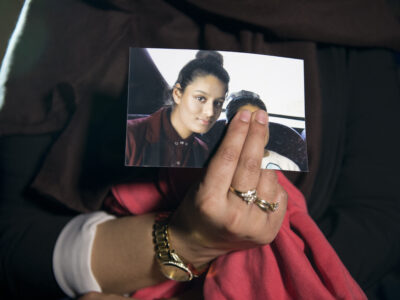
The older sister of Shamima Begum, Renu Begum, holds a photo of her sister with a child. Two of her fingers obscure the child's face. She is wearing rings on two of her fingers and a watch on her wrist. In the photo, Shamima's hair is tied in a bun and she's wearing a burgundy button down shirt buttoned to the top, and a matching blazer over it. She is looking directly at the camera.

When Britain Revoked a Jihadi Bride’s Citizenship, They Fell for ISIS Propaganda

WP_Post Object
(
    [ID] => 602
    [post_author] => 5
    [post_date] => 2019-02-15 16:25:09
    [post_date_gmt] => 2019-02-15 16:25:09
    [post_content] => 


The children of California farmworkers are working with research scientists seeking a way to limit their exposure to toxic pesticides; conflict resolution experts and journalists workshop strategies for bringing more nuance to reporting from war zones and election campaigns; and a heartening story about teenage sisters in Bali who led a successful grassroots campaign to ban single use plastic bags

  • The children of migrant farmworkers in California have been invited to join a program led by scientists who want to figure out how to minimize the children's exposure to dangerous pesticides. By including the children, they are setting an example of how to democratize scientific research. Read the story published by Ensia.
  • How can journalists make their reporting on conflict and on elections more nuanced? Apparently, a very successful strategy is to bring together journalists and conflict resolution experts to workshop essential questions that "complicate the narrative." Fascinating report here.
  • There is a dearth of affordable housing in American cities, but Austin, Texas, is considering lifting building restrictions in exchange for developers building more affordable units. Next City has the story.
  • In order to stop global warming at 1.5 degrees, we need to increase radically our use of sustainable energy sources. Solutions like solar and wind energy require the use of "rare earth metals" like cadmium, neodymium and indium — which must be mined from the earth. Now the issue is: How can we do this sustainably? Here's a concrete suggestion.
  • In Bali teenage sisters led a successful grassroots campaign to ban single-use plastic in 2019. NPR has the story.
  • In Europe, teenage girls are calling for strikes to demand action on climate change, and BuzzFeed profiled their heroic efforts.


[post_title] => Bringing nuance to conflict reporting, successful campaigns to ban plastic, and children who learn scientific research for their own benefit [post_excerpt] => The children of California farmworkers are working with research scientists seeking a way to limit their exposure to toxic pesticides; conflict resolution experts and journalists workshop strategies for bringing more nuance to reporting from war zones and election campaigns; and a heartening story about teenage sisters in Bali who led a successful grassroots campaign to ban single use plastic bags [post_status] => publish [comment_status] => open [ping_status] => open [post_password] => [post_name] => bringing-nuance-to-conflict-reporting-successful-campaigns-to-ban-plastic-and-children-who-learn-scientific-research-for-their-own-benefit [to_ping] => [pinged] => [post_modified] => 2024-08-28 21:15:14 [post_modified_gmt] => 2024-08-28 21:15:14 [post_content_filtered] => [post_parent] => 0 [guid] => https://conversationalist.org/?p=602 [menu_order] => 356 [post_type] => post [post_mime_type] => [comment_count] => 0 [filter] => raw )

Bringing nuance to conflict reporting, successful campaigns to ban plastic, and children who learn scientific research for their own benefit

WP_Post Object
(
    [ID] => 412
    [post_author] => 2
    [post_date] => 2019-01-22 14:50:49
    [post_date_gmt] => 2019-01-22 14:50:49
    [post_content] => 

This interview was originally published in March 2017.

Adam Linehan was 21 when he joined the Army, an “old guy” at the time he did it. After waking up during basic training and briefly wondering, “What the fuck did I get myself into?” he went on to serve as a combat medic in Iraq and Afghanistan. Today he’s a senior staff writer at Task & Purpose. I spoke to him about Trump, the prospect of more war, and the relationship between military and civilian life for the Anti-Nihilist Institute’s Woke Vets series.

Natalia: You’ve written about the Clint Lorance case— I’ve been following that story for a while, and it freaked me out. Both the case and the reaction to it [Editor’s note: 1st Lt. Clint Lorance was serving in Afghanistan’s Kandahar province when he ordered his men to fire on civilians, resulting in two deaths. The argument of his supporters hinges on the notion that “everyone is a potential enemy in Afghanistan.” Yet not one of Lorance’s men was willing to support his actions in court. Platoon members further testified that Lorance tried to get them to shoot a 12-year-old who came to retrieve the bodies in the aftermath of the shooting.] You can’t understand the Lorance case without understanding the nuances around it, but how do you begin to explain the nuances of war to civilians who have no experience of it?

Adam: If there is one thing that my experience at war taught me it is that war is not that far removed from our everyday reality. It’s a human thing — human beings easily adopt the role of soldier. Civilians overcomplicate it in their minds.

I remember getting back from Afghanistan and a lot of people saying, “Oh, I could’ve never done that.” And my response was always, “You don’t know. You could have probably done it—and it’s not that hard to do.”

There are ways of talking, writing or filming stuff about war that make it accessible. A lot of veterans adopt the stance of, “You’ll never understand this,” but I think that’s a defense mechanism.

Natalia: I’ve spent a lot of time writing about Russia, which has a draft. I think the draft is horrible, but I also notice that in America, because we don’t have a draft anymore, civilians see military life as very removed from their own lives. We end up with a weird dichotomy— people either fetishize the military or say, “Why should I give a fuck about it?” But if you’re American, Iraq and Afghanistan were fought in your name. No matter who you voted for, you can’t get around it — and in my experience, this isn’t something people like to hear. Have you encountered similar denial and/or apathy?

Adam: After I got back from Afghanistan, the Occupy movement took off. People were in the street. And I remember thinking, “Why aren’t people reacting to Afghanistan in a similar fashion?” I had just gotten back from witnessing terrible things and remember being very angry about how few people even cared.

When you’re at war, you think the country’s paying attention. When you get home, one of the first things you realize is that hardly anyone actually gives a shit.

That’s a dangerous mentality. It allows us, as a country, to be in perpetual conflict.

We are ultimately responsible for what our soldiers are doing overseas. I’m a civilian now, but I’m still responsible. But I’ll add that it’s equally dangerous to go from apathy to the fetishization of soldiers.

Natalia: A year ago, I was telling my liberal friends, “Trump’s going to win,” and nobody believed me. Now I’m the one waking up in disbelief every morning, having to tell myself, “Yep, it’s real.” Having said that, I think everything he’s doing is predictable — especially if you have experience with wealthy narcissists. I think someone like that gets off on being in charge of a huge, powerful military. But how would you characterize that relationship? Who do you see him as when you think of him as our commander-in-chief?

Adam: Trump comes from a class of people who don’t serve in the military. On a personal level, he is very far removed from soldiers and their lives. I don’t think he is able to see them for the people that they are.

When he claims to know more about ISIS than the generals, this suggests that he doesn’t hold career officers in high regard. Look at it this way — they took Iraq off the travel ban list. But why was it there in the first place?

If Trump had been interested in the Iraq war and had been following it, he would have known how extremely dangerous it is to insult a country where you have American soldiers on the ground.

American soldiers depend on Iraqi civilians and soldiers for everything from intelligence gathering to basic security. Anyone who has ever been to Iraq would know how dangerous it is to send the message that the travel ban conveyed to the people of that country.

It’s dangerous for a commander-in-chief to think he knows it all, full stop.

In light of that, under this administration, it will take very little for us to get sucked into another war. And when that happens, it’s not going to be managed with the careful consideration that we had under Obama, and even George W. Bush.

I wasn’t a Bush supporter, but when he sent men into combat, he felt it. You can see that he’s still struggling with that decision today. I think Trump is very different.

If we have another Boston Marathon-like bombing, or a San Bernardino-style situation under Trump, he will use that as justification to go to war. He has positioned himself as a strong leader who will destroy terrorism — and even though everyone knows that it’s impossible to win the war on terror like that, he won’t be able to walk it back.

Natalia: How does one win this war?

Adam: I’ve reached the conclusion that counter-insurgency is not an effective strategy.

The key to counter-insurgency is winning the hearts and minds of the local population, and persuading them to get on your side. That’s an impossible task, because you have soldiers in there, and soldiers’ priority is survival.

In a life-or-death situation, a soldier will choose life over the mission.

When you put soldiers in a very dangerous environment and tell them to forge relationships with the locals, soldiers are not opposed to that idea. But the second that bullet start flying, they’re going to shoot back. And the second that one of their buddies is killed, they’re going to perceive that entire population as the enemy. Introduce suicide bombers into the equation, and the suspicion of the local population goes through the roof.

So the distance between the local population and the soldiers grows — and insurgents know that. IEDs and suicide bombers are not designed just to kill, they’re designed to sow suspicion, and they work.

I’m inclined to say that it’s smarter to rely more heavily on special forces and surgical raids. Mass deployment of troops is not the answer in fighting terrorism. Career Delta Force, Navy SEAL guys are very good and take what they do very, very seriously. It’s better to lean more on those guys.

We started these wars. It’s idealistic to think we can sever our involvement completely.

That’s why I’m not advocating not doing anything at all, since we obviously have to keep terrorists on their toes.

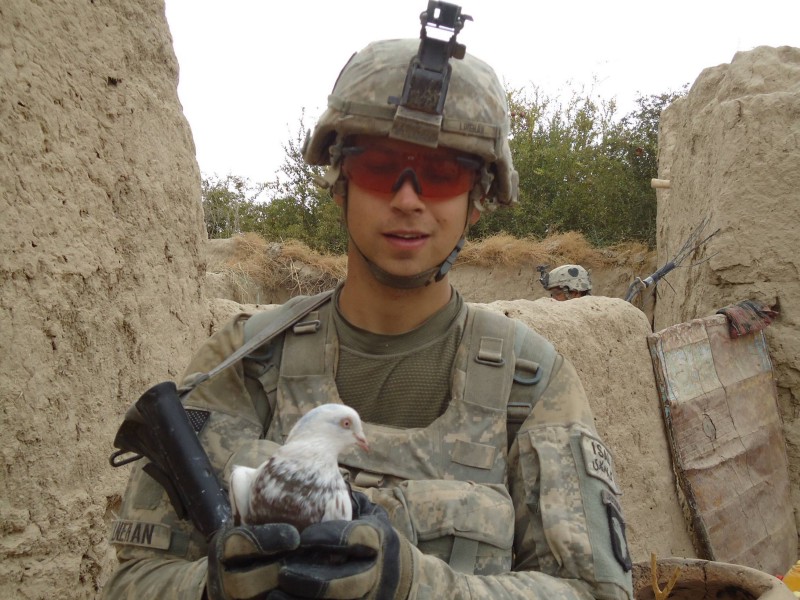
Adam Linehan hanging out with a pigeon in Kandahar, 2010.

Natalia: So you joined the military under Bush, and deployed for the first time under Bush, and then the second time under Obama. And this is a dumb question, but I have to ask it — did you feel any difference while serving under these two administrations?

Adam: No. I was in Iraq when Obama was elected. I thought there would be no more deployments, so when Obama announced the Surge in Afghanistan, I was very surprised.

I don’t remember observing a difference, nobody I knew did either. Obama was very aggressive on Afghanistan. Overall, he didn’t strike me as less aggressive when it came to executing missions at all.

There were complaints that the rules of engagement were getting tighter, but I don’t think that was coming from Obama. I think it was coming from the generals, whose logic was, “We’re under a lot of pressure to turn this war around. We can’t do that while killing civilians.”

By the time Obama came around, there were a lot of military commanders who understood that one of the things holding us back was we were not forging good relationships with the local people and the local government.

Natalia: Let’s say you were ten years younger now. Do you think you would have joined up under a Trump administration?

Adam: To be honest, yes. I was going to be a medic — I wanted to help people. I knew the war would be happening with or without me. And people don’t usually let politics affect their decision to join.

Obviously, a lot of people in the military hated Obama. But they still didn’t have problems with recruiting people.

Natalia: Why did so many people in the military hate Obama?

Adam: A lot of people in the military come from conservative backgrounds. Obama represented the epitome of liberal values to them. He symbolized everything they didn’t stand for.

On a certain level, there was also racism going on. But a lot of the guys in my unit in Iraq? During the campaign, they didn’t know much about Obama. They just knew that he was an eloquent Democrat. That’s all it took for them to think “He’ll take our guns and tighten up the ROEs.”

Natalia: We have a tradition of the military being politically neutral. Do you think this will hold under Trump and his chaotic policies?

Adam: I’m liberal, and I was the only one in my platoon. Most everyone else [in the military] is conservative, and they will be perfectly fine serving under Trump.

Natalia: We’re talking about conservatism, and it’s interesting to me, because Trump is not really conservative. He’s a rich hedonist and a con artist, basically, and will do whatever it takes to keep power. Do you think this will ever become obvious to people?

Adam: I think there are guys in the military who are starting to wake up to some of his shortcomings. So it’s fortunate for Trump that he has [James] Mattis as Secretary of Defense. Mattis is seen as the buffer, as the person who will hold Trump in check on issues that affect the military.

But a lot of people in the infantry are simply happy to have someone like Trump in power, because they want to go to war. They want to have that experience, and Trump is the quickest way to get there.

Keep in mind — a lot of the people in the military aren’t super political. They’re just young guys who like being soldiers.

For what it’s worth, I don’t think that the military could become this super radicalized force that Trump could deploy against the people of the United States.

Natalia: Do you really think Mattis can keep Trump in check?

Adam: Mattis is very strategic. Take the Muslim ban, for example. Mattis knew that this wasn’t smart strategically speaking.

Who was pressuring Trump to remove Iraq from the Muslim ban list? It was Mattis and [National Security Advisor H.R.] McMaster, and Rex Tillerson (surprisingly).

If Trump ever loses Mattis or gets rid of him, there goes a lot of his military support. Because a lot of people in the military are suspicious of the civilians surrounding Trump — people like Steve Bannon or Steve Miller — but I cannot overstate how revered Mattis is by the military. Mattis has put himself in a position where he is indispensable, so if anyone is going to rein in Trump, it’s down to him.


[post_title] => Woke vets: 'Hardly anyone gives a shit' about America’s perpetual war [post_excerpt] => [post_status] => publish [comment_status] => open [ping_status] => open [post_password] => [post_name] => woke-vets-hardly-anyone-gives-a-shit-about-americas-perpetual-war-2 [to_ping] => [pinged] => [post_modified] => 2024-08-28 21:11:31 [post_modified_gmt] => 2024-08-28 21:11:31 [post_content_filtered] => [post_parent] => 0 [guid] => https://conversationalist.org/?p=412 [menu_order] => 363 [post_type] => post [post_mime_type] => [comment_count] => 0 [filter] => raw )

Woke vets: ‘Hardly anyone gives a shit’ about America’s perpetual war

WP_Post Object
(
    [ID] => 408
    [post_author] => 2
    [post_date] => 2019-01-22 14:48:51
    [post_date_gmt] => 2019-01-22 14:48:51
    [post_content] => 

I thought I was doing the right thing, I was obeying orders, and now, of course, I see that it was unnecessary and wrong. But I don’t know what you mean by being upset….I didn’t personally murder anybody. I was just the director of the extermination program at Auschwitz.
—Rudolf Hoess, April 11, 1946 at Nuremberg.

Several years ago I began researching Nazi mens rea, the legal term for a criminal defendant’s mental state at the time a crime is committed, in order to explore what it means to obey unethical orders. How do evil people convince others to do their dirty work? What effect do hateful ideologies and propaganda have on individual agency? Can complicity in crimes against humanity be explained by obedience to hierarchies or coercion?

How does one rationalize or compartmentalize genocide? Towards that end, I compared a Jewish-American Army psychiatrist’s interviews with defendants during the Nuremberg Trials in 1946 to Hannah Arendt’s reporting for The New Yorker on Adolf Eichmann’s kidnapping from Argentina and subsequent trial in Israel in 1961, Eichmann in Jerusalem. You could call it an examination of the banality of evil, the concept Arendt coined while watching Eichmann testify. The project was fascinating, but also sickening and mentally and physically exhausting.

I discovered that any attempt to pin down the origin and nature of atrocities foundered when shifting from systemic failures onto issues of individual moral culpability.

This was especially true when dealing with the testimony of perpetrators. The result was a paradox, described by Emil Fackenheim as the “double move”: to seek an explanation but also to resist explanation.

The Nuremberg Trials disturbed observers not simply with revelations of mass atrocities, but also by the Nazis’ seeming normalcy and lack of remorse. Dr. Leon Goldensohn spent seven months studying the mental health of the Nuremberg defendants on assignment from the U.S. Army. Goldensohn regularly interviewed both defendants and witnesses, 33 in total. His notes were published in The Nuremberg Interviews: An American Psychiatrist’s Conversations with the Defendants and Witnesses.

Goldensohn, himself a Jew, treated the defendants as subjects in a study, hoping for signs of a distinctive Nazi pathology. He didn’t find one. There were common patterns of behavior and repetitive answers, but from Goldensohn’s notes it’s clear that each Nazi made their own impression on the doctor. Defendants for the most part used their time with him to rehearse their testimony.

The basic measure for competence to stand trial at Nuremberg was the ability to tell right from wrong (historically, competence was also measured by an awareness of one’s actions). The tribunal’s authority rested on the notion that individuals act of their own free will and that those who cannot tell right from wrong belong in an insane asylum, not prison.

Of all the defendants, only two were deemed incompetent to stand trial. As for the others, Goldensohn held that psychopathy or sadistic tendencies didn’t necessarily negate one’s ability to distinguish right from wrong. The most repulsive interviews were with Julius Streicher, editor of Der Stürmer, the Nazi tabloidWhile calling himself a Zionist, Streicher was the only defendant wholly unable to contain his anti-Semitic tirades. As Goldensohn put it: “He is of below-average intelligence, but all the same awoke one morning inspired to dedicate himself to becoming an ‘authority on anti-Semitism.’”

In order to get a conviction for each crime, prosecutors at Nuremberg not only had to prove that the Nazis committed the acts, actus reus, but also that they had the requisite mental state or intent when they did. Murder committed intentionally is punished more harshly than a murder committed in the heat of passion.

Since it was impossible to read their minds, this introduced an element of conjecture to the trials. How deliberate was the Final Solution? Who knew when and how far back did the plan go? Hitler was dead, so who was responsible? Why would anyone tell the truth?

The court drama played out over the original charge of conspiracy. Some scholars argue that the prosecution’s wish to prove that the defendants had all collaborated together in an organized conspiracy towards the Final Solution led them to exaggerate the intentionality and coherence of Nazi planning and policy. At trial, defense counsels were quick to point out the enormous confusion of authority in the Third Reich. In the hopes of having the conspiracy charges dismissed, Nazi defendants pled ignorance of the atrocities, blaming the compartmentalized system of Nazi administration.

There is evidence from Goldensohn’s interviews that even during the trial, Hermann Goering, the highest ranking Nazi defendant, was maintaining party discipline in prison. Goering’s plan for the defense was copied by the majority of defendants and involved ignoring the atrocities, or in the alternative, blaming Goebbels and Himmler, both conveniently dead. He disparaged lower-level officials’ claims when they contradicted his own, and proudly took responsibility for all but the extermination camps. No one living would account for those.

Goering was smooth:

We Germans consider an oath of fealty more important than anything….Mind you, I said almost anything. I don’t consider the extermination of women and children as proper even if an oath were taken. I myself can hardly believe that women and children were exterminated. It must have been that criminal Goebbels, or Himmler, who influenced Hitler to do such a dastardly thing.

The disconnect between language and reality was astounding. By Nazi reasoning, Goering’s stolen art was a major disgrace, whereas killing Jews was merely distasteful. In an interview with Otto Ohlendorf, commander of Einsatzgruppe D, one of the paramilitary death squads, Goldensohn couldn’t hide his disgust.

LG: Did your wife know of this business of the Einzatsgruppe?

OO: No.

LG: Have you seen her since 1941–42?

OO: I saw her, but never talked to her about those things. I didn’t think it was good conversation for a woman.

LG: But it’s all right to shoot women, not all right to talk to them about shootings?

OO: In the first place, I didn’t shoot women. I merely supervised.

Hans Fritzsche, one of the few defendants to be released, was the head of the Radio Division in Goebbel’s Ministry of Propaganda from 1942 onwards. His defense:

Pure idealism on my part. I can defend everything point by point. But I won’t try to do that, because everything I did, I did before the world public. On the other side of the picture is the fact that on the basis of my work, 5 million people were murdered and untold atrocities took place. It is purely a question of judgment as to whether a connection can be established clearly between these two things.

Fritzsche felt no personal responsibility for his actions spreading anti-Semitic propaganda. His idealism, aka his Hitler-worship, was to blame. It’s not that they hated Jews, you see. They were simply devoted to the Führer. The Führer made it legal to kill Jews; if it’s legal, it’s not murder.

Fifteen years later, Eichmann still blamed idealism for everything.

The psychiatrists who examined Eichmann pronounced him normal, or as one psychiatrist said, “more normal, at any rate, than I am after having examined him.” Still, the disconnect between systemic crimes and personal culpability remained. By Eichmann’s reasoning, his fixation on the Jewish question was the result of idealism. He was quoted once saying “Had I been born Jewish, I’d have been the most fervent Zionist!” As Arendt explained: an idealist was not merely a man who believed in an idea.

An idealist lived for his idea…and was prepared to sacrifice for his idea everything and, especially, everybody.

Eichmann might have personal feelings on a subject but he would never permit them to interfere with his actions if they came into conflict with his idea. This blind fanaticism allowed for some form of conscience so long as it did not obstruct the Nazi in the execution of his duties. For Eichmann that meant planning the deportation of Europe’s Jewish population.

Hannah Arendt was furious that Eichmann, like the Nuremberg defendants before him, had distanced himself from his crimes through mental gymnastics. She cut to the chase, arguing that he was guilty of crimes against humanity because the subjective element, his mens rea, was objective by virtue of complete obedience to the Führerprinzip. Eichmann not only obeyed orders, he obeyed the law.”

She advocated rethinking criminal intent altogether in cases of crimes against humanity. Arendt seized upon Eichmann’s distortion of Kant’s categorical imperative:

“Act in such a way that the Führer, if he knew your action, would approve it.”

Eichmann had abdicated his ability to think for himself, she said. In relinquishing himself to Hitler, Eichmann became strictly liable for the crimes he committed on Hitler’s behalf.

Strict liability in such cases resolved the issue of criminal intent and made it difficult for those who benefitted from the regime to then disavow it later, as “so-called inner emigrants.”

[Inner emigrants] were people who frequently had held positions, even high ones, in the Third Reich and who, after the end of the war, told themselves and the world at large that they had always been “inwardly opposed” to the regime. The question here is not whether or not they are telling the truth; the point is, rather, that no secret in the secret-ridden atmosphere of the Hitler regime was better kept than such “inward opposition.” As a rather well-known “inner emigrant,” who certainly believed in his own sincerity, once told me, they had to appear “outwardly” even more like Nazis than ordinary Nazis did, in order to keep their secret.

One such emigrant was Oswald Pohl, head of the SS Economic and Administrative Main Office, and witness at Nuremberg. In interviews, Goldensohn pushed back on Pohl’s answers:

Had he ever objected to the whole business?

OP: No. Nobody asked for my opinion. It would have done no good to protest anyway….I did not participate in the murder of the Jews.

I remarked that nevertheless, he did run all the concentration camps.

Yes, but the camps had nothing to do with it….Some of my present wife’s best friends were Jewish. That is proof enough of how I feel.

Such were the totalitarian perversions of the moral and legal order. How did such a distortion take place? It was a deadly mix of ideological fanaticism, authoritarian state structure, intellectual and linguistic conformity, a subjugation of conscience, and ultimately the ability to overcome an innate aversion to human suffering.

South African psychologist Pumla Gobodo-Madikizela conducted prison interviews with the infamous Apartheid death squad leader Eugene de Kock, serving consecutive life sentences and barred from amnesty under the Truth and Reconciliation Commission. De Kock was said to have repented and showed remorse, but in her book, A Human Being Died That Night, Gobodo-Madikizela writes that he exhibited outright similarities to the Nazis, particularly in his views on racism. Just like Eichmann and Streicher’s claims to Zionism, de Kock insisted that his zealously nationalist father equated Afrikaaner nationalism with the ANC’s struggle for freedom, that his father could not possibly have been a racist because he spoke multiple African languages, and “had he been Black, he would have joined the ANC.”

Just this past week, President Trump equated neo-Nazis to the anti-fascist protesters. Richard Spencer regularly equates white pride with black pride. Ben Carson is their Black friend.

When we consider history, we see that such mental gymnastics are not coincidental. If they were unique to Nazis, the Klan would not be marching and lynching postcards would not exist. When Trump said he could shoot someone on Fifth Avenue and his followers would support him, he was right. To paraphrase Nixon, It’s not murder when the President does it.” Destroying society’s moral compass promotes the politics of hate from a practical perspective.

In light of this, we must continue to study the nature of genocide and mass atrocities, not in an attempt to find definitive answers, but rather to illuminate the boundaries of what’s knowable. Expanding our collective imagination of what’s humanly possible is crucial if we’re ever going to stop embracing old horrors with new technologies.

[post_title] => What were the Nazis thinking when they killed all those people? [post_excerpt] => [post_status] => publish [comment_status] => open [ping_status] => open [post_password] => [post_name] => what-were-the-nazis-thinking-when-they-killed-all-those-people-2 [to_ping] => [pinged] => [post_modified] => 2024-08-28 21:11:31 [post_modified_gmt] => 2024-08-28 21:11:31 [post_content_filtered] => [post_parent] => 0 [guid] => https://conversationalist.org/?p=408 [menu_order] => 364 [post_type] => post [post_mime_type] => [comment_count] => 0 [filter] => raw )
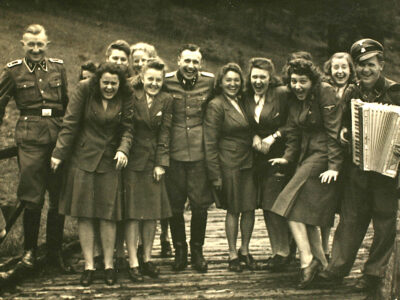
A sepia photo from 1944 of a group of about a dozen Nazi officers and auxiliaries—including Karl Höcker in the center—all openly laughing. The photo was taken at Solahütte, a "resort" where Nazis who worked at Auschwitz would vacation on weekends. They are all in uniform: The women wear long sleeved blazers and knee length skirts with flat shoes, and the men wear long sleeved military jackets and trousers tucked into tall boots. The man on the right is wearing a Nazi hat and is holding an accordion. They're standing on what appears to be a wooden bridge. There is grass behind them.

What were the Nazis thinking when they killed all those people?

WP_Post Object
(
    [ID] => 394
    [post_author] => 2
    [post_date] => 2019-01-22 14:34:21
    [post_date_gmt] => 2019-01-22 14:34:21
    [post_content] => 

This interview was conducted and originally published in June 2017.

Tim Hardin is a United States Army veteran who served on active duty for 12 years. He deployed twice to Iraq with the 3rd Infantry Division and 3 times to Afghanistan as a USASOC soldier. Now he’s a full-time student-veteran in upper Manhattan attending a CUNY school thanks to the Post 9/11 GI Bill. Tim organizes with his New York City chapter of the Democratic Socialists of America, where he’s also a part of the DSA Veterans Working Group.

Natalia: Did 9/11 influence your decision to join the military? I’ve heard from a lot of veterans about how it was a formative event.

Tim: I grew up in rural western North Carolina, I’m from a pretty poor family. Neither one of my parents graduated from high school — they got their GEDs after I was born. So I joined the military to escape poverty and get money for college.

And I was in high school when 9/11 happened. It influenced me, but it didn’t leave a scar on my psyche as it did for some people. I understand it was a formative event for a lot of people, but I don’t like the romanticism that’s attached to it. Look at all the frustrating and harmful ways that the romanticism [surrounding the War on Terror] is used to manipulate Americans into getting behind the jingoism which runs through so much of our discourse.

Natalia: So we’ve had all of these years of war, war that you served in. And now a lot of people I know who are ex-military or still in the military are saying that the rules of engagement have changed under Trump. Do you see it this way?

Tim: In a broad sense, all indications are that the rules of engagement have changed. This doesn’t surprise me.

This administration has shown a complete disregard for civilian casualties. It damages our standing abroad and it really hurts our mission. It’s self-defeating.

You know, I actually still have my rules of engagement card from when I was deployed the first time in 2003. [I remember] the first time I got into a firefight in 2003, when we invaded [Iraq]. You know, it’s an extremely unnatural thing, I think, to try to kill another person. At least for the broad majority of people who are not sociopaths.

Can you really hesitate if you’re questioning whether there is a threat in front of you? This is why there are so many critical protections that we have — they’re to keep us from making a situation worse. 
 
I’ve had some people tell me off the record — who can’t go on record because they’re still [on] active duty — that the signal to military command from the White House is that “we’re not going to care so much if a bunch of Iraqis die,” or whatever.

Obama obviously had his flaws as president and leader, but he was also more conscious of the fact that we’re killing people. I’m not seeing that [level of] care with the Trump administration.

Reporting on civilian casualties [quickly] evaporates from the public’s memory. This hurts [the mission]. But we forget so quickly.

Natalia: A lot of people in the military are conservative, so I’m always being told that, hey, they don’t care about any of this stuff, they’re just happy that a Republican is president. That’s interesting to me, because of course Trump is not a real conservative. He used the conservative platform to his advantage to get to the White House, but that’s it. Do you think some people in the military are starting to see him for what he is?

Tim: I was in the Army for 12 years on active duty, and for major events that impacted broad swathes of the public — take for example the crisis of 2008 — there was such a signifiant buffer for me there.

Most people on active duty are insulated from a lot of the events happening to the general public, so it’s actually very easy to be straight up apolitical.

I was generally apolitical for most the time I was in the military, until my last four years — when I started developing my own personal politics.

Most people in the military are young and impressionable, and they’re lacking an education. So you can have a lot of toxic masculinity. Or, for example, racism. And they’re insulated from the public, so there are significant obstacles to having a culture of accountability. I think that’s the real issue.

Natalia: Do you encounter anger from other veterans when you say stuff like that? Some of my veteran friends are upset with me for doing this series, for example. Because, well, we’re touching on issues that can be very upsetting.

Tim: Most of my interaction with other veterans now comes via Facebook. And I’ve been in my own little bubble with veterans who I knew and worked with. [But] last November I really took a more socialist turn. So there have been some mean and hateful things said to me. A [former] Green Beret told me, “I want to split your gristle.” And this was in response to what I think is really mild socialist stuff.

Yeah, I’ve been threatened and criticized by other veterans, not even dyed-in-the-wool conservatives, for that matter.

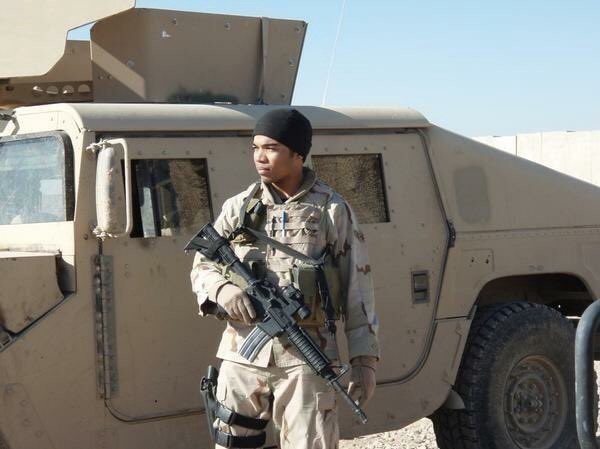
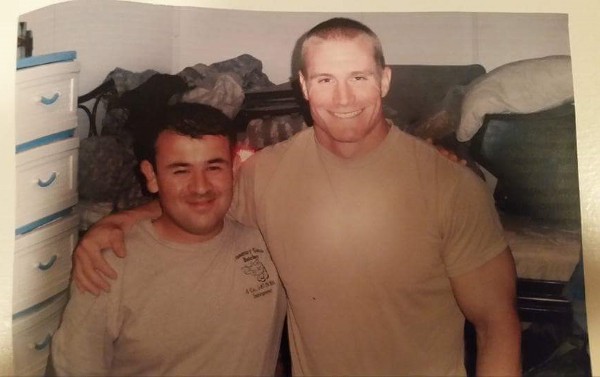
Our favorite picture from Tim Hardin’s Army days, hands down. Courtesy of Tim Hardin.

Natalia: I’m one of those people whose life — let’s admit this — has basically been ruined by student debt. And when I talk about how education should be a right, I’ve definitely had veteran friends say things like, “I had to fucking go to fucking Iraq because I wanted an education. Now some privileged assholes will get it for free?” And I completely see their argument, I’m not trying denigrate what they went through — but I also see a flaw in that logic, and I’m wondering if you see it too, or if you think I’m completely off-base to point it out.

Tim: That’s a refrain that I’ve seen out there multiple times as I advocated for free public higher education.

I tell people that when fighting for this country, I got put in some really bad situations that no one should be put in. People shouldn’t have to risk their lives so they can have access to higher education.

The system rewarded me because I risked my life for it, but education is a human right. You’re investing in your citizens when you give them the right to an education. It’s very simple stuff, and I don’t understand why we haven’t figured that out as a country.

There are people who come out of combat who are human husks. How many thousands of people who signed up to get free college are dead now? We live in the richest country in the world, and we could choose to empower Americans and invest in them.

I don’t understand why the richest country in the world does not have this shit figured out. I mean, there’s lots of reasons for it, but I just get so angry about it.

Natalia: So we were talking earlier about how there’s lots of young men in the military, and how that determines a lot of things. In this interview with Task & Purpose’s Adam Linehan we also discussed age, and how a lot of these young guys, for what it’s worth, are not going to get radicalized by the current administration and are not going to want to let Trump use the military against the American people. But I think we can all see someone like Steve Bannon just itching for that. Do you have any thoughts on that? Is this a possibility under Trump?

Tim: Well it didn’t take long for Homeland Security to go after undocumented immigrants under Trump, did it? And it could be a trial balloon — like, “How much will the American public be willing to take?”

I’m a pretty positive person, but I’m also a realist, and the young enlisted guys? They can be impressionable. And it doesn’t help that, like I said, a lot of people who have been in the military for a long time can feel isolated from the general public. It’s difficult with no cross-dialogue, no moderating influence, and people creating their own bubbles.

In my old unit, Fox News was always playing at the battalion headquarters. I see the same people who were my superiors just Breitbarting it up on Facebook right now.

So I’m not super hopeful. Maybe I’m hopeful on a regional basis. I don’t have a good read on what might happen, but I think that whatever happens would be very different from place to place.

I think Trump might try to turn the military [against the American people] if he comes close to being impeached.

And impeachment doesn’t necessarily mean the end of his presidency, but that there are legal clouds gathering above his head. Even though our system is slow, it does eventually process these things. Should Trump realize he might get booted from the White House, he could turn aggressive. But I think by that point the people on his side would also be like rats leaving a sinking ship.

Natalia: There is a lot of indication that Trump wants a war. He’s like a little boy who thinks its all a big game, and the military is his big boy toy. What do you think renewed armed conflict would look like under Trump?

Tim: I don’t think we’re headed into a new World War or anything like that. Like with Russia — it’s in the Trump administration’s interests to placate them, because of business interests.

But he’s itching to be a wartime president. Maybe [an attack on] North Korea? Maybe lots of limited strikes all over the place?

But [the Trump administration] also has a lot of turnover, and maybe that turnover will continue, and the chaotic shitshow will continue.

I mean, who’s really advising him on these issues? People like Jared Kushner? God, just think about it.

The bottom line is that they’re trying to run this government like a business, so they’ll do whatever is good for their business interests. Maybe they’ll just keep launching fucking Tomahawks for show.

[post_title] => Woke Vets: 'Disregard for civilian casualties hurts our mission' [post_excerpt] => How many thousands of people who signed up to get free college are dead now? We live in the richest country in the world, and we could choose to empower Americans and invest in them. [post_status] => publish [comment_status] => open [ping_status] => open [post_password] => [post_name] => woke-vets-disregard-for-civilian-casualties-hurts-our-mission-2 [to_ping] => [pinged] => [post_modified] => 2024-08-28 21:11:31 [post_modified_gmt] => 2024-08-28 21:11:31 [post_content_filtered] => [post_parent] => 0 [guid] => https://conversationalist.org/?p=394 [menu_order] => 368 [post_type] => post [post_mime_type] => [comment_count] => 0 [filter] => raw )

Woke Vets: ‘Disregard for civilian casualties hurts our mission’

WP_Post Object
(
    [ID] => 389
    [post_author] => 2
    [post_date] => 2019-01-22 14:32:41
    [post_date_gmt] => 2019-01-22 14:32:41
    [post_content] => 

This interview was originally published in March 2017.

Dylan Park is a United States Air Force veteran who served for six years in a Pararescue unit in Iraq and Afghanistan among other places. He’s now a writer and music video director living in Santa Monica . A sci-fi nerd who signed up for Mars One, he’s written a graphic novel (Zombiraq) and worked on tv shows including AMC’s The Walking Dead. His Twitter thread about his Iraqi teenage interpreter, Brahim, recently went viral. We discussed issues ranging from North Korea and military rape to cancer and the KKK.

Anna: One theme I’ve seen through all of your work is the issue of violence in society. You draw parallels between being at war and life in America. A lot of Americans haven’t experienced violence at home. You haven’t been so fortunate, your family especially.

Dylan: I think it’s a misconception that a lot of Americans haven’t experienced violence.

I think it’s around 30,000 people a year dying from gun violence. That’s astronomical.

I grew up in an affluent, upper-middle class area. My house literally had a white picket fence. But mom is an orphan from North Korea. My dad was growing up in Texas and Louisiana during the civil rights movement. When he was a kid they were still lynching people. He witnessed that. That’s super traumatic.

His father was murdered by the KKK. I tell people that and they think I’m joking. I have to explain to a lot of my peers that slavery and all that stuff was not that long ago.

So I never met my grandfather because he was murdered by the KKK. I never met my other grandfather because he was a North Korean defector. 

I did six years in the military in Iraq, Afghanistan, and Africa. There was a lot of violence, a lot of trauma there. I got back and a few years later, my brother was murdered in a carjacking. It’s a sad story, but I try not get down on myself. I know a lot of Americans, a lot of people in the world, have had it so much worse.

Anna: While studying to be a historian, I looked at postcards of lynchings people sent to one another. You look at some of the photos and see the sheriff standing there. If the sheriff is supervising, how much of mob justice is separate from state violence? Is this really an extrajudicial killing?

Dylan: A lot of people don’t realize that racism was state-sponsored. It was essentially law. When I talk about my grandfather being murdered in Killeen, Texas in 1972, that’s not that long ago.

The Killeen Police Department listed it as a cold case, an unsolved mystery. My father says, “That’s bullshit. We watched two cops walk into our house and shoot my father.”

So of course it’s not going to be solved. They threatened my father and uncles, saying “If you don’t get out of here, we’re going to kill you too.” This all happened because my grandfather had remarried [to] a woman from an affluent white family. They weren’t happy with a black guy getting in on the wealth.

Anna: I’d like to ask you about the different political administrations. What kind of changes have you seen in the military over time?

Dylan: When I first signed up for the military, George W. Bush was still president. We still had a lot of blind nationalism, a kind of gross patriotism after 9/11. If you weren’t for the red, white, and blue, you were the enemy. As an 18-year old, I got caught up in that.

I wanted to go fight the fucking terrorists. They promised me action, adventure and a little bit of money. There were a lot of teenagers my age that were all about that.

We’re a country that glorifies violence. We romanticize it.

When I had a recruiter telling me that I’d get a $15,000 bonus to go blow shit up, I said awesome, that sounds great.

This was in 2004. A year later, I was in Iraq and wondering, what are we even doing here?

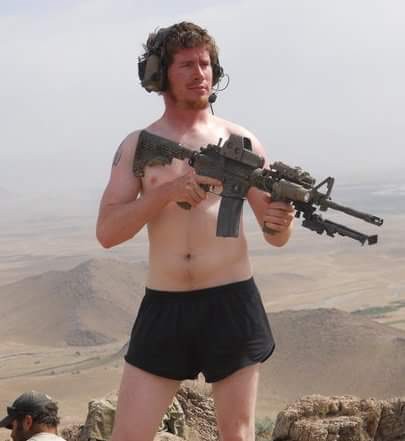
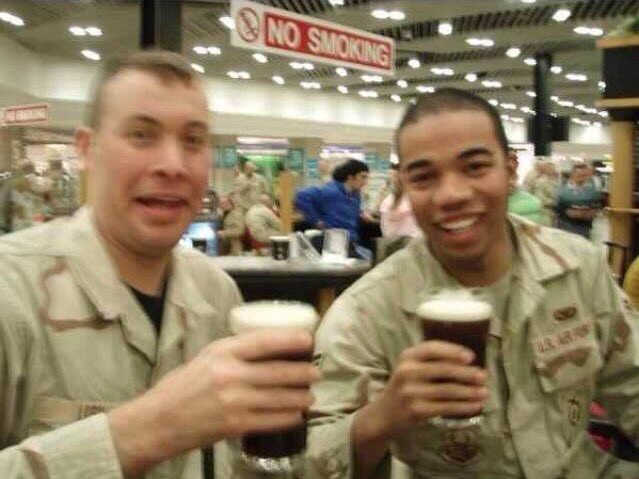
Dylan Park in his “blowing shit up” days

And the Iraqis are normal people, but now all of a sudden they have these Americans occupying their country. Of course they’re going to be hesitant and defensive.

When I admit this a lot of my veteran buddies get pissed, but we had no right to be in Iraq.

It was such a sham. They literally had us fighting over an oil town. They weren’t even trying to hide it. We were occupying an oil town while American contractors did whatever they needed to do to get the oil.

A couple of years later, Obama became president. That was great. My veterans benefits immediately increased.

Anna: I didn’t realize that he passed a law on veteran’s benefits.

Dylan: Oh yeah, Barack passed a lot of laws for veterans.

It’s crazy when you think about how Republicans say that Obama hates vets. The amount of attention I was receiving, the healthcare, everything was exponentially better.

Barack often gets criticized for pulling our troops out of Iraq, and in the long run, that might have been a mistake. I still don’t think that’s his fault, though, because we shouldn’t have been there in the first place.

He also gets criticized for the drone program. I get that too, but essentially he’s using drones instead of having boots on the ground. There’s no real difference, besides fewer Americans dead. Either way, the war machine is not going to stop.

Anna: In that sense, to what extent is U.S. foreign policy this juggernaut with a figurative head to be replaced each time there’s a new president? What influence does the president have over how our military force is used?

Dylan: You can see it right now. Before Trump got in office, he was talking about killing civilians. That’s a war crime.

Anna: Right, already we’re seeing the number of civilian deaths shoot up, like in Mosul and Yemen.

Dylan: He’s basically gotten rid of rules of engagement. He’s usurping the Geneva Conventions.

Trump’s been in office for 65–70 days and he’s already killed 1000 civilians? It’s crazy, but that puts him on a record pace.

You read the articles and the quotes from the commanders or generals that are leading these troops into battle and they say, “It’s disgusting, but these are our orders. If we’re told to level a city, we’re going to do it.”

Anna: Theres a lot of talk about Mattis and his influence over Trump. Their relationship has been framed as Trump needing Mattis in order to keep the military loyal to some extent. If Trump decided he was through with Mattis because he’s said “no” one too many times, what happens? Does it work that way?

Dylan: There’s a large population of liberal veterans and service members, but we’re never going to be larger than the conservative side. You’ll always have this group of service members that would do anything for their commander in chief, including war crimes, which is the problem. I don’t think replacing Mattis would make a difference, and I don’t see a military coup happening. It is what it is.

Anna: You’ve tweeted about civil war. I’m worried about that, too, honestly. I don’t think it’s that far-fetched to think about, especially given Steve Bannon and Trump’s threats to use the National Guard in Chicago. I think that his base will follow him no matter what and also that he won’t go quietly.

Dylan: It’s scary. I joke around about it, but usually when you’re joking it’s because it’s somewhere in the back of your head. I don’t think we’re close to that yet, but who knows?

You know we’re gonna start talking about impeaching Donald Trump, and you know the dude is going to be a psychopath on his way out.

The guy is in bed with the Kremlin, which is crazy in itself. Not to be a conspiracy theorist, but America is more ripe for attack than we’ve ever been. We’re messing up really badly right now.

Anna: Yeah, we’ve also sort of taken apart our entire State Department, which is not helpful. I worry about us getting attacked as well, and what kind of things they could use that as an excuse for.

Dylan: Donald Trump is attacking all these people in the defense services, the NSA. So now all of a sudden, all the guys who are protecting us don’t want to work for him. He’s not going to his security briefings. This is unprecedented.

It’s crazy because we have North Korea firing missiles off while Trump is golfing.

Russia’s saying, we’re going to expand our nuclear program, and Donald Trump is like, no you’re not, we’re going to have a better nuclear program.

[In general], Donald Trump is the type of leader who has a short temper and an ego. That is something that could potentially get a lot of Americans killed.

Anna: I’ve spent a lot of time in Russia. Half my family are Russian Jews who emigrated from the Soviet Union. My dad was alive for World War II. That affected how I was raised, and gave me some perspective. The thing that I’ve seen change the most since he took power is that America became like everyone else.

Dylan: That’s exactly what it is.

Anna: I’m waiting for everyone else to catch up to that fact. It’s hard when people don’t want to deal.

Dylan: [Trump’s] actually making our country a bigger target. ISIS is using this as a recruiting tool to say, “look how America hates Muslims.” And it’s true, America does hate Muslims. It’s not going to get better, it’s only going to get worse… ISIS is ramping up their hate for America, and so more attacks are going to happen. It’s a sick cycle.

Anna: I wanted to talk to you about the VA. You just had a procedure, you’re alright?

Dylan: I have some stomach complications, but I’m okay. When I was in Iraq, I was in Kirkuk, an oil town. Imagine the worst smog you’ve ever seen in your life. The sky was black. [And then there was] the depleted uranium, burning corpses, burning fecal matter, chemicals.

It was a bad environment. A crazy number of people in my detachment were getting sick.

The VA couldn’t figure out what was going on, people were getting cancer. A couple of smart doctors figured out, oh, we had these awful conditions. They set up this thing called a Burn Pit Registry. If you had been on certain bases or at certain locations at certain times you went to the VA.

My best friend went back to Iraq for another tour. He came home and was diagnosed with Stage IV stomach cancer the same day that his daughter was born. He was in the hospital feeling really sick. They pulled him to another room and did tests on him. The day his daughter is born he finds out he has a year to live. It was really fucked up.

Anna: That’s so messed up, how old was he?

Dylan: He was 30 years old. This was 2014. It’s very sad. It happens to a lot of guys. I have a lot of problems too, but I’m one of the lucky ones.

From Dylan Park’s Twitter: “Me and Allen (RIP) walked into the Shannon airport terminal in our uniforms and we got a standing ovation. Free Guinness & Jameson for days.”

Anna: The story of Brahim, your translator, was so touching. I’m wondering if the response to that story gives you hope that people aren’t totally terrible?

Dylan: I had just written a proposal for that book. I was about to start shopping it. I’ve actually told that story before but I decided to retell it because it was so relevant to the Refugee Ban. It just blew up. The amount of attention it received, couldn’t have seen that coming. For a week straight, my phone would not start beeping. I had tens of thousands of strangers telling me that I made them cry.

And there were dozens of deplorables in my mentions, too, calling me a liar. But it was heartwarming to see that not everyone’s a complete piece of shit.

Anna: You’ve tweeted about sexual assault in the military. To what extent is the military just a microcosm of society?

Dylan: The military is worse than society because the military is a fraternity. The U.S. military is basically the biggest gang in the world. It’s a big frat with the good ole boys. They keep everything on the inside, they don’t want any bad publicity.

There were two women in my unit who were raped, and the unit buried it. They actually forced the women to work alongside their rapist for almost two years before he got court-martialled.

If you can imagine that trauma having to work with the guy who assaulted you. When guys like me would go around and cause a fuss, I got blacklisted essentially. Dudes started treating me completely differently. Started calling me a narc, a snitch… It was like high school. I was in a clique and then all of a sudden I was an outcast. Don’t talk to Dylan.

And again not everyone in the military is like that. It’s the same parallel with law enforcement. We know that not all cops are shitty cops. I’d say 90% of cops aren’t shitty cops. But the fact that they protect shitty cops makes them a shitty cop. That’s exactly the situation in the military.

Anna: They become complicit. What do you think about militarized police?

Dylan: Did you just see the video of that machine they’re using? It’s like a protest sweeper. I definitely could have used that in Iraq.

Police departments in the U.S. are armed better than I was in Iraq in a war zone. I grew up in Campbell, CA. It’s the cutest little town. Their police department has a fucking tank. It’s just sitting there in a parking lot. There’s been one homicide in Campbell in five years. What are they going to do with that? You’re giving police departments military equipment so they’re going to start acting like the military.

It’s not about law and order anymore. It’s not about justice. It’s about suppression and intimidation.

You’re seeing peaceful protesters getting tear gassed, beaten and shot. On the flip side, you can have a KKK rally and they’ll get police protection. A neo-Nazi rally, the police will protect them because of their First Amendment rights. I get it, they have freedom of speech, but what happens to freedom of speech when you’re a brown guy and you’re speaking out against the system? Then you’re the enemy.

Anna: Knowing what you know now, would you do it again? Would you have joined?

Dylan: Even though they were some of the worst times of my life, they were also some of the best times too. I got to do things, experience things, meet people and go places that I had never been before and never would have had the chance to go. In the military I went to every continent but Antarctica.

I traveled a lot. A lot of it was — humanitarian missions, peacekeeping missions. My unit was a pararescue unit. We weren’t an offensive force.

We were the 129th rescue wing. Pararescue units are combat rescue units who pick up downed troops, downed civilians behind enemy lines. We’re equipped as military, so if we need to fight we can do that too.

My first mission when I signed up was New Orleans, Hurricane Katrina. We had gotten intel that there were militias running around raping women and shooting people, shooting our helicopters. They armed us up and said get ready for a fight. We’re going to fight gangbangers.

We fly out there and its not that at all. It’s just a bunch of scared black people. On their roofs, trying to survive.

There was no violence whatsoever but we had been conditioned to believe we were going to fight people. Our mission was a rescue mission so we were pulling scared people off roofs. But we were ready for a fight, had our guns loaded up.

Anna: Why would they say that about those people on the roofs?

Dylan: When you have a group of disenfranchised minorities they are the enemy no matter what. That’s how the United States has always been. It took 5 days to send help. And then when we did go, they said the people on the ground were enemies. It was absurd.

Anna: How did you feel as a person of color serving in the military?

Dylan: I had never really experienced real racism until I got into the military. There was a little bit of racism in private Catholic school: as a 5th grader if some kid calls you the n-word , what are you going to do?

But in the military people have real control over you and can send you to your death. That was an issue.

In Iraq, I found myself working the Suicide Gate more often than not. They call it the Suicide Gate because that’s where all the suicide bombers would go blow themselves up.

I always found myself working that station. It was not a coincidence. If everything had been fairly distributed, I would have only been there a few times. I found myself there nightly.

To answer your question, I often say that I’m, I don’t know if ashamed is the right word, but sometimes I’m ashamed to have been a part of the war machine. But if I had not gone through that experience, I wouldn’t have been as “woke” as you would say.

Anna: You saw a lot — and that changes you. When you were talking about the racism, I was thinking about “Get Out.”

Dylan: Oh my god that movie was insane. Not to spoil anything, but I kinda knew from the beginning that there was double-sidedness going on.

Anna: What projects are you working on right now?

Dylan: I’m working on a book based on the Twitter story, and there’s already interest in making it into a movie. Being a veteran that writes is rare thing in Los Angeles, so that’s my niche. Coming up there’s a reboot of “Behind Enemy Lines” with Owen Wilson and a “Call of Duty” TV show. They want people with experience to write for them. I also have a couple of comic books that I’m working on. And I do music videos.

Anna: Oh, right! I saw your pictures with Wyclef Jean.

Dylan: Yeah, I write and direct music videos now. Wyclef is one of my favorite artists ever, and I’ve been working with him.


[post_title] => Woke vets: black skies and the suicide gate [post_excerpt] => "There’s a large population of liberal veterans and service members, but we’re never going to be larger than the conservative side. You’ll always have this group of service members that would do anything for their commander in chief, including war crimes, which is the problem. I don’t think replacing Mattis would make a difference, and I don’t see a military coup happening. It is what it is." [post_status] => publish [comment_status] => open [ping_status] => open [post_password] => [post_name] => woke-vets-black-skies-and-the-suicide-gate-2 [to_ping] => [pinged] => [post_modified] => 2024-08-28 21:15:15 [post_modified_gmt] => 2024-08-28 21:15:15 [post_content_filtered] => [post_parent] => 0 [guid] => https://conversationalist.org/?p=389 [menu_order] => 369 [post_type] => post [post_mime_type] => [comment_count] => 0 [filter] => raw )

Woke vets: black skies and the suicide gate

WP_Post Object
(
    [ID] => 383
    [post_author] => 2
    [post_date] => 2019-01-22 14:29:05
    [post_date_gmt] => 2019-01-22 14:29:05
    [post_content] => 


Justin 'Judd' Lienhard is a former U.S. Army Ranger officer who did multiple tours in Iraq and Afghanistan. The Conversationalist interviewed him in 2017 for its 'woke vets' series.

Natalia: I’ve read your excellent pieces on The Humanist — including your take on America refusing refugees and the gut-wrenching story of your last combat mission. It struck me that what you’re discussing, among other things, are realities of war that make the average civilian really uncomfortable — so uncomfortable that they would rather shut these stories out. Do you find that most Americans don’t want to know? Or has that not been the case?

Judd: In my experience, Americans are fine with the gory details in my stories as they’ve been desensitized pretty well. They are even OK with hearing about our soldiers’ suffering. They really like the the stories I share that humanize our soldiers in a good way.

What they don’t like to hear are my stories that humanize the enemy or even the locals that collude or sympathise with them. They change the subject quickly when I describe civilian deaths or tribulations that we were responsible for. They often try to interject and exonerate me and my compatriots from blame — and maybe themselves as well, by extension.

Judd Lienhard during his days with the Army Rangers

I think it’s important for everyone’s psyche to dehumanize the people we kill or maim.

There must be absolutely no righteousness in anyone’s cause but our own, it is simply not enough to fight for our nation’s own best interests, our enemies’ interests must be entirely deviant as well. That is nothing new however.

What has changed is that we are deep in an era of war romanticism. We almost deify our soldiers, especially our special operators, they are becoming a class to themselves, almost like a warrior elite that are beyond reproach. It’s comparable to the Janissaries or the Samurai. It’s unfair, even to them. They are very good at what they do but they are also very human.

When you begin to treat men like gods they can only disappoint.

Unless their exploits are fabricated or at the very least embellished — which is what is happening in Hollywood right now.

Natalia: I once worked with a wealthy narcissist, and a lot of what Trump is doing now has, to me, seemed predictable. I think that men like him see other human beings in terms of how they can be used. So there are beautiful women to exploit, powerful businessmen to forge beneficial relationships with, and as for the military, he sees it as an extension of his, uh, manhood. I don’t think it was an accident that he wanted to parade missile launchers on Inauguration. I am with those people who say that he has used fallen SEAL William Owens and his widow as props. So that’s my take on it. But how do you read Trump’s relationship with the military? And how do you think our military command sees Trump? I’ve seen a lot of speculation, for example, that he makes them less than comfortable, though they obviously won’t show as much in public.

Judd: Of course Trump is a narcissist, but I’m hesitant to build him up into some evil genius. He, more than anything else, wants to be liked. He’s dangerous because he’s so pliable. His mental acuity has declined greatly in the past decade, and he’s being guided by ideologues. He is probably the anti-ideologue in that he’ll back whatever side or position that will get the most people to like him.

I believe our military command sees Trump much differently than the rank and file, who are more attracted to the tough, blunt, and simplistic rhetoric of the president (this doesn’t mean they aren’t intelligent, many are extremely bright, but their areas of interest and aptitude reside more on the tactical level rather than in the intricacies of history, geopolitics and macroeconomics).

Military command sees a bumbling idiot with no grasp on the nuances of operational or strategic level planning.

Not only does Trump lack military experience, he lacks the attention span to absorb complex situational briefings.

I hate to compare Trump to Hitler, because there are many differences, but in that respect they are very similar. I believe that both lacked the respect of the military establishment and were otherwise surrounded by misfits, ideologues, and outcasts.

[The military establishment] followed Hitler nonetheless, because those generals thought they were playing the long game and wanted to be in a good position when that wave of populism passed. It wasn’t until 1942 that they realized his decisions would mean the end for Germany and not until 1944 that they organized an assassination attempt.

Our generals want to use Trump’s increases in military funding to further their own limited aims — many aren’t fully considering the damage it will do to the other two pillars of our national security triad, which are diplomacy and development.

Natalia: Everything I know about men like Trump leads me to believe that he would love to go to war. I see him thirsting for it as much as his chief strategist, Steve Bannon, is thirsting for political chaos and martial law. I think a lot of people right now are under the impression that if Trump goes to war, it will be very similar to when George W. Bush went to war — but I believe that Trump makes W look like a wise elder statesman by comparison. Am I being too apocalyptic? And how do you think a military conflict under Trump might play out?

Judd: Trump absolutely wants to go to war because wartime presidents are popular, at least at first. And Bannon wants to go to war because he has a strange obsession with military conflict. I think you are being too apocalyptic however — because you overestimate this administration’s ability to build coalitions and underestimate their utter incompetence.

Congress is protecting them right now because they want to push through their legislation.

As soon as that happens they will turn on them. Their visions of America’s role in the world diverge far too much.

Natalia: I think because we no longer have a draft, and because our military is so powerful, a lot of civilians brush off the reality of what the military deals with with a kind of, “Oh, but they signed up for it, they’re professionals, they have helicopters and cool gear, so whatever, I don’t care, what they do has nothing to do with me.” I personally agree with someone like Phil Klay when he says that — sorry, no, that’s not how it should work. But would you agree or disagree? And can anything be done to make American civilians less apathetic to the risks and dilemmas of modern military service?

Judd: I believe that because there is no draft and because the conflicts of the last generation have resulted in relatively light casualties that Americans see our military adventures as a spectator sport. It’s almost expected that we “mourn” our hero warriors, but relatively few Americans have felt the personal loss of a loved one to conflict.

They don’t relate to those Americans whose sons and daughters signed up to escape poverty rather than out of patriotic reasons.

I mean, expensive college and the GI Bill/VA Loan serve as a de-facto draft anyway. Wait until we start getting carrier groups decimated by surface skimming supersonic missiles and we start losing tens of thousands a year. The human face of war will hit us hard then.

It’s always been that way. The average Roman cared little about the legionary until Hannibal was tossing their severed heads over the gates of Rome.

Natalia: There has been a lot of dehumanization of Muslims in our public discourse. You’ve written beautifully about how awful and misleading stereotypes of Muslims are. What do you think can be done to combat such stereotypes? Besides writing, which is obviously really important, but, as a lot of psychologists point out, only reaches certain people and at certain times.

Judd: I’m a realist and I understand that our tribal nature needs mysterious foreign threats to bind itself together, especially when other social units are falling apart. There is always an enemy that poses an “existential threat” — be it Jews or Blacks, or Catholics, or Communists.

Judd Lienhard with an Iraqi interpreter. who, Lienhard has reason to believe, did not survive the continuing conflict in Iraq.

Honestly, the best cure is exposure and normalization, we fear what we know the least about and propagandists with an agenda exploit those fears for their own gains, that is nothing new.

We must avert catastrophe, let the old fear-mongers that rose up as Iran fell apart die off. Then, once there’s a mosque down the street and your Muslim neighbor feeds your dogs for you while you’re on vacation, it won’t be such a big deal anymore.


[post_title] => 'Americans see our military adventures as a spectator sport,' says former U.S. Army Ranger [post_excerpt] => "I hate to compare Trump to Hitler, because there are many differences, but in that respect they are very similar. I believe that both lacked the respect of the military establishment and were otherwise surrounded by misfits, ideologues, and outcasts." [post_status] => publish [comment_status] => open [ping_status] => open [post_password] => [post_name] => 383 [to_ping] => [pinged] => https://thehumanist.com/commentary/refusing-refugees-former-army-ranger-shares-shame [post_modified] => 2024-08-28 21:11:31 [post_modified_gmt] => 2024-08-28 21:11:31 [post_content_filtered] => [post_parent] => 0 [guid] => https://conversationalist.org/?p=383 [menu_order] => 370 [post_type] => post [post_mime_type] => [comment_count] => 0 [filter] => raw )

‘Americans see our military adventures as a spectator sport,’ says former U.S. Army Ranger