WP_Post Object
(
    [ID] => 9113
    [post_author] => 15
    [post_date] => 2025-07-28 20:48:44
    [post_date_gmt] => 2025-07-28 20:48:44
    [post_content] =>
How younger generations are turning knitting and crochet into a community building affair.


The first known knitted project was a pair of socks. Discovered in Egypt, the socks featured colorwork made from indigo and white cotton, and were believed to date back to the 11th century, although the craft itself has likely existed for much longer. In the many decades since, knitting, crochet, and other fiber arts have become widespread and global, evolving from the work of artisans to a beloved pastime across generations, while still staying true to the original techniques used in the very first woven fabrics. And now, the craft has evolved once more—this time, at the hands of young people seeking a comforting hobby that gets them out of the house.


This is what led Virginia Meinhausen, 28, and Lea Engler, 31, to take the leap and start Knitting Club Potsdam in Germany earlier this year. “Being part of a community in person is something [meaningful], not only just to speak to each other, it's also… Wow, so many people are doing this and we are doing this together,” says Meinhausen. “We are now meeting each other in a huge group once a month.”


Since launching the club in March, Meinhausen says it’s grown to over 100 members. But this quick success isn’t unique to just Knitting Club Potsdam. In recent years, the age-old practice has found new meaning amongst Gen Z and Millennials, who have turned to knitting as a means of bringing back the “third place” and reconnecting with their peers.


“I remember thinking, it’s crazy how many people don’t have a real hobby anymore,” says Isabelle Mann, textile business expert and owner of knitwear brand Fable and Failure. But she says this started to shift during the pandemic, as younger generations sought more analog ways to pass the time.


The trend first began online, rising to prominence through influencers like Petite Knit and platforms like Ravelry, with younger generations taking ancient techniques and adapting their garments and patterns to match modern trends. “People do appreciate knitting more again,” Mann says. She sees fiber arts as a community building affair for those between 25 and 35, and started her own club through her business in 2019 as a means of teaching and preserving the craft. She also believes that fiber arts skipped a generation, and that parents in the 90s and early 2000s simply never taught their Millennial and Gen Z children how to do it. Instead, these generations taught themselves—and eventually, as COVID lockdowns lifted, these same knitters decided it was time to take things offline.


Craving human interaction and a break from their screens, hobbyists began coming together post-pandemic as a means of bringing back the “third place”: a neutral, physical space separate from home and work (or school). The concept is set on community building in-person, without having to spend much or any money to participate—something Gen Z feels that they’ve missed out on, and Millennials frequently mourn, as social media has increasingly replaced it online.


Knitting clubs, in particular, have gained global interest in recent years, with communities expanding rapidly, even in small cities. The industry is expected to grow by $10.69 billion between 2024 and 2028, according to Technavio, a company that specializes in market research reports and industry analysis.


In addition to creating bonds through a like interest, in-person knitting clubs are also helping young fiber artists learn new techniques faster and more effectively. When they began Knitting Club Potsdam, Meinhausen was a beginner and Engler was a seasoned knitter, having learned from her mother starting at 8 years old. The club currently has 60% beginner knitters and 40% advanced, according to Engler. Meinhausen, still a beginner herself, says she can’t believe the intricate project she’s working on now, which she credits to how quickly she’s learned since starting the club. She adds that advanced members “love to help,” which gives those just starting out the confidence to continue attending—and makes everyone joyful in the process.


“I told Gini [Virginia] after the first meeting, for me, it was very calm. Everyone was smiling. Everyone [was] so, so happy,” Engler says. “I think this feeling is the best part.”


According to Meinhausen and Engler, knitting and crochet is very popular amongst young people in Germany, but the hobby has gained traction amongst 20- and 30-somethings in other places, as well. In New York, crochet designer Michelle Palacio is creating garments for her brand Venganza using crochet techniques from her Colombian grandmother. In Nepal, the Nepal KnotCraft Centre, founded in 1984, aims to help women of all ages build traditional skills in fiber arts. In Paris, Avril Bas, 26, and her co-president Alice Pierre-François, 28, launched a crochet club called Club Crochet Tricot in 2024, a club that is now officially recognized by the French government. She says membership is growing every week.


“It's really incredible to have [this] place where a common hobby links people, and it helps us find similarly minded people that want to [enjoy] the same activities,” Bas says. “It's really beautiful.”


Bas says that starting the club, combined with her passion for knitting and crochet, contributed to her pursuing fiber arts full time. She fell in love with the tight-knit nature of the community, and now, their club’s efforts have “blossomed into something massive.”


“I started this club and all of a sudden I had like quadrupled my number of friends,” she says.


Club Crochet Tricot meets on Sundays four times a month, with locations varying from scenic park picnics, local cafes, public libraries, and even the cinema. Between 40 and 100 people regularly attend their in-person crafting sessions, and there are always new and interested attendees week to week. Bas feels like younger generations long for this kind social interaction, building community around creativity—and her club is an outlet for that. She also says that she’s more than happy to be a “third place” for those who have been seeking it—and perhaps, that it’s a sign of more “third places” to come.


“Everybody around our age wants to open a bookstore, plant store, cafe,” Bas says. “I feel like it’s going to happen.”

    [post_title] => Weaving a New Third Place
    [post_excerpt] => How younger generations are turning knitting and crochet into a community building affair.
    [post_status] => publish
    [comment_status] => closed
    [ping_status] => closed
    [post_password] =>
    [post_name] => third-place-fiber-arts-knitting-circles-clubs-crochet-weaving-community-crafts-artists-artisan
    [to_ping] =>
    [pinged] =>
    [post_modified] => 2026-08-03 22:33:13
    [post_modified_gmt] => 2026-08-03 22:33:13
    [post_content_filtered] =>
    [post_parent] => 0
    [guid] => https://conversationalist.org/?p=9113
    [menu_order] => 5
    [post_type] => post
    [post_mime_type] =>
    [comment_count] => 0
    [filter] => raw
)

 During the decade prior to the 2011 uprising, Egypt saw a blogging boom, with people from diverse socio-economic backgrounds writing outspoken commentary about social and political issues, even though they ran the risk of arrest and imprisonment for criticizing the state. The internet provided space for discussions that had previously been restricted to private gatherings; it also enabled cross-national dialogue throughout the region, between bloggers who shared a common language. Public protests weren’t unheard of—in fact, as those I interviewed for the book argued, they had been building up slowly over time—but they were sporadic and lacked mass support.
While some bloggers and social media users chose to publish under their own names, others were justifiably concerned for their safety. And so, the creators of “We Are All Khaled Saeed” chose to manage the Facebook page using pseudonyms.
Facebook, however, has always had a policy that forbids the use of “fake names,” predicated on the misguided belief that people behave with more civility when using their “real” identity. Mark Zuckerberg famously claimed that having more than one identity represents a lack of integrity, thus demonstrating a profound lack of imagination and considerable ignorance. Not only had Zuckerberg never considered why a person of integrity who lived in an oppressive authoritarian state might fear revealing their identity, but he had clearly never explored the rich history of anonymous and pseudonymous publishing.
In November 2010, just before Egypt’s parliamentary elections and a planned anti-regime demonstration, Facebook, acting on a tip that its owners were using fake names, removed the “We are all Khaled Saeed” page.
At this point I had been writing and communicating for some time with Facebook staff about the problematic nature of the policy banning anonymous users. It was Thanksgiving weekend in the U.S., where I lived at the time, but a group of activists scrambled to contact Facebook to see if there was anything they could do. To their credit, the company offered a creative solution: If the Egyptian activists could find an administrator who was willing to use their real name, the page would be restored.
They did so, and the page went on to call for what became the January 25 revolution.
A few months later, I joined the Electronic Frontier Foundation and began to work full-time in advocacy, which gave my criticisms more weight and enabled me to communicate more directly with policymakers at various tech companies.
Three years later, while driving across the United States with my mother and writing a piece about social media and the Egyptian revolution, I turned on the hotel television one night and saw on the news that police in Ferguson, Missouri had shot an 18-year-old Black man, Michael Brown, sparking protests that drew a disproportionate militarized response.
The parallels between Egypt and the United States struck me even then, but only in 2016 did I become fully aware. That summer, a police officer in Minnesota pulled over 32-year-old Philando Castile—a Black man—at a traffic stop and, as he reached for his license and registration, fatally shot him five times at close range.
Castile’s partner, Diamond Reynolds, was in the passenger’s seat and had the presence of mind to whip out her phone in the immediate aftermath, streaming her exchange with the police officer on Facebook Live.
Almost immediately, Facebook removed the video. The company later restored it, citing a “technical glitch,” but the incident demonstrated the power that technology companies—accountable to no one but their shareholders and driven by profit motives—have over our expression.
The internet brought about a fundamental shift in the way we communicate and relate to one another, but its commercialization has laid bare the limits of existing systems of governance. In the years following these incidents, content moderation and the systems surrounding it became almost a singular obsession. I worked to document the experiences of social media users, collaborated with numerous individuals, and learned about the structural limitations to changing the system.
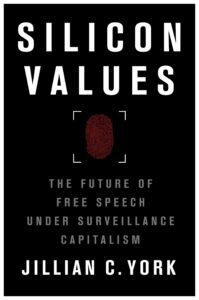
Over the years, my views on the relationship between free speech and tech have evolved. Once I believed that companies should play no role in governing our speech, but later I shifted to pragmatism, seeking ways to mitigate the harm of their decisions and enforce limits on their power.
But while the parameters of the problem and its potential solutions grew clearer, so did my thesis: Content moderation— specifically, the uneven enforcement of already-inconsistent policies—disproportionately impacts marginalized communities and exacerbates existing structural power balances. Offline repression is, as it turns out, replicated online.
The 2016 election of Donald Trump to the U.S. presidency brought the issue of content moderation to the fore; suddenly, the terms of the debate shifted. Conservatives in the United States claimed they were unjustly singled out by Big Tech and the media amplified those claims—much to my chagrin, since they were not borne out by data. At the same time, the rise of right-wing extremism, disinformation, and harassment—such as the spread of the QAnon conspiracy and wildly inaccurate information about vaccines—on social media led me to doubt some of my earlier conclusions about the role Big Tech should play in governing speech.
That’s when I knew that it was time to write about content moderation’s less-debated harms and to document them in a book.
Setting out to write about a subject I know so intimately (and have even experienced firsthand), I thought I knew what I would say. But the process turned out to be a learning experience that caused me to rethink some of my own assumptions about the right way forward.
One of the final interviews I conducted for the book was with Dave Willner, one of the early policy architects at Facebook. Sitting at a café in San Francisco just a few months before the pandemic hit, he told me: “Social media empowers previously marginal people, and some of those previously marginal people are trans teenagers and some are neo-Nazis. The empowerment sense is the same, and some of it we think is good and some of it we think is not good. The coming together of people with rare problems or views is agnostic.”
That framing guided me in the final months of writing. My instinct, based on those early experiences with social media as a democratizing force, has always been to think about the unintended consequences of any policy for the world’s most vulnerable users, and it is that lens that guides my passion for protecting free expression. But I also see now that it is imperative never to forget a crucial fact—that the very same tools which have empowered historically marginalized communities can also enable their oppressors.
[post_title] => Between Nazis and democracy activists: Social media and the free speech dilemma
[post_excerpt] => The content moderation policies employed by social media platforms disproportionately affect marginalized communities and exacerbate power imbalances. Offline repression is replicated online.
[post_status] => publish
[comment_status] => closed
[ping_status] => open
[post_password] =>
[post_name] => between-nazis-and-democracy-activists-social-media-and-the-free-speech-dilemma
[to_ping] =>
[pinged] =>
[post_modified] => 2026-08-06 22:43:16
[post_modified_gmt] => 2026-08-06 22:43:16
[post_content_filtered] =>
[post_parent] => 0
[guid] => https://conversationalist.org/?p=2452
[menu_order] => 216
[post_type] => post
[post_mime_type] =>
[comment_count] => 0
[filter] => raw
)
During the decade prior to the 2011 uprising, Egypt saw a blogging boom, with people from diverse socio-economic backgrounds writing outspoken commentary about social and political issues, even though they ran the risk of arrest and imprisonment for criticizing the state. The internet provided space for discussions that had previously been restricted to private gatherings; it also enabled cross-national dialogue throughout the region, between bloggers who shared a common language. Public protests weren’t unheard of—in fact, as those I interviewed for the book argued, they had been building up slowly over time—but they were sporadic and lacked mass support.
While some bloggers and social media users chose to publish under their own names, others were justifiably concerned for their safety. And so, the creators of “We Are All Khaled Saeed” chose to manage the Facebook page using pseudonyms.
Facebook, however, has always had a policy that forbids the use of “fake names,” predicated on the misguided belief that people behave with more civility when using their “real” identity. Mark Zuckerberg famously claimed that having more than one identity represents a lack of integrity, thus demonstrating a profound lack of imagination and considerable ignorance. Not only had Zuckerberg never considered why a person of integrity who lived in an oppressive authoritarian state might fear revealing their identity, but he had clearly never explored the rich history of anonymous and pseudonymous publishing.
In November 2010, just before Egypt’s parliamentary elections and a planned anti-regime demonstration, Facebook, acting on a tip that its owners were using fake names, removed the “We are all Khaled Saeed” page.
At this point I had been writing and communicating for some time with Facebook staff about the problematic nature of the policy banning anonymous users. It was Thanksgiving weekend in the U.S., where I lived at the time, but a group of activists scrambled to contact Facebook to see if there was anything they could do. To their credit, the company offered a creative solution: If the Egyptian activists could find an administrator who was willing to use their real name, the page would be restored.
They did so, and the page went on to call for what became the January 25 revolution.
A few months later, I joined the Electronic Frontier Foundation and began to work full-time in advocacy, which gave my criticisms more weight and enabled me to communicate more directly with policymakers at various tech companies.
Three years later, while driving across the United States with my mother and writing a piece about social media and the Egyptian revolution, I turned on the hotel television one night and saw on the news that police in Ferguson, Missouri had shot an 18-year-old Black man, Michael Brown, sparking protests that drew a disproportionate militarized response.
The parallels between Egypt and the United States struck me even then, but only in 2016 did I become fully aware. That summer, a police officer in Minnesota pulled over 32-year-old Philando Castile—a Black man—at a traffic stop and, as he reached for his license and registration, fatally shot him five times at close range.
Castile’s partner, Diamond Reynolds, was in the passenger’s seat and had the presence of mind to whip out her phone in the immediate aftermath, streaming her exchange with the police officer on Facebook Live.
Almost immediately, Facebook removed the video. The company later restored it, citing a “technical glitch,” but the incident demonstrated the power that technology companies—accountable to no one but their shareholders and driven by profit motives—have over our expression.
The internet brought about a fundamental shift in the way we communicate and relate to one another, but its commercialization has laid bare the limits of existing systems of governance. In the years following these incidents, content moderation and the systems surrounding it became almost a singular obsession. I worked to document the experiences of social media users, collaborated with numerous individuals, and learned about the structural limitations to changing the system.
Over the years, my views on the relationship between free speech and tech have evolved. Once I believed that companies should play no role in governing our speech, but later I shifted to pragmatism, seeking ways to mitigate the harm of their decisions and enforce limits on their power.
But while the parameters of the problem and its potential solutions grew clearer, so did my thesis: Content moderation— specifically, the uneven enforcement of already-inconsistent policies—disproportionately impacts marginalized communities and exacerbates existing structural power balances. Offline repression is, as it turns out, replicated online.
The 2016 election of Donald Trump to the U.S. presidency brought the issue of content moderation to the fore; suddenly, the terms of the debate shifted. Conservatives in the United States claimed they were unjustly singled out by Big Tech and the media amplified those claims—much to my chagrin, since they were not borne out by data. At the same time, the rise of right-wing extremism, disinformation, and harassment—such as the spread of the QAnon conspiracy and wildly inaccurate information about vaccines—on social media led me to doubt some of my earlier conclusions about the role Big Tech should play in governing speech.
That’s when I knew that it was time to write about content moderation’s less-debated harms and to document them in a book.
Setting out to write about a subject I know so intimately (and have even experienced firsthand), I thought I knew what I would say. But the process turned out to be a learning experience that caused me to rethink some of my own assumptions about the right way forward.
One of the final interviews I conducted for the book was with Dave Willner, one of the early policy architects at Facebook. Sitting at a café in San Francisco just a few months before the pandemic hit, he told me: “Social media empowers previously marginal people, and some of those previously marginal people are trans teenagers and some are neo-Nazis. The empowerment sense is the same, and some of it we think is good and some of it we think is not good. The coming together of people with rare problems or views is agnostic.”
That framing guided me in the final months of writing. My instinct, based on those early experiences with social media as a democratizing force, has always been to think about the unintended consequences of any policy for the world’s most vulnerable users, and it is that lens that guides my passion for protecting free expression. But I also see now that it is imperative never to forget a crucial fact—that the very same tools which have empowered historically marginalized communities can also enable their oppressors.
[post_title] => Between Nazis and democracy activists: Social media and the free speech dilemma
[post_excerpt] => The content moderation policies employed by social media platforms disproportionately affect marginalized communities and exacerbate power imbalances. Offline repression is replicated online.
[post_status] => publish
[comment_status] => closed
[ping_status] => open
[post_password] =>
[post_name] => between-nazis-and-democracy-activists-social-media-and-the-free-speech-dilemma
[to_ping] =>
[pinged] =>
[post_modified] => 2026-08-06 22:43:16
[post_modified_gmt] => 2026-08-06 22:43:16
[post_content_filtered] =>
[post_parent] => 0
[guid] => https://conversationalist.org/?p=2452
[menu_order] => 216
[post_type] => post
[post_mime_type] =>
[comment_count] => 0
[filter] => raw
)

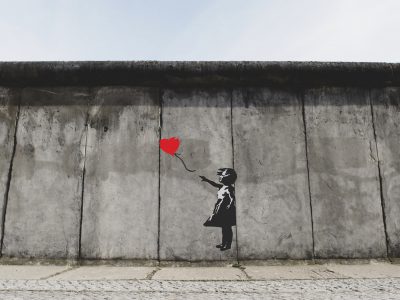
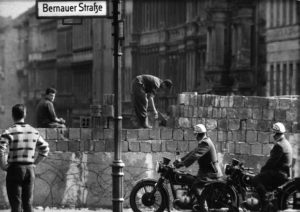 Building the Berlin Wall, 1961.[/caption]
Which brings us back to the present place and time. Trump envisions a wall that keeps people out, but his wall is destined only to exacerbate the problems it seeks to solve. Until the 1970s, the United States had a porous border with Mexico—which, contrary to what most Republican lawmakers might claim, actually resulted in
Building the Berlin Wall, 1961.[/caption]
Which brings us back to the present place and time. Trump envisions a wall that keeps people out, but his wall is destined only to exacerbate the problems it seeks to solve. Until the 1970s, the United States had a porous border with Mexico—which, contrary to what most Republican lawmakers might claim, actually resulted in