
WP_Post Object
(
    [ID] => 1488
    [post_author] => 2
    [post_date] => 2019-11-22 16:24:16
    [post_date_gmt] => 2019-11-22 16:24:16
    [post_content] => In an age of declining democracy, rising walls, and closing borders, a brilliant art exhibition makes a persuasive case for openness and freedom. 

Three decades ago, the world watched as throngs of East and West Germans tore down the wall that had divided Berlin for 28 years. Joyous street celebrations marked the end of an era distinguished by repression and censorship, ushering in a new age of democracy and freedom. My own fuzzy childhood recollection of that evening by our family television in Westchester, N.Y. is soaked in champagne toasts and heartfelt tears.

Unfortunately, the promise of those heady days has long since faded. While in 1989 history seemed to be moving in a straight line toward democracy and openness, today we are seeing the global rise of autocrats, demagogues and xenophobia. Even the phrase “we are the people,” which pro-democracy demonstrators chanted at the Berlin Wall in 1989, has been coopted by Germany’s far-right AfD party in support of nationalist, isolationist policies. Instead of a post-wall utopian paradise, we’ve found ourselves in increasingly border-obsessed times, entering what the historian David Frye author of Walls: A History of Civilization in Blood and Brick, calls “a second age of walls.”

For most millennials, the Cold War is barely-remembered history. They might recall a few dry textbook paragraphs. Perhaps they saw Hollywood movies like The Hunt for the Red October — with Sean Connery starring as a Soviet naval commander — or the impossibly sexy television drama The Americans, about two Soviet spies living under deep cover in suburban Washington, D.C., during the 1980s. But the Berlin Wall was a very real part of my childhood. As the daughter of a refugee from the German Democratic Republic (East Germany), some of my earliest memories include learning during a family vacation that East German water wasn’t safe to drink, and hearing my parents describe my petulant scowls as my “East German border guard look.” The Wall was a totem that loomed large in our home. It shaped my entire conception of good and evil into a simple, binary understanding of the world: freedom (U.S.A.) good; wall (U.S.S.R.) bad. At the time, it seemed that all the adults saw the world in the same way: indeed, one would have been hard pressed to justify the morality of dividing families, bugging private residences, and terrorizing a population into obedience through the Stasi (State Security Service).

During the Cold War, opposition to the Berlin Wall was a bipartisan issue in the United States. In Berlin in 1963, President John F. Kennedy famously said “Ich bin ein Berliner,” indicating his support for a united, democratic city; he did not know that a “Berliner,” was the local word for a jelly donut, a fact that inspired many memes and jokes.


When Ronald Reagan stood at the Brandenburg Gate to give his own Cold War speech in 1987, the line that became iconic was, “Mr. Gorbachev, tear down this wall.”


Today, walls again fill the news, but the rhetoric has shifted dramatically. Since first tweeting about it on August 4, 2014, Donald Trump has been crowing regularly about the great American border wall to be, albeit with variable costs, heights, and Mexican-bill-footers. So, what happened over the past decades that morphed the Republican rallying cry from “tear down this wall” to “build a wall?”

As someone who grew up thinking of “wall” as another four-letter word, I’m not the only one to notice the ironic timing of this anniversary. In the Annenberg Space for Photography’s affecting exhibition WALLS: Defend, Divide and the Divine, curator Jennifer Sudul Edwards grapples with our contradictory reality and breaks down the significance of walls across the ages. She notes at the exhibit’s entrance, “When the Berlin Wall was torn down in 1989, there were 15 border walls around the world. Today there are more than 70.” Although globalism and technology have presented more opportunities for connection than ever, countries around the world are increasingly shutting others out and turning inward. Where the internet erases distance, politics reinstates it.

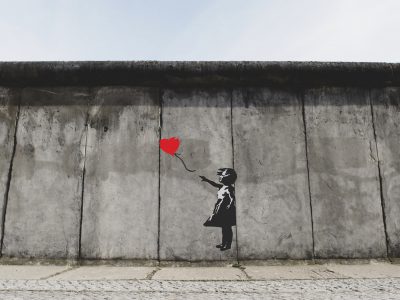
Edwards’ WALLS traverses the boundaries both historical and metaphorical. We see the segregationist 8-mile wall that divided white and black residents of Detroit; the so-called peace walls that were built to separate Catholics from Protestants in Northern Ireland; and, of course, the Berlin Wall, with the now iconic images of East German soldiers leaping over the half-constructed wall to freedom, and graffiti of Brezhnev and Honecker (the East German Communist party leader) kissing in what came to be known as the “socialist fraternal kiss” (now available as both a beer  and a gin!)

[caption id="" align="aligncenter" width="575"]Restoration of the kiss - between East German leader Erich Honecker and Soviet leader Leonid Brezhnev, Berlin Wall A Berlin wall mural shows the famous 1979 kiss between East German leader Erich Honecker and Soviet leader Leonid Brezhnev.[/caption]

Outside, we are met with the obligatory full text of Robert Frost’s Mending Wall and, in full woo-woo Los Angeles fashion, an installation called Light the Barricades, where patrons are invited to meditate on the inner walls we all create-- Resentment, Judgment, and Doubt, specifically. Inside, you’re encouraged to write down “What is blocking your path,” with the understanding that your response may be selected for inclusion in a projected video loop. (Unsurprisingly, a majority of the answers I saw centered on crippling student debt and other sundry money issues. Now that’s a wall.) From the Walls! children’s book for sale in the gift shop to Pink Floyd’s Another Brick in the Wall music video being projected in the women’s bathroom, the exhibit leaves very few wall-stones unturned.


Edwards’ exhibit is unapologetic in the ethos it engenders, which very much echo those of my childhood self: freedom = good; walls = bad. But she also elegantly captures the manner in which public opinion dictates the meaning and significance of walls in our society. In her exhibit, we see walls shift from a symbol of authority to a canvas for resistance. Like any other framing device, walls are used to delineate and define, but unlike these fixtures, what they signify is fluid. To borrow from literary theorist Kenneth Burke’s Terministic Screens, we make sense of the world around us by what elements of reality we reflect, select or deflect. A wall is a wall is a wall. But whereas to some it can symbolize safety or defense, to others it signifies exclusion and division, control and repression. While most pictures of the Berlin Wall capture a famously colorful concrete scar of bright, expressive, politically-charged graffiti, the Berlin Wall I knew — the one my father risked his life to cross —was a drab gray; anyone who approached it would be shot. The West-facing Berlin Wall told a story of resistance that was invisible to the East.

Edwards’ exhibit is as much a collection of wall photos as it is classic, insightful wall quotes. Its “Delineation-Deterrent-Defense” section begins with this old chestnut from Upton Sinclair’s classic 1905 novel The Jungle — “There is one kind of prison where the man is behind bars, and everything that he desires is outside; and there is another kind where the things are behind bars, and the man is outside.” When the Berlin Wall was built in 1961, its purpose was to keep people in, although publicly Walter Ulbricht, the East German communist party leader, claimed it was a defense “against West German influence.” The wall was a symbol that represented the opposite of freedom—the opposite of American values. As advocates for a unified, democratic Germany, U.S. politicians stood unwaveringly in opposition to the GDR. You don’t have to be a historian to see that creating a wall to stop the flow of people across a border only intensifies the natural human desire to cross. Create a wall and create an obstacle—a definition, a delineation, a limitation. As WALLS captures, few problems are permanently solved by these barriers, whether it be the obedience of East Germans or keeping the peace in Northern Ireland.

[caption id="attachment_1496" align="aligncenter" width="636"] Building the Berlin Wall, 1961.[/caption]

Which brings us back to the present place and time. Trump envisions a wall that keeps people out, but his wall is destined only to exacerbate the problems it seeks to solve. Until the 1970s, the United States had a porous border with Mexico—which, contrary to what most Republican lawmakers might claim, actually resulted in fewer undocumented migrants living in the United States, as workers could cross over, work, and then return to their homes back in Mexico. The current administration calls the now-militarized border “porous,” with “record-breaking” rates of “illegal aliens” crossing over and remaining in the country. In fact, it was the U.S. government’s elimination of border porousness and availability of work visas, starting in 1965, that sparked the ever-increasing “surge” of immigrants from Latin America. Once you take away the option to allow people to leave, you encourage those who very well might have left, if given the freedom to do so, to stay. But instead of easing off of militarized borders, our government is leaning further and further in.

Thirty years ago, the world celebrated the elimination of a wall, the reunification of a country, the hope for a day where walls need no longer exist. I think of my father, a refugee who fully embraced his American citizenship as his identity, who proudly put out our American flag on every holiday, whose eyes shone with tears of gratitude to the lyrics of “Born Free,” warbled by my tone-deaf elementary school choir. Trump’s wall is not just a wall. It demarcates the end of the American ideal. It is the elimination of “nation of immigrants” from the United States Citizenship and Immigration Services’ mission statement. It is a line that places our country on the wrong side of history. For refugees seeking a better life, for the sake of our country’s future, for the memory of my father: Mr. Trump, don’t build this wall.

 
    [post_title] => 'Wall' is a four-letter word
    [post_excerpt] => “When the Berlin Wall was torn down in 1989, there were 15 border walls around the world. Today there are more than 70.”
    [post_status] => publish
    [comment_status] => closed
    [ping_status] => open
    [post_password] => 
    [post_name] => wall-is-a-four-letter-word
    [to_ping] => 
    [pinged] => 
    [post_modified] => 2026-09-16 22:44:48
    [post_modified_gmt] => 2026-09-16 22:44:48
    [post_content_filtered] => 
    [post_parent] => 0
    [guid] => https://conversationalist.org/?p=1488
    [menu_order] => 291
    [post_type] => post
    [post_mime_type] => 
    [comment_count] => 0
    [filter] => raw
)
‘Wall’ is a four-letter word

WP_Post Object
(
    [ID] => 1465
    [post_author] => 2
    [post_date] => 2019-11-14 19:08:41
    [post_date_gmt] => 2019-11-14 19:08:41
    [post_content] => Launched with a hashtag, a new movement seeks to raise awareness of how fundamentalist Christianity is polarizing the national discourse.

In thousands of evangelical elementary schools across the United States, children begin each day by reciting three pledges — one to the American flag, another to the Christian flag, and a third to the Bible. The latter two might come as a shock to people who are unfamiliar with white Christian fundamentalist subculture, but they are standard practice in these schools, approximately 2,000 of which are subsidized by taxpayer funds.

The version of the pledge to the Christian flag typically recited in fundamentalist and evangelical schools, which usually self-identify simply as Christian schools, ends with “one Savior, crucified, risen, and coming again with life and liberty for all who believe.” This is hardly a pluralistic sentiment. One wall in the elementary building of the K-12 Christian school I attended in the 1980s and ‘90s was emblazoned with part of Psalm 33:12, “Blessed is the nation whose God is the Lord.” We schoolchildren knew exactly what those words meant. We were raised to be the generation that would take back America for Christ, “saving” the country from the godless liberals who, we were told (explicitly and often), killed babies and were destroying the institution of the family, and whose preferred policies, we were told, would bring divine punishment on our nation.

Eighty percent of white, born-again Christians — that is, white evangelicals and fundamentalists — voted for Donald Trump in 2016. More than 90 percent of them object to his impeachment, and polls consistently show him at over 70 percent in their favorability rating. If you want an answer to the question of where President Trump’s white evangelical base was radicalized, it’s right here. And while this demographic is down to 16 percent of the population, it remained 25 percent of the electorate in the 2018 midterms and is advantaged by gerrymandering, voter suppression, and the Electoral College.

Ex-evangelicals (or “exvies”) like myself have been trying to draw attention to the problem of evangelical authoritarianism in recent years, bringing the insights that come with lived experience to the table. Using hashtag campaigns like #EmptyThePews,  #ChurchToo, #ChristianAltFacts, and #ExposeChristianSchools to achieve collective visibility we have, in conjunction with the efforts of researchers who have been monitoring the Christian Right for decades, made some progress in changing the national conversation around evangelicalism. A change in the discourse is essential if we are to shift the Overton window back from the extremes to which the Right has taken it over the last few decades.

For too many pundits, commentators, and gatekeepers, the answer to “where were they radicalized” is found in taboo territory. Christianity as it is practiced by millions is not always a social good — indeed, it is sometimes downright harmful to both individuals and society. But the Americans who most need to have that conversation are often unable to engage with the idea that the Christianity they view as “authentic” is anything less than perfect. And so we continue to see hand wringing, pearl clutching, and an increasingly desperate barrage of unhelpful think pieces about the “crisis” of young people leaving the church and about evangelical hypocrisy.

Repeating that the “coastal elites’” reading of the Bible is “correct” and “heartland evangelicals’” reading of the Bible is wrong will not, despite the former’s best intentions, convince evangelicals to withdraw their allegiance from Trump. The vast majority of white evangelicals are not going to listen to mainline Protestant, liberal Catholic, moderate to liberal evangelical, or Jewish commentators who quote Bible verses exhorting readers to treat foreigners with kindness. And fellow conservative evangelicals like Michael Gerson, a George W. Bush administration alum who helped create the monster of which Trump is a symptom — but who now sees Trump as a liability — are not going to rein them in. And none of this does anything to reverse the normalization of Christian extremism that now dominates the American public sphere.

Hashtags like #EmptyThePews can harness the democratic potential of social media — which still exists, despite the anti-democratic forces that exploit it for nefarious purposes — to break through these barriers. Indeed, hashtags may prove critical in the fight for human rights and democracy, the greatest threat to which, in the United States, is undoubtedly represented by the Christian Right and the Christian nationalist ideology to which its members adhere.

In August 2017, I launched #EmptyThePews out of frustration with the response from conservative white evangelical leaders to the white supremacist “Unite the Right” rally in Charlottesville, VA, at which protestor Heather Heyer was killed. Prominent Christian Right voices either remained silent on Trump’s “very fine people on both sides” comments, or even went so far as to assert on Pat Robertson’s Christian Broadcasting Network that there was “not a racist bone” in Trump’s body. Opining on how, as authoritarians, white evangelicals typically refuse to listen to any criticism, I observed that the only things they’re really afraid of are declining church attendance numbers and losing the youth. We should, therefore, throw their alienation of young Americans and their loss of members in their faces.

On August 16, 2017 I tweeted, “If you left Evangelicalism over bigotry and intolerance or this election specifically, please share your story with the hashtag #EmptyThePews. The hashtag trended, representing perhaps the first viral ex-evangelical hashtag, and my call for stories received a robust response.


Ruth Tsuria, a communications scholar who is working toward the publication of a peer-reviewed academic article on #EmptyThePews, said that the hashtag has created a community and provided it with a platform to discuss the bigoted and discriminatory behaviors its members experienced in church. Akiko Bergeron*, a former Southern Baptist who was an early adopter of the hashtag, told me: “Finding the Exvangelical community and using #EmptyThePews has been an enlightening and enriching experience for me. I have met others of different faiths and no faith at all. I have met people that have never been welcomed in evangelical churches because they don’t fit the rigid mold expected by a white patriarchal and authoritarian system. I have been changed for the better.”

But can #EmptyThePews create a lasting impact beyond this community? Can it help change the ways in which we discuss religion and society at a time when a large faction of Christians are unswervingly devoted to a president who continually undermines democracy and the rule of law?

While no one can control the ways in which a hashtag is used once it’s out in the world, I framed #EmptyThePews not as anti-religious, but as means of creating a coalition for those of us who leave toxic versions of Christianity — whether for better religion or for no religion at all. Even so, the hashtag does flip the predominant script about American secularization in our elite media. Peter Beinart contends, for example, in a sloppily-argued article for The Atlantic, that religion is a social good for its ability to foster good citizenship and national cohesion, full stop. Those who abandon it, he indicates, are divisive and probably disproportionately responsible for American polarization. In fact, Beinart frames the issue of asymmetric polarization in the United States precisely backwards — our polarization is driven from the right, and, I maintain, the Christian Right above all. #EmptyThePews points to the necessity of abandoning and confronting anti-democratic Christianity. Some religion embraces pluralism, but fundamentalism, in its intolerance, undermines pluralism, and white evangelical Protestantism is a variety of fundamentalism.

Two years after its launch, I still believe in the message, the protest quality, and the storytelling capacity of #EmptyThePews and similar hashtags as a means of inspiring people to confront the threat to democracy, human rights, and pluralism represented by right-wing evangelicalism and the Christian nationalism it fosters. As more stories of leavers of high-demand, anti-pluralist, fundamentalist religious groups are highlighted in the public sphere, we might begin to see prominent media outlets and personalities grappling seriously with the nexus of authoritarian religion and the authoritarian politics currently on the ascendant in America.

Andrew L. Seidel, a constitutional attorney with the Freedom From Religion Foundation and the author of The Founding Myth: Why Christian Nationalism is Un-American, notes that representation matters when it comes to attaining social equality. “It is absolutely critical to showcase heathens, apostates, heretics, dissenters, and ex-believers. Conservative and insular religions only survive as closed information loops.” The hashtag “tells the truth about what happens behind the closed doors of the churches,” he said, adding: “The truth might hurt the church, but that doesn't make the truth anti-religious.” Indeed, as Seidel argues throughout The Founding Myth, there can be no freedom of religion without freedom from religion.

In addition to providing Trump with his most enthusiastic and immovable base, right-wing, mostly white American evangelicalism has been shown in recent years to have widespread issues with sexual abuse and cover-ups, and even with child marriage. This kind of born-again Protestantism is, like all fundamentalisms, ultimately incompatible with democracy; it must be defeated politically if we are to have a functional democracy in the United States. The first step to achieving that defeat must be the ability to name the problem and discuss it frankly.

My hope for #EmptyThePews and similar hashtag campaigns is that they will help to make those conversations possible in the upper echelons of America’s public sphere, and sooner rather than later. Without that shift in our national conversation, we could well be doomed to at least a generation of authoritarian rule imposed on the majority by the minority of America’s unreconstructed, waving their flags and worshipping at their megachurches.

*Akiko's surname is a pseudonym.
    [post_title] => If we want to save American democracy, we must have a very difficult conversation about evangelical Christianity
    [post_excerpt] => Born-again Protestantism is, like all fundamentalisms, ultimately incompatible with democracy; it must be defeated politically if we are to have a functional democracy in the United States.
    [post_status] => publish
    [comment_status] => closed
    [ping_status] => open
    [post_password] => 
    [post_name] => if-we-want-to-save-american-democracy-we-must-have-a-very-difficult-conversation-about-evangelical-christianity
    [to_ping] => 
    [pinged] => 
    [post_modified] => 2026-09-15 23:55:23
    [post_modified_gmt] => 2026-09-15 23:55:23
    [post_content_filtered] => 
    [post_parent] => 0
    [guid] => https://conversationalist.org/?p=1465
    [menu_order] => 293
    [post_type] => post
    [post_mime_type] => 
    [comment_count] => 0
    [filter] => raw
)

If we want to save American democracy, we must have a very difficult conversation about evangelical Christianity

WP_Post Object
(
    [ID] => 1437
    [post_author] => 2
    [post_date] => 2019-10-25 15:38:07
    [post_date_gmt] => 2019-10-25 15:38:07
    [post_content] => Once, the purpose of philanthropy was to elevate civil society. Today, it is used by the wealthy to purchase power and influence — often at the cost of civil society. Now a young generation of Americans who were born into rich families are searching for new models for the wealthy to give and effect change.

Recently, philanthropic donations from prominent organizations or individuals have become controversial. Leading cultural institutions, such as London’s Tate Museum and the Guggenheim in New York, renounced donations from the Sackler family, because their role in the opiate epidemic could no longer be disputed. Prestigious universities, like Harvard and MIT, are under fire for having accepted large sums from Jeffrey Epstein, even after a Florida court convicted him in 2008 of procuring underage girls.

Exposing the problem of “third-rail donors” is important, but public outrage at the rich getting richer by giving to the poor also obscures more fundamental questions: is philanthropy, even by those with ostensibly altruistic motives, such as Bill Gates, compatible with democracy? Does it serve or subvert it? Are there newer models that might better serve the public interest? And how should wealthy channel their resources for the common good?

During America’s Gilded Age of the late nineteenth century, inequality became so stark that it became an issue in the public discourse. Industrialists like Andrew Carnegie implored the wealthy to ask, “What is the proper mode of administering wealth after the laws upon which civilization is founded have thrown it into the hands of the few?”  Carnegie became a philanthropist in order to lift up the less fortunate but at the time his generosity was not well received. Eugene V. Debs, the famous socialist and labor leader, railed against him:

We want libraries, and we will have them in glorious abundance when capitalism is abolished and workingmen are no longer robbed by the philanthropic pirates of the Carnegie class. Then the library will be as it should be, a noble temple dedicated to culture and symbolizing the virtues of the people.

Most of the labor movement, however, took a more practical view. Samuel L. Gompers, founder of the American Federation of Labor, once responded that,

After all is said and done, [Carnegie] might put his money to a much worse act. Yes, accept his library, organize the workers, secure better conditions and particularly, reduction in hours of labor and then workers will have some chance and leisure in which to read books.

Carnegie’s philanthropic program created one of the most important civic institutions in the United States and in the rest of the English-speaking world — the branch library. His example, however, remains exceptional, not least because he endeavored to bolster the public sector. During the Progressive Era of the early twentieth century, civil society activists enlisted the wealthy to help champion causes that would lead to new public policy and civic institutions. Their ideals and achievements heavily influenced President Franklin D. Roosevelt’s New Deal, under which Congress enacted public works and welfare policies, like Social Security, that are taken for granted today but which were revolutionary at the time. Contemporary philanthropy in the United States does not address inequality, or promote progressive public policy. In Just Giving: Why Philanthropy Is Failing Democracy and How It Can Do Better, political philosopher Rob Reich notes two surprising things: at most, 30 percent of giving in the United States goes to poverty-fighting programs; and the higher your income, the less likely you are to give your money to those programs. The wealthy tend to give to cultural institutions and higher education, while the less wealthy are more disposed to give to poverty alleviating institutions like soup kitchens. Reich then asks a question that only seems rhetorical: would society benefit more from altruistic philanthropy or private consumption? Does the tax-deductible charitable work a foundation or wealthy individual undertakes contribute more to society than the taxes the public coffers would receive from a major purchase, or from inheritance taxes? Furthermore, why should the public subsidize a wealthy person’s priorities and discretionary spending? At a recent panel, Reich recounted a story told in Mark Dowie’s 2002 book, American Foundations An Investigatory History: when George Soros set up his Open Society foundation, there was disagreement about what its priorities should be. Soros allegedly pounded his fist on the table and said, “This is my money at the end of the day, and we’re going to do it my way.” A junior staff member then chimed in,

Excuse me Mr. Soros, roughly half the money in this foundation is not yours but the public’s – if you hadn’t placed your money in this institute, half of it would be in the U.S. Treasury.

According to Reich, foundations and charitable giving cost the US roughly $50 billion per annum in foregone taxation. As Reich says, big philanthropy is then essentially an exercise of power that is unaccountable, nontransparent, donor-directed, tax-deductible. It’s a plutocratic exercise of power in a democratic society. Over the past 100 years, the changing economic and political landscape has affected and been affected by the role of philanthropy. In Nicholas Lemann’s essential Transaction Man: the rise and the decline of the American dream, the author explores reasons for the decline of the big corporation and big government, and the rise of unregulated finance and private sector solutions (or lack of solutions) in their place. Lemann writes about the series of policy decisions that led to a disintegration of the social compact. A confluence of factors led to a receding welfare state, made easier by a growing distance from the lessons of the Great Depression. However, Lemann shows that the status quo is not the inevitable result of the march of progress. Transaction Man, with his eyes fixed on the bottom line, is the manifestation of years of shifting priorities. Anand Giridharadas perfectly illustrates how this new transactional ethos affects philanthropy in Winners Take All: The Elite Charade of Changing the World, (Penguin Random House, 2018). Most conspicuously it is to “do well by doing good.” As Giridharadas writes, “In the journey from Adam Smith’s theory to that of the win-win, the entrepreneur is transformed from an incidental booster of the common good into a unique figure specially capable of tending to it.” Winners Take All brings the reader along to the ubiquitous conferences and panels where tech entrepreneurs, thought leaders, politicians, corporate executives and philanthropists contemplate the challenges of the world, then enthusiastically agree with one another’s often market-based solutions.  “If the logic of our time had applied to the facts of an earlier age,” writes Giridharadas, “someone would have put out a report suggesting that ending slavery was great for reducing the trade deficit.” Giridharadas unfortunately overlooks a major reason for the neoliberalist bent to current philanthropy. As Jane Mayer explains in her important 2016 book Dark Money, liberal philanthropy is the consequence of very intentional conservative philanthropy. Mayer charts the weaponization of philanthropy by the Kochs and other conservative billionaires, in their successful attempt to move previously radical libertarian positions about money and government into the mainstream. Not all philanthropic foundations exist to promote policy that undermines government regulation or benefits respective industries. Most, however, seem to perpetuate the notion that the private sector is better positioned to offer solutions. Rob Reich and Nicholas Lemann are not the only ones challenging this received wisdom. Many, like Holly Fetter, are searching for new models for the wealthy to give and effect change. Fetter grew up wealthy, but felt unable to reconcile her class with her more progressive politics. As she tells it: “When I went to an Occupy rally, I then went home and actually googled “rich kid social justice.”  She founded the Stanford University chapter of the Resource Generation, a community of young people, 35 and younger who are in the wealthiest 10 percent and are committed to wealth redistribution that aids progressive causes. The tagline on their website reads, “Got class privilege and want social justice?” Patriotic Millionaires is another group of the very wealthy people seeking systemic change. The quote framing its homepage, by former AOL executive Charlie Fink states, “Because my country – our country – means more than my money.” It includes links to a conference that calls for taxing the rich, and an article titled Equalizing Capital Gains is Essential for Equality. The North Star Fund is a 40 year-old New York City-based social justice foundation that provides more options for rich people who want to make the world more equitable. Their work includes the participation of communities to which they have contributed grant money totaling $57 million. Rachel Sherman, a sociologist who has been studying the habits of the wealthy, feels that there is something important about this political moment. In an interview with The Conversationalist she said, “Sanders and Warren talk about inequality and that it is silence about wealth, the fact that it’s kind of uncouth to talk about money, that allows so much inequality to hold together.” She emphasized the importance of not attacking individual rich people, or pointing out the “good” wealthy person who spends her money “appropriately.” Her work has raised this issue of what kind of person is a good wealthy person, and if we deem them so, would we then think they are entitled to their wealth? Sherman points to Warren Buffet as an example, saying: “It doesn’t matter that he’s lived in the same house he bought in 1951; there is nothing you can do to be entitled to that much money.” Sherman makes an apt analogy to engaging with white privilege and says, “If we can get rich people to not feel personally defensive…it is very analogous to white people feeling defensive about white privilege – ‘I’m not racist so it’s fine.’  You may not be a rich asshole, but you are still benefiting from class privilege.” She feels it is extremely important to depersonalize wealth and “show that this is a moment where we actually have shared interest in having a more egalitarian society and it is something we can do collectively.” She reflects that the new younger wealthy class, like Resource Generation, are able to catalyze this kind of conversation by openly saying “this is not about me personally — it’s not my fault — we just need to recognize the structural reasons [for inequality].” With the 2020 elections looming, inequality, and the role of government in addressing it, have risen to the surface for the first time in several generations. The spate of books about the role of philanthropy and the private sector attest to this. Problematic contributions by the Sacklers, the Kochs, and others with dubious intentions or sources of wealth, should highlight the urgency of reassessing redistribution of wealth more generally. Rather than relying on the wisdom and moral clarity of the very wealthy to fix societal ills, perhaps new models of philanthropy, or their tax contributions as citizens, should replace them. [post_title] => Is philanthropy subverting democracy? [post_excerpt] => Contemporary philanthropy in the United States does not address inequality, or promote progressive public policy. Instead it has become transactional — a means for the rich to purchase power and influence. [post_status] => publish [comment_status] => closed [ping_status] => open [post_password] => [post_name] => how-philanthropy-is-subverting-democracy [to_ping] => [pinged] => [post_modified] => 2026-09-15 23:29:34 [post_modified_gmt] => 2026-09-15 23:29:34 [post_content_filtered] => [post_parent] => 0 [guid] => https://conversationalist.org/?p=1437 [menu_order] => 296 [post_type] => post [post_mime_type] => [comment_count] => 0 [filter] => raw )

Is philanthropy subverting democracy?