WP_Post Object
(
    [ID] => 832
    [post_author] => 5
    [post_date] => 2019-04-12 16:43:40
    [post_date_gmt] => 2019-04-12 16:43:40
    [post_content] => Google is not known for self-sacrifice. That is why New York should be more skeptical of its latest 'free' offer

Earlier this week, Google opened their temporary "Grow with Google New York City Learning Center" on the first floor of the company's Chelsea offices. The "pop-up" space embodies techno-optimism: well-lit classrooms with nearly floor-to-ceiling windows, decorated in neutrals with occasional pops of primary colors, and well-stocked with Google Chromebooks. For five months, the technology company will provide free and open-to-the-public classes on topics like "Manage Projects More Effectively with Online Tools" and "Make Your Website Work For You."

The vast majority of classes are based on Google products: Learn to manage projects with Google Sheets; get your business online with Google My Business; discover new job opportunities with Google Search. In other words, Google is further entrenching their business monopoly under the pretence of helping entrepreneurs and job seekers. The company is  cynically deploying the American dream of hard work and the self-made success story for its own benefit, expecting New Yorkers to thank them for the opportunity to help make Google even richer and more powerful.

But, you say, knowing how to use Google products effectively is a great and marketable skill! Why shouldn’t we accept trickle-down education? Perhaps because to do so is to cede another facet of our society to a company that already has an outsized influence on our lives. The money spent on this glorified PR stunt could have been used to support the original programming of the initiative’s partner organizations, like the New York Public Library, which already offers free classes on subjects like basic computer skills, creating a resume, and social media marketing. Unlike the Google Learning Center, the NYPL won’t close up shop in five months.

Exploiting our fears

Enthusiasm for technology skills programs often stems from our collective anxieties about the future of work, or what will happen when the robots come for our jobs. "If you can't beat 'em, join 'em," goes this line of thinking. Google is subtly playing to these fears, to our desire to come out on top in a tech-dominated world. "Tech related skills are essential for people looking for jobs in the modern economy, and Grow with Google will go far toward helping New Yorkers gain the expertise they need to thrive," Manhattan Borough President Gale Brewer said in a statement given to a local reporter. The cause-and-effect is made even more explicit in another article on a tech news website that covered the center's launch. "The Google NYC Learning Center is part of the "Grow with Google" initiative, first launched in 2017," AJ Dellinger writes for Engadget. "As part of that project, Google has pledged to spend $1 billion to help people adapt to an increasingly digital world and learn new skills that may place them in suitable jobs should their current career get wiped out by automation." Even if Google hasn’t made such a promise, the company has let the misconception stand. Google describes the material taught at the learning center as "digital skills.” The phrase is almost meaningless given that nearly every facet of our lives is mediated by digital devices, but it conveys the impression that the company is generously preparing New York workers for an automated future — the very future they're doing their best to bring about. The reality is not quite so cutting-edge: In addition to the Google product-based courses, there are classes like "Design an Effective Resume" and "Optimize Your Energy for High Performance" and "Coach Your Team to Success." These are important and valuable skills, to be sure — but they are not "digital skills." The marketing of this project is an ingenious and insidious bait and switch: offer glitzy and in-demand tech skills, but limit the actual courses to the walled garden of Google products, which has the additional benefit (for Google) of drumming up more customers for their services. The model is similar to Facebook's Free Basics program, whereby Facebook subsidizes free internet access, but only to an incomplete and partial internet that is mediated by Facebook. Thus neophyte users conflate Facebook with the internet, and become captive users of the social media platform. Google's spokespeople have been more careful about what they promise. Ruth Porat, the Senior Vice President and Chief Financial Officer of Google and Alphabet, characterizes the pop-up shop as part of their commitment to "STEM education, workforce development and access to technology." Porat describes Grow With Google as "our initiative to create economic opportunities for all Americans" — an ambitious goal that is so vague, it becomes meaningless. Torrence Boone, the NYC site lead, describes Grow with Google as "our program to help individuals and small businesses gain the skills that can set them up for success, today and in the future."

Digital robber barons

Even this seemingly innocuous statement is based on an outdated fantasy; it perpetuates the myth that it's easy to pull yourself up by the bootstraps in contemporary America. In the United States between 1978 and 2012, the number of startups (companies less than a year old) plummeted, their share of all businesses falling nearly 44 percent. While there are a number of factors at play, the most significant is that the largest players are crowding out the little guys. Google is among those big baddies. As Robert Levine reported for The Boston Globe, Google controls 90 percent of the search market. It operates the most popular online video site, mapping application, and internet browser. The company has used their market dominance to stifle the competition — by giving Google products preference in the Google search engine, for example. As Open Markets Institute outlines in this explainer on "Entrepreneurship and Monopoly," market concentration centralizes resources, talent, and money while squeezing out potential up-and-comers. This happens at the expense of the larger job market; nearly two-thirds of the nation's net jobs created over the past 15 years have been at smaller companies. In other words, we have a monopolistic company with a track record of self-promotion and stifling competition dispersing crumbs of knowledge to the unskilled masses, while creating more revenue opportunities for Google. And what Google is offering truly is just crumbs — not even a full loaf of bread. Students are limited to just three classes at the learning center, a fact that is not mentioned either in Google's promotional material or in any of the launch publicity. (Some partner organizations are using the space to hold their own private or public classes, which may run over three classes, but registration for those appears to be handled by the partners, not Google.) It's not clear from the class registration page if prospective students are limited to just three classes over the five weeks, or if one can only sign up for three classes at one time. Either way, three classes on any topic is hardly sufficient to prepare someone for a job they weren't already qualified to do. Judging by the registration page, nearly every class at the learning center — through April 27 — is entirely full. There is clearly a demand for this kind of programming. Google worked with local partners like the New York Public Library to design course offerings that would be worthwhile for New Yorkers, but one might be justified in seeing this as a case of a tech giant having rebranded programming suggestions from local experts and taking the credit. But only a grinch would deny kids the opportunity to learn to code, so what’s the problem?

Gifts with strings attached

The gap between what has been promised and is provided is a problem, especially if Google is getting more from the programming than the company is giving. There is a question of what goodwill or favors initiatives like this will buy the company as they expand their New York City footprint. A $5 million investment in workforce development and job training was part of the deal with Amazon that fell through; what will Google get when they point to their generous free programming and say "Look what we did for you, NYC"? The same could be said for any of the cities and towns where Google has disseminated their “Grow With” programming, albeit over the course of weeks, not months. Anxiety about the future of work is real. As local governments seek to prepare residents for potentially grim employment prospects, they will surely be tempted to cede responsibility to the tech giants. After all, local officials aren't usually known for being particularly tech-savvy, so why not let the experts handle it? But when those experts are monopolistic corporate giants upon which society is already reliant and beholden in so many ways, we cannot trust them to fix the problems that their business models exacerbate. Their track record proves they are unwilling to share information that will help anyone but themselves. If we've learned anything from the surveillance economy, it's that nothing is ever really free. Local government officials should follow Google’s example: look to public libraries to help create equitable paths to prosperity and ongoing education. Empower them and fund them. Don’t let the corporate monopolies stifling innovation and throttling the American dream determine the future of workforce development solely to their benefit and not ours. Jessica McKenzie is a freelance journalist based in Brooklyn, NY. You can follow her on Twitter @jessimckenzi. [post_title] => Beware of Google bearing gifts [post_excerpt] => Google's offer of free courses in digital skills is packaged as a philanthropic initiative, but a closer look raises serious questions about its motives and the intangible but serious costs to the public. [post_status] => publish [comment_status] => open [ping_status] => open [post_password] => [post_name] => beware-of-google-bearing-gifts [to_ping] => [pinged] => [post_modified] => 2024-08-28 21:15:14 [post_modified_gmt] => 2024-08-28 21:15:14 [post_content_filtered] => [post_parent] => 0 [guid] => https://conversationalist.org/?p=832 [menu_order] => 340 [post_type] => post [post_mime_type] => [comment_count] => 0 [filter] => raw )

Beware of Google bearing gifts

WP_Post Object
(
    [ID] => 806
    [post_author] => 3
    [post_date] => 2019-04-05 15:58:28
    [post_date_gmt] => 2019-04-05 15:58:28
    [post_content] => In times of repression and despair, art plays an essential role — politically, intellectually, and spiritually

What do Childish Gambino’s “This Is America” and a giant penis on a drawbridge in St. Petersburg have in common? 

Both tell us something about the importance of art in political life.

In societies that place a high value on monetary wealth, and which regard not having money as a moral failing, artists, whose careers are precarious, are marginalized. In contemporary America, we like to think that people with the most brains and ambition go into finance, or head to Silicon Valley. 

The truth about artists and their function is far more complicated. Russian art is a good example here, because the oppressive mechanisms used against people in Russia are disturbingly similar to those employed by the current U.S. administration and its powerful supporters. The power of these reactionary forces could become even more entrenched after the 2020 election.  

It’s undeniable that the current U.S. president’s penis occupies its own space in cultural lore. With that in mind, recall the penis drawing that Voina, the Russian art collective supported by Banksy, drew to taunt agents inside the St. Petersburg headquarters of the FSB, the notorious state security agency. That drawing famously won a state-supported Russian art prize in 2011, despite the official uproar.

[caption id="attachment_809" align="alignnone" width="300"] A Dick Captured by the FSB, 2010, Liteiny Bridge, St. Petersburg. (photo: Voina)[/caption]

The FSB is one of the most feared institutions in Russia. Art critics understood that taunting the successor to the KGB with an enormous image of an erect penis drawn on the bridge outside its headquarters makes an interesting statement. Is that statement juvenile? Yes, it is. But it also identifies the fact that power in Russia, and power in general, is a dick-measuring contest.

Art as catharsis

The immaturity of the gesture is also a statement. In a chaotically repressive country like modern Russia, where self-expression can be an exhausting maze of dead ends because officials have power to make capricious decisions like cutting off an organization’s funding for political reasons, or having someone arrested on trumped up charges, waving a dick at an official organ of the state is catharsis. Catharsis — and the fearless desire to shock — brings me back to Donald Glover, a.k.a. Childish Gambino, with his tight combination of laughs, parodies of racist fantasies of blackness, unflinching gun violence, and so much more. The song and the video for This Is America unspool into a dissertation’s worth of political commentary. But what ties Glover’s work together is how it elevates surviving malevolent, oppressive conditions into living; it flips the experience of being caricatured into owning the narrative. If you’re looking for ways to understand how important art is to real resistance (not the hashtag kind), this is it. [caption id="attachment_810" align="alignnone" width="300"]Childish Gambino (This is America, screencap) Childish Gambino (This is America, screencap)[/caption] In an oppressive political framework, the artist occupies an interesting position — and we shouldn’t always assume it to be subversive. All art can be co-opted by a repressive state apparatus, but its meaning and role in history can also change over time.

Art as resistance

One of the most interesting, and sadly overlooked, examples of artistic resistance in practice was the husband and wife team of Arkadiy Aktsynov and Lyudmila Aktsynova. These two talented painters met and fell in love in the Soviet gulag; like millions of other Soviet citizens, the state had sent them there in the 1930s for imaginary crimes. Miraculously, they survived well into the 1990s and left behind a treasure trove of both joyful and contemplative work; their landscapes, which they frequently collaborated on, are a particular favorite of mine. Having been forced out of the Soviet cultural mainstream by the legacy of the gulag, they dedicated their lives and their work to provincial Russia, where they found recognition. “We were saved by our faith in people and in kindness, and by an immeasurable fury in our work,” they recalled in their jointly authored memoir. The fury was both a symbol of their productivity and their desire to carve out a space for themselves, to create their own landscape, even while they were prisoners hemmed in by barbed wire. [caption id="attachment_812" align="alignnone" width="300"] Landscape by Arkadiy Aktsynov and Lyudmila Aktsynova, 1962. Oil and cardboard.[/caption] The nature of state oppression is such that it penetrates into all levels of society and all factors of daily life. It seeks to demonstrate that you do not “own” yourself, and do not have a right to any damn landscape — be it outside or in your head. In the Soviet Union, oppression had a totalitarian aspect; it was bloody and brutal at the beginning of the USSR and lackadaisical toward its end. In Putin’s Russia, oppressive measures are frequently random and chaotic, their goal more psychological than ideological, creating a gripping unease that allows a small group of people to casually plunder the country. Yet the mechanisms in both instances remain the same: your life can be changed at any moment, because an official stomped his foot or waved her hand, and you will have little to no recourse in the aftermath. For Americans who follow Donald Trump’s tweets — i.e. for Americans who until recently had not considered the unpredictable nature of marginalized existence as captured by Childish Gambino — that feeling of instability might suddenly seem familiar.
Art as a teacher

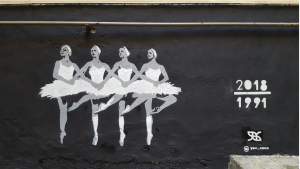
The passage of time meanwhile has a salutary effect on the interpretation of art that was originally created as an act of subversion. The Aktsynovs created art in the gulag as an act of survival. But after the state rehabilitated them in the post-Stalin era, their work became woven into the history of the Soviet nation as a cautionary tale. The message was, “These terrific painters were forced to suffer because our government made terrible mistakes!” Today, I’m sure that many of the people who admire the Aktsynovs, collect their paintings, and help organize their exhibitions, are also Putin supporters. Putin wouldn’t be a very good authoritarian if he didn’t know how to harness collective complicity. As for what meanings can be gleaned from the Aktsynovs work in the future — and what kind of cultural space they will come to occupy — only time can tell. The history and fate of dissident artists under repressive regimes might sound discouraging, but it need not be. In fact, it should inspire. An authoritarian can tell you to look or not look at a certain work of art, and tell you how you should feel about it. For example, when Vladimir Putin was elected for the fourth time, Russian graffiti artists co-opted the classical ballet Swan Lake to express a political statement about the decline of Russia’s democracy. [caption id="attachment_813" align="alignnone" width="300"] Swan Lake graffiti by Yav Zone art collective, (Moscow, 2018)[/caption] In Nazi Germany, the Nazis banned as degenerate some of the most important art and artists of the nineteenth and twentieth centuries. But you are the one who is responsible for what you feel when you look at a moody rural painting by a repressed artist. I’m specifically using the word “responsible,” because authoritarianism, due to its controlling nature, is ultimately infantilizing; this is something that Childish Gambino captures brilliantly in “This Is America,” by demonstrating how oppressive infantilization was practiced against generations of black people. In Russia, the late artist Vladislav Mamyshev-Monroe acted as a kind of bridge between the stuffy paternalism of the late Soviet era and the shiny cynicism in the age of Putin. Most people gravitate toward Mamyshev-Monroe’s depictions of male political leaders in bold makeup, and search for very serious political meaning. Mamyshev-Monroe was indeed a serious artist, but my admiration for his work stems from how much fun he had — how expressive, vulnerable, and powerful in his vulnerability this man was, whether dressed in drag to shock the elderly or poking fun at the celebrity cult embraced by Russia’s younger generation. [caption id="attachment_823" align="alignnone" width="300"] Russian Questions and Life of Marvellous Monroes shining with gold and silver foil. (New Museum)[/caption]


Art to bind communities

Once, the West exported capitalism to the post-Soviet countries. Now, the former Soviet Union is selling capitalism back to the West in a purer, more vicious form. Donald Trump, the sleazy real estate man who would sell state secrets for the opportunity to build a dubious casino on the banks of the Moskva River, is a good example of this exchange. But this phenomenon is bigger than one individual. It is present in greater social atomization, in greater political extremes, and in our fetishization of voting as a purely individual, consumerist act. Today, Mamyshev-Monroe is a good artist to turn to if we’re looking for creative ways to respond to seismic changes and growing rifts in our society. He knew how to poke fun while maintaining compassion toward his subject matter, inserting himself into his work not out of narcissism, but a sense of intimacy. In other words, Mamyshev-Monroe observed extremes in society — Soviet bureaucracy, the extravagance of crony capitalism — and sought to contain them, and forge something new out of them. In this light, politically engaged artists are not just cool or interesting. They work to repair the common threads that run through society. In good times or bad, art is not an escape. It’s about being present. The world being what it is, we end up being present for a lot of crap. Some people will sell you on the idea of art as transcendence, but I think of it as wading through the thick mess of existence alongside other people, reminding them that they are not alone. It’s a silly-sounding issue that is deadly serious: if we’re to make it through our current troubles, and the troubles yet to come, we must connect. We must be there for one another. Natalia Antonova is a writer, journalist, and editor of Bellingcat. She is currently based in D.C. Follow her on Twitter @nataliaantonova. [post_title] => This is your mind on art [post_excerpt] => In times of repression and despair, art plays an essential role — politically, intellectually, and spiritually [post_status] => publish [comment_status] => open [ping_status] => open [post_password] => [post_name] => this-is-your-mind-on-art [to_ping] => [pinged] => [post_modified] => 2024-08-28 21:15:14 [post_modified_gmt] => 2024-08-28 21:15:14 [post_content_filtered] => [post_parent] => 0 [guid] => https://conversationalist.org/?p=806 [menu_order] => 342 [post_type] => post [post_mime_type] => [comment_count] => 0 [filter] => raw )
Russian Stardust, by Vladislav Mamyshev-Monroe (Moscow Museum of Modern Art)

This is your mind on art

WP_Post Object
(
    [ID] => 792
    [post_author] => 5
    [post_date] => 2019-04-04 15:07:28
    [post_date_gmt] => 2019-04-04 15:07:28
    [post_content] => The following stories all address ways in which expectations, precedents, and like-begets-like can stifle, hinder, and hold back society — and how breaking from tradition can be revolutionary. Cara Marsh Sheffler broached this issue in an article for the Anti-Nihilist Institute that made the case for diversifying the liberal media, but this problem is not limited to news and storytelling: it extends to politics, elections, and to personal technology.

“Flooding” is a term to describe the effect of tens or hundreds of media outlets reporting the same story simultaneously, all with the same point of view. The result is an echo chamber that drowns out dissent and sidelines important stories. How can we outsmart the algorithms and be better informed? Read more.

Big Tech is eroding our expectations of privacy by offering us convenience. When ordinary people try to resist — as in the case of an English village that tried to stop Google Street View from mapping their village, Big Tech wears down opposition with “years of litigation, media misdirection, and political manipulation, until the land grab becomes established fact.” The only response to this can be: “Create friction”; do not go gently, etc. Read more.

Speaking of obsolete structures and habits holding society back — shall we consider the electoral college? As the debate over the future of our elections rages, it's worth considering the pros and cons, and why some people are so invested in the status quo. Read the op-ed.

In an op-ed for The New York Times, Tina Brown makes the case that women leading like women can pave the way for a more just, even-keeled society — she points to Jacinda Ardern's response to the Christchurch massacre as an example. Read the op-ed, "What Happens When Women Stop Leading Like Men."

Jessica McKenzie is a freelance journalist based in Brooklyn, NY. You can follow her on Twitter @jessimckenzi.
    [post_title] => How to beat the algorithms and become a better-informed person
    [post_excerpt] => 				This week we look at articles about how expectations, precedents, and like-begets-like can stifle, hinder, and hold back society — and how breaking from tradition can be revolutionary.		
    [post_status] => publish
    [comment_status] => open
    [ping_status] => open
    [post_password] => 
    [post_name] => how-to-beat-the-algorithms-to-become-a-better-informed-person
    [to_ping] => 
    [pinged] => 
https://conversationalist.org/2019/02/04/want-to-save-democracy-diversify-the-liberal-media/
    [post_modified] => 2024-08-28 21:15:14
    [post_modified_gmt] => 2024-08-28 21:15:14
    [post_content_filtered] => 
    [post_parent] => 0
    [guid] => https://conversationalist.org/?p=792
    [menu_order] => 343
    [post_type] => post
    [post_mime_type] => 
    [comment_count] => 0
    [filter] => raw
)

How to beat the algorithms and become a better-informed person

WP_Post Object
(
    [ID] => 771
    [post_author] => 11
    [post_date] => 2019-03-29 15:21:53
    [post_date_gmt] => 2019-03-29 15:21:53
    [post_content] => While the world praises Prime Minister Jacinda Ardren and the people of New Zealand for their compassionate, inclusive response to the Christchurch mosque attack, a more complex and nuanced conversation about the flaws in their society is taking place at home 
(with contributions from Brannavan Gnanalingam, Laura O’Connell-Rapira, Lamia Imam, and Jess Berentson-Shaw)
The world has been riveted by New Zealand’s response to the terror attack committed on March 16 by a white nationalist, who murdered 50 Muslims attending Friday prayers at two Christchurch mosques. Prime Minister Jacinda Ardren’s response, from her “they are us” to her insistence that she will not say the name of the attacker, has been heralded as a new standard in how to respond to such events. Meanwhile the public reaction — with New Zealanders gathering spontaneously in their thousands to stand in silent vigil around mosques all over the country for the first Friday prayers after the attack, has been praised as an example of compassion and tolerance. But in New Zealand, the public conversation about our response to this attack and what enabled this to take place in our country is more complex. Many New Zealanders have been challenged by what appear to be two mutually exclusive stories about who we are, as individuals and as a nation, in the wake of these attacks. On the one hand, our Prime Minister rapidly assured us and the world that this attack was an abomination against the values of tolerance and inclusiveness that we as a nation hold dear. In her first public statement after the attack, Ardern was unequivocal: the person who carried out the massacre was not ‘us’. Many New Zealanders were more than ready to believe her, and to identify with Ardern as a representation of who we really are — compassionate, empathetic, inclusive. Resolute in the face of hatred and terrorism. But there is another story being told in these days of grief and reckoning. It’s the story of Muslim New Zealander Lamia Imam’s experiences as a student in Christchurch, learning to stomach racism because ‘it wasn’t a big deal.’ “When white nationalists were congregating in Christchurch I was alarmed but let it go because ‘it is their country and they can choose to hate people'," she said. Anjum Rahman of the Islamic Women’s Council of New Zealand has written about the lengths her group went to, over five years and two governments, to draw attention to the growing threat of anti-Islamic and racist activity in New Zealand.

"We begged and pleaded, we demanded. We knocked on every door we could. … We told them about our concerns over the rise of vitriol and the rise of the alt-right in New Zealand. We asked them what resources were being put in to monitoring alt-right groups."

So which is it? Is New Zealand a country, as our prime minister has asserted, in which there is no place for the ideologies espoused by the Christchurch mosque terrorist? Or are we a country in which Islamophobia and racist hatred has been directed towards Muslim women for years, with little apparent action from our government? The mosque massacre has forced many New Zealanders to face this gap between who we want to believe we are and who we actually are.

A tale of two New Zealands

It’s the gap between the New Zealand that stood in silence outside mosques all over the country as our national radio station played the Islamic call to prayer, and the New Zealand that provides a man who compared immigrants to a snake with one of the largest media audiences in the country. It’s the gap between the New Zealand in which thousands of people stood together at vigils over the past two weeks to sing traditional Māori songs of peace, lament and love, and the New Zealand in which people regularly complain about te reo Māori — an official language of our country — being spoken on public radio, or taught in our schools. Some commentators in New Zealand have responded defensively to these competing stories, decrying it as a ‘narrative of self-loathing that wants us to think the worst of ourselves’. As one writer put it, we have to choose whether the true version of our country was to be represented by ‘a few misanthropic cranks who haven't yet got their heads around the new multicultural New Zealand, or the countless thousands of New Zealanders who attended vigils, donated money or quietly grieved at home for fellow citizens who happen to be Muslim’. But perhaps both these things can be true. For many New Zealanders, this tension has always been apparent, as has the fact that racism in New Zealand exists well beyond ‘a few misanthropic cranks’. New Zealand lawyer and writer Brannavan Gnanalingam, who was born in Sri Lanka, says that growing up, he thought Aotearoa (the Maori name for New Zealand) had a curious form of racism.

"Most people on a day-to-day basis were generally friendly to your face, but also subscribed to racist narratives that meant structural racism got embedded, particularly towards Māori. It meant we put up with casual racist jokes from friends and colleagues or faced racism from complete strangers without warning. The thing was, the discursive frameworks used in all of those 'light' situations were the same discursive frameworks used by those with far more nefarious motives."

For others, like Lamia Imam, the mosque massacre meant she could no longer maintain the illusion of the ‘better version’ of New Zealand.

“I looked at my New Zealand passport with pride and told myself I came from a country that was more compassionate and kind, a country that was slightly better. Today we are no better. We as a country failed to stop something horrific, because we like to believe we are better.”

One of the reasons these two competing narratives have taken so many by surprise, suggests Gnanalingam, is because of the highly segregated nature of New Zealand society.  

"We've got a very segregated society — class-wise, racially, politically. Christchurch took some Pākehā (white New Zealanders) by surprise because their everyday life didn't come into contact with people who subscribed to the terrorist's views. It meant they were very complacent. It also meant insidious narratives get embedded because there's no-one challenging it. Our mainstream culture is far too anti-intellectual and monocultural for that."

A leader who reflects her people

Reconciling this tension has been a challenge for Jacinda Ardern. Her first instinct — to reassure New Zealand and the world that this attack was entirely out of character for our country — was met with widespread approval at home and abroad. But as the narrative here in New Zealand has become more nuanced, and as time has passed since the attack, Ardern has begun to find ways to acknowledge the racism and intolerance that exists in our country. Ardern’s leadership has been seen by many New Zealanders to represent and reflect the best version of ourselves. She has shown very genuine empathy for the survivors and the families of those killed. She has been clear on the nature of this attack and resolute in her commitment to not naming or in any way elevating the profile of the attacker. She has demonstrated rare political skill in negotiating the support of both her more populist coalition partner and the opposition party for gun law reform. In the widespread, and justified, global admiration of Ardern’s empathy and compassion in the wake of the Christchurch attacks, her determination and political skill have perhaps been underplayed. Behind her ability to reflect back to us the best of who we want to be, is there something particularly ‘Kiwi’ about our Prime Minister? Ardern grew up in a small, working class rural town. Her father was a police officer, her mother worked in the school-cafeteria. They were members of the local Mormon congregation and Ardern has credited her upbringing as the source of her relatability, empathy and compassion. But as commentator Jess Berentson-Shaw has pointed out ‘there is something more important than our prime minister's empathy and compassion’ being demonstrated in her response to the mosque attack.   

"It is this: she has inhabited a role that was thrust upon her, and responded with a style of leadership that is guided not by a desire for personal recognition, but by a very clearly articulated set of collective values. She seems utterly genuine about putting others' needs before her own. Jacinda Ardern is restoring, in a uniquely 21st century way, the old-fashioned notion of public service."

That this public service leadership feels extraordinary, and so different from other leaders, says Berentson-Shaw, speaks volumes at how far we have travelled from what leadership should be. However, as she goes on to say, this commitment to serving the collective good is not without precedent in New Zealand. It has been demonstrated, ‘for decades, centuries even’ by Māori.

"Many Māori have made endless attempts to work with the Crown, and all New Zealanders, to find resolution and repair for violence and hate, intolerance and theft, enacted against them for decades. ... Yet they have been prepared to rebuild relationships. Māori have shown tolerance, and a willingness to work with Pākehā [white New Zealanders], even when Pākehā  refuse to see those efforts."

Maori lessons in grieving

In the immediate days following the attacks in Christchurch, it was to the example set by Māori that New Zealand looked for a guide on how to conduct ourselves. Māori campaigner Laura O’Connell-Rapira explains:

"In Māori culture, one of the most important aspects of losing a loved one is the tangihanga or tangi. The word means to weep and sing a lament for the dead. People travel from all around the country and world to these funerals to share in grief and memories of those who pass. The vigils that have been attended by tens of thousands of New Zealanders serve very much the same purpose."

In the wake of the attack, Māori from across New Zealand and Australia have also been captured, and shared across social media, performing haka to express solidarity with the Muslim community. The haka, popularised by the All Blacks, and often mistranslated as a ‘war dance’ is so much more than that. Haka can be a way of expressing grief, love, support, mourning. The week following the terror attack, Christchurch iwi (tribe) Ngāi Tahu opened their marae (spiritual meeting homes) to the Muslim community to sleep, pray and mourn their loved ones. This concept of opening up your home to others is based on a principle called manaakitanga, which means to ‘care for and uplift a person’s mana,’ or well-being in a holistic sense. So, if we turn so readily to traditional Māori values and practises to guide us in how to deal with grief and loss and prioritise collective care in our response to Christchurch mosque attack, asks O’Connell-Rapira, why haven’t we listened to Māori when they have repeatedly told us about the need to address our country’s racism? Countless commentators of colour including Muslims, Māori and migrants have been calling for New Zealanders to make the connection between this act of white supremacist terror and colonization. So much so it prompted a walk-out at an Auckland vigil. As wise elder and Māori lawyer Moana Jackson points out, “In many ways, today’s white supremacists are the most recent and most extreme colonizers." Laura O’Connell-Rapira adds:

"The person who killed 50 Muslims did so because he believes white people are superior to people of colour and he (and we) live in a society that promotes that message in a number of ways. Early colonizers also believed white people were superior to people of colour, so much so they kill(ed) us."

Recognizing colonial history

If we really want to do everything we can to ensure that this kind of violence is ‘never again’ perpetrated in our country, this may be the painful bridge we have to cross — a recognition that this is not the first time we’ve seen this scale of white supremacist violence in our country. That, in fact, the modern nation of New Zealand was built on such violence. Pākehā New Zealanders don’t have a good track record when it comes to having the ugly truths of our nation’s history pointed out to us. So the burning question is whether, as we reach for the best versions of ourselves in the wake of the Christchurch attacks, we will find the courage to look beyond the surface story of a compassionate, inclusive and tolerant New Zealand, to face the fuller, more complex story of our colonial history and its remnants, which continue to shape our country today. Marianne Elliott is co-director of The Workshop, an independent, non-profit policy and communication think tank based in Wellington, New Zealand. Follow her on Twitter @zenpeacekeeper [post_title] => After Christchurch: a tale of two New Zealands [post_excerpt] => Over the two weeks since the Christchurch mosque massacre, Prime Minister Jacinda Ardern has begun to find ways to acknowledge the racism and intolerance that exists in New Zealand. [post_status] => publish [comment_status] => open [ping_status] => open [post_password] => [post_name] => a-tale-of-two-new-zealands-and-the-journey-toward-reconciliation [to_ping] => [pinged] => [post_modified] => 2024-08-28 21:14:03 [post_modified_gmt] => 2024-08-28 21:14:03 [post_content_filtered] => [post_parent] => 0 [guid] => https://conversationalist.org/?p=771 [menu_order] => 344 [post_type] => post [post_mime_type] => [comment_count] => 0 [filter] => raw )

After Christchurch: a tale of two New Zealands

WP_Post Object
(
    [ID] => 739
    [post_author] => 5
    [post_date] => 2019-03-21 15:12:23
    [post_date_gmt] => 2019-03-21 15:12:23
    [post_content] => Our collected stories this week look at how ordinary citizens can strengthen the essential pillars of  democracy. One way is to streamline direct communication between constituents and their political leaders, to help guide policy and governance. A strong Fourth Estate keeps politicians accountable. And now we know that we need to rethink the purpose and functioning of technology, so that it works for the people rather than as a means by which the government controls the people.

Civic hackers are remaking Taiwan’s democracy from within. Audrey Tang, Taiwan’s Digital Minister, describes in The Economist the rise of the g0v-zero movement, which encourages the public to participate in writing and rewriting new laws and policies, and to suggest new ideas for consideration. If an e-petition reaches a certain threshold of signatures, the relevant ministry is required to respond. Tang’s message is that technology can enable the promise of democracy in ways that were previously impossible. Read more.

How can we make the media more diverse? Broadcast and print media in the western democracies remain stubbornly dominated by white men, despite rising levels of awareness and some conscious efforts to change hiring practices. Sarah Jones, a staff writer at The New Republic, examines the structural problems that prevent aspiring journalists of non-white and/or working class backgrounds from breaking into journalism. One of the main issues, she writes, is that an entry level job in journalism usually begins with unpaid internships — or at the very least, years of low pay and job insecurity. Read more.

Making social media more civil is the goal of entrepreneur Brian Whitman. The New York-based technologist created an algorithm that is essentially a more ethical recommendation system, so that users won’t be duped by clickbait into spreading the worst racist, sexist, and conspiratorial content. Read more.

Will anti-trust activism be the driving issue for the Democrats in 2020? Barry Lynn, a prolific writer and former New America fellow, has joined presidential hopeful Elizabeth Warren in pushing for a breakup of the big tech monopolies for a more democratic capitalist system. This is the story of a few tough activists pushing hard against a system that has failed to check unrestrained consolidation of money, power, and market dominance. Read more.
    [post_title] => What you can do to strengthen democracy
    [post_excerpt] => 				The theme of this week's curated stories is tangible steps that ordinary citizens can take to strengthen the essential pillars of  democracy.		
    [post_status] => publish
    [comment_status] => open
    [ping_status] => open
    [post_password] => 
    [post_name] => what-can-you-do-for-democracy
    [to_ping] => 
    [pinged] => 
    [post_modified] => 2024-08-28 21:15:14
    [post_modified_gmt] => 2024-08-28 21:15:14
    [post_content_filtered] => 
    [post_parent] => 0
    [guid] => https://conversationalist.org/?p=739
    [menu_order] => 347
    [post_type] => post
    [post_mime_type] => 
    [comment_count] => 0
    [filter] => raw
)

What you can do to strengthen democracy

WP_Post Object
(
    [ID] => 702
    [post_author] => 9
    [post_date] => 2019-03-08 15:33:45
    [post_date_gmt] => 2019-03-08 15:33:45
    [post_content] => In the decade Benjamin Netanyahu has been prime minister of Israel, his right wing narrative has come to dominate the country's political discourse while the progressive minority shrinks, flails, and finds its voice drowned out. But there is a way forward, and the prescription has powerful lessons for American progressives searching for a way to win back the White House

Israel has, over the past decade, appeared to be part of the global wave of right-wing populism. Parties considered far-right just over a decade ago are now seen as moderate, while extreme-right fringe parties are increasingly legitimized. The Svengali-like Benjamin Netanyahu has won every election since 2009. The right wing bloc of parties will probably win again in Israel’s national election on April 9 , with Netanyahu once again forming and heading the governing coalition. 

Israel’s lurch to the right is not, however, the work of a single political figure. Benjamin Netanyahu, the master political puppeteer, rode the right wing wave to buoy his personal fortunes, but his political success is rooted in events and ideas that developed over decades.

A populist narrative

The modern start of Israel’s shift to the right began with the collapse of the July 2000 Camp David Summit between Ehud Barak, then Israel’s prime minister, and Yasser Arafat, the late Palestinian leader. The failure of those negotiations led right-wing leader Ariel Sharon to make a provocative visit in September 2000 to the Jerusalem holy site that the Muslims call Haram al-Sharif; the Jews call it the Temple Mount. That event precipitated the Palestinian uprising that is now called the Second Intifada. During the violent years that followed, Jewish Israeli voters who had, until then, identified as left wing, defected en masse to the center and center right. Their change in political ideology was a response to the narrative proffered by Ehud Barak — i.e., that he had offered Arafat everything at Camp David, and not only had the Palestinian leader refused, but he had then set off the Second Intifada. This is a widely accepted narrative among Israeli Jews today. By 2005, the center had eclipsed the left wing. By 2008, a poll I conducted showed that nearly half of Israelis identified as right wing, up nearly 10 points from before the Intifada. Since then the percentage of voters who self-define as right wing has climbed to the low 50s; meanwhile, the Jewish left has been stable at around 15 percent, ever since the mid-2000s (20 percent of Israeli citizens are non-Jewish Arab Palestinians). Another narrative that has taken root amongst Israeli Jews is that Ariel Sharon made a peace offering in 2005 by unilaterally withdrawing IDF bases and Jewish settlements from Gaza; but that Palestinians responded with rocket fire on southern Israeli towns and a Hamas takeover of Gaza in 2007, which forced Israel into three wars. There are other interpretations of these events, but they have little traction in Israel. Israelis rarely consider the accusation that Ehud Barak is at least partly responsible for the failure of the Camp David talks in 2000 because he tried to dictate the terms with little leeway for negotiations. Or that Israel responded to the Second Intifada with collective punishment, temporary re-occupation of cities, suffocation of Palestinian economic livelihood and, as always, settlement expansion. Israelis definitely don’t recall that Ariel Sharon’s own advisor once said that the withdrawal from Gaza was politically calculated to stymie the peace process, by dividing Palestinians and weakening their leadership. Those arguments never registered in Israeli discourse, which largely explains why there is almost no domestic opposition to Israel’s 12 year-old, ongoing military siege of Gaza. Netanyahu won the 2009 election because he skillfully leveraged the popular Israeli version of recent events, the one about the Palestinians responding with violence to all of Israel’s peaceful overtures. But he combined that narrative with a deeper and older story — one that began more than four decades earlier.

The roots of resentment

In 1977 the Likud beat the Labor party for the first time. It did so by channeling the resentment and anger of Mizrahi Jews, those from Middle Eastern backgrounds, against the Ashkenazi (European) Jews. At the time, Ashkenazi Jews were Israel’s elite, dominating every aspect of the country’s economy, polity, and culture; Mizrahi Jews were the marginalized underclass. This class/ethnic dynamic still exists, although the manner in which it manifests has changed. Prior to 1977, Labor — Ben Gurion’s party — had dominated Israeli politics without interruption since the state’s founding in 1948. The Likud won in 1977 largely based on party leader Menachem Begin’s direct appeal to Mizrahi voters, whom he identified as a constituency that had been neglected by Labor. Since then, generations of Likud voters have remained unstintingly loyal to the party, which they consider the authentic, anti-elitist voice of the people. Netanyahu perpetuated the idea that the “people” vote for the right wing parties, and that a small cadre of the leftist (read: Ashkenazi) elite has for decades been fighting a relentless, bare-fisted battle to maintain their control over Israel’s major institutions — such as the media, for example. The deep-seated populist resentment that helped fuel Donald Trump’s success has plenty in common with the the worldview espoused by Netanyahu’s base. Since the investigation into corruption allegations against Netanyahu began to close in on the prime minister, his narrative has expanded. Now he accuses the Israeli justice system, the Attorney General, the police, and civil society of coming under the influence of the elite that he insists is trying to oust him, a democratically elected leader, from power. He repeatedly accuses them all of succumbing to subversive leftist political pressure to bring him down at all costs. Sound familiar? Many Israelis agree that Netanyahu is the victim of a vast, left-wing conspiracy. The day after the attorney general announced he was likely to indict Netanyahu on criminal charges, 42 percent agreed that the AG had succumbed to pressure from the media and the left. With substantial parts of the public on Netanyahu’s side, and a new level of extremist right-wing parties moving into the political mainstream, the upcoming elections are unlikely to bring a significant change.

How the left can win (again)

But this does not mean that liberals are permanently defeated. There is a way forward. Those who support a progressive agenda must commit to playing a long game, with better strategy. To achieve their goal, progressives can take a number of important steps. First, Israel is in urgent need of a coherent ideological alternative. The left has for years been apologizing for its beliefs and obfuscating its goals, out of fear that the right wing narrative is so all-powerful that anyone who tries to express an alternative view will fail at the voting booth. The result is the perception that the left is hiding something, with the subtext that it is hiding something nefarious. If they want to win, the progressive parties must be clear about their agenda. They should say that they want to end Israel’s occupation of the occupied Palestinian territories; that they want complete separation of religion and state; that they want to strengthen democratic norms; and that they want to strengthen civil society, to integrate minorities and marginalized populations. It wouldn’t hurt to adopt other progressive causes that are generally ignored in Israel, such as climate change. To be sure, Meretz, the party that represents those who are furthest left while still on the Zionist spectrum, openly promotes these basic goals. Meretz also faces the perennial danger of falling below the electoral threshold and seeing its political presence evaporate. Meretz’s problem is partly rooted in the current left-wing camp’s insistence on continuing to promote stale solutions that long ago lost their political credibility. The second major step, therefore, is for the Israeli left to propose new approaches to its core problems. For example: while nearly half of Israelis and a majority of Palestinians believe that a two-state solution is no longer feasible, the left-wing parties cling to this ever-more remote idea. A new generation of activists examining alternative solutions, such as a two-state confederation, can breathe new life into the debate because they recognize the failure of old approaches. Given that just 20 percent of Israeli society (Jews and Arabs) self-identify as left wing, there is no way for the left to win an election solely on votes from its base. Progressive parties need a compelling message that can win over voters from the center and even from the moderate right. In order to achieve this, they will have to swallow a bitter pill: they will have to humanize the right. And that is the third important strategy. Like anyone else, the Israeli left can be guilty of disparaging and dismissing those who disagree with them. But while Israel’s right-wing can afford to alienate their adversaries, the reverse is not true. Progressive forces, if they want to win, will have to forge partnerships. That means reaching out and being inclusive.

Finding common ground

“Reaching out,” however, cannot mean imitating right-wing themes. This fourth point is essential: progressives pretending to be hardline will never win votes. This lesson proves itself time and again; at present, the Israeli Labor party is barely crossing the electoral threshold in surveys, largely for this reason. Appealing to the right without imitating them means searching for specific areas of common cause, and forging partnerships where possible. For example, a majority of Israelis support positions that are generally viewed as liberal and progressive in the United States. Israelis across the political spectrum enthusiastically embrace LGBT rights, including support for surrogacy, adoption and marriage for same sex couples. Israel saw a vigorous wave of #MeToo exposés already in 2016, the year before it began in the U.S., and surveys regularly show high overall support for further gender equality and representation. Israel has a broadly liberal de facto approach to abortion; it has growing support for marijuana legalization, a strong universal health care system and widespread expectations of a strong social safety net.   Instead of assuming that everyone who is fearful of the Palestinians in the midst of a violent conflict is a fascist, progressives should help release Israel’s inner liberal spirit. This final prescription might not end the occupation overnight. But in the long game, perhaps Israeli Jews will recognize that their policies in the occupied territories are antithetical to the kind of society the majority wishes to build at home. There are lessons for American progressives in this prescription for Israeli politics. Pandering to the right will never be a winning case for voting left. Clarity about values, acknowledging what didn’t work in the past, and creative policymaking for the future are much more attractive. That’s the kind of approach that might cause a 2012 Obama voter who defected in 2016, to consider coming home.   Dr. Dahlia Scheindlin is a public opinion expert and a political consultant. Her articles have been published in Foreign Policy, the Forward, Haaretz, the Guardian, and the Huff Po and she is a frequent commentator for the BBC, Aljazeera, and France 24. She co-hosts The Tel Aviv Review podcast and writes regularly for +972 Magazine. Dr. Scheindlin lives in Tel Aviv. [post_title] => Lessons for American progressives from Netanyahu's Israel [post_excerpt] => A strategy for progressives in Netanyahu's Israel has a lot to teach American progressives in the age of Trump. [post_status] => publish [comment_status] => open [ping_status] => open [post_password] => [post_name] => what-american-progressives-can-learn-from-netanyahus-israel [to_ping] => [pinged] => [post_modified] => 2023-11-06 14:24:52 [post_modified_gmt] => 2023-11-06 14:24:52 [post_content_filtered] => [post_parent] => 0 [guid] => https://conversationalist.org/?p=702 [menu_order] => 350 [post_type] => post [post_mime_type] => [comment_count] => 0 [filter] => raw )

Lessons for American progressives from Netanyahu’s Israel

WP_Post Object
(
    [ID] => 698
    [post_author] => 5
    [post_date] => 2019-03-07 15:50:25
    [post_date_gmt] => 2019-03-07 15:50:25
    [post_content] => Many of the stories in our roundup this week are about silver linings: The activist arrests that fortified a movement; a bottom-up small-dollar revolution in the absence of campaign finance reforms; from the ashes of local newspapers and shrinking media empires, an opportunity to remake the news by learning from the mistakes of the past. We hope these stories inspire you to look for the best-case scenario in any setback, and to find the opportunity to grow and change for the better.
  • The Chinese government thought that they could nip a feminist protest in the bud by arresting five activists planning to hand out anti-sexual harassment stickers on International Women’s Day in 2015—but instead their crackdown turned the women into heroes, and laid the foundation for a growing feminist movement. On a recent episode of The Current, author Leta Hong Fincher discussed a new book she wrote on the subject. Listen here.
  • South Jersey non-profit Distributing Dignity provides women in need with free, new bras and other goods that often go overlooked, but are essential to any woman’s well-being and dignity. Read the story at The Philadelphia Citizen.
  • According to a new study published by the Aspen Institute, schoolchildren who study in an environment with strong, secure relationships grow up to become empathetic and collaborative adults. Read about the education reform that appeals to conservatives and progressives alike in Governing magazine.
  • The industry working to improve global access to clean water, food, and education, relies too heavily on jargon that obscures more than it explains—and usually excludes the very people NGOs are trying to help. Simpler, more accessible language does not necessarily mean simpler, less impactful interventions. Read the op-ed in Bright Magazine.
  • Big money distorts our democracy in favor of those with the deepest pockets, but in the absence of campaign finance reform, politicians can make small-donor contributions a cornerstone of their for-the-people platforms. Read the op-ed in The American Prospect.
  • Defying telecoms and internet service providers, cities across the country are taking steps to create municipal broadband utilities to help close the digital divide in our country. Learn more on Smart Cities Dive.
  • Although the steady drumbeat of layoffs at newspapers and media companies across the country is devastating for the people who work in the industry, one optimistic way of looking at the wreckage is to see an opportunity to remake digital news and local media, learning from the mistakes of the past. Read the op-ed in Wired.
  • Finally, a start-up seeks to make disposable coffee cups a thing of the past with its reusable coffee mugs on-demand service. Sierra Magazine has the story.
Jessica McKenzie is a freelance journalist in Brooklyn, NY. Previously, she was the managing editor of the civic technology news site Civicist and interned at The Nation magazine. You can follow her on Twitter @jessimckenzi. [post_title] => Setbacks and silver linings [post_excerpt] => [post_status] => publish [comment_status] => open [ping_status] => open [post_password] => [post_name] => setbacks-and-silver-linings [to_ping] => [pinged] => [post_modified] => 2024-08-28 21:11:31 [post_modified_gmt] => 2024-08-28 21:11:31 [post_content_filtered] => [post_parent] => 0 [guid] => https://conversationalist.org/?p=698 [menu_order] => 351 [post_type] => post [post_mime_type] => [comment_count] => 0 [filter] => raw )

Setbacks and silver linings

WP_Post Object
(
    [ID] => 639
    [post_author] => 5
    [post_date] => 2019-02-21 16:56:49
    [post_date_gmt] => 2019-02-21 16:56:49
    [post_content] => Compassion seems to be the common theme in the articles ANI has curated for this week’s look at journalism that goes beyond reporting the problem by presenting possible solutions. A non-profit initiative in Oklahoma helps chronically homeless children catch up on essential life skills; an editor suggests the means of making a story about a white teenage boy who supports Trump more insightful and thoughtful; a Finnish study on basic income suggests that alleviating poverty is an effective means of combating depression; and perhaps there is a simple solution for the crisis of student debt in the United States.
  • When Esquire profiled a 17-year-old, white, male Trump supporter from middle America earlier this month, there was an uproar in liberal circles. Why do we need to hear the thoughts of this ‘privileged’ teenager? Why aren’t we hearing the voices of young men of color? But the real problem with the profile, writes Alexandra Tempus in this thought-provoking op-ed, is not who it’s about; the problem is the magazine’s failure to provide any context or meaningful insight that might help the reader understand the circumstances that created this young man and his worldview. If it had provided that insight, it would have been an example of valuable journalism.
  • A non-profit initiative in Oklahoma City established a school for homeless children. The idea is to help kids who have been living with the chaos of chronic homelessness by providing an environment that allows them to catch up developmentally and re-enter the mainstream school system. The school provides cooking lessons for students and families who might never have lived in a home with their own kitchen; it also provides washers and dryers and a place to socialize outside of school hours, all with the intention of helping kids grow academically and socially, in spite of the uncertainty in their home life. One way the school made sure they were meeting student needs? They asked the kids what they wanted. Read the story at Fast Company. 
  • With student loan debt soaring, one school is operating on a whole new model: tuition is free, until you land a good job. Andrew Ross Sorkin explains the concept and how it works in this intriguing New York Times op-ed.
  • When poverty is alleviated, depression levels decline. This is one of the conclusions presented in the results of a Finnish study on basic income. According to the study, “recipients [of basic income] reported a 37 percent reduction in depression levels, a 22 percent improvement in confidence for their futures, and an 11 percent bump in faith in politicians,” Fast Company reports.
  • The epidemic of loneliness is now widely viewed as a public health threat with consequences as bad or worse than smoking and obesity. But how can one build the communities that are essential for combating loneliness in our increasingly atomized, frenetic society? One answer, according to this Bloomberg report, is to throw a party.
[post_title] => How to save the world, one compassionate step at a time [post_excerpt] => Compassion seems to be the common theme in the articles ANI has curated for this week’s look at journalism that goes beyond reporting the problem by presenting possible solutions. [post_status] => publish [comment_status] => open [ping_status] => open [post_password] => [post_name] => how-to-save-the-world-one-compassionate-step-at-a-time [to_ping] => [pinged] => [post_modified] => 2024-08-28 21:15:14 [post_modified_gmt] => 2024-08-28 21:15:14 [post_content_filtered] => [post_parent] => 0 [guid] => https://conversationalist.org/?p=639 [menu_order] => 355 [post_type] => post [post_mime_type] => [comment_count] => 0 [filter] => raw )

How to save the world, one compassionate step at a time

WP_Post Object
(
    [ID] => 555
    [post_author] => 2
    [post_date] => 2019-02-08 18:02:05
    [post_date_gmt] => 2019-02-08 18:02:05
    [post_content] => 


Today we’re introducing a weekly feature: a blog post composed of curated links to articles and podcasts from around the web, which elide with our mission — i.e., to present stories that identify a problem that is usually regarded as intractable, and suggest a solution or a way forward.

  • The Guardian reports on a small company in northern England that has resolved the persistent problem of gender pay-gaps. It decided to skip the traditional corporate hierarchy, establishing itself instead as a cooperative that pays all of its employee-members the exact same wage, regardless of race, gender, age, or experience.
  • Genocide is potentially preventable. According to researchers at the U.S. Holocaust Memorial Museum in Washington, D.C., the conditions that lead up to genocide are consistent. The conclusion: that if genocide can be predicted, it can also be pre-empted. NPR reported the story.
  • In their search for a compassionate solution to the problem of homeless people using libraries to bathe or sleep, libraries in San Francisco and Denver have hired social workers who work at the libraries, where their job is to direct homeless people to the services they need. The municipalities have also hired peer navigators with lived experiences of homelessness to help guide their work. Next City reports the story.
  • In order to fight the political polarization that is tearing Poland apart, five news outlets representing editorial positions across the political spectrum came to an agreement to publish one another’s stories, in order to present their readers with diverse opinions. Read the New York Times op-ed.
  • Helsinki has figured out a remarkable solution to the problem of homelessness. By implementing its Housing First program, which provides a stable and permanent home to indigent people for as long as they might need it, the city reduced the number of people living on the street from a high of 18,000 in 1987, to 6,600 today. The BBC reported the story.
  • How to reduce the social tension in university towns between local residents and the students and staff? The Institute on Inequality and Democracy at the UCLA Luskin School of Public Affairs is working with social justice activists and community organizers, and asking how their research can help advance and sustain movements on the ground. Read the Next City story. 
  • Newspapers around the world have for years been shutting down, reducing staff, or operating at a loss as advertising revenue continues to slide downward, but The Seattle Times might have found a solution. The paper is working with reporters to understand which stories and products drive subscriptions, rather than clicks. One Seattle Times reporter noted on Twitter that the result so far has been: No layoffs. Read the story at Digiday.
  • A grassroots movement in Louisville, Kentucky, has tackled the unaffordable housing issue. Black Lives Matter raised the funds to purchase inexpensive houses, which they then gifted to transient families and single mothers with low incomes. Read about it at Yes! Magazine.
  • An insurance company, noting that its employees had an average student loan debt of $32,000, came up with a solution: It would allow its workers to trade up to five of their 28 paid vacation days for assistance with that debt. Read the Bloomberg Business report.


[post_title] => Solutions to intractable problems: homelessness, debt, political polarization, and more [post_excerpt] => Successful efforts to resolve homelessness, prevent political polarization, and pre-empt genocide are just some of the solutions-oriented stories we curated from around the web. [post_status] => publish [comment_status] => open [ping_status] => open [post_password] => [post_name] => solutions-to-intractable-problems-homelessness-debt-political-polarization-and-more [to_ping] => [pinged] => [post_modified] => 2024-08-28 21:15:14 [post_modified_gmt] => 2024-08-28 21:15:14 [post_content_filtered] => [post_parent] => 0 [guid] => https://conversationalist.org/?p=555 [menu_order] => 358 [post_type] => post [post_mime_type] => [comment_count] => 0 [filter] => raw )

Solutions to intractable problems: homelessness, debt, political polarization, and more

WP_Post Object
(
    [ID] => 422
    [post_author] => 2
    [post_date] => 2019-01-22 14:56:03
    [post_date_gmt] => 2019-01-22 14:56:03
    [post_content] => 

Journalist and author Peter Pomerantsev is an expert in propaganda and media development. He has testified on the challenges of the information war to the U.S. House Foreign Affairs Committee, U.S. Senate Foreign Relations Committee, and the U.K. Parliament Defence Select Committee. 

Natalia: People are wondering what to do now that Trump has won. I’ve noticed that for those of us who have covered Russia, the answers come more easily. In light of that, what is your advice? What should people be doing now that Trump is the president-elect?

Peter: Since we’re speaking about Russia — learn from the mistakes of Russian liberals. A lot of liberal America is inspired right now, and I can just see it falling into the same trap that the Russian liberals fell into. Russian liberals are in an echo chamber. They’re not reaching the people they’re supposed to reach. So the Kremlin gets to define them. Remember — your echo chamber is a trap. You need to be going out of your comfort zone to at least reach the people who are sitting on the fence.

Natalia: That’s very hard to do, for journalists especially. We have our target audience, and that’s it.

Peter: This is why it’s time to reinvent the profession. If you’re writing your Atlantic long-read, you’re targeting the Atlantic readership. Now you must do the thing that’s much harder. You must go beyond that. We need to reinvent journalism so that it doesn’t just involve us talking to ourselves. Let’s face it, the bad guys have been more effective.

Natalia: Can we talk about how they are more effective?

Peter: Take a look at [conservative radio and TV host Sean] Hannity. Remember Trump’s “pussy grabbing” fiasco? When that came to light, you couldn’t just lavish Trump with praise. So Hannity discussed Hillary Clinton’s e-mail scandal and WikiLeaks every day, hammering and hammering away on that. Saying that e-mails and WikiLeaks didn’t play a role in the election is wrong. If Hannity thought they were useful — they played a role. Look at how someone like Milo [Yiannopoulos, British journalist and technology editor for the far right Breitbart News] uses humor to legitimize far right ideas. Watch people like Hannity, like Milo, see how they work, study the propaganda, so you can be effective in countering it.

Natalia: Let’s discuss the allegations that state-sponsored Russian hackers interfered in the 2016 presidential election to help Trump win. A lot of people are mad at Obama for not taking a bolder stand against that at his last presser as president. But did he have a choice? On the one hand, a lot of people feel violated, and they want him to do more. On the other hand, he’s being cool and calm and presidential about it, and maybe the point is to play the long game — give Trump enough rope to hang himself with.

Peter: I love Obama, but he was played. Where is the strategy? How long is this long game? Cool and calm is a good approach, especially when everyone else is hysterical, but there is a vast difference between “ignore strategically” and “let the Russians do whatever they want.”

Natalia: How do you handle a guy like Trump, who simply doesn’t care about Russian interference?

Peter: You can’t do what the Democrats have done. They’re pushing Trump and Putin together now. Instead you should be smart and do everything to push Putin and Trump apart. Saying nothing and then going into overdrive once the truth is out is the wrong approach. What is needed now is a thorough investigation, of course. Also, let’s not go overboard with our definitions of Trump. There are similarities between his approach and Putin’s approach, but Trump is more of a [populist former leader of Italy Silvio] Berlusconi figure.

Natalia: What should the American public prepare for now?

Peter: That Trump will be an 8-year president? If some of his populist economic measures succeed, we could be looking at that.

Natalia: Unless he starts a trade war with China and everything goes to hell. Based on his Twitter feed, I feel like this is a likely outcome.

Peter: It all depends on whether or not he’s a complete moron.

Natalia: Not very reassuring.

Peter: Look — Trump has the power of reality TV on his side. What’s more powerful than that? How about President George Clooney? All those women who voted for Trump will forget him in an instant. Maybe I’m joking, or halfway joking, but the truth is, it’s time for the media and for liberals to reinvent themselves. It’s doable and has been done before. Just don’t stay in your bubble. So many Democratic leaders are in a bubble, so they cocked it it up, when they should have been calling on those who would tell them what they needed to hear, as opposed to what they wanted to hear. They didn’t plan for bad outcomes. You can learn a lot from others, but you have to actually be willing.

Peter Pomerantsev is the author of “Nothing is True and Everything is Possible: The Surreal Heart of the New Russia,” winner of the 2016 Ondaatje Prize.

Originally published December 19, 2016.


[post_title] => 'Your echo chamber is a trap': on Trump and the media [post_excerpt] => [post_status] => publish [comment_status] => open [ping_status] => open [post_password] => [post_name] => your-echo-chamber-is-a-trap-peter-pomerantsev-on-trump-and-the-media-2 [to_ping] => [pinged] => [post_modified] => 2024-08-28 21:15:15 [post_modified_gmt] => 2024-08-28 21:15:15 [post_content_filtered] => [post_parent] => 0 [guid] => https://conversationalist.org/?p=422 [menu_order] => 360 [post_type] => post [post_mime_type] => [comment_count] => 0 [filter] => raw )

‘Your echo chamber is a trap’: on Trump and the media