WP_Post Object
(
    [ID] => 10772
    [post_author] => 15
    [post_date] => 2026-07-22 19:39:36
    [post_date_gmt] => 2026-07-22 19:39:36
    [post_content] => 

It's been over four years since I moved to Japan, and I'm still baffled by the country's food sexism.

My first visit to Japan was a flurry of city lights, fresh sushi, and cherry blossoms in 2017. Between crying (joyful tears) three times in the Studio Ghibli Museum, and chasing down a cotton candy rainbow in Harajuku, I returned to the U.S. thinking, That was the best trip of my life. But on my second visit two years later, I started seeing the societal cracks I’d initially overlooked. While talking to a local near Tokyo’s Arakawa River about our favorite Japanese foods, I excitedly shared my love for strawberry shortcakes.

“That’s for women,” he replied.

I was stunned.

It’s been over four years now since I moved to Tokyo. My early ignorant bliss of Japan being a fantasyland—when it is in fact a very real place with very real problems—has long subsided. But my echoing bafflement over the country’s food sexism has remained and only grown over time. 

Japan has a misogyny problem. In June 2023, the country faced international criticism for sending a male minister, instead of a woman, to lead a G7 meeting on women's empowerment. According to the 2024 Global Gender Gap Report (a way to measure gender equality across categories like economic participation, education, health, political empowerment, and more), Japan ranked 118th out of 146 countries. And despite electing its first female prime minister in 2025, which on the surface, seemed like a win for equality, it was a superficial victory: Prime Minister Sanae Takaichi ascended to power as a hardline conservative who championed traditional gender roles. She even voted against a woman becoming Emperor in 2021, echoing her political party’s stance on maintaining the country’s sexist male-only succession rule. The decision risks the end of Japan's 1,500-year-old monarchy, the oldest continuous hereditary dynasty in the world.

In a society built upon patriarchy (and actively maintaining it), these entrenched beliefs have far-reaching ripple effects that seep into the fabric of everyday life. Groping on packed commuter trains and notorious workplace harassment are just the tip of the misogynistic iceberg. From lingering high heel mandates to the negative social stigmas around showing cleavage, there are countless other everyday instances that feel like never-ending microaggressive daggers, magnifying the depths of the country’s prejudice and discrimination against women. It shouldn’t be surprising, then, that this bleeds into the country’s relationship with food. It’s even unusual for women to be sushi chefs, due to false beliefs that women’s hands are too warm to handle raw fish and that menstruation can impact a person’s ability to taste. 

As a professional food writer, I’ve long been privy to how sexism impacts dining culture. But in Tokyo, it’s something I’ve seen and experienced firsthand. Recently, while working on a restaurant guide, I pushed my normal ramen-eating limits by visiting 10 different shops in a month, continuously finding myself in a line of mostly, if not all, men. It’s common to see queues of men in business suits waiting for hot ramen throughout the city, but it was only after seeing it so often up-close that I picked up on—and felt—the stark gender imbalance.

Reading restaurant reviews in Japanese only further confirmed my growing suspicions. “This ramen isn’t good for women because it’s too big” was a common theme; or on the flip side, “This place is amazing! Even I, as a [mere] woman, can eat the whole bowl!!!” There was also a constant pattern of reviewers mentioning whether it was acceptable for women to dine alone at certain ramen shops, or if the ramen was “light” enough for women to eat. 

The message across these reviews was clear: Women can have ramen, but it can’t be too large, or too fatty, and must be somewhere acceptable to the male gaze.

What I’ve seen for ramen is the same for sweets, but the inverse. Inside many dessert shops, a sea of women customers quietly sit and enjoy their cakes and other pastries, without a man in sight. The bare walls, minimal decor, and ambient slurping sounds of a standard ramen shop are replaced with detailed crown modeling and the clinking of tiny forks on floral porcelain plates. Lines of men in business suits are swapped with lines of women in dresses and skirts. While I have also seen men in these shops on occasion, they are often accompanied by a woman on what appears to be a date. 

As an “outsider,” especially as an American living in Japan, I recognize it’s easier to notice and be critical of a culture that’s not my own. After all, the U.S. has its own sexist food norms, and is far from immune to toxic stereotypes around food. Remember Women Laughing Alone with Salad? Or when tall, bearded men were wrapping meat logs in bacon? Today, guys are slapping raw meat down on countertops so hard and so often that it’s become background noise on TikTok, all while the current administration uses MAHA and MAGA to strengthen the stereotype of meat consumption as a cultural symbol of “traditional” masculinity. The U.S. might have slightly greater gender parity with regards to desserts (even though they still lean more heavily towards women), but like many countries, we are not exempt from our own forms of food misogyny. 

This is to say, Japan’s culturally-specific gendered relationships with food do not live in a void. There is home-grown food sexism in Japan, yes, but there are just as many beliefs that have developed via global influences, including its diet culture amongst women.  

Despite the ongoing patriarchal stronghold, cultural shifts in food have also started to emerge here. There’s a rise in a movement called ramen girls (or ramen joshi in Japanese), where some women make a concerted effort to slurp down as much ramen as they can. Women ramen influencers have also attracted large audiences in recent years, like Satoko Morimoto, who proudly claims to eat more than 600 bowls of ramen a year and has amassed over 53,000 Instagram followers. More men are leaving the post-war “carnivorous” image behind and are embracing the sweeter things in life, too. Some refer to them as “herbivore men,” a term that can carry a derogatory image because of its outward rejection of old masculine ideals—but they persist all the same. 

When I do witness a man enjoying dessert alone in a room full of women, or a woman dining solo going ham on a bowl of tsukemen—I think to myself, YES! To me, it’s a small, quiet act of resistance against gender expectations. There’s a lot of room for progress, but these small changes can have a snowball effect in changing not just Japan’s food culture but more widely, its entrenched national sexism. I believe anyone, regardless of their gender, should be able to eat ramen, little cakes, and whatever else they want, whenever they damn well please. The food doesn’t care, so why should we? 

When I think back to my second trip to Japan, I always remember my chat with that Tokyo local. After he told me that cake was only for women, I asked him, “Do you not like shortcakes? They’re so good!” He looked away shyly. “I do,” he said, “but I don’t tell people.”

Wherever he is, I hope he’s more than just occasionally throwing down on the tallest, thickest slices of strawberry shortcake out there, fully owning his sweet tooth for all to see.

[post_title] => Let Men Eat Cake (and Women Eat Ramen) [post_excerpt] => It's been over four years since I moved to Japan, and I'm still baffled by the country's food sexism. [post_status] => publish [comment_status] => closed [ping_status] => closed [post_password] => [post_name] => japan-food-sexism-culture-ramen-cake-desserts-tokyo-eating-sanae-takaichi-soapbox [to_ping] => [pinged] => [post_modified] => 2026-08-03 20:28:01 [post_modified_gmt] => 2026-08-03 20:28:01 [post_content_filtered] => [post_parent] => 0 [guid] => https://conversationalist.org/?p=10772 [menu_order] => 0 [post_type] => post [post_mime_type] => [comment_count] => 0 [filter] => raw )

An illustration of a woman on a blue striped background eating a bunch of ramen, next to a man on a pink striped background eating a bunch of desserts.

Let Men Eat Cake (and Women Eat Ramen)

WP_Post Object
(
    [ID] => 9889
    [post_author] => 15
    [post_date] => 2026-01-08 00:16:00
    [post_date_gmt] => 2026-01-08 00:16:00
    [post_content] => 

While reporting on climate change isn’t always hopeful, the women I've met along the way are forging a path forward for intergenerational resilience.

In the dim flicker of a kerosene lantern on a fog-wreathed houseboat, I watched Nazia Qasim’s reed-scarred hands pierce threadbare fabric with her needle, weaving colored abayas as her eyes fixed on Dal Lake’s silt-choked horizon, diesel haze mingling with the sour tang of rotting lotus stems, where vibrant beds once bloomed. 

I’ve heard endless tales from Nazia—and Qudisa, and Bano, and their sisters—about how the lake’s relentless shrinkage has mirrored their own lives’ contracting. Yet the women have overcome: As the lake withers, under absent snows and dying streams, the water now polluted and undrinkable, they have found new work and purpose through their weaving. For hours last January, I watched their hands move in the lantern’s glow, transforming loss into livelihood. This sisterhood, which once thrived on an endless, ancestral bounty of lotus, water chestnuts, and fish, now scraps stitched tight, the women’s quiet knots a fierce stand against the fade.

As a climate reporter based largely out of India, I am often tasked with telling stories on the frontlines of disaster. I have crouched in Pampore’s parched Karewas at dawn, watching farmers Farida Jan and Snobar Ahad recount the decline of saffron, a visceral dirge for disappearing traditions I could feel in the cracked earth underfoot. I’ve seen women shoulder jerry cans under a merciless sun, irrigating wilted bulbs past cobwebbed government drip lines, turning the world’s most prized spices into frantic wagers against the sky, where one failed season means debt for entire villages. And in countless moments, I’ve watched with growing frustration how easily the world abandons the Global South, which disproportionately bears the brunt of climate change, and how rarely the countries most responsible seem to face the same consequences. 

This work necessitates exhaustive fieldwork in fragile ecosystems, sifting through scarce data amid conflict, and confronting the grief of vanishing landscapes and livelihoods. But in my writing on the realities of climate change, I’ve also made a conscious effort to find stories of resilience, rather than just stories of despair. Stories that not only show there are still people who haven’t given up on the fight, but who have made a meaningful difference in changing the tides.

These changemakers are often women. 

Perhaps because of this, my work has always felt inherently hopeful: Despite climate theft splintering families—stealing not just saffron yields and Dal Lake’s bounties, but the heartbeat of a country’s soul—these women persist as resilient guardians, weaving their survival with fierce tenderness from the shattered threads. 

This has also made it all the more important to me that I get their stories right. As a writer, I prioritize women’s agency and consent, letting them narrate their own stories however I can. This approach shatters poverty tropes, spotlighting their resilience and innovation over the victimhood stereotypes that dominate mainstream coverage of rural Indian women. It also imbues my work with deeper meaning, in hopes that harmful narratives might begin to shift as more of these women’s stories are allowed to take up space.

Over the years, I’ve chased India’s climate fury, from Kashmir’s vanishing glaciers to Maharashtra’s cracked fields and Tamil Nadu’s drowned coasts. And the women I’ve met along the way light a fire in me: Their grit isn’t survival, it’s rebirth for a warming world. 

~

“When I got married, nobody asked my choices,” Kamla told me on her daughter’s wedding day, now nearly two years ago. “Today, I ensure hers.”

The message was loud and clear: Economic independence is agency in a patriarchal script. And for Kamla, it had allowed her to reclaim this agency on her own terms, and to give her daughter a chance at a better life.

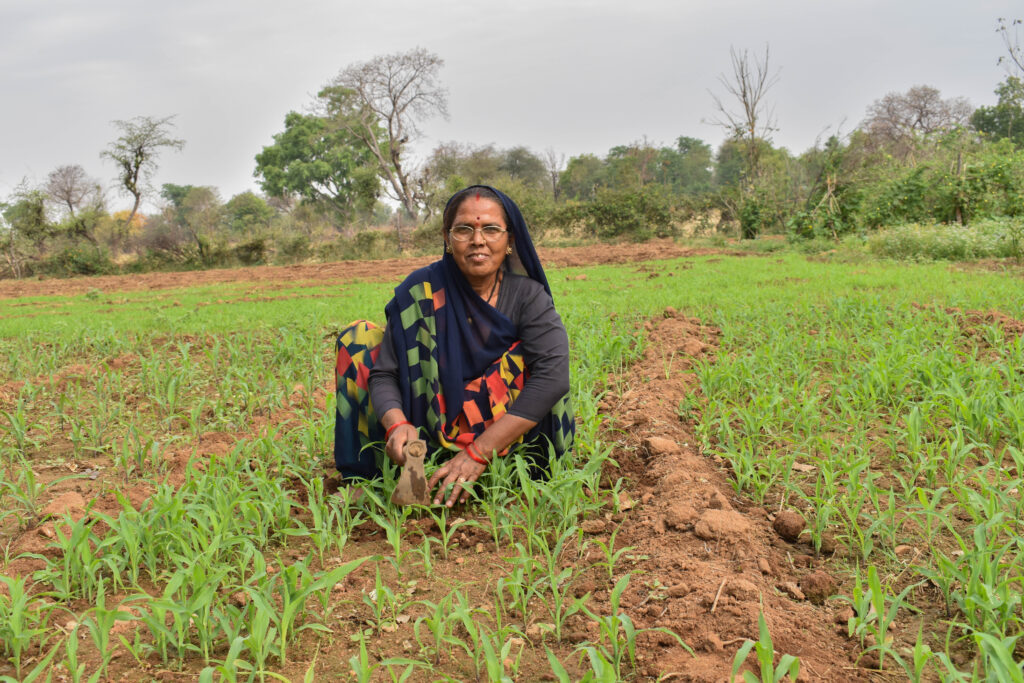
I first met her in early 2024, while reporting my story “A Farm of One’s Own” for The Conversationalist. Kamla is a farmer from Khajraha Khurd’s sunbaked fields, in parched Bundelkhand’s Jhansi district, Uttar Pradesh. She leads local farming techniques to combat drought, something that has helped pull families in the region out of poverty, proving climate adaptation thrives on female ingenuity.  

In the days we spent together, I crouched beside Kamla as she worked, enveloped in the mud’s earthy scent. Her eyes were sweat-stung, her fingers plunged into the sun-warmed soil. As she crunched freshly picked beetroot, she explained to me how she uses neem traps to ward off pests amid erratic rains. Her father-in-law burst out laughing, teasing her for explaining farming to me like she knew anything at all. 

But it was clear she knew more than he understood. When the global coronavirus pandemic rapidly swept across India, some of the most vulnerable, and climate-vulnerable, migrant women were robbed of their work, Kamla included. She not only found meaningful work in the aftermath, but self-reliance, trading callused hands for hoe and seed, wresting millet, broccoli, and lentils from her own organic farm.

Kamla’s resilience was magical to witness. I spent many days with her, seeing how she started her day, plunging into compost heaps steaming with kitchen scraps and dung, spreading the fertilizer across her garden. Watching her wipe soil from her weathered palms, spinach bunch in hand, I saw her rooted at last from laborer to earth-tender, peace in every leaf, life hers again.

In the afternoon, she tiptoed through the fields and quickly kneaded the dough for lunch and put it on the tawa, slapping it thin and golden and slathering the sizzling ghee, serving it with a tin cup of frothy chai brewed strong over a chulha fire. We ate together in the rows of a multi-cropped farm, the air humming with neem leaves. This wasn't just a meal; it was a window into resilience in motion, women and girls weaving nourishment from the land. Nearby, her great-grandmother sat cross-legged on the earthen floor, her gnarled fingers deftly cleaning a mound of fresh red chillies in the sun—plucking stems, wiping dust, and muttering local songs on the front porch of her house, a visual treat to witness a silent hymn to preservation in a world of fleeting harvests.

As we ate, I thought of these women, whose callused hands not only yield the wisdom and knowledge of saplings and sickles, but carry it forward, forging an intergenerational resilience against climate chaos that exists beyond immediate harvests, or even lifetimes—ensuring the next generation endures.

~

Over the years, I’ve met countless women enacting change like Kamla, often without credit or acknowledgement. In India’s northern Haryana state, I met Sunita Dahiya, a woman pioneering eco-friendly menstrual products, and training rural women to produce organic pads that decompose rapidly, slashing microplastic pollution and the burden of billions of plastic disposables in landfills each year. In north Kashmir’s Bandipora district, I met Phula Bano, who manages large herds of wild dogs, cattle, and horses through daily treks in the Himalayas, helping to sustain a low-carbon, resilient ecosystem.

For an early story for The Conversationalist, I also met the beekeeper Towseefa Rizvi—a living embodiment of sisterhood in action. As the first female beekeeper in Ganderbal district, Kashmir, Towseefa has demonstrated, again and again, how one woman’s rise can create pathways for others to join her. Within her community, she also demonstrated that beekeeping could be a profitable path, as well as a productive response to ecological despair. Today, she still trains and supervises village women in the tender art of queen-rearing and swarm management, and sells local honey through various haats and online.

When I visited her home in Bandipora district in north Kashmir, I saw apple groves dotted with buzzing apiaries in her backyard, as she coaxed her bees into new, modern hives. She viewed her bees as family, and over the years, dedicated herself to learning about the restoration of biodiversity, pollination of resilient crops, and climate vagaries. 

Her journey was also proof that true climate hope lies not in flashy summits, but more often, in one woman’s quiet and relentless work.

~

Centering hope in my reporting, of course, hasn’t saved me from the realities of writing about and from regions affected by climate change.

What started as whispers of women-led mangrove safaris while researching another story last year eventually evolved into a gruelling quest, marked by relentless weather delays and elusive sources. For months, I chased the story of Sindhudurg’s mangrove guardians—fierce women from one of Maharashtra’s pioneering women-led self-help groups (SHGs). And for months, I wondered if the story I hoped to tell would ever come to fruition.

Weather changes were unforgiving foes. Monsoons flooded coastal paths and stranded my sources with switched-off phones for weeks. Out of anxiety, I’d chase them via voicemail. Officials also proved phantoms as the network dropped along eroding coastlines.

It wasn’t easy to convince the women to entrust me with their stories; their promises fading with each storm surge and postponed boat trip. But visiting the coast and sharing chai in salt-lashed homes finally broke the ice last fall, and resulted in my final piece from the year, “Guardians of the Mangroves”, about how Maharashtra’s crab farmers are spearheading women-led coastal restoration amid local climate chaos. 

Late in my visit, I stood with farmer Sonali Sunil Acharekar amid the hushed mangroves, her rough hands parting their roots in silent vigil, as cries of herons and egrets filled the skies. She paused mid-story about lost fish, her fingers sifting through the silty tides to snare a scuttling fiddler crab.

She grinned. “See? Even the birds know we’re guardians.” 

I felt a spark of wonder that, despite rough weather nearly killing this story, I could still bring these women’s unbreakable strength into the light. As we enter a new year, I am ending the last with gratitude for their efforts, and the stories these women have shared. I hope, too, I continue to push myself to amplify excluded voices, to craft stories of climate hope that counter the despair-dominating headlines, and to show women as stewards of India’s Global South.

When we lose sight of hope, we risk nihilism that doesn’t allow us to see ingenuity amidst climate chaos—something women in the Global South have delivered time and time again, and something that has made me feel consistently hopeful in my work. While reporting on climate change itself isn’t always hopeful, there is always hope—and at the center of that hope are the women who bend, rise, and persist, their strength illuminating the fragile edge where water meets earth.

[post_title] => Planting the Seeds of Climate Hope [post_excerpt] => While reporting on climate change isn’t always hopeful, the women I've met along the way are forging a path forward for intergenerational resilience. [post_status] => publish [comment_status] => closed [ping_status] => closed [post_password] => [post_name] => hope-week-climate-change-resilience-action-profile-economic-independence-global-south-india [to_ping] => [pinged] => [post_modified] => 2026-08-03 21:01:04 [post_modified_gmt] => 2026-08-03 21:01:04 [post_content_filtered] => [post_parent] => 0 [guid] => https://conversationalist.org/?p=9889 [menu_order] => 0 [post_type] => post [post_mime_type] => [comment_count] => 0 [filter] => raw )

An illustration of a girl surrounded by a growing flower bush, with a cut-out around her in the shape of a woman.

Planting the Seeds of Climate Hope

WP_Post Object
(
    [ID] => 9839
    [post_author] => 15
    [post_date] => 2025-12-17 18:25:59
    [post_date_gmt] => 2025-12-17 18:25:59
    [post_content] => 

How women crab farmers along India's coast have linked their livelihoods to environmental conservation.

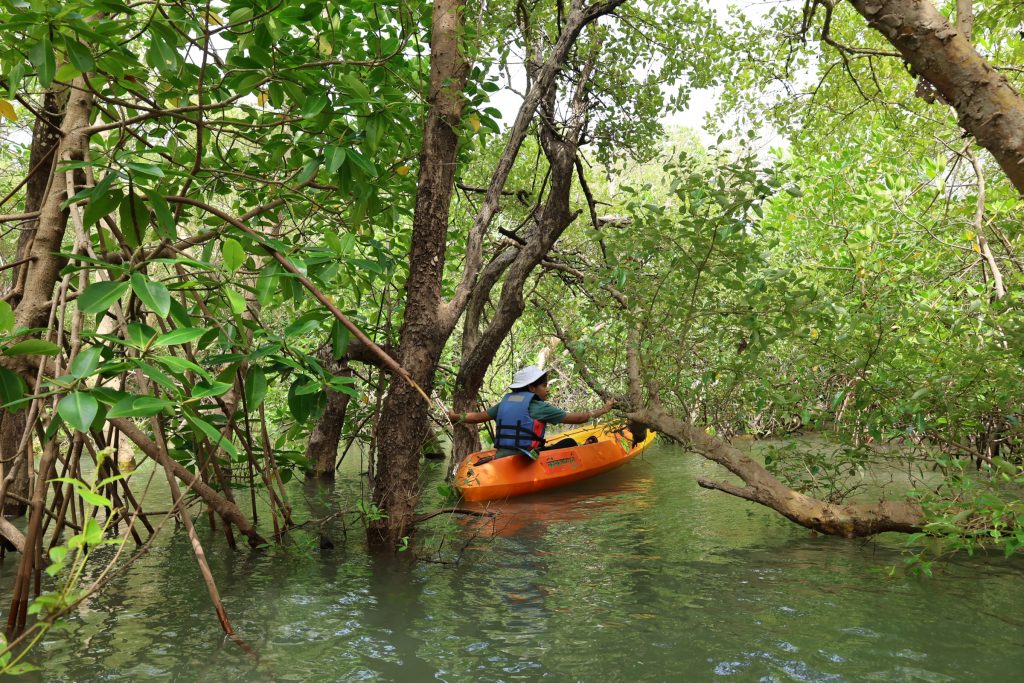
A soft current ripples near Jamdulwadi Island as 15-year-old Prachi Santosh Acharekar guides her canoe through the gnarled trunks of a mangrove forest.

The afternoon sun warms the surface of the water, revealing a familiar scene to local communities around India’s Konkan coast: clusters of mud-covered crabs, basking on branches.

As she approaches them, she slows her boat. Prachi, a 10th-standard student, doesn’t just see mud crabs: She sees her future. Her focused gaze and deft handling of the boat are part of her autodidactic training, a testament to a burgeoning passion that runs deep within the Acharekar family. 

Prachi Santosh Acharekar navigating her canoe through the mangroves, a part of her crab farming training.

Champions of the Mangroves

In Achara village, where she lives, crab farming season typically runs from October to May. When Prachi is fully inducted into her family’s business in about three years, during this time, she’ll be busy with preparations, stocking seed, feeding the crabs, and folding boxes to safely transport them once they’ve been harvested. 

All of it will also formalize her role in a grassroots movement, led by women from India’s coastal belt: In Sindhudurg, women fisherfolk have become champions in linking their livelihoods with environmental conservation. Through crab farming, they’ve created a strong incentive to protect local mangroves, which serve as critical nursery habitats for mangrove crabs. The benefits of this are both economical and ecological: Alongside generating sustainable income for the women, the mangroves’ preservation stabilizes shorelines and mitigates erosion, enhancing coastal resilience against the impacts of climate change. 

At the heart of this enterprise is Prachi’s aunt, 55-year-old Sonali Sunil Acharekar, a proud entrepreneur and leading member of Konkansparsh, one of Maharashtra’s pioneering women-led self-help groups (SHGs). Like all women of this SHG, for her, the mangrove is not just an ecosystem, but a dynamic marketplace.

“Be it dolphin safari, trekking, birdwatching, or traditional fishing, we do it all at Konkansparsh,” says Sonali, sitting in a charpoy at her home, surrounded by a vast area of mangroves. “But crab farming is our speciality. It is something we feel deeply attached to.”

Sonali and other leaders manage the entire crab farming supply chain, from feeding and harvesting the crabs to selling them. The process is meticulous but straightforward. Crab seeds are carefully placed one-by-one into fiber boxes. Each box is then deployed within the protected mangrove territories of Sindhudurg district, which boasts 6,940 hectares of mangroves perfectly suited for farming. Sonali also feeds the small raw fish stock twice daily, in the morning and evening. Then, once the crabs are ready, they’re harvested, boxed, and sold. 

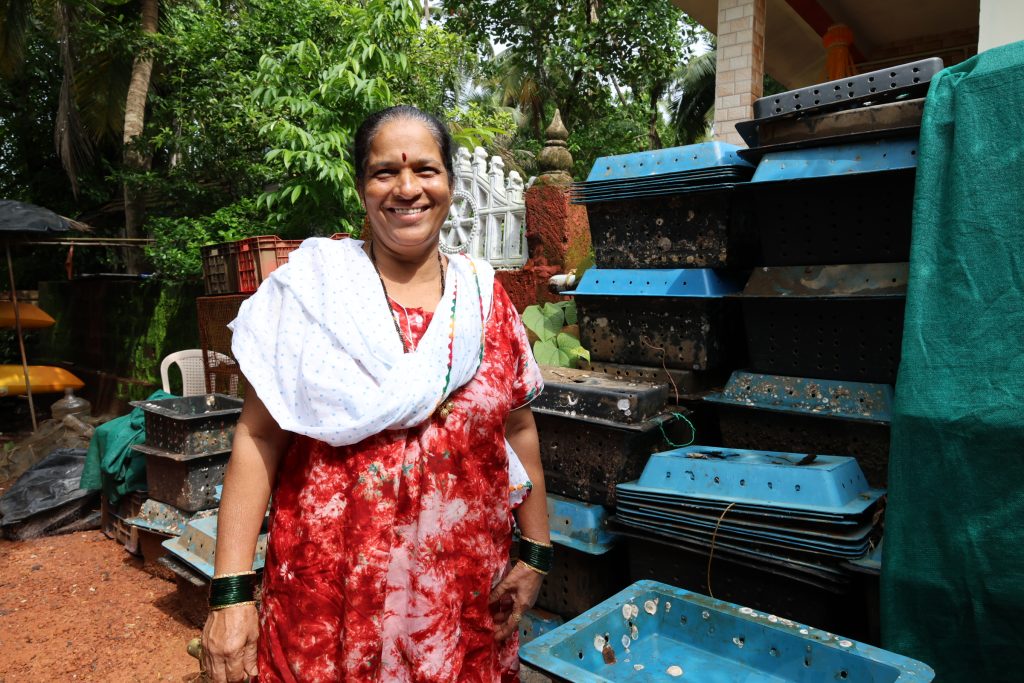
Sonali Sunil Acharekar in the backyard of her home in Achara village.

Overseeing the entire operation in this way has significantly enhanced the women’s access to resources, as well as to the market. The payoff is also demonstrable, including as a sustainable model: Last year, the Acharekar family, a seven-member unit that works in tandem, generated an impressive 150,000 INR ($1,706 USD) from the sale of 180 crabs. They also earned an additional 130,000 INR ($1,466 USD) from running mangrove safaris. 

“It feels so good to partake in the process,” says Sonali. “This year, we intend to maintain 200 boxes fully. More boxes mean more business and more business means more prosperity.”

Their success also reinforces a crucial ecological benefit: According to research published in the Marine Biological Association of India, mud crab farming is not only a sustainable—and profitable—livelihood, but an essential strategy for mangrove conservation, supporting the region’s climate resilience through ecosystem protection. The mangroves provide a conducive natural habitat for raising mud crabs, or green crabs, commonly from the species Scylla serrata, which are indigenous to the region. By breeding and harvesting crabs, and building and tending to crabs pens in mangrove creeks, the women have both created a financial incentive for the mangroves' protection and helped to increase the local crab population.

In coastal areas, crabs are considered an economically significant species due to their huge demand. The crabs themselves can also tolerate a wide range of temperatures and salinities without destroying local ecosystems. But over the years, sand mining, saltwater intrusion, and rising water temperatures have contributed to a declining mud crab population, and are just a few of the ongoing stresses and trends that fisher communities have dealt with, and that local SHGs hope to tackle. 

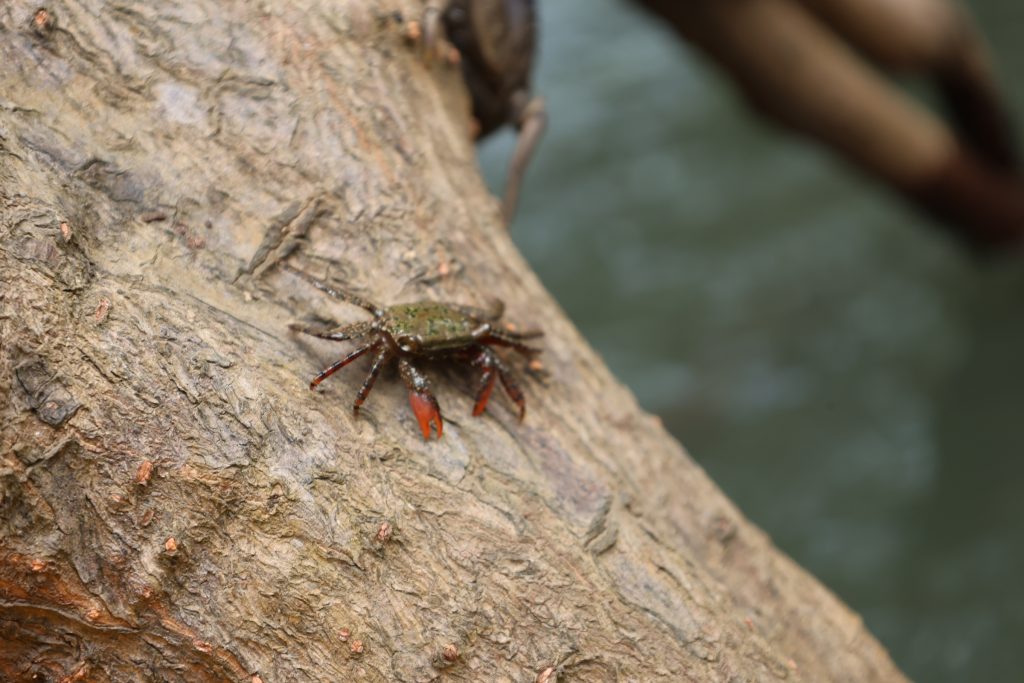
A wild baby crab crawls on the trunk of a mangrove tree.

In other coastal communities like Kerala, Maharashtra’s neighboring state, crab farmers who once caught wild juvenile crabs and had plentiful stock are grappling with rising costs and dwindling returns, as crabs have become scarce and stressed. Their annual incomes have dropped by 50,000 INR to 100,000 INR (around $600 USD to $1,200 USD) due to poor water quality, causing frequent disease outbreaks, pushing many farmers to downsize or cease operations altogether, largely due to reduced harvests linked to environmental degradation.

Sustainable crab models in coastal communities in Maharashtra aim to address the pressing problems of overfishing, habitat loss, and food insecurity through long-term economic stability. But without such practices, crab harvesting may yield fleeting profits, triggering ecological collapse and harm to a region’s inhabitants.

In addition to boosting the economy, this is part of why the SHG’s endeavors have been such a great boon to the area.

According to Kedar Palav, Livelihood Specialist at Sindhudurg’s Mangrove Foundation, women-led groups comprising 40 women have been active in Sindhudurg district during the 2024-25 crab farming season. “Our aim,” he notes, “is to facilitate strong livelihood opportunities for the women.”

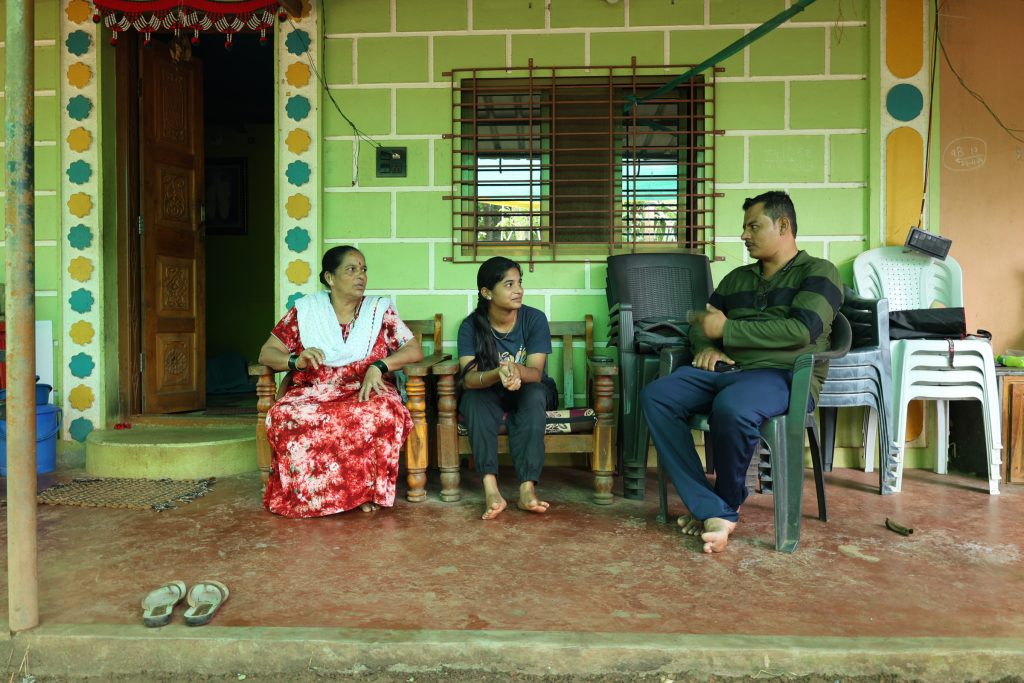
Sonali Sunil Acharekar (left) and her niece Prachi Santosh Acharekar (center) in conversation with Mayur Pansare (right), a Project Assistant for the Mangrove Foundation.

But even those with formal careers are drawn to the potential. Sonali’s 32-year-old son, Omprakash Sunil Achrekar, an engineering graduate, has embraced crab farming full-time; and Manish Tari, 22, an undergraduate in fisheries science, launched Manish Agro & Seafood with his father during the Covid-19 pandemic, specializing in vertical crab farming.

“We deal in red and green crabs,” says Tari. “A single piece per kilo can go up to 2,400 INR. It’s very lucrative.”

Navigating the Tides

Despite the economic potential, the journey is not without profound risks and hurdles. The most immediate occupational hazard, however, is theft.

“Theft of crabs is a big problem here,” says Sonali. “Sometimes diseases can spread in the backwaters, as well…A mortality rate of 20 percent is considered normal.”

It’s a challenge that has historically forced some farmers out of business. Samiksha Gaonkar, 50, from Pirawadi village, recalls being part of Sindhudurg’s very first crab culture group, which operated between 2014 to 2019. Despite each group member earning around 5000 INR per month, they were forced to shut down.

“Our crabs got suddenly stolen,” says Samiksha. “We could not keep a check on the thefts and then we had to pull out.”

Anagarajan Joshi, 58, a former crab farmer, at her friend’s home in Pirawadi village.

Another hurdle is the scarcity of crab seed. According to Palav, there is only one hatchery in India: the Rajiv Gandhi Centre for Aquaculture (RGCA) in the southernmost state of Tamil Nadu. 

Sanjeevni Santosh Mithbavker, 43, a member of the Vedoleshwar SHG, says crab farming has become more difficult as a result. “We lack seed,” she says. “If the supply of seed becomes easy, we can take this business forward.” 

Despite the scarcity, Sanjeevni sold crabs worth 60,000 INR last season. But while business is “great,” seed still costs 25 to 30 INR for a single piece—makings it an expensive venture for the average crab farmer.

A Wave of Resilience 

To counter these challenges, government and non-governmental efforts have actively focused their support on the most vulnerable communities, placing women at the forefront.

Government initiatives such as the Mangrove Conservation and Livelihood Generation Scheme, alongside international projects like Enhancing Climate Resilience of India’s Coastal Communities (ECRICC), have been instrumental in fostering local interest in Sindhudurg’s coastal villages, including Achara and Hadi. As part of the Mangrove Foundation’s intervention, women’s groups also receive substantial training and support, including expert talks, presentations, and hands-on workshops that offer extensive practical training. 

On the ground, additional support comes from 34 Sagar Mitras—fisheries graduates who act as vital resources for the women. Mayur Vinayak Pansare, Project Assistant with the Mangrove Foundation, sees themselves in a family-like role. While they occasionally help fix issues, like crabs breaking through fiber boxes, he says, “It’s heartwarming to see these women coming forward and taking steps towards self-reliance.”

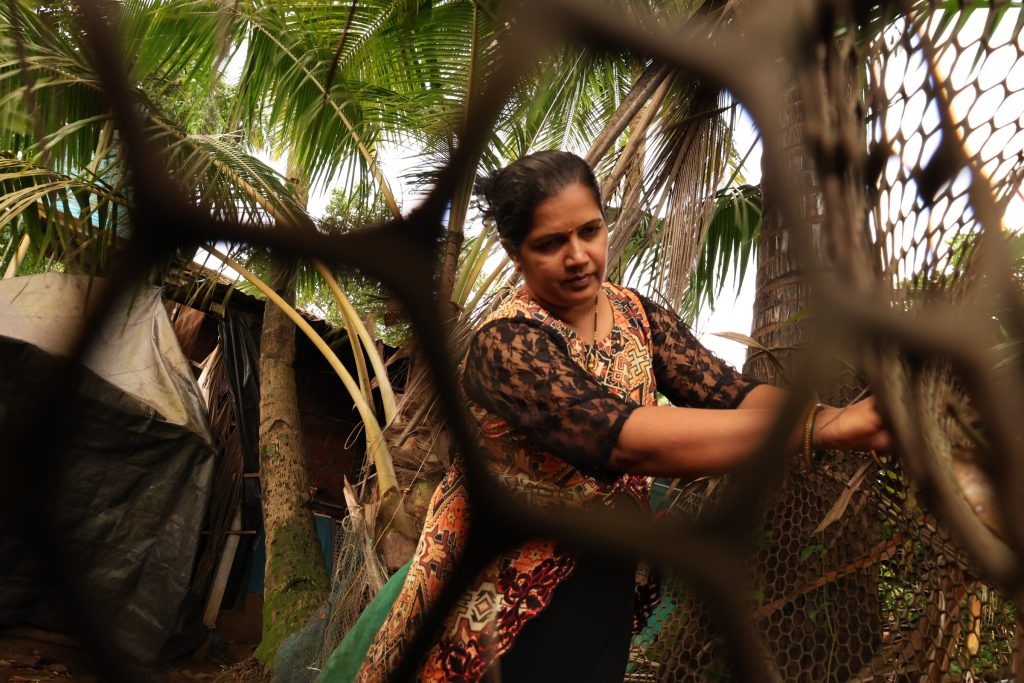
Sanjeevni Santosh Mithbavker, 43, mends nets at her home in Hadi village.

The financial assistance is also significant: The Achrekar family, for instance, received a substantial 90 percent subsidy from the Department of Fisheries and the Mangrove Foundation. Between 2021 and 2025, larger initiatives like the Pradhan Mantri Machi Sampada have backed an additional 124 fisheries projects, with women as a remarkable 60 percent of beneficiaries between 2021 and 2025, says Bahar Vithala Mahakal, Sindhudurg District Program Manager at the Fisheries Department.

This focus is clear across other programs, too: The Sindu Ratna Samrudhi Scheme saw a 70 percent rise in female beneficiaries in a single year, between 2022 and 2023.

Planting the Future

Women’s presence as crab sellers in Sindhudurg’s main fish market signals a generational shift in the industry: They’re taking center stage in an otherwise male-dominated marketplace. For Dakshita (who asked we only use her first name), her presence here is about more than selling her own yield—she’s also reclaiming a little more of herself. 

“What is the need for middlemen when I can run my own business?” she says, waiting for customers.

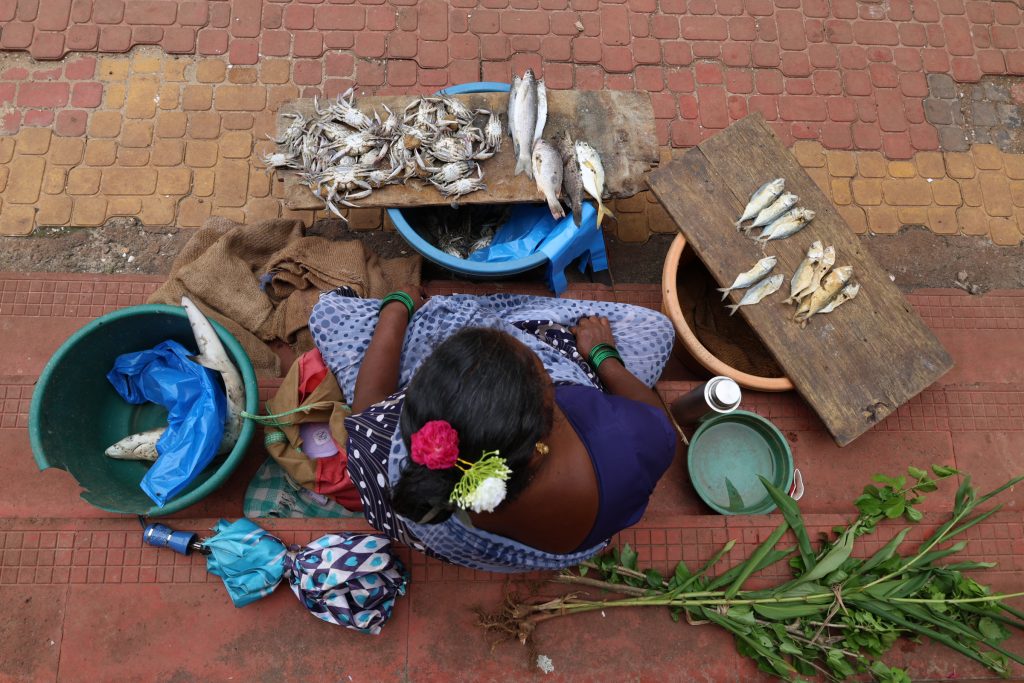
Dakshita, 50, sells green crabs at the Malvan fish market in Sindhudurg.

In Prachi’s case, the journey towards self-reliance began slowly. She initially “harbored no interest in crab farming.” But witnessing her family’s dedication and serving as a guide for tourists through the vibrant backwaters transformed her perspective, converting her initial disinterest into a passion.

In the shifting tides of the Maharashtra coast, Prachi represents the strong voice of a younger generation, seamlessly blending tradition with science to carve a new path forward. For them, crabs are the ‘green gold,’ promising economic returns.

While elder members strengthen their place in the market, Prachi is now articulating a dream that links her environment to her education, which she plans to pursue further by studying Marine Science.

“By protecting the mangroves, my crabs thrive,” she says. “The mangroves in return protect my family from storms, erosion, and the rising sea.”

A view of a mountain village in Sindhudurg.

In the nearby pond, Prachi and Sonali have also started to plant new mangrove saplings. Other efforts at sustainability have only grown. In 2017, scientists visited the area and told local crab farmers that in order to have a better catch, they needed to maintain cleaner water. To boost women’s participation in local water and pond management, women farmers are now being trained to regularly flush water through the crab ponds for freshness, monitor water quality, and prevent overcrowding. Since then, they’ve seen the return of many new birds in the area, from cattle egret to common sandpiper and Indian pond heron.

The tides speak louder than people in Sindhudurg’s coastal communities, and for these powerful women, mangroves stand like guardians along the coast. The more they nurture the mangroves, the more the mangroves give back to them, too. It’s a quiet partnership in nature, this connection between crab farmers and the mangrove forests, and a small step in healing the Earth.

[post_title] => Guardians of the Mangroves [post_excerpt] => How women crab farmers along India's coast have linked their livelihoods to environmental conservation. [post_status] => publish [comment_status] => closed [ping_status] => closed [post_password] => [post_name] => crab-farmers-farming-aquaculture-india-mangroves-conservation-climate-change-ecosystem [to_ping] => [pinged] => [post_modified] => 2026-08-03 21:03:35 [post_modified_gmt] => 2026-08-03 21:03:35 [post_content_filtered] => [post_parent] => 0 [guid] => https://conversationalist.org/?p=9839 [menu_order] => 0 [post_type] => post [post_mime_type] => [comment_count] => 0 [filter] => raw )
Guardians of the Mangroves