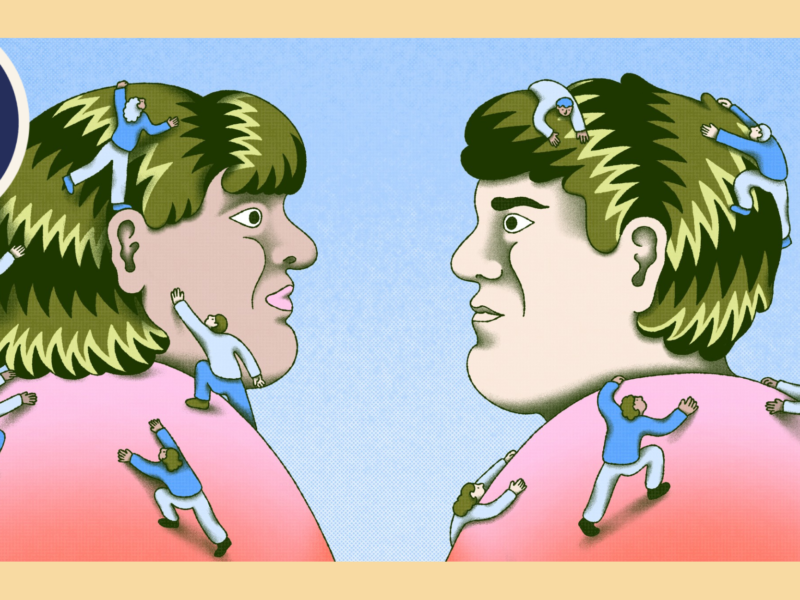





A memoir chronicling the depths of depression and the kindness that helps carry us to the other side.
It’s an ungenerous opinion, but I consider the oft-repeated aphorism, to treat everyone with kindness because you don’t know the difficulties they face, among the more vapid sayings of our time. This is largely because, thanks to the internet, its sentiment has been watered down to a triviality superseding cliché—a pleasant-sounding appeal, without demanding substantial commitments. Owing to many a digital platform’s penchant for misinformation, you may have even attributed the saying’s abundant variants to Plato or Ralph Waldo Emerson, or the late actor Robin Williams, rather than the late 19th century Scottish minister and author, John Watson, who wrote the first known iteration of the phrase under the pen name Ian MacLaren. In an 1897 Christmas message for The British Weekly, MacLaren wrote, precisely, “Be pitiful, for every man is fighting a hard battle.”
Spending several weeks reading and re-reading Ted Scheinman’s sophomore book, Jolt: My Electric Journey Out of Darkness, I’ve decided what MacLaren’s sentiment deserves today is better advocates—Ted’s personal memoir on depression leading among them. That I don’t call the author by his last name makes clear I didn’t engage his work from the typical distance: Ted has been my editor for several years at two magazines, picking me up from the trenches of a layoff to write for him at Pacific Standard until it folded, then again after he landed at Smithsonian Magazine. Two years into our working relationship, I would eventually learn that Ted was regularly battling in trenches of his own: a mind, a body, a person, all taxed by a deep-seated, longstanding depressive disorder.
In the early chapters of Jolt, Ted illustrates himself as a curious child who learned far too early to be self-conscious of the world around him. He describes a boyhood marked by what might be mistaken for personality quirks: anxiety over death, fixation on hygiene, and a fascination with the possibilities of madness. Other constant features of his upbringing—like his mother’s “type A plus” melancholic personality, his father’s optimistic but withdrawn demeanor, and the pair’s eventual divorce—further contribute to an overtly wistful, downcast disposition as he comes of age. Still, Ted acknowledges his life has been marked by hallmarks of privilege: boarding school, an undergraduate education at Yale, trips to Europe in adolescence and adulthood. But while these individual markers appear to contradict the plight of his internal malaise, put together, they demonstrate how the liberties and beauties of his outer life are no match for an inner life almost dutifully distorted by a perennial, clinical sadness.
In his writing, Ted doesn’t spare the reader from the depths and contours of exactly how these depressive battles unfold throughout his life—in continued concerns he’d end up mad and alone on the streets, in fretting over the long-term prospects his graduate education would afford him, in his unease about sustaining employability once a career path became clear. If it sounds like he was on the rollercoaster of substituting one hypothetical agony for another, that is because he was. It’s a daunting reflection of how much the disorder consumed him. Even with talk therapy and medication—several concoctions and timetables of SSRIs administered by a host of doctors—none of it seems to give Ted what he desires most: the opportunity to construct a self that isn’t engulfed in an unexplained emptiness.
For all who have read at least excerpts of Robert Burton’s landmark The Anatomy of Melancholy, a humorous 17th century treatise and lamentation on the cause and textures of depression, in Jolt, they might recognize Ted’s personal mnemonic confessions as evidence of depression’s mundanity. Even in the most worrisome subjects Ted traverses, including suicidal ideation, any reader, whatever their relationship to mental health, is invited to connect to the pain, sufferings, and sadness he explores, not solely as part of one individual life, but as a part of life in general.
Moreover, despite the abyss of sadness detailed, Jolt is a recollection of what it means to have been a young, transient, progressive white man in post-Great Recession and third-wave feminist USA. And for Ted, between D.C. (where he arrived post-Yale), UNC Chapel Hill (where he pursued graduate studies), Santa Barbara (where he went thereafter), then D.C. again, this meant there was spontaneous travel, a few brief stints in bands, recreational drugs, and a slew of lovers and romantic relationships.
In fact, Ted’s chronology of sadness is at times framed by the romances he shared along the way. Far from being the poster child for the Millennial fuck boy of the era, his disclosures give way to another longstanding archetype, transcending generations: the romantic, ever falling-in-love lover boy. In one way or another, these relationships leave an impression on the reader, but none so much as the one he has with Mel, who endured perhaps a rock-bottom version of Ted as he pursued electroconvulsive therapy (ECT), a last resort of sorts, in his quest for reprieve.
Given the book’s title, it was clear the narrative was always heading towards Ted’s experience with ECT, and his time in a psych ward, both of which I knew about long before I read the book. What I didn’t know was the contemporary history that has rendered ECT so unfavorable, despite its utility over several rounds for some—including, at last, Ted himself. But the trial rendered his memory so delicate, his relationship with Mel began to suffer, even as his mental health at last improved. Jolt further reveals the depths of care and community that Ted would need and rely on to carry him through to the other side, not to a life devoid of sadness—because whose life is?—but to a life no longer detained by it.
While Ted gained a new lease on life after multiple rounds of ECT, his losses didn’t end in romantic separation from Mel. A few years later, his mother would receive a cancer diagnosis and die shortly after. Life is relentless in its opportunities for offering pain; it also offers prospects for unexpected joy. By then, Ted had gained a new love in his future wife, Tara. He’d also reclaimed equal footing with those friends who had for years given more to him than he was able to give in return.
By the book’s end, I was certain that even those same friends could not have wholly grasped the depths of Ted’s despair and the internal battle he was fighting until his renderings in Jolt. Yet so many refused to let him fight alone. As I see it, although the kinds of obligations we have to friends and strangers might differ, this is the obligation of kindness I believe we owe to each other—a refusal to let any of us fight life’s battles alone. Ted’s journey in Jolt, then, was a revelation, not just about transcending depression, but about refusing to succumb to the lie that sadness, clinical or otherwise, insists upon: that any of us are alone. In reading his story, I suspect so many others will realize that they, too, are being lied to: You are not alone.