This interview was originally published in March 2017.
Dylan Park is a United States Air Force veteran who served for six years in a Pararescue unit in Iraq and Afghanistan among other places. He’s now a writer and music video director living in Santa Monica . A sci-fi nerd who signed up for Mars One, he’s written a graphic novel (Zombiraq) and worked on tv shows including AMC’s The Walking Dead. His Twitter thread about his Iraqi teenage interpreter, Brahim, recently went viral. We discussed issues ranging from North Korea and military rape to cancer and the KKK.
Anna: One theme I’ve seen through all of your work is the issue of violence in society. You draw parallels between being at war and life in America. A lot of Americans haven’t experienced violence at home. You haven’t been so fortunate, your family especially.
Dylan: I think it’s a misconception that a lot of Americans haven’t experienced violence.
I grew up in an affluent, upper-middle class area. My house literally had a white picket fence. But mom is an orphan from North Korea. My dad was growing up in Texas and Louisiana during the civil rights movement. When he was a kid they were still lynching people. He witnessed that. That’s super traumatic.
His father was murdered by the KKK. I tell people that and they think I’m joking. I have to explain to a lot of my peers that slavery and all that stuff was not that long ago.
So I never met my grandfather because he was murdered by the KKK. I never met my other grandfather because he was a North Korean defector.
I did six years in the military in Iraq, Afghanistan, and Africa. There was a lot of violence, a lot of trauma there. I got back and a few years later, my brother was murdered in a carjacking. It’s a sad story, but I try not get down on myself. I know a lot of Americans, a lot of people in the world, have had it so much worse.
Anna: While studying to be a historian, I looked at postcards of lynchings people sent to one another. You look at some of the photos and see the sheriff standing there. If the sheriff is supervising, how much of mob justice is separate from state violence? Is this really an extrajudicial killing?
Dylan: A lot of people don’t realize that racism was state-sponsored. It was essentially law. When I talk about my grandfather being murdered in Killeen, Texas in 1972, that’s not that long ago.
The Killeen Police Department listed it as a cold case, an unsolved mystery. My father says, “That’s bullshit. We watched two cops walk into our house and shoot my father.”
So of course it’s not going to be solved. They threatened my father and uncles, saying “If you don’t get out of here, we’re going to kill you too.” This all happened because my grandfather had remarried [to] a woman from an affluent white family. They weren’t happy with a black guy getting in on the wealth.
Anna: I’d like to ask you about the different political administrations. What kind of changes have you seen in the military over time?
Dylan: When I first signed up for the military, George W. Bush was still president. We still had a lot of blind nationalism, a kind of gross patriotism after 9/11. If you weren’t for the red, white, and blue, you were the enemy. As an 18-year old, I got caught up in that.
I wanted to go fight the fucking terrorists. They promised me action, adventure and a little bit of money. There were a lot of teenagers my age that were all about that.
We’re a country that glorifies violence. We romanticize it.
When I had a recruiter telling me that I’d get a $15,000 bonus to go blow shit up, I said awesome, that sounds great.
This was in 2004. A year later, I was in Iraq and wondering, what are we even doing here?
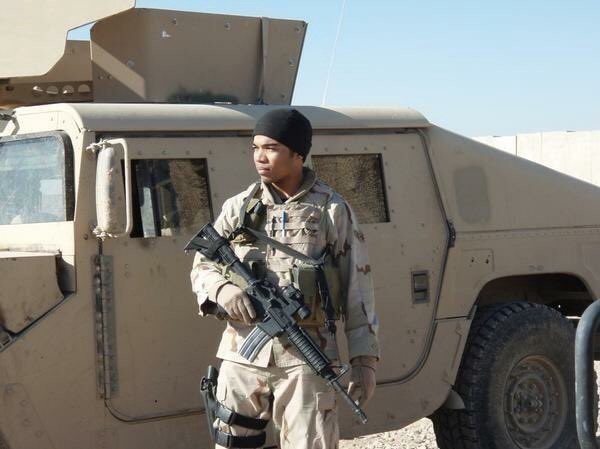
Dylan Park in his “blowing shit up” days
And the Iraqis are normal people, but now all of a sudden they have these Americans occupying their country. Of course they’re going to be hesitant and defensive.
When I admit this a lot of my veteran buddies get pissed, but we had no right to be in Iraq.
It was such a sham. They literally had us fighting over an oil town. They weren’t even trying to hide it. We were occupying an oil town while American contractors did whatever they needed to do to get the oil.
A couple of years later, Obama became president. That was great. My veterans benefits immediately increased.
Anna: I didn’t realize that he passed a law on veteran’s benefits.
Dylan: Oh yeah, Barack passed a lot of laws for veterans.
It’s crazy when you think about how Republicans say that Obama hates vets. The amount of attention I was receiving, the healthcare, everything was exponentially better.
Barack often gets criticized for pulling our troops out of Iraq, and in the long run, that might have been a mistake. I still don’t think that’s his fault, though, because we shouldn’t have been there in the first place.
He also gets criticized for the drone program. I get that too, but essentially he’s using drones instead of having boots on the ground. There’s no real difference, besides fewer Americans dead. Either way, the war machine is not going to stop.
Anna: In that sense, to what extent is U.S. foreign policy this juggernaut with a figurative head to be replaced each time there’s a new president? What influence does the president have over how our military force is used?
Dylan: You can see it right now. Before Trump got in office, he was talking about killing civilians. That’s a war crime.
Anna: Right, already we’re seeing the number of civilian deaths shoot up, like in Mosul and Yemen.
Dylan: He’s basically gotten rid of rules of engagement. He’s usurping the Geneva Conventions.
Trump’s been in office for 65–70 days and he’s already killed 1000 civilians? It’s crazy, but that puts him on a record pace.
You read the articles and the quotes from the commanders or generals that are leading these troops into battle and they say, “It’s disgusting, but these are our orders. If we’re told to level a city, we’re going to do it.”
Anna: Theres a lot of talk about Mattis and his influence over Trump. Their relationship has been framed as Trump needing Mattis in order to keep the military loyal to some extent. If Trump decided he was through with Mattis because he’s said “no” one too many times, what happens? Does it work that way?
Dylan: There’s a large population of liberal veterans and service members, but we’re never going to be larger than the conservative side. You’ll always have this group of service members that would do anything for their commander in chief, including war crimes, which is the problem. I don’t think replacing Mattis would make a difference, and I don’t see a military coup happening. It is what it is.
Anna: You’ve tweeted about civil war. I’m worried about that, too, honestly. I don’t think it’s that far-fetched to think about, especially given Steve Bannon and Trump’s threats to use the National Guard in Chicago. I think that his base will follow him no matter what and also that he won’t go quietly.
Dylan: It’s scary. I joke around about it, but usually when you’re joking it’s because it’s somewhere in the back of your head. I don’t think we’re close to that yet, but who knows?
You know we’re gonna start talking about impeaching Donald Trump, and you know the dude is going to be a psychopath on his way out.
The guy is in bed with the Kremlin, which is crazy in itself. Not to be a conspiracy theorist, but America is more ripe for attack than we’ve ever been. We’re messing up really badly right now.
Anna: Yeah, we’ve also sort of taken apart our entire State Department, which is not helpful. I worry about us getting attacked as well, and what kind of things they could use that as an excuse for.
Dylan: Donald Trump is attacking all these people in the defense services, the NSA. So now all of a sudden, all the guys who are protecting us don’t want to work for him. He’s not going to his security briefings. This is unprecedented.
It’s crazy because we have North Korea firing missiles off while Trump is golfing.
Russia’s saying, we’re going to expand our nuclear program, and Donald Trump is like, no you’re not, we’re going to have a better nuclear program.
[In general], Donald Trump is the type of leader who has a short temper and an ego. That is something that could potentially get a lot of Americans killed.
Anna: I’ve spent a lot of time in Russia. Half my family are Russian Jews who emigrated from the Soviet Union. My dad was alive for World War II. That affected how I was raised, and gave me some perspective. The thing that I’ve seen change the most since he took power is that America became like everyone else.
Dylan: That’s exactly what it is.
Anna: I’m waiting for everyone else to catch up to that fact. It’s hard when people don’t want to deal.
Dylan: [Trump’s] actually making our country a bigger target. ISIS is using this as a recruiting tool to say, “look how America hates Muslims.” And it’s true, America does hate Muslims. It’s not going to get better, it’s only going to get worse… ISIS is ramping up their hate for America, and so more attacks are going to happen. It’s a sick cycle.
Anna: I wanted to talk to you about the VA. You just had a procedure, you’re alright?
Dylan: I have some stomach complications, but I’m okay. When I was in Iraq, I was in Kirkuk, an oil town. Imagine the worst smog you’ve ever seen in your life. The sky was black. [And then there was] the depleted uranium, burning corpses, burning fecal matter, chemicals.
It was a bad environment. A crazy number of people in my detachment were getting sick.
The VA couldn’t figure out what was going on, people were getting cancer. A couple of smart doctors figured out, oh, we had these awful conditions. They set up this thing called a Burn Pit Registry. If you had been on certain bases or at certain locations at certain times you went to the VA.
My best friend went back to Iraq for another tour. He came home and was diagnosed with Stage IV stomach cancer the same day that his daughter was born. He was in the hospital feeling really sick. They pulled him to another room and did tests on him. The day his daughter is born he finds out he has a year to live. It was really fucked up.
Anna: That’s so messed up, how old was he?
Dylan: He was 30 years old. This was 2014. It’s very sad. It happens to a lot of guys. I have a lot of problems too, but I’m one of the lucky ones.
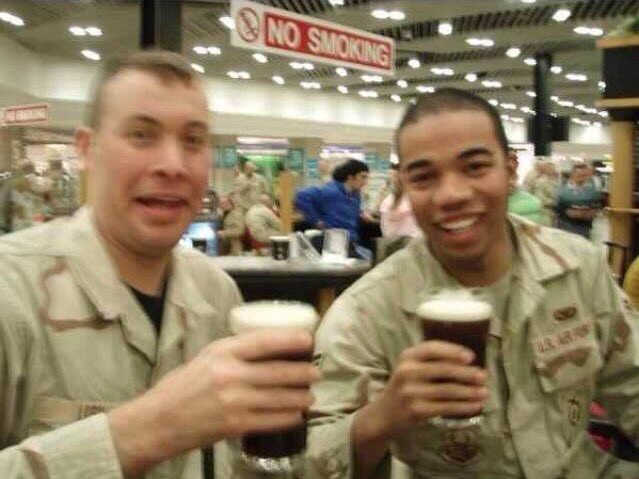
From Dylan Park’s Twitter: “Me and Allen (RIP) walked into the Shannon airport terminal in our uniforms and we got a standing ovation. Free Guinness & Jameson for days.”
Dylan: I had just written a proposal for that book. I was about to start shopping it. I’ve actually told that story before but I decided to retell it because it was so relevant to the Refugee Ban. It just blew up. The amount of attention it received, couldn’t have seen that coming. For a week straight, my phone would not start beeping. I had tens of thousands of strangers telling me that I made them cry.
And there were dozens of deplorables in my mentions, too, calling me a liar. But it was heartwarming to see that not everyone’s a complete piece of shit.
Anna: You’ve tweeted about sexual assault in the military. To what extent is the military just a microcosm of society?
Dylan: The military is worse than society because the military is a fraternity. The U.S. military is basically the biggest gang in the world. It’s a big frat with the good ole boys. They keep everything on the inside, they don’t want any bad publicity.
There were two women in my unit who were raped, and the unit buried it. They actually forced the women to work alongside their rapist for almost two years before he got court-martialled.
If you can imagine that trauma having to work with the guy who assaulted you. When guys like me would go around and cause a fuss, I got blacklisted essentially. Dudes started treating me completely differently. Started calling me a narc, a snitch… It was like high school. I was in a clique and then all of a sudden I was an outcast. Don’t talk to Dylan.
And again not everyone in the military is like that. It’s the same parallel with law enforcement. We know that not all cops are shitty cops. I’d say 90% of cops aren’t shitty cops. But the fact that they protect shitty cops makes them a shitty cop. That’s exactly the situation in the military.
Anna: They become complicit. What do you think about militarized police?
Police departments in the U.S. are armed better than I was in Iraq in a war zone. I grew up in Campbell, CA. It’s the cutest little town. Their police department has a fucking tank. It’s just sitting there in a parking lot. There’s been one homicide in Campbell in five years. What are they going to do with that? You’re giving police departments military equipment so they’re going to start acting like the military.
It’s not about law and order anymore. It’s not about justice. It’s about suppression and intimidation.
You’re seeing peaceful protesters getting tear gassed, beaten and shot. On the flip side, you can have a KKK rally and they’ll get police protection. A neo-Nazi rally, the police will protect them because of their First Amendment rights. I get it, they have freedom of speech, but what happens to freedom of speech when you’re a brown guy and you’re speaking out against the system? Then you’re the enemy.
Anna: Knowing what you know now, would you do it again? Would you have joined?
Dylan: Even though they were some of the worst times of my life, they were also some of the best times too. I got to do things, experience things, meet people and go places that I had never been before and never would have had the chance to go. In the military I went to every continent but Antarctica.
I traveled a lot. A lot of it was — humanitarian missions, peacekeeping missions. My unit was a pararescue unit. We weren’t an offensive force.
We were the 129th rescue wing. Pararescue units are combat rescue units who pick up downed troops, downed civilians behind enemy lines. We’re equipped as military, so if we need to fight we can do that too.
My first mission when I signed up was New Orleans, Hurricane Katrina. We had gotten intel that there were militias running around raping women and shooting people, shooting our helicopters. They armed us up and said get ready for a fight. We’re going to fight gangbangers.
We fly out there and its not that at all. It’s just a bunch of scared black people. On their roofs, trying to survive.
There was no violence whatsoever but we had been conditioned to believe we were going to fight people. Our mission was a rescue mission so we were pulling scared people off roofs. But we were ready for a fight, had our guns loaded up.
Anna: Why would they say that about those people on the roofs?
Dylan: When you have a group of disenfranchised minorities they are the enemy no matter what. That’s how the United States has always been. It took 5 days to send help. And then when we did go, they said the people on the ground were enemies. It was absurd.
Anna: How did you feel as a person of color serving in the military?
Dylan: I had never really experienced real racism until I got into the military. There was a little bit of racism in private Catholic school: as a 5th grader if some kid calls you the n-word , what are you going to do?
But in the military people have real control over you and can send you to your death. That was an issue.
In Iraq, I found myself working the Suicide Gate more often than not. They call it the Suicide Gate because that’s where all the suicide bombers would go blow themselves up.
I always found myself working that station. It was not a coincidence. If everything had been fairly distributed, I would have only been there a few times. I found myself there nightly.
To answer your question, I often say that I’m, I don’t know if ashamed is the right word, but sometimes I’m ashamed to have been a part of the war machine. But if I had not gone through that experience, I wouldn’t have been as “woke” as you would say.
Anna: You saw a lot — and that changes you. When you were talking about the racism, I was thinking about “Get Out.”
Dylan: Oh my god that movie was insane. Not to spoil anything, but I kinda knew from the beginning that there was double-sidedness going on.
Anna: What projects are you working on right now?
Dylan: I’m working on a book based on the Twitter story, and there’s already interest in making it into a movie. Being a veteran that writes is rare thing in Los Angeles, so that’s my niche. Coming up there’s a reboot of “Behind Enemy Lines” with Owen Wilson and a “Call of Duty” TV show. They want people with experience to write for them. I also have a couple of comic books that I’m working on. And I do music videos.
Anna: Oh, right! I saw your pictures with Wyclef Jean.
Dylan: Yeah, I write and direct music videos now. Wyclef is one of my favorite artists ever, and I’ve been working with him.
[post_title] => Woke vets: Black skies and the suicide gate
[post_excerpt] => "There’s a large population of liberal veterans and service members, but we’re never going to be larger than the conservative side. You’ll always have this group of service members that would do anything for their commander in chief, including war crimes, which is the problem. I don’t think replacing Mattis would make a difference, and I don’t see a military coup happening. It is what it is."
[post_status] => publish
[comment_status] => open
[ping_status] => open
[post_password] =>
[post_name] => woke-vets-black-skies-and-the-suicide-gate-2
[to_ping] =>
[pinged] =>
[post_modified] => 2026-09-10 20:04:44
[post_modified_gmt] => 2026-09-10 20:04:44
[post_content_filtered] =>
[post_parent] => 0
[guid] => https://conversationalist.org/?p=389
[menu_order] => 369
[post_type] => post
[post_mime_type] =>
[comment_count] => 0
[filter] => raw
)
Justin 'Judd' Lienhard is a former U.S. Army Ranger officer who did multiple tours in Iraq and Afghanistan. The Conversationalist interviewed him in 2017 for its 'woke vets' series.
Natalia: I’ve read your excellent pieces on The Humanist — including your take on America refusing refugees and the gut-wrenching story of your last combat mission. It struck me that what you’re discussing, among other things, are realities of war that make the average civilian really uncomfortable — so uncomfortable that they would rather shut these stories out. Do you find that most Americans don’t want to know? Or has that not been the case?
Judd: In my experience, Americans are fine with the gory details in my stories as they’ve been desensitized pretty well. They are even OK with hearing about our soldiers’ suffering. They really like the the stories I share that humanize our soldiers in a good way.
What they don’t like to hear are my stories that humanize the enemy or even the locals that collude or sympathise with them. They change the subject quickly when I describe civilian deaths or tribulations that we were responsible for. They often try to interject and exonerate me and my compatriots from blame — and maybe themselves as well, by extension.
Judd Lienhard during his days with the Army Rangers
I think it’s important for everyone’s psyche to dehumanize the people we kill or maim.
There must be absolutely no righteousness in anyone’s cause but our own, it is simply not enough to fight for our nation’s own best interests, our enemies’ interests must be entirely deviant as well. That is nothing new however.
What has changed is that we are deep in an era of war romanticism. We almost deify our soldiers, especially our special operators, they are becoming a class to themselves, almost like a warrior elite that are beyond reproach. It’s comparable to the Janissaries or the Samurai. It’s unfair, even to them. They are very good at what they do but they are also very human.
When you begin to treat men like gods they can only disappoint.
Unless their exploits are fabricated or at the very least embellished — which is what is happening in Hollywood right now.
Natalia: I once worked with a wealthy narcissist, and a lot of what Trump is doing now has, to me, seemed predictable. I think that men like him see other human beings in terms of how they can be used. So there are beautiful women to exploit, powerful businessmen to forge beneficial relationships with, and as for the military, he sees it as an extension of his, uh, manhood. I don’t think it was an accident that he wanted to parade missile launchers on Inauguration. I am with those people who say that he has used fallen SEAL William Owens and his widow as props. So that’s my take on it. But how do you read Trump’s relationship with the military? And how do you think our military command sees Trump? I’ve seen a lot of speculation, for example, that he makes them less than comfortable, though they obviously won’t show as much in public.
Judd: Of course Trump is a narcissist, but I’m hesitant to build him up into some evil genius. He, more than anything else, wants to be liked. He’s dangerous because he’s so pliable. His mental acuity has declined greatly in the past decade, and he’s being guided by ideologues. He is probably the anti-ideologue in that he’ll back whatever side or position that will get the most people to like him.
I believe our military command sees Trump much differently than the rank and file, who are more attracted to the tough, blunt, and simplistic rhetoric of the president (this doesn’t mean they aren’t intelligent, many are extremely bright, but their areas of interest and aptitude reside more on the tactical level rather than in the intricacies of history, geopolitics and macroeconomics).
Military command sees a bumbling idiot with no grasp on the nuances of operational or strategic level planning.
Not only does Trump lack military experience, he lacks the attention span to absorb complex situational briefings.
I hate to compare Trump to Hitler, because there are many differences, but in that respect they are very similar. I believe that both lacked the respect of the military establishment and were otherwise surrounded by misfits, ideologues, and outcasts.
[The military establishment] followed Hitler nonetheless, because those generals thought they were playing the long game and wanted to be in a good position when that wave of populism passed. It wasn’t until 1942 that they realized his decisions would mean the end for Germany and not until 1944 that they organized an assassination attempt.
Our generals want to use Trump’s increases in military funding to further their own limited aims — many aren’t fully considering the damage it will do to the other two pillars of our national security triad, which are diplomacy and development.
Natalia: Everything I know about men like Trump leads me to believe that he would love to go to war. I see him thirsting for it as much as his chief strategist, Steve Bannon, is thirsting for political chaos and martial law. I think a lot of people right now are under the impression that if Trump goes to war, it will be very similar to when George W. Bush went to war — but I believe that Trump makes W look like a wise elder statesman by comparison. Am I being too apocalyptic? And how do you think a military conflict under Trump might play out?
Judd: Trump absolutely wants to go to war because wartime presidents are popular, at least at first. And Bannon wants to go to war because he has a strange obsession with military conflict. I think you are being too apocalyptic however — because you overestimate this administration’s ability to build coalitions and underestimate their utter incompetence.
Congress is protecting them right now because they want to push through their legislation.
As soon as that happens they will turn on them. Their visions of America’s role in the world diverge far too much.
Natalia: I think because we no longer have a draft, and because our military is so powerful, a lot of civilians brush off the reality of what the military deals with with a kind of, “Oh, but they signed up for it, they’re professionals, they have helicopters and cool gear, so whatever, I don’t care, what they do has nothing to do with me.” I personally agree with someone like Phil Klay when he says that — sorry, no, that’s not how it should work. But would you agree or disagree? And can anything be done to make American civilians less apathetic to the risks and dilemmas of modern military service?
Judd: I believe that because there is no draft and because the conflicts of the last generation have resulted in relatively light casualties that Americans see our military adventures as a spectator sport. It’s almost expected that we “mourn” our hero warriors, but relatively few Americans have felt the personal loss of a loved one to conflict.
They don’t relate to those Americans whose sons and daughters signed up to escape poverty rather than out of patriotic reasons.
I mean, expensive college and the GI Bill/VA Loan serve as a de-facto draft anyway. Wait until we start getting carrier groups decimated by surface skimming supersonic missiles and we start losing tens of thousands a year. The human face of war will hit us hard then.
It’s always been that way. The average Roman cared little about the legionary until Hannibal was tossing their severed heads over the gates of Rome.
Natalia: There has been a lot of dehumanization of Muslims in our public discourse. You’ve written beautifully about how awful and misleading stereotypes of Muslims are. What do you think can be done to combat such stereotypes? Besides writing, which is obviously really important, but, as a lot of psychologists point out, only reaches certain people and at certain times.
Judd: I’m a realist and I understand that our tribal nature needs mysterious foreign threats to bind itself together, especially when other social units are falling apart. There is always an enemy that poses an “existential threat” — be it Jews or Blacks, or Catholics, or Communists.
Judd Lienhard with an Iraqi interpreter. who, Lienhard has reason to believe, did not survive the continuing conflict in Iraq.
Honestly, the best cure is exposure and normalization, we fear what we know the least about and propagandists with an agenda exploit those fears for their own gains, that is nothing new.
We must avert catastrophe, let the old fear-mongers that rose up as Iran fell apart die off. Then, once there’s a mosque down the street and your Muslim neighbor feeds your dogs for you while you’re on vacation, it won’t be such a big deal anymore.
[post_title] => 'Americans see our military adventures as a spectator sport,' says former U.S. Army Ranger
[post_excerpt] => "I hate to compare Trump to Hitler, because there are many differences, but in that respect they are very similar. I believe that both lacked the respect of the military establishment and were otherwise surrounded by misfits, ideologues, and outcasts."
[post_status] => publish
[comment_status] => open
[ping_status] => open
[post_password] =>
[post_name] => 383
[to_ping] =>
[pinged] =>
https://thehumanist.com/commentary/refusing-refugees-former-army-ranger-shares-shame
[post_modified] => 2026-09-10 20:03:37
[post_modified_gmt] => 2026-09-10 20:03:37
[post_content_filtered] =>
[post_parent] => 0
[guid] => https://conversationalist.org/?p=383
[menu_order] => 370
[post_type] => post
[post_mime_type] =>
[comment_count] => 0
[filter] => raw
)