WP_Post Object
(
    [ID] => 1669
    [post_author] => 2
    [post_date] => 2020-03-27 03:07:35
    [post_date_gmt] => 2020-03-27 03:07:35
    [post_content] => What has been driving the harmful behaviors exhibited by some Christians in reaction to the coronavirus pandemic?

The World Health Organization worries, in a February 2 report about the spread of the COVID-19 virus, that an “infodemic,” i.e., “an over-abundance of information—some accurate, and some not,” is making the public feel that it’s difficult to find trustworthy sources and reliable guidance. The authors of the report seem to assume that most people want objectively reliable information. Unfortunately, far too many are looking not for objectively reliable information, but rather for “guidance” that corresponds with their political loyalties and ideological preconceptions.

In the United States, there are fundamentalist Christians who see institutions like the WHO and the Centers for Disease Control and Prevention as part of a “godless liberal” plot. Tony Spell, the Apostolic Pastor of Tabernacle Life Church in Baton Rouge, Louisiana, said: “The virus, we believe, is politically motivated.” He made this statement during a church service reportedly attended by 350 people on the evening of Tuesday, March 17, in defiance of a ban on gatherings of more than 50 people issued by Louisiana Governor John Bel Edwards.

Governor Edwards is a Democrat.

While CBS News reported that police told Spell the National Guard would break up any future gatherings at his church, a FOX News report quotes Louisiana National Guard Colonel Ed Bush denying that any such order has been issued. In any case, Life Tabernacle Church doubled down, bragging that it planned to bring 27 buses’ worth of area children to church on Sunday, March 22;  and, according to a public Facebook post by Tony Spell’s father Timothy, that they planned to host a blood drive on the same day. And the church followed through.

In a period of surging right-wing authoritarianism, defenders of democracy must not ignore the dangers posed by those who embrace “alternative facts.” Anti-intellectualism and pseudo-intellectualism are hallmarks of authoritarianism, and in the United States in particular, opposition to much modern science has come to define the mostly white, mostly Christian Republican Party. The problem, however, is global.

Independent Apostolic Christians like Spell are extremists even among extremists, but similar radical charismatic Christians are attaining ever more power and influence in a number of countries, including Uganda and Brazil, where these far-right Protestants represent strong-man President Jair Bolsonaro’s base. Meanwhile, Vladimir Putin’s Russia has emerged as the global standard bearer for international efforts to oppose women’s and LGBTQ Rights. Russia, too, is one of the countries in which authoritarian Christians have undermined efforts to stem the tide of the coronavirus pandemic.

Over the past few weeks, the coronavirus threat has dominated the news cycle, and quite a few stories about the reactions of churches—both responsible and irresponsible—have appeared. In the Orthodox Christian World, the Ecumenical Patriarchate of Constantinople—traditionally considered “first among equals” among the world’s Eastern Orthodox Churches—initially sent mixed messages; now, however, in a tacit rebuke to Russian and Greek Orthodox Christians’ insistence that “coronavirus cannot be transmitted by communion,” it has announced the cancellation of all services for laity within its jurisdiction. Here geopolitical tensions are in play, as the Putinist Russian Orthodox Church has increasingly defied the more moderate Constantinople in recent years.

Meanwhile, after calling the virus, or at least Democrats’ responses to it, a “hoax,” President Trump seemed to feel compelled to address COVID-19 in a more serious (if still dubious) manner, and, for a moment his white evangelical supporters seemed to be shifting with him, at least in some cases. Jerry Falwell, Jr., who at first declared that he would not shut down Liberty University, changed his mind. Pastor Robert Jeffress, leader of the influential megachurch First Baptist Dallas, has canceled physical church services, even going so far as to state that “every pastor and every church ought to follow the guidance to not assemble during this crisis.” But then President Trump oafishly declared that he wanted America’s economy reopened by Easter (April 12 this year for Protestants and Catholics), and Falwell called for Liberty students to return to campus after all, in sharp contrast to most universities essentially shutting down in order to slow the spread of the virus. Liberty University’s residential enrollment is around 13,500 students.

What has been driving the harmful behaviors exhibited by some Christians in reaction to the coronavirus pandemic? I turned to several experts on aspects of the crisis for their assessments of Christian defiance of public health measures.

Sarah Kendzior, an expert in authoritarianism, notes in fairness that “there’s a rational component” to the fear of government malfeasance and overreach, which underlays the paranoia of American far-right actors. She sees “a combination of defiance and obedience” in right-wing Christians’ reactions to the pandemic, and is spot-on in describing Trump’s style of demagoguery as “much more similar to a televangelist than to any previous president.” Kendzior’s observation goes some way toward illustrating why white evangelicals tend to be Trump supporters.

Obedience to authority is certainly emphasized as a virtue among authoritarians, and the Christian Right is no different in this regard. However, the authority in question must conform to their white supremacist patriarchal social hierarchy in order for them to consider it legitimate. Hence the “defiance of what they think of as evil liberal officials telling them what they can’t do,” as seen, for example, in former Alabama Supreme Court Chief Justice Roy Moore calling the inclusion of restrictions on church services in public health responses to the pandemic “tyranny.” When asked about the parallels between right-wing American Christians and the Russian Orthodox Church with respect to coronavirus, Kendzior found them unsurprising.

André Gagné, a former charismatic pastor and current Associate Professor of Theological Studies at Concordia University in Montreal, offered some insights into why charismatic believers are so vocal in defying the imposition of public health measures to contain the spread of coronavirus. He maintains that we must understand charismatic Christians’ defiance in terms of their theology of “spiritual warfare” and the “victorious eschatology” espoused by some charistmatics, i.e., “the idea that the church will be victorious before the second coming of Christ.”

According to Gagné, “Some neo-charismatics believe that ‘end-time’ Christians will be able to heal people from plagues, diseases, or any other physical conditions, and even take dominion over entire hospitals, healing every patient in them by laying hands on the building.” Such theology is, of course, not benign. “When people die, these ministers will find a way to rationalize the consequences, saying that the Church is also called to go through a time of tribulation and persecution, and that God is somehow sifting his Church for the Second Coming of Christ.”

Also in play is Christian nationalism, a phenomenon that sociologists Andrew L. Whitehead and Samuel L. Perry have found to be predictive of Trump support. Whitehead was kind enough to speak with me about the issue and about his forthcoming research with Perry and Joseph O. Baker, which shows how anti-science views in the United States are intimately intertwined with Christian nationalism. Noting that “Christian nationalism is a threat to a pluralistic democratic society,” an issue I have also written about for both The Conversationalist and Religion Dispatches, Whitehead observes that Christian nationalists “legitimate their desires for the country in the will of the Christian God. This severely inhibits any chance or even desire for compromise.”

But how is this related to the kind of science denial we find in right-wing Christian responses to the coronavirus pandemic? Whitehead summarizes some of the key findings from his forthcoming paper with Perry and Baker as follows:

We find consistent evidence that Christian nationalism—a desire to see a particularistic and exclusive version of Christian symbols, values, and policies privileged and enshrined in US civil society—is a strong predictor about Americans’ attitudes toward science. In fact, the effect of political conservatism on skepticism about the moral authority of science is mediated through Christian nationalism, meaning that political conservatives are more likely to be skeptical of science because they are more likely to be Christian nationalists.

The conclusion of the new paper puts it more simply: “Christian nationalism is many things, but above all it is an effort to (re)assert the dominant moral and cultural authority of a white, native-born, straight, masculine, and Christian social order. Likewise, disputes about ‘science and religion’ are primarily conflicts over moral and cultural order.” We can only hope that the empirical demonstration of such connections will prove useful in the struggle for a more equitable democratic future for reasonable believers and non-believers alike. Charismatic and evangelical Christians represent, after all, varieties of Christian fundamentalism, and fundamentalism is a constant source of disinformation. Indeed, fundamentalism is incompatible with democracy, yet for the most part the American press remains deferential to authoritarian Christians. That needs to change if we have any hope of stemming the influence of the radical right-wing Christians Trump has surrounded himself with. As has become clear, they threaten not only our human rights, but also our public health. [post_title] => Authoritarian Christians are deliberately undermining the public health response to coronavirus [post_excerpt] => In a period of surging right-wing authoritarianism, defenders of democracy must not ignore the dangers posed by those who embrace “alternative facts.” [post_status] => publish [comment_status] => closed [ping_status] => open [post_password] => [post_name] => authoritarian-christians-are-deliberately-undermining-the-public-health-response-to-coronavirus [to_ping] => [pinged] => [post_modified] => 2026-09-16 23:07:08 [post_modified_gmt] => 2026-09-16 23:07:08 [post_content_filtered] => [post_parent] => 0 [guid] => http://conversationalist.org/?p=1669 [menu_order] => 276 [post_type] => post [post_mime_type] => [comment_count] => 0 [filter] => raw )
Authoritarian Christians are deliberately undermining the public health response to coronavirus

WP_Post Object
(
    [ID] => 389
    [post_author] => 2
    [post_date] => 2019-01-22 14:32:41
    [post_date_gmt] => 2019-01-22 14:32:41
    [post_content] => 

This interview was originally published in March 2017.

Dylan Park is a United States Air Force veteran who served for six years in a Pararescue unit in Iraq and Afghanistan among other places. He’s now a writer and music video director living in Santa Monica . A sci-fi nerd who signed up for Mars One, he’s written a graphic novel (Zombiraq) and worked on tv shows including AMC’s The Walking Dead. His Twitter thread about his Iraqi teenage interpreter, Brahim, recently went viral. We discussed issues ranging from North Korea and military rape to cancer and the KKK.

Anna: One theme I’ve seen through all of your work is the issue of violence in society. You draw parallels between being at war and life in America. A lot of Americans haven’t experienced violence at home. You haven’t been so fortunate, your family especially.

Dylan: I think it’s a misconception that a lot of Americans haven’t experienced violence.

I think it’s around 30,000 people a year dying from gun violence. That’s astronomical.

I grew up in an affluent, upper-middle class area. My house literally had a white picket fence. But mom is an orphan from North Korea. My dad was growing up in Texas and Louisiana during the civil rights movement. When he was a kid they were still lynching people. He witnessed that. That’s super traumatic.

His father was murdered by the KKK. I tell people that and they think I’m joking. I have to explain to a lot of my peers that slavery and all that stuff was not that long ago.

So I never met my grandfather because he was murdered by the KKK. I never met my other grandfather because he was a North Korean defector. 

I did six years in the military in Iraq, Afghanistan, and Africa. There was a lot of violence, a lot of trauma there. I got back and a few years later, my brother was murdered in a carjacking. It’s a sad story, but I try not get down on myself. I know a lot of Americans, a lot of people in the world, have had it so much worse.

Anna: While studying to be a historian, I looked at postcards of lynchings people sent to one another. You look at some of the photos and see the sheriff standing there. If the sheriff is supervising, how much of mob justice is separate from state violence? Is this really an extrajudicial killing?

Dylan: A lot of people don’t realize that racism was state-sponsored. It was essentially law. When I talk about my grandfather being murdered in Killeen, Texas in 1972, that’s not that long ago.

The Killeen Police Department listed it as a cold case, an unsolved mystery. My father says, “That’s bullshit. We watched two cops walk into our house and shoot my father.”

So of course it’s not going to be solved. They threatened my father and uncles, saying “If you don’t get out of here, we’re going to kill you too.” This all happened because my grandfather had remarried [to] a woman from an affluent white family. They weren’t happy with a black guy getting in on the wealth.

Anna: I’d like to ask you about the different political administrations. What kind of changes have you seen in the military over time?

Dylan: When I first signed up for the military, George W. Bush was still president. We still had a lot of blind nationalism, a kind of gross patriotism after 9/11. If you weren’t for the red, white, and blue, you were the enemy. As an 18-year old, I got caught up in that.

I wanted to go fight the fucking terrorists. They promised me action, adventure and a little bit of money. There were a lot of teenagers my age that were all about that.

We’re a country that glorifies violence. We romanticize it.

When I had a recruiter telling me that I’d get a $15,000 bonus to go blow shit up, I said awesome, that sounds great.

This was in 2004. A year later, I was in Iraq and wondering, what are we even doing here?

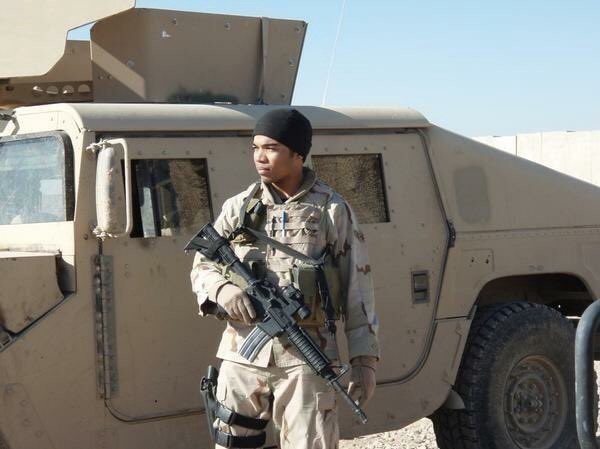
Dylan Park in his “blowing shit up” days

And the Iraqis are normal people, but now all of a sudden they have these Americans occupying their country. Of course they’re going to be hesitant and defensive.

When I admit this a lot of my veteran buddies get pissed, but we had no right to be in Iraq.

It was such a sham. They literally had us fighting over an oil town. They weren’t even trying to hide it. We were occupying an oil town while American contractors did whatever they needed to do to get the oil.

A couple of years later, Obama became president. That was great. My veterans benefits immediately increased.

Anna: I didn’t realize that he passed a law on veteran’s benefits.

Dylan: Oh yeah, Barack passed a lot of laws for veterans.

It’s crazy when you think about how Republicans say that Obama hates vets. The amount of attention I was receiving, the healthcare, everything was exponentially better.

Barack often gets criticized for pulling our troops out of Iraq, and in the long run, that might have been a mistake. I still don’t think that’s his fault, though, because we shouldn’t have been there in the first place.

He also gets criticized for the drone program. I get that too, but essentially he’s using drones instead of having boots on the ground. There’s no real difference, besides fewer Americans dead. Either way, the war machine is not going to stop.

Anna: In that sense, to what extent is U.S. foreign policy this juggernaut with a figurative head to be replaced each time there’s a new president? What influence does the president have over how our military force is used?

Dylan: You can see it right now. Before Trump got in office, he was talking about killing civilians. That’s a war crime.

Anna: Right, already we’re seeing the number of civilian deaths shoot up, like in Mosul and Yemen.

Dylan: He’s basically gotten rid of rules of engagement. He’s usurping the Geneva Conventions.

Trump’s been in office for 65–70 days and he’s already killed 1000 civilians? It’s crazy, but that puts him on a record pace.

You read the articles and the quotes from the commanders or generals that are leading these troops into battle and they say, “It’s disgusting, but these are our orders. If we’re told to level a city, we’re going to do it.”

Anna: Theres a lot of talk about Mattis and his influence over Trump. Their relationship has been framed as Trump needing Mattis in order to keep the military loyal to some extent. If Trump decided he was through with Mattis because he’s said “no” one too many times, what happens? Does it work that way?

Dylan: There’s a large population of liberal veterans and service members, but we’re never going to be larger than the conservative side. You’ll always have this group of service members that would do anything for their commander in chief, including war crimes, which is the problem. I don’t think replacing Mattis would make a difference, and I don’t see a military coup happening. It is what it is.

Anna: You’ve tweeted about civil war. I’m worried about that, too, honestly. I don’t think it’s that far-fetched to think about, especially given Steve Bannon and Trump’s threats to use the National Guard in Chicago. I think that his base will follow him no matter what and also that he won’t go quietly.

Dylan: It’s scary. I joke around about it, but usually when you’re joking it’s because it’s somewhere in the back of your head. I don’t think we’re close to that yet, but who knows?

You know we’re gonna start talking about impeaching Donald Trump, and you know the dude is going to be a psychopath on his way out.

The guy is in bed with the Kremlin, which is crazy in itself. Not to be a conspiracy theorist, but America is more ripe for attack than we’ve ever been. We’re messing up really badly right now.

Anna: Yeah, we’ve also sort of taken apart our entire State Department, which is not helpful. I worry about us getting attacked as well, and what kind of things they could use that as an excuse for.

Dylan: Donald Trump is attacking all these people in the defense services, the NSA. So now all of a sudden, all the guys who are protecting us don’t want to work for him. He’s not going to his security briefings. This is unprecedented.

It’s crazy because we have North Korea firing missiles off while Trump is golfing.

Russia’s saying, we’re going to expand our nuclear program, and Donald Trump is like, no you’re not, we’re going to have a better nuclear program.

[In general], Donald Trump is the type of leader who has a short temper and an ego. That is something that could potentially get a lot of Americans killed.

Anna: I’ve spent a lot of time in Russia. Half my family are Russian Jews who emigrated from the Soviet Union. My dad was alive for World War II. That affected how I was raised, and gave me some perspective. The thing that I’ve seen change the most since he took power is that America became like everyone else.

Dylan: That’s exactly what it is.

Anna: I’m waiting for everyone else to catch up to that fact. It’s hard when people don’t want to deal.

Dylan: [Trump’s] actually making our country a bigger target. ISIS is using this as a recruiting tool to say, “look how America hates Muslims.” And it’s true, America does hate Muslims. It’s not going to get better, it’s only going to get worse… ISIS is ramping up their hate for America, and so more attacks are going to happen. It’s a sick cycle.

Anna: I wanted to talk to you about the VA. You just had a procedure, you’re alright?

Dylan: I have some stomach complications, but I’m okay. When I was in Iraq, I was in Kirkuk, an oil town. Imagine the worst smog you’ve ever seen in your life. The sky was black. [And then there was] the depleted uranium, burning corpses, burning fecal matter, chemicals.

It was a bad environment. A crazy number of people in my detachment were getting sick.

The VA couldn’t figure out what was going on, people were getting cancer. A couple of smart doctors figured out, oh, we had these awful conditions. They set up this thing called a Burn Pit Registry. If you had been on certain bases or at certain locations at certain times you went to the VA.

My best friend went back to Iraq for another tour. He came home and was diagnosed with Stage IV stomach cancer the same day that his daughter was born. He was in the hospital feeling really sick. They pulled him to another room and did tests on him. The day his daughter is born he finds out he has a year to live. It was really fucked up.

Anna: That’s so messed up, how old was he?

Dylan: He was 30 years old. This was 2014. It’s very sad. It happens to a lot of guys. I have a lot of problems too, but I’m one of the lucky ones.

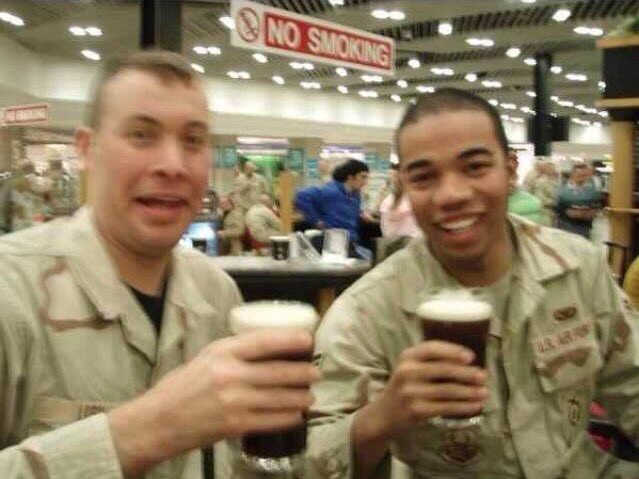
From Dylan Park’s Twitter: “Me and Allen (RIP) walked into the Shannon airport terminal in our uniforms and we got a standing ovation. Free Guinness & Jameson for days.”

Anna: The story of Brahim, your translator, was so touching. I’m wondering if the response to that story gives you hope that people aren’t totally terrible?

Dylan: I had just written a proposal for that book. I was about to start shopping it. I’ve actually told that story before but I decided to retell it because it was so relevant to the Refugee Ban. It just blew up. The amount of attention it received, couldn’t have seen that coming. For a week straight, my phone would not start beeping. I had tens of thousands of strangers telling me that I made them cry.

And there were dozens of deplorables in my mentions, too, calling me a liar. But it was heartwarming to see that not everyone’s a complete piece of shit.

Anna: You’ve tweeted about sexual assault in the military. To what extent is the military just a microcosm of society?

Dylan: The military is worse than society because the military is a fraternity. The U.S. military is basically the biggest gang in the world. It’s a big frat with the good ole boys. They keep everything on the inside, they don’t want any bad publicity.

There were two women in my unit who were raped, and the unit buried it. They actually forced the women to work alongside their rapist for almost two years before he got court-martialled.

If you can imagine that trauma having to work with the guy who assaulted you. When guys like me would go around and cause a fuss, I got blacklisted essentially. Dudes started treating me completely differently. Started calling me a narc, a snitch… It was like high school. I was in a clique and then all of a sudden I was an outcast. Don’t talk to Dylan.

And again not everyone in the military is like that. It’s the same parallel with law enforcement. We know that not all cops are shitty cops. I’d say 90% of cops aren’t shitty cops. But the fact that they protect shitty cops makes them a shitty cop. That’s exactly the situation in the military.

Anna: They become complicit. What do you think about militarized police?

Dylan: Did you just see the video of that machine they’re using? It’s like a protest sweeper. I definitely could have used that in Iraq.

Police departments in the U.S. are armed better than I was in Iraq in a war zone. I grew up in Campbell, CA. It’s the cutest little town. Their police department has a fucking tank. It’s just sitting there in a parking lot. There’s been one homicide in Campbell in five years. What are they going to do with that? You’re giving police departments military equipment so they’re going to start acting like the military.

It’s not about law and order anymore. It’s not about justice. It’s about suppression and intimidation.

You’re seeing peaceful protesters getting tear gassed, beaten and shot. On the flip side, you can have a KKK rally and they’ll get police protection. A neo-Nazi rally, the police will protect them because of their First Amendment rights. I get it, they have freedom of speech, but what happens to freedom of speech when you’re a brown guy and you’re speaking out against the system? Then you’re the enemy.

Anna: Knowing what you know now, would you do it again? Would you have joined?

Dylan: Even though they were some of the worst times of my life, they were also some of the best times too. I got to do things, experience things, meet people and go places that I had never been before and never would have had the chance to go. In the military I went to every continent but Antarctica.

I traveled a lot. A lot of it was — humanitarian missions, peacekeeping missions. My unit was a pararescue unit. We weren’t an offensive force.

We were the 129th rescue wing. Pararescue units are combat rescue units who pick up downed troops, downed civilians behind enemy lines. We’re equipped as military, so if we need to fight we can do that too.

My first mission when I signed up was New Orleans, Hurricane Katrina. We had gotten intel that there were militias running around raping women and shooting people, shooting our helicopters. They armed us up and said get ready for a fight. We’re going to fight gangbangers.

We fly out there and its not that at all. It’s just a bunch of scared black people. On their roofs, trying to survive.

There was no violence whatsoever but we had been conditioned to believe we were going to fight people. Our mission was a rescue mission so we were pulling scared people off roofs. But we were ready for a fight, had our guns loaded up.

Anna: Why would they say that about those people on the roofs?

Dylan: When you have a group of disenfranchised minorities they are the enemy no matter what. That’s how the United States has always been. It took 5 days to send help. And then when we did go, they said the people on the ground were enemies. It was absurd.

Anna: How did you feel as a person of color serving in the military?

Dylan: I had never really experienced real racism until I got into the military. There was a little bit of racism in private Catholic school: as a 5th grader if some kid calls you the n-word , what are you going to do?

But in the military people have real control over you and can send you to your death. That was an issue.

In Iraq, I found myself working the Suicide Gate more often than not. They call it the Suicide Gate because that’s where all the suicide bombers would go blow themselves up.

I always found myself working that station. It was not a coincidence. If everything had been fairly distributed, I would have only been there a few times. I found myself there nightly.

To answer your question, I often say that I’m, I don’t know if ashamed is the right word, but sometimes I’m ashamed to have been a part of the war machine. But if I had not gone through that experience, I wouldn’t have been as “woke” as you would say.

Anna: You saw a lot — and that changes you. When you were talking about the racism, I was thinking about “Get Out.”

Dylan: Oh my god that movie was insane. Not to spoil anything, but I kinda knew from the beginning that there was double-sidedness going on.

Anna: What projects are you working on right now?

Dylan: I’m working on a book based on the Twitter story, and there’s already interest in making it into a movie. Being a veteran that writes is rare thing in Los Angeles, so that’s my niche. Coming up there’s a reboot of “Behind Enemy Lines” with Owen Wilson and a “Call of Duty” TV show. They want people with experience to write for them. I also have a couple of comic books that I’m working on. And I do music videos.

Anna: Oh, right! I saw your pictures with Wyclef Jean.

Dylan: Yeah, I write and direct music videos now. Wyclef is one of my favorite artists ever, and I’ve been working with him.


[post_title] => Woke vets: Black skies and the suicide gate [post_excerpt] => "There’s a large population of liberal veterans and service members, but we’re never going to be larger than the conservative side. You’ll always have this group of service members that would do anything for their commander in chief, including war crimes, which is the problem. I don’t think replacing Mattis would make a difference, and I don’t see a military coup happening. It is what it is." [post_status] => publish [comment_status] => open [ping_status] => open [post_password] => [post_name] => woke-vets-black-skies-and-the-suicide-gate-2 [to_ping] => [pinged] => [post_modified] => 2026-09-10 20:04:44 [post_modified_gmt] => 2026-09-10 20:04:44 [post_content_filtered] => [post_parent] => 0 [guid] => https://conversationalist.org/?p=389 [menu_order] => 369 [post_type] => post [post_mime_type] => [comment_count] => 0 [filter] => raw )

Woke vets: Black skies and the suicide gate