A decade later, activist and politician Feleknas Uca is still seeking justice for her community.
At the broad, gray steps of the entrance to the European Parliament in Brussels, a group of women circle around one in particular. Most are dressed in traditional Yazidi attire—long, white dresses with short lilac or black vests, and white headscarves—but the woman they’ve assembled around is dressed inconspicuously, her long, dark hair tied in a loose knot. Everybody knows who she is: Feleknas Uca, a long-time advocate for the rights of her Yazidi community. Looking at the women around her, she calls out their names one by one, handing each a badge. With these badges, the women will be able to enter the colossal building before them, where their voices are desperately needed inside. Uca has organized this gathering, a one-day conference, to demand justice for the Yazidi genocide, ten years ago this August.
"Yazidis need to be able to protect themselves,” she says.
Those who remember the Yazidi genocide, which started on August 3, 2014, likely recall the haunting footage of Iraqi and US helicopters throwing water and food down to the bone-dry, scorching hot mountain below, where Yazidi refugees had gathered in a panic. Down the hill, ISIS, the fundamentalist jihadist group that had quickly occupied large swaths of Iraq and Syria, had begun an ethnic cleansing of their people.
Mount Sinjar (or Shingal, in Kurdish) is the center of the historic homeland of the Yazidis, and was, at the time, their last hope for salvation. As some of the helicopters touched ground, they prioritized pulling women, children, and the elderly to safety. Those left behind on the mountain either succumbed to the heat, thirst, or exhaustion; the rest were brought across the border after Kurdish militias opened a corridor to Kurdish-controlled land in Syria.
The fate of those who never made it to the mountain would become clearer in the weeks and months thereafter. Thousands of men were instantly massacred by ISIS, and thousands of women and children were abducted. Girls and women were forced into ISIS “marriages,” sold on markets, and used as domestic and sex slaves, while boys became “cubs of the caliphate,” fighters-in-training. All were forcibly converted to Islam.
Ethnically, Yazidis are considered Kurdish, and their mother tongue is the eponymous language; although some in the Yazidi community consider it an ethnic identity of its own. Others contend all Kurds used to be Yazidis, until the emergence of Islam, when many Kurds converted. ISIS considered the Yazidis to be devil worshippers, as most adhere to a centuries-old pre-Christian and pre-Islamic faith.
Uca was visiting Germany when the genocide started to unfold, receiving the news in real time on the day the tragedy began. ISIS had been approaching, but the Kurdish peshmerga forces present in the Shingal region had promised to protect the Yazidis from harm. They withdrew just as ISIS began their attack.
“A call came from a man I knew who was there,” she says. “His sister wanted to kill herself because she was about to fall into ISIS’ hands. She had a weapon. We tried to talk to her but then I heard a shot. I will never forget that moment.”
The daughter of a Yazidi family that migrated to Germany in the 1970s, Uca was born in the north-central town of Celle, which has a large Yazidi community. In 1999, at age 22, she became the youngest-ever member of European Parliament (MEP) as a German representative of the Party for Democratic Socialism, and later for Die Linke (The Left), where she remained an MEP until 2009, when she didn’t seek re-election. When the genocide began, she had just recently moved from Germany to Turkey, where her family was originally from: The Yazidis are indigenous to Kurdistan, which geographically includes regions of Turkey, Iraq, Syria, and Iran. She’d chosen to live in Diyarbakır, the largest Kurdish city in Turkey’s southeast region, and had become a candidate in the parliamentary elections for the Peoples’ Democratic Party, or HDP. Founded in 2012, HDP is a leftist party rooted in the Kurdish political movement; their main objective is to democratize Turkey and give regions and communities the opportunity to govern themselves. In the June 2015 elections, Uca was elected MP and became the first Yazidi in Turkish parliament.
From the start of her time as an HDP MP, Uca was in a delicate position. While advocating for Kurds and for Yazidis specifically, the HDP claimed that the Turkish government had been aiding ISIS, and consequently held it co-responsible for the genocide—something the government vehemently denied. The HDP, including Uca, also supported the armed Kurdish groups that fought against ISIS, including those the Turkish government considered to be terrorists because of their adherence to the same leftist ideology as the Kurdistan Workers Party, the PKK, which has been waging an armed struggle for Kurdish autonomy in Turkey since the 1980s. Because of this overlap, HDP MPs, like Uca, became victims of a government campaign that accused them of supporting terrorism.
Uca was undeterred by it. The author of this piece, herself based in Diyarbakır during those years, got to know Uca as a parliamentarian who was often found among her community, listening to their needs and trying to forge solutions for them in her capacity as MP. For example, many Yazidis who fled to Turkey to escape ISIS were left in refugee camps with tents that did not protect them during harsh winters and hot summers. They also lacked adequate medical care and were not receiving substantial education. As MP, Uca made attempts to increase the budget for the camps, and while she only had limited success, her presence and care endeared her to the community.
Feleknas Uca in 2008. (AP Photo/Christian Lutz)
Having witnessed the Yazidis’ struggles over the years while advocating for them at high levels of government, Uca has a profound understanding of her community’s needs, wants, and fears. Today, she believes what’s most important is ensuring they are able to return to their homeland. In the aftermath of the genocide, thousands of Yazidis left their home as refugees, resettling in Europe, the United States, Canada, and Australia. While they may be physically safe in these places, Uca tells me, their displacement is still a continuation of the genocide.
“What ISIS wanted to do, is not only to kill and enslave the Yazidis, but also remove them from their ancestral lands. One of the problems we face now is that the community is still not able to return to Shingal because it remains too unsafe,” she says.
In Shingal, where the Iraqi army and Iran-backed militias are now stationed, the Yazidi self-defense force—the Shingal Resistance Units (YBŞ)—founded by the PKK in the weeks after August 3, 2014, is under pressure to be dismantled. Like the PKK, Turkey considers the YBŞ a terrorist group, and regularly bombs them, killing fighters; in addition to targeting local medical clinics, according to reports by Human Rights Watch and the International Crisis Group. Consequently, Yazidis can’t always return to their homeland, even if they wish to do so. Uca believes that Europe and the US have a responsibility to step in.
“Many Western countries have recognized the Yazidi genocide, but they don’t take any action to assist the community in building a future again in Shingal,” she says. “They don’t visit the region, they don’t help rebuilding it, they don’t hold Turkey responsible for assisting ISIS then, and letting it attack Shingal now.”
Among her many grievances are the centers that were opened in several European countries—mostly in Germany—where Yazidi women who were rescued from ISIS could process their trauma. These same services remain unavailable in Shingal.
“I have always said that if we really want to help these women, we will have to build trauma centers in Shingal, so they can process their trauma and rebuild their future and live their culture and religion in their homeland, where they were born and raised,” Uca says. “But the therapy has been transferred abroad, and with that, the future of the Yazidis. While the community can only really survive at home.”
The continued plight of the Yazidis could cause Uca great despair, but she is adamant that there are also victories, large and small. She has heard countless stories of Yazidi women, in particular, overcoming horrific circumstances and fighting back. She was able to get a visa for one of these women, Hêza Shengalî, so that she could speak at the one-day conference in Brussels. Shengalî was taken captive by ISIS in 2014 and remained in their custody for a year. After she escaped, she joined the Şengal Women’s Units, or YJŞ—the armed women’s wing of the YBŞ—and requested to be sent to Syria to join the forces fighting ISIS there.
“For me, and for other Yazidi women who have joined the YBŞ, fighting back against ISIS is a way to heal,” Shengalî says.
As a commander, she contributed to their eventual victory in the city of Raqqa, which ISIS had deemed their “capital.” When Raqqa was liberated, many Yazidi women and girls were liberated, too. After returning to Shingal, Hêza was even a part of a small delegation that handed over a newly liberated young Yazidi woman back to her family.
In large part because of the YBŞ, despite the Yazidi community’s past gender conservatism, things have started to change in the last decade, including its expectations of women.
“Hêza is normative for what Yazidi women can accomplish,” Uca says. “In 2014, and after that, even 70-year-old women have taken up a weapon to defend themselves. The community has transformed itself.”
Of course, there is still a long way to go. In early 2018, after ISIS lost the last territory they occupied, the women and their children were locked up in camps in northeast Syria and guarded by Kurdish forces. Amongst them were Yazidi women who were once held captive by ISIS. They were (and are) afraid to reveal themselves as such because ISIS ideology is still prevalent amongst the prisoners there. For others, it’s because they’ve had children with ISIS members and are afraid to lose them, as the Yazidi community does not accept these children as legitimate.
Periodically, Yazidi women and girls have been discovered within the camps and rescued by the Kurdish armed forces, but currently, some 2700 remain missing, and are believed to still be in the camps or abroad with ISIS members who managed to flee to neighboring countries, including Turkey. Others may be dead, and their remains are unlikely to ever be found.
Thousands of boys and men remain missing, as well. In cooperation with the United Nations, mass graves in different locations in the Shingal region have been opened since early 2019. Some remains have been identified by Iraqi authorities in cooperation with the UN and have gone on to be reburied with dignity. However, many mass graves remain untouched, leaving families in anguish over the exact fate of their loved ones and unable to give them a proper burial or grave. Other boys may have died in battle as “cubs of the caliphate,” although occasionally, some are found in Turkey, staying with families who belonged to ISIS, who may have distanced themselves from their ideology or who may quietly still support it. Some Yazidi boys have also been reunited with their families in exchange for a ransom.
Having visited Shingal multiple times since the genocide, Uca has been present to witness some of these reunions. She’s also spent a lot of time talking to the women, men, girls, and boys who have been liberated.
“I remember one boy whose first question was: ‘How is Shingal? Is it liberated?’ I saw hope in his eyes. ‘Yes, it has been liberated,’” she says. “And I see that hope in the eyes of the liberated women, too. They have gone through so much, but their resilience is impressive. This is what makes me feel hopeful.”
Uca knows she still has much work to do. In 2018, she was re-elected to the Turkish parliament and visited Shingal with an HDP delegation after Turkey targeted a clinic with a drone, killing eight. She gave a speech about it in parliament, demanding answers from her fellow MPs—answers she didn’t get.
In last year’s general elections, Uca wasn’t on the ballot, due to the party’s two-term limit for all parliamentarians. The end of her mandate also meant the end of her parliamentary immunity, compelling her to leave Turkey instantly because state prosecutors had opened investigations against her for “propaganda for a terrorist organization,” as it had done to dozens of Kurdish MPs, many of whom have been imprisoned. She returned to Germany, and from there, continued her political work in Europe, including organizing conferences, undertaking diplomacy work in the EU, and networking and cooperating with a wide range of Yazidi, Kurdish, and other women’s groups. She’s still keen to solve her legal problems in Turkey, however, and is also planning a new journey to Shingal; it’s been a year since she was last able to visit. And while there is still much to resolve and to heal in the aftermath of what the Yazidis have endured, for Uca, hope is alive and ahead.
“You know what comes to mind when I think of hope? I remember just walking in Shingal and suddenly seeing a lilac flower. Shingal, too, will bloom again and be the hope of humanity,” she says. “Of course, I can do a lot of work in Europe, but my heart is in Shingal. Only when I am there, working in my community, I know that I am Feleknas.”
[post_title] => The Story of the Yazidi Genocide Isn't Over
[post_excerpt] => A decade later, activist and politician Feleknas Uca is still seeking justice for her community.
[post_status] => publish
[comment_status] => closed
[ping_status] => closed
[post_password] =>
[post_name] => yazidi-genocide-isis-feleknas-uca-parliament-justice-kurdish-liberation
[to_ping] =>
[pinged] =>
[post_modified] => 2026-08-04 16:53:54
[post_modified_gmt] => 2026-08-04 16:53:54
[post_content_filtered] =>
[post_parent] => 0
[guid] => https://conversationalist.org/?p=7088
[menu_order] => 50
[post_type] => post
[post_mime_type] =>
[comment_count] => 0
[filter] => raw
)
WP_Post Object
(
[ID] => 3704
[post_author] => 2
[post_date] => 2022-01-13 19:24:38
[post_date_gmt] => 2022-01-13 19:24:38
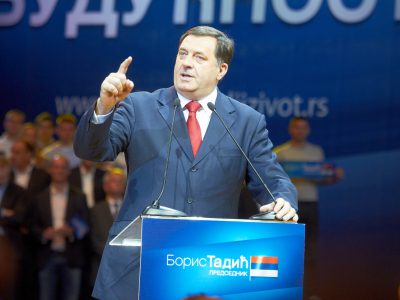
[post_content] => Officially, Dodik's secessionism is in reaction to a new law that bans genocide denial. But his true motives are more cynical and venal.
Bosnia and Herzegovina (BiH) appears to be coming apart at the seams. The Balkan state is currently embroiled in its worst political crisis since the 1992-1995 war, the bloodiest on European soil since the Second World War. The current tumult was triggered by Milorad Dodik, a Bosnian Serb nationalist politician and notorious demagogue, who has been leading calls for Republika Srpska (RS), the Serb-majority region established after the war, to “pull out” of the country’s central institutions—its armed forces, intelligence agency, and tax authority. Most recently, he and his party, the SNSD, have expanded their secessionist rhetoric to include the state police, the border police, and even the country’s constitutional court.
Dodik and his party are paving the way for the RS entity to secede from BiH in all but name. His calls to quit the state’s central institutions are a violation of BiH’s constitution and of the 1995 Dayton Peace Accords, which played a key role in ending the Bosnian War. According to that agreement, BiH is governed by a complex ethnic-based power system, which includes a tripartite presidency, wherein one Bosniak, one Serb, and one Croat simultaneously serve on the body and arrive at decisions via consensus. Or, at least, that is the theory. In practice, the system is marred by dysfunction and near constant obstruction, especially by Dodik and the SNSD.
What does he have to gain by pushing his war-scarred country dangerously close to the brink of another armed conflict? The answers are both cynical and predicated on a mix of political survival and ideology.
Officially, Dodik’s secessionist talk is based on his party’s rejection of a new law that criminalizes genocide denial. On July 23, 2020 the then High Representative, the Sarajevo-based international envoy who oversees the implementation of the 1995 peace agreement, Valentin Inzko, imposed a law banning the denial of all internationally recognized war crimes, crimes against humanity, and genocides (like the Holocaust). This means that anyone who denies that Serb nationalist forces committed genocide against Bosniaks during the 1992-95 war is now committing a crime.
For Serb nationalist leaders in BiH, this is an outrage. Genocide denial is a staple of their politics; Dodik’s regime has even funded bogus “commissions” to cast doubt on the well-established and forensically proven fact that Serb nationalist forces carried out widespread atrocities against Bosniak civilians while under the command of Radovan Karadzic and Ratko Mladic, both of whom were convicted of genocide by the International Criminal Tribunal for the former Yugoslavia (ICTY). Their convictions are largely concerned with the 1995 genocide in the eastern Bosnian town of Srebrenica, where Serb nationalist forces forcibly separated over 8,000 Bosniak men and boys from refugees nominally under the protection of the UN, transferred them to nearby fields and industrial buildings, and gunned them down. The New York Timesreport on the killings, quotes human rights officers and diplomatic officials who described it as “the worst crime since World War II.” Most experts and scholars, however, consider the totality of the Serb nationalist war effort in BiH to have been genocidal in nature, and not isolated merely to the events in Srebrenica.
The Bosnian parliament failed to pass its own legislation banning genocide denial because of obstruction by Dodik’s SNSD bloc and their coalition partners in the Croat nationalist HDZ. While the HDZ is not a secessionist party, they do want to further the ethnic fragmentation of BiH through the creation of a so-called “third entity,” a kind of Croat-dominated RS. Such an entity existed briefly during the war; its entire senior leadership was also convicted of crimes against humanity. Because Dodik sees the HDZ’s goals as a means of further undermining the central BiH state, he is happy to champion the HDZ’s interests.
In any case, Christian Schmidt, the new High Representative, has said the law imposed by his predecessor would remain in effect until parliament passed its own. Rather than engage in democratic niceties like parliamentary debate, Dodik has now shifted tactics to creating illegal parallel institutions. He has even threatened to recreate the “Army of the Republika Srpska” (VRS), the militia that committed the Srebrenica genocide.
Dodik has governed BiH’s RS as a virtual autocrat since 2006. Prior to the genocide, the areas of northern and eastern BiH that now constitute the entity were wholly multiethnic; today they are almost wholly Serb-dominated. Dodik is currently a member of BiH’s tripartite state presidency and has no official function within the RS, but the Serb enclave is his personal fiefdom in all but name. Once an American-backed reformist who helped eject Karadzic’s SDS party from power, Dodik has spent much of the last 16 years reinventing himself as a hardline nationalist. That has also meant violently cracking down on civil society, creating a regime-controlled media apparatus, and centering all real power in the entity of his own person.
Because of the Dodik regime’s near-authoritarian domination of the Serb entity, the SNSD is unlikely to lose power in the next BiH general elections, scheduled for October 2022. Moreover, because of the expansive power-sharing provisions of the Dayton constitution, Dodik and his Croat nationalist allies in the HDZ also (in)directly control large aspects of the state apparatus, a fact that has shielded leading figures in both parties from prosecution for a legion of criminal affairs and a smorgasbord of anti-constitutional activities. In October 2021, for instance, BiH’s BN TV reported that the SNSD government had allowed industrial grade oxygen tanks, unfit for human consumption, to be used in hospitals in the region. In December 2020, Dodik’s appointee on BiH’s central judicial oversight body was forced to resign in disgrace after he was caught on tape directing payoffs to underlings, and openly discussing how to sway justices.
It is this trinity—sectarian ultranationalism, autocracy, and kleptocracy—that is the nucleus of Dodik the person, and the regime he has constructed in RS. He wants to dismantle the Bosnian state because he needs all three to survive politically and because of venal, financial self-interest.
Dodik and his party have made the glorification of genocide denial one of their central ideological and electoral pillars. Without it, their political survival is in grave danger. The law banning genocide denial also creates politically and emotionally legitimate grounds for the High Representative to remove Dodik, which in turn would decimate his expansive criminal patronage networks. As noted in a January 5 U.S. Treasury Department brief, outlining the reasons for a new round of U.S. sanctions against him:
“Dodik…has established a patronage network in BiH from which he and his associates benefit. As one example of his corrupt actions, Dodik has provided government contracts and monopolies in the RS directly to close business associates. With his corrupt proceeds, Dodik has engaged in bribery and additional corrupt activities to further his personal interests at the expense of citizens in the RS.”
To be clear, the High Representative had grounds to remove Dodik already, but the SSND is hardly the only political party in BiH guilty of corruption, self-dealing, and abuse of office. Systematic genocide denial, however, packs a more robust, normative punch.
This also explains why Dodik has resisted implementing the “5+2 Agenda,” the formula set out in 2008 for the phasing out of the Office of the High Representative (OHR). The two most important pieces of that checklist are: the dispute over state properties on RS territory, the most sensitive of which are military installations that belong to the Bosnian Armed Forces; and “the entrenchment of the rule of law.” Both items strike at the heart of Dodik’s authoritarian autonomy in BiH. If Dodik agreed to respect the presence of Bosnian military bases on RS territory and to abide by the rule of law, including an appropriate genocide-denial law, he could secure the OHR’s departure. But he would also be undermining his own authority by accepting the state’s primacy over his fiefdom. That is why he is trying to get rid of the OHR without implementing the 5+2 Agenda.
Dodik ’s extremist gambit, however, reveals the true nature of his broader political project. He is not concerned about the anti-genocide law per se. He is worried because the OHR has shown that it is willing and still able to activate the Bonn Powers—i.e., its authority to use extra-constitutional powers to protect the integrity of the Dayton Accords—and this threatens Dodik’s own political survival.
What gives Dodik’s current efforts additional weight is not only that his party has begun using the RS assembly to formalize his purported “withdrawal” from state institutions, or his dismissing the legitimacy of Schmidt’s tenure at the OHR. That, in and of itself, does not make such acts legal. A sub-national assembly cannot unilaterally override the acts of a state parliament or the contents of international agreements—which is what the SNSD is doing—in any country on Earth, not even in BiH. But these actions indicate a degree of actual political courage Dodik’s regime has not hitherto displayed.
Dodik feels he can afford to be bold because he enjoys the support not only of Moscow and Belgrade, but also of Hungary, which is a member of the EU and NATO; he recently claimed to have the support of several additional EU member states. While the Russians had Schmidt barred from the UN Security Council—the first time a BiH High Representative was prevented from addressing the body—Hungary’s Viktor Orbán has said explicitly that he would prevent the EU from imposing sanctions against Dodik’s regime, even as his country pledged financial aid to the RS. Orbán, whose Fidesz party is notoriously racist, antisemitic, and anti-democratic, has also peddled thinly veiled Islamophobic conspiracy theories to buttress Dodik’s brinksmanship.
Where BiH goes in the months ahead remains to be seen. Dodik and his partners in the HDZ might try to scuttle the country’s next elections, in order to further the narrative that BiH is a “failed state” that should be partitioned among neighboring powers, in line with the contents of a recent non-paper written by the cabinet of Slovenia’s Prime Minister, Janez Jansa, another Dodik ally. The U.S. has imposed new rounds of sanctions on Dodik; on Alternativa Television, a regime-controlled TV station that broadcasts pro-Dodik propaganda; and on Dodik’s former appointee to BiH’s judicial oversight body. The U.S. is expected to add more names to the list in coming weeks. The UK and Germany have also threatened their own measures, though they have not yet initiated them. In the interim, Zeljko Komsic, the Chairman of BiH’s presidency, has warned that unless the international community works with local authorities to stop Dodik, “force will have to be the response.”
Komsic is not wrong. Whether because of his extremist politics or his criminal interests, Dodik is clearly replicating the 1992 march to war under presided over by Radovan Karadzic, the convicted genocidaire. For all his bravado, though, Dodik knows he does not have the necessary hard power to go up against the BiH security apparatus, as fragmented as it is. The fear, however, is that he is still gambling on the idea that if he concocts a serious enough crisis, Serbia and Russia will come to his aid—little green men and all. Such a scenario would create a vortex of instability and conflict in the strategic center of the Western Balkans that, as in the 1990s, would suck in neighboring states. With Russia threatening further aggression against Ukraine, the West can ill afford another security crisis in the volatile southeast of Europe.
[post_title] => A genocide-denying autocrat is threatening to throw a lit match into Bosnia's tinderbox
[post_excerpt] => Once a US-backed anti-nationalist reformist, Milorad Dodik has spent much of the last 16 years reinventing himself as a hardline nationalist politician.
[post_status] => publish
[comment_status] => closed
[ping_status] => open
[post_password] =>
[post_name] => a-genocide-denying-autocrat-is-threatening-to-throw-a-lit-match-into-bosnias-tinderbox
[to_ping] =>
[pinged] =>
https://conversationalist.org/2021/04/24/bearing-witness-to-genocide-quo-vadis-aida-is-a-shattering-essential-film/
[post_modified] => 2026-08-05 18:11:35
[post_modified_gmt] => 2026-08-05 18:11:35
[post_content_filtered] =>
[post_parent] => 0
[guid] => https://conversationalist.org/?p=3704
[menu_order] => 149
[post_type] => post
[post_mime_type] =>
[comment_count] => 0
[filter] => raw
)
I thought I was doing the right thing, I was obeying orders, and now, of course, I see that it was unnecessary and wrong. But I don’t know what you mean by being upset….I didn’t personally murder anybody. I was just the director of the extermination program at Auschwitz. —Rudolf Hoess, April 11, 1946 at Nuremberg.
Several years ago I began researching Nazi mens rea, the legal term for a criminal defendant’s mental state at the time a crime is committed, in order to explore what it means to obey unethical orders. How do evil people convince others to do their dirty work? What effect do hateful ideologies and propaganda have on individual agency? Can complicity in crimes against humanity be explained by obedience to hierarchies or coercion?
How does one rationalize or compartmentalize genocide? Towards that end, I compared a Jewish-American Army psychiatrist’s interviews with defendants during the Nuremberg Trials in 1946 to Hannah Arendt’s reporting for The New Yorker on Adolf Eichmann’s kidnapping from Argentina and subsequent trial in Israel in 1961, Eichmann in Jerusalem. You could call it an examination of the banality of evil, the concept Arendt coined while watching Eichmann testify. The project was fascinating, but also sickening and mentally and physically exhausting.
I discovered that any attempt to pin down the origin and nature of atrocities foundered when shifting from systemic failures onto issues of individual moral culpability.
This was especially true when dealing with the testimony of perpetrators. The result was a paradox, described by Emil Fackenheim as the “double move”: to seek an explanation but also to resist explanation.
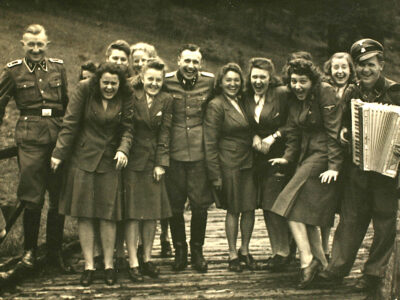
The Nuremberg Trials disturbed observers not simply with revelations of mass atrocities, but also by the Nazis’ seeming normalcy and lack of remorse. Dr. Leon Goldensohn spent seven months studying the mental health of the Nuremberg defendants on assignment from the U.S. Army. Goldensohn regularly interviewed both defendants and witnesses, 33 in total. His notes were published in The Nuremberg Interviews: An American Psychiatrist’s Conversations with the Defendants and Witnesses.
Goldensohn, himself a Jew, treated the defendants as subjects in a study, hoping for signs of a distinctive Nazi pathology. He didn’t find one. There were common patterns of behavior and repetitive answers, but from Goldensohn’s notes it’s clear that each Nazi made their own impression on the doctor. Defendants for the most part used their time with him to rehearse their testimony.
The basic measure for competence to stand trial at Nuremberg was the ability to tell right from wrong (historically, competence was also measured by an awareness of one’s actions). The tribunal’s authority rested on the notion that individuals act of their own free will and that those who cannot tell right from wrong belong in an insane asylum, not prison.
Of all the defendants, only two were deemed incompetent to stand trial. As for the others, Goldensohn held that psychopathy or sadistic tendencies didn’t necessarily negate one’s ability to distinguish right from wrong. The most repulsive interviews were with Julius Streicher, editor of Der Stürmer, the Nazi tabloid. While calling himself a Zionist, Streicher was the only defendant wholly unable to contain his anti-Semitic tirades. As Goldensohn put it: “He is of below-average intelligence, but all the same awoke one morning inspired to dedicate himself to becoming an ‘authority on anti-Semitism.’”
In order to get a conviction for each crime, prosecutors at Nuremberg not only had to prove that the Nazis committed the acts, actus reus, but also that they had the requisite mental state or intent when they did. Murder committed intentionally is punished more harshly than a murder committed in the heat of passion.
Since it was impossible to read their minds, this introduced an element of conjecture to the trials. How deliberate was the Final Solution? Who knew when and how far back did the plan go? Hitler was dead, so who was responsible? Why would anyone tell the truth?
The court drama played out over the original charge of conspiracy. Some scholars argue that the prosecution’s wish to prove that the defendants had all collaborated together in an organized conspiracy towards the Final Solution led them to exaggerate the intentionality and coherence of Nazi planning and policy. At trial, defense counsels were quick to point out the enormous confusion of authority in the Third Reich. In the hopes of having the conspiracy charges dismissed, Nazi defendants pled ignorance of the atrocities, blaming the compartmentalized system of Nazi administration.
There is evidence from Goldensohn’s interviews that even during the trial, Hermann Goering, the highest ranking Nazi defendant, was maintaining party discipline in prison. Goering’s plan for the defense was copied by the majority of defendants and involved ignoring the atrocities, or in the alternative, blaming Goebbels and Himmler, both conveniently dead. He disparaged lower-level officials’ claims when they contradicted his own, and proudly took responsibility for all but the extermination camps. No one living would account for those.
Goering was smooth:
We Germans consider an oath of fealty more important than anything….Mind you, I said almost anything. I don’t consider the extermination of women and children as proper even if an oath were taken. I myself can hardly believe that women and children were exterminated. It must have been that criminal Goebbels, or Himmler, who influenced Hitler to do such a dastardly thing.
The disconnect between language and reality was astounding. By Nazi reasoning, Goering’s stolen art was a major disgrace, whereas killing Jews was merely distasteful. In an interview with Otto Ohlendorf, commander of Einsatzgruppe D, one of the paramilitary death squads, Goldensohn couldn’t hide his disgust.
LG: Did your wife know of this business of the Einzatsgruppe?
OO: No.
LG: Have you seen her since 1941–42?
OO: I saw her, but never talked to her about those things. I didn’t think it was good conversation for a woman.
LG: But it’s all right to shoot women, not all right to talk to them about shootings?
OO: In the first place, I didn’t shoot women. I merely supervised.
Hans Fritzsche, one of the few defendants to be released, was the head of the Radio Division in Goebbel’s Ministry of Propaganda from 1942 onwards. His defense:
Pure idealism on my part. I can defend everything point by point. But I won’t try to do that, because everything I did, I did before the world public. On the other side of the picture is the fact that on the basis of my work, 5 million people were murdered and untold atrocities took place. It is purely a question of judgment as to whether a connection can be established clearly between these two things.
Fritzsche felt no personal responsibility for his actions spreading anti-Semitic propaganda. His idealism, aka his Hitler-worship, was to blame. It’s not that they hated Jews, you see. They were simply devoted to the Führer. The Führer made it legal to kill Jews; if it’s legal, it’s not murder.
Fifteen years later, Eichmann still blamed idealism for everything.
The psychiatrists who examined Eichmann pronounced him normal, or as one psychiatrist said, “more normal, at any rate, than I am after having examined him.” Still, the disconnect between systemic crimes and personal culpability remained. By Eichmann’s reasoning, his fixation on the Jewish question was the result of idealism. He was quoted once saying “Had I been born Jewish, I’d have been the most fervent Zionist!” As Arendt explained: an idealist was not merely a man who believed in an idea.
An idealist lived for his idea…and was prepared to sacrifice for his idea everything and, especially, everybody.
Eichmann might have personal feelings on a subject but he would never permit them to interfere with his actions if they came into conflict with his idea. This blind fanaticism allowed for some form of conscience so long as it did not obstruct the Nazi in the execution of his duties. For Eichmann that meant planning the deportation of Europe’s Jewish population.
Hannah Arendt was furious that Eichmann, like the Nuremberg defendants before him, had distanced himself from his crimes through mental gymnastics. She cut to the chase, arguing that he was guilty of crimes against humanity because the subjective element, his mens rea, was objective by virtue of complete obedience to the Führerprinzip. Eichmann not only “obeyed orders, he obeyed the law.”
She advocated rethinking criminal intent altogether in cases of crimes against humanity. Arendt seized upon Eichmann’s distortion of Kant’s categorical imperative:
“Act in such a way that the Führer, if he knew your action, would approve it.”
Eichmann had abdicated his ability to think for himself, she said. In relinquishing himself to Hitler, Eichmann became strictly liable for the crimes he committed on Hitler’s behalf.
Strict liability in such cases resolved the issue of criminal intent and made it difficult for those who benefitted from the regime to then disavow it later, as “so-called inner emigrants.”
[Inner emigrants] were people who frequently had held positions, even high ones, in the Third Reich and who, after the end of the war, told themselves and the world at large that they had always been “inwardly opposed” to the regime. The question here is not whether or not they are telling the truth; the point is, rather, that no secret in the secret-ridden atmosphere of the Hitler regime was better kept than such “inward opposition.” As a rather well-known “inner emigrant,” who certainly believed in his own sincerity, once told me, they had to appear “outwardly” even more like Nazis than ordinary Nazis did, in order to keep their secret.
One such emigrant was Oswald Pohl, head of the SS Economic and Administrative Main Office, and witness at Nuremberg. In interviews, Goldensohn pushed back on Pohl’s answers:
Had he ever objected to the whole business?
OP: No. Nobody asked for my opinion. It would have done no good to protest anyway….I did not participate in the murder of the Jews.
I remarked that nevertheless, he did run all the concentration camps.
Yes, but the camps had nothing to do with it….Some of my present wife’s best friends were Jewish. That is proof enough of how I feel.
Such were the totalitarian perversions of the moral and legal order. How did such a distortion take place? It was a deadly mix of ideological fanaticism, authoritarian state structure, intellectual and linguistic conformity, a subjugation of conscience, and ultimately the ability to overcome an innate aversion to human suffering.
South African psychologist Pumla Gobodo-Madikizela conducted prison interviews with the infamous Apartheid death squad leader Eugene de Kock, serving consecutive life sentences and barred from amnesty under the Truth and Reconciliation Commission. De Kock was said to have repented and showed remorse, but in her book, A Human Being Died That Night, Gobodo-Madikizela writes that he exhibited outright similarities to the Nazis, particularly in his views on racism. Just like Eichmann and Streicher’s claims to Zionism, de Kock insisted that his zealously nationalist father equated Afrikaaner nationalism with the ANC’s struggle for freedom, that his father could not possibly have been a racist because he spoke multiple African languages, and “had he been Black, he would have joined the ANC.”
When we consider history, we see that such mental gymnastics are not coincidental. If they were unique to Nazis, the Klan would not be marching and lynching postcards would not exist. When Trump said he could shoot someone on Fifth Avenue and his followers would support him, he was right. To paraphrase Nixon, “It’s not murder when the President does it.” Destroying society’s moral compass promotes the politics of hate from a practical perspective.
In light of this, we must continue to study the nature of genocide and mass atrocities, not in an attempt to find definitive answers, but rather to illuminate the boundaries of what’s knowable. Expanding our collective imagination of what’s humanly possible is crucial if we’re ever going to stop embracing old horrors with new technologies.
[post_title] => What were the Nazis thinking when they killed all those people?
[post_excerpt] =>
[post_status] => publish
[comment_status] => open
[ping_status] => open
[post_password] =>
[post_name] => what-were-the-nazis-thinking-when-they-killed-all-those-people-2
[to_ping] =>
[pinged] =>
[post_modified] => 2026-09-15 20:02:12
[post_modified_gmt] => 2026-09-15 20:02:12
[post_content_filtered] =>
[post_parent] => 0
[guid] => https://conversationalist.org/?p=408
[menu_order] => 364
[post_type] => post
[post_mime_type] =>
[comment_count] => 0
[filter] => raw
)