WP_Post Object
(
    [ID] => 5810
    [post_author] => 15
    [post_date] => 2023-04-19 00:32:53
    [post_date_gmt] => 2023-04-19 00:32:53
    [post_content] => 

The first question we ask about complex chronic illnesses shouldn't be whether or not they're real.

Over the last few months, the question of whether long Covid is real has been the subject of lengthy examinations from publications across the political spectrum. These articles are often ambiguous in their conclusions, giving equal weight to the legitimacy of the condition while simultaneously attempting to debunk it.

As anyone who has it will tell you, long Covid is very real, but if you’ve been reading these articles purporting to explore LC’s reality or unreality—questioning if society has it “wrong”—you might think that it is not, or that the people who have it (and illnesses like it) do not have a physical ailment at all, but instead a mental health one. While it’s not surprising that more right-leaning publications have engaged in long Covid denialism, the trend of left-leaning legacy publications like New York Magazine and the New Republic doing something similar is, to me, cause for concern. As a disabled, nonbinary feminist who has dedicated a large chunk of their career to exploring the tangled issues of gender, chronic pain/illness, and the society-wide disbelief of these illnesses, I think the insistence on showing “bo­­th sides” of long Covid is a slippery slope.

“Skepticism” of complex chronic illnesses is nothing new. I and many other chronically ill people have seen “skepticism” of our disabilities play out in media, amongst the general public, and in the medical field plenty of times before. Diseases such as multiple sclerosis (MS), rheumatoid arthritis, and ulcers were all thought to be psychosomatic at one time. In more modern times, chronic fatigue syndrome/myalgic encephalomyelitis (CFS/ME), fibromyalgia, Postural orthostatic tachycardia syndrome (POTS), and many other chronic illnesses and pain conditions have been explained away as mysterious, and therefore Maybe Not Real, too.

Yet time and time again, it’s been shown that they are. After a CFS/ME outbreak occurred in Incline Village, Nevada in the mid-1980s, proving that the illness was seriously impacting patients, the Centers for Disease Control (CDC) pledged $12.9 million to research the condition, only to then quietly move the money they had earmarked to other departments. Meanwhile, CFS/ME remains just as pervasive today: Many long Covid patients have ended up with CFS/ME after battling acute Covid, in addition to experiencing a host of other debilitating, multi-systemic symptoms

As a person who has had lifelong health problems of varying severity, when I first heard about CFS/ME as a high school student, my immediate thought was that it sounded awful. Being tired all of the time and having to deal with muscle pain, cognitive issues, poor sleep, and post-exertional malaise (symptoms getting worse after a patient exerts themselves) sounded like a version of Hell on Earth. It’s not that I didn’t think becoming chronically ill could happen to me—because if I’ve learned one thing as a person with multiple health problems, it’s that your health is not under your complete control, no matter how much willpower you think you have. Rather, even then, I understood that extending a crumb of empathy to people whose health conditions seem weird or mysterious or exaggerated to you is not fucking rocket science.

Just a few years later, however, I would learn not everyone feels the same. When I was a 19 year-old college student, I began experiencing extreme fatigue and muscle pain in my back, neck, legs, and shoulders for no apparent reason one day. It never went away, and I spent over a year trying to figure out what was happening to me. Shortly after my 21st birthday in 2007, I was diagnosed with fibromyalgia by a rheumatologist. It would be another year before fibromyalgia had its media tipping point, but I became familiar with the stereotypes very quickly, mostly via internet comments and a few real-life unsolicited opinions. The people who get it (mostly women, as the gender ratio is very skewed), according to commentors online, tend to be middle-aged or older. They are fat and eat the wrong foods. They’re lazy. They just want prescription drugs. They are mentally ill. They aren’t utilizing positive thinking effectively enough to get better. They just need to exercise more. They are brainwashed by Big Pharma TV ads into thinking they are sick—this one courtesy of popular women’s website Jezebel.

Several of these stereotypes have been projected onto people of all genders with various disabilities, but there’s something about “mysterious” diseases with no single cause that tends to push ableism and sexism to the front—again, most likely because they disproportionately affect women. Unsurprisingly and likely because of this, fibromyalgia tends to be subjected to the “hysteria” argument, too: Per an (in)famous New York Times article titled “Drug approved. Is disease real?” about the fibromyalgia medication Lyrica, “The more these patients are around the medical establishment, the sicker they get.” I am left wondering how soon an “expert” will make a similar argument about long Covid.

Such both-sides claptrap when it comes to illnesses that medical science hasn’t “solved” yet is a thing that some media outlets like to do in the interest of “balance,” and it has been going on for a long time—longer than I have been alive, in some cases. But giving equal weight to opposing perspectives that are not, in fact, equal does not make sense. What, exactly, is the rationale for treating debilitating chronic illnesses, new and old, and those conditions’ reality for millions of people as a neat little thought experiment?

Because I’ve been writing about these issues—and living with them as a chronically ill person—for a long time, I suspect that the answer is multi-faceted. A lack of empathy is one facet; it does not escape my notice that most high-profile articles questioning the “realness” of complex, multi-system chronic illnesses are written by journalists who do not have these health conditions themselves. It also does not escape my notice that it has almost exclusively been chronically ill people, ME/CFS patients, and the journalists, writers, and medical professionals who work with ME/CFS and long Covid patients to call out NYMag, the New Republic, and other publications on bad journalism related to long Covid so far.

But another facet is the broader, ableist pattern of doubting chronically ill people in general, especially those debilitated by contested illnesses. It’s easier to not see ableism, or take it seriously as a mode of oppression, if you don’t deal with it every day. Much like it’s easier to say Well, if I had long Covid, I would just think more positively or If I had CFS/ME, I would at least TRY graded exercise therapy (GET) and cognitive behavioral therapy (CBT) to get better (even though both have been debunked) when you’re not actually going through it. Medical and everyday sexism, too, is another ingredient in this crappy metaphorical pie—doubting and dismissing women and other people who are not cis men who say that yes, they are in debilitating pain, that their fatigue crushes them 24/7, that they really are sick, has been a huge part of how chronic illness has been talked about in the U.S. for decades. Would you be surprised to learn that, like many of these illnesses, long Covid also has a gender discrepancy? Maybe I’m just cynical, but I was not.

Believing people of all genders when it comes to their experiences—of their own bodies—should be an obvious starting point when it comes to long Covid and other post-viral or “mysterious” chronic illnesses. Just because medical science hasn’t discovered the answers to long Covid, CFS/ME, fibromyalgia, and other chronic illnesses so far does not mean that there are not answers—nor does it definitively mean that these illnesses are psychosomatic. As we’ve seen, disbelieving people about their experiences of their own bodies is deeply entrenched in American culture—especially if those bodies are outside of the norm of cisgender, non-disabled, white, thin, young, and male. The long Covid coverage that’s been highly publicized in this current moment is only continuing this callous tradition of doubting, dismissing, and socially gaslighting chronically ill people as they are—yet again—shoved to the margins. It is time for the media, the government, other institutions, and the non-disabled public to do better.

[post_title] => Long Covid Skepticism is a Slippery Slope [post_excerpt] => The first question we ask about complex chronic illnesses shouldn't be whether or not they're real. [post_status] => publish [comment_status] => closed [ping_status] => closed [post_password] => [post_name] => long-covid-cfsme-fibromyalgia-skepticism-chronic-illness-media-both-sides [to_ping] => [pinged] => [post_modified] => 2026-08-04 19:20:59 [post_modified_gmt] => 2026-08-04 19:20:59 [post_content_filtered] => [post_parent] => 0 [guid] => https://conversationalist.org/?p=5810 [menu_order] => 85 [post_type] => post [post_mime_type] => [comment_count] => 0 [filter] => raw )

An illustration of a larger figure contorted and in motion, bending over and arms spread, legs buckling. The person is featureless in the face, smooth and curved. Two smaller figures are grabbing and pulling at the larger figure, one grabbing at its wrist, and the other at its calf. We can just barely perceive an orb of light rising from behind the shoulders of the larger figure. The entire illustration is bathed in dark purple.

Long Covid Skepticism is a Slippery Slope

WP_Post Object
(
    [ID] => 3855
    [post_author] => 2
    [post_date] => 2022-02-17 19:58:26
    [post_date_gmt] => 2022-02-17 19:58:26
    [post_content] => 

After two years of living under stringent pandemic protocols, Canadians are fed up. They might not agree with the freedom convoy's politics, but they understand their feeling of resentment.

“You’re taking the swastika out of context!”

I sat there wondering if someone had dosed my coffee with LSD. 

“Excuse me?”

I could feel her seething on the other end of the telephone as she prepared to walk me through the ins and outs of Nazi iconography etiquette. Annette is a patient woman. She runs a private daycare in the suburbs north of Montreal — the kind of place that teaches toddlers to use sign language so they can tell their parents when they’re thirsty or need a fresh diaper.

But the swastika thing is testing her limits. 

Two weeks ago, when a group calling itself the “Freedom Convoy” flooded downtown Ottawa with tractor trailers and an estimated 8,000 protesters, people were seen flying a Canadian flag with swastikas etched into it. There were a few, actually.

When I mentioned this to Annette, asking her why a protest about ending vaccine mandates and COVID-19 restrictions seemed like such an inviting place for extremists, she took a deep breath. Annette, who supports the convoy, told me the symbol of the Third Reich on Parliament Hill wasn’t meant to be taken literally.

“It’s not a Nazi swastika, well it is but it’s not a pro-Nazi swastika. Okay, that sounds bad. It’s a comment on how Canada has become a fascist state with all these COVID restrictions.”

“So it’s an ironic swastika?” I replied.

“Yes,” she said, sounding relieved.

“But what about the actual Nazi flag?”

I swear I heard Annette’s palm hit her forehead. We agreed to change subjects.

The problem with Canada’s Freedom Convoy isn’t people like Annette. Well, it is and it isn’t.

Annette is triple vaccinated. She respects all of the COVID protocols and even voted for Justin Trudeau’s Liberal government three times. But after two years of living with the ebbs and flows of a virus and restrictions that can feel improvised at the best of times, Annette is fed up. Which is understandable. 

In Quebec—which has the most stringent COVID protocols of any province—an estimated two million people have contracted the Omicron variant since it arrived last fall. That’s roughly a quarter of my home province’s population. Of course, this is just an estimate since the latest wave wiped out Quebec’s testing capacity.

Annette’s frustration is perfectly normal. Where things get more complicated is that while the Freedom Convoy is supported by a small but sizeable minority of Canadians from all walks of life, it’s being led by a coalition with ties to American extremists like the Three Percenters militia, QAnon and even one former Trump staffer who’s helping with strategy on the frontlines.

But there are distinctly Canadian elements to the convoy as well. Alberta’s ultra-conservative “WEXIT” secessionists and Quebec’s Europe-inspired far right are both flying their colours on Parliament Hill. I’d be remiss if I didn’t mention sightings of a few Proud Boys at the rally two weeks ago. Founded by Canadian Gavin McInnes, the Proud Boys were recently designated a terrorist group by Trudeau’s government because of their penchant for insurrection and political violence.

The convoy’s logistics and messaging is handled by a group called Canada Unity, which is a mishmash of classic Canadian grievances — the Liberal government has never had a strong presence in Conservative strongholds like the prairies and rural Ontario, which only fuels a sense of mutual resentment — the French populist gilets jaunes (Yellow Vest) movement  and American-style alt-right tactics. 

Far-right activist Pat King is a major figure in the WEXIT campaign, which advocates for Alberta to secede from Canada; many in the oil-producing province resent their tax dollars going to the federal government’s coffers. Western alienation has been a central theme of Canadian politics since Trudeau’s father Pierre Elliot Trudeau was prime minister in the 1970s.

What’s different from past western protest movements is that Albertans are finding common ground with Quebec conservatives. Traditionally, these two groups aren’t even on speaking terms—partly because they speak different languages, but also because each sees the other as taking up too much space in the national conversation. But they appear to be finding common ground over their shared resentment of Trudeau and his multiculturalist view of Canada.

King also organized attacks on anti-racist demonstrators last year in northern Alberta, referring to his roughneck crew as “Patriots” — which certainly rings a bell to American ears. He says Muslim immigration will lead to the “depopulation of the caucasian race” which is a common theme for both the American and European far right. James Bauder, a leader of the far-right movement Canada Unity (in which King is also active), authored a “Memorandum of Understanding” that would force Canada’s unelected head of state, Governor General Mary Simon, and its unelected senate to negotiate with protesters and ultimately force Canada’s elected government to “resign their lawful positions” if they don’t meet the convoy’s demands.

A constitutional lawyer friend who looked through the document called it “somewhere between political witchcraft and January 6 fan fiction.”

Here, too, Canadians feel the influence of their southern neighbours, where far right activists and conspiracy theorists justified their attempt to overturn the presidential election on January 6, 2021 with an archaic and inconsistent reading of the U.S. Constitution.

And then there’s the question of who’s funding this thing. Political parties in Canada don’t raise money at nearly the rate of their American counterparts. Elections are almost entirely funded by the state and overseen by a robust arms-length entity, Elections Canada. For context, the Conservative Party of Canada raised $13 million in the second half of 2020 — more than any other party in the country during that period.

In the U.S. that kind of cash barely finances a down ballot congressional race.

So how is it that Canadians, who are notoriously thrifty when it comes to politics, put together a $10 million war chest for the Freedom Convoy in under two weeks? Most of that money, raised on the American GoFundMe platform, was frozen by the company because there was no way of tracking how it would be spent.

The federal government has since called on GoFundMe executives to testify before Parliament as to the source of this cash.

Determined not be thwarted by financial oversight, the Freedom convoy turned to GiveSendGo — the Christian platform that collected millions in donations for Kyle Rittenhouse — to keep their movement alive. It didn’t take long for millions more in donations to pour into the Convoy’s cause. This isn’t typical of Canadian politics.

QAnon slogans like “Free the Children” and “WWG1WWA” are scattered throughout the Ottawa site, alongside signs calling for Trudeau to be jailed and tried for treason, which bring some real “lock her up” vibes.

Perhaps the most frightening aspect of the Freedom Convoy is the ease with which journalists are harassed, attacked and threatened by supporters. In Alberta—where satellite protests are being staged—a reporter from CTV News tweeted a picture of himself removing the station’s logo from its TV truck to avoid being targeted by mob violence.

“It’s just not safe right now,” CTV reporter Justin Thompson wrote.

In Ontario, supporters of the convoy smashed the windows of a van belonging to Radio Canada, the French-language national broadcaster. The Quebec-based TVA Nouvelles started sending security guards alongside its reporters when covering the convoy’s Ottawa encampment. Meanwhile, the Canadian Association of Journalists reports that members covering the protest have been spat on and shoved, and have received countless death threats since the outset of the movement.

Last week, during a “press conference” organized by the convoy’s leaders, CTV News was barred from the event because organizers wanted to “(teach) the fake news industry what news is.” Again, this must sound familiar to Americans.

I’ve written just one article about the Freedom Convoy and some of its more enthusiastic supporters have threatened to stab, shoot, and hang me.

Adding another degree of American weirdness to the mix, former Trump administration advisor Paul Alexander has been on the frontlines of the protest, helping with strategy and sitting in on meetings with leadership.

For the residents of Canada’s notoriously boring capital city, life has been upended. A friend of mine, who works as an interpreter on Parliament Hill, told me she doesn’t feel safe at night walking past the encampment. But she also says she’s been so angry that she flips them off on her way to work every morning and struggles to suppress the urge to instigate a fight with them.

“I’m just looking for an excuse to throw a punch,” she said.

Here’s something an American audience might not realize. Canadians are perfectly capable of committing political violence independently of any outside influence. Though we may not have the American appetite for revolution, this country’s wealth is derived from stolen Indigenous land and ongoing colonial violence. But I digress.

Which brings me back to Annette.

We grew up in the same small town, where a huge percentage of our parents worked in the machine shops building airplanes for Bombardier, an aeronautics giant based out of Quebec. That changed after 9/11, when Canada’s aeronautics industry collapsed. Thousands of workers were laid off and while unemployment approached historic lows ahead of the pandemic, the years of a steady, well-paid job and access to home ownership feel like something that’s dying with our parents’ generation.

This too mirrors the economic anxiety of our southern neighbours. The Obama presidency may have turned the tide on the 2008 housing market collapse but income inequality persists and average household wealth hasn’t returned to pre-recession numbers.

So a lot of people — like Annette’s machinist husband — are living through an endless cycle of being laid off, hired again and then tossed back to the wilderness when the economy takes a dip. Meanwhile, companies like Bombardier get giant government bailouts even though they fail to meet benchmarks, continue laying off workers and rewarding their inept executives with millions in bonuses.

Add two years of COVID-19 to that and it seems only to have accelerated the frustration in Annette’s household.


“It’s time for this to end, I don’t recognize life in this country anymore,” she said. “We’re told to put our lives on hold and then start again and then put them back on hold. We have a set of rules that are constantly changing. Some of us have been vaccinated three times. What’s the end game here? Why are we being treated like idiots?

“I’m not a violent person, I am against the violence in the Freedom Convoy but I’m also angrier than I’ve ever been.”

U.S. influence among supporters of the Freedom Convoy is obvious but much of the anger fueling these protests has elements of western-Canadian alienation, resentment for a Liberal government that’s been in power 21 of the last 30 years and anxiety over a rapidly changing Canadian economy. Some of the far right elements of the movement have an American feel to them but there’s an anti-immigrant, Islamophobic segment of the protest that mirrors European conservative movements like Brexit, Front National or Éric Zémmour’s ultra nationalist Reconquête party.

The most worrisome aspect of the protest is how rapidly it was embraced by American conservatives with deep pockets, access to weapons and a wealth of knowledge about attacking democratic institutions. 

Perhaps it’s just the LSD in my coffee making me paranoid but that seems like a dangerous combination. After all, we share the world’s longest international border.

[post_title] => The Freedom Convoy's politics are fringe, but the average Canadian's frustration is real [post_excerpt] => Here’s something an American audience might not realize. Canadians are perfectly capable of committing political violence independently of any outside influence. [post_status] => publish [comment_status] => closed [ping_status] => open [post_password] => [post_name] => the-freedom-convoys-politics-are-fringe-but-the-average-canadians-frustration-is-real [to_ping] => [pinged] => [post_modified] => 2026-08-04 20:59:21 [post_modified_gmt] => 2026-08-04 20:59:21 [post_content_filtered] => [post_parent] => 0 [guid] => https://conversationalist.org/?p=3855 [menu_order] => 138 [post_type] => post [post_mime_type] => [comment_count] => 0 [filter] => raw )
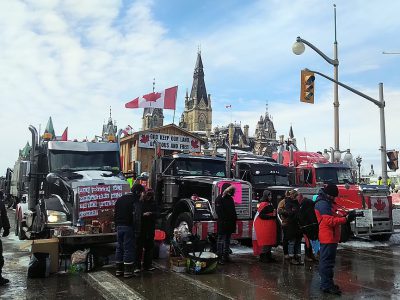
The Freedom Convoy’s politics are fringe, but the average Canadian’s frustration is real