
WP_Post Object
(
    [ID] => 3675
    [post_author] => 2
    [post_date] => 2022-01-05 21:49:48
    [post_date_gmt] => 2022-01-05 21:49:48
    [post_content] => The current situation for journalists in Belarus is horrific enough, but will probably worsen. 

On May 23, Belarusian authorities caused a global outcry when they diverted a Lithuania-bound commercial flight to the Belarus capital of Minsk so they could arrest two passengers on the plane: self-exiled journalist Raman Pratasevich and his girlfriend Sofia Sapega. This shocking tactic was seen as emblematic of just how far President Aleksandr Lukashenko is willing to go to capture and punish his critics.

The dramatic arrest should not have surprised anyone familiar with the vindictive nature of the Lukashenko regime. The Belarusian leader, who has run the country since 1994, launched an especially brutal crackdown against the media around the August 9, 2020, presidential election, which was widely seen as rigged.

Dozens of reporters were detained for reporting on mass anti-government protests after Lukashenko claimed victory in the contested vote; Belarus now has at least 19 reporters behind bars —up from 10 in 2020 —according to CPJ’s 2021 prison census. 

CPJ has documented the beatings of journalists in detention as well as the authorities’ attempts to close media outlets, block the internet, raid newsrooms, harass journalists, and keep bringing new charges against those in jail. Many journalists have been detained multiple times.

By late 2020, CPJ noted another change in the Belarusian authorities’ tactics: they started bringing criminal charges against journalists rather than just holding them in 15-day administrative detentions. In February, two journalists of the Poland-based online broadcaster Belsat TV were sentenced to two years in jail. The two were detained in November 2020 while livestreaming from a protest in Minsk. Katsiaryna Barysevich, a correspondent for Tut.by, one of Belarus’ largest media outlets, was also detained in November 2020 and sentenced in March this year to six months in jail on absurd charges of reporting on the death of protester Raman Bandarenka.

When Barysevich, whom CPJ honored with its International Press Freedom Award this year, was released from prison on May 19, she found out that her media outlet was shuttered, more than a dozen of her colleagues, including chief editor Maryna Zolatava, journalists Elena Tolkacheva and Volha Loika were in custody on tax evasion charges. Barysevich was unable to enter the Tut.by office. “I can’t get a document that proves my past employment with Tut.by because the office is sealed off, and there’s nobody in there. I cannot prove that I am unemployed now,” she told CPJ in June. (Several other Tut.by staff remain in detention and face serious charges. They are not listed in CPJ’s prison census because they did not work as journalists.)

Days after the authorities raided the Tut.by and Belsat offices in May, the arrest of Pratasevich reinforced the full extent of the brutal nature of the Lukashenko regime.

Pratasevich, who was made to appear on state TV and at press conferences after a publicized “confession,” is now under house arrest in Minsk, banned from seeing anybody and going outside. Agents from the KGB, Belarus’ national security agency, reportedly live with him in his room. Pratasevich’s parents, Dmitry and Nataliya, say they do not know what charges their son is facing and told CPJ they are concerned about him.
By late 2021, Belarusian authorities had closed down most prominent independent media outlets and popular social media channels, branding them “extremist.” The authorities also targeted organization that help journalists. The Belarusian Association of Journalists (BAJ), an advocacy and trade group that is a partner of CPJ, was ordered to close after 26 years of operations. Its leaders continue monitoring press freedom violations from inside Belarus. The Press Club Belarus, which assisted journalists with training, education and capacity building, was shuttered; its head Yulia Slutkskaya and other employees ended up behind bars. They were released only after asking for presidential pardon and paying large fines to cover the taxes they were accused of evading. In addition, Belarusian authorities took extra measures to ensure that the information about detainees does not get to local and international media. They forced many lawyers to sign non-disclosure agreements that prevent them from speaking on cases, and stripped some lawyers of their licenses. Belarus prison conditions are harsh. Journalists usually share cells with a dozen of other inmates, some with diseases, including COVID-19, or lice. Many have health issues but are not getting the medical treatment they need. Ksenia Lutskina, detained in December 2020 and facing seven years in jail in retaliation for her work as a journalist, has a brain tumor that is growing and causing bad headaches, her father, Aleh Lutksin, told CPJ. She’s been given painkillers but is not allowed to receive tests or medication she needs. (Belarus authorities have not responded to CPJ’s requests for information about any detainees.) The current number of journalists behind bars is the highest for Belarus in the three decades since CPJ launched its prison census. Many are facing lengthy prison sentences on retaliatory and anti-state charges, such as treason. The situation for journalists in Belarusian jails is likely to worsen. Every day, there are fewer media outlets and press freedom advocates to report on the journalists’ conditions, upcoming trials, and sentences. Those who continue to do so, like reporters at BAJ, are at risk of imprisonment. Lukashenko’s track record shows he can be expected to use every available tool to continue gagging dissident voices. *This article was originally published by the Committee to Protect Journalists (CPJ).  [post_title] => In Belarus, Lukashenko’s vindictiveness reaches new heights [post_excerpt] => The current number of journalists behind bars is the highest for Belarus in three decades. [post_status] => publish [comment_status] => closed [ping_status] => open [post_password] => [post_name] => in-belarus-lukashenkos-vindictiveness-reaches-new-heights [to_ping] => [pinged] => [post_modified] => 2026-08-05 18:15:53 [post_modified_gmt] => 2026-08-05 18:15:53 [post_content_filtered] => [post_parent] => 0 [guid] => https://conversationalist.org/?p=3675 [menu_order] => 152 [post_type] => post [post_mime_type] => [comment_count] => 0 [filter] => raw )
In Belarus, Lukashenko’s vindictiveness reaches new heights

WP_Post Object
(
    [ID] => 2168
    [post_author] => 2
    [post_date] => 2020-11-06 04:17:13
    [post_date_gmt] => 2020-11-06 04:17:13
    [post_content] => Gender equality in Belarus looks good on paper, but comes with many caveats. 

Less than five minutes into a recent television appearance, the interviewer asked Sviatlana Tsikhanouskaya about her last time in a kitchen. Tsikhanouskaya is generally believed to have won the August presidential election in Belarus, beating the long-term authoritarian ruler, Alyaksandr Lukashenka. During the election campaign, Tsikhanouskaya referenced her role as a housewife in what turned out to be a politically savvy move. Diverse groups within Belarus — reformists, conservatives, feminists — could all see a reflection of their ideals in Tsikhanouskaya. Conservatives could see a loving housewife and mother; reformists, an opportunity for change; and feminists saw a viable female candidate for the presidency. But the housewife trope was also used to undermine her. President Alyaksandr Lukashenka claimed that while he was sure Tsikhanouskaya could cook a good cutlet, how could he debate with her? The President sought to diminish his female opponent by comparing her knowledge of the kitchen to her lack of political experience.

During the election campaign and the now three month-old protest movement against Lukashenka’s blatant attempt to rig the results, the media spotlight has deservedly focused on Belarusian women for the outsized role they have played leading the struggle for fair elections, an end to egregious police violence, and peaceful regime change. Maria Kalesnikava, a political activist who was abducted by security forces on September 7 and then jailed, and Nina Bahinskaya, the 73 year old woman who is an iconic protest figure, have become household names for their roles in the protest movement.

However, the long-term impact on women’s role and position in society is more difficult to gauge. While a reporter for The New York Times wrote that the movement has “already shattered deeply entrenched gender stereotypes built up over generations,” and Belarusian media TUT.BY labelled it a “feminist revolution,” this view is not shared by everyone. Women have certainly played a pivotal role, but there is a great deal of work to do in mobilizing this newfound empowerment to dismantle Belarus’s deeply entrenched patriarchal system.

Barriers facing Belarusian women

On paper, Belarus is a leader in gender equality. In The Global Gender Gap Index 2020, it is ranked 29th out of 153 countries for women’s economic participation, educational attainment, health, and political empowerment. It has signed and ratified international legal frameworks on gender equality. At 69 percent, the share of women in the Belarusian judiciary is high. The Women’s Power Index shows that women have 35 percent representation in parliament, exceeding many European countries and giving Belarus a world ranking of 39th. On closer inspection, however, gender equality in Belarus comes with caveats. In the Cabinet, where more decision-making power lies, women’s representation falls to 3 percent. In 2004, Lukashenka declared that the presence of women in Parliament, makes it “stable and calm,” and that it will ensure that “the male Members of Parliament work properly,” thus reducing a woman's role to one of a caretaker or matron. True, there were a handful of high profile women in Belarusian politics before the August election—such as Lukashenka's press secretary Natalya Eismont, Senate Speaker Natalya Kochanova, and the Head of Central Election Committee, Lidziya Yarmoshyna—but their prominence does not reflect the reality for most Belarusian women. The 2019 UN Gender Equality Brief highlighted entrenched systematic gender norms and stereotypes as the biggest challenge to gender equality in Belarus, where a woman’s role is defined primarily as wife and mother. The majority of men and women in Belarus believe that being a housewife is as fulfilling as working for pay, with more women agreeing with this statement than men. Maternity leave is up to three years. This might sound ideal to women in the United States, where there is no legally mandated maternity leave, but because employers in Belarus are legally required to hold a woman’s job open for her while she is on leave, women of child-bearing age can see their careers suffer. A General Director of a medium-sized factory in Minsk once told me that it is common practice to weed out newly-married women when hiring to avoid taking on an employee who is likely to seek maternity leave. This is contributing to the wage gap that is currently around 25 percent and growing. A 2019 UN report found that almost every second woman in Belarus has faced partner violence; yet in October 2018, Lukashenka dismissed a new law on the prevention of domestic violence, decrying it as “nonsense” borrowed “from the West.”

The three graces

After the government prevented the three most popular male candidates from running as opponents of Lukashenka in the August election, women stepped up to form the main opposition. Tsikhanouskaya ran in place of her imprisoned husband, Siarhei Tsikhanouski; she was joined by Veranika Tsapkala representing her husband Valery Tsapkala, who had been forced to flee; and Maria Kalesnikava, who was the campaign manager for imprisoned opposition candidate Viktar Babaryka. It took just 15 minutes for the three women to agree to unite campaigns, something previous opposition had never managed to achieve. Over the course of the campaign, they emerged as a powerful triumvirate; it is because of their work, many believe, that Tsikhanouskaya won the election. Hundreds of thousands attended Tsikhanouskaya’s campaign rallies across Belarus, amassing huge support. But for Galina Dzesiatava, project manager at the NGO Gender Perspectives, there was also disappointment. Dzesiatava attended the rally in Homel, in southeastern Belarus, where Tsikhanouskaya expressed her desire to be “back in the kitchen frying cutlets.” Another moment that stung for Dzesiatava was when Tsikhanouskaya said “I do not have a program for changing Belarus,” adding “the men…have it.” deferring to the excluded male candidates. Dzesiatava said she “was devastated” upon hearing this.  Irina Solomatina, the founder of the project Gender Route and the Head of the Council of the Belarusian Organisation of Working Women, noted the lack of a feminist agenda in the campaign. Solomatina said they “mentioned social problems exclusively in terms of care” (for husbands, children..). In their rhetoric, “there was no place for either feminist or gender agendas.” Women rights’ issues, such as domestic violence and labour discrimination, were not mentioned during the campaign.

The women’s protests

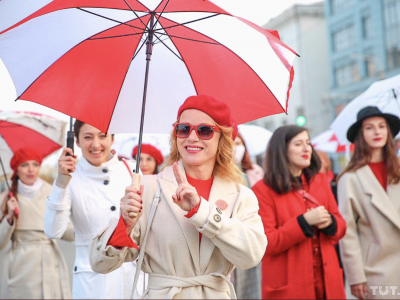
Katya* created the initial Telegram group ‘Girl Power’ on the evening of  August 11, following two nights of protests against the fraudulent election results, which police broke up with brutal violence. She could never have foreseen the impact of a group chat she said she originally made “for close friends and friends of their friends.” The initial plan was for a flashmob of women to meet at Komarovka market in Minsk the next day wearing white and holding flowers. Katya said “the goal [of the flashmob] was to transform the violent energy of protest into something safe and inspiring.” The chat, which began inviting people that evening, had more than 8,600 members by morning, “I couldn’t believe my eyes,” Katya said. By the afternoon, thousands of women were joining hands and lining the streets all over the country. Katya and her friends had to learn fast, “it was our first chat on Telegram. Me and my friends at first had no clue how to handle it, how to pin messages, change settings etc. We had to learn on the go.” Still in awe of the power behind the protests, Katya reveals that it began as “kind of a bet” saying “I promised my friend and sister that I [would] think of a safer way for us to protest.” Katya also noted that at the time she encountered a backlash from some women who saw this form of protest — of wearing white and carrying flowers —as “revealing our weakness.” She received comments like “flowers? Don’t forget about candies for the torturers too.” Solomatina echoed this perspective, arguing that these female protests perpetuated patriarchal values and stereotypes, appealing to beauty and softness. But Solomatina also highlighted the argument that it would have been a sin “not to take advantage of the patriarchal way of life.” The idea to play on gender stereotypes and roles was central to the performance of a Belarusian lullaby as part of the protests, where women stood barefoot dressed in white holding flowers. They altered the lyrics of the lullaby, calling upon those near them to open their eyes—instead of closing them. Dzesiatava said that in these protests, the women were successfully “playing the patriarchal system against the patriarchal system.” Leandra Bias, a Gender and Peacebuilding Advisor at Swisspeace, said that foreign feminists observing from the outside sometimes “think they know which female tropes and roles are the most emancipating” but that actually “we know nothing about the lived reality of Belarusian women.” Bias added that “when it comes to women protesting, they are the ones who know best how to navigate their daily lives, they know what is going to be effective.” 

The Fem Group

One aspect of the movement with a clear feminist agenda is the Fem Group, a working group of the Coordination Council for the Transfer of Power, founded by Tsikhanouskaya. The Fem Group was created to ensure that women are involved in all the transformation processes that would follow regime change. Their work includes increasing the visibility of women’s political participation, documenting state violence against women and raising awareness of state violence against men. The group are currently conducting an anonymous study on the needs of Belarusian women and the tools required to support them. While Lukashenka labelled Tsikhanouskaya a “poor thing” during the election campaign, he now appears to have woken up to the political force women possess. The women’s marches, initially left alone by the regime, were soon subject to a cruel crackdown. Russia put out an arrest warrant for Tsikhanouskaya, who is now in exile in neighboring Lithuania, while Kalesnikava is in prison after tearing up her passport at the border to prevent police from expelling her from the country. Prominent Belarusian feminists Olga Shparaga, Yulia Mitskevich and Svetlana Gatalskaya have all recently spent time in prison. While under arrest Shparaga conducted tutorials on feminism for fellow prisoners from her prison cell.

Belarusian feminism

“Feminism” is still largely a taboo word in Belarus. Few women openly identify as a feminist, and there are many women currently marching each weekend who would balk at the label. A survey carried out back in 2012 which analysed attitudes towards feminism found that just four percent of women considered themselves feminists and more than half of the men surveyed said that they would treat such women with disgust. In 2016, fewer than one percent of Belarusian NGOs advanced women’s rights, and fewer still identified themselves as feminist.  Yuliya* is an activist from Minsk who has been organizing peaceful evening gatherings; when asked how she perceives feminism she replied: “I can’t say I’m fully aware of what ‘feminism’ really means.” Katya*, the founder of Girl Power, said she identifies as a “humanist more than a feminist.” This may change. One of the potential impacts of the current women-led protest movement is an acceptance of the term ‘feminist’ in Belarus. Kalesnikava, who openly identifies as a feminist, says that Lukashenka “accidentally did more for the development of feminism in Belarus than anyone else,” adding that “feminism will stop being a dirty word.”  Nonetheless, feminism is advancing in Belarus. In 2019 there were more than 470 educational activities associated with women’s rights—workshops, lectures, and roundtables—and more than 2,500 consultations in legal, psychological and business support. Events in the gender sphere attracted over 5,000 participants. Some of the female-led initiatives in Belarus include: March on Baby, which aims to introduce a domestic violence law; Wen-do, which conducts self-defense training for women; and Her Rights, which strengthens women’s awareness of their rights. Gender Digest stresses however, that this work that promotes gender equality is often invisible to a wider audience.

Long-term impact

Renewed awareness of domestic violence is another source of hope. The widely publicized violence of OMON, the paramilitary security forces, repulsed many, but Dzesiatava explained that “OMON are actually the fabric of Belarusian society — this level of violence has always been visible for feminists and it is now visible to everyone.” The overt violence seen today was being committed before, but behind closed doors. Now that the violence is out in the open it will be harder to ignore; the hope is that this will inspire a national conversation about domestic violence. Dzesiatava draws parallels between an abusive domestic relationship and that of the regime and the Belarusian people. Bias noted the same thing, adding that “the most dangerous moment for someone in an abusive relationship is when they decide to leave”—just as Belarusians want to leave Lukashenka.  The August election and subsequent protests have seen both classic femininity and feminism being used and inverted. Sviatlana Tsikhanouskaya has become a feminist icon around the world, but she never intended for that to be. Belarusian feminism still faces many barriers, including the use of patriarchal tropes by both women and men. Yet Belarusian women are defining a feminism of their own, one that fits their lived reality, and it may well be that regime change will enable a redefining of the women’s agenda, offering up space for new opportunities. The recent women-led uprising may not necessarily be called ‘feminist’ but, as Galina Dzesiatava makes clear, they have been dubbed the ‘Revolution of Dignity,’ and dignity is a basic tenet of feminism. [post_title] => The Belarusian protests: Feminized, but feminist? [post_excerpt] => One of the potential impacts of the current women-led protest movement is an acceptance of the term ‘feminist’ in Belarus. [post_status] => publish [comment_status] => closed [ping_status] => open [post_password] => [post_name] => the-belarusian-protests-feminized-but-feminist [to_ping] => [pinged] => https://rada.vision/en/news-from-the-coordination-council-working-groups [post_modified] => 2026-08-06 22:58:54 [post_modified_gmt] => 2026-08-06 22:58:54 [post_content_filtered] => [post_parent] => 0 [guid] => http://conversationalist.org/?p=2168 [menu_order] => 238 [post_type] => post [post_mime_type] => [comment_count] => 0 [filter] => raw )
The Belarusian protests: Feminized, but feminist?

WP_Post Object
(
    [ID] => 2115
    [post_author] => 2
    [post_date] => 2020-10-09 04:32:33
    [post_date_gmt] => 2020-10-09 04:32:33
    [post_content] => Belarusians have found a unifying crucible in their resistance to state violence.

Mass demonstrations erupted in Belarus on August 9 to protest what was widely viewed as a rigged election that gave long-time strongman Alexander Lukashenko, who has ruled Belarus for 26-years, a victory over the popular incumbent. The protests have continued on a daily basis for nearly two months, despite mass arrests, beatings, and torture. The largest civil society movement in Belarus’s history is shaping the future of this former Soviet bloc country.

Mikita Mikado, 34 years old, is the CEO of PandaDoc, a California-based software company. From his office in San Francisco, he is following the news from his home country of Belarus. In the midst of the nationwide protests over the result of the presidential election and a crackdown of unprecedented force, he stepped in and urged police officers to resign. Money? “We can solve it,” he promised.

Never before, Mikado said, had he felt like standing up against Alexander Lukashenko, the authoritarian leader who has been president of Belarus since 1994. The breaking point was when he watched in horror as his fellow countrymen were dragged away and beaten up by riot police.

“I knew someone who was tortured and beaten,” he said. “I could no longer stay silent and do nothing, when stun grenades were exploding on the streets.”

Mikado’s crowdfunding initiative, Protect Belarus, was successful: over the ensuing three weeks it raised money to financially support police officers who quit their jobs. Hundreds of security forces members applied for re-training in the technology industry and for financial aid.

For years, Belarus’s rapidly expanding IT industry coexisted with Lukashenko’s government, keeping out of politics while benefiting from preferential tax rates and little regulation. For many tech professionals, the luxury of having a stable and relatively well-paid job allowed them the privilege of not following politics.

That relationship was already changing ahead of the August 9 election. Valery Tsepkalo, a former Belarusian ambassador to the United States and founder of the Hi-Tech Park— the Minsk equivalent of Silicon Valley—joined the opposition. Some startups created apps to monitor vote counts and collect data on poll violations.

Young and savvy engineers, fashion designers and successful entrepreneurs joined the protests. Passivity became just what a country could no longer afford. The middle class that long flourished within the system began separating from it. Post-election violence became the last straw.

An apolitical nation fights

Middle class disenchantment with the regime became apparent during the peak of the COVID-19 pandemic. Lukashenko played down the danger posed by the virus and dismissed it as mass “psychosis.” He said it was a minor health issue that could be cured easily with a shot of vodka, or with a day of working on the farm. A mass Victory Day military parade went off as scheduled. Public gatherings were not banned. Without guidance or policy from the government, Belarusians organised what they called “the people’s quarantine”: either individuals stayed home from work, or businesses introduced work from home policies without official guidance. Lacking support from the government, dozens of local initiatives and crowdfunding efforts emerged to buy and produce medical equipment, sew protective masks and raise financial support from local and diaspora communities. In Belarus, the pandemic utterly destroyed Lukashenko’s reputation as the controller-in-chief. Despite all his bravado, the president failed spectacularly to contain the virus. More importantly, civil society proved faster, more creative and resourceful than the state. By his very inaction, the president of Belarus unintentionally galvanized ordinary people to take action. Andrej Stryzhak, a human rights activist and volunteer worker, co-founded the #ByCovid19 initiative to help doctors deal with the pandemic. An informal group of some 1,500 volunteers delivered personal protective equipment (PPE) and medical equipment, purchased with money raised through crowdfunding, to hospitals across the country. Private businesses contributed funds and masks. Restaurants donated food. Hotels provided rooms pro bono to medical workers. In May, when we spoke about the initiative, Stryzhak told me he hoped the crisis would develop trust in the country’s third sector. “I see it as gradation from dissidents to parliamentary opposition,” he said. “Even if the dissidents are being trapped, they exist. If there’s less control, they are slowly becoming civil society. Later, alternative candidates appear, after which political parties will be initiated.” As numerous initiatives and projects exploded since then, he’s emerged from all that’s taken place in recent weeks in a distinctly optimistic mood. “Alternative structures of society are being created at the moment. These structures, which citizens are forming themselves, will eventually take over the current dysfunctional politics,” Stryzhak says now. The needle has indeed moved quickly.

Unprecedented solidarity

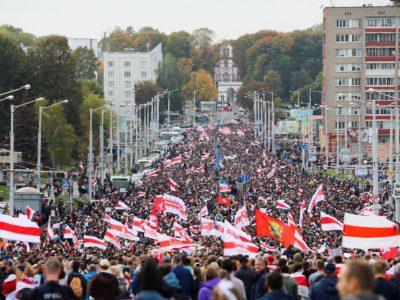
A vibrant popular movement has unfolded in the past months in Belarus. More than 100,000 rallied against Lukashenko in Minsk each of the past seven Sundays, despite detentions and police violence, insisting that his landslide re-election in August was falsified. Unlike in previous elections, the widespread grassroots protests —the largest in the country’s history—are sustained and organized with skillful use of social media. Telegram, a social media app that often remains available even during internet outages, has become a crucial tool in coordinating the unprecedented mass protests that have swept Belarus since the election. Several channels, such as Nexta and Belarus of the Brain, have become the most popular and main tools to facilitate the protests. The crowds are coming from all walks of life. In addition to the middle class, popular public figures are joining the protests. Among the celebrity protesters are athletes and Olympic medalists who march under the banner of the Free Union of Athletes, a newly-created movement. Nearly 600 Belarusian athletes signed an open letter demanding, among other things, new elections and an end to police violence. The wave of solidarity and self-organization is unprecedented in this country. Strike committees have been formed at state enterprises across the country, even though police are arresting and fining workers. Students gather on university campuses to protest repression and censorship. Lecturers support them. Media outlets publish blank pages when journalists are detained. Local residents feel the pride in belonging and self-identification; nearly every neighbourhood has its own newly designed flag. In the largest crowdfunding campaign, Belarusians have raised more than $6 million to help those who suffered from police violence and were fired for political reasons. It is a significant amount in a country where the average salary is roughly $500—and hasn’t increased in the past decade.

New values

The tide of anger and frustration with the Belarusian authorities is longstanding. People have united in the face of blatant injustice. But why was it this particular election that proved to be the tipping point? “Now it’s different. Belarusians made a sharp leap thanks to the generational change,” says Minsk-based sociologist Alena Artsiomenka. “People who grew up in the post-Perestroika era are more inclined to contribute to the society’s well-being. Those who were brought up in more stable and safe conditions are more interested in post-materialistic values.” Technology has been essential to the movement’s growth. Crowdfunding platforms made philanthropy easier. But this is no longer considered desirable. The work of one such platform, MolaMola, came to a halt after the government shut it down. It was launched by Lukashenko’s main rival’s son, Eduard Babariko, who has been under arrest since June. The same platform was used to collect money during the pandemic and previously for civil society projects that were not related to politics. Mikita Mikado felt a desire for revenge, too, after police raided the Minsk office of PandaDoc and arrested four of the company's managers. The government subsequently blocked the company’s accounts. In order to save his employees in Belarus, Mikado left the project Protect Belarus. But this did not halt the initiative. The state’s use of violence against protesters has proved to be not only a breakthrough in the way people think about the authorities— and the Belarusian public’s reaction against police brutality— but also in the way they see many realms of day-to-day life. Belarusians have been moving away from the paternalistic culture that was the tradeoff for economic stability during the post-Soviet period. In recent years, local communities managed to preserve a historic district that was slated for demolition. Residents also protested against the construction of a plant that would pollute their environment. Belarusians have long been associated with a strong paternalistic culture. This began changing in the recent years —people took matters into their own hands. The 2020 demonstrations are not without precedent. In 2017, ordinary citizens rocked the country with widespread protests against a tax on the unemployed, a bizarre plan that would have forced those who do not officially work to pay a penalty to the state. Injustice was the main driving force for the protests; the same is true of the current protests. In response to the 2017 protests, Lukashenko initially agreed to impose a ban on the tax—only to reintroduce it at a later date. He might not have changed in the intervening years, but the country has. Belarusian society had for years seen the trust of ordinary people in one another drain away. Now it has found a unifying crucible in its resistance to violence. Self-organizing and helping one another became fundamental. A nation’s new, yet old, encounter with its autocratic leader may not be finished yet. But there is little to no chance that Belarusians will submit any longer to Lukashenko's authoritarian regime. [post_title] => Belarus's protests are fueled by an unprecedented civil society movement [post_excerpt] => For years, Belarus’s rapidly expanding IT industry coexisted with Lukashenko’s government, keeping out of politics while benefiting from preferential tax rates and little regulation. The rigged August 9 election proved to be a tipping point. [post_status] => publish [comment_status] => closed [ping_status] => open [post_password] => [post_name] => belaruss-uprising-against-autocracy-is-fuelled-by-an-unprecedented-civil-society-movement [to_ping] => [pinged] => [post_modified] => 2026-08-06 22:59:40 [post_modified_gmt] => 2026-08-06 22:59:40 [post_content_filtered] => [post_parent] => 0 [guid] => http://conversationalist.org/?p=2115 [menu_order] => 242 [post_type] => post [post_mime_type] => [comment_count] => 0 [filter] => raw )
Belarus’s protests are fueled by an unprecedented civil society movement

WP_Post Object
(
    [ID] => 1941
    [post_author] => 2
    [post_date] => 2020-08-13 23:11:48
    [post_date_gmt] => 2020-08-13 23:11:48
    [post_content] => From Belarus to America: a lesson in how an authoritarian responds to those who threaten his power.

Six masked police officers in black uniforms and helmets were filmed beating one unarmed man, who can be heard moaning in pain. A woman runs up, screaming, and the cops turn on her, one of them explicitly threatening her, the other pushing her away. “Don’t touch him, that’s my husband!” she screams, flailing at them with her arms. The officers haul her husband up off the ground, presumably to be detained. It was just another day of violent crackdowns in Belarus, a country that has been ruled since 1994 by Alexander Lukashenko, who is often called Europe’s last dictator

We don’t know for certain where police took the man, but another video provides some clues. 


The women narrating the clip are clearly horrified at what they are seeing through the window. They fear the detained people lying face down in the walled yard of the police precinct will be murdered by police. One of the women wants to go out on the balcony to film, but then both decide it’s unsafe. The scene has a Children of Men vibe — dystopian and horrifyingly banal at the same time. Subsequent videos published on Twitter show protesters gathered outside a detention center in Minsk while chanting encouragement to the detainees who are being beaten inside, and weeping as large police vehicles arrive with yet more detained protesters inside. 

Reports of horrific torture in detention have begun to leak out. Here is just one video featuring the sounds of detainees screaming. Here is a video of a woman behind barbed wire, screaming “Don’t! Please stop! I can’t see anything!” A friend of mine who lives in Minsk has likened the situation to a war being waged by the state against its own populace. 

An independent Russian journalist, freed with the aid of his diplomats, was able to recount the scenes he saw after being essentially kidnapped by police (as they told him themselves, “You are not detained”), including minors being savagely beaten, people forced to lie face down in pools of blood for hours, police jumping on protesters’ backs until bones are broken, threats of rape, and much more. 

Four days into the anti-Lukashenko demonstrations, Belarusian state television broadcast a horrifying video report that shows young protesters at a detention center, obviously beaten and terrified, confirming to an off camera police officer that they will not engage in any more protests.

The mass arrests are part of a violent state crackdown on opposition demonstrators, who poured into the streets on August 9 to protest  an election that the president claimed he had “won” with 80% of the vote. Protests have sprung up all over the country, not just in the capital, Minsk. While exact numbers of protesters are hard to come by, official statistics say that at least 6,000 have been detained in just a few days. 


While media organizations have been careful to stress that vote rigging has been “alleged” in Belarus, I can state confidently that the election was stolen; the evidence is there for all to see.  Svetlana Tikhanovskaya, the 37 year-old woman who ran against Lukashenko after her husband, a well-known opposition blogger, was jailed in May, has been forced into exile in neighboring Lithuania. Security officials threatened to make orphans of her children, whom she sent abroad before the election; they later arrested her campaign manager, Maria Moroz.  They detained Moroz as a hostage, to be released in exchange for Tikhanovskaya’s departure from Belarus.  Before she was allowed to leave the country, Tikhanovskaya recorded what amounts to a hostage video, in which she reads from a script while sitting in what seems to be the office of a Belarusan Central Elections Commission chairperson. In a personal video, which she recorded shortly after arriving in Lithuania, Tikhanovskaya speaks emotionally; she calls herself a “weak woman” — a chilling reference to Lukashenko having mocked her as a “poor little girl” ahead of the election. “Children,” she said in that video, “are our everything”—a  clear indication that she was told her children would not be safe. She added: “God forbid you should ever have to face the choice I had to face.” Even with her children safely abroad, Tikhanovskaya had every reason to be terrified for them. Her husband, who was originally supposed to run instead of her before Lukashenko had him thrown in jail, remains behind bars, another hostage.  Svetlana Tikhanovskaya is young, passionate, and charismatic in a way that galvanizes voters. She has a wholesome image — an independent candidate who declared her love for her activist husband, Sergei, after he was locked up, and ran on a platform of freeing political prisoners, weakening ties with Russia, and democratic reforms. Her courage invested her with instant appeal. The threats against Tikhanovskaya and her family are not the actions of a confident leader who easily won the majority of the polls. They are the actions of a dictator who feels his throne wobbling underneath him. Although the election was not monitored — already a major red flag — the machinations witnessed by ordinary citizens at the polls were giving the game away, Tikhanovskaya was clearly getting too many votes for comfort. Demands for “all votes to be counted” are no longer relevant at this point; to get to the bottom of what happened, one would need to hold a whole new, transparent election, which is impossible at the moment. Look at this graph if you want to understand the generational span of Lukashenko’s rule: Add to that stagnation and growing inequality, as well as a history of repressions and crackdowns. Now add the fear, uncertainty, and crisis that 2020 brought — a spectacle that has included Lukashenko mocking the coronavirus and hosting a parade as infections surged Lukashenko’s response to the protests has included not just threats and violent crackdowns; he also cut off the internet in an attempt to stifle dissent. The people, however, appear furious and determined in their defiance. Bypassing restrictions, some have even created a Telegram channel dedicated to unmasking and doxxing Lukashenko’s security services — a situation that could escalate dramatically on top of all of the other escalations.  It is not clear if Lukashenko will be toppled. Certainly, the savagery with which the protesters are being treated shows us that he fears as much. Some regional analysts believe that the regime is nearing collapse, but the question is — at what cost? Americans should be paying close attention to events in Belarus. Lukashenko’s response to the opposition shows how a cornered rat behaves — with mass arrests, death threats, and attempts to shut down or limit access to the internet. Donald J. Trump is just a wannabe authoritarian, but like Lukashenko he can be dangerous when under duress. We have observed Trump’s increasing petulance — everything from the constant revenge-firings of officials and blasting his own intelligence community on Twitter — and see how it can easily turn into a rage.  We can see how that rage finds an outlet via unidentified paramilitary police grabbing protesters  in places like Portland. We can see it in how peaceful protesters were tear-gassed in D.C. for a bizarre photo op. One of the functions of authoritarianism is to bulldoze the safeguards that a democratic system places between the individual and the state — as craven officials continue to help Trump, more and more of the American public is exposed to both his anger and his incompetence. Americans are lucky to have a system that still provides many protections from Trump’s rage, but that system has its vulnerabilities. With the pandemic out of control in the States, voting by mail has become more important — but our Postal Service is being sabotaged, to name one obvious example. Republicans have been going after the USPS for years, but their efforts now present Trump with a potential opportunity to cast the upcoming presidential election as seriously flawed, especially if it’s a close one. When a crucial part of the societal infrastructure that is propping up our democracy is weakened, we stray further toward unpredictable scenarios.  Keith Kahn-Harris, a London based sociologist and prolific author, explains in an excellent Twitter thread that Western ideological zealots who support foreign dictators and cast them as fighters of Western imperialism (Kahn-Harris he refers to them as “Tankies” — the term originated with British people who supported Soviet tanks rolling across Europe, but has since broadened to include different groups, united by a disdain for the Western countries they call home) have succumbed to delusion by treating Lukashenko’s state propaganda as though it were meant to be believed.  Rather, explains Kahn-Harris, “In dictatorships the absurdity of the lie is precisely the point—it is an expression of dominance.” People who have grown up in authoritarian regimes know that official statements are lies. The trick is to understand the subtext of the lie. People who have grown up in democracies are not equipped with the necessary cynicism to combat a leader who lies axiomatically, which is why the U.S. media has failed to cover the Trump presidency with adequate insight.  There is a very good parallel to be drawn between Trump’s base — as they do everything from cheering on our own examples of horrific police violence to ignoring or dismissing the president’s inaction on the pandemic — and Lukashenko’s Western fanboys as they seek to discredit protesters in Belarus Both groups are operating in a state of unreality. As we have seen over the past few months,  2020 has shown all too well, unreality is both seductive and deadly. [post_title] => Why you should care about what's happening in Belarus [post_excerpt] => Americans should be facing close attention to events in Belarus. Lukashenko’s response to the opposition shows how a cornered rat behaves — with mass arrests, death threats, and attempts to shut down or limit access to the internet. Donald J. Trump is just a wannabe authoritarian, but like Lukashenko he can be dangerous when under duress. [post_status] => publish [comment_status] => closed [ping_status] => open [post_password] => [post_name] => why-you-should-care-about-whats-happening-in-belarus [to_ping] => [pinged] => [post_modified] => 2026-08-06 23:01:20 [post_modified_gmt] => 2026-08-06 23:01:20 [post_content_filtered] => [post_parent] => 0 [guid] => http://conversationalist.org/?p=1941 [menu_order] => 252 [post_type] => post [post_mime_type] => [comment_count] => 0 [filter] => raw )
Why you should care about what’s happening in Belarus