Unlearned historical lessons from Jacques-Louis David’s retrospective at the Louvre.
Cultural Currency is a bi-monthly romp through the intersections of art with writer Cara Marsh Sheffler.
Many of us have had enough of living through Interesting Times. As an American raised in the misguided, batshit optimism between the fall of the Berlin Wall and 9/11, I often feel as if my adult life has been lit by the glow of a global garbage fire no one conditioned me to anticipate—a garbage fire lit by the US government, and tended to with as much care as it lavishes on the Eternal Flame. For this reason, I was eager to see the monumental Jacques-Louis David retrospective at the Louvre earlier this year: David is, in many ways, the official court painter of Interesting Times. He lived through some of the most shocking regime changes in European history and both painted and propagandized them.
Born in 1748 during the ancien régime, David rose through the traditional, royally patronized ranks to become a painter known for his austere style and his focus on Neoclassical themes. Though socially connected, during the heyday of the salon, he was tormented by a benign facial tumor that impeded his speech, somewhat setting him apart from polite society. When the French Revolution kicked off, he dove into radical politics and befriended Maximilien Robespierre, the architect of the Reign of Terror, which saw some 17,000 public executions by guillotine. David served in government designing festivals, monuments, and uniforms; he also sat on the Orwellian Committee For Public Safety and voted for the death of Louis XVI. When Robespierre fell, David went to prison for the better part of a year, but kept his own head. A few short years later, he rose to prominence once more as the official court painter of Napoleon, outliving the empire, only to die in 1825 in exile in Brussels. Remarkably, this was a voluntary exile: the restored Bourbon King had invited him to serve as court painter, despite knowing David voted to guillotine his brother.
If this Louvre show was any indicator, the French curatorial class is still vaguely terrified of one of its most emblematic painters and unsure of what to make of him, the same way French elected officials are still afraid of an electorate that once managed to chop up its ruling class. The Internet likes to joke the White House would be covered in shitand on fire if Trump were governing France and, there is, perhaps, some truth to this. The French are known as feisty, indignant, and quick to strike or riot in a way that we Americans deem “bad for business.” Each time I’m in the country for any kind of civil unrest, it is not hard to imagine how they conceived of the guillotine, a sublime machine of both political horror and political theater concocted under the cynical pretense of science, democracy, and progress (cf., Liberté, Égalité, Fraternité).
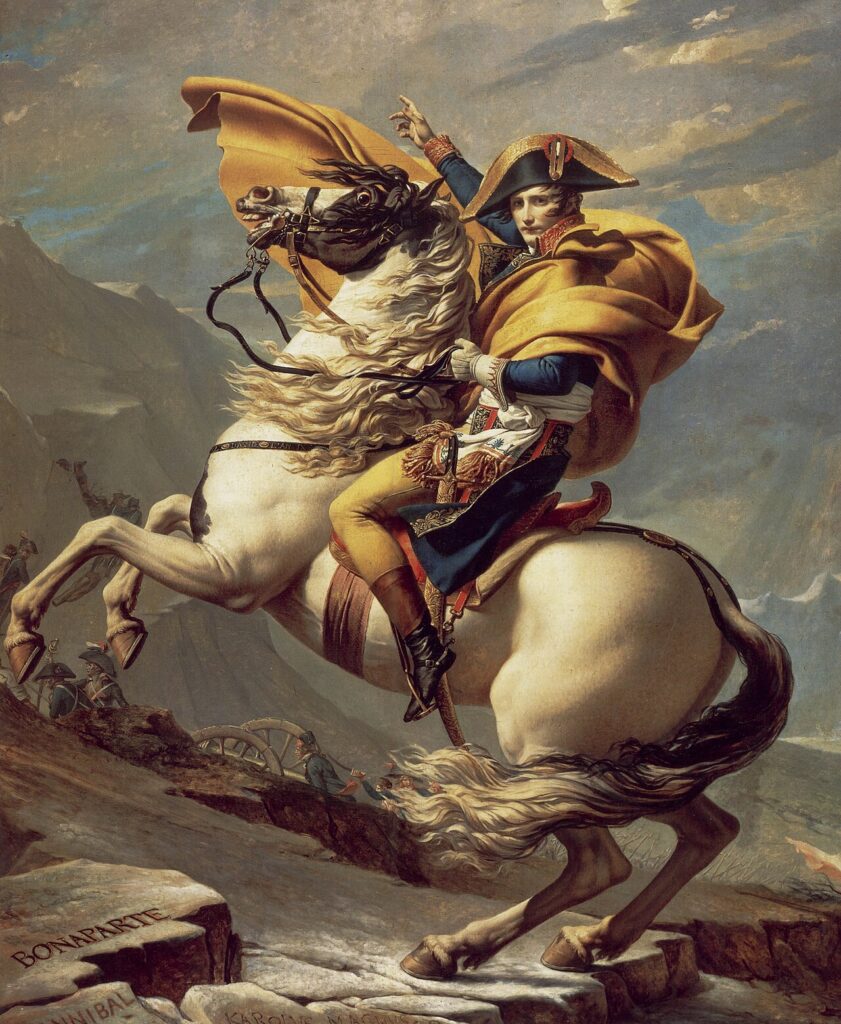
"Napoleon Crossing the Alps" by Jacques-Louis David
A Neoclassical master, David’s most famous paintings include “The Oath of the Horatii” (1785), “The Death of Marat” (1793), “Madame Récamier” (1800), “Napoleon Crossing the Alps” (1801), and “The Coronation of Napoleon” (1807). The show was organized chronologically to chart the violent, winding historical path between these paintings, and David’s relationship to each regime he served. His evolution marks him at best as a cipher, and at worst, the most corrupt hypocrite. But David was hardly alone in changing alliances to survive: Talleyrand, the French statesman and contemporary political chameleon survived five regimes in succession, brazenly switching sides to do so. When he died, Metternich, his Austrian nemesis, sarcastically remarked, “I wonder what he meant by that?” In many ways, that question felt like the animating force of the David exhibition. One could easily assert he was an artist without scruples who went where the moment and money took him. But, that’s too simplistic. David painted the long, strange journey through the phases of one’s life, one’s country, and one’s era. He painted the life and death of ideas and the flesh-and-blood people who lived them; his works testify to the gap between espoused ideals and lived reality—between pulling the trigger and watching the body fall.
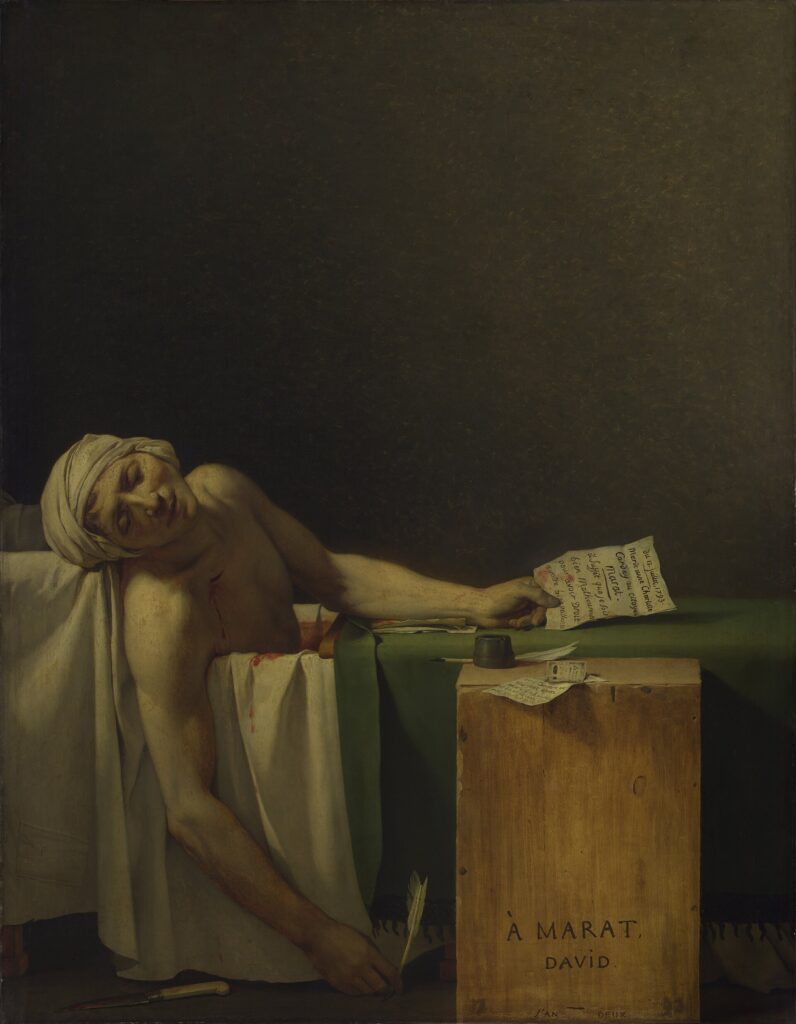
Hot-headed and famously difficult from the jump, David attempted suicide the second time he failed to win the Prix de Rome in 1772. His third time was the charm, however, and he proved to be a prescient artist: His themes of stoicism and self-sacrifice conveyed through Neoclassical renderings of Athens and the Roman Republic foretold a great deal of politics and fashion, from the empire waistlines to the rise of democracy in modern Europe. His earliest successful paintings, such as “The Oath of the Horatii”, are impressive, even as they are also re-imagined scenes from a mind untested by political reality. The 1784 painting is literally bloodless: men swear to die for a cause while their wives cry in a corner. Nine years later came “The Death of Marat”, a visceral masterwork of propaganda. Oddly, when I first came upon it in the exhibit, I said to myself, “Welp, there it is,” and meandered into the next room. It wasn’t until I re-entered the gallery, painted green to match the solemn background of the composition, that I realized I had seen a copy: The entire room was filled with painted copies that had been disseminated across France. I turned around to face the utterly electrifying Real One. You didn’t need to know a thing about art to figure out which one it was: a painting of the cold, calculated stabbing of a vulnerable man in his bathtub, the artist’s own murdered best friend, dead for the Republic.
"The Death of Marat" by Jacques-Louis David
David’s political journey is also evident in the gap between his stiff, slightly asexual representation of so many female figures in his earlier allegorical paintings, versus the real and vibrant women he painted with loose brushstrokes and incredible intelligence in his portraits, such as that of Marie-Louise Trudaine.David’s own wife, Marguerite-Charlotte, divorced him in 1789 for being a regicide, but they remarried after he was released from prison, raising four children together who sat for him often. For a painter often criticized as unfeeling, his portraits of married couples are a delight: “father of chemistry” Antoine Lavoisier and his wife (and underappreciated fellow chemist) Marie-Anne Paulze dominates his depiction of them together in the lab; he also painted a tender double portrait of Antoine and Angelique Mongez, simply because they were great friends of his, as an inscription attests.
That he eagerly chased an ideal (or three) is nothing novel or noteworthy, but his art became more compelling the more tested he was by events. The more shit spiraled out of control, the more David understood the power of the narrative—as well as when to turn it off completely. His self-portrait in prison is a high watermark of decontextualizing. It’s a testament to that ever-present gap between our personal political thoughts and our complicated, shared realities. Finding an authentic perspective on that gap is impossible: If the Renaissance painters taught us about visual perspective, David demonstrated that perspective on current events is a lie. In fact, his best use of literal perspective is a metaphorical one. In his great portrait of Comte Antoine-Français de Nantes he shows us the cost of living through Interesting Times: The count, once a fiery, young revolutionary, became a Napoleonic crony. David painted him from below, so he literally looks down his nose at viewers. His contemptuous face and saggy jowls are articulated with unsparing detail, a countenance juxtaposed with and choked out by finery—the lace, the velvet cape, and a medal for the ideals he betrayed along the way. Survival is an exercise in brutality. This sellout—the sellout—David says, is what winning actually looks like. This is the political happily ever after.
I came to this show as a citizen of a different empire presently running amok. France forged the United States’ first alliance and, like so many American allies to come, was left holding the bag. (This should have been a caveat emptor for future allies: Leopards do not change their spots, and Americans do not change their stars and stripes—but we Yanks are, if nothing else, fantastic at sales.) Funds sent to aid the American Revolution helped bankrupt the French crown and sparked a chain of events that cost the French king his head. All the while Thomas Jefferson meddled in The Declaration of the Rights of Man from his Parisian salon, Sally Hemings was enslaved in the next room. From this eventful early alliance, France and the US allegedly share ideals (cf., the Enlightenment), but we don’t exactly share historical roots. One major difference was reflected in a telling piece of wall text in the show: the role of the Catholic church. Next to the OG “Death of Marat”, the curator alluded to how revolutionary France needed martyrs to fill the void left by the abrupt banishment of the Catholic Church and the monarchy. Hours after Marie Antoinette was beheaded, “The Death of Marat” was unveiled at the Louvre, recently changed from palace to museum. That is to say, a cult of the state was invoked to fill the void of state religion.
Self-portrait by Jacques-Louis David
To this New Yorker, it often feels laïcité—the French principle of secularity—demands its own sort of worship. Religious freedom in France looks to me more like a hole in the ground where a Catholic church once was. Rather than a new structure where all are welcome and inclusion is additive, it’s one that demands the sacrifice or sublimation of all other cultural tenets for those wishing to be included. This creates toxic conditions as France wrestles with a number of postcolonial realities, including a large Muslim minority. Those limitations on the public imagination for an honest plurality were, to me, somehow reflected in this state-funded exhibit’s unwillingness or inability to reach final conclusions about David—and his attempts to fill that civic-religious void with new meaning. If America’s fundamental struggle is with equality, France’s is with diversity. Today, the French do not understand their secularity is exclusionary, much the same way we Americans don’t understand our democracy is a fiction.
Unlike France, we never have had a class revolution in the United States. In 1776, a bunch of rich lawyers told a king far away to fuck off, then immediately turned around and did business with him without changing all that much on the ground. That’s why the 13th Amendment is still, somehow, just sinking in. Ironically, white Americans scored many of their freedoms from Britain when the country was still a colony: Even the pope of the Enlightenment himself, Voltaire, envied the British their Parliament and the rights it accorded in the mid-18th century. From France, we may have learned exceptionalism, but we never learned real revolution. In America, the “revolution” was just another nice thing that only rich white people could have; in France, the revolution cost the upper class their heads.
If the French figured out how to stop deifying the king, maybe someday we can figure out how to stop deifying billionaires. And if we do, maybe someone will stay alive long enough to paint the whole drama as it unfolds. Doing so requires vanity, opportunism, gall, cruelty, and a profound degree of hypocrisy. However, it also requires bravery, and for that bravery, David was rewarded with awareness of some very modern dilemmas that keep his work relevant: of knowing it is impossible to portray a scene without altering it; of knowing all art is inherently political; of knowing the stories we tell control our realities; and of knowing that you will be judged as harshly as you judged others—and going through with it anyway, charging into The Void, no matter the cost.
[post_title] => Painting as It Burns
[post_excerpt] => Unlearned historical lessons from Jacques-Louis David’s retrospective at the Louvre.
[post_status] => publish
[comment_status] => closed
[ping_status] => closed
[post_password] =>
[post_name] => jacques-louis-david-retrospective-louvre-art-cultural-curreny-history-museum-france-united-states
[to_ping] =>
[pinged] =>
[post_modified] => 2026-04-03 19:30:30
[post_modified_gmt] => 2026-04-03 19:30:30
[post_content_filtered] =>
[post_parent] => 0
[guid] => https://conversationalist.org/?p=10407
[menu_order] => 0
[post_type] => post
[post_mime_type] =>
[comment_count] => 0
[filter] => raw
)
How the ephemerality of the internet and the many ways we present ourselves online has warped our ability to know who we really are.
Will the Future Like You? Reflections on the Age of Hyper-Reinvention begins with a declaration: Our personal identities have not kept pace with the tempo of technology. And, according to author Patricia Martin, this imbalance has made us wholly unprepared to explore—let alone answer—the age-old question of who we really are.
In her book, Martin, a cognitive psychology-informed cultural analyst and host of the podcast Jung in the World, frames many of her arguments using Carl Jung’s theory of archetypes, applying them to identity formation in the digital age. If Jung’s original thesis proposes that humans rely on universal themes and inherited behaviors in the psyche to present who we are across self, shadow, persona, and anima, Martin contends the ephemerality of the internet has warped our inheritance. Her primary concern are the selves we present to the world via our various performances online, often manufactured as authentic while being anything but. Carrying out numerous ethnographic approaches including content analysis, narrative interviews, and sorting and coding “15,000 online users across 500 million posts,” she concludes these performances are also occurring at an exorbitant rate never experienced before in human history, sowing mass identity confusion in the process.
Having become increasingly skeptical (and weary) of internet self-presentation via social media, I devoured Martin’s latest work, which utilized psychoanalytical language and frameworks to explore observations I’ve mainly considered through a cultural and anthropological lens. But even those who don’t agree with Martin (or me) about the current state of affairs will likely find instructive value in the book’s summations about our ever brave new technological era and its effects on identity.
According to Martin, there are three main elements contributing to our modern distortions of self-construction and development: “personal fog,” “chronic self-doubt,” and “cascading crossroads.” Borrowing from Jung’s definition of the persona as a complex system that helps the individual relate with the world socially by wearing a kind of mask, Martin argues that personal fog comes from the continuous amplification and proliferation of various personas online, which obliterate our sense of who we are. Chronic self-doubt, meanwhile, delineates the distances between our digital presentations, which rely on external validation, and the selves we present offline, a gap that can cause tremendous self-uncertainty. Finally, cascading crossroads is characterized by how previously reliable identity anchors—such as family and work, or even other modes, such as class, gender, and where we consider home—now fluctuate more frequently, making our shape-shifting far more incessant.
Among the many examples Martin offers of this increasing ephemerality, she cites the story of the trailblazing confessional blogger, Heather Armstrong. In the early aughts, Armstrong’s blog, Dooce, was a “mommy tell-all” magnet to millions, especially young mothers, who regularly consumed her relatable personal accounts of raising two children in Salt Lake City, Utah. But even before Dooce’s eventual decline due to the rise of social media, Martin points out that as Armstrong “matured, she found her light waning,” and the blogger increasingly divulged more serious confessions, including daily alcohol consumption and marital issues, not to mention the details of her history with depression. Martin isn’t explicit about whether Armstrong’s solemn shift was a cry for help or an effort to reinvigorate the blog. She does, however, add that “Dooce attempted several comebacks. But traffic never bounced back.” In 2023, Armstrong died by suicide. Examining how she was remembered, Martin notes “how little was said about her massive output of content, the effort it took, and the emotional toll of constant reinvention…”
While Armstrong’s story is a particularly dire case, there are others—admittedly less tragic—throughout the book that still speak to the toll our relationship to having an audience is taking on our relationship to ourselves. Martin also makes clear this goes beyond those who are, in some shape or form, attempting to be influencers: All of us online are liable to the emotional struggles of trying to juggle various presentations at cost to our psyche and identity development.
However, the book doesn’t propose that we all abandon the internet (to the extent that we can) to counter these identity disruptions. Nor does Martin suggest that we wholly desert digital performance and presentation altogether. Rather, she asks the reader to more carefully consider the repercussions to our relationships—both to ourselves and others—online, where our identities are overwhelmed by seemingly endless transmutations, and ultimately underpinned by digital spaces extorting our identity confusion for profit.
This inevitably has affinities with Karl Marx’s concept of the alienation of the factory worker from anything that could give their work meaning. But for me, it brought to mind Aimé Cesaire’s Discourse on Colonialism, and its thesis that the thingification of the colonized subject turns them into a commodity, isolating a person from themselves and the other. Transposing Cesaire’s contentions onto Martin’s begs questions worth probing further: Are we being colonized by the internet? Or by the tech bros that run it?
Luckily, Martin doesn’t leave us without specific resolutions for alleviating our identity disruptions, the greatest of which is—perhaps surprisingly—a spiritual recommendation: that we reconsider the soul. Some anecdotes in the book are even dedicated to people who've been able to subvert identity confusion by relying on time-honored means of transformation and soul-enrichment: insulating themselves offline, and leaning on close bonds in the flesh.
Martin also challenges us not to render onto technology what cannot be done by technology. Instead, she encourages us to create and honor our most true selves beyond the curations the internet can only offer. “We set boundaries, we verify claims, and we don’t give ourselves away too easily for the sake of a little fawning attention,” Martin writes in the concluding chapters of the book; to me, sound advice regardless of which continuum of internet identity discourse you choose to be on. She also offers perhaps one resolve for the question the book’s title proposes, Will the Future Like You?: Ultimately, the quest to answer this in the digital space is a hollow endeavor, because it requires an endless reconfiguration of selves, often to our own detriment. So, whatever selves we do offer up as performance in digital spaces, at the very least, we should refuse to give in fully—saving us perhaps not only from ourselves, but for ourselves.
[post_title] => March Book of the Month: "Will The Future Like You?" by Patricia Martin
[post_excerpt] => How the ephemerality of the internet has warped our ability to know who we are.
[post_status] => publish
[comment_status] => closed
[ping_status] => closed
[post_password] =>
[post_name] => march-book-of-the-month-botm-will-the-future-like-you-patricia-martin-identity-online-social-media-nonfiction-psychology
[to_ping] =>
[pinged] =>
[post_modified] => 2026-03-27 21:38:46
[post_modified_gmt] => 2026-03-27 21:38:46
[post_content_filtered] =>
[post_parent] => 0
[guid] => https://conversationalist.org/?p=10374
[menu_order] => 0
[post_type] => post
[post_mime_type] =>
[comment_count] => 0
[filter] => raw
)
How samba schools in Brazil are teaching Black history through the parades at Carnival.
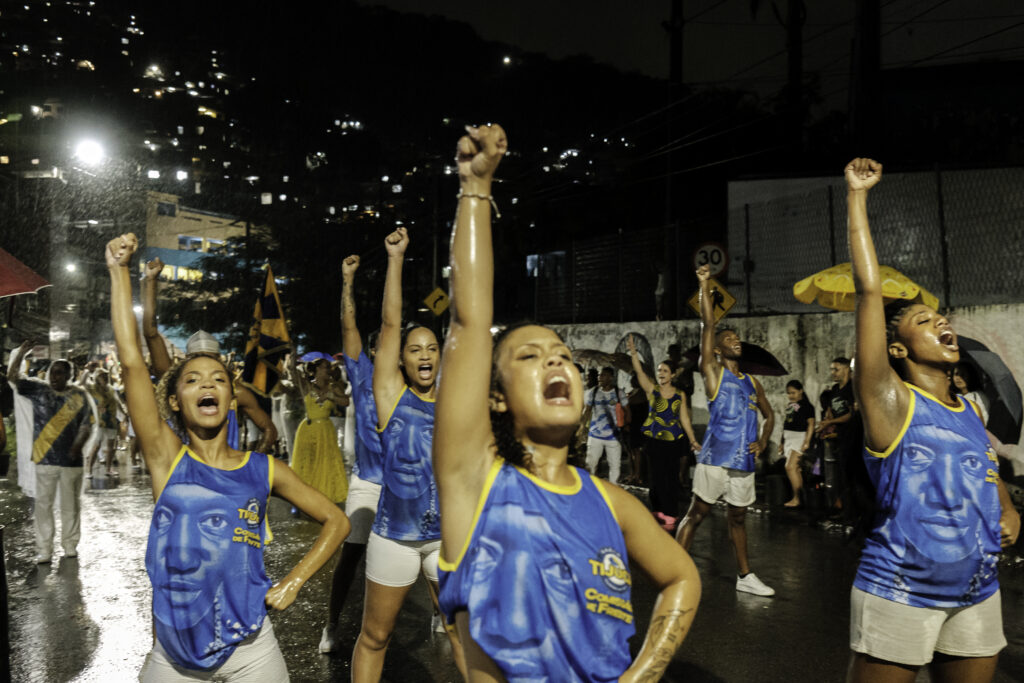
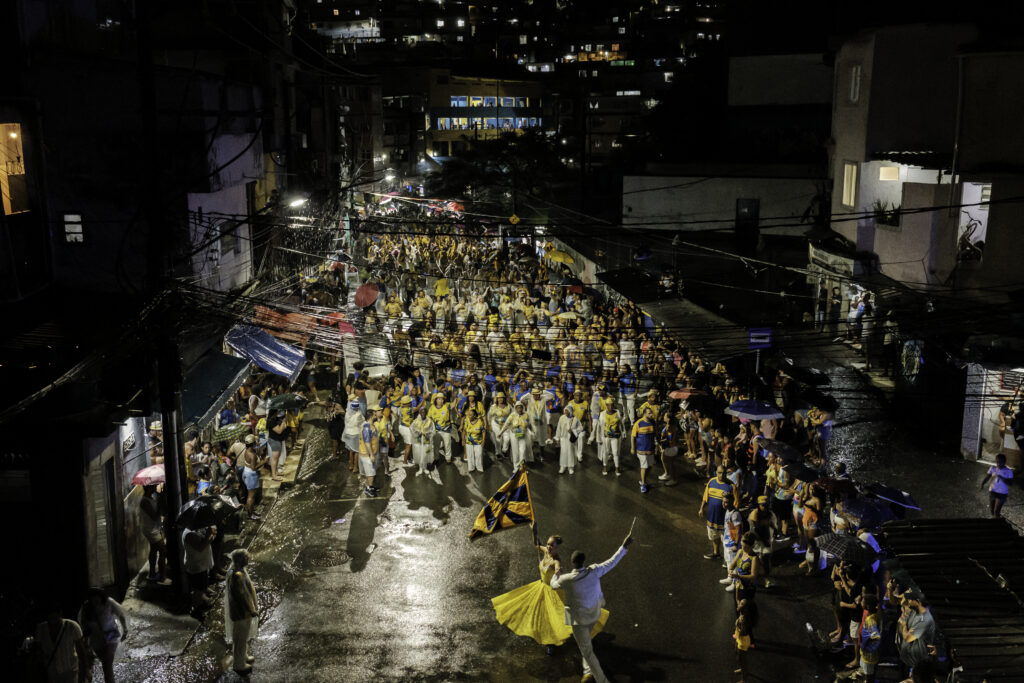
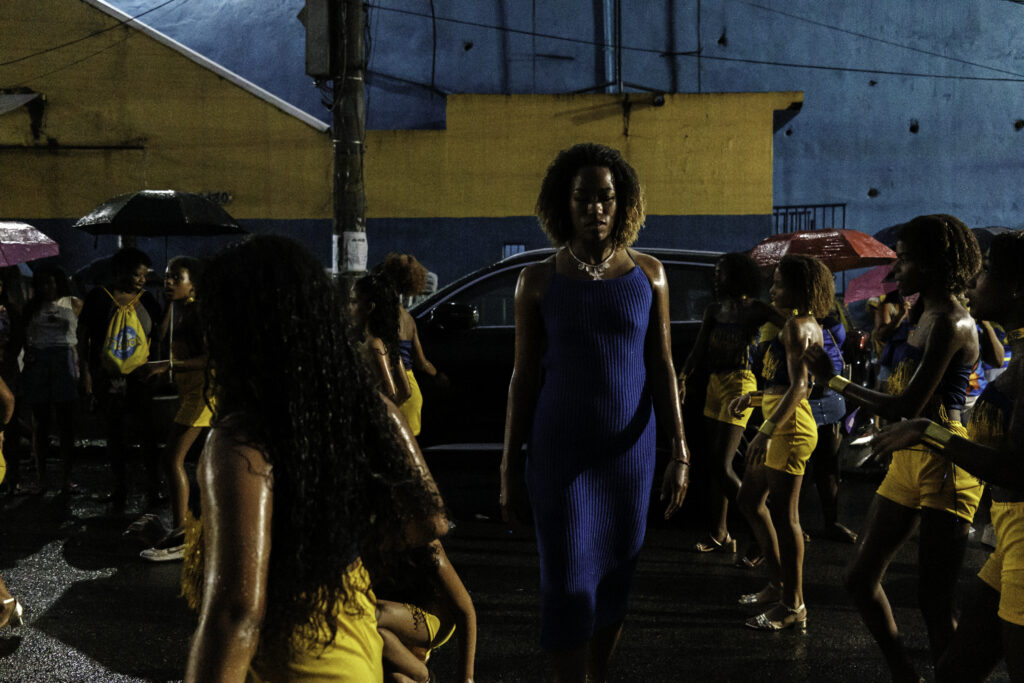
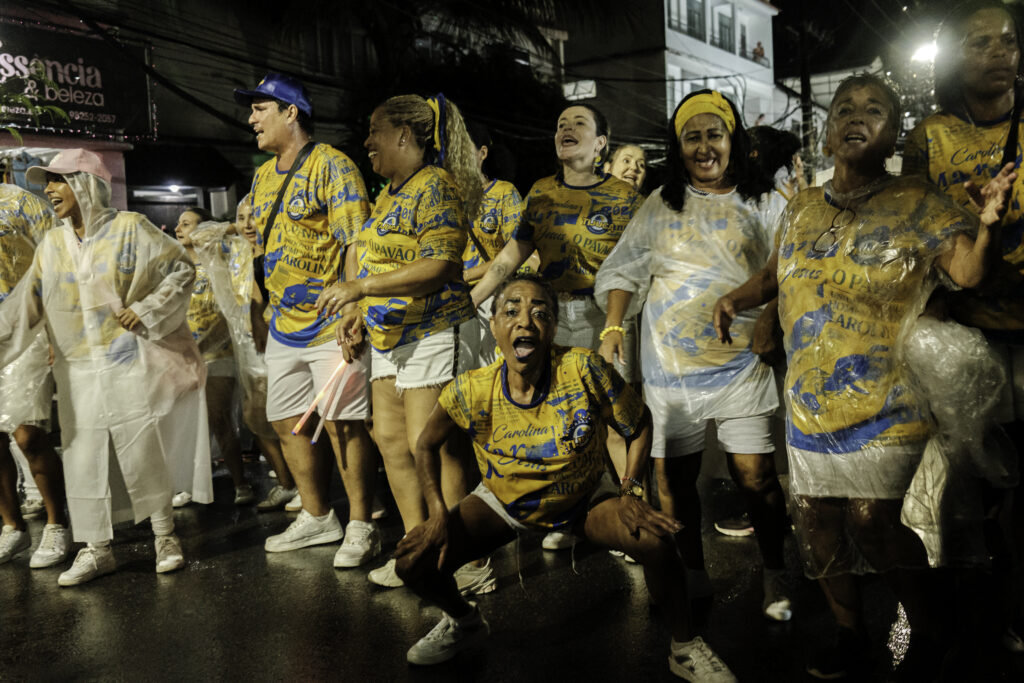
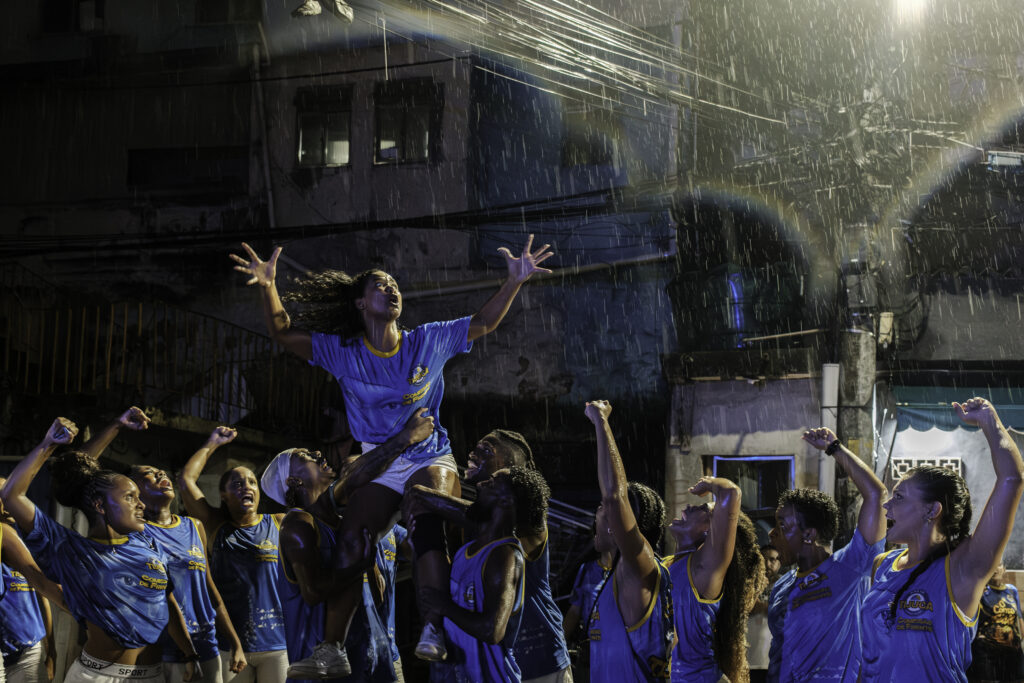
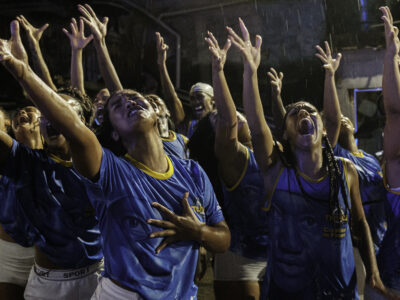
The torrential rain couldn’t stop Unidos da Tijuca, one of the oldest samba schools in Rio de Janeiro, Brazil, from rehearsing in the streets. On an evening in early February, dancers flooded the Morro do Borel community, moving their bodies in unison as a crowd cheered them on, shouting their loyalty to the samba school and dancing alongside them. The crowd had been waiting for hours for the rehearsal to begin, drinking beer and barbecuing, the evening already a celebration. Now, the sound of snare drums, quick and sharp, moved each spectator to sing along to the music, as the year's anthem began to play. The performance had officially begun.
Though the parades in Rio are world-famous, attracting a global audience for Carnival each year, the greatest show in the world still belongs to these communities, where the parades—a pivotal part of the season’s festivities—originated. It is also here that these samba schools work hard year-round to honor the parades’ original purpose: bringing marginalized histories that aren’t taught in Brazilian schools to the national stage.
“Since the 1930s, samba schools have been addressing themes closely related to Brazilian history,” historian Luiz Antonio Simas tells The Conversationalist. “This created a tradition in which Brazilian history, important figures from Brazilian history, and the country's natural beauty became recurring themes [at each parade].”
Leonardo Carrato
Founded in 1931, Unidos da Tijuca is one of 12 samba schools that compete during Carnival, each putting on a parade built from scratch that highlights a different piece of forgotten Brazilian history. For this year’s parade, Unidos da Tijuca chose to tell the story of Carolina Maria de Jesus, a Black Brazilian memoirist, poet, composer, playwright, and best-selling author, most known for her book Child of the Dark: The Diary of Carolina Maria de Jesus, published in 1960 and translated into 14 languages. Last year, the school chose to tell the story of Logun-Edé, an orisha of the Black Brazilian religion Candomblé, and the year before, the influence of Portuguese folk tales on Brazilian samba music.
Other competing schools chose different figures to celebrate this year: Acadêmicos do Salgueiro paid homage to Carnival designer and professor Rosa Magalhães, a samba school legend who won six Carnival championships in the 1980s. The samba school Paraíso de Tuiuti performed a parade about Afro-Cuban religious practices, with a whole chorus written in the Yorubá language. And the 2026 winner, Unidos do Viradouro, honored Moacyr da Silva Pinto, or Mestre Ciça, the school's legendary percussion conductor.
In telling these stories, Unidos da Tijuca and other samba schools aim to make marginalized histories—and Black history in particular—more accessible through popular culture, allowing them to keep these histories alive. The construction of the parade is a year-long process that starts again right after Carnival ends, beginning with each school democratically electing a theme, running a song competition, and translating history into a visual performance through choreography that involves hundreds of dancers.
But while the parades are a joyful culmination of the schools’ efforts, for the communities each samba school represents, it’s the lead-up to the final performance that often most solidifies the history being celebrated.
Leonardo Carrato
That rainy Sunday was Unidos da Tijuca’s last street rehearsal before the official parade at the Sambadrone, and party dwellers excitedly gathered to watch an intimate preview of what would later earn the school 7th place in the official competition. At 6 PM, onlookers dressed in the colors of Unidos da Tijuca—blue and yellow—waited outside of the school, a tall building painted in yellow. The energy was high as people gathered, and the song composed for this year’s parade played loudly through speakers at the closest bar, along with songs from previous years: "Logun-Edé - Santo Menino que Velho Respeita" (“Logun-Edé - The Holy Child Old Men Respect”) and "O Conto de Fados" (“The Tale of Fairies”).
As the time for the performance neared, people began singing along to the story of Maria de Jesus, one that mirrors the stories of many Black women in Brazil today. A single mother of three, Maria de Jesus lived in the favela of Canindé in São Paulo, where she spent her time picking up recyclables to sell, taking care of her children, and writing about her day-to-day life. One of her notebooks from this time would eventually become her first best-selling book, Child of the Dark, which sold 10,000 copies in its first week of publication in 1960—an achievement that was unheard of at the time, and still rarely met in Brazil now.
But the majority of the community was unfamiliar with these details of Maria de Jesus’s life before Unidos da Tijuca chose to tell her story for the 2026 parade. “It’s essential that we talk about a person who has been made invisible by society and by the Brazilian people,” Mariah Dantas, one of the principal dancers, tells The Conversationalist. “Almost nobody remembers her importance, or how impactful she was at the time, and how important she is today. Because many women still live in poverty like she did… This isn’t just about telling Carolina’s story, but also about highlighting that Black women still live like that, and that this needs to change.”
Many of these same women also live in Morro do Borel, and saw themselves reflected in Maria de Jesus’s story for the first time. “It was the perfect choice,” Carlos Batata, member of Unidos da Tijuca and president of Unidos da Tijuquinha, a version of the samba school for children, tells The Conversationalist. “The story was unknown, [but] with time, people got to know more about Carolina’s work, and now people sing the samba song and relate and cry to it, because there are parts of the lyrics—a phrase, a chorus—that represents each woman’s story here.”
Leonardo Carrato
To accurately tell Maria de Jesus’s story, Unidos da Tijuca worked with an academic consultant on everything from the writing of the samba song’s lyrics, the design of thousands of costumes and five floats, and even some of the choreography. (The practice of hiring a consultant is relatively new across samba schools, a union of institutional education and popular education that only began around 10 years ago.) This year, Unidos da Tijuca collaborated with researcher Fernanda Felisberto, a literature professor at the Federal University of Rio de Janeiro, who is a part of an editorial committee that has salvaged, re-edited, and published Maria de Jesus’s work in recent years.
“For a long time, we used to say that there are histories that traditional schools don’t tell, but that Carnival will tell those histories, almost as if they’re in opposition to each other,” Felisberto says. “But in reality, we are building a process that goes hand-in-hand, especially because hiring consultants has become more and more common for samba schools. So, samba schools today are learning from these traditional sources of knowledge. The challenge for Carnival is to translate that knowledge in a way that reaches more people.”
The act of performing in community is a large part of this translation, and in Morro do Borel, it is what has brought Maria de Jesus’s story back to life. “Sou a liberdade, mãe do Canindé / Muda essa história, Tijuca / Tira do meu verso a força pra vencer / Reconhece o seu lugar e luta / Esse é o nosso jeito de escrever,” both members of the samba school and party dwellers alike screamed at the top of their lungs during the street rehearsal. (“I am freedom, mother of Canindé / Change our history, Tijuca / Get the strength to win from my verses / Recognize your place in struggle / This is our way of writing.”)
Leonardo Carrato
For this year’s parade, Felisberto says the school intentionally focused on lesser known works by Maria de Jesus, like the music she composed and recorded, and the plays she wrote, which remain unreleased to the public. They hoped to show Maria de Jesus was more than her biggest successes, in part so that she is recognized for the breadth of her creative work, which never got as much exposure as her first book. “We want people to understand that Carolina was a multidimensional artist,” Felisberto says. “Child of the Dark constructed an image of Carolina that spotlighted precarity, which is how people see her today. The challenge was to humanize her, show her failures and successes beyond a narrative around her best-selling memoir.”
Like Felisberto, many view the Carnival parades not just as a celebration marginalized histories, but as a collective experience with a lasting impact. “I consider samba songs by samba schools to be historical documents,” Simas says, adding that in his 30 years working as a history teacher in public schools in Rio, he has used samba songs as pedagogical sources. “It’s a tool to start debates, we can analyze the lyrics, study the trajectory of some historical characters who are less talked about in formal education.”
For Unidos da Tijuca member Douglas Coutinho, studying samba songs even helped him to pass his university entry exams. “My history teacher used the samba song from 2008, ‘João e Marias’ by Imperatriz Leopoldinense, [in class],” Coutinho says. “The samba song helps teachers teach, and it helps students understand the material that is being taught.”
Leonardo Carrato
Perhaps most importantly, in telling and preserving these stories through samba parades, communities are able to reclaim the narrative from the dominant classes, which tend to dismiss or downplay the importance of marginalized histories. Sometimes, it also allows these stories to become the dominant narratives—at least, during Carnival, when the media’s attention turns to the communities these samba schools represent.
“Samba schools will tell us stories that are important for the people,” says Iara Cassano, a member of Acadêmicos do Salgueiro and a samba teacher. “The dominant narratives will tell histories that are important to the elites… Carnival gives us autonomy to tell our own histories.”
[post_title] => A History Lesson Through Samba
[post_excerpt] => How samba schools in Brazil are teaching Black history through the parades at Carnival.
[post_status] => publish
[comment_status] => closed
[ping_status] => closed
[post_password] =>
[post_name] => samba-school-forgotten-marginalized-black-history-rio-de-janeiro-brazil-carnival-parades-unidos-da-tijuca
[to_ping] =>
[pinged] =>
[post_modified] => 2026-03-20 02:25:49
[post_modified_gmt] => 2026-03-20 02:25:49
[post_content_filtered] =>
[post_parent] => 0
[guid] => https://conversationalist.org/?p=10356
[menu_order] => 0
[post_type] => post
[post_mime_type] =>
[comment_count] => 0
[filter] => raw
)
A memoir interwoven with historical research that might leave you wondering if anything really changes in these United States.
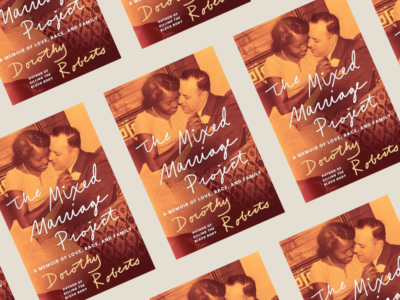
The Mixed Marriage Project’s title will more than likely give an onlooker pause. Perhaps that’s the point. But before conjuring up too many presumptions based on the name, one might also note it is the work of renowned law professor and sociologist Dorothy E. Roberts. Amongst other books, Roberts is the author of Killing the Black Body (about black women’s reproductive history in the United States) and Fatal Invention: How Science, Politics, and Big Business Re-create Race in the Twenty-first Century. In her latest, a memoir interwoven with historical research, she unfolds her parents’ interracial relationship, and through it, partly unravels a United States’ history of the subject itself.
The “project” of the book’s title is personal for Roberts: In the 1930s, her father, a white American of Welsh and German descent, set out to examine interracial relationships between black and white people specifically, while studying to be an anthropologist at the University of Chicago. His interview-based research, which explored interracial unions formed as early as the late 1800s, continued till the 1960s and ’70s, and included interviewing the children of couples he’d earlier surveyed. This feat was supposed to become a book, sold to a publisher while her father was working as a professor at Chicago’s Roosevelt University. But the book was never published, and its stories left untold until now.
Roberts theorizes the reason for this was that her father’s work had become so interwoven into his identity—and their family life—that its completion would have caused a real identity disruption. Who was he if he wasn’t working on the project? And where did that leave her and her family?
Through her own research, Roberts learns her mother, a black, Jamaican immigrant, was also involved in this work, conducting interviews alongside her father for many years. Both were committed to the project’s objectives, one of which was to demonstrate that interracial relationships are not inherently abnormal, because black and white people are not fundamentally different. This was also how her parents met: While majoring in chemistry at Roosevelt, her mother became her father’s research assistant. (In the book, Roberts explicitly states she “wonder[s] how their professional partnership evolved into a romantic one—and whether they worried about the perception of impropriety.”) This prompts Roberts to question an underlying reason for her parents' marriage: Were they supposed to be embodiments of their own mixed marriage project? If Roberts’ parents were indeed as much a part of the study as they were leads of it, she concludes, it would make her and her sisters its subjects, too—or, at least, its personified outcomes.
Rather than be rattled by this possibility, the author measures it against the people she personally knew her parents to be—curious, culturally-aware, well-traveled, and community-minded. Her parents’ relationship, after all, existed beyond their work, and they were initially drawn to each other by their shared sense of adventure, similar values on education, and complementary sensibilities—her mother as the planner and her father as the spontaneous one. By her own admission, Roberts gives them a latitude that an outsider might not. But I reckon this is where the book shines as memoir, rather than an investigation of an investigation: the reader gets to know Roberts’ parents through her loving eyes. Loving eyes that, for the record, do not condone the same politics her parents—especially her father—may have arrived at through their work: that interracial relationships offer some kind of medium to restore black and white relations in the United States, shaped by white supremacy and violence. (On this, Roberts pointedly disagrees.)
Beyond family history, the themes in Project will be recognizable to anyone versed on the discourse, likely causing you to wonder if anything really changes in these United States. The politics of the study’s participants—black men, black women, white men, and white women in heterosexual, interracial relationships—reveal how black men-white women couples were seen as more “acceptable” but also more arduous in the long-run; white women often lost privilege they couldn’t regain unless divorced. The research also highlighted the sexual tropes attached to black women-white men couples—and the misogynoir that informs outsiders' views of them. Recurring themes, regardless of interracial pairings, showed how marital cutting across the color line affected one’s choice of neighborhood and the life afforded to them and, possibly, their children. Also recurring—especially in the civil rights era—were the many well-meaning couples who entered these marriages in the hopes of proving to the world as much as to themselves that interracial coupling inherently combats a racist society. This hope, Roberts argues, was often an erroneous one, as countless couples later found out.
In the lasting analysis of her father’s work, Roberts arrives at the same conclusion that she began with regarding interracial relationships: They are not panacea for a society, a country, or a world that has yet to unravel itself from white supremacy, let alone repair its many casualties. But in Project, Roberts shows us that despite flawed, socially-constructed and racialized societies, people will enter unions and arrangements of all kinds, her parents included. These unions may not transcend race, but they do demonstrate that, in spite of the race politics attached, people will deem them worth fighting for. Some do so naively and are thus confronted with seeing the depths of racism like they never have before. But others, especially the curious, culturally-aware, and community-minded, go into them with eyes wide open, prepared to confront all of its politics united.
[post_title] => February Book of the Month: "The Mixed Marriage Project" by Dorothy E. Roberts
[post_excerpt] => A memoir interwoven with historical research that might leave you wondering if anything really changes in these United States.
[post_status] => publish
[comment_status] => closed
[ping_status] => closed
[post_password] =>
[post_name] => february-book-of-the-month-botm-pick-the-mixed-marriage-project-by-dorothy-e-roberts-memoir-interracial-relationships-dating-history-research
[to_ping] =>
[pinged] =>
[post_modified] => 2026-02-27 20:45:28
[post_modified_gmt] => 2026-02-27 20:45:28
[post_content_filtered] =>
[post_parent] => 0
[guid] => https://conversationalist.org/?p=10212
[menu_order] => 0
[post_type] => post
[post_mime_type] =>
[comment_count] => 0
[filter] => raw
)
A look at the cross-continental sloshing of capital beneath the art market bubble.
Cultural Currency is a bi-monthly romp through the intersection of art and capital with writer Cara Marsh Sheffler.
Lately, a series of memes, graphs, and cartoons have gone viral, all asserting variations of the same thing: “The entire U.S. economy right now is 7 companies sending a trillion fake dollars back and forth to each other.” The source diagram for this claim was published in Bloomberg last October, in a piece highlighting why all these circular deals—largely between the usual AI suspects, such as Nvidia, Microsoft, and OpenAI—indicate a likely bubble. Together, this cloud-based clusterfuck has generated a $1 trillion AI market and $192.7 billion in 2025 Venture Capital investments. As of yet, however, they’ve also yielded scant indications of any productivity gains whatsoever.
Unsurprisingly, we’re starting to see this reflected in the art itself. To my eye, the art fair circuit of today largely seems to exist to dare to dream what slop—Merriam-Webster’s 2025 word of the year—might look like in the flesh, spread out across a couple of hundred booths. Nearly 55 galleries participated for the first time at New York’s Armory fair this year, the second since Frieze purchased it in 2023. When I attended, I wondered how many of them actually belonged at Javits Convention Center. Surely, taste is subjective, but to me—and the art advisor who gifted me a VIP Pass—there wasn’t enough champagne in the joint to make the fair look anything close to well curated. I heard many whispers that the Armory show hadn’t sold all of its booths and, as a result, what they let in looked like the kind of upscale beach art you’ll see next to a store that only sells white clothing or Vilebrequin swim trunks in Amagansett. When you figure booths are about $40K, the metallic driftwood art made sense: That's nothing to the very rich, who spend about as much if not more on a Christmas vacation. A booth might placate any number of ailing family dynamics, from a bored spouse to a listless kid.
Of course, many large corporations simply fudge the numbers when the going gets tough. They pay good money for sunnier analyses. But when paired with the news of Frieze’s expansion, this dissonance should ring alarms: Something is up. Why open more fairs when the ones they already have are neither profitable nor novel and of dubious artistic merit?
The cross continental slosh has a pattern, after all. It’s a game of appearances played across the globe until resources totally, utterly run out, and crash violently. As Ernest Hemingway famously put it: “‘How did you go bankrupt?’ ‘Two ways. Gradually, then suddenly.’” And, in the meantime, it is of the utmost importance to set up shop someplace new while the goods still have some value, and the brand hasn’t yet been completely tarnished.
In the art world, this is panning out in a palpable way. It's one thing to talk about AI slop as a harbinger of economic doom, or the imminent insolvency of Social Security, but it's even wilder as a bubble indicator to see mid-tier and blue chip galleries sliding horribly in Western world capitals, while the same art fairs that are coughing and wheezing in the West open entirely new ventures in Gulf States. Rather than cultivate a new base of collectors that might sustain art markets on a local level, the industry is continuing to cater to the uber wealthy, wherever it can find them—even as this model fails miserably in the West.
Of course, the art market isn’t quite a Ponzi Scheme, if you consider that the original investors aren’t technically promised an artificially high rate of return off the bat. But neither is, say, Nvidia, which hasn’t stopped its CEO from openly insisting his company “isn’t Enron” as its stock price tumbles. Like other markets, the art market continues on by force of its ability to lure in new investors. Frankly—to bring up Michael Burry again—the notion of carrying a certain tranche of goods from market to market in search of new investors while bundling them together (in this instance, as a fair), strikes me as a sort of arty CDO (collateralized debt obligation). Magical circular thinking abounds in budget offices across the board, from art to tech to government. But, I would argue, when consulting the US Treasury’s page explaining how the national debt is structured seems helpful in understanding our current predicament…it’s not looking good.
Perhaps there is someone in Abu Dhabi who will be thrilled to learn of the art world’s KKK: Koons, Kapoor, and Kaws. But you don’t need to read that US Treasury page to know who will be left holding the bag when the cross-continental slosh finally goes splat. Even if Frieze is able to eke out an existence from selling balloon dog sculptures to billionaires, it won't protect them from the inevitable pop, although it might provide a little delusional cushion in the meantime. As critic Jerry Saltz recently cautioned in an Instagram post, quoting Yale School of Management’s Magnus Resch, “Let’s be clear: multi-million dollar trophy auctions don’t reflect the health of the market. They reflect its distortion. What the art world needs isn’t more $50 million headlines. It needs more $5,000 collectors.”
To any working artist, that Resch observation has the infuriating tenor of the proverbial “Fork Found In Kitchen” headline. We need more art for art’s sake, much as we need communities that are affordable for creators. However, today’s collector class values art that functions as investment, not the health and cultivation of anything so quaint and unremunerative as artistic communities, or even individual artists. In the same way, corporations now chiefly exist to create value for investors, rather than to provide goods and services to consumers—let alone provide any kind of reciprocal benefit to workers.
To be perfectly clear, today’s billionaire class is one mostly disinterested in public works or philanthropy. Art collection itself is not about collecting objects that carry beauty or even status, but rather ones that accrue value and allow them to hide more money from the tax man. After all, the art world KKK is not an unholy trinity of art but rather a bundle of financial tools. If 1989’s independent cinema gave us The Cook, the Thief, His Wife & Her Lover, 2026’s art market has given us The Collector, the Tax Attorney, His Wife & Her Art Advisor. Whether or not Frieze’s latest venture succeeds, the West cannot flatter itself that these new markets of Middle Eastern buyers seek Western signifiers of wealth so much as access to more of our gloriously opaque financial tools: to wit, the art itself. (That Richter will really tie the Swiss bank vault together!)
Perhaps the greatest work of art right now, then, is this art market bubble itself, that sloshes so showily as it grows. It is the work of a collective that daringly splits the newly irrelevant hair between metonymy and metaphor, spanning continents, industries, and banking systems. It performs the same wistful, elegant, melancholic drift of Albert Lamorisse’s 1956 children’s classic, The Red Balloon, aping the film’s Gallic ennui with a Chanel sweater set for the booth and Ruinart champagne in the VIP room, dragging a damning homogenizing aesthetic in its wake like a dead zone in the ocean. And all it touches turns to slop as it grows and grows, for only homogenized slop signifies fungible, quantifiable value.
This homogenizing force and its flattening aesthetics are not unique to the art world, and might be handily encapsulated in 2025’s Q4 neologism, “chubai,” meaning something “chopped but also spiritually Dubai.” (Examples were given as Soho House, Goyard, and Carbone.) All the world’s a shopping mall, to borrow from the Bard. Beige is inescapable. Travel to any continent you like and you’ll find the same shit at every fair, much as the same internationally braindead flagship fashion stores anchor every fancy downtown strip in every major city around the world.
After all, that’s what a bubble does: it floats away, to foreign lands, all year round. As long as the ultra-rich need to keep their money safe from taxes, the art market will obviously continue to spurn its own sustainability—and why shouldn’t it? What market model indicates a path that creates something other than a tiny panic room full of winners, and utter doom for every other poor schmuck who won’t make it to the slopes of Gstaad this winter? Middle and working classes are so 20th-century, and the art market bubble is just one of many that’s eventually going to pop.
We live in a global society that valorizes the iterative as novel, lionizing AI and utterly unable to tell the difference between a tool and its master. Asses and elbows are easily conflated and confused. The art market itself has more to say about the state of contemporary art—and of the economy, of what the government has promised us and won’t deliver, and to what ends the tech world will go to deem anything innovative if it might push up stock prices to enrich that selfsame collector class—than a lot of art does. The sound of shit hitting the fan is perhaps a soothing one, a sort of white noise pedaled in Instagram ads. Or perhaps that sound is the sloshing itself, crossing continents and coming home in a fantastic, tidal fashion, to crash upon our shores.
[post_title] => "The Collector, the Tax Attorney, His Wife & Her Art Advisor"
[post_excerpt] => A look at the cross-continental sloshing of capital beneath the art market bubble.
[post_status] => publish
[comment_status] => closed
[ping_status] => closed
[post_password] =>
[post_name] => the-collector-the-tax-attorney-his-wife-her-art-advisor
[to_ping] =>
[pinged] =>
[post_modified] => 2026-02-12 19:44:35
[post_modified_gmt] => 2026-02-12 19:44:35
[post_content_filtered] =>
[post_parent] => 0
[guid] => https://conversationalist.org/?p=10167
[menu_order] => 0
[post_type] => post
[post_mime_type] =>
[comment_count] => 0
[filter] => raw
)
“This is a hilarious and brilliant way to use your weed zapper technology LMAO how do you always find the best TikToks??? My FYP is never this obscure,” my friend and colleague Erin Biba replied when I shared the tractor video to Bluesky. I took her question as a challenge: How weird could my For You Page get? With a bit of effort, as it turns out: very, very weird.
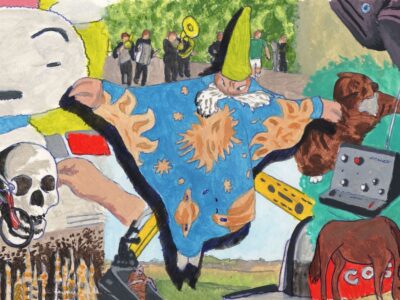
#WeirdTok is a magical, fascinating, bizarre, wonderful, confusing, sometimes horrifying place filled with myriad wonders, delights, and, unfortunately, the inevitable incursion of AI slop. It is also art I genuinely, unironically love. It’s fucking great. And thanks to TikTok’s highly powerful algorithm, the app has learned what I like—and what I do not—with uncanny alacrity. If the FYP throws most people a hodge-podge of content it thinks is popular—horses for the horse girls, tradwives in beige kitchens cooking cereal from scratch, political commentators weighing in on the minutia of the Trump administration—for me, it has been forced to come up with the unpopular. The artisanal videos made by fellow strangeness enthusiasts, with 200 views and three baffled comments from normies wondering how they got there.
Refusing to keep these gems to myself, several nights a week, I select a carefully curated #WeirdTok to share on Bluesky. I always tag Erin, who replies with a different weird video SHE has found. Over the months, our interactions have attracted a small band of loyal followers akin to those who wait to see how many eels show up under a bridge every morning; a small, fun, silly bright spot in dark times.
This shouldn’t be mistaken for escapism—delightful as it may be to watch remote control cars carrying a payload of pastel plushies while crushing autumn leaves, or a man’s surreal video series about his sleep paralysis demon, or a woeful potato taking a shower. Rather, the utter randomness of #WeirdTok—and the community that has formed around it—feels inherently strange and ungovernable, a necessary connection to humanity during a fucking scary time to be alive. We cannot survive if we cannot find joy: Surrounded by the fall of empire and the rise of fascism, I DO want to watch a whimsical video of wizard puppets jerkily animated in outdoor locations, thank you—and as it turns out, other people do, too.
While at surface level, #WeirdTok is all fun and games, it also cuts to something deeper about being human and the way art can transcend linguistic and social boundaries. I’m a long-time fan of so-called “outsider art.” Strange performance pieces. Unsettling musical compositions. Surreal found object exhibitions. Art cars and bohemian silliness. Whole communities centered around radical living, such as Bombay Beach along the Salton Sea.
These spaces feed my deep and abiding affection for weirdness, but also for making a place for art that is unconventional, highly specific, challenging. #WeirdTok, too, is often produced by self-taught, working-class artists exploring the world without feeling bound to whatever the rules of art are supposed to be. Art that is increasingly difficult to make in the modern era because of how expensive it has become to simply live. Gone are the days of the WPA and its serious investment in arts and creativity in the United States, or the arts grants that contributed to a flowering of culture in the U.K. in the 1960s and ‘70s. Instead, our cities are filled with creeping homogeneity, Airbnbs, and flipper homes trying to cash in on reputations of countercultures that now can’t actually afford to exist in those same places, while the true radicals are forced to the margins, such as the Ghost Ship collective in Oakland, destroyed by a fire in 2016 that killed 36 people. In the face of this, supporting weird art is essential.
It's also a surprisingly human thing to do. The cream of the #WeirdTok crop doesn’t use artificial intelligence, and in fact, actively defies even the most feverish robot hallucinations. Human weirdness is original. It comes from somewhere deep in the heart, not a blender filled with other people’s creativity and run on high for 30 seconds before being blorped out and shoved in your face. It is produced for the love of the game.
To discover a truly unhinged video feels hard-earned, a sort of reverse algorithmic manipulation. It is also, fundamentally, a rejection of technofascism and the bland hegemony tech companies want to force upon all of us, to turn us into passive consumers gobbling up slop and rolling in garbage while the world burns. As a very specific niche, #WeirdTok often only makes it way to the right viewers, often without captions, hashtags, or explanations. It simply is, waiting to be discovered as you scroll. Some nights I am hit with banger after banger, saving every other video for future enjoyment and sharing, the FYP and I in a groove, unstoppable. It is like wandering the streets of a new city with no destination in mind, my favorite way to travel, finding new, intriguing things around every corner. It’s an experience that reminds me of the “old internet,” a long-gone place that we all once inhabited and loved, where it was possible to randomly stumble upon a painstakingly hand-coded website, human-made, then never see it again.
The ephemerality of TikTok is also an important element of #WeirdTok, and not just because the videos can vanish at the click of a button. At times, it feels like a fever dream, one that is frustratingly elusive to explain to people outside this liminal space. From an entirely practical perspective, there is also a “you had to be there” sense that is escalating as the app’s future in the U.S. grows increasingly uncertain. After a forced deal with Oracle, it appears ByteDance will be licensing its algorithm, but TikTok’s future overall is a big unknown as its new parent company brings its own biases and priorities to the table, all under the looming hand of the Trump administration. Will this change squeeze the joy from the FYP, as weird art serves no purpose under capitalism? If so, where will the weird art go next?
There is a sense of being on the rooftop at a wild party, watching the grey fingers of dawn slowly creep over the horizon, knowing that in daylight, everything will look very different. Yet, #WeirdTok is a reminder that even if this party ends and people trickle home, shedding feathers and sequins on transit, weird art, human ingenuity, joyous creativity, will endure. There will always be another party, and no matter where it shows up and who will be there, it will exist.
[post_title] => How Weird Can Your For You Page Get?
[post_excerpt] => While at surface level, #WeirdTok is all fun and games, it also cuts to something deeper about being human.
[post_status] => publish
[comment_status] => closed
[ping_status] => closed
[post_password] =>
[post_name] => soapbox-weirdtok-tiktok-videos-social-media-outsider-weird-art-strange-unusual-fun-content
[to_ping] =>
[pinged] =>
[post_modified] => 2026-02-03 21:00:39
[post_modified_gmt] => 2026-02-03 21:00:39
[post_content_filtered] =>
[post_parent] => 0
[guid] => https://conversationalist.org/?p=9787
[menu_order] => 0
[post_type] => post
[post_mime_type] =>
[comment_count] => 0
[filter] => raw
)
A memoir that grapples with changing ambitions and the myth of having it all.
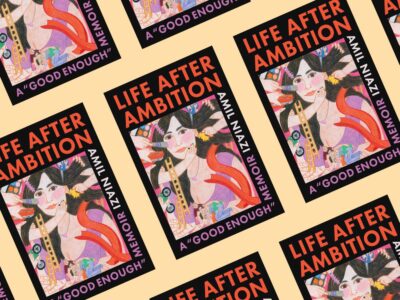
Many millennials (or non-millenials, for that matter) will be familiar with the overarching plight of Amil Niazi’s Life After Ambition, her "good enough memoir": the experience of being stuck in the rat race of chasing one dream after another, only to find yourself on a never-ending grind. In this race, there’s always one more goal to achieve—one more professional hurdle to overcome, one more career ambition to attain—before the dream can be realized. For women especially, relentlessly pursuing a profession, while ensuring all other aspects of your life are left unscathed, becomes an ever-shifting goalpost; the quintessential “having it all”.
As the book’s title implies, Niazi unfolds the futility of this chase, made especially futile given the instabilities accompanying her career of choice—journalism and writing. But the memoir is as much a personal unfolding as it is a professional one. In it, we learn of Niazi’s parents' almost romcom-like origins before she disabuses the reader of the myth of their marriage and the prospect of an idyllic childhood. There are the anticipated working-class migrant struggles, the family never having quite enough, which takes them across oceans to seek a better life in England, where the author was born, and eventually, to Canada, where the author has spent most of her life. There’s also the abuse between her parents, which Niazi touches without ever quite expounding on, even as she informs of their eventual divorce and sketches her own experience of intimate partner abuse later in life.
In Niazi’s childhood, adolescence, and early adulthood, there’s a persistent feeling of lack. There’s little romanticizing of her circumstances, and she admits her personal rat race was likely born from this instinct: Storytelling—reporting and writing—was the one endeavor that allowed her to make sense of the world. In distressing but humorous episodes, she depicts a life of underemployment before eventually landing a job that sets her on a viable career path. Amid all the instabilities, she moves from Vancouver to Toronto with a boyfriend who physically abuses her—and there, the violent ending of their final contact results in a hard-to-shake addiction to prescription drugs. Through all of this, Niazi continues to work, uncertain of who she can trust with the vulnerable parts of her life, but finding stability through her ambitions—learning along the way, her calculus won’t always pay off.
There are bright spots throughout Niazi’s ordeals, despite the numerous and varied difficulties. There is a dog she loves and cares for, friends who intervene, and a reliable boyfriend who eventually becomes her husband. Yet her career ambitions remain the driving force that shapes her life, until suddenly, it isn’t; and for Niazi, a large part of this shift happens when she becomes a mother. After a period in London—chosen, of course, for her career ambitions—she ultimately returns to Toronto with her family when she realizes those ambitions have changed.
Indeed, in the final analysis of Life After Ambition, I wonder if the author doesn’t slightly betray the title. She gains fresh perspective through her choice to pursue having a third child, and by attempting the kind of writing career she’s always longed for, one less defined by output, and instead, by balance. For her, motherhood and writing are intertwined and related; one aids the other, and though she must make sacrifices to have both, neither can be forfeited.
Perhaps less than delineating what life looks like after ambition fades and falters, what the author concludes is what becomes of us—especially of many women—when our ambitions include more than the careers we set out to have. In so doing, what Niazi offers in her debut book is not only a re-think of our lives as she unravels her own, but a re-defining of ambition entirely, demanding we consider the whole of our lives, and not just the parts we keep separate in the name of career.
[post_title] => January Book of the Month: "Life After Ambition" by Amil Niazi
[post_excerpt] => A memoir that grapples with changing ambitions and the myth of having it all.
[post_status] => publish
[comment_status] => closed
[ping_status] => closed
[post_password] =>
[post_name] => book-of-the-month-botm-january-pick-life-after-ambition-amil-niazi-memoir
[to_ping] =>
[pinged] =>
[post_modified] => 2026-01-29 23:09:45
[post_modified_gmt] => 2026-01-29 23:09:45
[post_content_filtered] =>
[post_parent] => 0
[guid] => https://conversationalist.org/?p=9993
[menu_order] => 0
[post_type] => post
[post_mime_type] =>
[comment_count] => 0
[filter] => raw
)
We’re kicking off a new gathering for our community, and you’re invited! Starting in February, we’re launching Conversation Club, a special new way to spotlight some of our favorite stories, by hosting conversations where writers can answer your questions and share more about how their stories came to be. It’s kind of like a book club, but you don’t have to read a whole book!
Read the article, come with questions (or not—just bring your mug of tea if that’s what you’re feeling), and be in community with us. It’s a casual, friendly discussion group and an encouraging space to stay curious, informed, and connected with fellow Conversationalist readers.
Our first Conversation Club will feature our Executive Director Erin Zimmer Strenio’s recent piece “A Helping of Something Hopeful”, about her weekly neighborhood potlucks and how they've nourished her community on multiple levels. How did she get the potluck up and running? How did she keep it going? How can you get one started in your own community? Erin will chat with our Executive Editor Gina Mei, sharing what she’s learned and answering other questions from the community, including readers just like you.
You can RSVP to our first Conversation Club below, and read Erin’s piece right here. We can’t wait to be in conversation with you. See you there!
For months, I've tried to make sense of my sudden inability to write about societal collapse. Then, I found out I was pregnant.
I've been promising, and failing, since before the 2024 U.S. election to write about the world on fire, and the arsonists fanning the flames. The essay I'd had in mind was called "Don't Be Fucking Stupid About Dictatorship", a warning I’d been repeating to anyone who’d listen, that felt increasingly urgent as the months went by. There's been plenty to write about since: Just this week, the Trump administration sowed global chaos when it kidnapped Venezuelan President Nicolás Maduro. Unlike Bush's invasion of Iraq, his administration didn't bother with any pretense for regime change beyond dick-swinging dominance and oil. They also don't even have a concept of a plan beyond further threats to invade Greenland, Cuba, Mexico, and Colombia. Yet still, I couldn’t get myself to write about any of it.
This was unusual. For the last decade, I've written extensively about abusive tyrants and their destructive attempts at control. In that time, they've only gotten more brazen—enough so that arguments that used to get me accused of tin-pot hysterics have now become common sense for the same people who used to do the accusing. The U.S. is, in fact, a corrupt billionaire-backed authoritarian regime staffed by rapists and racists with imperial delusions, in league with a fanatical Supreme Court and a global network of gangster heads of state. The behemoth that is the climate crisis is real and accelerating, as monstrously strong hurricanes hit the Caribbean, and monsoon flooding across South and Southeast Asia kills thousands and displaces millions. Dehumanization continues to lead to countless atrocities: in immigrant detention camps, on Venezuelan fishing boats, for civilians in Gaza, Sudan, Congo, and Ukraine. Meanwhile, the free press is eroding worldwide, and Elon Musk, world's richest man, has killed humanitarian aid for the world's poorest people. Simultaneously, fellow techbro Sam Altman wants us to believe the same chatbots that insist there are two r’s in "strawberry" will solve all of our problems, when so far, they mostly seem to be causing psychosis in users while killing the job market, making bikini pics of children and women without their consent, and stealing people's water.
In the midst of all this, I've tried to make sense of my writer’s block. Perhaps it's because I have a hard time repeating myself—my ADHD brain is wired to seek out novelty—or because it's too painful to write about societal paralysis and collapse.
Then, eight months ago, I found out I was pregnant.
Suddenly, I had a much better excuse for my inability to focus on all the shitheads ruining everything. But also, something far more welcome: a new surge of hope, and with it, an urge to write again, this time about something slightly different. As I write this, I’m in my third trimester, anxious and excited for my daughter’s arrival, which feels imminent. While this baby wasn't planned, she was very much wanted: I've known I wanted to have a kid ever since my mom died when I was 24. My mom had always mothered me so well, in a way even my adolescent self recognized, and when she died, I felt untethered. The only clarity I got from that awful time was that I was meant to pass on all the unconditional love she'd given me to a child of my own.
But I also wasn’t sure how or when I’d get there. At the time, I was still stuck in abusive dynamics, and would be for years to come. Like many survivors, I had a lot of grieving and healing to do before I eventually broke the cycle. (As Philip Larkin famously wrote, "They fuck you up, your mum and dad, they may not mean to but they do.")
Luckily, I've been blessed with financial stability, which allowed me to take my time and find my way. But it still took many years of therapy, loving community, and good decisions—freezing my eggs; ending bad relationships, whether familial, romantic, platonic, or work-related; getting blessed by Buddhist monks while cradling a baby-sized wooden penis in a fertility ritual at Chimi Lhakang, the temple of the Divine Madman in Bhutan—to prepare me at forty to become a mom.
It's a funny fact of modern life to have the old-fashioned way of doing things—meet a wonderful man, fall in love, get pregnant—be the surprise. I had an appointment booked with my fertility doctor and was set to pursue single motherhood with a sperm donor when I met my partner last fall. I joked with my friends, "The minute you light a cigarette, the bus comes." But we’ve both been grateful for the ride.
I'm also old enough to be immersed in all the doomerism around what until recently was called "geriatric pregnancy", so I was shocked at how easily we got pregnant. (Thank you, Divine Madman of Bhutan!) It took me eight weeks to even realize what was happening—already too late in many U.S. states to make an informed decision about keeping a pregnancy. I'd chalked up the first trimester exhaustion to depression over rising fascism, and spent the night before my blood test googling "pregnancy or perimenopause?”, genuinely unsure which was to blame for making my boobs so sore. The morning after we got the results, I got an email from my fertility doctor asking how I was doing. I thanked him for checking in, and shared the fortunate news that we wouldn't be needing his help after all.
I’d been excited but daunted to undertake parenting alone, and it's been a beautiful gift to go through the process with a partner, especially someone so loving and supportive. Simultaneously, there have been so many aspects of this process that have felt out of our control, and it's scary to be bringing a little girl into a world of rising temperatures and white supremacy. The Trump regime, and RFK Jr. in particular, has a eugenicist fixation on breeding white women to produce more white babies, while simultaneously showing extreme hostility to pregnant people. Our future pediatrician needed to check we still believe in vaccines, and that we understood that Tylenol and infant formula are safe. Meanwhile, my partner was turned away from getting the recommended COVID vaccine because becoming a new parent does not qualify him under the new, absurd restrictions.
But in the face of this, I'm also confident that our daughter will be well-loved, both by us and the village that supports us, and that we will do what we can to model a better way of life for her in our home and in our community. I hope she always feels that sense of comfort and safety with us, even as the world rages on. And I hope that the strong foundation we’re building together gives her the courage to face the challenges that we know we can't shield her from. Our daughter hit the jackpot with two parents who cannot wait to meet her and surround her with love—something she’s already repaid by kicking her dad hard in the face when he put his cheek to my belly. (He's a soccer player, and a true believer that "football is life!"; so you can imagine his delight.)
I got lucky that I could feel her little flutterkicks super early. This summer, at the beginning of my second trimester, I took a long-planned trip to Berlin with friends. I'd debated trying to get into the nightclub Berghain with them, and even got a pleather raver dress that fit my growing bump for the occasion. Baby had already attended Beyoncé’s Cowboy Carter tour with me, and stayed up to see Cardi B (also pregnant at the time!) perform at Pride, so I was tickled at the thought of us sober dancing together in a warehouse. But I ate too much schnitzel at dinner and my feet hurt, so I stayed in watching Irish murder mysteries instead; probably the wiser choice. That night, I felt little twitches in my tummy for the first time. I thought maybe I was imagining things—but I'm confident now that she was just already saying hello.
On that same trip, I dragged my friend to the Stasi Museum, converted from their creepy former headquarters. It was easy, and terrifying, to see the parallels to the U.S.: The East German secret police's growth over time reminded me of ICE and Border Patrol's expanded reign of terror, both in terms of mission creep and surveillance techniques. Even the recruitment perks mirrored one another, though the Stasi had much higher standards for who they let in the club. Once again, I was confronted with the dichotomy of bringing new life into the world as other lives are being torn apart.
It’s been hard not to think of the Stasi murdering border crossers and street protestors when ICE just executed a mother of three by shooting her in the head through her windshield in broad daylight, her wife sitting next to her and neighbors recording the scene on video. Renee Nicole Good was not the first person Trump’s paramilitary thugs have bragged about inflicting violence on, either. After shooting Marimar Martinez in November, a Border Patrol agent reportedly texted his buddies with the line, “I fired 5 rounds and she had 7 holes. Put that in your book, boys.”
As I’m discovering firsthand, having kids nowadays is apparently a never-ending lesson in this kind of cognitive dissonance. I realize, too, it’s both totally natural and a bit crazy to be excited and hopeful about growing this new little human inside me, considering all the horrors I’ve already listed, and the many others I haven’t. Many people I love and respect are foregoing having children entirely, whether because they simply don't want them, because they're too expensive (especially in New York City, where I live), or because ecofascism has robbed them of any hope for the future. My loved ones who do have kids have shared the joys of parenting, but also the struggles, especially during COVID. As their kids grow, they're facing difficult questions about declining prospects, school shootings, and how adults let the world get this way.
I recognize that the aforementioned financial stability takes care of some, though not all, of these concerns. As for those that remain, I think, in spite of everything, here's my vote of confidence for perpetuating the species: Humanity can be pretty awful, but also pretty amazing. There's still so much joy and wonder to be found in this world, something I've witnessed from people who continue to live and love under the direst of the circumstances. I don't agree with people who say that having children is what gives life meaning—my life had meaning and purpose before. But I do think my daughter has already challenged me to remain hopeful on her behalf, and to take action to better myself and my community to create a softer landing for her when she’s here.
She's kicking me as I write this. I'm congested, my joints hurt, I’ve developed gestational diabetes, and I miss carbs. As excited as I am for her to arrive, I'm also terrified of giving birth, and how much I have to do and learn before then. But I also take solace now in all the good news I can find, because it gives me new hope for the future—for her future. Zohran Mamdani won his mayoral campaign with a promise to bring affordable childcare to New York City. CUNY researchers recently discovered a potential universal antiviral that can defeat multiple families of viruses at once, including Ebola, COVID, and SARS. Chicagoans are telling ICE to fuck off, whether that's dads in pajamas or the Pope. Chinese and European solar power technology is moving forward in leaps and bounds, with renewable energy overtaking fossil fuels in most parts of the world, even as the U.S. lags behind. The African Union passed a Convention on Ending Violence Against Women and Girls, lapping many parts of the world with its second regional treaty on women's rights. Trump and Putin won't live forever, and Stephen Miller, RFK Jr., and Pete Hegseth aren't immune from prosecution. Bolsonaro and Duterte are in jail. Elon Musk is the loneliest man on Earth.
Yes, it's an extremely dark time, but that's not exactly a historical outlier. People have been making babies throughout the worst of them. And nothing motivates me more to build a better future for all of us than this little girl, who, like every child, deserves safety, stability, love, and care, and a world equipped to give it to her.
I can’t wait for her to see it.
[post_title] => The Strange Hopefulness of Growing a Human While the World Burns
[post_excerpt] => For months, I've tried to make sense of my sudden inability to write about societal collapse. Then, I found out I was pregnant.
[post_status] => publish
[comment_status] => closed
[ping_status] => closed
[post_password] =>
[post_name] => hope-week-pregnancy-motherhood-children-personal-essay
[to_ping] =>
[pinged] =>
[post_modified] => 2026-01-09 08:25:27
[post_modified_gmt] => 2026-01-09 08:25:27
[post_content_filtered] =>
[post_parent] => 0
[guid] => https://conversationalist.org/?p=9891
[menu_order] => 0
[post_type] => post
[post_mime_type] =>
[comment_count] => 0
[filter] => raw
)
Why Ireland's Basic Income for the Arts program is just the first step in better supporting the country's artists.
In 2022, visual artist Elinor O’Donovan was working as a receptionist in Cork, Ireland, when she began to receive the Basic Income for the Arts (BIA) stipend. The Irish government had launched the program that year as a way to address the country’s unstable arts sector, which had left many artists without job security and consistent financial earnings—O’Donovan included. At the time she applied, she'd just graduated from university and was living with her parents as she tried to figure out the next steps for her career. When she found out she’d been selected from a pool of over 9,000 other applicants for the BIA, it was life-changing. As one of 2,000 artists receiving a weekly income of €325 over a three-year period, O’Donovan was able to quit her job and move to Dublin to make art full-time.
“The BIA has allowed me to be a bit more brave with the stuff that I make,” she tells The Conversationalist. “It allowed me to make whatever I want, and not feel as if I have to justify why it's important to a funding body.”
According to a cost-benefit analysis published by the Department of Culture, Communications and Sport last September, the BIA has been a resounding success for beneficiaries, and Irish society at large. The report revealed that recipients were able to dedicate an additional four hours per week to art-making, and that the program “strengthened artists’ professional autonomy, capacity for creative work, and attachment to the arts sector.” Moreover, for every €1 of public money invested in the pilot, the country received €1.39 in return—a value that accounts for an increase in earnings generated from art-making as well as an increase in public engagement with the arts. In short: Giving money to artists, with no strings attached, was demonstrably profitable.
For O’Donovan, income from the BIA not only gave her more time to make art, but provided her with newfound financial stability, something that affected every part of her life. She had more time to cook for herself, joined a gym, and for the first time, was able to afford to go to therapy. She was also finally able to plan for the future.
“I was 26 when I started receiving [the BIA], and I was able to start a pension fund,” she says. “Just having that fallback [was a relief], knowing that I would receive an income no matter what happened; if I got sick, I would still be able to pay my bills, pay my rent. It has really been transformative for my well-being.”
Importantly, the BIA has also allowed her to create opportunities for other artists: O’Donovan’s ability to explore filmmaking, something she was afforded because of the stipend, meant she could create new jobs in the field. “Having financial stability from the basic income means that I've been able to hire other people to work with me,” O’Donovan says. “So there's even been a kind of trickle down of the basic income to other artists and other creatives in Ireland.”
For artists around the world, the program has also offered one hopeful potential solution for a global arts sector severely hit with funding cuts and political uncertainties over the last few years. But while things have taken a recent downturn, the financial instability of the arts has been a major problem for decades, if not centuries, something that likely explains the growing admiration for the BIA around the world.
In a capitalist society, creative work is not valued as a productive or profitable field, which often means that artists are being underpaid for their work, if they’re paid at all. Creativity and art-making require passion and time, two resources that are generally scarce in an economic system more concerned with profit than beauty. Often, this forces workers to abandon or sideline their creative work in favor of taking a non-creative job that will provide financial stability. But a program like the BIA provides an alternative model, giving artists the financial foundation to create without the stress of figuring out how they will pay their rent or bills.
Even the program’s most ardent supporters, however, argue that the BIA is only the start of a more stable arts field. In Ireland, the arts generate €1.5 billion in income each year, but according to Praxis, the artists’ union of Ireland, artists still face “extremely challenging economic conditions.” In an open letter published in September, the group cited that 50.7% of artists in Ireland still live in Enforced Deprivation, compared to 15.7% of the general population. (The Irish Central Statistics Office defines Enforced Deprivation as when a household experiences two or more of 11 national deprivation items, such as being unable to replace worn out furniture, or being unable to afford a drink or a meal with friends once a month.) The BIA, then, should be seen as just the first step in a bigger effort to make the industry more sustainable.
“It has always been precarious,” writer, editor, and Praxis policy director Michaele Cutaya tells The Conversationalist. “I've never managed to make a living off just my art income, [and] my situation, my difficulties, are not isolated instances.” As a union representative, Cutaya helped advise the government on the BIA’s design; but despite its success, she emphasizes that the country still has a long way to go.
“Quite a large part of the economy relies on the work of artists,” she says, citing the profit the arts brings to the hospitality sector in Dublin as one example. But very little money generated by the arts sector actually goes to artists, a discrepancy that continues to grow despite the BIA. In the last three years, work opportunities have diminished throughout the sector, a trend worrying to union leadership and artists alike. “Access to public funding remains the main source of income for artists, mainly through the Arts Council,” Cutaya continues. “[But] I find that the number of chances of getting your work selected has gone down because essentially there seems to be a lot more people applying [to public funding].”
This may explain why some are concerned that the BIA will become “the shiny object” of policies, while other issues in the sector go ignored, like unregulated pay, the use of AI, and the still-growing lack of opportunities.
“There's a lot of issues and they’re not doing much about it,” says actor Christophe Lombardi, who was in the control group of the BIA pilot program, where he received one yearly payment of €650 as compensation for participating, rather than the weekly stipend of €325. (The results of Lombardi’s control group were used so researchers could better understand how the BIA helps artists over a longer period of time, in comparison with those not receiving it.)
Emphasizing other issues he would like to see addressed, Lombardi points to Gayanne Potter, a voice actor whose voice was used without permission by ScotRail to create AI-generated platform announcements in Scotland. “We are facing all the [same] problems [in Ireland]. So I don't want [the government] to use the BIA as an excuse to pretend to help the artists, but behind the scenes, not [do] anything about the rest of the issues.”
Last April, the Irish Creative Industries Forum (ICIF) wrote to the Irish government requesting measures for the protection of artists from AI, and the enforcement of copyright infringement laws against the misuse of the technology. As of yet, however, the government has yet to implement any AI regulation policies in response.
Still, there is a widespread recognition that the BIA is a net positive, and can and should be used to help address many of the existing issues in the industry. In its letter, the ICIF requested that the BIA be extended to artists affected by job loss caused by AI. Across Ireland, unionized artists are currently campaigning for the BIA’s permanent expansion. “It does make a difference, obviously,” Lombardi says. “Because it's hard to stay creative, to keep things going, while you can't keep a roof over your head. There was [an] upswing in mental health—everything's better.”
In Praxis’ open letter, the union demanded for the program’s extension for an indefinite period of time, and for the income to be indexed to inflation. Additionally, the union urged the government to expand eligibility to include previously omitted art forms, like performance artists, socially-engaged artists, craftspeople, and designers.
Arguing that the BIA pays for itself in economic returns, Praxis warns this expansion should not come at the expense of other arts agencies, which also deserve resources, attention, and support. “The arts sector needs more funding, not less,” the letter reads.
O’Donovan agrees. Given her experience, she says the BIA should be one part of a “bigger ecosystem” that helps the arts sector thrive, and allows artists to be fairly compensated for their work. “I think what people don't understand about being an artist is how much work you do that goes unpaid,” she says. “Having the basic income means that I'm still able to live and I'm still able to work.”
The pilot program was originally set to end in December 2025, but has now been extended to February 2026. From September 2026, it will be a permanent program in the country, although the government has not defined eligibility criteria or the number of recipients moving forward. In an email to The Conversationalist, a spokesperson for the Department of Culture, Communications and Sport writes that “details such as the duration, eligibility and selection method… have not yet been decided.”
Cutaya says, so far, they’ve also been left in the dark about the expanded program’s specifics, something especially concerning because, while the program was initially launched under a progressive coalition government, the current government is conservative. “We know very little at this stage,” Cutaya says, but adds that Praxis is holding out hope their input will be taken into consideration as the program evolves.
This lack of transparency has also left current BIA recipients in the dark, unsure of how they will support themselves in the gap between February and September. “Realistically I'll just have to start working again,” O’Donovan says. “It feels like a shame. I'm really grateful to have had these three years where I've been able to work full-time as an artist because very few people who aren't on the basic income can afford that.”
Reflecting on how public arts funding is the first to be cut during economic hardship, Lombardi wishes that society at large would recognize the inherent value of artists’ labor for the mental health and wellbeing of the general population. “Imagine life without art,” Lombardi says, pointing to how artists played a key role in keeping people sane during the pandemic. “Imagine for six months, there is no art. You can't watch stuff, you can't read stuff, you can't go out and see stuff. You can't sing, there's no music, there's nothing. The only thing is work and sports. That's it. The decrease in mental health would be astounding, people would go around the bend.”
Having access to the most basic resources to be able to live while working in your preferred profession shouldn’t be a privilege for the few: Everyone deserves what the BIA has provided to artists for the last three years. But as too many places proverbially edge closer to the dystopia Lombardi describes, the BIA might be seen as a place to begin to reimagine how we value and fund the arts moving forward. Whether it’s an album, a painting, a play, a movie, a live band—whatever your preferred mode of expression—the arts remind us of the wonders of life, forcing us to see the beauty in between work shifts and growth indicators. Fair pay to the workers who deliver those reminders to the general population, then, is urgent; otherwise, we risk a world without fascination. The findings of the BIA pilot reveal the systemic flaws of how society treats its artists, and beyond the stipend, point to more hopeful solutions on the path to a world where art and artists are truly valued.
[post_title] => Painting a More Hopeful Future
[post_excerpt] => Why Ireland's Basic Income for the Arts program is just the first step in better supporting the country's artists.
[post_status] => publish
[comment_status] => closed
[ping_status] => closed
[post_password] =>
[post_name] => hope-week-universal-basic-income-for-the-arts-artists-ireland
[to_ping] =>
[pinged] =>
[post_modified] => 2026-01-07 07:35:53
[post_modified_gmt] => 2026-01-07 07:35:53
[post_content_filtered] =>
[post_parent] => 0
[guid] => https://conversationalist.org/?p=9937
[menu_order] => 0
[post_type] => post
[post_mime_type] =>
[comment_count] => 0
[filter] => raw
)
How committing to a weekly neighborhood potluck has both fed and strengthened my community.
There’s a certain serendipity that happens at a potluck. Foods that have never mingled together find themselves side by side: jambalaya in a crockpot, a cardboard pizza box, a plastic tub of Trader Joe’s hummus, a platter of gluten-free brownies. None of it really makes sense when scooped together onto a plate, but all of the flavors blend like fast friends—and if you’re lucky, oftentimes, the people do, too.
It’s another Monday night, which for me, means another neighborhood potluck. Every week, a group of us meets in the same grassy area by the bay in our neighborhood outside of Providence, Rhode Island. This week, I brought a pesto pasta salad with random veggies I found in our fridge; last week, it was leftover ribs my husband made over the weekend; the week before, a bag of chips and salsa. As we set up shop on a foldout table, I can see the curious faces of people driving and biking by, wondering what the heck is going on. But for us, it’s just another Monday night. People start trickling in around 5:30pm and stay until the sun goes down. We catch up on each other’s lives, and watch the kids run around while helping ourselves to a second plate. Then, we pack up our things and say our goodbyes, knowing we’ll see each other again next week.
While these gatherings now feel like a staple in my life, I first learned the magic of weekly potlucks a few years ago, in my old neighborhood in New Orleans, Louisiana. It was 2022, and we were still feeling a bit socially raw, fresh out of our Covid bubbles. A neighbor friend started a group text, inviting us to gather every Monday at the playground for a whatever-you-have-lying-around potluck dinner and a good hang.
At first, the weekly cadence sounded like… a lot. Weekly? Really? Could my social battery handle it?
Yet after the first few months, it started feeling like an important ritual, and after the first year, it felt like a sacred space. The regular cadence was key. It allowed us to check in on each other and get to know our week-to-week rhythms. I could ask how Jen’s doctor’s appointment went last week, or if Joel had recipe-tested the chicken and dumplings he was planning for his upcoming popup restaurant. When I wanted someone to be my accountability-buddy to do that yoga class I kept swearing I’d do, I could ask if anyone else had been looking for an accountability-buddy, too. And with the standing weekly gatherings, all of this could happen in an intentional way, our commitment to a weekly meal slowly blossoming into something more.
After spending a couple of years social-distancing and mostly avoiding group gatherings, our neighborhood potlucks also felt like a joyful and much-needed form of social fitness, something scientifically proven to be just as important to our well-being as physical exercise. Maybe you’ve heard of Harvard's 85-year happiness study? It started in 1938 and followed 724 participants from their teens to old age. The participants regularly answered questions about their health and habits, their income and relationships, their joys and disappointments. The study also incorporated insights from their spouses and 1,300 of their descendants.
What did the study find to be the most important factor in determining a long and happy life? Strong, supportive relationships. Not cholesterol levels, or how many kettlebells you’ve lifted (although those things are important, too!)—but genuine human connection. It was a stronger indicator for happiness than even genetic predispositions, social class, or IQ.
This was also precisely what many of us were so starved for back in 2022. As the weeks went by, it felt like we had cracked the code to maintaining a genuine closeness with our neighbors. I also realized it wasn’t just the shared meal that was feeding us and allowing for deeper relationships to grow: It was our commitment to having it in the first place.
In New Orleans, I experienced the fruits of this firsthand. A group of us kept showing up, kept checking in on each other, kept extending the invite to other neighbor friends, and kept feeling the goodness of our Monday merriment spilling into the rest of the week. It was something to look forward to, something that consistently got our weeks started on a hopeful note. The Sunday scaries felt almost cured by the Monday potluck magic.
It was also a weekly reminder that, no matter what else was happening in the world, we were all still here, still showing up, and still feeding each other—with food, with friendship, with community, with care.
This commitment never felt burdensome, but instead, like a newfound necessity. In the age of TikToking your way down the street and scrolling in bed until you fall asleep, people are overconnected but undercommitted. Relationships, however, are built on commitment—and at least according to the Harvard study’s findings, that means our happiness is built on commitment, too. It’s a muscle to exercise like any other, and when we allow it to atrophy, our communities tend to suffer. But when we put the effort into consistently exercising it, our relationships and our communities begin to bloom.
It still impresses me that we managed to meet up every week for over a year, even with small kids and busy jobs and all the rest. I believe a big part of this was probably the fact that we met in a public space (the neighborhood playground), that was walking distance for all of us (no driving required), which also meant that nobody had to host (no need to clean your house).
The not-hosting part felt especially important. Nobody had to stress about people coming over and nobody had to deal with washing the dishes since we BYO’d our own plates and cutlery. We also never felt the pressure to bring anything fancy, a rule we established early on. One week it might be a bag of chips and the next it might be leftover birthday cake and maybe the next it would be homemade enchiladas if you had a little more time to cook. It all evens out in the potluck wash. And when everyone brings something, everyone leaves full.
When I moved to Rhode Island in 2024, I knew I had to keep my potluck muscles active in order to keep this little bit of magic alive, too.
I started a Whatsapp group and kept adding new neighbor friends to join as I met them. I scheduled the first potluck as a test run, just a couple months after we’d moved into our house. Given the big turnout (close to 40 people), I knew it could be a regular thing, so we started it up in earnest in the summer when the weather was more reliably outdoor-friendly. My husband and I began sending out a reminder on Monday mornings. And for the regular crew that started showing up each week, and telling other people to join, the potluck magic alchemized just as it had in New Orleans. I felt especially proud when I started seeing people I didn’t recognize who had heard about it through the neighborhood grapevine.
Every Monday, we’d arrive at the park with our foldout table and gingham tablecloth (adding a tablecloth instantly makes any gathering feel more special). For a quick second, I’d worry that nobody would show up. I’d feel a bit self-conscious, then I’d remember that even if nobody came, I’d still be outside eating with my family, which is a gift on its own.
I wouldn’t take it personally if people couldn’t make it (although a younger version of myself probably would have). But sure enough, people always did, and a mishmash of dishes would start appearing on the table. Hot dogs and mini quiche? Sure, why not! Barbecue ribs and a mountain of edamame? I mean, yeah, let’s do this! The neighborhood kids would run around on the grass and inevitably start piling on top of each other, like a Polaroid snapshot from 1995. No iPads or AI or any other tech-y shenanigans. Just some good ole wholesome potluck fun.
After a full summer of weekly potlucks, however, it became clear that one major difference between New Orleans and New England is, well, winter. In New Orleans, we could keep the weekly cadence humming along for most of the year. The summer heat and storm season did force some cancelations, but in Rhode Island, the days started growing dark by 6 p.m. and it was puffy coat season by Halloween, so we had to “close for the season” in October.
“I really miss our Monday potlucks,” neighbor friends have told me recently. Some have even offered to host in their homes, but this feels like breaking a key tenet. Removing the hosting pressure is a big part of what keeps our potlucks running so smoothly and solidly, so inclusively and so stress-freely.
While I know it’ll come back in full force once the weather warms up and the sunlight stretches back into dinner hours, I can still feel my potluck muscle craving exercise. We’ve been looking into community spaces that might be willing to host us during the winter, such as the library or the masonic center a few blocks away. Or the old-school bowling alley, which has some tables in the back. We’ve also been brainstorming other ways to stay connected during the colder, darker months. Perhaps a weekly walking club around the neighborhood? Or a soup swap (like a cookie swap, but for soup)?
But I also know that rest is important when it comes to exercise, too. And it’s during this wintry off-season that I’m discovering how much the seedlings of our summer potluck friendships have sprouted. People are still texting each other to check in, still asking each other for HVAC repair advice and babysitter recommendations. And thankfully I still have my accountability buddy checking in on how we might move our bodies this winter — she just suggested a 30-day “gentle burn workout” with short daily videos, asking if we could text each other once we’ve finished each as motivation and a healthy bit of peer pressure.
A potluck, of course, isn’t the only way to nurture and maintain our relationships, but it’s one that’s made me feel particularly hopeful. Commitment begets commitment, and makes the muscle stronger, something we can feel even when it’s not in use.
Bringing people together on a regular basis is also a reminder that small rituals can add up to something much bigger. In the months since our last potluck, our Providence community has been deeply hurting following the horrific mass shooting that took place at Brown University in December. We’ve been checking in on our neighbors, and feeling a wide range of emotions: grief, sadness, anger, anxiety, and heartbreak. But as we continue to grieve, our commitment to holding space for each other gives me hope that we’ll live another day, and share another meal, and continue to show up for each other, again and again.
[post_title] => A Helping of Something Hopeful
[post_excerpt] => How committing to a weekly neighborhood potluck has both fed and strengthened my community.
[post_status] => publish
[comment_status] => closed
[ping_status] => closed
[post_password] =>
[post_name] => hope-week-weekly-neighborhood-potluck-community-food-personal-essay
[to_ping] =>
[pinged] =>
[post_modified] => 2026-01-14 02:30:14
[post_modified_gmt] => 2026-01-14 02:30:14
[post_content_filtered] =>
[post_parent] => 0
[guid] => https://conversationalist.org/?p=9910
[menu_order] => 0
[post_type] => post
[post_mime_type] =>
[comment_count] => 0
[filter] => raw
)
My favorite book of the year was The Emperor of Gladness by Ocean Vuong, which lived up to its hype. It features Hai, a dropout and addict who is saved from jumping off a bridge by Grazina, an elderly woman with dementia. He becomes her caretaker and roommate, and they develop an odd, moving relationship that reaches across generations and connects their shared immigrant experience. It’s also a story about getting by in a backwater town (East Gladness, Connecticut), and the found family Hai makes working at a Boston Market type chain. I loved Vuong’s poetic sensibilities in his last novel, On Earth We’re Briefly Gorgeous, and his latest felt like the author stretching his wings.
I loved No Fault, writer Haley Mlotek's cultural history of divorce, for the way it combines historical research with literary analysis, and for how Mlotek weaves the story of her own divorce through it all. It's a moving inquiry into big topics (love, marriage, family, partnership, community, autonomy) that feels like an honest conversation with a trusted friend. I came away from this book thinking differently about our cultural scripts for romance and separation, but also about the various couplings and splits that have shaped my life and those of the people I love.
I've long been curious about Brazilian writer Hilda Hilst, whose work was only translated into English for the first time in 2012, nearly a decade after her death. The Obscene Madame D—a slim and profane novella about a 60-year-old woman named Hillé who goes "insane" following the death of her lover—did not disappoint. I read it in one sitting, allowing myself to be carried along the current of Hilst's existential contemplations about grief and God and sex and sanity. I've since learned fellow Brazilian writer Clarice Lispector was a friend and fan, and I can see it. But having read (and loved) both, I think Hilst is more absurd; more corporeal. This book felt like sinking into a fever dream, and achieved the rare feat of both making me laugh out loud and sending me into a philosophical spiral. (Note: A new edition of The Obscene Madame D was released earlier this year by Pushkin Press, but I nabbed myself a secondhand copy from Nightboat, Hilst's original U.S. publisher, which is the edition included here.)
I'm obsessed with Airplane Mode: An Irreverent History of Travel by Shahnaz Habib. For the factoid or wanderlust lover, this book explains the modern history of travel and explores the theme of colonization through a traveler mindset. Most travel books are written by white authors, so I also found it extremely refreshing to see travel from Shahnaz's perspective. This book opened my eyes to topics like passport privilege and even how Thai food's popularity in the U.S. began. If you've ever said, "I love to travel," Airplane Mode is essential reading.
As a mom of two young kids, I read a lot of children's books, and one that I keep coming back to is Little Witch Hazel by Phoebe Wahl. The book is divided into four seasons, and during each season—in the blossom-filled spring, in the carefree summer, during spooky season, and in the snow—the kind witch makes house calls throughout the forest to help her animal neighbors and deepen her community. Hazel is a midwife, a mystery solver, and an always kind-hearted friend. Each time we read it together, my daughter and I discover new details in the illustrations that we hadn't noticed before. It's a delightful escape to another world and reminds me how important it is to show up for our neighbors throughout the seasons.
When I picked up Oyinkan Braithwaite's Cursed Daughters at the Lagos airport in November, my flight had been delayed. It was a happy coincidence to be able to start reading it when I had some unexpected free time, as I'd been meaning to get it since its September release. The problem came days after, when between some busy reporting days and visiting family I don't get to see very often, I found it difficult to put the book down.
Braithwaite's Cursed Daughters is an intergenerational story about Nigerian (Yoruba) women in a family, the Faloduns, who are quite literally cursed in their love lives. The story oscillates between different time periods and marks how culture and tradition can evolve—or not—in different eras we think of as contemporary. Aside from the witty writing and plot, what I loved most about it was its mix of originality while also exploring a familiar subject that I think anyone from anywhere can relate to. Without giving too much away, I think what impresses me most about Braithwaite's writing is that she manages to avoid obvious clichés about Nigerian sensibilities and how family obligations work, and instead offers the nuance so many of us observe and live in.
Before I'd finished, while still in Nigeria, one of my aunts managed to convince me to leave the book behind for her to read. Reluctantly, I did, then almost immediately ordered another copy so I could pick up from where I left off as soon as I got home.
Months after finishing this book, I'm still baffled at how Kevin managed to write something so eerily prophetic. Mỹ Documents takes place in a not-really-that-dystopian timeline where, following a slate of domestic terrorist attacks, the U.S. begins rounding up Vietnamese Americans and sending them to internment camps. The book centers on four "cousins" from the same family, and their vastly different experiences of survival over the years the order is in effect. Mỹ Documents doesn't shy away from the obvious parallels to the internment of Japanese Americans during World War II (and, in fact, specifically admonishes one of the characters for not knowing their Asian American history), but instead shows how easily history can and does repeat itself. Somehow, Kevin handles this with both the weight it deserves, and a good sense of humor, the moments of levity so necessary, and so human, they make the rest of the book feel like a punch to the face.
This book came to me as a recommendation from a friend, who highly encouraged me to read it because of our shared love of nature, adventure, and musings on the great unknown. MacFarlane is an explorer who writes in a captivating, vivid way about his experiences and interactions with some of the most interesting environments and people on the planet. He hones in on the idea of "deep time" and how there is a relativity to experience depending on where and how we live. Underland is filled with wonderful explorations of caverns, catacombs, glaciers, mountains, and more...all with insightful history of both the places and people who dare to explore them to their fullest (or "deepest").
—Jessica Granato, Executive Assistant
Lili is Crying by Hélène Bessette, translated by Kate Briggs
A cult classic when it came out in France in the 1950s, Lili is Crying was translated into English for the first time this year, and is the most "holy shit"-worthy cautionary tale against codependency I've ever read. With sparse language, and stylistic choices that blur the lines between narration and inner monologue, Lili is Crying is a book about a mother and daughter's increasingly unhinged relationship, told over the course of the daughter's lifetime. Charlotte (the mother) emerges as an all-time literary villain, insidious and manipulative and cruel. Lili (the daughter), meanwhile, more than lives up to the title: She spends most of the book in tears. Despite multiple attempts at detangling herself from her mother, she just can't seem to leave her behind. While definitively a work of literary fiction, after finishing it, I texted a friend who works in film and TV that it would make a hell of a horror movie. This is my official plea for someone to please make it.
—G.M.
[post_title] => The Best Books We Read in 2025
[post_excerpt] => From new releases to new translations, everything worth adding to your TBR pile next year.
[post_status] => publish
[comment_status] => closed
[ping_status] => closed
[post_password] =>
[post_name] => best-books-2025-reads-tbr-ocean-vuong-oyinkan-braithwaite-haley-mlotek-hilda-hilst-shahnaz-habib-phoebe-wahl-robert-macfarlane-kevin-nguyen-helene-bessette
[to_ping] =>
[pinged] =>
[post_modified] => 2026-01-15 21:43:21
[post_modified_gmt] => 2026-01-15 21:43:21
[post_content_filtered] =>
[post_parent] => 0
[guid] => https://conversationalist.org/?p=9866
[menu_order] => 0
[post_type] => post
[post_mime_type] =>
[comment_count] => 0
[filter] => raw
)