WP_Post Object
(
    [ID] => 10407
    [post_author] => 15
    [post_date] => 2026-03-31 19:27:25
    [post_date_gmt] => 2026-03-31 19:27:25
    [post_content] => 

Unlearned historical lessons from Jacques-Louis David’s retrospective at the Louvre.

Cultural Currency is a bi-monthly romp through the intersections of art with writer Cara Marsh Sheffler. 

Many of us have had enough of living through Interesting Times. As an American raised in the misguided, batshit optimism between the fall of the Berlin Wall and 9/11, I often feel as if my adult life has been lit by the glow of a global garbage fire no one conditioned me to anticipate—a garbage fire lit by the US government, and tended to with as much care as it lavishes on the Eternal Flame. For this reason, I was eager to see the monumental Jacques-Louis David retrospective at the Louvre earlier this year: David is, in many ways, the official court painter of Interesting Times. He lived through some of the most shocking regime changes in European history and both painted and propagandized them. 

Born in 1748 during the ancien régime, David rose through the traditional, royally patronized ranks to become a painter known for his austere style and his focus on Neoclassical themes. Though socially connected, during the heyday of the salon, he was tormented by a benign facial tumor that impeded his speech, somewhat setting him apart from polite society. When the French Revolution kicked off, he dove into radical politics and befriended Maximilien Robespierre, the architect of the Reign of Terror, which saw some 17,000 public executions by guillotine. David served in government designing festivals, monuments, and uniforms; he also sat on the Orwellian Committee For Public Safety and voted for the death of Louis XVI. When Robespierre fell, David went to prison for the better part of a year, but kept his own head. A few short years later, he rose to prominence once more as the official court painter of Napoleon, outliving the empire, only to die in 1825 in exile in Brussels. Remarkably, this was a voluntary exile: the restored Bourbon King had invited him to serve as court painter, despite knowing David voted to guillotine his brother.

If this Louvre show was any indicator, the French curatorial class is still vaguely terrified of one of its most emblematic painters and unsure of what to make of him, the same way French elected officials are still afraid of an electorate that once managed to chop up its ruling class. The Internet likes to joke the White House would be covered in shit and on fire if Trump were governing France and, there is, perhaps, some truth to this. The French are known as feisty, indignant, and quick to strike or riot in a way that we Americans deem “bad for business.” Each time I’m in the country for any kind of civil unrest, it is not hard to imagine how they conceived of the guillotine, a sublime machine of both political horror and political theater concocted under the cynical pretense of science, democracy, and progress (cf., Liberté, Égalité, Fraternité).

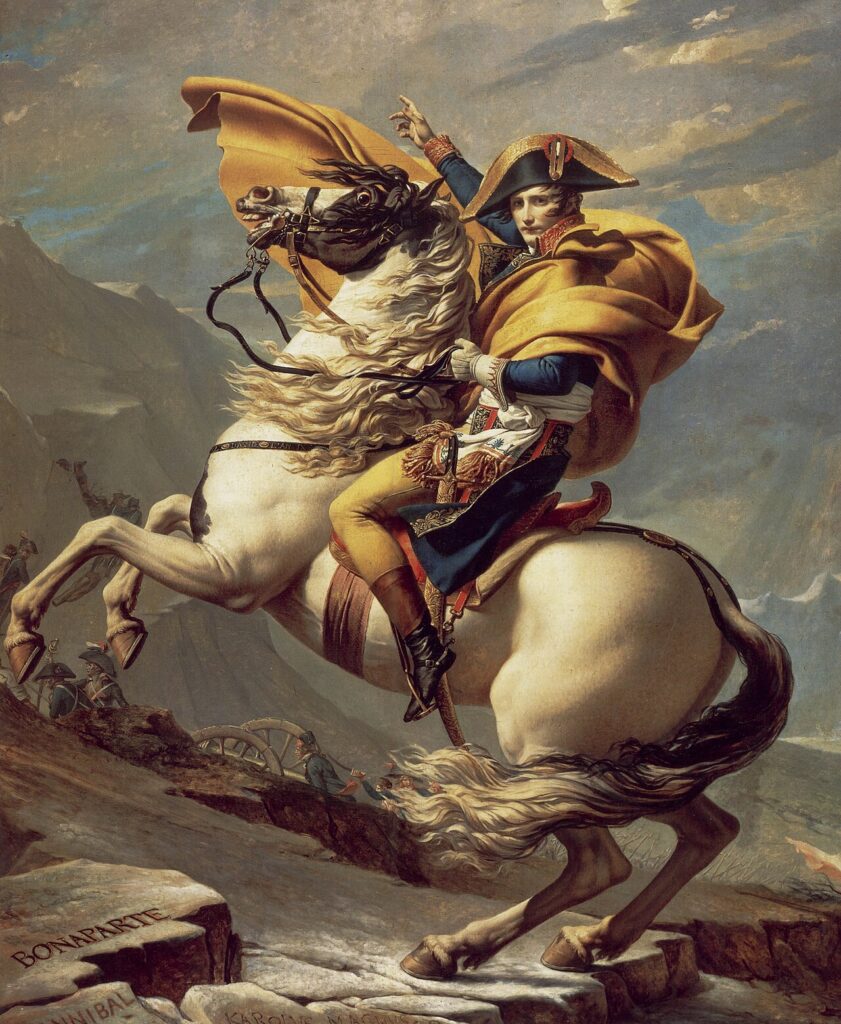
"Napoleon Crossing the Alps" by Jacques-Louis David

A Neoclassical master, David’s most famous paintings include “The Oath of the Horatii” (1785), “The Death of Marat” (1793), “Madame Récamier” (1800), “Napoleon Crossing the Alps” (1801), and “The Coronation of Napoleon” (1807). The show was organized chronologically to chart the violent, winding historical path between these paintings, and David’s relationship to each regime he served. His evolution marks him at best as a cipher, and at worst, the most corrupt hypocrite. But David was hardly alone in changing alliances to survive: Talleyrand, the French statesman and contemporary political chameleon survived five regimes in succession, brazenly switching sides to do so. When he died, Metternich, his Austrian nemesis, sarcastically remarked, “I wonder what he meant by that?” In many ways, that question felt like the animating force of the David exhibition. One could easily assert he was an artist without scruples who went where the moment and money took him. But, that’s too simplistic. David painted the long, strange journey through the phases of one’s life, one’s country, and one’s era. He painted the life and death of ideas and the flesh-and-blood people who lived them; his works testify to the gap between espoused ideals and lived reality—between pulling the trigger and watching the body fall.

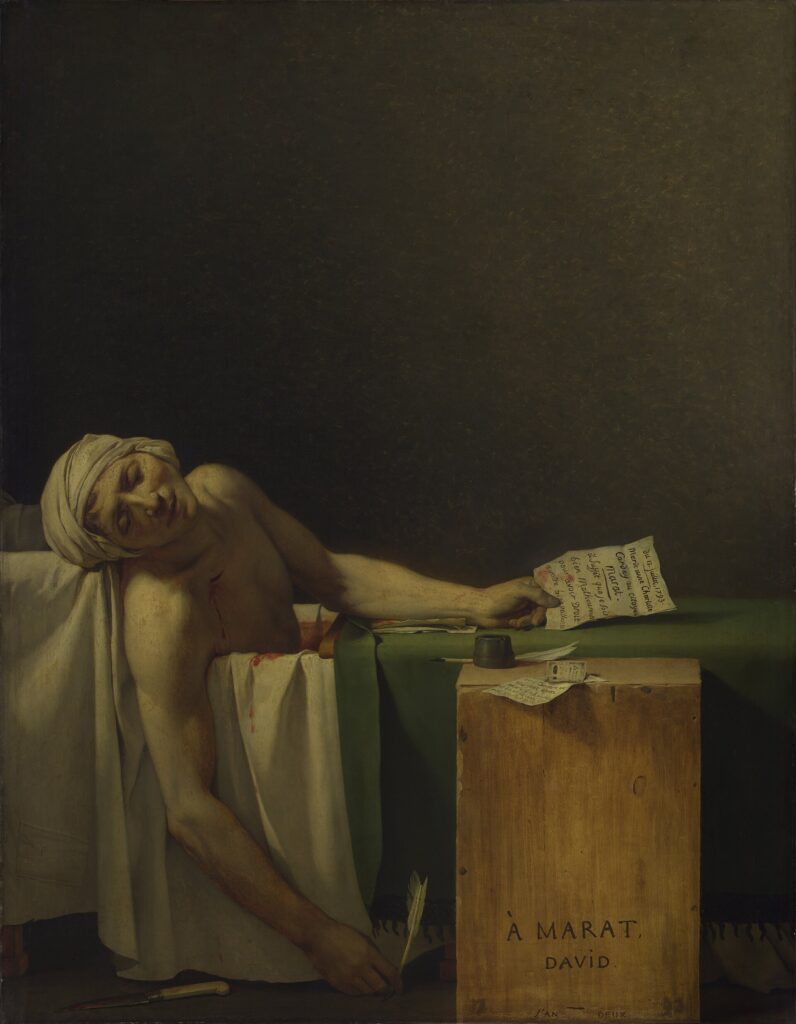
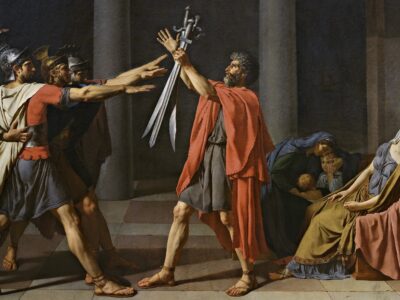
Hot-headed and famously difficult from the jump, David attempted suicide the second time he failed to win the Prix de Rome in 1772. His third time was the charm, however, and he proved to be a prescient artist: His themes of stoicism and self-sacrifice conveyed through Neoclassical renderings of Athens and the Roman Republic foretold a great deal of politics and fashion, from the empire waistlines to the rise of democracy in modern Europe. His earliest successful paintings, such as “The Oath of the Horatii”, are impressive, even as they are also re-imagined scenes from a mind untested by political reality. The 1784 painting is literally bloodless: men swear to die for a cause while their wives cry in a corner. Nine years later came “The Death of Marat”, a visceral masterwork of propaganda. Oddly, when I first came upon it in the exhibit, I said to myself, “Welp, there it is,” and meandered into the next room. It wasn’t until I re-entered the gallery, painted green to match the solemn background of the composition, that I realized I had seen a copy: The entire room was filled with painted copies that had been disseminated across France. I turned around to face the utterly electrifying Real One. You didn’t need to know a thing about art to figure out which one it was: a painting of the cold, calculated stabbing of a vulnerable man in his bathtub, the artist’s own murdered best friend, dead for the Republic.   

"The Death of Marat" by Jacques-Louis David

David’s political journey is also evident in the gap between his stiff, slightly asexual representation of so many female figures in his earlier allegorical paintings, versus the real and vibrant women he painted with loose brushstrokes and incredible intelligence in his portraits, such as that of Marie-Louise Trudaine. David’s own wife, Marguerite-Charlotte, divorced him in 1789 for being a regicide, but they remarried after he was released from prison, raising four children together who sat for him often. For a painter often criticized as unfeeling, his portraits of married couples are a delight: “father of chemistry” Antoine Lavoisier and his wife (and underappreciated fellow chemist) Marie-Anne Paulze dominates his depiction of them together in the lab; he also painted a tender double portrait of Antoine and Angelique Mongez, simply because they were great friends of his, as an inscription attests. 

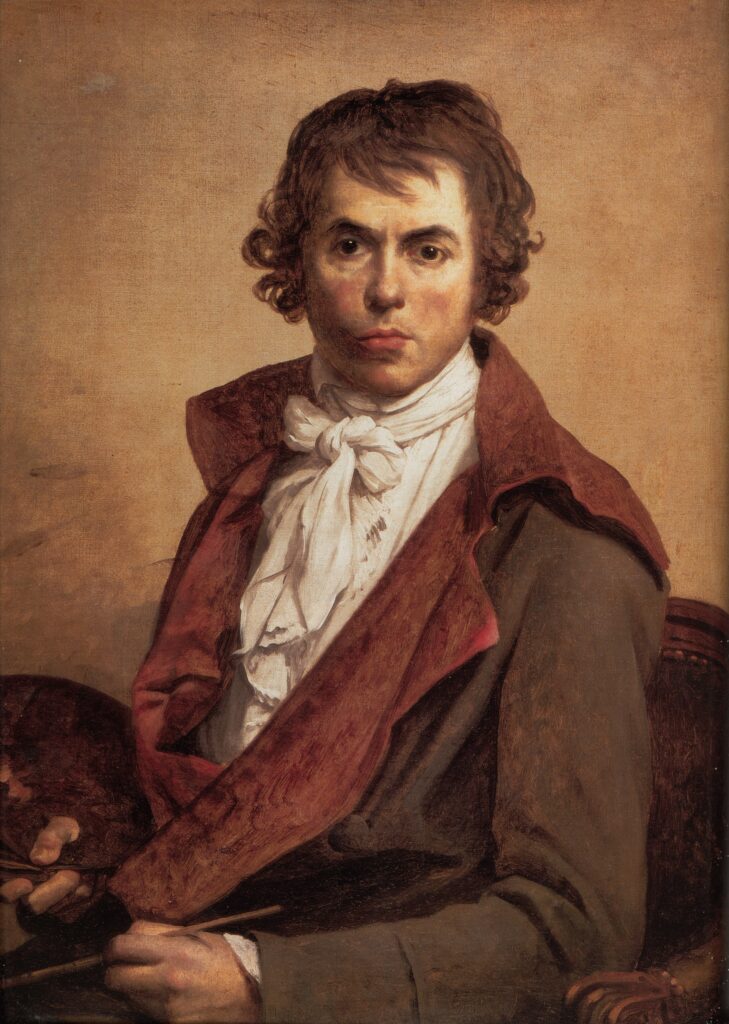
That he eagerly chased an ideal (or three) is nothing novel or noteworthy, but his art became more compelling the more tested he was by events. The more shit spiraled out of control, the more David understood the power of the narrative—as well as when to turn it off completely. His self-portrait in prison is a high watermark of decontextualizing. It’s a testament to that ever-present gap between our personal political thoughts and our complicated, shared realities. Finding an authentic perspective on that gap is impossible: If the Renaissance painters taught us about visual perspective, David demonstrated that perspective on current events is a lie. In fact, his best use of literal perspective is a metaphorical one. In his great portrait of Comte Antoine-Français de Nantes he shows us the cost of living through Interesting Times: The count, once a fiery, young revolutionary, became a Napoleonic crony. David painted him from below, so he literally looks down his nose at viewers. His contemptuous face and saggy jowls are articulated with unsparing detail, a countenance juxtaposed with and choked out by finery—the lace, the velvet cape, and a medal for the ideals he betrayed along the way. Survival is an exercise in brutality. This sellout—the sellout—David says, is what winning actually looks like. This is the political happily ever after.

I came to this show as a citizen of a different empire presently running amok. France forged the United States’ first alliance and, like so many American allies to come, was left holding the bag. (This should have been a caveat emptor for future allies: Leopards do not change their spots, and Americans do not change their stars and stripes—but we Yanks are, if nothing else, fantastic at sales.) Funds sent to aid the American Revolution helped bankrupt the French crown and sparked a chain of events that cost the French king his head. All the while Thomas Jefferson meddled in The Declaration of the Rights of Man from his Parisian salon, Sally Hemings was enslaved in the next room. From this eventful early alliance, France and the US allegedly share ideals (cf., the Enlightenment), but we don’t exactly share historical roots. One major difference was reflected in a telling piece of wall text in the show: the role of the Catholic church. Next to the OG “Death of Marat”, the curator alluded to how revolutionary France needed martyrs to fill the void left by the abrupt banishment of the Catholic Church and the monarchy. Hours after Marie Antoinette was beheaded, “The Death of Marat” was unveiled at the Louvre, recently changed from palace to museum. That is to say, a cult of the state was invoked to fill the void of state religion. 

Self-portrait by Jacques-Louis David

To this New Yorker, it often feels laïcité—the French principle of secularity—demands its own sort of worship. Religious freedom in France looks to me more like a hole in the ground where a Catholic church once was. Rather than a new structure where all are welcome and inclusion is additive, it’s one that demands the sacrifice or sublimation of all other cultural tenets for those wishing to be included. This creates toxic conditions as France wrestles with a number of postcolonial realities, including a large Muslim minority. Those limitations on the public imagination for an honest plurality were, to me, somehow reflected in this state-funded exhibit’s unwillingness or inability to reach final conclusions about David—and his attempts to fill that civic-religious void with new meaning. If America’s fundamental struggle is with equality, France’s is with diversity. Today, the French do not understand their secularity is exclusionary, much the same way we Americans don’t understand our democracy is a fiction. 

Unlike France, we never have had a class revolution in the United States. In 1776, a bunch of rich lawyers told a king far away to fuck off, then immediately turned around and did business with him without changing all that much on the ground. That’s why the 13th Amendment is still, somehow, just sinking in. Ironically, white Americans scored many of their freedoms from Britain when the country was still a colony: Even the pope of the Enlightenment himself, Voltaire, envied the British their Parliament and the rights it accorded in the mid-18th century. From France, we may have learned exceptionalism, but we never learned real revolution. In America, the “revolution” was just another nice thing that only rich white people could have; in France, the revolution cost the upper class their heads. 

If the French figured out how to stop deifying the king, maybe someday we can figure out how to stop deifying billionaires. And if we do, maybe someone will stay alive long enough to paint the whole drama as it unfolds. Doing so requires vanity, opportunism, gall, cruelty, and a profound degree of hypocrisy. However, it also requires bravery, and for that bravery, David was rewarded with awareness of some very modern dilemmas that keep his work relevant: of knowing it is impossible to portray a scene without altering it; of knowing all art is inherently political; of knowing the stories we tell control our realities; and of knowing that you will be judged as harshly as you judged others—and going through with it anyway, charging into The Void, no matter the cost.

[post_title] => Painting as It Burns [post_excerpt] => Unlearned historical lessons from Jacques-Louis David’s retrospective at the Louvre. [post_status] => publish [comment_status] => closed [ping_status] => closed [post_password] => [post_name] => jacques-louis-david-retrospective-louvre-art-cultural-curreny-history-museum-france-united-states [to_ping] => [pinged] => [post_modified] => 2026-04-03 19:30:30 [post_modified_gmt] => 2026-04-03 19:30:30 [post_content_filtered] => [post_parent] => 0 [guid] => https://conversationalist.org/?p=10407 [menu_order] => 0 [post_type] => post [post_mime_type] => [comment_count] => 0 [filter] => raw )
"Oath of the Horatii" by Jacques-Louis David

Painting as It Burns

WP_Post Object
(
    [ID] => 9177
    [post_author] => 15
    [post_date] => 2025-09-02 20:19:11
    [post_date_gmt] => 2025-09-02 20:19:11
    [post_content] => 

How one word has birthed a globe-spanning tradition of resistance.

A few months ago, I was at a protest in Washington, D.C. This was not unusual. Gaza burns. The president deports with impunity. Respect for the rule of law—notably and especially by the government—now seems like the nostalgic artifact of a more innocent era, an era merely months ago. Unsurprisingly, for those of us moved by these simultaneous horror shows, expressing our anger through protest has become almost unremarkable. I’ve lost count of the number of protests I’ve attended, the catchy homemade signs I’ve crafted and seen, and the clever chants I’ve memorized. But at that particular march, something unusual happened: a chant-leader exhorted us to cry a word in my mother tongue, Urdu.

“Azadi!” she called.

“Azadi!” the crowd responded in unison.

Suddenly, the word seemed everywhere: scrawled in chalk across sidewalks and columns; emblazoned across signs. In the heart of the nation, the seat of its power, everywhere, that old watchword of uprising—Azadi.

~

Azadi, or freedom, is a small word. A scant five letters in both English and its original Farsi (آزادی), these five letters have birthed a globe-spanning tradition of resistance, having been shouted by students in Srinagar and Tehran, whispered in prison cells in Ankara, and sung by women in Kashmir and Delhi. A cry familiar to all children of the Middle Eastern and South Asian diaspora, myself included, Azadi is hymn, music, and lifeline. It’s a demand for dignity from its callers and from all those who answer the call. 

This demand is expansive in scope and depth, inclusive of the dignity of life, of identity, and of the ability to govern your own political destiny. Azadi evokes our collective memory that freedom is claimed, not given, while narrating a people’s unified struggle for systemic social change. For those who seek the protection of the most vulnerable while preserving the dignity of all, Azadi is always within reach. 

Still, for all that Azadi is, we must be clear about what it is not. It is not a slogan to be selectively invoked. It is not a justification for state violence. Azadi cannot mean the protection of innocent life only when politically convenient. Moreover, it becomes meaningless when uttered by those who do not uphold a politics grounded in human dignity. Nowhere was this distinction starker than in a recent televised address, in which Prime Minister Benjamin Netanyahu briefly switched from English to Farsi while commenting on Israel’s bombing of Iran. “Women, life, freedom. Zan, zendagi, azadi,” he said—invoking the slogan of the Iranian women’s rights movement. In that moment, the language of liberation was co-opted to justify the machinery of war. It was surreal to hear a feminist chant—professed often by Iranian women defying authoritarian rule—repurposed by the very man overseeing the brutally indiscriminate bombing of thousands of women and girls in Gaza. The slogan, stripped of its radical roots and repurposed as rhetorical cover, stood in direct contradiction to the grassroots movements that had once breathed life into it. 

Creeping autocracy in the United States has for too long been ignored and shrugged off as a dysfunction that happens only in the Middle East and elsewhere in the Global South—the lawless other. But this careless, arrogant posture can no longer be supported, nor can the dangers of autocracy be reduced to a foreign export; and so, Americans chant Azadi now, because America needs it now. The past 100+ days have exhibited what the marginalized in this country have always known: that the greatest repression within America’s borders remains homegrown. Despotism collapses the political distance between nations and times, and just as fascism is rising globally, it has risen here. The myth of American exceptionalism falsely preached that our democracy was immune to the spell of demagoguery. But we know that Americans are just as capable of voting themselves into tyranny as any other people. White supremacy, toxic masculinity, and violent inequalities in rights and liberties were always part of the country’s domestic architectures. Now, from the streets to digital silos, they are plain for all to witness. 

From Hungary to India, Israel to the U.S., authoritarian regimes the world over are in conversation, looking admirably upon each other. They swap notes in class, sharing tactics of repression, like aggrandizing executive power and politicizing independent institutions. But just as authoritarian regimes learn from each other, so too must we build solidarity across movements. The rhymes of history—from the surveillance of Black radicals in the U.S. to the targeting of Kashmiri students in India—demand collective study. And along with any new lessons that may arise, we must continue to echo the lessons of some of our most beloved visionaries. From Angela Davis to Edward Said to Arundhati Roy, we are reminded that global resistance is strongest when deeply rooted in local struggle. 

In fact, therein lies Azadi’s greatest power: It crosses borders, languages, and faiths, moving between nations without itself becoming nationalized. It is a global grammar of defiance.

~

Language lives. It breathes, grows, reproduces. Azadi has done so, too, absorbing every movement and tongue it touches: Farsi, Urdu, Kurdish, Pashto, Punjabi, English. The precise journey of the word is contested; after all, linguistic borrowing is never an isolated event. Still, it carries an expansive genealogy of struggle through its travels: against gendered violence, against settler colonialism, against religious nationalism.

While I heard cries for Azadi in D.C. for the first time this year, in Indian-occupied Kashmir—the most militarized zone on earth—Azadi has been invoked for decades, having been part of the Kashmiri liberation movement since its inception. Yet as Modi’s India forbids conversations about the region and brands it as sedition, as students and organizers are arrested for expressing their desire for freedom, as the indigenous Kashmiri struggle for self-determination persists—Azadi remains the movement’s heartbeat. 

Long serving as the anthem of the Kashmiri separatist movement, now that Azadi can no longer be expressed in the open, it hides itself in art or in niche digital spaces not yet subject to state discipline. Digital speech, however, is increasingly policed. On platforms like X (formerly Twitter), Indian authorities now block, geofence, or suspend accounts that challenge its narrative. Content from advocacy groups like Stand With Kashmir is censored using the same tools of repression that platforms in the U.S. deploy against pro-Palestinian activists—algorithms, shadowbanning, keyword suppression. Surveillance and censorship, previously characterized as exclusive to so-called illiberal regimes, are now a feature of the liberal democracies just catching up. 

As all this occurs, state actors escalate their repression of dissent in the United States. Trumpism has made it clear what can and cannot be said: speech critical of the Trump administration is met with swift retribution; and speech challenging domestic and foreign policy is quickly vilified, as seen by the vicious response to ICE protests in California earlier this summer. Meanwhile, students protesting for Palestine in the U.S. now face the same brutal state retaliation we’ve long associated with authoritarian regimes abroad—even though the U.S. has always had its own archive of violent suppression, from the surveillance and silencing of civil rights activists and abolitionists to the the crackdown on anti–Vietnam War protesters after them. Today, much to Trump’s delight, some of the most prestigious law firms have capitulated to executive pressure, agreeing to perform approximately $1 billion worth of pro-bono labor for Trump’s retributive pet projects. Activists and pro-Palestine advocates have been doxxed, fired, expelled, and/or blacklisted. All the while, institutional liberalism bends the knee: DEI offices that once promised safe harbor for marginalized voices now fall silent or side with power; liberal media outlets fire staff who speak out against atrocities in Gaza. The suppression of speech, criminalization of protest, surveillance of dissent—these are global patterns, and we are not exempt. Arguably, if American exceptionalism matters here at all, it will be in its ability to normalize this authoritarian bent worldwide.

And yet resistance continues. The same dignity Azadi rallies for abroad is now demanded here. On the steps of American universities. In its hallowed institutions. At the foot of the Capitol. 

~

For all that Azadi gives, it demands something of us—namely that we do more than simply bear witness. When we chant Azadi, we are not just echoing other movements, past and present, but entering into dialogue with them, from Kashmir to Kabul to Tehran. This is not mimicry, but lineage, as Azadi reminds us in every generation that our rights are not guaranteed and must be renewed through struggle. 

It is not enough, then, to be the appreciative, passive inheritor of a tradition of resistance; one must mobilize. This means texting rideshares, learning how to administer basic first aid for those whose names you don’t yet know, and tracking jail releases of those who you just met and marched alongside. This means disagreement without collapse, and accountability without exile. This means spending hours in rooms with bad lighting and too many opinions, trying to move toward consensus anyway. 

If Azadi is to continue to mean something lasting, we’ll need to carry it beyond the chants—into policy fights, mutual aid networks, protective kinship, and more. Because Azadi is not metaphor, it is mandate, and requires all of us to answer its call. 

~

Call and Response: 

Hum kya chahte? Azadi!
What do we want? Freedom!

Chheen ke lenge—Azadi!
We will snatch it—Freedom!

Hai haq hamara—Azadi!
It is our right—Freedom!

Zor se bolo—Azadi!
Say it louder—Freedom!

Hai jaan se pyaari—Azadi!
We love it more than life—Freedom!

Tum kuch bhi kar lo, hum leke rahenge—Azadi!
Do what you want, we will still win it—Freedom!

[post_title] => America Needs Azadi [post_excerpt] => How one word has birthed a globe-spanning tradition of resistance. [post_status] => publish [comment_status] => closed [ping_status] => closed [post_password] => [post_name] => america-united-states-azadi-freedom-protest-palestine-gaza [to_ping] => [pinged] => [post_modified] => 2025-09-03 10:27:10 [post_modified_gmt] => 2025-09-03 10:27:10 [post_content_filtered] => [post_parent] => 0 [guid] => https://conversationalist.org/?p=9177 [menu_order] => 4 [post_type] => post [post_mime_type] => [comment_count] => 0 [filter] => raw )
America Needs Azadi