




In the face of the country’s plethora of problems, its artists continue on.
For as long as I’ve been alive, I’ve been aware of Nigeria’s potential.
Globally, this potential has largely been measured by the country’s natural resources, from relatively recent (and continuing) discoveries of rare earth elements, to crude oil, its greatest export commodity, and arguably also its greatest curse. Discovered some years short of independence from British colonial rule in 1960, oil has been the main cause of poverty and ecological degradation in the Delta region, often stagnating development in Nigeria’s other industries due to over-reliance on its “black gold”.
Then, there’s the potential of our country’s expansive 230 million-plus population, consisting of over 400 ethnic groups (or 500, depending on how they’re counted), with just as many languages. Equally important is our religious diversity, composed largely of Muslims and Christians, as well as practitioners of various traditional religions, the latter sometimes performed (quietly) alongside the Abrahamic faiths. Increasingly, if only marginally, there’s also a rise in irreligiosity and atheism among Nigeria’s youth, noteworthy because Nigerians are, on average, a deeply religious (pontificating and practicing) people.
There is also the potential of our diaspora. From the time of independence or even before it, the Nigerian diaspora has produced notable writers, artists, and musicians, a feat that has only grown as the country’s entertainment industries, especially in music and film, have exploded in the last decade. Notwithstanding the prevalence of a “scammer” stereotype, Nigerians in diaspora—especially in the West—stand out as among the most educated, flourishing immigrant populations across various countries. Last year, Nigerians abroad even remitted over $20 billion back to the country, exceeding its foreign direct investment. This statistic does more than simply demonstrate the economic success enjoyed by many Nigerians abroad; it offers insight into the intimate connections we have to the nation of our birth—or of our parents’ or grandparents’ birth. It also shows that, where the government has failed to create economic conditions for the average Nigerian to meet their basic needs, Nigerians individually and collectively have offered the necessary support to fill the gap.
This, however, reveals a truth that has persisted from one generation to the next: Nigeria’s potential has not staved off its reality.
“I’ve found myself inching ever closer to a resignation that what Nigeria may mostly have in my lifetime is potential.”
While the truth of any country exists beyond what data reveals, it cannot be entirely ignored. The numbers show that by most measures, Nigerians at home are collectively worse off than they were even a decade ago. Its GDP per capita, for example, has fallen to an estimated $835.49 this year; just four years ago, that figure was $2,057. Unsurprisingly, this has meant an exacerbation of extreme poverty, even as, notoriously, the combined worth of the nation’s five wealthiest people could put an end to it should they so choose.
Just as unsurprising is that Nigeria’s rate of unemployment remains high, despite the National Bureau of Statistics’ recent manipulation to arrive at the now low 4.3% figure, after surpassing 30% unemployment just a few years ago. Simultaneously, the cost of living in Nigeria has escalated to its worst in a generation, while rising security concerns, rife in different parts of the country for different reasons, have made it difficult to determine the sheer scale of crime nationally.
Put together, then, the potential of Nigeria is exponential. But the reality of Nigeria is we have a multigenerational kleptocratic political class with little interest in strengthening the nation’s institutions or improving the lives of ordinary people. Whatever improvements have been made—for decades—have been in spite of this class, and often by the sheer will of persistent individuals and grassroots community initiatives.
“Seeing the cultural and artistic production of Nigerians once again revived my belief that hope must be a practice.”
You might not know any of this, of course, if you only frequent, or are attentive to, the country during its Detty December period, where the weeks-long partying never ends in the palatable parts of its Lagos metropolis. Even with hiked prices and complaints from Nigerians at home and abroad, who go less for the merriment than to visit family, the period shows no signs of easing. People anywhere, I believe, have a right to enjoyment despite whatever depths of despair we may find ourselves in. But when does this enjoyment start to become smoke and mirrors for the lack—and a desensitization to the lack—experienced by most Nigerians?
If it sounds like I am describing a country on the brink, my visits in the last two years, especially, have felt like I was witnessing it, too. This is the same country where many of our parents survived a late ’60s civil war and perennial eras of dictatorship through to the ’90s. And yet, the country today seems somehow less tolerable, because the last decade of governance has revealed even the smallest gains can be reversed; that this is not a developing country, but a regressing one.
Having frequently meditated on the state of the nation’s potential versus its reality, I’ve found myself inching ever closer to a resignation that what Nigeria may mostly have in my lifetime is potential—and a potential that will never even be minorly realized. What’s more is that the values that Nigerians ordinarily uphold—our ability to persevere, to get through, to make good of what is bad—is also ultimately what holds us back. Realizing this made me all the more hopeless, because how do a people resist over time and collectively when enough is never enough?
With all of this on my mind, last November, visiting Nigeria yet again, I was apprehensive; despite my own relative economic privilege, I’ve been enjoying my stays less, considering them more a labor of my particular family culture than a joyful homecoming. This visit, lasting less than 10 days, would be dominated by art and art makers across two cities—Lagos and Benin City. I’d also be making it to my ancestral hometown, Ughelli, in the Delta.
Yet for all my apprehensions, I found myself less fatigued by the state of the country than contemplative. While I would witness many swaths of society that spoke to the country’s regression, seeing the cultural and artistic production of Nigerians once again revived my belief that hope must be a practice.
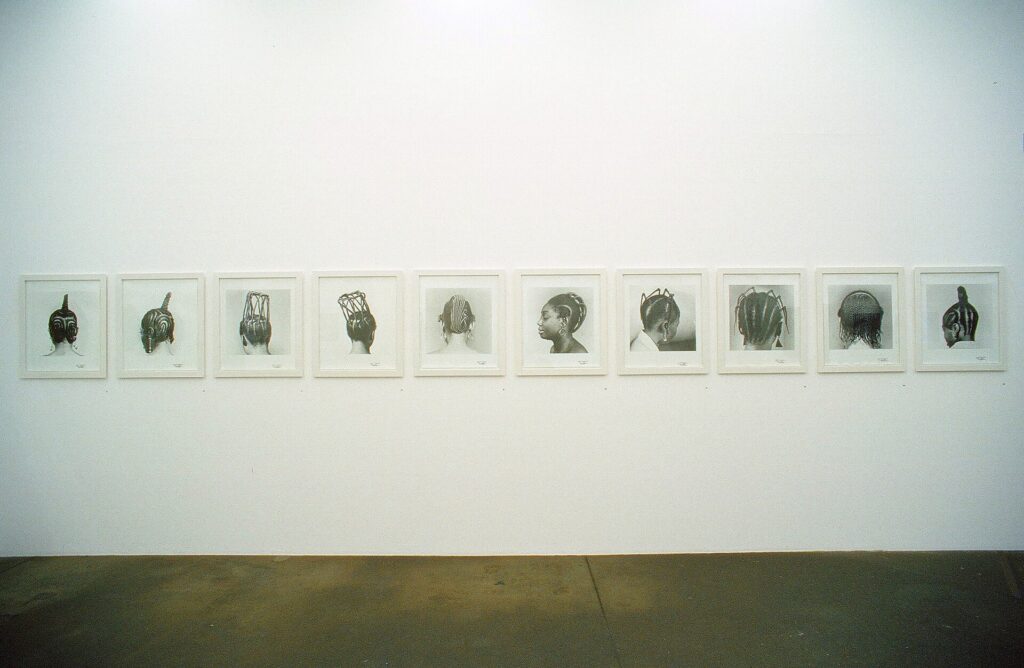
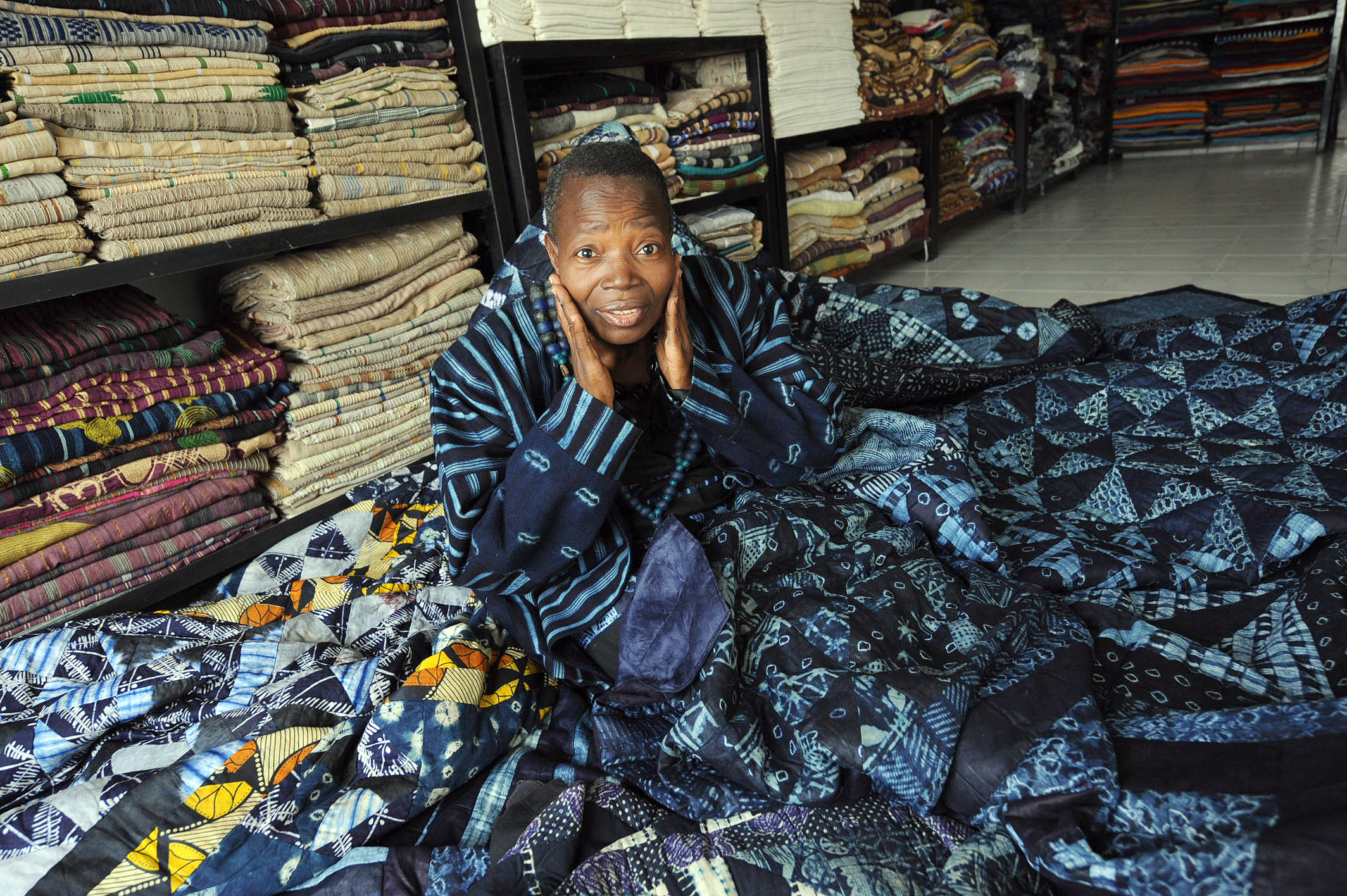
In its tenth year, ART X Lagos provided me with a swanky welcome as I encountered the who’s who of the Lagos art scene and beyond, the international fair now among Africa’s largest. Well-curated with numerous official and unofficial events, you would have to try to have a bad time. There were symposiums dedicated to the country’s different postcolonial art schools featuring the likes of Chief Nike Davies-Okundaye, founder of one of the largest art galleries in West Africa, named after herself. Then there was the live photography studio inspired by the late J.D. ‘Okhai Ojeikere, who captured Nigerians’ hairstyles as an artistic process, reminding us of the great value of art as a cultural archive.
In the midst of craftspeople, visual artists, sculptors—upcoming and established—there was also hearteningly, programming for children, inviting them to be art makers at a young age. Away from ART X Lagos, the Fela Kuti: Afrobeat Rebellion immersive exhibition, ongoing since October, was a gratifying celebration of perhaps one of Nigeria’s most notable cultural icons. Savoring it all, the only reservation I had was a familiar one—that more than just well-off Lagosians and visitors deserve access to such things, too.
Leaving for Benin City shortly after—the old historic home of the once powerful Edo nation, famous for the Benin Bronzes—I attended the inaugural Black Music Art Festival, established by the artist Victor Ehikhamenor. The fair showcased exhibitions and a remarkable new Sculpture Park, all done in tandem with local Nigerians and featuring a plethora of young artists, including Osaru Obaseki. A multidisciplinary artist who won the surprise first prize on opening night, Obaseki stood out for many reasons, but most notably to me, for her incorporation of bronze casting, traditionally done by men. Between her work and that of her contemporaries, innovation was everywhere I looked, including in the mixed media installation Invisible Pedestrians by Seidougha Linus Eyimiegha, AKA Mr. Danfo, and a studio visit with artist Derek Jombo, who blends surrealism with classical realism in portraits of postcolonial Nigerians.
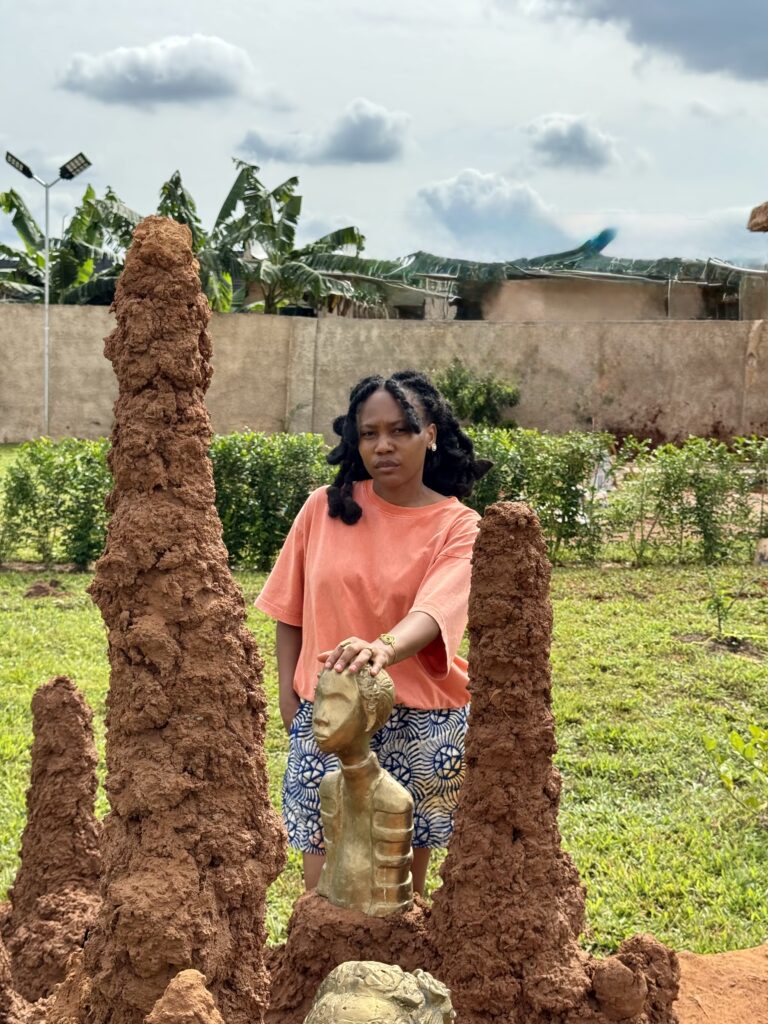
On the way to Ughelli, four hours by road from Benin, I traveled with a colleague turned friend, Agohogo Otega, a photojournalist and artist whose work I was finally able to purchase after years of eyeing a particular piece showcasing our hometown’s sunrise. Once in Ughelli, I spent time with a cousin I don’t often see, who has turned his artistic vocations from music to visual art once again. He shared his work with me as he told me of his future plans of pursuit.
I had not wanted the best Nigeria has to offer to trick me into succumbing once again into narratives of our potential, and it didn’t. But what happened in spending time with the full range of artists—from those who have international acclaim to those who struggle to afford the most basic items for their practice—was a reminder that while I’ve never had much faith in the Nigerian political class, if I’m to maintain my ties to the country as a whole, I cannot afford to give up on its people.
“Nigerians—and that is, ordinary Nigerians—refuse to sacrifice art at the altar of the country’s plethora of problems.”
This includes their many achievements despite the countless factors working against them. Aside from art, even with inadequate infrastructural support, everything from agritech businesses to renewable energy companies are still advancing, continually exhibiting to those that control the nation’s purse strings what the future could be, long before they’ve invested in it. Despite the very real partly religious conflicts and sometimes ensuing violence that has occurred in various parts of the country, for the most part, we also do more than tolerate each other: I was born in Ibadan, and if you’ve ever been there, you know that one’s neighbors are just as likely to be Christian as they are to be Muslim (or traditionalists) and celebrating each other’s festivities is part of the city’s ethos. There are many more Ibadans in Nigeria than not.
It’s why the characterization of Western (and Western-minded) politicians and pundits who don’t understand (or intentionally misunderstand) the complex dynamics of the nation—quick to weaponize “Christian genocide” rhetoric—are speaking out of turn; there are too many additional factors at play to oversimplify our national woes. It is true that Nigeria has an ethnocentrism problem that has seldom been adequately examined in the context of power and privilege, akin to racism. But for a people who still embody the memory of our once independent precolonial nations, that we have never really had many leaders keen to unite us—and in fact have leaders even today who weaponize our differences—my sense is we often belittle our everyday congeniality towards each other. A congeniality I would like to see more of in how we regard each other’s cultural expressions.
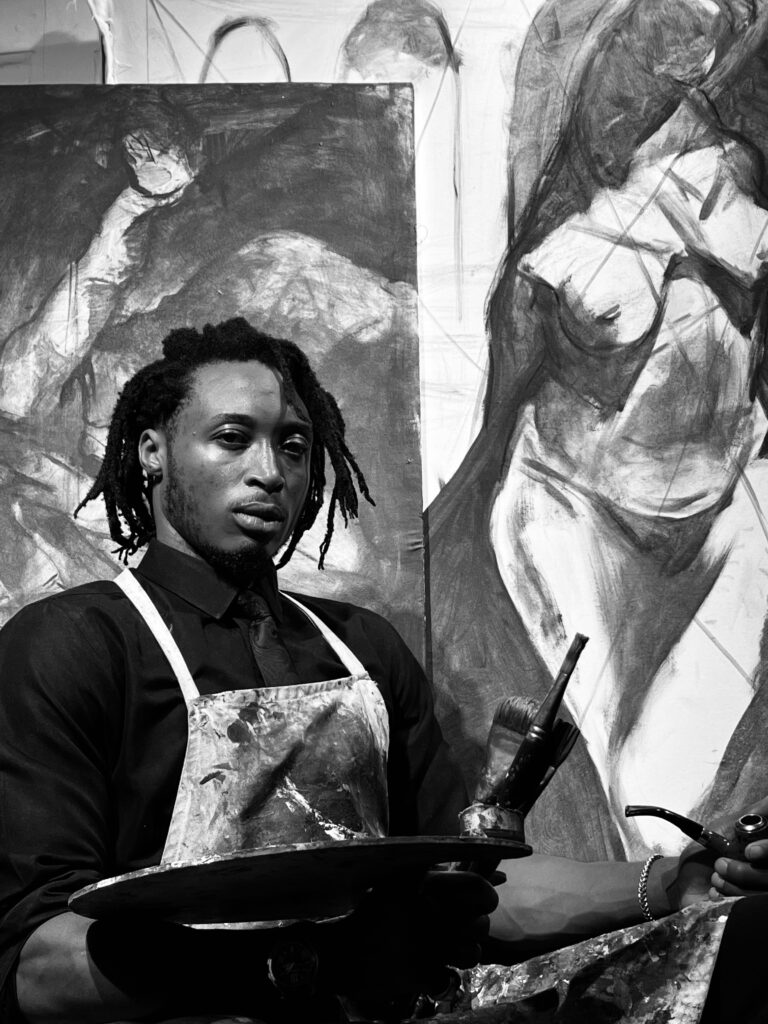
Given all the tragedies of Nigeria, I remain astonished at the art and the artists the country produces. For a country that is in such dire straits, that quite frankly, has so much for its ordinary citizens to be attentive to, and where institutional support for the creative industries is dire, our artistic production feels like a small miracle. Beyond this, Nigerian families are notorious, if stereotyped, as discouraging their children from artistic undertakings, preferring they go into “practical” fields—medicine, engineering, or otherwise. Of course, there is also the wide gap of privilege: The difference between what a wealthy child is exposed to in Lagos artistically, and what a child from the working poor will be exposed to in Lagos, or Ughelli, or Benin, is great—a distance that ordinarily only exacerbates my despair. But I’d be lying if I didn’t admit that it also gives me hope that Nigerians—and that is, ordinary Nigerians—refuse to sacrifice art at the altar of the country’s plethora of problems, as something only to be pursued by the elite.
It is here that Nigeria’s potential merges with its reality. Whether accompanied with other “practical work,” or disappointing their families, or restricting themselves to smaller towns and cities, Nigeria’s artists continue on. Many, without fame and certainly almost no fortune, continue on. And little else can explain why, other than because they can’t help themselves. It is something they must do, even with no fairytale ending in sight, because the art itself is the point. This, above all, is where the unexpected hope lies among a people obsessed with reaping the fruits of one’s labor: that even still, in spite of our condition, creating itself, and not its aftermath, is what matters most.