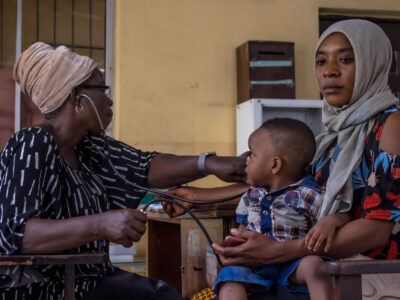
In the face of the country's plethora of problems, its artists continue on.
For as long as I’ve been alive, I’ve been aware of Nigeria’s potential.
Globally, this potential has largely been measured by the country’s natural resources, from relatively recent (and continuing) discoveries of rare earth elements, to crude oil, its greatest export commodity, and arguably also its greatest curse. Discovered some years short of independence from British colonial rule in 1960, oil has been the main cause of poverty and ecological degradation in the Delta region, often stagnating development in Nigeria’s other industries due to over-reliance on its “black gold”.
Then, there’s the potential of our country’s expansive 230 million-plus population, consisting of over 400 ethnic groups (or 500, depending on how they’re counted), with just as many languages. Equally important is our religious diversity, composed largely of Muslims and Christians, as well as practitioners of various traditional religions, the latter sometimes performed (quietly) alongside the Abrahamic faiths. Increasingly, if only marginally, there’s also a rise in irreligiosity and atheism among Nigeria’s youth, noteworthy because Nigerians are, on average, a deeply religious (pontificating and practicing) people.
There is also the potential of our diaspora. From the time of independence or even before it, the Nigerian diaspora has produced notable writers, artists, and musicians, a feat that has only grown as the country’s entertainment industries, especially in music and film, have exploded in the last decade. Notwithstanding the prevalence of a “scammer” stereotype, Nigerians in diaspora—especially in the West—stand out as among the most educated, flourishing immigrant populations across variouscountries. Last year, Nigerians abroad even remitted over $20 billion back to the country, exceeding its foreign direct investment. This statistic does more than simply demonstrate the economic success enjoyed by many Nigerians abroad; it offers insight into the intimate connections we have to the nation of our birth—or of our parents’ or grandparents' birth. It also shows that, where the government has failed to create economic conditions for the average Nigerian to meet their basic needs, Nigerians individually and collectively have offered the necessary support to fill the gap.
This, however, reveals a truth that has persisted from one generation to the next: Nigeria’s potential has not staved off its reality.
"I’ve found myself inching ever closer to a resignation that what Nigeria may mostly have in my lifetime is potential."
While the truth of any country exists beyond what data reveals, it cannot be entirely ignored. The numbers show that by most measures, Nigerians at home are collectively worse off than they were even a decade ago. Its GDP per capita, for example, has fallen to an estimated $835.49 this year; just four years ago, that figure was $2,057. Unsurprisingly, this has meant an exacerbation of extreme poverty, even as, notoriously, the combined worth of the nation’s five wealthiest people could put an end to it should they so choose.
Just as unsurprising is that Nigeria’s rate of unemployment remains high, despite the National Bureau of Statistics’ recent manipulation to arrive at the now low 4.3% figure, after surpassing 30% unemployment just a few years ago. Simultaneously, the cost of living in Nigeria has escalated to its worst in a generation, while rising security concerns, rife in different parts of the country for different reasons, have made it difficult to determine the sheer scale of crime nationally.
Put together, then, the potential of Nigeria is exponential. But the reality of Nigeria is we have a multigenerational kleptocratic political class with little interest in strengthening the nation’s institutions or improving the lives of ordinary people. Whatever improvements have been made—for decades—have been in spite of this class, and often by the sheer will of persistent individuals and grassroots community initiatives.
"Seeing the cultural and artistic production of Nigerians once again revived my belief that hope must be a practice."
You might not know any of this, of course, if you only frequent, or are attentive to, the country during its Detty December period, where the weeks-long partying never ends in the palatable parts of its Lagos metropolis. Even with hiked prices and complaints from Nigerians at home and abroad, who go less for the merriment than to visit family, the period shows no signs of easing. People anywhere, I believe, have a right to enjoyment despite whatever depths of despair we may find ourselves in. But when does this enjoyment start to become smoke and mirrors for the lack—and a desensitization to the lack—experienced by most Nigerians?
If it sounds like I am describing a country on the brink, my visits in the last two years, especially, have felt like I was witnessing it, too. This is the same country where many of our parents survived a late ’60s civil war and perennial eras of dictatorship through to the ’90s. And yet, the country today seems somehow less tolerable, because the last decade of governance has revealed even the smallest gains can be reversed; that this is not a developing country, but a regressing one.
Having frequently meditated on the state of the nation’s potential versus its reality, I’ve found myself inching ever closer to a resignation that what Nigeria may mostly have in my lifetime is potential—and a potential that will never even be minorly realized. What’s more is that the values that Nigerians ordinarily uphold—our ability to persevere, to get through, to make good of what is bad—is also ultimately what holds us back. Realizing this made me all the more hopeless, because how do a people resist over time and collectively when enough is never enough?
With all of this on my mind, last November, visiting Nigeria yet again, I was apprehensive; despite my own relative economic privilege, I’ve been enjoying my stays less, considering them more a labor of my particular family culture than a joyful homecoming. This visit, lasting less than 10 days, would be dominated by art and art makers across two cities—Lagos and Benin City. I’d also be making it to my ancestral hometown, Ughelli, in the Delta.
Yet for all my apprehensions, I found myself less fatigued by the state of the country than contemplative. While I would witness many swaths of society that spoke to the country’s regression, seeing the cultural and artistic production of Nigerians once again revived my belief that hope must be a practice.
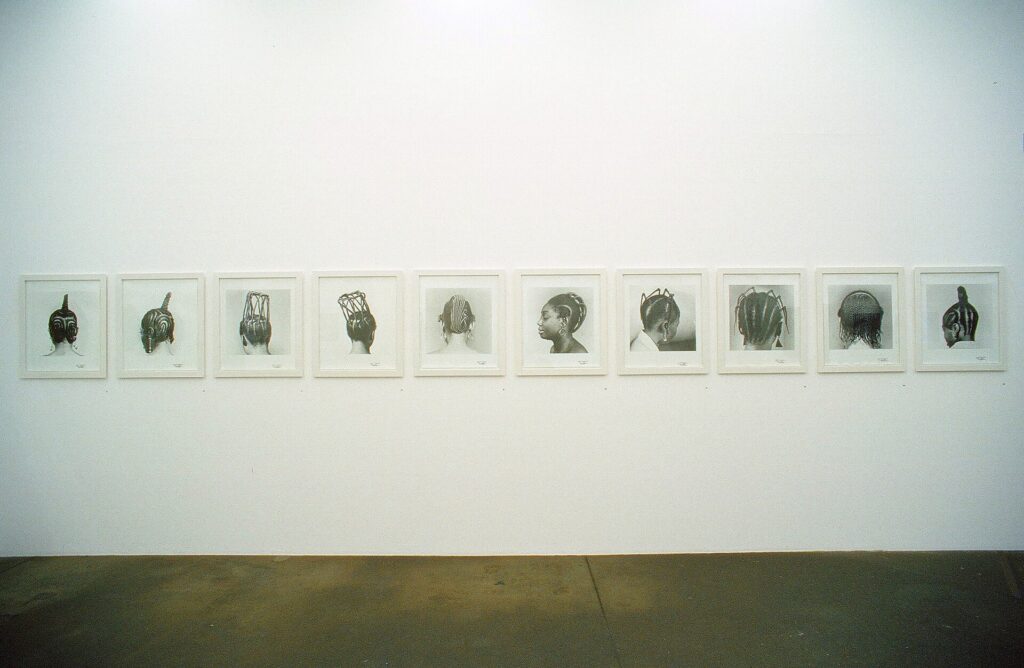
Photographs from J.D. ‘Okhai Ojeikere's Hairstyles exhibit at MAMCO in 2001. (Photo courtesy of MAMCO / Wikimedia Commons.)
In its tenth year, ART X Lagos provided me with a swanky welcome as I encountered the who’s who of the Lagos art scene and beyond, the international fair now among Africa’s largest. Well-curated with numerous official and unofficial events, you would have to try to have a bad time. There were symposiums dedicated to the country’s different postcolonial art schools featuring the likes of Chief Nike Davies-Okundaye, founder of one of the largest art galleries in West Africa, named after herself. Then there was the live photography studio inspired by the late J.D. ‘Okhai Ojeikere, who captured Nigerians’ hairstyles as an artistic process, reminding us of the great value of art as a cultural archive.
In the midst of craftspeople, visual artists, sculptors—upcoming and established—there was also hearteningly, programming for children, inviting them to be art makers at a young age. Away from ART X Lagos, the Fela Kuti: Afrobeat Rebellion immersive exhibition, ongoing since October, was a gratifying celebration of perhaps one of Nigeria’s most notable cultural icons. Savoring it all, the only reservation I had was a familiar one—that more than just well-off Lagosians and visitors deserve access to such things, too.
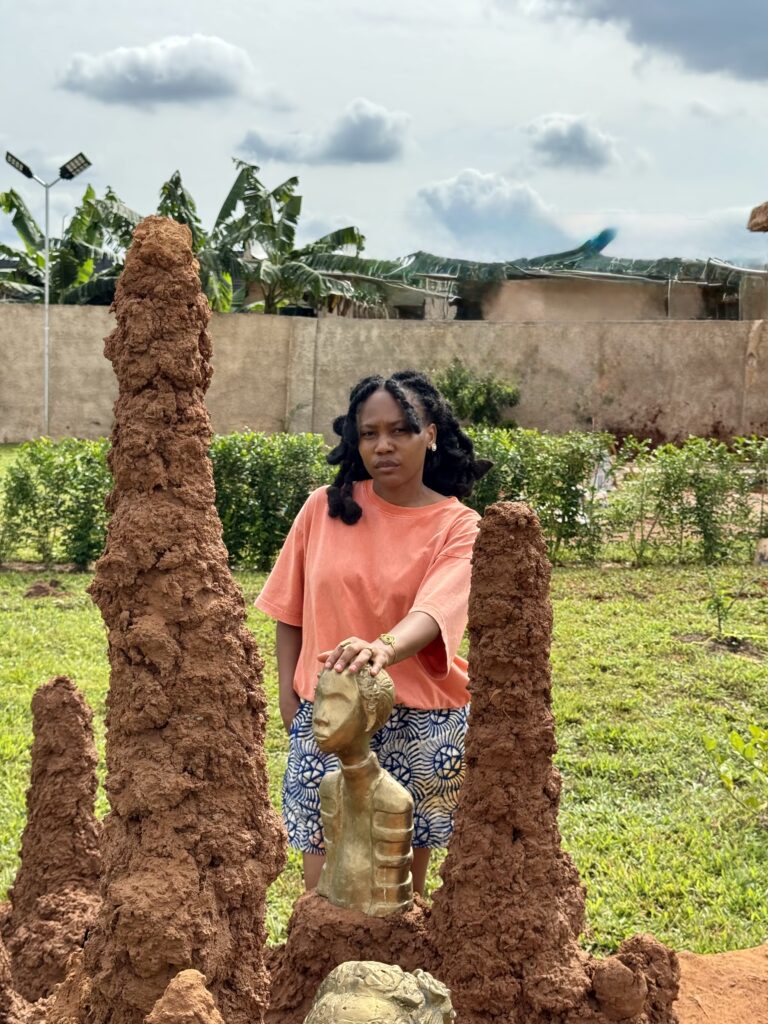
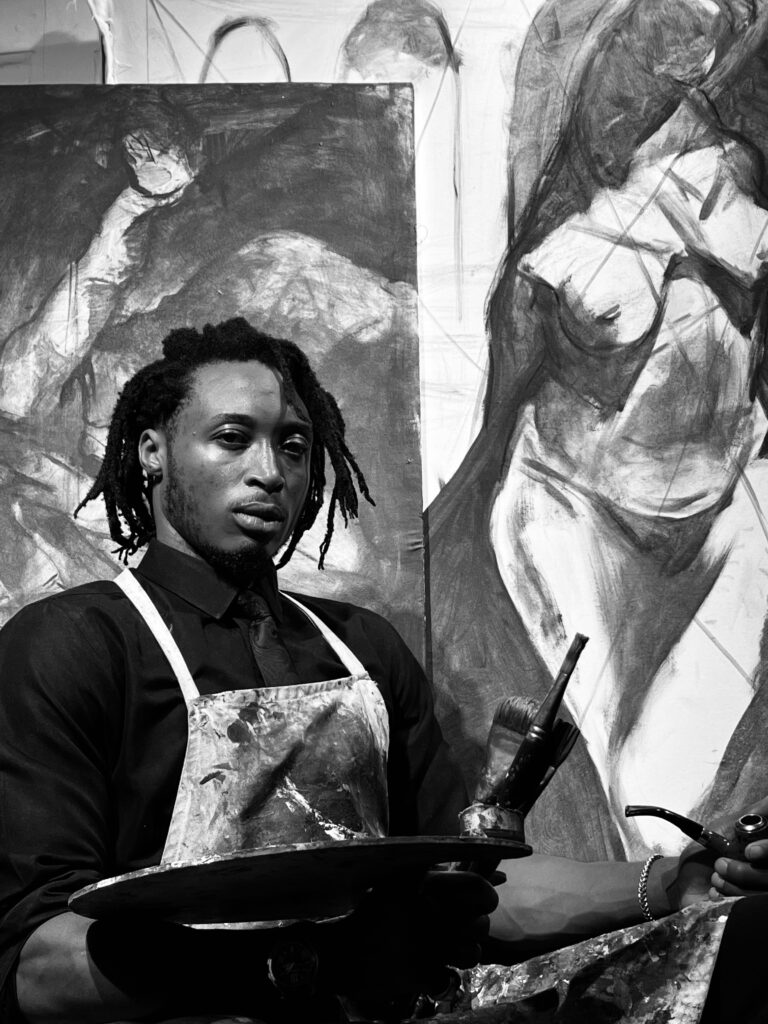
Leaving for Benin City shortly after—the old historic home of the once powerful Edo nation, famous for the Benin Bronzes—I attended the inaugural Black Music Art Festival, established by the artist Victor Ehikhamenor. The fair showcased exhibitions and a remarkable new Sculpture Park, all done in tandem with local Nigerians and featuring a plethora of young artists, including Osaru Obaseki. A multidisciplinary artist who won the surprise first prize on opening night, Obaseki stood out for many reasons, but most notably to me, for her incorporation of bronze casting, traditionally done by men. Between her work and that of her contemporaries, innovation was everywhere I looked, including in the mixed media installation Invisible Pedestrians by Seidougha Linus Eyimiegha, AKA Mr. Danfo, and a studio visit with artist Derek Jombo, who blends surrealism with classical realism in portraits of postcolonial Nigerians.
Osaru Obaseki. (Photo courtesy of the artist.)
On the way to Ughelli, four hours by road from Benin, I traveled with a colleague turned friend, Agohogo Otega, a photojournalist and artist whose work I was finally able to purchase after years of eyeing a particular piece showcasing our hometown’s sunrise. Once in Ughelli, I spent time with a cousin I don’t often see, who has turned his artistic vocations from music to visual art once again. He shared his work with me as he told me of his future plans of pursuit.
I had not wanted the best Nigeria has to offer to trick me into succumbing once again into narratives of our potential, and it didn’t. But what happened in spending time with the full range of artists—from those who have international acclaim to those who struggle to afford the most basic items for their practice—was a reminder that while I’ve never had much faith in the Nigerian political class, if I’m to maintain my ties to the country as a whole, I cannot afford to give up on its people.
"Nigerians—and that is, ordinary Nigerians—refuse to sacrifice art at the altar of the country’s plethora of problems."
This includes their many achievements despite the countless factors working against them. Aside from art, even with inadequate infrastructural support, everything from agritech businesses to renewable energy companies are still advancing, continually exhibiting to those that control the nation’s purse strings what the future could be, long before they’ve invested in it. Despite the very real partly religious conflicts and sometimes ensuing violence that has occurred in various parts of the country, for the most part, we also do more than tolerate each other: I was born in Ibadan, and if you’ve ever been there, you know that one’s neighbors are just as likely to be Christian as they are to be Muslim (or traditionalists) and celebrating each other’s festivities is part of the city’s ethos. There are many more Ibadans in Nigeria than not.
It’s why the characterization of Western (and Western-minded)politicians and pundits who don’t understand (or intentionally misunderstand) the complex dynamics of the nation—quick to weaponize “Christian genocide” rhetoric—are speaking out of turn; there are too many additional factors at play to oversimplify our national woes. It is true that Nigeria has an ethnocentrism problem that has seldom been adequately examined in the context of power and privilege, akin to racism. But for a people who still embody the memory of our once independent precolonial nations, that we have never really had many leaders keen to unite us—and in fact have leaders even today who weaponize our differences—my sense is we often belittle our everyday congeniality towards each other. A congeniality I would like to see more of in how we regard each other’s cultural expressions.
Derek Jombo. (Photo courtesy of the artist.)
Given all the tragedies of Nigeria, I remain astonished at the art and the artists the country produces. For a country that is in such dire straits, that quite frankly, has so much for its ordinary citizens to be attentive to, and where institutional support for the creative industries is dire, our artistic production feels like a small miracle. Beyond this, Nigerian families are notorious, if stereotyped, as discouraging their children from artistic undertakings, preferring they go into “practical” fields—medicine, engineering, or otherwise. Of course, there is also the wide gap of privilege: The difference between what a wealthy child is exposed to in Lagos artistically, and what a child from the working poor will be exposed to in Lagos, or Ughelli, or Benin, is great—a distance that ordinarily only exacerbates my despair. But I’d be lying if I didn't admit that it also gives me hope that Nigerians—and that is, ordinary Nigerians—refuse to sacrifice art at the altar of the country’s plethora of problems, as something only to be pursued by the elite.
It is here that Nigeria’s potential merges with its reality. Whether accompanied with other “practical work,” or disappointing their families, or restricting themselves to smaller towns and cities, Nigeria’s artists continue on. Many, without fame and certainly almost no fortune, continue on. And little else can explain why, other than because they can’t help themselves. It is something they must do, even with no fairytale ending in sight, because the art itself is the point. This, above all, is where the unexpected hope lies among a people obsessed with reaping the fruits of one’s labor: that even still, in spite of our condition, creating itself, and not its aftermath, is what matters most.
[post_title] => Where Nigeria's Potential Meets Its Reality
[post_excerpt] => In the face of the country's plethora of problems, its artists continue on.
[post_status] => publish
[comment_status] => closed
[ping_status] => closed
[post_password] =>
[post_name] => nigeria-potential-reality-art-lagos-gallery-sculpture-photography-nike-davies-okundaye-osaru-obaseki-derek-jombo-benin-ughelli
[to_ping] =>
[pinged] =>
[post_modified] => 2026-08-03 20:46:52
[post_modified_gmt] => 2026-08-03 20:46:52
[post_content_filtered] =>
[post_parent] => 0
[guid] => https://conversationalist.org/?p=10683
[menu_order] => 0
[post_type] => post
[post_mime_type] =>
[comment_count] => 0
[filter] => raw
)
Nearly seven months later, a case for why some healthcare providers in Nigeria are getting nervous.
Rose sits in the waiting room of a Planned Parenthood clinic in Isolo, Lagos, waiting to receive her prescription for oral contraceptives. While her husband supports her decision, her family does not, and she is here despite their insistence on her having more children before trying them, believing that they can take away her fertility. That she’s even able to get these contraceptives would have been unthinkable just a few years ago: Rose has never heard about Roe v. Wade, but she remembers when it was impossible to consider family planning at all, let alone have access to it, and fears returning to those times.
Before organizations like Planned Parenthood Federation Nigeria (PPFN), sexual and reproductive agency were impossible for most women in the country. “Many women who visit Planned Parenthood defy their husbands to get contraceptives, secretly making choices that save their lives despite facing consequences if they are ever found out,” says Zainab Mukhtar, Communications Officer for PPFN. "We advocate method by choice and exercising free will, not only for married women but sexual and reproductive health choices for young people."
In Nigeria, many women cannot access reproductive health services without spousal permission, and if unmarried, they are shunned for considering it. Even health workers cite God's omniscience when refusing care: While trying to obtain birth control, one unmarried woman recalls her male doctor condescendingly telling her, "Ah, madam, do you want to test God? Where is your husband? Go and bring [him]." This provider bias, where health workers lead with disapproval when consulted for reproductive and sexual health care, has only made it harder for many women in Nigeria to access the care they need—a bias that becomes far more severe when it comes to abortion.
This bias is likely to only get worse: Sani Mohammed, a sociologist, activist, and the executive director of the Bridge Connect Africa Initiative, says the repeal of Roe v. Wade last summer has had ripple effects beyond the U.S., and creates justification for more limits on women's rights worldwide, often detering advocacy efforts and slowing momentum behind progressive bills. “It sends a signal to anti-abortion advocates in Nigeria that if the U.S. can do it, why not us?” Mohammed says. “It will take longer for Nigeria to make abortion services open and legal because it sets a precedent and justification, rescinding all the work done today and making it harder to make a case in favor of sexual and reproductive rights.”
Sani was careful in choosing his words, so as not to risk the little progress made, adding that it took a long time to even get this far. Bridge Connect Africa Initiative focuses on women’s rights and reproductive health rights, pushing for policies and campaigns around gender-based violence, and access to education for young girls to help inspire more informed social and reproductive health choices, especially in northern Nigeria. But it’s been an uphill battle.
Except in situations where having the child puts the mother's life at risk, Nigeria is governed by two laws that criminalize abortion: the penal code in the north and the criminal code in the south. When discussing restrictive sexual and reproductive laws in Nigeria, people often think of the north, associating it with Sharia law and terrorism, but southern Nigeria is predominantly Christian, comprising of Catholics and evangelical Christians, and their stance toward abortion and sexual reproductive rights is similar to hardliners in America. In Enugu State, in southeastern Nigeria, for example, a coalition of civil society organizations claimed that the comprehensive sexuality education (CSE) in the public school curriculum equates to pornography and demanded to stop sex education in schools.
While abortion is a crime in Nigeria, it is also a cause of shame to be pregnant out of wedlock, regardless of the circumstances of the pregnancy. In northern Nigerian culture, a girl is considered old enough to be married and have children at 11 years old, but an 11-year-old girl is not allowed to seek out family planning methods. Young girls who get pregnant from rape still have to carry it to term, and to avoid scorn and ostracism, often find unsafe means to hide their shame. Without legal recourse, these girls either neglect the children after they are born or resort to unsafe abortions, regardless of the risks. Sani recalls witnessing two cases of hysterectomies performed on 14-year-old girls. "It is already difficult to have access to safe abortion, and other reproductive health devices that help girls as young as 12 to 14 stay safe and live healthy lives."
According to a report by the Population Reference Bureau (PRB), about two million women and girls aged 15 to 45 have abortions in Nigeria every year—a staggeringly high number over three times the estimated number of abortions in the U.S. Of these women and girls, 6,000 die, and 500,000 live with complications from unsafe abortions, despite some doctors risking their licenses to provide off-record/off-book abortion care. It is also the fourth leading cause of death for lower and middle income women, according to the Academy for Health Development (AHEAD), a not-for-profit health research agency in Nigeria.
Organizations like PPFN—which is a member of the International Planned Parenthood Federation (IPPF)—are doing their best to combat this, but similar to America, misconceptions about their services abound. Like in the U.S., the majority of Planned Parenthood Nigeria’s services are preventive, especially against HIV/AIDS, cervical cancer, and malaria. They provide maternal and child care through malaria prevention and treatments, especially intermittent preventive treatment (IPT) for pregnancy malaria, which is a critical public health problem in Nigeria. Also like in the U.S., PPFN provides post-abortion care for women and girls having spontaneous abortions or miscarriages, and those who attempt incomplete abortions using crude objects to remove an unwanted pregnancy “by any means necessary.” Sometimes these objects are found still inside the women.
Would PPFN provide abortions in uncomplicated cases? Zainab, with a careful laugh, says they would, but that it’s “tricky.” They are damned if they do and damned if they don’t. If they don’t help, the patient could seek an unsafe abortion elsewhere that could lead to death; if they do, it could mean breaking the law. Nevertheless, PPFN will not turn away a patient in need, and will perform abortion services within legal exceptions—that is, when the birth of the child directly puts the life of the mother in mortal danger.
Perhaps if Nigerians were more open about abortion, it could inspire a legislative debate similar to the one in Ireland, and allow a platform to discuss the benefits of legalizing abortion, providing safer choices for women and girls through government funding and training for health care providers. But with the Nigerian health sector being one of the most underfunded in the world, it does not leave much hope.
While Zainab believes it is too early to say what the real effects of the overturning of Roe v. Wade will be on Africa, she predicts the heightening of fear and possibilities of regression. “It is difficult to work in this field in Nigeria; these things happening here have existed a long time but signaling from the U.S. can make things worse.” Shortly after the repeal of Roe v. Wade, the Lagos Government proposed new abortion guidelines on the safe termination of pregnancy. They were quickly rejected after the governor, Babajide Sanwo Olu, who is running for re-election, received backlash from Christian and Muslim religious organizations in the state.
But even before the overturning of Roe v. Wade, it’s been an especially difficult time. For more than 50 years, the United States has supported global family planning and reproductive health rights in Nigeria, but when countries like America, which have historically provided aid, start taking them away in their own countries, the idea of choice for women in oppressive societies is erased forever. Most notably, the global gag rule on abortion during the Trump years reduced reproductive health funding and setback the work being done independently on sexual health rights both locally and abroad.
There is progress, however, no matter how slow. Planned Parenthood Nigeria has a more comprehensive curriculum for sexual and reproductive health rights (SRHR) education currently being piloted in private schools, where there is less national control of the curriculum. They also train health workers on sexual and reproductive health rights and how to identify provider bias. Bridge Connect Initiative has been able to get three northern states (Kano, Jigawa, and Bauchi) to recognize the Violence Against Person Prohibition Act (VAPP) and the child protection bill. They also provide psychosocial support to child brides and survivors of gender-based violence while helping many girls complete their education.
The durability of these successes lies in the allyship of progressive nations towards women’s health abroad. This is why the rescinding of Roe v. Wade is so dangerous on a global scale. Women are dying now. Nigerian women are deprived of contraception when they want it or forced by their husbands to take it when they don’t, and even that is considered progressive. What becomes the fate of a woman living in Nigeria when the government takes a more hardline stance on her agency without a powerful ally to help? With the right support from local organizations and international health rights networks, and a renewed interest in Africa from the U.S., hopefully, we never have to find out.
[post_title] => The Overturning of Roe v. Wade Didn't Just Affect America
[post_excerpt] => Nearly seven months later, a case for why some healthcare providers in Nigeria are getting nervous.
[post_status] => publish
[comment_status] => closed
[ping_status] => closed
[post_password] =>
[post_name] => roe-v-wade-abortion-reproductive-access-planned-parenthood-nigeria
[to_ping] =>
[pinged] =>
[post_modified] => 2026-08-04 20:03:10
[post_modified_gmt] => 2026-08-04 20:03:10
[post_content_filtered] =>
[post_parent] => 0
[guid] => https://conversationalist.org/?p=5461
[menu_order] => 99
[post_type] => post
[post_mime_type] =>
[comment_count] => 0
[filter] => raw
)
Ajo, a traditional microsavings system based on trust, allowed women in the informal economy to survive the pandemic lockdown.
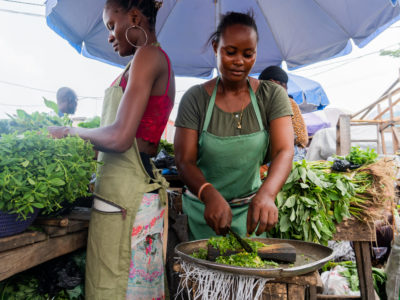
The outdoor markets of Lagos are a noisy clutter of shops and makeshift stalls. The traders are mostly women who call out their wares loudly, with customers clustering in front of the stalls to haggle while the business owner multitasks and chats with them all. The stall owners are friendly but competitive, bantering with one another all day.
In this familiar chaos, the women form sisterhoods and support systems. One of these systems is called “ajo” (or “esusu” in eastern Nigeria). It is an ancient informal cooperative savings culture passed down for generations, with the women contributing a portion of their earnings on a weekly or monthly basis and each receiving the full amount, in turn, to invest in her business.
This is a typical example of how an ajo works:
In a 12-unit rotation for 12,000 naira ($29.01) monthly, each member contributes 1,000 naira ($2.42) per month, choosing a number or month when they would like to receive their due. They give their money to a thrift collector, who is responsible for disbursing the collected money at the end of each agreed-upon period, and for keeping the women’s savings. At the end of the rotation, a member can cancel her contribution or start again. But a unit of 12 does not mean 12 people. It could also mean 12 “hands,” or contributions. Some members might decide to contribute two hands, or double the amount (2,000 naira), to collect double (24,000 naira).
The foundational principles of ajo are trust, familiarity, and an uninterrupted cycle of donation. These might not seem like concrete measures for financial security, but they are remarkably successful—most of the time. The restrictions and privations of the Covid-19 pandemic interrupted this usually reliable traditional micro-savings system. Women make up half of Nigeria’s informal labor force, which is unregulated and often exploited. Whether they are traders, farmers, or domestic workers, these women are often the family’s secret breadwinners (in this conservative patriarchal culture, the man must always be seen as the financial head of the family). The pandemic lockdowns, with income drastically cut due to restrictions that for several months kept market hours reduced to four from the usual 60 per week, made ajo more important than ever.
Surviving the pandemic, despite the prevalence of disinformation
In December 2021 I visited Addo market in Lagos to speak with some of these women. Ify, a single mother in her mid-thirties who sells dried fish, told me she panicked when the government announced a lockdown in March 2020, at the beginning of the pandemic. For several months hardly any customers visited the market; the few who came to shop were limited to one at a time. According to the women, if stallholders neglected to wear masks, the police forced them to buy one from them at exorbitant prices, or even kicked them out of the market. I could not independently verify this, but have no reason to doubt the women given the Nigerian police's well-documented corruption. To save on the expense of buying a new disposable mask to wear each day, Ify bought a reusable face shield.
Ify said she was not worried about catching the virus. She gets her information on COVID-19 from mainstream news outlets, but her opinions reflect the disinformation that circulates on social media. She said that one woman in the area died after she was vaccinated, although she acknowledged never having met her. Ify said she never met anyone who had caught the virus, nor did she believe she would catch it, which is why she did not plan to be vaccinated. She asked why the government was mandating vaccines when they had not done the same for HIV tests or antiretrovirals.
The government is, in fact, not mandating vaccines. As in other countries, vaccine passports are required to enter certain public spaces and in order to travel.
Ronke, a 21-year-old college student who helps at her mother’s vegetable stall during semester breaks, could only sell fresh produce to neighbors for their meals during the lockdown. “I saw no dead bodies or sick people in Nigeria even on social media, me and my family believe COVID-19 is fake and we will not be taking the vaccine,” she said.
Nigeria’s first phase of the vaccine rollout was in March–April 2021; it was limited to essential workers and the elderly, which excluded most of the women who work at the market. Before the lockdown, these women, some of whom have little or no formal education, received health information from the local radio, community workers, and primary healthcare centers. But the pandemic exposed them to unverified sources and misinformation on WhatsApp and Facebook.
Family and friends innocently share viral messages via WhatSapp groups; the messages, in pidgin English and various local languages, recommend homemade cures for the virus, like herbal steaming. Or they contain disinformation, like the claim that Covid vaccines inject magnetic chips into the body. According to this conspiracy theory, the chips attract metals, like spoons, which stick to the skin. According to another conspiracy theory the virus is fake and the pandemic restrictions are just another government ploy to steal public funds. Since people receive these messages from those they trust, like their faith leaders or educated members of their families, they believe they are credible.
How COVID affected the ajo system
Because they made so little money during the lockdowns and were struggling to feed their families on their reduced earnings, neither Ify nor Ronke could keep up their ajo contributions, nor could many other women in their groups. With contributions reduced by 70 percent, their ajo unit could not stay afloat. Contributions stopped, pending the lifting of the lockdown and the full re-opening of the markets. Ronke refers to the semblance of normalcy that followed the 2020 lockdown as the “end of Corona,” a sentiment shared by most women in the market. If they may trade, then “corona” must be over, they say, associating the virus with the period of restrictions and nothing more. These women go about their business without face masks or social distancing. The police no longer compel them to abide by any pandemic restrictions.
A study of the impact of COVID-19 on women’s savings groups carried out by a collaboration of think tanks and researchers, including the Bill and Melinda Gates Foundation, Africa Center for Systematic Reviews, and Makerere University, found that households with women who are in informal savings groups were less likely to experience food insecurity and more likely to have savings, which was critical in getting through the pandemic. Women’s savings groups showed more potential for resilience and provided women with a platform for leadership and community responsiveness.
Ajo, however, still carries risk. The women in Addo market lost their savings during the pandemic lockdown to a thrift collector who suddenly “disappeared with everything.” In case of death or serious illnesses, no one is liable for the loss. Sometimes, bad loans accumulate from members who misappropriate funds. That is why researchers recommend that financial institutions and governments offer further support for ajo.
Beatrice Joseph is a thrift collector and restaurateur in Yola, Adamawa State, in northeast Nigeria, an area that has been plagued by terrorists and bandits. She manages the contributions of women across five markets in the state, engaging them in financial literacy training, bookkeeping, and loan repayment. During the lockdown, Beatrice lost all her investments when her restaurant was vandalized. She managed to keep her business and that of her members thanks to a partnership with Riby, a digital financial services (DFS) platform that supports financial cooperatives and trade groups in Nigeria. These services act as the central collector while simplifying the banking process by accepting social credit as collateral (the group stands as guarantor), using USSD codes and text messages instead of complicated apps, and securing their savings. This reduces the risk associated with ajo, while providing financial independence for the women by converting their savings to investments.
Ekundayo Kiyesi, general manager of Riby, describes the thrift collector as an individual microfinance bank that provides accountability, accessibility, and security to the ajo for a monthly service charge that is commonly around 25 cents. Platforms like Riby are formalizing the ajo system for larger collectives in markets and cottage industries like the unit Beatrice manages, but among smaller, homogenous groups some believe ajo should remain communal and independent.
Joy Ehonwa, a freelance writer and book editor in Lagos who runs a small ajo group for employed middle-class women, is one of them. Joy created a system of accountability for her group, a record and digitization process that involves registering a next of kin—which, she laughingly assured me, she had never had a reason to use.
Financial insecurity is just as much of an issue for women working in formal business employment, as it is for those whose income is derived from the informal economy. According to the Central Bank of Nigeria (CBN), approximately half the Nigerian working population earns less than 700 naira ($1.70) per day, even in formal employment; in cases where income is determined by gender (e.g. in the case of office assistants), women earn even less. With such low income and no collateral, they can neither save money nor afford to take a loan. This is where ajo comes in; it is a saving and interest-free loan system that they can depend on.
Nigerian women have more financial agency today than ever before, but societal and cultural norms are still very conservative. Husbands thus control the family finances due to the widely held belief that a man whose wife is financially independent is emasculated. A lack of education, religious and gender bias, and low trust in financial service providers are also reasons for financial dependence. But when women are empowered to earn and invest, they drive innovation, invest in health and child development and increase productivity and economic growth. The economic strength of a country is directly proportional to the economic strength of its women. Despite the digitization of ajo, it will remain a fluid system driven by community, trust and independence. With some financial education, Nigeria’s hardworking, innovative women will save their country’s declining economy.
[post_title] => How a traditional microsavings system enabled Nigerian women to save their businesses during the pandemic
[post_excerpt] => Ajo, a traditional microsavings system based on trust, allowed women in the informal economy to survive the pandemic lockdown.
[post_status] => publish
[comment_status] => closed
[ping_status] => open
[post_password] =>
[post_name] => how-a-traditional-microsavings-system-enabled-nigerian-women-to-save-their-businesses-during-the-pandemic
[to_ping] =>
[pinged] =>
[post_modified] => 2026-08-04 20:56:25
[post_modified_gmt] => 2026-08-04 20:56:25
[post_content_filtered] =>
[post_parent] => 0
[guid] => https://conversationalist.org/?p=3894
[menu_order] => 137
[post_type] => post
[post_mime_type] =>
[comment_count] => 0
[filter] => raw
)