WP_Post Object
(
    [ID] => 11171
    [post_author] => 15
    [post_date] => 2026-10-20 12:29:20
    [post_date_gmt] => 2026-10-20 12:29:20
    [post_content] =>
My father left Somalia in 1982 to study engineering on a scholarship in Washington D.C. Then, a war began in his absence and changed the course of his life.


In the winter of 2021, forty years after his departure, I boarded a flight with him ready to see Mogadishu for the first time. My grandmother gone, my father wanted to track down his childhood home and divide the proceeds from its sale among his siblings.


The house was in poor condition, the concrete and stone badly damaged. My father was disoriented. He lamented that he did not recognize the neighborhood—the Hodan District—or the route we took there. So much had changed, been leveled or lost. What remained was in ruins.


~


I grew up in Portland, Oregon. I spent my days daydreaming in class and my evenings on the internet where I befriended other Somali girls from around the world. We were young and earnest and thought our angst made us exceptional. We were embarrassingly self-fetishizing. We didn’t want to be reduced to our identities, yet secretly feared they were the most interesting thing about us. We were raised on nostalgia, took it into our bodies like milk from our mothers.


We were born in the rupture of the archive, in its lapse.


Two weeks before our trip to Mogadishu, I stumbled down a staircase and hurt my ankle—a hairline fracture caused by repetitive strain, as opposed to a single discrete injury. The importance of strong ankles is basic physics: they dictate the force with which one can meet the world.


Traveling with my father, I walked with a limp; I could not bear my own weight. I took pictures of everything in an attempt to find my place in the rift between him and his fate, between his history and the history of his country.


To this day, my ankle buckles beneath me if I step the wrong way, instability no longer a condition but a fixture of my body.


~


Somalia’s borders were not drawn by clans, but through colonial contracts. Italy claimed the south, England the north, but in Djibouti, it is France’s legacy that lives on.


The proof of these colonial horrors can be found in the museums of Europe, alongside much of Africa’s plundered heritage. In 1923, Benito Mussolini inaugurated Rome's Colonial Museum in the Palazzo della Consulta which housed, at its height, over 12,000 artifacts stolen from its African colonies—Somalia, Libya, and Eritrea. In 1940, it was moved to a larger location and renamed the Museum of Italian Africa. With the outbreak of World War II, the museum fell into neglect. A damning relic of a defeated regime. Its archives were boxed away.


The history of the modern museum cannot be separated from the history of empire. Almost eight decades later, Italy’s colonial archives were transferred to the Museum of Civilizations in Rome which curated a project titled “The Museum of Opacities” in an attempt to critically examine Italy’s colonial past as it absorbed thousands of artifacts. The exhibit invoked French philosopher Édouard Glissant’s assertion that a people have a “right to opacity.” That is, something in each of us and our histories that cannot be translated, easily understood, catalogued, or contained.


~


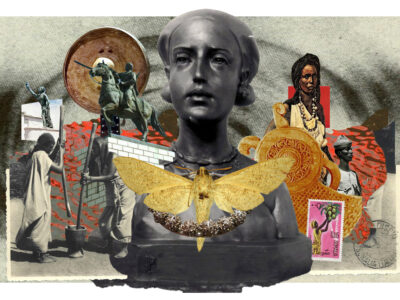
When my father took me to see Somalia's national monuments, my uncle and cousin joined us. We started at the Somali Youth League memorial, a plaza dedicated to the young activists who played a key part in the movement for independence. Next was Daljirka Dahsoon, the Tomb of the Unknown Soldier, and Hawo Tako, a woman who watched over the city with a torch in her hand and an arrow through her heart. Then we saw the Seyed, father of the Dervish Movement, disparagingly called the Mad Mullah by the British, seated atop his famed steed in Mogadishu’s city center. A short distance away was Taalada Dhagaxtuur, the statue of an anonymous stone-thrower, symbolizing the brave men who fought the British with nothing but stones and the steel in their spines.


None of these statues are the originals, all of which were destroyed at the start of the Somali Civil War, their bronze and stone limbs reduced to scrap and sold to neighboring countries. We took pictures in front of their doppelgangers.


We wandered the streets of Mogadishu and the streets of memory. Our last stop of the day was the Somali National Museum, but it was closed to the public. Built by the Sultan of Zanzibar, the building dates back to 1872 before it was converted into Somalia’s first public museum, the Museo della Garesa, by the Italian colonial administration in 1933. Its collection included roughly 3,000 items, serving as an archive of Italian military history. For the colonial administration, it also served as proof that the Italians had created order out of chaos, and preserved what would have otherwise been lost.


It would not be the building’s last transformation.


In 1960, seventeen African countries, including Somalia, gained independence from colonial rule. Less than a decade later, General Siad Barre seized power in a military coup and the Supreme Revolutionary Council adopted Scientific Socialism as Somalia's state doctrine.


As political, economic, and cultural ties between Somalia and the USSR deepened, a team of Soviet scholars arrived in Mogadishu in 1971 for an archaeological expedition aimed at decolonizing Somali history. The scholars sought to forge a continuous chain of rebellion by linking the Dervish Movement in the late 19th century to Siad Barre's 1969 coup, casting Somalis as both victors of an unbroken struggle and heirs to its liberation.


The construction of a new national museum and the preservation of the country’s cultural heritage became top priorities for the new government, and the 1987 completion of the Somali National Museum was hailed as a great achievement by UNESCO.


But the promise of the young republic was usurped by a ruinous civil war. The museum was looted, its collection stolen and sold, then scattered as far and wide as Somalia's people.


~


In the fall of 2024, my friends Aziz Farah and Ibrahim Hirsi, cultural workers with no formal training in art history or curation, joined forces with Asha Noor, a higher education professional, and Idel Rasheed, a researcher and curator, to launch Koor Archives, a traveling exhibition dedicated to preserving Somali heritage. Though they live in four different countries— Canada, the United States, Germany, and the United Kingdom—they are bound by their shared commitment to the tangible and intangible elements of Somali culture.


Aziz and Ibrahim met earlier that year at Piasa, a French auction house that was selling the lifetime collection of Pierre Loos, a Belgian “tribal art dealer.” They successfully bid on 45 Somali headrests. The next day, they spent hours wandering through a Parisian flea market and stumbled upon a Brazilian dealer of East African art. After some haggling, they acquired a cache of books and a traditional Somali amber necklace. Their collection has since grown substantially, culled from galleries, private collections, estate sales, online auctions, street vendors in Somalia’s back alleys, and donations from families and friends.


Their search has exposed them to the political economy of antiquities, an underworld built on expropriation and dispossession. They spend time on Facebook forums where people clash over what constitutes art, where African artifacts are described as primitive, even as they exchange hands for thousands of dollars, buying Somali artifacts from non-Somalis, often at exorbitant prices, and haggling with strangers over the right to their own heritage.


In Somalia, the buying and selling of antiquities is unregulated. There is a network of impoverished residents who steal items from graves and sell them to local dealers. And while most of Africa’s cultural heritage remains in Europe due to centuries of colonialism, Turkey and the UAE’s increased influence in the region has resulted in what Aziz calls a “second plunder.” One antique seller in Mogadishu tells Ibrahim that Arabs and Turks are now his most frequent customers.


Some of the items in the Koor Archives’ collection make Aziz and Ibrahim uncomfortable, like the taxidermy mounts of gazelle and antelope heads, their faces frozen since they were hunted in 1910. “Europeans loved their trophies,” Aziz says. The duo dream of returning them to Somalia where they can be properly laid to rest.


In many ways, Koor is what Françoise Vergès, the French postcolonial scholar and curator, calls the anti-museum: a space that uplifts a poetics of ordinary life and invests in communal stewardship, both the tangible and intangible elements of Somali culture, including oral traditions, poetry, music and song, and collective memory. In Frantz Fanon’s theory of decolonization this kind of rupture is “a program of complete disorder.” The anti-museum, then, might be understood as an attempt to reconstitute what Fanon describes as a world “cut in two”: a world of buyers and sellers, objects and owners. A program that dares to emancipate both the imagination and archive.


Koor is a project of love and disorder, the only forces strong enough to upend “a world of statues" and bring into being a world with no masters and no marble gods.


In their first public exhibit in Toronto of over 100 rare Somali artifacts back in the summer of 2024, three generations of a single family—a grandmother, a mother, and a daughter—stood around a loox, a wooden tablet used to read and write the Quran. Elders shared memories of learning the holy book this way. Someone recalled the process of making ink. Another spoke of trees sprouting from the dirt where the ink of sacred verses had been rinsed. The verses they first read on the loox were inscribed not only on wood, but on their hearts.


~


Long before I met Aziz and Ibrahim, I took my grandmother to the only Somali Museum in North America, in Minneapolis. I expected her to share my excitement, but she was dismissive. “We have these things at home,” she said.


It was true: In our garage in Portland were several xeedho, woven containers central to her tribe’s wedding customs, which she’d lovingly protected from dust in hopes of saving them for my own wedding.


She looked at the wooden fandhaals on display and said: “This is a spoon. Why is a spoon in a museum?”


I did not yet know to question the museum’s logic, its bureaucratic and lifeless classification of the world. My grandmother was impervious to this conditioning. To her, these items were ordinary, pedestrian staples of everyday life.


Years later, wandering the Africa collection at the British Museum, I marveled at the Somali artifacts sealed behind display cases. I knew there were even more hidden within the museum’s bowels. I pressed my hand to the glass that separated me from them and them from the world—a checkpoint I could not cross. Each artifact bore a date of acquisition wed to the name of the donor, the seller, the excavator, the field collector.


I thought of the feet that once wore the leather sandals on display, imagined the roads they tread. The woman who held her long hair over the smoke of a glazed incense burner. The fingers of the blacksmith wrapped around his iron hammer. The shield of hide and wood and the human heart it once protected from harm.


I look at the pictures from my 2021 trip to Mogadishu, I see our smiling faces, our skin glistening with sun and sweat. My uncle has since died, but he is immortalized in these photographs. In my favorite picture, we are posing in front of the Somali flag and underneath a banner that says, “Soomaliya Soomali baah leh.”


Somalia belongs to Somalis.


I lay claim to all that lays claim to me. My living and my dead and the dirt from their graves. My father’s childhood home. His schoolbooks and the sins of his youth. The grief that beats inside him like a second heart. I inherit the echo and the trace and the blue that binds us—the flag, the sky, the sea.


    [post_title] => A Somali Archive of Our Own
    [post_excerpt] => When memory in the aftermath of war meets nostalgia for a place and time that no longer exist.
    [post_status] => publish
    [comment_status] => closed
    [ping_status] => closed
    [post_password] =>
    [post_name] => a-somali-archive-of-our-own
    [to_ping] =>
    [pinged] =>
    [post_modified] => 2026-10-20 19:09:58
    [post_modified_gmt] => 2026-10-20 19:09:58
    [post_content_filtered] =>
    [post_parent] => 0
    [guid] => https://conversationalist.org/?p=11171
    [menu_order] => 0
    [post_type] => post
    [post_mime_type] =>
    [comment_count] => 0
    [filter] => raw
)