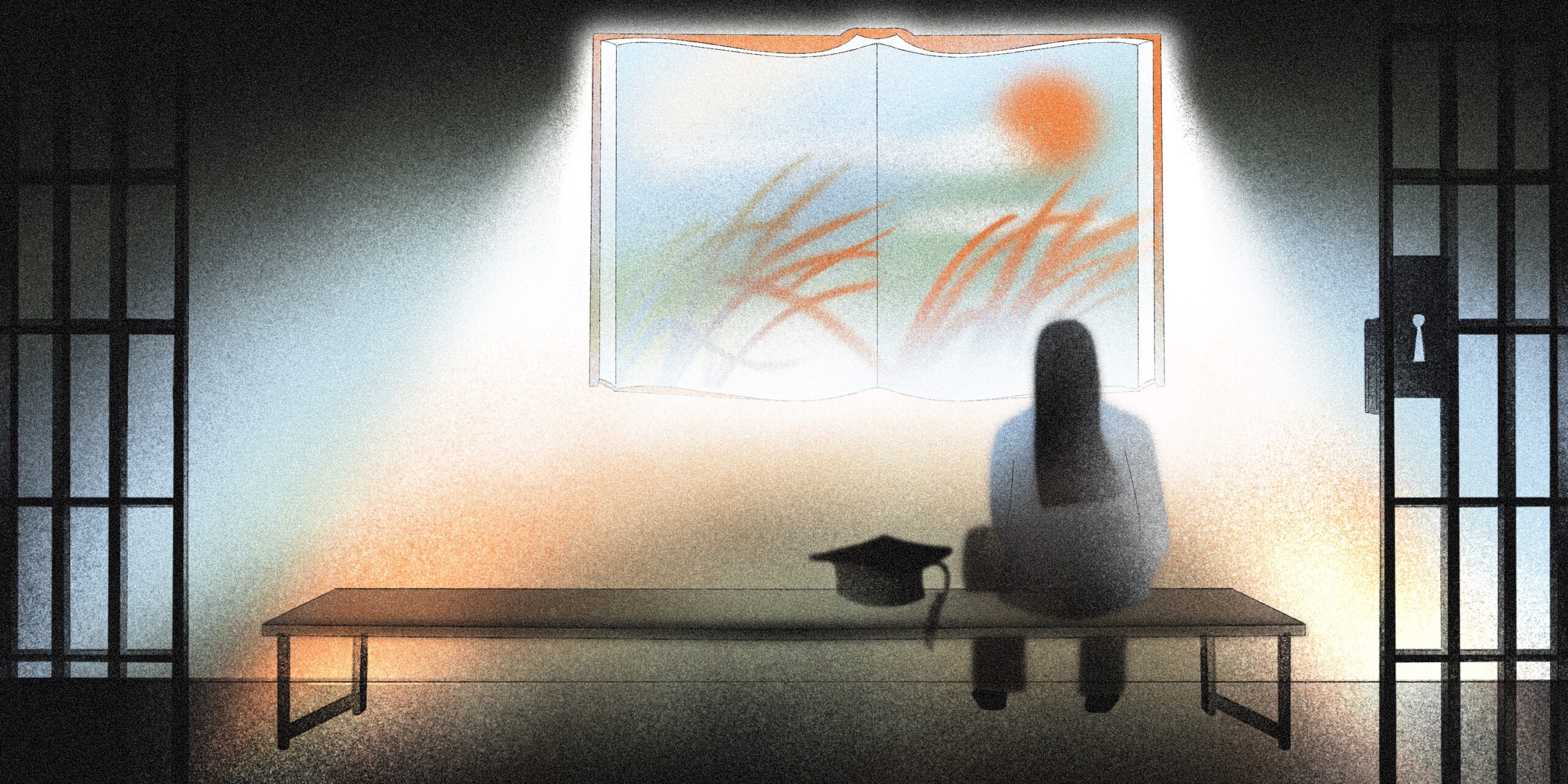





How women impacted by incarceration are building new futures for themselves and their communities.
This article originally appeared in Ms. magazine as “Breaking the Cycle,” a three-part series on how women impacted by incarceration are building new futures—from education and job training, to debate teams and book clubs inside jails.
For Women Leaving Prison, Education Can Be a Way Out
Standing at the bottom of the steps, waiting for her name to be called, Stephanie King took a deep breath. She was ready to walk across the stage at Tulane University and receive her diploma.
“At that moment, I knew it was a bigger deal than I had allowed myself to believe,” she told Ms.
King was 63 years old. She had spent 27 years, seven months, and 24 days in prison. She had never attended a graduation ceremony outside a corrections facility. As a teenager, she dropped out of high school after becoming pregnant. It would be 13 years before she obtained her high school diploma—and that was in jail.
“I just wanted to walk across that stage,” she says.
King was the first person to graduate from the college-in-prison program offered by Tulane University and Operation Restoration, a Louisiana-based organization that provides education, housing, and other resources to women impacted by the criminal justice system.

Syrita Steib, who herself spent nearly 10 years in prison, started the organization in 2016. Upon her release in 2009, she found no reentry resources specifically for women in New Orleans. She applied to college and was initially denied after disclosing her conviction. Two years later, she reapplied without revealing that history; she was accepted.
While completing her degree to become a clinical lab scientist, Steib applied for a lab assistant license. As part of her licensing application, she once again had to disclose her conviction history. But the Louisiana State Board of Medical Examiners considers each case individually and, fortunately, several of her professors were on the board. Her conviction was not held against her.
Female incarceration increased by more than 600 percent between 1980 and 2023. While women and girls make up approximately 10 percent of the nation’s imprisoned population, they have far fewer opportunities than their male counterparts—both inside and upon release.
For years, Louisiana was considered the nation’s “prison capital.” There, efforts to reduce incarceration largely focused on Black men and boys. Steib founded Operation Restoration to address this gender disparity, and it’s one of a growing number of programs across the nation serving women impacted by the justice system.
Steib graduated college. She became a clinical laboratory scientist. She started a family.
She also joined the National Council for Incarcerated and Formerly Incarcerated Women and Girls, a network of justice-impacted women advocating for state and federal policy changes. Through the council, she met Vivian Nixon, a formerly incarcerated woman and then-executive director of College and Community Fellowship, which works to help justice-impacted women in New York City pursue higher education, and assists formerly incarcerated women in other cities working on reentry.
Meeting women in these nonprofits gave Steib blueprints for how to create a nonprofit that addresses women’s incarceration in Louisiana in ways that are impactful, sustainable, and long-lasting.
Operation Restoration began with direct services, providing clothing for women returning home from incarceration and GED tutoring for women in jail and out in the community. By then, Steib was working in a supervisory role at a hospital. Whenever applicants checked the box disclosing their criminal history, she made sure to walk them through what to expect during the interview process and how to present themselves so that board examiners saw past their conviction.
From there, Steib’s organization grew to include a lab assistant training program open to women both inside prison and outside in New Orleans. It developed its Safety and Freedom Fund to post bail for people who could not afford it and to connect them with other resources needed while awaiting trial. The organization also joined advocacy efforts to remove barriers to reentry, including amending the question about criminal history on public college application forms.
In 2017, Operation Restoration began a partnership with Tulane University to offer college courses at the Louisiana Correctional Institution for Women in St. Gabriel, just south of Baton Rouge.
By then, King had already been imprisoned for more than 20 years. She had taken other courses at the prison, including a degree program offered by the New Orleans Baptist Theological Seminary. But she knew that when she finally did walk out of the prison gates, she needed as many skills and as much education as she could get.
“I knew that the answer to breaking the cycle that I had been going in since I was 15 was going to come through education,” she says.
But getting an education in prison has a unique set of challenges. Students struggle to acquire basic supplies, like pens, calculators, paper, folders, notebooks, erasers, and highlighters. Operation Restoration had to provide these—as well as textbooks.
Students cannot conduct their own research. Instead, they rely on Tulane students, who are sent lists of research requests written out on paper. Often what the women get in return isn’t what they were looking for. Once, King intended to write a paper about the disparity in educational programs in men’s and women’s prisons. But the materials she received weren’t what she needed, so she had to pivot to a different topic.
The actions of others, even if they aren’t enrolled in the program, affect the students as well. During a semester when students were studying movies and TV shows, a woman in the prison was caught watching a show on someone else’s tablet—a violation of the institution’s rules. In response, the prison removed movies from all prison tablets. The students and instructor managed to get through the rest of the class, but without access to the shows and films they had intended to watch and analyze.
In October 2023, King was released from prison. She had been in the middle of two classes and had nine more to go. Tulane allowed her to finish her classes online. Federal student aid paid for her tuition; Operation Restoration paid for her books and other materials. King, who was incarcerated in 1996 when beepers were the latest technology, had to learn 21st century tools.
Lacking a computer, King figured out how to use her cell phone to Zoom into classes and turn in her papers. The professors worked to accommodate her, but she no longer had access to the peer support system she had built inside prison, where she and five other students in her housing unit frequently turned to each other with questions or for support. Outside, and in Baton Rouge—far from Tulane’s New Orleans campus—she had to figure out everything on her own. Still, if not for Operation Restoration, King wouldn’t have had that opportunity at all. Now approaching its 10th year, the organization reportedly provided 22,650 direct services and worked with 2,058 women from 2020 to 2024 alone.
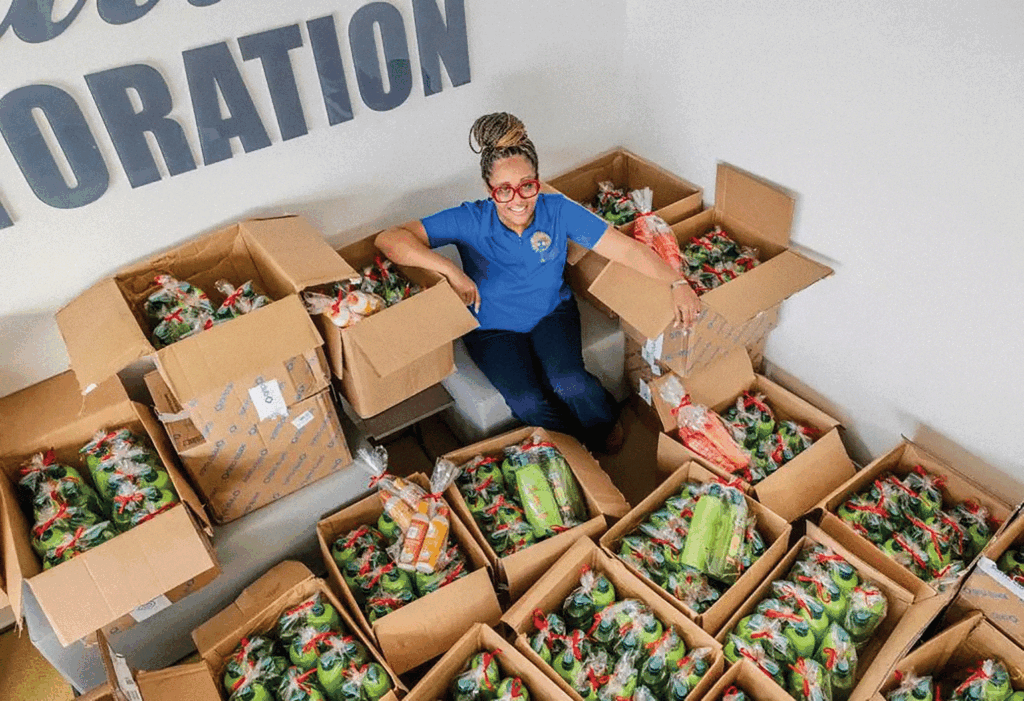
M.D., who asked that only her initials be published, learned about Operation Restoration when her mother went to bail her out of jail. Members of the organization’s Safety and Freedom Fund paid M.D.’s bail. They also gave her mom information on the organization. When M.D. contacted them, she learned about the lab assistant program. (M.D.’s charges were later dropped.)
“I didn’t even know what [being a lab assistant] was,” she says.
Still, as a single mother, she knew she needed a career that paid better than what she earned as a restaurant hostess. Operation Restoration provided childcare, allowing her to bring her 3-year-old, who played while she learned.
M.D. says she was intimidated by some subjects, but her classmates motivated each other and the cohort learned together. After graduating, she was hired at a local hospital.
“She came in with green scrubs,” Steib recalls. “She was dancing, and she was so excited. That was such a drastic change from us bailing her out and her and her daughter living in this one room at her mom’s house.”
Later, M.D. was arrested again after her ex-boyfriend’s new girlfriend called the police on her. Operation Restoration not only bailed her out, but spoke with her hospital supervisors so that she didn’t lose her job.
They also spoke with M.D., encouraging her not to jeopardize the new life she had built.
“We had those tough conversations with her, like, ‘You can’t put yourself in that position for a man. You got to figure out how to control your emotions,’” Steib says. “She appreciated that we didn’t quit on her.”
M.D. attended an expungement workshop, applying to remove the arrest from her record. (She is currently awaiting the judge’s approval.)
Kendreka, who asked that only her first name be published, has never been incarcerated. But her children’s father cycled in and out of jail, leaving her to raise their two sons. During one of his absences, she lost her job. A friend told her about Operation Restoration and its lab assistant program.
“I had always wanted to be in the medical field,” Kendreka told Ms. But drawing blood scared her, so she never pursued that avenue.
She enrolled in the eight-week program and became a licensed lab assistant. She stopped juggling three jobs and instead found a position at a local hospital. The schedule is still grueling—12-hour shifts for seven days followed by seven days off work—but having every other week off allows her to spend time with her sons, now ages 10 and 12.
“If it wasn’t for Operation Restoration, I don’t know where I’d have ended up,” she says. “It has set me up to be where I am now.”
Inside the DC Jail Debate Team, Women Find Their Voice
“I know of a woman who spent the majority of her first prison bid in isolation. She didn’t have access to any programs to help her heal from her childhood trauma, abuse, neglect and depression,” Chelsee Wright wrote in remarks she prepared for a February debate. “The lack of mental health treatment led her to self-mutilate and multiple suicide attempts.”
Wright is part of the DC Jail Debate Team. Started in 2024, it’s the first coed team of the National Prison Debate League. Each semester, up to 20 participants—many of whom have no previous debate experience—meet twice a week at the Washington, D.C., jail where they are incarcerated.
Each semester starts with a mini-debate on questions like “Is a hot dog a sandwich?” or “Is ice cream the best dessert?” From there, the participants vote on 10 potential topics related to incarceration and prepare for a debate against a university team.
Like people in prisons, those in jails do not have access to research materials. Law students at Georgetown University put together evidence packets—typically 200 pages for the affirmative and 80 pages for the negative. Each member of the jail debate team is responsible for reading the entire packet and coming to class prepared to discuss what’s missing and whether more research is needed.
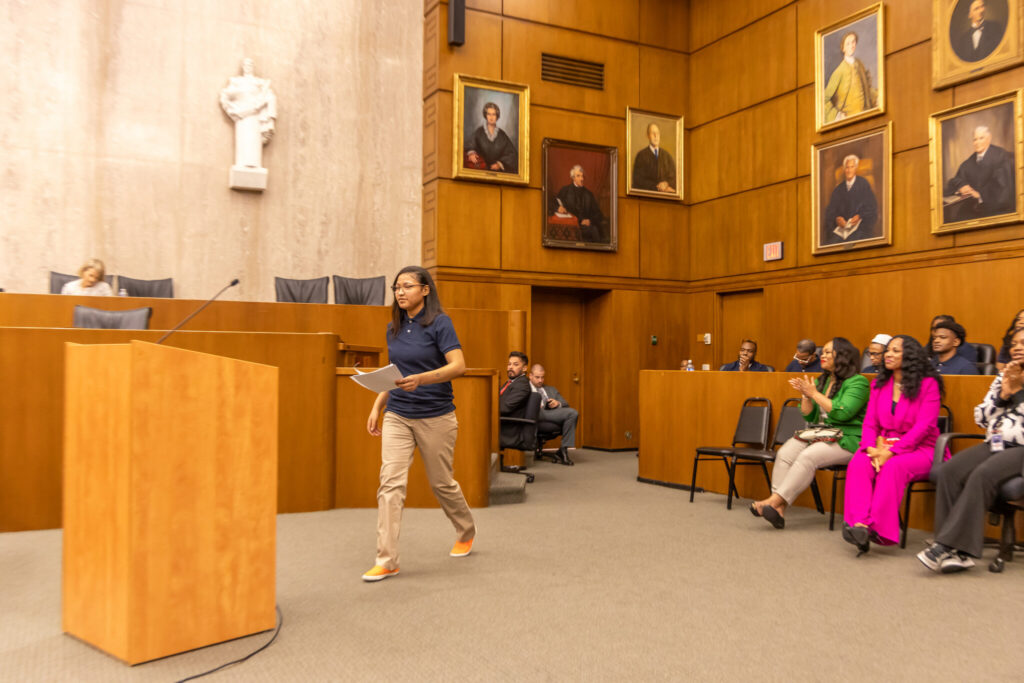
“They’re really mastering the material,” says Sarah Istel, a cofounder of the debate program and volunteer coach. Once they’ve done so, they fill out their preferences for debate roles: affirmative speakers, rebuttal speakers or closers.
“There are different kinds of roles,” Istel notes. “Some require thinking on your feet more. Some require more lengthy [arguments] written in advance.”
Participants write the first drafts of their arguments and refine them through practice debates in class.
But conditions in jail are often unconducive to preparation. They cannot do their own research or type their drafts. They cannot have binders or paper clips to organize their notes. Cell searches scatter their papers. Still, students not only persevere, but support one another, encouraging and helping each other with their arguments.
Inside or out, coed classes carry the potential for male students to dominate at the expense of their female classmates. The coaches strive to ensure that women aren’t overlooked. At least two of each semester’s six speaking roles go to women.
London Teeter, now 22, joined the team after giving birth behind bars. She had spent her third trimester on the medical unit, where she was locked in her cell for 22 hours a day. Only one other woman was on the unit (their babies were born 15 days apart) and other than those two hours outside her cell, Teeter had nothing to do and no one to talk to.
At first, she didn’t want a speaking role in the debate. “I have really bad speaking anxiety,” she says.
But with her coaches’ encouragement, Teeter agreed to speak in the debate about mandatory minimums, laws that require judges to impose specific minimum prison sentences for certain crimes, regardless of the defendant’s circumstances. She asked for the closing, which, at 90 seconds, was the shortest role. Istel and the other coaches persuaded her to take on a larger role—and she did.
Teeter went through the packet and pulled out the most meaningful arguments. She also worked her own story into the materials.
“It was tricky because I’m not great at talking about myself,” she says. “I also wanted to make sure it included my team.”
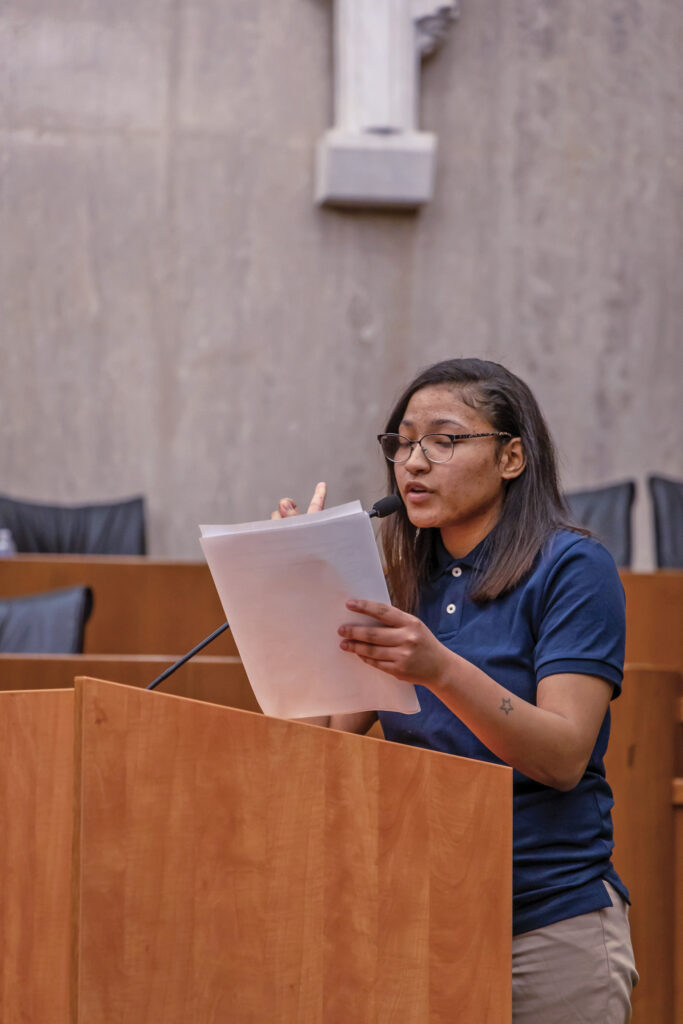
When she presented her first draft, her classmates were brought to tears. Last May, Teeter stepped up to the podium in the debate against Towson University.
“I currently face a mandatory minimum, as does every speaker on my team. And in total, our team faces a minimum of 198 years behind bars,” she began.
She went on to enumerate her arguments against mandatory minimums: their failure to prevent crime, their diversion from more effective resources, the devastation of families, the colossal price tag of long sentences, and prosecutors’ weaponization of mandatory minimums to coerce guilty pleas.
“Imagine being a 20-year-old woman, a first-time offender, no criminal background and 24 weeks pregnant when arrested. To exercise her fundamental right to trial, she faces a mandatory minimum of 49 years and even eventually was forced to give birth while incarcerated.”
“This woman is me,” she said as she drew her argument to a close. “Before my team and I leave today, we ask that you remember, each of us is more than the worst thing we’ve ever done. Each of us deserves a chance to be considered as an individualized person, not a statistic, and it starts by abolishing mandatory minimums.”
The jail team won the debate.
~
The only time Chelsee Wright had ever attempted a public speaking role, she was so nervous that she stuttered.
Joining the debate team gave her an opportunity to overcome her fears. “I wanted to be able to stand up in front of a lot of people without stuttering,” the 31-year-old told Ms.
After she delivered her first speech to the group, her teammates gave her feedback: read slower, make more eye contact, emphasize certain words. She followed those suggestions, and by the time she read her final speech, she could look at her teammates and coaches and deliver a powerful argument. They gave her a standing ovation.
Wright’s sentencing was originally scheduled for this past December, but she requested that it be postponed so she could finish the debate program.
Wherever she’s transferred to serve her sentence, she plans to attend college.
“I didn’t attend [in jail] because I thought it was too hard for me,” she says.
The debate team taught her otherwise. Being part of the team, she says, “gave me confidence. It made me realize who I am and how far I can go, and that my voice can always be heard.”
At a February debate about solitary confinement, Wright used her voice in her closing remarks: “When her release date was near, she intentionally assaulted numerous officers. She needed more time.”
“Three years later, she thought she was ready … but the outside world was intimidating. Now this individual is back in jail on a charge that could have been avoided if she had learned healthier outlets. Being home felt uncomfortable. You wouldn’t believe this, but solitary felt like home. Being controlled, degraded and caged in was what she was used to. They don’t feel deserving of freedom. No human should feel like this, to the point where human contact is frightening.”
She paused for a few seconds, then added, “And by the way … the woman I just described is me.”
At Rikers, a Book Club Is Helping Women Imagine Life Beyond Bars
In 2024, comedian Nora Fried started the Rosebuds Reading Collective, a monthly book club for women incarcerated at Rikers Island, New York City’s island jail.
After considering local volunteer opportunities, Fried set out to start a jail reading group to find a way to make a difference using literature as an outlet and a lifeline. She put out feelers about a book discussion group to several organizations and was surprised when the director of volunteer programs at Rikers Island responded.
Fried purchased copies of Tara Westover’s Educated, a memoir about a woman’s journey from a Mormon survivalist family in rural Idaho to earning her Ph.D. at Cambridge University, and in February 2025 she sat with nine women in a jail classroom to talk about it.
Rosebuds quickly became a popular program (22 women attended the last meeting). Discussions aren’t limited to the book. “Women cry, share personal stories about their cases,” Fried told Ms. “I always make it very clear that what happens in this room stays in this room.”
Jails are transitory. Each week, some women are sentenced and either transferred or released. Each day, new women arrive to await adjudication. Books must be approved and ordered in advance, and not every woman receives the book before the meeting. Fried estimates that 80 to 90 percent of attendees are new. But Fried, who performs stand-up, is used to reading and winning over an audience, a skill set she uses each month.
“I was looking forward to this all month,” Fried recalls multiple women telling her. “This is the only thing I had to look forward to.”
The women read Down the Drain, a memoir by actor Julia Fox. After the discussion, Fried tagged Fox on Instagram. Fox, whose brother was incarcerated at Rikers at the time, agreed to visit the group.
Although Fox had visited friends and family at Rikers many times before, this time was different. “I felt like I’d known these girls my whole life,” she says. “They are amazing, remarkable, intelligent young women [who] made mistakes. We’ve all made mistakes. Some of us are lucky enough not to get caught.”
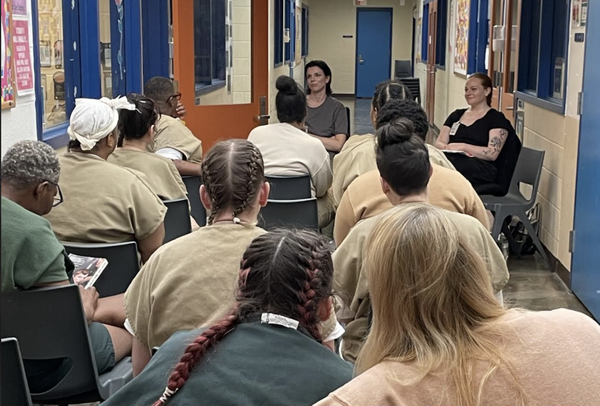
Fox learned that her book was a particularly hot commodity and that one woman’s copy had been stolen. Still, all were curious about how a girl like them had become a published author. The room resonated with laughter, from both the incarcerated women and the guards.
“It made me think to myself, I would do this every weekend. I want to come back. I love these girls,” Fox says.
“I’ve been there,” she recalls. “I have been in trouble with the law. I was facing a lengthy jail sentence if I didn’t turn my life around. … We’re cut from the same cloth, but I got really lucky. I want to make sure that they’re awarded the same opportunities and grace that I was given.”
After Fox’s visit, Fried added a 15-to-20-minute creative writing component. “A lot of women were really inspired by Julia’s book to start writing,” she notes.
Now Fox facilitates a monthly creative writing workshop. She had her own brushes with the legal system as a teenager. She says she found creative writing to be a therapeutic, cathartic release and she wanted to share that. Fox creates prompts from the books the group has read, such as Cheryl Strayed’s Wild about reinventing your life.
“You wake up in your dream life. What does it look like?” Fox asks the group.
Then, she encourages participants to read their writing aloud. Some stride to the front of the classroom. Others read aloud from their seats, while the shiest writers only allow Fox to read over their shoulders.
Fox is awed by the women’s willingness to share and show vulnerability, especially in a setting where vulnerability is often seen as weakness. She marvels at their bravery in standing before a group of near-strangers and sharing their deepest desires.
“My dream is that they each write something and we get it published somewhere,” Fox says. Reflecting on her own life, she adds, “For me, that was huge.”
That’s not the only goal that Fried and Fox have for Rosebuds. They hope to eventually expand, partnering with other organizations to offer more. For now they’re providing books and a safe space to dream of life beyond bars.
As Fox says, “Aim for the moon and land in the stars.”
—
*This article originally appears in the Spring 2026 print issue of Ms. magazine. Join the Ms. community today to get issues delivered straight to your mailbox.