How women impacted by incarceration are building new futures for themselves and their communities.
This article originally appeared in Ms. magazine as “Breaking the Cycle,” a three-part series on how women impacted by incarceration are building new futures—from education and job training, to debate teams and book clubs inside jails.
For Women Leaving Prison, Education Can Be a Way Out
Standing at the bottom of the steps, waiting for her name to be called, Stephanie King took a deep breath. She was ready to walk across the stage at Tulane University and receive her diploma.
“At that moment, I knew it was a bigger deal than I had allowed myself to believe,” she told Ms.
King was 63 years old. She had spent 27 years, seven months, and 24 days in prison. She had never attended a graduation ceremony outside a corrections facility. As a teenager, she dropped out of high school after becoming pregnant. It would be 13 years before she obtained her high school diploma—and that was in jail.
“I just wanted to walk across that stage,” she says.
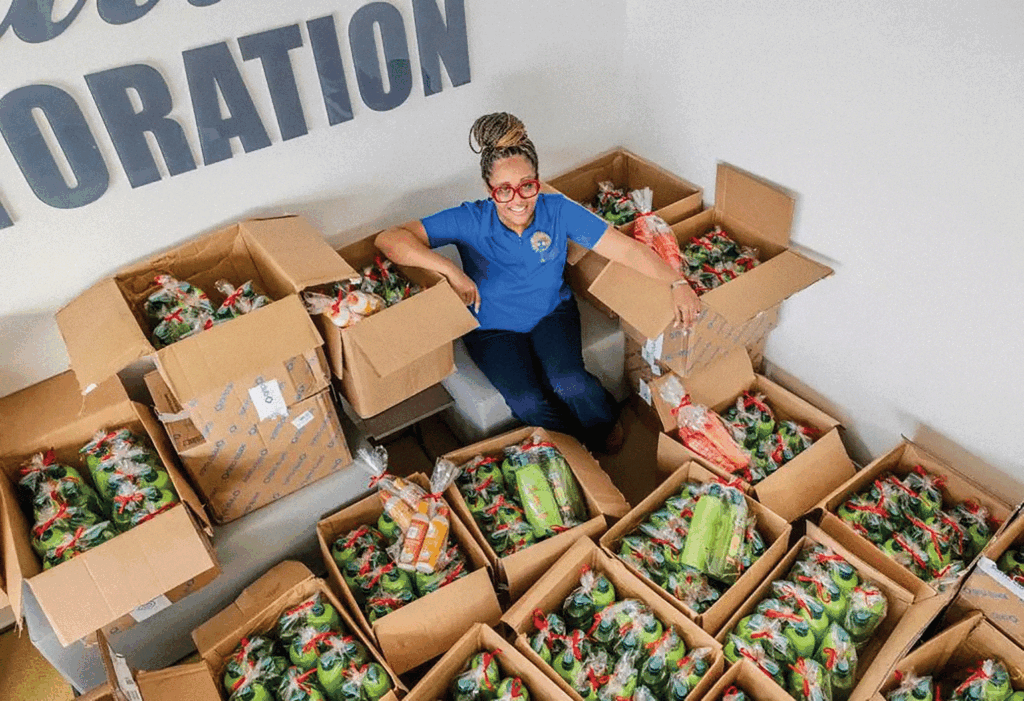
King was the first person to graduate from the college-in-prison program offered by Tulane University and Operation Restoration, a Louisiana-based organization that provides education, housing, and other resources to women impacted by the criminal justice system.
(Courtesy of Stephanie King.)
Syrita Steib, who herself spent nearly 10 years in prison, started the organization in 2016. Upon her release in 2009, she found no reentry resources specifically for women in New Orleans. She applied to college and was initially denied after disclosing her conviction. Two years later, she reapplied without revealing that history; she was accepted.
While completing her degree to become a clinical lab scientist, Steib applied for a lab assistant license. As part of her licensing application, she once again had to disclose her conviction history. But the Louisiana State Board of Medical Examiners considers each case individually and, fortunately, several of her professors were on the board. Her conviction was not held against her.
Female incarceration increased by more than 600 percent between 1980 and 2023. While women and girls make up approximately 10 percent of the nation’s imprisoned population, they have far fewer opportunities than their male counterparts—both inside and upon release.
For years, Louisiana was considered the nation’s “prison capital.” There, efforts to reduce incarceration largely focused on Black men and boys. Steib founded Operation Restoration to address this gender disparity, and it’s one of a growing number of programs across the nation serving women impacted by the justice system.
Steib graduated college. She became a clinical laboratory scientist. She started a family.
She also joined the National Council for Incarcerated and Formerly Incarcerated Women and Girls, a network of justice-impacted women advocating for state and federal policy changes. Through the council, she met Vivian Nixon, a formerly incarcerated woman and then-executive director of College and Community Fellowship, which works to help justice-impacted women in New York City pursue higher education, and assists formerly incarcerated women in other cities working on reentry.
Meeting women in these nonprofits gave Steib blueprints for how to create a nonprofit that addresses women’s incarceration in Louisiana in ways that are impactful, sustainable, and long-lasting.
Operation Restoration began with direct services, providing clothing for women returning home from incarceration and GED tutoring for women in jail and out in the community. By then, Steib was working in a supervisory role at a hospital. Whenever applicants checked the box disclosing their criminal history, she made sure to walk them through what to expect during the interview process and how to present themselves so that board examiners saw past their conviction.
From there, Steib’s organization grew to include a lab assistant training program open to women both inside prison and outside in New Orleans. It developed its Safety and Freedom Fund to post bail for people who could not afford it and to connect them with other resources needed while awaiting trial. The organization also joined advocacy efforts to remove barriers to reentry, including amending the question about criminal history on public college application forms.
In 2017, Operation Restoration began a partnership with Tulane University to offer college courses at the Louisiana Correctional Institution for Women in St. Gabriel, just south of Baton Rouge.
By then, King had already been imprisoned for more than 20 years. She had taken other courses at the prison, including a degree program offered by the New Orleans Baptist Theological Seminary. But she knew that when she finally did walk out of the prison gates, she needed as many skills and as much education as she could get.
“I knew that the answer to breaking the cycle that I had been going in since I was 15 was going to come through education,” she says.
But getting an education in prison has a unique set of challenges. Students struggle to acquire basic supplies, like pens, calculators, paper, folders, notebooks, erasers, and highlighters. Operation Restoration had to provide these—as well as textbooks.
Students cannot conduct their own research. Instead, they rely on Tulane students, who are sent lists of research requests written out on paper. Often what the women get in return isn’t what they were looking for. Once, King intended to write a paper about the disparity in educational programs in men’s and women’s prisons. But the materials she received weren’t what she needed, so she had to pivot to a different topic.
The actions of others, even if they aren’t enrolled in the program, affect the students as well. During a semester when students were studying movies and TV shows, a woman in the prison was caught watching a show on someone else’s tablet—a violation of the institution’s rules. In response, the prison removed movies from all prison tablets. The students and instructor managed to get through the rest of the class, but without access to the shows and films they had intended to watch and analyze.
In October 2023, King was released from prison. She had been in the middle of two classes and had nine more to go. Tulane allowed her to finish her classes online. Federal student aid paid for her tuition; Operation Restoration paid for her books and other materials. King, who was incarcerated in 1996 when beepers were the latest technology, had to learn 21st century tools.
Lacking a computer, King figured out how to use her cell phone to Zoom into classes and turn in her papers. The professors worked to accommodate her, but she no longer had access to the peer support system she had built inside prison, where she and five other students in her housing unit frequently turned to each other with questions or for support. Outside, and in Baton Rouge—far from Tulane’s New Orleans campus—she had to figure out everything on her own. Still, if not for Operation Restoration, King wouldn’t have had that opportunity at all. Now approaching its 10th year, the organization reportedly provided 22,650 direct services and worked with 2,058 women from 2020 to 2024 alone.
(Courtesy of Operation Restoration.)
M.D., who asked that only her initials be published, learned about Operation Restoration when her mother went to bail her out of jail. Members of the organization’s Safety and Freedom Fund paid M.D.’s bail. They also gave her mom information on the organization. When M.D. contacted them, she learned about the lab assistant program. (M.D.’s charges were later dropped.)
“I didn’t even know what [being a lab assistant] was,” she says.
Still, as a single mother, she knew she needed a career that paid better than what she earned as a restaurant hostess. Operation Restoration provided childcare, allowing her to bring her 3-year-old, who played while she learned.
M.D. says she was intimidated by some subjects, but her classmates motivated each other and the cohort learned together. After graduating, she was hired at a local hospital.
“She came in with green scrubs,” Steib recalls. “She was dancing, and she was so excited. That was such a drastic change from us bailing her out and her and her daughter living in this one room at her mom’s house.”
Later, M.D. was arrested again after her ex-boyfriend’s new girlfriend called the police on her. Operation Restoration not only bailed her out, but spoke with her hospital supervisors so that she didn’t lose her job.
They also spoke with M.D., encouraging her not to jeopardize the new life she had built.
“We had those tough conversations with her, like, ‘You can’t put yourself in that position for a man. You got to figure out how to control your emotions,’” Steib says. “She appreciated that we didn’t quit on her.”
M.D. attended an expungement workshop, applying to remove the arrest from her record. (She is currently awaiting the judge’s approval.)
Kendreka, who asked that only her first name be published, has never been incarcerated. But her children’s father cycled in and out of jail, leaving her to raise their two sons. During one of his absences, she lost her job. A friend told her about Operation Restoration and its lab assistant program.
“I had always wanted to be in the medical field,” Kendreka told Ms. But drawing blood scared her, so she never pursued that avenue.
She enrolled in the eight-week program and became a licensed lab assistant. She stopped juggling three jobs and instead found a position at a local hospital. The schedule is still grueling—12-hour shifts for seven days followed by seven days off work—but having every other week off allows her to spend time with her sons, now ages 10 and 12.
“If it wasn’t for Operation Restoration, I don’t know where I’d have ended up,” she says. “It has set me up to be where I am now.”
Inside the DC Jail Debate Team, Women Find Their Voice
“I know of a woman who spent the majority of her first prison bid in isolation. She didn’t have access to any programs to help her heal from her childhood trauma, abuse, neglect and depression,” Chelsee Wright wrote in remarks she prepared for a February debate. “The lack of mental health treatment led her to self-mutilate and multiple suicide attempts.”
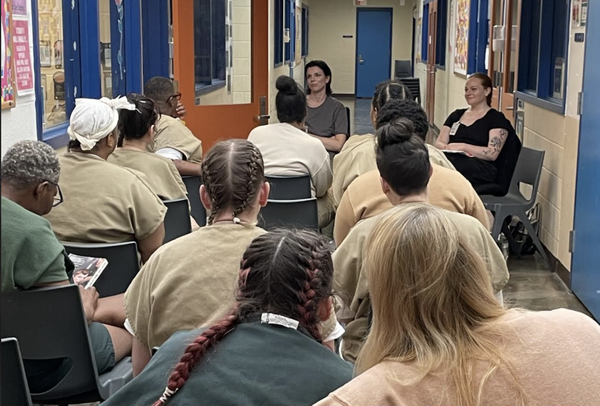
Wright is part of the DC Jail Debate Team. Started in 2024, it’s the first coed team of the National Prison Debate League. Each semester, up to 20 participants—many of whom have no previous debate experience—meet twice a week at the Washington, D.C., jail where they are incarcerated.
Each semester starts with a mini-debate on questions like “Is a hot dog a sandwich?” or “Is ice cream the best dessert?” From there, the participants vote on 10 potential topics related to incarceration and prepare for a debate against a university team.
Like people in prisons, those in jails do not have access to research materials. Law students at Georgetown University put together evidence packets—typically 200 pages for the affirmative and 80 pages for the negative. Each member of the jail debate team is responsible for reading the entire packet and coming to class prepared to discuss what’s missing and whether more research is needed.
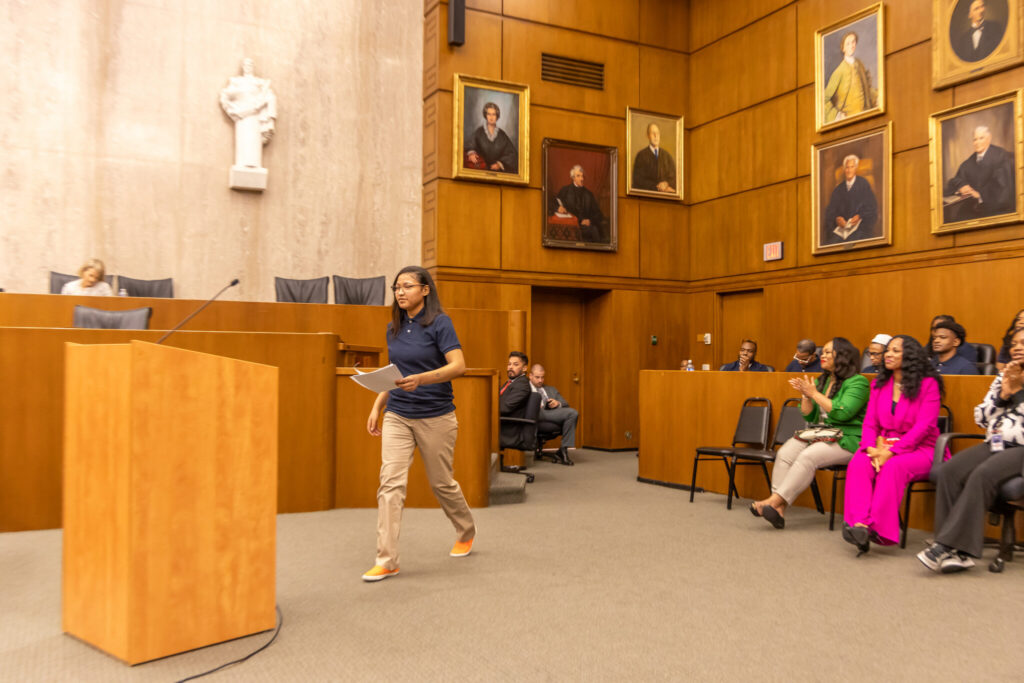
London Teeter takes the stand to argue against mandatory minimum sentences. (Courtesy of Sarah Istel.)
“They’re really mastering the material,” says Sarah Istel, a cofounder of the debate program and volunteer coach. Once they’ve done so, they fill out their preferences for debate roles: affirmative speakers, rebuttal speakers or closers.
“There are different kinds of roles,” Istel notes. “Some require thinking on your feet more. Some require more lengthy [arguments] written in advance.”
Participants write the first drafts of their arguments and refine them through practice debates in class.
But conditions in jail are often unconducive to preparation. They cannot do their own research or type their drafts. They cannot have binders or paper clips to organize their notes. Cell searches scatter their papers. Still, students not only persevere, but support one another, encouraging and helping each other with their arguments.
Inside or out, coed classes carry the potential for male students to dominate at the expense of their female classmates. The coaches strive to ensure that women aren’t overlooked. At least two of each semester’s six speaking roles go to women.
London Teeter, now 22, joined the team after giving birth behind bars. She had spent her third trimester on the medical unit, where she was locked in her cell for 22 hours a day. Only one other woman was on the unit (their babies were born 15 days apart) and other than those two hours outside her cell, Teeter had nothing to do and no one to talk to.
At first, she didn’t want a speaking role in the debate. “I have really bad speaking anxiety,” she says.
But with her coaches’ encouragement, Teeter agreed to speak in the debate about mandatory minimums, laws that require judges to impose specific minimum prison sentences for certain crimes, regardless of the defendant’s circumstances. She asked for the closing, which, at 90 seconds, was the shortest role. Istel and the other coaches persuaded her to take on a larger role—and she did.
Teeter went through the packet and pulled out the most meaningful arguments. She also worked her own story into the materials.
“It was tricky because I’m not great at talking about myself,” she says. “I also wanted to make sure it included my team.”
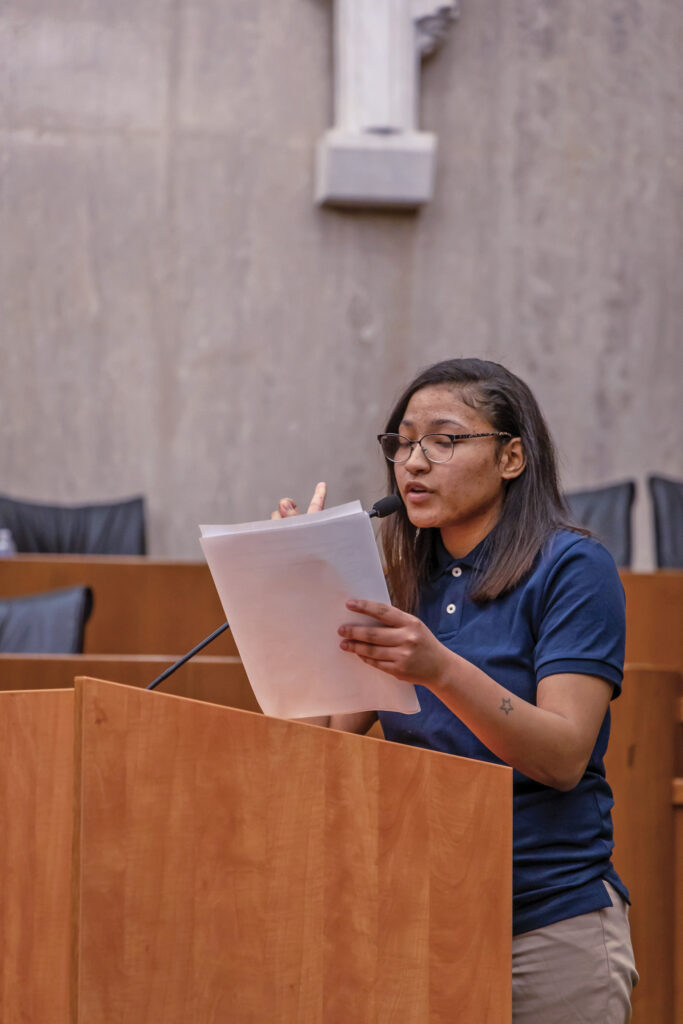
London Teeter. (Courtesy of Sarah Istel.)
When she presented her first draft, her classmates were brought to tears. Last May, Teeter stepped up to the podium in the debate against Towson University.
“I currently face a mandatory minimum, as does every speaker on my team. And in total, our team faces a minimum of 198 years behind bars,” she began.
She went on to enumerate her arguments against mandatory minimums: their failure to prevent crime, their diversion from more effective resources, the devastation of families, the colossal price tag of long sentences, and prosecutors’ weaponization of mandatory minimums to coerce guilty pleas.
“Imagine being a 20-year-old woman, a first-time offender, no criminal background and 24 weeks pregnant when arrested. To exercise her fundamental right to trial, she faces a mandatory minimum of 49 years and even eventually was forced to give birth while incarcerated."
“This woman is me,” she said as she drew her argument to a close. “Before my team and I leave today, we ask that you remember, each of us is more than the worst thing we’ve ever done. Each of us deserves a chance to be considered as an individualized person, not a statistic, and it starts by abolishing mandatory minimums.”
The jail team won the debate.
~
The only time Chelsee Wright had ever attempted a public speaking role, she was so nervous that she stuttered.
Joining the debate team gave her an opportunity to overcome her fears. “I wanted to be able to stand up in front of a lot of people without stuttering,” the 31-year-old told Ms.
After she delivered her first speech to the group, her teammates gave her feedback: read slower, make more eye contact, emphasize certain words. She followed those suggestions, and by the time she read her final speech, she could look at her teammates and coaches and deliver a powerful argument. They gave her a standing ovation.
Wright’s sentencing was originally scheduled for this past December, but she requested that it be postponed so she could finish the debate program.
Wherever she’s transferred to serve her sentence, she plans to attend college.
“I didn’t attend [in jail] because I thought it was too hard for me,” she says.
The debate team taught her otherwise. Being part of the team, she says, “gave me confidence. It made me realize who I am and how far I can go, and that my voice can always be heard.”
At a February debate about solitary confinement, Wright used her voice in her closing remarks: “When her release date was near, she intentionally assaulted numerous officers. She needed more time."
“Three years later, she thought she was ready … but the outside world was intimidating. Now this individual is back in jail on a charge that could have been avoided if she had learned healthier outlets. Being home felt uncomfortable. You wouldn’t believe this, but solitary felt like home. Being controlled, degraded and caged in was what she was used to. They don’t feel deserving of freedom. No human should feel like this, to the point where human contact is frightening.”
She paused for a few seconds, then added, “And by the way … the woman I just described is me.”
At Rikers, a Book Club Is Helping Women Imagine Life Beyond Bars
In 2024, comedian Nora Fried started the Rosebuds Reading Collective, a monthly book club for women incarcerated at Rikers Island, New York City’s island jail.
After considering local volunteer opportunities, Fried set out to start a jail reading group to find a way to make a difference using literature as an outlet and a lifeline. She put out feelers about a book discussion group to several organizations and was surprised when the director of volunteer programs at Rikers Island responded.
Fried purchased copies of Tara Westover’s Educated, a memoir about a woman’s journey from a Mormon survivalist family in rural Idaho to earning her Ph.D. at Cambridge University, and in February 2025 she sat with nine women in a jail classroom to talk about it.
Rosebuds quickly became a popular program (22 women attended the last meeting). Discussions aren’t limited to the book. “Women cry, share personal stories about their cases,” Fried told Ms. “I always make it very clear that what happens in this room stays in this room.”
Jails are transitory. Each week, some women are sentenced and either transferred or released. Each day, new women arrive to await adjudication. Books must be approved and ordered in advance, and not every woman receives the book before the meeting. Fried estimates that 80 to 90 percent of attendees are new. But Fried, who performs stand-up, is used to reading and winning over an audience, a skill set she uses each month.
“I was looking forward to this all month,” Fried recalls multiple women telling her. “This is the only thing I had to look forward to.”
The women read Down the Drain, a memoir by actor Julia Fox. After the discussion, Fried tagged Fox on Instagram. Fox, whose brother was incarcerated at Rikers at the time, agreed to visit the group.
Although Fox had visited friends and family at Rikers many times before, this time was different. “I felt like I’d known these girls my whole life,” she says. “They are amazing, remarkable, intelligent young women [who] made mistakes. We’ve all made mistakes. Some of us are lucky enough not to get caught.”
Julia Fox facilitates a monthly creative writing workshop at Rikers Island. (Courtesy of Rosebuds Reading Collective.)
Fox learned that her book was a particularly hot commodity and that one woman’s copy had been stolen. Still, all were curious about how a girl like them had become a published author. The room resonated with laughter, from both the incarcerated women and the guards.
“It made me think to myself, I would do this every weekend. I want to come back. I love these girls,” Fox says.
“I’ve been there,” she recalls. “I have been in trouble with the law. I was facing a lengthy jail sentence if I didn’t turn my life around. … We’re cut from the same cloth, but I got really lucky. I want to make sure that they’re awarded the same opportunities and grace that I was given.”
After Fox’s visit, Fried added a 15-to-20-minute creative writing component. “A lot of women were really inspired by Julia’s book to start writing,” she notes.
Now Fox facilitates a monthly creative writing workshop. She had her own brushes with the legal system as a teenager. She says she found creative writing to be a therapeutic, cathartic release and she wanted to share that. Fox creates prompts from the books the group has read, such as Cheryl Strayed’s Wild about reinventing your life.
“You wake up in your dream life. What does it look like?” Fox asks the group.
Then, she encourages participants to read their writing aloud. Some stride to the front of the classroom. Others read aloud from their seats, while the shiest writers only allow Fox to read over their shoulders.
Fox is awed by the women’s willingness to share and show vulnerability, especially in a setting where vulnerability is often seen as weakness. She marvels at their bravery in standing before a group of near-strangers and sharing their deepest desires.
“My dream is that they each write something and we get it published somewhere,” Fox says. Reflecting on her own life, she adds, “For me, that was huge.”
That’s not the only goal that Fried and Fox have for Rosebuds. They hope to eventually expand, partnering with other organizations to offer more. For now they’re providing books and a safe space to dream of life beyond bars.
As Fox says, “Aim for the moon and land in the stars.”
A decade later, activist and politician Feleknas Uca is still seeking justice for her community.
At the broad, gray steps of the entrance to the European Parliament in Brussels, a group of women circle around one in particular. Most are dressed in traditional Yazidi attire—long, white dresses with short lilac or black vests, and white headscarves—but the woman they’ve assembled around is dressed inconspicuously, her long, dark hair tied in a loose knot. Everybody knows who she is: Feleknas Uca, a long-time advocate for the rights of her Yazidi community. Looking at the women around her, she calls out their names one by one, handing each a badge. With these badges, the women will be able to enter the colossal building before them, where their voices are desperately needed inside. Uca has organized this gathering, a one-day conference, to demand justice for the Yazidi genocide, ten years ago this August.
"Yazidis need to be able to protect themselves,” she says.
Those who remember the Yazidi genocide, which started on August 3, 2014, likely recall the haunting footage of Iraqi and US helicopters throwing water and food down to the bone-dry, scorching hot mountain below, where Yazidi refugees had gathered in a panic. Down the hill, ISIS, the fundamentalist jihadist group that had quickly occupied large swaths of Iraq and Syria, had begun an ethnic cleansing of their people.
Mount Sinjar (or Shingal, in Kurdish) is the center of the historic homeland of the Yazidis, and was, at the time, their last hope for salvation. As some of the helicopters touched ground, they prioritized pulling women, children, and the elderly to safety. Those left behind on the mountain either succumbed to the heat, thirst, or exhaustion; the rest were brought across the border after Kurdish militias opened a corridor to Kurdish-controlled land in Syria.
The fate of those who never made it to the mountain would become clearer in the weeks and months thereafter. Thousands of men were instantly massacred by ISIS, and thousands of women and children were abducted. Girls and women were forced into ISIS “marriages,” sold on markets, and used as domestic and sex slaves, while boys became “cubs of the caliphate,” fighters-in-training. All were forcibly converted to Islam.
Ethnically, Yazidis are considered Kurdish, and their mother tongue is the eponymous language; although some in the Yazidi community consider it an ethnic identity of its own. Others contend all Kurds used to be Yazidis, until the emergence of Islam, when many Kurds converted. ISIS considered the Yazidis to be devil worshippers, as most adhere to a centuries-old pre-Christian and pre-Islamic faith.
Uca was visiting Germany when the genocide started to unfold, receiving the news in real time on the day the tragedy began. ISIS had been approaching, but the Kurdish peshmerga forces present in the Shingal region had promised to protect the Yazidis from harm. They withdrew just as ISIS began their attack.
“A call came from a man I knew who was there,” she says. “His sister wanted to kill herself because she was about to fall into ISIS’ hands. She had a weapon. We tried to talk to her but then I heard a shot. I will never forget that moment.”
The daughter of a Yazidi family that migrated to Germany in the 1970s, Uca was born in the north-central town of Celle, which has a large Yazidi community. In 1999, at age 22, she became the youngest-ever member of European Parliament (MEP) as a German representative of the Party for Democratic Socialism, and later for Die Linke (The Left), where she remained an MEP until 2009, when she didn’t seek re-election. When the genocide began, she had just recently moved from Germany to Turkey, where her family was originally from: The Yazidis are indigenous to Kurdistan, which geographically includes regions of Turkey, Iraq, Syria, and Iran. She’d chosen to live in Diyarbakır, the largest Kurdish city in Turkey’s southeast region, and had become a candidate in the parliamentary elections for the Peoples’ Democratic Party, or HDP. Founded in 2012, HDP is a leftist party rooted in the Kurdish political movement; their main objective is to democratize Turkey and give regions and communities the opportunity to govern themselves. In the June 2015 elections, Uca was elected MP and became the first Yazidi in Turkish parliament.
From the start of her time as an HDP MP, Uca was in a delicate position. While advocating for Kurds and for Yazidis specifically, the HDP claimed that the Turkish government had been aiding ISIS, and consequently held it co-responsible for the genocide—something the government vehemently denied. The HDP, including Uca, also supported the armed Kurdish groups that fought against ISIS, including those the Turkish government considered to be terrorists because of their adherence to the same leftist ideology as the Kurdistan Workers Party, the PKK, which has been waging an armed struggle for Kurdish autonomy in Turkey since the 1980s. Because of this overlap, HDP MPs, like Uca, became victims of a government campaign that accused them of supporting terrorism.
Uca was undeterred by it. The author of this piece, herself based in Diyarbakır during those years, got to know Uca as a parliamentarian who was often found among her community, listening to their needs and trying to forge solutions for them in her capacity as MP. For example, many Yazidis who fled to Turkey to escape ISIS were left in refugee camps with tents that did not protect them during harsh winters and hot summers. They also lacked adequate medical care and were not receiving substantial education. As MP, Uca made attempts to increase the budget for the camps, and while she only had limited success, her presence and care endeared her to the community.
Feleknas Uca in 2008. (AP Photo/Christian Lutz)
Having witnessed the Yazidis’ struggles over the years while advocating for them at high levels of government, Uca has a profound understanding of her community’s needs, wants, and fears. Today, she believes what’s most important is ensuring they are able to return to their homeland. In the aftermath of the genocide, thousands of Yazidis left their home as refugees, resettling in Europe, the United States, Canada, and Australia. While they may be physically safe in these places, Uca tells me, their displacement is still a continuation of the genocide.
“What ISIS wanted to do, is not only to kill and enslave the Yazidis, but also remove them from their ancestral lands. One of the problems we face now is that the community is still not able to return to Shingal because it remains too unsafe,” she says.
In Shingal, where the Iraqi army and Iran-backed militias are now stationed, the Yazidi self-defense force—the Shingal Resistance Units (YBŞ)—founded by the PKK in the weeks after August 3, 2014, is under pressure to be dismantled. Like the PKK, Turkey considers the YBŞ a terrorist group, and regularly bombs them, killing fighters; in addition to targeting local medical clinics, according to reports by Human Rights Watch and the International Crisis Group. Consequently, Yazidis can’t always return to their homeland, even if they wish to do so. Uca believes that Europe and the US have a responsibility to step in.
“Many Western countries have recognized the Yazidi genocide, but they don’t take any action to assist the community in building a future again in Shingal,” she says. “They don’t visit the region, they don’t help rebuilding it, they don’t hold Turkey responsible for assisting ISIS then, and letting it attack Shingal now.”
Among her many grievances are the centers that were opened in several European countries—mostly in Germany—where Yazidi women who were rescued from ISIS could process their trauma. These same services remain unavailable in Shingal.
“I have always said that if we really want to help these women, we will have to build trauma centers in Shingal, so they can process their trauma and rebuild their future and live their culture and religion in their homeland, where they were born and raised,” Uca says. “But the therapy has been transferred abroad, and with that, the future of the Yazidis. While the community can only really survive at home.”
The continued plight of the Yazidis could cause Uca great despair, but she is adamant that there are also victories, large and small. She has heard countless stories of Yazidi women, in particular, overcoming horrific circumstances and fighting back. She was able to get a visa for one of these women, Hêza Shengalî, so that she could speak at the one-day conference in Brussels. Shengalî was taken captive by ISIS in 2014 and remained in their custody for a year. After she escaped, she joined the Şengal Women’s Units, or YJŞ—the armed women’s wing of the YBŞ—and requested to be sent to Syria to join the forces fighting ISIS there.
“For me, and for other Yazidi women who have joined the YBŞ, fighting back against ISIS is a way to heal,” Shengalî says.
As a commander, she contributed to their eventual victory in the city of Raqqa, which ISIS had deemed their “capital.” When Raqqa was liberated, many Yazidi women and girls were liberated, too. After returning to Shingal, Hêza was even a part of a small delegation that handed over a newly liberated young Yazidi woman back to her family.
In large part because of the YBŞ, despite the Yazidi community’s past gender conservatism, things have started to change in the last decade, including its expectations of women.
“Hêza is normative for what Yazidi women can accomplish,” Uca says. “In 2014, and after that, even 70-year-old women have taken up a weapon to defend themselves. The community has transformed itself.”
Of course, there is still a long way to go. In early 2018, after ISIS lost the last territory they occupied, the women and their children were locked up in camps in northeast Syria and guarded by Kurdish forces. Amongst them were Yazidi women who were once held captive by ISIS. They were (and are) afraid to reveal themselves as such because ISIS ideology is still prevalent amongst the prisoners there. For others, it’s because they’ve had children with ISIS members and are afraid to lose them, as the Yazidi community does not accept these children as legitimate.
Periodically, Yazidi women and girls have been discovered within the camps and rescued by the Kurdish armed forces, but currently, some 2700 remain missing, and are believed to still be in the camps or abroad with ISIS members who managed to flee to neighboring countries, including Turkey. Others may be dead, and their remains are unlikely to ever be found.
Thousands of boys and men remain missing, as well. In cooperation with the United Nations, mass graves in different locations in the Shingal region have been opened since early 2019. Some remains have been identified by Iraqi authorities in cooperation with the UN and have gone on to be reburied with dignity. However, many mass graves remain untouched, leaving families in anguish over the exact fate of their loved ones and unable to give them a proper burial or grave. Other boys may have died in battle as “cubs of the caliphate,” although occasionally, some are found in Turkey, staying with families who belonged to ISIS, who may have distanced themselves from their ideology or who may quietly still support it. Some Yazidi boys have also been reunited with their families in exchange for a ransom.
Having visited Shingal multiple times since the genocide, Uca has been present to witness some of these reunions. She’s also spent a lot of time talking to the women, men, girls, and boys who have been liberated.
“I remember one boy whose first question was: ‘How is Shingal? Is it liberated?’ I saw hope in his eyes. ‘Yes, it has been liberated,’” she says. “And I see that hope in the eyes of the liberated women, too. They have gone through so much, but their resilience is impressive. This is what makes me feel hopeful.”
Uca knows she still has much work to do. In 2018, she was re-elected to the Turkish parliament and visited Shingal with an HDP delegation after Turkey targeted a clinic with a drone, killing eight. She gave a speech about it in parliament, demanding answers from her fellow MPs—answers she didn’t get.
In last year’s general elections, Uca wasn’t on the ballot, due to the party’s two-term limit for all parliamentarians. The end of her mandate also meant the end of her parliamentary immunity, compelling her to leave Turkey instantly because state prosecutors had opened investigations against her for “propaganda for a terrorist organization,” as it had done to dozens of Kurdish MPs, many of whom have been imprisoned. She returned to Germany, and from there, continued her political work in Europe, including organizing conferences, undertaking diplomacy work in the EU, and networking and cooperating with a wide range of Yazidi, Kurdish, and other women’s groups. She’s still keen to solve her legal problems in Turkey, however, and is also planning a new journey to Shingal; it’s been a year since she was last able to visit. And while there is still much to resolve and to heal in the aftermath of what the Yazidis have endured, for Uca, hope is alive and ahead.
“You know what comes to mind when I think of hope? I remember just walking in Shingal and suddenly seeing a lilac flower. Shingal, too, will bloom again and be the hope of humanity,” she says. “Of course, I can do a lot of work in Europe, but my heart is in Shingal. Only when I am there, working in my community, I know that I am Feleknas.”
[post_title] => The Story of the Yazidi Genocide Isn't Over
[post_excerpt] => A decade later, activist and politician Feleknas Uca is still seeking justice for her community.
[post_status] => publish
[comment_status] => closed
[ping_status] => closed
[post_password] =>
[post_name] => yazidi-genocide-isis-feleknas-uca-parliament-justice-kurdish-liberation
[to_ping] =>
[pinged] =>
[post_modified] => 2026-08-04 16:53:54
[post_modified_gmt] => 2026-08-04 16:53:54
[post_content_filtered] =>
[post_parent] => 0
[guid] => https://conversationalist.org/?p=7088
[menu_order] => 50
[post_type] => post
[post_mime_type] =>
[comment_count] => 0
[filter] => raw
)
WP_Post Object
(
    [ID] => 3689
    [post_author] => 2
    [post_date] => 2022-01-06 13:39:17
    [post_date_gmt] => 2022-01-06 13:39:17
    [post_content] => If Maxwell ends up being the only person involved in this vast criminal enterprise to do hard time, when so many prominent men have been named as 'guests' and associates of Epstein's, the reckoning will be very incomplete.

On December 29, following five days of deliberations, a New York jury found the disgraced British socialite Ghislaine Maxwell guilty of recruiting and grooming underage girls for pedophile Jeffrey Epstein to abuse. The most serious of the charges—sex trafficking—carries a maximum sentence of 40 years. As 2021 drew to a close, the verdict felt like a giant exhale. But it was not powerful enough to bend the moral arc of the universe toward justice.

Maxwell turned 60 on Christmas and will likely be spending the rest of her life behind bars. This is good. For the victims, it is necessary—though, considering the scale and scope of Epstein’s criminal enterprise, it is not sufficient.

Once the social media high-fiving subsided, there was something about the whole trial that left me feeling empty and bamboozled. It felt as if the incarceration of this one individual was supposed to satisfy the victims’ long quest for justice, and we observers should now move on, leave it alone. No further questions. It reminded me of what Maxwell’s lead attorney Bobbi Sternheim had said in her opening arguments, that “[e]ver since Eve was accused of tempting Adam with the apple, women have been blamed for the bad behavior of men.” While I disagree with the contention that Maxwell was just a scapegoat for Epstein, who died in 2019, it would be an incomplete reckoning—for the victims, and for the rule of law—if this woman were to end up being the only person involved in this vast criminal enterprise to do hard time.

For more than two decades Jeffrey Epstein operated a child sex-trafficking ring allegedly patronized by some of the most powerful men in the world. Heads of state, billionaire businessmen, thought leaders, prominent academics, members of royal families, and philanthropists are accused of having partaken in, or having had knowledge of, what Epstein had on offer. One of those people is Prince Andrew, second son of Queen Elizabeth; he currently faces a civil suit brought by Virginia Giuffre, who has accused Andrew of assaulting her at the London home of Ghislaine Maxwell when she was 17. Another is Epstein’s former attorney Alan Dershowitz, who is also being sued by Guiffre; she alleges that he, too, raped her. (Dershowitz has countersued her for defamation.)

[caption id="attachment_3693" align="alignleft" width="640"] Virginia Roberts Giuffre was 17 in this 2001 photo with Prince Andrew and Ghislaine Maxwell.[/caption]

There remain many questions left unanswered by the Maxwell trial, which focused narrowly on the testimony of four victims, none of which was Guiffre. The most critical question centers on the origins of Epstein’s obscene wealth. Was he really a financier, a math whiz with a rare ability to discover patterns in stock movements (as he was often described in the press), or just a very talented blackmailer? If the latter, then who was he blackmailing and with what?

Here’s what we do know: In 1974, a 21-year-old college dropout from Coney Island named Jeffrey Epstein managed to get a job teaching math at Dalton, one of the most prestigious private schools in New York City. The outgoing headmaster at the time was one Donald Barr, father of former Attorney General Bill Barr; in what might just be a creepy coincidence, Donald Barr was also the author of a 1973 novel called Space Relations, which features the rape of teenage girls. Whether Barr was the person directly responsible for hiring Epstein is unknown, according to the New York Times. What is known is that being inside the Dalton orbit afforded Epstein the opportunity to schmooze with bigwigs like Bear Stearns chairman Ace Greenberg, whose daughter attended the school. So, when Epstein was eventually fired from his teaching job, those connections enabled him to do what he did best: fail upward. He scored a job working for Greenberg at Bear Stearns, where he was made a limited partner before departing in the early 1980s after allegedly violating securities laws, although the specifics are murky. Investigative journalist Vicky Ward has noted that the death last week of former Bear Stearns CEO Jimmy Cayne—whom Epstein once reported to—might help clarify the circumstances of his departure; she speculates that, amid an SEC investigation, Epstein might have taken the fall for the bank’s higher-ups in exchange for their loyalty.

Several years after leaving Bear Stearns, once he glommed onto his first big client, Epstein reinvented himself as a globe-trotting philanthropist, rubbing shoulders with powerful people and building up an aura of mystery. That client was legendary retailer Leslie Wexner, the founder and Chief Executive of Limited Brands—later renamed L Brands—who boasted a net worth of $1.4 billion in 1986. For such a savvy businessman, Wexner made some strange financial moves in the 1990s, such as firing his longtime financial adviser and giving Epstein—a man with a revoked broker’s license and no experience—power of attorney over all his money. From Wexner, Epstein acquired his 51,000-square-foot New York City townhouse, in which he entertained rich men and abused young girls; he also obtained a private jet that was formerly owned by his client’s company. Epstein exploited his connections to the company, which owns now-embattled lingerie brand Victoria’s Secret, as a way to lure young girls with promises of modeling contracts.

Wexner, now 84, has some explaining to do. It wasn’t until September 2019, after Epstein was arrested, that he spoke about Epstein, without naming him. “Being taken advantage of by someone who was so sick, so cunning, so depraved,” he said at an analysts’ meeting, “is something that I’m embarrassed that I was even close to, but that is in the past.” Is it really? Maria Farmer, a visual artist, was in her mid-20s when Ghislaine Maxwell invited her under false pretenses to Wexner’s sprawling Ohio compound, where she was held hostage and sexually assaulted by Epstein; she would probably disagree that this trauma, which she has said is the reason she chose not to have children, is all in the past. Farmer went to the FBI in 1996 to report Epstein, and nothing was done. It wasn’t until a shareholder lawsuit was filed last year that allegations emerged that Wexner and his wife, Abigail, were not only aware of Epstein’s conduct but allowed him to “use their home for liaisons with victims.” (Following internal investigations, the results of which have not been made public, Wexner has since resigned from his company and its board.)

Only once we follow the money can we begin to understand why people like former Israeli prime minister Ehud Barak was so tight with Epstein, why Bill Gates said Epstein’s “lifestyle is very different and kind of intriguing,” why ex-presidents Bill Clinton and Donald Trump frequently rode on his plane, nicknamed the Lolita Express, and attended his parties. At one point, there was a lawsuit filed in New York by a victim who alleged that when she was just 13, Trump violently raped her at one of Epstein’s soirees. But just days before the 2016 election, right as the victim was expected to hold a press conference at the office of her attorney, Lisa Bloom, the case was abruptly dropped. What happened there? Did it have anything to do with the reason why Trump said, following the arrest of Maxwell, “I wish her well”? Did it have anything to do with why,  according to a new book by journalist Michael Wolff, Trump advisor Steve Bannon told Epstein that he was “the only person we were afraid of during the [2016] campaign”? And where did all the videos of Epstein’s high level friends engaged in illegal sexual activity with minors go? Why was CCTV footage from the prison cell where Epstein killed himself mysteriously deleted? (In a supreme irony, the investigation into Epstein’s death was led by the former attorney general Bill Barr, who concluded, in the understatement of the century, that it stemmed from “a perfect storm of screw ups.”)

Until the public can understand who was involved in Epstein’s crime ring, and see them held accountable for their involvement, the conviction of Ghislaine Maxwell will feel like a sad consolation prize, a cover up for the predations of extremely powerful men. Some legal experts have said that there’s a remote possibility that Maxwell could now negotiate a deal with prosecutors and name names in exchange for a more lenient prison sentence. But the fact that she’s the only person who has been prosecuted by the government for her role in this sprawling decades-long criminal conspiracy is just further evidence that a corrupt elite has captured our institutions and perverted the justice system to serve their own ends.

Under such conditions, as it stands right now, Maxwell’s best bet is to keep her mouth shut and pray that Trump can win in 2024, at which time he can pardon her and wish her well in person.
    [post_title] => Ghislaine Maxwell's conviction is just one step toward still-elusive justice for her victims
    [post_excerpt] => Maxwell will likely spend the rest of her life behind bars. This is good. For the victims, it is necessary—but insufficient.
    [post_status] => publish
    [comment_status] => closed
    [ping_status] => open
    [post_password] =>
    [post_name] => ghislaine-maxwells-conviction-is-just-one-step-toward-still-elusive-justice-for-her-victims
    [to_ping] =>
    [pinged] =>
    [post_modified] => 2026-08-05 18:12:59
    [post_modified_gmt] => 2026-08-05 18:12:59
    [post_content_filtered] =>
    [post_parent] => 0
    [guid] => https://conversationalist.org/?p=3689
    [menu_order] => 150
    [post_type] => post
    [post_mime_type] =>
    [comment_count] => 0
    [filter] => raw
)






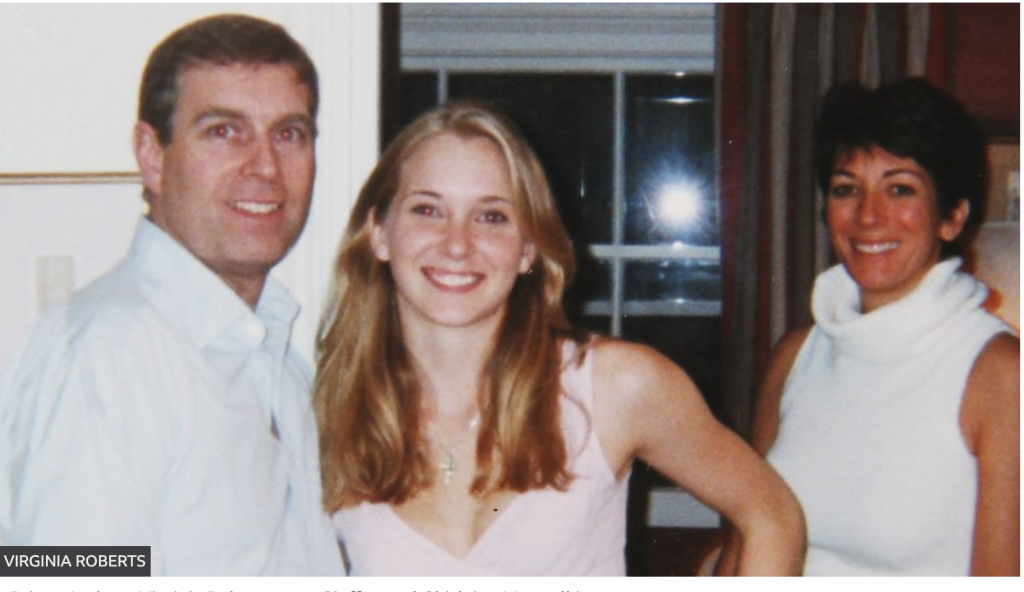 Virginia Roberts Giuffre was 17 in this 2001 photo with Prince Andrew and Ghislaine Maxwell.[/caption]