WP_Post Object
(
    [ID] => 10212
    [post_author] => 15
    [post_date] => 2026-02-26 12:45:10
    [post_date_gmt] => 2026-02-26 12:45:10
    [post_content] => 

A memoir interwoven with historical research that might leave you wondering if anything really changes in these United States.

The Mixed Marriage Project’s title will more than likely give an onlooker pause. Perhaps that’s the point. But before conjuring up too many presumptions based on the name, one might also note it is the work of renowned law professor and sociologist Dorothy E. Roberts. Amongst other books, Roberts is the author of Killing the Black Body (about black women’s reproductive history in the United States) and Fatal Invention: How Science, Politics, and Big Business Re-create Race in the Twenty-first Century. In her latest, a memoir interwoven with historical research, she unfolds her parents’ interracial relationship, and through it, partly unravels a United States’ history of the subject itself. 

The “project” of the book’s title is personal for Roberts: In the 1930s, her father, a white American of Welsh and German descent, set out to examine interracial relationships between black and white people specifically, while studying to be an anthropologist at the University of Chicago. His interview-based research, which explored interracial unions formed as early as the late 1800s, continued till the 1960s and ’70s, and included interviewing the children of couples he’d earlier surveyed. This feat was supposed to become a book, sold to a publisher while her father was working as a professor at Chicago’s Roosevelt University. But the book was never published, and its stories left untold until now.

Roberts theorizes the reason for this was that her father’s work had become so interwoven into his identity—and their family life—that its completion would have caused a real identity disruption. Who was he if he wasn’t working on the project? And where did that leave her and her family? 

Through her own research, Roberts learns her mother, a black, Jamaican immigrant, was also involved in this work, conducting interviews alongside her father for many years. Both were committed to the project’s objectives, one of which was to demonstrate that interracial relationships are not inherently abnormal, because black and white people are not fundamentally different. This was also how her parents met: While majoring in chemistry at Roosevelt, her mother became her father’s research assistant. (In the book, Roberts explicitly states she “wonder[s] how their professional partnership evolved into a romantic one—and whether they worried about the perception of impropriety.”) This prompts Roberts to question an underlying reason for her parents' marriage: Were they supposed to be embodiments of their own mixed marriage project? If Roberts’ parents were indeed as much a part of the study as they were leads of it, she concludes, it would make her and her sisters its subjects, too—or, at least, its personified outcomes. 

Rather than be rattled by this possibility, the author measures it against the people she personally knew her parents to be—curious, culturally-aware, well-traveled, and community-minded. Her parents’ relationship, after all, existed beyond their work, and they were initially drawn to each other by their shared sense of adventure, similar values on education, and complementary sensibilities—her mother as the planner and her father as the spontaneous one. By her own admission, Roberts gives them a latitude that an outsider might not. But I reckon this is where the book shines as memoir, rather than an investigation of an investigation: the reader gets to know Roberts’ parents through her loving eyes. Loving eyes that, for the record, do not condone the same politics her parents—especially her father—may have arrived at through their work: that interracial relationships offer some kind of medium to restore black and white relations in the United States, shaped by white supremacy and violence. (On this, Roberts pointedly disagrees.) 

Beyond family history, the themes in Project will be recognizable to anyone versed on the discourse, likely causing you to wonder if anything really changes in these United States. The politics of the study’s participants—black men, black women, white men, and white women in heterosexual, interracial relationships—reveal how black men-white women couples were seen as more “acceptable” but also more arduous in the long-run; white women often lost privilege they couldn’t regain unless divorced. The research also highlighted the sexual tropes attached to black women-white men couples—and the misogynoir that informs outsiders' views of them. Recurring themes, regardless of interracial pairings, showed how marital cutting across the color line affected one’s choice of neighborhood and the life afforded to them and, possibly, their children. Also recurring—especially in the civil rights era—were the many well-meaning couples who entered these marriages in the hopes of proving to the world as much as to themselves that interracial coupling inherently combats a racist society. This hope, Roberts argues, was often an erroneous one, as countless couples later found out. 

In the lasting analysis of her father’s work, Roberts arrives at the same conclusion that she began with regarding interracial relationships: They are not panacea for a society, a country, or a world that has yet to unravel itself from white supremacy, let alone repair its many casualties. But in Project, Roberts shows us that despite flawed, socially-constructed and racialized societies, people will enter unions and arrangements of all kinds, her parents included. These unions may not transcend race, but they do demonstrate that, in spite of the race politics attached, people will deem them worth fighting for. Some do so naively and are thus confronted with seeing the depths of racism like they never have before. But others, especially the curious, culturally-aware, and community-minded, go into them with eyes wide open, prepared to confront all of its politics united.
[post_title] => February Book of the Month: "The Mixed Marriage Project" by Dorothy E. Roberts [post_excerpt] => A memoir interwoven with historical research that might leave you wondering if anything really changes in these United States. [post_status] => publish [comment_status] => closed [ping_status] => closed [post_password] => [post_name] => february-book-of-the-month-botm-pick-the-mixed-marriage-project-by-dorothy-e-roberts-memoir-interracial-relationships-dating-history-research [to_ping] => [pinged] => [post_modified] => 2026-02-27 20:45:28 [post_modified_gmt] => 2026-02-27 20:45:28 [post_content_filtered] => [post_parent] => 0 [guid] => https://conversationalist.org/?p=10212 [menu_order] => 0 [post_type] => post [post_mime_type] => [comment_count] => 0 [filter] => raw )
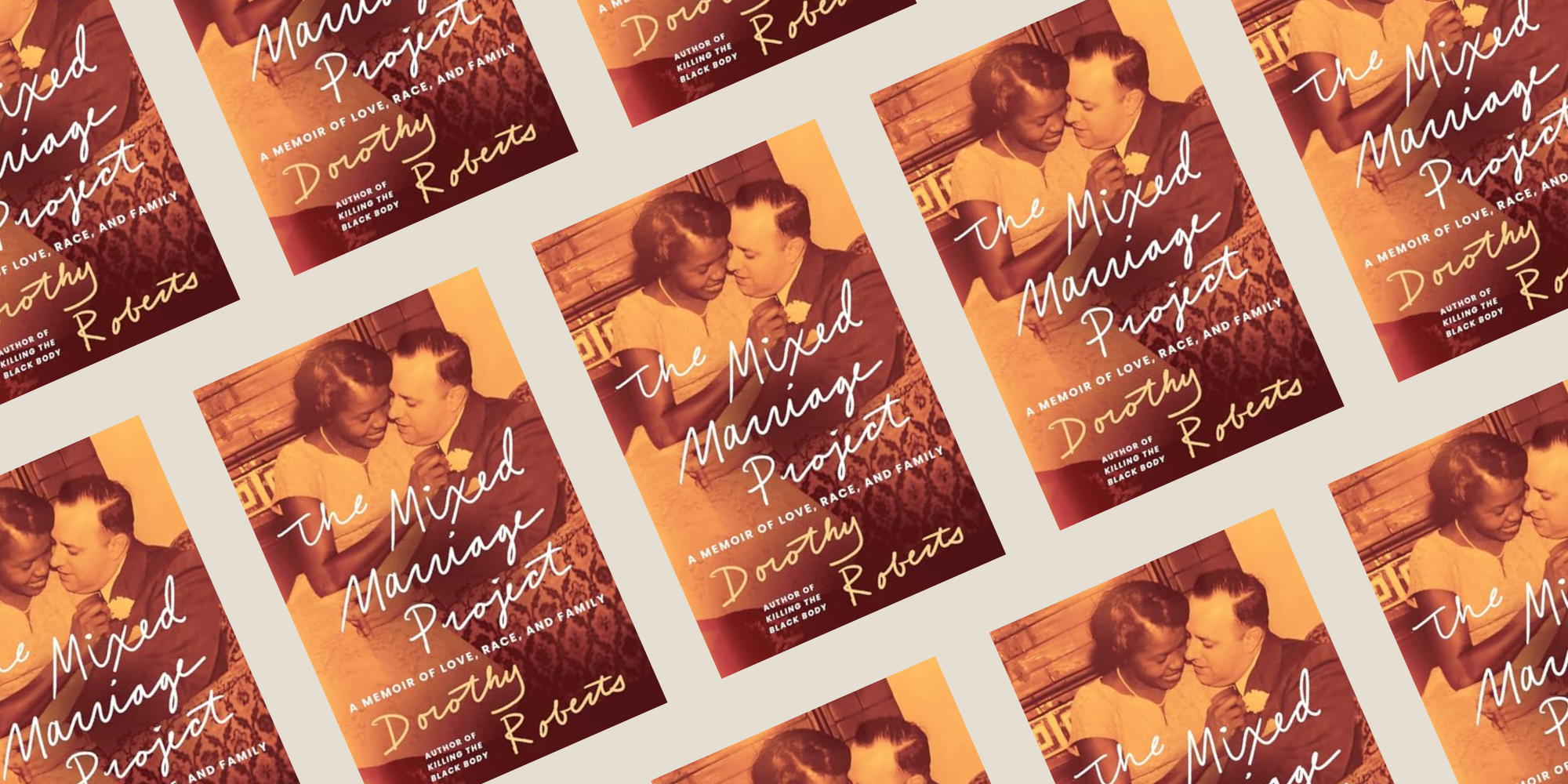
The book cover for "The Mixed Marriage Project" by Dorothy E. Roberts.
Atria/One Signal Publishers

February Book of the Month: “The Mixed Marriage Project” by Dorothy E. Roberts

A memoir interwoven with historical research that might leave you wondering if anything really changes in these United States.

The Mixed Marriage Project’s title will more than likely give an onlooker pause. Perhaps that’s the point. But before conjuring up too many presumptions based on the name, one might also note it is the work of renowned law professor and sociologist Dorothy E. Roberts. Amongst other books, Roberts is the author of Killing the Black Body (about black women’s reproductive history in the United States) and Fatal Invention: How Science, Politics, and Big Business Re-create Race in the Twenty-first Century. In her latest, a memoir interwoven with historical research, she unfolds her parents’ interracial relationship, and through it, partly unravels a United States’ history of the subject itself. 

The “project” of the book’s title is personal for Roberts: In the 1930s, her father, a white American of Welsh and German descent, set out to examine interracial relationships between black and white people specifically, while studying to be an anthropologist at the University of Chicago. His interview-based research, which explored interracial unions formed as early as the late 1800s, continued till the 1960s and ’70s, and included interviewing the children of couples he’d earlier surveyed. This feat was supposed to become a book, sold to a publisher while her father was working as a professor at Chicago’s Roosevelt University. But the book was never published, and its stories left untold until now.

Roberts theorizes the reason for this was that her father’s work had become so interwoven into his identity—and their family life—that its completion would have caused a real identity disruption. Who was he if he wasn’t working on the project? And where did that leave her and her family? 

Through her own research, Roberts learns her mother, a black, Jamaican immigrant, was also involved in this work, conducting interviews alongside her father for many years. Both were committed to the project’s objectives, one of which was to demonstrate that interracial relationships are not inherently abnormal, because black and white people are not fundamentally different. This was also how her parents met: While majoring in chemistry at Roosevelt, her mother became her father’s research assistant. (In the book, Roberts explicitly states she “wonder[s] how their professional partnership evolved into a romantic one—and whether they worried about the perception of impropriety.”) This prompts Roberts to question an underlying reason for her parents’ marriage: Were they supposed to be embodiments of their own mixed marriage project? If Roberts’ parents were indeed as much a part of the study as they were leads of it, she concludes, it would make her and her sisters its subjects, too—or, at least, its personified outcomes. 

Rather than be rattled by this possibility, the author measures it against the people she personally knew her parents to be—curious, culturally-aware, well-traveled, and community-minded. Her parents’ relationship, after all, existed beyond their work, and they were initially drawn to each other by their shared sense of adventure, similar values on education, and complementary sensibilities—her mother as the planner and her father as the spontaneous one. By her own admission, Roberts gives them a latitude that an outsider might not. But I reckon this is where the book shines as memoir, rather than an investigation of an investigation: the reader gets to know Roberts’ parents through her loving eyes. Loving eyes that, for the record, do not condone the same politics her parents—especially her father—may have arrived at through their work: that interracial relationships offer some kind of medium to restore black and white relations in the United States, shaped by white supremacy and violence. (On this, Roberts pointedly disagrees.) 

Beyond family history, the themes in Project will be recognizable to anyone versed on the discourse, likely causing you to wonder if anything really changes in these United States. The politics of the study’s participants—black men, black women, white men, and white women in heterosexual, interracial relationships—reveal how black men-white women couples were seen as more “acceptable” but also more arduous in the long-run; white women often lost privilege they couldn’t regain unless divorced. The research also highlighted the sexual tropes attached to black women-white men couples—and the misogynoir that informs outsiders’ views of them. Recurring themes, regardless of interracial pairings, showed how marital cutting across the color line affected one’s choice of neighborhood and the life afforded to them and, possibly, their children. Also recurring—especially in the civil rights era—were the many well-meaning couples who entered these marriages in the hopes of proving to the world as much as to themselves that interracial coupling inherently combats a racist society. This hope, Roberts argues, was often an erroneous one, as countless couples later found out. 

In the lasting analysis of her father’s work, Roberts arrives at the same conclusion that she began with regarding interracial relationships: They are not panacea for a society, a country, or a world that has yet to unravel itself from white supremacy, let alone repair its many casualties. But in Project, Roberts shows us that despite flawed, socially-constructed and racialized societies, people will enter unions and arrangements of all kinds, her parents included. These unions may not transcend race, but they do demonstrate that, in spite of the race politics attached, people will deem them worth fighting for. Some do so naively and are thus confronted with seeing the depths of racism like they never have before. But others, especially the curious, culturally-aware, and community-minded, go into them with eyes wide open, prepared to confront all of its politics united.