WP_Post Object
(
    [ID] => 7604
    [post_author] => 15
    [post_date] => 2025-01-01 11:27:00
    [post_date_gmt] => 2025-01-01 11:27:00
    [post_content] => 

How skincare has, and hasn't, changed across generations of women.

I have a distinct memory from when I was a young girl, of my nani, my maternal grandmother, opening her Ponds cold cream, with its white base and light green lid, and tapping it onto her face. 

I’m still a child, maybe 10 or 11, and when she finishes, she offers the jar of cold cream to me, insisting I also start putting it on regularly to take care of my skin. As I scoop up some of the cream and begin applying it, my nani watches my technique intently, correcting me wherever she thinks I'm not being gentle enough. “Never rub your face,” she tells me. “It’ll make your skin sag and give you wrinkles.”

For as long as I can remember, I have associated my nani with that Ponds cold cream. It really was, and still is, such a key part of her everyday life. She still has jars of it in her bedroom and her bathroom so that it’s always on hand, and brings it with her whenever she leaves home. Yet despite her obvious brand loyalty, my nani’s routine has always been more about process than product. At a time when women were asked to be invisible, to put everyone before themselves, those five minutes spent meticulously applying her face cream each night were an almost rebellious act of self care. 

Skincare in Pakistan, and perhaps across the world, has changed significantly since my nani’s days, and I’ll admit even I’ve given in to the hype, buying at least a couple of products with fancy ingredients on the label like “hyaluronic acid” and “AHAs.” But unlike my nani, I’ve always been far less meticulous with my skincare routine. Perhaps it's because these trends are still quite new to me, or maybe the routines themselves have become too complicated. But perhaps more than either, it’s because these products are only selling me an idea of self care, rather than actually fostering a habit of it. 

Growing up, aside from what I learned from my nani, the concept of skincare was taught to me very differently. In fact, it wouldn’t be remiss to say that in South Asia, the importance of skincare starts from the womb. I remember, starting from when I was a child, the pregnant women around me were told to eat “white” foods during pregnancy so that their baby would have fair skin. Anything dark—coffee, chocolate—was to be avoided, out of fear that it would cause their baby to have a darker complexion. Despite these myths being completely debunked, they still form a critical part of skincare motivations for older South Asians today, and pregnant people often still receive the same advice. 

It’s no secret that whitening has long been a major motivation behind skincare within many Asian cultures and amongst countless other cultures around the world. Despite global trends to push “fairness” out of advertising lingo, the underlying beliefs and colorism still persist, along with the dangerous ways people choose to realize them. This has been true for centuries: Some Renaissance era women would even wear leeches behind their ears to suck out their blood and leave them looking paler, which was considered more beautiful. As recently as the mid to late 20th century, many brides in South Asia would utilize a similar technique in anticipation of their weddings—again, to appear paler and “more beautiful.” Dr. Christine Hall, a GP and Aesthetics Doctor at London’s Taktouk Clinic, says that similar beliefs have long existed in Korean culture, too. “There is an age-old belief which suggested that darker skin tones mean that you worked the land, and so this was correlated to a poorer societal class,” she says. “As a result, most South Koreans did and still do prefer to avoid the sun and tanning—but the focus is on anti-aging, and not so much skin lightening or bleaching.”   

As Dr. Hall notes, while some skincare practices have remained consistent across generations, it is the motivations and drivers behind those routines that have continued to shift. In a more extreme example, a recent T: The New York Times Style Magazine article reported that people are still using leeches for beauty treatments today—not for the sake of becoming paler, however, but “in an effort to refresh the skin and reduce wrinkles.” 

It makes sense that as beauty standards have continued to evolve, our motivations for partaking in skincare would evolve with them. But, Dr. Hall argues, this isn’t necessarily always because women are trying to chase an ever-changing standard of beauty. After all, we live in a time where women are perceived very differently from the world my nani grew up in; and some of these shifts can also come from letting go of the societal pressures that demand women to conform to them in the first place. “Sometimes, the ideology of having perfect skin and being beautiful goes too far,” Dr. Hall explains, citing the extreme pressure many South Koreans, especially women, feel to maintain their looks. “This has resulted in a movement called ‘escape the corset’ where women are cutting their hair short and throwing away their makeup and refusing to conform to these unrealistic expectations.”

In some ways, the motivation behind the “escape the corset” movement—driven by self-empowerment and a woman’s right to look however she’d like—almost feels closer to my nani’s relationship to skincare than most of what’s sold to us today. One major reason for this, of course, is the overwhelming and unnecessary economy of choice fueled by capitalism, which depends on continuously moving the bar for “beauty” in order to keep us buying more new products. Beauty is now a multi-billion dollar industry, largely funded by women, and it’s only growing each year. This is also partially why, compared to previous generations, there’s been a global shift from more natural skincare—including a reliance on homemade DIY products—to lab-formulated, fancy-sounding multiple-step routines that can only be purchased in a store, and at a cost. “In Greece where I’m originally from, older generations always used natural remedies for many years,” shares Fani Mari, a freelance beauty journalist and content creator. Despite not being a fan of DIY skincare herself, she still incorporates some of these remedies into her skincare routine because they’re simple and effective—and connect her to her culture and the elders who passed it down to her. 

For many young women, a similar influence has guided them through their own skincare evolutions, as well. Haniya Shariq Khan, a young college student in Lahore, remembers her own skincare journey with her nani very fondly. While her nani passed away five years ago, Khan shares that she and her mother still follow the same skincare regimen she taught them to this day. 

As the wife of a landlord, living in a rural area, Khan’s grandmother endured grueling days of work for most of her life, and skincare was her reprieve. “She was expected to do certain chores, such as making lassi by hand, an incredibly rigorous activity, but she realized quickly that the leftover butter made for a really nourishing moisturizer,” Khan shares. As time went on, and her grandparents' financial situation improved, she continued to indulge in her skin, eventually buying new creams, including some from as far as London.

“I think honestly she was just very into beauty,” Khan says. “Growing up so poor, she had no shoes to wear if she outgrew them… [But] even as a little girl living in the tenements, she used to be crazy about fashion, about the latest hairstyles, and always had her own kohl and mirror from the age of about nine. So this was a hang up from her very deprived childhood: She was keeping her inner child happy by indulging in all these things.”

This relationship to skincare felt similar to my own nani’s relationship to it, even if it took a slightly different shape: So much of the motivation behind skincare for our ancestors was a way of indulgence and self care. While on surface level, this might seem shallow, or largely motivated by societal pressures, these individual experiences show a far deeper sense of well-being, and even treating one’s self, in a time where, for most women, this was largely inaccessible. 

Based on most beauty ads today, it may seem like “self care” is still the main driver behind the skincare industry. But the onslaught of consumerism, and the increasing pressure to buy more and more, has turned it more sinister. As a culture, we’ve turned skincare into a necessity. Combined with the pandemic’s impact on our mental health, the pervasiveness and pressures of social media, and an overflow of information in the digital age, skincare has also become a compulsion. Children as young as 10 are now buying into the pressure of using anti-aging products. Capitalism has meant that the move away from the pressure to wear makeup hasn’t necessarily freed us from caring about our appearance. It’s only made skincare our new cult-like obsession, and makes me question whether we’ve learned anything at all. 

The way we begin to counter this is by discerning and deciding for ourselves what feels right, not what we’re told will make us feel beautiful by a slew of constantly changing trends and ads that insist we have to buy absolutely everything. It’s by returning to why our grandmothers washed their faces, and reconnecting to skincare as an actual vehicle of self care. This is easier said than done, but some beauty enthusiasts are trying—and in the process, building a new legacy that seeks to find the balance in all of it. 

Meraj Fatima, the founder of Her Beauty, a Pakistan-based skincare brand that launched last year, says her brand was inspired by her own skincare journey, and unlearning the skincare traditions of past generations that didn’t work for her. But in the process of creating it, something surprising happened: Her mother and grandmother were willing to go on this renewed skincare journey with her.  

Fatima, who had Rosacea growing up, says her skin condition meant she had to figure out what worked for her and what didn’t amongst the various natural “totkas” (home remedies) her mother and grandmother had passed down to her. “One thing that differentiates me from my mom is my mom used natural agents to do skincare, like using lemon, which is terrible for your skin, or malai, which could soften your skin, but my kind of skin will react to it,” she shares. Today, her mother and grandmother are open to trying the products she recommends instead, and are some of Her Beauty’s regular customers. 

Still, Fatima wants to be mindful of not eschewing old remedies or products just because something newer and supposedly “better” might be available. She always tells potential customers to start with what they have at home first, and not buy products unnecessarily—even if they’re her own. “I’ve seen my teenage cousins who feel pressured to use so many products without reason. And I have a daughter, too, now, so I keep thinking about what I want to pass down to her,” she says.

The work for younger generations of women, then, is one of both learning and unlearning: Seeing skincare as more than just a trend, but instead, as a practice. Or perhaps as a ritual for the self, or an act of rebellion, like it was for our nanis. Perhaps, then, rather than buying something new, we need to step back, and realize the Ponds already in our cabinet is already enough. 

[post_title] => Why Our Grandmothers Washed Their Faces [post_excerpt] => How skincare has, and hasn't, changed across generations of women. [post_status] => publish [comment_status] => closed [ping_status] => closed [post_password] => [post_name] => generations-women-skincare-beauty-standards-pakistan-south-asia [to_ping] => [pinged] => [post_modified] => 2026-08-03 23:41:08 [post_modified_gmt] => 2026-08-03 23:41:08 [post_content_filtered] => [post_parent] => 0 [guid] => https://conversationalist.org/?p=7604 [menu_order] => 32 [post_type] => post [post_mime_type] => [comment_count] => 0 [filter] => raw )
An illustration of the reflection on a bathroom mirror. An older woman is applying cream to her face, with her tied back in a scarf around her ahead. In the background, a young girl watches attentively. There's a pale blue tile behind them. In little inserts around the image are close ups of the cream being applied.

Why Our Grandmothers Washed Their Faces

WP_Post Object
(
    [ID] => 7175
    [post_author] => 15
    [post_date] => 2024-09-06 23:15:35
    [post_date_gmt] => 2024-09-06 23:15:35
    [post_content] => 

If we want to restore and preserve abortion rights in the United States, we have to fight harder for the ERA.

U.S. President Joe Biden’s overdue decision to suspend his reelection campaign and endorse Vice President Kamala Harris for the nomination has given the Democratic Party a decent shot at winning in November. It has also freed the Democrats to emphasize an issue they believe will drive voters to the polls: At its recent national convention, the party put reproductive rights and the “power of women” front and center, hoping to capitalize on voters’ very rational fear of a potential nationwide abortion ban if Trump is reelected.

But while the landscape for abortion rights will be less bleak if Democrats retain the White House next year, electing Harris alone will not be enough to restore these rights or prevent them from being ripped away again. Nor will it keep the far-right Supreme Court from laying the groundwork for the next Republican administration to implement the same reactionary social policies favored by the architects of Project 2025, the so-called blueprint for a second Trump term.

Aside from changing the composition of the Court, many advocates believe that passing the Equal Rights Amendment (ERA) is the best and possibly the only way to restore our abortion rights, and, more broadly, to protect the rights of millions of American women and LGBTQ+ people from current and future attacks. First proposed in 1923, the ERA would prohibit gender discrimination and ensure that “equality of rights under the law shall not be denied or abridged by the United States or by any State on account of sex”—something our Constitution does not explicitly guarantee. Most crucially, it would also safeguard these rights no matter which political party is in power. Its passage has rarely felt so urgent; in the wake of Dobbs, Americans cannot afford to leave the ERA’s fate up to the leaders of either party. Congress has already repeatedly failed to pass federal legislation to protect abortion rights: With so much at stake, demanding that the Biden administration immediately publish this badly needed amendment, and, to a lesser extent, joining efforts to add gender equality provisions to state constitutions has become far more crucial to preserving our rights than voting alone.

According to the American Bar Association (ABA) and other experts, the ERA has already achieved the number of state ratifications required to add it to the Constitution. (Conservative activists argue that some states’ decisions to rescind their original ratifications means the ERA never met this threshold, but many legal scholars say those rescissions are legally invalid and can be ignored.) But while Biden has repeatedly affirmed his support for the ERA, he has, to the outrage of its proponents, resisted publishing it for years. Why he is so reluctant is anyone’s guess. Perhaps his administration is taking a conservative approach due to perceived legal issues and a general fear of rocking the boat, despite the ERA’s popularity and legal validity. Or maybe they think it’s in their best interest to preserve threats to equality that double as fundraising tools for the Democratic Party and its allies, which help them retain the support of voters who know today’s GOP will do nothing to publish the ERA or protect abortion rights, but still hold out hope that the Democrats might.

It could also be personal: Biden, who is technically pro-choice, is a notably poor advocate with an appalling record on the issue. By contrast, Harris speaks passionately about abortion and, in March, became the first sitting U.S. president or vice president to visit an abortion clinic in an official capacity. In her convention speech, she declared, “We trust women,” and vowed that when “Congress passes a bill to restore reproductive freedom” she would “proudly sign it into law.” Yet she offered no explanation as to why this didn’t happen when Democrats controlled Congress, no strategy for ensuring that it happens in the next Congress, and no reason why the Democratic administration she is currently a part of hasn’t yet published the ERA. There is also no reason to assume that if Harris wins in November, she will honor her 2019 presidential campaign pledge to pass the ERA in her first 100 days in office, either. In fact, she did not mention the ERA in her speech at all, despite the party’s promise in its official 2024 platform that “Democrats will fight to make the Equal Rights Amendment the law of the land.” Notably, this year’s platform also promised that “Democrats will work to pass the Paycheck Fairness Act”—something then President Obama promised to do over a decade ago—and repeal the Hyde Amendment, which bars federal programs like Medicaid from covering the cost of most abortions, and which Biden supported until June 2019. It did not explain how they plan to do so. (Neither the Biden administration nor the Harris campaign responded to my requests for comment by the time this was published.)

Nicole Vorrasi Bates, Executive Director of the pro-ERA organization Shattering Glass, did not mince words in a recent phone call. “Both parties are playing political football with the rights and lives of 187 million women, girls, and LGBTQ+ people,” she said. Regardless of who is in the White House, the Supreme Court will issue rulings in the next year that could further damage women’s legal standing for decades to come by subjecting claims of gender discrimination to a lower standard of judicial review—something that theoretically could not happen if we could point to language in the Constitution that explicitly guarantees sex equality, rather than relying on what many legal scholars consider an implicit guarantee under the 14th Amendment.

The quickest and most straightforward path to achieving that guarantee is to publish the ERA. As Mrinalini Sisodia Wadhwa explained in a 2020 Columbia Undergraduate Law Review article, “the Court has continually changed the test it uses to evaluate claims of sex-discrimination…Without [the ERA], the Court will continue to evaluate sex-discrimination cases without a steady metric, thereby leaving problems of inequality unsolved.” The fact that sex equality is not clearly guaranteed in the Constitution, Wadhwa wrote, gives the Court “a blank check to decide what test to use” and “how seriously to take challenges against statutes that discriminate on the basis of sex.”

Today, the vast majority of pro-ERA politicians are Democrats. But the ERA continues to enjoy broad bipartisan support among voters. A 2016 poll found that 90% of Republicans support it, which suggests that most non-elite Republicans favor basic equality—and GOP leaders are, on this issue, profoundly out of step with their base. A more recent 2022 poll shows that the vast majority of Americans still support the amendment—and gender equality—across party lines. Conservative activist Phyllis Schlafly derailed the ERA in the 1970s and left it for dead at the dawn of the Reagan era; decades later, fury at Trump resurrected it. Nevada ratified the ERA in 2017, Illinois in 2018, and Virginia in 2020, bringing the total number of state ratifications to the 38 required to make it part of the Constitution.

Twenty-nine states already explicitly guarantee sex or gender equality in their constitutions, which offers stronger and more durable protections for abortion rights than state laws banning discrimination. The ERA would guarantee these protections at the federal level. Such protections are necessary even in blue states with strong anti-discrimination laws for two main reasons: (1) laws are much easier to change and/or repeal than constitutional text and (2) gender discrimination claims are usually subject to intermediate scrutiny, which is a lower standard than the one applied in cases involving explicitly protected categories like race. This is because a minority of Americans with outsized power do not consider abortion a right and do not want U.S. courts to treat gender discrimination as seriously as other forms of prejudice. Once courts are required to apply the same standard to sex-discrimination cases, abortion restrictions, which apply almost exclusively to women, will be much harder to defend.

This is already clear at the state level. In Connecticut and New Mexico, the constitutions of which prohibit sex discrimination, courts have upheld public funding of abortion. The New Mexico Supreme Court is considering striking down abortion restrictions passed by conservative localities because they violate the state’s constitution. The Pennsylvania Supreme Court recently ruled that abortion providers can challenge Pennsylvania’s ban on Medicaid coverage for abortion as sex discrimination under the state’s Equal Rights Amendment and constitutional equal protection provisions. Even in blood-red Utah, the state Supreme Court recently upheld a suspension of the state’s abortion ban, keeping the procedure legal while the ban is being challenged in court. In suing to block the Utah ban, Utah Planned Parenthood argued that it violated several provisions in the state’s constitution, including the right to gender equality.

But as Wendy J. Murphy explained in a recent law review article, amending state constitutions is an imperfect strategy for reasons similar to those put forth by Wadhwa. According to Murphy, only thirteen states enforce their own constitutional gender equity provisions under the highest standard of judicial review. In Texas, for example, the state constitution’s sex equality provision failed to protect Texas women when the state Supreme Court concluded that abortion-related funding restrictions do not deny equality “‘because of’ sex, even though only women [can] become pregnant.” As Murphy argued, “without the ERA, States are free to apply their State constitutional equality guarantees unequally to women.”

This doesn’t mean that states’ efforts are futile. A year ago, abortion rights supporters had reason for cautious optimism: Ballot measures designed to enshrine abortion rights in state constitutions passed, and those intended to restrict such rights failed in all seven of the states, including red states like Kansas, Kentucky, and Ohio, that voted on these measures in the aftermath of Dobbs. In November, New Yorkers will vote on whether their constitution should guarantee equality regardless of gender and reproductive status. (New York’s constitution currently prohibits discrimination on the basis of “race, color, creed or religion,” but not “sex.”) Floridians, too, will have the opportunity to enshrine abortion rights in their constitution. Abortion-related state constitutional amendments are also on the ballot or under consideration in Arizona, Arkansas, Colorado, Maryland, Missouri, Montana, Nebraska, Nevada, and South Dakota.

Yet some recent efforts to protect abortion and other rights via state constitutions have stalled. Despite having approved a resolution calling on Congress to ratify the federal ERA in 2023, Minnesota was unable to pass a state ERA in 2024. Minnesota’s proposed amendment did not include the word “abortion,” but it would have protected Minnesotans’ right to make “decisions about all matters relating to one’s own pregnancy or decision whether to become or remain pregnant.” An effort to enshrine abortion rights in Maine’s constitution similarly failed in April after lawmakers voted against putting the proposal on the November ballot. The Maine proposal, which would have asked whether Mainers wanted their state constitution “to declare that every person has a right to reproductive autonomy,” also omitted the word “abortion,” though supporters did not avoid the word in promoting it.

Even states that have managed to get reproductive rights on the ballot have had to fight to include the word “abortion.” In New York, pro-choice advocates and legislators attempted to revise the language of the upcoming ballot measure to make its primary purpose—protecting abortion rights—clear, after the state board of elections voted to exclude the word “abortion” from the initiative’s description. Democrats challenged that decision on the grounds that the state is obligated to provide easy-to-understand explanations of ballot proposals to voters. A judge recently upheld the vague language, and state Democrats are now squabbling over whether to keep fighting for the broadly popular initiative or retreat in hopes of neutralizing bad-faith GOP attacks on Democrats in swing districts. But allowing an abortion-rights initiative to fail in deep-blue New York would have serious implications for women’s and LGBTQ+ rights nationwide.

Gender equality as a concept is broadly popular in the United States, whether or not it always exists in fact. And as we’ve seen many times in the wake of Dobbs, abortion rights are popular and restricting them is not. That’s why the GOP is working so hard to keep abortion off of state ballots and overrule the will of the voters, and why New York Democrats belatedly tried to tie the word “abortion” to the state’s upcoming ballot proposal: Both parties know that opportunities to defend abortion rights drive voter turnout. But whatever happens in November, our rights would be better protected if Biden simply published the ERA today.

Despite her frustration with the two major parties, Bates remains hopeful that the tide is beginning to turn. “In light of recent events, and given all that’s at stake, the momentum for ERA publication is growing exponentially,” she recently said. Whoever our next president is, one thing is clear: Actions speak louder than words, and we will need to do more than vote to take back our rights.

[post_title] => Voting Isn't Going to Be Enough [post_excerpt] => If we want to restore and preserve abortion rights in the United States, we have to fight harder for the ERA. [post_status] => publish [comment_status] => closed [ping_status] => closed [post_password] => [post_name] => 2024-election-abortion-rights-reproductive-justice-equal-rights-amendment-kamala-harris-dnc [to_ping] => [pinged] => [post_modified] => 2026-08-04 16:50:44 [post_modified_gmt] => 2026-08-04 16:50:44 [post_content_filtered] => [post_parent] => 0 [guid] => https://conversationalist.org/?p=7175 [menu_order] => 48 [post_type] => post [post_mime_type] => [comment_count] => 0 [filter] => raw )
Equal Rights Amendment supporters voice their disapproval of the 22-16 vote against E.R.A. in the Florida Senate as they streamed out of the capitol for a demonstration and shouted "vote them out" in response to the Senate vote, June 21, 1982. It is a black and white photo of women gathered in protest. They appear to be shouting.

Voting Isn’t Going to Be Enough

WP_Post Object
(
    [ID] => 5947
    [post_author] => 15
    [post_date] => 2024-03-07 18:56:22
    [post_date_gmt] => 2024-03-07 18:56:22
    [post_content] => 

Meet the women creating new life from arid land in India.

It was a day of joy and relief for Kamla: Her daughter was getting married—and the night before, it had rained.

Far from a bad omen, the downpour had been ever welcome. Kamla is a farmer, whose livelihood is directly dependent on the land she cultivates, the land that gives her and her family a variety of vegetable crops to eat and to sell, like beetroots, tomatoes, beans, and chilis. For much of the year, however, the weather works against her: She and her family live in Khajraha Khurd, a village in the Jhansi district of Bundelkhand, Uttar Pradesh—an otherwise drought-prone region in India’s most populous state.

In Kamla's home that morning, preparations were being made for the wedding. Women were singing folk songs and cleaning the freshly picked vegetables from her farm to prepare meals for their guests. Young girls were making roti on the earthen stove burning with a wood fire. Other children were jumping in muddy puddles as cows grazed in a nearby pasture. The entire scene resembled a Satyajit Ray film, portraying their small, Indian village as a mosaic of intertwining agrarian lives.

Kamla was overjoyed. Because of the savings she’d earned through farming, she would be able to gift her daughter two heavy, embroidered sarees with matching glass bangles, heels, and bindis as a wedding gift. She wouldn’t have been able to afford them otherwise. “When I got married, nobody asked me about my choices,” she says. “But today, at my daughter’s wedding, I have made sure her choices are taken care of.”

Farming is a path that has opened many new doors for Kamla, one she first chose to walk in 2020, when the outbreak of the COVID-19 pandemic led to the imposition of a country-wide lockdown. In cities across India, migrants who worked as daily wagers—Kamla included—suffered the most, as their jobs were eliminated overnight. Their very livelihoods came to a complete standstill, and few to none could meet their personal needs, let alone those of their families.

At the time, Kamla was working as a construction worker on a site in New Delhi. After the lockdown was announced, she stuffed her things into a sack and started the journey back to Bundelkhand—where she was born and raised—along with her three children and husband. Without employment, the couple had to exhaust all their savings simply to return home.

Once in Bundelkhand, Kamla was desperate for work. She was not alone: During the pandemic, Uttar Pradesh experienced one of the largest reverse migrations in India. More than 3 million workers returned to their villages from the cities, many of them living below the poverty line—and for women freshly out of work like Kamla, their options were especially limited.

Even before the pandemic, women had been at a disadvantage. According to the dozens of people that I spoke to for this piece, women in India often work more than men, keeping households and raising children in addition to some form of employment outside of their homes—all while being paid less than their male counterparts. In cities, women frequently worked as concrete mixers, diggers, stone breakers, and brick haulers; climbed unstable scaffolding carrying bricks; and were exposed to pollution at their work sites—as were their children, who they often brought to work because there was no one at home to provide childcare. Despite these women doing equal (if not more) work, the people I spoke to estimated that a male laborer usually makes up to 500 Indian rupees (US$7) a day at a construction site, while a woman only makes up to 300 (US$4).

This disparity in pay and promotions, along with regular sexual harassment, a lack of maternity leave, and the absence of toilets, are all an everyday reality for most working women in the informal and unorganized labor market in India. These factors are predominantly driven by patriarchal norms, as well as social, economic, and cultural restrictions, and often feel impossible to avoid. Overworked and underpaid—and now facing a global pandemic—many women didn’t want to migrate to new cities where they would again be forced to compromise on the health, hygiene, and education of their children, or to continue living without community support. With a pandemic at their doorstep, there had to be another option.  

Luckily, at home in Bundelkhand, women like Kamla had access to a resource they did not have in the cities: land. Many of their husbands were in possession of inherited land once ripe for farming, but long abandoned in the past due to drought.

Historically, farming in the region had been a challenge. For the past several decades, Bundelkhand has faced a crisis due to uncertain rainfall patterns, causing severe crop damage and sometimes total crop failure. If they could revive this land, however, it could be a tremendous opportunity for financial security. Putting their heads together, these women regularly met three or four times a week to share their household and financial troubles, brainstorm ways to address their issues, and identify how to achieve their financial goals. Farming quickly became one of them.

Kamla expressed an early interest in farming for two reasons: She wanted a sustainable source of food for her family, and she wanted a fair way to earn a livelihood. This is why, in 2022, she decided to join the Basant Mahila Farmer Producer Organisation, a collective of about 3,000 women entrepreneurs across forty villages in the Jhansi, Mahoba, and Lalitpur districts in Bundelkhand. The program was founded in 2020 by ActionAid India through Work4Progress India to create and promote more livelihood opportunities for women, especially those pushed to migration due to the effects of climate change.

The majority of farming-related policies and programs in Uttar Pradesh are not women-friendly, but Basant aimed (and aims) to change that. Rajendra Nigam, a district coordinator at Basant, tells me, “We trained women like Kamla to produce organic seeds, and they successfully produced seeds of wheat, groundnut, pea, and urad (black gram), which are always in high demand in the region.” Through Basant, Kamla learned how to grow her own organic vegetables and fruits, how to prepare cow manure as organic fertilizer, and how to grow multiple crops on the same land in a year. Soon after completing her training, Kamla also received about eleven types of vegetable seeds and some farming tools, spray machines, drums with which to prepare fertilizers, and material for farm fencing to continue farming independently.

“I came back from Delhi tired and empty handed,” says Kamla, who in the past often hid her face in front of local village elders as a mark of modesty and respect when in the presence of men. Now, she fearlessly calls herself “an organic woman” who has successfully and continuously grown vegetables and grains on her 1.5 acres of land since 2022.

It wouldn’t be the only skillset that Kamla gained from Basant. The program isn’t just about teaching women the skills necessary to begin farming, but also to give them the financial literacy and independence necessary to make financial decisions of their own—in India, a realm traditionally dominated by men. To that end, Basant has worked as an intermediary between the government and farmers to educate the latter on various insurance protection plans and credit opportunities specific to their work. These local solutions, according to Khalid Chaudhry, an associate director at ActionAid India, contribute to helping women reach financial independence, some for the first time. And Kamla is just one of many women benefiting from it.

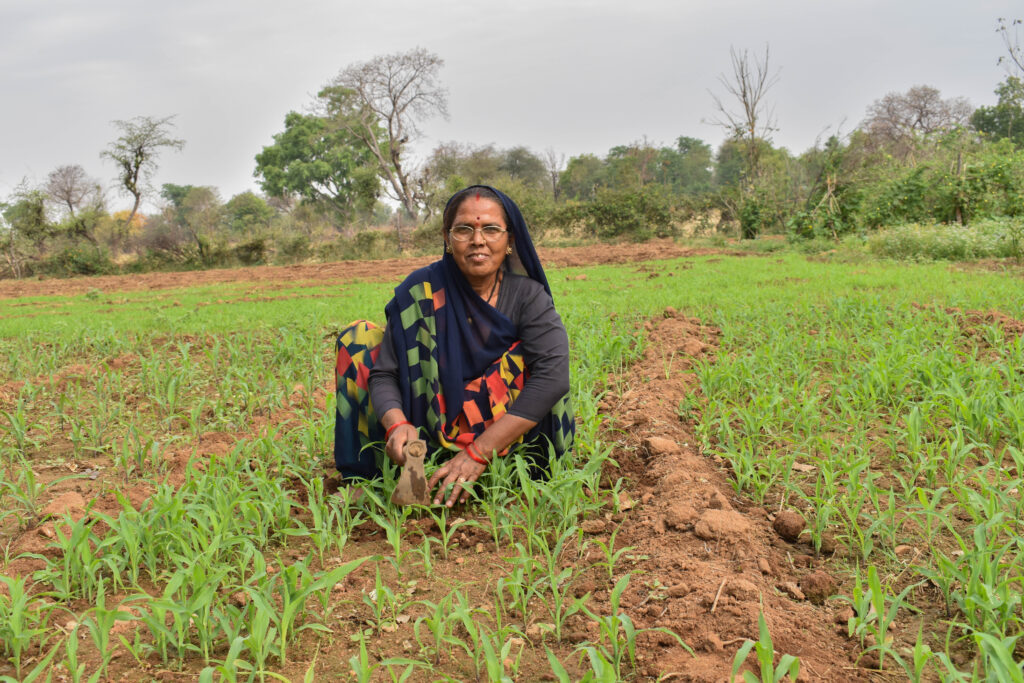
Deva, an older Indian woman, is crouched down in a field of sprouting green leaves. She is wearing a navy blue sari with a colorful geometric pattern of greens and yellows and oranges; round glasses; and red bangles on her wrists.
Deva. Photo courtesy of Aliya Bashir.

“I didn’t know how to grow home-grown food. It felt like a dream,” says Deva, a mother of three sons, who recently began farming a “nutrition garden” on her 1.5 acres of land. She decided to join Basant after she’d seen some women in her community benefit from it, and was particularly interested in learning about the cultivation of various vegetables and fruits, what plants to grow in what season, how to prepare manure and a compost pit, and how to save her produce from pests. Before long, she could do all of this herself.

“Now, I teach women to prepare organic manure, pesticides, and fertilizers at a very low cost by using the material usually available on our farms,” she says.

Prior to returning to Bundelkhand in 2020, Deva worked for three years in the brick kilns of Delhi and Uttar Pradesh. Now, she grows organic beetroot, bottle gourd, tomato, fenugreek, cucumber, brinjal, and other vegetables, and is able to sell them at fair prices compared to commercial farming. In addition, she hopes to begin selling her organic manure in the market to better maintain the soil health of other local farms.

Equipped with so much new agricultural knowledge, Deva has become an advocate for nutritious food in her village, and takes great care with her family’s diet, always feeding them a variety of fruits and vegetables. In 2022, she was also able to purchase six chicks and four goats from her earnings.

“Earlier, we would always have less availability of food. But now, we are not only having chemical-free food, but also eggs and chicken and dairy at home,” she says.

Her care has proven profitable: In a recent harvest, Deva earned a profit of 66,600 Indian rupees (~US$800) by cultivating a wide variety of vegetables and fruits in her garden. When she was working as a manual laborer, she wasn’t able to save anything—but now, she hopes to give her grandchildren the good education she couldn’t afford to give to her children before them.

Kamla has similar hopes and dreams. Although she couldn’t afford her elder daughters’ education due to limited financial resources, she is determined to pay for her youngest daughter’s schooling, and farming has allowed her to save more money than she could have ever imagined when she was working in construction.  “In Delhi, we would work for almost ten hours a day and would earn 20,000 Indian rupees (~US$240) per month,” Kamla says. “The place is very costly to live in—around 15,000 (~US$180) would go into rent and other expenses. Saving a few thousand rupees was difficult.” In comparison, in the past three months, Kamla has sold 30,000 Indian rupees (~US$365) worth of eggplants alone; the cost for cultivation for which was just 5,000 rupees (~US$60).

“We are expecting the eggplant production to increase three times in this season,” she adds.

Over the last few months, Kamla has sold 80,000 Indian rupees (~US$965) worth of produce through multiple vegetable cultivation, growing high yield vegetables like beetroot, bottle gourd, chickpeas, and cucumber simultaneously. The overall expenses were 13,000 Indian rupees (~US$155), which meant a profit of 67,000 Indian rupees (~US$810), much of which she has been able to put into savings.

“I grew up with the thought that a woman can’t have big dreams,” she says—but still, she’d always refused to give up on them. Customs and tradition taught her that only men have the capability to manage food security in a rural Indian family, and she’s already proven this doesn’t need to be the case. “My family is very happy with my farming work,” she says. “When I am busy on the farm, my husband not only takes care of the children, but also helps in preparing meals.”

This domestic bliss feels prescient. One of the founding members of the Balant program, Laxmi Devi, chose its fitting name upon its founding: In Hindi, basant means happiness and prosperity. With their new skillset, Kamla—and Deva, and so many other women—seem to have found just that.

[post_title] => A Farm of One's Own [post_excerpt] => Meet the women creating new life from arid land in India. [post_status] => publish [comment_status] => closed [ping_status] => closed [post_password] => [post_name] => india-women-farmers-basant-bundelkhand-farming-agriculture-climate-change [to_ping] => [pinged] => [post_modified] => 2026-08-04 17:40:16 [post_modified_gmt] => 2026-08-04 17:40:16 [post_content_filtered] => [post_parent] => 0 [guid] => https://conversationalist.org/?p=5947 [menu_order] => 61 [post_type] => post [post_mime_type] => [comment_count] => 0 [filter] => raw )
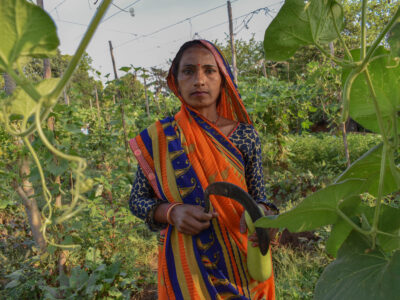
A woman in a colorful patterned sari, rich with bright oranges and blues and golds. She is holding vegetables she has grown on her farm, and is surrounded by bright greenery.

A Farm of One’s Own

WP_Post Object
(
    [ID] => 5695
    [post_author] => 15
    [post_date] => 2023-03-27 17:00:00
    [post_date_gmt] => 2023-03-27 17:00:00
    [post_content] => 

Their stories, in their own words—and why you should be paying attention.

Rode Wanimbo’s aunties welcomed her back to her ancestral village in the usual way—with a song of lament. This, in her Lani tribe’s language, is known as leendawi, somewhere between singing and crying. And whenever she visits for a vacation, or when a family member passes away, her aunties greet her with it. 

On this occasion as always, Rode followed her aunties into a traditional honai, a roundhouse built with natural materials, and sat to hear their stories, told through song. Her village has witnessed an unspeakable horror. In 1977, a year before Rode was born, the Indonesian military swept into West Papua in a hostile takeover, killing swathes of villagers. Rode’s family fled to the town of Wamena, her mother pregnant with Rode and already caring for an infant son. Others were forced to flee on foot, either seeking refuge in neighboring Papua New Guinea or becoming internally displaced people (IDPs) and clutching at survival in the forest. On her last trip home, Rode’s aunties sang tales of these atrocities. They spoke of how they were raped by the Indonesian army, of witnessing loved ones die, and how others crossed the border to live as refugees. 

As Rode recounts this, her voice begins to tremble, as it does for much of the interview. The first time she heard the leendawi, she was 11 years old.

“That’s the way they express what they have been going through. I think that in our culture, that’s the only way they try to pass a message to me, through that leendawi,” she says. Women are not allowed to speak in front of men, Rode adds, making it hard for them to express their feelings. Yet across West Papua, thousands of Indigenous women are dealing with trauma after trauma after being displaced from their homes, with no outlet to speak on it.

“We thought about how to create a safe space for women, so women can talk,” Rode says.

As part of her role as the coordinator of the women’s department for the Evangelical Church of Indonesia, she’s done just that. Alongside her team, Rode has created what she calls “storytelling circles,” where women can openly share their experiences and emotions with each other. Currently, Rode runs a handful of sessions a year, taking long journeys across tricky terrains to reach different communities.

At these sessions, around 20 women come together. They start with body mapping, where each woman lies on a large sheet of paper, as her body is outlined on the page by a partner. Using this silhouette as a guide, the pair asks each other which parts are sick or need attention. Sometimes the women, forced to walk for hours each day to collect food and water, share how it impacts their bodies. Other times, the women share what they’ve survived. 

In another session, the participants use time periods as a way into their stories, the steady concept of dates and seasons opening a door to the traumas they’ve never spoken aloud. The women share their experiences, first with a partner and then the group, revealing how the military and police burned down their villages. They talk about their homes and gardens being destroyed, yet how they still long to go back. How they want to be in a place where they belong, the place of their ancestors.

Alongside these safe spaces, Rode—who has also sent joint submissions to the UN on the issue of IDPs in West Papua—is collecting an oral record of these women’s testimonies. She shared some of their stories with The Conversationalist, originally spoken in local languages and written down from memory. The stories here have been collected by Rode, and the names have been changed. 

At this time, international journalists are not allowed into West Papua.

The women of Nduga

When Yohana and her family were forced from their home in Nduga, Yohana’s husband walked with her as far as the region’s border. He parted with sobering words.

“He said, ‘If you find a man who is able to make a garden and make sure you and our children have a meal every day at the shelter, I give you permission to marry him as if I was dead, for I will go back to join the National Liberation Army to protect our homeland,’” Yohana told the storytelling circle. She has been living in an IDP center in Wamena for around four years, and has survived by gardening on land borrowed from the local community.

Yohana was forced to flee her home after an incident that displaced hundreds of people in her community. It occurred in 2018, during a celebration of what many Indigenous Papuans consider their independence day: when their elders declared their freedom from Dutch Colonial rule on December 1, 1961, before Indonesia took over in 1969. According to Rode, as members of the West Papua National Liberation Army (a rebel civilian organization) celebrated this day in Nduga, some construction workers took a photograph. The liberation army believed the workers to be police informants, and violence broke out. Some of the workers—reportedly up to 31—were killed. According to those displaced, army and police raids followed in retaliation: They burned down houses, churches, and schools, and dropped explosives from helicopters.

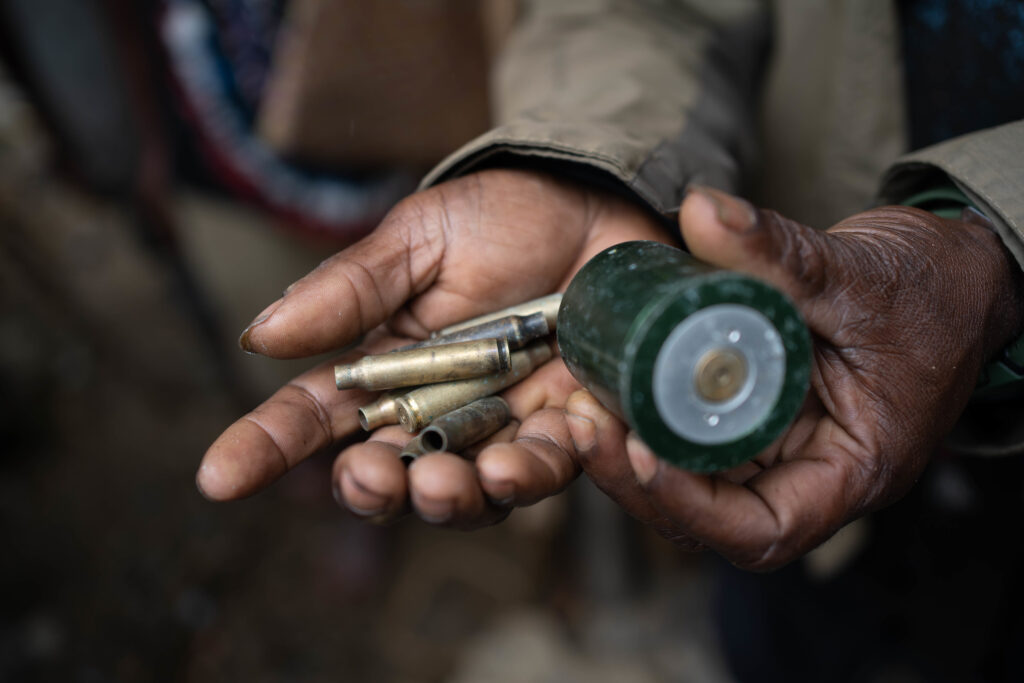
A close-up photograph of hands holding recovered ammunition from an aerial attack in West Papua, including what appear to be large brass-colored shells and a larger canister. The only thing in focus are the hands and the weaponry, but you can see the person holding the shells is wearing a dark gray-green jacket.
An eyewitness to an aerial attack in West Papua shares recovered ordnance. (Photographer anonymous by request.)

Life before the conflict, according to some of Rode’s friends, was peaceful and centered around community, family, and gardening. Now, this particular community in Wamena is host to around 200 women and children displaced from Nduga. There are eight other such communities in the region. Most of the men have either gone to the jungle to join armed rebel groups or have stayed behind to look after their villages, leaving them behind. There is no clean water nearby, no electricity, no hospital access, and no school. When babies are born, it is often in the IDP centers themselves.

“Some [women] spend sleepless nights because they don’t know the situation of their children,” Rode says, many of whom were separated from their mothers during the military attacks. There is no internet connection to trace them. 

Displaced in Ilaga

At around 7 a.m. one morning, Irene and her husband were in front of a village office in Ilaga when she heard the fatal gunshot. She didn’t see who had fired it—only that it had come from the direction of the trees, and that it had killed her husband. She did not cry.

“My children are living with trauma as I did, but I pretend to be strong in front of them,” she told Rode. The violence has only continued: One night during her stay in Ilaga, Rode heard gunfire at the Indigenous settlement. She claims the source was the Indonesian security forces. She lay awake all night, thinking of her own two children.

The day-to-day life for these women is no easier. For many of the women in Ilaga, hours every day are spent walking to gardens and rivers, hours away, just to collect sweet potatoes and clean water. Along the way, soldiers stop them at regular army posts, where they have to report on the purpose of their travel. According to Rode, the reason for these checkpoints comes down to the army being suspicious of the IDPs—they believe they might be providing information and food to armed separatist groups. The women told Rode that they know it is dangerous to travel these distances, but that they have no choice. To stay still is to starve.

Beyond tensions around independence movements, there is another driver of conflict in the region. The island of New Guinea is home to the world’s third largest area of rainforest, and its natural resources are highly sought after. Indigenous communities, the guardians of this environment, have been further displaced from their homes as companies seek gold, minerals, or space for palm oil monocultures. Freeport’s Grasberg Mine—one of the world’s largest gold mines—has been the most famous example. But there have also been plans to build a mine in the gold-filled mountains of the Wabu Block, which have been met with huge concern from groups like Amnesty International. 

In Ilaga, one mother told Rode, with anger in her eyes, “If the Indonesians want to have our gold from our mountains, they could just take it. Why did they treat us like animals? They came into our homes without permission and uprooted us from our ancestral land.”

For Indigenous communities, Rode explains, this removal feels especially painful, because of their spiritual and cultural connection with the mountains, rivers, and land. To remove the people is to destroy their identity.

“We view mountains as our mother who nurtured the plants, which become food for the animals, and we get the milk from the animals,” she says. “When our mountains are being exploited, it’s like a rape to our mother. We have to protect our mother.”

An aerial shot of a forest in West Papua. There are trees of different heights and varieties, and no notable gaps in the canopy; it's lush and dark green.
A view of the Papuan highlands near Kiwi. (Photographer anonymous by request.)

The root of West Papua’s problems

West Papua’s problems go back to 1898, when it was colonized by The Netherlands, along with the other islands that now form Indonesia. When the country became independent in 1949, however, it was without West Papua, which stayed in the control of the Dutch. Instead, West Papua prepared for its own independence throughout the 1950s, and by 1961, that moment had arrived: A congress of people declared independence and raised their new Morning Star flag for the first time in what is now called Jayapura. The Indonesian government, however, was not happy with this arrangement, and soon invaded. In a bid to end the conflict between Indonesia, the Netherlands, and Indigenous Papuans, the US government encouraged the Dutch to hand control of West Papua to Indonesia. The New York Agreement gave control of West Papua to first the United Nations, and then, by 1963, to Indonesia, which became the temporary administrator of the country, with the stipulation that West Papuans would have the right to self determination.

But a promised independence referendum in 1969, as part of the transition after the end of Dutch rule, was not a democratic event. Instead, 1,000 people were given a vote by the Indonesian army, and told to make a very specific choice under threat of being shot. Yet this vote was still approved by the UN—cementing West Papua’s place under Indonesian rule.

“The Papuans were just outside the room, while the rest of the world decided their future,” says Naomi Sosa, founder of Papua Partners, an organization that supports training and global links in the country. “The root goes down to the political contestation. They were supposed to have a vote for self determination, but it was controlled by Indonesia.”

Eventually, in 2000, West Papua was given special autonomy, with their own government looking after their affairs, but without independence. In reality, Naomi says this special autonomy wasn’t implemented properly, with all the powers being taken back to Jakarta. Today, there is a movement demanding self determination, where West Papuans could determine their own future through a referendum. But in stark contrast to this desire, the Indonesian government is focusing on the decentralization of provinces. Under Indonesian president Joko Widodo, known as Jokowi, things have become more difficult for West Papuans, with UN experts saying that since violence escalated in 2018, there are now 100,000 displaced people and humanitarian aid is being blocked. Naomi says Indigenous communities, particularly those in the highlands, are under severe threat. Any form of protest is met with brutal force. Now, the government wants to make further divisions, which Naomi says makes it harder for the 250 tribes to unite and weakens the independence movement. 

More districts also means more military posts—which makes many IDPs uneasy. Rode says when displaced women in particular are encouraged to go back home, they feel they have no guarantees of their safety because of the increased military presence.

“Please tell them to leave our homeland so we can go back home,” they tell her.

Still, Rode has not given up hope, and neither have the thousands of people displaced throughout the country, whether they are part of independence movements or staying strong to keep their families alive in IDP camps. As the final call with her ends, Rode makes a plea: West Papuans need solidarity from the international community. They are experiencing settler colonialism, and it cannot be separated from global politics. Papuans do not want to be forgotten.

“We are powerless,” Rode says. “We really need help.”

[post_title] => The Forgotten Women of West Papua [post_excerpt] => Their stories, in their own words—and why you should be paying attention. [post_status] => publish [comment_status] => closed [ping_status] => closed [post_password] => [post_name] => west-papua-indigenous-women-idps-crisis-indonesia [to_ping] => [pinged] => [post_modified] => 2026-08-04 19:29:01 [post_modified_gmt] => 2026-08-04 19:29:01 [post_content_filtered] => [post_parent] => 0 [guid] => https://conversationalist.org/?p=5695 [menu_order] => 89 [post_type] => post [post_mime_type] => [comment_count] => 0 [filter] => raw )
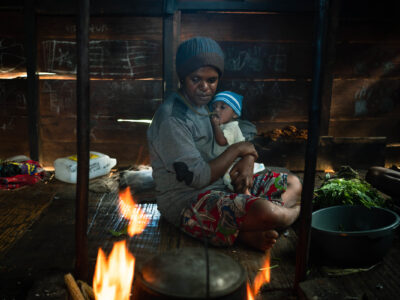
A mother sits cross-legged inside of a dark wooden structure, looking at a pot on a fire. She is holding a young child, who is grasping her necklace and putting it in their mouth. The woman is wearing a dark blue and black knit cap, a long-sleeved gray shirt, and a red skirt patterned with large leaves. The child is wearing a lighter blue knit hat and a white garment. There are chalk drawings on the wooden walls behind them.

The Forgotten Women of West Papua